
Home Blog Page 31

LLCNameGenerator.ai Launches Free AI-Powered LLC Name Generator With Live Domain Checks for Businesses

0
Dubai-Based Lumitech Named Among Top Generative AI Development Companies in 2026 by Techreviewer.co

LLC Name Generator offers AI-generated name ideas, live .com domain checks, advanced filters, naming tools tailored to LLC, corporation, and nonprofit filings.

LLCNameGenerator.ai announced the launch of its free AI-powered naming platform built to help entrepreneurs generate business name ideas for limited liability companies, corporations, and nonprofit organizations. Check it out here: https://www.llcnamegenerator.ai/

The platform’s flagship LLC name generator offers AI-generated business name suggestions, live .com domain availability checks, advanced customization filters, and support for users operating in all 50 U.S. states. The company also offers an AI corporation name generator and an AI nonprofit name generator through dedicated tools on the same platform.

According to the official website, the platform has already been used and tested by more than 1,000 users since launch.

LLCNameGenerator.ai said the product was created to address a practical challenge early-stage founders face at the start of business formation: choosing a name that is both brandable and usable across legal filings, websites, bank accounts, and customer-facing materials.

The company’s main LLC name generator is designed for entrepreneurs who want more than a basic keyword spinner.

– Users can enter a keyword or business concept
– Select from more than 18 business categories
– Receive up to 24 name ideas generated by AI. Plus option to generate more for free

Each result can be reviewed alongside a live .com domain availability check, helping users evaluate whether a business name can also support an online presence. The platform states that its tools are free to use, require no account, and do not require a credit card.

Marketing Technology News: MarTech Interview with Haley Trost, Group Product Marketing Manager @ Braze

A Business Name Is Often the First Operational Decision a Founder Makes

LLC Name Generator AI positions naming as an operational and compliance-related step, not only a branding exercise. On its site, the company notes that an LLC name typically appears on Articles of Organization, business banking records, contracts, and tax filings. It also explains that a name that is already in use in a state may lead to refiling, delays, or additional fees, making the naming stage more consequential than many first-time founders expect.

The site further explains that, in most states, an LLC name must include a designator such as “Limited Liability Company,” “LLC,” or “L.L.C.” and must be distinguishable from other business entities already registered in that jurisdiction. LLCNameGenerator.ai states that its naming interface automatically appends “LLC” to ideas so users can visualize how a proposed legal name may appear in practice, while also recommending that users confirm final availability directly through the relevant Secretary of State before filing.

The co-founder of LLCNameGenerator.ai said, “Selecting a business name is one of the earliest decisions an entrepreneur makes, but it can affect legal filing, domain selection, and overall brand clarity. LLCNameGenerator.ai was built to give founders a free tool that brings those considerations together in one place.”

LLC Name Generator Combines AI Suggestions With Real-Time Domain Availability

The company describes its platform as an AI-powered LLC name generator that goes beyond simple word combinations.

According to the site, users can guide results using industry context, brand tone, and customization settings intended to improve the relevance of the names generated. The LLC tool supports industries including technology, finance, healthcare, retail, real estate, consulting, marketing, education, food and beverage, fitness and wellness, legal services, cleaning, construction, automotive, beauty and cosmetics, travel and hospitality, entertainment, e-commerce, nonprofit, and other categories.

Marketing Technology News: Cross-Department Collaboration with Marketing Workflow Automation: Enhancing Alignment Between Sales, Customer Service, and Marketing Teams

One of the platform’s core features is live domain checking. The company says every generated name is checked for .com availability in real time so users can avoid pursuing names that may not be practical for a website or digital brand. On the site, LLCNameGenerator.ai links the value of exact-match or closely matched domains to brand consistency and online discoverability.

The platform also includes advanced filters that allow users to refine results based on name length, word count, naming style, prefix and suffix modifiers, inspiration brands, additional keywords, language, and total result count. On the site, naming styles referenced for the LLC generator include catchy, brandable, fused names, and alternate spelling. The company says these controls are intended to give users greater precision when moving from a broad concept to a narrower naming direction.

Expansion Includes Corporation Name Generator and Nonprofit Name Generator

In addition to its core LLC tool, LLCNameGenerator.ai has launched a separate Free Corporation Name Generator for users planning to file as an Inc., Corp., or Corporation. The corporation tool is described on the site as built for C-corps, S-corps, and incorporated businesses, and it includes AI-generated naming suggestions, instant .com domain checks, advanced filters, and support across all 50 states. The company states that this version is designed for users who want names that sound professional and suitable for formal incorporation.

The site also includes a Free nonprofit name generator intended for foundations, charities, community organizations, and users exploring names for a 501(c)(3)-oriented organization.

According to the company, that tool is designed to generate names that sound mission-driven and credible, while also providing live domain checks and customization controls similar to those found in the LLC and corporation tools. The nonprofit platform references use cases across education, healthcare, animal welfare, arts, environment, youth development, and community health, among others.

By launching dedicated generators for LLCs, corporations, and nonprofits, the company is presenting the platform as a broader naming resource rather than a single-purpose utility. That positioning may help serve users at different stages of formation, whether they are creating a new LLC, incorporating a startup, or organizing a mission-based entity that requires a formal legal name.

Free Access, No Signup, and a Direct Path to Formation

Across the three naming tools, LLCNameGenerator.ai states that the generator, domain check, and advanced filters are available free of charge, with no account creation and no credit card required. The company also says users can generate as many names as needed until they identify a preferred option. That free-access model is presented consistently on the LLC, corporation, and nonprofit pages.

Once a user identifies a preferred name, the platform offers a path to filing through a formation partner. On the LLC page, the company states that users can file through Northwest Registered Agent starting at $39 plus state filing fees, with registered agent service included for the first year. Similar formation language appears on the corporation and nonprofit pages, where the company describes incorporation or formation support starting at $39 plus state fees.

The site also discloses that LLCNameGenerator.ai is an independent resource and may receive compensation from companies mentioned through affiliate links. It further states that the information provided is not legal advice. Those disclosures may be important for users treating the platform as a research and naming aid rather than a substitute for state-specific legal review.

How the Platform Is Positioned for Founders and Small Business Operators

The company’s messaging emphasizes the practical overlap between business naming, legal formation, and digital presence.

On the LLC page, the platform highlights that a strong name should be short, easy to say, relevant to the business, distinguishable from existing entities in the state, and ideally available as a .com domain. The site also notes that the same name can sometimes exist in different states, which is why domain checks and trademark review remain important steps even after state-level entity screening.

That emphasis may resonate with first-time entrepreneurs who are often balancing multiple formation tasks at once, including selecting a legal structure, checking naming rules, securing a domain, and preparing filing documents. By combining idea generation, domain checks, and formation pathways within one interface, LLCNameGenerator.ai is positioning itself as an early-stage business setup tool rather than only a branding aid. This is an inference based on the platform’s features and workflow as described across its pages.

The company also presents sample naming outputs across sectors such as real estate, legal services, consulting, finance, technology, healthcare, manufacturing, education, and community health. Those examples appear intended to show how the tools can adapt to different industries and organizational goals while maintaining a formal naming structure appropriate to the filing type selected.

Write in to psen@itechseries.com to learn more about our exclusive editorial packages and programs.

The Role of Business Websites Evolves With Increased AI Integration

0
WSI Warns SMBs That AI Search Is Answering Questions Before Anyone Visits Their Website

New Orleans Web Design Company | Rhino Web Studios

The role of business websites is undergoing a structural shift as artificial intelligence becomes embedded in daily operations. Once designed primarily as static repositories of information, modern websites are increasingly functioning as dynamic systems capable of responding, learning, and adapting in real time. This transition is influencing how organizations manage customer interactions, internal workflows, and digital visibility.

Websites are no longer just pages on the internet. A website is becoming an operational system that interacts with customers, processes information, and contributes to decision-making”

— Brett Thomas

AI-driven tools are now being integrated into websites to handle tasks that traditionally required human intervention. These tools include automated chat interfaces, intelligent search functions, predictive content delivery, and data-driven personalization systems. As a result, websites are evolving from passive platforms into active participants in business operations.

This shift is particularly evident in customer communication. AI-powered interfaces can interpret user intent, respond to inquiries, and guide visitors through decision-making processes without delays. Response times that once depended on business hours are now measured in seconds, regardless of time zone or staffing levels. This continuous availability is changing expectations around accessibility and responsiveness.

Marketing Technology News: MarTech Interview with Haley Trost, Group Product Marketing Manager @ Braze

Beyond communication, AI integration is also affecting how content is presented. Websites can now adjust messaging based on user behavior, preferences, and past interactions. Instead of displaying uniform content to all visitors, systems can deliver tailored experiences that reflect individual interests. This level of personalization has implications for engagement, as users are more likely to interact with content that aligns with specific needs or intent.

Search functionality within websites is also advancing. Traditional keyword-based search is being supplemented by natural language processing, allowing users to interact with websites in a more conversational manner. Queries can be interpreted in context, producing more accurate and relevant results. This reduces friction in navigation and improves the overall user experience.

Marketing Technology News: Cross-Department Collaboration with Marketing Workflow Automation: Enhancing Alignment Between Sales, Customer Service, and Marketing Teams

From an operational perspective, AI integration is streamlining internal processes. Data collected through website interactions can be analyzed in real time, providing insights into user behavior, conversion patterns, and content performance. These insights can inform decisions related to marketing, product development, and customer service strategies. The ability to process and act on data quickly is becoming a defining factor in digital competitiveness.

Security and compliance considerations are also evolving alongside AI adoption. Intelligent systems can monitor for unusual activity, detect potential threats, and respond to vulnerabilities with minimal delay. As websites become more integrated with business operations, maintaining secure and compliant environments is gaining increased importance.

The impact of AI integration extends to search engine visibility as well. Search algorithms are placing greater emphasis on relevance, authority, and user engagement. Websites that incorporate structured, high-quality content alongside intelligent functionality are better positioned to align with these criteria. AI tools can assist in identifying content gaps, optimizing structure, and maintaining consistency across digital assets.

Brett Thomas, owner of Rhino Web Studios in New Orleans, Louisiana, described the transition as a fundamental change in how websites are perceived within a business framework.

“Websites are no longer just pages on the internet. A website is becoming an operational system that interacts with customers, processes information, and contributes to decision-making,” said Thomas. “AI integration is shifting the focus from presentation to performance.”

Industries across the spectrum are beginning to adopt these technologies. In healthcare, websites are being used to manage patient inquiries and appointment scheduling. In retail, AI systems are guiding product discovery and assisting with purchasing decisions. Service-based businesses are using intelligent tools to qualify leads and streamline communication. Each application reflects a broader trend toward automation and efficiency.

Despite the benefits, implementation requires careful planning. Integrating AI into a website involves considerations related to infrastructure, data management, and user experience design. Systems must be configured to align with business objectives while maintaining clarity and usability. Overly complex implementations can create confusion rather than improvement.

Training and oversight also remain important factors. While AI systems can operate independently in many scenarios, human supervision is necessary to ensure accuracy and appropriateness. Ongoing evaluation allows businesses to refine performance and address any inconsistencies that may arise.

As adoption continues, the definition of a “standard” business website is being redefined. Static designs are giving way to adaptive systems that respond to both user behavior and operational demands. This evolution reflects a broader movement toward integration, where digital platforms serve as central hubs for communication, analysis, and execution.

The pace of change suggests that AI integration will become a baseline expectation rather than a distinguishing feature. Businesses that adapt to this shift are likely to experience changes in efficiency, engagement, and data utilization. Those that do not may encounter increasing pressure as user expectations continue to evolve.

The transformation of websites into intelligent systems represents a significant development in digital strategy. As technology advances, the role of the website is expanding beyond its original purpose, positioning it as a central component in how modern businesses operate and interact with the world.

Write in to psen@itechseries.com to learn more about our exclusive editorial packages and programs.

How 2026 Will Redefine Agency Creativity and Efficiency

0
How 2026 Will Redefine Agency Creativity and Efficiency

The epicenter of cutting edge business trends is arguably neither Wall Street, nor Silicon Valley, but a bustling marketing agency, where everyone from the receptionist to the CEO will be chasing down the latest fashions. It will be no different for AI, where agencies will be the early adopters, paving the path forward for their clients on implementation, garnering efficiencies and building new business models.

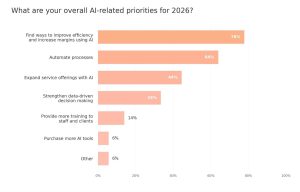
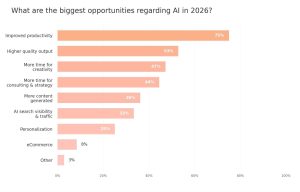
To gauge where AI is headed this year, Duda, a leading white label website building platform for agencies and SaaS companies, conducted a survey to find agency sentiments and priorities regarding AI for 2026. The survey reveals that agencies will be implementing AI from the ground up in order to increase productivity and efficiencies, while freeing up consultants to focus on creativity and strategy.

Rebuilding from the Ground Up

According to the survey, 78% of agencies are prioritizing improved efficiency and higher margins, while 64% will focus on process automation and 44% on expanding service offerings with AI. The 44% will be the space to watch, as creatives, writers and strategists let their imaginations run wild with new solutions to offer their clients. Simultaneously, SaaS companies have quietly been launching new AI tools embedded in existing platforms where creatives can organically explore AI within existing workflows and find productivity methods without the need for expensive, customized AI tools.

“AI is most powerful when it speeds up thinking, execution, and decision-making. We use it to support research, structure documentation, generate first drafts, surface insights, and reduce manual setup time. That allows our team to focus on strategy, creativity, and quality — where humans still matter most,” said Alex Mann, Managing Director, Big Boy Digital in Duda’s new 2026 Agency Growth Operating Framework eBook.

Creatives Tackle AI

Creatives have a complicated history and view on AI. While many purists wouldn’t know what a prompt is, others are already experimenting with Seedance 2.0. The survey reveals that many of them see AI freeing up time for more artistic endeavors. While 75% of respondents view improved productivity as AI’s biggest opportunity, 47% said AI could allow them to spend more time on creativity, 44% on consulting and strategy and 36% saw value in generating more content at scale.

Leading brands learned the hard way that the use of AI in creative endeavors must be approached with care. In December, an AI generated ad by McDonalds in the Netherlands had to be pulled due to major negative backlash. Coca Cola and Toys “R” Us were no different.

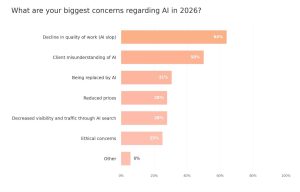
For communications professionals, AI is proving to be an opportunity for new job opportunities, with tech companies notably hiring ‘storytellers’ including companies like Anthropic, which, ironically, tripled the size of its communications team in 2025. Nevertheless, 31% of respondents are worried about being replaced by AI, revealing overall anxieties around the future of consultants.

Quality vs. Quantity

The survey further underscores questions surrounding the quality of AI output. While 53% believe AI can drive higher-quality output., 64% cite “AI slop,” as their top concern. And it’s not just agencies. Neal Mohan, the YouTube CEO, has declared managing AI slop as a top priority for 2026, with other tech companies seeking to clean up low quality content in order to maintain model performance.

Beyond quality, concerns around AI include worrying about clients misunderstanding it (50%), downward price pressures (28%) and cite ethical concerns (25%).

Marketing Technology News: MarTech Interview With Fredrik Skantze, CEO and Co-founder of Funnel

Design Trends

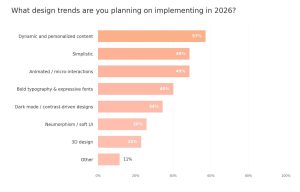
On the web design front, agencies plan to lean into dynamic and personalized content (57%), simplistic layouts and animated or micro-interactions (49% each), bold typography and expressive fonts (40%), and dark mode or contrast-driven designs (34%). One quarter of respondents also saw dynamic and personalized content on websites as an opportunity for AI in 2026. This goes beyond Netflix and Spotify showcasing personalized recommendations on their homepages or Amazon, who is a pioneer in this space. For brands with smaller budgets, AI can analyze user data, including browsing history and demographics, in order to tailor content, layouts and product recommendations in real time.

Everyone is still figuring out AI, and that includes agencies. However, there is no doubt that as early adopters, they will be the ones to hit the ground running. Agencies are betting on AI to transform their operations, boost margins, and unlock creative potential, but they’re doing so by weighing the risks of quality degradation and client confusion. As they rebuild their operations from the ground up, these early adopters will be defining what responsible, effective AI integration looks like for the broader business world.

Methodology

The survey was conducted between November and December 2025 among 36 Duda customers, including agencies located in North America (61%), Europe (22%), Asia (14%), and the Middle East (3%). Eighty-nine percent of respondents represent agencies with up to 10 employees, while 11% employ up to 100 people.

Marketing Technology News: The Death of Third-Party Cookies Was Just the Start. Are You Ready for Consent Orchestration?

Artificial Intelligence Integration Continues to Influence Digital Marketing Strategy Development

0
Artificial Intelligence Integration Continues to Influence Digital Marketing Strategy Development

Content Development | Jambalaya Marketing

The integration of artificial intelligence into digital marketing systems continues to shape how marketing strategies are developed, executed, and evaluated across multiple industries. As organizations manage increasing volumes of data and more complex consumer behavior patterns, AI-driven tools are being incorporated into marketing workflows to support analysis, targeting, and campaign optimization.

Recent developments in digital marketing platforms have highlighted a shift toward real-time data processing and adaptive campaign management. Traditional marketing methods often relied on static datasets and scheduled adjustments, while AI-enabled systems are designed to respond dynamically to changing conditions. This approach allows for continuous refinement of messaging, timing, and channel selection based on current performance indicators.

Marketing strategies are becoming more dynamic as AI systems process data and adjust campaigns in real time. ”

— Brett Thomas

Audience targeting methods are also evolving as AI tools analyze behavioral signals, interaction history, and engagement patterns. These systems support more granular segmentation, enabling marketing campaigns to align more closely with user interests and intent. The use of behavioral data in segmentation reflects a broader trend toward individualized content delivery within digital environments.

Marketing Technology News: MarTech Interview with Haley Trost, Group Product Marketing Manager @ Braze

Content planning processes are being influenced by AI-assisted analysis of search behavior and topic trends. Marketing teams are incorporating predictive insights into editorial planning, allowing content strategies to reflect current demand patterns. This shift supports consistency across platforms while reducing reliance on manual forecasting methods.

Advertising systems are incorporating automation features that adjust campaign parameters in real time. Budget distribution, bid strategies, and audience selection are increasingly managed through algorithmic processes that respond to engagement and conversion data. These adjustments are designed to improve campaign efficiency while reducing the need for continuous manual oversight.

Email marketing systems are adopting similar capabilities, with AI-driven tools used to determine delivery timing, personalize messaging, and refine automation sequences. These systems analyze recipient behavior to inform adjustments that may improve engagement rates and overall campaign performance.

Marketing Technology News: Cross-Department Collaboration with Marketing Workflow Automation: Enhancing Alignment Between Sales, Customer Service, and Marketing Teams

Search visibility is also being affected by AI-driven algorithm updates that prioritize user intent, contextual relevance, and overall experience. Digital marketing strategies are adapting to these changes by focusing on content structure, technical performance, and accessibility. Automated tools are being used to monitor site performance and identify areas for improvement.

Social media platforms continue to incorporate AI into content distribution models. Feed curation is influenced by engagement patterns and user interaction history, affecting how content is surfaced to audiences. Marketing strategies are adjusting to emphasize engagement-driven content that aligns with platform-specific algorithms.

Data analysis remains a central component of AI integration in marketing. Large datasets generated across websites, advertising platforms, email campaigns, and social media channels are being consolidated and interpreted through automated systems. This process supports the identification of trends and informs strategic decision-making.

Brett Thomas, owner of Jambalaya Marketing in New Orleans, addressed the ongoing role of AI in marketing strategy development.

“Marketing strategies are becoming more dynamic as AI systems process data and adjust campaigns in real time. The focus is shifting toward systems that respond to behavior rather than relying on static planning,” said Thomas.

The adoption of AI technologies presents operational considerations related to system integration and data management. Ensuring data accuracy and consistency remains an important factor in maintaining reliable outputs from AI-driven tools. In addition, organizations are evaluating data governance practices to align with privacy regulations and transparency standards.

Human oversight continues to play a role in guiding AI-supported marketing efforts. While automated systems contribute to execution and analysis, strategic planning and creative direction remain dependent on human input.

The use of artificial intelligence in digital marketing is expected to expand as platforms evolve and data availability increases. Ongoing developments indicate a continued shift toward data-driven systems designed to improve responsiveness and operational efficiency across marketing channels.

Write in to psen@itechseries.com to learn more about our exclusive editorial packages and programs.

Firma.dev Launches Firma 12 With Full AI Integration, Becoming the First E-Signature Platform You Can Operate Entirely Through AI

0
Syntax Launches AI-First Application Managed Services for SAP Solutions

Tips on Electronic Signature API & Developer Insights | Firma.dev Blog

At €0.029 per envelope, the world’s most affordable e-signature API now ships dual MCP servers with 84 AI-ready tools for documentation and live data, letting anyone send, track, and manage signing requests from Claude, ChatGPT, Cursor, or any MCP-compatible AI tool. No developer required.

Firma.dev, the developer-first e-signature API used by thousands of developers worldwide, announced the release of Firma 12 with dual MCP (Model Context Protocol) server integration. The update makes Firma.dev the first e-signature platform in the world to offer both a documentation MCP server and a full data MCP server, giving users complete control of their e-signature workflows through AI tools like Claude, ChatGPT, Cursor, GitHub Copilot, VS Code, and OpenAI Codex.

The Data MCP server, new in Firma 12, provides 84 tools across 10 categories, covering signing requests, templates, workspaces, webhooks, email domains, custom fields, and more. Users can create signing requests, send documents, check envelope statuses, manage templates, and query usage data, all without writing a single line of code or downloading anything. Authentication is handled through OAuth, so getting started is as simple as adding the server URL to your AI client and signing in with your Firma.dev account.

“You can literally say ‘send the standard NDA to Sarah’ inside Claude, and it happens,” said Derick Dorner, co-founder of Firma.dev. “We’ve removed the last barrier between people and e-signatures. You don’t need to be a developer. You don’t need to learn an API. You just talk to your AI.”

Marketing Technology News: MarTech Interview with Haley Trost, Group Product Marketing Manager @ Braze

The World’s Most Affordable E-Signature API

Firma 12’s AI-native capabilities arrive alongside pricing that remains unmatched in the industry. At €0.029 per envelope (roughly 3¢ USD), Firma.dev operates on a pure pay-as-you-go model with no monthly minimums, no per-seat fees, and no contracts. For context, legacy providers like DocuSign charge enterprise customers anywhere from $1 to $5+ per envelope depending on plan and volume.

The pricing has driven real results. Paul Jolley, CEO of Clear, a Hawaiian property management platform processing around 20,000 envelopes per month, switched from DocuSign to Firma.dev and estimates savings between $5,000 and $10,000 over the next year. He completed his integration, including a complex 107-data-point lease agreement template, in a day and a half.

Marketing Technology News: Cross-Department Collaboration with Marketing Workflow Automation: Enhancing Alignment Between Sales, Customer Service, and Marketing Teams

“Firma.dev is what I’ve always wanted,” Jolley said. “The billing model is like Twilio. You just use it and pay for what you send.”

Built for the AI Workflow

The dual MCP architecture in Firma 12 reflects a broader shift in how software gets built and operated. The Docs MCP server, launched in February 2026, lets developers query live API documentation from within their coding environment. The new Data MCP server goes further: it connects directly to a user’s Firma.dev workspace, enabling real operations through conversational AI.

Yavuz Selim Mert, founder of Splendid Consulting in Toronto, integrated Firma.dev without any prior coding experience. Using ChatGPT to guide his setup, he completed his entire integration in about a day and reduced his monthly e-signature costs from $230 with his previous provider to approximately $14 with Firma.dev, a 94% cost reduction.

“I found Firma.dev because AI recommended it to me,” Mert said. “Then I built the whole thing using AI. It’s the perfect example of how these tools are supposed to work together.”

Ghali Bennani, co-founder of London-based fintech startup Ralio, specifically sought out Firma.dev for its MCP integration. His setup took under five minutes.

Write in to psen@itechseries.com to learn more about our exclusive editorial packages and programs.

Bandwidth Partners with New Agentforce Contact Center

0
Bandwidth Partners with New Agentforce Contact Center

Bandwidth has partnered to deliver infrastructure for Salesforce’s new CRM-native, AI-driven contact center platform

Bandwidth Inc., a leading global cloud communications software company, announced it has partnered with the newly launched Agentforce Contact Center.

The boundaries between CRM systems, contact centers and agentic AI are beginning to dissolve as enterprises consolidate around unified cloud architectures that connect customer data directly to live engagement. Salesforce’s launch of Agentforce Contact Center is leading this market shift. Built directly into the CRM, it enables enterprises to re-architect customer engagement around AI-powered conversations informed by full customer-360 data. The result is smarter, more personalized and more contextual customer interactions powered by the same data that manages the customer relationship.

Marketing Technology News: Martech Interview with Meena Ganesh, Senior Product Marketing Manager @ Box AI

“Salesforce is taking a bold and visionary step in evolving the contact center model for the agentic AI era,” said David Morken, Bandwidth’s Co-Founder and CEO. “We are honored to partner with Salesforce to deliver the voice and messaging infrastructure foundation that will help contact centers scale.”

As agentic AI begins to orchestrate customer engagement, voice is emerging as the primary interface between enterprises and their customers. In this environment, quality of service, reliability and trust are critical. Bandwidth’s owned-and-operated Communications Cloud and Maestro™ orchestration software deliver the performance and global reach AI requires, while enabling faster innovation cycles and superior economics. The company has a long history of powering hyperscalers and cloud platforms to deliver resilient, low-latency voice infrastructure for enterprise-grade deployments. Bandwidth supports all the 2025 Gartner Magic QuadrantTM Leaders in both Contact Center as a Service (CCaaS) and Unified Communications as a Service (UCaaS). This Salesforce collaboration extends Bandwidth’s Communications Cloud into the next generation of CRM-native engagement platforms, reinforcing Bandwidth’s role as foundational infrastructure for AI-driven customer experience.

Marketing Technology News: Feature-Rich to Functionally Effective: Adjusting your Martech Strategy

Write in to psen@itechseries.com to learn more about our exclusive editorial packages and programs.

SAP to Acquire Reltio: Make SAP and Non-SAP Data AI-Ready

0
SAP to Acquire Reltio: Make SAP and Non-SAP Data AI-Ready

SAP SE and Reltio Inc. announced that SAP has agreed to acquire Reltio, a leading master data management (MDM) software provider, to help customers make their SAP and non-SAP enterprise data AI-ready. Terms of the deal were not disclosed.

Once closed, the acquisition will strengthen SAP Business Data Cloud (SAP BDC)—integral for SAP’s AI-First and Suite-First strategy—and accelerate the evolution of SAP BDC to a fully interoperable enterprise data platform for enterprise-wide agentic AI. It will provide customers with the tools they need to unify, cleanse and harmonize data across sources for superior enterprise-wide agentic AI.

“Reltio is a natural fit with SAP,” said Muhammad Alam, member of the Executive Board of SAP SE, SAP Product & Engineering. “Acquiring them will further improve our position as a leading business AI provider, combining SAP and non-SAP data to deliver data context that business AI requires. AI cannot reach its full potential when data is fragmented across business units, platforms and domains without connection or context.”

Marketing Technology News: MarTech Interview with Haley Trost, Group Product Marketing Manager @ Braze

By integrating Reltio after closing the acquisition, SAP will make customers’ enterprise data fully AI-ready. Customers will be able to rely on trusted, high-quality data across SAP and non-SAP sources that Joule and Joule Agents use to deliver faster time-to-value for business AI.

Reltio’s platform helps organizations manage and govern structured and unstructured enterprise data from start to finish. Its AI-based entity resolution identifies and merges related records from different formats and applications into one reliable “golden record” system of context. Its cloud-native, AI-first design supports a single, consistent view of customers, products, suppliers, locations and employees across both SAP and non-SAP applications. Customers running AI tasks will benefit from increased reliability and consistency of data, bundled in a single source of truth, improving business AI. With that, customers can trust that AI results are correct, and AI-interactions are resolved fast.

“Joining forces with SAP presents a tremendous opportunity for us to accelerate our mission,” Reltio Founder and CEO Manish Sood said. “Enterprise AI needs trusted context that is open and interoperable across the heterogeneous IT landscapes our customers run. This combination accelerates our ability to deliver Reltio as the system of context across SAP and non-SAP environments, while maintaining continuity for our customers and our partner ecosystem.”

Marketing Technology News: Cross-Department Collaboration with Marketing Workflow Automation: Enhancing Alignment Between Sales, Customer Service, and Marketing Teams

Reltio’s data cleansing, unification capabilities and agent-driven workflows will work alongside SAP Business Suite applications to improve decisions, reduce integration complexity and deliver trusted, consistent data critical for successful business processes and AI use cases. Low latency delivery and support for the Model Context Protocol (MCP) enable real-time, multiagent workflows across SAP and non-SAP environments, allowing AI agents, such as a procurement agent, to assess supplier risk and trigger actions almost instantly using trusted, real-time data. Reltio offers prebuilt, industry-specific “velocity packs” that include data models, rules, matching logic and integrations, and solutions tailored to sectors like life sciences, healthcare and financial services.

By integrating Reltio after closing the acquisition, SAP intends to accelerate its customers’ ability to govern and expose master data as trusted and context-rich data products across multiple sources that serve both traditional analytics workloads and AI agents. Reltio will become a core capability within SAP BDC, with a flexible commercial model where customers can purchase Reltio as a separate solution or with other SAP products. The Reltio portfolio will also remain available as a standalone offering for the foreseeable future.

Write in to psen@itechseries.com to learn more about our exclusive editorial packages and programs.

VisiGEO Launches: The Tool to Make Your Brand Visible to AI

0
Kanil PRwire Launches Dedicated PR Distribution Services for Indian Startups and D2C Brands Seeking Global Media Visibility

VisiGEO empowers brands to boost AI visibility and stay competitive as search shifts from SEO to AI-driven answers.

In the age of ChatGPT, Perplexity, and Claude, your customers are no longer typing keywords into Google—they’re asking AI directly. The question is: when AI answers, does it mention your brand?

Focus Technology Co., Ltd. today announces the launch of VisiGEO, the comprehensive Generative Engine Optimization (GEO) SaaS platform designed to put independent sites and brand websites on the AI map.

Why Traditional SEO Isn’t Enough

Search is undergoing its biggest shift since Google. Users now trust AI engines to synthesize answers, compare options, and recommend brands—all without visiting a single website. If your brand isn’t in the AI’s training data or visible during real-time retrieval, you’re invisible to the next generation of buyers.

VisiGEO changes the game with a standardized, three-phase workflow that transforms abstract AI optimization into actionable results.

Phase 1: Know Where You Stand

Before optimizing, you need intelligence. VisiGEO’s AI Visibility Analysis gives brands a comprehensive battle map of their current presence across major AI engines. See exactly how often you’re mentioned, what sentiment AI associates with your brand, and—crucially—which competitors are stealing your share of voice. This isn’t a one-time report; it’s continuous monitoring as AI landscapes evolve.

Marketing Technology News: From MarTech Stack to MarTech Fabric: Weaving Brand, Content, and Conversion Into One Thread

Phase 2: Build an AI-Friendly Digital Home

Your website needs to speak AI. VisiGEO’s Website GEO Audit identifies and fixes the technical barriers blocking AI crawlers—from robots.txt misconfigurations that accidentally ban GPTBot, to missing Schema markup that prevents proper understanding. The platform generates LLMs.txt files that serve as clean, code-free “official guides” for AI agents, ensuring your core value propositions are captured accurately. Plus, the GEO Content Creator generates and restructures content specifically designed for how large language models parse and prioritize information.

Phase 3: Own the Conversation Beyond Your Site

AI doesn’t just read your website—it reads the entire web. VisiGEO helps brands generate authoritative, third-party content with proper citations and objective comparisons, then provides strategic guidance on where to publish for maximum AI impact: high-authority platforms like Reddit, Quora, industry forums, and trusted news sources that AI engines weight heavily in their recommendations.

Built for the AI-First Future

“Every brand with a website is now an AI publisher, whether they realize it or not,” said Rachel Cao, Vice President of Focus Technology Co., Ltd. “We’re giving businesses the tools to ensure they’re not just found, but favored by the AI systems their customers now rely on.”

Whether you run an independent e-commerce store, manage a corporate brand site, or lead marketing for an industry giant, VisiGEO provides the infrastructure to turn AI visibility from an uncertainty into a competitive advantage.

Write in to psen@itechseries.com to learn more about our exclusive editorial packages and programs.

DTOM Soft Launch Breadth Edits AI Motion Engine for SaaS Promos

0
DTOM Soft Launch Breadth Edits AI Motion Engine for SaaS Promos

Breadth Edits | Next-Gen AI Motion Engine

Breadth Edits Beta v1.0, a revolutionary AI Motion Engine delivering studio-grade product promos with 100% typography precision.

Engineering and technical architecture firm DTOM Soft today announced the official Beta v1.0 launch of Breadth Edits. This innovative AI Motion Engine is specifically engineered to solve the persistent challenge of unreadable and distorted typography in AI-generated video content through advanced code-based rendering.

We engineered Breadth Edits to end the AI typography nightmare, delivering pixel-perfect motion graphics with code-based precision for high-fidelity product launches.”

— Oğuzhan Yıldırır

As the digital landscape shifts toward video-first communication, developers and marketers have struggled with traditional AI video tools that often produce low-fidelity visuals or “hallucinated” text. Breadth Edits addresses this “AI Typography Nightmare” by utilizing DTOM Soft’s unique code-to-video rendering architecture. This allows users to generate studio-grade, 1080p product promos with 100% text precision in seconds, requiring zero post-processing in complex software like After Effects.

Marketing Technology News: MarTech Interview with Stephen Howard-Sarin, MD of Retail Media, Americas @ Criteo

“We recognized a critical technical gap where high-end product launches were being compromised by substandard AI visuals,” said the engineering lead at DTOM Soft. “By focusing on pure motion engineering and pixel-perfect rendering, we have delivered a tool that allows any brand to present its product with absolute visual authority from day one.”
The Beta v1.0 launch on Product Hunt has already garnered significant international attention, securing a Top 35 position within hours and onboarding new users. The platform’s ability to handle complex UI interactions and precise motion timing has made it an immediate favorite among the technical and SaaS communities.

Marketing Technology News: From MarTech Stack to MarTech Fabric: Weaving Brand, Content, and Conversion Into One Thread

Beyond its current capabilities, DTOM Soft has also provided a “sneak peek” into the upcoming Design Module. This next iteration promises to grant users even more granular creative control over their motion assets, further bridging the gap between automated generation and professional-grade technical design.

Write in to psen@itechseries.com to learn more about our exclusive editorial packages and programs.

Former OpenAI & Google AI Experts Launch HyperDev

0
Former OpenAI & Google AI Experts Launch HyperDev

HyperDev

Making Software Development Accessible with Guided Generative AI

HyperDev today announced the launch of its Version 1 generative AI coding platform, marking a significant milestone in how aspiring developers, tech-adjacent individuals, and entrepreneurs prototype and launch software.

We’re building AI that helps people use AI.”

— Piotr Sobolewzki

Developed for a global market, HyperDev is positioned as a major entry into the AI-native coding space, signalling a shift for founders from technology consumption to global intellectual property (IP) creation.

The venture is anchored by a unique synergy between its core team: Piotr Sobolewski, an expert who honed his craft at OpenAI where he worked on ChatGPT, and Riaz Moola, formerly of Google where he worked on language models within the Google Search team.

Both founders conducted AI research at leading centres, including the University of Cambridge, enabling them to build proprietary generative AI technology, dubbed ‘Guided Mode’, which makes the creation of websites, apps, and other technology using code generated using Large Language Models (LLMs) more efficient and affordable.

Marketing Technology News: MarTech Interview with Stephen Howard-Sarin, MD of Retail Media, Americas @ Criteo

“We’re building AI that helps people use AI,” says Piotr Sobolewski, Chief Technical Officer at HyperDev.

“While the first generation of AI app builders have removed some of the barriers to building software, millions of people are getting stuck due to a lack of foundational technical knowledge or scalable assistive technology to complete the technical work needed to ship”.

HyperDev is a comprehensive AI app builder that enables users to generate production-ready, full-stack applications using LLMs.

Unlike traditional prototyping tools, HyperDev’s Guided Mode intelligently selects and helps fix buggy code while providing an intelligent rules-based framework to radically accelerate the software development lifecycle. This solves a major industry pain point: the fact that most AI-generated code is not production-ready.

Marketing Technology News: From MarTech Stack to MarTech Fabric: Weaving Brand, Content, and Conversion Into One Thread

Riaz Moola, Chairman at HyperDev, who has spent a decade enabling tens of thousands of individuals to transition into tech careers through HyperionDev, stated: “I am pleased to support the HyperDev team as they embark on a venture to harness generative AI in a way that continues to make tech work more accessible around the world”.

Key Features of the Version 1 Launch:

• Guided Mode: An advanced AI layer that guides users through the build process, with a safety net of on-demand human expert assistance to resolve edge cases.
• Affordable Build Credits: Reducing common paywalls by enabling unlimited access to Guided Mode AI, allowing for continuous iteration.
• Full-Stack Sovereignty: Complete control over deployment and code logic, designed for production environments rather than just demonstration.
• Developer Ecosystem Integration: Premium plans include up to a 50% discount on HyperionDev courses for users seeking intensive human-mentored education and university certification.

Write in to psen@itechseries.com to learn more about our exclusive editorial packages and programs.

Wondershare Launches Relumi, an AI-Powered App to Retake and Perfect Missed Photo Moments

0
Wondershare Launches Relumi, an AI-Powered App to Retake and Perfect Missed Photo Moments

Wondershare, a global leader in creativity and productivity software solutions, recently announced the launch of Wondershare Relumi, a new AI-powered mobile application designed to help users improve imperfect photos and recreate moments that could not be captured perfectly the first time.

As smartphone photography and social sharing continues to grow, users are capturing and sharing more moments, yet factors such as timing, lighting, and angles often result in imperfect images that cannot be retaken. Whether it’s a once-in-a-lifetime family gathering, a travel moment during golden hour, or a spontaneous social capture, even small imperfections can make photos fall short of expectations. This gap has created growing demand for solutions that go beyond traditional photo editing, enabling users not just to enhance photos, but to effectively “retake” them after the moment has passed.

Marketing Technology News: MarTech Interview with Miguel Lopes, CPO @ TrafficGuard

Wondershare Relumi is designed to address this limitation by introducing an AI-powered photo retake approach. Powered by advanced AI models, including the integration of Nano Banana Pro, the app enables users to refine visual elements, adjust expressions, and optimize composition, while maintaining the overall context and authenticity of the original image. The app also features an exclusive Multi-Person Photo Repair capability. This allows users to revisit missed or imperfect moments and recreate them in a more natural and visually refined way.

Key highlights of Wondershare Relumi include:

Photo Flaw Repair automatically detects and corrects common portrait issues such as closed eyes, unnatural expressions, and subtle pose imperfections. By focusing on individual subjects while preserving lighting and environmental details, it transforms imperfect captures into natural, studio-like results.

Multi-Person Photo Repair addresses the challenges of group photography by identifying individuals with closed eyes or unflattering expressions and adjusting them independently within the same image. This makes it possible to perfect group shots from events where retakes are not an option.

Smart Environment Preset Retake enables users to reimagine the mood and lighting of a photo. By analyzing the scene, the AI recommends optimized lighting and atmosphere presets, allowing users to instantly apply cinematic-style enhancements without manual editing.

3D Angle Adjustment Retake introduces a new level of flexibility by reconstructing images from alternative perspectives. Using AI-powered 3D modeling, users can refine camera angles—such as correcting distorted selfies or shifting viewpoints—to achieve more natural compositions.

Photo-to-Video with Sound brings still images to life by generating subtle motion, facial micro-expressions, and audio-enhanced animation. This feature transforms static memories into short, immersive video clips, making them more engaging for sharing across social platforms.

Marketing Technology News: Is the Traditional CDP Already Out of Date?

“Photos are more than images—they are memories,” said Dirk, Head of Product at Wondershare. “With Relumi, we are redefining what it means to ‘retake’ a photo. Instead of missing the moment, users can now go back and take it better.”

Relumi is designed for a wide range of users—from memory keepers preserving family moments, to social creators seeking more expressive content, to nostalgia seekers revisiting past experiences. By combining ease of use with advanced AI capabilities, the app lowers the barrier to high-quality photo recreation.

Write in to psen@itechseries.com to learn more about our exclusive editorial packages and programs.

Lightfield Launches One-Hour CRM Migration Agent, Enabling Startups to Replace HubSpot With an AI-Native CRM in Under 60 Minutes

0
Lightfield Launches One-Hour CRM Migration Agent, Enabling Startups to Replace HubSpot With an AI-Native CRM in Under 60 Minutes

Lightfield Jobs

More than 2,500 companies have signed up for Lightfield since November — hundreds migrating directly from HubSpot. The new CSV migration agent automates the switch.

Lightfield, the AI-native CRM built for high-growth companies, announced the launch of its automated migration agent, enabling companies to move all of their CRM records onto Lightfield in as little as one hour. The agent processes CSV exports from HubSpot and other legacy CRMs, automatically mapping contacts, companies, deals, custom fields, pipeline stages, and cross-record relationships — without manual data cleaning or field mapping.

Since coming out of stealth in November 2025, more than 2,500 companies have created a Lightfield workspace, with hundreds migrating directly from HubSpot — making it the fastest-growing CRM platform in the startup ecosystem.

The launch comes as HubSpot CEO Yamini Rangan told investors on the company’s Q4 2025 earnings call that HubSpot intends to “monitor, meter, and monetize” third-party agent access to customer data on its platform, adding that HubSpot is “not a free data pipeline for everybody to take that information out.” For startups building with AI-native development tools like Claude, Cursor, and similar platforms, the implication is clear: the wall around your most valuable business data is getting higher, not lower.

Lightfield CEO Keith Peiris sees the moment differently. “Your data is yours — and you should be able to use it, unencumbered, with any agentic tool you choose,” Peiris said. “Every object, every attribute, and every piece of unstructured data in Lightfield will be accessible through our API. No egress fees. If you don’t want our CRM, use the API to move your data somewhere else.”

Marketing Technology News: MarTech Interview with Lee McCance, Chief Product Officer @ Adverity

“The future of work will be far more fluid than the last generation of SaaS,” Peiris added. “We’re building for that world, not against it.”

Tyler Postle, co-founder of Y Combinator backed Voker, spent months manually logging customer conversations into HubSpot before switching to Lightfield.

“Using HubSpot, I was a data hygienist,” Postle says. “Using Lightfield, I’m a closer.”

Postle’s experience reflects a pattern across Lightfield’s customer base: founders and sales leaders trapped in a cycle of manual data entry that pulls them away from selling.

A detailed comparison of Lightfield and HubSpot is available at lightfield.app/alternatives/hubspot

The Problem: Legacy CRMs Create a Permanent Competitive Disadvantage

Startups using traditional CRM platforms face a compounding data problem. Founders and sales reps spend hours each week on manual data entry — logging calls, updating deal stages, typing notes — and still end up with incomplete records. Meeting context disappears. Follow-ups slip. Forecasts are built on whatever someone remembered to update, not what customers actually said.

The problem worsens with scale. Each new hire inherits sparser data and less context. Founders who should be delegating remain bottlenecked because institutional knowledge lives in their heads, not in their CRM.

Traditional CRM migration requirements have historically reinforced this lock-in. A typical HubSpot migration requires weeks of consultant time, manual field mapping, and significant data loss risk. Lightfield’s agent-driven approach reduces migration from a multi-week project to a single one-hour session, with full relationship preservation across contacts, companies, and deals.

Marketing Technology News: What is a Full Stack Marketer; What MarTech Matters Most to Full Stack Marketers?

How the Migration Agent Works

Lightfield’s migration agent makes the switching process mechanical and verifiable:

  1. Upload and structure alignment. Users export their data from any CRM as CSV files. The agent reads the file structure — contacts, deals, companies, custom fields — and confirms the import mapping before touching any data.
  2. Data model configuration and import. The agent configures the Lightfield workspace to match the source data, including custom fields, pipeline stages, and deal properties. Records are imported and relationships between contacts, companies, and deals are wired automatically. The agent can process up to 90,000 records per hour.
  3. Inbox connection for contextual enrichment. Once data is migrated, Lightfield ingests email and calendar data from connected inboxes to build comprehensive context on every account, contact, and opportunity.
  4. Call transcript import. Teams can optionally bulk-upload call recording transcripts, which Lightfield automatically associates with the correct contacts, opportunities, and accounts.

After migration, Lightfield’s AI continuously logs calls, emails, and meetings — eliminating manual data entry entirely. Every conversation is summarized and queryable, follow-ups are drafted automatically, and pipeline analytics are generated from actual customer interactions rather than manually entered fields.

Write in to psen@itechseries.com to learn more about our exclusive editorial packages and programs.

SplashBI Names Brian Morgan Regional Sales Director for North America

0
SplashBI Names Brian Morgan Regional Sales Director for North America

SplashBI Sales Analytics for Salesforce® | Salesforce AppExchange

Veteran enterprise technology leader joins as SplashBI advances its position as an AI-powered analytics platform built for the modern enterprise

SplashBI, an AI-powered enterprise analytics platform, announced that Brian Morgan has joined the company as Regional Sales Director, North America. Morgan brings more than 15 years of enterprise technology sales experience and a proven track record of helping organizations move from raw workforce data to decisions that drive the business forward.

Brian has spent his career helping finance and workforce leaders turn complex data into decisions they can trust. He is exactly the right person to lead these conversations at SplashBI.”

— Brian Koh, Chief Growth Officer, SplashBI

The appointment reflects SplashBI’s continued growth as a full-solution provider for enterprise reporting, analytics, and decision intelligence. SplashBI’s AI-powered platform gives organizations a unified environment that connects data across the enterprise, surfaces insight automatically, and puts trusted answers in the hands of the people who need them — at the speed the business demands.

Morgan joins SplashBI from Crunchr, where he served as Director of Sales for North America. His career spans senior leadership and strategic sales roles at Workhuman, Gloat, and SkyHive, with deep expertise in people analytics, talent strategy, and workforce planning. That experience gives him a precise understanding of one of the most data-intensive challenges facing enterprise organizations today: turning the information they already collect into workforce intelligence they can act on.

Marketing Technology News: MarTech Interview with Stephen Howard-Sarin, MD of Retail Media, Americas @ Criteo

Organizations today are under increasing pressure to get more from their data—faster and with greater confidence. Brian has spent his career operating in exactly those environments, helping finance and workforce leaders turn complex data into decisions they can trust. Combined with his deep understanding of what AI-powered platforms make possible, he is uniquely positioned to lead these conversations at SplashBI.

Marketing Technology News: From MarTech Stack to MarTech Fabric: Weaving Brand, Content, and Conversion Into One Thread

In his new role, Morgan will focus on expanding SplashBI’s enterprise presence across North America, working closely with marketing, customer success, and product teams to connect organizations with the full depth of what SplashBI’s AI-powered platform offers. His background in people and workforce analytics will be particularly valuable as demand in that space continues to grow — and as organizations increasingly look for a platform that can serve the entire enterprise intelligently, not just a single function.

Write in to psen@itechseries.com to learn more about our exclusive editorial packages and programs.

Transparent Partners and Kana Announce Strategic Partnership to Deliver Enterprise-Grade Agentic AI for Marketing

0
Transparent Partners and Kana Announce Strategic Partnership to Deliver Enterprise-Grade Agentic AI for Marketing

Kana Logo
Combined offering pairs deep martech strategy and data expertise with a unified agentic platform, helping brands finally realize the full promise of their marketing technology investments.

Kana, the AI-native marketing platform founded by the team behind Krux (acquired by Salesforce) and Rapt (acquired by Microsoft), and Transparent Partners, a leading martech and data consultancy, announced a strategic partnership to help enterprises adopt agentic marketing at production scale. The partnership combines Transparent Partners’ proven approach to data strategy, technology architecture, and operational readiness with Kana’s unified agentic platform delivering highly tailored, enterprise-grade agentic marketing solutions at unprecedented velocity.

“Every client we talk to is asking the same question: can you build this with AI? The answer has to be yes, but it also has to be enterprise-grade, defensible, and accurate.”

For decades, marketing technology has promised to unify customer data, automate complex workflows, and deliver measurable business outcomes. Yet most enterprises remain mired in fragmented data, siloed tools, and manual processes that drain resources and slow growth. The partnership between Transparent Partners and Kana is designed to close that gap; bringing together the strategic rigor and implementation discipline needed to prepare organizations for AI, and the agentic technology platform capable of turning that readiness into action.

Marketing Technology News: MarTech Interview With Fredrik Skantze, CEO and Co-founder of Funnel

Bridging Strategy and Execution

Transparent Partners differentiates itself by doing what few consultancies can: delivering end-to-end engagements that span upfront strategy, architecture, and design all the way through implementation and operating models. Unlike traditional strategy firms that hand off a playbook, or systems integrators that build without a strategic blueprint, Transparent Partners stays with clients through every phase of their transformation, ensuring that data hygiene, governance, and organizational maturity are in place before and during technology deployment.

Kana brings a fundamentally new approach to marketing technology. Its unified agentic platform integrates with various disparate data systems, produces real-time intelligence, and provides the ability to execute as a single system that learns, decides, and acts. With its proprietary Just-In-Time Data Integration technology, Kana connects to existing enterprise systems without requiring disruptive infrastructure changes. The platform begins delivering value immediately and grows smarter as new data streams come online.

Together, the two companies offer a complete path from data strategy to agentic execution: Transparent Partners ensures clients have the data maturity, clean architecture, and organizational alignment required for AI to succeed, while Kana provides the enterprise-grade platform that transforms insights into recommendations and recommendations into action every single day.

Production-Grade AI, Built for Enterprise Marketers

The combined offering is designed around a practical philosophy: go small to get big. Rather than requiring a massive upfront transformation, the partnership enables brands to begin with targeted use cases – audience development, campaign optimization, or performance measurement – and expand as trust and demonstrated value grow. Kana’s platform surfaces a curated set of insights, recommendations, and actions organized as stop, continue, and start directives that are re-evaluated and reprioritized daily, ensuring marketing teams always know exactly where to focus.

The platform integrates as a first-class citizen with the enterprise data stack. Documents and data can be uploaded directly, and Kana’s agents autonomously determine how to use them, no manual configuration required. For enterprise data warehouses such as Snowflake and Databricks, the platform queries data in place without copying it, preserving security and governance. Where direct integration is needed, such as with advertising platforms, Kana securely manages that data on the client’s behalf.

Marketing Technology News: The Death of Third-Party Cookies Was Just the Start. Are You Ready for Consent Orchestration?

Leadership Perspectives

“Every client we talk to is asking the same question: can you build this with AI?” said Aaron Fetters, CEO at Transparent Partners. “The answer has to be yes, but it also has to be enterprise-grade, defensible, and accurate. Our partnership with Kana allows us to deliver on that promise with a platform that is enterprise-ready from day one.”

“The biggest barrier to AI adoption for marketers isn’t the technology itself – sometimes it’s the belief that the disparate data sets and systems are configured well enough that they can wield the results they’re looking for from AI,” said Tom Chavez, Co-Founder and CEO of Kana. “We’re excited to partner with Transparent Partners to provide a resource that has experience addressing those concerns through trust-based change management, meeting clients where they are, proving value quickly, and building toward a future where agents have the autonomy to drive real business outcomes.”

“Our world is insights, recommendations, and actions,” said Vivek Vaidya, Co-Founder and CTO of Kana. “We built Kana so that you don’t have to wait for perfect data, or until every integration is done to see value. Our just-in-time approach means the platform starts working with whatever data you give it. But as new streams are optimized and begin to come in, Kana learns so you can get additive value from that data right away.”

Write in to psen@itechseries.com to learn more about our exclusive editorial packages and programs.

MC-IF Targets Smaller-scale Innovators to Accelerate Real-World Adoption of Versatile Video Coding in 2026

0
MC-IF Targets Smaller-scale Innovators to Accelerate Real-World Adoption of Versatile Video Coding in 2026

Media Coding Industry Forum

The Media Coding Industry Forum (MC-IF) is intensifying efforts in 2026 to recruit growth-stage technology companies with less than $300 million in annual revenue, acknowledging these emerging innovators as a critical force in accelerating commercial adoption of Versatile Video Coding (VVC) across streaming, mobile, and broadcast markets.

“We are pleased to announce that the entry-level fee for membership has been expanded to encompass a broader segment of the innovation community. Widespread deployment of a next-generation codec such as VVC not only depends on technological merits, but also on the availability of support on devices and a robust collaboration of the larger ecosystem centered around the market’s needs,” said Aytac Biber, MC-IF board member and Director at Qualcomm.

There are numerous growth-stage and emerging companies actively developing products and services around VVC. Through collaboration with these entities, MC-IF seeks to proliferate the adoption of VVC in new products and services.

Companies that join MC-IF gain access to:

* A neutral forum for interoperability and deployment discussions
* Coordinated participation in industry events
* Joint communications to highlight real-world VVC implementations

These activities are designed to help members demonstrate deployment readiness, align with partners, and shorten the path from development to commercial rollout.

Technologically, MC-IF leaders emphasize that many of the most practical innovations in VVC implementation are emerging from agile development teams working on compression optimization, mobile delivery efficiency, broadcast scalability, and software-based deployment models. Through targeted communications and industry outreach, the forum plans to highlight these real-world innovations to help the market better understand how VVC-enabled solutions are already delivering measurable value.

Marketing Technology News: MarTech Interview with Stephen Howard-Sarin, MD of Retail Media, Americas @ Criteo

The renewed membership push comes as the video industry enters a pivotal period in which codec coexistence, bandwidth economics, and next-generation service expectations are reshaping deployment strategies worldwide. MC-IF representatives say expanding participation among smaller-scale innovators will be essential to ensuring that VVC evolves from a promising technical standard into a broadly adopted commercial foundation for the future of media delivery.

“MC-IF is committed to creating tangible opportunities for companies to elevate awareness of their work and to demonstrate how VVC-based innovations are delivering real value in the market,” said Justin Ridge, president of MC-IF and principal engineer in Nokia’s Multimedia Research and Standardization unit. “By bringing together emerging innovators, established technology leaders, and the broader media ecosystem, we help translate technical progress into visible industry momentum.”

Marketing Technology News: From MarTech Stack to MarTech Fabric: Weaving Brand, Content, and Conversion Into One Thread

By expanding participation among smaller innovators, MC-IF strives to increase the pace and visibility of VVC deployments.

The VVC standard, published in July 2020, delivers a substantial increase in compression efficiency over its predecessor, HEVC/H.265, achieving around 50% bitrate reduction for the same video quality. VVC’s unparalleled compression performance stems from a combination of efficient coding tools designed from the start to support a wide range of video content properties including High Dynamic Range (HDR), Wide Color Gamut (WGC), and computer-generated imagery for gaming and remote screen content sharing.

Write in to psen@itechseries.com to learn more about our exclusive editorial packages and programs.

Domo Gives Admins New Control Over Agents and How Data Is Delivered Across the Business

0
Domo Gives Admins New Control Over Agents and How Data Is Delivered Across the Business

Domo Logo

Domo expands its platform with new capabilities that help administrators manage, govern, and deliver data experiences and agentic AI at scale

Domo introduced a set of new capabilities that give administrators more control over how data is delivered across the business and how AI agents are built and deployed from that data. Announced at the company’s annual Domopalooza conference, the announcement addresses how organizations manage access, organize content, and deliver consistent data experiences.

As data products, applications, and AI-driven workflows become part of daily operations, administrators are taking on a more operational role. They are expected not only to manage access, but to ensure data is delivered in a way that works for the people using it.

“The hardest part of managing data at scale isn’t access. It’s making sure people see the right thing, in the right way, at the right time,” said Ben Schein, Chief Analytics Officer and SVP of Product at Domo. “That depends on governance being built into how data is delivered, not layered on afterward. Administrators are responsible for delivering data that is secure and tailored to how people actually work, and these updates give them the tools to do that with more precision and less friction.”

Solving a Persistent Admin Challenge

At the center of the announcement is User Impersonation, a new capability that allows authorized administrators to view and interact with Domo as another user. The feature addresses one of the most common and time-consuming challenges in enterprise data platforms: diagnosing issues tied to a specific user’s permissions and data access.

User Impersonation was the most requested feature on Domo’s Ideas Exchange, reflecting a widespread need among customers for faster troubleshooting and validation. With this capability, administrators can quickly understand what a user sees, identify issues, and resolve them without relying on screenshots or back-and-forth communication.

The feature is currently in progress and expected to be available early in the second half of this year.

Extending Data Beyond the Platform

Domo also introduced Native App Distribution, which allows organizations to deploy Domo applications as standalone, branded mobile apps in the Apple App Store and Google Play.

Instead of requiring users to navigate a full analytics environment, this allows organizations to deliver focused, role-specific applications to executives, partners, and frontline teams where they are already working. The result is a more direct path between data and action, particularly for users who rely on mobile access in the field.

Native App Distribution is expected to be available in beta this summer.

Governance Across Complex Data Environments

Domo also introduced updates designed to simplify how governance is applied consistently across datasets, particularly for organizations managing large and distributed data environments.

Marketing Technology News: MarTech Interview With Fredrik Skantze, CEO and Co-founder of Funnel

Global PDP Policies allow administrators to define a single data access policy and apply it across multiple datasets, reducing duplication and keeping policies consistent across datasets. Column masking with calculated field support is now generally available and it extends policy enforcement into more complex data models, ensuring that derived fields follow the same governance rules as source data.

Together, these capabilities simplify how organizations enforce data access controls while maintaining flexibility in how data is modeled and used.

Shaping the Data Experience

Domo also introduced new tools that help administrators shape how users interact with data across the platform.

Nav Configs, now generally available, enable administrators to define consistent navigation experiences for specific groups or across the entire organization. As organizations create more apps and insights, this helps prevent content sprawl and ensures users can quickly find what matters most.

Marketing Technology News: The Death of Third-Party Cookies Was Just the Start. Are You Ready for Consent Orchestration?

Workspaces, now expanded to a broader beta, allow teams to create curated content hubs with organized folders and key assets. These hubs act as central destinations for specific functions, teams, or initiatives.

From Gatekeeper to Orchestrator

Administrators are increasingly responsible for how data is delivered, not just how it is secured. As AI-driven workflows and AI agents expand across the business, that responsibility is growing in both scope and complexity. That shift requires tools that unify governance, distribution, and experience design in a single system.

Domo’s approach focuses on giving administrators a more consistent way to manage that complexity. By combining governance, distribution, and experience design within one platform, organizations can scale their data efforts while maintaining control.

Write in to psen@itechseries.com to learn more about our exclusive editorial packages and programs.

Ears Wide Open: Why Programmatic Audio is B2B’s Untapped Frontier

0
Ears Wide Open: Why Programmatic Audio is B2B's Untapped Frontier

You spend your whole day staring at screens. Your clients do the exact same thing. By 5 PM, their eyes are tired. They do not want to read another white paper or view another banner ad. They put on headphones and listen to a podcast instead. This is a huge chance for your marketing team.

While your rivals fight for expensive screen time, the audio channel is wide open. Programmatic audio advertising lets you reach these bosses when they are busy with other tasks. You can slip your message into their ears while they drive, run, or cook dinner. It turns “dead time” into a real connection for your brand.

What Does the Audio World Look Like Now?

The days of buying a random radio spot are over. Programmatic audio advertising is now a smart, data-driven tool. It is just as precise as a display ad. You can bid on spots in real time and target specific people.

This tech lets you buy ads across thousands of podcasts and music apps instantly. You are not stuck in long-term contracts with a single network. You control the dial. You can pause ads that are not working and boost the ones that are. It brings speed to a place that used to be slow.

Can You Reach the Right Ears at the Right Time?

You do not need to blast your ad to everyone with headphones. You can target the exact moment that fits your product.

  • Pick specific topics like “Tech News” to reach bosses during their morning drive.
  • Skip comedy shows where your serious business message sounds weird.
  • Use keywords to place ads only in episodes talking about your industry.
  • Reach listeners when they are in “learning mode” and ready to hear you.
  • Filter people based on their job title or company size data.

How Do You Personalize Sound for Every Listener?

Static ads are boring. Modern tools let you swap out parts of the script in real-time to fit the listener.

  • Location Data:

Mention the listener’s specific city or local weather to grab their attention immediately.

  • Company Matching:

Insert the name of the listener’s industry dynamically to make the offer feel exclusive.

  • Time Sensitivity:

Change the call-to-action script based on whether it is morning or evening.

  • Creative Testing:

Run four different versions of the intro to see which one keeps them listening.

Why Does Your Brand Need a Sound Identity?

You likely have a brand style guide for colors and fonts. But what does your brand sound like? In the world of programmatic audio advertising, your sonic identity is everything. Think of the Netflix “ta-dum” sound. You know exactly who it is without looking at the screen.

B2B brands rarely invest in this. By creating a consistent audio logo or jingle, you build memory structures in the listener’s brain. When they hear that specific three-note chime, they think of your software. This sonic branding acts as a mental bookmark. It ensures that even if they zone out during the ad, they still register your brand presence subconsciously.

Is It Possible to Track Who Actually Listens?

You might think audio is hard to measure, but the metrics are actually very clear.

  • Track “Listen-Through Rate” to see if people actually stay for the whole message.
  • Use pixel tracking to see if a listener visits your site later that day.
  • Measure brand lift by surveying listeners who were exposed to the ad campaign.
  • Correlate spikes in direct web traffic with the exact time your ads aired.
  • Use unique promo codes in the audio script to track distinct conversions directly.

How Does Audio Fit Into Your LinkedIn Strategy?

An audio ad should not live in a silo. It works best when it feeds your other channels. Imagine a prospect hears your programmatic audio advertising spot on their way to work. They are interested, but they cannot click a link while driving.

Later that day, they open LinkedIn. Because you linked your audio data to your social campaigns, you serve them a display ad immediately. This creates a surround-sound effect. The audio planted the seed, and the visual ad harvests the click. This multi-channel approach significantly increases conversion rates because the prospect is already familiar with your name.

Marketing Technology News: MarTech Interview With Fredrik Skantze, CEO and Co-founder of Funnel

Should You Buy From Networks or Use Software?

You have two main ways to buy this inventory, and each serves a different goal.

  • Demand Side Platforms:

These tools allow you to buy audiences across thousands of shows using automated bidding logic.

  • Direct Networks:

You get premium host-read slots that cost more but offer much higher trust levels.

  • Private Marketplaces:

Secure guaranteed inventory on top-tier business podcasts without fighting in the open auction.

  • Automated Efficiency:

Programmatic tools let you adjust bids in real-time based on performance data.

What Makes a 15-Second Ad Work?

You have very little time to make an impact. The best programmatic audio advertising spots are short and punchy. Do not try to explain your entire product roadmap. Focus on one single pain point.

Start with a question that hooks the listener instantly. Use a clear, warm voice that sounds like a peer, not an announcer. Avoid using jarring sound effects like sirens or horns, as these annoy people listening in traffic. End with a very simple call to action that is easy to remember. If they can’t memorize the URL while driving, you have lost them. Keep it simple to win the ear.

Marketing Technology News: The Death of Third-Party Cookies Was Just the Start. Are You Ready for Consent Orchestration?

LearnUpon Launches Create+, Bringing AI-Native Content Authoring Directly Into Its LMS

0
LearnUpon Launches Create+, Bringing AI-Native Content Authoring Directly Into Its LMS

LearnUpon Logo

New integrated capability eliminates the content bottleneck and empowers subject matter experts to build high-quality courses in minutes

LearnUpon, a leading Learning Management System (LMS) provider, announced the full integration of AI-native content authoring into its platform under the name Create+. The launch follows LearnUpon’s acquisition of AI learning creation platform Courseau in November 2025 and marks a significant milestone in delivering faster, more efficient course creation for modern organizations.

Create+ addresses one of the most persistent challenges facing learning and development teams: the content bottleneck. Traditionally, building a single course could take months and require significant external resources and budget. With Create+, organizations can now transform disparate source materials—including PDFs, videos, and documents—into structured, interactive courses in minutes.

By removing the dependency on lengthy development cycles and heavy external resourcing, Create+ delivers substantial efficiency gains while maintaining high standards of instructional quality. The solution democratises course creation, enabling internal subject matter experts to build compelling learning experiences without requiring formal instructional design expertise.

Marketing Technology News: MarTech Interview With Fredrik Skantze, CEO and Co-founder of Funnel

“By using Create+ as part of our LearnUpon portal, Ebor Academy Trust can instantly transform our internal expertise and existing resources into engaging, high-quality learning modules for our staff. It’s really easy to use and by simply uploading a document or link as a starting point, the AI builds a structured course for us within minutes with the content easily editable after that. Create+ will allow us to move away from expensive external content and toward a sustainable, bespoke training model that reflects high pedagogical standards, as well as our core values of Excellence, Belonging, Opportunity and Respect.”

– Louise Jackson, Learning and Development Business Partner, Ebor Academy Trust

By integrating Create+ directly into the platform, LearnUpon is making high-impact, AI-assisted authoring accessible from the moment a learning need is identified. This allows administrators to manage the entire learning lifecycle—from content creation to delivery—within one centralized hub, effectively consolidating spend and streamlining the technology stack.

Marketing Technology News: The Death of Third-Party Cookies Was Just the Start. Are You Ready for Consent Orchestration?

“It’s so great to see this come together so quickly. I can’t wait to get Create+ out there and support our customers with their evolving course creation needs. We’re incredibly keen to save them both time and money,” said Brendan Noud, CEO of LearnUpon. “As part of our mission to partner with organizations to unlock the potential of their employees, customers, and members, I’m excited to put this power in the hands of our customers.”

With manual hurdles removed from the process, teams are more free than ever to focus on quality and creativity. From learning leaders to Subject Matter Experts (SMEs), everyone has a clear pathway to share knowledge with the people who need it most, while keeping pace with the evolving needs of their business.

“This launch is a clear testament to the great fit between LearnUpon and Courseau. I’m so proud of the spirit of collaboration and energy from our teams. Now that we’ve achieved this milestone, we’re excited to focus on building the future of workplace learning together,” said Ro Ren, co-founder of Courseau.

Write in to psen@itechseries.com to learn more about our exclusive editorial packages and programs.

CreatorIQ Deepens Partnership with YouTube With Integration Unlocking Audience Insights for Smarter Creator Campaigns

0
Wishtree Technologies Announces Partnership with Databricks to Strengthen Data and AI Capabilities

New YouTube Creator Partnership API integration delivers first-party YouTube data into CreatorIQ, unlocking previously unavailable insights that enables brands and agencies to run more effective, informed creator campaigns

CreatorIQ, the global operating system for creator-led growth, expanded its partnership with YouTube by integrating the YouTube Creator Partnership API to deliver deeper, first-party measurement and bring greater accountability to the creator economy.

The integration brings first-party YouTube data for creators directly into CreatorIQ’s AI-powered Discovery experience, allowing brands to evaluate creators based on who actually watches their content—not just surface-level metrics like followers or engagement. CreatorIQ is among the first to make this available to customers, further strengthening CreatorIQ’s role as a trusted enterprise partner to YouTube and advancing its mission to deliver the most comprehensive system of record for the creator economy.

Marketing Technology News: MarTech Interview With Fredrik Skantze, CEO and Co-founder of Funnel

By embedding platform-native insights directly into creator discovery and evaluation workflows, CreatorIQ is helping brands make more informed decisions, improve creator-audience fit, and confidently measure the value of their creator investments.

“Creator marketing has matured into a core growth channel, but the industry has lacked the depth of measurement needed to scale with confidence,” said Tim Sovay, Chief Business Development and Partnerships Officer at CreatorIQ. “This integration with YouTube is a major step forward in giving brands trusted, first-party data that helps them unlock deep creator audience insights, within their existing workflows in the CreatorIQ operating system—so creator marketing can be planned, evaluated, and optimized with the same rigor and scale as any other media channel.”

Marketing Technology News: The Death of Third-Party Cookies Was Just the Start. Are You Ready for Consent Orchestration?

First-Party YouTube Viewership Data, Now Available in CreatorIQ Discovery

CreatorIQ’s integration with YouTube’s new Creator Partnership API embeds first-party YouTube viewership data directly into CreatorIQ Discovery, giving brands access to trusted audience insights for YouTube Partner Program creators.

Unlike subscriber-based metrics, these insights reflect the demographics and interests of viewers who have watched YouTube videos or Shorts, enabling more accurate creator discovery and stronger creator–brand alignment earlier in the partnership process.

With CreatorIQ’s support, brands can:

  • Identify the right creators with confidence; creator discovery powered by verified data: Access verified data to more easily find and evaluate eligible YouTube creators—making it easier to find the right partners and reduce uncertainty in creator selection
  • Make smarter decisions with clearer performance context: Compare creator audiences and content performance to understand reach, relevance, and impact before activating partnerships
  • Measure impact across organic and paid campaigns: Connect creator partnerships with paid amplification, enabling more holistic measurement and stronger ROI reporting

Write in to psen@itechseries.com to learn more about our exclusive editorial packages and programs.

LILT Launches Assist: An Autonomous Agent to Run Global Content Programs

0
LILT Launches Assist: An Autonomous Agent to Run Global Content Programs

Assist moves beyond simple translation to intelligent orchestration of content workflows, brand governance, and real-time analytics for the modern enterprise

LILT, the #1 enterprise multilingual AI platform, announced the launch of LILT Assist, an autonomous AI agent that manages the end-to-end production of multilingual content. While legacy “co-pilots” require constant human steering, Assist functions as a standalone operator. It transitions global teams from manual task management to agentic orchestration, allowing a single user to do the work of an entire department, managing massive content volumes through simple natural-language prompting.

Marketing Technology News: MarTech Interview with Nicholas Kontopoulous, Vice President of Marketing, Asia Pacific & Japan @ Twilio

From Manual Management to Agentic Orchestration

Assist fundamentally shifts how global teams work by moving beyond simple task automation to autonomous execution. Through a natural conversational interface, Assist eliminates a manual operational layer by serving as an autonomous operator companion that handles day-to-day execution, including:

  • Intelligent Workflow Orchestration: Assist evaluates content intent and proactively determines the optimal production workflow for every content asset, and executes the workflow from start to finish without manual routing.
  • Autonomous Brand Governance: Assist autonomously scans websites and documents to extract technical terms and enforce brand voice in real-time. This replaces manual terminology management and “brand drift” oversight.
  • Agentic Content Creation: Assist generates high-fidelity, on-brand multilingual assets directly within the chat interface, adhering to complex stylesheets automatically.
  • Instant Operational Intelligence: Assist surfaces instant business intelligence on spend, quality, and performance metrics through simple natural-language queries for informed, data-driven decision-making.

By moving from task-based tools to an autonomous agent, organizations can scale content volume by 10x without increasing headcount or vendor spend. Acting as a single entry point for all global content needs, Assist eliminates the typical bottlenecks that traditionally consume a team’s time and resources.

Marketing Technology News: The ‘Demand Gen’ Delusion (And What To Do About It)

Systemic Control at Enterprise Scale

Consistency is the cornerstone of global trust. LILT Assist acts as a digital brand steward, ensuring that every piece of content remains grounded in the company’s unique voice, regardless of the language or department.

By acting as a single, governed entry point for all AI-driven content, Assist eliminates the risks associated with “Shadow AI.” It enforces brand guidelines and data compliance within a secure, SOC 2 Type II-certified environment. This allows organizations to achieve massive scale without sacrificing quality or losing administrative control.

“LILT Assist fundamentally shifts the human interaction with AI, moving from AI as a tool you can use to a partner that works for you,” said Spence Green, CEO at LILT. “With Assist, our customers can now use AI as an extension of their team, outsourcing day-to-day project management, operations, and monitoring to an always-on operator.”

Write in to psen@itechseries.com to learn more about our exclusive editorial packages and programs.