Home Blog Page 4384

Email Is Hard – Here’s How To Make It Easier

1
Email

myemmaAccording to Ensighten, 62% of marketers say they often feel overwhelmed by the sheer volume of information that’s coming at them from all directions. On the flip side, segmented and targeted emails generate 58% of all revenue (Direct Marketing Association). If marketers have the data they need to send personalized emails that drive engagement and results, why aren’t more brands actually doing it?

It’s not that marketers don’t want be better at email marketing, they’re just busy. As we discovered through conversations at our recent roadshow stops in Austin and Denver, marketers are increasingly strapped for resources, manpower, and time. Very few people actually hold the position of full-time email marketer, and because email returns a solid ROI regardless of the effort put into it – 3,800%, on average – it often gets reduced to an afterthought.

However, by not making email a priority, marketers are missing out the kind of returns that are possible from owning the most effective digital marketing channel available to them. Here are four ways to start building email campaigns that drive remarkable, engaging experiences in the inbox and beyond.

Define your goal and build your email around it

When building an email marketing campaign, you should hone in on one of four main goals: acquisition, conversion, retention, or advocacy.

Acquisition: Get the right kind of awareness

Conversion: Convert awareness into revenue

Retention: Keep your current customers

Advocacy: Encourage new referrals

What marketers have to understand is that you can’t achieve all four with a single email. The minute you try to accomplish too much, you’re going to lose engagement from an audience that doesn’t understand what you actually want from them. Build each email you send with a clear, focused goal in mind to help drive results.

Marketing Technology News: Gartner Survey Shows Inside Sales Organizations Risk Losing 24% of Employees This Year

Create a better experience with thoughtful design 

Brands spend an inordinate amount of money on every facet of their brand when it comes to design, so why should their email programs be any different? When it comes to email, design tends to get overlooked. However, as a marketer, it’s your responsibility to tell a story and maintain consistency across all of your channels.

Use mobile-friendly templates that help amplify – not distract from – your branding elsewhere. Consider including animated GIFs, which can boost conversion rates by as much as 130%, according to Marketing Sherpa. Most of all, keep your design focused around a CTA button that draws the eye (and the clicks).

Segment based on what you know about your audience

Even though relevant emails drive 18X more revenue, 42% of marketers still aren’t sending targeted email messages (MarketingProfs). List segmentation helps you guarantee you’re sending the right messaging to the right folks, and small tweaks can make a huge difference.

A few key pieces of data to segment based on include location, engagement or inactivity, and purchase history. At the end of the day, email is all about minimal viable audience: What is the smallest, most targeted list you can send to in order to make your email as relevant as possible?

Marketing Technology News: Paysafe Announces YouTube Partnership

Automate whenever possible for scale and efficiency

Email automation is the key to making the most of your resources and content. It helps you save time, repurpose content, and deliver some impressive results. And since emails trigger based on subscriber activity, they’ll be the most relevant and timely messages you can possibly send.

Automate based on key dates like birthdays or sign up anniversary, as well as behavior, like browsing your website, clicking on a particular link in an email, or abandoning a shopping cart.

Truly owning the inbox is a marathon, not a sprint, so choose the area you can most easily tackle and move from there. You don’t need to do everything all at once, and even incremental improvements will help. Plus, as we like to say, data solves debates: The hard results you gain will help you iterate with time and get better at email with every send.

Marketing Technology News: Mono Solutions Joins Bauer Media Group to Strengthen SME Marketing Services Across the Globe


Delivering 30 Million Messages Daily: The Power of Machine Learning at SendinBlue

0
Sendinblue Raises $160M in Series B Funding; Largest Amount By Any All-In-One Digital Marketing Platform

Sendinblue Partnered With Dataiku To Develop A Machine Learning Solution That Validates New Customer Data Against Over 1 Billion Emails And Events

SendinBlue , a leading email marketing and marketing automation software provider is delivering more than 30 million emails and text messages each day. To ensure their customers’ emails reach the inbox and that SendinBlue’s delivery system maintains the highest reputation, the company created a machine learning platform with Dataiku to automatically validate new customer applications using historical data from over 1 billion emails and associated events.

Armand Thiberge, CEO of SendinBlue, said, “Dataiku helped us to massively scale our team’s productivity while delivering a better user experience. We are now going to leverage the power of machine learning to aid our customers in real time while they use SendinBlue. As the fraudsters’ systems always evolve, we’ll soon leverage a new generation of advanced algorithms to detect new kinds of fraud.”

sendinblue + dataiku

The resulting system saves time and money for SendinBlue by automating checks that filter out potential spammers before they are allowed access to the SendinBlue platform.

SendinBlue previously relied on manual validation of new customers, checking (among  other  things)  the quality  of their databases, but  it was  a  painful  and  long process that  required  a large workforce. It also severely delayed account validation for customers which negatively affected SendinBlue’s reputation. Faced with a growing customer base, SendinBlue could not continue down the path of manual validation and scale up operations.

Dataiku Data Science Studio Drives Automated Email Validation

To move away from manual validation and allow for rapid growth, SendinBlue turned to Dataiku Data Science Studio (DSS), leveraging their expertise in the area of automated fraud detection. With Dataiku, SendinBlue  built a scalable  solution using historical data coming from more than 1 billion emails and associated events (clicks, open  rates, bounces, etc.), thousands of blocked  accounts, and  hundreds of fraud criteria  (IP addresses, history, behaviours, etc.).

Customer Credibility Improves Servicing with a Rationalized Approach

SendinBlue’s new process allows email marketers to –

  • Analyse new customers and automatically classify them as “good,” “bad,” or “uncertain.”
  • Once the new customers are classified, an algorithm determines the customer’s credibility by taking into account send volume, the scoring of the contacts, etc.
  • Depending on the customer’s risk score, they may be blocked, validated, or sent to customer care for manual analysis.

The resulting solution allows SendinBlue to scale, by reducing the turn around time for customer service. This analytics initiative saved the equivalent of a full time job and rationalized the global validation process, letting SendinBlue exponentially scale its team and customer growth.

SendinBlue is also able to provide a better customer experience by considerably shortening validation delays. Initially handling just 24 percent of the new accounts as part of a staged rollout, the machine learning model now handles most of the new accounts.

Email Reputation: How SendinBlue Improves Productivity of Email Marketing

Dataiku also allowed SendinBlue to be more accurate in their validation, thereby increasing their email reputation; the first iteration of their model leverages Random Forest and has an 83 per cent precision rate on email address classification.

The Dataiku DSS is an advanced analytics software solution that enables companies to build and deliver their own data products more efficiently.

Thanks to a collaborative and team-based user interface for data scientists and analysts, a unified framework for both development and deployment of data projects, and immediate access to all the features and tools required to design data products from scratch, customers such as L’Oreal, Intermedix, and Hostelworld among others, can easily apply machine learning and data science techniques to all types, sizes, and formats of raw data to build and deploy predictive data flows.

Currently, SendinBlue offers intuitive SaaS solution empowering B2B and B2C businesses, e-commerce sellers and agencies to build customer relationships through digital marketing campaigns, transactional messaging, and marketing automation. Founded in 2012, SendinBlue is a venture-backed startup dedicated to making the most effective marketing channels accessible to all businesses. Compared to other marketing solutions built for enterprise-level budgets and expertise, SendinBlue tailors its all-in-one suite to suit the marketing needs of growing SMBs.

Connectleader Awarded US And Canadian Patents For Innovative Sales Engagement And Sales Acceleration Platform

0
ConnectLeader

Platform to Engage Prospects Systematically Using Multiple Modes of Communications

ConnectLeader, a leading innovator in B2B sales acceleration technologies, announced its 6th patent issued by the U.S. Patents and Trademark office (U.S. Patent number 9,674,364) and the company’s 1st patent issued by the Canadian Patent office (Canadian Patent number: 2,815,399) for its award-winning sales acceleration platform.

ConnectLeader’s patents are key components of a comprehensive, international patent portfolio that also includes many pending patents worldwide, and Connectleader is the exclusive licensee. These patents protect many innovative sales acceleration and engagement capabilities that continue to shorten sales cycles by automating sales engagement and leveraging artificial intelligence (AI) to identify and qualify leads faster.

“Awarding multiple patents from several countries, speaks to the depth and breadth of ConnectLeader’s continued innovations,” stated Senraj Soundar, CEO of ConnectLeader.

In addition, these patents protect many other innovative sales acceleration capabilities offered by ConnectLeader (or planned for near future), such as:

  • Cadence Functionality – Enables sales reps to easily plan and execute a sequence of communication touches that involve calling, leaving voice messages, sending emails and text messages, social media contact and other omni-channel communications.
  • Remote Coach – Enables sales managers to actively listen and coach sales reps during calls.

“These patents enable ConnectLeader to assertively maintain its status as the leader of ground-breaking innovations in sales acceleration,” said Jim Lochry, SVP of Corporate Development at ConnectLeader.

ConnectLeader’s Intelligent Sales Acceleration platform helps B2B sales representatives prioritize the right prospects using predictive intelligence and engage them systematically using multiple modes of communications such as email, call, social media, etc. During the sales engagement process, ConnectLeader provides ‘visibility and control’ to sales representatives that allow them to see, in real-time, which prospects are being queued up for engagement and make updates on-the-fly if necessary.

TechBytes with Shamez Dharamsi, SVP, Customer Success, iSpot.tv

0
Shamez Dharamsi Ispot

Shamez Dharamsi
SVP, Customer Success, iSpot.tv

How do you find out if consumers are paying enough attention to your advertisements? iSpot.tv, a leading real-time TV ad analytics company offers Attention Score, a measure of how consumers react to TV ads. We spoke to Shamez Dharamsi, SVP, iSpot, to understand how TV ad analytics would change in the years to come.

Html code here! Replace this with any non empty text and that's it.

MTS: Tell us about your role and what inspired you to be a part of a technology innovation company?
Shamez Dharamsi: I started my career as a marketer, when data-driven marketing was in its infancy. My initial love for marketing grew out of my study of consumer behavior — how consumers interact with brands, how they consider brands, as well as their purchase behavior. Over the course of my career, I have transitioned from being a marketer to advising Fortune 1000 companies as a marketing strategy partner (working within the advertising agency framework, and most recently at technology-enabled SaaS companies).

My current role involves building and managing the Customer Success function at iSpot.tv. This involves partnering with our customers to understand their needs (which feed into the iSpot product), uncovering and delivering the insights that help our customers take action, that ensures that customers continue to realize the value of their investment with iSpot.  One of the key values at iSpot is for us to be customer-first, both in our service approach as well as the evolution of our product.

My roots in Marketing, and Martech/Adtech (SaaS, Insights, and Analytics) continue to provide the foundation for the advisory work that I do with our customers today to help them make data-driven decisions on their TV advertising investment (while understanding their technology and analytics aspirations and constraints).

MTS: Given the changing dynamics of ad engagement with customers, how do you see the AdTech market evolving in the years to come?
Shamez: I think three key areas are going to continue to evolve within AdTech, namely, programmatic, personalization and transparency.

Programmatic leverages data-driven segmentation to position the right creative in front of a target customer. As machine learning and AI become more commonplace, programmatic will continue to grow. Moreover, marketers will need to become more comfortable with the technology to earmark a portion of their budgets to be driven through programmatic.

At its inception, the key tactical goal of personalization (beyond the right message to the right customer at the right time) for marketers was to drive email click-throughs to content (through marketing automation). This tactical goal also applies to content marketing and social engagement.  However, engagement through content scratches the surface – as marketers are being held more accountable for driving demand generation, CMOs are being asked about their contribution to the company’s top and bottom line.  Leveraging personalization to link a brand’s story (and related content) to a consumer’s action can be a great way to connect the dots.

Transparency is the bedrock for a healthy brand-customer relationship. Organizations continue to become data-driven in an effort to triangulate how to best serve content to customers. However, they must simultaneously provide transparency to customers regarding what data they are collecting, what data they may be sharing or selling to other organizations, and how customer data will be used.  In addition, providing customers with the ability to dictate the content served to them can result in deeper customer relationships.

MTS: What do you see audience attention and conversion analytics influencing their omnichannel experience?
Shamez: 
Many advertisers primarily consider TV as a reach medium, leveraging TV as a vehicle to drive brand recognition and awareness. Now that televisions and specifically, TV ads can be connected to attribution, marketers are able to connect the dots between ‘viewing and doing’ – in other words, is my ad being watched and is the viewer taking an action, such as visiting my website or downloading my app?

I believe that TV is the last frontier in terms of a content delivery channel that needs to be conquered by marketers (in terms of measurement). Others channels such as digital and social, are much further along in being able to connect the dots of the customer journey. A brand is introduced at the top of the funnel, engagement occurs mid-funnel, then a pinpointed sales action takes place lower in the funnel.

Historically, we have been able to decipher what aired and what was spent from TV. Show ratings told us the potential for ad viability and performance, but only in the context of the program where the ad appeared. With the advent of new technology, we are now able to look at TV ads in real-time and the attention and conversions that they drive. Marketers are no longer held hostage to delayed and in many cases incomplete insights around their TV ad investment.

They can now answer questions such as: Who’s watching my (my competitor’s) ad, who’s interrupting ad play, and what call-to-action is being driven by my ad?

MTS: What’s the biggest challenge that CMOs need to tackle to make their media decisions work?
Shamez: 
The biggest challenge CMOs need to tackle in order to make media decisions revolves around the speed with which customers engage with content. In order to address this, CMOs must have access to granular and just-in-time insights.  For example, if a CMO has real-time visibility into which creative on which day part is underperforming (e.g. are viewers tuning away?  Is my creative driving brand consideration KPIs on my website?), they can optimize media decisions very quickly and effortlessly.

Historically, CMOs have been able to understand what happened to an ad, in very generic terms. With some work, they could decipher which creatives work for which target audience, and make estimations around how consumers may have responded to a call-to-action. Digital and social solutions take this a step further with statistical attribution models used to determine what is driving interest for a brand or product.

As CMOs continue to be under pressure to drive top and bottom line growth within the organization, they are being asked to prove the value of their TV advertising investment.  In order to do that, they need to be able to connect their ad investment to ad engagement (attention scores and creative wear) to a call-to- action (brand and product evaluation and in many cases, sales). Where technology historically didn’t provide information past the top-of-funnel information, it does now.

MTS: What statups, from the analytics industry, are you following keenly?
Shamez: 
We’re working with a start-up that was spun out of Vizio, called InScape, which allows us to get analytics straight from the glass in the television (smart TVs). Matched with iSpot’s robust TV ad catalog, it allows help marketers understand the customer journey (especially along the last mile).

One company in Seattle, Azuqua, simplifies cloud application connectivity by allowing the organization to connect its most used and most popular apps (and adjacent business processes). Think of all of the data (and processes) that exist within an organization – Azuqua allows you to pull it all together and seamlessly include additional business process and rules, as needed.

Another company in Philadelphia, Orai, specializes in AI and machine learning. It started with an app that helped people to become better public speakers, and has most recently pivoted to sales enablement services. Orai allows Fortune 1000 brands to reflect on the ways they’re positioning to customers and prospects using speech analytics.

MTS: How do you leverage customer engagement and sales automation platforms at iSpot?
Today’s marketing stack has to have a few different components:

A customer engagement platform (we use Marketo) and a sales automation platform (we use Salesforce and Highspot) — These tools help us to streamline communications with customers and prospects, better understand the revenue pipeline, and uncover who’s engaging with which content.

In addition, connecting the dots between the data that has been collected and what decisions need to be made requires a robust Insights and Analytics tool. For this important part of the marketing stack, we use a few homegrown analytics tools to dig deeper into the iSpot platform. We also use a couple other off-the-shelf tools such as Tableau and InsightSquared, to help us analyze our performance as a SaaS business.


MTS: Thanks for chatting with us, Shamez.
Stay tuned for more insights on marketing technologies. To participate in our Tech Bytes program, email us at news@martechseries-67ee47.ingress-bonde.easywp.com

Interview with Andrew Stephens, CEO, Ambient Digital Group

0
Andrew Stephens Ambient Digital

[mnky_team name=”Andrew Stephens” position=” CEO, Ambient Digital Group”][/mnky_team]
[easy-profiles profile_twitter=”https://twitter.com/ambient_digital” profile_linkedin=”https://www.linkedin.com/in/andrewjamesstephens/”]
[mnky_testimonial_slider][mnky_testimonial name=”” author_dec=”” position=”Designer”]“Programmatic technology platforms also unlock valuable data insights that help advertisers improve the effectiveness of their campaign, and tweaking it in real time to reinvest in the right areas.”[/mnky_testimonial][/mnky_testimonial_slider]

On Marketing Technology

MTS: Tell us about your role and how you got here? What inspired you to be part of a digital media company?
I was first appointed as CEO for Ambient Digital in July 2010. My main responsibilities include finding key opportunities to take Ambient Digital into new markets as well as expanding revenue lines for our business. I started out in the media and advertising industry in 1992 with DDB and have been involved in the media scene for over 20 years! I co-founded Ambient Digital in Vietnam seven years ago, when I saw that digital was clearly where the media industry was heading, and this has worked out well.

MTS: How do you see the proliferation of data science and social media analytics impacting the digital media campaigns?
The paradigm of the entire advertising industry has shifted considerably. I have seen ad formats evolving from print to television, and now digital and social and this is where it gets super exciting for us at Ambient Digital. In this information age where data is the currency for many organisations, data science and social media analytics allow for accurate and personalised targeting that benefits both customers as well as advertisers. This virtuous cycle can only be win-win for the entire industry.

MTS: What are the benefits of leveraging proprietary programmatic technology platforms for digital advertising?
Programmatic technology platforms deliver a guaranteed set of results for both advertisers as well as publishers. The ad marketplace will allow for multiple ad exchanges and data exchange accounts with one platform, and advertisers will be able to control each aspect of the ecosystem – data, planning, negotiating, buying and reporting – everything except auditing of course! Programmatic technology platforms also unlock valuable data insights that help advertisers improve the effectiveness of their campaign, and tweaking it in real time to reinvest in the right areas.

MTS: What excites you the most in programmatic advertising technology?
I am seeing the amazing efficiencies that we can achieve for advertisers who believe in the use of data in this digital age. With data and analytics, we are able to see how insights can improve advertisers’ campaigns through an optimized strategy.

MTS: How do you see the ad tech landscape evolving amidst the risk of ad fraud and increasingly stringent data privacy regulations?
The adtech industry will definitely be seeing emerging technologies come through, such as the rise of blockchain and AI. Ad fraud and data privacy regulations will definitely have to evolve as well to meet these new technologies. I think it’s important for everyone in this space to stay ahead of what is “required” – especially in Asia. We are always updating our IP to ensure we are in line with standards and regulations globally. Although we have seen broad improvements in the recent years for the adtech industry, it is imperative that brands, publishers, agencies and even digital media players remain diligent and dedicated in the ongoing fight against fraud.

MTS: What startups are you watching/keen on right now?
I am keenly watching the war between ride-sharing apps around the region. I also find the fin-tech space and whole Crypto-currency phenomenon fascinating at the moment.

MTS: What tools does your marketing stack consist of in 2017?
We have an entirely in-houses stack consisting of a proprietary trading platform, a DMP and a Meta-DSP.

MTS: Would you tell us about a standout digital campaign? 
We work with a bank in one of our markets who wanted to target home loan applications. However, they only wanted to pay based on approved home loans. This was the trickiest Cost Per Action (CPA) brief we had ever received. The CPA cost we had estimated was around 5 times higher than any other campaign we had done in that market – but the “A” was also much more granular. It took us 3 months – and access to their site back end – but we absolutely nailed it! They have since decided to award Ambient Digital their complete media account and they have been one of our steadiest clients for over two years and still going strong. That’s the power of ad technology – when the advertiser trusts you.  

MTS: How do you prepare for an AI-centric world as a business leader?
We have one of the largest, most advanced and diverse technology teams in the region with data scientists, mathematicians, coders and engineers. They work tirelessly to stay up to date with global ad tech trends – and they have managed to keep ahead of the curve.

This is How I Work

MTS: One word that best describes how you work.
Efficient.

MTS: What apps/software/tools can’t you live without?
I live on FB messenger, WhatsApp, and old-fashioned email – I am increasingly finding almost all correspondence – be it spoken or typed – happening through FB messenger.

MTS: What’s your smartest work-related shortcut or productivity hack?
I skim read all of my emails before I get out of bed. I delete the unimportant stuff and then reread the important emails. I leave my bed, have coffee and either go to the gym or shower. I think about the important emails over that time, and as soon as I am in the taxi heading to work I pen my responses. That way my email box is empty by the time I get to the office – allowing me to focus on the issues of the day. I also turn off email alerts on my phone every night at nine so I can get some uninterrupted sleep!

MTS: What are you currently reading? (What do you read, and how do you consume information?)
I am currently reading a book called “The Bone Ritual ” by one of my favourite Authors – Julian Lees. In terms of more professional publications, I also read The Economist cover to cover every week.

MTS: What’s the best advice you’ve ever received?
Don’t put off till tomorrow what you can do today.

MTS: Tag the one person in the industry whose answers to these questions you would love to read:
Matt Harty from The Trade Desk

MTS: Thank you Andrew! That was fun and hope to see you back on MarTech Series soon.

[vc_tta_tabs][vc_tta_section title=”About Andrew” tab_id=”1501785390157-b58e162d-0ae25a4b-c27aca64-108e08b8-5611″]

Andrew is the co-founder and Chief Executive Officer of Ambient Digital since the company was established in 2010. Andrew oversees the company’s regional commercial functions, including Sales, Client Services and Marketing.

Prior to joining Ambient Digital, Andrew served as Regional Director for WPP’s Kinetic, where he managed P&L responsibility and strategy for expansion of business footprint into new markets across Southeast Asia.

Andrew is a 20 year veteran of the advertising industry with international experience and over 16 years living and conducting business in countries throughout Southeast Asia including Singapore, Thailand, Indonesia, Vietnam, Malaysia, The Philippines, Hong Kong, Cambodia and Myanmar.

[/vc_tta_section][vc_tta_section title=”About Ambient Digital Group” tab_id=”1501785390320-2d44fa50-740c5a4b-c27aca64-108e08b8-5611″]

Ambient Digital

Ambient Digital is the largest, fastest growing digital advertising supplier in South East Asia; headquartered in Singapore, with offices in Vietnam, The Philippines, Indonesia and Thailand. Ambient reaches over 180 million consumers and delivers over 2.8 billion impressions per month. Our products are highly viewable and engaging, delivering results for both brand and performance clients. Our scale, local connections and innovative formats combine to build the deeper conversations with local consumers essential for advertisers. As the market leaders, Ambient offers global, regional and local marketers a trusted digital partner in South East Asia.

[/vc_tta_section][/vc_tta_tabs]
[mnky_heading title=”MarTech Interview Series” link=”url:https%3A%2F%2Fmartechseries-67ee47.ingress-bonde.easywp.com%2Fcategory%2Fmts-insights%2Finterviews%2F|||”]

The MTS Martech Interview Series is a fun Q&A style chat which we really enjoy doing with martech leaders. With inspiration from Lifehacker’s How I work interviews, the MarTech Series Interviews follows a two part format On Marketing Technology, and This Is How I Work. The format was chosen because when we decided to start an interview series with the biggest and brightest minds in martech – we wanted to get insight into two areas … one – their ideas on marketing tech and two – insights into the philosophy and methods that make these leaders tick.

Roxot Report Names AppNexus, Rubicon, and Index Exchange As Top Header Bidding Partners

0
roxot

Roxot Report Names AppNexus, Rubicon, and Index Exchange As Top Header Bidding Partners

In collaboration with publishers using Prebid AnalyticsRoxot conducted a header bidding partners research based on the real publishers’ client-side data. With the rapid development of header bidding, publishers are often overwhelmed with a variety of header bidding wrappers, demand partners, and ways to implement the tech on their sites – there are more than 60 bidder adapters available only for prebid.js.

Almost 4 billion ad requests and 1.3 billion impressions generated by US users on 179 websites from July 15 to Sept. 30, 2017 were analyzed to provide publishers with the insights into the performance of the most popular header bidding demand partners. Despite the fact that the data doesn’t represent the whole market, the report gives the clear understanding of the top bidders performance and implementation trends that may be used to adjust publisher’s monetization strategy.

In the pursuit of maximized revenue, online media companies try to increase the fill of their inventory by often blindly adding new partners. The report shows that, indeed, the site fill rate (how often there is at least one bid for an ad request) correlates with the number of demand partners on the site. However, the success of publisher’s monetization strategy depends more on the right combination of demand partners in the header rather than their quantity.

“No doubts header bidding boosts publisher’s website revenue. But let’s face it – header bidding doesn’t work on its own. The research is intended to be the reference for publishers so they can adjust their business strategy based on the real industry data, trends, and adoption patterns”  said Radmir Nasyrov, CEO, Roxot.

According to the Roxot’s research, Sovrn, AOL, and Index Exchange are the most popular prebid.js bidders among Prebid Analytics users as they received the most ad requests. However, AOL and Sovrn have low efficiency and can’t fill more than a half of requests. In turn, Rubicon Project and AppNexus reply with a bid to 74 percent and 70 percent ad requests respectively, which makes them the top demand partners by Bid Rate.

As a result of the wide adoption, frequent bidding, and competitive clearing prices, Index Exchange and AppNexus are the demand partners with the biggest shares of total desktop impressions (16.3 percent and 11.7 percent respectively). Rubicon Project is the leader in the number of Mobile Impressions with the 25 percent share of all mobile Impressions.

AppNexus, Rubicon Project, and Index Exchange are the top revenue-generating bidders with 18.2 percent, 13.9 percent, and 13.9 percent share of total Desktop Revenue respectively. Facebook Audience Network and Rubicon Project are the leaders in Mobile Revenue generated with an astonishing combined share of the Total Mobile Revenue exceeding 55 percent.

Hero Digital Expands Customer Experience (CX) Services with Second Acquisition in Two Months

0
herodigital

Hero Digital’s acquisition of Seattle-based Beyond Vigilant grows Pacific Northwest footprint for top independent Customer Experience consulting services

Hero Digital announced it has that completed the acquisition of Beyond Vigilant, a marketing technology agency that helps clients to envision and execute their future customer experiences. The addition of Beyond Vigilant to Hero Digital expands Hero’s full service CX consulting services deeper into the Pacific Northwest region including clients like Microsoft. Since its inception in 2014, Hero Digital has grown its employee base to 200+ experts nationally, with offices in San FranciscoLos AngelesPhiladelphia, and now Seattle. Last month Hero Digital acquired Delphic Digital, a digital CX agency based in Philadelphia. Terms of the transaction were not disclosed.

“It’s clear that tomorrow’s companies will win and retain customers because of magnetic brand experiences. The demand for an independent CX partner that deeply understands the multi-channel customer experience and is agile enough to work with customers to achieve business goals has never been greater. We are thrilled to welcome Beyond Vigilant to our team to help us meet growing customer demand,” said David Kilimnik, Hero Digital CEO.

Beyond Vigilant’s Kristine Stebbins has been leading digital transformations for over 20 years and is a known thought leader in CX. She will be speaking at the Sitecore Symposium user conference on October 17, 2017, about the power of Sitecore Analytics and how to unlock the value through using real world scenarios.

Hero Digital is a recognized leader in delivering best-in-class customer experiences for enterprise companies like Logitech, Sephora, and Western Digital. Recent work includes a global site launch for Nerium International, a skincare and wellness product company. Nerium came to Hero with the goal of elevating their affiliate seller and consumer experience – and a tight timeline for an experience launch. In just 4.5 months, Hero Digital was able to move through strategy, design, content, and build to launch a Sitecore-backed website that supports eight global regions and offers a personalized experience across each element. Nerium has seen a 30% increase in site conversions and is able to push out site updates in a fraction of the time.

“We chose Hero Digital because we knew their first interest was in our success. They understood our CX goals and were able to deliver a strategy-led experience that exceeded our expectations,” said Christopher Sawyer, Director Digital Campaigns, Nerium International.

VertaMedia Launches One-of-a-kind Holistic Demand Management Platform for Publishers

0
vertamedia

VertaMedia announces the industry-first solution for managing omni-channel demand for publishers at dmexco.

VertaMedia, an award winning global video technology solution provider, today announces the launch of a Holistic Demand Management Platform for publishers. Fueled by increased publisher adoption of the VertaMedia’s video ad technology platform, the company has developed a unique solution to fulfill direct publisher needs in a unified, holistic sell side technology solution.

Recognizing the advertiser community’s recent calls for a more transparent and direct supply chain, VertaMedia brings a new thinking and product design to the market that returns control and significant lost revenues to media companies which have seen growth in programmatic demand via a highly intermediated marketplace model that has leveraged many resellers to create demand. This announcement comes after months of development in partnership with top-tier demand and supply partners.

The platform provides media owners with a suite of solutions for conducting programmatic direct deals via client and server side points of access, connecting platform buyers with omni-channel media sources without a need to involve business mediators into the workflow.  By operating their own private exchange, publishers have the ability to integrate an RTB bidder to any media placement (desktop, video, native, mobile, or OTT) through single unified user interface. Publishers can even connect to DFP without switching to a different ad server.

“The innovation we are bringing to the market establishes a new standard for the sell side technology workflow. It is time for publishers to take back the control of their monetization process and realize the benefits of developing technology independence via direct buyer and seller integrations. These innovations are the inevitable outcome of a marketplace that has undergone a significant transformation in the last decade,” commented Chris Karl, VertaMedia CEO.

VertaMedia has already conducted the initial pilot of the project and hosted its first Direct Marketplace Roundtable on August 1st receiving immediate positive feedback on the initiative from several leading media companies.

TechBytes with Jason Atlas, CTO, Adbrain

0
Jason Atlas Adbrain

Jason Atlas
CTO, Adbrain

Adbrain’s Identity AI™ approach utilizes machine learning technology to create cohorts of identities across three dimensions of data: People, Places and Devices. The multi-dimensional identity methodology affords a comprehensive view of identity beyond a single-device context. We spoke to Jason Atlas, Chief Technology Officer, Adbrain,  to understand how Customer Identification Mapping technology helps resolve the challenges in marketing attribution.

Html code here! Replace this with any non empty text and that's it.

MTS: How have the definitions for “unified, cross-platform customer experience” evolved with time and technology?
Jason Atlas: 
The terms have evolved with the creation of new delivery experiences, such as smart phones, tablets, smart TVs, the connected home, the IoT including wearables such as smart watches, and the extraordinary amount of mobility with laptops taking over from desktops as the norm. Given these new technologies, the need for new means of gathering data along the customer journey based off different types of data has quickly emerged. This new period marks an evolution from the early 2000’s, when we were just experiencing the emergence of search and adoption of content platforms like Yahoo and Google. Those platforms collected customer intelligence information, like user agent information from browsers and applications, which allowed those companies to serve their users smarter, more targeted ads.

Technology innovation in the concept of identity is really at the fulcrum for these changes. Single Sign On, Federation of accounts, Oauth tokenization, and other emerging identity technologies have allowed the data science to gain understandings, and make the work we do possible.

MTS: How does Customer ID mapping technology solve the pain points in marketing attribution?
Jason: 
For a marketer, it is about not only knowing, but finding your customer first and foremost. By identifying a user as they move across devices, by creating a singular view of that customer, the marketer can extract a tremendous amount of information. What types of devices are used? How many people are in a household? What are their purchasing patterns (i.e. do they start browsing on mobile or a laptop and on which device are purchases being made?) The marketer also knows a significant number of other key attributes, such as demographics, device used, time on site, and others. The combination of these attributes builds a complete customer profile allowing marketers to master attribution.

MTS: What does Adbrain’s roadmap to leverage AI/ML look like?
Jason: 
Adbrain has been on an aggressive trajectory using more advanced data science methods of machine learning and artificial intelligence. As we have evolved from a statistical and heuristic model, into the use of true supervised learning over the past few years, and expanded our supervised learning into a multitude of different methods, from identifying, to neighbouring, to clustering. As we look ahead, we are going into deep learning, with areas such as neural nets, tensor fields, and others, as yet to be explored unsupervised learning systems to continue to extend and expand the deductions we make from our observations.

MTS: What are the key metrics in Customer ID Map that a marketer and technologist would look at differently? How does Adbrain correlate both these requirements to create a unified personalized experience?
Jason: 
Marketers tend to be focused on getting a deeper understanding of their customers. Who are they? What do they buy? What are their habits? How do demographics and time impact decisions? Technologists tend to be more concerned about what the data means, and how it can be used to derive a better algorithm, delve into a new way of understanding trends, or whether different “features” when combined give different results. It is Adbrain’s job to provide views for the marketing team that are consuming the content of the data we provide, and also to provide data and information to technologists or data scientists, so they can validate our data. Transparency in our approach, and our output is paramount.

MTS: In a hugely disruptive space like data science where privacy and transparency laws are getting tighter, how does Adbrain retain the trust of customers?
Jason: 
We must not only be compliant with all privacy laws and regulations, but we must detail how we are compliant as well. As new regulations are rolled out, we will be telling our customers exactly what we are doing to ensure consent and opt out. We have been thinking about the use of personal data and our systems for many years, and have worked on means and methods of still producing best in class results, without ever violating privacy. As we advance our technology and methods, we continue to have our data science work in lockstep with our business to keep privacy and regulatory obeisance a top priority.

MTS:  Moving slightly away from the clichéd narrative around the use of AI/ML, what are the other technologies that Customer ID Mapping platforms would benefit from?
Jason: 
AI/ML get a lot of the press, and have an almost metaphysical aura around them. One thing all of us who are exploring cutting edge technologies needs to understand is, you cannot throw away things that worked or can still be improved just because they are not cutting edge. Advanced statistics and heuristics are probably more common than true ML, but many folks still call these ML. The more data we have, the more intelligent we can be but to have more data, we need to be able to absorb, process, normalize, compute and output massive quantities of data. The use of Kafka to ingest streams of data.  Graphing databases for producing the outputs. Data visualization frameworks, to allow people to gain insights into their data that were previously unavailable. The fact that we can now ingest petabytes of information, producing identity graphs of billions of individuals is something that would not have been computationally possible even 10 years ago, except in the most advanced labs in the world. This is now a commodity. The tools to do the work are as important as the ML/AI itself. To be able to do math at scale and speed is a huge change and equals the importance, and not coincidentally, corresponds to the rise of ML/AI.

MTS: Thanks for chatting with us, Jason.
Stay tuned for more insights on marketing technologies. To participate in our Tech Bytes program, email us at news@martechseries-67ee47.ingress-bonde.easywp.com

The Data & Measurement Behind Successful Influencer Marketing

1
Data Analytics Influencer Marketing

‘Analytics and measurement’ are typically treated as a blanket statement in Influencer Marketing. Most marketers hear analytics and measurement and think of reach and engagement. While those metrics are certainly key for every influencer collaboration, there are actually a number of layers in analytics and measurement that are available today.

While it is great to be able to quickly see the number of followers or average engagement rate an influencer has, there are many other aspects to consider as a brand looking to partner with an influencer. Having access to rich profiles that include data-sets like Retailer Affinities (where the influencer likes to shop), Past Branded Collaborations (how they compare with his/her organic content), and Key Areas of Influence (perhaps the influencer is a travel blogger, but also can weigh in on food and home). This data is a combination of first-party information (supplied by influencers) as well as knowledge from our team and platform from having executed thousands of influencer activations.

Source: Activate by Bloglovin’

Audience Level Measurement

Audience level analytics are an area of influencer measurement that has been developing recently. We find brand and agency partners to be particularly excited when we introduce this to them.

If we go back a year or two, when you worked with an influencer, you did not have a real idea of where their audience was. Savvier influencers might have surveyed their audience or pulled metrics from their Google Analytics to share with you, but by and large, marketers just assumed that if they were working with an LA-based influencer, their audience would be mostly in LA.

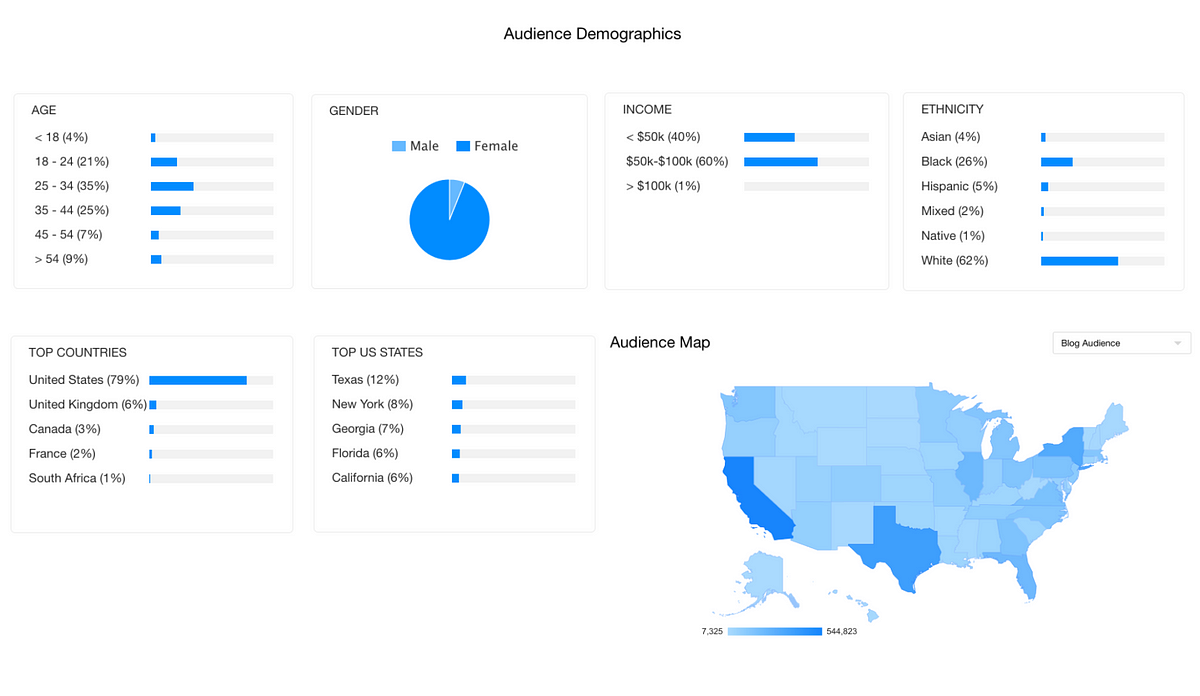
Today, we can quickly see the demographics of an influencer’s audience on their blog, Facebook, Instagram, and/or Twitter. These demographics are quite robust featuring details on audience geography, age, gender, and more. We recently put the value of audience level measurement to the test with a US-based top-tier influencer with whom we’ve worked several times. We were shocked to find that over 40% of her audience resides in South Korea! This is wonderful if you are launching a product in SK (it is a prime luxury retail market!), but if you are targeting the US market, booking her would be a miss.

Audience level measurement becomes even more valuable when evaluating content after it has been published — we can quickly see if a piece of content is getting more engagement in Florida and Texas, and less engagement in New York.

Source: Activate by Bloglovin’

Content Level Analytics in Real Time

One benefit of working with a robust platform is the ability to see the actual data behind each piece of content, and not just relying on what the influencers (or their agents) claim.

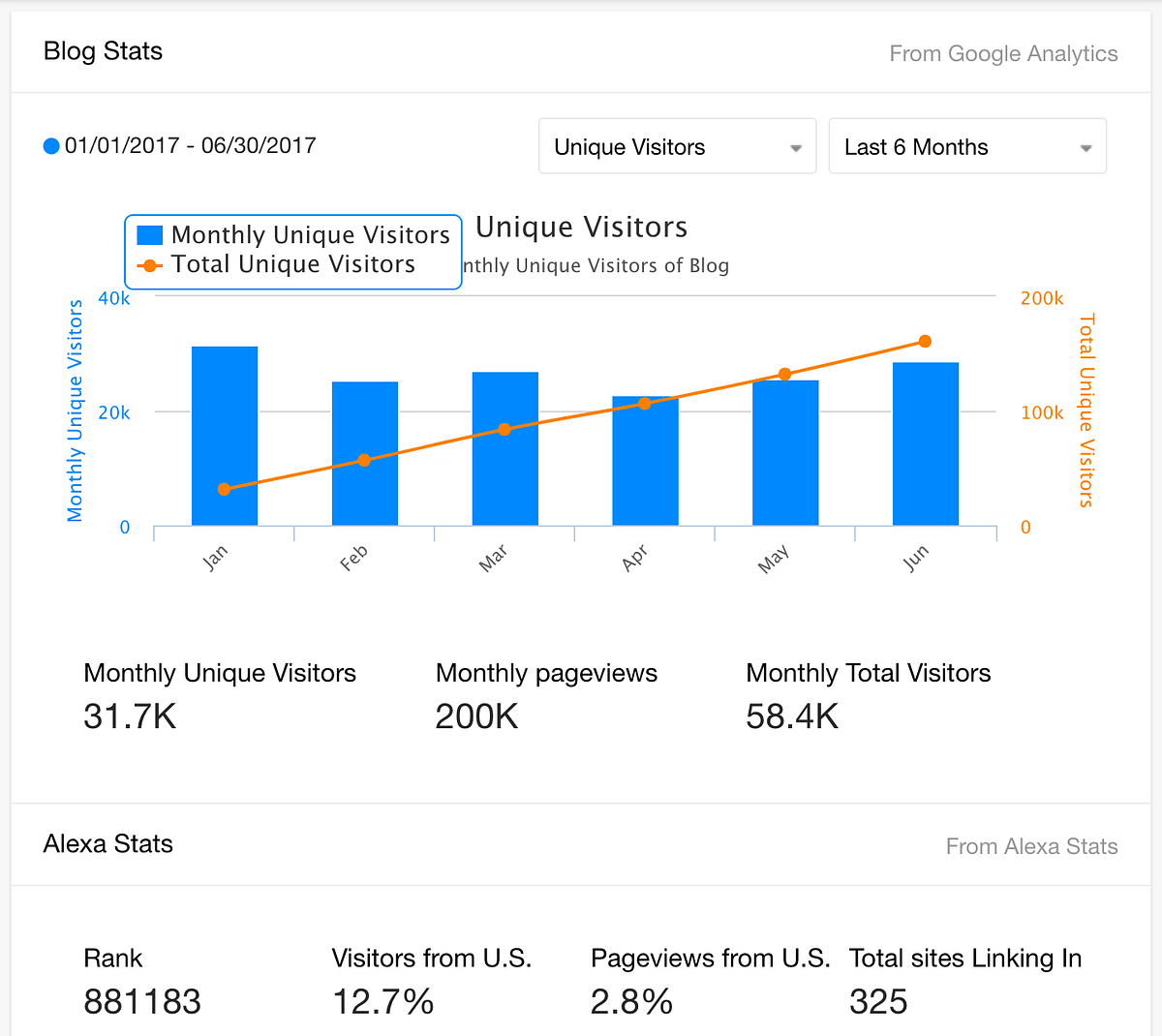
Every single influencer we work with O-Auth(orizes) their Google Analytics for their blog content — often the most obscured metric as it is hard to access publicly — and their social media accounts (Instagram, YouTube, Pinterest, Facebook, Twitter) with us.

This means that as soon as a piece of content is published, whether it be an Instagram Story, a Blog Post or a Custom Pinboard, we can see what the reach, views, and engagement are in real-time. We have brand partners that leverage our platform to monitor hundreds of pieces of content for a particular program. We find that this knowledge helps our partners to optimize quickly, understand which content/platform/influencer works particularly well for them and quickly deploy additional budget in that direction.

‘ROI’ Measurement as it Relates to Partner KPIs

Today, Return On Investment (ROI) on an influencer program can be measured in a number of different ways — many choose to measure it with some sort of EMV (Earned Media Value), where a dollar value is attributed to certain metrics — each ‘like’, ‘click’ or ‘comment’, for example, to add up to a total ‘value’ garnered from the content to then calculate a ROI. Of course, this can be somewhat subjective, as a lot of ‘likes’ may not always add up to real ‘value’ to a brand.

Alternatively, conversion attribution can be assigned via promo codes and affiliate links. However, it is important to be mindful that this can favor influencers that are more adept at promoting coupons and sales vs. influencers that are great at introducing a new brand or product to their audience.

Finally, there are technologies that can help measure higher funnel attribution, attributing value to the content and influencer that introduces a product to the consumer, as well as value to the content that drives the final click to conversion, whether it be a sale or an app install. The downside here is that the brand/retailer needs to have proper server-side integration (beyond just cookie or pixel-based tracking) with these technologies to track effectively. For instance, if someone clicks on a piece of influencer content to land on the retailer’s product page, and then returns months later via another link, that all needs to be tracked from the retailer’s site.

We work with partners to employ a number of methods to get to an appropriate measurement of ROI. Depending on how they are measuring it across their marketing strategy today, Influencer Marketing is, after all, another channel of marketing alongside other channels for them, so we work with them to ensure that it can be measurable and comparable with those other channels.

Also Read:  Pressing Engagement: The Art of Social Selling

Interview with Volker Smid, CEO, Searchmetrics

0
Volker Smid
Interview with Volker Smid, CEO, Searchmetrics

[mnky_team name=”Volker Smid” position=” CEO, Searchmetrics”][/mnky_team]
[easy-profiles profile_twitter=”https://twitter.com/SmidVolker” profile_linkedin=”https://www.linkedin.com/in/volker-smid-875a566/”]
[mnky_testimonial_slider][mnky_testimonial name=”” author_dec=”” position=”Designer”]“No enterprise can cope with 5400 companies in MarTech. Consolidation of data and platforms will ultimately create more value for the economic buyer.”[/mnky_testimonial][/mnky_testimonial_slider]

On Marketing Technology

MTS: Tell us about your role and how you got here? What inspired you to be a part of a MarTech company?
Marketing – more than any other department in enterprises – is drastically changing the way it operates, leveraging data and market-consumer insights. 6 Billion searches every day are consumer signals and demand patterns. We have only started in marketing to leverage the opportunity.

MTS: Given the changing dynamic of online engagement with customers, how do you see content marketing analytic platforms evolving by 2020?

We will see a number of data and technology consolidations in the coming years. No enterprise can cope with 5400 companies in MarTech. Consolidation of data and platforms will ultimately create more value for the economic buyer than standalone startups.

MTS: How would the Ranking Factors for a B2B SaaS company differ from that of a publishing/media company?
Nowadays, Ranking Factors are first and foremost focused on the user. That means, if users like your content, it is very likely that this content will rank well in search results. For you as a company that means you must think about the two questions:  What content does your targeted user need and want?  and how does that content need to be shaped? We’ve conducted many studies and analyses in different sectors and industries on this and although many Ranking Factors are shaped differently depending on the industry, what all of our results across all fields have in common is, that the content of the best ranking URLs is in general providing the best content in the best way to the user. It’s tailored to the needs of the user which is specific for this industry.

As a publishing/media company on the one hand, your intent is obviously to inform and maybe to entertain the reader – depending on the respective niche you’re in (general news, industry magazine, etc. ). Even within these niches, the content differs with regards to content length, structure and format – depending on the topic. Journalistic reports tend to be long and text heavy, sports news are articles are rather short, celebrity gossip contains many images and tutorials are often videos.

As a B2B SaaS company on the other hand, you obviously offer a service or a product, respectively, which – at least if you’re doing your job right – is supposed to facilitate people’s work. That means, you help customers solve problems and/or save time. So, your content shouldn’t be focused on your product and how good everything is, but rather should on your users’ problems. That means, you as a B2B company should be concerned with educating your users and provide different kinds of content pieces along  all the stage of the sales funnel (infographics, whitepapers, blog posts, webinars) in order to – finally – convert them. But everything starts with a problem, a need, an intention. That’s what businesses often forget.

MTS: Are these Ranking Factors linked to search and mobile visibility scores?
Ranking Factors are one out of many ways to take a deep and analytical look at how the current search landscape is shaped. And: they are based on data, which never lies. To put it differently: Ranking Factors provide a framework of values from best practice benchmarks that are based on an analysis of websites that perform well in search. These studies are supposed to show, what factors separate successful websites from less successful ones. That means for you as a marketer, being aware of the current market situation helps you to understand and learn – to improve your own performance based on the results of these analysis. And here’s the link to visibility scores: With the help of such elaborate KPIs, you are 1. able to track your own performance and either act when you’re outperformed by competitors and lose market share or 2. You’re able to track the success of your hard work and stay ahead of your competition. Doing it right and being aware of your very own Ranking Factors, will make the difference and finally result in higher visibility scores.

MTS: With the recent changes in data privacy policies, how do you see audience identification and tracking platforms delivering content personalization?
Content personalization has always balanced on the edge of being worthy of the investment for all but the world’s most sophisticated (and resources blessed organizations). As data privacy regulations evolve in the US and begin to mirror the EU’s it’s likely that the ROI will tip away from content personalization for many organizations.

MTS: What startups are you watching/keen on right now?
Mostly following the “Uberisation” of industries with a specific view on deep machine learning, healthcare, legal and R&D.

MTS: What tools does your marketing stack consist of in 2017?
HotJar, Optimizely, Google Analytics, Searchmetrics Search Experience, Searchmetrics Content Experience, WordPress, Sugar, Marketo, HootSuite, DivvyHQ

MTS: Could you tell us about a standout digital campaign? (Who was your target audience and how did you measure success?)
Our well know Ranking Factors studies have been a major driver of awareness and leads for Searchmetrics and a critically important guide for marketers looking to understand the constantly shifting search landscape. In 2015, Ranking Factors studies contributed 30% of our inbound lead flow, a clear indicator of its importance to Searchmetrics and to the marketers that depended on the research.

In 2017, as Google’s development and application of machine learning algorithms presented an opportunity to launch industry-targeted digital campaigns, Searchmetrics pivoted its approach. Beginning with our Finance and Travel Industry Ranking Factors reports; we began integrating industry influencers into the final analysis and conclusions of our reports. With their buy in and the activation of their social channels as they promoted the reports, our multi-channel efforts (a mix of traditional press, blog posts, Twitter, LinkedIn and Instagram), centered on the ranking factors reports and deep-dive webinars allowed us to reach digital marketing leadership that we’d struggled to reach in the past. Our goal for our Ranking Factors campaigns at the beginning of the year was to increase both the reach (number of downloads and shares) and the quality of our contact database as measured by contact-level quality scores.

Note that the ranking factors campaigns tend to be secondary contributors to revenue (meaning, it’s an excellent first touch and contributes highly qualified prospects to our database for future campaigns) such that downloads remain an effective tool for measuring success.

MTS: How do you prepare for an AI-centric world as a business leader?
AI is a business enabler with several unknown elements of risk. Machines are learning based on data at an enormous speed. Business leaders will have to manage change at an even higher speed than in the past 10 years. It is a lot easier to train a machine than to lead an organization through change.

This Is How I Work

MTS: One word that best describes how you work.
Dolphin.

MTS: What apps/software/tools can’t you live without?
The entire Google stack.

MTS: What’s your smartest work-related shortcut or productivity hack?
Define what we do through the lenses of a customer

MTS: What are you currently reading? (What do you read, and how do you consume information?)
I enjoy reading the best German weekly Newspaper “Die Zeit” believe it or not on paper. In contrast, I consume all the ad-hoc information online. Books- 80% eReader, 20% Paper. Best Book so far “One Trillion Dollars” by Andreas Eschbach.

MTS: What’s the best advice you’ve ever received?
Try to find solutions in balance between customer, employee and shareholder needs.

MTS: Something you do better than others – the secret of your success?
“Read” and understand people and their unique capabilities. Comprehension of very complex problems.

MTS: Tag the one person in the industry whose answers to these questions you would love to read:
Larry Ellison.

MTS: Thank you Volker! That was fun and hope to see you back on MarTech Series soon.

[vc_tta_tabs][vc_tta_section title=”About Volker” tab_id=”1501785390157-b58e162d-0ae25a4b-c27aca64-108e09f1-7c99″]

Volker Smid is the CEO of Searchmetrics and has over 25 years of management experience in the technology and media industry. Before joining Searchmetrics, as the Head of Digital & Technologies at the Holtzbrinck Publishing Group, Volker Smid was responsible increasing the Group’s focus on its online business. He was also responsible for the development and coordination of interdivisional system technologies and for the Holtzbrinck business division Digital, Information & Services. As the CEO of Searchmetrics, Smid will contribute his extensive knowledge of the online sector to drive the ongoing international expansion of the Berlin-based group.

[/vc_tta_section][vc_tta_section title=”About Searchmetrics” tab_id=”1501785390320-2d44fa50-740c5a4b-c27aca64-108e09f1-7c99″]

searchmetrics
We are your pathfinder to content that uniquely matches user intent with the deep learning insights of the Searchmetrics Suite and Searchmetrics Content Experience platforms. Search has evolved into a data-driven field that requires powerful tools to guide companies through discovery, optimization, and measurement of engaging storytelling. There’s only one search and content development platform that owns its data: Searchmetrics, the world’s #1 SEO and content performance platform. We don’t rely on data from third parties. Our historical database spans more than five years and contains over 250 billion pieces of information, such as keyword rankings, search terms, social links, and backlinks.

[/vc_tta_section][/vc_tta_tabs]
[mnky_heading title=”MarTech Interview Series” link=”url:https%3A%2F%2Fmartechseries-67ee47.ingress-bonde.easywp.com%2Fcategory%2Fmts-insights%2Finterviews%2F|||”]

The MTS Martech Interview Series is a fun Q&A style chat which we really enjoy doing with martech leaders. With inspiration from Lifehacker’s How I work interviews, the MarTech Series Interviews follows a two part format On Marketing Technology, and This Is How I Work. The format was chosen because when we decided to start an interview series with the biggest and brightest minds in martech – we wanted to get insight into two areas … one – their ideas on marketing tech and two – insights into the philosophy and methods that make these leaders tick.

ReadyCart Has Been Sold To Grapevine, The World’s Leading End-to-End Influencer Marketing Platform

0
grapevinelogic

ReadyCart is the first portfolio company backed by Very Ventures from inception to exit

Very Ventures, the investment and product scaling division of Very, LLC, announced that it has successfully completed an exit of its investment in ReadyCart, LLC. The company was acquired by Grapevine, the world’s leading end-to-end influencer marketing platform with more than 135,000 influencers in the network.

Since it was launched in 2014, ReadyCart has been the market leader in bundling products mentioned on YouTube videos, allowing viewers to easily purchase products in a single click. Created by Very, ReadyCart delivers key e-commerce insights and generates incremental revenue to social media influencers and the media networks that manage them.

“The amount of product-driven content was skyrocketing across different platforms like YouTube, Instagram, Facebook and blogs. As we searched for ways to monetize content, we were baffled by influencers’ inability to get compensated for inspiring their followers to make purchases beyond the traditional methods of advertising and affiliate marketing. We knew we could bring a product to market and solve for that gap,” Jesse Morris, Co-founder, ReadyCart and Partner, Very said.

Very Ventures provided a unique combination of capital investment, product development and operational expertise, moving ReadyCart from an early experiment to a platform that could generate value by connecting more than 135,000 YouTube creators in the Grapevine network to large e-commerce brands and retailers.

“Very Ventures helps management teams scale companies by generating cash flow and enterprise value. ReadyCart is the first portfolio company that we have backed from inception to exit, and it represents the kind of innovation and strategic market disruption that we will continue to seek out,” Jonathan Bragdon, Partner, Very and Head, Very Ventures said.

Very and Very Ventures is headquartered in Chattanooga, Tennessee, with talent in 22 U.S. cities, Very is a software product development firm that partners with companies seeking to aggressively turn objectives into outcomes. Very has served a diverse portfolio of clients, including Thrive Global, founded by Arianna Huffington; Relationship Science; The American Society of Mechanical Engineers; and Amalgamated Bank.

Ties.com Partners With Global Access To Expand Internationally

0
globalaccess

Ties.Com Will Leverage Global Access’ Integrated Technology Platform So International Customers Have A Branded Checkout Experience

Global Access, a leading provider of cross-border commerce technologies and shipping solutions, is partnering with Ties.com to help the Southern California-based Internet retailer expand its cross-border sales of premium men’s neckwear and better serve its international customers.

The partnership agreement enables Ties.com to expand its brand globally by leveraging Global Access’ integrated technology platform to provide international customers with a Ties.com branded checkout experience including real-time tax and duty calculations along with Global Access’ extensive international logistics network and transparent package tracking.

Dave Nielsen
Dave Nielsen

“We founded Global Access on the belief that any US eCommerce retailer can build an international brand if international consumers are provided the same trusted, merchant branded, shopping experience that their domestic shoppers receive. Our advancements in duty and tax automation, real-time order tracking and customs brokerage technology combined with our expansive international logistics network make it possible for Ties.com to expand around the world and build a valued global brand without compromising its passionate commitment to customer care,” David Nielsen, CEO, Global Access said.

Founded in 2000, Ties.com is the website that ties your outfit together. The company provides a wide range of men’s high quality fashion accessories with products ranging from neckties to socks and other fine sundries.

“For 15 years our company has succeeded and grown by providing high-quality products with superior customer service, and we are thrilled to expand our brand internationally,” said Ties.com CEO Omar Sayyed. “Since day one we’ve sought to offer our customers the best shopping experience online. With the help of Global Access’ cross-border expertise, technology and international logistics network, we’re confident that we can now deliver that to customers anywhere in the world.”

Global Access is a leading expert in international growth logistics for eCommerce retailers, providing clients with:

  • Cross-border expertise to help navigate the regulatory requirements of each country
  • A technology platform that maintains transparency and control throughout the process
  • An international logistics network scaled to their business

Founded in 2002, Global Access has shipped more than $1 billion in gross merchandise value to more than 184 countries.
Global Access is a leading provider of cross-border technology and shipping solutions that allow direct sellers and eCommerce retailers to tap into the fastest growing markets and build global brands. The Company’s decades of cross-border expertise protects consumers and brands by successfully navigating the regulatory requirements of each country and by providing their international consumers with the same seamless, branded experience enjoyed by domestic consumers. The Global Access technology platform ensures accuracy in duty and tax assessment and speedy customs clearance and maintains transparency and control throughout the order process with real-time data access delivering a superior consumer experience that builds loyalty to our customers’ brands.

You Are in Control… How GDPR Will Revolutionize Location Marketing

1
GDPR

beemrayThere’s a lot to be done ahead of May when it comes to GDPR. The risk of not complying with GDPR is real and could lead to fines for companies of up to €20 million or 4% of global annual turnover. So what does it mean for the marketing industry, and why will the location be the new imperative for marketers?

In a nutshell, GDPR is about users giving consent to data collection, the flip side is that it also gives them the ability to withdraw that consent. Therefore, it is vital that marketers treat the user IDs that different platforms collect and segment in an open and transparent way. The customer is in control of their data and, as the old saying goes, the customer is always right!

It’s a jungle out there

The existing ID management ecosystem is a jungle; involving so many tech and service vendors that ruthlessly fetch every single ID they can… hoping to monetize it somewhere down the road. It’s no wonder that government bodies are taking this seriously!

Europe is getting organized, and I think it shows in the new legislation. Different countries within the EU will surely treat the implementation of GDPR a bit differently. There are also still a few gaps in data regulations that enable assumptions but overall the careless days are long gone. This is a good thing for the industry, a good thing for marketers and, most importantly, a good thing for consumers.

Looking at GDPR from the location vendor’s perspective, you could say that most will take a severe hit. Primarily this is because the bid stream is the typical source for most vendors of location resolution and profiling data. GDPR will put an end to this and the value of such profiles and audiences will be very close to zero.

The science of location

Currently, no governments are talking about location data and how it relates to GDPR – primarily because they don’t have a real answer for it. On the flip side, marketers must get ahead of GDPR and see location marketing as being at the top of their agendas.

The world is based on its history but lives and breathes now every second. The ability to analyze behavior in real-time is therefore of utmost importance. Real-time consumer behavior is primarily about location and the context of that location. This insight is gold dust for brands and advertisers, as well as being the sleeping pill for any marketer who truly wants to understand their customer.

The most interesting, and perhaps surprising thing, about location intelligence is that knowing one’s identity is not even necessary in most cases. It is more about analyzing and reacting to behavior as it takes place, then acting on it. This is a double win for customers and marketers alike as it’s both privacy friendly whilst vastly improving the user experience.

As users need to give their consent under GDPR, location data will be the front line of customer marketing. This will ensure marketers stay compliant from the off and that consumers are given the best experiences at all times. Therefore, businesses that use location specific audience intelligence platforms will have first mover advantage in a post-GDPR world.

In this sense GDPR will herald a new era of personalisation. An era where location means everything.

How Can We Take Facebook Marketing to the Next Level?

1
How Can We Take Facebook Marketing to the Next Level?

AbsolutdataMarketing on Facebook can bring great rewards — or a lousy ROI. What’s the secret to Facebook marketing? Facebook is just about as big as the Internet: it has 2 billion users worldwide out of an estimated 3.8 billion Internet users. That’s more than half of all Internet users, and in some places, these numbers get even higher. In the US, for example, 79% of Internet-connected adults use Facebook. Marketing on Facebook is not new; an estimated 3 million businesses advertise on it, and 94% of marketers incorporate the social network into their efforts. But…


In this case, the but is that many businesses struggle to get a decent ROI on their Facebook marketing efforts. In total, 34% of the marketers in the above-mentioned report said that Facebook wasn’t a very effectual marketing channel for them. And according to Weebly, 62% of the small business owners who used Facebook ads said these weren’t really reaching their target audiences.

Admittedly, there is a learning curve involved in Facebook marketing, just as there is with any new technology or platform. And there are many ways you can customize your reach on FB, including geographic area, device type, operating system, and customer interests, behaviors, and demographics. So the potential is there. Do you have the data to make it work?

In Facebook Marketing, Success Is All About Your Data

Facebook certainly provides huge amounts of data on each active user. But there are other data sources — such as your own CRM data, customer data, and survey data — that Facebook doesn’t have. Do you use this data in your Facebook marketing efforts?

It’s a worthwhile question. Precisely because there’s so much Facebook data available, marketers may not think to connect what they already know about a customer — i.e. their company’s proprietary customer data — with the individual’s social media presence. This is where advanced analytical techniques come into play; by matching up customers with their Facebook profiles, you can learn a lot about their tastes, views, and preferences. And you can bring targeted messages to their attention more easily.

If you want to take Facebook marketing to the next level, don’t rely solely on Facebook’s data troves and ad-targeting options. What people put on their profiles is only part of what you need to understand about them; the rest resides in your company’s data stores. To be truly effective at Facebook marketing, you need to combine data from all available sources.

TechBytes with David Johnson, Director, Product Marketing, Oracle

0
David Johnson Oracle

David Johnson
Director, Product Marketing, Oracle

Last month, Oracle announced their integration with WeChat, enabling marketers to directly deliver connected and personalized experiences. We chatted with David Johnson, Director of Product Marketing at Oracle, to understand the B2B features of the Eloqua-WeChat integration and how this partnership would take brands closer to the customers via a popular social messaging platform like WeChat.

Html code here! Replace this with any non empty text and that's it.

MTS:  What are the B2B facets of the Oracle-WeChat integration?
David Johnson: There are a couple of benefits for B2B companies. For any company currently headquartered in APAC and actively seeking their ideal customers in the Chinese market, this provides a great opportunity to connect with potential buyers on the social media platform they use most.  Second, for any global company looking to expand their footprint into the Chinese market, this is the perfect opportunity to create a new channel through Oracle Eloqua, part of the Oracle Marketing Cloud, and to do that most effectively.

This integration is also just as effective for B2C companies. We currently have several customers in APAC who use Oracle Eloqua for B2C marketing

MTS:  Would this integration push the boundaries of customer experience and social selling?
David: This absolutely pushes the boundaries of social selling. We are the first global marketing automation platform to have an integration of this sophistication with WeChat. As of August 2017, WeChat has over 963 million users on their platform. This is a huge market that has been virtually inaccessible for marketing automation until recently. Being able to increase brand recognition and capture ideal buyer interest that can be used to augment buyer profiles and leads to more customers is a huge focus for any marketer.

MTS:  How would this enable Oracle to become a stronger data-first company and resolve pain points in customer identity management?
David: By supporting engagement over this channel, it broadens our ability to capture profile and behavioral data for B2B marketers. Now profile data from the most common channels for global marketers can be unified within Oracle Eloqua.

MTS:  How do you see social messaging platforms playing a role in bringing customers closer to their preferred brands?
David: 
Most buyers in today’s world expect to be able to access information on the brands they are interested in most on their preferred social media platform. Whether it’s on WeChat, Facebook, LinkedIn or Twitter, people follow the companies they are passionate about to keep up to date on the latest and greatest or to be educated on new trends, whether for business or pleasure.

MTS:  How would personalized messaging experiences integrate with existing Data Management and CRM models?
David: 
Whether targeting anonymous or known users, this integration enhances Oracle’s ability to provide the most granular level of detail necessary for marketers to be able to create personalized experiences.

MTS: Thanks for chatting with us, David.
Stay tuned for more insights on marketing technologies. To participate in our Tech Bytes program, email us at news@martechseries-67ee47.ingress-bonde.easywp.com

Interview with Richard Thornton, COO and Deputy CEO, Cint

0
Richard Thornton
Interview with Richard Thornton, COO & Deputy CEO, Cint

[mnky_team name=”Richard Thornton” position=” COO and Deputy CEO, Cint”][/mnky_team]
[easy-profiles profile_twitter=”https://twitter.com/rthornton1976″ profile_linkedin=”https://www.linkedin.com/in/thorntonrichard/”]
[mnky_testimonial_slider][mnky_testimonial name=”” author_dec=”” position=”Designer”]“Without having a clear vision around data its difficult for any business to optimize understanding their customers or the general consumer in terms of trends and behavior.”[/mnky_testimonial][/mnky_testimonial_slider]

On Marketing Technology

MTS: Tell us about your role at Cint and how you got here? What inspired you to join an insight exchange?
I’m the Deputy CEO and COO for the global business and my background is in data and insights. I started out as a Research Analyst for a digital consultancy before getting into the marketing research technology space in 2003 with Ciao, one of the pioneers of online research panels (built of its industry leading price comparison e-commerce business), which was then acquired by Greenfield Online and subsequently sold to Microsoft, in a successful exit in 2008. At that point, I thought it was the opportune time to pursue a fresh challenge and saw Cint had a lot of potential as a real disruptor with a unique exchange model in a very traditional vertical (Market Research). The challenge back then was that the model was ahead of its time as an exchange and also primarily a self-service SaaS offering competing in a heavily dominated managed service oriented industry. It was actually this challenger position and the fact that this company has technology in its DNA that was appealing.

MTS: How do real-time tracking technologies and audience profiling solutions help monetization?
Cint’s insight exchange (our platform) brings several monetization opportunities to several facets of digital marketing. Per audience profiling, our platform is capturing unique first-person data points from over 200 mappable questions, asked to digital research participant (over 40 million registered in our platform and growing).  The first-person data points we capture from the registered, verified consumers in our platform may then be licensed to DMPs and other data providers to validate existing data sets, or to enrich them with additional data points.

– Content Marketing

Content marketing is a facet of marketing we have not yet approached, or worked with a partner to enhance data and audience targeting. However, this is another avenue that we can support via the first-person data collected in our platform in the near future.

– Programmatic Advertising

The first-person data points within our platform may be used to power our next generation ad tracking technology Connect by Cint, which shares unique data points for those exposed and clicking on online content.  In addition, those that license access to our data may enrich their ad targeting technologies with our first-person data for much better ad targeting accuracy.

MTS: How should marketers utilize the Cint Platform to better segment their audience?
Cint has a suite of solutions that help advertisers, marketers and publishers optimize their investments and deliver more ROI by enabling richer data and insights to be integrated into campaigns, all connected to a global audience of more than 40 million deeply permission-based, deeply profiled and re-contactable people. Cint’s Connect solution is a programmatic end-to-end ad-effectiveness and audience validation product that allows you to track, measure and survey exposed (matched) panelists from Cint’s open exchange panel marketplace. You get viewability metrics and real-time dashboards allowing you to dynamically optimize campaigns and change them inflight based upon the audience insight being collected. Connect can also be used for bid enrichment and to drive premium pricing in advertising whereas marketers are able to use other solutions like Cint Engage (customer insights, panelization, and monetization) or Cint Access (self-serve or programmatic audience survey solution used by CMOs, brand managers, researchers and many others to get to the ”why” through research).

MTS: How should CMOs leverage customer intelligence and intent data to deliver better omnichannel personalization and customer experiences?
Data today is king. Knowledge is still power, but data is the new currency. Any CMO worth their salt should be ensuring they are leading any data-driven initiatives that connect in any way to the brand or its customers. There is no excuse today, with the wealth of technology and data sources available, that a CMO or marketing department shouldn’t be building data-led marketing strategies with insights at the heart of them. Finding the balance between first, second and third-party data is still a challenge and many companies are still reliant on too much third-party data which is often inferred or probabilistic rather than deterministic. I would advise any CMO to think hard about how they can build out their first data set and enhance or enrich that over time. To do it successfully you need to be close to your customers through the entire customer journey and have trigger-based touchpoints and feedback loops set in place that not only the marketing team, but the entire business can leverage in as near real-time as possible. Then, and only then, will you get the maximum out of personalization and the ability to deliver best in class customer experience.

MTS: What’s the biggest challenge that businesses fail to address in measuring media trends and ad buying behaviors? How does Cint help overcome these challenges?
Many organizations today don’t have a full data strategy buttoned down. Without having a clear vision around data its difficult for any business to optimize understanding their customers or the general consumer in terms of trends and behavior. Beyond strategy, another challenge is technology.  Today it’s imperative businesses understand what technology stack is required for their specific objectives and where technology and machines (AI) can help automate, scale and operationalize efficiently tracking and measurement of trends and behaviors.  Of course, this often comes with a hefty price tag and requires a collective commitment from top down for a business to fully embrace to drive results.

At Cint, we try and help our customers and partners address these two challenges through a combination of our technology and our people. Increasingly, companies are placing our capabilities front and center within their data strategies and technology stacks to help power and support the flow of people-based data across their business. Importantly, they are adding our core value proposition of ensuring there is a clear feedback channel to customers and non-customers via surveys and behavioral tracking capabilities to augment with other data sources they might be collecting.

MTS: What startups are you watching/keen on right now?

  • Cornerstone – Crowdfunding start-up disrupting the shaving business with a SaaS-based subscription model. It has good branding and great marketing with value-proposition.
  • HouseKeep – Exchange model creating an efficient connection between homes and house cleaners.
  • Kahoot! – Free game-based learning platform that makes it fun to learn in any area and for all ages. This is starting to help rethink the shape of education and learning.
  • ZipJet – A fantastic app and a slick home collection dry-cleaning service.
  • SoundCloud – While the company is burning through millions of euros as it struggles to find a reliable revenue stream, it is reportedly still on the acquisition radar of Silicon Valley giants like Google and Twitter. They have a very interesting product and are a solid alternative to Spotify and Pandora.
  • I must also mention one I’ve invested in personally, which is MindSauce a ’Knowledge On Demand’ platform in the UK. It is in its very early days, but it already has an impressive network of ’experts’ connected to the platform.

MTS: What tools does your marketing stack consist of in 2017?

  • Oracle NetSuite ERP
  • LinkedIn Sales Solutions  – LinkedIn Sales Navigator Enterprise Edition
  • LinkedIn Campaign Manager
  • AppNexus
  • Programmatic Mechanics (Managed Services/buying desk for AppNexus)
  • BannerFlow
  • SEM Rush
  • HotJar
  • Google Analytics
  • Trentkite
  • ClearSlide
  • GaggleAmp

MTS: Would you tell us about a standout digital campaign?
One of our core target audiences are individuals responsible for managing the targeting and fieldwork of digital and online market research, which is a niche audience among a niche audience. While we have tested the waters with DoubleClick and App Nexus to target this audience, we have seen the greatest success targeting this audience with ads and online content using LinkedIn’s Campaign Manager. This is because they have the best business-related first-person data sets collected from their users. From our frequent campaigns with LinkedIn, we have converted several thousand followers to the company LinkedIn page, and have converted several marketing qualified leads for our sales team to call upon and covert to users of our technology.

MTS: How do you prepare for an AI-centric world as a business leader?
This is a challenging question.  As our platform is built to add automation and efficiencies to what was time consuming managed service and manual work and uses AI to assist with managing several parts of our services, I am partial to enabling machines to assist us with time consuming, labor intensive tasks. On the flip side, I am also aware that there must still be smart people (humans) to help build, improve and repair the machines. In short, there must be a happy medium between how humans interact in business, with the support of AI to assist with adding efficiencies, resulting in better maximizing productivity and profitability.

This Is How I Work 

MTS: One word that best describes how you work.
Collaboratively.

MTS: What apps/software/tools can’t you live without?

  • Apps – Amazon, Lyft, BA, Deliveroo, SoundCloud, Sky Sports Football, WhatsApp, Twitter & Strava apps
  • Tools / Devices – Apple Watch, iPhone, Amazon Echo
  • Platforms – LinkedIn, AirBnB!

MTS: What’s your smartest work-related shortcut or productivity hack?
Evernote.

MTS: What are you currently reading? (What do you read, and how do you consume information?)
I recently read Chaos Monkeys, which was bought for me when I moved to San Francisco to work for the past 12 months (I’m now back in London). Very enlightening read on the inner workings of Silicon Valley. Other than this, most of what I read and consume is online via a selection of preferred apps or subscriptions covering a range of industry and non-industry related content (BBC, Guardian, Digiday, Adexchanger, Business Insider, Twitter newsfeed, etc).

MTS: What’s the best advice you’ve ever received?
Whatever you do, have fun – I think that’s a good mantra. Also, take your chance and try and have no regrets. It’s better to look forward and keep an opportunistic mind, otherwise, the good things in life will pass you by.

MTS: Tag the one person in the industry whose answers to these questions you would love to know.
Bernd Hacker, Director Advertising Sales & Audiences EMEA at Sprinklr.com

MTS: Thank you Richard! That was fun and hope to see you back on MarTech Series soon.

[vc_tta_tabs][vc_tta_section title=”About Richard” tab_id=”1501785390157-b58e162d-0ae25a4b-c27aca64-108e837a-a345″]

Working with customers and partners for over 15 years in consultancy and commercial roles, within the data and insights industry at high growth, fast scale, SaaS technology businesses. A consultative and operational executive leader with a passion in helping clients grow and optimise their businesses through smarter technology adoption and automation. Focused on driving growth through value-selling and a strategic partnership approach to build scalable long-standing relationships. Proven track record of hiring and nurturing the best industry talent to collectively create successful disruptive businesses from start-up environments through to fully operational, profitable entities.

[/vc_tta_section][vc_tta_section title=”About Cint” tab_id=”1501785390320-2d44fa50-740c5a4b-c27aca64-108e837a-a345″]

Cint
Founded in 1998 in Stockholm, Sweden, Cint is the world’s insights exchange.

Hosting 40 million registered consumers within 80 countries worldwide, Cint maintains an online insight exchange platform that connects publishers and community owners to researchers, agencies, and brands, for the sharing and accessing of consumer insights and data.

[/vc_tta_section][/vc_tta_tabs]
[mnky_heading title=”MarTech Interview Series” link=”url:https%3A%2F%2Fmartechseries-67ee47.ingress-bonde.easywp.com%2Fcategory%2Fmts-insights%2Finterviews%2F|||”]

The MTS Martech Interview Series is a fun Q&A style chat which we really enjoy doing with martech leaders. With inspiration from Lifehacker’s How I work interviews, the MarTech Series Interviews follows a two part format On Marketing Technology, and This Is How I Work. The format was chosen because when we decided to start an interview series with the biggest and brightest minds in martech – we wanted to get insight into two areas … one – their ideas on marketing tech and two – insights into the philosophy and methods that make these leaders tick.

comScore Names Michelle McKenna-Doyle to Board of Directors, Appoints Gregory Fink as CFO

0
comscore

McKenna-Doyle served as Senior Vice President and Chief Information Officer of the NFL 

comScore, Inc announced that Michelle McKenna-Doyle joins its Board as an independent director. McKenna-Doyle, who is currently Senior Vice President, Chief Information Officer at the National Football League (NFL), was proposed by Starboard Value LP, one of comScore’s largest shareholders, and approved by the comScore Board. The addition of McKenna-Doyle, as the remaining independent director to be appointed pursuant to the previously announced settlement with Starboard, will increase comScore’s Board of Directors to nine members.

Sue Riley, comScore’s Board Chair, said, “I am very pleased to welcome such a visionary and dynamic senior business leader as Michelle to our Board. Her extensive expertise in technology and marketing, as well as business operations and finance, make her a valuable addition to our Board. We all look forward to working with Michelle as we continue to focus on delivering additional value to comScore customers, investors and employees.”

McKenna-Doyle has served as Senior Vice President and Chief Information Officer of the NFL since September 2012. She is executive sponsor of the NFL WIN – Women’s Network, and was recently awarded a Game Changer Award by Sports Business Journal. Prior to joining the NFL, McKenna-Doyle served as Senior Vice President and Chief Information Officer at Constellation Energy Group, Inc, where she implemented major technology strategic initiatives and led the company’s integration with Exelon Corporation upon the firm’s merger.

Prior to joining Constellation Energy, she was President of Vision Interactive Media Group, Inc., a global digital interactive media solutions provider. Between 2007 and 2010, she served as Senior Vice President and Chief Information Officer at Universal Orlando Resort. She also previously served as Senior Vice President and Chief Information Officer at Centex Destination Properties. In her 13-year career with the Walt Disney World Company, she held a variety of executive positions in Resort Development, Finance, Marketing, Operations and Technology. She currently serves on the Board of Directors of RingCentral, Inc, a leading provider of global enterprise cloud communications and collaboration solutions, and previously served on the Board of Directors of Insperity, Inc, a professional employer organization.

Gregory Fink Appointed CFO

comScore also announced that Gregory A Fink, Executive Vice President, Finance, has been appointed Chief Financial Officer and Treasurer, effective immediately. Interim CFO and Treasurer, David Kay, has resumed his full-time role at CrossCountry Consulting LLC, which has been providing accounting consulting services to comScore in connection with its pending restatement and audit process.

Fink is an accomplished senior finance executive with more than 25 years of experience in accounting, financial reporting, business analytics, budgeting, internal controls, and talent development. Prior to joining comScore, he served as Senior Vice President, Controller and Chief Accounting Officer at Fannie Mae, where he led a team of 600 professionals and oversaw a multi-billion dollar annual expense budget. With extensive experience in SEC reporting, Fink had responsibility for Sarbanes-Oxley compliance and Audit Committee reporting. Prior to joining Fannie Mae in 2006, he served as Vice President of Financial Reporting and Policy at MCI, Inc. and was a Senior Manager at Deloitte. Fink holds a B.S. in Business Administration with an accounting emphasis from San Diego State University and is a licensed Certified Public Accountant in Virginia.

Gian Fulgoni
Gian Fulgoni

“Greg is a proven leader with an outstanding track record of managing large finance teams. He has a wealth of experience in overseeing complex accounting matters and financial operations that will help move comScore forward. I’d like to thank Dave Kay for stepping into the CFO role on an interim basis and look forward to his continued contributions as a consultant,” Gian Fulgoni, CEO, comScore said.

Criteo Elevates Mollie Spilman To Chief Operating Officer

0
criteo

Spilman Has Helped Achieve A Steady 90 Percent Customer Retention Rate

Mollie Spilman
Mollie Spilman

Criteo S.A, the leading commerce marketing technology company, announced the promotion of Mollie Spilman, one of the most respected executives shaping today’s competitive advertising and commerce marketing landscape, to Chief Operating Officer. Spilman joined Criteo in 2014 and leads all commercial teams — revenue, supply, operations and marketing — globally.

During her tenure, Spilman has been instrumental in Criteo’s growth to a nearly two billion dollar revenue business and has helped achieve a steady 90 percent customer retention rate. She excels at the integration of global go-to-market strategies across product and marketing teams to ensure that Criteo delivers to retailers, brands and other commerce companies the highest sales performance from their marketing investments through Criteo’s open Commerce Marketing Ecosystem.

“Since day one, Mollie has brought deep experience and a strong, fresh strategic point of view to how Criteo approaches the agile and dynamic environment of commerce marketing. Criteo is a trusted partner to retailers, brands and other commerce companies and everything we do is rooted in our mission to enable them to better compete in a data and technology driven environment. Mollie understands the complex and nuanced challenges our customers face and is expertly positioned to ensure that Criteo exceeds expectations as we help to reshape the future of commerce marketing,” Eric Eichmann, CEO, Criteo said.

“I am honored and humbled to expand my role at Criteo while continuing to work alongside the industry’s most talented and driven team members who reach new heights every single day in order to achieve our aggressive growth and innovation goals. Criteo is at the forefront of an e-commerce industry that is defined by change, uncertainty and ever-shifting expectations. I am confident that we will sustain the strong momentum realized at the start of 2017, and I am committed to the continuation of our market leadership and success,” Mollie Spilman, COO, Criteo said.

Most recently, Spilman won the Working Mother of the Year Award, a Silver Stevie award for ‘Female Executive of the Year’ and is ranked the fifth most powerful woman in mobile advertising by Business Insider. Prior to Criteo, her two-decade career in advertising included executive roles at Millennial Media, Yahoo, Advertising.com/AOL and Time Inc.

Fortune Magazine and Great Place to Work Name Panopto One of 2017’s Top 10 Small Workplaces

0
Panopto

Video platform company recognized for its culture, leadership, employee development, and more

Panopto, the leading video platform provider for enterprise and education markets, today announced it has been named one of the 2017 Best Small & Medium Workplaces in an annual ranking compiled by Great Place to Work and Fortune Magazine. Panopto was listed as one of the top ten small workplaces, and was recognized for its engaging and motivating workplace culture, as well as the strength and transparency of its leadership and communications.

Eric Burns Panopto
Eric Burns

“Every employee at Panopto has a tangible impact on the growth and success of our business,” said Eric Burns, co-founder and CEO of Panopto. “We give our people big challenges, we empower them to do what they think is right, and we foster an environment where great contributions are recognized and rewarded. We’re honored that our focus on those principles has earned the praise of our employees and has led to this recognition of our work environment and culture.”

A leader in video content management systems, video capture software, and inside-video search technology, Panopto’s more than 100 employees serve Fortune 500 companies and leading academic institutions around the world. Now celebrating its 10th anniversary, the company has doubled its Seattle office space and recently relocated its Pittsburgh offices to accommodate its rapidly-growing team.

The Best Small & Medium Workplaces is one of a series of rankings by Great Place to Work and Fortune Magazine, and is based more than 74,000 anonymous employee surveys from hundreds of businesses across all industries. Panopto’s Great Place to Work rating places the company in the among the very best when it comes to workplace atmosphere, rewards, challenges, and leadership.

Panopto helps businesses and universities create searchable video libraries of their institutional knowledge. Since 2007, the company has been a pioneer in video content management systems, video capture software, and inside-video search technology. Today, Panopto’s video platform is the largest repository of expert learning videos in the world.