


Agentic commerce is coming to the Asia-Pacific region. The retailers who win will be the ones whose loyalty infrastructure is fast enough for machines to find
Picture this: A loyal customer asks their AI assistant to restock the household essentials they buy every fortnight. The agent checks inventory, compares prices, and looks for loyalty benefits it can apply. Your competitor’s loyalty platform responds in under 250 milliseconds with a personalised offer. Yours times out.
The agent completes the purchase with the competitor.
That scenario isn’t hypothetical for much longer. Google’s Universal Commerce Protocol (UCP) is creating the standardised infrastructure for AI agents to discover products, check stock, apply loyalty benefits, and complete purchases on behalf of consumers, all without the shopper visiting a website or opening an app. The transaction happens inside the conversation.
For more than a decade, the retail industry has treated chatbots and personalisation engines as the headline AI story. They’re finally decent. But the more consequential shift is happening at the transaction layer, and in my conversations with retailers across Asia-Pacific, very few are thinking about it yet.
Agentic commerce to remove the shopfront entirely
It’s worth being precise about what agentic commerce actually changes, because the instinct is to file it under “better e-commerce.” It isn’t.
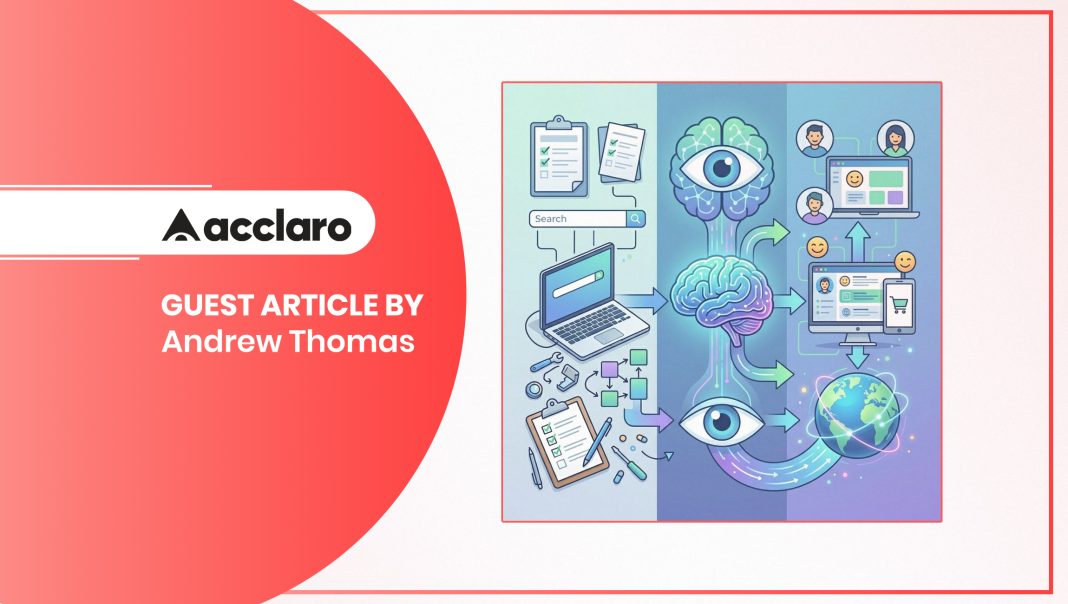
Traditional e-commerce moved the shopfront online but kept the same structure: browse, select, add to cart, enter details, pay. Agentic commerce removes the shopfront entirely. The AI agent becomes the interface. The “store” becomes a set of machine-readable data and APIs that the agent queries on the customer’s behalf.
This matters for two reasons. First, it eliminates the handoff that kills conversion. When a customer moves from a search result to a retailer’s mobile checkout, roughly 6-in-10 drop off. Under UCP, the customer stays in the conversation, uses saved credentials, and completes the transaction. Industry estimates suggest this could lift conversion rates meaningfully, some early projections point to double-digit improvements.
Second, it changes data ownership. On aggregator platforms, and aggregator-led e-commerce dominates our region, the platform captures the customer relationship. Under UCP, the merchant remains the legal seller and retains all customer data.
Pricing, fulfilment, and the customer relationship stay with the retailer. For Asia-Pacific retailers who’ve spent years competing on someone else’s marketplace, that’s a fundamentally different commercial model.
Loyalty infrastructure will offer competitive edge
This is where I think most commentary on agentic commerce is missing the point. The discussion tends to focus on payments and product discovery. But loyalty infrastructure is going to be the differentiator, the thing that determines whether an AI agent routes a transaction to you or to your competitor.
UCP supports identity linking, meaning a shopper’s loyalty credentials can be connected to their AI agent. When that shopper searches for a product, the agent can call out to a loyalty platform in real time, check point balances, access personalised offers, apply member pricing, all within the conversation and before checkout completes.
Think about what that means for the promotional model. Mass offers applied uniformly across a customer base have always been an imprecise tool: they attract price-sensitive shoppers and discount purchases that would have happened at full price.
In an agentic context, the agent already knows the shopper’s intent, preferences, and purchase history. A targeted offer served at that exact moment converts at higher rates with less margin erosion.
But here’s the catch: the loyalty platform has to be fast enough. We’re talking sub-250-millisecond response times at scale, across thousands of concurrent transactions. If your system can’t issue and redeem a personalised offer in the time it takes an AI agent to assemble a cart, the agent moves on. It’s not personal. It’s architecture.
Payments and loyalty are converging inside the agent
The other piece falling into place is payment infrastructure. This is sometimes discussed separately, but in an agentic transaction, payments and loyalty are resolved in the same interaction. In other words, they’re converging.
Mastercard has already completed live authenticated agentic transactions in Singapore through DBS Bank and UOB, using Agentic Tokens and Payment Passkeys. Visa is expanding its Intelligent Commerce framework across Asia-Pacific with pilot programs underway, partnering with Ant International, Tencent, and others. Singapore is emerging as the testing ground for both networks.
For retailers, the implication is that the payment authorisation and the loyalty redemption will happen in the same sub-second window. If your loyalty platform and your payment stack can’t talk to each other at that speed, you’re creating friction that an AI agent will route around.
Marketing Technology News: MarTech Interview With Fredrik Skantze, CEO and Co-founder of Funnel
Physical store is advantageous
There’s a common assumption in global commentary that agentic commerce is a purely digital play. I think that’s a misread of our region.
Roughly 90 per cent of retail in Southeast Asia still happens in physical stores. That’s not a lag, rather a feature. And, it’s exactly why agentic commerce could be more transformative here than in markets where e-commerce already dominates.
UCP enables real-time local inventory queries, buy-online-pick-up-in-store transactions, and location-specific knowledge. An AI agent can confirm whether a product is available at a shopper’s preferred store, reserve it, and arrange for collection, all within a single conversation.
For a region where proximity and convenience drive purchasing decisions, this connects digital intelligence to physical operations in a way that pure e-commerce never could.
FairPrice’s “Store of Tomorrow” concept points in this direction. Digital agents help customers navigate physical aisles. Smart carts use conversational AI for in-store assistance. The checkout process integrates digital loyalty and payment without requiring traditional point-of-sale interaction. It’s not replacing the physical store, it’s making it smarter.
The consumer appetite is there. The region’s digital infrastructure is mature, mobile payment adoption is high, super-apps are embedded in daily life, and a significant majority of APAC shoppers say they want AI-powered shopping features.
Lazada has deployed multiple AI agents, Shopee is integrating AI across its buyer and seller experiences, and both card networks are running live pilots in our markets.
Three questions for your next leadership meeting
I’ve been road-testing a set of questions with the retail teams I work with across the region. They’re useful as a self-assessment for agentic readiness:
First: Can your loyalty platform issue and redeem personalised offers in under 250 milliseconds during peak traffic? Not in a demo environment, in production, at scale, across all channels including in-store.
Second: Is your product and inventory data structured in a way that AI agents can query in real time? If your catalogue lives in PDFs or behind login walls, it’s invisible to the agent economy.
Third: When an AI agent evaluates your loyalty program against a competitor’s, side by side, in milliseconds, with no human intervention, will yours be visible and fast enough to win the transaction?
If the answer to any of these is no, the agent will route your customer to a retailer who can say yes. Not because the customer chose to leave, but because the machine did.
About Eagle Eye
Eagle Eye is a leading SaaS and AI company, enabling retail, travel and hospitality brands to earn lasting customer loyalty through harnessing the power of real-time, omnichannel and personalized marketing. Our powerful technology combines the world’s most flexible and scalable loyalty and promotions capability with cutting edge, built-for-purpose AI to deliver 1:1 personalization at scale for enterprise businesses, globally.
Our growing customer base includes Loblaws, Southeastern Grocers, Giant Eagle, Asda, Tesco, Morrisons, JD Sports, E.Leclerc, Carrefour, the Woolworths Group and many more. Each week, more than 1 billion personalized offers are seamlessly executed via our platform, and over 500 million loyalty member wallets are managed worldwide.
AI-powered, API-based and cloud-native, Eagle Eye’s enterprise-grade technology is fully certified by the MACH Alliance and has received recognition from leading industry bodies, including Gartner, Forrester, IDC and QKS. To find out more visit: https://eagleeye.com/.
Marketing Technology News: The Death of Third-Party Cookies Was Just the Start. Are You Ready for Consent Orchestration?