

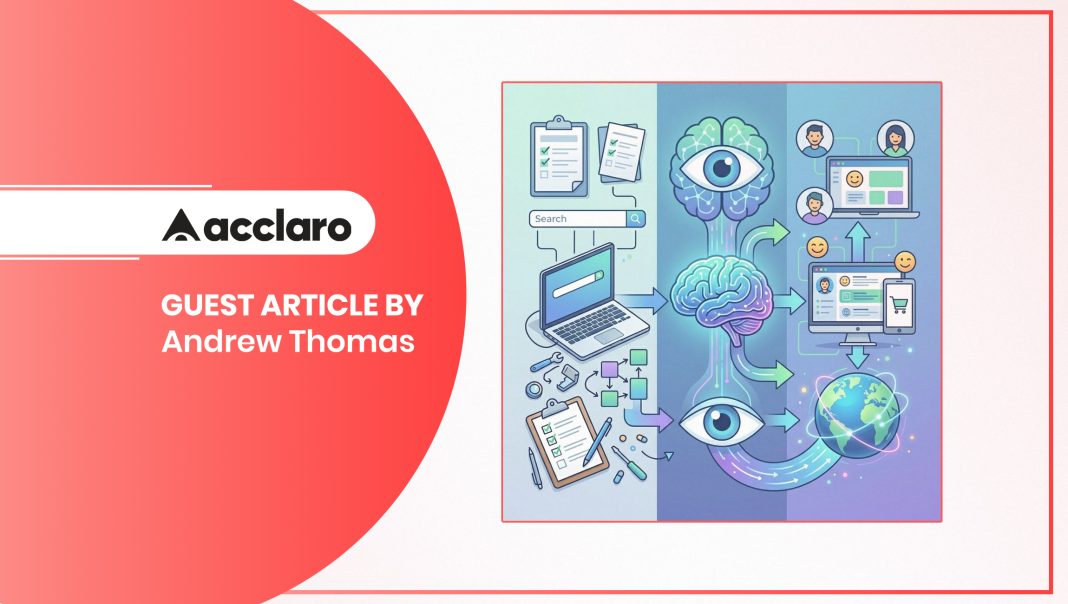
In an AI-driven buyer landscape, being “found” is no longer enough; being understood is what drives measurable results.
Long before modern marketing existed, humans communicated solely through spoken language before adopting an early form of localization using images and symbols to communicate stories across tribes and cultures. Centuries later, innovations such as the printing press made it possible to distribute knowledge globally at scale, with works such as the Gutenberg Bible becoming some of the first widely translated texts. More recently the internet ushered in a similar exponential leap in global communication.
And now we are seeing new means of brand information dissemination that will likely have a similar impact on how we share information. Websites are falling away as the primary destination for both information and transactions, as increasingly discovery is happening through conversational interfaces, voice assistants, and AI-driven platforms where users have come to expect ultra-fast, highly contextual answers.
With AI as the new default user interface, marketers are changing their approach to content localization. The new imperative for marketers is semantically rich, intelligently structured content that machines can interpret and surface wherever discovery occurs. With generative engine optimization (GEO) and conversational search, localization is no longer just about language that resonates with local buyers but also building content that is inherently discoverable across markets, channels, and technologies.
The challenge is that global brands are rolling out AI‑generated content at scale without understanding how models interpret meaning, tone, or cultural nuance across markets. The result: off‑brand messaging, embarrassing mistranslations, and poor customer experiences. Marketers are discovering that “multilingual AI” isn’t actually delivering the necessary cultural relevance.
AI-Driven Discovery Changes Everything
For years, marketing technology stacks have been built around keyword optimization, campaign automation, and performance analytics. But as AI-driven discovery reshapes how buyers research brands and solutions, traditional SEO tactics are no longer enough. Modern search systems evaluate content based on semantic understanding — whether it demonstrates a clear grasp of buyer intent, not just keyword relevance.
AI-powered discovery engines prioritize questions over isolated terms, concepts over fragmented phrases, and contextual meaning over traffic volume. Increasingly, they evaluate whether content clearly communicates the problem a company solves, the audience it serves, and how it differentiates from competitors within specific buying scenarios. Relevance is dynamic, shifting across industries, geographies, and regulatory environments — and AI systems are designed to favor these nuances.
This means semantically aligned content attracts more qualified audiences, improves engagement, and accelerates pipeline readiness.
Global Martech Strategies Need a Semantic Foundation
Global marketing organizations have invested heavily in martech platforms to accelerate content delivery, automate workflows, and scale campaign execution. Yet international performance often lags behind expectations.
Direct translation preserves wording but often loses the contextual signals that influence conversion. Traditional transcreation can address this, but differences in local search behavior, industry terminology, regulatory requirements, and cultural framing shape how buyers evaluate solutions. For example, compliance-related searches may differ significantly between markets, while terminology used to describe risk, security, or operational efficiency can vary widely across regions.
When these nuances are lost, content may be linguistically accurate but commercially invisible — particularly to AI systems trained to evaluate authority and relevance. The result is weaker engagement, inconsistent campaign performance, and underutilized martech investments.
With a semantic approach, products, services, and value propositions are clearly defined using language aligned to real buyer challenges. Problem–solution narratives reflect real-world use cases, and content answers high-intent questions in natural language. Consistent terminology and entity clarity are maintained globally while contextual examples are adapted locally.
For revenue teams, this approach results in higher-quality organic traffic and improved conversion rates across regions.
Marketing Technology News: MarTech Interview With Fredrik Skantze, CEO and Co-founder of Funnel
Building a Semantic Framework in the Martech Stack
AI-powered content and SEO tools have become essential components of the modern martech ecosystem. Topic modeling can reveal high-intent content gaps, entity extraction can sharpen positioning, and structured data can strengthen relevance signals. AI-assisted content expansion can accelerate authority building in priority segments.
However, automation without a defined semantic framework often leads to fragmentation across markets and channels.
The foundation should begin with a semantic core defined in the source language. This includes standardized descriptions of solutions, industries, use cases, and differentiators. Establishing this foundation determines which elements must remain globally consistent to maintain brand clarity and which should adapt to local buyer behavior.
Once defined, this semantic strategy should be embedded into marketing operations — including localization workflows, governance processes, and performance measurement. This is where SEO, marketing operations, and localization maturity intersect, turning content from a production task into a structured growth asset.
The Future of Global Demand Generation
The future of global demand generation will not be defined by producing more campaigns or increasing content velocity. Instead, success will depend on ensuring that content is clearly understood by both buyers and machines across every target market.
Semantically structured global content improves discoverability in AI-driven search environments while strengthening alignment across marketing, product, and revenue teams. It increases traffic quality, accelerates pipeline contribution, and supports scalable international growth.
In an AI-driven buyer landscape, being “found” is no longer enough. Being clearly understood is what drives measurable results — and for martech leaders focused on predictable growth, semantic clarity is quickly becoming a core competitive advantage.
Marketing Technology News: The Death of Third-Party Cookies Was Just the Start. Are You Ready for Consent Orchestration?