

Over the past two years, artificial intelligence has moved from experimentation to implementation. Organizations that once focused on testing chatbots and content-generation tools are now exploring a more advanced frontier: agentic AI.
Unlike traditional AI systems that primarily respond to prompts, agentic AI can plan, reason, make decisions, and execute actions across multiple systems with limited human intervention. These intelligent agents can interact with software applications, coordinate workflows, access enterprise data, and complete complex tasks from start to finish.
This evolution is changing how businesses think about productivity.
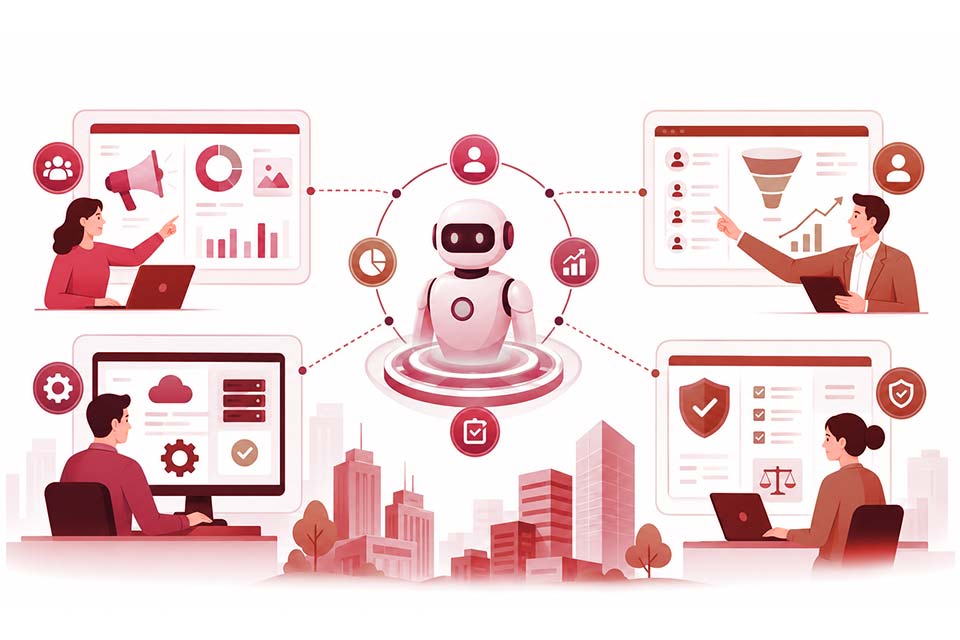
From marketing and sales to IT and compliance, enterprises are beginning to discover that agentic AI is not simply another automation tool. It represents a new operating model for work.
Moving Beyond Task Automation
For years, automation focused on repetitive tasks.
Organizations automated invoice processing, email routing, customer support tickets, and data entry. While these initiatives improved efficiency, they typically operated within narrow boundaries and required extensive human supervision.
Agentic AI changes this equation.
Instead of automating individual tasks, AI agents can manage entire workflows.
For example, a traditional marketing automation platform might send emails based on predefined rules. An agentic AI system can analyze audience behavior, create campaign strategies, generate content, launch campaigns, monitor performance, and recommend adjustments in real time.
The difference is significant.
Businesses are no longer automating activities. They are automating outcomes.
Transforming Marketing Through Autonomous Execution
Marketing teams are under constant pressure to deliver personalized experiences across an expanding number of channels.
The challenge is not a lack of ideas. It is the growing complexity involved in executing them.
Agentic AI is helping organizations bridge this gap.
Some enterprises are deploying AI agents that continuously monitor customer behavior, market trends, competitor activity, and campaign performance. These systems can identify opportunities, recommend content strategies, and optimize budgets without waiting for manual analysis.
Reimagining Sales Operations
Sales organizations have historically struggled with administrative overhead.
Researching prospects, updating customer relationship management systems, creating proposals, forecasting revenue, and managing pipelines consume significant time that could otherwise be spent building relationships and closing deals.
Agentic AI is helping sales teams reclaim that time.
Modern sales agents can gather intelligence about prospects, identify buying signals, draft personalized outreach messages, prepare meeting briefs, and recommend next actions.
Some organizations are even deploying revenue intelligence agents that monitor customer interactions across channels and proactively identify expansion opportunities.
Creating More Resilient IT Operations
The IT department has become one of the earliest beneficiaries of agentic AI.
Modern technology environments are increasingly complex, spanning cloud infrastructure, applications, cybersecurity tools, networks, and distributed workforces.
Maintaining visibility across these environments is challenging, even for highly skilled teams.
Agentic AI provides a new layer of operational intelligence.
AI agents can continuously monitor infrastructure, identify anomalies, investigate incidents, and recommend corrective actions.
In some cases, they can resolve issues autonomously before employees or customers experience disruptions.
For example, an AI agent monitoring cloud infrastructure may detect unusual resource consumption, identify the underlying cause, and initiate remediation workflows automatically.
This reduces downtime and enables IT teams to focus on strategic initiatives rather than routine troubleshooting.
Strengthening Compliance and Governance
Compliance teams face a growing challenge.
Regulations are evolving rapidly, while organizations generate unprecedented volumes of data, communications, transactions, and documentation.
Traditional compliance processes often struggle to keep pace.
Agentic AI offers a way to scale oversight without proportionally increasing resources.
AI agents can monitor regulatory developments, review internal processes, identify policy violations, and generate compliance reports.
For example, a compliance agent may continuously evaluate customer communications for regulatory risks, flag suspicious transactions, or verify adherence to internal governance standards.
Marketing Technology News: MarTech Interview with Theresa Pham, Head of Product @ Wayvia
Human and AI Collaboration: The Winning Model
A common misconception is that agentic AI aims to eliminate human involvement.
In reality, the most successful deployments emphasize collaboration rather than replacement.
Humans continue to provide strategic direction, ethical judgment, creativity, and contextual understanding.
AI agents contribute speed, scale, consistency, and operational efficiency.
Together, they create a hybrid workforce capable of achieving outcomes that neither could accomplish alone.
Organizations that recognize this balance are likely to realize the greatest value from their AI investments.
Wrapping up – The Future of Enterprise Operations
The adoption of agentic AI represents more than another technology upgrade.
It signals a fundamental shift in how work is organized, executed, and scaled.
Just as cloud computing transformed infrastructure and digital platforms transformed customer engagement, agentic AI is poised to transform operational workflows across the enterprise.
The organizations leading this transformation are not simply deploying AI tools.
They are redesigning processes, redefining roles, and building systems where intelligent agents can collaborate with people to achieve business objectives more efficiently.
As the technology matures, the competitive advantage will increasingly belong to enterprises that can successfully combine autonomy, governance, and human expertise.
The future of work is unlikely to be fully automated.
But it will almost certainly be increasingly agent-driven.
And for organizations willing to embrace this shift, the opportunities are only beginning to emerge.
Ref: https://martech.org/agentic-ai-use-cases/
Marketing Technology News: Idle data is as good as no data