
Marketing is entering a new era as intelligent systems take over many of the repetitive decisions and operational tasks that once required constant human intervention. For decades, marketers have executed campaigns by mapping customer journeys, choosing communication channels, timing messages, monitoring campaign performance, and manually adjusting strategies based on outcomes. Marketing automation brought a lot of efficiency to the table by automating emails, workflows, and customer segmentation. But much of it was still rule-based and human-driven. Today, artificial intelligence is taking marketing from automation to autonomy, allowing systems to continuously learn, adapt, and engage customers across multiple channels with minimal human intervention.
The shift from multichannel marketing to autonomous client engagement mirrors the increasing complexity of contemporary consumer behavior. Today, customers interact with brands across websites, mobile apps, social media platforms, email, messaging apps, search engines, connected devices, physical retail stores, voice assistants, and new digital experiences. These interactions are no longer predictable, linear paths. Instead, customers are moving across channels and demand seamless, personalized experiences regardless of location and time. With customer touchpoints multiplying constantly, manually managing these intricate journeys is getting harder and harder.
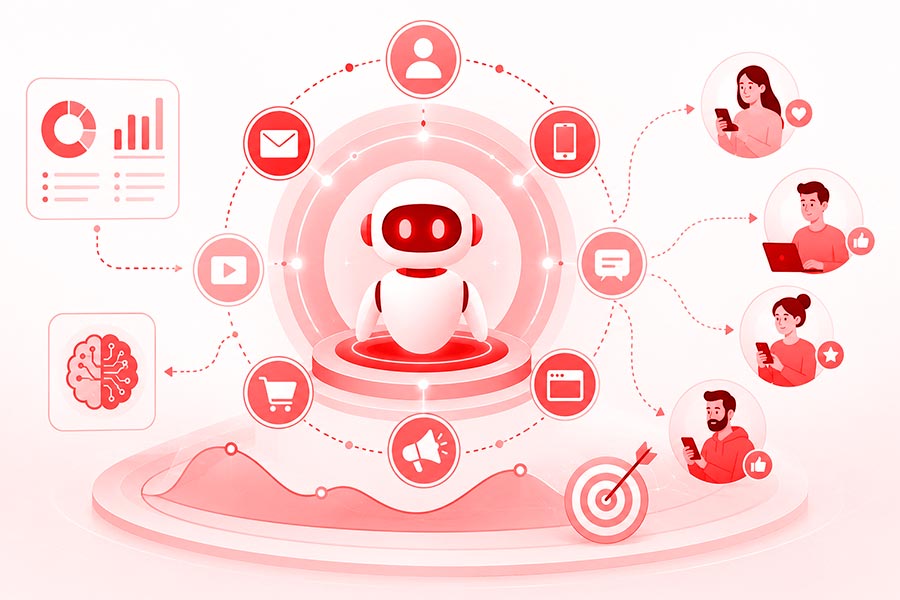
Artificial intelligence agents are emerging and fundamentally changing how marketing works. AI agents are not like traditional automation tools that follow defined workflows. They are constantly analyzing customer behavior, predicting future actions, personalizing communications, and optimizing engagement strategies in real time. These intelligent systems can process millions of customer signals at once, spotting interaction opportunities that human marketers could never spot at scale. Now, AI agents can independently choose the correct message, determine the optimal communication channel, recommend personalized offers, and start client engagement without waiting for manual approval.
This change has led to a critical need for continuous cross-channel orchestration. Today’s consumers expect brands to know their preferences and past interactions, whether they are engaging via email, social media, mobile apps, websites, customer support platforms, or in brick-and-mortar locations. To provide a consistent experience across those environments requires intelligent systems that can coordinate all customer interactions in real-time. Autonomous engagement ensures that every single communication is part of a single customer journey rather than being disparate marketing activities.
MarTech has become the intelligence layer powering autonomous engagement. Modern marketing technology platforms integrate customer data, behavioral analytics, artificial intelligence, forecasting, and automation into connected ecosystems that constantly track customer behavior and optimize engagement strategies. MarTech platforms have evolved from campaign execution tools to intelligent decision engines that interpret customer intent, incorporate contextual information, and orchestrate highly personalized experiences across every available channel.
The next step in customer relationship management is autonomous brand engagement. It brings together AI-powered analytics, machine learning, customer data platforms, predictive intelligence, and intelligent automation to build marketing systems that can autonomously manage customer interactions. Instead of relying on marketers to figure out when and how to engage customers, intelligent systems dynamically adjust engagement strategies to changing customer behaviour, business objectives, and market conditions.
AI-powered client engagement is quickly becoming a critical competitive advantage. Organizations that respond quickly to customer needs, personalize every interaction, and continuously optimize engagement outperform competitors that rely on manual marketing processes. Autonomous engagement allows businesses to build better relationships with their customers, to be more operationally efficient, to market more effectively, and to grow revenues. As customer expectations continue to grow, the ability to deliver intelligent, personalized experiences at scale will become increasingly important to maintain competitive differentiation.
The future of marketing is self-optimizing ecosystems powered by intelligent automation.” These ecosystems are continuously collecting customer data, extracting insights, forecasting future behavior, engaging in personalized interactions, and optimizing performance without the need for constant human intervention. Autonomous engagement is not a replacement for marketers, but it allows marketing professionals to focus on creativity, brand strategy, customer innovation, and long-term business growth as AI takes over operational execution across increasingly complex customer journeys.
What is Autonomous Brand Engagement?
Autonomous brand engagement is the use of artificial intelligence to autonomously deliver, customize, and optimize customer experiences across multiple channels throughout the customer lifecycle. What makes autonomous engagement different from traditional marketing automation is that it learns from customer behavior, makes intelligent decisions, and adapts communication strategies without constant human supervision.
At the heart of this idea is the development of intelligent marketing systems that autonomously understand customer intent, predict future behavior, identify the best way to engage, and deliver personalized experiences. AI turns mountains of customer data into actionable intelligence that drives real-time decisions at every digital and physical touchpoint.
Autonomous marketing is built on continuous, personalized engagement. Instead of viewing customer interactions as separate events, AI constantly monitors browsing behavior, purchase history, social engagement, customer service interactions, geographic context, and behavioral signals to create dynamic customer journeys that change with every interaction.
Rather than manually trying to figure out each customer interaction, autonomous engagement systems are constantly assessing what customers need, when they should be contacted, the best channel to use, and how the message should be customized to maximize engagement.
Evolution from Campaign Automation to Autonomous Marketing
There have been a number of key phases of marketing technology leading to autonomous engagement.
In the old days, managing a campaign was mostly about planning and carrying things out yourself. Marketing teams created customer segments, scheduled campaigns, monitored performance reports, and adjusted strategies after reviewing historical results. This was okay for simpler customer journeys, but it just couldn’t cope with today’s fast-paced digital environments.
Marketing automation platforms introduced rule-based workflows automating repetitive tasks like email campaigns, lead nurturing, customer onboarding, and behavioral triggers. While these technologies were highly effective, they still depended on predefined business rules set by marketers.
The next evolution was AI-assisted client engagement. Artificial intelligence has turbocharged marketing automation with predictive analytics, intelligent segmentation, recommendation engines, and behavioral scoring. AI was used by marketers to make better decisions, and humans were still managing overall campaign strategy.
Today, fully autonomous brand interaction ecosystems represent the latest stage of marketing evolution. AI agents are autonomous, continuously monitoring customer behavior and optimizing the timing of communications, personalizing messaging, coordinating omnichannel experiences, and improving client engagement through self-learning algorithms. Marketing is flexible, manually controlled, continuously optimized, predictive, and adaptive.
The requirement for autonomous engagement
The growing importance of autonomous brand engagement for today’s companies is being driven by key trends. Customer expectations are rising. Consumers are expecting hyper-personalized experiences at every touchpoint. Customers want brands to understand their personal preferences, behavior, and buying intent, and generic campaigns just won’t cut it anymore.
The growing number of digital channels that customers engage with adds to the complexity of marketing. Organizations must orchestrate customer experiences across websites, mobile apps, email, social media, messaging channels, voice assistants, retail, connected devices, and new digital platforms simultaneously.
Customers also want to be responded to right away. Delayed engagement means missed opportunities, lower satisfaction, and lower conversion rates. AI empowers organizations to deliver highly personalized interactions at enterprise scale while still being able to react in real time.
Omnichannel marketing is much more complex as customer journeys cross multiple devices, channels, and communication platforms. Autonomous engagement continuously orchestrates these interactions to ensure a consistent customer experience, no matter where the engagement takes place.
Competitive pressure is also driving organisations to always-on engagement models. Companies that use intelligent automation to build lasting customer relationships have higher loyalty, better retention, higher conversion rates, and better operational efficiency than their competitors who still rely on manual marketing execution.
From Reactive Campaigns to Continuous Client Engagement
The most significant change in modern marketing is surely the transition from reactive campaign management to continuous client engagement. Traditional marketing was heavily dependent on event-based campaigns that were triggered by scheduled promotions, product launches, seasonal activities, or customer actions. These campaigns were effective in some cases, but were often reactive to customer behavior that had already happened.
Predictive engagement changes this fundamentally. AI is constantly evaluating customer behaviour to anticipate future needs before customers articulate them verbally. Predictive Analytics: AI detects purchase intent, churn risk, product interests, lifecycle changes, and engagement opportunities.
AI-driven decision-making helps to make marketing more effective by identifying the best content, communication channel, timing, frequency, and personalization strategy for each customer interaction. Decisions are being made on a continuing basis, not on periodic campaign planning cycles.
The end goal of autonomous engagement is self-learning orchestration of the customer journey. Intelligent systems are always monitoring results, learning from customer responses, refining engagement strategies, and automatically improving future interactions. Every customer touchpoint with a company helps make the next touchpoint better, creating marketing ecosystems that keep improving.
As artificial intelligence permeates every aspect of customer interaction, autonomous brand interaction will become the standard operating model for modern marketing organizations. Intelligent automation will enable businesses to learn and adapt continuously, engaging customers in ways that will help improve marketing performance and create sustainable competitive advantages in a more digital marketplace.
Autonomous Brand Engagement Core Capabilities
Autonomous brand engagement is the next evolution of marketing, where artificial intelligence continually monitors customer behavior, predicts intent, personalizes experiences, and optimizes engagement without the need for constant manual intervention. Autonomous engagement platforms differ from traditional marketing automation that relies on predefined workflows, as they learn from customer interactions and dynamically adjust marketing strategies across all touchpoints.
MarTech is the intelligence layer that links customer data, AI, analytics, and automation to deliver highly personalized experiences at enterprise scale. The following capabilities are the foundation for autonomous brand engagement.
a) Unified Customer Intelligence
To automate engagement, you need one complete view of each customer, and that’s what unified customer intelligence delivers. Consumers today interact with brands through websites, mobile apps, social media, emails, retail locations, customer service, marketplaces, and connected devices. Without a single view of the customer, organizations struggle to provide consistent and personalized experiences.
First-party customer data is the most valuable source of marketing intelligence as privacy regulations limit third-party tracking. Organizations are increasingly gathering behavioral, transactional, demographic, and engagement data directly from customer interactions to build trusted customer intelligence.
Unified customer profiles combine information from CRM platforms, e-commerce systems, customer service platforms, loyalty programs, marketing applications, and digital channels into a single customer view. This comprehensive profile enables AI to comprehend consumer habits, interests, purchase history, and engagement behavior at each interaction.
Real-time behavioral insights in continuous mode analyze browsing activity, purchasing behavior, content engagement, search history, and customer interactions as they occur. AI uses these insights to tailor future interactions and discover new opportunities in real time.
Key capabilities are:
- First-party customer data integration.
- Unified customer profiles.
- Real-time behaviour insights.
- Cross-channel identity management.
- Constant updates on customer intelligence.
Unified customer intelligence helps companies to understand customers holistically, rather than as a collection of touchpoints.
b) AI-Driven Customer Journey Orchestration
Customer journeys are not linear anymore. They hop from channel to channel, device to device, touchpoint to touchpoint before they buy. AI-powered customer journey orchestration enables organizations to intelligently and continuously orchestrate these intricate journeys.
Dynamic journey mapping constantly updates customer journeys as behavior, interests, life events, and purchase intent evolve. “AI doesn’t follow a pre-determined marketing funnel. It builds customer journeys that evolve and change with every interaction.
Next-best-action recommendations use the customer context to recommend the best engagement opportunity. The AI determines if customers get educational content, promotional offers, customer support, product suggestions or loyalty incentives.
AI is able to track what customers are responding to in real time, and automatically adjust engagement strategies with continuous journey optimization. Every interaction makes the recommendations better for the future, so the customer journeys become more and more effective over time.
Organizations benefit from:
- Dynamic customer journey mapping.
- AI-powered next best action recommendations.
- Ongoing journey optimization.
- Adaptive engagement workflows.
- Smarter customer lifecycle management.
This lets you turn static customer journeys into continuously learning engagement ecosystems.
c) Hyper-Personalization Engines
Consumers today demand a highly personalized experience that is relevant to their preferences, behavior, and context. AI-powered hyper-personalization engines deliver individualized experiences at the scale of an enterprise.
AI is able to personalize website experiences, emails, ads, product recommendations, landing pages, and mobile apps based on each customer’s interests and engagement history with individual content personalization.
Context-aware messaging considers location, device, time of day, browsing activity, stage in the purchasing process, weather conditions, customer sentiment, and prior interactions when making decisions about how communication should be personalized.
Predictive customer experiences go beyond what a customer is doing now to predict what they’ll need in the future. AI detects likely buys, potential questions, churn risks, and engagement opportunities before customers even say so.
Hyper personalization features:
- Individual content personalization.
- Context-aware messaging.
- Predictive customer experiences.
- Personalized recommendations.
- Dynamic customer engagement.
Personalization is moving away from simple segmentation to unique customer experiences that are continuously created by AI.
d) Autonomous Decision Engines
AI is able to independently assess marketing opportunities and decide on the most suitable engagement tactics through autonomous decision engines, removing the need for human approval.
AI-powered campaign optimization constantly tracks campaign performance, audience behavior, conversion rates, engagement metrics, and business objectives and automatically makes changes to improve the outcome.
Intelligent offer selection is the process of identifying the products, services, discounts, incentives or educational content that should be shown to individual customers based on predicted purchasing behavior and business priorities.
AI makes automated marketing decisions — when to reach out, how often, to which customers, how to split budgets, and what the best channels are to engage in real-time, eliminating the need to manage campaigns manually.
The core Decision Engine capabilities are:
- AI campaign optimization.
- Intelligent offer selection.
- Automated marketing decisions.
- Dynamic budget optimization.
- Continuous performance improvement.
Marketing is moving from manual campaign management to intelligent, autonomous execution.
e) Omnichannel Engagement Orchestration
Consumers want the same experience no matter how they interact with a brand. Omnichannel orchestration lets AI orchestrate engagement across all customer touchpoints.
Cross-channel coordination ensures customer interactions are in sync across websites, email, social media, messaging platforms, mobile apps, contact centers, retail stores and digital ad platforms.
AI may optimize channel selection to identify the most likely channel to elicit positive customer responses, based on the customer’s past behavior and preferences, urgency, and context of engagement.
Consistent customer experiences ensure that messaging, branding, offers and personalization are unified no matter which channel customers choose at any point in their journey.
Organizations increase engagement through:
- Cross-channel coordination.
- Intelligent channel selection.
- Consistent customer experiences.
- Unified communication strategies.
- Continuous omnichannel optimization.
Omnichannel orchestration links fragmented customer experiences into connected engagement ecosystems.
f) Continuous Performance Intelligence
Continuous learning is a prerequisite for autonomous engagement. Performance intelligence enables the AI to monitor marketing effectiveness and automatically optimize future customer interactions.
Conversion rates, consumer engagement, campaign performance, channel effectiveness, customer lifetime value, and marketing ROI are all analyzed on an ongoing basis through real-time campaign analytics.
Engagement optimization uses real-time performance data to identify opportunities to improve messaging, audience targeting, content performance, timing of communications, and customer experiences.
“AI-and machine learning-based marketing feedback loops allow autonomous systems to learn continuously from every customer interaction. The good strategies are reinforced, the bad ones are automatically refined or replaced.
With performance intelligence, you get:
- Real-time campaign analytics
- Continuous engagement optimization.
- AI-powered feedback loops.
- Predictive performance insights.
- Continuous learning systems.
Marketing is not a quarterly report; it is an ongoing optimization process.
Technologies Supporting Autonomous Engagement
Today, autonomous engagement is driven by a connected ecosystem of leading-edge technologies that blend customer intelligence, artificial intelligence, predictive analytics, automation, and real-time decision-making. These technologies enable MarTech platforms to continuously assess customer behavior, provide personalized experiences, and optimize engagement across all channels with minimal human intervention.
a) Artificial Intelligence and Machine Learning
Artificial intelligence is the analytical engine powering autonomous marketing.
Predictive customer behavior models use behavioral analytics and historical data to predict purchasing intent, engagement probability, risk of churn, and value of the customer over the lifetime.
Intelligent segmentation groups customers by changing behaviors, rather than static demographic characteristics.
As customer behavior evolves, adaptive marketing optimization fine-tunes personalization, targeting, timing of communications, and campaign execution in a continuous cycle.
AI capabilities are:
- Predictive customer behavior.
- Intelligent segmentation.
- Adaptive optimization.
- Behavioral analytics.
- Continuous machine learning.
b) Generative AI
Generative AI is revolutionizing content creation and personalized communications.
Content created by AI crafts personalized emails, ads, product descriptions, landing pages, chatbot conversations, and social media posts to cater to consumer needs.
Personalized creative generation dynamically adapts visuals, headlines, calls-to-action, and promotional messaging to individual audiences.
With dynamic campaign messaging, organizations can scale their personalized communications to millions of customer interactions and still stay on brand.
Generative AI makes:
- AI-generated content.
- Personalized creative generation.
- Dynamic campaign messaging.
- Automated copywriting.
- Intelligent content optimization.
c) Customer Data Platform (CDP)
Customer data platforms give you the single view of the customer you need to engage on your own.
Unified customer profiles consolidate data from marketing, sales, customer service, ecommerce, and digital engagement systems into a single central customer record.
Identity resolution enables you to connect customer identities across multiple devices, applications, and channels for a complete view of individual customer behavior.
Customer profiles are updated in real-time as interactions occur, allowing for immediate personalization and decision-making.
CDP capabilities are:
- Unified customer profiles.
- Identity resolution.
- Real-time customer intelligence.
- Cross-platform data integration.
- Continuous profile enrichment
d) Agentic AI
Agentic AI brings autonomous decision-making into marketing workflows.
These autonomous marketing agents observe customer actions, assess campaign results, fine-tune engagement strategies, and implement marketing initiatives that align with business goals.
AI campaign managers manage customer journeys, campaign execution, budget optimization, and performance monitoring with little human intervention.
Multi-agent marketing collaboration allows specialized AI agents that are responsible for personalization, content generation, analytics, advertising, and client engagement to coordinate decisions across the whole marketing ecosystem.
Organizations benefit from:
- Autonomous Marketing Agents
- AI campaign management.
- Multi-agent cooperation.
- Intelligent decision-making.
- Self-learning marketing systems.
e) Marketing Automation Platforms
Marketing automation is still a core technology that enables autonomous engagement.
Intelligent workflows automate the customer onboarding, lead nurturing, retention campaigns, event communications, and lifecycle marketing workflows.
Customer interactions are triggered by behaviors such as purchases, abandoned carts, website visits, product use, or service requests.
Campaign execution offers automated communication delivery via email, SMS, social, mobile apps, digital ads, and customer support channels.
Automation features:
- Workflow automation.
- Trigger-based engagement.
- Campaign execution.
- Lifecycle marketing.
- Process standardization.
f) Real-Time Analytics and Decision Engines
Real-time analytics provide ongoing intelligence for self-directed engagement.
Live customer insights track customer behavior and campaign performance, conversion activity, and engagement patterns in real time.
Event-driven marketing allows AI to respond instantly to customer actions like buying, searching, viewing a product, making a support request, or hitting a loyalty milestone.
Continuous optimization enables autonomous systems to analyze results, optimize engagement strategies, and improve marketing performance without manual analysis.
Together, these technologies turn MarTech from a platform to execute campaigns into an intelligent engagement system that can continuously learn, adapt, and deliver highly personalized customer experiences across every channel.
Marketing Technology News: MarTech Interview with Theresa Pham, Head of Product @ Wayvia
Enterprise Applications
Autonomous marketing is transforming how organizations interact with customers across every stage of the buying journey. Autonomous marketing systems differ from traditional automation in that they use pre-defined workflows. They continuously learn from customer behavior, market conditions, and business objectives to make intelligent decisions in real-time.
AI-powered platforms allow businesses to provide personalized experiences, optimize campaigns, improve customer relationships, and maximize revenue, all without the need for constant human intervention. As organizations compete in increasingly dynamic digital markets, autonomous marketing is emerging as a strategic driver of consumer engagement, operational efficiency, and long-term business growth.
a) Personalised Customer Experiences
Today’s customers expect brands to understand what they like, anticipate their needs, and present relevant experiences throughout their journey. In autonomous marketing, companies can develop highly personalized experiences based on ongoing analysis of customer behavior such as browsing history, buying patterns, engagement signals, and contextual data.
Instead of seeing audiences as broad market segments, AI creates individualized customer journeys for every individual. Marketing messages, recommendations, promotions, and the timing of communications automatically change with the changing behavior of customers.
AI-powered recommendation engines drive product discovery by suggesting relevant products, services, and content that match customer interests. The recommendations get better and better as we get more behavioral data.
Context-aware engagement also improves personalization by taking into account:
- Customer location
- Device usage
- Purchase history
- Browsing behavior
- Time of interaction
- Previous brand engagement
- Seasonal preferences
The result is highly relevant customer experiences that build trust, increase engagement, and improve conversion rates.
b) Multichannel Marketing
Today’s consumers are engaging with brands via websites, mobile apps, email, social media, messaging, retail stores and customer support. Autonomous marketing ensures these interactions stay connected and consistent, wherever the engagement is happening.
Rather than running individual marketing campaigns, companies are now able to deliver seamless customer experiences across all touchpoints. AI continuously aligns messaging, promotions, and engagement tactics across a range of channels.
The key omni-channel capabilities are:
- Integrated cross-channel campaign management
- Personalized cross-platform messaging
- Dynamic channel selection
- Automated campaign optimisation
- Device-to-device customer recognition
- Seamless brand experience
For example, when a customer abandons a shopping cart on a website, the AI system may automatically send an email reminder, display personalized ads on social media, send a mobile notification, and suggest complementary products the next time the customer interacts.
The seamless coordination creates a more engaging, frictionless customer experience and maximizes campaign effectiveness.
c) Customer Retention
Customer retention is one of the most important priorities for any business because it is a lot more expensive to gain new customers than to keep the ones you have. Autonomous marketing enables organizations to detect potential churn risks before customers disengage.
AI continually scans behavioral signals such as:
- Reduced website activity
- Lower purchase frequency
- Declining engagement
- Customer support interactions
- Subscription usage
- Sentiment analysis
- Buying pattern changes
Upon detection of early warning signs, autonomous marketing systems automatically deploy personalized retention campaigns to re-engage customers before they leave.
Retention initiatives may include:
- Exclusive promotional offers
- Personalized recommendations
- Loyalty rewards
- Educational content
- Customer appreciation campaigns
- Automated follow-up communications
AI also enhances loyalty programs by identifying the rewards most likely to drive repeat sales and sustained engagement.
Ongoing relationship management allows businesses to interact with customers at all stages of their lifecycle, leading to increased satisfaction and lifetime value.
d) Lead Nurturing and Revenue Creation
With autonomous marketing, lead management is totally transformed. It continuously analyzes prospect behavior and automatically delivers personalized nurturing experiences.
Dynamic communication based on each prospect’s interests, level of engagement, buying readiness, and behavioral cues is possible with AI, compared to static email sequences.
Smart lead nurturing includes:
- Personalized Educational Content
- Dynamic email marketing campaigns
- Automated follow-up
- Behavioral targeting
- Recommended content
- Multi-channel client engagement
AI also automates lead qualification, scoring prospects on their likelihood to convert. Sales teams get high-quality leads at the right time so they can concentrate on opportunities with the greatest revenue potential.
Conversion optimization drives better business outcomes by:
- Custom-made landing pages
- Live Offers
- Real-time campaign adjustments
- AI-driven content optimization
- Automated A/B testing
- Intelligent pricing recommendations
With automation and predictive intelligence, companies shorten sales cycles and increase conversion rates and revenue growth.
e) E-commerce and Internet Commerce
One of the strongest use cases for autonomous marketing has been ecommerce. Online retailers have enormous amounts of customer data, allowing AI to optimise every element of the shopping experience.
Personalized product recommendations are based on browsing behavior, purchase history, consumer tastes, and similar customer profiles to offer product suggestions that are most likely to lead to sales.
Optimizing the shopping journey includes:
- Personalized homepage content
- Dynamic product displays
- Customized promotions
- Intelligent search recommendations
- Adaptive navigation
- Personalized checkout experiences
Autonomous marketing also reduces abandoned shopping carts through automated recovery campaigns.
Cart recovery strategies are:
- Personalized reminder emails
- Mobile notifications
- Limited-time offers
- Discount incentives
- Product recommendations
- Retargeting advertisements
These automated interventions increase conversion rates dramatically and improve customer satisfaction throughout the buying journey.
f) Customer Service Integration
Customer service is increasingly becoming an integrated part of autonomous marketing rather than a separate business function. AI enables organizations to deliver a consistent customer experience across marketing, sales, and support.
AI-powered customer assistants can respond immediately to customer queries and help users to find products, troubleshoot problems, book appointments, or complete transactions.
Intelligent automation support journeys help customers navigate:
- Product selection
- Troubleshooting
- Order tracking
- Account management
- Technical support
- Service requests
All customer interactions across all departments are merged into a single customer profile, so support is personalized with complete historical context.
Unified customer involvement means that customers have the same experience whether they engage with marketing campaigns, sales reps, or customer support teams.
This combination leads to lower operating costs and higher service efficiency and enhances customer satisfaction.
Business Benefits
The use of autonomous marketing delivers tangible improvements in marketing performance, client engagement, operational efficiency, and competitive positioning for organizations. Artificial intelligence and continuous learning together help companies react faster to changing customer expectations and optimize long-term growth.
a) Continuous Customer Engagement
Traditional marketing campaigns are usually based on fixed schedules, which makes it hard to keep up with the pace of customer behavior. Autonomous marketing keeps businesses connected around the clock.
AI tracks customer interactions in real time and automatically updates communication strategies when new opportunities arise.
Key benefits include:
- Always-on customer engagement
- Immediate campaign adjustments
- Real-time customer interactions
- Personalized communication timing
- Continuous behavioral monitoring
- Higher engagement consistency
This ongoing presence helps brands stay relevant throughout the customer lifecycle.
b) Better marketing efficiency
Marketing teams spend a lot of time managing campaigns, analyzing performance, and tweaking them manually. Autonomous marketing automates many of these repetitive tasks, but it also improves performance overall.
Campaigns are constantly optimized by AI; no constant human supervision is needed.
Efficiency improvements include:
- Reduced manual campaign management
- Automated optimization
- Faster campaign deployment
- Lower operational costs
- Better resource allocation
- Improved productivity
Strategic planning, creativity, and innovation may take more time for marketing professionals than routine operational activities.
c) Enhanced Personalization
One of the biggest advantages of autonomous marketing is the ability to deliver personalization at scale. AI optimizes customer experiences in real time based on behavioral insights rather than static customer segments.
Better personalization includes:
- Context-aware customer experiences
- Individual customer journeys
- Personalized recommendations
- Adaptive content delivery
- Dynamic messaging
- Relevant promotional offers
This high degree of personalization enhances customer relationships, enhances satisfaction, and increases the probability of repeat purchases.
d) Quicker Marketing Decisions
Today’s markets are fast, and companies need to make decisions based on what customers are doing today, not what reports from yesterday said. With autonomous marketing, you get ongoing intelligence that enables faster and more accurate decisions.
AI can evaluate millions of customer interactions at once and find patterns that humans might miss.
Decision-making advantages:
- Real-time campaign optimization
- Predictive customer insights
- Automated experimentation
- AI-assisted decision support
- Dynamic budget allocation
- Faster strategic adjustments
Organizations become more agile to capitalize on emerging opportunities and minimize marketing risks.
e) Improved Customer Lifetime Value
Because long-term profits depend on cultivating strong customer relationships, not just on winning new customers. Autonomous marketing increases customer lifetime value through engagement across the customer lifecycle.
AI identifies opportunities for:
- Increased customer retention
- Smarter cross-selling
- Personalized upselling
- Loyalty program optimization
- Repeat purchase encouragement
- Proactive customer support
The closer and more personal the customer relationship, the higher the revenue, loyalty and brand advocacy a business experiences.
f) Competitive Advantage and Sustainability
Organizations that successfully adopt autonomous marketing gain significant long-term competitive advantages. AI is constantly learning from customer interactions, campaign results, and market changes, enabling businesses to get better faster than their competitors using traditional marketing approaches.
The strategic benefits are:
- Smart customer involvement
- Continuous learning of AI
- More rapid innovation
- Predictive analytics business intelligence
- Scalable marketing operations
- Marketing leadership, powered by AI
As autonomous marketing technologies continue to develop, companies that adopt intelligent automation will be better positioned to adapt to evolving consumer expectations, optimize marketing performance, deepen customer relationships, and sustain long-term growth in an increasingly competitive digital economy.
Challenges
The rapid adoption of autonomous marketing presents great opportunities for businesses but also poses several challenges for organizations to overcome for sustainable success. As AI takes on increasingly complex marketing decisions, companies will need to wrestle with data quality, transparency, privacy, tech integration, organizational readiness, and creative governance challenges. Successfully managing these challenges ensures that autonomous marketing provides meaningful business value, while also maintaining customer trust and regulatory compliance.
a) Customer Data Quality
The quality of customer data is a key ingredient to the effectiveness of autonomous marketing. Artificial intelligence requires accurate, trusted, and consistent data to be able to generate accurate insights and personalized experiences. Unfortunately, many organizations still battle fragmented customer data, spread across multiple systems, making it difficult to develop a holistic view of customer behavior.
Unified customer profiles are one of the biggest priorities for businesses that are implementing autonomous marketing. Customer information is frequently dispersed across a range of platforms, such as CRM, e-commerce, marketing automation, customer service, loyalty programs, and social media channels. AI is able to take these siloed datasets and knit together the whole story of each customer interaction.
The other significant challenge is identity resolution. Customers interact with brands across many devices, email addresses, browsers, and digital platforms. The only way artificial intelligence can offer truly personalized experiences is if it can recognize that these interactions are from the same individual.
The consistency of the data is equally important. Poor recommendations, ineffective campaigns, and reduced customer satisfaction can result from inaccurate, outdated, duplicate, or incomplete records. Therefore, organizations must invest in strong data governance practices to ensure that customer information is accurate, standardized, and current.
b) AI Trust and Explainability
Businesses need to make sure that autonomous marketing systems that make strategic decisions with minimal human involvement are explainable and trustworthy. Marketing leaders need to be confident that AI is based on logic for its recommendations, not on unpredictable algorithms.
AI decision transparency helps marketers understand why a certain audience was targeted, why a particular offer was recommended, or why campaign budgets were reallocated, which fosters accountability. Explainable AI helps marketing teams to build trust and allows organizations to check that automated decisions are in line with business goals.
Ethical automation is also becoming more important. Artificial intelligence should not perpetuate bias, exploit vulnerable customers, or create unfair marketing practices. Responsible AI frameworks help organizations set the ethical standards that guide automated decision-making.
Responsible personalization is about striking the right balance between being relevant and respecting a customer’s boundaries. Customers like personalization, but too much of it can be invasive if it feels like the brand knows more than it should. Organizations must therefore make sure personalization is transparent, appropriate, and in line with customer expectations.
c) Privacy and Regulatory Compliance
As consumers become more aware of digital privacy, the regulatory landscape around customer data has grown as well. As autonomous marketing systems develop to deliver personalized customer experiences, they will have to operate within more complex legal structures.
Consent management has become a basic need for organizations that collect and use customer data. Companies must be able to demonstrate how they will use customer data, seek appropriate permissions, and give users simple options to change or withdraw consent.
With third-party cookies continuing to fade, the value of first-party data governance increases. They are paying more attention to gathering data from direct customer interactions with policies that guarantee the quality, security, accessibility, and responsible use of data.
International markets are subject to global privacy regulations like the General Data Protection Regulation (GDPR), the California Consumer Privacy Act (CCPA) and many regional privacy laws that require businesses to treat customer information with great care. Autonomous marketing platforms must be aware of compliance requirements at all times and adapt to the evolving regulatory landscape.
Compliance with privacy regulations reduces legal risk and fosters customer trust—a competitive advantage that is more valuable than ever.
d) Technology Integration
Many organizations have complex marketing technology environments with dozens, or even hundreds, of specialized applications. For autonomous marketing to work, these systems have to talk to each other.
For AI to access customer information across different business functions, the MarTech stack must be interoperable. Marketing automation platforms, CRM systems, ecommerce applications, customer support software, analytics platforms, and advertising technologies need to share information in real time.
API connectivity allows these systems to share customer data, campaign metrics for performance, and operational insights efficiently. If you have a solid architecture for APIs, it’s easier for an organization to scale and adopt new technology without having to interrupt what already exists.
Modernization of legacy systems continues to be a challenge for many enterprises. Most older software platforms do not have the agility to enable AI-powered automation and real-time data processing. During a digital transformation initiative, businesses may need to incrementally modernize infrastructure while ensuring business continuity.
e) Organisational preparedness
No amount of technology can create successful autonomous marketing. Organizations also need to prepare their people, processes, and culture to be open to AI-driven operations.
Marketing AI skills. As marketing professionals learn to work with intelligent systems as opposed to managing every campaign manually, marketing AI skills are becoming more and more important. Employees need to be able to understand AI recommendations, monitor automated performance, and optimize strategic marketing initiatives.
Working across functions is equally important. Autonomous marketing requires strong collaboration across marketing, sales, customer service, information technology, data science, compliance, and executive leadership. These departments need to collaborate to develop seamless client engagement strategies based on shared data and integrated technology.
Managing change is essential for successful implementation. Initial employee resistance to automation may be rooted in concerns about changing responsibilities or uncertainty about what AI is capable of. Good communication, ongoing training, and management support help organizations to build confidence and encourage the adoption of new marketing practices.
f) Balancing Automation with Human Creativity
AI is excellent at analyzing data, spotting trends, and improving marketing performance, but human creativity is still needed to build real customer relationships and authentic brand identities.
Human supervision ensures that autonomous marketing systems are aligned with company values, strategic objectives, and customer expectations. Marketing professionals still have an important role to play in reviewing AI recommendations, validating campaign strategies, and making high-level business decisions.
Brand authenticity can’t be fully automated. Human imagination is still a prerequisite for emotional storytelling, cultural awareness, creative innovation, and original brand experiences. AI should be viewed as a collaborative partner that augments creativity, not as a replacement for it.
Creative governance is the framework for balancing automation and artistic direction. Businesses should create policies that specify how content produced by AI, recommendations, messaging, and campaign decisions align with brand standards, and guarantee consistency across all customer interactions.
Future Prospects
Autonomous marketing is still a work in progress, and its capabilities will grow exponentially over the next few years. Marketing ecosystems will evolve from campaign automation to intelligent business environments, where AI is used to continuously manage client engagement, anticipate market opportunities, and orchestrate business functions with little or no human intervention. These developments will alter the way organizations develop customer relationships and compete in digital markets.
a) Autonomous Marketing Agents
The next generation of marketing technology will be driven by autonomous marketing agents who can run entire campaigns on their own. These artificial intelligence systems will review customer behavior, generate content, allocate budgets, optimize channels, and assess campaign results without the need for constant human supervision.
AI brand managers could help orchestrate marketing strategies across global markets, customizing campaigns to regional preferences, customer sentiment, competitive activity, and business objectives. With continuous autonomous optimization, brands will be able to improve their marketing performance 24/7 and instantly respond to changes in customer behavior.
b) Predictive Customer Ecosystems
Future marketing systems will be more predictive and less reactive. Artificial intelligence will be able to anticipate customer intent before the customer even clearly expresses their needs by analyzing behavioral patterns, contextual clues, previous interactions, and external market signals.
As consumer tastes change over time, AI will be able to dynamically update customer profiles through continuous behavioral learning. Businesses will not just respond to existing demand, but proactively identify emerging customer needs and create personalized opportunities before competitors recognize them.
Organizations will discover new sources of income, find untapped customer segments and optimize engagement strategies with ongoing predictive analysis through the help of AI-powered opportunity discovery.
c) Agent-to-Agent Marketing
With consumers increasingly relying on AI-powered personal assistants, marketing interactions are likely to become agent-to-agent interactions. AI buyer agents will work for consumers in product research, comparison of alternatives, negotiation of prices and recommendations for purchases based on personal likes and dislikes.
AI brand agents will be representing businesses, offering personalized deals, answering questions, negotiating incentives, and managing customer experiences at the same time.
Such autonomous digital negotiations could revolutionize ecommerce, allowing smart systems to negotiate directly, offering maximum benefits to both customers and businesses.
d) Emotionally Intelligent Engagement
Future autonomous marketing platforms will have sophisticated emotional intelligence capabilities that understand customer sentiment and adapt communications accordingly. AI will look at language, engagement patterns, behavioral signals, and contextual information to get a better understanding of how customers are feeling.
Sentiment-aware personalization will allow brands to provide more empathetic interactions at every stage of the customer journey. Orchestrating the emotional journey will allow marketing systems to modify their messaging according to customer satisfaction, confidence, frustration or excitement.
Adaptive brand communication will build more human-centered experiences that build trust, loyalty and long-term customer relationships.
e) Enterprise-Wide Engagement Intelligence
“The whole enterprise, not just the marketing department, will increasingly be responsible for client engagement. AI will link customer insights from marketing, sales, customer service, operations, finance, and product development to create connected customer ecosystems.
Connected marketing operations will enable each business function to deliver consistent customer experiences with shared intelligence and coordinated decision-making. AI-driven cross-functional collaboration will help break down organisational silos and will enable businesses to better address the changing demands of customers.
f) MarTech as the Autonomous Engagement Platform
The future of MarTech is to be the intelligent engagement platform that orchestrates every interaction between a business and its customers. These platforms will not be standalone marketing software, but instead the central infrastructure for enterprise-wide customer orchestration.
Intelligent Marketing Infrastructure will be a unified ecosystem of AI, predictive analytics, automation, customer data, and decision intelligence that will be capable of continuous optimization. Companies will go from running one campaign at a time to running lifetime customer relationships, all orchestrated by AI.
As autonomous marketing evolves, companies that embrace continuous AI-powered engagement optimization will be better positioned to deliver highly personalized experiences, improve operational efficiency, build stronger customer loyalty, and gain a sustainable competitive advantage in an increasingly intelligent digital economy.
Final Thoughts
MarTech is in the midst of one of the most dramatic changes in its history, transforming from a series of campaign automation tools into intelligent platforms that can engage with customers autonomously. Traditional marketing has long been based on manual planning, scheduled campaigns, and reactive decision-making. But the fast evolution of artificial intelligence is fundamentally changing this approach. Modern MarTech platforms can increasingly analyze customer behavior and predict future needs, optimize campaigns in real-time, and deliver highly personalized experiences without ongoing human intervention. This shift is the start of a new era where marketing is not just an executional but an intelligent, adaptive business function.
Artificial intelligence is turning client engagement from fragmented moments into sustained, meaningful relationships. Rather than simply reacting after customers act, AI is able to predict intent, detect behavioral patterns, and proactively serve up the right content, recommendations, and experiences at each stage of the customer journey. These features enable organizations to maintain ongoing engagement that evolves as customer needs change. Therefore, businesses are creating deeper customer relationships while improving satisfaction, loyalty, and lifetime value through highly personalised experiences.
Another major milestone in the evolution of MarTech is the emergence of self-optimizing marketing ecosystems. These intelligent systems are continuously learning from customer interactions, campaign results, market conditions, and business results. Each engagement is a new insight that allows the platform to automatically refine future decisions. Instead of periodic campaign reviews or manual optimization, organizations can trust AI to make real-time adjustments that optimize performance in real time. The capability to learn, adapt, and optimize at scale is fast becoming the new normal for competitive marketing organizations.
In the future, AI agents will own customer journeys across all digital and physical channels. Autonomous systems will orchestrate interactions across websites, mobile applications, email, social media, ecommerce platforms, customer service, and emerging communication channels to deliver consistent and personalized experiences. These AI agents will intelligently decide what message to send, when to send it, which channel to use, and how to engage each customer, creating seamless cross-channel experiences that strengthen relationships while improving marketing efficiency.
The future of MarTech is smart systems that can learn, adapt, and engage customers with little human intervention. The AI will be constantly analyzing customer behavior, updating predictive models, finding new opportunities, and optimizing engagement strategies, all in real time. Adaptive marketing ecosystems will be more responsive to enable businesses to deliver highly relevant experiences that evolve with customer expectations. These technologies won’t replace marketers, but will enable them to concentrate on strategic innovation, creativity and customer-centric growth, while AI handles routine optimisation and operational delivery.
The future of MarTech will ultimately be a world of autonomous engagement platforms that combine AI agents, unified customer intelligence, predictive analytics, and real-time orchestration into one intelligent ecosystem. Organizations investing in autonomous brand engagement will gain from higher marketing efficiency, deeper personalization, enhanced customer lifetime value, and sustainable competitive differentiation. As AI evolves, marketing will transition from managing campaigns to orchestrating self-learning customer relationships. Autonomous engagement will be central to next-generation marketing excellence and long-term business success.
Marketing Technology News: Idle data is as good as no data