




Most marketers working through generative engine optimization (GEO) right now are trying to answer a straightforward question: how visible is my brand?
We’ve seen this pattern before when a new channel shows up. The instinct is to measure it like the last one, figure out where the brand appears, how often, and under what conditions. With AI, that’s largely meant applying the SEO playbook to a new interface, leading to a wave of tools focused on prompt-based visibility.
The problem is that this model assumes AI systems behave like search engines, and that buyers behave like people typing isolated queries into a box. When you look at how these systems are actually used, something important is missing from most GEO strategies.
Yes, the data is different, and yes, the tooling is evolving. But the bigger shift is behavioral, because buyers don’t use LLMs the way they use search.
From Queries to Conversations
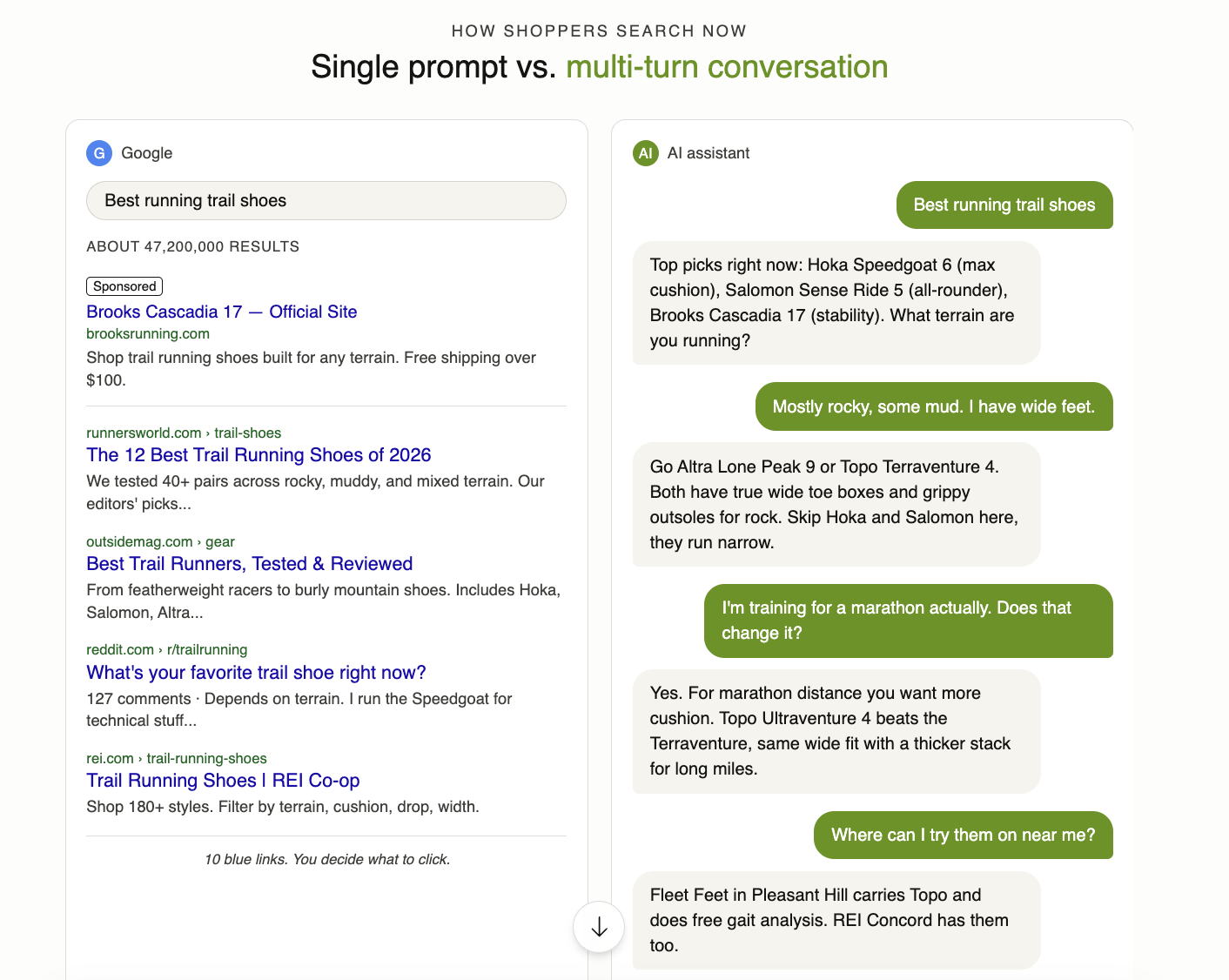
Search engines have trained us to think in inputs and outputs. I ask a question, I get a ranked list, I click a link, the interaction resets. Even when personalized, each search is treated as its own event. But that’s not how generative AI works. It builds context over time and adjusts as the conversation evolves, so the answer is less tied to a single prompt and more directly reflects the path we took to get there.
More importantly, LLMs don’t just influence a single touchpoint, they can now absorb much more of the decision-making process itself. What used to happen across multiple searches, sites, and sessions can now happen inside one continuous interaction.
That difference is easy to overlook, especially when you’re trying to measure something at scale. Single-turn prompts are clean and repeatable and they give us something to track, but they’re also more controlled, and far less realistic than the one most people are actually in.
So we end up with outputs that are somewhat accurate, but contextually thin. They show what happens when AI is treated like search, not when it’s used like a conversation.
How People Actually Decide
Most of us don’t make decisions in a single step. We usually start broad, then begin adding details as things come into focus.
Here’s a personal example. I wear a lot of HOKA shoes, so this is a familiar process for me. I might start with something simple like, “What are the best running shoes?” What starts with a simple question, turns into a conversation as I become more specific. Maybe I need something for longer runs or I want more cushion but not something too bulky. Maybe I want to know how a specific model compares to other brands. By the time I land on a decision, I’m not really asking for a list anymore, I’m trying to figure out what actually fits what I need.
If we freeze the interaction at that first question and measure which brands appear, we’re analyzing the least informed version of the buyer. We’re looking at a moment before the real decision-making has even started. As a marketer, it’s not just about showing up early, we need to stay relevant as the conversation evolves. Sometimes that means our brand may appear later, or it might mean surviving multiple rounds of filtering. Either way, it’s a moving target.
Marketing Technology News: MarTech Interview with Stephen Howard-Sarin, MD of Retail Media, Americas @ Criteo
The Risk of Optimizing to the Wrong Signal
Staying with the shoe example, if we only look at a prompt like “What are the best running shoes,” we’ll probably see a handful of big brands show up consistently. On the surface, that looks like strong visibility, but that’s not how most people actually buy.
One person might ask about long-distance comfort, knee pain, or something cushioned but still lightweight. Others might ask if the shoes are wide enough, good for trail running, or easy to return if they don’t fit. As those details come in, some brands drop out while others show up more consistently.
This is where shopper context starts to matter far more than it ever did in search. Two people can ask similar questions and get completely different recommendations based on how the conversation unfolds. That’s a fundamental shift, and one of the biggest mistakes in early GEO strategies is treating visibility as if it’s static.
Early prompts suggest one set of winners, but the recommendations that matter are the ones that hold up at the end of the conversation.


In search, you’re optimizing for a single moment of visibility. In AI, you’re optimizing for a moving target. The question isn’t just whether your brand appears, it’s whether it stays relevant as the user refines what they actually need.
A more useful way to think about this is to focus less on prompts and more on behavior. Instead of asking whether a brand appears for a given input, it’s more valuable to understand how its presence changes as the interaction evolves. Where does it enter the conversation? Where does it drop out? What actually strengthens its position?
Those questions are harder to answer, but they map much more closely to how decisions get made. Instead of collecting outputs, you’re looking at sequences, how recommendations move, not just where they land. Once you do that, patterns start to emerge that you simply won’t see in single snapshots.
Why This Matters Now
We’re already starting to see a world where discovery and action happen in the same place, with OpenAI working with partners like Stripe to enable in-chat checkout, and retailers like Walmart experimenting with letting users complete purchases directly inside ChatGPT.
Buyers are using AI tools to research products, compare options, and narrow decisions before ever visiting a brand’s site. That shift is happening faster than most teams can measure, which is why so many are scrambling to understand where they show up.
These examples are still early, but the direction is clear, “search” is no longer about getting the click, it’s about making sure you’re one of the few options the AI puts in front of the user. And those recommendations aren’t coming from a single prompt, they’re shaped over the course of a conversation.
Where Marketers Should Focus
If you’re still treating AI as a thin layer on top of search, stop. It behaves differently enough, and influences decisions directly enough, that it needs its own approach. That starts with recognizing the limits of single prompt-based measurement and understanding the need for a more persona-based, multi-turned, model approach. It also requires asking better questions. Not just “Are we visible?” but “When do we become relevant?” Not just “Where do we show up?” but “Why do we show up there, and not somewhere else?” Yes, those questions are harder and they may not roll up neatly into a single metric, but they’re a lot closer to how things actually work.
For a long time, search has been about matching queries to content. What we’re seeing now is a system that tries to model people and their intent. If you approach GEO like SEO, you’ll get answers that look precise but miss the point.
The question isn’t just whether your brand shows up. It’s whether it holds up once the buyer actually enters the picture.
About Parsnipp
Parsnipp is a GEO (generative engine optimization) platform with a new take on AI Search marketing.
Marketing Technology News: From MarTech Stack to MarTech Fabric: Weaving Brand, Content, and Conversion Into One Thread






 right now are trying to answer a straightforward question: how visible is my brand?)