Home Blog Page 4325

Competitive Intelligence and Backlink Audits—What Marketers Need to Know from the Latest SEMrush Study

0
SEMrush
Competitive Intelligence and Backlink Audits—What Marketers Need to Know from the Latest SEMrush Study

September 27 Was World Tourism Day. The Theme Of World Tourism Day 2017 Was “Sustainable Tourism— A Tool For Development.”

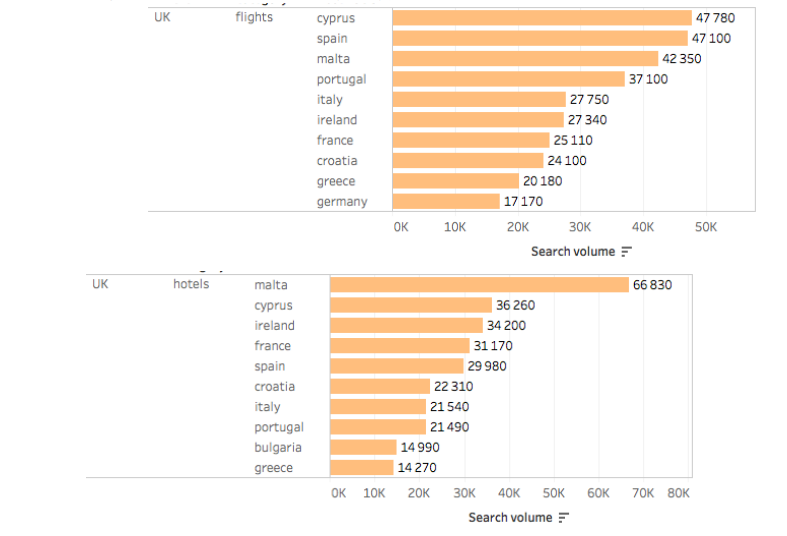
To show how top businesses see tourism as a potent driver of economic growth, leading online marketing intelligence and analytics company SEMrush, released the “SEMrush Website Airline and Keyword Study.” The study highlights the top destinations, top travels and the main channels that generate the highest traffic streams for the travel industry.

On key words for destinations and website traffic (SEMrush) highlights include—

– Cyprus Malta, Ireland, Spain, Portugal, France, Italy, Bulgaria, Greece are the top destinations

– Tripadvisor, Airbnb, skyskanner, the trainline.com, easyjet.com, expedia.com – top travel websites

–  Facebook (83.7%), Youtube (8.63%) and Twitter (5.69%) – main channels from which travel websites get traffic

SEMrush

semrush

Olga Andrienko
Olga Andrienko

At the time of the release of this Tourism Day 2017 study, we spoke to Olga Andrienko, Head of Global Marketing, SEMrush, to understand how top brands leverage competitive intelligence and backlink audits to align their marketing and advertising for seamless customer conversations.

Olga said, “Word-of-mouth advertising has transformed into referral traffic on the web. Backlink analysis and backlink audit play essential role in online marketing today. Firstly, having a lot of quality websites that link to your content increases your traffic and builds your authority. And, links are one of the ranking signals for Google – in our latest Ranking Factors Study we have identified that the number of referring domains has huge importance to your page’s position in SERPs. The TOP-1 had almost twice as many referring domains as pages on 10th position. So, the more backlinks and more domains link to you, the more likely the conversation with the customer will happen – you’ll get more visitors to your website.”

So how do marketers ensure that their social interactions positively influence the website traffic?

Olga informed, “Key to engaging the audience on social is to support the readers with not selling, but educational content. You should explain why this article is important for reading and what conclusions the user can make by reading it and what advantages he or she can have if he/she uses your site or your product. That will lead the potential customer to the website and existing users will really love you because you are not only the product, you are the service from where they learn. Show users an interesting infographic, make sure that they share your findings and your posts, this will help not only bring traffic to the site, but also draw new loyal customers.”

Olga said that though the traffic from social media platforms generally is not really high compared to direct or organic, yet it should not be neglected. She said, “Social media is where the conversation about your brand is happening. Dissatisfied customers link to your site to ensure their friends never buy from you, satisfied clients give referrals and prospects in doubt ask their audience if they should consider buying from you.”

Gaining the Millennial Stamp of Approval on Social Media

0
Millenials

ABC Creative GroupEngrossed in technology and well versed in the over-played marketing anthem, millennials can smell insincerity from a mile away and one artificial move from your company could be death for your brand

Establishing authenticity and a cohesive brand voice across all social media platforms is essential in establishing trust and loyalty from millennials.

With the constant exposure to media, millennials have already witnessed the major missteps and triumphs of brands, resulting in a different set of expectations for advertisers.

With an aversion to traditional marketing methods, millennials seek relatability and authenticity from a brand. According to the 2014 Nielsen Report, the top values of millennials are family, philanthropy, society, the environment and community. Use that to your advantage.

Highlight the core values and unique sentiments of your brand and create a sense of consistency across media platforms.

Start by rediscovering your organization’s roots.

What is your mission? What sets you apart from the competitor? Does your brand support any philanthropies or causes?

Answering these questions can dig up authentic content that will earn the trust of your audience and make a brand more relatable.

Even the largest corporations have a small-town story.

Take Walmart for example, which boasts “What started as a single discount store and the simple idea of selling more for less, has grown to the largest retailer in the world.” I guarantee that if one of the largest corporate giants can form a modest background story, then so can you.

Establish the tone and jargon of your brand.

Whether your brand voice is educational and serious or witty and fun, creating content that is cohesive and consistent is key to winning over the millennial generation. The internet is not 9-5, and your brand can’t be either.

Having a set of standards for your brand voice will help streamline content creation without compromising consistency. But always opt for quality posts over mass-produced quantity.

Incorporate relevant news stories into your feed.

With your brand values in mind, take a stance on appropriate media topics. A company that supports going green may chime in when a new eco-friendly bill has passed, for example. Or perhaps a brand that supports LGBT rights will invite their followers to join them at a pride parade.

When consumers look at a social media feed, it should tell a story about what the company stands for and the values it supports. Research what your specific millennial audience is into and find a way to organically incorporate that into your feed.

Utilize social media to connect to your target market.

Brands are rejected by millennials when they focus primarily on selling the product – consider the car salesmen stereotype. Instead of appearing pushy or too eager, market the aspects of the brand that differentiate you from competitors.

Don’t fear the platform, conquer it.

Even a social media novice will learn, in time, how best to navigate the digital realm. Every brand’s following is different, so a “one size fits all” solution does not apply.

Allow your brand to grow with your following, become resilient and adapt to your target market. If you see a trend and it applies, jump on it! Social media is meant to be fun.

Establishing an authentic brand voice and positive image will come with time, so be patient. Gary Vaynerchuk wasn’t built in a day.

Also Read: A Window on What You’re Buying: VR for Marketing Spaces

AI + Humans Is the Perfect Recipe for B2B Growth

0
Artificial Intelligence

We are used to seeing AI and machine learning in our “consumer” lives — from Netflix and Amazon’s eerily accurate recommendations about what we would like to watch or buy next, to our Nests having our home at the just right temperature when we walk in at night. We are comfortable cohabitating with AI at home, yet AI adoption by sales and marketing professionals is elusive.  We’re riding the crest of innovation in go-to-market technologies — first CRM, then marketing automation and now applied AI for sales acceleration — you want to catch this new wave.

To be clear, B2B sales and marketing professions have nothing to fear and everything to gain from adopting AI. The human element of B2B sales and marketing is necessary despite all the technology at our fingertips. While it may be called B2B, at the end of the day, there are real people engaging with each other in each of the “B’s” and it is this IRL relationship that cements sales.

Applied AI assists B2B sales and marketing

The worry about a fictional HAL or Skynet replacing sales and marketing professionals prevents teams from actually seeing the reality of applied AI for sales acceleration. In the movies, AI is generalized and the horror comes from the machines “becoming human”, but applied AI points at specific use cases — generally those that are tedious, time consuming and involving lots of data. And because there are many of these tasks within B2B — applying AI can liberate sales and marketing pros from these tasks, and quickly provide them the actionable insights needed to accelerate sales.

Applying AI to 3 key areas of your go-to-market strategy will significantly increase sales momentum:

  1. Market planning/ABM:

Every B2B strategy starts with identifying “who” to target for demand generation and outbound sales efforts. You want to focus your limited resources on just those companies who best fit your desired customer profile.  To be effective, your desired customer profiles must extend beyond basic firmographics and take into account the characteristics and elements unique to each company including their technology investments, product and services offered, as well as elements around growth and hiring. It is these nuanced characteristics which best distinguish your best fit targets from the basic firmographic lookalikes so you can accelerate your sales cycles. That’s powerful.

The best AI solutions will assist your team in:

1) defining your desired customer profile utilizing insights that go far beyond basic firmographics in minutes, not months.

2) Identifying all of the companies with the highest fit to the profile you desire.

  1.  Prospecting:

Statistics show that sales professionals can spend upwards of 30% of their time just on prospecting. And while we want their outreach to be informed, personalized and relevant; prospecting is tedious and a time waster. Your sales team doesn’t need more data, they need actionable insights right at their fingertips.

AI-assisted prospecting crunches through all the available company data, doing the legwork to reveal the right companies to focus on and the most up to date intelligence. This includes insights for a strong talk track or personalized, relevant email outreach, and up to date names and contact information of decision makers. The sales team has the intelligence right on hand – directly within their workflow.

  1. Intent: who is in market now?

One of the most valuable things AI can provide your sales team with is the insight into who is actively in market right now or their intent to buy. AI can be used to uncover intent by powering through all the data signals from companies, including whether decision makers within a company are researching your product or even a competitor’s.

Your team definitely wants to know if a competitor is on a target account’s radar, plus knowing intent can help you spot new opportunities outside your target accounts. Growth-minded B2B organizations use AI solutions to stay agile and focus their energy on accounts that are already in active demand.

AI must be at the whole team’s fingertips

Too many times people hear the terms AI and machine learning and their minds flash to programmers locked in a basement with whirring computers. This provides an inaccurate impression that AI is only “safe” in the hands of a data scientist and not a part of the day to day work of the team.

While you don’t want to confuse team members with all the inherent complexity of AI, the power of it needs to be at the fingertips of every sales and marketing pro on your team. The best applied AI solutions arm sales and marketing teams with the actionable insights — not “more data” or another “score”. Ideally these insights are seamlessly delivered within an intuitive, friendly UX or, even better, within their CRM or automation tool of choice.

Agility is crucial for high growth

High growth organizations never stand still. Market conditions, customers, prospects, your competition — these are always changing and evolving. If the ‘ideal customer profile’ or set of target accounts established at the top of the year remains too rigid, you will miss a growth opportunity.

Applied AI helps a busy, focused B2B team both perceive early signals from amidst all the shifting sands and take action. The best solutions helps teams create new models in minutes, not weeks or months,  with as little as a keyword or just one customer record.  And it’s necessary that everybody on your go-to-market team have the power of AI at their fingertips – so a an intuitive interface and/or integrations are a must.  

Now is the time for B2B to get comfortable with AI and separate fact from fiction. Use it to liberate sales and marketing teams from the most tedious and boring tasks and allow them to do what humans do best: make informed insights and interact personally with prospects. That’s the wave you want to catch.

Janrain Raises Bar for Most Rigorous Security Certifications in CIAM Industry

0
janrain

Janrain Becomes First To Obtain CSA STAR Level 2 Certification, Adds ISO 27018 Certification For Cloud Security

 Janrain, the company that pioneered the Customer Identity and Access Management (CIAM) category and market leader in Privacy by Design, announced that it has obtained two of the industry’s most comprehensive third-party security certifications, and the only ones designed specifically for the cloud: 1) Cloud Security Alliance Level 2 (CSA) STAR Certification, which verifies that Janrain follows industry-best practices for securing cloud offerings, and 2) the International Organization for Standardization’s (ISO) 27018:2014 Certification for handling personally identifiable information (PII) data in the cloud. These certifications apply to all services and product offerings associated with Janrain’s Identity Cloud product, which provides customers with a seamless and secure way to move between web, mobile and IoT device properties.

Janrain becomes the first CIAM provider to achieve CSA Star Certification, the highest level achievable in CSA’s program. Until now, no CIAM provider had exceeded CSA’s Level 1 self-assessment, which is simply a questionnaire uploaded by the vendor to the CSA site. By contrast, CSA Level 2 certification entails an in-depth audit by an accredited, independent third party to verify that the company adheres to the highest cloud security standards throughout its operations. ISO 27018 certification confirms that Janrain applies industry best practices when handling PII, which is only going to increase in importance once the EU’s General Data Protection Regulation’s (GDPR) stringent PII-protection decrees go into law May 2018.

Jim Kaskade
Jim Kaskade

“Meeting CSA’s and ISO’s most exacting security protocols doesn’t just benefit Janrain, it assures our clients that their customers’ most critical data — upon which their respective businesses are built — is secure with Janrain,” said Jim Kaskade, CEO of Janrain. “The monetary and manpower expense of meeting these standards is a drop in the bucket compared to the peace of mind our customers get knowing that the 1.5 billion – plus digital identities under Janrain’s management are safe.”

More than 3,400 Global 1,000 and midsize organizations use Janrain’s cloud-based product suite — which includes social login, registration and profile-data storage, among other offerings — to give their customers a seamless, highly personalized experience across their web, mobile and digital properties. The number of digital customer accounts under Janrain’s management is expected to grow further — the Identity and Access Management market will reach $14.82 billion by 2021 according to research firm MarketsandMarkets. Janrain was first to market in 2002, and has pioneered almost every major CIAM product development since. By obtaining CSA STAR Level 2 Certification by Attestation and ISO 27018 certification, Janrain once again raises the bar in the CIAM industry while saving CIAM customers the time, money and hassle of performing their own vendor security audits in evaluating choices.

Janrain aims to keep its security measures as ironclad as possible. In order to make this transparent and attestable for clients, Janrain maintains more security assurance programs than any other CIAM vendor. In addition to the new CSA STAR Level 2 and ISO 27018 certifications, Janrain also maintains and is audited or assessed for certification/compliance with ISO 27001:2013, SOC 2 Type II (in addition to the Security Common Criteria, Janrain is compliant for the Availability and Confidentiality Trust SOC 2 Trust Principles), HIPAA (storage of healthcare data), HITECH (transmission of healthcare data), US-EU Privacy Shield Framework and the TRUSTe privacy program. Janrain is Open ID connect (OIDC)–certified, GDPR-ready and compliant with many other security/privacy regulations, such as COPPA, PIPEDA, and CFR (Code of Federal Regulations Title 21, Part 11).

Report finds C-Suite’s Use Of Social Media Is On The Rise

0
GRISDALE_ADVISER

Study Sheds Light On Executive Social Media Use; Trump Tweets Have Little Impact

Social media use among C-Suite executives is on the rise, with 66 percent reporting they use social media professionally, and 70 percent of those saying they regularly create and share original content. That means the so-called “lurker” ratio among socially active executives (just 25 percent) is opposite of that found among the general population (around 75 percent), a new study reveals.

C-Suite

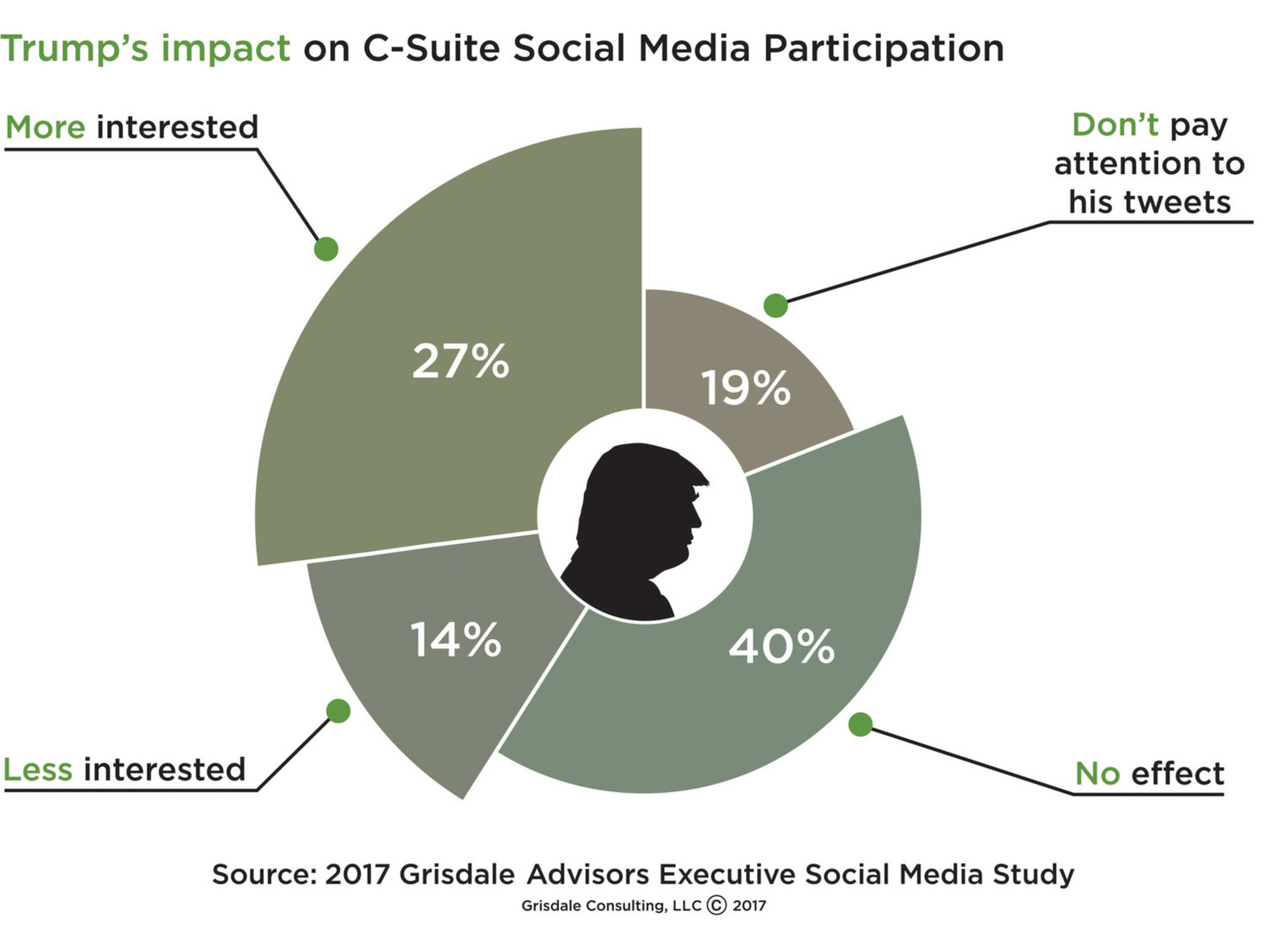
Interestingly, Chief Executive Donald Trump’s Twitter use has had little impact — 40 percent said it had no effect, and 19 percent said they don’t even pay attention to the president’s tweets.

The findings are part of a new national survey of 300 C-Suite executives across a broad range of companies, geographies, ages and gender conducted by Grisdale Advisors, a San Francisco-based social media consulting firm. The survey reveals that executives active on social media say they use it as one of their main sources of news, communication and engagement with employees, colleagues, customers, influencers and opinion leaders, with almost equal presence on Facebook (71 percent) and LinkedIn (70 percent). Twitter ranked a distant third among survey respondents, at 38 percent.

“This research gives us much-needed data about how and why executives are using social media for professional purposes. It tells us that, increasingly, executives recognize the power of social media to build and grow their sphere of influence,” says Grisdale’s founding partner Tim Collins.

Reasons for participation (or not) are myriad. Of the C-Suite executives who use social media professionally, 87 percent read news and others’ posts. They choose to follow experts in their profession, colleagues, employees and, less so, competitors. Forty percent plan to use social media more in the future to expand their customer base and join what they agree is now mainstream media.

C-Suiters who don’t use social media as a professional communication tool cite a preference for a more direct style of communicating (23 percent), say someone else in the organization handles it (20 percent) and say it’s too time-consuming (19 percent). The remainder are concerned about risks to their career and company, and don’t think the benefits outweigh these risks.

SAS a Leader: Gartner 2017 Magic Quadrant for Digital Marketing Analytics

0
sas

 SAS Recognized For Its Ability To Execute With Completeness Of Vision

Measuring the effectiveness of digital marketing is among the most significant challenges for brands today. Organizations that tap into digital marketing analytics, which allows them a comprehensive view of which digital strategies are working, and which aren’t, have a noteworthy advantage. SAS Customer Intelligence, powered by predictive analytics and machine learning, helps marketers make smart, customer-centric decisions. For the third consecutive year, SAS is a leader in Gartner’s Magic Quadrant for Digital Marketing Analytics.

In addition to being positioned the highest in ability to execute, SAS believes its recognition is based on the suite’s flexibility and customizability, allowing an organization’s data to be managed and presented in a variety of ways.

A pillar of the SAS Customer Intelligence suite, SAS Customer Intelligence 360, allows marketers to dig deeper into digital with practical self-learning (AI) applications and guided analytics.

Wilson Raj
Wilson Raj

“Marketers must be able to aggregate, analyze, and act on a flood of digitally-generated customer data faster than their competitors. If not, the end is in sight. We feel that our continued leadership position in Gartner’s Magic Quadrant showcases SAS’ analytics pedigree which helps marketers harmonize the noise into a clear signal to win, serve, and retain customers – and remain competitive,” said Wilson Raj, Global Director of Customer Intelligence for SAS.

We had previously reported that about the IDC Worldwide Business Intelligence and Analytics Tools Software Market Shares, 2016: Here Comes the Cloud report where SAS once again found prime position as the market leader.

SAS topped all predictive and advanced analytics suppliers and data integration suppliers, according to the IDC report. SAS held a 30.5 percent market share for 2016 in the advanced and predictive analytics category, well over twice the market share of the next-closest competitor. SAS has led in this category since IDC started tracking the market in 1997. SAS has demonstrated continued growth every year in the category, with 2016 showing a 5 percent revenue growth.

Infogroup Data Solutions Selected as Digital and Media Management Service Provider by Scranton Gillette Communications

0
infogroup

The partnership hopes to boost brand awareness, and deliver effective communication channels for clients and audiences in the business-to- business marketplace

Infogroup Data Solutions, the leading provider of business and consumer media management solutions, has been selected as the digital and media management service provider for Scranton Gillette Communications (SGC)/SGC Horizon, a business-to-business (B2B) media company.

Infogroup is one of the leading providers of innovative business data, and marketing solutions that are used to increase customer acquisition and retention. They use Big Data at a core part of multichannel marketing. Their business units include: Yes Lifecycle Marketing, Infogroup Data Solutions and Infogroup Local Marketing Solutions. Products include Data Axle, Marketing Genetics, Marketzone, Bulk Update, Sapphire, Express Update, InfoUSA, Salesgenie, Credit.net and ReferenceUSA.

SGC/SGC Horizon owns more than 20 recognized brands and events serving diverse industries that include, among others, infrastructure, healthcare, construction equipment, and residential and commercial building. The company has partnered with Infogroup Data Solutions to deliver advanced digital strategies and media management techniques that will maximize exposure and data monetization.

“We chose Infogroup Data Solutions to manage our media assets because of their superior data resources, extensive digital network, and depth of knowledge across markets and channels. This partnership will help us expand our capabilities, boost brand awareness, and deliver effective communication channels for our clients and audiences in the business-to- business marketplace,” says Robert Haas, SGC/SGC Horizon’s senior vice president of strategic product development & marketing.

“It is a privilege to partner with Scranton Gillette Communications, one of the fastest-growing companies in B2B publishing. We look forward to helping them achieve even better results with our latest solutions,” says Jeff Adee, senior vice president and general manager, Infogroup Data Solutions.

Mike Iaccarino
Mike Iaccarino

“We are thrilled at the addition of an award-winning company like SGC/SGC Horizon to our roster. Infogroup Data Solutions’ growing client base is a true testament to our commitment to innovation on behalf of our partners,” adds Mike Iaccarino, chairman and CEO, Infogroup.

Liferay Symposium 2017 to Focus on Transforming Customer Experiences

0
liferay

Two-Day Event Will Provide Attendees With A Clear Understanding Of How To Execute Real Digital Change In Customer-First Businesses

Liferay, Inc, which makes digital experience software for enterprises, announced its annual Liferay Symposium North America, which will be held on October 16-17 in Austin, Texas. The event includes talks from The GLOBE Program sponsored by NASA, the Transportation Security Administration (TSA), Smith & Nephew and Austin Angels, a local foster care non-profit.

Liferay Symposium invites technical and business professionals across industries to come together and gain fresh insights on customer experience and digital transformation. Whether attendees are already part of the 180,000+ member-strong Liferay community, or currently exploring new digital strategies to fuel business growth, Liferay Symposium provides an opportunity to learn from the technology builders and adopters that are leading the way.

This year, Liferay Symposium will feature three guest keynotes, each providing a unique perspective on how to engage audiences through technology-driven experiences. These talks will dig into The GLOBE Program’s campaign – sponsored by NASA to create ‘citizen scientists’ during the recent solar eclipse – the TSA’s successful strategy of using social content to help shape brand perception, and how an Austin entrepreneur used the power of her community to create meaningful change in her local foster care system.

Attendees will hear from like-minded peers who are embracing customer-first business practices, and understand how to use Liferay Digital Experience Platform (DXP) to deliver valuable user experiences that advance their digital strategies. With more than 50 speakers confirmed to discuss a variety of topics, attendees will hear from:

  • Liferay’s business and technical leaders. From product roadmaps to understanding fast-moving industry trends to technical workshops, they ensures that attendees come away with a clear vision for how Liferay technology can drive business growth.
  • Customers. Organizations, including multinational medical manufacturer Smith & Nephew, will discuss their Liferay use cases, and the specific challenges overcome through digital transformation.
  • Partners. Several sessions offered by Liferay solution providers will walk through best practices for getting the most of the newest Liferay DXP capabilities.
Bryan Cheung
Bryan Cheung

“Liferay Symposium really has something for everyone – for every stage in an organization’s digital transformation and for myriad use cases. Through carefully planned discussions from our customers, our partners, and our technology creators, our aim is that attendees come away with an actionable path for improving digital operations within their business,” said Bryan Cheung, CEO, Liferay.

Zaius Study Reveals 40% Retail Marketers are Overlooking Omnichannel This Holiday Season

0
zaius

86 Percent Fail To Engage Customers At Every Purchase Location

Zaius, the leading B2C CRM that delivers real-time, cross-channel marketing automation and attribution built on a single customer view, announced the release of its 2017 Holiday Marketing Report, highlighting what’s on hundreds of retail marketers’ minds as the holiday season approaches. The study helps ecommerce and retail companies understand which marketing priorities and distribution strategies to focus on during one of the busiest and potentially most lucrative times of the year. The survey pulled insights from CMOs, CEOs, founders and marketing executives from businesses across the U.S.

The report findings uncover a variety of trends, including the following:

  • Omnichannel: Omnichannel is a place for improvement. Forty percent of respondents don’t have any strategy in place, 46 percent are in the process of developing one, and only 14 percent say they execute omnichannel marketing well.
  • Customization: The top areas of focus for marketers are segmentation (33 percent), personalization (31 percent) and optimization (20 percent), showing they are most concerned with delivering engaging and relevant content to their audiences.
  • Traditional marketing: Browser and mobile push strategies are a missed opportunity for marketers, with only 2 percent taking advantage of these channels. The majority of marketers are prioritizing investment in traditional marketing strategies, including email campaigns (43 percent), social media campaigns (22 percent), and search/ad retargeting (27 percent), showing that marketers need to be educated on how to better engage with consumers across all channels and devices.

These findings confirm the need for a better understanding of why and how customers shop, and for the ability to engage those shoppers in a more individualized way. As Forrester Research found, consumers are increasingly empowered, with 42 percent of U.S. online adults researching products via online customer reviews weekly, if not daily. In the always-on age of commerce, retail marketers must deliver engaging messages in a seamless experience, at the right time, to persuade empowered customers to buy.

Mark Gally
Mark Gally

“In these survey results, we hear marketers’ frustration, ambition and dedication to their brands at a critical time of year. They know they need personalized and relevant content to convert potential buyers into customers, especially during busy seasons when consumers are overwhelmed with messages from brands. This data uncovers the path to help marketers overcome their frustration by leveraging omnichannel, marketing automation and B2C CRM solutions that can put them ahead this holiday season,” said Mark Gally, CEO, Zaius.

SBS Group to Launch SalesConnect 365, a New Solution for Microsoft Dynamics 365 for Sales

0
sbsgroupusa

Cloud-Based Technology Provides Intelligent Connections Between CRM, Email, And Calendar Systems To Provide Robust Insight Into Customer Relationships And Value

SBS Group, a leading information technology services and solutions firm, announced the availability of SalesConnect 365, a revolutionary solution for Microsoft Dynamics 365 for Sales (formerly Microsoft Dynamics CRM) leveraging cutting-edge machine learning and analytics. SBS will be highlighting the solution in Booth 311 at the Microsoft Dynamics User Group Summit 2017 being held on October 10th–13th at the Gaylord Opryland Resort in Nashville, TN.

SBS SalesConnect 365 crawls an organization’s email and calendar systems, intelligently searches and retrieves all useful data about customers and prospects, organizes the information in Dynamics 365 for Sales (or Microsoft Dynamics CRM Online), and presents it as actionable knowledge that companies can use to improve close ratios, create more opportunities, and drive more revenue. Sales and customer service team members no longer need to manually enter or associate activities with Dynamics 365 records. SalesConnect 365 provides automatic association giving them more time in front of customers. SalesConnect analytics help improve forecast accuracy, identify customer buying behaviors, and create more sales opportunities.

“SalesConnect 365 captures all customer-facing activities directly from email and calendar systems like Microsoft Office 365 and applies natural language processing, data science, and machine learning techniques to analyze and characterize the level of engagement with leads, accounts, and opportunities in Dynamics 365,” said SBS Chief Solution Strategist, Robbie Morrison. “SalesConnect 365 provides a new level of insight into the nature and value of customer relationships, allowing companies to be vastly more effective at sales and customer service.”

TechBytes with Timothy Sovay, Chief Operating Officer, CreatorIQ

1
Timothy Sovay CreatorIQ

Timothy Sovay
Chief Operating Officer, CreatorIQ

Influencer marketing, in 2017, is an undisputed engagement strategy for marketers to create branded stories and influence customer journeys. With a swelling hunger among brands to create and distribute user-generated content across omnichannel marketing platforms, we see a significant gap between what audiences want to see and what’s fed to them. We spoke to Timothy Sovay, Chief Operating Officer, CreatorIQ, to understand how the influencer marketing software solution provider helps marketers scale influencer content to create a realistic and more-connected interaction among their audience.

Html code here! Replace this with any non empty text and that's it.

MTS: How do you see brands optimizing Influencer Marketing through the customer journey?
Timothy Sovay:
As influencer marketing has become a critical component of brand storytelling, we’ve seen its growing significance in the continued evolution of the customer journey. For example, progressive brands are building more meaningful, long-term relationships with creators as opposed to one-off sponsorships that have been the norm in the early days of the industry. This is healthy for all three components of the ecosystem where brands, creators, and consumers all benefit from understanding that the brands’ creators partner with are ones they have a true connection and passion for. The work that Samsung Mobile and Casey Neistat have done together is a prime example of how the industry will continue to evolve.

MTS: To what extent is user-generated content (UGC) scalable for marketers to create believable interactions with the audience?
Timothy: Now more than ever, brands can build direct relationships with consumers by creating brand advocacy networks. ipsy is a prime example of an e-commerce brand who developed their ipsy OpenStudio program that has turned into a community of consumers and creators that numbers in the thousands and delivers over 300MM earned impressions each month through organic social content.

MTS: How does CreatorIQ leverage IBM Watson to manage Influencer Marketing programs?
Timothy: Advertisers rightfully expect more granular data around both the creators they’re working with and (more importantly) the audience that connects and engages with the content distributed across their ecosystem of social channels. IBM Watson provides our customers with an added layer of contextual audience psychographic data for better insight into personality traits, brand affinity, and interests.

MTS: How do you see Influencer Marketing technologies shaping up, with the improvements in data science and machine learning capabilities?
Timothy: From influencer and brand matching to predictive campaign performance, machine learning will continue to optimize the automation of key areas of influencer marketing workflow and actionable intelligence. However, unlike other areas of programmatic digital media ad spend, the influencer marketing sector will still rely on the human element of creativity and talent relationships as a form of premium content production.

MTS: What are the key metrics and compliances that brands must seek from an Influencer Marketing platform?
Timothy: Performance metrics and compliance should be considered on two separate fronts. The vast majority of creator-developed content is utilized for brand marketing and awareness campaigns. While there are companies that focus on the performance marketing aspect, it remains difficult to finish the conversion loop based on the closed sales systems that often times do not provide the necessary attributional feedback. Amazon can (and will) be the game changer in this arena but branded content and influencer marketing should predominantly be judged against other forms of digital and social ad spends.

While FTC guidelines are somewhat vague for individual platforms, efforts are being made on all sides to comply with current disclosure requirements provided for brands and creators (#Influencers101). Those who are trying to skirt these disclosures are doing a disservice for the branded content industry, which consumers have clearly shown interest in and continue to prefer over disruptive advertising. CreatorIQ is providing workflow and automation software for brands and agencies to ensure they have the ability to review and approve creator content at scale for campaigns that are getting more complex as the industry grows. We’ve seen an increase of over 300 per cent on a number of creators and pieces of content per campaign over the last 24 months. This requires technology to become an integral part of any progressive organization.

MTS: To what extent do “white label” solutions help brands generate ROI from their campaigns?
Timothy: Many of our early clients were technology-driven media companies who had built internal solutions as part of their pedigree. However, in-house solutions typically prove to be costly and unsustainable over time, and companies can sometimes miss broader industry technology trends if they’re just focused on maintaining their own product. Like many SaaS companies, we have a broad range of clients whose workflow and data needs differ, but they are all focused on the broader goal of scaling their branded content efforts. This allows us to see common themes across sectors – including brands, publishers and agencies – but still allows our clients to utilize an “in-house” solution with their advertising partners.

MTS: If yes, how does CreatorIQ utilize AI/ML technologies to improve proficiency of Influencer Marketing tools?
Timothy: 
CreatorIQ is building AI tools to analyze tens of thousands of creators across thousands of influencer campaigns from many Fortune 500 clients in order to better predict the most effective outcomes for brand marketers. By using machine learning, CreatorIQ aims to better understand and predict how creators’ content and audiences can be matched to deliver the most engaging social marketing campaigns. CreatorIQ’s Platform provides the necessary technology to make better decisions around campaigns and reporting for evaluating ROI on campaigns.

MTS: Thanks for chatting with us, Timothy.
Stay tuned for more insights on marketing technologies. To participate in our Tech Bytes program, email us at news@martechseries-67ee47.ingress-bonde.easywp.com

MediaVillage Analysis Suggest Marketing Communications Spend in Media Buoyed Largely by Growth of Digital

0
MediaVillage

Mediavillage Analysis Shows Digital Spend Continues To Replace Declines In Linear Investments

A new analysis by MediaVillage, which has been tracking media and marketing expenditures since 1988, shows that the total investment in marketing communications has remained flat since 2010, and is projected to increase by 2.8% from $580 billion in 2010 to a projected $596 billion in 2020.

Jack Myers, Media Ecologist and founder of MediaVillage, said, “When factoring inflation, the real dollars invested by marketers in the US marketing and media economy has declined precipitously. The increased spend in digital continues to offset the overall decline but we are also seeing a decline in digital from previous years.”

Of the total spend in 2017, digital advertising/marketing expenditures increased 20% to $157 billion and continue to offset the decline in linear spend. This growth of digital offsets overall 2017 declines in legacy marketer expenditures of 6.2%, with only out-of-home/place-based media, cinema, broadcast syndication and branded content receiving increased investments from marketers for their legacy inventory. However, digital spend for 2017 is down from a 26% spending increase in 2016 vs. 2015 and MediaVillage forecasts a continued slowdown in digital spending growth across all media and marketing sectors.

Jack added, “The fragmentation and commoditization of marketing and media, the effectiveness of search and social advertising for achieving corporate below-the-line sales objectives, and the increased involvement of procurement officers in the marketing budgeting process has enabled marketers to reduce their corporate commitment to marketing.”

Total digital investments are projected to increase at an average of 15% annually in 2019 and 2020. Myers forecasts that broadcast network linear expenditures would decline by 2.2% in 2017 and grow 1.6% in 2018, while marketers’ investments in broadcast network digital inventory would increase by 18% annually, bringing the total broadcast network industry ad revenues into the black — to +0.3% this year and +4.0% next year.

Myers economic reports also exclusively separate legacy/linear and digital spending within each category. MediaVillage’s full 2000-2020 Marketing/Advertising Expenditure Report will be issued later this month and is available to MediaVillage member companies.

Currently, MediaVillage is a leading research and trade marketing communications platform dedicated to helping global media and advertising companies increase their brand equity through strategic perceptions management. Through unique marketplace intelligence, strategic counsel, and an exclusive content creation and distribution platform, the company shapes the perceptions that influence key decision makers in the media buying, planning and selling process.

MediaVillage was founded by Jack Myers, a media expert, author and leading business analyst with decades of experience in the media and advertising industries. MediaVillage’s mission is to strategically improve the positive perceptions of its client’s organization, products, services, and executives.

Gigya Introduces Enterprise Preference Manager To Fortify Customer Trust and Address New Privacy Regulations

0
Enterprise Preference Manager
Gigya Introduces Enterprise Preference Manager To Fortify Customer Trust and Address New Privacy Regulations

The Enterprise Preference Manager Can Be Adopted Without The Need To Access  The Gigya Customer Identity Management Platform

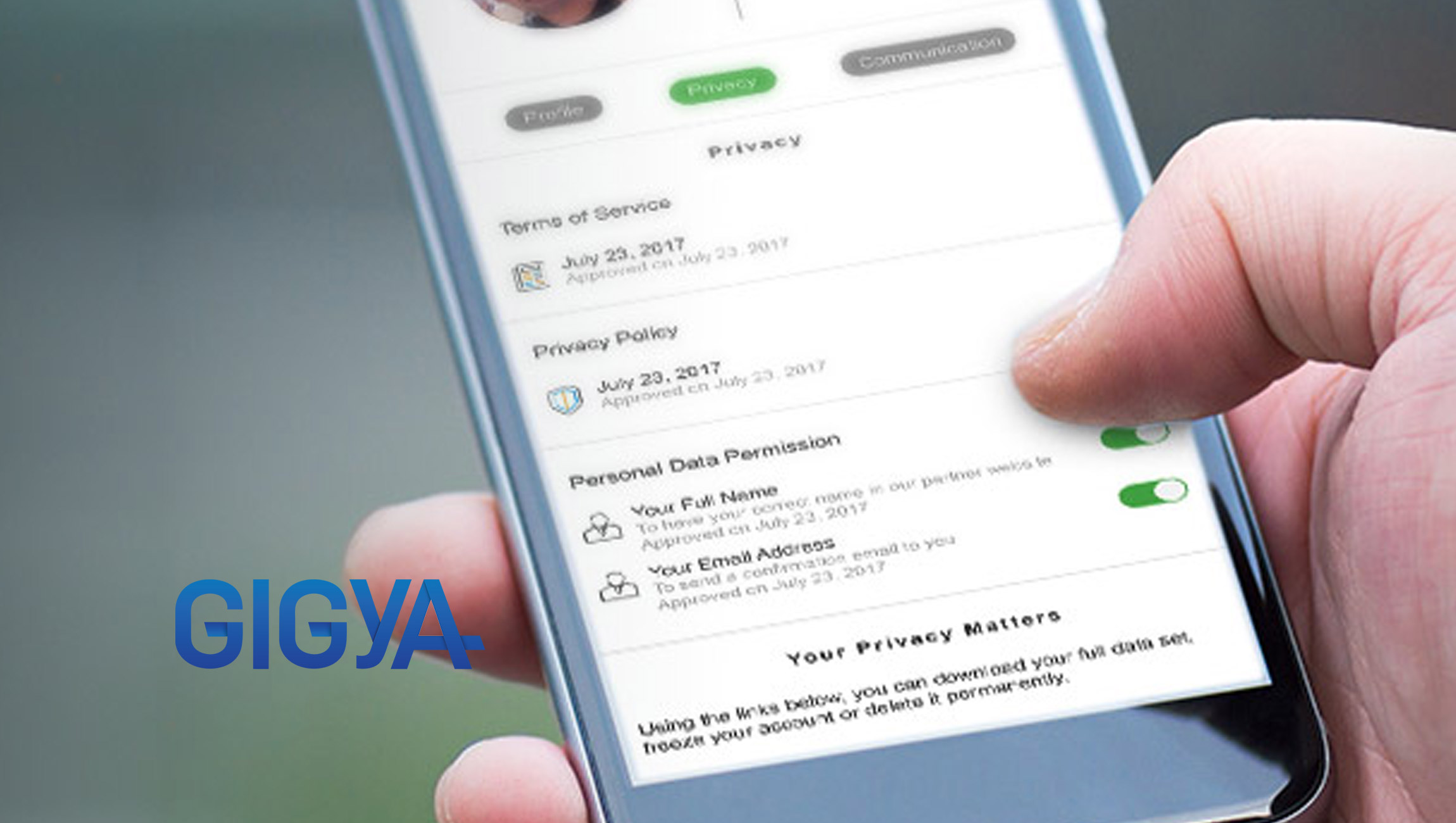
Following closely on the heels around the announcement of its acquisition by SAP, Gigya, the leader in customer identity and access management (CIAM), has introduced Gigya Enterprise Preference Manager, to help organizations build customer trust and address upcoming privacy regulations, including the European Union’s upcoming General Data Protection Regulation (GDPR).

Patrick Salyer, CEO of Gigya, said, “We’re entering a new era where customers demand respect for their online privacy and expect relevant, personalized communications when they do agree to share personal information.“

Recommended Read: SAP Announces Plan to Acquire Gigya to Strengthen Position in Omnichannel Customer Experience

The Enterprise Preference Manager, is a complete solution for centrally managing all aspects of consent settings and customer preferences such as social interests, brand affinities and product tastes. From accepting terms of service at initial registration to opting into marketing communications such as newsletters and promotions – all consent activities are stored as secure and audit-ready records.

Customers are given control of their experience through a preference center that makes it easy for them to review, change, delete or export any profile data, as well as withdraw consent to agreements or communication preferences they have given to an organization.

The Enterprise Preference Manager can be adopted without the need to access  the Gigya Customer Identity Management platform

GDPR and other privacy regulations around the world are intended to restore consumer control over their digital identities and enhance the security of their data. Enterprise Preference Manager helps organizations meet these requirements:

  • Preference and consent capture. Organizations can automate the presentation and recording of consent to agreements for terms of service, privacy policies, cookies, marketing communications, and custom activities.
  • Version control. Up-to-date records of consent can be maintained for all customers, with tracking of consent history and automated triggering of consent renewals when required.
  • Enforcement of consent. Consent and preference records can be synchronized with downstream marketing, sales and services applications, so that organizations stay compliant as they interact across all brands and channels.
  • Self-service preference center. Customers are given easy access to view, change, export or remove their information, including personal data, consent to agreements and communication preferences and frequency (such as subscriptions to monthly newsletters or weekly special offers).
  • A secure data vault. Customer consent and preference data is stored securely in a cloud-based vault, where it is always available for regulatory reviews, such as the data protection impact assessments (DPIAs) mandated under GDPR.

Beyond meeting regulatory requirements, Enterprise Preference Manager can help organizations respond to the rising expectations of customers for their personal information to be respected and under their control.

Read Also: Gigya Lite Registration Refines the Concept of “Progressive Identity” in the Buyer Journey

A recent Gigya survey found that 68 percent of consumers in the United States and the United Kingdom don’t trust brands to handle their personal information appropriately. Giving customers transparent access and control is the first step in rebuilding trust.

Patrick added, “Gigya Enterprise Preference Manager is designed to help organizations do the right thing – both in building trust through transparent interactions with customers and by providing the features and functionality to meet regional data privacy laws and regulations.”

Read More: Analytics TechBytes with Jason Rose, SVP Marketing at Gigya

How to Stay on Customers’ Radar – Without Bugging Them

0
Customers
How to Stay on Customers’ Radar – Without Bugging Them

We’ve all done it before: we’ve given away our e-mail address. Perhaps we discovered a new website or met someone at an event. Ultimately our e-mail ends up in the hands of a stranger, and to our dismay, this stranger does not really know what to do with it. With no apparent rhyme or reason, an onslaught of e-mails begins.

As bad as it is to be on the receiving end of a poorly executed customer communications strategy, it’s even worse to be the one executing that strategy. Those who get it wrong not only elicit groans from customers every time their name appears in the recipient’s inbox, they never actually get their message across. How do service providers prevent this from happening? How do they stay in touch with customers without coming on too strong?

The answer is personalization. By personalizing communications for each customer, service providers can give clients what they need, when and how they need it; ensuring their spot in customers’ inboxes stays warm.

Personalize offerings based on data

When service providers make personal connections, people pay attention. When they don’t, it’s a waste of everyone’s time. Because today’s customers move at a million miles per minute, those valuable few seconds after a customer clicks on an e-mail or opens a text are opportunities that must be seized.

When companies personalize communications based on data and data analytics, they can deliver value directly to each individual customer, building trust and improving the relationship. Sending customer-specific insights and offers based on actual data gets customers to pay attention. How messages are personalized varies by industry, but the common thread is that personalized communications shows customers that service providers are paying attention and value their needs, which ultimately increases loyalty and engagement.

Personalize messaging for the recipient of the e-mail

By segmenting customers, companies can gain a greater understanding of who they are talking to and can tailor the communication accordingly. Two different ways to do this are to segment customer personas and customer types. Here’s how they might work:

  • Customer persona: A salesperson for solar technology is marketing to building engineers, CFOs and property managers. By tailoring messaging for these customer personas, the salesperson can focus on what’s pertinent to each of them (i.e., budget, operations, carbon footprint, etc.)
  • Customer type: A business owner segments customers based on what kind of business they are in and their attitude towards the product and company. By making this identification, the business owner reaches customers with the right message about the right offers at the right time.

Communicate based on preferred channel and cadence

For companies wondering when and how to contact customers, the best method is to simply ask. With a myriad of options available to them, putting the power of communication cadence in customers’ hands is crucial and appreciated. It shows respect for customers’ time and personal preferences, and opens up a two-way conversation. There are many different ways service providers can do this. Some examples include shooting an e-mail at the start of a project that links to a customer preferences page, or sending a text to confirm a sale, which also provides an opportunity to sign up for communications.

It’s important to remember to always give customers the opportunity to change their preferences. If it’s hard to edit preferences, companies run the risk of being a source of frustration, and even becoming an automatic delete.

Track results and make adjustments

Once service providers implement a personalized communications strategy, they should track the results. It is the best way for companies to figure out what works and what does not. For e-mail, tracking results is straightforward and standard e-mail marketing tools make it easy. Open rates and click-throughs are great indicators of how people engage with e-mails. Well executed campaigns can also show bumps in web traffic and sales.

If it’s unclear what messaging will resonate with different customer types or personas, companies can try A/B testing and experimenting with messaging based on pre-determined customer segments. Move forward with what works and always make continuous improvements to grow with the audience.

By personalizing communications with customers, service providers share valuable information that is relevant to them how and when they want it. In doing so, companies won’t need to worry about bugging their customers; they will be eager to hear from service providers that keep them informed and help them meet their goals.

Why Organizing Business Intelligence Is a Necessity These Days (and How It Increases Sales)

0
Business Intelligence

Many businesses are leveraging business intelligence to streamline their customer service or to achieve excellence in other areas of business operation. For starters, business intelligence is the use of tools and systems to aid planning and strengthen decision-making in any organization. Business intelligence is more than a term and the scope stretches to areas such as customer support, research, market profitability and statistical analysis.

Applying business intelligence involves a lot such as collating and analyzing data, a situation that produces a lot of data that may be difficult to comprehend. For effectively using business intelligence, your business needs to come up with a strategy to organize the data for deriving meaningful results. So, developed business intelligence is a necessity and the following items will show you the aspects where your business will flourish if you invest into gathering and organizing big data.

Act on Precise Information

Many businesses still work on the guesswork principle, which shouldn’t be the case. Sure following your intuition is alright, however, basing your decisions on plain intuition can be detrimental for any business. So, if your employees pick up the “intuition” mindset and start applying it to their decision-making, your business is unlikely to reap fruitful results. Luckily, there’s a way out:

Concrete and precise data can eliminate guesswork from your business, helping it thrive over the years.

To ensure your business stays relevant to your customers, it’s mandatory that you start collecting and organizing data. By doing so, you can be positive that your company will grow in the coming year, and continue to develop afterward.

Study Customer Behavior

It’s needless to mention how saturated the market is; businesses are competing to gain customer loyalty. To stay on top of your game, you need to deep dive into customer behavior and understand their requirements.

Naturally, this means that you need to adopt a different kind of behavior and spread it around your office. Your employees need to start asking questions in order to gather highly valuable information about your target audience.

However, that data will be useless unless you store it properly. To preserve the collated data, you will need a quality knowledge base software that can hold business intelligence for you. Using this information, you’ll be able to study customer behavior and draw on-point conclusions about their needs.

Improve Employee Efficiency

Using a knowledge base software with a powerful browser bar, your employees can access any piece of data within seconds. The whole point of collecting business intelligence is to be able to actually use it and convert data into action. This will take the functioning of your office to a new level.

The most challenging task of turning business intelligence into action is a lack of transparency. If everything you managed to collect is scattered and stored in different places, completely disorganized, your effort will be a waste of both resources and time. Therefore, in order to be able to use this information, it is necessary to equip your team with handy tools.

Work on Upselling and Cross-Selling

If your employees have precise data in front of them about every customer in the form of a profile, they will be able to conduct upselling and cross-selling without facing any significant difficulties.

So, when a customer who already made some kind of purchase gets in touch with your business, one of your employees should check their history. After doing so, they will be able to ask them about whether or not they are satisfied with your product and recommend different packages and products.

Therefore, business intelligence will not only enable you to build better customer relationships, but it also helps in improving your business. Thanks to the information about your customer’s experience which is in regard to one of your products or services, you’ll be to gather data about necessary improvements.

Comprehended Functioning of Your Business

To be fully confident about a decision concerning the future of your business, it’s necessary to know the impact the past decisions on your business. Sometimes, it can be quite challenging to have a clear overview of all the previous and current happenings.

For this reason, you need a quality knowledge base software that can withhold business intelligence, archive it neatly, thereby enabling you to access any piece of information. Something useful like this will provide you with the necessary data you need to form an opinion about your company that’s based on  solid arguments. With it, the development of future strategies won’t be a line of insecure guesses, but a clever plan that are fact-based.

With all of this in mind, the way you do business should look differently from now on. With a useful piece of software, a process of gathering and organizing, and the proper use of collected data, the sales numbers in your company will most definitely increase. However, this is an ongoing project and you will need to invest continuous effort into forming business intelligence. If you do this, you’ll be able to keep up with the latest business trends and satisfy the needs of your customers.

It can help you learn about your audience

It isn’t easy to find out what your potential customers want. Many travel agents make the mistake of stereotyping older people, thinking that they want to go on a calming vacation where they can relax whereas the millennials are always looking for fun and excitement while on a holiday.

This is not always so easy to determine and its essential for a travel agency to know what people want. Especially when you are specialized for a certain niche. It’s essential to know these three things:

  1. What interests your audience
  2. The reasons why they would want an experience
  3. What motivates your audience

When understanding these three essentials, you will be able to easily boost the bookings count you get. A Knowledge base can help you achieve this. These databases have comment sections where customers and those potential ones can comment on your services and share their feedback.

Customer feedback is very important and by analyzing and acting on them, you will be able to deliver the things your target audience wants. You can talk to them, answer their questions, and learn about their likes and dislikes. It’s possible to build a whole community on your knowledge base and use it to drive your results.

Summing up

Technology can be a very valuable asset for managing and delivering travel agency services in a better way. What’s great about knowledge base systems is that they can be integrated with other valuable tools such as live chat software. This kind of integration could allow you to store conversations with your customers and analyze them to adjust your sales pitch, offer them relevant experiences, and recognize why a conversation was successful or not. Making incentives online is the future and travel agencies should look to utilize on this.

Interview with Jim Kaskade, CEO, Janrain

0
Jim Kaskade Janrain

[mnky_team name=”Jim Kaskade” position=” CEO, Janrain”][/mnky_team]
[easy-profiles profile_twitter=”https://twitter.com/jimkaskade” profile_linkedin=”https://www.linkedin.com/in/jimkaskade/”]
[mnky_testimonial_slider][mnky_testimonial name=”” author_dec=”” position=”Designer”]“Brand marketers pay a lot of money to drive unique visitors to their digital properties, only to see more than 95 percent of them go away and 5 percent or less register. Then of those 5 percent registered, less than 15 percent remain active.”[/mnky_testimonial][/mnky_testimonial_slider]

On Marketing Technology

MTS: Tell us about your role and how you got here? What inspired you to join a Customer Identity and Access Management (CIAM) company?
I was on a hike with John Kim, managing partner at HighBar Partners, just before New Year’s 2015. John was very excited as he described a “Portland-based identity company called Janrain.” “We’re looking at a team that invented social login,” I recall John saying. “The company has evolved over the years to provide identity cloud services for some amazing marquee brands.” As he described founder Larry Drebes and the team, it was easy to get sucked in. It was an amazing story.

But to be honest, what intrigued me equally as much as the identity space itself was the fact that the company was based in Portland. Larry, the founder, was part of Jerry Yang’ team at Yahoo! back in 1997, and later decided to move from Silicon Valley to Portland.

“Interesting, John. I wonder what the talent is like in Portland.” I found out later that not only was Janrain’s culture exactly what I was interested in, but that the Portland tech talent pool itself was less prone to chasing “shiny objects” (i.e., less likely to job hop) and much more loyal than those in Silicon Valley. I learned that the people made up the company’s competitive advantage.

My story for John was far less interesting. It was my third year at DXC Technology, created from the merger of Computer Sciences Corporation (CSC) and the Enterprise Services business of Hewlett Packard Enterprise (HPE). I had just finished pulling together several disparate lines of business into one organization called Digital Applications ($1 billion in the Americas, and $2 billion worldwide). I was finishing up a big milestone for me in the DXC business, and what would later become my final chapter there.

As John and I finished our quarterly hike, I said “Happy New Year, John! Let me know how things go.” “See you next year, Jim!” That was the last thing John said until I received a phone call from him two weeks later.

“Jim, remember that company I was telling you about? Janrain? Well, we made a significant investment in them, and the founder, Larry Drebes, is really excited to meet you. Can you come into the partnership so we can talk about you coming onboard as Janrain’s CEO?”

The rest is history.

MTS: How does Janrain analyze customers’ expectations and link it to drive personalized experiences?
Janrain is in the business of making it easy for end consumers to access any and all of their digital applications, no matter which device.

I was taking my typical Uber ride from the Portland airport to Janrain’s headquarters on a Monday morning. The driver asked me, “So, what do you do?” I smiled because I love telling the Janrain story to anyone interested listening.

“What do I do? Well, let me first ask you, ‘did you happen to log into an application on your smartphone this morning, like the Uber application itself?’” The driver answered, “Sure did, I actually logged into my credit union mobile application this morning.”

Well, what if I told you that most of the largest companies in the world use our company to handle that experience of you logging in? That we actually make sure ‘you are who you say you are,’ and once we prove that you’re not the ‘bad guy’ we allow you into your application. Then based on who you are, we provide you access to certain parts of your digital world. For example, are you an Uber driver or an Uber passenger?

Simply put, I’m the CEO of the coolest digital identity business. We have over 1.5 billion identities under management—that’s about half of the connected world!

“That’s so cool! You guys must be killing it!” was my Uber driver’s last words as I was dropped off at the Janrain office. I was still smiling and nodding my head up and down.

Janrain is in a unique position because every consumer starts their digital experience with us (through Registration-as-a-Service) and then, later, is allowed access (or not) through our authentication services (Login-as-a-Service). We’ve been in the consumer identity business since Larry’s social login concept was envisioned at Yahoo! back in 1997. It was the basis for the founding Janrain in 2002.

Some companies, like our banking clients, create experiences which require a higher degree of security. These experiences may include biometrics (thumbprint, facial scan, retinal scan, voice scan, etc.) instead of a username and password; it may include asking you personal questions to gain a higher level of assurance that it’s you or “multi-factor” authentication using your mobile phone to receive a text from the bank (via Janrain) before you are allowed to log in.

Most of our Global 1,000 clients want a seamless experience, where security needs to be “hidden” or less intrusive. In these cases, we may automatically log you in (if you were in the digital application recently), or only step up your level of authentication if our fraud analytics determine that you are a high risk due to abnormal behavior.

User experiences differ based on the industry, or the application itself—does it allow monetary transactions, or simply provide access to account preferences?

We can tailor your experiences depending on what you are trying to access—normal login for access to a news article, two-factor authentication if you want access to your bank account balance and multi-factor if you want to perform a wire transfer.

MTS: How should businesses leverage social login and registration conversion analytics to segment customer data?
Enterprises have been attempting to use digital experiences to enrich their view of the customer for quite some time now. Most of our clients, a good number of which are Fortune 500/Global 1,000, have sophisticated analytics teams leveraging technologies like Hadoop, NoSQL databases and real-time stream processing frameworks to capture and operationalize their view of customer. Analytics start with segmentation because if you understand how different groups of customers behave, you can tailor your experiences, promotions and even your products for those segments of similar consumers.

Larry’s vision for social login back in 1997 called for users to be able to use their Yahoo credentials to log into their websites. Yahoo at the time was sitting on the largest social identity pool in the world. Why not simply remember your Yahoo login to access every other website? What Larry didn’t realize was that this idea would come with a host of Yahoo-based information that the website using social login could leverage for customer segmentation! That’s right, your interests, preferences, likes and a host of other social data can be used to enrich your profile for Janrain clients who deploy social registration and login.

In addition, Janrain’s identity services are unique from other website analytic services because we don’t summarize or aggregate behavioral data. We literally score each and every individual consumer with rich behavioral information that can be used for that user’s individualized or customized experience.

Brand marketers pay a lot of money to drive unique visitors to their digital properties, only to see more than 95 percent of them go away and 5 percent or less register. Then of those 5 percent registered, less than 15 percent remain active—that’s less than 1 percent of the unique total. Thus, for every $100 of marketing spend you get $1 of value in registered and active users!

What if I told you that with Janrain’s customer journey analytics, we can triple registration conversions and login activity? Well, it’s true, and that equates to almost a 10-times increase in ROI.

MTS: What is your vision of Identity and Access Management evolving with new-age regulations like GDPR? How would businesses benefit from using Janrain’s Consent Life Cycle Management to comply with such regulations?
Our vision starts with empowering end users with a simple approach to managing their own data. Our vision also includes turning more end-user control into an increased level of trust in our clients’ brands.

Can you imagine a world where more control for end users equates to increased revenue for the brand?

GDPR represents a major market opportunity for us. So much so that we are offering and engaging our customers in readiness assessments to accelerate their compliance.

Janrain’s solutions are built for a post–GDPR world. The company has adhered to the Privacy-By-Design standards that GDPR will require due to Janrain’s inherent data architecture, conceived by Larry Drebes during his time at Yahoo. Janrain allows brands to apply policy to every individual element in the consumer’s profile. We have a unique advantage over our peers in identity because we’re a data-centric company vs. those who are simply offering a transactional authentication service.

Customer Identity and Access Management (CIAM) solutions are inherently geared toward the opt-in–based approach that GDPR mandates. Janrain’s recently released Consent Lifecycle Management (CLM) solutions, which you mentioned in your question, will play a pivotal role in GDPR compliance by providing brands fine-grained consent forms that make it easy and clear for end users to provide explicit consent by profile data element.

If you wake up one morning and decide that you don’t want anyone to have access to your last name, your gender or your zip code, you simply change it. Users can review, validate, revoke or make other changes to their consent declarations with Janrain’s CLM, and those consent changes are immediately realized and guaranteed.

Aside from our CLM, Janrain’s Identity Cloud enables brands to meet all of GDPR’s articles associated with technology-enabled regulations, including data portability, the “right to be forgotten” and the procurement of progressive permissions, to name a few. But in the bigger picture, the real impact GDPR should have on brands is to change their mindset on how to engage their users.

Companies will no longer be able to retarget or collect personal data in a “bundled” way (i.e., collecting consent using pre-checked “opt-out”–type boxes), and they will need to view this new opt-in–based approach as an opportunity to get to know their customers better and earn their trust.

Our clients are preparing for when GDPR will become the global norm. The UK is considering its own version of GDPR for a post-Brexit world, and it’s a good bet that Canada and Australia will soon follow suit with similar legislation. Consent-based customer communication will be the norm before you know it, so brands might as well embrace the change.

MTS: What startups in MarTech ecosystem are you watching/keen on right now?
There are now more than 5,000 martech solutions, per Scott Brinker’s marketing technology landscape, with almost half of them investor-funded startups! It should be no surprise that the analytics space represents the largest category, fetching over $1.5 billion in funding! So I say analytics!!!

We’re using some real Big-Data horsepower under the Janrain identity hood now. Leveraging the domain experience of our Big-Data past, we deploy technologies like Confluent, the developers behind Apache Kafka, a real-time messaging and streaming Big Data engine. We also use Imply, which helps us collect real-time and historical events, and provides instantaneous reports through interactive visualizations, SQL or your own custom apps. Imply is powered by Druid, a massively scalable column store—it can scale to thousands of columns, billions of unique values and trillions of rows. These may seem like building blocks rather than packaged marketing solutions but, in fact, they are the future for better collection and analysis of real-time customer behavior.

We at Janrain can say with resolve that with our experience in Big Data dating back to the founding of Cloudera in 2008, we have the most sophisticated identity data platform in the world. But our success in the this area is also a result of standing on the shoulders of these analytic technology giants.

It’s sometimes forgotten that the power of Google’s infrastructure was disclosed in a paper that was published in October 2003. This paper spawned another one from Google—”MapReduce: Simplified Data Processing on Large Clusters”—and fueled the Apache Nutch project, which was later moved to the new Hadoop subproject in January 2006 by Doug Cutting, another tech wizard from Yahoo. Well, this technology is at the core of Janrain’s massive petabyte-scale analytics platform.

MTS: What tools does your marketing stack consist of in 2017?
Janrain’s Identity Cloud includes a host of registration and login cloud services including traditional registration and login aaS, social registration and login aaS, single sign-on aaS, preference and consent management aaS, as well as a number of security and marketing analytics solutions. But the real power of the Janrain Identity Cloud is its ability to connect to hundreds of digital applications and provide a single “customer identity hub.”

Using Janrain to build a customer identity hub, on one hand, provides a seamless experience to end users no matter where they go; on the other hand, we allow our enterprise clients to consolidate those digital applications into a single view of customer across them all.

We deliver a consolidated view of the consumer (the identity profile) to any downstream marketing solution and any downstream data infrastructure, analytics and/or business intelligence platform that an enterprise has configured. So I guess, in a nutshell, I’m saying that our “marketing stack” consists of the marketing stacks of every one of our clients.

Brands build a single common identity platform with our Identity Cloud, taking advantage of our pre-integrations. We integrate with leading marketing clouds from Adobe, Salesforce, IBM, Oracle, Nielsen and others. We have blueprints which allow our clients to connect to any of the leading CRM, marketing automation, ad tech, email marketing, CMS, e-commerce and marketing analytics applications.

MTS: Could you tell us about a standout digital campaign? (Who was your target audience and how did you measure success)
Janrain and British television broadcaster Channel 4 began a journey in 2006—the latter began by launching its on-demand website 4OD, making programs available to people on smartphones, laptops and internet TVs on demand. Janrain’s journey began when it moved its identity services into AWS’s infrastructure to support its vision of becoming the largest digital identity network in the world. It wasn’t until 2012 that the two companies came together with a joint vision to help better connect with Channel 4 viewers, leveraging viewer profiles to power innovative and customized advertising, and tailor web and mobile content experiences.

Channel 4 has the third-highest reach of all of the UK broadcasters across its portfolio of TV channels, behind only the BBC and ITV, and well ahead of fourth-place Channel 5. Channel 4 reaches more than three-quarters of all UK viewers every month.

Channel 4’s digital network has grown its base of registered users to almost half of the UK population of 65 million, including a staggering half of the region’s coveted 16- to 24-year-old demographic.

Channel 4 illustrates how to use CIAM services in an ideal way to expand the customer base and bottom line. The organization personalizes viewing experiences based on the insights gleaned from each individual viewer’s unique personal identity data. The network is able to share more accurate demographics with their advertisers and help them better engage their target audiences, providing significantly more value.

Channel 4 not only has a more direct relationship with its viewers, Janrain has helped the broadcaster raise the bar for its interactive marketing efforts as well. The network has built creative campaigns, like its award-winning digital marketing campaign with Coca-Cola, which have resulted in the following highly successful metric:

  • Individual campaign reach of 11 million users
  • Campaign awareness increases of 17 percent
  • Ad recall of 71 percent
  • Purchase intent increases of 24 percent
  • Forty-four percent interaction rate
  • A 98 percent complete view rate

Imagine that you are watching a Coca-Cola “Share a Coke” advertisement on a Channel 4 property and you see your name printed on the coke bottle label as part of the video?

MTS: How do you prepare for an AI/ML-centric world as a business leader?
Simply put, every business will soon be touched by artificial intelligence (AI) and machine learning (ML) technologies. So if these sophisticated analytics aren’t part of your digital transformation in the coming years, you will most likely be left behind relative to your competition (which isn’t so complacent).

These technologies are already being deployed and constantly enhanced as part of Janrain’s Identity Cloud product roadmap. Using data from individual digital properties, all properties within a single client’s domain and across the Janrain network of clients, we create a value proposition that is inherently a large part of Janrain’s Identity Cloud future.

This becomes even more interesting when identity analytics are applied to consumer and Industrial-Internet-of-Things (IIoT) use cases. Janrain already powers more than 50 IoT applications, including IP-connected toasters, smoke alarms, pet devices, scales and coffee makers, for consumer IoT and healthcare devices such as CT scanners.

A Janrain-enabled experience starts as I’m driving home in my new Tesla Model 3. I’m coming back from my usual travel week, listening to easy-listening music. When I drive up to my connected home, my home and my Tesla communicate. My identity is associated with both my Tesla and home devices, of course.

My Google Nest cameras notice that with high probability “Jim is home” through visual recognition as I walk across my front stairs. My wife and two sons are not home yet, so the house quickly enables my preferences—lower lighting with my Philips Hue lights, warmer temperature with my Google Nest Thermostat, Spotify music on my Bose Wave® SoundTouch® music system which, of course, is set to my easy-listening Spotify station at a medium volume.

As I place my thumb on my Locstar digital doorlock, the house locks in—“Jim has been 100-percent authenticated. All preferences are permanently set.”

Had it been my wife, of course, the lights would have been bright, temperature cold and music set to modern rock!

Savvy folks with Identity Cloud offerings like Janrain’s quickly realize that saving and transferring state from one digital application to another is one of the many benefits of having a centralized real-time profile. Moving my easy-listening station from the Tesla to my mobile device to my home entertainment system is a simple use-case for those using Janrain’s Identity Cloud.

So how does AI and ML apply to this? Well, just imagine the identity analytics associated with preference management, security and recommendations for an improved customer journey. Learning about my “favorites” is something we’re doing today with many of our retail customers. Analyzing anomalies with user behavior to apply adaptive authentication is something we’re doing today with our financial services customers.

Not long from now, multichannel experiences will include dozens of “things” in addition to the typical web and mobile properties. A single consumer might soon have over 100 touchpoints, and Janrain’s Identity Cloud will ensure that each individual has a seamless, deeply customized and secure experience across every one of them.

This Is How I Work

MTS: One word that best describes how you work.
Passionate.

MTS: What apps/software/tools can’t you live without?
Google applications (Android, Google Docs/Sheets/Slides, Gmail).

MTS: What’s your smartest work related shortcut or productivity hack?
Using IFTTT to text me when certain customers send me emails (customer response time is one of my pet peeves).

MTS: What are you currently reading? (What do you read, and how do you consume information?)
I’m reading two books, “People Over Profit,” by Dale Partridge, entrepreneur and CEO of Sevenly based in Southern California, and “Customer Success,” by Nick Mehta, one of my favorite peer CEOs here in the San Francisco Bay Area who founded Gainsight.

I consume information through many different channels including my morning Netvibes RSS feed review, Ubersocial app on my Android (tweets from those who I follow) and Google news feeds (which ping me with daily summaries), to name a few. Judging by how quickly my new Samsung S8+ battery drains with alerts from various applications, I’m somewhat overconnected.

MTS: What’s the best advice you’ve ever received?
Wow, that’s a powerful question! My life in business has advanced manyfold through an inner circle of about 15 other CEOs, whom I meet with every month for a full day. When I relocated my family from San Diego to Silicon Valley, where I live today, I took the advice back in 2010 to establish a mentor network of peer CEOs. It has been seven wonderful years of being challenged by CEOs who run $1 billion to pre-revenue startup companies.

MTS: Tag the one person in the industry whose answers to these questions you would love to read:
I’m curious about what our famous Jeffrey Preston Bezos is dreaming of these days. His impact has been nothing less than phenomenal.

MTS: Thank you Jim! That was fun and hope to see you back on MarTech Series soon.

[vc_tta_tabs][vc_tta_section title=”About Jim” tab_id=”1501785390157-b58e162d-0ae25a4b-c27aca64-108e90ab-f5e0″]

I currently lead Janrain, the category creator of Consumer Identity & Access Management (CIAM).

Prior to this I led CSC’s newly formed Digital Applications business in the Americas, a team of over 7,000. The convergence & mutual reinforcement of disruptive technologies such as analytics, mobile, cloud & cyber security were leveraged to help our clients become digital businesses. Prior to this, I led CSC’s global Big Data & Analytics (BD&A) business unit, CSC’s fastest growing business.

As a senior executive/CEO, I’ve built companies in Big Data, Cloud Computing, Software as a Service (SaaS), Online & Mobile Digital Media, Advertising, & Semiconductors. I also spent 10+ years in leadership roles developing enterprise data warehousing, data mining, and business intelligence solutions.

[/vc_tta_section][vc_tta_section title=”About Janrain” tab_id=”1501785390320-2d44fa50-740c5a4b-c27aca64-108e90ab-f5e0″]

janrain
Janrain makes it easy to know your customers and personalize every interaction. Our Customer Identity and Access Management Platform helps companies build a unified view of their customers across all devices by collecting accurate customer profile data to power personalized marketing. The platform encompasses social login, registration, customer profile data storage, customer insights, single sign-on, and engagement. Janrain powers customer identity management for brands like Pfizer, AMC, Samsung, Whole Foods, Fox News, Philips, Marvel, Mattel and Dr. Pepper.

[/vc_tta_section][/vc_tta_tabs]
[mnky_heading title=”MarTech Interview Series” link=”url:https%3A%2F%2Fmartechseries-67ee47.ingress-bonde.easywp.com%2Fcategory%2Fmts-insights%2Finterviews%2F|||”]

The MTS Martech Interview Series is a fun Q&A style chat which we really enjoy doing with martech leaders. With inspiration from Lifehacker’s How I work interviews, the MarTech Series Interviews follows a two part format On Marketing Technology, and This Is How I Work. The format was chosen because when we decided to start an interview series with the biggest and brightest minds in martech – we wanted to get insight into two areas … one – their ideas on marketing tech and two – insights into the philosophy and methods that make these leaders tick.

Tremor Video DSP Expands Leadership Team to Drive Growth

0
Tremor Video
Tremor Video

Tremor Video Dsp Ceo Lauren Wiener Spoke To Martech Series About The Objectives Of Expanding Leadership Team To Reach New Customer Base

Tremor Video DSP, a Taptica Company, announced changes to its executive team. The company announced three key promotions—

  • Anthony Flaccavento has been promoted to Chief Revenue Officer, responsible for the overall revenue achievement and sales process for all of Tremor Video DSP. Flaccavento has been a member of the team since joining in 2011 and most recently he served as Senior Vice President, Sales, running the CPG and retail verticals.
  • Abbey Thomas is Tremor Video DSP’s new Chief Marketing Officer, based out of Los Angeles. Thomas brings her 10 years of experience at Tremor to this new role, including establishing the entertainment vertical, and will continue to help the company grow its business and revenue. Thomas previously served as Senior Vice President, Sales, in charge of the auto and entertainment verticals.
  • Jay Baum has been promoted to Head of Global Partnerships to oversee all partnership channels including supply and data partnerships. In this role, Baum will work closely to craft ongoing agency business deals, renegotiate data partnerships and drive supply revenues. Baum previously served as Senior Vice President, Agency Partnerships.

New Leadership is a Mix of Talent, Experience and Achievement

Lauren Wiener
Lauren Wiener, CEO, Tremor Video DSP

We spoke to Lauren Wiener, CEO, Tremor Video DSP, about how the company planned the latest round of executive promotions.

Lauren said, “As a customer centric company, we started our strategic process with planning for how to best serve global advertisers who need to reach and engage consumers who are rapidly migrating from watching live TV on linear devices to watching video on their own time across portable devices and smart TVs.We understand how capturing consumer attention across screens requires a high level of innovation in data targeting and measurement and also requires deep understanding of customer needs to create customized solutions for a range of verticals. “

Lauren mentioned how Tremor Video DSP identified the leadership qualities and personalities to fill their executive roles. She said, “We profiled the type of leaders and cross functional expertise we need to serve these customers, first looking internally to our best in class talent to build our executive team which made our choice evident. Collectively, we put together a highly innovative team with backgrounds from agencies, TV companies and ad tech along with a demonstrated track record driving revenue and unique partnerships, and deep relationships with Tremor Video DSP’s customers.”

Programmatic Rush and Challenges Galore: Tremor Video’s Roadmap

Despite the programmatic rush, brands are yet to fully achieve true ROI from their video inventories. Lauren explained the recurrent challenges facing the industry,, “Consumers are watching hours of video per day via digital sources but there are several challenges in capturing and measuring their aggregate attention in this fragmented landscape, the number one challenge being standardized measurement across all screens.”

Supported by numbers, Lauren took us deeper into the changing landscape of TVs and connected TVs around digital video consumption.”

Lauren identified –

  • 82 million households have connected TVs and CTV accounts for 20% of digital video usage. While CTV has both very high viewability and completion rates, Nielson’s reporting for CTV still has some limitations in terms of audience validation for reach and performance due to data inconsistency across devices and apps
  • As an industry we are looking to advanced technology to solve the measurement issue via cross device graphs that link device identifiers from CTV to other devices.  In addition to improving measuring this will also allow for more granularities in targeting.

Tremor Video 2020: Views on the Chief Digital Officer

Intrigued to know how the Tremor Video DSP team would like in 2020, we asked Lauren if the company is planning to hire a Chief Digital Officer!

Lauren replied—“We are embarking on our next chapter today as a leading global video and mobile DSP with a deep and diversified data bank and data tech capabilities as our core differentiators. We expect the leadership team to look very similar by the end of 2018 as it will at the end of 2020. As a digital centric company, digital DNA is at the core of all 200 employee’s roles, not held within one position solely. With digital overtaking television in spend, I believe, the practice of having digital as a siloed expertise will be extinct by 2020.”

Lauren added, “This is an important time for Tremor Video DSP, after an exciting few months with the announcement of the acquisition by Taptica. With this new leadership team in place, we are accelerating our global strategy and our laser focus on serving the largest TV advertisers seeking to reach and engage consumers across all video screens through innovation in data and technology.”

Flipboard Launches Self-Service Publisher Program, Embracing Mobile Standards

0
flipboard

Flipboard launches a new self-service program for publishers: for the first time publishers around the world can easily join Flipboard, have their stories discovered by readers on the platform and build a new channel for traffic to their websites. Flipboard is also rolling out the Reader Enhanced Display (RED) Bolt performance mark to give fast, reader-friendly websites more visibility on the platform.

Every month more than 100 million people are on Flipboard reading and sharing stories they discover, and publishers are seeing that engagement reflected in their traffic. In a post on August 7, 2017Parse.ly reported:  “One key thing to note is that this (Flipboard to publisher) traffic almost exclusively comes from a tablet, phone or other mobile device; 99.4% of Flipboard’s referrals in the first half of June were via mobile. In fact, when we narrow our scope to mobile consumption, Flipboard becomes the fourth most common referrer to sites in our network, right behind Twitter.”

Mike McCue
Mike McCue

“With the bulk of traffic now coming from mobile devices, it’s an important time to invest in fast, quality experiences that readers love. And, with the advancements in design and mobile standards, we are now able to open our platform to millions of sources,” said Mike McCue, CEO of Flipboard. “The tools we are rolling out today allow us to welcome new publishers and celebrate great content, which has been a key part of our mission from the beginning.”

The Mobile Web and the RED Bolt
Starting today, the RED Bolt will appear next to articles on Flipboard that have mobile-optimized pages. The first titles that will receive the RED Bolt include world-class publications such as The New York Times, The Washington Post, The Verge, Axios, The Economist, People, Esquire, Self, Conde Nast Traveler and Mashable.

Regina Buckley
Regina Buckley

“With Flipboard we’ve been able to develop a new, high-quality channel for web traffic and social discovery of our content that is consistently one of our top referring sources,” said Regina Buckley, Senior Vice President, Digital Operations and Business Development, Time Inc. “Premium mobile products are a priority for Time Inc. and Flipboard’s new RED Bolt program is a great innovation that allows us to benefit from that work.”

To receive the RED Bolt, mobile sites need to load in one second or less, be free from aggressive pop-up ads and not redirect readers to an alternate site. Generally, publishers that have implemented AMP technologies will meet the core requirements for the RED Bolt and AMP optimized sites will be fast-tracked in the process. In the coming months, the RED Bolt will roll out to thousands of publishers on Flipboard and by the end of the year it will be automatically awarded to all sources that meet the user experience standards.

Publisher Self-Service – How It Works
In addition to the RED Bolt recognition, Flipboard is simplifying how publishers join its growing platform with a new publisher sign-up tool that lets them automatically add, edit and organize their content on Flipboard. Starting today, publishers not yet on Flipboard can go to www.flipboard.com/publishers, select “Sign Up,” and follow the steps to submit an RSS feed for review. Once approved, a publisher’s content will be live on Flipboard and articles will be algorithmically indexed and surfaced in related topics and Smart Magazines across Flipboard.

Jenni Ryall
Jenni Ryall

“Mashable’s referral traffic from Flipboard has increased ten-fold in recent months,” said Jenni Ryall, Mashable’s Vice President of Content Strategy. “It’s proving to be one of our top four drivers of traffic, outperforming many other more traditional platforms.”

Existing publishers on Flipboard can log into their accounts on flipboard.com, go to their profiles to add or manage the RSS feeds that power each of their Flipboard Magazines. Publishers can now edit, add and update feeds associated with any of their Flipboard Magazines. This new functionality gives publishers a new interface to control their feeds on Flipboard and ensures fresh stories and important coverage are reaching their audiences on the platform as stories are published.

etouches Unveils Comprehensive Event Management Platform Integrated to Its Venue Sourcing Solution

0
etouches

 Event Managers Now Equipped to Manage Entire Event Lifecycle, with Award-Winning Venue Sourcing Solution

etouches, a leading global provider of cloud event management software, has announced its Venue Sourcing offering. Venue Sourcing is an innovative and robust solution now fully integrated into the etouches event management platform. Announced at IMEX America, Venue Sourcing integrates sourcing and booking with meeting registration and approval, along with an enterprise calendar. The result is a first-of-a-kind solution that enables data incorporation throughout the entire event lifecycle, including unprecedented visibility to drive value and ROI through strategic venue sourcing.

Currently, etouches is demonstrating its full event lifecycle solution, including eVS and Loopd, at booth #G859 at IMEX America, taking place October 10-12, 2017.

With a strengthened venue sourcing offering, the platform now provides the industry’s most complete, end-to-end solution that supports the entire event lifecycle.

Mike Tenholder, vice president, Sourcing and Hospitality Solutions, etouches, said, “Travel and meeting professionals must validate their success to senior management and stakeholders, making quick access to meetings data vital. They can drive millions and even tens of millions of dollars in savings through strategic venue sourcing.”

Mike added, “Using Venue Sourcing, they don’t have to spend days gathering data or duplicating entry of the same information on multiple spread sheets. All the data they need is instantly available all in one place. We make strategic sourcing simple, so our customers can focus on creating incredible meetings and events, while we handle the data and analytics to maximize success.”

Empowered by etouches’ 2016 acquisition of venue sourcing and booking platform Zentila, the Venue Sourcing solution combines the features and functionality of Zentila’s award-winning platform with etouches’ best-in-class event management software (EMS) solution.

Venue Sourcing provides access to 225,000 venues worldwide and is unique in that it automates the heavy lifting needed to source, negotiate, and book a meeting. As a result, it captures 10 times more data to increase event performance while reducing sourcing and booking time by 70 percent, enabling organizations to handle more meetings with the same size staff. Travel and meeting professionals gain instant access to data-driven insights in real time.

With greater visibility to manage meeting spend, they can enhance the attendee experience while also driving significant gains in productivity, profitability, and compliance with travel protocols.

This latest integration enhances etouches’ industry-leading ability as a global provider to provide an end-to-end solution for clients with tools to enhance every aspect of an event, including venue sourcing, event management, real-time attendee engagement, and ROI.

Most recently, etouches finalized the integration of Loopd technology to create a first-of-its-kind solution to manage every aspect of the event and meeting lifecycle—including unprecedented visibility into real-time performance of live events.

Combining an exclusive wearable smart badge with bi-directional CRM, data analytics, and mobile technology, Loopd transforms the attendee experience and provides data-driven insights that help meeting planners realize ROI and monetize their events.

Shane Edmonds, Chief Technology Officer, etouches, said, “In recent years, etouches has struck a balance between strategic technology acquisitions and organic product development to build out our event management solution, with a mission of making events and meetings better for all parties—participants, planners, and sponsors.”

Shane added, “With Venue Sourcing integrated into our comprehensive end-to-end platform, etouches now offers an unrivaled solution that lets our customers measure and manage the entire event lifecycle.”

Earlier this year, etouches announced the company was acquired by HGGC, a leading middle market private equity firm. HGGC’s investment will help etouches expand its business and further invest in its market-leading cloud platform. More than 1,300 customers use etouches’ integrated event management and sourcing platform to organize and execute world-class events around the world. Over the past 12 months, etouches has executed 46,000 events totaling 5.8 million registrations.