Home Blog Page 4335

Interview with Jamie Gutfreund, Global CMO, Wunderman

1
Jamie Gutfreund
Interview with Jamie Gutfreund, Global CMO at Wunderman

[mnky_team name=”Jamie Gutfreund” position=” Global CMO, Wunderman”][/mnky_team]
[easy-profiles profile_twitter=”https://twitter.com/jamiecentral” profile_linkedin=”https://www.linkedin.com/in/jamiegutfreund/”]
[mnky_testimonial_slider][mnky_testimonial name=”” author_dec=”” position=”Designer”]“We need to remember that just because we can doesn’t mean we should. Sometimes we get so caught up in data that we forget that we are talking to people.”[/mnky_testimonial][/mnky_testimonial_slider]

On Marketing Technology

MTS: Tell us about your role and how you got here? (What inspired you to join a technology innovation company?)
I have a background in innovation and technology, so my role at Wunderman is to help build and share our story – to help our clients and our talent better understand our broad range of strategic capabilities and make that story interesting and accessible. In our industry, we often talk about the “what,” the technology platforms, the tools and processes – which are clearly very important, but its crucial that we get people excited about “the why,” how we can help our clients grow their business – what’s the impact on people, how does it connect to their goals and objectives.

As for why I am at Wunderman, the simple answer is it’s an exciting place to be. Everyone wants to be part of the future, and under Mark Read’s leadership, Wunderman is building out a strategic creative and technology offering that’s focused on tomorrow. I love being on the cutting edge, whether that’s working with my talented colleagues to launch our new AI Services Division or Wunderman Commerce – I am in the unique position to work at a company with a clear vision and to spend my days with really smart people who are building for the future.

MTS: Given the changing dynamic of online engagement with customers, how do you see the marketing automation and analytics market evolving in the years to come?
I think we’re at a tipping point. Up until now, the conversation around marketing automation has been about the features and platforms—it’s been focused on how the technology works. But people, behavior, and expectations are changing, and the way brands interact with them must adapt to that. So, marketing automation, whether B2B or B2C, has an opportunity to truly be in the service of customers. We have to provide better experiences at scale and use data to deliver real value.

Above all, that requires rethinking how we bring creativity in at every point of the journey. With our partners, Adobe, Salesforce, Marketo etc, we can leverage the sophistication of the platforms to build content that delivers a much better experience and is engaging and exciting.

MTS: How should CMOs leverage customer intelligence and intent data to deliver better omnichannel personalization and customer experience?
We need to remember that just because we can doesn’t mean we should. Sometimes we get so caught up in data that we forget that we are talking to people. We need to start with common sense and focus on what’s important to a consumer, whether they are buying a new car, an airline ticket, or an enterprise software solution. And I don’t mean that in a traditional funnel-centric way. We can also pick up signals about what’s motivating people and speak to that with real empathy.

With data and analytics today, you can also anticipate needs. We don’t merely have keep up with the customer, we can figure out what they want before they even know that they want it. In the old paradigm, you sent out an ad or email and prayed. In the new paradigm, you can not only reach the right people, you can respond their individual intent and needs at scale.

MTS: What’s the biggest challenge that CMOs need to tackle to make their mobile marketing campaigns work effectively?
This one is pretty easy: silos. You can always tell how customer centric a business is by how great its mobile experience is – which requires that we move past traditional constructs and put what’s best for people as the biggest priority.

MTS: What startups are you watching right now?
Marketplace Ignition. They’re an all-inclusive consultancy focused on Amazon. You might not think that Amazon requires a specialized partner, but its influence on consumer behavior, especially in the United States, is vast. Having a successful Amazon strategy is crucial. Just putting a single product on the platform can involve 700 different data inputs. Under Eric Heller’s leadership, Marketplace Ignition has built a comprehensive offering that’s helping brands navigate the opportunities of the platform, and other commerce platforms as well.

MTS: Tell us about a standout digital campaign? (Who was your target audience and how did you measure success?)
Gamercrest was a great campaign that Wunderman created for Xbox that allowed us to show how we can combine creativity and data to deliver something unique and meaningful at a massive scale. First, and most importantly, We started with the insight that no two gamers are alike. People play games in different ways, so each has his or her own, unique gamer DNA. To acknowledge and celebrate that, we took a year’s worth of every gamer’s individual Xbox data, 64 terabytes in all, and then commissioned street artist Jeff Soto to create illustrations connected to these individual accomplishments using a huge range of genres and styles. Then, we used algorithms to build a unique profile of each person’s accomplishments but translated into their very own Gamercrest. The results and responses were amazing, and one data point in particular, illustrates the excitement that we generated: when we gave non-Xbox gamers a tool to create their own Gamercrests, they were being created at a crazy level of 27,000 of them per hour. Xbox really knows that if you show gamers you know them and appreciate them – they respond with serious fan love.

MTS: How do you prepare for an AI-centric world as a marketing leader?
At its best, AI supports personalized, one-to-one conversations. This is a complete game changer for brands. Now, we’ll be able to have a real dialogue with people that evolves and learns based on an individual’s real-life needs, feelings, and interests. This will make true personalization possible at scale, with much more dynamic creative and customized copy, one-to-one emails, and customized web and mobile experiences.

In terms of preparation, not to sound self-serving, but only a relatively small number of agencies and consultancies can walk the walk in this area. It’s important to learn your options, understand the implications for data and what needs to change in your organization and start thinking about how you can make the most of AI for your customers.

This Is How I Work

MTS: One word that best describes how you work.
All the time. Ok, that’s three words, but they’re true. I’m an intense and curious person, so whatever I’m doing can inspire ideas and solutions. You never know when inspiration will happen.

MTS: What’s your smartest work-related shortcut or productivity hack?
The 20-minute meeting. Because Outlook defaults to 30 minutes, everyone always feels the need to spread each meeting out until the next. I set them to 20 and go in with a clear agenda of what we need to accomplish. Once we get those things done, the meeting is over, and we all get our time back.

MTS: What are you currently reading?
I fly a lot so I read constantly. I like to go to airport newsstands and buy all kinds of magazines and books. And it’s not just business magazines. I’ll check out Scientific American, Time, The Economist, Smithsonian, or whatever looks good. I also download books to my iPad. The book I’m recommending these days is Everybody Lies by Seth Stephens-Davidowitz.

MTS: What’s the best advice you’ve ever had?
Kathleen Kennedy once told me that sometimes in life it’s more important to know what you don’t want to do – which means you have to be ready to make changes and be honest with what works for you and what doesn’t.

MTS: Tag the one person in the industry whose answers to these questions you would love to read:
Ann Lewnes, CMO of Adobe.

MTS: Thank you Jamie! That was fun and hope to see you back on MarTech Series soon.

[vc_tta_tabs][vc_tta_section title=”About Jamie” tab_id=”1501785390157-b58e162d-0ae25a4b-c27aca64-108e21bd-1d5c”]

I’m a digitally savvy, business development and marketing executive with significant experience building teams, creating new products and delivering results for my colleagues and clients.

I excel and thrive in “uncharted territory” and have always reinvented or created my job. I have even been called a “pioneer” for quickly recognizing the potential of the Internet as a powerful marketing channel for brands and entertainment companies.

I worked for Prodigy and helped launch the service on the Internet.

[/vc_tta_section][vc_tta_section title=”About Wunderman” tab_id=”1501785390320-2d44fa50-740c5a4b-c27aca64-108e21bd-1d5c”]

Wunderman

We are Wunderman, a global digital agency that is ‘Creatively Driven. Data Inspired.’​ In a world where clients struggle to derive value from the volumes of data they collect, our 9,200 data scientists, creatives and executives in 60 countries identify powerful cultural insights to build campaigns that inspire action and deliver measurable business results.

[/vc_tta_section][/vc_tta_tabs]
[mnky_heading title=”MarTech Interview Series” link=”url:https%3A%2F%2Fmartechseries-67ee47.ingress-bonde.easywp.com%2Fcategory%2Fmts-insights%2Finterviews%2F|||”]

The MTS Martech Interview Series is a fun Q&A style chat which we really enjoy doing with martech leaders. With inspiration from Lifehacker’s How I work interviews, the MarTech Series Interviews follows a two part format On Marketing Technology, and This Is How I Work. The format was chosen because when we decided to start an interview series with the biggest and brightest minds in martech – we wanted to get insight into two areas … one – their ideas on marketing tech and two – insights into the philosophy and methods that make these leaders tick.

3 Ways That IoT Technology Will Change The Future of Marketing

1
Marketing
3 Ways That IoT Technology Will Change The Future of Marketing

Content fuels the engine of modern-day marketing and driven by a focused sales strategy. The purpose of marketing is to deliver a valuable message to the right customer, at the right time, so they have a higher likelihood to purchase a given product or service.

As companies continue to find ways to make their marketing dollars more efficient and increase their marketing efforts, many businesses are looking to networking and algorithms to drive their future marketing strategies. As the online environment becomes faster, companies will need real-time data about their customers to help them create more relevant ads to increase sales and boost conversions.

This is where IoT technology is going to help companies reach their business goals. By developing highly personalized messages for each customer based on their needs, companies will be able to improve their marketing strategy. This technological evolution will also enable small businesses to have access to the same powerful messaging tools that are only available to larger corporations today.

Let’s take a look at three of the top ways that IoT technology will change the future of business marketing!

1. Improved Direct Interaction & Communication With Clients

In the next several years, the Internet of Things provides virtually limitless opportunities for businesses to interact with their customers directly. As more devices become connected, companies will be able to communicate with their clients on a very personalized level based on real-time analytics and data.

Internet-connected devices can supply an abundance of information regarding consumer behavior, including purchasing patterns, precisely where clients have been in their decision-making process, as well as particular customer likes and dislikes. All of this information will not only make Internet marketing strategies of all businesses more focused, but they will also allow companies to create messaging around the unique traits of each customer.

By utilizing big data processing, companies will be able to analyze this data and optimize their marketing message around individual users. Data will also help businesses improve their production, QA cycles, and even build their business plans around the needs of their customers.

2. Connected Devices, Homes, and Intelligent Cities

With the advancement of IoT technology in our daily lives, we’re beginning to see how it’s impacting our lives at every level. From adjusting our lights and temperatures in our homes to catering the best content based on our preferences, IoT will have an impact in every area of our lives.

Here are some examples of apparatus groupings that make up the connected home and how marketers will take advantage of IoT technology to improve their marketing efforts:

  • Smart thermostats: A great example is Google’s Nest, that is manipulated from afar and learns heating and heating tastes over time, with no programming. Marketers will be able to determine household patterns and even integrates their data with air filtration systems. This will unlock new opportunities for marketers to customize their message based on allergens and other factors in a customer’s home.
  • Smart lights: for example Philips’ Hue that can be used therapeutically in your home and hospital surroundings. Marketers will be able to customize their message about indoor lighting needs based on the use and preferences of their customers. Some clients might need brighter lights based on their geographic locations, while hospitals and other civic centers will need different lights to meet their safety codes.
  • Wearables: Devices, for example, Fitbit, which monitor and monitor physiological activity from conducting to sleeping, are somewhat omnipresent, yet portion of a the attached home. These devices will feed data streams for other devices, and subsets of communication feed.
  • Transportation: Today, people are only able to engage with marketing content passively while they are sitting on the couch watching T.V. or taking a break on their computer. IoT technology will unlock the future of marketing as autonomous cars become more prevalent on our city roads. Autonomous vehicles will enable marketers to communicate with their audience using engaging content as they commute from work and home each day in ways that are not possible today.

3. Improved Customer Service & Support

Since IoT technology will provide real-time data about what and how customers are using products and services, companies will be able to provide better customer service for all of their client’s needs.

IoT data and analytics will help marketers learn the weaknesses of their products or services so they can improve their development cycle. The data-driven connection will create more connectivity resulting in more information, applicable campaigns, and much more client engagement.

IoT may be utilized to create a huge store of vast advice for Advertisers and Marketers to:

  1. Assess customer behavior across various platforms
  2. Interact with all the customers with different connected devices
  3. Receive an insight of their client’s purchasing process
  4. Produce targeted advertisements, send notifications and much more
  5. Provide better customer support

The Future Of Marketing Looks Bright With IoT Technology

With the rapid proliferation of this IoT, we’re seeing a growing number of devices getting linked through detectors–at the individual level to regions of residence as well as cities. When we look at intelligent houses, there have been significant benefits based on the IoT with devices and solutions that help you to save energy, boost security and make life easier.

The same is true with smart cities, which enable citizens at the organizational and individual level to contribute and help out with making cities more efficient, productive, healthy and safe!

TechBytes with Tara Kelly, President and CEO, SPLICE Software

0
Tara Kelly
TechBytes with Tara Kelly, President & CEO at SPLICE Software

Tara Kelly
President & CEO at SPLICE Software

Voice Assistants have taken human machine interaction to new levels. SPLICE Software recently released new data-driven voice applications for Alexa Skills enabled devices. We spoke to Tara Kelly, CEO, SPLICE Software, to understand what the future looks like for voice assistants and how they could be used to drive better customer engagement.

Html code here! Replace this with any non empty text and that's it.

MTS: Tell us about your role at SPLICE Software and why you founded a customer engagement firm?
Tara Kelly: I’m the founder, president and CEO of SPLICE Software. The idea behind SPLICE came to me when I had a bad experience as a customer. I was trying to perform a routine function via an automated response menu. I knew the company I was interacting with had my customer data, but they failed to use it effectively, so every interaction was frustrating. I’m a strong believer in the power of technology to change lives for the better, so I knew there had to be a better way. The experience inspired me to develop technologies that enhance operations, enable better service delivery and improve the customer experience.

That’s what SPLICE does. SPLICE products like the Dialog SuiteTM harness big data, artificial intelligence, scalable cloud storage and secure API connections to engage customers. We help retailers, insurance companies, banks, and credit unions use automated Voice and SMS messages to reach customers at the optimal moment in the customer journey and drive desired actions. We manage customer permissions and preferences to enable unprecedented levels of personalization and provide companies with the opportunity to test and measure outreach for continuous improvement.

MTS: The rate of adoption of Voice assistants has increased significantly in 2017. What are the main reasons behind this trend?
Tara: One reason for the change is that people are becoming less inhibited about talking to their devices. A study last year by Creative Strategies noted that almost everyone with a smartphone voice assistant like Siri or Cortana has used the service at home or in the car, but they remain a bit embarrassed about talking to their AI assistant in public. That barrier seems to be falling as AI assistants become more sophisticated and the sale of in-home assistant devices like Amazon’s Echo and Google Home grow by leaps and bounds. But the primary reason is that people are finding that AI assistants make life easier, and the exchanges are becoming more natural and conversational, so the rate of adoption will continue to grow.

MTS: SPLICE says these are new data-driven voice apps for Alexa. Please help us understand the data you are referring to here.
Tara: We help retailers, insurance companies and financial institutions use the data they have on their customers — contact information, account data, information on past interactions, scheduled deliveries or upcoming events, etc. — to connect with customers where they are on their preferred terms. For example, through secure API connections that already exist, a furniture company that uses SPLICE can send an automated voice response via Alexa Skills to a customer who asks a question such as, “When will my new sofa be delivered?” Insurers can use the platform to respond to queries about an insurance claim, for example, checking the rental car coverage while a customer’s car is being repaired. A bank can use Alexa Skills to provide updates on mortgage applications or to respond to a customer’s request to change an appointment time. The possibilities are virtually limitless.

MTS: How do you see the new voice apps for Alexa Skills transforming Marketing and Sales campaigns?
Tara: Several years ago, Google came up with the concept of the “micro-moment,” which is the instant in which a consumer turns to technology to learn something new, make a decision or purchase a product. Increasingly, customers ask their AI assistants about products or services they’re interested in buying instead of entering search terms on devices via text. Voice apps like Alexa Skills can allow companies to get their product information and message out there so they’ll be ready to respond in the micro-moment and prepared to offer suggestions for additional purchases when a customer needs it.

MTS: There are over 10,000 Alexa skills, but nearly 70% of them have a very low relevance in terms of usage and adoption? Will the new Voice apps from SPLICE increase the adoption rate of Alexa for business?
Tara: It’s important to remember that while the use of AI assistants is growing steadily, we’re still in the early adoption phase. In 2000, approximately 300 million people, or about 5% of the world’s population, were online. Today, billions are online, nearly half the people on the planet. The Apple App Store has only been around since 2008, but mobile apps have already transformed the way companies do business.

I expect we’ll see a similar trajectory with AI assistant apps, and I am confident SPLICE will play a major role in companies’ participation because we make it so simple for businesses to connect with customers where they are,  in the a voice that is contextually accurate. Connection requires using accurate timely data and tone to drive meaningful interaction.

MTS: Speech recognition is among the quickest adoptions in AI/ML category within MarTech. What would be the next technology in line that would have an equal or similar adoption rate by 2020?
Tara: By 2020, it’s likely that the speech recognition and Speech creation Text to Speech, or as we like to say Speech to Speech® technologies that are currently making inroads will be a dominant player in marketing technology. Data-driven dialogs with AI assistants will drive product and service discovery at the rate that online and mobile text searches currently do. The next frontier beyond speech may be video responses that will incorporate speech recognition and data-driven dialogs.

MTS: How do you see AI proliferating into B2B communications, especially in sales intelligence and customer experience? Will SPLICE play a key role with its innovation?
Tara: There’s a clear pattern where employees demand the advanced tools they use as consumers in their roles as business people — this was behind the “bring your own device” trend that inspired initially reluctant companies to allow employees to use their personal mobile devices on the job. I think we’ll see a similar pattern emerge in B2B communications, with employees who have become accustomed to learning about products and services and solving customer service issues as consumers using AI demanding similar solutions in their role as employees within a B2B ecosystem.

SPLICE Software’s innovative products, like our Dialog SuiteTM, can help B2B companies connect with their customers using existing APIs and data, so I definitely see us playing a role in advancing adoption in the B2B world, just as we’re currently doing in the B2C space.

MTS: What is the next frontier in voice automation solutions based on AI/ML?
Tara: At SPLICE, our corporate mantra is “we believe it can be better,”  over the next several years, we’ll continue to apply that principle to every aspect of our business. Our voice automation solutions in 2020 and beyond will use emotion, tone, and dialect adjusting in real time, to enable our customers to improve engagement with their customers, deliver a better customer experience, increase loyalty and retention and generate ROI. We’re on the cutting edge with patented technology that was recognized by Forrester and earned us a 2016 Cool Vendor designation from Gartner, as well as a CODiE Award just last month, and we plan to stay at the forefront of AI innovation in the years to come.

MTS: Thanks for chatting with us, Tara.
Stay tuned for more insights on marketing technologies. To participate in our Tech Bytes program, email us at news@martechseries-67ee47.ingress-bonde.easywp.com

Epicor iScala Wins Gold Stevie® in the 2017 International Business Awards

0
epicor

Epicor Software Corporation, a global provider of industry-specific enterprise software to promote business growth, announced that the Epicor iScala solution was named the winner of a Gold Stevie Award in the Best New Software Product of the Year, Financial Management Solution category in the 14thAnnual International Business Awards.

The latest version of Epicor iScala was selected a Stevie Award winner for its brand new user interface, innovative functionality, and extensive industry capabilities that help companies drive cost efficiencies to increase revenue growth, take advantage of new global growth opportunities and protect the overall business.

The International Business Awards are the world’s premier business awards program. All individuals and organizations worldwide—public and private, for-profit and non-profit, large and small—are eligible to submit nominations. The 2017 IBAs received entries from more than 60 nations and territories. Nicknamed the Stevies for the Greek word for “crowned,” the awards will be presented to winners at a gala awards banquet at the W Hotel in Barcelona, Spain on the 21st of October.

“The IBA judges from across the world were highly impressed with the nominations they reviewed this year. With the level of achievement documented in the nominations from 60 nations, the Stevie Awards are proud to honor organizations that demonstrate a high level of achievement in a variety of industries,” said Michael Gallagher, president and founder, Stevie Awards.

Robert Sinfield - Image
Robert Sinfield

“We are honored to be a winner in the International Business Awards. Being recognized with a Stevie Award further validates iScala as the optimal platform for helping enable businesses to be leaner and more agile by reducing and eliminating inefficiencies that affect output and profits. iScala supports the rapidly changing business needs and challenges faced by companies who are looking to effectively compete and grow in their markets,” said Robert Sinfield, director, product marketing, Epicor Software.

A record total of more than 3,900 nominations from organizations of all sizes and in virtually every industry were submitted this year for consideration in a wide range of categories, including Company of the YearBest New Product or Service of the Year, and Executive of the Year, among others. Stevie Award winners were determined by the average scores of more than 200 executives worldwide who participated on 12 juries.

Also Read: WealthEngine and Arreva Software Announce Partnership to Deliver Integrated Donor Management and Fundraising Solutions

Interview with Raviteja Dodda, Founder & CEO at MoEngage

0
Raviteja Dodda
Interview with Raviteja Dodda, Founder & CEO at MoEngage

[mnky_team name=”Raviteja Dodda” position=” Founder & CEO at MoEngage”][/mnky_team]
[easy-profiles profile_twitter=”https://twitter.com/raviteja2007″ profile_linkedin=”https://www.linkedin.com/in/rteja/”]
[mnky_testimonial_slider][mnky_testimonial name=”” author_dec=”” position=”Designer”]“I envision a world where machine learning algorithms shall replace all the data analysis and decisions that marketers take on a day-to-day basis.”[/mnky_testimonial][/mnky_testimonial_slider]

On Marketing Technology

MTS: Tell us a little bit about your role and how you got here? (what inspired you to start a martech company)
At MoEngage, I help customers get the best out of marketing automation to achieve early growth. Marketing technology is the key to achieving customer success in today’s Mobile era. The thought initially led me to co-found and successfully launch DelightCircle app – a leading offers network in India, that helped e-commerce companies drive mobile conversions early-on. Backed by Delight Circle’s success and learning from this experience working with e-commerce companies, I founded MoEngage – an omnichannel user analytics and engagement platform, that helps consumer businesses reduce churn and improve customer lifetime value.

MTS: Given the massive proliferation of marketing technology, how do you see the martech market evolving over the next few years?
Most marketing automation tools today are rule-based. Marketers need to manually analyze data, define the rules for segmentation, personalized content and time, create campaigns, learn from the results and iteratively optimize them (campaigns) for better results. I believe in a future where, all of this will be handled behind the scenes by platforms like ours, which automatically optimize the message and time for higher conversions.

MTS: What do you see as the single most important technology trend or development that’s going to impact us?
The advent of AI. In our case, MoEngage Sherpa, our Artificial Intelligence Engine has had the most impact for our clients, helping them auto-optimize their campaigns. We use AI to identify the right message and send it at the right time to the right customer. What usually is a lengthy iterative process has been made simple using AI. With MoEngage, marketers can spend more time on planning and creative rather than spend endless hours crunching numbers. Customers have seen an increase of up to 21% in CTRs with MoEngage Sherpa.

MTS: What’s the biggest challenge that CMOs need to tackle to make marketing technology work?
Technology has made deep inroads into marketing, complicating things a bit.  Technology also brings with it, many benefits that marketers cannot ignore. Currently, we are focusing on simplifying this technology and helping marketers take advantage of it in their marketing efforts to drive business outcomes. How marketers make the best out of this trend remains to be seen.

MTS: What tools does your marketing stack consist of in 2017
Ravi: At MoEngage we use Google Analytics, Hubspot, Zapier, Drift, Hotjar, Unbounce, and MailChimp among others.

MTS: Could you tell us about a standout digital campaign? (Who was your target audience and how did you measure success?)
Ravi: While I cannot talk about a single campaign, the use cases are both unique and plenty. Our customers use our products differently but with a common purpose – to positively impact business outcomes. Having said that, our recent launch of MoEngage Sherpa AI platform has helped clients improve campaign performance by up to 25%.

MTS: How do you prepare for an AI-centric world as a marketing leader?
Ravi: I envision a world where machine learning algorithms shall replace all the data analysis and decisions that marketers take on a day-to-day basis. In such a world, marketers would exploit these systems to drive personalized engagement with their customers and outperform competition consistently.

We recently rolled out a solution where our Machine Learning engine experiments and optimizes the best time to trigger a campaign. On a run time basis, it also explores content performance and sends the best message to maximize metrics like CTR. Our clients are already using these solutions and have seen large improvements.

We believe we have just scratched the surface here. There is so much potential yet to be unlocked.

This Is How I Work

MTS: One word that best describes how you work.
Focus

MTS: What apps/software/tools can’t you live without?
Mail, Notes, Slack, Calendar, Pocket 

MTS: What’s your smartest work related shortcut or productivity hack?
Have a list of things to complete everyday at the start of the day

MTS: What are you currently reading? (What do you read, and how do you consume information?)Behind the Cloud by Marc Benioff. I add the relevant articles I see online to Pocket, and read through Pocket when I have time.                                                           

MTS: What’s the best advice you’ve ever received?
Your time is limited, so do what you really love.

MTS: Something you do better than others – the secret of your success?
Perseverance

MTS: Tag the one person whose answers to these questions you would love to read:
Elon Musk.

MTS: Thank you Raviteja! That was fun and hope to see you back on MarTech Series soon.

[vc_tta_tabs][vc_tta_section title=”About Raviteja” tab_id=”1501785390157-b58e162d-0ae25a4b-c27aca64-108e2d71-aa71″]

Entrepreneur Forbes Asia 30 under 30 in Enterprise Tech, 2016

[/vc_tta_section][vc_tta_section title=”About MoEngage ” tab_id=”1501785390320-2d44fa50-740c5a4b-c27aca64-108e2d71-aa71″]

moengage LOGO
MoEngage Inc. is technology company based in Bangalore, Jakarta and San Francisco, building the Growth Marketing platform for Consumer Internet companies across the world. We help internet companies deliver individual-level personalized interactions at scale across channels like push notifications, emails, in-app, web notifications, SMS, etc.

We are a fast-growing enterprise software company, working with some of the largest internet companies across the world including Airtel, Times Internet, Vodafone, Matahari Mall, Snapdeal and BigBasket. We are one of the top vendors and the youngest company to be included in the Forrester Vendor landscape reports.

[/vc_tta_section][/vc_tta_tabs]
[mnky_heading title=”MarTech Interview Series” link=”url:https%3A%2F%2Fmartechseries-67ee47.ingress-bonde.easywp.com%2Fcategory%2Fmts-insights%2Finterviews%2F|||”]

The MTS Martech Interview Series is a fun Q&A style chat which we really enjoy doing with martech leaders. With inspiration from Lifehacker’s How I work interviews, the MarTech Series Interviews follows a two part format On Marketing Technology, and This Is How I Work. The format was chosen because when we decided to start an interview series with the biggest and brightest minds in martech – we wanted to get insight into two areas … one – their ideas on marketing tech and two – insights into the philosophy and methods that make these leaders tick.

Why Mobile Is About More Than Push

0
Mobile Tracking

Let’s put this in the nicest possible way. There’s a school of thought out there that native mobile marketing = push notifications. I have no interest in naming and shaming, but we talk to people and we frequently hear something along those lines, even if not explicitly stated in such terms.

In some ways this is understandable. As consumers we’re all familiar with push (all too familiar in some cases). And as marketers we love anything that feels like activity, and you can’t get much more active than firing out messages at random to millions of users! But the truth is that push is only a small piece of the mobile marketing puzzle.

Why is that? Well, for two core reasons, each of which I will discuss in turn:

  • The ability to send push is many orders of magnitude less significant than how sophisticated your push campaigns are
  • There are a number of other native mobile marketing tools available, all of which are often significantly more effective than push in achieving our objectives

Ultimately it all boils down to this. But as promised, let’s look at each of these in turn. Then we’ll join them up in the end.

Why Ability To Send Push Is About 10% Of The Story

There’s no need to beat around the bush. In the year 2017, the simple ability to send a push notification is about as valuable as having a large collection of carrier pigeons. As with any communications channel, all the value is in how you use it. So when any organization or vendor claims to have push notifications covered, it’s worth checking exactly what they mean by that.

I could write at some length on this subject, but let’s try to be concise. Push sent without intelligence is little more than mobile spam. Again, as consumers most of us know this. But what do we mean by intelligence? Here’s just a few examples of what I am talking about:

  • Proper, dynamic targeting. Not “people who have not been in the app for 7 days”. Try something like “people who left an item in the shopping cart, either on mobile or desktop, between 4 and 28 hours ago, who based on previous history are most likely to open the app at this time, and who have previously purchased via the app”. And that’s a single example. Targeting is everything.
  • Thoughtful personalization. It’s relatively straightforward to add in a name. But smarter personalization involves the majority of the content of a push message being relevant solely to that individual. In the example above – what item was left in the shopping cart? You have the data – name it!
  • Tested content. As we noted above, it’s easy to send push notifications, but how do you know what you are sending is effective? For that matter, how do you know what you send is not actively irritating and leading to app uninstalls? Push without clear measurement is meaningless, and in an ideal world you’ll be testing content on a regular basis to ensure you’re delivering the best possible performance from your campaigns.

I could go on, and there is a whole lot more to say – but space is limited. But if there’s one key lesson here it’s that any communication channel is only as good as the data and the thought behind it. And in the modern digital marketing era, that means a whole lot of work gathering, processing and making sense of data – ideally in real-time.

Lastly, like any other channel, push alone isn’t particularly effective. It works best in conjunction with other communication channels. Some of those are outside the native mobile environment, but not all are. And that brings us to our next topic – the fact that push is only part of the puzzle.

Beyond Just Push – The World Of Native Mobile Marketing

There’s one blindingly obvious limitation when it comes to push marketing. It can only be sent when the user is not in the app. As such, whilst it might do some sort of a job when it comes to simple messages that bring people back to the app, it fails in terms of delivering a rich marketing message at precisely the time when users are most likely to be responsive – when you already have their attention.

To do that, you’ll need to some of those other native mobile marketing techniques that we mentioned above, and two in particular.

The first of these are in-app campaigns. These are simply dynamic content and screens, delivered using the same intelligence we talked about above, to users who are already in the app. Think splash screens promoting sale items or personalized offers for users – although that is only the tip of the iceberg.

These campaigns typically have response rates up above 50% – compared to somewhere between 1% and 5% for push campaigns. And that’s no surprise, because when they are well targeted and triggered at the right time, they are giving the user just what they need when they need it. Now is not the time to go into great detail about all the ways in which these campaigns can drive the numbers in your mobile business, but a brief read through our Blueprints site or this blog post will certainly put you in the picture.

The second is the editing of the app UX itself. To some, this might not sound like marketing, but to those people I would point out that ‘Product’ has always been one of the 4 Ps of marketing, and changing or personalizing user experience is a very direct and effective way of moving mobile metrics. We’ve had customers increase engagement rates by 50% through simple UX changes relating to navigation.

These techniques are both direct and effective. And they work best when used together, and alongside (not instead of) push notifications. Smart, integrated marketing campaigns of this type are a million miles away from the borderline-spam approach of push alone.

And Beyond Native Mobile Marketing…

Finally (and mercifully briefly), it’s worth noting that we have not yet even touched on the world beyond native mobile. But of course, for the consumer there is not necessarily a clear distinction between the mobile app, the desktop website, or indeed even the bricks-and mortar store.

Standalone push is ignorant of this outside world, whereas an integrated mobile marketing platform most certainly is.

That matters – for two very simple reasons:

  • Native mobile data in terms of behavior in the app and response to native mobile campaigns can inform campaigns in other channels. Some of those, such as web push and email, are relatively adjacent and tools that most digital marketers will want in their armory.
  • The campaigns you deliver on native mobile (including push) can be informed by data from outside that space. So for example, a push campaign or an in-app message can be shown to users who have browsed a particular item on desktop internet.

Unless push is linked – ideally in real-time – with the wider marketing infrastructure, it simply isn’t possible to provide this kind of 360° experience. Another reason why mobile marketing is about so much more than push notifications!

Meltwater Acquires Algo to Supercharge its Industry-Leading Media Intelligence Platform

0
Meltwater
Meltwater Acquires Algo to Supercharge its Industry-Leading Media Intelligence Platform

Meltwater, a global leader in media intelligence, announced the acquisition of Algo, a real-time data analytics platform powered by the most advanced machine learning techniques available. The acquisition further strengthens Meltwater’s powerful media analytics and insights platform by bringing on Algo’s patented Velocity of Information engine, which surfaces rising trends from tens of millions of real-time data points. The acquisition also brings Algo’s team of award-winning information Natural Language Processing and information retrieval experts in-house to oversee development of new products.

Founded in 2015 by Matt Michelsen, Aaron Rama, and Evon Onusic, Algo leverages machine learning and natural language processing to democratise online semantic data that currently only the tech giants have the infrastructure to support. Its Information Velocity algorithm is the foundation for several patents. It processes one billion data points daily in real-time, determining which information is spreading fastest globally. The Algo app has been massively adopted, with over three million downloads.

“In this day and time we are all drowning in data. Meltwater’s goal is to give our clients access to smart technology that can cut through the clutter and extract critical insights from billions of data points – data points which would be impossible for a human being to make sense of. There is a vast amount of external data that companies today largely overlook containing real-time information about how competitors invest, how they hire, how they spend their ad budget, and how their products are received in the market. Anyone that is thoughtful about mining this information will create a powerful information advantage over their competitors,” said Jorn Lyseggen, CEO of Meltwater.

“We’re excited to marry Algo’s infrastructure with Meltwater’s current technology and become the global leader in media intelligence. The opportunity to help grow an international organisation committed to helping its customers gain an unprecedented level of analysis is exciting,” said Matt Michelsen, Investor and Co-Founder of Algo.

The team behind Algo is composed of some of the best minds in data science. Adviser Eric Nyberg led development on IBM’s Watson. A PhD and pioneer in Natural Language Processing, Nyberg’s contributions of automatic text translation, information retrieval and automatic question answering have been fundamental to the industry. Nyberg currently leads the Language Technology Institute at Carnegie Mellon University. Rok Sosic, PhD, has also been instrumental in developing Algo, having created the first Linux Grid Cluster, considered the foundation of Grid Computing. Sosic has published 30 academic papers, holds several patents and founded Active Tools, which was acquired by TurboLinux. Matt Michelsen; investor in Palantir, Uber, and many others invested and Co-founded Algo in early 2015 with Rama and Onusic.

“Our platform ingests and analyses data from tens of millions of sources, in over 80 languages –
in real time. Applying Algo’s information velocity engine on top of our existing streams will help us identify anomalies and predict trends in several micro and macro topics that are relevant to our customers,” said Aditya Jami, Senior Director of Engineering & Head of AI at Meltwater.

The acquisition of Algo comes off the heels of several key AI acquisitions for Meltwater, cementing the company’s commitment to developing industry-leading data science and machine learning technology. Meltwater recently acquired Hong Kong-based social big data SaaS solution Klarity. Earlier this year, it acquired Oxford University spinout, Wrapidity, to add AI media monitoring capabilities to Meltwater’s platform, followed by Cosmify, to boost analysis of large data sets. Last year, Meltwater acquired Encore Alerts, a US-based machine learning company.

Papyrus, A Blockchain-Supported Online Advertising Ecosystem, Launches in the US

0
Papyrus
Papyrus

The New Scalable Model for Transparency, Fraud Protection and Fair Play by Papyrus Will Optimize Digital Ad Spend and Save the Industry up to $110B Annually

Papyrus, a decentralized ecosystem for advertisers, publishers, developers, and users supported by Ethereum blockchain and smart contracts, announced its launch in the US. The project, funded so far by private investors for $1 million, was first conceptualized in January 2017 and aims to develop a revolutionary digital advertising platform using a constellation of integrated technologies that will transform and unite the entire digital advertising market in a single, comprehensive solution that offers unmatched transparency, security and cost effectiveness.

The Papyrus project is a decentralized ecosystem for advertisers, publishers, developers, and users, created on the basis of the Ethereum blockchain and smart contracts.

Papyrus Technology Evangelist Leonid Yeletskikh, said, “As the Ethereum blockchain model gains traction, developers are spawning new tools for the same old problems. Papyrus takes that a step further by developing architecture for an entirely new decentralized digital advertising ecosystem that effectively prevents ad fraud with expedited verification processes to improve real-time bidding. The Papyrus model gives autonomy to all participants, including beleaguered netizens who have up to now only exercised control with adblock technology to ward off unwanted ads,” Yeletskikh added.

A New Vision for AdTech

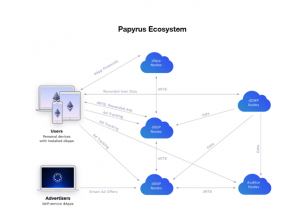
Papyrus Ecosystem
The Papyrus Ecosystem

Papyrus will deliver the world’s first decentralized, scalable ecosystem for programmatic-advertising capable of processing billions of targeted advertisements daily. This system will bring together users, publishers, advertisers and developers of decentralized applications (dApps) in a new way that permits them to interact in an efficient, transparent and mutually beneficial environment that has built-in fraud prevention, and which offers an unprecedented level of control, even for users.

The current digital advertising market is plagued by the absence of transparency and ad fraud. Moreover, despite the availability of predictive technology, targeted advertising using current technology has very low accuracy.

The result is up to 50 percent of advertising budgets derailed to pay intermediaries or simply wasted on fraudulent traffic – for every $1 spent, advertisers receive only $0.5 in value. As the 2017 global market for digital advertising reaches a value of over $223 billion, this could mean up to $110 billion of misused ad spend by the end of the year.

The uniqueness of the Papyrus approach lies in the “trustless” environment powered by blockchain technology.

Using blockchain, participants rely on decentralized consensus and universal transparency and incentives for fair and efficient cooperation within the ecosystem.

Papyrus Identified the Reasons Behind the Growth of AdBlock Programs

Papyrus emerged in response to the overwhelming negative user experience with irrelevant, irritating and fraudulent digital advertising. Hidden surveillance of user behavior and data exploitation has prompted the growth of adblock programs, which further reduce efficiency.

In addition, the long, inefficient and opaque chains of intermediaries between advertisers and publishers bleeds advertisers of revenue, increases costs for fraud prevention and impede their ability to accurately calculate true costs.

To accelerate the adoption of the ecosystem by the market, Papyrus will provide special open source libraries that can easily be embedded within traditional digital advertising systems. These libraries will be available at a very low cost barrier, creating no direct threat to existing business models.

Blockchain Goes Mainstream in a Big Way

Unlike other advertising blockchain projects, including BasicAttentionToken, Adchain, QChain, AdEx, and others that address single, highly specialized problems, Papyrus is a full-service solution that seeks to strategically transform the entire digital advertising landscape. The adoption of blockchain technologies in advertising has until now been associated with scalability issues.

Papyrus is both scalable and built with open architecture that will accommodate the integration of other projects within the Papyrus ecosystem. This creates a truly global, decentralized platform open to all developers of new adtech solutions for continuous improvement and evolution.

How does RTB Breed Transparency-Related Issues, Allowing Fraud to Continue?

While real-time bidding technology (RTB) for ad buying has already overcome peak expectations, it has plateaued in terms of productivity. RTB has transparency-related issues, allowing fraud to continue and forcing users to turn to Adblock technology to protect against irrelevant content and gratuitous exploitation of their attention.

Papyrus uses state channels and other blockchain technologies to prevent these weaknesses of traditional advertising while reinforcing the speed and efficiency of RTB.

Papyrus Product Director Alexander Shvets, said, “Papyrus is a breath of fresh air in the world of real-time bidding. Blockchain is game-changing tech that will not only solve the industry’s transparency and fraud problems, but unleash a new era of advertising creativity. The Papyrus mission is to use the best of blockchain tech to reinvent the RTB ecosystem from the ground up.”

This leads to Shvets’ vision for the future of digital advertising, “Papyrus solves the problems of digital advertising by simply scrapping the whole thing, instead of trying to fix it. It is far more user-centric than any previous system, offering full involvement of all ad cycle participants, from publishers and application owners to advertisers and end users.”

Technology for the Future

The Papyrus decentralized digital ad ecosystem is built on top of the Ethereum blockchain and its smart contracts, utilizing a network of state channels for bandwidth scalability and a reliable decentralized data storage structure. This enables Papyrus to minimize storage costs and maximize speed for handling large amounts of data.

Papyrus consists of four layers of architecture with the components of each layer developed as open source software. It will also employ blockchain-based identification and reputation management tools for ecosystem participants, as well as a decentralized real-time-bidding (RTB) protocol that will support dApps and instantaneous transactions. This framework combines decentralization, capacity, and speed.

Total Volume of PPR Utility Tokens Fix

Publishers, dApp developers, advertisers and end users will use Papyrus Ethereum-based tokens, called PPR, as a utility token for exchange within the ecosystem. The total volume of PPR utility tokens in the ecosystem will be fixed at the volume of 1 billion.

With the launch of Papyrus, circulating PPR tokens will be application ready for trade on crypto exchanges outside the Papyrus ecosystem, allowing conversion of tokens to fiat liquidity on secondary markets.

After launching an initial prototype of the ecosystem, followed by a limited pre-sale of tokens scheduled for September-October 2017, Papyrus will start integration with traditional advertising networks and platforms.

Read AlsoIt’s 2017 and you still don’t know where your ads are running

#SamSales’ Five Tips for Getting Personal on Social Media

3
Social Media
#SamSales’ Five Tips for Getting Personal on Social Media

As a career sales executive, I can say with experience: social media has completely changed how we do business. Social media is an entire ecosystem of audiences and potential customers that we, as salespersons, can tap into at will – of course, with varying degrees of success.

With Twitter’s launch of a new direct message button, social media strategy has evolved once again. Now brands, companies, sales reps, you name it, have even more opportunities to actively engage users through chat bots and other automated services.

But user beware; this newly-automated nature of “direct messaging” prospects can only take sales and marketing efforts so far. Bots and automated experiences lack the intuitiveness of a sales rep, to know when an engagement needs to be nurtured long-term, or when to provide an in-depth client experience.

Let’s face it, we’d rather talk to a person than some bot. That’s why today it’s crucial marketers and sales reps develop a client-brand relationship on social media that’s personal. Give your fans the first-class social experience they deserve!

Here are five ways to put the personal back in social:

Create short and compelling content.

The average viewing attention span is only 7 seconds, down from the high of 12 seconds in 2000. Across the industry, there is an unmet need for shorter content.

For your next pitch, consider producing a short video about what you do. Less is more after all. Another idea is to take your webinar content, splice pieces out, and create shorter, snackable pieces of content primed for social media sites.

via GIPHY

Gifs anyone?

Show me you know me (SMYKM).

If you’ve read my posts you know I’m a huge believer in the Show Me You Know Me philosophy. The eighty million Americans – the Millennials – are not some single monolith, and they shouldn’t be treated as such. They enjoy being stereotyped or pigeonholed as much as Generation Xers or Baby Boomers.

That’s why it’s important to do your homework, and find out who your potential client is not “what” they are. You need to go beyond the basic Three Gs: gender, geography, generation. Craft your message with nuance and details.

The heart and soul of outreach is knowing your buyer. So, take a step back, and personalize your interactions with customers. Context and a well tailored message are now imperative to reel in a prospective client.

Host your first networking pow-wows

Go beyond who you already know and find the people on the edges of your network, where other’s networks overlap. Chances are, there are hundreds of contacts who just need a simple introduction.

Gather your staff for an “Account Executive Social Pow Wow.” Go from being a “third degree” connection to a “first degree” connection with a simple introduction from your colleague. Think of it as a LinkedIn Party – an office social event to tweak and boost online profiles – with a kick.

Find commonalities anywhere! Be creative. Perhaps you know someone who went to the same college, likes the same baseball team, television show, or has a similar leisure activity.

(As a bonus: Meetings such as these also boost morale and collaboration across teams).

Social selling is not a suggestion, it’s a must-do!

Like your email address, a hashtag is now an extension of your brand, company, and you. It’s all ties back into personalization. A hashtag makes you searchable, memorable and encourages others to carry that message forward. It can be emotive, topical, or humorous.

Additionally, offer advice through your social account. Stay away from “share, share, share,” as it lacks creativity and can sometimes annoy. Instead leave insightful comments related to relevant posts. Then promote your own materials for followers to see – in moderation.

Create a campaign or contest between sales/marketing for referrals

The networking universe is constantly expanding – so why not be proactive in keeping pace? Unfortunately, far too many people let this slide, and let social network growth and referrals fall by the wayside.

Develop a system to refer people that you know or to help others out. Increase the number of people you are connected with who can offer resources or support. Even consider revisiting old opportunities and reinvigorate past networks. These are small, but important steps, and again, this builds morale between competitive reps.

People aren’t the least endeared by the “take a number” approach to customer service, or automated phone transfers that never seem to direct you to the right service desk. Why, then, would anyone want cold, generic dialog from a social media interaction? Personalize your approach to social media, and your audience is sure to follow suit.

Also Read:  Five Ways to Get Personal with Your Marketing

TechBytes with Gil Chamiel, Director of Data Science and Algorithm Engineering at Taboola

0
Gil Chamiel
TechBytes with Gil Chamiel, Director of Data Science and Algorithm Engineering at Taboola

Gil Chamiel
Director of Data Science and Algorithm Engineering at Taboola

In an era of personalization and web customization, marketers are increasingly relying on programmatic and AI technologies. Predictive technology and omnichannel experience help businesses increase user engagement, monetize traffic and deliver relevant content throughout the customer journey. We spoke to Gil Chamiel, Director of Data Science and Algorithm Engineering at Taboola, to understand how the predictive recommendation engine for content discovery works and how AI helps to understand audience behavior analytics.

Html code here! Replace this with any non empty text and that's it.

MTS: Tell us about your role at Taboola and how you arrived at this position?
Gil Chamiel: I am Director of Data Science and Algorithm Engineering at Taboola. This means that I am in charge of our algorithmic development efforts and research. Before I came to Taboola, I completed my PhD at the University of New South Wales in Sydney, Australia where I focused on AI research for web personalization.

I joined Taboola at the end of 2010 when it was still a very small company of around 20 people worldwide – today we are nearly 800. I started as an algorithm engineer as part of a team that consisted of software developers and a few algorithm engineers. As we grew, we decided to dedicate more resources towards algorithmic efforts and established an algorithm engineering team that I then led. The team grew and became a group consisting of several teams of data scientists/machine learning researchers and software engineers. In the past 18 months or so, we have been heavily investing in our Deep Learning knowledge and capabilities. This included studying new modeling techniques as well as the engineering of production-level scalable deep learning pipelines. The result is a strategic shift in Taboola’s R&D. We graduated most of our algorithmic stacks to be based on deep learning and adopted it as the default technique.

MTS: How does Taboola’s predictive recommendation engine work?
Gil: The challenge is matching content, products, apps, videos, etc (out of hundreds of thousands of possible recommendations at any given time) to users in specific contexts in a way that increases both short/long term engagement and revenue. We look at over 100 factors including previous engagement with Taboola recommendations and at the user’s browsing behavior outside of Taboola.

We then build predictive models that try to estimate the probability that users will engage with a certain item in the future. For example, imagine predicting when an article is being written what’s the likelihood certain people will like it before they even knew it existed – it’s a complex problem, and exciting for us at the algorithm team. Due to the ever-changing nature of the internet and of our marketplace, we needed to invent an unique exploration/exploitation paradigm where most of the time we show users recommendations that we are fairly certain will work well for them, but sometimes explore new recommendations that we have a reason to believe may also work well for them. Also, since we never come across the exact same scenario twice, we must use sophisticated algorithms, such as Deep Neural Networks, in order to power the predictive models with generalization capabilities.

Just to share the magnitude of scale, we recommend 14 billion times a day to a billion people a month. We need to make a decision out of tens of millions of items (content, videos, ..) across tens of thousands of publishers/marketers – and the decision needs to take less than a second.

MTS: How is AI-based personalization technology transforming the omnichannel user experience?
Gil: AI brings together a variety of technologies from different fields. For instance, it allows computers to understand language much better than we did before. Since users consume a lot of their content by reading text, this significantly helps us to improve the user experience: we can understand what sort of language people engage with better than before and in which situations. This means understanding not only the semantics of the text but also other properties, which might influence people’s engagement with text such as style and grammar.

Another example comes from the field of Computer Vision: people engage with images during the discovery process and AI helps us understand how people interact with those images, thereby improving the user experience.

MTS: How do you see data analytics algorithms moving from descriptive towards prescriptive intelligence? How are MarTech platforms adopting Embedded Analytics over Business Intelligence?
Gil: As mentioned previously, the internet and the Taboola marketplace constantly change. This means that simple descriptive methods, with limited generalization capabilities, will fail to perform well enough in understanding the subtleties of new web content. Deep Learning algorithms are geared specifically for that type of task: to capture the essence of new cases that they have not seen previously.

In addition, we are dealing with a very high-dimension optimization problem. Simple statistical approaches may work in simpler problems, for instance, if we merely had to match advertisers to publishers. But here, we have what researchers call the “curse of dimensionality”, where the optimization problem has a vast number dimensions (for instance, individual user clicks; raw text; images), with potentially high order relations between them, which makes Deep Learning techniques the only way to deal with this task successfully.

MTS: How should businesses build and adopt the ‘right’ strategy for AI-based content marketing and customer experience?
Gil: Start simple and use what’s already out there. Ten years ago, Taboola didn’t use deep learning: we used simpler models that required less engineering complexity to get a good head start. When getting into deep learning, make sure you use the great tools and data already out there. As far as tools, there’s an abundance of open source technologies to kick off your project for many of the problems you will come across before you’ll need to get unique talent that is experienced in Deep Learning. One of the nice things about working with deep neural networks is the concept of transfer learning: you can take a solution (a neural network), which was built over a very large dataset and plug it into your solution in order to get a head start (especially if you don’t have a lot of data or a lot of computational power).

Obviously, plugging in a network that was built to optimize a problem that is different than yours is not going to just work seamlessly. But you might want to take parts of that network and then continue to optimize yourself. It’s a good way to get a head start.

Finally, build your AI pipeline in a simple manner that is geared towards experimentations. There are lots of knobs to twist in every algorithmic solution and usually it takes quite a few experiments to find a good solution. In Taboola, we constantly experiment (offline and online) with new solutions and it brings good value to the business. Also, equally important, it allows every data scientist in the team to come up with new ideas and experiment on real data, which means every individual’s level of influence is pretty much bound only by the amount of influence they would like to have.

MTS: How do discovery platforms enable marketers to leverage their assets for retargeting and republishing without losing credibility?
Gil: One of our tech innovations is to automatically find the delicate balance between recommending relevant content and defusing user fatigue (that’s the effect you get when users get exposed to the same stuff repeatedly in a way that makes them develop an aversion or even blindness to the content). In Taboola, we let the data speak for itself and model the effect of user fatigue using deep learning tools. This must not be forgotten when retargeting – even though you have a positive signal; a reason to believe the user would like to engage with some recommended item, you must cater for fatigue. This is particularly important given that the feedback we get from users is implicit – they never tell us what they really want to do on a specific page (perhaps they are not sure about it themselves). There might be a tension between the positive signals you have about the user’s past behavior and the number of times they saw a piece of content. A good algorithm will find the balance in a way that will be effective for the platform and won’t frustrate the user.

MTS: Ad fraud and bot traffic are major disruptions to marketing and advertising objectives. How are AI-powered recommendation platforms preparing to combat these challenges?
Gil: Taboola employs numerous strategies to combat fraud and bot traffic. We use predictive models to detect bot traffic by inferring whether the user response is plausible. For instance, we compare the response to personalized and optimized recommendations against the user response when recommending content at random. Humans respond differently to personalized recommendations vs.random ones, while bots respond the same.

MTS: Thanks for chatting with us, Gil.
Stay tuned for more insights on marketing technologies. To participate in our Tech Bytes program, email us at news@martechseries-67ee47.ingress-bonde.easywp.com

Interview with Amit Bendov, CEO and Co-Founder at Gong.io

0
Amit Bendov
Interview with Amit Bendov, CEO and Co-Founder at Gong.io

[mnky_team name=”Amit Bendov” position=”CEO and Co-Founder at Gong.io”][/mnky_team]
[easy-profiles profile_twitter=”https://twitter.com/banditmove” profile_linkedin=”https://www.linkedin.com/in/amitbendov/”]
[mnky_testimonial_slider][mnky_testimonial name=”” author_dec=”” position=”Designer”]“We should all be using these technologies to better craft our marketing programs to hone in on the few true benefits our customers are looking for, to better differentiate ourselves, and to stop wasting money on ineffective marketing.”[/mnky_testimonial][/mnky_testimonial_slider]

On Marketing Technology

MTS: What inspired you to start a technology innovation company?
While managing teams at several successful hyper-growth start-ups, I realized that most companies don’t understand why their sales teams aren’t meeting their targets. Listening to a one-hour call to figure out what the salesperson said and how he handled objections is excruciatingly inefficient and not scalable. I thought to myself, there has got to be a better way. That’s why we started Gong.io.

MTS: Given the changing dynamic of sales intelligence technologies, how do you see the marketing automation and analytics market evolving in the years to come?
The automation and analytics market will change in at least two ways:

  1. The tools will become simpler for everyone to use – not only reports and dashboards but voice and gesture-based systems so everyone can use them, not just highly-trained business analysts.
  2. They will encompass the entire business in a streamlined fashion, not just a silo like sales or marketing.

MTS: How should CMOs leverage AI-assisted sales enablement technologies to scale the challenges in sales coaching and ABM?
We now have technologies available to truly understand our customers – how are they describing the value your product provides them? Which competitors are they exposed to? Which product benefits make them go “Ah!” We should all be using these technologies to better craft our marketing programs to hone in on the few true benefits our customers are looking for, to better differentiate ourselves, and to stop wasting money on ineffective marketing.

MTS: How should CMOs plan their stack integrations to maximize the benefits from predictive analytics and AI-assisted conversation analytics platforms?
Choose platforms from leading, well-funded companies, with an open architecture and a formidable ecosystem. Even if other tools have cooler features and a slight edge in the user interface, there is no substitute for connectivity so all your tools play together in harmony. Choosing a leading, well-funded vendor, also means that they will still be around in a couple of years and you won’t have to switch tools soon.

MTS: What startups in the MarTech ecosystem are you watching/keen on right now?
SalesLoft for SDRs is interesting in that it provides sophisticated automation at the fingertips of SDRs, who used to have to wait for marketing to do that for them. We love scheduling solutions like Chili Piper and Calendly, which do away with a lot of the email ping pong of scheduling demo meetings. Video conferencing systems are awesome for making the world a little bit smaller – we hold all our internal and external meetings via web conferencing to get a feel of how our message is getting across and bring everyone a little bit closer together.

MTS: What tools does your marketing stack consist of in 2017?
We love automation tools. They allow us to be more effective, efficient, and scalable. Here’s a partial list of what we use:

  • Act-On for email automation
  • Salesforce.com for CRM
  • Sumo for website conversions
  • SalesLoft for SDR outreach
  • Chili Piper and Calendly for meeting scheduling
  • Delighted for collecting NPS from users
  • G2 Crowd for customer reviews
  • Teamable for hiring and prospecting
  • LinkedIn Navigator and Unomy for marketing intelligence
  • Ambassador for our referral program
  • Gong.io for listening to sales calls, persona and case study interviews, coach our sales reps and gather market intel.

MTS: Could you tell us about a standout digital campaign? (Who was your target audience and how did you measure success?)
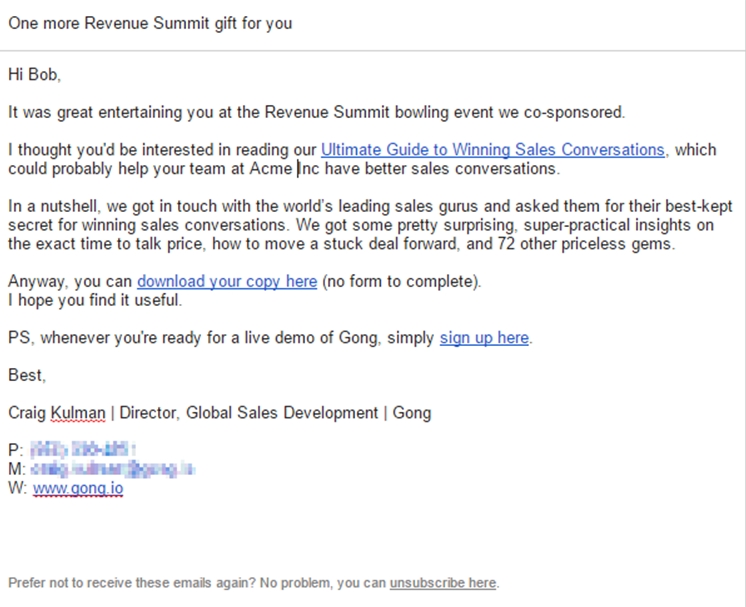
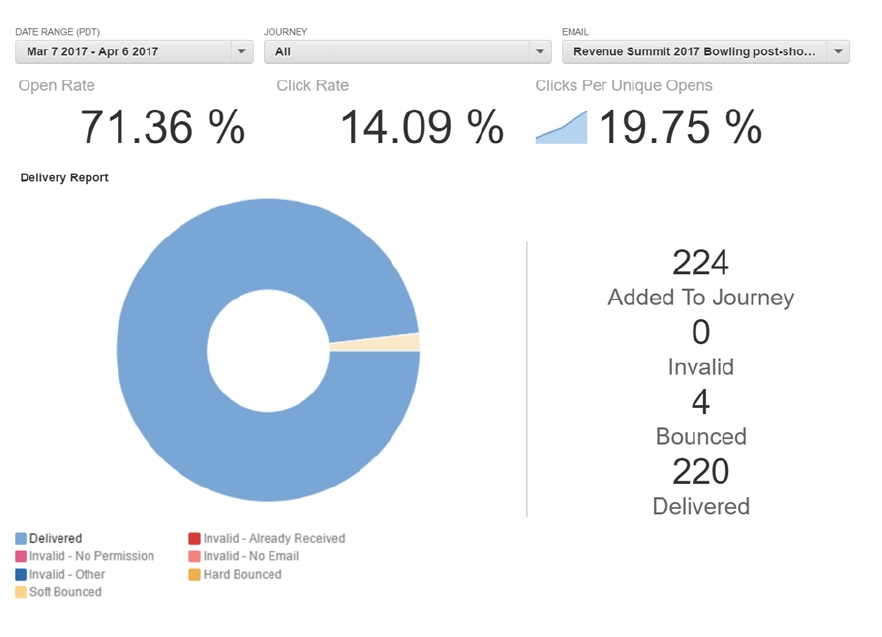
Our VP Marketing, Udi Ledergor, ran an email campaign targeting visitors to our booth at a recent trade show. By planning the right timing, the exact message, and the right target audience, we were able to achieve phenomenal results both at the tactical level – 71.36% open rate and 14.09% CTR, and at the strategic level – a healthy flow of product demo requests and many warm leads to nurture and advance into sales opportunities.

MTS: How do you prepare for an AI-centric world as a marketing leader?
Always be learning what’s out there – what’s the latest and the greatest, what other leading companies are using, what creative uses we can make of the technologies and tools available today. Above all – try lots of stuff. Fail quickly. Scale what works.

This Is How I Work

MTS: One word that best describes how you work.
More

MTS: What apps/software/tools can’t you live without?
TextEdit: I use a simple text editor for writing- no fonts, spell checker, etc. This way I can focus on the message.

  • Kindle: I’m on airplanes a lot. Kindle helps time fly
  • LinkedIn: A few times a day. Sales, recruiting, marketing.
  • SiSense: Simple BI tool that shows us our numbers.
  • Delighted: for getting customer feedback
  • And of course, Gong for knowing what’s going on with our sales & support. I am addicted to our
    own beer 🙂

MTS: What’s your smartest work related shortcut or productivity hack?
Turn all/most notifications off. Keep meetings short. I fly through long PPT decks, reading only the last 1-2 slides.

MTS: What are you currently reading? (What do you read, and how do you consume information?)
Sapiens, by Yuval Noah Harari. Zooming out is one of the best ways to understand a domain. Before telescopes and Astronomy, most folks believed the earth is the center of the solar system. This book provides a zoom out view of human history.

MTS: What’s the best advice you’ve ever — your secret sauce?
What you learn from success is more valuable than what you learn from failure. I like to hire successful people and learn from successful people and companies.

MTS: Thank you Amit! That was fun and hope to see you back on MarTech Series soon.

[vc_tta_tabs][vc_tta_section title=”About Amit” tab_id=”1501785390157-b58e162d-0ae25a4b-c27aca64-108eb4e4-3627″]

Over 20 years of senior leadership experience in hyper-growth technology startups; managing R&D, marketing, and sales to global corporations in North America, Europe and APAC. Track record includes taking tech companies from zero sales traction to successful exit/IPO, from small teams to large organizations, and from anonymity to white-hot companies.

[/vc_tta_section][vc_tta_section title=”About Gong” tab_id=”1501785390320-2d44fa50-740c5a4b-c27aca64-108eb4e4-3627″]

Gong.io logo
Gong is the #1 conversation intelligence platform for B2B sales teams. It helps you convert more of your pipeline into revenue by shining the light on your team’s sales conversations. Gong records, transcribes, and analyzes every sales call so you can scale the effectiveness of your sales conversations.

[/vc_tta_section][/vc_tta_tabs]
[mnky_heading title=”MarTech Interview Series” link=”url:https%3A%2F%2Fmartechseries-67ee47.ingress-bonde.easywp.com%2Fcategory%2Fmts-insights%2Finterviews%2F|||”]

The MTS Martech Interview Series is a fun Q&A style chat which we really enjoy doing with martech leaders. With inspiration from Lifehacker’s How I work interviews, the MarTech Series Interviews follows a two part format On Marketing Technology, and This Is How I Work. The format was chosen because when we decided to start an interview series with the biggest and brightest minds in martech – we wanted to get insight into two areas … one – their ideas on marketing tech and two – insights into the philosophy and methods that make these leaders tick.

ePrivacy: The Online Privacy Stakes Are About to Get Higher

0
ePrivacy: The Online Privacy Stakes Are About to Get Higher

Since it was first announced in January 2012, the General Data Protection Regulation (GDPR) has dominated the marketing industry agenda. And with its effective date now only ten months away, it’s easy to see why the debate has now risen to a clamor. But the GDPR isn’t the only new rule book companies should be prioritizing, especially when it comes to marketing.

The ePrivacy Directive (ePD) — commonly known as the “cookie law” — must also be taken into account. It’s certain this will be challenging, given that a legislative overhaul is still in progress, but the stakes will be high and that means it’s essential for marketers to start making their preparations now.

With that in mind, let’s take a look at what it is and why it matters.

The ePrivacy Regulation (ePR) in Brief

While the full details are not yet known, what we do know is enough to make the digital marketing industry sit up and take notice. Of course, there is already an ePrivacy Directive in existence, but this upgrade is set to be tougher and will become a Regulation, meaning there will be one pan-European cookie law marketers must observe – the ePR. It will not become part of the GDPR, but will be another law to comply with in parallel to the GDPR.

What Will It Mean for the Industry?

The ePR will adopt two critical aspects of the GDPR, which could make it even more important to marketers and publishers. Firstly, the ePR will adopt the GDPR’s definition and approach to consent. This means consent will have to be specific to the cookies being used, as well as freely given and unambiguous. There will be a number of technical details that need to be defined but the it’s already clear that marketers will not be allowed to load tracking cookies until consent is given. That’s a tough nut to crack, but by deploying a data specialist with the right expertise, marketers can make sure they’re equal to the challenge.

The second critical thing to know is that the ePR will adopt the GDPR’s penalties: namely up to 4% of a company’s global turnover or €20 million, whichever is greater.

For marketers, the risk level for non-compliance just jumped manifold, particularly as the inconsistent content standards of the current ePR are sparsely enforced and failure to adhere rarely results in significant penalties. Now there will be a higher benchmark for consent and heavier fines if marketers fall below it, which means there are more opportunities for things to go wrong.

Privacy officers are already under pressure to comply with the GDPR and, with the realization that ePR alignment could be even more complex, it’s not surprising some are hoping it won’t be finalized in time for its target enforcement date: 25 May 2018, the same as the GDPR.

Why Is Speedy Preparation So Important?

Privacy officers already under significant pressure to comply with the GDPR will now have to work at double speed to bring practices in line with a law that brings its own complexities and isn’t even in its final form yet.

Some are taking solace in the idea that the ePR won’t be finalized in time for it to take effect in tandem with the GDPR. But this is a misapprehension. A nuanced and overlooked aspect of the present ePD is that it accepts whichever data protection framework is currently in place. This means even if the new ePR is not finalized on schedule, the existing ePD will automatically adopt the GDPR’s definition of consent, and penalties. In light of recent changes, the UK has introduced its Data Protection Bill to reiterate the need for the consumer’s control over their personal information held by organizations.

We should expect robust enforcement right out of the gate — many data protection authorities have signaled that they intend to take ePR implementation seriously. Furthermore, as checking how companies gain consent is easiest, it’s the most likely element authorities will assess first. This is because they can simply go to website or apps and look for notice and consent tools that meet GDPR standards, instead of asking companies for records or evidence of compliance.

Next Steps…

Time is of the essence, but there is still enough left for marketers to develop a mature ePR strategy that includes a cogent digital governance framework. It is vital to ensure that they know what cookies are on their sites and apps, and have control over them, while also ensuring their tools exceed the ePR thresholds. Notice and consent is the law of the land, and while the finer details remain to be revealed companies need to start aiming for higher regulatory standards now. Certainly, compliance with the ePR will be tough, but shying away from it is not a good strategy for anyone, especially when the stakes are so high.

Bucksense and Lotame Join Forces to Provide Self-Serve Audience Segments for All Ad Buyers

0
Bucksense
Bucksense and Lotame Join Forces to Provide Self-Serve Audience Segments for All Ad Buyers

Incorporating Lotame’s Audience Segments Into Bucksense’s Platform Will Result In More Targeted And Better Performing Campaigns

Bucksense, the programmatic platform for agile marketers, has announced a strategic partnership with Lotame, the leading independent data management platform (DMP) and data exchange. Through the partnership, advertisers can access Lotame’s global, third-party data and audience segments directly on the Bucksense console to create targeted display, native, and video campaigns around the world. The partnership covers the United States, Canada, Asia-Pacific, Europe and Latin America.

bucksense + lotame
Bucksense, part of Acotel Group SpA, was founded in 2012 and is currently used by more than 300 agencies worldwide. As a leading programmatic platform for agile marketers, Bucksense offers marketers with micro-bidding, ad tags and macros, video ad viewability, KPI optimization for display, video and native campaigns, smart budget controls, access to thousands of audience segments worldwide, brand safety features and built-in fraud prevention features.

Cristian Carnevale
Cristian Carnevale, CEO, Bucksense

Cristian Carnevale, CEO, Bucksense, said, “Incorporating Lotame’s audience segments into our platform will result in more targeted and better performing campaigns.  For this partnership and because we are largely a self-serve platform,we put additional effort into integrating a smooth data selection process into our existing agile campaign creation interface. Our focus on user workflow is something that we know our growing base of more than 300 agency and advertiser clients truly appreciate.”

By having access to the most reliable data and audience segments, provided by Lotame, within an acclaimed cutting edge DSP — such as Bucksense —advertisers and agencies can now more easily meet their goals under a single roof.

Ryan Rolf
Ryan Rolf, Vice President Data Sales, Lotame

Ryan Rolf, Vice President Data Sales, Lotame, said, “We’re extremely excited to partner with Bucksense. The sophistication of the Bucksense platform makes it an ideal fit for our rich taxonomy of audiences, allowing marketers to fine tune their media campaigns and better understand and reach their target audience at scale. It’s a perfect fit as we bring our recent work on data quality and audience creation to their brand and performance clientele.”

By partnering with Bucksense, Lotame is extending its position as a leading independent DMP that offers the most widely used, trusted and comprehensive data exchange in the industry.

Today more than ever, advertisers demand that their digital campaigns increase conversions while protecting their brand. At the same time, agencies strive for programmatic technologies that help them deliver those client requested KPIs within budget and under a seamless and efficient internal operation.

Instapage Launches Advertising Attribution Solution

0
Advertising Attribution Solution
Instapage Launches Advertising Attribution Solution

Marketers Can Track Cost-Per-Visitor And Cost-Per-Lead For Their Paid And Organic Traffic, Using The Latest Instapage Solution

Instapage, the only landing page platform for paid advertising, has announced its Advertising Attribution Solution for teams that invest in paid marketing platforms like Google AdWords.

Recommended Read: Interview with Tyson Quick, Founder & CEO – Instapage

This first-of-its-kind offering delivers unparalleled insights into Google AdWords attribution across the entire marketing and sales funnel. Customers will be able to track cost-per-visitor and cost-per-lead for their paid and organic traffic.

Tyson Quick
Tyson Quick, Founder and CEO, Instapage

Tyson Quick, Founder and CEO, Instapage, said, “This is the next step in our effort to make digital advertising more efficient for everyone. Advertising attribution is a powerful means to understanding the true value of an AdWords campaign. With our advanced analytics, our customers will be able to make strategic decisions about their campaigns that have a direct effect on ROI.”

Read More: Instapage Announces Integration with HubSpot to Bring Best-In-Class Customer Experience on Landing Pages

90% of Instapage customers use Instapage in conjunction with their digital advertising. With this solution, customers have full visibility into paid advertising attribution. Users can:

  • Fully integrate with Google AdWords and Google Analytics to pass lead meta-data to down-funnel systems
  • Attribute conversion, pipeline, and revenue to specific Adwords campaigns
  • Track cost-per-visitor and cost-per-lead for paid and organic traffic
Chris Briggs
Chris Briggs, Creative Director, Verizon Digital Media Services

Chris Briggs, Creative Director, Verizon Digital Media Services, said, “Instapage has become an important part to scaling our AdWords campaigns. The ability to create, A/B test, optimize, and analyze the success of our landing pages has made our team smarter and faster.”

The Advertising Attribution Solution is part of a larger Instapage product release, the Advertising Conversion Cloud for teams and agencies that undertake advertising at scale. The product includes a full range of enterprise solutions and services including advanced security, implementation services, and customization.

Currently, Instapage, the most powerful landing page solution for marketing teams and agencies, is on a mission to continually lower the cost of online customer acquisition. Instapage provides an end-to-end solution that empowers marketers to quickly build, integrate, and A/B split test landing pages for every unique campaign. With Instapage, paid advertising is more relevant and effective for everyone.

Amplero Lifts Lid on AI’s Black Box for Marketers with New AI-Fueled Learned Insights Capability

0
Amplero Raises $17.5 Million in Series B Funding

Amplero, a recognized leader in core artificial intelligence marketing technology, announced enhancements to its pioneering AIM Learned Insights capability.

The announcement comes immediately following a $17.5 million Series B funding round co-led by Greycroft and Ignition Partners.

Powering personalized, cross-channel customer experiences at brands like Sprint, Xbox, Virgin Mobile, DoubleDown Interactive, the Amplero Artificial Intelligence Marketing (AIM) Platform adaptively optimizes every customer interaction to maximize customer lifetime value and loyalty at a scale that’s not humanly possible.

“Both the customer experience and the enterprise marketing infrastructure landscape are being transformed through the application of artificial intelligence at the core of the martech stack,” said Andrew Toner, Chief Technology Officer, Amplero. “The machine-intuited insights surfaced as part of the Amplero AIM Platform’s revamped Learned Insights feature provides marketers critical new visibility into campaign performance and customer behavior, while automatically and continuously optimizing toward the marketer’s specified KPIs.”

“For companies to deliver optimized customer experiences, there can no longer be daylight between systems of engagement and systems of record—measurement, insight and action must be synonymous. Based on the number of customer attributes and potential customer experiences, the average B2C enterprise has more testable permutations than the length of the universe in seconds. Rules-based, “bolt-on AI” testing platforms and traditional analytics technologies simply cannot run even a fraction of the simultaneous experiments necessary to keep up,” said Olly Downs, PhD, Chief Executive Officer and Chief Scientist, Amplero.

As part of the Amplero AIM Platform, the new Learned Insights capability provides powerful benefits to B2C marketers in enterprise organizations working to deliver personalized customer experiences at scale:

  • Makes AI real for marketers by lifting the lid on the “black box” approach prevalent among marketing vendors claiming AI. Marketers have access to key learnings related to both short-term engagement metrics and longer-term business KPIs such as incremental revenue and retention rates, without dependencies on data science or business intelligence teams for analysis and recommendations.
  • Transforms the marketing campaign process from one of journey building and hypothesis testing to one of dynamic discovery. The Amplero AIM Platform uses machine learning and multi-armed bandit experimentation to recursively test and continuously optimize thousands of marketing permutations at the nano-level to expose marketing performance drivers that otherwise may have been overlooked.
  • Proactively distills learnings into key themes that are surfaced to the marketer in an insightful and intuitive way, with deep links to relevant reports for further context and insight. This approach ensures that deep learnings being discovered and acted upon by the Amplero AIM platform may be understood by the marketer, shared and applied across the organization to shape future creative, offer and product development,  provide alerts to unexpected shifts in customer behaviors, and monitor campaign efficacy.

“With its ability to runs thousands of tests simultaneously and orchestrate decisions based on our entire customer data ecosystem, the Amplero AIM Platform optimizes our customer experiences and delivers deep-dive insights at a scale that’s not humanly possible,” said Angela Sigley-Rittgers, CMO of Sprint’s Prepaid Brands. “The numbers speak for themselves. After implementing the Amplero AIM Platform, we saw a 10 percent year-on-year increase in prepaid ARPU, resulting in millions of dollars in incremental revenue.”

Unmatched Sales Intelligence Powers DiscoverOrg to Seventh Consecutive Listing on Inc. 5000 List

0
DiscoverOrg
Unmatched Sales Intelligence Powers DiscoverOrg to Seventh Consecutive Listing on Inc. 5000 List

Joining the Elite Inc. “Honor Roll,” DiscoverOrg is Again Recognized for its Continued Growth and Leadership in Sales and Marketing Intelligence Technology

DiscoverOrg, the world’s leading sales and marketing intelligence provider, announced it has been named an Inc. 5000 company for 2017, the 7th consecutive year it has earned this award. As a 7-time honoree, DiscoverOrg joins the Inc. Honor Roll, a distinction given to less than 10 percent of companies named an Inc. 5000 company. The list, published annually by Inc. magazine, ranks the fastest growing privately held companies in the United States based on revenues over the past three years.

DiscoverOrg  co-founder and CEO Henry Schuck attributes the achievement to rapid growth in the company’s sales and marketing intelligence offerings, which have propelled DiscoverOrg to double-digit revenue growth every year since 2007. “Our mission remains focused on accelerating our customers’ pipeline and revenue growth—we can only grow when they grow,” said Schuck. “Since our inception 10 years ago, our customers have experienced the difference our unmatched data has on their own sales. Making the Inc. 5000 list for the seventh time is a reflection of their trust and of our mutual success.”

DiscoverOrg ranks number 1,977 on the 2017 Inc. 5000 list, one of only four sales and marketing intelligence providers and one of 62 companies from the Portland Metro Area. Over the last three years, DiscoverOrg’s revenue has grown by 191%.

“Only a tiny fraction of the nation’s companies have demonstrated such remarkably consistent high growth,” said Eric Schurenberg, President and Editor in Chief, Inc. Magazine. “This achievement truly puts DiscoverOrg in rarefied company.”

Currently, DiscoverOrg is the leading global sales and marketing intelligence tool used by over 2,500 of the world’s fastest growing companies to accelerate growth. The company itself has been named an Inc. 5000 fastest-growing company seven times.

DiscoverOrg’s award-winning solutions provide a constant stream of accurate and actionable company, contact, and buying intelligence that can be used to find, connect with, and sell to target buyers more effectively – all integrated into the leading CRM and Marketing Automation Tools in the market.

DiscoverOrg’s team of over 250 researchers refreshes every data point at minimum every 60 days – ensuring customers reach the right buyers with the right message at the right time.

HYPR Launches World’s First Unique Audience Tool For Influencers; To Open A Branch in London

0
HYPR
HYPR Launches World’s First Unique Audience Tool For Influencers; Opens A Branch in London Branch

New Tool from HYPR Allows Brands that Work With Multiple Influencers to Identify Duplication in Audience

HYPR, the world’s leading influencer search and discovery directory, providing real-time analytics for social media influencers, has announced the launch of its Unique Audience Tool. The Unique Audience Tool allows marketers to evaluate the level of contribution an influencer provides to a campaign by understanding how much of their audience has already been reached through other influencers.

On the heels of this latest development, HYPR has also announced the opening of its first European office in London.

On one dashboard, users can view the key interests, age, gender, ethnicity, location, and the number of unique followers for a list of influencers — key information that’s essential to planning an effective and targeted influencer campaign.

HYPR

Gil Eyal
Gil Eyal, CEO and Co-Founder, HYPR

Gil Eyal, CEO and Co-Founder of HYPR, said,“Brands tend to treat influencer audience numbers as unique, but the truth is this varies greatly. If you activate all Kardashian Sisters, you’ll end up reaching a much smaller number of followers than you might expect. Of course, this varies greatly among groups, and other influencers might have completely unique followings.”

The Unique Audience dashboard displays the total reach for a number of influencers combined, as well as the unique reach. Key audience interests are displayed, as well as combined audience characteristics for gender, age, ethnicity and location. Additionally, a graph details the number of unique followers exclusive to each individual influencer.

This tool is the first to allow marketers to strategically curate a list of influencers with distinctive reach for specific campaigns, eliminating audience overlap and ensuring that unique followers are exposed to promoted products and brands.

“HYPR is committed to its mission of replacing vanity metrics in the Influencer Marketing space with actionable data and analytics. Influencer marketing is a form of digital marketing and it should be measured as such,” added Eyal. .”

 New Office in London

The opening of the London branch allows HYPR to expand on its geographic footprint, and to provide its European clients with a more robust service experience.

The office will be led by Jon Lawford, Business Development Director – Europe. With over a decade of experience working in sales for various social media companies, Jon’s primary focus is to expand HYPR’s UK and European operations, and growing the sales and account management teams.

“I’m very excited to announce the opening of our London branch. We believe there is a tremendous opportunity to introduce cutting edge analytics into the Influencer Marketing industry that is growing rapidly in Europe,” added Eyal.

Currently, HYPR’s in-depth influencer marketing platform houses profiles and audience demographic information for over 10 million influencers across major social channels—making it the world’s largest and smartest influencer index. Marketers can reach large audiences at scale by targeting influencers based on their audience demographics such as age, location and interests. Having access to these audience insights is essential to running a successful influencer marketing campaign.

What Makes Some Companies Heroes and Others Villains?

0
Narratives
What Makes Some Companies Heroes and Others Villains?: How Popular Narratives and the Way Businesses Measure Them Determines Success or Failure

How Popular Narratives and the Way Businesses Measure Them Determines Success or Failure

United Airline’s extremely public PR difficulties have overtaken the public conversation, unleashing a flood of ire toward the company and causing stocks to drop by what was at one point one billion dollars. It is a dire position to be in as a company, and though the need for response is obvious, the optimal response isn’t. United CEO Oscar Munoz issued three different statements, including one in which he assured United staff that protocol had been followed.

The intention was to demonstrate support internally, but instead, Munoz found himself facing off against thousands of vocal opposers who considered this statement a “non-apology.” Whereas a United employee might have been reassured by the statement, outsiders found it inefficient and therefore offensive. In today’s world, the same message can resonate completely differently when viewed through various filters.

In order to market the right message, companies need to understand the issues their audiences care about, how much they care and how it matters–something that’s become increasingly difficult with the amount of noise in the digital age.

Popular opinion is difficult to track, and changes often. There are many times multiple layers of belief patterns playing into the same issues. At the same time, a single action could be interpreted a dozen different ways.

A marketer or business leader’s job is to not only correctly identify and comprehend each of these trends but also make strategic decisions about how to interact with these narratives as a brand. New software breakthroughs for processing information hold the key to demystifying these decisions.

Traditional marketing and PR tactics are no longer effective. There are far too many factors to take into account for intuition or painfully limited historical market research methods to provide sufficient insight for action. Misreading the information can mean putting resources into sending the wrong messages–a business mistake that ranges from inconvenient to devastating.

Using software-powered analysis driven from multiple sources establishes a foundation of firm, data-supported truth from which marketers can make decisions that influence consumer perceptions and actions, win hearts and heal wounds when necessary.

Read Also: Introducing the Protagonist Platform, A Narrative Analytics Solution That Uses Data Science to Expose Comprehensive Market Landscapes Without Limit or Bias

Traditional Research Has Left Marketers Operating Blindly

The first step toward creating narratives that strengthen a brand is understanding where they come from. Companies aren’t deaf to the importance of understanding their audience or their brand and have invested heavily in research to help them do so. Unfortunately, that research can hurt more than it helps. Polls, surveys, and focus groups inherently access only a small part of the picture, and companies that take action based on them risk miscalculating and hurting their brand.

To Understand What Makes Polls Unreliable, Consider the Last Two US Elections

In 2012, Gallup miscalculated the forecasted results of the election so drastically that USA Today dissolved its partnership with the organization. The pollsters attributed the inaccuracy to factors including relying too heavily on limited populations.

In the recent election, the inaccuracy of the polls for predicting the results was record-setting. Like in 2012, most surveyors focused too heavily on the wrong populations, leaving massive portions of the voter base completely unconsulted.

And, the error went further; sometimes it’s not about asking the wrong people; it’s about asking the wrong questions. Many poll takers misreported their feelings about the election, and poll givers didn’t necessarily ask about the issues that were really driving voter behaviors. They weren’t mining for beliefs.

These same shortcomings plague the consumer studies that enterprises shell out for, resulting in untrustworthy results and subsequently ineffective marketing campaigns. At the enterprise level, most companies can access information about buying behavior or customer feedback from surveys, but that information does little to reveal which narratives really resonate with that audience.

Companies don’t have the luxury of having poll results to tell them how to win their customers back when they’re outraged. They have to rely on their own analyses, given the available information.

For years, polls were the best option for consumer insights. With new innovations, that’s no longer the case. Technology like natural language processing, data science and machine learning mean that companies can suddenly access a comprehensive analysis of their audience’s deeper beliefs, and can strategize accordingly.

Read Also: Interview with Robert Carroll, Chief Marketing Officer at Protagonist

The Age of Science-Based Marketing

There is more digital information available today than ever before, as social media profiles become universal, smartphones and connected devices collect information and companies as a whole produce and collect unprecedented amounts of customer data.

But that sheer volume of information wouldn’t actually be all that valuable on its own; more information is only valuable if there’s a way to process it at scale. Deeper beliefs aren’t exactly easy to quantify, so unless business strategists have nothing better to do than assessing each piece of data individually, the job has essentially boiled down to educated guesswork–until recently.

Natural language processing is computer programming that enables software to comprehend human language, and when combined with machine learning, the two can actually derive meaning from huge qualitative data sets. This process of applying technical breakthroughs to understand belief systems is called Narrative Analytics.

Both natural language processing and machine learning have experienced explosive innovation in the past few years in what Forrester’s Diego Lo Giudice calls a “renaissance of AI”–the first meaningful, dramatic advancement of cognitive capabilities in 30 years. The net result is that algorithms can expose trends and insights that can help answer the questions that have been plaguing marketers for decades — belief mining.

In the right hands, Narrative Analytics exposes trends and impactful belief patterns that might have otherwise been overlooked, uncovering opportunities for dramatic growth that businesses didn’t know they had…or threats they didn’t realize existed.

Narrative Analytics can actually deliver real answers to questions like:

How can I understand customer beliefs in my industry?

– How can I shape customer narratives about my brand?

– How can I anticipate the emerging threats to my company or recover from mistakes?

Culture globally is shifting rapidly, voices are rising from unexpected places and the business landscape is no longer consistent. Companies that grasp the value of the uptick in software capabilities and create messages that resonate will come out ahead in the battle for consumer hearts and minds; the ones that don’t will fall behind, and maybe out of favor entirely.

Read Also: Catapult PR-IR Won Two Industry Awards for Creating New Strategic Narrative Marketing Framework

Interview with Daniel Meehan, Founder & CEO, PadSquad

0
Daniel Meehan
Interview with Daniel Meehan, Founder & CEO at PadSquad

[mnky_team name=”Daniel Meehan” position=” Founder & CEO at PadSquad”][/mnky_team]
[easy-profiles profile_twitter=”https://twitter.com/meehandaniel” profile_linkedin=”https://www.linkedin.com/in/danmeehan/”]
[mnky_testimonial_slider][mnky_testimonial name=”” author_dec=”” position=”Designer”]“The CMO challenge for media buying is telling a brand story in a mobile first and fragmented world, and building differentiation for their products that leaves a positive effect on consumers.”[/mnky_testimonial][/mnky_testimonial_slider]

On Marketing Technology

MTS: Tell us about your role and how you got here? What inspired you to start PadSquad?
When the iPad launched in 2010, my first thought was that it would change content consumption forever.  That was the initial inspiration for PadSquad. A powerful device, with amazing graphics, that you can interact with content on a touchscreen was born! iPads flew off the shelves for the first 3-4 years after launch, then were sort of replaced by larger smartphones as the consumption device of choice. So in some ways, I totally got the iPad media thing wrong!

As that migration from tablet to phone as happened, so has the focus of our business changed. Coming from the publishing and media industry, I was focused on two critical topics that remain relevant today.

MTS: How would publishers and media owners format and design content for this new family of devices?  How can brands leverage these new touch-enabled devices to engage customers?
PadSquad was launched midway through 2012 to solve both of those challenges. We created a mobile software platform that formatted web content for smaller devices so publishers could deliver a better user experience for their audiences. In tandem, we focused our efforts on building the most amazing mobile creative campaigns for brands on mobile, so they can delight consumers in a polite way that is memorable.

MTS: Given the changing dynamic of engagement with online customers, how do you see the existing viewability and on-target audience benchmarks for mobile advertising evolving by 2020?
Viewability is sort of the lowest common denominator to solve for digital bad actors and fraud in my opinion. It’s not a metric I believe in when measuring any lasting effect of a brand message. The digital market has some interesting challenges to figure out when it comes to measuring audiences in a mobile first world. The app space allows for IDFA targeting, better attribution and high viewability, but for the vast majority of ad inventory, there is utility based and in gaming.

Mobile web is restricted based on browser settings, and lack of 3P cookies in Safari, but offers audiences that are typically in consumption mode engaging with content. My sense is that by 2020 there will be some sort of clearinghouse for mobile browser fingerprinting that can be matched to mobile IDFA to develop an industry standard so that data targeting and measurement can be more robust and accurate across devices, browsers, etc. This will lead to more intelligent benchmarks for marketers, and not the hodge-podge of third-parties that exist today, all only telling parts of the measurement story.

MTS: What are the emerging ad formats and bidding technologies that a CMO’s budget by 2020?
Vertical Video in mobile is a favorite ad format, and should take larger share of budget probably before2020 if I had to guess.  When done well, it’s an elegant ad format that tells a story in a polite manner. I’m bullish on it overall. PadSquad is transacting on mobile vertical video in programmatic more than any other ad product right now, and seeing really encouraging results for VCR and engagement. Snap helped pave the way for this ad format, and we’re having success with marketers because of programmatic execution and scale in the mobile web, combined with our creative abilities to edit and format video assets.

Further out, I’ll be interested to see how much traction Augmented Reality ad formats get for budgets. 2020 seems about right for some form of AR to be fully adopted, enough marketers to allocate dollars to, and enough Supply-Side partners to be ready for it. We can execute forms of mobile AR now in non-Safari browsers, and the launch of iOS 11 this Fall will pave the way for mobile AR in Safari and accelerate adoption if I had to guess. Should be exciting!

As for bidding technologies, certainly more progression in automated media transactions will continue by 2020. Over the next few years, machine learning and computer based intelligence will allow marketers much greater insight into media decisioning, hopefully allowing them to spend more time on ideation, messaging, and creative solutions.

MTS: Padsquad offers a premium marketplace for innovative mobile rich media experiences. How is it effective in driving engagement and intent?
We control so many components of most of our client campaigns, starting with ideation, creative design, format and feature development, then activation across content publishers we have directly sourced, vetted and optimized for our unique mobile ad units. The balance of technology and “hand-crafted” creative formats is a good one, and leads to delivery of mobile ads that consumers are intrigued by. We break the mold in many ways, so our uniqueness drives some consumer interest, and then the features, animations, utilities, movement and video used in the campaigns typically draw a user to interact with that message in some way.

MTS: With the growing prominence of programmatic, how does PadSquad bring innovative rich media formats with better experiences?
Transacting via programmatic has certainly exploded onto the marketplace, and we’re seeing some industry growing pains as marketers, media agency teams, and their respective DSPs adopt it. There is just not enough talent that has expertise in it as of yet, but that is changing very fast. Some larger clients we do business with programmatically have very robust and sophisticated in-house teams. We view programmatic as another way to execute for our clients, and can help them accomplish their campaign goals using automation in numerous ways. Since we’ve been singularly focused on creating unique mobile ad experiences, our team has developed code that allows non-standard mobile ad formats to render properly across hundreds of publishers at scale.

As some of the largest digital marketers are realizing that great creative is a differentiator for their brands, they are looking for partners who can execute great mobile creative at scale, the benefits of automation, data. We think PadSquad is uniquely positioned to do that, and the early results are that we’re winning new clients because of our programmatic solutions for high-impact advertising in mobile.

MTS: What’s the biggest challenge that CMOs need to tackle to make their media buying decisions work?
CMO roles are about much more than advertising, but media buying success ultimately comes down to ROAS (Return On Ad Spend), and selling the products and solutions which they are marketing. That’s the end goal eventually. Yet, I think most CMOs will share that the unbelievably fragmented media market, combined with a shorter attention span and more ad collision, has made the job of brand awareness and storytelling much more difficult. The 30-second spot used to be the go-to for storytelling, yet with time-shifting, cord-cutting and ad free streaming services that tool for CMOs is evaporating.

How do you tell stories and have your brand stand for something in today’s marketplace? Sure, we could talk about measurement across platforms, screens, and media. Or we could talk about attribution tracking, or fake news, or brand safety. These are all challenges. My opinion is the CMO challenge for media buying is telling a brand story in a mobile first and fragmented world, and building differentiation for their products that leave a positive effect on consumers. It’s hard, and probably why CMO tenures are at historical lows right now.

MTS: What startups are you watching/keen on right now?
I’m interested in Tenor, as the idea of mapping emotion and communication via mobile GIF sharing, then developing solutions for marketers to leverage that platform is fascinating. Recently I’m watching Albert, because using computing power to disrupt digital marketing, drive efficiencies and insights, resulting in more time for old fashioned creativity is most likely the future of our industry in some form or another.

MTS: Tell us about a standout digital campaign that you were a part of? (Who was your target audience and how did you measure success?)
A good example would be a campaign PadSquad developed for Timberland to introduce their SensorFlex Comfort System technology in boots targeted at both Male and Female audiences. The brand enlisted dancer/choreographer Virgil Gadson as the front man for the overall campaign.

PadSquad’s creative development team brought the SensorFlex technology to life in unique mobile ad formats custom designed to illustrate the ease of movement.  One of our formats allowed users to interact with Virgil and make him dance as they scrolled through mobile content on their device.  It was a very cool experience that led to users spending more than 7 seconds making Virgil dance, before engaging with him to open to a larger mobile experience with Timberland boots. Overall the engagement rate for the campaign was more than 5%, and drove ~500,000 total engagements. Even more interesting to me (and to the client), was the advanced analytics their custom format resulted in. We tracked interesting data such as 91,000 device tilts that flexed the Timberland boots, and that users tilted their device forward 92% of the time, only tilting back 8% of the time. Users spent more than 500,000 minutes engaging with the format during the short campaign.

These are the type of metrics that truly great creative execution, cool formats, and targeting can produce.  What’s more amazing?  The client tracked sales lift from the campaign internally, telling us it resulted in a 300% sales lift.  So you CAN have engagement, awareness and down funnel activity from great mobile campaigns.

This Is How I Work

MTS: One word that best describes how you work.
Hustle

MTS: What apps/software/tools can’t you live without?
It’s probably not a very cool or sexy tool, but I’m a huge fan of Microsoft’s Office 365 Cloud. I use it for email, document storage, sharing, notes, collaboration. PadSquad is a heavy Slack user for our team as well.

MTS: What’s your smartest work related shortcut or productivity hack?
I’m actually a big believer in a list of things to accomplish on a daily basis. Mine are typically categorized into sort of a “must accomplish”, for say 2-3 tasks that day, then an “on going” list of tasks that need to be accomplished in the near term. I try to use a large portion of my Fridays to make sure the list is completed for the week, and absolutely use a few hours on weekends to get a bit of a jump-start on the upcoming week.

MTS: What are you currently reading? (What do you read, and how do you consume information?)
As you walk into my office at home, you’ll see a bookshelf full of lots of the classics in first-bound hard cover editions… Dickens, Tolstoy, DeFoe, Chaucer. I don’t understand any of those books, but I think they make me look smart!  My favorite book of all-time is probably Redemption by Leon Uris. Our first son is named Conor, after the protagonist in that novel. I’m also a fan of printed magazines, and you’ll see copies of Vanity Fair, Rolling Stone, Sports Illustrated, Bloomberg BusinessWeek and The Atlantic laying around that same home office. The last book I finished was actually American Kingpin, the story behind the founder of The Silk Road dark web marketplace, which was pretty interesting.

MTS: What’s the best advice you’ve ever received?
Make decisions based on a thorough examination of data, but always, always trust your instinct. If it doesn’t feel right, it probably isn’t.

MTS: Something you do better than others – the secret of your success?
I’m decent at recognizing media trends, and mapping those to opportunities. My last business (Haven Home Media, acquired by Trusted Media Brands) leveraged the fragmentation of digital publishing in the Home/DIY category.  Prior to Haven Home, there was no easy way for marketers to buy custom digital media campaigns across a large audience deep into that category.  Specific to mobile, we’ve been talking about the power of creative execution and experiences for years, and now think the industry is moving off of the fascination with platforms and recognizing the power of great creative. Ideas are easy, execution is hard, as is having the guts to start things and finish them.

MTS: Tag the one person in the industry whose answers to these questions you would love to read:
I’d be interested in Jason Krebs, Chief Business Officer at Tenor. He thinks he’s very smart, and surprisingly enough he actually is.

[vc_tta_tabs][vc_tta_section title=”About Daniel” tab_id=”1501785390157-b58e162d-0ae25a4b-c27aca64-108e0566-0760″]

Daniel Meehan is the CEO and founder of PadSquad, a creative-first mobile advertising stack with a focus on user-controlled, in-line mobile ad formats that foster polite engagement with consumers across a premium publisher marketplace.

[/vc_tta_section][vc_tta_section title=”About PadSquad” tab_id=”1501785390320-2d44fa50-740c5a4b-c27aca64-108e0566-0760″]

PadSquad Logo

AT PADSQUAD, IT’S AN ART AND SCIENCE. We infuse creativity and emerging ad tech into immersive, hand-crafted mobile rich media brand experiences. We deliver innovative ad formats at scale and inline within premium publisher environments. Our work results in stellar performance, award winning recognitions and long-standing partnerships with Fortune 100 brands.

[/vc_tta_section][/vc_tta_tabs]
[mnky_heading title=”MarTech Interview Series” link=”url:https%3A%2F%2Fmartechseries-67ee47.ingress-bonde.easywp.com%2Fcategory%2Fmts-insights%2Finterviews%2F|||”]

The MTS Martech Interview Series is a fun Q&A style chat which we really enjoy doing with martech leaders. With inspiration from Lifehacker’s How I work interviews, the MarTech Series Interviews follows a two part format On Marketing Technology, and This Is How I Work. The format was chosen because when we decided to start an interview series with the biggest and brightest minds in martech – we wanted to get insight into two areas … one – their ideas on marketing tech and two – insights into the philosophy and methods that make these leaders tick.