Home Blog Page 4388

Pegasystems Launches Robotic Accelerators for Pega Customer Service, Making It Easy To Improve Agent Productivity

0
Pega

Unified Robotic Capabilities Help Agents To Automate Routine Tasks

Pegasystems, the software company empowering customer engagement at the world’s leading enterprises, today announced the launch of Robotic Accelerators for Pega Customer Service, making it easy to deploy personal desktop robots to help customer service agents automate their most mundane and repetitive tasks. Now organizations can quickly provide service agents with task-specific bots to simplify their work, increase productivity, and ultimately improve customer experience.

While customers continue to demand better and immediate service from brands, customer service representatives are saddled with legacy systems that have only grown more complex to use and manage. A typical agent must toggle between dozens of applications and screens dispersed across the enterprise as they try to focus their attention on the customer. Now Robotic Accelerators for Pega Customer Service allows organizations to simplify their desktops and eliminate low-value work by quickly deploying personal bots designed to handle common service agent tasks. This frees agents from cumbersome manual processes that slow them down, such as re-entering the same information across multiple systems.

The Robotic Accelerators for Pega Customer Service allow for rapid integration of personal desktop robots into agent workflows. The first set of task-specific accelerators include:

  • Start My Day: Enables agents to sign into all applications they use with a single click, saving them valuable minutes to begin or resume their work day.
  • Call Wrap: Captures all notes and actions taken from a service call and populates them into all systems that need the information, allowing agents to quickly transition between calls.
  • Shortcuts: Improves usability of existing applications with prebuilt core task shortcuts that automatically launch their favorite or most used functions.
  • At-A-Glance Customer View: Retrieves contextually relevant customer data from disparate applications in a centralized, easy-to-consume format so agents have the data they need to service a transaction at a glance.

Additional bots can be quickly configured and deployed with Pega Robotic Automation to streamline other unique tasks and workflows. All bots are automatically unified within Pega Customer Service, the application that enables service teams to anticipate customer needs, connect customers to the right people and systems, and automate or intelligently guide each step of each interaction. No other customer service application on the market provides integrated personal bots that help streamline work for every agent. Robotic Accelerators for Pega Customer Service allow organizations to jump start their customer service transformations, making a substantial impact on productivity and customer experience in as little as a few days.

Nintex Brings Powerful, Easy to Use Process Automation to Box Customers

0

By Integrating the Award-Winning Nintex Workflow Cloud® with Box’s Modern Cloud Content Management Platform, Box Customers Can Easily Automate and Optimize Document-Driven Processes

Nintex unveiled Nintex Workflow for BoxTM, a new app that allows Box customers to easily automate processes from within their familiar Box environments.

The Nintex Workflow for Box connects to the award-winning Nintex Workflow Cloud, which offers packs of workflows on a subscription basis.

Nintex Workflow
Nintex is pleased to unveil Nintex Workflow for Box, a new app that allows Box customers to easily automate processes from within their familiar Box environments.

Tens of thousands of organizations worldwide have standardized on Box’s secure cloud content management platform to share, access and collaborate on files every day. Now they may also take full advantage of Nintex’s award-winning workflow cloud platform. Since announcing the integration earlier this year, Nintex has been providing seamless connectivity with Box’s best in breed cloud content management solutions to support growing customer demand for workflow and content automation across departments like HR, sales, finance, operations and IT.

Comments on the News

  • “Box’s strategic partnership with Nintex is further proof that the company is serious about empowering its customers by giving them the ability to deliver content in motion,” says Aragon CEO Jim Lundy. “With Nintex’s industry leading workflow and content automation solutions, Box customers can access their stored content and now quickly kick off the automation of sophisticated content-rich workflows without ever leaving their Box environments. This expands Box’s solution portfolio and it should help enterprise organizations around the world accelerate business outcomes.”
  • “We’ve specifically designed Nintex technology to be easy enough for line of business departments to use while ensuring it is trusted by IT,” says SVP, Technology Strategy, Nintex, Ryan Duguid. “With the introduction of Nintex Workflow for Box, we’re enabling every Box customer to extend the powerful collaboration and security of Box with advanced workflows. Nintex Workflow for Box lets customers leverage our award-winning workflow cloud technology to streamline content creation and collaboration from anywhere with less manual work, while ensuring consistency, repeatability and auditability across business processes.”
  • “The need to automate content-centric processes to drive faster business results for customers is more critical than ever before,” says Box CPO Jeetu Patel. “Box’s cloud content management platform combined with Nintex’s workflow automation capabilities opens up new possibilities for enterprises to streamline businesses processes while ensuring their content stays secure and compliant.”

Nintex Workflow for Box unlocks the full power of Nintex Workflow Cloud for organizations who use Box’s cloud content management and includes the following capabilities:

  • Workflow – simply drag-and-drop to visually create sophisticated processes that act on the content stored in Box and capitalize on its metadata to dynamically drive business outcomes.
  • Document Generation – easily incorporate data-driven document generation by bringing together form data and line of business data with content and metadata from different sources (like Box, Salesforce and more) to securely share files and collaborate as part of a workflow; automatically stores resulting files back in Box.
  • Forms – quickly design dynamic, modern web and mobile forms that makes it easy to go from data capture to action, like updating metadata on content stored in Box or driving business decisions.
  • Mobile – quickly build powerful process mobile apps to support content creation, distribution and management.
  • Process Intelligence – immediately gain actionable insight into the effectiveness and business impact of automated content-centric workflows to analyze and optimize organizational content and collaboration processes.

From new employee onboarding, to contract lifecycle management, to empowering customer service, Nintex Workflow for Box empowers businesses to move beyond simple automation and achieve process optimization natively in Box with clicks, not code.

Ansira Named as Vendor Offering Holistic Support for Consumer Insights by Independent Research Firm

0
Ansira

Ansira Included Among Partners To Leverage For Data Optimization

Ansira, a leading data-driven, technology-enabled marketing solutions provider, has been named among the customer engagement agencies and marketing database providers in a new report released by Forrester Research, Inc. titled, Vendor Landscape: The Consumer Data Ecosystem’s Service Providers (October 10, 2017).

The report provides an overview of the services from organizations in the consumer insights ecosystem and catalogs the services providers use to support marketers and advertisers who are seeking to optimize the use of first, second, third and zero-party data. Today, marketers rely on a multitude of data providers, partners and platforms to acquire and activate the correct data for their business.

Ansira was listed in the Vendor Landscape: The Consumer Data Ecosystem’s Service Providers report, among vendors who can bolster a firm’s internal data expertise. In order to qualify as such, the vendors services must include: demonstrating expertise with processing PII-based, first-party data; helping clients identify and acquire external data appropriate to their needs; and demonstrating competence managing and utilizing multiple forms of consumer data.

Additionally, Ansira’s services support its clients with local and channel marketing, digital media buying and planning, CRM and loyalty programs, web and creative development and strategies and analytics.

Judge Graham
Judge Graham

“Now it is more important than ever that organizations provide the appropriate consumer insights service to enhance customer data strategy,” says Judge Graham, Chief Marketing and New Business Officer at Ansira. “Being cited in this report is such an honor as we enable ourselves to be in a position to continue to serve customers, grow and take a leadership role in the industry.”

Ansira is majority owned by Advent International, one of the largest and most experienced global private equity investors. Over the past five years, Ansira has grown revenue and EBITDA by 59% and 68%, respectively. Advent and Ansira continue to be open to strategic acquisitions to reinforce Ansira’s foothold as an industry leader. Ansira is focused on other best-in-class marketing services companies that would complement Ansira’s business while best positioning it for continued growth. Ansira continues to be the leader in modeling and activating 1st, 2nd and 3rd party data, delivering results for world-class brands, including 25+ Fortune 500 brands.

Seeking Solutions and Going Global: A View from dmexco 2017

0
Dmexco

Seeking Solutions and Going Global: A View from dmexco 2017

With nearly 20 years in the ad tech and mar tech industries, I’ve seen my fair share of trends come and go. With every new “must have” product offering pitched by purveyors of software, computing platforms and one-off services, there’s likely to be a measure of industry buzz generated—though it’s often short-lived. While I observed this once again at this year’s Digital Marketing Exposition & Conference (dmexco 2017), held a few weeks ago in Cologne, Germany, I also walked away with a fresh perspective on what I believe will become increasingly important trends shared by many across the marketing and advertising ecosystem: the need for fully integrated, omnichannel solutions, coupled with a truly global perspective on activating audiences across geographies.

After only a few hours wandering the trade show floor and speaking with a handful of exhibitors and attendees, I was struck by the reality that dmexco has evolved from being a primarily tech-focused conference to now being a solutions conference. In the past, conversations with platforms, publishers and others largely converged around topics that were quite technical in nature. This year, though, the discussions I had with partners, peers and a multitude of other ecosystem players—even leading platforms and publishers—largely steered clear of technology. Instead, my industry colleagues were interested in discussing ways in which to collaborate to activate audiences across media.

What was fascinating to me was how the industry has moved quickly beyond point solutions and features to wanting to talk about how this ties in to a true, omnichannel story. We call this persistency of identity, and it’s critically important both to provide a more personalized experience for consumers and to accurately measure results against each desired audience.

Marketers today want to be able to better manage customer experiences across multiple platforms and provide that high-level of personalization that consumers expect, but even most major players in the ecosystem are only focused on one aspect. What’s needed today is a partner that can work across the multitude of technologies to truly help brands and others solve problems and activate audiences. People I spoke with are definitely starting to embrace this integrated perspective.

The concept of globalization also emerged as something of increasing importance at dmexco. In years past, conference discussions—both informal and during formal sessions—were focused almost uniquely on the European Union. This year, every single partner I spoke with was interested in what they can do around the world, not just in one or two countries. Because we live in a borderless digital age, the conversations taking place in Germany could have been happening anywhere—the United States, APAC or Latin America. It is abundantly clear that the challenges faced by marketers today are not local or regional in nature. Global perspective and global solutions are quickly becoming the new normal.

I would suggest that this year’s dmexco event was illustrative of what’s happening worldwide. It’s increasingly important for providers to be able to help brands find their audience, give crucial insight, activate the audience, connect in a meaningful way and measure success.  If that means finding a partner to fill in the gaps that you’re missing, that’s what brands are expecting.

LinkedIn Launches Beta Program with Video for Sponsored Content

0
LinkedIn
LinkedIn

Less than two months ago, LinkedIn had introduced native video in the LinkedIn Feed and the response to that was overwhelmingly positive. However, marketers were awaiting the release native video ads. LinkedIn announced the launch of their beta program to test video for Sponsored Content with a limited number of advertisers. In this closed beta, advertisers can use richer visual narratives to their target audiences in the LinkedIn Feed with video.

The LinkedIn beta program is comprised of several hundred customers, such as Prudential Financial and Microsoft Canada, among others. The company plans to make video for Sponsored Content available to all marketers in the first half of  2018.

LinkedIn Sponsored Content’s Targeting Capabilities

LinkedIn video ads will feature the same targeting options as other LinkedIn advertising products. Marketers will be able to reach specific audiences based on member profile data like company size, geography, job title, and more. They will also have the ability to target their video ads using LinkedIn’s Matched Audiences suite. For now, video ads will only be served on mobile, but will expand to desktop in the near future.

Unlike pre or post-roll video ads, native video ads live directly on a feed as a standalone post. While scrolling on the LinkedIn Feed, the members will see the video ad as they would any other piece of content, albeit with the “Promoted” label.
Using video ads, which represent a natural extension of Sponsored Content native ads, advertisers can build brand awareness, engage the people who matter most to their business, and generate qualified demand for their products and services.

Promote Video Content on LinkedIn with Higher Campaign ROI

This new capability would enable advertisers will be able to upload video through LinkedIn Campaign Manager, their Company Page, or their Showcase Page. They can then promote that video content as part of a Sponsored Content campaign and target an audience within LinkedIn’s professional environment.

Since understanding the campaign ROI is key, LinkedIn’s reporting tools will allow marketers to track video ad performance with metrics like view count and views by percentage of completion. Linkedin plan to update our campaign reporting with additional video-specific metrics in the coming months.

Boostability Wins Sitejabber 2017 Customer Choice Award

0
boostability

Utah-Based Digital Marketing Company Among Top 1 Percent Of Over 70,000 Businesses Reviewed

Boostability, a leading provider of SEO, social media and website services for small and medium-sized businesses, has been awarded a 2017 Customer Choice Award in the Top 10 SEO Businesses category by Sitejabber, a prominent business review and ratings website.

Michael Lai
Michael Lai

“The annual Sitejabber Customer Choice Awards honor outstanding businesses that demonstrate superior customer service and provide exceptional products or services,” said Sitejabber Founder and CEO Michael Lai. “These awards reflect the best businesses in over 60 different categories based on the reviews of over 100 million visitors. Over 70,000 businesses are reviewed by the Sitejabber community each year, and Boostability has ranked in the top 1% of businesses reviewed on Sitejabber.”

Boostability Vice President of Client Services, Trish Stines, was pleased that the hard work that the company has put towards providing quality customer service was recognized by the Sitejabber community.

Trish Stines
Trish Stines

“I’m ecstatic,” Stines said, “Our employees have worked really hard. 2017 has been a concerted effort to improve the client experience, and we treat every interaction as if it’s the most important. Client satisfaction and an overall positive experience are what make us the best in the industry.”

Stines indicated that the company has seen a marked increase in reported customer satisfaction, which has increased in all areas and is now at an all-time high.

“The increase is phenomenal. It is evidence that the entire company is working hard to provide a quality product, and our customers are seeing value in it,” Stines said.

The Sitejabber Customer Choice Award is the second major award that Boostability has won recently, as the company was named in the Inc. 5000 list for the fourth consecutive year in August. Boostability has helped thousands of businesses grow online since the company’s founding in 2009.

Stines expressed optimism about Boostability’s future as it continues to provide high-quality digital marketing services to small and medium-sized businesses at an affordable price and enables its clients to outcompete much larger companies for coveted spots on the first page of Google.

“One thing that’s unique about Boostability is our mission statement, ‘We help small businesses succeed online’. Everyone in the company focuses on that initiative, regardless of the team. If we keep that in mind and continue to focus on the customer, then we will continue to be successful,” Stines said.

Also Read:  Pressing Engagement: The Art of Social Selling

What Does the Blue Checkmark Mean for Your Business?

0
Twitter Blue Tick

Every minute, Twitter receives 100,000 new tweets. For brands looking to engage on Twitter, cutting through the constant stream of noise and acquiring a social following doesn’t come easy. But savvy marketers and media gurus understand the power of harnessing the platform to help grow their business and their personal brands. It can mean the crucial difference between building a direct connection with key audiences of influencers and being entirely left out of the conversation. But how do you break through the noise?

What businesses struggle to achieve early on, especially for startup brands, is getting people to believe that they are a real and thriving entity. On a platform with no barrier to entry and over 328 million users, it’s not always clear who is worth following. To solve for this, Twitter came up with an inventive remedy to set businesses and specialized users apart. Since 2009 Twitter has offered “verified accounts,” which adds a blue checkmark badge next to user’s name.

Exactly who and what gets verified has always been shrouded in mystery. Once you’ve made your case to be verified, it’s truly up to the Tweeting powers that be. From my perspective, being verified requires the following principles:

It’s about being trustworthy

As part of the verification process you need to prove that you are legit. This means expressing in concrete terms what you’ve built, what you have to say and why you matter. This can come down to having a specific POV, being considered a thought leader or having established status with an industry. It also helps if you are a Kardashian.

It’s about engagement and performance

You have to actually use the platform. No bots, no mindless retweets and no fake content. The upside to being a heavy users is that verified Twitter accounts will receive access to Twitter’s Analytics Dashboard to measure performance. How many people saw each tweet? How many followers actually clicked through your links? Though this information initially reserved for members of the advertising community, Twitter’s platform gives verified brands key access to insight about engagement levels and the effectiveness of their social media strategies.

It’s about what you’ve built

Few startup firms will be provided a verified account unless they are well connected or have produced a product or service which is wildly popular or revolutionary. Before applying for a verified account it is best to build a name for your business, appearing in news and other social media sites first before attempting to get a verified account. Verification helps with networking and pushing companies toward the forefront as a trusted option against the competition.

It’s about your reputation

Though Twitter has allowed accounts to be verified since 2009, the distinction was only granted to a select few with a high profile, such as politicians, musicians, top-tier journalists and anyone who runs the risk of being impersonated online. For many, the designation of being verified is largely symbolic, but also a defensive measure against the number of spam or impersonation accounts on the platform. Even the businesses whose profiles have been verified still receive impostors and they succeed in scamming people, either by selling knockoffs or extracting their information through phishing tactics.

Having the legitimacy of a check mark or badge next to a brand’s name helps underline necessary consumer-facing aspects, such as being reputable and trustworthy. For businesses looking to be impactful in their verticals and increase awareness and visibility, a verification will signal to users that you’re, in fact, the real deal.

Interview with Chad Wollen, CMO, Smartpipe Solutions

0
Interview with Chad Wollen, CMO, Smartpipe Solutions

[mnky_team name=”Chad Wollen” position=” CMO, Smartpipe Solutions”][/mnky_team]
[easy-profiles profile_twitter=”#” profile_linkedin=”https://www.linkedin.com/in/chadwollen/”]
[mnky_testimonial_slider][mnky_testimonial name=”” author_dec=”” position=”Designer”]“The focus will need to shift away from exclusively thinking about data outputs – the product of analytics and data science, to data inputs – building trust with customers so they will happily share their information because of the relationship they have with the brand, and the tools of control and transparency they can access.”[/mnky_testimonial][/mnky_testimonial_slider]

On Marketing Technology

MTS: Tell us about your role and how you got here. What inspired you to be a part of technology innovation company?
I am the CMO at Smartpipe Solutions. Smartpipe is building the Third Identity Ecosystem with telcos so they can monetize their subscriber data in open markets without compromising data protection. There are three reasons why I joined Smartpipe:

  • Leadership: I have known Tobin Ireland for years; he has been at the forefront of driving mobile operators’ data monetization efforts. Smartpipe is based on their expertise and experience built up at Vodafone and Telefonica. On top of that, this is my third time working for Tobin – we were previously at AOL and Vodafone together – he has a knack for finding stuff that is just too huge and audacious to turn down.
  • The company: I have been a big corporate animal all my working life – WPP, Yahoo!, AOL, ITV and Vodafone – a startup is a new challenge which takes me out of my comfort zone.
  • The opportunity and challenge: Great technology must deliver an “eat your cake and have it too” solution – making things that have always been thought of as opposites, complement each other. For Smartpipe, our platform is delivering privacy, and as a result, we are unlocking high-quality deterministic subscriber data from telcos – enabling innovation across sectors, starting with programmatic advertising, while reducing data protection risks.

MTS: Given the changing dynamic of engagement with online customers, how do you see the customer data intelligence market evolving in the coming years?
There are big changes coming, changes that will impact the core practices of customer data intelligence, and will challenge the viability of many businesses in the market. These changes are driven by new data protection rules around the world, led by the General Data Protection Regulation (GDPR) in the EU. The Regulation is running much faster, but in the same direction as consumer opinion. Now, it is about compliance. Next, it will be about building sustainable data-centric business models. Then, it will be about meeting individual customer needs around how they want to manage their data (or not).

The focus will need to shift away from exclusively thinking about data outputs – the product of analytics and data science, to data inputs – building trust with customers so they will happily share their information because of the relationship they have with the brand, and the tools of control and transparency they can access. Data collection is going to depend on so much more that a set of T&Cs.

MTS: How should intelligent data platforms extend the benefits of audience attention and conversion analytics to customers for monetization?
Focus should be on data quality – better data not just bigger data. There is far too much low-quality data in the market. From an advertising perspective, this means far greater sophistication in pricing data and packaging it for specific contexts. If you follow through on ‘data is the new crude oil’, then you have to also believe that crude oil is processed and packaged into paints, plastics and petrol. And, with a little more pressure, it becomes a diamond.

To unlock access to the better data – first party, deterministic and ideally from a billed subscriber relationship – Smartpipe believes platforms need to be privacy first from the ground up. The brands with “ground truth” data need assurance that their data will be safe in the digital ecosystem.

MTS: What’s the biggest challenge that CMOs need to tackle to make their customer data analytics work effectively and accurately?
Establishing a new ‘data relationship’ with their customers. Brands must start communicating with their customers and prospects about the benefits of data use. The communication must be loud and clear, not the legal speak or silence that is common today. This means CMOs are going to have to point their marketing capability firmly at customer engagement, understanding and trust to unlock the use of audience/customer data.

Starting to think about ‘data safety’ not just ‘brand safety’ in the digital sphere. This means looking at data provenance – where does the data come from, how is it processed and is it being managed in a sustainable manner?

MTS: What startups are you watching/keen on right now?
I am looking at consent management platforms, for instance, Optanon, Consentua, Privio, etc. They are springing up like mushrooms at the moment – they represent a critical – and mostly ignored – part of the stack. Also, I am constantly on the lookout for startups joining Smartpipe in the Dynamic De-identification space to see how they measure up!

MTS: How do you prepare for an Artificial Intelligence-centric world as a marketing leader?
Roy Amara is widely cited as saying ‘We tend to overestimate the effect of a technology in the short run and underestimate the effect in the long run’. I am a firm believer in Amara’s Law. I am preparing by learning and trying to understand some of the fundamental principles, assumptions, and narratives.

This Is How I Work

MTS: One word that best describes how you work.
Polytopical.

MTS: What apps/software/tools can’t you live without?
Instagram, Pocket, Acrobat, Powerpoint.

MTS: What’s your smartest work-related shortcut or productivity hack?
Getting to work early, having a work ‘uniform’ of black suits/white shirts, and Google searches with ‘filetype’. But, mostly I think that doing the hard yards is inescapable if you want to win.

MTS: What are you currently reading? 
Edward Higgs’ Identifying the English: a History of Personal Identification 1500 to the Present; Andrea Camilleri’s A Beam of Light in the Montalbano series, Bobby Seale’s Barbeque’n With Bobby Seale, The European Parliament’s amendments to the ePrivacy directive (as well as other inputs into the process) and ANA’s report – Programmatic: Seeing through the financial fog.

MTS: What’s the best advice you’ve ever — your secret sauce?
When Paul Edwards joined the Henley Centre, one of the first of many wise and useful things he said to me was ‘It is all about the preparation’. If you want to do something well — prepare, practise, repeat.

MTS: Tag the one person in the industry whose answers to these questions you would love to read.
Sameer Modha, Head, Data Propositions, LBI UK

MTS: Thank you Chad! That was fun and hope to see you back on MarTech Series soon.

[vc_tta_tabs][vc_tta_section title=”About Chad” tab_id=”1501785390157-b58e162d-0ae25a4b-c27aca64-108ee5b1-99c0″]

Senior marketing and insight executive with 20 years+ experience with online. Always the marketer and never the nerd, Chad’s focus is benefits over features; consumer’s lives over the bleeding edge; and, commercial impact rather than what’s cool or hot. At his core, Chad is a consumer marketer and digital media specialist with restless need to drive change, innovation and create success.

[/vc_tta_section][vc_tta_section title=”About Smartpipe Solutions” tab_id=”1501785390320-2d44fa50-740c5a4b-c27aca64-108ee5b1-99c0″]

Smartpipe Solutions logo

Smartpipe works with mobile, fixed and Wifi network operators to monetise their first party subscriber data – safely and securely – across open digital advertising ecosystems without compromising privacy.

The Smartpipe platform uses patented technology to deliver Privacy First impression based targeting into the RTB ad request so there is no disruption to the bid flow.

Smartpipe is backed by leading mobile, enterprise, and SaaS investors. The company is headquartered in London, with a software and development centre in Cwmbran, Wales.

Data Monetisation, Programmatic Advertising, Data Protection, Privacy, Mobile Advertising, 1st Party Data, Deterministic Profiles, Audience Buying, RTB, Data Packaging, Data Propositions, GDPR, Transient Identities

[/vc_tta_section][/vc_tta_tabs]
[mnky_heading title=”MarTech Interview Series” link=”url:https%3A%2F%2Fmartechseries-67ee47.ingress-bonde.easywp.com%2Fcategory%2Fmts-insights%2Finterviews%2F|||”]

The MTS Martech Interview Series is a fun Q&A style chat which we really enjoy doing with martech leaders. With inspiration from Lifehacker’s How I work interviews, the MarTech Series Interviews follows a two part format On Marketing Technology, and This Is How I Work. The format was chosen because when we decided to start an interview series with the biggest and brightest minds in martech – we wanted to get insight into two areas … one – their ideas on marketing tech and two – insights into the philosophy and methods that make these leaders tick.

Brandwatch Acquires Content Marketing Platform Buzzsumo

0
brandwatch

BuzzSumo will retain its branding as its team continues managing all day-to-day functions of the business

The acquisition of the BuzzSumo business builds on Brandwatch’s strengths as a group giving insights to marketers, adding both a leading position in the SMB market to complement its recognized leadership in the enterprise, as well as opportunities to take BuzzSumo’s content and influencer marketing technology to Brandwatch’s global client base.

BuzzSumo provides data-driven content discovery and performance analytics to nearly 3,400 customers and over 300,000 users worldwide including Expedia, BuzzFeed and Disney. It brings the world’s most comprehensive database of content with social sharing data on almost every article published in the last five years. BuzzSumo is the go-to platform for content marketers, beloved for its ability to easily and instantly surface insights from trending topics, online influencers, and questions asked across hundreds of thousands of forums.

Giles Palmer
Giles Palmer

“Customer and market needs drive every decision we make at Brandwatch, which is why I’m so pleased to find such a complementary spirit in BuzzSumo. BuzzSumo is a high performing and high-growth tech firm that fills an important need in the marketing world. Bringing together our strengths at serving either end of the market while maintaining our brands will only bring more value to all our customers,”  Giles Palmer, CEO, Brandwatch said.

The strategic partnership also brings to Brandwatch BuzzSumo’s world-class founding team, who have grown the company from startup to one of the most popular solutions among content marketers and creators in just three years.

Steve Rayson
Steve Rayson

“We are delighted to be joining a company that shares our values and aspirations. This is an exciting development which means we can leverage Brandwatch’s expertise, data and resources to improve BuzzSumo for our customers,” Steve Rayson, Director, BuzzSumo said.

BuzzSumo will retain its branding as its team continues managing all day-to-day functions of the business. The tool’s highly successful trend identification and content discovery capabilities, along with an expansion of its content measurement offering will be enhanced with a hefty infusion of Brandwatch’s data and analytics expertise, and global business footprint.

The combination of two companies’ complementary technologies represents a formidable force in content marketing, one of the most rapidly growing marketing industries. According to Ryan Skinner, senior analyst at independent research firm Forrester Research, US companies alone spent upwards of $10 billion on content marketing in 2016*.

Olapic Unveils Four New Solutions to Enhance the Power of Visual Content along the Customer Journey

0
Olapic
Olapic Unveils Four New Solutions to Enhance the Power of Visual Content along the Customer Journey

Four New Solutions From Olapic Allow Brands To Create And Enhance Visual Content To Drive Better Performance And Stronger Consumer Engagement

Olapic, an innovator in visual content solutions, has introduced four new solutions designed to help marketers harness and enhance visual content to make their customers’ buying journey more personalized, authentic and effective.

The new solutions from Olapic are:

  • Content Creator App
  • Content-as-a-Service
  • Inspire
  • Content in Motion On Demand

Olapic is offering the tools, techniques and scale necessary for brands to address an ever-growing number of consumer touchpoints.

Pau Sabria, co-founder, Olapic, said, “Today’s distracted consumers are cautious about trusting brands and demand personalization and authenticity at every interaction. For brands, this causes a challenge of cost, scale and relevancy. Marketers must now consider building visual marketing strategies that deliver more relatable brand experiences and drive greater engagement. Our expansion of Olapic’s solutions to include the commissioning and management of influencer content, as well as the enhancement of branded content, gives marketers a complete foundation to build high-performance visual marketing strategies.”

Olapic
With the explosion of new digital and mobile channels fracturing what used to be a linear path to purchase, marketers must now extend the brand experience by stretching existing content to hundreds of touchpoints, risking creative fatigue and ad-blindness. Brands can now use Olapic’s connected platforms to collect user-generated content, request content creation from employees or influencers, transform existing content into dynamic or shoppable media, and distribute these assets across all marketing channels, from offline, print, or out-of-home and social channels.

For digitally driven fashion brands such as Rebecca Minkoff, with ‘connected’ stores and mass followings on social media including 750k+ followers on Instagram, mapping the right content to the customer journey is critical.

Craig Fleishman, Executive Vice President, Corporate Development at Rebecca Minkoff, said, “Our customer is a highly sophisticated digital native that is engaging with us on multiple channels. At Rebecca Minkoff, we’ve created a consistent omnichannel brand experience that feels authentic and connects with our customer in a real way. We’re working with Olapic to continue to engage with our brand audience through inspiring visual content in a variety of formats including video and UGC.”

Quick Overview of the Four New Solutions from Olapic

Built on a foundation of data science and analytics, Olapic’s new products and services ensure brands are delivering the right visual message at every point in the customer journey — from awareness to advocacy.

Content Creator App
Content Creator App offers a fast and easy way to create on-brand content immediately without having to stage elaborate and expensive photo shoots. Now, brands can activate employees or advocates by submitting content requests to quickly generate timely visual content (seasonal campaigns, fast fashion, re-brands, promotions and more) and users can upload content directly into Olapic’s Content Engine for use across all of its marketing channels.

Content-as-a-Service (CaaS)
Content-as-a-Service (CaaS) is a fully managed service that allows brands to commission on-brand, rights-approved photos and videos from a network of content creators and influencers. Used to help increase visual assets associated with individual products, CaaS augments user-generated and brand-generated content to provide a comprehensive visual content strategy for use across all brand touchpoints.

Inspire
Inspire makes any image or video on a website instantly shoppable via embedded shopping cart hotspots. With a seamless add-to-cart functionality, it enables consumers to shop for products directly from the brand’s most engaging visuals, whether it’s the “hero” image on a homepage, or within a respective category or gallery pages. These easy-to-navigate hotspots, linked within digital image assets, make adding products to a user’s online shopping cart quick and easy. Inspire works to virtually eliminate roadblocks to purchasing by reducing the number of clicks between the point of inspiration and the point of purchase.

Content in Motion On Demand
Built on the success of Content in Motion, this new on-demand version provides brands with customized templates for a flexible self-service model to create animated, dynamic content ideal for performance marketing channels, tailored social posts and eye-catching mobile content. Content in Motion On Demand offers brands full control over the development of scalable, performance-based templates for the unlimited creation of short-form videos that help bring the consumer story to life.

If Data isn’t Real-Time, It’s Not Accurate for B2B Marketing and Sales

0
Sales Acceleration
If Data isn’t Real-Time, It’s Not Accurate for B2B Marketing and Sales

Rishi Dave, Chief Marketing Officer At D&B, Explains How Marketing And Sales Teams Could Equip Themselves With Powerful Data And Drive Alignment In Selling Effectively To Engaged B2b Buyers

Last month, Dun and Bradstreet (D&B) released the first annual report on the state of B2B marketing, selling, buying and the impact of data and technologies on the selling process. Titled “State of Sales Acceleration,” the report, by D&B, identified that B2B sellers still have a long way to go before they can hope to use data and analytics to accelerate sales and turn potential prospects into customers.

Have the Data, But Does it Offer the Complete Picture?

We spoke to Rishi Dave, Chief Marketing Officer at D&B, to understand how marketing and sales teams could equip themselves with powerful data and drive alignment in selling effectively to engaged B2B buyers.

We asked Rishi that how despite sharing common data, insights and, to an extent, intelligence tools, marketing and sales teams were unable to build complete alignment in engaging B2B buyers. Rishi answered, “Just sharing these things isn’t enough. The tools the teams share have to be capable of surfacing insights to the right person at the right time. They also have to be kept up to date with real-time, connected data so that decisions can be made on the most recent prospect and company information. This requires structured, clean, and augmented data sets. Finally, one of the main things that prevent alignment is not having a complete view of the customer in those shared systems and data.”

In order to get that complete view, companies have to find a way to tie together online activities like form fills and web visits to offline actions like trade show visits or sales calls.

Rishi explained, “Having a single, unique identifier for each record allows that connection and allows the two teams to get a complete view of what is happening with the customer at all times.  That is how you create seamless customer experiences. As well, Marketing and Sales need to have common metrics like closed deals. Oftentimes, disconnects occur when marketing focuses only on one metric, like leads, while sales cares most about closed deals.”

Marketer or Sales: Who is Best Poised to Define and Track Buyer Signals

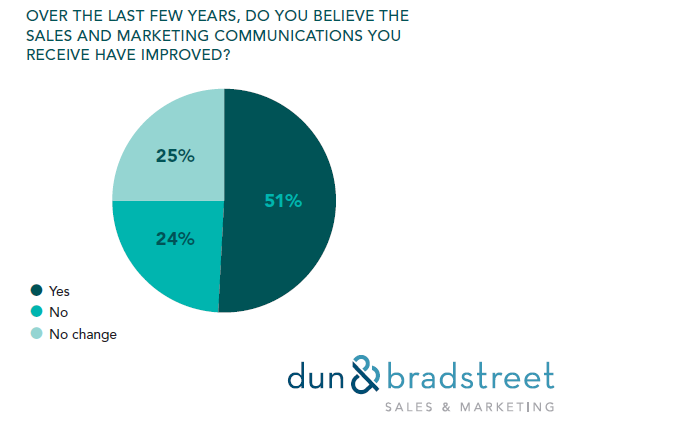
The study found that only 51% of buyers believed that communications they receive have improved, which suggest that they are constantly looking for more information to research on products and solutions before they make a purchasing decision. So, out of marketers and salesreps, who are best poised to define customer profiles and track buyer signals?
D&B
Rishi believes ‘both’. He said, “If marketers and sellers are not working together on this, they will not align and create integrated customer experiences and close deals. Once a real-time data set is created that is structured, clean, and complete (this is called “mastering” your data), analytics professionals can leverage look-alike modeling and predictive modeling to define profiles and prioritize opportunities and accounts.”

For the D&B CMO, real time buying signals should be used by all people who touch customers to create integrated experiences, whether it is sales, marketing, customer support or other touchpoints.

Marketing Technology News: Paysafe Announces YouTube Partnership

How CRMs and Automation for Marketing and Sales Impact Sales Acceleration

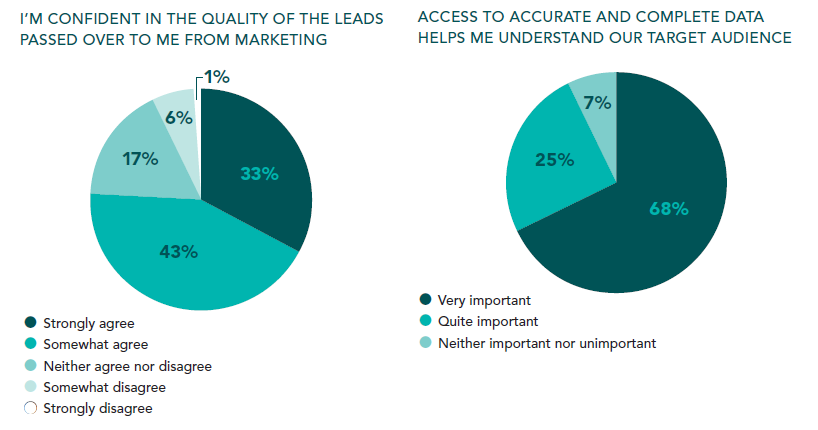
Evidently, there seems to be a significant gap between what marketers and sales professionals think is relevant to reach the right buyers with the right messaging. 76% of sales professionals are actually optimistic and confident about the quality of lead passed over to them from marketing. However, 93% agree that access to accurate and complete data helps them understand the target buyers more effectively.
D&B
So, are CRMs and automation tools intelligent enough to segregate data based on what marketing and sales teams may be looking for, separately?

Rishi replied, “Not by themselves! While they are great repositories of data, they don’t necessarily have the analytics and insights marketing and sales teams need to make the decisions they need to make.  What is the key here is augmenting those systems with some sales or marketing intelligence software that can segment accounts for marketing while providing sales with the real-time buying indicators they need.”

Rishi added that the absolute key to getting the B2B marketing and sales team very-relevant information is making sure the systems they are using are “connected and fed by the same real-time, clean, structured data.”

Marketing Technology News: Gartner Survey Shows Inside Sales Organizations Risk Losing 24% of Employees This Year

Data Relevancy and Understanding Your Target Audience

A surprisingly similar number of respondents (from the report) were unsure about the relevance of data and their understanding of the target audience.

Rishi clarified that though people (92%) know they need to use data don’t they are adept at using it yet.  He explained, “They may not trust it or they may not have the appropriate software solutions to surface that data as insights, or they may suffer inaccurate, dirty data. You have to have several things to actually be able to gain insights from the data.”

D&B’s Playbook to Gain Accurate Insights from the Data

  • Mastered data across the organization. This means it is clean, structured, and connected across departments.
  • Analytics that provide insights on that data
  • Tools or solutions that help surface that data as insights. That may be a solution that helps segment your customer by best traits, identify white space market opportunities, or identify a trigger event at a target account that may indicate a need to buy.
  • Real-time information. If data isn’t current, it isn’t accurate.
  • A connected, 360 degree view of the customer. This is one reason respondents don’t understand their target audience. It’s a hard thing to do when you can’t track all their actions. Having the unique identifier to tie together all of a customer’s actions is key to understanding target customer behavior.

Cold Calling and Its Impact on Sales Productivity

A large part of the buying decision is now based on online research, product recommendations and personalized marketing campaigns.  In such a scenario, why do businesses still rely on cold calling? Isn’t it counter-productive to sales productivity?
D&B
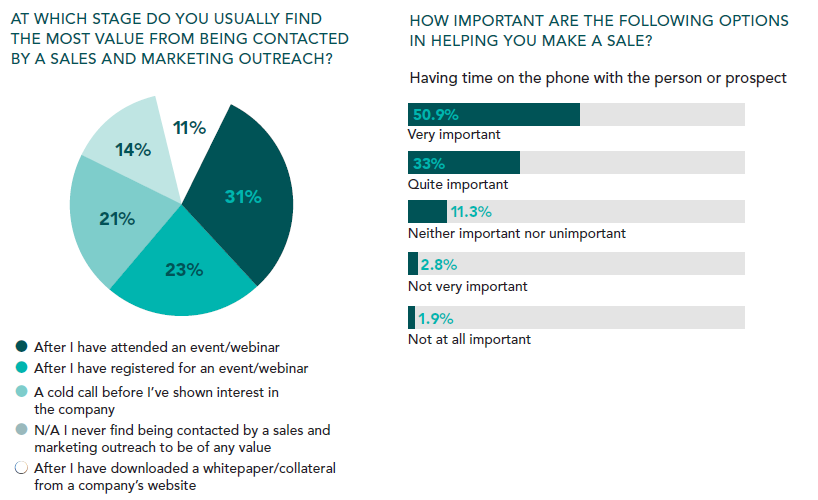
The report states that despite buyers hesitating to take a call, 83% of sellers actually felt that it’s still very important to speak or meet with a prospect to close a deal.

Rishi explained why cold-calling is still not out of ‘sales acceleration’ equation. He stated, “If the sales person has done their research and knows the business of the customer they are calling, they may be able to provide some real value that the customer couldn’t have gotten online.”

Rishi also took us deep into the complaints that respondents raised. He said, “One of the top complaints of respondents was that the sales rep didn’t know enough about their business. In that case, of course the cold call is a waste of time. But imagine if that cold call is timed exactly on the day that a trigger event takes place and could indicate a need to buy for that customer.  Placing an intelligently timed call may just be the thing that pushes that customer from consideration to purchase.”

Here’s an example that the CMO of D&B offered—

Using our own sales intelligence platform, our sales team recently saw a triggered alert announcing a new EVP of Sales and a new EVP/CMO at one of our customers whom we prioritized as a having a high probability of buying one of our solutions. Immediately, our sales person left a voicemail to introduce himself to the new contacts, proposing a meeting to talk through their go-to-market strategy, priorities, and anticipated challenges, based on the data we had.

The CMO’s assistant responded, suggesting a day and time, and is bringing the EVP of Sales into the meeting. By focusing on the relationship, the individuals, and their real-time needs, the sales rep putting self in a position to have the right conversation at the right time with the decision makers that will form the core buying group at the prospect company.

Having “Mega Data”: Why it’s Far from Being the Winning Formula for B2B sellers

Like in life, it’s the battle between thoughts and actions. Rishi explained how having mega insights is the winning potion, and not mega data.

He said, “Data alone is not enough. To have a truly winning potion, your in-house data (CRM, MAS, etc.) needs to be matched with 3rd party master data and then connected across the organization for complete customer views. This is what offers seamless customer experiences and what sets companies apart in a world where much research is done online.”

So, with data and intelligence in place, does having bots perform all the talking for B2B marketers make any sense?

Rishi acknowledged how the combination of ‘right’ data and intelligence can drive bots to do quite a bit of the work, although there will always be a need for some human intervention.  He provided a scenario where there will be use-cases where bots get stumped and a human will need to step in where the bot can’t. He identified how if the bots were fed with, accurate real-time data, they really can do a lot of the heavy lifting. Rishi expounded, “By analyzing trends and responses, the bots get ‘smarter’ over time and can take on more tasks. But the key really is to make sure the data on which they are built is always accurate, always updated, and always connected across systems the buyers may touch.”

Mission Incredible for Sales Acceleration: Draw a Line between Confidence and Hubris

According to the State of Sales Acceleration report, “To be truly effective with their time, sellers need to leverage real-time buyer insights to determine who to call, at what time, and what to talk about. This should lead to better conversations for both parties.”

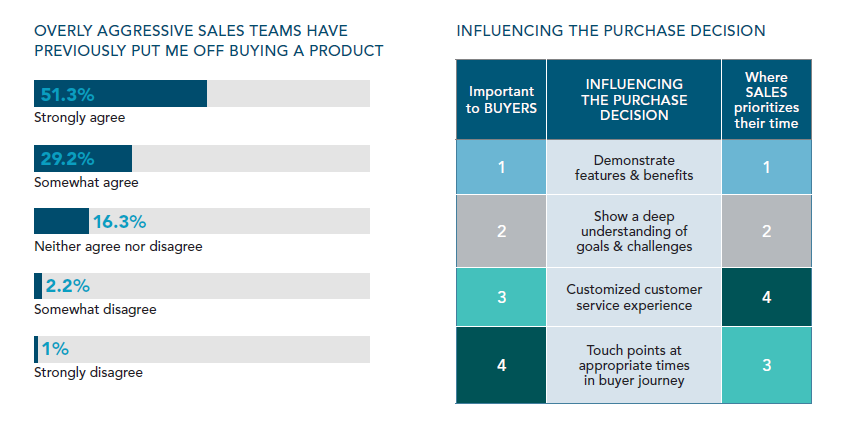
From aggressive pitchmen, the sales professionals must shed their drive to achieve quick sales and instead focus on being ‘trusted advisors’ to buyers. When 80% buyers say that aggressive sales pitch puts them off—B2B teams use data to better predict the buyer’s persona and engage them with valuable actions and not unresponsive traditional tactics.

Marketing Technology News: Mono Solutions Joins Bauer Media Group to Strengthen SME Marketing Services Across the Globe


Competitive Intelligence and Backlink Audits—What Marketers Need to Know from the Latest SEMrush Study

0
SEMrush
Competitive Intelligence and Backlink Audits—What Marketers Need to Know from the Latest SEMrush Study

September 27 Was World Tourism Day. The Theme Of World Tourism Day 2017 Was “Sustainable Tourism— A Tool For Development.”

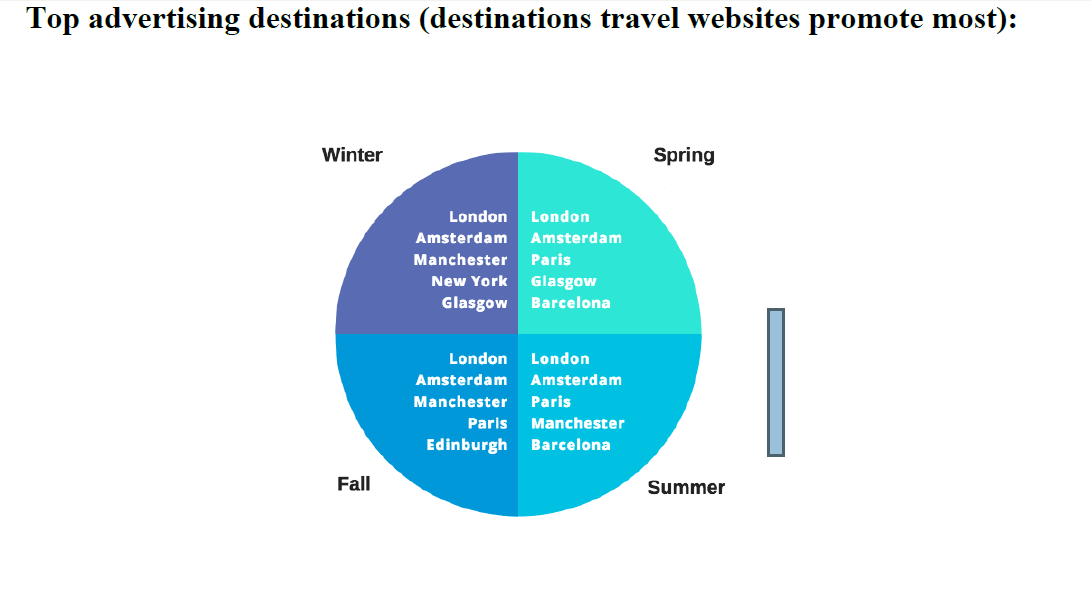
To show how top businesses see tourism as a potent driver of economic growth, leading online marketing intelligence and analytics company SEMrush, released the “SEMrush Website Airline and Keyword Study.” The study highlights the top destinations, top travels and the main channels that generate the highest traffic streams for the travel industry.

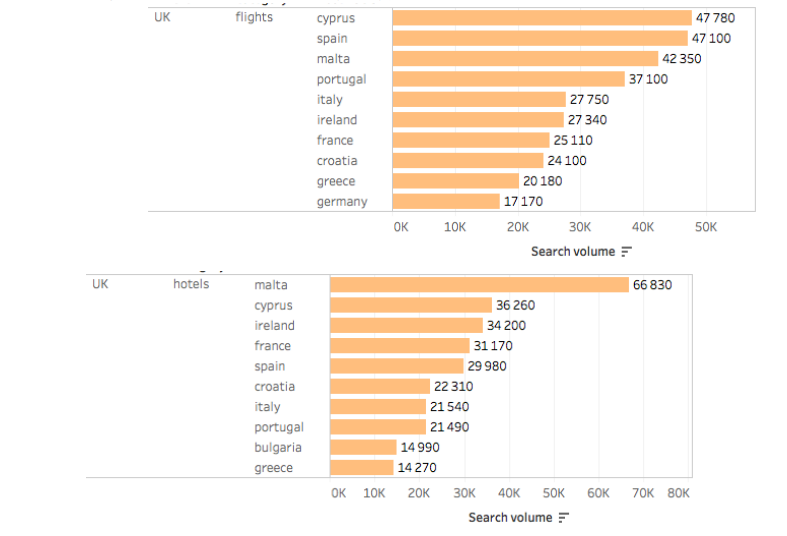
On key words for destinations and website traffic (SEMrush) highlights include—

– Cyprus Malta, Ireland, Spain, Portugal, France, Italy, Bulgaria, Greece are the top destinations

– Tripadvisor, Airbnb, skyskanner, the trainline.com, easyjet.com, expedia.com – top travel websites

–  Facebook (83.7%), Youtube (8.63%) and Twitter (5.69%) – main channels from which travel websites get traffic

SEMrush

semrush

Olga Andrienko
Olga Andrienko

At the time of the release of this Tourism Day 2017 study, we spoke to Olga Andrienko, Head of Global Marketing, SEMrush, to understand how top brands leverage competitive intelligence and backlink audits to align their marketing and advertising for seamless customer conversations.

Olga said, “Word-of-mouth advertising has transformed into referral traffic on the web. Backlink analysis and backlink audit play essential role in online marketing today. Firstly, having a lot of quality websites that link to your content increases your traffic and builds your authority. And, links are one of the ranking signals for Google – in our latest Ranking Factors Study we have identified that the number of referring domains has huge importance to your page’s position in SERPs. The TOP-1 had almost twice as many referring domains as pages on 10th position. So, the more backlinks and more domains link to you, the more likely the conversation with the customer will happen – you’ll get more visitors to your website.”

So how do marketers ensure that their social interactions positively influence the website traffic?

Olga informed, “Key to engaging the audience on social is to support the readers with not selling, but educational content. You should explain why this article is important for reading and what conclusions the user can make by reading it and what advantages he or she can have if he/she uses your site or your product. That will lead the potential customer to the website and existing users will really love you because you are not only the product, you are the service from where they learn. Show users an interesting infographic, make sure that they share your findings and your posts, this will help not only bring traffic to the site, but also draw new loyal customers.”

Olga said that though the traffic from social media platforms generally is not really high compared to direct or organic, yet it should not be neglected. She said, “Social media is where the conversation about your brand is happening. Dissatisfied customers link to your site to ensure their friends never buy from you, satisfied clients give referrals and prospects in doubt ask their audience if they should consider buying from you.”

Gaining the Millennial Stamp of Approval on Social Media

0
Millenials

ABC Creative GroupEngrossed in technology and well versed in the over-played marketing anthem, millennials can smell insincerity from a mile away and one artificial move from your company could be death for your brand

Establishing authenticity and a cohesive brand voice across all social media platforms is essential in establishing trust and loyalty from millennials.

With the constant exposure to media, millennials have already witnessed the major missteps and triumphs of brands, resulting in a different set of expectations for advertisers.

With an aversion to traditional marketing methods, millennials seek relatability and authenticity from a brand. According to the 2014 Nielsen Report, the top values of millennials are family, philanthropy, society, the environment and community. Use that to your advantage.

Highlight the core values and unique sentiments of your brand and create a sense of consistency across media platforms.

Start by rediscovering your organization’s roots.

What is your mission? What sets you apart from the competitor? Does your brand support any philanthropies or causes?

Answering these questions can dig up authentic content that will earn the trust of your audience and make a brand more relatable.

Even the largest corporations have a small-town story.

Take Walmart for example, which boasts “What started as a single discount store and the simple idea of selling more for less, has grown to the largest retailer in the world.” I guarantee that if one of the largest corporate giants can form a modest background story, then so can you.

Establish the tone and jargon of your brand.

Whether your brand voice is educational and serious or witty and fun, creating content that is cohesive and consistent is key to winning over the millennial generation. The internet is not 9-5, and your brand can’t be either.

Having a set of standards for your brand voice will help streamline content creation without compromising consistency. But always opt for quality posts over mass-produced quantity.

Incorporate relevant news stories into your feed.

With your brand values in mind, take a stance on appropriate media topics. A company that supports going green may chime in when a new eco-friendly bill has passed, for example. Or perhaps a brand that supports LGBT rights will invite their followers to join them at a pride parade.

When consumers look at a social media feed, it should tell a story about what the company stands for and the values it supports. Research what your specific millennial audience is into and find a way to organically incorporate that into your feed.

Utilize social media to connect to your target market.

Brands are rejected by millennials when they focus primarily on selling the product – consider the car salesmen stereotype. Instead of appearing pushy or too eager, market the aspects of the brand that differentiate you from competitors.

Don’t fear the platform, conquer it.

Even a social media novice will learn, in time, how best to navigate the digital realm. Every brand’s following is different, so a “one size fits all” solution does not apply.

Allow your brand to grow with your following, become resilient and adapt to your target market. If you see a trend and it applies, jump on it! Social media is meant to be fun.

Establishing an authentic brand voice and positive image will come with time, so be patient. Gary Vaynerchuk wasn’t built in a day.

Also Read: A Window on What You’re Buying: VR for Marketing Spaces

AI + Humans Is the Perfect Recipe for B2B Growth

0
Artificial Intelligence

We are used to seeing AI and machine learning in our “consumer” lives — from Netflix and Amazon’s eerily accurate recommendations about what we would like to watch or buy next, to our Nests having our home at the just right temperature when we walk in at night. We are comfortable cohabitating with AI at home, yet AI adoption by sales and marketing professionals is elusive.  We’re riding the crest of innovation in go-to-market technologies — first CRM, then marketing automation and now applied AI for sales acceleration — you want to catch this new wave.

To be clear, B2B sales and marketing professions have nothing to fear and everything to gain from adopting AI. The human element of B2B sales and marketing is necessary despite all the technology at our fingertips. While it may be called B2B, at the end of the day, there are real people engaging with each other in each of the “B’s” and it is this IRL relationship that cements sales.

Applied AI assists B2B sales and marketing

The worry about a fictional HAL or Skynet replacing sales and marketing professionals prevents teams from actually seeing the reality of applied AI for sales acceleration. In the movies, AI is generalized and the horror comes from the machines “becoming human”, but applied AI points at specific use cases — generally those that are tedious, time consuming and involving lots of data. And because there are many of these tasks within B2B — applying AI can liberate sales and marketing pros from these tasks, and quickly provide them the actionable insights needed to accelerate sales.

Applying AI to 3 key areas of your go-to-market strategy will significantly increase sales momentum:

  1. Market planning/ABM:

Every B2B strategy starts with identifying “who” to target for demand generation and outbound sales efforts. You want to focus your limited resources on just those companies who best fit your desired customer profile.  To be effective, your desired customer profiles must extend beyond basic firmographics and take into account the characteristics and elements unique to each company including their technology investments, product and services offered, as well as elements around growth and hiring. It is these nuanced characteristics which best distinguish your best fit targets from the basic firmographic lookalikes so you can accelerate your sales cycles. That’s powerful.

The best AI solutions will assist your team in:

1) defining your desired customer profile utilizing insights that go far beyond basic firmographics in minutes, not months.

2) Identifying all of the companies with the highest fit to the profile you desire.

  1.  Prospecting:

Statistics show that sales professionals can spend upwards of 30% of their time just on prospecting. And while we want their outreach to be informed, personalized and relevant; prospecting is tedious and a time waster. Your sales team doesn’t need more data, they need actionable insights right at their fingertips.

AI-assisted prospecting crunches through all the available company data, doing the legwork to reveal the right companies to focus on and the most up to date intelligence. This includes insights for a strong talk track or personalized, relevant email outreach, and up to date names and contact information of decision makers. The sales team has the intelligence right on hand – directly within their workflow.

  1. Intent: who is in market now?

One of the most valuable things AI can provide your sales team with is the insight into who is actively in market right now or their intent to buy. AI can be used to uncover intent by powering through all the data signals from companies, including whether decision makers within a company are researching your product or even a competitor’s.

Your team definitely wants to know if a competitor is on a target account’s radar, plus knowing intent can help you spot new opportunities outside your target accounts. Growth-minded B2B organizations use AI solutions to stay agile and focus their energy on accounts that are already in active demand.

AI must be at the whole team’s fingertips

Too many times people hear the terms AI and machine learning and their minds flash to programmers locked in a basement with whirring computers. This provides an inaccurate impression that AI is only “safe” in the hands of a data scientist and not a part of the day to day work of the team.

While you don’t want to confuse team members with all the inherent complexity of AI, the power of it needs to be at the fingertips of every sales and marketing pro on your team. The best applied AI solutions arm sales and marketing teams with the actionable insights — not “more data” or another “score”. Ideally these insights are seamlessly delivered within an intuitive, friendly UX or, even better, within their CRM or automation tool of choice.

Agility is crucial for high growth

High growth organizations never stand still. Market conditions, customers, prospects, your competition — these are always changing and evolving. If the ‘ideal customer profile’ or set of target accounts established at the top of the year remains too rigid, you will miss a growth opportunity.

Applied AI helps a busy, focused B2B team both perceive early signals from amidst all the shifting sands and take action. The best solutions helps teams create new models in minutes, not weeks or months,  with as little as a keyword or just one customer record.  And it’s necessary that everybody on your go-to-market team have the power of AI at their fingertips – so a an intuitive interface and/or integrations are a must.  

Now is the time for B2B to get comfortable with AI and separate fact from fiction. Use it to liberate sales and marketing teams from the most tedious and boring tasks and allow them to do what humans do best: make informed insights and interact personally with prospects. That’s the wave you want to catch.

Janrain Raises Bar for Most Rigorous Security Certifications in CIAM Industry

0
janrain

Janrain Becomes First To Obtain CSA STAR Level 2 Certification, Adds ISO 27018 Certification For Cloud Security

 Janrain, the company that pioneered the Customer Identity and Access Management (CIAM) category and market leader in Privacy by Design, announced that it has obtained two of the industry’s most comprehensive third-party security certifications, and the only ones designed specifically for the cloud: 1) Cloud Security Alliance Level 2 (CSA) STAR Certification, which verifies that Janrain follows industry-best practices for securing cloud offerings, and 2) the International Organization for Standardization’s (ISO) 27018:2014 Certification for handling personally identifiable information (PII) data in the cloud. These certifications apply to all services and product offerings associated with Janrain’s Identity Cloud product, which provides customers with a seamless and secure way to move between web, mobile and IoT device properties.

Janrain becomes the first CIAM provider to achieve CSA Star Certification, the highest level achievable in CSA’s program. Until now, no CIAM provider had exceeded CSA’s Level 1 self-assessment, which is simply a questionnaire uploaded by the vendor to the CSA site. By contrast, CSA Level 2 certification entails an in-depth audit by an accredited, independent third party to verify that the company adheres to the highest cloud security standards throughout its operations. ISO 27018 certification confirms that Janrain applies industry best practices when handling PII, which is only going to increase in importance once the EU’s General Data Protection Regulation’s (GDPR) stringent PII-protection decrees go into law May 2018.

Jim Kaskade
Jim Kaskade

“Meeting CSA’s and ISO’s most exacting security protocols doesn’t just benefit Janrain, it assures our clients that their customers’ most critical data — upon which their respective businesses are built — is secure with Janrain,” said Jim Kaskade, CEO of Janrain. “The monetary and manpower expense of meeting these standards is a drop in the bucket compared to the peace of mind our customers get knowing that the 1.5 billion – plus digital identities under Janrain’s management are safe.”

More than 3,400 Global 1,000 and midsize organizations use Janrain’s cloud-based product suite — which includes social login, registration and profile-data storage, among other offerings — to give their customers a seamless, highly personalized experience across their web, mobile and digital properties. The number of digital customer accounts under Janrain’s management is expected to grow further — the Identity and Access Management market will reach $14.82 billion by 2021 according to research firm MarketsandMarkets. Janrain was first to market in 2002, and has pioneered almost every major CIAM product development since. By obtaining CSA STAR Level 2 Certification by Attestation and ISO 27018 certification, Janrain once again raises the bar in the CIAM industry while saving CIAM customers the time, money and hassle of performing their own vendor security audits in evaluating choices.

Janrain aims to keep its security measures as ironclad as possible. In order to make this transparent and attestable for clients, Janrain maintains more security assurance programs than any other CIAM vendor. In addition to the new CSA STAR Level 2 and ISO 27018 certifications, Janrain also maintains and is audited or assessed for certification/compliance with ISO 27001:2013, SOC 2 Type II (in addition to the Security Common Criteria, Janrain is compliant for the Availability and Confidentiality Trust SOC 2 Trust Principles), HIPAA (storage of healthcare data), HITECH (transmission of healthcare data), US-EU Privacy Shield Framework and the TRUSTe privacy program. Janrain is Open ID connect (OIDC)–certified, GDPR-ready and compliant with many other security/privacy regulations, such as COPPA, PIPEDA, and CFR (Code of Federal Regulations Title 21, Part 11).

Report finds C-Suite’s Use Of Social Media Is On The Rise

0
GRISDALE_ADVISER

Study Sheds Light On Executive Social Media Use; Trump Tweets Have Little Impact

Social media use among C-Suite executives is on the rise, with 66 percent reporting they use social media professionally, and 70 percent of those saying they regularly create and share original content. That means the so-called “lurker” ratio among socially active executives (just 25 percent) is opposite of that found among the general population (around 75 percent), a new study reveals.

C-Suite

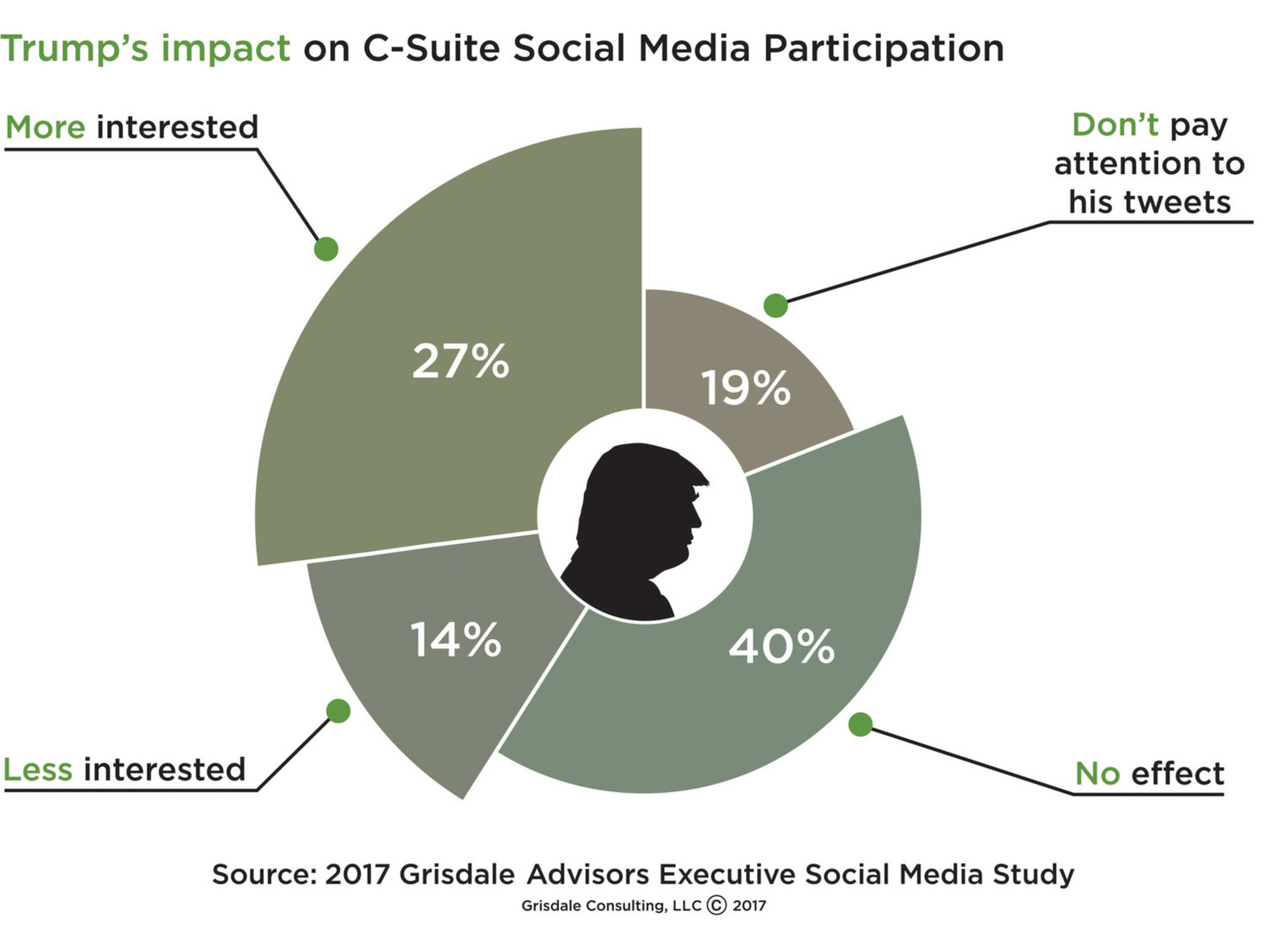
Interestingly, Chief Executive Donald Trump’s Twitter use has had little impact — 40 percent said it had no effect, and 19 percent said they don’t even pay attention to the president’s tweets.

The findings are part of a new national survey of 300 C-Suite executives across a broad range of companies, geographies, ages and gender conducted by Grisdale Advisors, a San Francisco-based social media consulting firm. The survey reveals that executives active on social media say they use it as one of their main sources of news, communication and engagement with employees, colleagues, customers, influencers and opinion leaders, with almost equal presence on Facebook (71 percent) and LinkedIn (70 percent). Twitter ranked a distant third among survey respondents, at 38 percent.

“This research gives us much-needed data about how and why executives are using social media for professional purposes. It tells us that, increasingly, executives recognize the power of social media to build and grow their sphere of influence,” says Grisdale’s founding partner Tim Collins.

Reasons for participation (or not) are myriad. Of the C-Suite executives who use social media professionally, 87 percent read news and others’ posts. They choose to follow experts in their profession, colleagues, employees and, less so, competitors. Forty percent plan to use social media more in the future to expand their customer base and join what they agree is now mainstream media.

C-Suiters who don’t use social media as a professional communication tool cite a preference for a more direct style of communicating (23 percent), say someone else in the organization handles it (20 percent) and say it’s too time-consuming (19 percent). The remainder are concerned about risks to their career and company, and don’t think the benefits outweigh these risks.

SAS a Leader: Gartner 2017 Magic Quadrant for Digital Marketing Analytics

0
sas

 SAS Recognized For Its Ability To Execute With Completeness Of Vision

Measuring the effectiveness of digital marketing is among the most significant challenges for brands today. Organizations that tap into digital marketing analytics, which allows them a comprehensive view of which digital strategies are working, and which aren’t, have a noteworthy advantage. SAS Customer Intelligence, powered by predictive analytics and machine learning, helps marketers make smart, customer-centric decisions. For the third consecutive year, SAS is a leader in Gartner’s Magic Quadrant for Digital Marketing Analytics.

In addition to being positioned the highest in ability to execute, SAS believes its recognition is based on the suite’s flexibility and customizability, allowing an organization’s data to be managed and presented in a variety of ways.

A pillar of the SAS Customer Intelligence suite, SAS Customer Intelligence 360, allows marketers to dig deeper into digital with practical self-learning (AI) applications and guided analytics.

Wilson Raj
Wilson Raj

“Marketers must be able to aggregate, analyze, and act on a flood of digitally-generated customer data faster than their competitors. If not, the end is in sight. We feel that our continued leadership position in Gartner’s Magic Quadrant showcases SAS’ analytics pedigree which helps marketers harmonize the noise into a clear signal to win, serve, and retain customers – and remain competitive,” said Wilson Raj, Global Director of Customer Intelligence for SAS.

We had previously reported that about the IDC Worldwide Business Intelligence and Analytics Tools Software Market Shares, 2016: Here Comes the Cloud report where SAS once again found prime position as the market leader.

SAS topped all predictive and advanced analytics suppliers and data integration suppliers, according to the IDC report. SAS held a 30.5 percent market share for 2016 in the advanced and predictive analytics category, well over twice the market share of the next-closest competitor. SAS has led in this category since IDC started tracking the market in 1997. SAS has demonstrated continued growth every year in the category, with 2016 showing a 5 percent revenue growth.

Infogroup Data Solutions Selected as Digital and Media Management Service Provider by Scranton Gillette Communications

0
infogroup

The partnership hopes to boost brand awareness, and deliver effective communication channels for clients and audiences in the business-to- business marketplace

Infogroup Data Solutions, the leading provider of business and consumer media management solutions, has been selected as the digital and media management service provider for Scranton Gillette Communications (SGC)/SGC Horizon, a business-to-business (B2B) media company.

Infogroup is one of the leading providers of innovative business data, and marketing solutions that are used to increase customer acquisition and retention. They use Big Data at a core part of multichannel marketing. Their business units include: Yes Lifecycle Marketing, Infogroup Data Solutions and Infogroup Local Marketing Solutions. Products include Data Axle, Marketing Genetics, Marketzone, Bulk Update, Sapphire, Express Update, InfoUSA, Salesgenie, Credit.net and ReferenceUSA.

SGC/SGC Horizon owns more than 20 recognized brands and events serving diverse industries that include, among others, infrastructure, healthcare, construction equipment, and residential and commercial building. The company has partnered with Infogroup Data Solutions to deliver advanced digital strategies and media management techniques that will maximize exposure and data monetization.

“We chose Infogroup Data Solutions to manage our media assets because of their superior data resources, extensive digital network, and depth of knowledge across markets and channels. This partnership will help us expand our capabilities, boost brand awareness, and deliver effective communication channels for our clients and audiences in the business-to- business marketplace,” says Robert Haas, SGC/SGC Horizon’s senior vice president of strategic product development & marketing.

“It is a privilege to partner with Scranton Gillette Communications, one of the fastest-growing companies in B2B publishing. We look forward to helping them achieve even better results with our latest solutions,” says Jeff Adee, senior vice president and general manager, Infogroup Data Solutions.

Mike Iaccarino
Mike Iaccarino

“We are thrilled at the addition of an award-winning company like SGC/SGC Horizon to our roster. Infogroup Data Solutions’ growing client base is a true testament to our commitment to innovation on behalf of our partners,” adds Mike Iaccarino, chairman and CEO, Infogroup.

Liferay Symposium 2017 to Focus on Transforming Customer Experiences

0
liferay

Two-Day Event Will Provide Attendees With A Clear Understanding Of How To Execute Real Digital Change In Customer-First Businesses

Liferay, Inc, which makes digital experience software for enterprises, announced its annual Liferay Symposium North America, which will be held on October 16-17 in Austin, Texas. The event includes talks from The GLOBE Program sponsored by NASA, the Transportation Security Administration (TSA), Smith & Nephew and Austin Angels, a local foster care non-profit.

Liferay Symposium invites technical and business professionals across industries to come together and gain fresh insights on customer experience and digital transformation. Whether attendees are already part of the 180,000+ member-strong Liferay community, or currently exploring new digital strategies to fuel business growth, Liferay Symposium provides an opportunity to learn from the technology builders and adopters that are leading the way.

This year, Liferay Symposium will feature three guest keynotes, each providing a unique perspective on how to engage audiences through technology-driven experiences. These talks will dig into The GLOBE Program’s campaign – sponsored by NASA to create ‘citizen scientists’ during the recent solar eclipse – the TSA’s successful strategy of using social content to help shape brand perception, and how an Austin entrepreneur used the power of her community to create meaningful change in her local foster care system.

Attendees will hear from like-minded peers who are embracing customer-first business practices, and understand how to use Liferay Digital Experience Platform (DXP) to deliver valuable user experiences that advance their digital strategies. With more than 50 speakers confirmed to discuss a variety of topics, attendees will hear from:

  • Liferay’s business and technical leaders. From product roadmaps to understanding fast-moving industry trends to technical workshops, they ensures that attendees come away with a clear vision for how Liferay technology can drive business growth.
  • Customers. Organizations, including multinational medical manufacturer Smith & Nephew, will discuss their Liferay use cases, and the specific challenges overcome through digital transformation.
  • Partners. Several sessions offered by Liferay solution providers will walk through best practices for getting the most of the newest Liferay DXP capabilities.
Bryan Cheung
Bryan Cheung

“Liferay Symposium really has something for everyone – for every stage in an organization’s digital transformation and for myriad use cases. Through carefully planned discussions from our customers, our partners, and our technology creators, our aim is that attendees come away with an actionable path for improving digital operations within their business,” said Bryan Cheung, CEO, Liferay.

Zaius Study Reveals 40% Retail Marketers are Overlooking Omnichannel This Holiday Season

0
zaius

86 Percent Fail To Engage Customers At Every Purchase Location

Zaius, the leading B2C CRM that delivers real-time, cross-channel marketing automation and attribution built on a single customer view, announced the release of its 2017 Holiday Marketing Report, highlighting what’s on hundreds of retail marketers’ minds as the holiday season approaches. The study helps ecommerce and retail companies understand which marketing priorities and distribution strategies to focus on during one of the busiest and potentially most lucrative times of the year. The survey pulled insights from CMOs, CEOs, founders and marketing executives from businesses across the U.S.

The report findings uncover a variety of trends, including the following:

  • Omnichannel: Omnichannel is a place for improvement. Forty percent of respondents don’t have any strategy in place, 46 percent are in the process of developing one, and only 14 percent say they execute omnichannel marketing well.
  • Customization: The top areas of focus for marketers are segmentation (33 percent), personalization (31 percent) and optimization (20 percent), showing they are most concerned with delivering engaging and relevant content to their audiences.
  • Traditional marketing: Browser and mobile push strategies are a missed opportunity for marketers, with only 2 percent taking advantage of these channels. The majority of marketers are prioritizing investment in traditional marketing strategies, including email campaigns (43 percent), social media campaigns (22 percent), and search/ad retargeting (27 percent), showing that marketers need to be educated on how to better engage with consumers across all channels and devices.

These findings confirm the need for a better understanding of why and how customers shop, and for the ability to engage those shoppers in a more individualized way. As Forrester Research found, consumers are increasingly empowered, with 42 percent of U.S. online adults researching products via online customer reviews weekly, if not daily. In the always-on age of commerce, retail marketers must deliver engaging messages in a seamless experience, at the right time, to persuade empowered customers to buy.

Mark Gally
Mark Gally

“In these survey results, we hear marketers’ frustration, ambition and dedication to their brands at a critical time of year. They know they need personalized and relevant content to convert potential buyers into customers, especially during busy seasons when consumers are overwhelmed with messages from brands. This data uncovers the path to help marketers overcome their frustration by leveraging omnichannel, marketing automation and B2C CRM solutions that can put them ahead this holiday season,” said Mark Gally, CEO, Zaius.