Home Blog Page 4387

Mellanox and Nevion Collaborate to Offer IP Media Network Solutions

0
Mellanox and Nevion Collaborate to Offer IP Media Network Solutions

Solutions enable broadcasters to move cost-effectively to IP in live production

 Nevion, award-winning provider of virtualized media production solutions, announced that it is collaborating with Mellanox Technologies, Ltd., a leading supplier of high-performance, end-to-end smart interconnect solutions for data center servers and storage systems. Together, Nevion and Mellanox are offering highly-scalable IP media network solutions for use in live broadcast production facilities and beyond.

The solutions are based on media nodes from Nevion and IP switching from Mellanox, all under the control of Nevion’s network management and service orchestration software, VideoIPath. The software-defined networking (SDN) solutions are designed to meet the scaling requirements of the world’s largest broadcasters, transporting video, audio and data in real-time with ultra-low latency and total reliability.

Marketing Technology News: Khoros Launches New Data Hosting Location in Sydney, Australia

Those solutions enable broadcasters to move incrementally and cost-effectively to IP technology and eventually to virtualization, thereby increasing their production nimbleness and reducing their costs.

Asaf Wachtel, VP of Enterprise Business Developmentat Mellanox Technologies explains: “Our technology is eminently suited to professional live media transport applications where performance, reliability and scalability are so mission critical. Nevion’s expertise in real-time video, audio and data transport, and their product offering are highly complementary with ours. Together, we can offer a standards-based solutions that are optimized for broadcast applications.”

Marketing Technology News: QU-in Helps Higher Education Campuses Reopen Safely

Andy Rayner, Chief Technologist at Nevion added: “For broadcasters and service providers, moving to IP is in part about having choice. For that reason, Nevion has been a keen supporter of open standards and has worked with vendors across the industry, including providers of switch fabric. For Nevion, working with Mellanox is of significant interest as they are keen to develop capabilities that are specifically designed for the real-time transport of media.”

Marketing Technology News: Sky Partners with TVSquared to Show True Picture of TV Effectiveness

Pressing Engagement: The Art of Social Selling

0
Social
Pressing Engagement The Art of Social Selling

Social media has proven itself as a great means of attracting consumer attention. But as our collective use of social media continues to evolve, it can mean so much more to businesses than just advertising. One aspect, that is quickly becoming an essential tool for sales teams, is Social Selling. Social Selling, in the right hands, can bring unprecedented opportunities for connecting and engaging decision makers.

For the most part, companies are beginning to wise-up to Social Selling.Forty-nine percent of B2B enterprises have developed a formal social selling programme, and 28% are in the process of doing so. But for those that have yet to formalize a Social Selling programme, it can be tough to understand what it is, and how can it benefit your business.

Let’s face the honest truth to begin with: apart from the odd exception, the days of wining and dining a business prospect are over. Of course, sales teams will always nurture relationships – that’s the beauty of the profession; but in our time-constrained world, it’s no longer just about meeting someone at the pub to see if you can eventually forge a deal.

Social Selling brings this relationship building into the modern era, by forging those initial bonds through social connections and networks, over time building rapport and trust to ultimately impact buying decisions. It’s about understanding buyers needs and having an active dialogue, becoming the defacto resource for information that leads to a buyer’s trust and buying power.

Reading Into Buying Signals

A good salesperson, or marketer, knows a customer’s needs before the customer does. Social media has opened up a world of opportunity when it comes to tracking every like, dislike, milestone, motivation and preference. Because of this, identifying pain points and buying signals can be a far more simplified process, but even before that opportunity begins social sellers, data in hand, have the ability to meaningfully place themselves in the prospect’s world. Further down the line, once a level of confidence and trust has been developed, they can then begin to influence purchasing decisions.

Time to Connect

Let’s say a potential customer looks at your LinkedIn profile. While this may seem like a signal for the salesperson to reach out and connect with that customer to attempt to build a sales lead, how would a Social Seller react?

First, it’s time to do some research. By looking at this person’s social channels, you can build a fairly accurate picture of their needs, desires, and interests. What are they tweeting about? What are they sharing on LinkedIn? What could have led them to your profile in the first place?

With this information at hand, there is an opportunity to begin to interact with these posts to get their attention. Perhaps you have a blog post pertaining to a problem or issue they’ve shared, or can lead them to a solution.If you receive an interaction in return, as a salesperson you know that you’re no longer interrupting them and it’s time to connect. Social Selling is about listening – understand enough about the prospect for you to appear to be the obvious choice.

Life’s a Pitch

The biggest mistake new Social Sellers will make is to go straight in with a pitch. You want to add value to this newly-formed relationship so that you get to the point where this person is coming to you for information. Always add value in excess of whatever you are asking for in return.

It’s about knowing enough about the prospect to gauge the relationship, and taking the conversation offline when it’s ready – this is usually a longer timeframe than other traditional sales channels, but it generates long-term rewards.

Begin by thinking about what you as a customer would be looking for from someone in your position. Share relevant news and updates on your own channels and start positioning yourself as an industry expert, a voice that people can begin to trust and value… The last thing you want is for people to unfollow or disconnect, so take the time to think about what you’re pushing out – and what it means to those you want to engage with.

Social media is not your sales platform, it’s a means of creating relationships with your customers. Strong salespeople are already in the game of building and maintaining relationships, so this avenue is just one more means of accomplishing this. Get to know the rules around this ever-evolving form of communication and the dreaded cold call can be a thing of the past.

MarTech Privacy Debate Should Focus on Solutions that Work

0
MarTech
MarTech Privacy Debate Should Focus on Solutions that Work

digital advertising allianceThis is likely to be an active fall for privacy issues, with California’s legislature considering a law that would dramatically disrupt digital advertising by changing how companies can collect information, the U.S. House Energy and Commerce Committee holding a hearing, and the European Union advancing the controversial implementation of broad new regulations.

The Digital Advertising Alliance (DAA) has always welcomed an open dialogue with policymakers around the best way to create a positive digital advertising experience for consumers while protecting the free ad-supported content and services they love. We believe the robust self-regulatory regime built by our industry provides the best model for addressing these important issues. Recent survey results validate our industry’s progress in gaining consumer trust through this model as well.

The DAA’s YourAdChoices program was launched seven years ago by a coalition of leading advertising trade associations as a cross-industry initiative to give consumers more information and control over the types of digital advertising they receive.

As the policy foundation for that program, the DAA worked with the U.S. Federal Trade Commission (FTC), other agencies, Congress, and industry leaders to develop a set of rigorous self-regulatory Principles to govern the collection and use of data for interest based advertising. Compliance with the DAA Principles is independently enforced by the Council of Better Business Bureaus (CBBB) and the Data and Marketing Association (DMA), which have undertaken and released more than 80 publicly announced enforcement actions.

On the consumer side, the DAA created the AdChoices icon as the visual centerpiece of the program, providing a consistent real-time visual cue and an interactive gateway for consumer choice directly from the ads themselves. This is notice outside of the privacy policy, in prime real estate. That icon is now served at a rate of a trillion times a month worldwide, and it can be found nearly everywhere that interest-based advertising appears, including desktop and mobile websites, mobile apps, social media, and digital videos.

While the wheels of government policy often turn slowly, making it difficult for legislation or regulation to quickly adapt to rapidly changing technologies and business models, the DAA’s policy program has been able to move quickly, offering updated guidance to companies in emerging areas like multi-site data, the mobile environment, and cross-device data.

In a recent report on cross-device advertising, the FTC commended the DAA for its work to adapt and extend the AdChoices regime. As the report said, “Their work has improved the level of consumer protection in the marketplace.”

While policymakers and industry have expressed their support, the DAA wanted to learn more about consumer impressions of the icon, so it recently conducted a survey of 1,000 U.S. adults. (The survey was conducted via SurveyMonkey in late May and early June.)

That survey showed that large majorities of consumers find our industry’s ubiquitous AdChoices icon useful and say it increases their trust in advertisers and the sites and apps on which they appear. As technology and business models continue to rapidly evolve, respondents also said extending use of the icon would increase their trust in emerging digital platforms.

According to the survey:

  • Nearly three-quarters of respondents (73 percent) said the kind of information and control provided by the AdChoices icon is very or somewhat useful.
  • A similar large majority (75 percent) said that seeing the AdChoices icon in an online or mobile ad would increase their trust in that advertiser;
  • Four out of five respondents (79 percent) said they would be more likely to use a website that clearly displayed the AdChoices icon; and
  • The same large majority of respondents (80 percent) said the AdChoices icon would increase their trust in emerging digital platforms like Web-connected devices, advanced TV, and digital billboards.

The results of that survey are good news not only for advertisers but also for consumers themselves, as the benefits of the ad-supported digital medium are widely recognized by the people who use it.

In another DAA-commissioned study released last year, consumers assigned a value of nearly $1,200 per year to the free ad-supported services and content available to them on computers and mobile devices. Not surprisingly, the overwhelming majority of those consumers (85 percent) said they would prefer to finance those services via advertising through the current model than pay out of pocket for them.

Given that near-universal support for the current ad-supported model, consumers have given our industry a green light to continue to innovate and create new value, so long as we provide them with the information and tools necessary to make informed and meaningful choices about their online experience.

As we move into a more active phase of discussion around these issues with policymakers around the world, our industry must continue to focus on the proven solutions that work.

The DAA’s YourAdChoices program has successfully established a ubiquitous and simple consumer control mechanism that allows the industry to adapt and grow, so it can continue to provide the spectrum of ad-supported content and services used by consumers every day. It has gained the trust of consumers and policymakers, and we hope to continue to build on that success as we address the challenges and changes of our rapidly evolving medium.

TechBytes with Adam Solomon, Chief Product Officer, PebblePost

0
Adam Solomon
TechBytes with Adam Solomon, Chief Product Officer, PebblePost

Adam Solomon
Chief Product Officer, PebblePost

In July this year, programmatic direct mail platform PebblePost raised $47 million. We spoke to Adam Solomon, Chief Product Officer at PebblePost, to understand how the new funding would help the company improve its programmatic direct mail platform.

Html code here! Replace this with any non empty text and that's it.

MTS: How do you see the European market for programmatic capabilities faring in comparison to the US?
Adam Solomon: Programmatic is very sophisticated and more centralized in the European market than the U.S. because of the outsized power that agencies maintain in Europe. Programmatic buying and selling has been controlled to date by agency trade desks. The burning question today is with the GDPR and new data regulations — and different flavors of those controls by country — how will these factors affect buying and selling? Will it slow the great gains the European market has made? If so, the result may swing more control to publishers and to those entities with direct relationships with consumers. The centerpiece of GDPR and its offshoots is this notion of a notice to the consumer to opt in/out of sharing their data. Only entities with those direct relationships with consumers can ask those questions.

MTS: What are the major challenges that PebblePost foresees in the programmatic marketplace?
Adam: I always like to ask, ironically, is programmatic a strategy or a tactic? The programmatic marketplace and its technologies have been marching down the road toward efficiencies but not necessarily efficacy of a marketer’s message. There’s been a great deal of work done to improve efficiencies, such as header bidding and various ways of buying and selling media, but what gets the short shrift is creating effective experiences for consumers, and, therefore, brands. So the challenge is how do you take these technologies and bring them together with approaches and creatives that actually help the marketer achieve some objective? Where is the intersection between art and science? The pendulum has started to swing back to publishers and media owners on one side and the brands themselves on the other side, without a lot of intermediaries in between. Their collective goal remains figuring out how to engage consumers and using programmatic as a tactic to achieve that end rather than a strategy.

MTS: How would the latest hiring and funding enable the company to deliver truly integrated marketing platform?
Adam: It’s all about a healthy balance between staffing up our sales and marketing capabilities, including customer service/success to make sure we understand brand challenges and propose solutions that meet their unique business needs. We’ll continue to pursue our aggressive innovation goals for the Programmatic Direct Mail solution with new hires in product, analytics and engineering, to create the tools and technologies that brands want and need.

MTS: What new markets is PebblePost looking at? Would your product innovation strategies change with the latest funding?
Adam: We launched the Programmatic Direct Mail solution with online retail, but are gaining rapid traction in real-world retail store brands where 90% of all transactions occur. To serve these brands, we’re investing in research and development to connect the dots across sales channels in never-been-done-before solutions.

Beyond retail, we are exploring other verticals like finance and travel, and plan to expand further in 2018. In terms of markets, we have hired a General Manager of European Market Strategy, who is laying the groundwork to explore regional and country-by-country potential for expansion of the Programmatic Direct Mail solution.

MTS: Thanks for chatting with us, Adam.
Stay tuned for more insights on marketing technologies. To participate in our Tech Bytes program, email us at news@martechseries-67ee47.ingress-bonde.easywp.com

Interview with Eric Keating, VP, Marketing, Zaius

0
Eric Keating
Interview with Eric Keating, VP of Marketing, Zaius

[mnky_team name=”Eric Keating” position=” VP, Marketing, Zaius”][/mnky_team]
[easy-profiles profile_twitter=”https://twitter.com/iamerickeating” profile_linkedin=”https://www.linkedin.com/in/erickeating/”]
[mnky_testimonial_slider][mnky_testimonial name=”” author_dec=”” position=”Designer”]“Marketers need a complete view of the customer experience – every interaction that a customer has with your brand – including sales, marketing, and support data. Without understanding all interactions in a single customer view, you’re bound to miss something vital.”[/mnky_testimonial][/mnky_testimonial_slider]

On Marketing Technology

MTS: Tell us about your role and how you got here? What inspired you to be part of a B2C CRM platform?
As the fortunate person who heads up marketing at Zaius, the team and I are focused on educating the market about the incredible value that B2C CRM brings to marketers and their businesses. After having led the software-as-a-service division at market research firm, Millward Brown, and launched ZoomInfo’s strategic freemium product, I knew that I wanted to be at the intersection of data and martech. Data — and in particular the unification of data to create a single source of truth — is the key to making intelligent marketing decisions and delivering the most effective, engaging customer experience.

MTS: How do cross-channel attribution and analytics help in maximizing the Customer Lifetime Revenue?
When data is fragmented (by channel, device, browser, etc), you’re only seeing a sliver of the truth. If you can’t understand how your shoppers behave across channels and devices, you won’t have the insights you need to truly maximize Customer Lifetime Revenue. When you know what they want and how to motivate them, you can offer them the right message at the right time on the right channel.

MTS: How does Zaius enable marketers to orchestrate multi-channel marketing campaigns from the ‘word go,’ using real-time analytics and dynamic customer segmentation?
The prerequisite to getting real value out of analytics or segmentation, or being able to orchestrate multi-channel marketing campaigns, is establishing a single source of truth – unifying customer attribute and behavioral data across all channels and devices. Zaius makes that quick and easy with a product that enables you to orchestrate multi-channel marketing campaigns. Because you know every interaction that a buyer has had with your brand — every page they’ve clicked on, every item they’ve added to a cart — you understand what they may be interested in. Then, you can build out targeted campaigns based on their behaviors, triggering automated emails, Facebook ads, push notifications and more.

MTS: How should businesses determine the boundaries of single-customer view for omnichannel marketing?
B2C marketers are tasked with creating engaging and effective customer experiences that drive repeat purchases and ultimately, loyalty. In order to do that, they need a complete view of the customer experience – every interaction that a customer has with your brand – including sales, marketing, and support data. Without understanding all interactions in a single customer view, you’re bound to miss something vital. In order to best serve your customers, you have to know if they have a customer service request pending even as you market to them.

MTS: Do you see the B2B CRM models converging with the B2C landscape for better customer engagement?
While I absolutely see the general convergence of B2B and B2C marketing (people are people after all), I really don’t see the convergence of B2B and B2C CRM. For starters, there are fundamental differences in the way that the sales process works in B2B vs B2C – account-based vs. person-based, lower frequency of transactions vs. higher frequency of transactions, planned purchases vs. spontaneous purchases – and also the purpose the CRM serves – sales-centric vs. marketing-centric, manual vs. automated data entry, etc. A CRM built for B2B is simply not equipped to engage consumers effectively.

MTS: What startups are you watching/keen on right now?
Within the industry, Terminus is definitely one to continue watching. Account-based marketing is continuing to gain momentum and Terminus is at the forefront of it. More personally, I’m keeping an eye on local Boston startup Mylestone. I first heard about them when a friend joined the company last year to lead their product team. My initial understanding was that they curated media-centric biographies of the recently-deceased, which I thought was not only super-interesting but also kind of weird and futuristic. Now they seem to be focused on expanding their use cases and broadening the market, so I’m interested to see how they leverage their unique approach and technology to do that.

MTS: What tools does your marketing stack consist of in 2017?
Pardot, Terminus, Bizible, Wistia, Google AdWords, Google Analytics, SpyFu, Moz

MTS: Would you tell us about your standout digital campaign?
Our most significant campaign to-date is the one we’re currently running. We call it the ESP campaign, and the primary question is: “Still running your business on an ESP?” Being a B2C CRM, Zaius solves the problems that marketers’ reliance on ESPs has helped create – all rooted in a siloed and channel-centric approach to marketing – while still delivering the value that marketers expect from an ESP. There are a number of ways we’re measuring the success of the campaign, but a two of the more quantifiable measures are overall traffic to the campaign landing page and downloads of the related long-form content.

MTS: How do you prepare for an AI-centric world as a marketing leader?
AI is obviously poised to have an incredible impact on marketing and business overall. That being said, regardless of the next innovation in marketing, the fundamentals won’t change – understanding your customer and developing a brand are critical to being a successful business. Marketing leaders do, however, need to prepare for a more data-driven future by staffing their teams with nimble, data and tech-inclined professionals. On a bootstrapped team, the dream is someone who, in addition to having a strong understanding of marketing principles and creative bent, can also manipulate and interpret data, iterate quickly, and even write code.

This Is How I Work

MTS: One word that best describes how you work.
Deliberately

MTS: What apps/software/tools can’t you live without?
Spotify, Google Drive, Fitbit

MTS: What’s your smartest work related shortcut or productivity hack?
Hire people smarter than you, give them goals, and let them do their jobs.

MTS: What are you currently reading? (What do you read, and how do you consume information?)
On Trails by Robert Moor, which is a “wondrous exploration of how trails help us understand the world—from invisible ant trails to hiking paths that span continents, from interstate highways to the Internet.” Obviously not my words. But next up is Growth Hacker Marketing by Ryan Holiday. I know I’m late to the party, but I’ve been meaning to read it for some time. Most books that I read aren’t directly related to business, but I do primarily read non-fiction. I consume business and marketing information primarily online in shorter-form content from publications like HBR and MarketingProfs, as well as based on recommendations from peers on LinkedIn.

MTS: What’s the best advice you’ve ever received?
Roughly: “Don’t underestimate the value of your ideas.” When I was younger and far less confident, I needed encouragement to speak up, especially in meetings with management, etc. I think the best young talent needs that encouragement because they are humble and have respect for those who have been there and done it. That being said, it’s definitely important to balance this with also knowing when to prioritize listening.

MTS: Tag the one person in the industry whose answers to these questions you would love to read:
Katie Staveley from Mautic!

MTS: Thank you Eric! That was fun and hope to see you back on MarTech Series soon.

[vc_tta_tabs][vc_tta_section title=”About Eric” tab_id=”1501785390157-b58e162d-0ae25a4b-c27aca64-108ee151-9232″]

Go-to-market business leader known for building efficient demand generation functions, optimizing digital properties for conversion, delivering on customer-centric product roadmaps, and encouraging cross-functional team performance through collaboration and communication. Always keeping an eye on metrics and an ear to customers.

[/vc_tta_section][vc_tta_section title=”About Zaius” tab_id=”1501785390320-2d44fa50-740c5a4b-c27aca64-108ee151-9232″]

Zaius
Zaius B2C CRM was built for marketers who need to maximize customer lifetime revenue, not just opens, clicks, and visits. Our software helps marketers understand which campaigns are driving first purchases, repeat purchases, customer loyalty, and average order value, and makes it easy to automate and optimize cross-channel campaigns to drive performance against those metrics.

[/vc_tta_section][/vc_tta_tabs]
[mnky_heading title=”MarTech Interview Series” link=”url:https%3A%2F%2Fmartechseries-67ee47.ingress-bonde.easywp.com%2Fcategory%2Fmts-insights%2Finterviews%2F|||”]

The MTS Martech Interview Series is a fun Q&A style chat which we really enjoy doing with martech leaders. With inspiration from Lifehacker’s How I work interviews, the MarTech Series Interviews follows a two part format On Marketing Technology, and This Is How I Work. The format was chosen because when we decided to start an interview series with the biggest and brightest minds in martech – we wanted to get insight into two areas … one – their ideas on marketing tech and two – insights into the philosophy and methods that make these leaders tick.

New Invoca and Google AdWords Integration Gives Search Marketers a Deeper Layer of AI-Powered Call Data

0
invoca

Now It’s Possible For Search Marketers To Go Beyond Conversion Reporting And Get Insights About The Types Of Calls And Callers Certain Keywords Are Driving

Invoca, the call intelligence company, announced a new integration with Google’s Offline Conversions API, which seamlessly pulls in Signal AI data to give marketers a new layer of insights into the types of calls and callers that keywords are driving. Signal AI analyzes the entire context of the conversation for language patterns, and identifies customer intent and behavior, as well as the outcome of the call. Having this data feed right into AdWords in real time enables marketers to more precisely optimize their search campaigns for not only more calls, but calls that have a high probability of converting and resulting in revenue.

The ability to hone in on the optimal bid and tailor paid search ad copy to the right audiences is particularly important given the sheer cost of search campaigns. With search at a whopping 48 percent of total digital marketing spend last year, and CPCs at an all-time high, it’s critical that marketers have the tools to deliver more ROI from search. Being able to tap into the power of AI for more precise targeting and optimization is incredibly powerful, especially when it’s tied to calls, which convert at 10x the rate of clicks. In fact, a recent report found machine learning-optimized campaigns saw 71 percent better conversion rates and lower CPCs than those not using it.

Colin Hart
Colin Hart

“Invoca’s integration of Signal AI with AdWords Offline Conversions gives us unprecedented visibility into the types of calls and callers certain keywords are driving,” said Colin Hart, senior media manager at Performics. “For one of our insurance clients, we can see which keywords are driving calls resulting in quote inquiries, and immediately use that data to optimize their campaigns directly in AdWords, in real time. This level of customization opens up a new world of possibilities for search marketers driving call conversions.”

Invoca’s new integration with Offline Conversions gives search marketers deeper insights into inbound call activity driven from AdWords marketing efforts. Signal AI delivers data from calls that are analyzed as they happen and automatically feeds this into AdWords in real time. Using these insights, marketers can customize, segment and classify callers, calls, and call outcomes. This enables marketers to easily analyze the ads and keywords that are driving the different types of calls, and use this to optimize their paid search and display investments, improve offline conversions, increase ad spend efficiency and drive revenue. Marketers can also use this information to tailor paid search copy to the reach the right audiences with the right message to maximize conversions.

Shutterstock Announces Beta Launch of Advanced Composition Aware Search Using Deep Learning Technology

0
ShutterStock

New Tool Transforms The Way Users Can Search For Images, Combining Computer Vision And Natural Language Processing To Deliver Spatially Positioned Results

Shutterstock, a leading global technology company offering a creative platform for high-quality assets, tools and services,  announced the release of its Composition Aware Search in beta, enabling an entirely new search experience. Built on Shutterstock’s next-generation visual similarity model, this tool allows users to specify one or more keywords, or to search for copy space, and arrange them spatially on a canvas to reflect the specific layout of the image they are seeking. The new technology goes live today in beta on Shutterstock Labs, the company’s test site for innovative search tools.

Shutterstock, Inc

This patent pending tool uses a combination of machine vision, natural language processing, and state of the art information retrieval techniques to find strong matches against complex spatially aware search criteria. For example, a user can look for images of wine and cheese, where the wine is on the left and the cheese is on the right. By simply moving the placement in the search, users can see the requested changes reflected in the image results. Shutterstock customers can then license and edit the image for use in their work.

Jon Oringer
Jon Oringer

“Shutterstock is on the front lines of improving the future of visual search technology using pixel data, deep learning, and artificial intelligence. What’s remarkable about this breakthrough is that we only trained our model to learn what things are, but our deep network learned how to represent where things are,” said Jon Oringer, Founder and CEO of Shutterstock. “For marketers, searching for an image with copy space using this tool will save a significant amount of time. We continue to innovate on this valuable search technology and invest in machine learning to improve the customer experience and provide more time for productivity and creativity.”

Composition Aware Search is the latest innovation leveraging Shutterstock’s investment in deep learning, following the launch of Reverse Image Search and Visually Similar Search last year. These innovations were developed by Shutterstock’s in-house computer vision team whose focus is on creating new ways to search and providing an unparalleled customer experience.

Comments and Collaboration Features Now Available in Onvia 8

0
Onvia

Teams Can Optimize Their Workflows With The Ability To Quickly And Easily Exchange Comments, Share Information And Collaborate On Pursuits Related To A Specific Project Or Lead Within Onvia 8

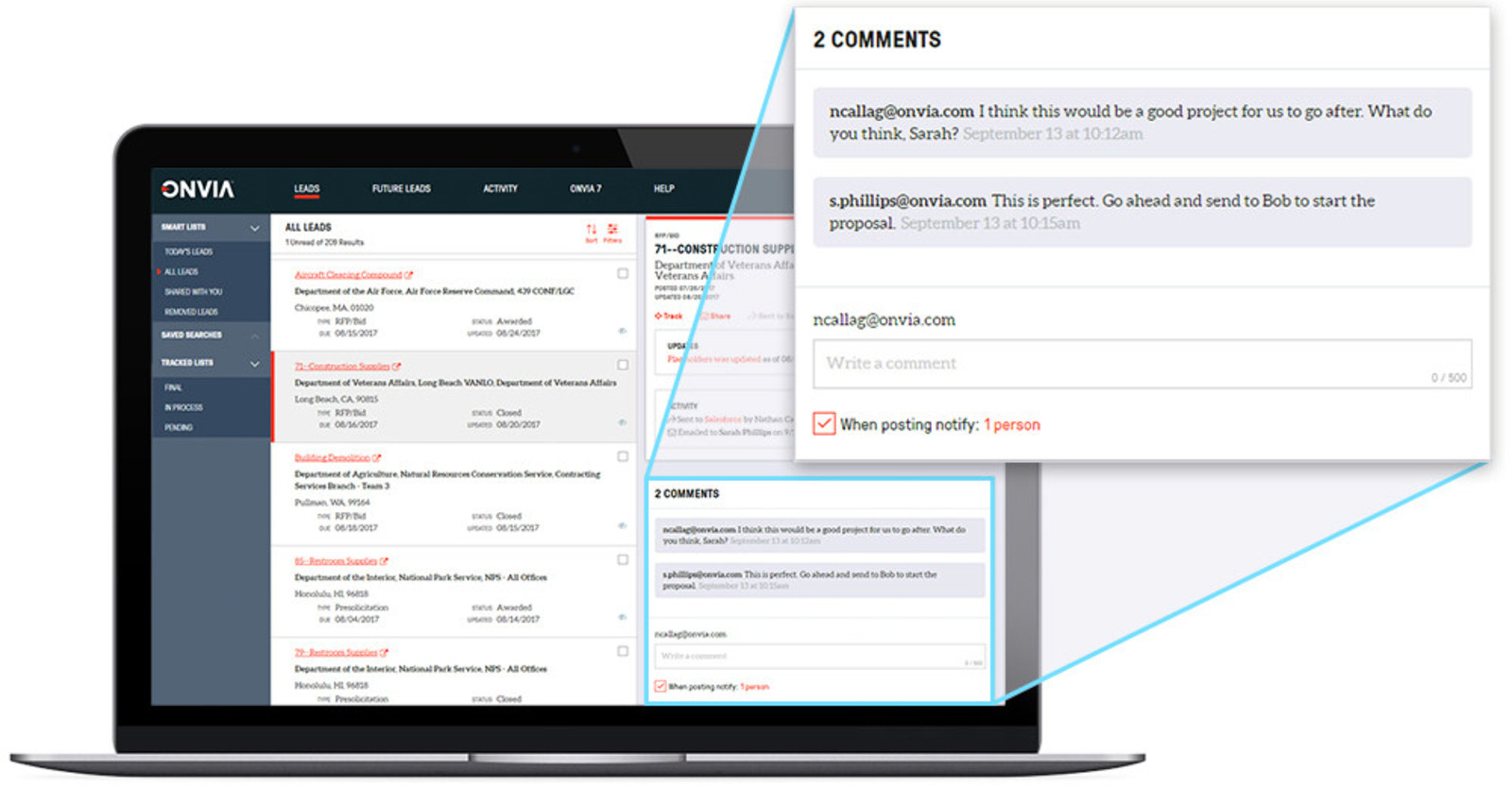
Onvia, the leading provider of sales intelligence and acceleration technologies for businesses selling to the public sector, announced the release of new comment features available within Onvia 8.

Onvia 8

Onvia 8 is a sales intelligence and acceleration platform that enables businesses of all sizes to easily distribute leads to their team or existing CRM, saving time in the lead qualification and management process. With this release, teams can optimize their workflows by quickly and easily exchanging comments, sharing information and collaborating on pursuits related to a specific project or lead, all managed centrally within Onvia 8.

“We are always researching ways to optimize the workflows of our clients, and we identified a need for more collaboration capabilities across teams, departments, functions and channels to streamline decisions around pursuing a lead,” said Chris Woerner, SVP of Product at Onvia. “These features give users the ability to provide status updates, make decisions or give more information and context around a given project, bid or RFP. Users can also edit or delete their comments at any time and their team can receive automatic notifications via e-mail alerts.”

New “Comments” Features Enable Collaboration with Teams Across Departments, Functions and Channels

The core of Onvia’s users include field teams and decision makers on the go. They often begin their day reviewing leads they receive through Onvia’s daily email notifications, and progress to qualify leads in Onvia’s cloud-based search portal. They are often busy, short on time and looking for ways to streamline their government contract pursuits.

These new features enhance the way users interact with the public sector sales intelligence available in Onvia 8’s intuitive user interface. Clients like U.S. Bank and VSS International already use Onvia 8 to easily identify critical project details and documents to make efficient lead qualification decisions. The new collaboration features allow them to save even more time in their workflows by giving users an easy way to share information, context and decision criteria to team members across departments (such as sales and marketing) and channels (such as dealers, distributors, resellers and partners).


ON24 Calls on European Marketers to Redefine Engagement for the Modern Buyer at the First-Ever Webinar World London

0
on24

ON24 Convenes Europe’s Most Innovative Marketers To Discuss Data-Driven Engagement Marketing Strategies That Build Customer Relationships And Drive Company Revenue

According to Forrester, 74% of today’s business buyers research online before ever talking to sales. In the era of the self-educated buyer, it’s imperative for marketers to develop engaging experiences that go beyond the superficial click and form a human connection.

With over 750 European marketers registered for the inaugural Webinar World London, the event focuses on the “Art and Science of Marketing” through data-driven engagement marketing strategies. The conference programme features marketing experts, including thought leaders from B2B Marketing, IBM, ON24, Oracle and SAP, sharing ways to personalize, scale and enrich engagement with customers and prospects through webinar marketing.

Joe Hyland
Joe Hyland

“It’s time for marketers to stop fooling ourselves that simply adopting automation technologies is enough to engage the modern buyer. We have to redefine engagement by the quality, not just the quantity, of our interactions and the level of customer intelligence they provide,” says Joe Hyland, CMO, ON24. “At ON24, we’ve developed our webinar marketing platform to do just that – enable businesses to engage their audience in interactive, contextual-rich digital experiences that uncover sales-ready leads. Webinar World London builds on our commitment to help marketers across the globe put engagement first and increase their business impact.”

ON24 Webinar World London caps a year of successful conferences, including sold-out events in San Francisco, Sydney and Singapore. Through the Webinar World conferences, ON24 continues to advance the conversation around engaging and converting today’s modern buyer.

ON24’s Content Gateway houses on-demand webinars, videos, white papers and podcasts in a centralized engagement hub that puts the right content at the fingertips of customers to explore on their own terms. And, with the Content Gateway Management Service, content is automatically refreshed, helping marketers deliver and delight customers with their newest, most powerful material. Every single interaction is tracked and seamlessly integrated into a company’s CRM and marketing automation system providing the behavioral data that marketers need to identify sales-ready leads and accelerate pipeline.

One North Debuts Sitecore Offering for Professional Services Organizations

0
onenorth

B2b Digital Agency Creates A Turnkey Content Management Solution Tailored To Business-To-Business Marketers

Digital marketing agency One North announced a new offering based on Sitecore, an enterprise marketing platform consistently recognized as a leader in web content management. Sitecore for PSOs combines Sitecore’s sophisticated marketing features with One North’s expertise in building business-to-business relationships.

John Simpson
John Simpson

“Our team has harnessed One North’s deep understanding of professional services organizations and their marketing processes to create a one-of-a-kind Sitecore offering,” said One North CEO John Simpson. “Sitecore for PSOs helps our clients take full advantage of Sitecore’s sophisticated marketing technology features with a step-by-step roadmap. Our agency has completed over 100 Sitecore implementations thus far and looks forward to helping clients ramp up their marketing capabilities and performance with this new solution.”

Sitecore for PSOs embraces One North’s professional services and technology expertise to enable companies to make the most of their marketing technology investment. With Sitecore for PSOs, One North’s technologists and strategists spend less time setting up technology to work within clients’ specific vertical, and instead focus on their strategy and creating excellent brand experiences.

One North’s Sitecore offering includes a technical starter kit and preset configurations that allow B2B marketers to quickly and strategically further their use of Sitecore’s advanced functionalities, as well as a progressive marketing maturity model. It also empowers clients to better integrate their tools, services and data into Sitecore, track user journeys, connect sales and business functions and deploy analytics and insights to improve marketing operations.

inMotionNow Rolls Out New Integrations with Brandfolder and Google Drive to Streamline the Creative Marketing Process

0
inMotionNow

Enhancements Poised to Help Large Marketing Shops that Produce a High Volume of Creative Assets and Eliminate Marketing Technology Silos

inMotionNow, a leading provider of workflow management solutions for marketing and creative teams, announced a new integration to the digital asset management (DAM) tool Brandfolder. The company is also releasing new enhancements to an existing integration with Google Drive. These integrations link the creative process to storage and asset management, which streamlines workflow and reduces clicks – while keeping creative assets well organized.

Chris Trauzzi
Chris Trauzzi

“The volume and intensity of creative marketing work being performed in larger organizations is incredible. It’s not unusual for a company with a dozen marketing campaigns to have hundreds of assets being created, while a company with a hundred campaigns may have thousands of assets,” said inMotionNow Chief Technology Officer Chris Trauzzi. “In this context, it’s easy to see why managing all these creative assets, from request to availability, is absolutely essential for those marketing organizations that aim to be more efficient and effective.”

Enterprise marketers and designers use creative workflow solutions like inMotion to add speed, transparency, and accountability, to the creative process, from project request – to review and approval. Similarly, these shops also use a centralized storage solution or DAM to keep these assets easily available for use by sales, marketing and other stakeholders. The challenge inMotionNow has solved is weaving these two systems together and eliminating the margin of error in moving assets between marketing technology silos.

Previously, moving assets into, or out of, the review process required project managers to download the asset from one platform – often onto a workstation or hard drive – and then upload it to other. These integrations mean project managers can open folders and files from these other platforms from directly within the inMotion console.

For Google Drive, a previously required file conversion step has been eliminated with this software release. After downloading an asset – Docs, Sheets, Slides, Drawings – a project manager also had to convert the file format before uploading it to the inMotion platform. For example, a Google Slide presentation needed to be converted to the Microsoft® PowerPoint® format. The new enhancements mean inMotion completes the conversion once the user selects the file type that should be used.

These three new integrations add to several existing DAM integrations inMotionNow has already developed with commensurate capabilities. These include DAM products commonly used by marketing departments and in-house creative teams such as Box, Dropbox, ShareFile, Canto Cumulus, Canto Flight, inRiver, Egnyte, Webdam and Widen.

“Internally we refer to this as ‘saving user events,’” added Trauzzi. “This means we are continuously looking for ways to automate or reduce the number clicks, steps or actions required of users – so teams can focus on getting business results rather than manage the process.”

More than ever, marketers are under pressure to produce more and more content without sacrificing quality. The polish and professionalism creatives breathe into marketing assets is proven to increase the effectiveness of campaigns – but this requires marketing and creative to work more efficiently together.

Trusona Brings Identity Authentication without Passwords to EMEA

0
trusona

Identity Authentication Leader Appoints Seasoned Technology Executive and Opens UK Headquarters

Trusona, the leading solution in #NoPasswords identity authentication, announced Oliver ‘Olly’ Brough has been appointed to lead the expansion of Trusona’s #NoPasswords Identity Authentication solutions into EuropeAfrica and Middle East markets.

Olly was named Vice President, EMEA and will oversee the regional mission to protect businesses and consumers by replacing static usernames and passwords with secure identity authentication.  The expansion follows a year of accelerated growth for Trusona that includes Series B funding from Microsoft Ventures and Kleiner Perkins, the opening of an office in Japan to serve the APAC region, and the addition of Trusona’s Identity Authentication Suite as a multi-factor option for millions of users within the Microsoft Azure Active Directory Premium conditional access engine.

Ori Eisen
Ori Eisen

“Usernames and passwords are the weakest link in the cyber security chain, and every day at Trusona we unshackle the false sense of security they’ve given the world. #NoPasswords is a global mission and Olly brings the breadth of experience, deep industry knowledge and a track record of building businesses in payments, cyber security and identity that will aid in the dissemination of technology to secure identity in the region,” Ori Eisen, Founder and CEO, Trusona said.

Olly brings more than 20 years of experience in fast-growing technology businesses to his role at Trusona. Most recently he served as Managing Director of Pay360 a full service multi-channel payment service provider, the UK market leader in public sector payments and expanding quickly into digital private sector markets following the acquisition of PayPoint Mobile & Online. Previously, he was General Manager, eCommerce for Cambridge Global Payments, Global Business Development Director for Experian Identity & Fraud and Sales Director for The 41st Parameter, also founded by Ori Eisen, Trusona founder and CEO.

Oliver Stebbings
Oliver Stebbings

“Digital transformation of businesses in EMEA is constrained by heightened security and data protection regulation meaning frustration for employees and consumers who are asked for passwords, pins and ‘secret questions’ when logging into websites or identifying themselves in person or over the phone. This frustration is seen in financial outcomes for business by way of reduced sales, increased operational costs, as well as poor adoption and return on investment for new digital channels. Our expanded presence across EMEA will accelerate adoption of identity authentication to achieve our mission of creating a more secure and more convenient way for people to access services,” Olly said.

The EMEA headquarters will play a critical role in the #NoPasswords revolution expansion into EMEA. Trusona replaces usernames and passwords and with secure identity authentication for all channels; physical, voice, app, web, email and chat. Trusona’s technology can be embedded directly (as an SDK) into an organization’s app, making consumer adoption intuitive and instantly delivers a frictionless customer experience. Trusona is already being utilized by global organizations across industries including: financial, healthcare, government, higher education and entertainment.

Media iQ Awarded Two Elite Designations for Online Safety and Security

0
mediaiqdigital

Data & Analytics Innovator Has Attained Network Advertising Initiative Membership And TAG Certified Against Fraud Status

Media iQ, the leading global analytics and technology company, announced that it has achieved two important industry designations that affirm its commitment to brand safety and consumer privacy in the digital space. The company has earned a TAG Certified Against Fraud status by the Trustworthy Accountability Group (TAG) and has been accepted as a member of the Network Advertising Initiative (NAI) by adhering to the organization’s strict Codes of Conduct.

TAG is the leading global certification program to fight criminal activity and increase transparency in the digital advertising supply chain. The NAI is a non-profit organization whose purpose is improving the health of the online ecosystem by enforcing high standards for data collection and consumer privacy. The NAI Codes of Conduct are considered the gold standard for self-regulation in the ad-tech industry.

Paul Silver
Paul Silver

“Together, these two designations underscore how dedicated we are to protecting both brands and consumers online. Being an NAI member communicates to the industry and our clients that we take all steps necessary to let users know how we use data for online behavioral advertising. And TAG certification confirms that we maintain best practices for brand safety and take advantage of a full array of protective technologies,” says Paul Silver, Chief Operating Officer, Media iQ.

The TAG Certified Against Fraud seal also reinforces GUARD, Media iQ’s existing three-part brand safety system, and demonstrates that Media iQ meets following requirements:

  • MRC-Accredited IVT monitoring on 100% of impressions bought
  • Fraud domain blacklist on 100% of impressions bought
  • Fraud IP blacklist on 100% of impressions bought
John Goulding
John Goulding

“Especially in light of recent headlines about advertisers paying for fake traffic on major publisher sites, our clients want absolute assurance that their brands and budgets are protected. This certification is just one more way we demonstrate our absolute commitment to ad integrity,” says John Goulding, Global Product Director, Media iQ.

Some studies estimate that as much as 20% of all ad spend is wasted on fraudulent ad traffic industry-wide. MIQ’s GUARD helps advertisers avoid fraud online by ensuring brand-safety, minimizing fraud and maximizing performance across all Media iQ campaigns.

“By aligning with NAI and TAG standards, Media iQ is contributing to a healthy online and mobile infrastructure, consumer privacy, and overall trust in the digital ecosystem. We want all stakeholders to be assured of our unwavering stance on brand protection; transparency as well as data access, quality and security,” concludes Paul Silver, Chief Operating Officer, Media iQ.

ViewLift Enhances Platform Services with Artificial Intelligence Technology

0
viewlift

Platform Provides Advanced Data Solutions and Services for Operators

ViewLift, an industry leading digital distribution and monetization company, has incorporated artificial intelligence engine technology into its platform. ViewLift Intelligence (VLI) uses the latest data science and artificial intelligence technology to provide enhanced customer behavioral insights and retention tools for operators. These analytic and retention services are integrated within the ViewLift platform, allowing clients to execute targeted churn reduction strategies across multiple channels including social, email, in-app, push notifications, among others.

Generated from every platform, piece of content and end-user, the data ViewLift provides allows for rapid and granular analysis of traffic, engagement, revenue and marketing. Their universal dashboard gives partners a 360-degree view of the business in real time.

As an end-to-end OTT platform that touches every part of the user journey, the ViewLift platform collects an incredible breadth of data on customer behavior. Using advanced machine learning and AI algorithms, ViewLift Intelligence leverages its data to accurately predict which paying subscribers are at high risk for churn. By analyzing user viewing behavior, content preferences, subscription packages, acquisition method, and device preferences with VLI, ViewLift allows operators to pinpoint specific users that are likely to cancel in the near future. Given the high cost of acquiring subscribers, targeted retention strategies offer a much higher return on marketing investment and can vastly increase client profitability.

With the implementation of ViewLift Intelligence technology, the platform continues to provide innovative solutions for brands. The platform continues to make milestones producing high quality tools that empower content owners and establish long lasting partnerships.

ViewLift provides a comprehensive suite of technology and services for brands and content owners. Using the platform and services, partners are able to get to market and reach consumers quickly. Their digital platform allows consumers to stream live and on-demand content and offers extensive marketing, data and analytics tools that empower businesses to generate revenue and enhance interaction with their audience.

Vlipsy Raises $1.3 Million in Seed Funding, Graduates Techstars Atlanta Accelerator

0
vlipsy

Ohio Startup Enhances GIFs by Adding Sound, Attracting Skype and Viber as Early Partners

Fresh off graduation from Techstars Atlanta, Canton-based startup Vlipsy has announced $1.3 million in seed funding from multiple investors—including JumpStart Inc., North Coast Angel Fund, Impact Angel Fund and Cox Enterprises—as well as early distribution partnerships with Skype and Viber.

Vlipsy offers users short, conversational video clips to share in their online communication—similar to the way sites like GIPHY provide looping images known as GIFs. However, Vlipsy’s clips also feature sound, unlike GIFs, which are silent.

“There are 6 billion emojis and 1 billion GIFs sent every day, but right now they’re all on mute,” said Vlipsy CEO Chris Nickless. “Vlipsy changes that. This seed funding, combined with the momentum coming out of Techstars, will allow us to ramp up our apps and partnerships, grow our team and continue integrating more media partners.”

Rem Harris
Rem Harris

“In less than a year Vlipsy has already become a major player in a rapidly growing sector,” added Rem Harris, JumpStart’s senior partner in charge of investing. “GIFs are such a massively popular method of communication, and sound-enabled video clips like the ones Vlipsy creates have the potential to be even more engaging.”

Matt Tew
Matt Tew

Founded in 2017 by Nickless, Co-founder Matt Tew and a team of consumer startup veterans, Vlipsy has quickly gained momentum with users. Meanwhile, the platform’s API for developers also makes third-party integration easy for partners such as Skype and Viber.

In conjunction with Techstars Atlanta Demo Day on October 10, Vlipsy has also announced mobile apps for both iMessage and Android, unlocking one-tap sharing to WhatsApp, SMS, Facebook, Messenger and Twitter while also enabling downloading for easy sharing to Instagram and Snapchat.

“This is the next generation of expressive content. We’re transforming video clips into truly conversational media,” said Nickless. “We integrate directly where you communicate most and allow you to fully express yourself using moments from your favorite TV shows, movies and random internet videos.”

Michael Cohn
Michael Cohn

“When we met Chris and Matt, we immediately knew their team was solid,” added Michael Cohn, Managing Director of Techstars Atlanta. “The duo spent the last decade building messaging and social consumer products; so when they started Vlipsy, we knew we wanted to be part of that journey.”

Also Read: Pressing Engagement: The Art of Social Selling

Textio Upgrades Enterprise Offering to Optimize Augmented Writing for Larger Teams

0
textio

Large Enterprises Finally Measuring Impact Of AI On Human Resource Platforms With Textio

Textio, the developer of the world’s first augmented writing platform, announced a host of new product features and updates designed to address the needs of large organizations looking to bring in leading talent. Enterprises are under increasing pressure to deliver measurable improvements in their hiring pipeline and they are turning to artificial intelligence (AI) solutions. While AI solutions for HR organizations have gained in popularity, few delivered real, substantive impact backed with results. Textio stands out by making a quantitative impact on the hiring results of large enterprises including NVIDIA, CVS, and Credit Suisse. As more and more enterprises have adopted Textio, the product has evolved to meet the unique needs of large scale companies including better organization of documents and analytics tracking by team.

Textio product
Textio product

Textio uses AI to predict how different people will respond to written content, and shows writers exactly why, so they can make performance improvements before a document is ever published. The company’s first application on the platform is used for writing job postings that perform better in the real world. Typically, customers using Textio attract 25% more candidates qualified enough to interview, get 23% more applications from women, and they fill roles two weeks faster than they did before using Textio.

Sjoerd Gehring
Sjoerd Gehring

“With roughly 1 million applicants for more than 25,000 job openings each year, Johnson & Johnson is in a rare position to disrupt the talent acquisition process. We’ve been impressed with the data and guidance delivered by Textio. In our first few months of using Textio, we saw a 9% increase in female applicants, which is helping us to achieve our goals to have a workforce that reflects our surrounding community,”  said Sjoerd Gehring, VP of Talent Acquisition, Johnson & Johnson.

Kieran Snyder
Kieran Snyder

“Textio has taken the mantle as a leader in AI for HR platforms. After using Textio, customers see measurable changes in their hiring pipelines. As Textio has continued to attract forward-thinking enterprises, we have built more robust features to help them achieve their goals including improving workflows, single sign-on, the ability to organize work in teams, measurement at scale,” said Kieran Snyder, CEO, Textio.

TwentyBN Unveils AI Systems With Awareness of Their Physical Surroundings

0
twentybn

The Artificial Intelligence system observes the world through live video and automatically interprets the unfolding visual scene

Deep Learning pioneer Twenty Billion Neurons (TwentyBN) debuts an AI technology that is the world’s first to show an awareness of its environment and of the actions occurring within it. The system observes the world through live video and automatically interprets the unfolding visual scene. The interpretation provides a comprehensive understanding of actions and human behaviors, as well as of concepts relating to the physical world that are beyond what still-image analysis can reveal.

At REWORK Montreal, a gathering of AI researchers and practitioners, the company will give a public demonstration of its technology that takes in a real-time camera stream and describes the actions and behaviors it observes. This recent breakthrough is based on a completely new approach to video understanding. It leverages deep neural networks, a form of machine learning, applied to a vast amount of video data recorded specifically for the purpose of teaching machines “common sense” about the physical world.

Roland Memisevic
Roland Memisevic

With the proliferation of connected camera devices, there is an urgent need for better ways to analyze video. The vast majority of commercial use cases in video understanding are out of reach for current technological capabilities. “Machines can identify objects in images, but they are unable to fully decipher the most important aspect: what’s really going on in front of you. Our technology lays the foundation for use cases that require an understanding of the context and actions that occur in the world,” CEO and scientific lead, TwentyBN, Roland Memisevic said.

“Roland and his team are definitely onto something. Their approach of using video to teach neural networks common sense about the world, by working their way up from visual primitives towards more complex concepts, could have a very strong impact,” Yoshua Bengio, professor at the Universite de Montréal and advisor, TwentyBN said.

TwentyBN is working with clients to deploy enterprise-grade systems in a range of industries, including smart homes, automotive, retail, robotics and healthcare. By providing situational awareness through vision, the company’s novel technology fills a significant gap in the market for intelligent systems.

InsightSquared Partners with LinkedIn, Integrates with LinkedIn Sales Navigator

2
Insight Squared and LinkedIn Navigator

Users Can Turn Records Into Rich Profiles By Viewing Linkedin Sales Navigator Information Directly Within Insightsquared

InsightSquared, a provider of sales intelligence solutions for high-growth technology companies, announced that it has partnered with LinkedIn to integrate InsightSquared with LinkedIn Sales Navigator. The integration will provide data on the critical actions taken by a sales team to help them reach peak performance. Users will be able to view LinkedIn Sales Navigator information alongside sales analytics within existing InsightSquared reports.

Samuel Clemens
Samuel Clemens

“Customers are hungry for analytics to help them understand and unlock the potential of their sales data,” said Samuel Clemens, co-founder and chief product officer of InsightSquared. “Yet, most analytics are either not insightful or difficult to interpret. LinkedIn partnered with InsightSquared because we aim to deliver analytics that our customers can not only use, but use for material impact.”

For example, with the InsightSquared and LinkedIn Sales Navigator integration, sales managers will be able to:

  • Understand the correlation between the opportunity close rate and LinkedIn Sales Navigator connections, including the number of connections into an account that a rep needs to optimize their particular sales process.
  • Monitor and manage rep performance using LinkedIn’s Social Selling Index (SSI) by tracking improvements in a rep’s SSI over time, and setting InsightSquared Alerts when an SSI drops below an acceptable threshold.
  • Identify the effectiveness of InMails for prospecting by revealing InMail conversion rates for each rep, and allowing managers to propagate successful best practices across the entire team.

The Commerce Data Opportunity: How Collaboration Levels the Retail Playing Field

0
criteo

A New Study Reveals Senior Marketers Understand The Power Of Collective Data and View It As A Competitive Advantage

Criteo S.A., the commerce marketing technology company, released data from its study in conjunction with Forbes Insights: “The Commerce Data Opportunity: How Collaboration Levels the Retail Playing Field“. The study, which surveyed more than 500 global marketing executives across several retail sectors, was designed to assess data’s role in ensuring retailers remain competitive in the evolving market. Results reveal that brands and retailers not only realize the potential of data, but also view collaboration and pooled assets as a way to better meet customers’ needs, drive value and compete.

Bruce Rogers
Bruce Rogers

“Despite the disruptive transformation of the retail industry, we are simultaneously witnessing that brands – large and small – understand the critical importance of data, are working hard to leverage the data they have, and see opportunity in working together to gain an edge. Data is the great equalizer in this time of division and global executives agree that a shared approach is the key for gaining an upper hand in the battle for consumers’ share of time, attention and wallet,” Bruce Rogers, Forbes’ Chief Insights Officer said.

Key insights from the study include:

  • Retail Industry Disruption is Reshaping Commerce: Brands demonstrate concern that physical-digital giants will limit access to their products, whereas retailers worry this trend will cause consumers to turn away from smaller retailers.
  • Brands and Retailers Realize Data’s Potential, but Lack Activation Capabilities: Nearly four out of five brands and retailers include customer data as a key part of their business strategy. But while retailers have access to more data than brands, especially online, they are less confident than brands in their ability to activate data into actionable insights. Bottom line: more data alone doesn’t necessarily translate into a greater ability to take action.
  • Pooled Data Assets are a Powerful Way to Get Ahead: Brands and retailers see value in collaboration and pooling data assets to meet customer needs and drive value for their business. In fact, 71% of retailers are willing to contribute online search data to a pool. And, three-fifths of those surveyed are already part of a data cooperative, with almost seven out of 10 of those companies already happy with their collaborations as well as the data they receive. Additionally, 72% of marketers cite “increased revenue” as a key benefit they experience from pooled data.
  • Value Drives Everything: Forward-thinking brands and retailers know that data is the key to providing value, and 68% believe their customers are satisfied with their use of data to deliver more targeted marketing. Nine out of 10 companies report placing even greater importance on delivering true value as a business driver during the past two years.
  • Quality and Confidentiality Chief Concerns: When it comes to data, 66% of marketers report that the biggest challenge they have with customer data is “ensuring quality data,” and 65% cite “confidentiality of data” as a top challenge in the context of pooled customer data assets.
 Eric Eichmann
Eric Eichmann

“Global marketing executives are fully aware of the disruption the industry faces. Leading CMOs are taking bold steps to capitalize on the opportunity created by this disruption. Understanding the value of data collaboration and pooling data is a massive step forward. Doing this within the Criteo Commerce Marketing Ecosystem, which holds a massive pool of granular shopper data and provides access to one of the best media inventories in the industry, will uniquely enable retailers and brands to connect more shoppers to the things they need and love, and maximize their company’s sales and profits,” Eric Eichmann, CEO, Criteo said.