
If you read the headlines from CES 2026, agentic AI dominated. Despite the hype, most executives across the ecosystems are asking, “How do we actually make this work with our tech stack?” Modern agentic systems work through layers from where data lives, to how actions are executed, to how intelligence is coordinated. APIs and MCPs sit within that architecture, working together to move systems from data to decisions. MCPs don’t replace APIs. They enable agents to interact with the real world and take actions. And understanding that distinction matters enormously for anyone building agentic systems.
What MCPs Actually Do
Model Context Protocols (MCPs) provide a valuable advancement as AI is changing the ways ads are bought, planned, and analyzed. They provide “context” – the “C” in MCP – to enable AI agents to understand what systems are capable of without needing to know how those systems work at a code level. MCPs understand an API’s capabilities and purpose, knowing what an agent can do with it, not how it’s programmed.
This is genuinely useful. When an agent receives a natural language prompt like “build an audience of high-net-worth sports enthusiasts in the Northeast,” the MCP layer helps translate that intent into structured queries. It knows which APIs to call and what parameters they need.
But here’s what the MCP layer doesn’t do: securely connect systems, query platforms, reformat data, and manage file transfers.
When you query a CDP to build that audience file, something still has to retrieve the data, apply the filters, generate the file, and transfer it to the activation platform. That “something” is the API, the execution layer that moves data, governs permissions, authenticates requests, and logs transactions.
If architected correctly, the MCP gateway will determine which MCP to leverage to make an API call, which formats the request to its associated platform. The API moves data from its deployed (or prepared) state to its activated state.
Why APIs Remain Essential Infrastructure
Every platform in the MarTech and AdTech ecosystem, such as CDPs, DSPs, ad servers, and measurement tools, manages private pools of data within structured environments. These platforms weren’t just built to store data; they were programmed with rules, guardrails, and workflows that govern how that data can be used.
All the functionality involved in campaign configuration, budget controls, targeting parameters, pacing logic, and brand safety requirements lives within the platforms themselves. These systems provide instructions on how to interact with data properly and capabilities for what you can do with it.
Humans access these systems through a platform’s user interface. We log in, enter information, analyze reports, and configure campaigns. But having an AI agent interact through a UI would be wildly inefficient. That’s where APIs come in. They’re the “Application Programming Interface” which are purpose-built for system-to-system communication to access the features or data of an operating system, application, or other service.
Marketing Technology News: MarTech Interview With Fredrik Skantze, CEO and Co-founder of Funnel
Now we’re adding another layer in the form of MCPs that help agents understand and coordinate API calls without needing to know the underlying code. But the APIs themselves? Still absolutely essential.
Consider what breaks without them:
-
Authentication and permissions.
APIs enforce governance, who can access what data and what actions they’re authorized to perform. An MCP describes capabilities; APIs control access.
-
Data transfer at scale.
When you’ve generated an audience file with 10 million profiles, you need batch transfer via API to move that data efficiently and map its schema to the downstream platform’s required format. The receiving API ingests it properly so the activation platform can actually use it.
-
Transaction logging and auditing.
Production systems need records of what happened, when, and why. APIs provide that audit layer.
-
Rate limiting and error handling.
When you’re operating at scale, with billions of transactions, you need infrastructure that can handle the load, manage failures, and prevent system overload.
You can’t demo away these requirements. Enterprise-grade systems need them.
The Programmatic Agentic Upgrade
Programmatic isn’t just about buyers and sellers talking to each other. It’s about operationalizing advertising at scale. And that scale means handling trillions of transactions in milliseconds, managing auction dynamics, enforcing floor prices, delivering ads to pages, applying brand safety rules, pacing campaigns, and measuring outcomes.
All of that infrastructure represents years of development solving scalability challenges. The systems work. They have guardrails in place. They handle edge cases and error conditions that took the industry years to discover and address. Two agents talking to each other doesn’t replace any of that. It automates the coordination between systems, which is valuable. But the underlying infrastructure still needs to function.
Think about ad serving. An ad server is a rules-based decision engine that determines which ad to deliver, when, and to whom. It manages pacing, frequency caps, targeting logic, and creative rotation. If you rebuild that from scratch as an “AI-native” system, you’re still building an ad server. The agent might control it more efficiently, but the core functionality must exist.
The more accurate framing of where the industry would acknowledge we’re moving from human automation through user interfaces to agentic automation through a merged layer of APIs and MCPs.
But we’re not replacing the infrastructure. We’re adding an intelligent coordination layer on top of it.
The Layered Architecture That Actually Works
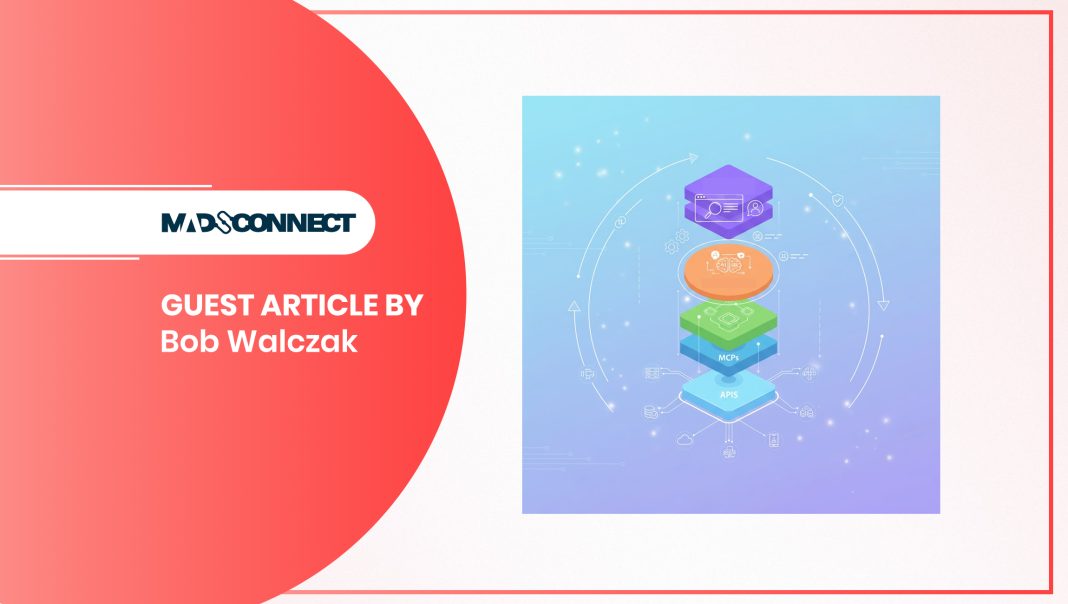
When you look at how agentic systems function in production, the architecture has distinct layers:
-
Data Layer:
Where information actually lives; in CDPs, data warehouses, and campaign management systems.
-
API/Execution Layer:
How systems take action; moving data, enforcing rules, logging transactions, and handling authentication.
-
MCP/Coordination Layer:
How agents understand capabilities and orchestrate workflows across multiple systems.
-
Agent Reasoning Layer:
Where AI applies intelligence to determine what actions to take based on prompts and objectives.
Each layer serves a purpose. You can’t skip the execution layer just because you’ve made the coordination layer smarter.
Building for Production, Not Demos
Anyone claiming you can eliminate APIs in favor of pure agent-to-agent communication hasn’t thought through what’s required at enterprise scale. You’d be burning through astronomical numbers of tokens to handle billions of transactions. You’d have no audit trail, no governance framework, no established error handling.
Maybe if you’re delivering one impression or running a pilot campaign, you could theoretically do everything through agent dialogue. But real advertising operates at the scale of petabytes of data, millisecond response times, and global infrastructure.
The reason it takes “less time to build and connect” with MCPs, is because MCPs don’t care how underlying systems work. They only care about what they’re capable of. That flexibility is valuable. But it’s limited. If you’re building production systems rather than just proofs of concept, you need all the security protocols, guardrails, and infrastructure that APIs provide.
The Real Opportunity
The agentic era is real and important. AI agents will automate manual processes, optimize campaigns more intelligently, and enable more sophisticated workflows than human operators could manage alone.
But this happens through layered evolution, not wholesale replacement. The platforms and APIs that run advertising today become foundational infrastructure that agentic systems build upon. MCPs make that infrastructure more accessible to AI agents. Together, they enable the next phase of programmatic advertising to deliver outcomes at scale.
The companies that understand this full-stack architecture are ones that respect both the coordination layer and the execution layer. They’re the ones that will build systems with more accurate and relevant outputs. The ones chasing headlines about APIs being “dead” will spend years rebuilding functionality that already works.
APIs’ moment isn’t over. They’re having their foundation confirmed.
Marketing Technology News: The Death of Third-Party Cookies Was Just the Start. Are You Ready for Consent Orchestration?