

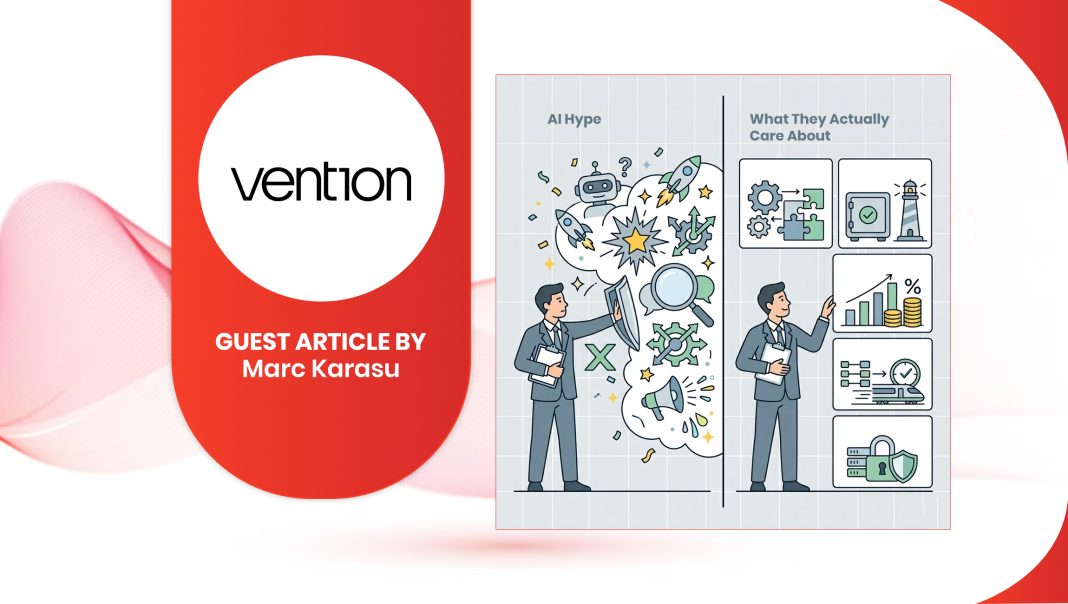
Artificial intelligence has quickly become the centerpiece of modern marketing narratives. From boardrooms to product pages, “AI-powered” is now the default promise, often positioned as the defining factor in competitive differentiation. Yet beneath this surge in messaging, a quiet but important shift is taking place among B2B buyers and audiences.
They are tuning it out.
Not because AI lacks value, but because the way it is being marketed often fails to align with what buyers actually prioritize. For organizations making high-stakes, long-term technology decisions, the fundamentals still matter most: engineering quality, technical expertise, reliable delivery, and reduced risk.
The growing disconnect between what vendors emphasize and what buyers need is creating friction in the buying process and, in some cases, eroding trust.
The AI Messaging Overload
Right now, nearly every platform, service, and solution touts some form of AI integration. While this proliferation reflects genuine advancements, it has also created a crowded and often confusing landscape.
For buyers, the challenge isn’t access to innovation—it is clarity.
When every vendor claims to be “AI-driven,” true differentiation actually becomes more difficult. Messaging starts to sound the same across the board, leaving buyers unsure what genuinely matters versus what’s just baseline capability. In this crowded landscape, bold AI claims without clear context or proof points don’t signal innovation, they blend into the noise.
To break through, marketers can’t rely on generic AI language alone. They need to be more technically fluent and deeply informed about emerging technologies, so they can engage increasingly sophisticated buyers and craft messaging that rises above vague, cookie-cutter AI narratives.
What Buyers Actually Prioritize
Despite the emphasis on AI, B2B buyers consistently return to a core set of priorities when evaluating solutions:
1. Engineering Quality
Buyers want to know that a product is well-built, scalable, and designed to perform under real-world conditions. According to recent BIXA research of 480+ business buyer decision-makers, quality of engineering and technical expertise are statistically tied for the most important attributes they look for in a vendor.
2. Technical Expertise
Beyond the product itself, buyers assess the depth of knowledge behind it. Research shows that technical expertise and guidance are tied as the most important attributes buyers look for in a vendor. They prioritize teams that understand their industry, technical challenges, and implementation complexities. For instance, 97% of buyers say it is important that a vendor both understands and uses AI technologies in their own processes.
Expertise ultimately signals credibility: 41% of tech leaders who augment their existing teams with external engineers say certified AI experts make a vendor stand out—and that credibility directly reduces perceived risk.
3. Reliable Delivery
Execution matters as much as vision. Buyers need confidence that timelines will be met, deployments will go smoothly, and ongoing support will be dependable. Efficient delivery is a top-five priority for buyers, and it is the single most important factor for 17% of UK-based decision-makers. Overpromising, particularly in emerging technologies, can quickly erode confidence when delivery does not keep pace. Buyers are also pragmatic about how to build that confidence quickly — 47% value paid workshops specifically because they accelerate project momentum. Buyers also increasingly expect AI to reinforce that reliability through faster code generation and automated code reviews.
4. Risk Reduction
At its core, every B2B purchase is a risk management decision. Whether it’s financial risk, operational disruption, or reputational impact, buyers are evaluating how a solution minimizes uncertainty. A bold guarantee is the top determining factor for buyers, carrying 40% of the relative importance in their decision-making process. In fact, 88% of buyers would choose a vendor offering a 100% bug-free guarantee even if their price was 30% higher than competitors. Clear documentation, proven use cases, and transparent communication, such as through de-risking workshops favored by 34% of buyers, all contribute to lowering the #1 hesitation in the market: concerns over code quality and security.
These priorities are not new. What has changed is how easily they can be overshadowed by trend-driven messaging.
The Cost of Misalignment
When marketing narratives focus on AI but ignore these foundational concerns, a gap forms between expectation and reality. This misalignment leads to clear consequences:
- Longer sales cycles, as buyers seek additional validation and clarity
- Increased skepticism, particularly toward bold or vague claims
- Missed opportunities, when solutions fail to resonate despite strong underlying value
In some cases, the emphasis on AI can even distract from a company’s true strengths. A well-engineered product with a track record of reliable delivery may be far more compelling than a newer, AI-heavy offering that lacks maturity. But if the messaging doesn’t reflect that strength, buyers may never fully recognize it.
Reframing the Narrative
The solution isn’t to move away from AI, it’s to stop pretending the tools are the transformation.
The teams winning with AI aren’t the ones with the most tools. They’re the ones that changed how their engineers work. This is a people and process problem, not a procurement decision—and most vendors avoid saying it because it’s harder to sell.
The shift in messaging is simple but demanding: stop leading with what the technology is and start with what it takes to make it work. That means structured workflows, validated output at every stage, and a clear acknowledgment that AI without governance doesn’t reduce costs—it increases them. AI usage is not free; it is metered in tokens and accumulates quickly.
There’s also a risk that almost no transformation partner raises: internal resistance. AI champions inside a client organization pull ahead. Resistors create drag. If you don’t address adoption at the engineer level from day one, the transformation fails at the people layer, not the technology layer. Buyers should be asking their vendors how they handle this. Most can’t answer.
Marketing Technology News: MarTech Interview With Jay H. Lee, Chief Marketing and Growth Officer @ Five9
Questions to challenge yourself and your teams:
- Is your AI architected well enough that the economics actually work?
- Do you have a structured methodology or just a capability?
- What happens when your engineers resist?
Building Trust Through Substance
Trust is the currency of B2B relationships. It is built through consistency, transparency, and proof. In a market saturated with AI claims, substance is the differentiator.
- That substance shows up in four ways:
- Clear, specific use cases that demonstrate real-world impact
- Technical depth that proves how solutions are built and maintained
- Evidence of reliability, backed by performance metrics and long-term customer outcomes
- Honest communication about capabilities and limitations
When buyers see that a company is willing to go beyond surface-level messaging, it signals confidence—and that confidence is often more persuasive than any single feature or capability.
The Opportunity Ahead
The current wave of AI enthusiasm is real, and so is the backlash forming underneath it. Buyers aren’t rejecting AI. They’re rejecting the version of AI that showed up late, overpromised, and left their teams holding the complexity.
The companies that will win this window aren’t the ones with the boldest AI narrative. They’re the ones who can answer the questions a sophisticated buyer will eventually ask: Is your AI architected well enough that the economics actually work? Do you have a structured methodology or just a capability? And what happens when our engineers resist?
Bad AI is expensive AI. Buyers are starting to do the math, and the vendors who can’t show their work are going to lose deals they don’t even know they’re losing.
The fundamentals haven’t changed. Proof, expertise, reliable delivery, and reduced risk. What’s changed is that AI has raised the stakes on all of them. The companies that understand that distinction – and can demonstrate it – are the ones that will eventually define this market.
About Vention
Vention is the premier global leader in software engineering, synonymous with technology designed for scale and the common denominator behind the world’s most successful tech-empowered enterprises, industry innovators, and startups.
Marketing Technology News: Experience-First Martech: Designing Campaigns Around Moments, Not Channels