Home Blog Page 4326

PerformLine Acqui-Hires Silverback Social; Chris Dessi Named VP of Sales

0
performline

The Acqui-Hire Accelerates Performline’s Sales And Marketing Growth

PerformLine, the leading RegTech company that delivers automated compliance solutions, announced the acqui-hire of leading social media technology company Silverback Social, with former CEO Chris Dessi joining as VP of Sales. Former Silverback Social CMO John Zanzarella will be joining PerformLine as Director of Sales and Marketing Operations.

The acqui-hire of Silverback and appointments of Dessi and Zanzarella will help PerformLine meet the accelerated demand its sales and marketing functions are facing for their RegTech and compliance SaaS platform. The deal comes at an ideal time for the company, with PerformLine recently announcing a $4 million debt facility from Bridge Bank to build on the milestone of sustained profitability and high growth.

Dessi was CEO of Silverback Social since 2012 and brings 20 years of sales leadership expertise in the software and tech sector. He’s written three highly regarded books on digital marketing, and is a regular contributor to FOX, CNN, MSNBC, and CNBC. Zanzarella is a natural marketer with a background in events who will assist in the growth of PerformLine’s industry leading RegTech and compliance conference COMPLY. He joined Silverback Social as CMO in 2013 and acted as CEO of the Westchester Digital Summit.

Alex Baydin
Alex Baydin

“This acqui-hire is a clear sign of how intelligently PerformLine is growing. When your customers are the largest and most complex financial institutions in the world, you recognize the need to bring in highly skilled A-level talent quickly. After closely tracking the success of Dessi and Zanzarella for the past five years, we knew that the most impactful way to further enhance our sales growth and COMPLY event was to integrate their leadership into the PerformLine team,” said Alex Baydin, CEO of PerformLine.

How Marketing Ops Runs Marketing Like a Business

0
Revenue Marketing
How Marketing Ops Runs Marketing Like a Business

Pedowitz GroupTwo basic principles of running an effective business include efficiency (doing things right) and effectiveness (doing the right things). This is the secret sauce that marketing operations bring to the business of marketing that enables marketing to meet financial goals such as ROI, pipeline, and revenue. In the technology-rich environment of martech today, it’s easy to get sidetracked by all the bright and shiny toys available. This article looks at how marketing operations injects a new sense of purpose and perspective into the business of Revenue Marketing™.

Doing Things Right = Efficiency 

The core tenant of any operations team is to drive efficiency. Marketing might be considered akin to a manufacturer in that marketing’s job is to produce tangible MQLs that convert to revenue. If we stay with this analogy, how efficiently that MQL can be produced can be a game changer for an organization. Think about how much “waste” a typical marketing organization generates over the course of a week, a month, a quarter or a year. Waste is generated in every part of marketing – planning, building, executing, communicating, reporting, etc. We must admit that project management, process streamlining, and finding more efficient ways to produce ANYTHING is not a natural marketing talent.

In many companies, this is the first charge of a marketing operations group – get rid of the waste, streamline processes and optimize current resources. Given this as an early charter, the marketing ops group brings not only operations talent to bear, but also key technologies that move efficiency improvements into the status quo of marketing.

Efficiency Example 

Let’s look at conversion rates as an example of doing things right. If I am working with a company and they can’t instantly quote their conversion rates, I know we have a lot of work to do. Lead conversion rates from the beginning of the funnel (name) to the end of the funnel (contract) is the most fundamental example of efficiency. The more the conversion rates can be improved, the more efficient the production process. Using the same set of resources to produce more or better product is the hallmark of an effective marketing operations group. Efficiency measures are always numbers such as conversion rates, cost per lead, pages per visit, number of website visitors per month, etc. Becoming a more efficient organization is typically what marketing operations addresses first.

Doing the Right Things = Effectiveness

The second part of the marketing operations’ charter has to do with effectiveness or doing the right things. Marketers are often caught in the loop of “this is the way we’ve always done things.” Once the marketing ops group has most of the efficiencies in place, they begin to look at the higher-level picture of what marketing could be doing differently. This alternate view is very much based on running marketing like a business in order to affect top line revenue growth. The marketing operations group is often charged with creating new processes, new metrics, new alliances and new results.

Effectiveness Example

 Marketing operations takes on a leadership role when addressing the effectiveness (Are we doing the right things?) of the marketing organization. Late last year I was working with a marketing operations leader who was responsible for the budgeting and planning process as well as the ongoing management of the budget. The company began a small inbound program early in the first quarter and increased the budget in small increments in the next six months. As the marketing ops team looked at the returns on the different areas of marketing spend, they noticed a very high conversion rate of inbound leads as well as a higher average deal size. Based on this analysis, doing the right thing was to take money out of lower performing programs and place more money into the better performing inbound campaigns. Without the overall analysis and comparison of different areas of marketing, this switch might never have happened.

Beyond the Bright and Shiny Toy

The marketing operations function is growing quickly and making a significant impact in redefining marketing’s contribution to the business. I first wrote about The Rise of the Marketing Operations Function in 2016.

Since that time, I’ve worked with many marketing operations leaders as they pioneer this new element of marketing.  Establishing the right core technologies as the foundation and ensuring the right marketing operations talent is essential to success. Equally important is the mindset of the marketing operations team.

If they view themselves as key to improving efficiency and effectiveness as it relates to financial goal achievement, they will lead the transformation of marketing from a cost center to a revenue center. This dramatic transformation is the essence of Revenue Marketing and what determines an organization’s profitability and long-term success.

50-50 Familiarity with AI Causes People To Be Cynical, says Report

0
AI
It’s The “50-50 Familiarity” With AI That Cause US People To Be Unsure, Cynical And Concerned About It

In A Recent Syzygy Report, 79% Of Americans Believe The Use Of AI In Marketing Should Be Regulated By A “Blade Runner” Rule

As Blade Runner 2049 hits movie theatres, new research by SYZYGY  (a WPP digital agency group) shows that concerns about artificial intelligence (AI) are top of mind for American consumers. Research titled “Sex, Lies and A.I.” from SYZYGY reveals that 79% of Americans believe a new “Blade Runner rule” is needed to make it illegal for AI applications such as social media bots, chatbots, and virtual assistants to conceal their identity and pose as humans.

The study, “Sex, Lies and AI: How the American Public Feels About Artificial Intelligence” was conducted in Q3, 2017 with 2000 American adults aged 18-65 years from the WPP Lightspeed Consumer Panel.

AI versus Human Service: How use of Artificial Intelligence Impacts Sentiment

Interestingly, 89% of Americans believe that the use of AI in marketing should be regulated with a legally-binding code of conduct and almost three-quarters (71%) think that brands should need their explicit consent before using AI when marketing to them.

Megan Harris, Managing Director, SYZYGY North America, said, “This is a human-centric study designed to uncover people’s positive and negative feelings about AI. As the advertising and marketing industry expands its use of AI and develops more AI-powered technology solutions, we need to collectively develop ethical and operational guidance grounded in the attitudes, values and fears of the consumer.”

  • 71% of Americans think brands should have consent before using AI to market to them
  • 28% would feel negatively towards their favorite brand if they discovered it was using AI instead of humans for customer service

Impact of AI Usage
Feelings towards AI being used in advertising were more neutral. Only 21% of respondents would feel negatively if they discovered the latest ad for their favorite brand was created by AI rather than humans, compared with 28% who would feel more negatively towards their favorite brand if they discovered it was using AI  instead of humans to offer customer service and support. This rises to a third (32%) among women.

Meanwhile, 21% would feel more negatively towards their favorite brand if they discovered it had been using AI in their marketing campaigns to profile them.

AI Understanding Still Limited
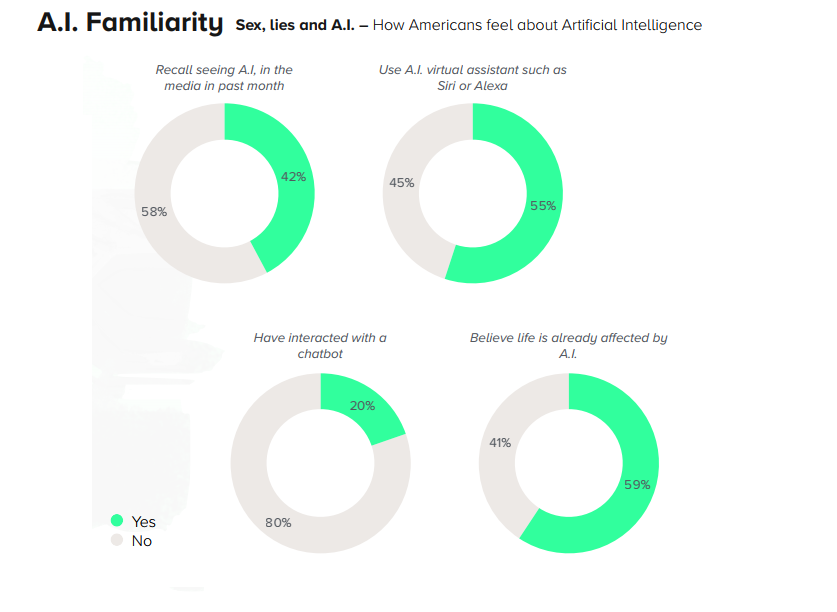
Only 11% of Americans say they know a lot about AI. When asked to choose from among 17 words that describe their feelings towards AI, “interested” was the top descriptor, given by 45% of US respondents. Close behind was “concerned” (41%), “skeptical” (40%), “unsure” (39%) and “suspicious” (30%). Most Americans expect that AI will have benefits, saving them time (40%) and making things safer (15%) and more useful (13%).

Still Limited

What an Ideal AI-assistant Should Feel Like

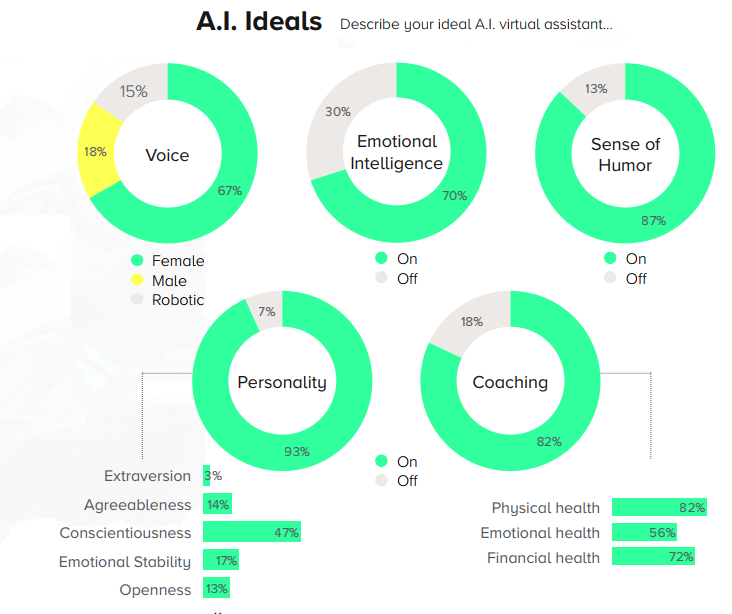
A first in many ways, the report clearly outlines what Americans expect from their interaction with the AI-assistant. 70% of them want the AI-assistant to demonstrate emotional intelligence; 87% anticipate a sense of humor; 93% want the virtual assistants to exhibit a combination of extraversion, emotional stability, openness, and agreeableness.

AI-assistant

Job Transformation vs. Job Loss
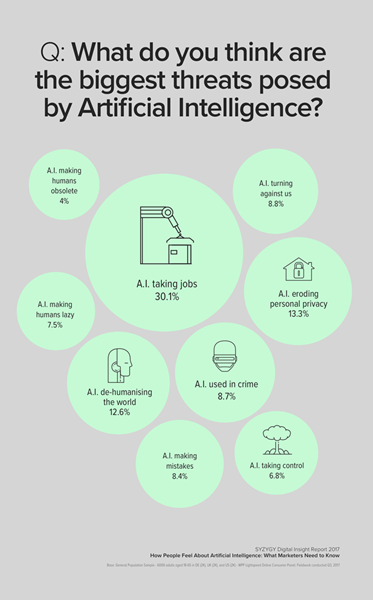
Almost a third of people (30%) most fear that AI will replace jobs. Americans believe that over the next five years, a machine could take over 36% of their individual job duties (this rises to 44% among Millennials).

Marketing AI  Rule Book
However, if brands use it fairly and transparently, consumers aren’t completely averse to them using AI  to market products and services: as many as 79% would not object to AI  being used to profile and target them in marketing.

MainInfo3 US
SYZYGY has defined a Marketing A.I Rule Book, with guidelines as follows –

Do no harm – AI technology should not be used to deceive, manipulate or in any other way harm the well-being of marketing audiences.

Build trust – AI should be used to build rather than erode trust in marketing. This means using AI to improve marketing transparency, honesty and fairness, and to eliminate false, manipulative or deceptive content.

Do not conceal – AI systems should not conceal their identity or pose as humans in interactions with marketing audiences.

Be helpful – AI in marketing should be put to the service of marketing audiences by helping people make better purchase decisions based on their genuine needs through the provision of clear, truthful and unbiased information.

Dr. Paul Marsden, SYZYGY’s consumer psychologist who managed the study, added: “This research reveals how consumers are conflicted when it comes to AI. Many see advantages, but there are underlying fears based on whether this technology or the organizations behind it have their best interests at heart. Brands need to be sensitive to how people feel about this new technology. What we need is a human-first, not technology-first approach to the deployment of AI.”

How Precisely Accurate Is Your Geo-intelligence?

0
Lotadata location intelligence

LotaDataLocation data is an important source of real-world context and geo-insights for many industry verticals. Market research pundits are projecting USD $20 Billion will be spent on geo-insights by 2020.

As location intelligence continues to become mainstream, marketers, advertisers, and smart city planners are busy purchasing as much 3rd party location data as they possibly can. Our blog post this week revisits the fundamentals to ensure the best return for your location data investment.

What is a Location Signal?

A location signal is a sequence of numbers that represent the geo-coordinates [ latitude and longitude ] for a point on the map. As an example, below map shows a marker for the Parson’s School of Design located at 5th Avenue, New York. The geo-coordinates for Parson’s are : [40.735316, -73.994583]

How precise is this blue marker? How accurate is the location for the place it represents? We’ve all heard that location data needs to be both accurate and precise in order to be actionable. What does that really mean? What is the acceptable accuracy and precision for data signals used for location intelligence?

LotaData has put together this cheat sheet to unravel the mysteries of location accuracy and precision, for the benefit of everyone in the industry.

How Precise are Location Signals?

Precision indicates the exactness of the location signal. The precision of the raw latitude and longitude is represented by the number of digits after the decimal point, ranging from 1 to 9. The table below lists the precision levels and explains the significance of each digit.

Decimal Place Queen’s Distance American Distance Translation
1 10 kilometers = 6.2 miles Town or City
2 1 kilometer = 0.62 miles Neighborhood
3 100 meters = About 328 feet City Block
4 10 meters = About 33 feet Street Address
5 1 meter = About 3 feet Store Entrance
6 10 centimeters = About 4 inches Drone Control
7 1.0 centimeter = About 1/2 an inch Military Operations
8 1.0 millimeter = As thin as a paper clip wire Civil Engineering
9 0.1 millimeter = As fine as a strand of hair Likely Fabricated

Turns out the blue marker for Parson’s is actually very precise. When evaluating sources of location signals, it is important to verify the precision of the dataset to ensure that latitude and longitude values include at least 4 digits after the decimal point. In other words, the signals should be precise to at least 10 meters or 33 feet for the location dataset to be useful for geo-targeting and audience segmentation.

How Accurate are Location Signals?

Accuracy indicates conformance with reality. Represented by a 2 digit number measured in meters, accuracy is the error margin in the reported latitude and longitude values relative to the ground truth. Most smartphone GPS receivers have an accuracy of 5 meters or approximately 15 feet. However, the accuracy could worsen near buildings, structures, trees, or indoors. Accuracy could also fluctuate with cloud cover and weather conditions.

Accuracy can be horizontal or vertical. The accuracy reported in location datasets is almost always the horizontal accuracy. GPS receivers in mobile phones are not designed to capture vertical accuracy beyond 5 meters, rendering such measurement moot in dense urban or downtown settings.

It is not uncommon to see location datasets with accuracy ranging from 1 meter to 100 meters. Below is the horizontal accuracy distribution for one of our datasets comprised of approximately 2 billion location signals obtained from 20 million mobile devices in the US.

When considering location datasets, it is important to understand the accuracy distribution of geo-signals to ensure that the bulk of the data has an accuracy better than or equal to 10 meters. Any more than 20 meters would be unacceptable for deriving actionable intelligence and meaningful geo-insights from your location data.

Blueshift Receives Patent for AI-Powered Marketing

0
Blueshift

Patent Validates Blueshift’s Innovative Approach in Using Real-Time Streams of Customer Data for AI-Powered Marketing on Every Channel

Blueshift, the leader in Artificial Intelligence (AI) Powered Marketing across all channels, announced that the company has been awarded Patent No. 9779443 from the United States Patent and Trademark Office for “EVENT-BASED PERSONALIZED MERCHANDISING SCHEMES AND APPLICATIONS IN MESSAGING”, further validating the company’s innovations in applying AI to real-time streams of behavioral data.

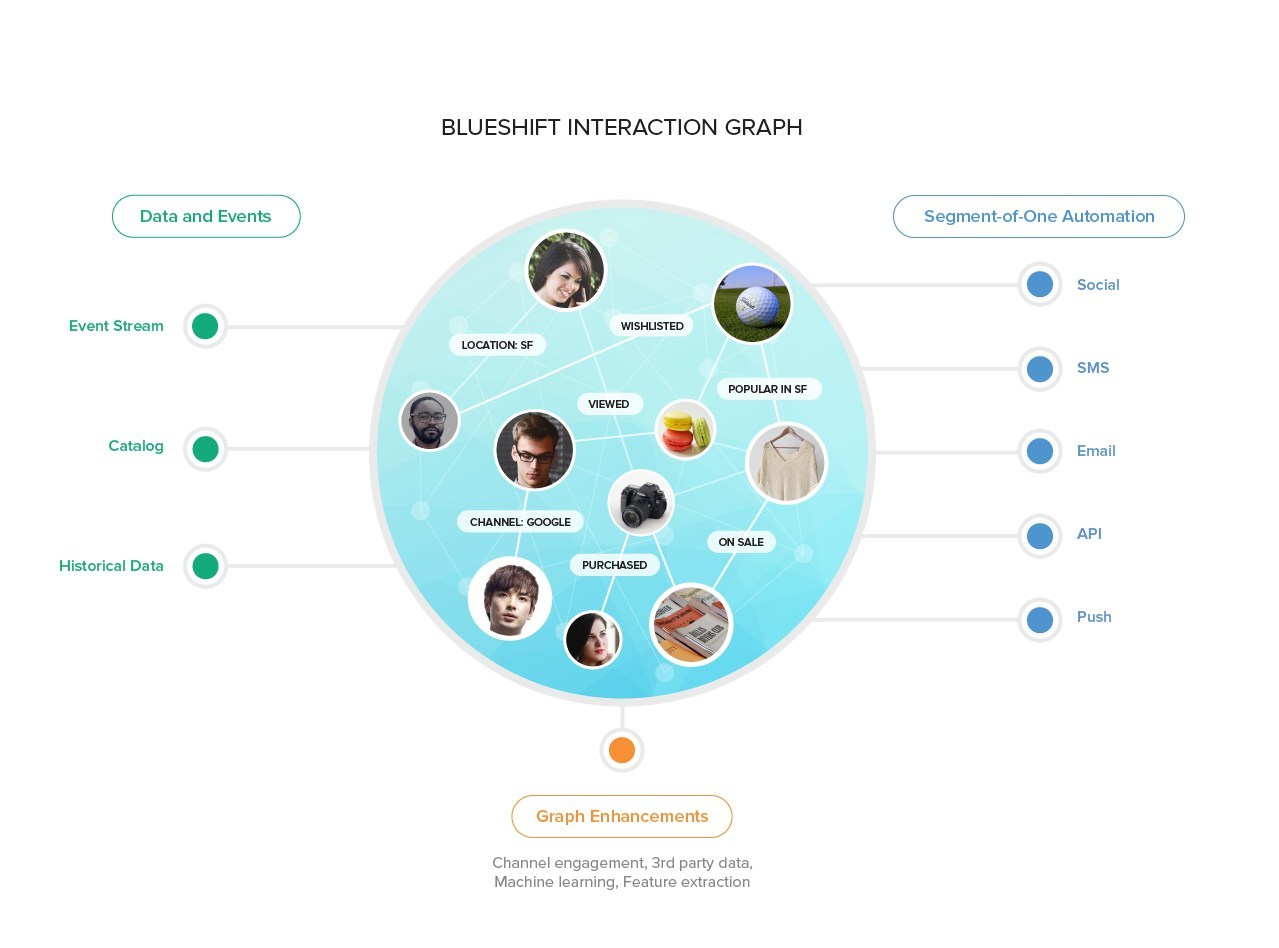
Blueshift's Interaction Graph drives Segment-of-One Marketing powered by Artificial Intelligence (AI)
Blueshift’s Interaction Graph drives Segment-of-One Marketing powered by Artificial Intelligence (AI)

Blueshift’s platform ingests and understands real-time streams of customer interaction ‘events’ from websites, apps, point-of-sale and other systems. These ‘events’ can include any customer behavior across any platform or marketing channel, e.g. a customer watched a video on a media platform, or submitted an online inquiry for a reverse mortgage with a financial-services company.

Blueshift’s patented method builds an “Interaction Graph” from the event data along with historical customer data and the brand’s catalog of products or content, and uses the graph for continuously computing various forms of AI-Based predictions and recommendations (“personalized merchandising schemes”) continuously. The patented technology also integrates these predictions into customer experiences on channels like email, direct mail, SMS, websites or mobile app notifications, enabling brands to seamlessly use the power of artificial intelligence to deliver 1:1 personalized experiences.

Manyam Mallela
Manyam Mallela

“Brands continue to generate more and more customer data in the form of behavioral ‘events’, that represent customer interactions on digital, mobile and social channels,” said Blueshift co-founder & Chief AI Officer, Manyam Mallela. “AI is the key to activating this fast moving stream of event data and delivering segment-of-one personalization on every channel.”

The flexibility of the Blueshift system to adapt to all types of customer interaction events and content catalogs makes it possible for a large variety of consumer facing industries to benefit from the platform’s innovations, ranging from consumer goods to retail, consumer finance, travel, healthcare, subscription services and marketplaces.

Mehul Shah
Mehul Shah

“We are proud to have been awarded a patent for our AI-Powered Marketing IP, especially in an increasingly stringent regulatory environment for patents, is further validation of the tremendous technological innovations by the Blueshift team,” added Blueshift CTO Mehul Shah, who has previously been awarded 10 other patents across various technology domains.  “Unlike other systems that have a rigid data schema, our innovation enables us to build 1:1 predictions and recommendations that adapt to any stream of real-time behavior from websites and mobile apps, or even from IoT devices. By flexibly adapting to the nature of the data, Blueshift is able to drive true cross-channel personalization for companies across a range of industries.”

The innovative capabilities outlined in the patent have previously caught the attention of key industry analysts. David Raab, founder of the Customer Data Platform Institute, states that Blueshift’s “recommendations are exceptionally sophisticated,” and that “… the system’s ability to load and expose imported data in near-real-time remains impressive.”

Vijay Chittoor
Vijay Chittoor

“With the explosion of customer data, AI is no longer a nice-to-have for brands that are looking to deliver personalized experiences at every touchpoint,” said Vijay Chittoor, co-founder & CEO of Blueshift. “Customer Experience is the new battlefield for competitive advantage. In an AI-first world, the only survivors will be the ones who embrace AI at the core of their marketing and customer experience strategies.”

Blueshift’s other recent innovations in AI-Powered Marketing include the launch of “AI-Powered Customer Journeys,” a next generation solution that enables marketers to deliver content rich & personalized customer engagement across every marketing channel. Blueshift also recently hosted a webinar on the theme of “AI in the Inbox” with partner Sparkpost and customer LendingTree. Blueshift also recently announced the general availability of its “Live Personalization” offering powered by AI.

Interview with Tony Zito, CEO, Rakuten Marketing

0
Tony Zito Rakuten

[mnky_team name=”Tony Zito” position=” CEO, Rakuten Marketing”][/mnky_team]
[easy-profiles profile_twitter=”https://twitter.com/tonyzito” profile_linkedin=”https://www.linkedin.com/in/tony-zito-4373865/”]
[mnky_testimonial_slider][mnky_testimonial name=”” author_dec=”” position=”Designer”]“Consumers find ads interruptive and even associate online advertising with fake news. However,81 percent of US consumers feel that advertising is OK when the content is useful and doesn’t interfere with their online experience.”[/mnky_testimonial][/mnky_testimonial_slider]

On Marketing Technology

MTS: Tell us about your role and how you got here. What inspired you to be a part of an integrated marketing company?
My career with Rakuten Marketing began in 2012 when my display company, mediaFORGE, was acquired by Rakuten Marketing. Directly following the acquisition, I served as Chief Revenue Officer of Rakuten Marketing. In early 2015 I was appointed CEO, and it’s been an incredible ride as we’ve navigated our way through several acquisitions and integrations, evolving consumer trends and the accelerated pace of innovation that’s driving our industry.

I was very familiar with Rakuten and Linkshare prior to the mediaFORGE acquisition. It was clear that, as leaders in the industry, they understood the necessity of integrated marketing – both in the value it brings marketers and the improved experiences it can deliver to consumers. In my world, integrated marketing means that there’s transparency and communication happening across all channels, teams, technologies, etc. And from that transparency comes crucial insights that fuel more efficient spending and more effective touchpoints. To be a part of a company that can bring all of this to advertisers and marketers around the world is both exhilarating and challenging, but it’s definitely what makes me excited to go to work each day.

MTS: Given the changing dynamic of online engagement with customers, how do you see integrating marketing strategies evolving by 2020?
Recently, Rakuten Marketing Insights released a report highlighting Consumer’s Online Ad Sentiments, and the insights were quite astounding. Despite the innovation in ad tech over the last 20 years, a lot of consumers find ads interruptive and even associate online advertising with fake news. However, we also found that 81 percent of US consumers feel that advertising is OK when the content is useful and doesn’t interfere with their online experience. We can all use this knowledge to spur changes across the industry that will create genuine and beneficial engagements with customers, so by 2020 those negative feelings and damaging experiences will be far less. We’ve started our own campaign to Save the Web, calling for a dedication to use targeting and advertising practices that put the experience of the customer as the number one priority.

At the crux of bettering experiences is understanding what’s actually happening with your marketing strategies. Emerging platforms and media are changing consumer behaviors, so we have to not only keep up but stay one step ahead to ensure we’re properly measuring and understanding touchpoints. I hope that by 2020, multichannel attribution is the norm and that we as an industry have moved beyond simple last-click measurement. Truly successful integrated marketing can only happen when marketers have a holistic and transparent view of the consumer journey.

MTS: How does Rakuten Marketing extend the benefits of audience and product data to B2B marketers?
It seems like often times the studies and insights related to digital marketing are focused solely on B2C marketers and audiences. We haven’t forgotten that B2B audiences are people and consumers who, at the end of the day, are looking for something to solve a specific need or problem. To this point, we regularly release reports through our Rakuten Marketing Insights program that can be utilized for both B2B and B2C. Reports like our Brand Affinity Report, Facebook Measurement Divide and Consumer Online Ad Sentiments uncover insights around device adoption, product and catalog trends, social media usage, year-over-year performance changes and more.

Rakuten Marketing has been working on a major data initiative focused on audience data and this is now available for B2B and B2C marketers as a part of our Audience Acquisition solution. We utilize transactional data from in-market shoppers that includes global brands from verticals like retail, travel, electronics, and digital media.

MTS: What are the new avenues for affiliates considering the growing prominence of Influencer Marketing?
Affiliate marketing has always been about empowering influencers and content creators. The rise of social media and other new content platforms have created so many new opportunities for influencers to have a voice and unique ways for consumers to find and interact with brands and products. From a recent survey we conducted, we found that 57 percent of consumers follow an online blogger or a social influencer and 88 percent of those who follow an influencer have made a purchase the influencer recommended.

We’re seeing the wide-reaching impact of influencer marketing in our own affiliate network, including a 51 percent increase in sales year-over-year. We know that influencers have a large role in introducing and reaching new consumers. Our data shows that, of all the touchpoints tied to an influencer, 53 percent are the first touchpoint.  And they’re touchpoints that are driving traffic and interactions! Last year in Q4, 84 percent of the traffic driven by influencers was new visitors.

MTS: How do you see the definition of Personalization changing with cross-screen viewability and expanding audience segments?
We’re in a unique place right now in our industry. Consumers are expecting and demanding personalized, meaningful interactions with ads and brands – but in order to deliver on this, we must capture, analyze and use data across dozens of sources, and in a manner that keeps consumers and their personal data safe.  It’s with that data that we can precisely identify and target consumers as they move beyond the reach of cookies – switching between devices and platforms. We tackle this with our consumer graph, built with probabilistic and deterministic data and signals.

The expectation for personalized and relevant experiences doesn’t just sit with current customers of a brand. First time and introductory interactions between a brand and new audiences have to be completely on point. That old saying of one chance with a first impression absolutely applies in advertising. To find new audience segments, marketers need to use high quality, accurate consumer data as a base or a seed. We’ve seen awesome results with lookalike campaigns using proprietary data for the seed audience – it always comes back to the quality of data you’re using. And then once you reach the new audiences, the message/product/promotion being used must be based in actual data. Many of our advertisers leverage product or message insights from other channels or campaigns with existing customers to inform their prospecting strategies.

MTS: What startups are you watching/keen on right now?
What I’m most excited about right now are start-ups that are effectively using AI technology to solve big challenges facing marketers, like improving the sophistication of cross-device personalization, developing more impactful product recommendations, getting better at predicting consumer behavior, avoiding fraud and brand safety risks, and measuring the impact of digital marketing strategies.

MTS: What tools does your marketing stack consist of in 2017?
The Rakuten Marketing business is built around our Integrated Marketing Solutions that encompass Affiliate, Display and Search. These solutions sit atop a platform that’s comprised of technologies, tools, and capabilities including:

  • User Identification: Consumer Graph for cross-screen identification and targeting.
  • Proprietary Technology: Cadence (attribution & insights), DSP, DCO, Bidder, Ad Server and Feed Management.
  • Unique Data: Consumer Intent Data, Ad Interaction, Product Scoring
  • Emerging Media Inventory: Social, Influencer, Video, and Audio

MTS: Could you tell us about a standout digital campaign? (Who was your target audience and how did you measure success?)
One campaign that stood out this year was for our retail client Cariloha. With the objective of driving engagement and retention with its increasing site traffic, Cariloha leveraged traditional and Facebook retargeting strategies to increase sales of its bamboo fabric products. Over the first seven months of the campaign, Cariloha saw a 42 percent increase in returning visitor traffic and a 50 percent increase in revenue from returning site visitors.
Cariloha was also exceptionally innovative with this campaign in their use of fractional attribution. By evaluating the influence of the campaign throughout consumers’ purchase journeys, Cariloha could see that its retargeting strategies influenced 54 percent of its sales, accounting for 68 percent of revenue. While the brand knew that its retargeting campaigns were driving sales, it didn’t become clear how much of its online revenue was being driven through retargeting until they started looking at attribution this way.

MTS: How do you prepare for an AI-centric world as a business leader?
At the heart of digital marketing is connecting consumers with products, services and experiences they want to buy. Artificial intelligence has revolutionized our ability to do that, and will continue to drive the innovation in the space. With the advancement of voice assistants, AI technology has shifted from operating primarily behind-the-scenes to being an in-home companion that takes orders, makes recommendations, plays games and even tells jokes. As consumers become more comfortable with their personal AI devices, they’ll increasingly rely on them for shopping and will be more receptive to the custom recommendations they make. At the same time, it will be harder for digital marketers to reach consumers directly, as their advertising messages will be filtered through consumers’ AI. This is something MarTech and AdTech companies will need to prepare for, as it will change the nature of how we reach and influence consumers through digital advertising.

One of the best ways to prepare for that future is to invest in better understanding the marketing that influences consumer behavior. While it’s easy to get caught up in the excitement of the technology itself and in using it in ways that are new and competitively different, it will be increasingly critical to consider the value it’s bringing to the consumer. If it’s not enhancing consumer shopping experiences and making it easier for them to connect with what they want to buy, it won’t pass the AI filter to reach to consumer. We will need to advance the level of sophistication with which we leverage data to understand consumers, so we can get the right ads in front of the right consumers, and maximize the influence and performance of digital marketing campaigns.

This Is How I Work

MTS: One word that best describes how you work.
Passionately.

MTS: What apps/software/tools can’t you live without?
Right now, the tools and apps I rely on most for day-to-day business operations are Domo and Box. I also spend lots of time on the road, so I am frequently using apps like Lyft, Open Table and Seamless Web. For more personal reasons, I love Vivino – I am always on the lookout for a great bottle of wine.

MTS: What’s your smartest work-related shortcut or productivity hack?
The smartest thing I’ve done as a business leader is to learn how to rely on the people around me. With roots as an entrepreneur, it can be difficult for me to give up control of aspects of the business – when you’re working with a team of 20, it’s possible to have a sense of what everyone is working on, and to become invested in every problem that needs to be solved. In a company the size of Rakuten Marketing, it is impossible for one person to be that involved in every aspect of the business. I have learned to surround myself with people who have strengths that complement mine, and I put my trust in them to tackle challenges and create opportunities for the business. Learning how to do this has given me a lot more space to focus on my own areas of strength, and the business is stronger because we have a whole team of outstanding leaders.

MTS: What are you currently reading? (What do you read, and how do you consume information?)
At the top of my reading list is Creative Change by Jennifer Mueller. It’s extremely important to me to nurture a culture of creativity, innovation and risk-taking. I want to be sure that, as a leader, I am primed not only to create opportunities for that thinking, but to recognize the potential of the ideas that come from it and to take action on the ideas that can drive the business forward.

MTS: What’s the best advice you’ve ever received?
The best advice I ever received is to stay attuned to the opportunities that the universe puts in front of you. A big part of that is being sure you never become too complacent about where you are and what you’ve achieved. Recognizing and capitalizing on opportunities is like a muscle that can be lost if it isn’t flexed.

MTS: Something you do better than others – the secret of your success?
One thing I’ve strived to do well as a business leader is to take opportunities to celebrate achievements and meaningful milestones, and to recognize people who are accomplishing great things, while at the same time, never getting too comfortable in success. No matter how well the business is doing, I challenge myself and my team to consider what opportunities are out there that we aren’t capitalizing on, and I empower those around me to pursue the ideas and opportunities that they believe will better our business.

MTS: Tag the one person in the industry whose answers to these questions you would love to read:
Jeff Green, CEO, The Trade Desk
Joe Zawadzki, CEO, MediaMath
Babak Hodjat, CEO, Sentient Technologies

MTS: Thank you Tony! That was fun and hope to see you back on MarTech Series soon.

[vc_tta_tabs][vc_tta_section title=”About Tony” tab_id=”1501785390157-b58e162d-0ae25a4b-c27aca64-108ed2ad-bb41″]

As CEO of Rakuten Marketing, Tony leads the company’s vision to empower marketers to achieve the full potential of digital marketing through its integrated multichannel solutions and consumer insights. Tony also serves as an executive officer for Rakuten, Inc., whose internet services span ecommerce, ebooks and reading, travel, finance, online marketing and professional sports. Tony’s entrepreneurial spirit has always fueled his vision for technological innovation and has been a driving force throughout his career. He started working in ad tech when he co-founded Precision Data Link in 1995. Shifting his focus to digital marketing, Tony became passionate about developing better ways for advertisers to measure and attributes their marketing success, which led to his next start-up venture mediaFORGE, acquired by Rakuten in 2012. Tony has carried this passion forward as CEO of Rakuten Marketing, Inc., driving the company’s innovation in omnichannel marketing and attribution. At the core of Tony’s motivation is a desire to have a positive influence on the world and his community, demonstrated through his commitment to serving his clients and providing a positive work environment that fosters creativity, innovation and a dedication to excellence.

[/vc_tta_section][vc_tta_section title=”About Rakuten Marketing” tab_id=”1501785390320-2d44fa50-740c5a4b-c27aca64-108ed2ad-bb41″]

Rakuten Marketing Logo

Rakuten Marketing empowers marketers to transcend the conventional and achieve the full potential of digital marketing. We deliver data-driven personalized ad experiences that engage consumers – across screens, platforms and traditional publishers – and influence them to purchase. Our commitment to transparency provides consumer journey insights that allow us to continually optimize for performance.

[/vc_tta_section][/vc_tta_tabs]
[mnky_heading title=”MarTech Interview Series” link=”url:https%3A%2F%2Fmartechseries-67ee47.ingress-bonde.easywp.com%2Fcategory%2Fmts-insights%2Finterviews%2F|||”]

The MTS Martech Interview Series is a fun Q&A style chat which we really enjoy doing with martech leaders. With inspiration from Lifehacker’s How I work interviews, the MarTech Series Interviews follows a two part format On Marketing Technology, and This Is How I Work. The format was chosen because when we decided to start an interview series with the biggest and brightest minds in martech – we wanted to get insight into two areas … one – their ideas on marketing tech and two – insights into the philosophy and methods that make these leaders tick.

TechBytes with Reshef Mann, CTO and Co-Founder, AppsFlyer

0
Reshef Mann AppsFlyer

Reshef Mann
CTO and Co-Founder, AppsFlyer

In September, mobile marketing analytics and attribution company, AppsFlyer, announced a novel integrated solution to immunize advertisers against mobile install fraud and loss of mobile customers. Branded as the Protect360, AppsFlyer’s latest anti-fraud technology provides near real-time protection against suspicious behavior on mobiles and anomalous activities. We spoke to Reshef Mann, CTO AppsFlyer, to familiarize with DeviceID Reset Fraud and how it poses big risks to mobile marketers that are yet to justify their investments in mobile marketing campaigns.

Html code here! Replace this with any non empty text and that's it.

MTS: Tell us about your role at AppsFlyer and the team and technology you handle?
Reshef Mann: 
As the CTO and co-founder, I lead a great research and development team. AppsFlyer is a mobile attribution and marketing analytics platform, providing the world’s most advanced marketers with granular insight into which marketing efforts drive their mobile business growth. Our global teams work incredibly hard to make sure that the billions of data points we are processing in real-time all run smoothly and as expected for the marketers that count on these insights.

Recognizing the importance of marketing data integrity, we have developed a number of proprietary technologies and solutions that provide an enhanced, bulletproof layer of protection against fraud.

MTS: What is the foundational tenet of Device ID Reset Fraud?
Reshef: 
DeviceID Reset Fraud was born out of necessity. The tens of billions of dollars flowing through the mobile app marketing ecosystem hold incredible promise for unsavory characters looking to make a quick buck. However, as marketers have gotten better at protecting themselves against your run-of-the-mill click flooding, install hijacking and device farms, fraudsters needed to find new ways to tap into marketing budgets.

DeviceID Reset Fraud works well for most fraudsters because it hides fraud behind a fresh IP address, a fresh DeviceID, a real click, a real app install and even real in-app engagement. Resetting a DeviceID is pretty easy, and the payouts are very lucrative.

Protecting yourself against DeviceID Reset Fraud requires a massive database – one that already recognizes nearly every app capable device on the market – as well as machine learning that can quickly identify criminal DeviceIDs and publishers. Building this solution wasn’t easy, but the results have been very powerful.

MTS: What apps are most likely to open threat pools related to Device ID Reset Fraud?
Reshef: 
Tools apps on Android are hit particularly hard by DeviceID Reset Fraud, followed closely by entertainment, finance, gaming and shopping apps across both iOS and Android.

However, this is all at a macro level. Marketers need to remember that DeviceID Reset Fraud hits them extremely hard on both Android and iOS and across verticals. Advanced fraud tends to target regions with the lowest barriers to entry (weak protection against the fraud) and the best payouts (high CPI). With 1 in 10 marketing-attributed installs coming from fraud, there is a good chance that if you are investing in mobile growth, you are facing some serious loss to fraud.

MTS: Together with Ad Fraud, Device-based fraud would expose brands and advertisers to poor ROI? Doesn’t that pose a greater risk for mobile marketers who are yet to justify their campaign investments?
Reshef: 
While marketers today certainly take ROI into account, most optimize their spend based on upper funnel KPIs – installs, early activity and short-term retention. This “lean marketing” allows for faster insights and optimization. For example, we have seen fraudsters that clearly know day 3 retention matters, and are willing to engage the necessary 3 days before resetting their DeviceIDs and repeating. In the short-term, these spurts of engagement often fool marketers lacking the means to identify the DeviceID Reset Fraud.

Furthermore, marketers using “open” SDKs with exposed code are highly susceptible to fake in-app revenue event reports, which can easily indicate positive ROI when none in fact exists. In one recent example, a large bank discovered that over 50% of their alleged mobile deposit transactions had in fact never occurred. While the criminals were not able to actually withdraw funds, they had fooled the marketer into doubling down on fraudulent traffic for quite some time.

We have also seen many savvy marketers use their ROI reports as part of a monthly or quarterly review. While these marketers may discover that their short-term “leading indicators” of eventual ROI did not result in actual revenue, this realization often occurs weeks or months into their campaigns after tens of thousands, if not millions, of dollars have already been spent on fraudulent traffic.

MTS: How would the combination of machine learning and human intelligence neutralize the newly discovered threat in mobile marketing?
Reshef: 
There are many tasks optimally suited to machine learning, and others that are best addressed by real, human analysts. The optimal solution leverages both approaches to deliver comprehensive coverage. Machine learning is ideal for new pattern and anomaly recognition, optimizing models based on false positives and the like.

In the context of DeviceID Reset Fraud, the latest advances in machine learning are ideal for scaling and optimizing our fraud recognition solutions, where analysts are often limited by the sheer size of the data that must be crunched. On the flip side, analysts still serve an important role – both here at AppsFlyer, by monitoring the changes to protections made by our machine learning solutions, and at the marketing organization, by performing their own fraud analysis based on Protect360’s unique fraud indicators.

MTS: How do you see App tracking and audience targeting analytics converging to create a unified omnichannel user experience?
Reshef: 
The one constant in the omnichannel environment is the mobile phone. Nearly everyone has a personal mobile device within reach 24×7. Our phone is our digital identity – it is where we surf the net, engage with our favorite brands and more often than not, is with us when we shop, watch TV and commute to work. Marketers are leveraging this identity to build highly targeted and engaging campaigns and in-app experiences, in addition to retail and web experiences.

When a consumer or user says to a brand, “Hey, I want to install your app,” what they are saying is that they are ready for a deeper, more engaging and often longer-term relationship. They will carry your app in their pocket, hold it in their hand when watching TV and use it as both a first and second screen. Brands that are going to succeed over the next few years are those that succeed in mobile, bridging relationships and data into a broader omnichannel experience. We have only begun to explore the true power of mobile.

MTS: Thanks for chatting with us, Reshef.
Stay tuned for more insights on marketing technologies. To participate in our Tech Bytes program, email us at news@martechseries-67ee47.ingress-bonde.easywp.com

Germany’s RTL II Selects Nevion for Video-over-IP Solution

0
Germany’s RTL II Selects Nevion for Video-over-IP Solution

VideoIPath and Virtuoso central to meeting RTL II’s requirements

Nevion, award-winning provider of virtualized media production solutions, announced that German broadcaster RTL II has selected Nevion and partner LOGIC media solutions to deliver a video-over-IP solution for its OTT-playout.

Following the acquisition of three channels-in-a-box servers for OTT programs, RTL II decided that all the routing in the new environment should be exclusively IP-based, using SMPTE 2022-6/7. All new devices also need to be free of traditional SDI-BNC connections.

In order to achieve this, RTL II chose a solution from Nevion consisting of its eMerge 10G IP switches, Virtuoso software-defined media nodes and VideoIPath network management and service orchestration software. The eMerge switches handle the routing, while the Virtuosos provide the bridge between the SDI and the IP environments. The equipment is under the control of VideoIPath, which provides the OpenFlow-based SDN control and monitoring. Users interact with VideoIPath both through its web GUI and a classic CP Touch panel.

Marketing Technology News: Khoros Launches New Data Hosting Location in Sydney, Australia

Bryan Bedford, Global Business Development, Strategy and Channel Lead, Sports, Media and Retail, at Cisco said, “Expanding our relationship with Nevion demonstrates the  growth in the industry and progress with multi-vendor interoperability. Working together, we can offer joint customers a full portfolio of the tools they need to launch new services quickly.”

Marketing Technology News: QU-in Helps Higher Education Campuses Reopen Safely

Andy Rayner, Chief Technologist at Nevion added: “We are pleased to formally cement our relationship with Cisco, already having a proven track record of delivering successful key projects for broadcasters and service providers together. Nevion is a firm believer in customer choice and working with leading switch vendors such as Cisco, means that our customers can decide the solution that best fit their needs.”

Marketing Technology News: Sky Partners with TVSquared to Show True Picture of TV Effectiveness

V12 Data Introduces New Holiday Audiences Powered by Leading Purchase-Intender Solution, V12 Signals

1
v12-data

People-based audience provider, V12 Data, announced the launch of its’ holiday audience segments, powered by the company’s industry-leading purchase intender solution, V12 Signals.  Utilizing V12 Data’s holiday purchase intender audiences, retail brands can now target consumers who have indicated high purchase intent based on off-line shopping indicators integrated with on-line (mobile and desktop) content consumption, web visits and keyword searches.

Michelle Taves
Michelle Taves

“As a leader in identifying actively engaged shoppers, I’m thrilled with the launch of our newly developed holiday audiences. These audiences include consumers who are known to be highly engaged and have expressed real-time purchase intent via web visits and digital content consumption versus more traditional data sets which include only modeled and off-line demographic data,” said Michelle Taves, EVP of Data Strategy and Product Management.

Examples of key audiences include:

  • Holiday (Thanksgiving, Black Friday, Cyber Monday, Christmas, Mother’s Day, and Father’s Day)
  • Season (Graduation Gift Buyers, Back to School, Outdoor Entertainers, Spring Break Planners, and Holiday Travelers)
  • Shoppers (Holiday Toy Shoppers, Luxury Holiday Shoppers, Early Holiday Shoppers, Holiday Entertainers, Holiday Cooks, and Post-Holiday Bargain Shoppers)
  • Sports (NFL Football Fans, Super Bowl, March Madness, and Summer and Winter Olympics Followers)
Anders Ekman
Anders Ekman

“The moments when consumers express an intent to purchase are key opportunities for brands to engage and convert shoppers at the right time and with the right message,” said Anders Ekman, CEO of V12 Data. “V12 Data’s holiday audiences represent exactly this group of highly-engaged shoppers who are most apt to respond to marketing messages that have been tailored to their unique needs. Our clients have experienced tremendous success using our purchase intender data, and these new audiences represent the next evolution in the V12 Signals set of in-market solutions.”

Akamai Content Delivery Network Now Available to Enterprises on the IBM Cloud

0
Akamai Completes Acquisition of Nominum

New Solution Accelerates Global Delivery Of Cloud-Based Content And Applications

Akamai Technologies, the world’s largest and most trusted cloud delivery platform, and IBM announced that Akamai Content Delivery Network (CDN) capabilities are now available on the IBM Cloud. The new offering is part of the IBM Cloud Content Delivery Network and is designed to optimize the performance of content and applications deployed and delivered via the cloud.

Enterprises in industries ranging from ecommerce to finance to media need to deliver valuable content such as video, web content and mobile apps quickly and reliably to end users, especially in times of peak demand. To meet this need, Akamai and IBM have come together to provide a new content delivery network service that can be configured and deployed in the IBM Cloud.

To help increase delivery speed and performance, the new service combines Akamai’s presence in nearly 1,700 networks in 131 countries with IBM’s global cloud footprint of nearly 60 cloud data centers across 19 countries. This expanded footprint enables storage of content at the edge of the network, positioning users for faster and more consistent delivery of web content, media and applications to end users.

Faiyaz Shahpurwala
Faiyaz Shahpurwala

“Enterprises are increasingly relying on the cloud to transform and deliver a spectrum of critical business applications to their users,” said Faiyaz Shahpurwala, general manager, IBM Cloud. “By combining the global reach of IBM Cloud with Akamai’s delivery and optimization capabilities, we’re giving businesses the tools they need to innovate in the market and deliver better customer experiences.”

Rick McConnell
Rick McConnell

“The promise of what the cloud can do for business is nearly limitless,” said Rick McConnell, president and general manager, Web Division, Akamai. “At the same time, as an increasing number of business-critical workloads move to the cloud, enterprises seek the assurance of scale, performance and security supporting their applications.  This is an exciting time to be part of the cloud ecosystem, and we look forward to further collaboration between Akamai and IBM to help our joint customers achieve their goals.”

IBM is Akamai’s longest tenured global partner and an established reseller of Akamai Web Performance and Security solutions. By making Akamai technology available directly to IBM Cloud customers, the two companies are helping enterprises to optimize the performance of their applications, ultimately speeding time to market and improving the end-user experience.

CARTO Survey Shows Businesses View Location Intelligence as Critical to Success

0
CARTO
CARTO Survey Shows Businesses View Location Intelligence as Critical to Success

Location Intelligence Will Rise In Importance Over Next Three Years As Organizations Realize The Full Potential And Emerging Applications Of The Technology

CARTO, a leader in location intelligence, announced the findings of its “State of Location Intelligence” survey, which polled more than 200 respondents at midsize to large enterprises about their current and future plans to implement location intelligence. The study found that while the knowledge and collection of location data is widespread across organizations, many face challenges to analyzing this data and understanding how mature their location intelligence is.

The goals of the report were to understand –

  • How location intelligence is critical to the success of companies, as seen by the business leaders
  • The common applications of location intelligence across industries
  • The pain points for marketers and data practitioners in adopting location intelligence
  • What separates successful businesses from the rest in preparing for a location intelligence-ready organization

carto 02
Javier de la Torre
, CEO and co-founder, CARTO, said, “We’re encouraged by the work we do every day with forward-looking organizations using location intelligence to truly make a change, not only in their business, but in society. It’s evident that more organizations are seeing the value of location data and the benefits possible from incorporating location intelligence insights into business decisions. With the right resources and mindset, we see the potential for smarter business models, more personal experiences, and better access to resources and general improvements to our work and personal lives.”

CARTO 01Image- via CARTO

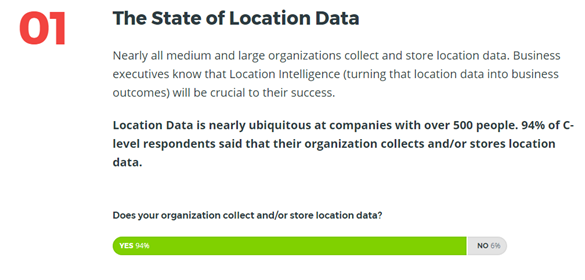
According to the study, 94 per cent of organizations knowingly collect data with a location component, and 84 per cent of C-level respondents are planning to invest in location intelligence in the next three years. Executives also believe that location intelligence data will grow in importance to their organizations over the next few years, with 68 per cent of respondents saying it is “very” or “extremely” important today and 85 per cent reporting that would be the case in the next three years.

However, the study found that only 17 per cent of analysts say their business performs spatial analysis on their location data, while 39 per cent of C-level executives believe this is the case.

In fact, the most popular software for analyzing location data was Microsoft Excel (54 per cent), indicating many companies don’t support spatial data science methods and techniques.

The survey also found that businesses collecting and analyzing location data will need to overcome some difficult challenges to successfully adopt location intelligence, particularly data quality and accessibility. Nearly half of respondents (49 per cent) said “ensuring data quality and accuracy” is a top challenge.

Analysts were reportedly less aware about the various possible methods to collect this data and related challenges, like extracting data in a useable way, and storing and securing data. However, analysts were more aware of challenges like ensuring data quality and accuracy and gathering data in real time.

Key findings from the State of Location Intelligence 2018

  • The top challenges of location intelligence data analysis were extracting, cleaning and transforming the data into a workable format (41 per cent); ensuring sufficient data is available for actionable insights (38 per cent); and making sense of the data (37 per cent).
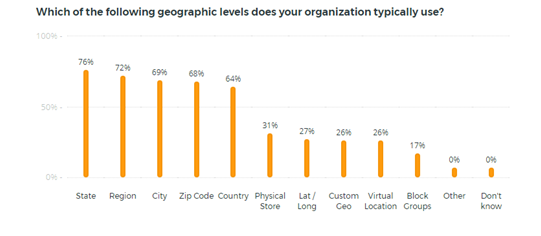
  • Only 27 per cent said they use custom geography and 17 per cent use block groups, indicating most businesses collect location intelligence data with less detail.
  • An overwhelming number of respondents that were extremely familiar with location intelligence said artificial intelligence, machine learning and the internet of things were either very important (44 percent) or extremely important (49 percent).
  • The availability of location intelligence data across departments varied widely, with 52 percent saying it was either “very accessible” or “extremely accessible,” while 30 percent reported it was “somewhat accessible” and 16 percent said it was “not at all accessible.”

In 2017, International Markets Will Bring In Half Of A Billion Dollars To Chinese Online Malls

0
Admitad

For an ordinary person and a final buyer, the global market means the opportunity to purchase what they need in any country at a targeted price. But for business, it is a new source of profit when people who buy their products and services live anywhere. Chinese business and, first of all, Chinese e-commerce is developing on a global scale. Its trading platforms are known all over the world and in fact have become common nouns: Aliexpress, GearBest, SheIN and many others.

No matter whether a business carries on trade in the country of its physical presence or in any other country in the world, the sale must be driven and the product must be promoted. We do not just think, but we strongly feel that CPA is one of the most efficient ways to promote products and increase sales.

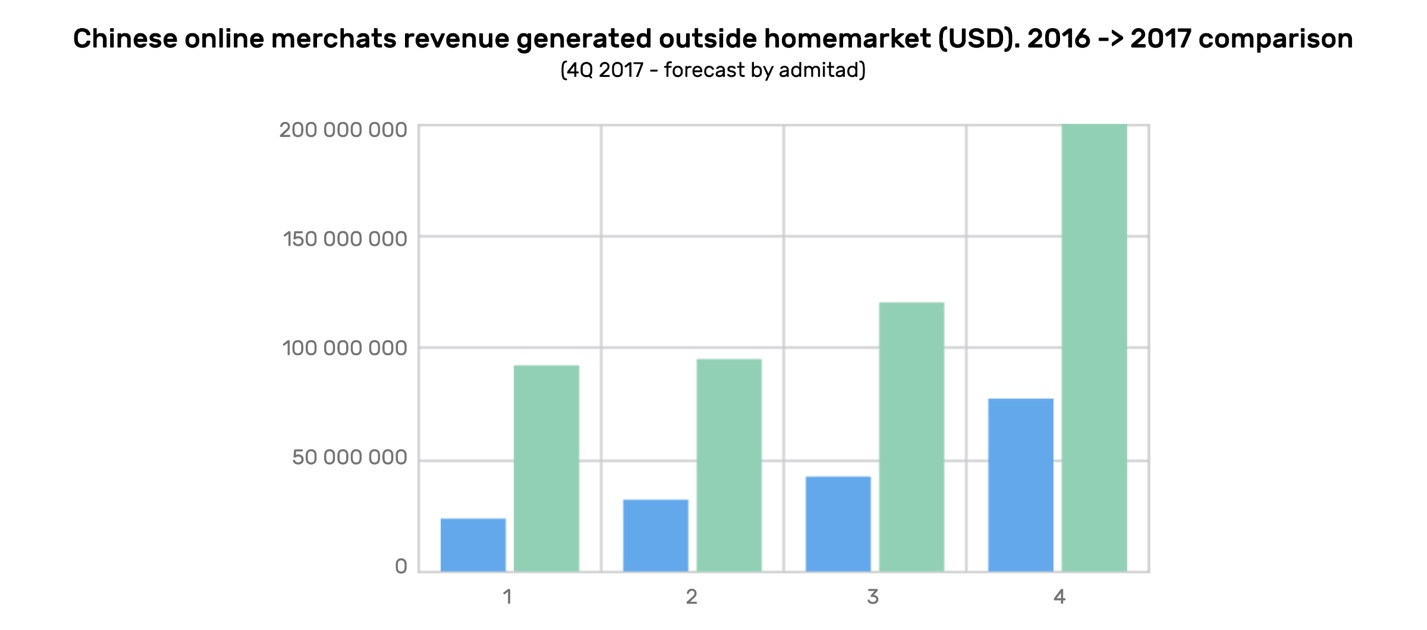
Admitad has calculated the amount attracted to Chinese business by sale in foreign markets through their affiliate program. The sum comes up to USD 310 million within nine months in 2017. This amount included more than 70 Chinese e-shops which place their offers through Admitad.

USD sales
Image Courtesy-Admitad

The most important thing is that the end of the year – a holiday season in all the countries of the Golden Billion – has not yet come, however Chinese e-commerce had already obtained one third of a billion dollars from sales with CPA in Admitad.

Alexander Bachmann
Alexander Bachmann

Alexander Bahmann, Admitad CEO, said “One of the vectors that we have chosen for Admitad’s development is really ambitious. We want our company and the instruments we have created to become a hub, an access point where Chinese e-shops could attract buyers from all over the world. What is more, with the CPA payment model which is transparent, demonstrative, scalable, projected – there are a lot of advantages. On the other hand, we see that many European and American products are in demand in China. For this purpose, we have established an office in China in order to help non-Chinese global e-commerce to enter the Chinese market and find core solvent audience there. It is important to us to combine these courses: to help business to sell, and buyers to purchase desirable products.

Indeed, the world and business are becoming global and Admitad, being a global company, does its best to cooperate in that effort.”

Infor Reports European Retail Growth

0
infor - Image
infor

Recent Successes Combine with New Technology Investment to Boost Innovation

Infor, a leading provider of business applications specialized by industry and built for the cloud, announced at ShopTalk Europe in Copenhagen, significant momentum for its European retail business. Infor’s retail applications for human capital management, converged commerce, merchandizing, demand management, enterprise asset management, supply chain management, deep analytics and risk and compliance, have contributed to 15 new or expanded relationships in 2017 throughout Europe.

Infor Retail is a suite of applications designed to support core operations, management teams, on-the-go district managers, and employees in a revolutionary new way that takes advantage of the latest consumer and business technologies: mobile, social, and cloud.

New European wins include Chausport (part of JD Sports Fashion Plc), New Look, MVideo and Direct Wines. Direct Wines, the world’s largest direct-to-home wine merchants, has implemented Infor Retail Demand Management to help it to better understand customer segments and drive more accurate forecasts and higher sales and margins.

“We have been using Infor Retail Demand Management for a while and upgraded to the latest release.  We can see additional benefits coming from our partnership with Infor Retail as we look to bring our businesses onto a single platform for campaign, offer and assortment planning. The three-year commitment we’ve just made will enable us to continue to grow as a business and exploit the platform to its full potential,” said David Ives, Group CIO of Direct Wines.

Also in Europe, Chausport has chosen Infor CloudSuite Fashion to integrate the functions of the distributor’s information system: from purchases to inventory management and logistics to the management of its stores’ supplies. The solution will also cover the delivery of products bought by the customers through Ecommerce.

Dominique Dambre
Dominique Dambre

Dominique Dambre, Project Sponsor at Chausport, said, “We aim to move from being a multi-channel player to an omni-channel distributor, which requires us to opt for a single management platform with a centralized database. Among the solutions we evaluated, Infor was able to demonstrate to us that the Infor CloudSuite Fashion solution is able to cover all the essential functions from back and front office, and to integrate them while taking into account our company’s specialities.”

With Infor, retailers are able to exploit the opportunities of huge recent investment in retail technology.  This means customers can quickly scale operations through science and predictive tools that help get ahead of consumer demands, and allow users to stay agile and fight digital disruption.

Jason Berry
Jason Berry

“We have made consistent and aggressive investments in retail and it is clearly reaping rewards. From the acquisitions of the likes of Starmount and Predictix to partnerships with Whole Foods and DSW, we have turned our industry focus full force onto retail.  The net result has been disruptive and immediate across Europe. But we are not resting on these laurels.  We are now already turning our attention to demand management and addressing the inventory issues that plague the industry, combining machine learning and artificial intelligence with a wider network perspective that will separate Infor and deliver truly next generation capabilities to today’s progressive retailer,” said Jason Berry, European vice-president, Infor Retail.

ScoreData Corporation Announces Completion of Series Seed Financing

0
ScoreData

Global Investor Group Expands Company’s Reach and Traction

ScoreData Corporation announced the completion of its Series Seed round of financing. Participating in the round were the following angel funds: 500 Startups Silicon Valley, USA, Global Reach Investments Ltd, (GRIL), Elevate Innovation Partners VC, NYC, USA, and 3one4Capital, Bengaluru, India.

ScoreData is a company that helps businesses leverage their data to dramatically improve the quality of their engagement with their customers. Their solutions can be deployed across multiple touch-points such as mobile, web, kiosk and store. ScoreData’s Scorefast™ platform enables data scientists and business managers to create the most effective run-time consumer models and scores for fraud detection, churn-management, caller-agent mapping, recommendations and cross-sell applications.

The modern Digital Contact Center is an indispensable touch-point for customer engagement in the enterprise. ScoreData’s ScoreFast™ is revolutionizing how customers interact with agents at enterprise contact centers. ScoreFast-powered applications are yielding greater revenues, significantly improved operations, and superior customer experiences at Fortune 1000 customers.

Sridhar Chityala
Sridhar Chityala

“ScoreData is reinventing how customers engage with the enterprise. The vast majority of enterprise engagement centers use script and attribute based routing. ScoreData’s ScoreFast engine not only streamlines the process of routing customers to the appropriate touchpoints in the enterprise but also simultaneously empowers agents to deliver superior customer service resulting in outstanding customer experiences. Early validation by leading firms, the extraordinary management team, and attributable business impact of the ScoreFast-powered applications at the engagement centers, were important reasons why we invested in ScoreData,” said Sridhar Chityala, Chairman, Elevate Innovation Partners VC, NYC.

Individuals who invested in the round were Ashok Krishnamurthi (angel investor), Betsy Atkins (Board Member at several US and international publicly held companies), Andrea Weiss (Board Member at several US and international publicly held companies), and Asha Jadeja Motwani (well-known Silicon Valley-based angel investor) and Shalini Prakash (via 500Startups).

TV in 2020: 50 Percent of Viewing Will be Mobile

0
ericsson

50 Percent Of All Viewing Will Be Done On A Mobile Screen, With Half Of This Done On The Smartphone Alone

Ericsson unveils the eighth edition of its annual ConsumerLab TV and Media report, which details the massive growth in TV and video viewing and the ongoing shift in the way consumers watch content.

Supported by eight years of extensive media insights, Ericsson ConsumerLab predicts that the growth of on-demand viewing will continue to soar through to 2020, making up almost half of total viewing. 50 percent of all TV and video viewing will take place on a mobile screen (tablets, smartphones and laptops), an increase of 85 percent since 2010, with the smartphone alone accounting for almost one quarter (an increase of nearly 160 percent since 2010). Additionally, VR will be on the road to becoming mainstream, with 1 in 3 consumers becoming VR users by 2020.

Anders Erlandsson
Anders Erlandsson

Anders Erlandsson, Senior Advisor, Ericsson ConsumerLab, says: “We can see that consumers are not only watching more video but also changing how and when they do so. This is also shown through the continued growth of mobile viewing, which has been a booming trend since 2010. This year also marks the first time that we have explored the level of consumer interest in VR in conjunction with media consumption, and the findings have been fascinating. VR has the potential to bring together people from all over the world and create deeper, more personalized, and more complementary media experiences. As consumer expectations for on-demand, mobile and immersive viewing continues to increase, the TV and media industry must focus on delivering highly personalized services in the very best possible quality available.”

Here are some highlights from the report and predictions that the Ericsson ConsumerLab TV and Media report makes about the video consumer to come.

The Content Discovery Crisis

According to the report, over 50 percent of Screen Shifters cannot find anything to watch on scheduled linear TV at least once a day, while slightly more than 30 percent say the same thing about VOD services. For this growing group of advanced users, the old-fashioned TV guide does not help. Their on demand experiences have set the bar too high – even though these services are themselves in need of improvement.

The total average time searching for content is also increasing; since last year, it has risen from 45 to 51 minutes per day (Figure 14). Interestingly, scheduled linear TV accounts for this entire increase, as searches on VOD services have remained constant since last year.

There are also interesting age differences both in terms of viewing and searching patterns. Millennials spend over 50 percent more time searching on VOD services than those aged 35 and up, and they spend over 80 percent more time watching VOD content.

Original Content Is In Demand 

Over 70 percent of consumers agree that content and price remain at the top of their priority list when evaluating new TV services. However, three in four Netflix subscribers say the most important factor is access to exclusive original content – a sentiment shared by less than half of all consumers.

A More Social Reality 

The future seems less lonesome for the video consumer of the future. The trend of increased solitary viewing due to the development of personal screens and on-demand viewing could be reversed thanks to the capabilities and promises of VR. Already, two in five VR users are watching TV and video together with other people on virtual sofas around the world.

The majority of current and potential VR users believe VR will be an essential component of TV and video in the future, which bodes well – a third of consumers are projected to be VR users by 2020.

Oracle NetSuite Expands Middle East Operations

0
Oracle + NetSuite

Cloud Leader Offers Support For New VAT, Adds Dedicated Sales Team And Strengthens Partner Ecosystem To Meet Growing Demand For Cloud ERP In Region

Oracle NetSuite, one of the world’s leading providers of cloud-based omnichannel commerce software suites, announced the expansion of operations in the Middle East to meet the increasing demand for cloud ERP in the market. With the support of Oracle’s global resources, NetSuite added a dedicated sales team with new leadership; new solution provider partners to strengthen its existing partner ecosystem; and increased customer adoption of NetSuite OneWorld. Additionally, NetSuite will offer support for the new Unified Value Added Tax (VAT) Agreement, set to take effect for Saudi Arabia and the United Arab Emirates (UAE) next year with more Gulf Cooperation Council (GCC) countries expected to follow.

Mark Woodhams
Mark Woodhams

“Local and global companies with regional headquarters in the area are already reaping the benefits of cloud ERP,” said Mark Woodhams, Oracle NetSuite Vice President, EMEA. “With today’s announcement, we’re signalling our ongoing commitment to the region and the success of our customers and partners here.”

NetSuite to Provide VAT Support, Enabling Businesses to Comply with New Tax Rules

With the Unified Value Added Tax (VAT) Agreement signed by the Gulf Cooperation Council (GCC) countries set to go into effect in the UAE and Saudi Arabia January 1, 2018, and with other countries in the region expected to follow, NetSuite will build support for the new changes directly into the system. The VAT will impact every part of the business, including cash flow, pricing of products and services, financial reporting, tax accounting and reporting and, of course, technology. NetSuite already has a highly flexible in-house tax engine that supports over 110 countries for VAT, both rules and reporting, creating a solid foundation on which to build out functionality specific to the GCC VAT. Tax codes for the standard rate, zero rates, reverse charges, as well as VAT on imports, will all be part of NetSuite’s International Tax Reporting SuiteApp. Existing customers will enjoy full business systems compliance with new changes in the value-added tax (VAT) rate without having to lift a finger. NetSuite’s cloud computing model and the flexible, powerful NetSuite Tax Engine inside NetSuite’s financial software ensure that NetSuite customers immediately benefit from this update.

NetSuite Adds Direct Sales Team and Leadership

NetSuite is extending its focus on the Middle East and the surrounding region with a dedicated sales team, pre-sales, country manager, marketing and other support functions, all operating out of a new Dubai office, which will be the center of East, Central EuropeMiddle East and Africa (ECEMEA) operations. The dedicated sales team has been established and trained to address the UAE and Saudi Arabian markets. NetSuite will also continue to recruit local implementation partners with experience in ERP to support continued growth in the region.

Khaled Ismail
Khaled Ismail

The dedicated sales office will be led by Khaled Ismail, Vice President, Oracle Digital Application Business, ECEMEA, who will manage sales and marketing strategy for the region. In this role, Ismail will manage an organization of 250 sales professionals with almost 20 managers and directors. He is also responsible for all the supporting functions for ECEMEA from pre-sales, sales development, marketing and customer success.

“The UAE has been a strong growth engine for NetSuite in recent years. Now, with the additional global resources of Oracle, we intend to continue that growth and expand not only our sales operations and partnership, but build out additional functionality specific to the region,” said Ismail

NetSuite Strengthens Partner Presence in the Region

NetSuite already has a strong partner presence in the region with 16 partners serving customers in the region. In 2017 alone, NetSuite added the following seven businesses to its Solution Provider Program: Azdan Business Analytics; Trinamix Business Solutions; Wolfrayet Business Consulting; Masterkey Software; Foresee Solutions; UnitedofOQ; and Digital Trends. As part of its expansion in the region, NetSuite will actively be recruiting qualified partners to continue to provide local businesses with a leading cloud ERP solution.

NetSuite OneWorld, a Game-Changer for Middle Eastern Businesses

Businesses seeking to gain efficiency, grow revenues, expand globally and enter new markets often find themselves held back by software systems siloed by department, geography or legal entity structures, leaving them unable to deliver an optimal customer experience and gain insights into their operations. The agility, flexibility and scalability that NetSuite OneWorld provides is difficult to achieve by businesses running legacy on-premise software. Meanwhile, other available cloud financial software solutions only offer basic product functionality that cannot scale and support changing business needs, growth and international expansion.

NetSuite OneWorld provides a unified and cloud-based suite of software that is flexible enough to meet the needs of diverse business models, legal structures and geographies. NetSuite OneWorld supports 190 currencies, more than 20 languages, automated tax calculation and reporting in more than 100 countries, and customer transactions in more than 200 countries.

Further, to help today’s B2B and B2C businesses with omnichannel commerce, NetSuite OneWorld delivers commerce-ready capabilities that can help both B2B and B2C commerce businesses to move from siloed online, in-store and phone consumer shopping channels to an integrated commerce solution, connecting ecommerce and in-store POS to order management, inventory, merchandising, marketing, financials and customer service, while delivering a seamless brand experience and exceeding customer expectations.


Creating Individualized Customer Experiences: Top Insights from The Personalization Summit 2017

1
Customer Experiences
Creating Individualized Customer Experiences: Top Insights from The Personalization Summit 2017

Harte HanksI recently attended my first Personalization Summit – an event dedicated to helping digital marketers deliver highly relevant, individualized experiences to their audiences across channels. It’s no secret that we’re in the Age of the Customer – and personalization is especially important and strategic to our organization because we feel that our digital presence should provide the same warm experience that occurs when two humans are conversing. I was hoping to get a little bit of inspiration in addition to a whole lot of implementation strategies out of the annual event, hosted by Evergage.

Boy, was I impressed. The Summit had all the polish of events hosted by industry giants like Oracle and Marketo, but with the intimacy to actually feel like your questions are being addressed and your feedback has a direct impact on the product roadmap.

The other thing that struck me was how passionate everyone was about personalization for the end consumer – attendees and presenters alike. There is a lot of talk in the press and by personalization vendors about how today’s marketer needs to have this technology or that tool, and this process or that capability to be considered “best in class.” Karl Wirth, Evergage’s CEO, reminded everyone during his morning keynote that the idea of personalization in marketing has been around for almost 25 years, since the release of The One to One Future by Peppers and Rogers in 1993. The most important thing is to start with a vision and to be committed to creating experiences that help and delight customers.

With that idea in mind, it was interesting to hear Forrester Analyst Brendan Witcher talk about individualization as opposed to personalization. He describes personalization as the perception of the customer and not something the marketer can control. However, by thinking of it as “individualization” (treating each person as an individual and focusing on delivering relevant experiences to each person), the goal becomes much more achievable through the use of personalization tools and machine learning – which uses algorithms and predictive analytics to determine and deliver the most relevant content and experiences to each and every visitor. He also challenged all of us in the crowd with the notion that the expectations of our customers are constantly changing and that today’s best practice is tomorrow’s old way. To me, this makes it even more critical that we keep on top of trends in the marketplace and ensure we can empathize with our customers to deliver an exceptional experience.

While all of the keynote speakers did a nice job of keeping the customer at the center of the personalization discussion, it was the “fireside chats” from real-world users that made me realize just how powerful personalization technology can be in the right hands. From microelectronics to insurance to auctions and more, machine-learning personalization is being used to not only drive highly relevant individualized experiences that feel personal to the consumer, but also to bring real value to each of the businesses through increased revenues and customer lifetime value. I came away with many ideas on how I could leverage some of the approaches to improve our digital presence at Harte Hanks.

The day would not have been complete without a few breakouts to help clients like me learn more about how to leverage our personalization investments. The breakouts covered a wide variety of topics from planning sessions to technical ones around how Evergage computes correlation models for recommendations. I walked out of each session knowing more about how to make my marketing better than I did before I walked in, even if I still don’t fully understand the math behind collaborative filtering!

It’s clear the technology has finally caught up to the vision Peppers and Rogers painted almost a quarter century ago, and machine learning is driving that evolution and propelling us forward. I am already looking forward to next year’s Summit and to seeing what Evergage will cook up.

TechBytes with Steve Murphy, CIO, 3Cinteractive

0
Steve Murphy 3C interactive

Steve Murphy
CIO, 3Cinteractive

Modern marketers have shown an appetite for leveraging mobile marketing platforms to drive interactions with customers. These interactions are based on the analysis of consumers’ preferences on how they would like to communicate with brands. Chatbots and intelligent assistants have created a flourishing opportunity for marketers to influence consumer loyalty and improve experience across mobile marketing campaigns. To understand how brands can leverage mobile marketing to better customer acquisition and brand advocacy through mobile and social channels, we spoke to Steve Murphy, CIO of 3Cinteractive.

Html code here! Replace this with any non empty text and that's it.

MTS:  Tell us about your role at 3Cinteractive and how you got here?
Steve Murphy: 
I lead 3C’s global technology organization, overseeing the existing platform and systems as well as championing the development of new, innovative products that support mobile marketing programs for the company’s clients. I am an experienced technology and business executive with more than 20 years’ experience profitably growing businesses by developing products for online, mobile and telecom companies—in both direct-to-consumer and business-to-business sectors. Over the years I’ve been fortunate to work on some innovative teams building great products which have resulted in 19 patents.

MTS:  How do 3C and its clients use customer data to benefit the consumer in their journey with the brand?
Steve: The more we engage with customers digitally, the more data we can gather from those interactions and, with the right analytics tools, we can gather useful insights to further our relationship with those customers. Whether targeting with the right offer to delight or using context to provide exceptional service, we operate in the age of data and can harness it to our advantage.

The key to data capture is not only the content but the context. When we engage our customers via mobile, we can bring added context to the conversation. The fact that they’re choosing to communicate with us on a mobile device is itself a contextual element.

Take location as an example: A change in location can be very powerful. If they’re moving at 60 miles per hour, it may not be the best time to suggest a sale on shoes at the store that’s now a half a mile behind them. If they’re on vacation visiting their hometown, they are probably in a different frame of mind than if they are in a strange city on business. It’s all context that can make a single interaction a moment of truth that defines your customer’s relationship with your brand.

MTS: How are mobile messaging platforms evolving with the changing dynamic of online engagement with customers?
Steve: Recently, Forrester Research indicated that roughly six billion text messages are delivered every day in the US, resulting in about 8.6 trillion text messages in a single year. However, the native text messaging experience is currently limited to plain text and clunky interactivity at best. The changing dynamic of online engagement has created consumers that now expect a rich, dynamic brand experience with every single interaction, and the native text messaging experience has been running on technology that is due for an upgrade.

Although mobile carriers have upgraded their networks to keep up with demand for data and smartphones, the SMS technology infrastructure also needs to evolve to enable new, rich functionality in the messaging experience. As a result, mobile players have begun to adopt a new technology called Rich Communication Services (RCS), which leverages data connectivity to deliver next-generation messaging features like location sharing, high resolution image and video sharing, read receipts, and rich cards — all within the native messaging application on the device. RCS is essentially the evolution of SMS and MMS to a more dynamic messaging experience. In many cases, RCS capabilities extend beyond messaging. The technology could integrate with the device’s address book, to see who else in a person’s network is utilizing RCS, and enable users to share media and location even during a telephone conversation.

MTS: How does the Switchblade platform enable marketers to leverage and maximize the ROI from their CRM?
Steve: The key to our platform is its flexibility and scale. We’ve found that many brands have customer data in many different places and in many different formats—making it difficult to create true 1:1 to engagements. Our platform is able to ingest these disparate data streams and leverage them to develop customer touch points that are real-time and relevant to the end user. Additionally, we do this at scale processing over 1 billion mobile events daily for some the world’s largest brands.

MTS: How can brands leverage mobile marketing to drive customer acquisition and brand advocacy through their social channels?
Steve: According to Nielsen, 83% of consumers say they trust friend and family recommendations more than any other form of advertising. When it comes to promoting products and services, there’s no source quite like social media and word-of-mouth marketing to get the word out.

At 3C, we see several brands who are looking to drive customer acquisition and brand loyalty by integrating their mobile marketing efforts with their existing social media strategy. By delivering a seamless mobile marketing experience, and then enabling satisfied customers to easily share their positive brand experiences with friends and family on their social channels, brands are seeing supplementary program results like increased app downloads, loyalty program sign-ups, and increases in social followers, among others.

MTS: Thanks for chatting with us, Steve.
Stay tuned for more insights on marketing technologies. To participate in our Tech Bytes program, email us at news@martechseries-67ee47.ingress-bonde.easywp.com

Interview with Bonnie Crater, President and CEO, Full Circle Insights

3
Bonnie Crater
Interview with Bonnie Crater, President and CEO, Full Circle Insights

Bonnie Crater
President and CEO, Full Circle Insights

[easy-profiles profile_twitter=”https://twitter.com/bonniecrater” profile_linkedin=”https://www.linkedin.com/in/bonniecrater/”]
[mnky_testimonial_slider][mnky_testimonial name=”” author_dec=”” position=”Designer”]“It’s very important to focus on acquiring the most complete and accurate marketing data you can. If the data is incomplete or inaccurate, neither the human nor the machine will draw the correct conclusion.”[/mnky_testimonial][/mnky_testimonial_slider]

On Marketing Technology

MTS: Tell us about your role and how you got here. What inspired you to be a part of a MarTech innovation company?
As a 5-time VP of Marketing in Silicon Valley, I always wanted to measure my marketing programs and their impact on revenue. I figured that if I could get great, detailed information on marketing performance I could be a better VP of Marketing. The trouble was I couldn’t get the data I wanted.  When I got a call from a former colleague, Roan Bear, and she told me that she had a solution to this issue, I jumped on the chance to start Full Circle Insights.

MTS: Given the changing dynamic of online engagement with B2B customers, how do you see campaign attribution and funnel metrics transforming the Lead to Revenue management?
Campaign attribution and funnel metrics are used to improve our ability and effectiveness in Lead to Revenue Management. Funnel metrics can be diagnostic of problems and opportunities in the Lead to Revenue cycle and campaign attribution can help us figure out what campaign mix is optimal to drive more revenue. The technology in our products connects dots in the data so we get a full picture of what actions drive what revenue outcomes, whether the outcome is between the funnel stages or the actual closed, won deal.

MTS: How does Full Circle Matchmaker enable the sales teams to connect individual leads to the right account for account-based everything?)
Being domain experts in B2B sales, we know that it’s important for sales teams (and marketing) to engage leads with the context of what accounts they represent. Matchmaker uses smart logic, fuzzy matching, and a customizable rules engine to match leads to the right accounts in your Salesforce database. We built Matchmaker knowing that salespeople take too much time manually matching leads within Salesforce. So, we tailored the product to address their problem, with the capability to run it continuously in the background as well as one-off in bulk batches, customize the rules to tweak the matching logic for your needs, and route or assign the leads to the right sales reps who own the specific account.

MTS: Would you tell us about the unique features of Customizable Attribution Models used for B2B marketing mix optimization?
Our Campaign Attribution product (also made available as part of our flagship Response Management product), is unique for a few key reasons. Firstly, the attribution runs natively inside Salesforce, enabling a marketing person to capture the impact of every campaign in Salesforce to revenue from each deal. Having this in Salesforce makes the numbers match and enable cross-organizational trust in the attribution figures. Second, with the application native in Salesforce, a marketer can run granular reports that slice and dice the data into any segmentation that exists in the fields they have already in Salesforce.

Finally, we built Campaign Attribution to support highly customizable models. Out-of-the-box, you can run the standard single-touch models and multi-touch models. Our product goes a couple steps further with multi-touch: you can self-customize the weighting as well as introduce variables into the weighting outside of just touch. For example, you might track the type of engagement or touch, such as online vs. offline, duration of engagement, etc. Our customizable weighting configuration allows you to customize attribution weightings along those variables as well.

MTS: How do you see predictive analytics driving the “Quick Dash” for Response Management? Is it possible for account-based marketers to customize their funnels with an accelerated deal velocity?
Quick Dash is a set of out-of-the-box dashboards that are designed to be action-driven. Too often we don’t have enough insights, we just have data. Our flagship product Response Management is meant to address the need for marketers to get granular with data to gain context and drive actionable insights. Most businesses require methods of measuring a lead and account funnel that automates the tracking of progression down the funnel and matches how they define their funnel stages. That is why easy customizability of funnels inside of Response Management turbocharges the marketing and sales data being created inside Salesforce and enables marketers to make decisions that accelerate deals, improve conversion rates, and drive higher revenue.

MTS: What startups are you watching/keen on right now?
Docusign, Slack, Splitwise

MTS: What tools does your marketing stack consist of in 2017?
Salesforce, Pardot, Full Circle Insights, WordPress, HootSuite, Google Analytics, AdRoll, and Google Adwords

MTS: How do you prepare for an AI-centric world as a business leader in MarTech?
It’s very important to focus on acquiring the most complete and accurate marketing data you can.  After all, if it’s a human interpreting a chart or an AI algorithm drawing a conclusion around a large data set, if the data is incomplete or inaccurate, neither the human nor the machine will draw the correct conclusion.

This Is How I Work

MTS: One word that best describes how you work.
Relaxed (mostly)

MTS: What apps/software/tools can’t you live without?
Docusign is my favorite (of course I can’t live without email, Powerpoint, Excel or Chrome)

MTS: What’s your smartest work-related shortcut or productivity hack?
Get exercise.  Exercise has been proven to make the brain work better.

MTS: What are you currently reading? (What do you read, and how do you consume information?)
Sapiens, The Washington Post, CNN and Fox News.

MTS: What’s the best advice you’ve ever received?
From Gary Kennedy, former VP of Sales at Oracle in the 80s.  Follow these 3 work rules in a fast growing company:

  1. Be responsive — respond to every email in 24 hours (now the time is shorter);
  2. Do what you say you’re going to do — we’re all depending on each other to deliver
  3. At the end of the day, when you leave the office, be sure you’ve done the most important things that day

MTS: Something you do better than others – the secret of your success?
Taking a very complex subject and making it easy for anyone to understand

MTS: Tag the one person in the industry whose answers to these questions you would like to read:
Marc Benioff

MTS: Thank you Bonnie! That was fun and hope to see you back on MarTech Series soon.

[vc_tta_tabs][vc_tta_section title=”About Bonnie” tab_id=”1501785390157-b58e162d-0ae25a4b-c27aca64-108e7775-d6ee”]

Prior to joining Full Circle Insights, Bonnie Crater was a five-time vice president of marketing and executive at many software companies in Silicon Valley. Bonnie held vice president and senior vice president roles at Genesys, Netscape, Network Computer Inc., salesforce.com, Stratify, Realization, and VoiceObjects (now Voxeo). A ten-year veteran of Oracle Corporation and its various subsidiaries, Bonnie was vice president, Compaq Products Division and vice president, Workgroup Products Division. In 2013, Bonnie was named one of the “100 Most Influential Women” by the Silicon Valley Business Journal, in 2015 the Sales Lead Management Association named her one of the “20 Women to Watch” and in 2016 Diversity Journal honored her as one of the “Women Worth Watching.” Bonnie holds a B.A. in biology from Princeton University.

[/vc_tta_section][vc_tta_section title=”About Full Circle Insights” tab_id=”1501785390320-2d44fa50-740c5a4b-c27aca64-108e7775-d6ee”]

Full Circle Insights products give marketers full response lifecycle management solutions, ensure every deal is attributed to the right campaign so you can get accurate ROI, and answers all your marketing questions in one place. Our products are built 100% on the Salesforce1 Platform and are compatible with the leading marketing automation solutions. All your marketing data is in one place and so are the answers.

[/vc_tta_section][/vc_tta_tabs]
[mnky_heading title=”MarTech Interview Series” link=”url:https%3A%2F%2Fmartechseries-67ee47.ingress-bonde.easywp.com%2Fcategory%2Fmts-insights%2Finterviews%2F|||”]

The MTS Martech Interview Series is a fun Q&A style chat which we really enjoy doing with martech leaders. With inspiration from Lifehacker’s How I work interviews, the MarTech Series Interviews follows a two part format On Marketing Technology, and This Is How I Work. The format was chosen because when we decided to start an interview series with the biggest and brightest minds in martech – we wanted to get insight into two areas … one – their ideas on marketing tech and two – insights into the philosophy and methods that make these leaders tick.

SEO Company webSURGE Digital Marketing Receives IMPACT Award for B2B App Development

0
webSurge

webSURGE Digital Marketing, a company that specializes in SEO, received the prestigious IMPACT Award for App Development B2B in recognition of its App Development for CooperVision. The Internet Marketing Association’s annual awards celebration was held on Sept. 29, 2017, at the Enclave in Las Vegas.

What is the Impact Award?

The mission of IMA, a global organization of professional partners, is to create a database of proven internet marketing strategies that provide a foundation of success for those in sales, marketing, business ownership, programming, and creative development. IMA created the IMPACT Award to reward those whose innovation, effort, or creativity made a dynamic improvement for their clients in their respective industry.

Sinan Kanatsiz
Sinan Kanatsiz

“The IMPACT Awards exemplify best-in-class creativity, expertise, and results achieved by the top practitioners of internet marketing across every business segment as well as non-profits, government, and education,” said IMA Chairman Sinan Kanatsiz. “IMA is a unique resource for top professionals. Our fundamental goal is to build the leadership that will continue to drive this dynamic industry.”

SEO Company Develops “Road to Adoption” App

webSURGE developed a sales analytics application for its client CooperVision. The app will be rolled out to various countries around the world to assist with CooperVision’s marketing and sales integration efforts.

The primary function of the app is to track the number of sales during the first 180 days following the release of a new product’s release to customers. If enough sales have been made, the product is considered adopted. If not, users are easily able to pinpoint and correct the problem. This sleek data visualization application is a valuable asset to CooperVision’s sales team in increasing account penetration and improving efforts to be more effective and efficient in increasing sales.