

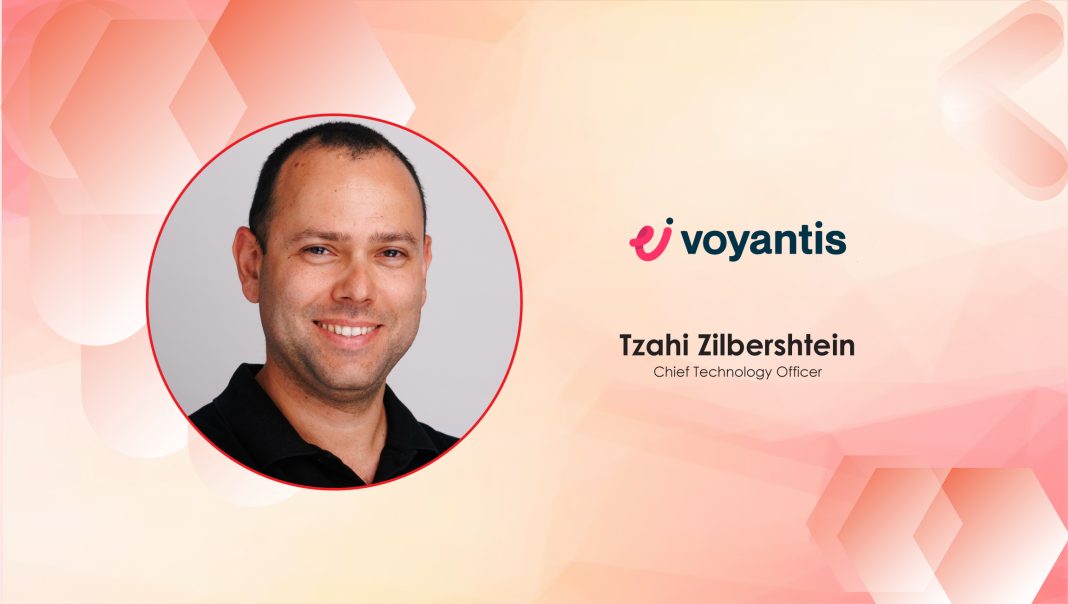
Tzahi Zilbershtein, Chief Technology Officer at Voyantis chats about what current adtech trends are influencing the ad buyer-seller relationship in this MarTech Series interview:
__________
Tzahi, tell us about yourself and your time in martech…
I’ve been a lifelong tech enthusiast. When I was 5 years old, my father purchased our first PC and a year later I had learned to code in QBasic – a passion that shaped my entire career. I’ve been tackling complex problems with technology personally and professionally ever since.
Joining Google in 2019 was my entry into the martech space. While there, I led solution engineering for the Ads business in EMEA, building custom technical solutions for the platform’s largest clients. My team helped advertisers maximize ROI by leveraging their existing first-party data to optimize campaigns in ways the platform couldn’t do natively. This included everything from being the first team to integrate CRM data into Google Ads to automating industry-specific bidding strategies.
What stood out across all those projects was seeing that predictive growth drove concrete business outcomes – whether for a global airline, a hospitality company with thousands of properties, or a fast-growing SaaS brand. But replicating that success required constant monitoring and recalibration because customer behavior shifts, ad platforms update their algorithms, and business priorities evolve. Without dedicated technical resources, it’s really challenging for brands to sustain on their own.
We’d love to hear about your new role at Voyantis.
I just joined Voyantis as Chief Technology Officer to scale and expand their AI-powered predictive growth platform. The company has spent over five years solving the exact challenge I was tackling at Google: helping brands predict, identify, and acquire their highest-value customers before they convert, not after.
What drew me to the role was the opportunity to make these capabilities accessible beyond advertisers with massive tech teams. I’m focused on using AI to automate what used to require those dedicated technical resources. We’re building systems that understand a brand’s business context, customer data, and ad performance immediately. Then, we generate predictive signals that guide platforms like Meta and Google toward high-value customers at efficient prices, automatically adapting as the ecosystem changes.
How is the online ads space evolving today? What is the top trend defining the market and ad buyer-seller relationship?
The online ads space is undergoing a major shift toward AI-driven automation and signal quality. Ad platforms are increasingly taking over the execution layer, from creative optimization to audience targeting, leaving marketers with a single, but critical, responsibility: defining and feeding the right value signals back into the network.
The top trend shaping the market and the buyer–seller relationship today is the move from manual campaign management to value-driven automation. What sets growth marketers apart today is their ability to teach the algorithms what “success” really means for their business.
Growth teams that rely on easy-to-measure conversions like installs or sign-ups are effectively training platforms to chase the wrong users – ones who may never become profitable or loyal. To close that gap, they need to translate deep customer insights and LTV predictions into smarter signals that guide the algorithms toward long-term value, not short-term wins.
Can you talk about the state of adtech today? What will dominate the adtech ecosystem in the years to come?
Adtech today is defined by a massive shift toward AI-driven automation, a world where tactical decisions once made by marketers are increasingly handled by intelligent systems. The next evolution of this trend is agentic AI, where autonomous marketing agents will be capable of operating, learning, and optimizing across platforms with minimal human input.
Instead of spending hours making manual optimizations in campaign dashboards, marketers will be able to focus on the higher-level decisions and creative ideation that actually sets their brand apart from cookie cutter AI content.
In the years to come, the adtech ecosystem will be dominated by these self-operating AI agents, systems that can plan, execute, and adapt campaigns in real time. But for them to be effective, they need reliable data, clear marketing objectives, and an orchestrating layer that connects all moving parts. Marketers who can effectively tap into their data and use that orchestration layer to support campaign objectives will elevate the marketing function as a growth engine, not just a cost center.
Marketing Technology News: Martech Interview with Aquibur Rahman, CEO of Mailmodo
What tips would you share with modern advertisers and marketers when it comes to the matter of optimizing ad budgets?
First, tap into the data you already have to get a clear picture of your best customers. For example, app marketers can map answers from onboarding questionnaires to known high-value behaviors. If your best customers consistently answer a certain way, that’s data you can and should use to influence campaign optimization. You likely already have the data to predict which customers will pay off long-term, but you aren’t looking in the right places.
Second, stop optimizing for proxy metrics alone. Sometimes, you want to bring in customers that will generate more meaningful revenue over time. Other times, you want to bring in customers that will help you scale at the best price. The only way to do this is by looking at individual user value rather than relying on blanket conversion events to guide how you allocate ad spend.
My last piece of advice is one that I think most teams miss. Prioritize adaptive infrastructure that monitors for data drift and keeps models aligned with how platforms actually optimize. To work inside ad platforms, predictions need to be engineered into signals for shifting APIs, continuously retrained, and validated against campaign goals. Teams that underestimate this “last mile” work often see models stall out before they deliver impact.
A few thoughts on your near future plans for Voyantis?
In the near future, my main focus at Voyantis is accelerating time to value. Many companies spend years trying to build predictive growth capabilities in-house. We want brands to go from onboarding to seeing meaningful impact in weeks.
To do that, we’re doubling down on our agentic AI foundation. Our goal is to create self-operating AI agents that can continuously learn, adapt, and optimize toward each brand’s unique definition of value. Since we already work across diverse industries and channels, every insight we gain from one customer strengthens our overall intelligence layer, allowing our AI agents to transfer learnings and deliver faster, smarter results to others.
We’re scaling a cross-channel learning ecosystem where agentic AI understands what drives long-term growth for each business, and acts on it autonomously.
Marketing Technology News: Beyond the Trend: How CMOs Are Using Cultural Intelligence to Lead Culture, Not Chase It

Voyantis is the leading predictive growth platform that transforms how marketing teams identify, acquire, and grow their most valuable customers. Our agentic AI empowers growth teams to transform first-party data into predictive signals that train ad platforms to acquire high-value customers, and optimize retention and upsell campaigns. By predicting customer value within hours of first engagement, Voyantis helps brands maximize revenue across the full customer journey.
About Tzahi Zilbershtein:
Tzahi Zilbershtein is CTO at Voyantis. He brings 20+ years of experience leading engineering teams to solve business problems and drive AI innovation from research to production. Previously, Tzahi led solution engineering for Google Ads in the EMEA region, delivering custom technical solutions for the platform’s largest advertisers. During his tenure, he pioneered the integration of first-party data into Google Ads to optimize marketing budgets, establishing the foundation for predictive LTV optimization that major brands rely on today. Before Google, Tzahi served as VP of R&D at InSoundz. He holds five patents, including two in Google’s adtech stack.