

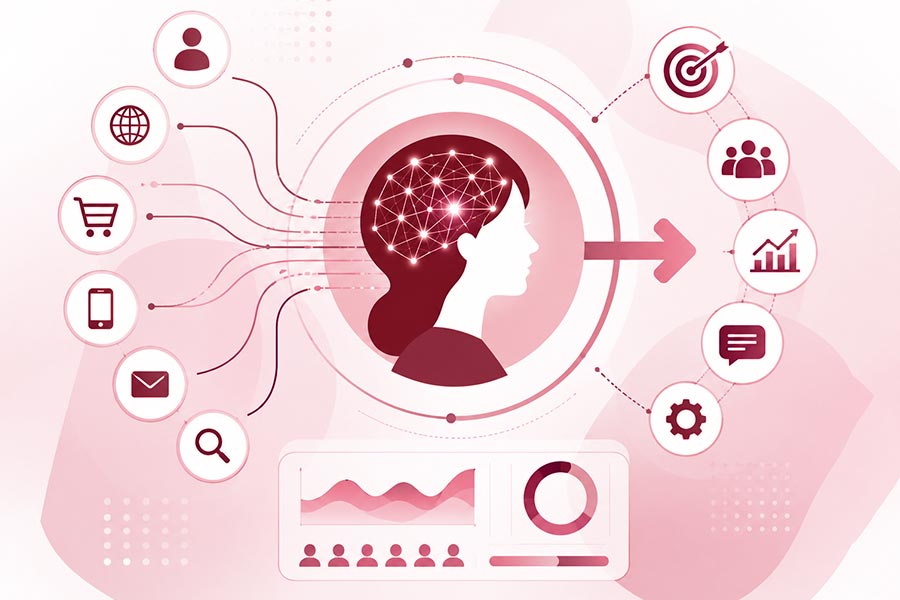
We have entered a new age of marketing where knowing what the customer will do next is more valuable than knowing who they are. Traditional demographic targeting, based on age, gender, income, or geography, helped brands identify broad audiences but often failed to capture what drove them to buy. With the rise of digital interactions and more complex customer journeys, marketers realized that behavior is much more valuable than static customer profiles. This evolution has taken marketing from targeting demographics to behavioral intelligence, where every click, search, interaction, and engagement adds to a richer understanding of customer intent.
This shift has been accelerated by the fast-paced development of artificial intelligence, which has made intent prediction more accurate and useful than ever before. Modern AI models can analyze millions of customer interactions across websites, mobile apps, emails, social platforms and ecommerce channels to identify patterns that indicate purchase readiness. AI lets marketers identify buying signals far earlier, so brands can reach out to prospects at the perfect moment, rather than waiting for customers to purchase or pose a question. This prediction capability is emerging as one of the most powerful competitive advantages in digital marketing.
Meanwhile, privacy laws and the decline of third-party cookies are changing the ways organizations collect and use customer data. “Gone are the days of businesses relying on external tracking mechanisms and anonymous audience data. Instead, the foundation of modern customer intelligence has become first-party customer signals such as website activity, past purchases, CRM activity, loyalty programs, customer support conversations, and email engagement. Trusted data sources provide richer, more reliable insights and help organizations stay compliant with evolving privacy standards and build customer trust.
With evolving customer expectations, intent is becoming the center of marketing strategy. Today’s consumers expect brands to understand their needs, offer relevant recommendations and personalized experiences without extensive searching or repetitive interactions. Generic campaigns aimed at large audience segments are quickly losing their effectiveness. Instead, organizations are investing in intelligent marketing capabilities that can recognize changing customer needs and adapt engagement strategies in real time. Customer intent is the bridge between customer behavior and actionable business.
MarTech platforms are helping to turn huge amounts of behavioral data into actionable intelligence. Today’s marketing technologies combine customer data, predictive analytics, artificial intelligence and automation into one ecosystem that can constantly track the customer journey. MarTech platforms have evolved from simply measuring the performance of a campaign after it is executed to now enabling organizations to anticipate customer behavior, optimize engagement strategies, and personalize interactions before purchase decisions are made.
This is a huge step from reacting to customer engagement to proactive marketing.” Instead of waiting for customers to show interest, organizations can proactively identify opportunities as they emerge, recommend relevant products, personalize messages, and orchestrate customer experiences across multiple touchpoints. Predictive engagement helps to increase conversion rates and helps to build a long-term relationship with customers through increased relevance across the buying journey.
AI-powered customer intent modeling is becoming the next evolution of intelligent customer engagement. Organizations can use behavioral intelligence, first-party data, predictive analytics, and machine learning to better understand customer motivations, predict future actions, and deliver personalized experiences at scale. As digital ecosystems grow, intent modeling will become a core capability, allowing marketers to go beyond audience targeting and towards increasingly sophisticated customer intelligence.
Introduction to Customer Intent Modeling
Customer intent modeling is the study of customer behaviors, interactions, contextual information, and historical data to predict future purchasing intentions and engagement preferences. Intent modeling is more than just figuring out who the customer is, but also understanding why they behave the way they do and what action they are likely to take next.
Behavioral intelligence is key to customer intent modeling. Every digital touchpoint, be it reading an article, comparing products, abandoning a shopping cart, downloading a white paper or repeatedly visiting pricing pages, provides valuable signals about customer interest and purchase readiness. Each of these is small in itself, but put together, they show meaningful patterns which AI can interpret with astonishing accuracy.
AI translates these customer signals into actionable business insights by continuously assessing behavioral patterns, contextual data, transaction history, engagement frequency, and customer preferences. AI models create dynamic intent scores to help marketers identify prospects with the highest likelihood to convert, customers at risk to churn, and opportunities for personalized engagement. This allows organizations to allocate marketing resources more effectively, while improving customer experiences at every stage of the buying journey.
-
From Audience Segmentation to Intent Intelligence
Audience segmentation is a traditional marketing technique where customers are grouped based on similar characteristics. Demographic segmentation grouped consumers by age, gender, education, location, and income. Business-to-business marketing uses firmographic segmentation, which is based on industry, company size, and revenue. These techniques allowed marketers to develop targeted campaigns, but often provided little insight into what motivates individual customers.
A key advance was the introduction of behavioral segmentation, which incorporated customer behavior along with static characteristics. The history of website visits, purchase frequency, product preferences, content consumption, and engagement allowed marketers to develop more personalized campaigns that mirrored actual customer behavior.
Now, this evolution continues with the advent of AI-powered predictive intent modeling. AI predicts what customers are likely to do next, rather than describing what they have done. Machine learning algorithms can analyze customer behavior continually to identify new patterns, changes in purchasing intent, and update predictions in real time. Intent intelligence transforms marketing from a retrospective discipline into one that can help organizations make predictive decisions about what customers will want, even before they express explicit buying signals.
-
Evolution from Audience Segmentation to Intent Intelligence
Several technological and market developments are driving the adoption of customer intent modeling among modern enterprises.
Digital customer interactions have exploded, dramatically expanding the amount of behavioral data available to marketers. Customers now engage with brands via websites, mobile apps, social media, ecommerce marketplaces, customer communities, streaming services, and conversational AI. Each interaction is a valuable insight that helps organizations better understand customer intent.
Customer expectations for personalized experiences are rising. Consumers are expecting more and more from businesses: to recognize their preferences, recommend products that are relevant, remember past interactions and provide seamless experiences across channels. Intelligent intent modeling is necessary to keep customers engaged, since generic campaigns and mass communications are no longer meeting their demands.
In many industries, purchasing cycles have also been compressed. A lot of research goes on online before customers interact directly with brands, leaving organizations with little chance to sway buying choices. By modeling intent, marketers can identify purchase readiness earlier and engage prospects before competitors.
First-party customer intelligence is further reinforced by privacy regulations. With third-party tracking becoming less reliable, organizations need to unlock the value of customer relationships by leveraging consent-based behavioral data collected directly through owned digital channels. Intent modelling enables responsible data governance and turns first-party data into a sustainable competitive advantage.
-
From Reactive Marketing to Predictive Customer Engagement
Traditional marketing strategies often rested on the idea that organizations would respond to customers’ actions. Businesses offered relevant offers after customers requested information, filled out forms, visited stores, or started making purchases. This reactive approach worked in some cases, but all too often it missed opportunities to influence customer decisions earlier in the buying process.
The key change in the relationship is predictive customer engagement. Artificial intelligence constantly monitors customer behavior, picks up new buying signals, and predicts future behavior before the customer even knows what they want. Therefore, marketing teams can proactively engage customers via personalized recommendations, educational content, tailored promotions, and context-aware communications.
As companies move away from broad audience characteristics to customer readiness, intent-first campaign planning is picking up speed. Instead of running campaigns targeted at market segments, marketers target customers with the strongest intent signals, which make campaigns more relevant and marketing efforts more efficient.
AI also makes it easier to engage proactively throughout the customer journey. Intelligent systems continuously track behavioral changes, optimize personalization approaches, suggest next best actions, and orchestrate omnichannel experiences that progress with the customer. Whether it’s product discovery, nurturing prospects, reducing churn or increasing customer lifetime value, predictive engagement enables organizations to build stronger relationships with timely and relevant interactions.
As MarTech platforms increasingly bake in artificial intelligence, predictive analytics and first-party customer intelligence, customer intent modelling will be one of the defining capabilities of modern marketing. In a digital economy that is becoming increasingly data-driven, organizations that can anticipate customer decisions rather than merely react to them will enjoy higher conversion rates, greater customer loyalty, more efficient marketing, and a sustainable competitive advantage.
Core Components of Intent Modeling
Customer intent modeling employs a combination of advanced data collection, artificial intelligence, predictive analytics, and real-time decision-making to accurately understand what the customer is likely to do next. Today’s MarTech platforms no longer wait for a single customer interaction, but instead pull together a range of behavioral, contextual and transactional signals to build a continuously updated view of customer intent.
These interrelated components allow marketers to move beyond traditional audience segmentation and to provide highly personalized, predictive customer experiences that enhance engagement, conversions, and long-term loyalty.
a) First-Party Customer Intelligence
First-party customer intelligence is the foundation of AI-driven intent modeling. With third-party cookies disappearing and privacy regulations tightening, organizations are relying more and more on the data they gather directly from their own digital properties and customer relationships.
Reliable insights into customer behavior include website visits, purchase history, CRM interactions, email engagement, customer service conversations, loyalty programs, and mobile app usage. First-party data is derived from real customer interactions and allows organizations to build trusted, privacy-compliant customer profiles, unlike third-party datasets.
Unified customer intelligence allows marketers to view customers across multiple touchpoints rather than in isolation. Each interaction brings a deeper understanding of what customers want, how they buy, and how their needs are changing.
Sources of first-party intelligence of importance are:
- Website browsing activity
- Sales and CRM engagement
- Purchase and transaction histories
- Email engagement metrics
- Customer support conversations
- Mobile application activity
By constantly feeding on these data sources, AI enables organizations to build ever more accurate intent profiles that enhance marketing precision and customer relevance.
b) Behavioral Signal Analysis
A customer’s behavior will often signal buying intentions well before a buying decision is made. Behavioral signal analysis allows organizations to identify these subtle indicators by tracking how customers interact across digital channels.
The way people browse is a major indicator of their interests. Multiple visits to product pages, longer sessions, comparison shopping, search and content downloads are often behaviors that evidence buy intent.
Additional context is engagement behavior like video views, webinar attendance, social interactions, newsletter sign-ups, and product reviews. AI can scan thousands of behavioral combinations simultaneously, distinguishing between casual interest and real purchase intent.
Behavioral analysis is also related to customer inactivity. Decreasing interest or increasing churn risk can be indicated by declining engagement, abandoned shopping carts, reduced website visits, or shorter sessions. Behavioral intelligence is constantly improved through machine learning that identifies new behavioral patterns associated with successful customer outcomes.
c) AI-Powered Intent Prediction
Artificial intelligence turns behavioral data into predictive business intelligence.Machine learning models predict future customer actions by examining customer interactions, past buying patterns, demographic information, contextual variables, and external market signals. AI is not rule-based, but it constantly updates its prediction with new customer data as it comes in.
Intent prediction identifies customers most likely to:
- Purchase
- Enhance existing services
- Respond to promotions
- Ask for product demonstrations
- Falling off their buying journey
- Be loyal customers for the long term
Another key capability is next-best-action recommendations. AI doesn’t just predict who is likely to buy; it predicts the best way to engage each customer, the best channel, the best time, and the best content.
The predictive intelligence allows organizations to allocate marketing resources more effectively and improve customer experiences.
d) Customer Context Modeling
Customer intent is determined not only by past behavior but also by current context. Context modeling helps organizations understand the environment in which each customer interaction occurs. Devices influence purchasing behavior. The intent of customers searching from mobile devices during commuting hours may be different from that of desktop users searching for products during business hours.
Location awareness brings a further dimension to personalization by including geographic information, local events, regional inventory availability, weather conditions and nearby retail locations into engagement strategies.
Intent is also impacted by time-based engagement. At the pricing pages at the end of the buying journey, customers often need different messaging than website visitors who are first exploring general information.
Context modeling continuously fuses behavioral signals with situational information to improve prediction accuracy and enhance the personalization of customer experiences.
e) Continuous Intent Scoring
Customer intent is constantly changing as people move along in their buying journeys. Static lead scores quickly become outdated, making continuous intent scoring more and more valuable.
Dynamic scoring measures customer behavior on each new encounter. The moment you open an email, download a white paper, request product information or compare pricing you are automatically influencing customer intent scores.
Ongoing updates enable marketing and sales teams to direct their engagement efforts to customers who are ready now, instead of relying on assumptions based on the past.
Modern MarTech platforms track continuously:
- Website Engagement
- Content interactions
- Product exploration
- Purchase progression
- Customer communications
- Sales engagement
These changing intent scores improve campaign efficiency and help organizations identify high-value opportunities at the right time.
f) Closed Loop Learning Systems
The biggest strength of AI-driven intent modeling is its ability to learn from marketing outcomes continuously.
Closed-loop learning systems automatically improve predictive models by measuring campaign performance, customer response, conversions, sales outcomes, retention rates, and engagement metrics.
Instead of manual optimization, AI determines which behavioral signals most accurately predict successful customer outcomes. This information enables better recommendations in the future and reduces the chance of bad targeting strategies.
Organizations benefit from:
- Continuous model improvement
- Improved predictive accuracy
- Improved campaign optimization
- Reduce waste in marketing
- More customer relevance
As each campaign contributes additional learning, intent models become progressively more intelligent over time.
Marketing Technology News: MarTech Interview with Theresa Pham, Head of Product @ Wayvia
Technologies for AI Intent Modeling
The rapid advancement of customer intent modeling is fueled by a combination of complementary technologies that enable organizations to collect customer data, analyze behavioral patterns, predict future actions, and deliver personalized engagement at scale. Combined, these technologies also make MarTech platforms intelligent customer intelligence ecosystems that can learn and adapt continually.
a) Machine Learning & Artificial Intelligence
AI is the analytical engine for customer intent modeling.
Machine learning algorithms can detect complex relationships in behavior that traditional analytics cannot readily identify. Rather than being explicitly programmed with rules, AI learns from customer interactions and gets better at predictions with experience.
Predictive models take into account several variables at once, including browsing behavior, purchase history, frequency of engagement, demographics, product interests, communication preferences, and external market conditions.
Capabilities powered by AI include:
- Behavior prediction
- Purchase probability modeling
- Segmentation of customers
- Suggestions for the next best action
- Churn prediction
- Adaptive personalisation
These capabilities allow organizations to anticipate customer needs rather than react after decisions have been made.
b) Customer Data Platforms (CDPs)
Customer Data Platforms offer the centralized foundation needed for effective intent modeling. A CDP pulls together customer data from websites, CRM systems, ecommerce platforms, mobile apps, customer service systems, email marketing platforms and loyalty programs into unified customer profiles.
Identity resolution connects interactions across multiple devices, browsers, channels, and customer touch points. It gives organizations a complete view of the customer journey, instead of fragmented experiences.
Unified customer profiles improve:
- Personalization accuracy
- Behavioral analysis
- Customer segmentation
- Intent prediction
- Omnichannel engagement
CDPs guarantee that AI models take advantage of consistent and complete customer intelligence.
c) Predictive analytics
Predictive analytics turns customer data into forward-looking business intelligence.
Predictive models don’t report on past performance, but rather, they estimate future customer behaviors based on a combination of statistical analysis, machine learning, historical transactions, and behavioral trends.
Organizations use predictive analytics to predict:
- Likelihood of purchase
- Customer lifetime value
- Probability of churn
- Responsiveness of the campaign
- Demand for the product
- Revenue Opportunities
This insight enables marketing teams to make proactive decisions while optimizing campaign performance.
d) Generative AI
Generative AI helps with intent modeling to automate the creation of personalized customer experiences. Rather than creating generic marketing content, generative AI produces personalized emails, advertisements, product recommendations, website copy, chatbot responses, and conversational interactions that match each customer’s expected intent.
AI-driven personalization delivers a major lift in customer relevance, giving marketers the ability to scale personalized engagement across millions of interactions. Generative AI also supports conversational marketing, helping virtual assistants to understand customer questions, recommend products, explain services, and help make buying decisions in a human-like way.
e) Real-time decision engines
Customer journeys change fast, and intent changes. This is why decision engines are a must-have for modern marketing. The engines constantly analyze incoming behavioral signals and decide the best possible marketing action within milliseconds.
Examples are:
- Customized homepage experiences
- Product suggestions
- Dynamic pricing provides
- Messaging for promotions
- Multi-channel engagement
- Next-best content delivery
Real-time decision engines enable organizations to react in real time as customer intent changes.
f) Privacy-First Data Technologies
Privacy now defines customer intent modeling. The MarTech platforms of today are integrating technologies that achieve a balance between personalization and responsible data management.
Consent management platforms help organizations collect, manage, and honour customer consents on data use. Cookieless tracking techniques, first-party identifiers, secure identity management, and privacy-preserving analytics allow marketers to still create valuable customer insights to meet changing regulatory needs.
Privacy-first technologies empower:
- Consent management
- First-party data activation
- Secure customer identity
- Regulatory compliance
- Ethical AI deployment
As customer expectations and privacy regulations evolve, organizations that can bring together first-party intelligence, artificial intelligence, predictive analytics, Customer Data Platforms, generative AI, real-time decision engines and privacy-first technologies will be the ones to build highly effective intent modeling capabilities.
These technologies allow MarTech to go beyond analyzing customer behavior to continually predicting customer decisions. This enables organizations to deliver proactive and personalized experiences that enhance engagement, improve marketing performance, and build sustainable competitive advantage.
Business Applications
Artificial intelligence-driven customer intent modeling is transforming how organizations engage with customers at each touch point in the buying journey. Today’s MarTech platforms are not based on historical reports or broad audience segments, but rather continuously interpret customer signals to anticipate needs, optimize interactions and deliver hyper-personalized experiences.
These capabilities aren’t just for marketing departments but affect sales, ecommerce, customer success and advertising. They also help businesses build seamless, data-driven customer journeys.
a) Personalized Customer Experiences
Personalization is no longer about simply inserting a customer’s name into an email but rather delivering highly personalized experiences fueled by real-time behavioral intelligence. AI-powered customer intent modeling helps organizations understand each customer’s interests, preferences and purchase readiness so that every interaction is more relevant.
We generate personalized product recommendations based on browsing history, purchase history, search queries, and engagement behavior. AI also does not show a one-size-fits-all product list, but offers products most likely to fit each customer’s current needs.
Dynamic website experiences automatically adapt homepage content, navigation paths, featured products, pricing offers, and promotional banners based on individual visitor behavior. Returning customers are given different experiences than first-time visitors, which increases engagement and reduces decision fatigue.
Personalized communications help to strengthen customer relationships by personalizing emails, notifications, SMS campaigns, chatbot conversations, and in-app messaging based on predicted customer intent.
Organizations typically offer:
- AI-powered product recommendations.
- Personalized landing pages.
- Dynamic website content.
- Context-aware customer messaging.
- Customized promotional offers.
These capabilities expand conversion opportunities while improving customer satisfaction.
b) Lead Scoring and Sales Enablement
Sales organizations are increasingly leveraging AI-powered intent modeling to identify high-value prospects and better prioritize sales activities.
The traditional lead scoring model has been based on either demographics or basic engagement metrics. Modern AI looks at hundreds of behavioural signals simultaneously, including website visits, content downloads, webinar attendance, email engagement, CRM activity, product research and purchasing behaviour.
AI-enabled lead qualification allows sales teams to concentrate on prospects with the greatest probability of buying rather than manually wading through huge lead databases.
Sales opportunity prioritization simplifies pipeline management by continuously prioritizing opportunities based on updated buying intent. Lead scores automatically adjust as customer behavior changes, so sales reps are always working on the best accounts.
Revenue acceleration occurs when marketing and sales teams work together with shared customer intelligence. AI suggests the best times to reach out, channels to use, messaging approaches, and next-best actions that increase conversion rates and speed up sales cycles.
Intent-driven sales enablement helps ensure marketing investments are more closely aligned with revenue generation.
c) Ecommerce Optimization
Ecommerce environments generate massive amounts of behavioral data and are prime candidates for AI-powered customer intent modeling.
Purchase intent detection tracks browsing behavior, search queries, wish list additions, product comparisons, price interactions, and checkout progressions to identify customers who are on the verge of making a purchase decision.
AI has taken cart abandonment recovery to a whole new level of sophistication. Smart platforms don’t just send generic reminder emails. They analyze the reasons for abandonment, suggest personalized incentives, optimize the time to follow up, and send relevant messages that encourage customers to complete their purchases.
Smart Product Recommendations: Recommending related products, substitutes, upgrades, and personalized bundles based on customer preferences and buying patterns leads to greater discovery for customers.
AI also helps optimize ecommerce through:
- Personalized search results.
- Dynamic merchandising.
- Context-aware pricing strategies.
- Inventory-aware recommendations.
- Intelligent checkout optimization.
These capabilities enable more seamless buying experiences and boost average order values and customer satisfaction.
d) Customer Retention
As customer acquisition costs continue to rise across industries, retaining existing customers has become all the more important. Churn prediction (AI-driven): In this case, we determine which customers are at risk of disengaging or ending their relationship before they complain. Organizations can intervene proactively using behavioral indicators such as a reduction in purchases, a decline in website activity, fewer support interactions, and a change in communication patterns.
Loyalty optimization is the practice of tailoring rewards, exclusive offers, educational materials, and customer experiences to the preferences of individual customers and their potential for long-term engagement.
Personalized retention campaigns replace standardized renewal communications to offer individualized experiences tailored to each customer’s unique needs, interests, and predicted behaviors.
Organizations increase retention by doing:
- Predictive churn tracking.
- Personalized loyalty programs.
- Automated cutomer journeys
- AI-driven customer health scoring.
- Active customer success activities.
Intent intelligence turns retention from a reactive problem-solving activity to proactive relationship management.
e) Omnichannel Marketing
With customer journeys today crossing many digital and physical channels, it is increasingly difficult to sustain consistent engagement.
Cross-channel intent recognition helps organizations to better understand customer behavior across websites, mobile apps, retail stores, customer service centers, email campaigns, social platforms, and conversational AI.
AI constantly updates customer intent profiles as customers move between channels, enabling consistent customer experiences. Marketing messages matter, no matter where engagement happens. Unified engagement strategies orchestrate customer engagement across marketing, sales, ecommerce, and customer service functions. All departments are using the same customer intelligence, so there are no gaps in the customer experience across the buying journey.
Benefits of omnichannel intent modeling:
- Consistent personalization.
- Unified customer journeys.
- Cross-channel engagement coordination.
- Improved customer satisfaction.
- Stronger brand experiences.
Companies eliminate disconnected customer interactions and deliver super personalized experiences.
f) Advertising and Media Optimization
Advertising is moving away from audience-based targeting and more towards intent-driven engagement. With intent-based audience targeting, marketers can now find consumers who are actively researching products, comparing alternatives, or showing purchasing behavior without relying just on demographics.
Dynamic media buying uses AI to figure out where, when, and how to spend advertising budgets, based on predicted customer intent and campaign performance. We’re always tweaking our marketing spend based on what’s happening in the market and how customers are behaving.
Campaign optimization is not a post-campaign activity anymore, but a continuous process. AI continuously evaluates data such as impressions, clicks, conversions, customer engagement, and attribution. It dynamically adapts the targeting of audiences, creative assets, messaging, and spend tactics.
These capabilities improve the effectiveness of advertising and reduce waste in marketing spend.
Business Advantages
AI-based customer intent modeling builds measurable business value through marketing performance, customer engagement, operational efficiency, and long-term competitive positioning. Organizations that can convert behavioral intelligence into actionable insight can build stronger relationships with their customers, improve marketing effectiveness and drive revenue growth.
a) Improved Marketing ROI
One of the key benefits of customer intent modeling is improved marketing return on investment. Smarter targeting means that campaigns are reaching customers who have a real intent to buy, not just broad swathes of an audience that may or may not be interested. Marketing budgets get more focused on high-value opportunities.
AI improves campaign efficiency by constantly optimizing targeting of customers, timing of communications, messaging, and engagement channels based on predicted customer behaviour.
With better budget allocation, companies can use their marketing dollars where they have the greatest impact on the business, instead of dividing budgets evenly across campaigns.
Organizations often achieve:
- Increased targeting precision.
- Reduced waste in advertisements.
- Improved campaign performance.
- Better return on marketing investment.
b) Improved Conversion Rates
Modeling customer intent greatly improves conversion performance by engaging customers at the right time when they are most likely to purchase. Intent-based engagement means you’re talking to customers who have strong buying signals, not disturbing people who aren’t interested in buying.
Personalized buying journeys make it easier to buy by serving up relevant products, education, offers and recommendations that fit customers’ needs. Less customer friction means fewer things in the way of a purchase. It eliminates unnecessary steps, irrelevant messaging, and generic promotions that stall the conversion process.
These enhancements directly lead to improved sales performance and higher revenue generation.
c) Building Deeper Customer Relationships
With intent intelligence, every interaction is more meaningful and relevant, improving customer relationships. Relevant experience shows that organisations understand the needs of the customer, not that each customer is the same.
This also helps build trust as customers receive valuable recommendations, not just a bunch of promotional messages. Responsible use of first-party data also helps to foster greater transparency and confidence.
Organizations that can consistently anticipate customer needs and offer personalized experiences that adapt to changing preferences will build long-term customer loyalty. Organizations develop more meaningful relationships through continuous customer understanding, not a one-time marketing campaign.
d) Making Decisions Faster
Modern marketing environments demand quick decisions based on ongoing customer intelligence. With real-time customer intelligence, marketing teams can see customer behavior as it happens instead of waiting for historical reports.
AI-powered marketing execution automates decisions around customer segmentation, campaign optimization, audience selection, personalization and engagement, thereby reducing manual analysis and increasing responsiveness.
With continuous optimization, marketing strategies can change every day based on how customers behave instead of reviewing campaigns periodically. These capabilities allow organizations to react more quickly to changes in market conditions and customer expectations.
e) Improved Customer Lifetime Value
Intent modeling builds customer relationships beyond individual transactions. Early identification of customer risks and personalized engagement strategies that build long-term loyalty result in better retention.
Instead of generic promotions, AI can suggest complementary products and premium services aligned with evolving customer needs through intelligent upselling. Predictive engagement helps organizations maintain meaningful customer relationships by providing ongoing personalization, just-in-time communications, and proactive support throughout the customer lifecycle.
This results in better engagement, greater satisfaction, and greater customer loyalty, all of which translate to higher lifetime value.
f) Sustainable Competitive Advantage
But perhaps the biggest long-term benefit of AI-powered customer intent modeling is sustainable competitive differentiation. Organizations that have a better understanding of their customers will be better able to predict customer decisions than competitors that rely solely on historical analytics.
Faster market responsiveness enables businesses to respond immediately when customer preferences change, market conditions change, or competitive pressures increase, to change marketing strategies.
In an era of AI-powered marketing leadership, organizations can innovate continuously by harnessing predictive intelligence, automation, first-party customer data, and personalized engagement into intelligent customer ecosystems.
The advantages of competition are:
- Superior customer intelligence.
- Faster marketing adaptation.
- Continuous personalization.
- Data-driven decision-making.
- Long-term customer loyalty.
As MarTech platforms continue to evolve, customer intent modeling will be a core component of intelligent marketing strategies. Organizations that are able to effectively leverage behavioral intelligence and predictive analytics with their first-party customer data and AI-powered personalization will see better marketing efficiency, better customer relationships, more revenue growth, and a sustainable competitive advantage.
The marketing leaders of the future will be those who can anticipate customer decisions, rather than simply react to customer behavior. They will deliver proactive experiences that create lasting value for the business and its customers.
Challenges
Customer intent modeling based on AI provides marketers with powerful ways to predict customer needs and deliver highly personalized experiences. However, there are some strategic, technological, and operational challenges organisations need to overcome to successfully implement intent intelligence.
Customer intent models are based on large amounts of accurate data, advanced AI algorithms, integrated MarTech ecosystems, and good governance practices. Organizations must strike the right balance between innovation and privacy, transparency, and ethical decision-making, while also ensuring their technology and their workforce are ready to enter this new era of predictive marketing.
a) Data privacy and consent
With growing reliance on first-party data for customer intent modeling, organizations need to put in place strong privacy and governance practices to maintain customer trust and comply with evolving regulations.
First-party data governance means you collect, store, process, and use customer data properly throughout the data lifecycle. Companies need to create clear policies about data ownership, retention, access control, and usage.
Customer consent management is just as important now. The modern consumer requires greater transparency into the collection and use of their data. Consent platforms enable customers to control their privacy preferences and help marketers build trusted relationships.
Regulatory compliance is still top of mind for organizations that operate across multiple jurisdictions governed by GDPR, CCPA, and other privacy regulations. AI-powered intent models should be built to meet these requirements while still providing valuable customer insights. Good privacy governance is the foundation of sustainable customer intelligence.
b) Data Quality
The effectiveness of customer intent modeling is directly proportional to the quality of the underlying data.
AI has a hard time understanding customer behavior well with incomplete customer profiles. Missing purchase history, disconnected customer interactions, or fragmented engagement records result in inaccurate predictions.
Data consistency is another challenge. Data about customers is usually taken from CRM systems, ecommerce platforms, websites, mobile apps, marketing automation systems and customer support tools. Variations in data format, update frequency, and quality standards lead to inconsistencies that impact AI performance.
Intent modeling is further complicated by identity resolution. Customers frequently engage across multiple devices, browsers, email addresses and digital channels. Linking these interactions into unified customer profiles is technically difficult, which is critical to accurate behavioral analysis.
Organizations should focus on:
- Enterprise-wide data governance.
- Unified customer profiles.
- Continuous data quality monitoring.
- Automated data cleansing.
- Reliable identity resolution.
High quality data significantly improves intent prediction accuracy.
c) AI Bias
The reliability of artificial intelligence is only as good as the data and algorithms used to train it. Fairly targeting customers is essential, and organizations need to make sure that their AI models don’t discriminate against certain groups of customers inadvertently due to biased historical data or wrong assumptions.
AI is also used for product recommendations, pricing, advertising and customer engagement, so ethical personalization is now more important than ever. Organizations should avoid manipulative personalization and ensure that recommendations are truly in the best interest of customers.
Continuous monitoring of model performance, fairness testing, algorithmic validation, and human oversight are part of responsible AI governance. Ethical AI practices help build customer trust and sustainable marketing innovation.
Any strategy for the deployment of AI should be anchored in transparency and accountability.
d) Technology Integration
Many organizations operate complex MarTech ecosystems, consisting of CRM platforms, customer data platforms, analytics solutions, ecommerce systems, advertising technologies, marketing automation tools, and customer support applications.
Effective customer intent modeling comes down to MarTech stack interoperability. When customer information is spread across different platforms, AI can’t provide accurate predictions.
Legacy platform compatibility is a hurdle too. Legacy enterprise systems may not have the modern APIs or real-time data sharing capabilities, so AI can’t fully analyze customer interactions.
API connectivity means that information is constantly shared between systems so that behavioral data is current across the marketing ecosystem. Well-designed integration strategies provide unified customer intelligence and scalable AI deployment. Successful organizations invest in flexible, connected MarTech architectures that allow for continuous innovation.
e) Customer Trust
Customer trust is emerging as one of the most valuable currencies in AI-driven marketing.
Transparency lets customers know why they’re getting personalized recommendations and how their information helps create better experiences. Organizations that talk about AI use breed more trust.
Marketers must collect only what is necessary and respect customers’ privacy preferences without collecting too much data. One of the biggest challenges is still balancing personalization with privacy. Today’s customers want relevant experiences, but they expect organizations to respect boundaries and protect sensitive information. To get that balance right, good governance, clear communication, and responsible AI practices are needed.
Putting trust first enables organizations to build better, longer-lasting customer relationships.
f) Organizational Readiness
Technology alone can’t deliver successful customer intent modeling.
As marketing professionals work more and more with data scientists, AI specialists, and analytics teams, they must develop AI skills. Employees need to understand predictive analytics, customer intelligence, and AI-assisted decision-making.
Marketing transformation is a shift from a campaign-centric mindset to an always-on customer engagement strategy powered by behavioral intelligence. Intent modeling is further strengthened by cross-functional collaboration. Marketing, sales, customer service, product development, and IT all need to share customer intelligence and coordinate customer experiences across the enterprise.
The organizations that invest equally in technology, people, and culture will receive the most value from AI-powered customer intent modeling.
Future Outlook
Customer intent modeling is still under development, but the rapid progress in artificial intelligence, predictive analytics, and customer intelligence platforms is accelerating its evolution. “Future MarTech ecosystems will transition from identifying likely buyers to autonomously understanding, predicting and responding to customer needs in real time. Intent intelligence will become smarter, more contextual, and embedded into every customer interaction.
a) Autonomous Customer Intent Engines
The next generation of intent modeling will leverage autonomous customer intent engines that learn continuously, with no human intervention. Self-learning customer models will automatically enhance behavioral predictions as customers engage across digital channels. AI will learn new patterns, and recommendations will keep getting smarter.
Ongoing behavioral adaptation will enable customer profiles to evolve dynamically with changing interests, life events, purchasing habits, and market conditions.
Autonomous campaign execution will further decrease manual marketing activities as AI independently discovers audiences, chooses communication channels, personalizes messaging, and optimizes campaign timing based on predicted intent.
b) Emotion-Aware Intent Modeling
Future customer intelligence will go beyond observable behavior to emotional understanding. Sentiment analysis will help analyze customer language, feedback, reviews, conversations, and social interactions to understand emotional context better.
The ability to predict emotional engagement will help organizations to uncover frustration, excitement, confidence, hesitation, or satisfaction before they have been explicitly expressed by customers.
Adaptive customer communication will automatically adjust messaging tone, recommendations, and engagement strategies based on customer sentiment to create more human-centric digital experiences.
Emotion-aware AI will greatly enhance personalization.
c) Agentic AI Marketing
Agentic AI is one of the biggest innovations in marketing technology of the future. AI marketing agents will analyze customer behavior, recommend strategies, deploy campaigns, measure results, and continuously improve marketing performance all on their own.
Automation of campaign management can reduce the need for manual configuration and respond faster to changes in customer conditions.
AI-to-AI customer interactions could be enabled by intelligent shopping assistants that interact directly with enterprise marketing agents to identify products, compare alternatives, negotiate offers, and make purchasing decisions.
The future of marketing automation will be intelligent collaboration, powered by agentic AI.
d) Hyper-Personalized Intent Ecosystems
It will be a customer engagement that is more and more personalized. Context-aware engagement will consider customer behavior, location, device, timing, weather, buying history, preferences, and situational context.
Marketing funnels will be replaced by AI-generated journeys that are unique to each customer in individual customer journey orchestration. Predictive personalization at scale will enable millions of unique customer experiences simultaneously, while maintaining operational efficiency.
Industries will use hyper-personalization as a competitive differentiator.
e) Intent Intelligence Across Every Channel
Customer journeys will continue to spread across physical and digital environments. Unified digital and physical experiences will link ecommerce platforms, retail stores, mobile applications, customer service centers, connected devices, and conversational AI to form seamless engagement ecosystems.
Connected customer ecosystems will be continuously exchanging behavioural intelligence, which will enable organisations to maintain full visibility over evolving customer intent.
Real-time omnichannel optimization synchronizes customer experiences across all touchpoints instantly, delivering highly consistent brand experiences no matter the channel. Intent intelligence will be enterprise-wide, not channel-specific.
f) MarTech as an Intent Intelligence Engine
MarTech is evolving beyond campaign execution to become an enterprise-wide intelligence platform. Unified customer intelligence will combine behavioral data, CRM data, predictive analytics, AI models, ecommerce behavior, and customer engagement into continuously updated customer profiles.
Marketing Brands will replace scheduled campaigns with always-on engagement strategies that are driven by real-time intent signals. Intent-driven decision-making across the enterprise will enable marketing, sales, customer service, ecommerce, and product teams to work together with a common understanding of the customer, improving every stage of the customer lifecycle.
As AI capabilities evolve, MarTech platforms will become intelligent ecosystems that continuously learn, predict, personalize, and optimize customer engagement. Companies that adopt these innovations will create deeper customer relationships, improve marketing performance, and build long-term competitive advantages in an increasingly intelligent digital marketplace.
Final Words
Artificial intelligence is transforming the future of marketing by transforming customer intent into one of the most valuable strategic assets available to contemporary organisations. In the past, traditional marketing campaigns were based on demographic segmentation, previous purchase behaviour, and general audience types. While these techniques offered valuable insights, they often failed to capture the dynamic motivations behind customer decisions at the time.
Today, with the advent of AI-powered intent modelling, organisations are shifting away from static customer profiles to continuously updating behavioural intelligence that predicts customer needs before purchase decisions are made. This means customer intent is quickly replacing traditional segmentation as the basis of modern marketing strategy, enabling companies to build more relevant, personalised and proactive customer relationships.
The increasing sophistication of artificial intelligence is also helping marketers predict customer needs before they are expressed. Predictive behavioural intelligence continuously evaluates first-party customer signals, including browsing behaviour, purchase history, engagement patterns, CRM interactions, and contextual data, to uncover new opportunities along the customer journey.
Instead of responding to customer questions or cart abandonment, organisations can be proactive in recommending products, customising communications, optimising offers and helping customers make better purchasing decisions. AI-led customer journeys make the interaction more relevant by sending the right message at the right time and in the right channel. This, in turn, helps to improve customer satisfaction while improving conversion rates and long-term loyalty.
As we look ahead, MarTech will shift from analysing past customer behaviour to predicting customer decisions with ongoing intent modelling. Smart marketing platforms will not be simply campaign management tools – they will evolve into predictive decision engines that orchestrate personalised experiences across all customer touchpoints. Instead of periodic, real-time behavioural analysis, AI-powered recommendation engines, dynamic customer scoring, and autonomous decision engines will work in concert to continuously optimise engagement.
Marketing teams will increasingly use AI to assess purchase readiness, prioritise customer opportunities and automate engagement strategies that adapt on the fly to customer behaviour changes. This shift from reactive marketing to predictive customer engagement will greatly enhance marketing efficiency while providing frictionless experiences that build customer trust and improve business performance.
The future of MarTech is about intelligent intent modelling platforms that continuously analyse first-party customer signals, predict changing customer needs, and orchestrate highly personalised experiences across digital and physical channels. Companies that invest in AI-driven customer intent modelling will win lasting competitive advantages. They will build stronger customer relationships, run more efficient marketing, increase conversion rates, and allocate resources more wisely.
As AI, predictive analytics, and customer intelligence technologies evolve, intent intelligence will be the foundation for next-generation customer engagement. The brands that are best able to combine ethical AI, responsible data governance, first-party intelligence and ongoing behavioural learning will be best positioned to anticipate customer decisions, personalise interactions at scale and build adaptive marketing ecosystems that evolve with changing customer expectations. The brands that will define the future of intelligent marketing and sustainable competitive growth in the years ahead are those that understand customer intent before customers themselves can fully articulate it.
Marketing Technology News: Idle data is as good as no data