

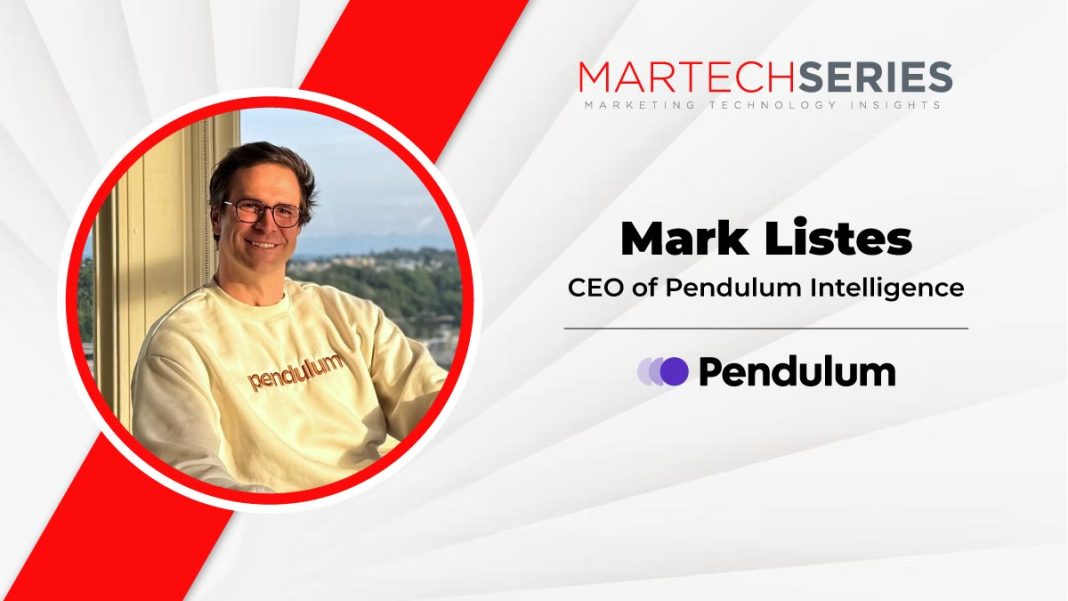
Mark Listes, CEO at Pendulum Intelligence shares more on why modern marketers should rely more on social intelligence to drive marketing impact in this MarTech Series interview:
_______
Tell us a little about Pendulum and how its social intelligence benefits marketing teams?
Pendulum is a marketing team’s superpower for staying relevant in the fastest-moving world brands have ever experienced. The era of having days to activate on a trend or communicate to prevent a reputational hit is over. Brands now have less than 24 hours to play or sit out. Today, GEO, social, and digital move faster than the line to get into the in-person activation that teams have spent months and budget executing. In 2025, the keywords were ‘relevance’ and ‘reputation.’ If the 2026 Cannes Lions showed us anything, it’s that marketing is moving toward ‘participation.’ KitKat, Dr Pepper, IKEA, and McDonald’s are all market-leading examples.
Pendulum is the fastest awareness-to-action loop you’ve ever experienced. It’s nuanced intelligence, informed strategy, coaching, and activation, all built around a marketing team’s specific context. It’s accurate, specific, and savvy monitoring connected to powerful ideation. It’s your team focused on taste, not data. It’s marketing teams outpacing the narratives spreading from the envious or angry lines outside that exclusive activation event they just spent a fifth of their budget on. Pendulum is you in control.
In what ways should modern brands use social data to drive more impactful marketing output?
First, don’t look at data as anything but an incomplete answer. Today, the best brands out there demand context-specific insights, ideas, and strategy as core outputs from any platform that serves them data. This is the difference between social listening and social intelligence. Winning brands are moving quickly because they’re leaning on social-focused technology as a flywheel of awareness and ideas in an almost team-member-like embedded intelligence team.
Second, look to social analysis for more types of answers than you did in the past. Technology has changed what’s possible. Social used to be a sea of voices that were nearly impossible to attribute to specific markets, demographics, and communities. This meant that you were really restricted on where you could apply it. Today, technology has changed the equation. Social is a great way to detect risk, and to catch and ride trends for opportunities, just as it used to be. Now, it’s also a fast and dynamic way to research and track important opinions in specific markets and core buying demographics. It helps you understand customer praise and complaints about your products and your competitors, while also finding the right voices to connect with your customers on your behalf.
Third, social is where our core buying demographics spend their time. It’s certainly not the only way they form opinions, but every single research study shows us that social media and digital connection play a critical role in how these generations understand their world, inform their future decisions, and connect with their own communities. Comprehensive social insights must be a core component of any measurement campaign. Otherwise, you’re blind to the places your customers hang out.
Can you discuss the fundamentals of a great social listening strategy that brands often miss?
Every brand’s marketing team operates differently, so everyone’s approach is slightly different. That said, I do see four core fundamentals across most high-performing teams:
1) Listen where your audience is speaking. Forbes just reported that over half of the traffic for Grok, the AI tool on X/Twitter, is connected to adult content. Meanwhile, Pew’s 2025 report shows that 95% of U.S. adults aged 18-29 use YouTube, and 63% use TikTok, while only 33% use X/Twitter. However, most social listening tech, and therefore most social listening strategy, is 90% based on X/Twitter. Core Tenet 1: Expand your visibility to where your audience actually is.
2) Get nuanced. Teams don’t come up with creative ideas using booleans and keywords. Listening shouldn’t be limited to those either. The best social listening strategies are based in brand values, brand-specific conceptualization of risk and opportunity, and connection to the ever-changing way the world speaks. This produces the highest connectivity between intelligence, authentic ideas, and audience reception.
3) Lean forward into proactive and predictive. No one has a crystal ball, and that isn’t going to change anytime soon. However, predictive and proactive tools are better than ever before. You might not be able to see what is actually around the corner, but you can see further down the road than ever before.
4) Stay vigilant. The world changes so fast right now. As humans, we spend most of our days reeling from the rate of change. The best social strategies are constantly listening, synthesizing, and activating. It’s one thing to know that a narrative, trend, story, or opportunity exists. It’s another to have a constant bead on it, be able to shape your own slice of it, and bring your audience along at their speed. The only way to do this effectively in our extremely interconnected world is through always-on vigilance.
Why is social listening still crucial in a modern marketing setup?
Social intelligence is absolutely essential. Traditional social listening? That’s old news, and we need to move on. Every single CMO and CCO I speak with used to say something like “I didn’t want more data, I wanted more insights.” Now they’re saying things like “I need to move faster, see more, and help my team have better ideas, faster.” Social listening – tech that rips data out of APIs and pulls it into a dashboard, forcing your team to bear the burden of sensemaking, ideation, and assessment – isn’t crucial anymore. It’s not even relevant. Powerful technology acting as a teammate that can see into social, carry the burden of the work that unlocks speed for your team, and creates an environment where your team is the best informed they’ve ever been? That’s social intelligence. And in a world where we don’t have a clue what tomorrow will hold, this type of awareness that connects directly into your marketing KPIs and existing workflows is essential.
Marketing Technology News: MarTech Interview with Theresa Pham, Head of Product @ Wayvia
Name a few ways in which leading brands have gotten their social listening plan right
Social has to be connected to outcomes. Otherwise, listening is a self-referencing expense. The best brands are doing this with the following process:
1) Start with your desired, measurable outcomes that map into your own metrics.
2) Use social intelligence as core research on buyers to get nuanced, always-on insights you wouldn’t have otherwise.
3) Use these nuanced insights to brainstorm socially relevant activations.
4) As you build toward activation, do what my father always told me to do in his woodshop: measure twice and cut once. Teams continually measure to ensure their idea is still relevant as the world changes around them.
5) Use the social intelligence gathered to choose and vet the right influencers to amplify their campaign.
6) Measure, adjust, measure, adjust, measure, adjust.
Look at Vaseline’s incredible “Vaseline Verified” campaign that they won a Lion for in 2025. Or look at KitKat’s “The KitKat Heist” campaign from this year. Both are socially native, customer-participating, and unbelievably successful. Social intelligence plans can do this for your brand too.
What are five out-of-the-box social listening tips you’d leave our readers with?
1. Focus on the communities. Instead of only building keyword lists, try mapping out the groups that drive conversations and trends. Who are the 50 accounts whose posts always seem to catch fire? Getting to know these key players will teach you more than any keyword report ever could.
2. Watch how language changes. When a community starts using new words for an old topic, that’s often the first sign of a bigger cultural shift. For example, if “self-care” is giving way to “nervous system regulation” in wellness circles, that’s a creative brief just waiting to be written.
3. Listen for the ideas that will shake up your category. What are people saying that might make your product feel less relevant a year or two from now? Most brands skip this step, but it’s one of the most valuable things you can do.
4. Use social data to check for alignment with your own creative work. Take a look back at past campaigns and see which communities joined in, which ones didn’t, and where you got some pushback. You’ll spot patterns in what worked and what didn’t, which are insights you’d never get from a focus group.
5. Build your own cultural calendar based on what you’re hearing, not just what’s in the latest trend report. Trend reports usually cover things that have already happened. If you listen closely, you can spot the moments, conversations, and events that will matter to your audience before anyone else does. That’s a real advantage.
Marketing Technology News: Idle data is as good as no data
Pendulum is an AI-driven social intelligence platform that monitors video, audio, and text at scale to help brands analyze social signals, identify trends, and counteract harmful online narratives.
About Mark Listes:
Mark Listes is the Chief Executive Officer of Pendulum Intelligence (www.pendulumintel.com). He leads Pendulum in its mission to increase the observability of the world in order to empower companies to take proactive action and convert threats into opportunities.