Home Blog Page 4366

Why the Ad Fraud Fight Needs a Global Approach

4
global ad fraud

Growing Types of Ad Fraud Technology Calls for Strict Standards and Transparency Reporting

In this Experts Series column, Marco Ricci, CEO of Adloox, says that a global approach to combating ad fraud is needed to face increasingly sophisticated threats. Adloox is an independent global audit verification company with offices in London, Paris and New York.

Botnets and fake domains have become common terminology when speaking of ad fraud, but it’s the newer types emerging from all around the world that are really testing our defenses. Forced mobile auto-refreshing, hijacked tags, falsified location data, domain spoofing, or ‘methbot fraud’, are just some of the countless types of malware that have become more prevalent.

With growing evidence that ad fraud is helping to fund organized crime and terrorism, you’d think the industry would have got its act together and created an aggressive global standard to tackle it. You’d be wrong. Especially in the UK and Ireland, there is a country-by-country approach rather than international cooperation.

A lot of progress has been made through these organizations in promoting higher standards and increased awareness of the dangers of ad fraud. However, even these well-funded groups are struggling to keep up with the constantly evolving and global nature of the threat.

Part of the reason for this has been the mistaken belief that simply reporting on website domains is going to catch the super-smart cyber criminals.

global ad fraud

The fact is, up to 80% of the invalid traffic online is hiding at a user (not website) level, yet most of the tools on the market don’t offer this deeper reporting; and the organizations monitoring ad fraud don’t enforce these standards. It’s no surprise then that fraud is increasing, not decreasing, and advertisers are starting to demand answers and more accountability.

Thankfully though, one organization is taking a lead in enforcing the kind of premium model and benchmark of capability that could form the basis for a more international approach. The US’ MRC has been ruffling more than a few feathers with their accreditation standards. Some have criticized the organization for needlessly adding complexity to the process by constantly adding new reporting requirements. Even Google were suspended for not complying with the required standards.

A more aggressive benchmark, like the MRC offers, is one that we support. It can evolve as the ad fraud threat does and looks at the deepest level to rout out malware. In fact, we’ve been beating the drum on the need for deeper auditing for some time. Our clients are seeing less than 1% of fraud rates on their campaigns, where the UK average is anywhere between 20-60%, once you realise it’s hiding at the traffic level. It’s actually shocking seeing the ineptitude and lack of transparency monitoring (viewability) tools are offering the industry.

Agencies are trying to optimize against top-line viewability scores, suppliers get the same non-transparent report for free, so claim they are covered, whilst the brands themselves are left in the dark (that is until they get roped into a frontpage exposé story).

The complacency that lies behind recent criticism of the MRC’s approach is exactly what’s allowed the current situation on ad fraud to arise. We all need to accept that quality comes at a cost. Worryingly, this quality has been widely and negligently missing across digital and its measurement to date.

This needs to change though, and fast. The army of developers creating these new types malware are some of the most talented on the planet, who constantly look for weaknesses in our defenses that they can exploit. They don’t think in terms of regions or national borders, so why should we think in those terms with our response?

There will always be criminals looking to make a fast buck from the system. But, if we can pool our resources and develop a truly global and robust standard, we might not win the battle entirely, but at least we can stay one step ahead.

About Marco Ricci

CEO Adloox Global Ad Fraud

Marco joined Adloox as Chief Executive Officer in 2014, after leading Sales teams at Google in New York and London, establishing worldwide deals for Doubleclick across 32 markets. He has managed Technology and Innovation teams at WPP GroupM and Publicis Starcom, and more recently as Managing Director at RTB specialists VisualDNA. Marco’s real passion is Verification, having previously cut his teeth as Global VP for Telemetry.

Ventures of Venture Capitalists: SF Bay Area

0
Lotadata Ventures of Venture Capitalists featured image
Baller (with a "b")

LotaData analyzes billions (with a “b”) of mobile location signals or geo-cookies each day to infer user profiles and behavioral segments for our customers.

Just like web browsers use cookies for identifying users, location is the geo-cookie for knowing your mobile users in the real world.

Our machine intelligence processes vast amounts of anonymized location signals gathered from mobile phones, to understand why people are where they are and what is on their minds. We look for thousands of behavior patterns, from shopping habits to fitness trends to dining preferences to commute routes. Our algorithms often uncover new behaviors or segments. Just this week, we discovered a new segment: The Bay Area VC. So we went through looking at VC profiles to understand their behaviors in the real world.

VC Geo-Profile

Per CityLab and Martin Prosperity Institute, the San Francisco Bay Area including Silicon Valley is the largest cluster of venture capital firms and VCs. No surprise there! But what does a typical day look like for a VC in the San Francisco Bay Area? Where do they venture into the real world when they are not screening and funding startups?Where do they lunch and dine? Where do they hang out? What are their go-to legal firms? What cars do they drive?

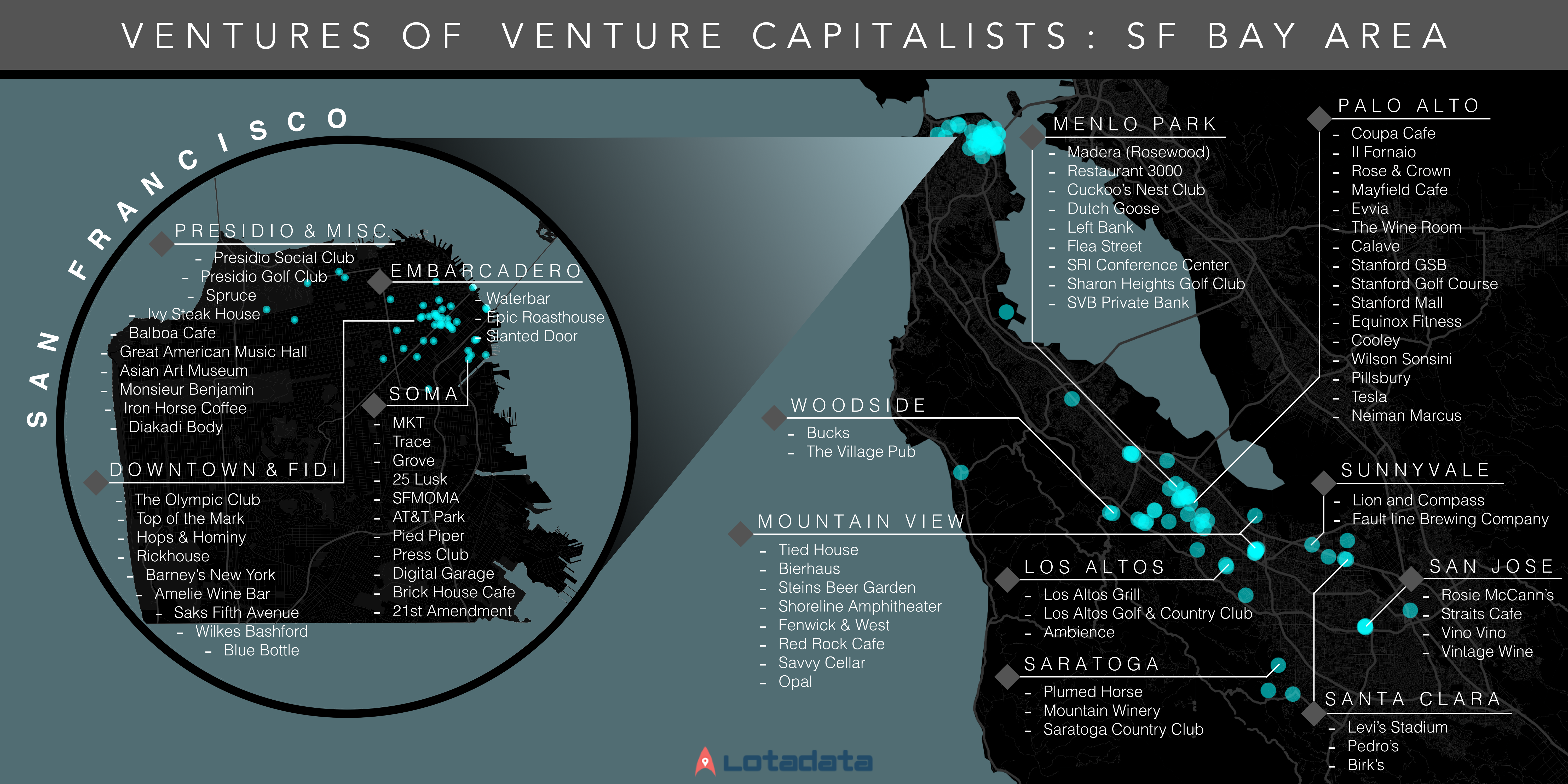
Below infographic shows you the aggregated behaviors of Bay Area VCs based on their anonymized geo-profiles.


Lotadata Bay Area VC Profiles

Behavioral Segments

In alphabetic order, below is the list of behavioral segments that stood out for Bay Area VCs.

  • Avid Sports Fan
  • Cafe Daily
  • Eats Out Daily
  • Entertainment Enthusiast
  • Financial Service Customer
  • Frequent Healthcare
  • Frequent Luxury Hotels
  • Occasional Luxury Retail
  • Gym Enthusiast
  • Live Music Lover
  • Luxury Car Owner
  • Museum Goer
  • Wellness Enthusiast
  • Wine Connoisseur

Conspicuous by their absence were grocery stores, convenience stores, dry cleaners and laundry. We expect these services are personalized and delivered directly to homes or offices.

Methodology

How did LotaData infer all of the above? Our “People Intelligence” platform ingests mobile location data or geo-cookies, in a privacy compliant manner, from mobile apps, programmatic exchanges and smart cities. We then correlate the location trails with our geo-temporal data: local places, businesses, brands, active deals, local events, experiences, environmental conditions.

It is relatively easy to infer the places of work like Sand Hill or South Park, based on the characteristics of repeating location signals.

The resulting profiles and behavioral segments are made available through LotaData’s cloud-based Geo-Dashboard, and also through searchable APIs.

Like “this”?

LotaData transforms mobile signals into insightful intelligence about people. In a world gone digital, NPR has written about “the business of VCs that can’t happen online“. As VCs move from meeting to meeting, and as our location data continues to grow, our algorithms will eventually infer car makes, models, and doors that open “like this”.

HBO Silicon Valley gif animation
Russ Hanneman, the “Trés Commas” VC from the HBO comedy series “Silicon Valley”

The Modern Marketer’s Omnichannel Opportunity

0
Featured image - man with tablet
Wallet online shopping
Source: Pixabay

With the dominance of smart phones, the lines between channels on the consumer path-to-purchase are blurring more than ever before. In a matter of minutes, a consumer may be exposed to an ad on Facebook, research a product and make a purchase on a brand’s site – all on a mobile device.

Despite the rise in mobile and eCommerce, according to BIAKelsey, 90 percent of all transactions today don’t happen online—they still happen in a store, on the phone, or by appointment, somewhere offline that is more difficult to track.


This creates a significant blind spot for marketers to evaluate and optimize their media spend as consumers seamlessly move from online to offline.

With this in mind, marketers need to rethink their strategy when it comes to connecting with, understanding and acquiring customers and prospects. How can marketers consider touchpoints on digital channels without losing sight of offline interactions with customers? And how can brands ensure that their ads are reaching and resonating with their target audiences? Let’s explore some approaches to omnichannel marketing strategy more in-depth:

Measuring and mapping every channel

There are a range of digital channels that are important to marketers today, including mobile display and video ads, site, search and social media. The challenge for marketers – especially in industries such as automotive and cable, which rely on inbound phone calls to drive sales and appointments – is understanding how their media strategy is performing across all digital channels, and identifying which channels are driving phone calls and store or showroom visits.

This discovery process can only be realized once the marketer has an integrated view into how a customer moves across channels toward an eventual sale. With so many potential nuances, marketers must tap insights that provide a holistic view of a customer’s digital and offline journey, in order to truly understand the impact of their ad spend and which channels are most important in facilitating conversions.

Answering your consumers’ call – literally

Business woman
Source: Pixabay

For businesses that rely on calls to drive sales, converting a caller to a customer is the last mile of the marketing journey. At the same time, this is the point at which marketers have the least control, and where there’s the most potential for a missed opportunity if a call is not handled correctly.

Many brands are turning to call analytics tools to understand what happens when consumers pick up the phone. Technological advancements in artificial intelligence and machine learning are giving way to new solutions that can identify indicators of a successful phone conversation, such as mentions of words like “credit card” or “appointment,” or even specific marketing promotions. At the same time, analyzing calls can expose missed opportunities that either warrant a follow-up conversation with a consumer down the line, or can provide lessons on how marketing efforts must be tailored to better appeal to consumers.

Leveraging online and offline data for personalization

With a range of solutions available to understand the online and offline customer experience, marketers can tap into new insights to personalize marketing to consumers. In addition to analyzing phone calls to better understand customers’ needs and preferences, the maturity of social media platforms like Facebook, Instagram, Twitter and LinkedIn is allowing marketers to specifically target the ideal buyer or user of their product or service, and build out their understanding of specific buyer personas based on social media usage.

Social media can be leveraged to offer personalized promotions, through content that is most likely to resonate with target audiences and compel them to take action. For example, if a brand determines that its target audience is predominately on Facebook, it may use the social network to offer customers a discount on products or services when they call or visit a store.

This feeling of personalization is key in order to cut through the noise of other brands, especially as consumers are inundated with content as they move across channels and are exposed to various ads in their daily lives. By using insights from both online and offline channels to understand audiences, brands are better equipped to retarget would-be customers, retain existing customers and find new prospects.

Bringing it all together

Even in today’s hyper-mobile world, understanding the customer experience offline is crucial, and marketers who fail to analyze the relationship between site, social, digital ads and phone calls are inevitably missing significant opportunities to retain and acquire customers.

Now more than ever, marketers need to have insight into what percentage of revenue is coming from each channel, track marketing activity to outcomes, such as a phone call, and know when a call results in a sale. As consumer behavior becomes more seamless across devices, marketing strategy needs to follow suit, by taking every opportunity to analyze and personalize the omnichannel path-to-purchase.

To learn more, visit The Offline Blind Spot and the Modern Marketer.

Interview with Robert Oberhofer, VP Technical Sales & Marketing – ItsOn Inc.

0
Robert Oberhofer ItsOn featured image

Robert Oberhofer
VP Technical Sales & Marketing – ItsOn Inc.

[easy-profiles profile_twitter=”https://twitter.com/robohofo” profile_linkedin=”https://www.linkedin.com/in/roberhofer/”]
[mnky_testimonial_slider][mnky_testimonial name=”” author_dec=”” position=”Designer”]“Asking the right question can be a much more powerful tool to influence someone vs. trying to teach and preach.”[/mnky_testimonial][/mnky_testimonial_slider]

On Marketing Technology


MTS:
Tell us a little bit about your role and how you got here.

I joined ItsOn early 2015. Having worked over the last decade and a half in both the telecoms industry and having brought to market mobile apps, I knew how big a gap was between how consumers now interact with business and how mobile carriers approach their customers. What attracted me to ItsOn was that it has a disruptive solution for addressing this very problem. At ItsOn I focus on enabling our customer facing organization with all the information and tools they need to be successful and help feed back what’s next in the product road-map.

MTS: Given the massive proliferation of marketing technology, how do you see the martech market evolving over the next few years?

Increased focus on hyper-personalization and contextual relevancy. Or in other words: the right information (offer) in the right context at the right time. As consumers are giving up more and more data I think it seems reasonable that the technology should be able to better understand the user and provide what is needed at the moment of intent or interest.

That is from an end-user perspective. From a marketers perspective the focus is whether my marketing spend is bringing in the results that I expect. E.g. more business related answers to by marketing ROI questions. Many (digital) marketing metrics do not provide this adequately.

MTS: What do you see as the single most important technology trend or development that’s going to impact us?

The big underlying trend that powers all new services is ‘real-time’. Whether it’s Amazon, Uber or Google – to have a seamless, transparent and immediate on-demand service, it is necessary to have a technology stack that is able to provide a 360 degree insight into the customer and all of his/her previous interactions plus the current context. Without it, the app model will not work. Without it virtual assistants (Amazon Echo, Siri etc) would not work.

This is simpler to do if you build a new business or app – but hard when you are already in business for a long time with older legacy technology that has not been created for this. The industry terminology for getting there is called Digital Transformation. Banks and Airlines have gone through this, Telecoms are just getting started – but there are thousands of businesses that still have that journey ahead of them. The migration to ‘real-time’ is happening – it will take time but will be pervasive.

MTS: What’s the biggest challenge that CMOs need to tackle to make marketing technology work?

Looking at it from our customer base – a mobile carriers perspective, the biggest challenge that a mobile service provider CMO faces is in the area of customer engagement. The old model of ‘monetizing’ a user with unwanted or irrelevant or obscure services (how much is a MB when roaming in Europe?) are over. But what to replace it with? To build trust and provide value I have to inform the user, provide transparency, be upfront. This is a shift in the mind-set of the telecom organization as well as a technology shift that is needed – going back to the ‘real-time’ aspect.

How can I replace confusion as to how much I pay for roaming data when on a business or holiday trip with clarity: Show a notification that welcomes the customer to the destination and offers clear options right there and then. It is doable – though needs the collaboration across different players within a carrier to do properly (namely marketing, business and IT).

MTS: What startups are you watching/keen on right now?

I find what Luis von Ahn is doing with Duolingo quite fascinating. Love the App.

MTS: What tools does your marketing stack consist of in 2017?

Funny enough for a technology company selling advanced digital transformation technology and marketing tools to customers, we are and have to be pretty old-school in working with our customers. Our target audience is the CxO’s at large international mobile carriers – not someone you reach with a Google Adword campaign. Thus relationships and industry word-of-mouth play a big role.

Our strength is that we can immediately show via working examples how our technology can empower their business. No PowerPoints needed.


This Is How I Work


MTS: A few words that best describes how you work.

Being in support of our customer facing teams, means that each day brings a new challenge with less predictability as perhaps in other roles. I shift through the communication necessary and then focus on 2-3 most important deliverables for the day and strive to get them done.

MTS: What apps/software/tools can’t you live without?

My Android phone, Outlook (I don’t like the Gmail UI much), Slack and Evernote. But can’t live without? Post-it notes. I tried all manner of digital replacements and productivity apps, but there is something about the physicality of it that always brought me back.

MTS: What’s your smartest work related shortcut or productivity hack?

Headphones.

Putting my headphones on is a physical anchor for focused work. It reduces ambient noise, communicates to others that I am heads down in/on something. It must be music without lyrics though.

MTS: What are you currently reading? (What do you read, and how do you consume information?)

The Inmates Are Running the Asylum by Alan Cooper. Not new but still highly relevant. A former colleague recommended it to me. I also have a list of blogs and news feeds that I track in Feedly and read on a regular basis.

MTS: What’s the best advice you’ve ever received?

Asking the right question can be a much more powerful tool to influence someone vs. trying to teach and preach.

MTS: Something you do better than others – the secret of your success?

Active listening. I always try to understand the underlying intent of what someone is saying.

Plus I seem to have a knack in explaining complex technology in a way that makes it relatable and allows people to trust it. The combination of both is especially great when working with customers.

MTS: Tag the one person whose answers to these questions you would love to read:

Elon Musk

MTS: Thank you Robert! That was fun and hope to see you back on MarTech Series soon.

[vc_tta_tabs][vc_tta_section title=”About Robert” tab_id=”1501785390157-b58e162d-0ae25a4b-c27a1877-b5d2″]

Robert is an experienced product evangelist with years of hands-on technical experience, product and innovation creation, customer and partner interaction skills.

His specialties include wireless and mobile technical planning, strategy, definition, product management,
client/server, telco infrastructure, consumer/apps, large scale systems and the cloud.

[/vc_tta_section][vc_tta_section title=”About ItsOn” tab_id=”1501785390320-2d44fa50-740c5a4b-c27a1877-b5d2″]

Formed by world-leading pioneers in the wireless field to fundamentally change how mobile services are delivered and consumed, ItsOn began leading the Smart Services™ revolution six years ago.

Through our cloud-based service platform, we’ve created a world where mobile service is exactly how people want it.

A world where carriers have the ability to turn existing wireless service offerings into dynamic service options and consumers have full visibility and control to personalize their mobile service right from their device.

[/vc_tta_section][/vc_tta_tabs]
[mnky_heading title=”About the MarTech Interview Series” link=”url:http%3A%2F%2Fstaging.loutish-lamp.flywheelsites.com%2Fmts-insights%2Finterviews%2F|||”]

The MTS Martech Interview Series is a fun Q&A style chat which we really enjoy doing with martech leaders. With inspiration from Lifehacker’s How I work interviews, the MarTech Series Interviews follows a two part format On Marketing Technology, and This Is How I Work. The format was chosen because when we decided to start an interview series with the biggest and brightest minds in martech – we wanted to get insight into two areas … one – their ideas on marketing tech and two – insights into the philosophy and methods that make these leaders tick.

AI 101, Part I: What You Need to Know about Predictive Models

3
AI predictive models

Four Steps to Start Building Predictive Models

While predictive analytics and AI are big topics in the sales and marketing profession these days, it can feel daunting when you’re trying to figure out how to get started with these data-dependent solutions. Although most marketers probably won’t actually be building any data models themselves, it’s vital that the next wave of go-to-market professionals develop a solid understanding of how to solve business problems using data. In this series of articles, I’ll break down key concepts surrounding these technologies piece-by-piece, and provide a helpful look under the hood of predictive modeling.

Business folks who are ready to get their feet wet with AI should first zoom out and learn the basics of predictive modeling – one of the underlying technologies that’s required in order to effectively replace human functions with machines. AI solutions use this advanced data science to process, understand, translate and interpret all the data that’s out there, and parse its meaning into visual and actionable outputs.

Let’s explore each of the four main phases of building predictive models:

1) Data acquisition

When it comes to building a predictive model, the first step is to gather all of your inputs or data sources. There’s no question that sales and marketing teams are acquiring a plethora of data. In many cases, however, marketers are collecting data that only they care about, and it might not be valuable, insightful or actionable for sales (and vice versa). Regardless, given the mass adoption of passive marketing channels, low-barrier free trials, etc., most businesses are gathering a lot of data about their prospects at scale – much of which can be used to inform smarter predictive models.

2) Data preparation

Before digging into all this data, it’s important to first step back and figure out what business problem you are trying to solve with AI, which will help you prioritize your data preparation tasks. The reality is that it’s very common for data to be incomplete and dirty (there’s no getting around the human error that comes with data entry), so data preparation is crucial to the future of AI. Your data should be properly cleaned up, if you will, so that you can normalize typical errors during the data acquisition phase, and ultimately produce a sound model. Only then, will predictive analytics answer your specific questions and drive the actions you want. Some common ways to prepare your data include enrichment (bringing in external signals to complement current records), spam analysis and title normalization – stay tuned for more on these techniques in my next post.

3) Modeling

Once you understand the machine-learning problem you want to solve for, the next step to building a model is to employ data science methodologies like classification or regression. Classification is also known as probability estimation, and it is used to predict which of a small set of classes each individual belongs to. For instance, you might ask “Among customers of Company X, who is most likely to respond to this offer?” There then would be two classes: “Will Not Respond” or Will Respond.”

On the other hand, regression (or value estimation) is used predict the numerical value of some variable for each individual. Looking at historical data, you might produce a model that estimates a particular variable specific to each individual, such as “How much will this customer use this service?” Both of these techniques, and many others, can deliver model outputs that drive powerful AI and predictive analytics use cases in sales and marketing.

4) Output

For example, sales teams can achieve major performance management improvements by using predictive models to improve the way they filter and prioritize both inbound leads and account-based outreach tactics. With score outputs that indicate which leads look most like the company’s ideal customer, sales can confidently focus their time on just those prospects that are likely to buy. In addition, teams can use AI to more thoughtfully route their leads – either to SDRs for outreach and development over time, to account executives for more aggressive follow-up, or to automated nurture programs – based on each lead’s potential value. Predictive behavior models can also alert sales when an old lead starts acting like a customer. By looking at engagement patterns in marketing automation and web analytics systems, you can determine when neglected leads are likely getting close to a conversion threshold. This helps reps find good qualified accounts and contacts that are “reawakening,” and then trigger data-driven workflows for more aggressive follow-up with just the right message at just the right time.

Another valuable use case for AI is to drive marketing efficiency. With the right customer intelligence, marketing teams can optimize conversions for the greatest possible funnel efficiency. And since predictive analytics outputs deliver immediate feedback on the quality of marketing campaigns, they can easily calculate key performance metrics in real-time rather than waiting for sales cycles to play out. Accurate predictions also add value when it comes to quantifying key marketing performance indicators like cost per good lead, average lead quality, pipeline-to-spend ratio, etc. By using these KPIs to look past traditional vanity metrics and identify top performing campaigns and content, marketers gain deeper insights into which programs attract the highest quality leads, drive larger deals, and accelerate deal velocity.

Each of these four steps to the predictive model build process is important to understand if you want your models to produce statistically accurate predictions, and these phases become increasingly mission-critical as AI takes over more and more everyday tasks from humans. No one wants to miss out on real revenue, just because AI made unnecessary mistakes when determining outbound prospecting lists or writing the content of sales outreach emails.

About Sean Zinsmeister

A regular MarTech Series Expert contributor, Sean Zinsmeister crafts the positioning, messaging and overall go-to-market strategy for Infer’s trove of next-generation predictive analytic models. Once a satisfied Infer customer himself, Sean joined Infer from Nitro, a San Francisco-based document management software company, where he developed and led an award-winning global marketing team. Sean holds advanced degrees from Suffolk Sawyer School of Business and Northeastern respectively in strategic marketing and project management. Sean also hosts the sales and marketing technology podcast show Stack & Flow.

Sean Zinsmeister Predictive models

HubSpot and Brightcove Join Forces to Target Growing Video Analytics Space

1
Brightcove Audience Video Analytics

HubSpot Brightcove Video AnalyticsNew partnership allows HubSpot users to track and target prospects based on video usage analytics from Brightcove.

Inbound marketing leaders HubSpot, and video solutions provider Brightcove, recent partnership announcement will help the two Boston-based companies deliver targeted video analytics to their customers. With video traffic projected to be 82% of consumer internet traffic by 2020, both companies believe their paths to growth will converge around the increasing domination of video content.

Consumers are increasingly looking to video as their preferred form of content, giving marketers the opportunity to analyzing video viewing data to more effectively target, prioritize, and track their best prospects. Tracking deeper metrics around individual video consumption figures and watching patterns is a gap in the market feel.

The new alliance will aim to address this insights gap to provide better analytics in both areas. Under the new partnership, video analytics data from Brightcove will now be available for marketers using HubSpot’s content marketing software. HubSpot users will also be able to capture prospect data and automate trigger-based email campaigns based on insights from the analytics.

Brightcove Audience Video Analytics

“We’re thrilled to be joining forces with HubSpot, another pillar in the vibrant Boston tech community, to provide marketers across the globe with the best combination of high return technology solutions they need to succeed,” said Caren Cioffi, EVP and GM, enterprise and digital marketing business at Brightcove. “We built a powerful product, Brightcove Audience, specifically for integration use cases like this one, enabling customers to connect video viewing data seamlessly with other tools in their marketing technology stack.”

“Our customers are savvy, forward-thinking marketers, and we are always looking to provide them with innovative solutions to help them grow,” said Brad Coffey, Chief Strategy Officer at HubSpot. “Video continues to be an important medium for our customers, and we’re excited to be teaming up with Brightcove to bring their robust video analytics directly into our product offering.”

PacketZoom Unveils Retail App Performance Index for Better Customer Engagement

0
PacketZoom

PacketZoom CEO talks to MTS to explain factors that affect app performance and help marketers identify CDNs to bring excellent CX without disruptions.

CMOs are increasingly leveraging the power of mobile app to drive customer engagement in a more meaningful manner. For marketers who are yet to acknowledge the power of mobile app messaging and advertising, 2017 could turn out to be a major tearjerker for them. Despite advancements in predictive and customer behavior analytics, not many martech companies can help CMOs determine the exact nature of their app spending and the performance. To bridge the very gap in-app metrics and performance benchmarking, PacketZoom released its Retail App Performance Index.

How Retail App Performance Index helps you and your app performance?

Read on…

PacketZoom, a mobile app performance enabler, announced Retail App Performance Index as a benchmarking tool to measure the download metrics for content within the most popular retail apps. The index highlights how important download times are for retail apps, and how far most leading retail apps have to go to meet consumer expectations. As app developers turn to AI and IoT technologies to connect to their products, finding the true worth of each app becomes even more vital.

According to data from market research firm Dynatrace, a majority of consumers — 61% — expect pages within mobile retail apps to download completely in four seconds or less. Anything longer than that, and retailers risk frustrating their users and having them abandon the app or perhaps uninstall it completely. Despite knowing this, retail apps fail to capitalize their campaigns.

There are two reasons for this—

  • Adding too many requests or making the total file size too large
  • Not optimizing their app’s overall performance

PacketZoom identified that most major retail apps take at least two or three times that desired amount of time to download the main page.

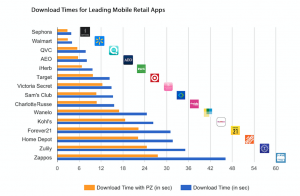
PacketZoom’s Mobile App Retail Index benchmarks the performance of selected popular retail applications. The Index focuses on the most frequently visited page of each app and ranks them by average download time. The variability in download time is a result of both (1) app infrastructure and (2) design methodology. Brands that are ranked high are likely to use either advanced mobile acceleration technologies or minimal design approach (or both).

In addition to the current performance, the Mobile App Retail Index lists the download time of each app using PacketZoom Mobile Expresslane technology.

How Mobile App Retail Index lists download time?

Similar to web pages, mobile pages represent essentially a collection of content elements that are fetched from the server and rendered on the user app. From a networking point of view the communication back and forth is very similar between the two platforms, and as such the size of the content download combined with the number of elements that has to be fetched will affect the number of network round trips that will take place to download the entire page.

PacketZoom Retail Index Comparison

Other than the app design itself, other factors that affect the app performance are the network conditions, which may vary from one geo-location to the other.

MTS Speaks to CEO of PacketZoom

We had Shlomi Gian, CEO of PacketZoom responding to some of our queries on how app performance and Content Delivery Network (CDN) CDN are actually related.

Shlomi Gian
Shlomi Gian, CEO of PacketZoom

MTS: How CDN affects app performance? What can retailers do to overcome CDN challenges?

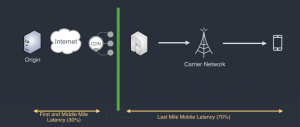
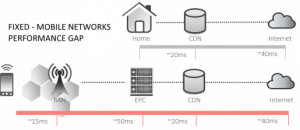
Shlomi Gian, CEO of PacketZoom (SG): CDNs are designed to speed up static and dynamic (API) content in what is called the “middle mile” (i.e. from one geo to another on the internet) but lack the ability to do so in the “last mile” (i.e. between a server in a given geo and the end use phone). As shown in the figure below PacketZoom focuses on the slow last mile and enhances the traditional CDN.

CDN has limitations and PacketZoom Mobile Expresslane removes those roadblocks in the last mile and speeds up content delivery. For retailers, it means more page views, enhanced user experience and an increase in conversions.

via PacketZoom
via PacketZoom
via PacketZoom
via PacketZoom

MTS: Mobile apps and retail services— what’s the hardest thing to manage in bringing excellent CX without disruptions?

SG: The hardest thing for mobile retail apps is to deliver a rich UX under poor network conditions. Large department stores are known to have poor cellular coverage and WiFi is not often unavailable. When searching for a product most apps leverage what’s called the carousel widget (or a long list of the search result) from which the customer can sort, filter and look up the product they want. This activity required a high level of connectivity (high throughput to download high res. images and a high number of connections), that will often fail when the surrounding networks cannot support.

(Thank you Shlomi for answering our queries)

After reviewing PacketZoom’s Retail App Performance Index, I realize that the CDN utilized by the app publisher plays a huge role in app performance. The PacketZoom report reveals that indeed Mobile app publishers have moved away from traditional CDN’s and are adopting newer ones (such as Amazon Cloudfront) that were created with mobile developers in mind.

What should App Marketers ideally be doing?

In order to optimize app page download times, PacketZoom recommends proper testing and monitoring using real devices during the design stage and not after. Too many mobile departments are “driving blind” by not having real-time access to user experience data. Real user monitoring for mobile apps is not difficult to employ and is offered by PacketZoom along with our Mobile Expresslane in-app technology.

Going forward, marketers can leverage PacketZoom’s in-app technology that is uniquely positioned as a CDN enhancer and not a CDN replacement. By removing roadblocks in the mobile last mile, in-app marketers can accelerate performance by 2x to 3x, rescue up to 80% of sessions from TCP connection drop and reduce CDN costs

Wrapping up Revenue Summit ’17 with Tony Yang of Mintigo

0
Pier 27, SF photo

In the last part of our coverage of the amazing Revenue Summit, we catch up with Tony Yang, Vice President of Demand Gen & Marketing Operations at Mintigo.

Tony Yang Mintigo
Tony Yang is a tech-savvy and data-driven marketing leader with deep experience in both large enterprises and startups in the B2B, software-as-a-service (SaaS), web/enterprise 2.0 and IT services space.

He possesses a unique blend of high-level strategic planning and management skills as well as the ability to execute on a tactical level as an individual contributor.


What was your impression of the event?

Revenue Summit 2017 was a solid event. Lots of great presentations and I saw many of the same thought leaders that I’d expect to be there. Participating in the event was also a part of our official launch of Mintigo’s Predictive Sales Coach where we were able to invite our customer from Oracle to speak in a case study session where Geet Dhillon shared the benefits and results of utilizing predictive analytics and AI for sales success.

Would you encourage more Sales and Marketing folks to attend these events together?

Absolutely. Sales and Marketing need to work closely in order to succeed in any organization, and with hot topics such as ABM on the rise, it’s ever so critical for these functions to work together as one. The sessions in many of these events address topics that helps with aligning the two teams.

Would you attend next year? Which session did you enjoy the most?

One of my favorite part of attending events like this is to hear how other people are doing things that I’m interested in. For example, there was a case study session on how a particular company measures the success of their ABM strategy, which is something we’re setting up internally as well. So yes, I would attend Revenue Summit next year. In fact, we will be participating in the next Sales Hacker event called Sales Machine 2017 in NY. Hope to see you there!

What’s the biggest challenge adopting ABM?

I’d say one of the biggest challenges is due to the tremendous increase in technology tools and access to data that’s available to, and purchased by, marketing and sales teams to execute ABM. While there are certainly great technology vendors that are offering capabilities for ABM execution, the marketer/sales person is often left with the challenge of how to piece all the tools that were purchased into a cohesive system.

This challenge is more than just integration – it includes the need for, and understanding of, data to flow between these systems as well as how the use of these tools affects workflows between marketing, sales, customer success, etc.

How did you get to driving Marketing at Mintigo – what’s your background?

We have a lean but mean marketing team at Mintigo. I primarily drive demand gen and marketing ops, but also wear other hats such as analyst relations, some content marketing, website management, etc. I suppose that’s part of the fun of working in a startup company — my last few companies have been startups as well… even smaller and earlier stage than Mintigo. You can check out more of my background on my LinkedIn profile – I’m generally happy to connect to anyone wanting to network with me.

What development at Mintigo you are excited about?

We’re really focused on how we can bring predictive and AI to marketing and sales organizations to help them see greater success in engaging with prospects and customers. As I previously mentioned, the recent launch of our Predictive Sales Coach was an exciting addition because it helps extend the benefits and value of predictive beyond what’s normally in marketing’s domain with targeting, segmentation and campaign execution to sales by giving them the insights to engage with prospects more intelligently.

We have some other exciting capabilities on our product roadmap for this year, but you’ll need to revisit with us to learn more about them!

What’s your take on AI in Marketing?

AI is a hot buzzword these days, but as with many terms that represent new technologies or methodologies these days I believe there needs to be greater market education before it becomes widely adopted. Don’t give into the hype, but understand the value that AI technologies can bring to your organization, whether it’s in marketing or sales or customer success.

Don’t view it as a single silver bullet that will magically solve all of your problems. But rather, learn how new technologies can utilize the vast amount of data that’s now available to you to help you make better decisions, such as who to target or which messages will resonate to which prospect. Once you understand this, then you can automate it.

A single everyday productivity hack you’d like to share with our audience?

One of my pet peeves is when I’m deep into working on something and when I get constantly interrupted by people to discuss something that ends up sucking up a good chunk of time or breaks my chain of thought. Now don’t get me wrong and think that I’m an anti-social grouch – I love bouncing ideas off of my colleagues or talking things through, and I realize that sometimes I have the answers to quick questions from my nearby colleagues.

But there are instances where I just need to hunker down and get stuff done without posting up in one of our in-high-demand conference rooms at our office. So I do two things – block out time on my calendar, and then just simply put on my earbuds and listen to music that doesn’t distract from my concentration. I do this whenever I need to put together a presentation slide deck or do a coding session to crank out web page content or marketing emails. This helps me be productive in chunks of time to get stuff done without the risk of getting constantly interrupted.

A single shining quality that has enabled you to excel?

Something that I do every day is read. Every morning before I get into the nitty gritty of work, I check out my sources of content that I subscribe to and try to learn more about topics that I care about — ABM, marketing and sales operations, startups, etc. This keeps me up-to-date on these topics and also helps me know who are the experts in these areas so I can connect with them. I often re-share these on my social networks, so over time I build relationships with these influencers and form my own point of view, which builds my own presence as a “thought leader”. At the end of the day, we’re all learning from each other so why not take an active part in the community?


Thanks for taking the time and sharing your insights Tony, we hope to catch up with you at Sales Machine 2017 too.

Also Read: Is AI All It’s Cracked Up to Be, or Does email Already Have the Answer?

Jeff Marcoux of Microsoft – Lead Prioritization, Predictive Lead Generation and The Rise of Customer Experience

0
Jeff Marcoux martech podcast

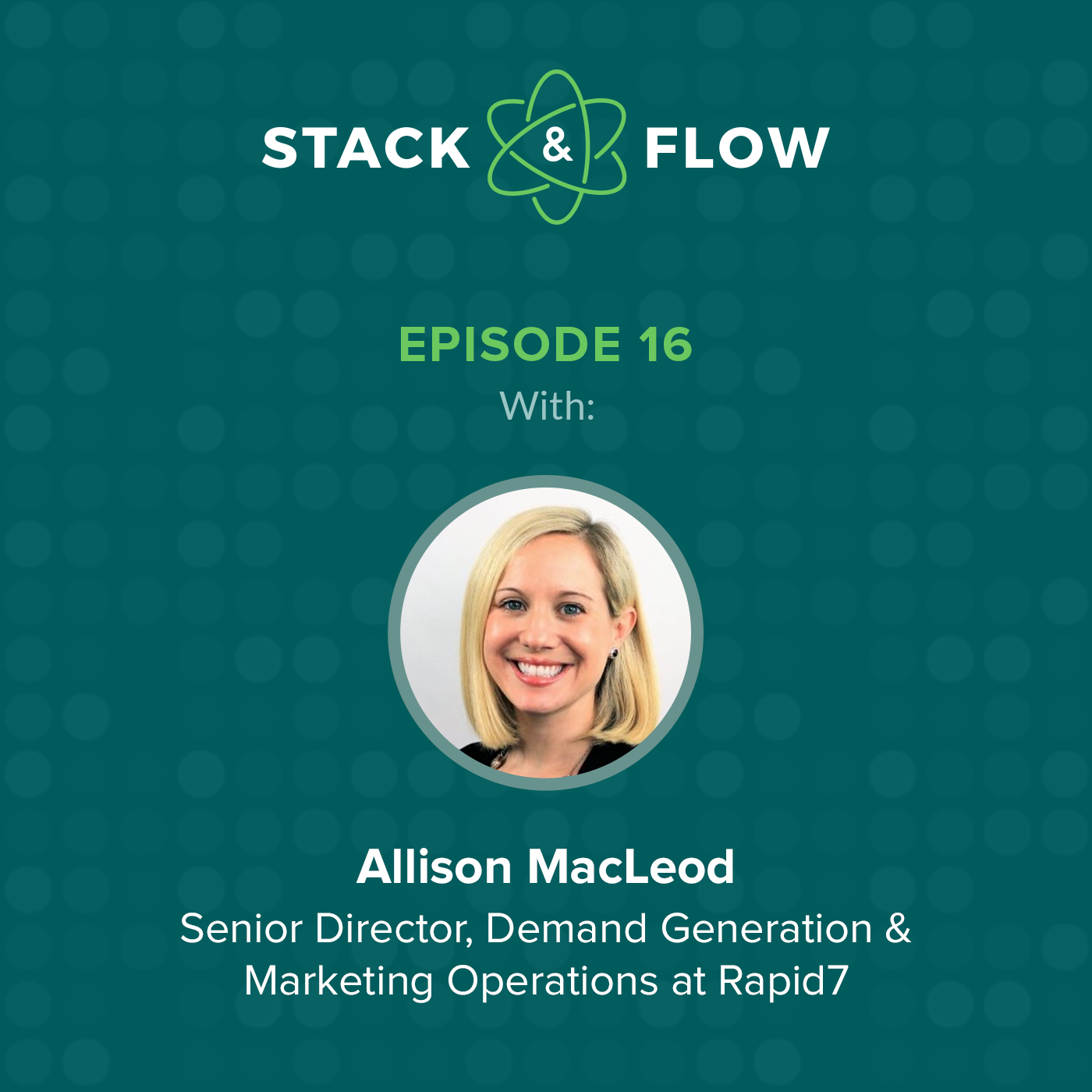
STACK & FLOW: The Sales & Marketing Technology Cast

MarTech Series presents Stack & Flow, a podcast series hosted by MTS Expert – Infer’s Sean Zinsmeister and EventHero’s John Wall.

Featuring Jeff Marcoux, CMO Lead for Worldwide Enterprise Marketing at Microsoft.

In this episode Jeff talks about Customer Experience being the next big thing and:

  • Data analysis vs. Emotional Intelligence vs. Diversity
  • The components all stacks have in common
  • 3 ways to get the biggest gains from predictive
  • The blind spot of total addressable market

About Jeff Marcoux

He has driven cross product and team collaboration, supported multiple product releases, bringing new products to market, innovative content strategies, channel development, and acquisition integration work. Jeff comes from the marketing automation and consulting industry where he led the service, consulting, implementation, marketing, and sales engineering teams. He believes that every touch point with a customer is a marketing experience- from marketing to sales to customer service. Jeff is a marketing growth hacker, martech expert, and brings entrepreneurial innovation to a big tech world. He attended the University of Washington where he received his MBA in Leadership, a Certificate in Technology Entrepreneurship, and was a Board Fellow for Leadership Eastside.  Jeff currently sits on the board for the Internet Marketing Association, is a professor of marketing at UC Irvine’s extension program, and has received Congressional recognition for his work in the Internet Marketing Industry.  In his spare time Jeff does lots of hiking and other fun outdoor activities.

Read the Transcript

John J. Wall: Hello and welcome to Stack and Flow. I’m John Wall.

Sean Zinsmeister: I’m Sean Zinsmeister.

John: Today’s guest is Jeff Marcoux. He is the CMO lead at Microsoft, and he’ll be telling us about what he’s got going on with their stack and what he’s been seeing as far as predictive and AI and a whole bunch of other topics, but Sean, you had kicked off with a Harvard business review article talking about emotional intelligence as contrasting to AI, so what jumped out at you here?

Sean: So EIQ, emotional intelligence, has been something that I’ve studied over the years sort of casually, and I’ve always been interested in the topic, and of course it’s the world’s combined when it came to the rise of artificial intelligence, or how more people are adopting artificial intelligence. I really liked how they broke down the article because, while I think that there’s a lot of fear mongering around AI in terms of like job replacement, you know, they talked about things like, “3,000 truck drivers seek new employment.”

Obviously, the continued innovation around self-driving vehicles will certainly push that even further, but it sort of offers this idea around how humans start to differentiate themselves because if you think about many of the skilled jobs that machines and AI are starting to replace kind of follow the same general workflow, and they break it down where it’s like you gather data, you analyze the data, you interpret the results, determine a recommended course of action, implement the course of action.

That sort of workflow is going to be something that’s going to be easily automated, and so where do people really start to differentiate themselves and this idea of these skills like persuasion, social understanding, and empathy, they really sort of push to be, these are going to be things that artificial intelligence. Could I say that they won’t catch up? I don’t think that we’re quite in the “Ex Machina” world quite yet, but I think that the other thing, too, and this is where I wanted to rope Jeff into the conversation, is that, something that I’m really proud and both passionate of is that I got a chance to study the humanities.

I was a music composition and theory major in college. I studied it all through high school, and I kind of feel like those were a lot of skills that really set me up, obviously for what I’m doing, in marketing technology, but Jeff, I know that also that you’re a teacher at UC Irvine extension school as well and do you see, first of all, what are you seeing on the AI front, and do you see this as sort of maybe a reinvestment in the humanities, and sort of building up those types of skills?

Jeff Marcoux: First off, thanks for having me on the show today, guys. I’m really excited to be here. Jumping straight to that comment, I think it’s really interesting. I think, as with all things in the marketing tech world, and we’re always looking at what’s up-and-coming in this, but I also have the sense that I think we’re going to be a little … AI, although quickly being researched and moving forward, I think is also a little ways out in terms of us embracing it as humans, almost to an extent of where we’re seeing it pop up in certain places, right? You’ve got things like Watson and what not where it was kind of a novelty on Jeopardy, and those sorts of items, but we still have a little bit of time before we’re really going to get to that huge transformation that you’re talking about there.

One of the things, honestly, I would love to have something be far more accurate and faster that I can talk to in my role to pull those analytics, gather that data, help crunch that stuff, but at the end of the day, there’s still a need to really look at it, and there’s aspects of human psychology, that emotional side of everything that still needs to be engaged with and it’s really hard. I mean, we all know people who are really bad at that side of it, right? Those are the people that we don’t necessarily like to hang out with all the time, and you only talk to them at work when you need to, but there are also those people that you love to be around, and that they kind of bring people together, and they spark innovation and thinking. Honestly, one of my hopes for the AI revolution that’s coming is I’m hoping it’s going to give us more head space to think again.

I feel like a lot of times, we are down, stuck doing data analysis, and you get into that analysis paralysis, and it’s almost inhibited some of the innovation that we had before we got so overrun with data. So, I’m cautiously optimistic. I think we’ve got some time before it’s really going to roll in, but I think we’re going to have to start seeing some people double-down on actually how do they talk and engage with the people around them, and take that data and make it actionable.

Sean: I completely agree on that, and I think that it is going to be a tempered approach, too, because you know, when you talk about that head space, I think about this like … I don’t actually think we are going to replace patents with poets. I’m not sure that that’s more of a realistic expectation. But I do think, sort of going back to that simile around the humanities, where it’s like one of the goals I’ve always thought about a liberal arts education is you leave with more questions than you walked in with, right? I think that that’s kind of what we’re talking about here, where it’s just like, well, we’re all about AI sort of being able to automate and build productivity around some of the more redundant activities and also increase the performance around them as well. I’m thinking that as we see that evolution go to market professionals and by that, I mean sales and marketing folks, again, to sort of tap into that.

Especially being at an enterprise like Microsoft before we sort of dive into your role. Are those soft skills more valuable than the data analysis? I mean obviously that’s where the demand is right now, right? Around some of those data science skills and analytics. Are you guys seeing a balance in terms of what you look for in, let’s call it, the next generation of sales and marketing professionals?

Jeff: It’s interesting. Honestly right now we still are pushing heavy on the data and analysis and the tech side of the house to be totally honest. We’re also really investing in things. Microsoft really values diversity and inclusion so we actually have full on courses that are mandated, every employee in the company takes around those sorts of things, these unconscious biases and those sorts of items which has been really great. They’re trying to kind of push down into that world.

I think one thing that we are seeing is, especially in the sales side of the house, are the people who are adopting these soft skills, they’re more successful. We’ve seen this in the social selling world coming out of marketing is producing great content, aggregating it, and helping their sellers to be seen as subject matter experts. The sellers who come off as authentic are the ones who are genuinely interested in A, learning about the topic and B, sharing that knowledge with the world. That comes down to some of that emotions driven, those human relations that are there.

It’s funny, I have a liberal arts degree myself from my undergraduate in International Studies and Comparative Religions which, what on earth does that have to do with marketing? Actually it’s been one of the most fascinating pieces for me in giving me almost an unfair advantage of I have an understanding of a broad spectrum of cultural backgrounds around the globe from almost every religion on the planet. At least having some core understanding of that really opens up the way of when you’re thinking about cultural engagement, language, all of that different stuff, that’s something that, to some extent, a machine may not ever be able to fully tap into. Maybe one day, but I still think that’s a ways out on that front.

I think it’s going to be fun seeing that. I’m hoping that those will get some more, those kinds of degrees will get some more value. One of the things that we see right now in that space is everybody is going to where they can get a good paying job out of school. You’re going for a lot of these data heavy, tech heavy kind of focuses. I’m cautiously optimistic but we still got to bring that bridge from the liberal arts to still driving business value. I’ve talked to many, many English majors, etc, and they end up going into content writing when they didn’t ever intend to do that, right? It’s like how do we get you down that road a little earlier?

John: That makes a lot of sense. It’s also, there’s the bigger issue of everything that we’ve been using in this business, the tools are rolling over at such a rapid pace that you need to be involved with lifelong learning and a lot of liberal arts degrees set you up better for that kind of thing, of constantly studying and moving. You’ve given us a great set-up. We’ve got you now, you’ve finished your undergrad, you’re learning about world culture and religion. What got you to Microsoft? Where did that path go and what are you responsible for now?

Jeff: I’ll give you the short version. Basically came out of undergraduate and my father in law introduced me to this company. I was into geo-caching at the time. It was a, for those not familiar, it’s basically a digital treasure hunt. Think about Pokemon Go, but 15 years ago. It was right after the GPS got unscrambled and civilians could use it. Some guy out in Portland went and hid a box somewhere and posted the coordinates and people would go out and find it and write their name in a log and that was it. Now all of the sudden if you go to geocaching.com you probably walk by hundreds everyday and you had no idea. It’s almost like this little hidden society of people. It’s a fun way to get out with families and friends, it gives you objectives.

I went and worked at a team building company that was focused around that where we did organizational design and analysis of essentially bringing teams out, watching them interact, setting them up with goals. There, I was leading marketing at the time and doing some course facilitating with that group there. Economy turned down. I had always kind of going to football games at the University of Washington. It always seemed like the big commercials coming on and I won’t say the brand here but one of them I saw and I was like “I can do that so much better. Their story telling is awful.”

At the time, kind of pivoted and realized that I wanted to go into marketing. I went back to school, got my business degree. Interned with Slalom Consulting and helped them launch their start of their marketing practice there. Then got, as a part of that, brought in a marketing automation system. Got asked to come join that company at the time and took them through an acquisition by SilverPop who’s now owned by IBM. At that time didn’t want to move out east to their headquarters in Atlanta. Microsoft kind of came and approached me on that front.

Since then, have kind of been in Microsoft and that’s led to me teaching at UC Irvine, being on the board of the Internet Marketing Association which has all been just awesome for me personally, and kind of led me to where I am today where my role is fairly unique in that I get to be, essentially, a core evangelist for Microsoft and it’s partners who have anything that touches marketing and digital and that space, and customer experience. I kind of look over everything from Bing advertising to artificial intelligence to chat bots and all of our partner stuff built on Azure, and anything that really focuses on that B to B or B to C and putting together and understanding strategies, architectures, cohesive narratives, how does that all tie together?

I have a pretty fun job because I get to work with a bunch of big brands all the time when they come into our executive briefing center. We do co-creation and ideation sessions and kind of punching at aspects of there’s a lot that we can do, but let’s figure out what’s going to drive the most bottom line impact for you and make better customer experiences. Getting to look at all of that kind of stuff is a lot of fun. The other hat that I wear, too, is I also focus on viral growth in some of our SAS products; driving user adoption, driving finding key activation points, doing things like churn analysis and cluster analysis to find upsell/cross-sell opportunities and that. It doesn’t matter how fast you fill the top of the funnel if the bottom of your funnel is super leaky, so kind of looking at all those different processes there.

Sean: Jeff I know that, obviously, CRM has been a big topic of discussion as well. It definitely intersects with the AI piece of it. I know it’s definitely got to be an exciting discussion around Microsoft. Do you play much in the dynamics organization? Curious, actually, in general what your thoughts are on the future of CRM and what’s getting you excited over there.

Jeff: I did a stint in the dynamics organization, actually, there for a bit and still stay pretty tied into that group. It’s really, really interesting to me. I actually, I used to be an advocate of user CRM as your core data platform including for marketing. Then very quickly came to realize all the garbage that marketers want to collect data on that sales reps couldn’t care less about. Started getting into that aspect, “Oh, it is actually smart to have two separate systems.” You’re only passing through the things that deliver value to your sales reps in context of that.

One of the coolest things I think that has really come out of some of the work that we’ve been doing is really helping put process in the CRM a bit, where it’s a visual. We’ve got a step by step process of you can put in any methodology that your sales team uses, and you can see all of your accounts tied over those different pieces, but where it’s getting really interesting, you can look up this great video. It’s on Dynamics 365 customer insights. It’s some of the pieces where we’ve taken from our machine learning library, and turned it into a very easy application that people can use to really build out audience segmentation and understanding great customer insights at a much easier way. You don’t have to hire a data scientist to do that kind of stuff, so really trying to make the advanced analytics and stuff that was traditionally held off to people who could hire those big guns of data scientists, accessible to everybody.

We’ve also been making some bets here recently, we built a partnership with a company called [inaudible 00:13:45] who it’s totally free for anybody with Dynamics CRM to use. It’s basic level, predictive, list building, audience segmentation, putting together basic models. It’s a great entry point for companies that want to get a bit more advanced in their marketing strategies without going and spending 50 to several hundred thousand dollars on some of these new, bigger, predictive marketing platforms and that work.

In terms of where CRM is going, I think what we’re going to start seeing here more and more is, it’s really going to have to pivot back to versus being essentially a system of record, to actually being a real, relationship driving engine. I know it’s called Customer Relationship Management but let’s be honest, most people don’t actually use it that way. It’s simply a system of records so I can do my forecast and get my budget and get my bonus from that. As we look at it, I think it’s going to come into the pieces of looking holistically at accounts. What is the individual? What is the best next product? Best next engagement? Best next touch point I should be having with this individual?

I think we’re going to start seeing things really overlaying advanced customer journeys with things like the AI and machine learning doing a lot of the signal analysis to let my sales rep know, and my marketing team know, what should we be delivering to this particular account, based on everything that we know about them? When is the right time to have that right conversation? Right now, it’s still pretty opinionated in terms of “I got to follow up with this account this week.” Versus “No, you should follow up on Tuesday at 10 AM because that’s when you should have this piece, and right before you do that, you should deliver this piece of content or hit them with this particular ad, so that you’re top of mind.” I think we’re going to see it start to pivot more in that advanced way that’s going to hopefully drive better human connection, better human interaction.

Sean: I think that you hit the nail on the head there, too, where we look at CRM today and at it’s rawest point, we’re looking at a structured database with a GUI and then you have next to that, whatever your system of engagement is. I think that that 3rd piece is really that system of intelligence. I think one of the driving factors, and something that I know that you’ve picked up as well is this idea of the account based strategies. Looking at it, something like account based marketing, everybody’s tired of hearing of, it’s not something that’s new. Why did you become a big proponent of ABM, why now? Why not seeing that years ago, if it’s been around? What do you think is the driving force there?

Jeff: I think the honest answer is, it’s new and it’s not at the same time. I’m a big proponent and I’m not, at the same time. The reason it’s coming now is honestly, I’ll be fully transparent, I think a lot of the Martech guys were looking at, “What do we do next after marketing automation and content?” They wore out their welcome as being the next hot topic, and I think people were looking for what was next. I think that was the build out of the category. It’s not new in the way that the same thing as social selling has never been new. If you look at the way that we used to sell, we did it by territory and industry.

Why was that? That was because you knew the people in your city. You knew the people in your industry. With social and digital coming, my industry and my network is no longer isolated to a geography. It might be enhanced in that geography, but I know people all over the globe. We saw that pivot almost back to social selling of, “We want you to sell to people that you know and you have relationships with, it’s just how we define that has changed.”

Similar to account based marketing, used to say “These are the accounts I want to get into and so we’re going to build a strategy around that.” I actually feel like marketing almost moved away from that joint, and we used to get along a lot better with sales when we did that joint planning and really building out roles and strategies around that. We moved away from that because we wanted to define ourselves and all the new tech was coming out there, and that’s driven that big wedge there. The companies that are going to get this early are definitely going to have a bit of an advantage.

I was just giving a talk yesterday at the B to B marketing exchange conference on how you don’t have to start with a big, fancy product. This is where I’ll say, I’m not an advocate of some of the traditional IBM stuff that’s out there right now. You can start with some basic stuff, right? I can say, “Here are the five accounts I want to get into. Work with my account manager, build out a plan.” Guess where I can do that? It’s in the most popular Martech solution out there, it’s called Excel. You can go out there and you can plan that out, when are we going to target them? If I want to get more advanced, I can go into LinkedIn and say, “Who are the six people I should be talking to at this account that we need to convert, or that we at least need to have part of the conversation?”

If I even want to get a little bit more advanced, I can then go do a targeted ad by on LinkedIn and Facebook, targeting those six people. I can work with my seller to deliver, here’s the content you should go with, here’s what they’ve seen, et cetera. You can execute that without anything really fancy to get going down that road. Similarly, most of us with our marketing automation systems, have a reverse IP look up. Oftentimes, you might get the batch IP of Comcast or Bell, or one of those, but for the bigger companies, they’ve bought their batch IP address so we can see who they are. You can even, again, start with some of the basics of just outreaching those people before they go from unknown to known.

Where it gets interesting, this is middle ground. This is where this ABM concept comes up. I think it’s coming back to being new, because we have more analytics, more access to it, more machine learning than we’ve ever had before. This is where we’re getting into some things like predictive lead generation, predictive list prioritization based on data, intent. This is where we’re finding these new things that are coming out that make it really exciting.

The reality also is at the same time, is that the vast majority of companies who have an advanced marketing automation system today, very few of them are doing much more beyond a standard monthly email blast and maybe a single path nurture stream. They’re not doing branching, personalization, all this other stuff, yet. Part of me looks at it as there’s such potential in this category, but there’s also such need for the majority of companies to still mature in the systems that they have today, before they’re almost ready to reach out and take advantage of these super incredible items that are out there.

Sean: Again, getting folks to, everybody take a deep breath and just sift through the noise, come back to center and realize that hey, maybe all the tools that you’re looking for, maybe you should start with like you said, best marketing tool around which is an Excel Spreadsheet. I have this conversation with folks a lot who are looking for attribution tools. I’m like, “I know that you’re looking for that shiny object that is going to help answer this question, but have you actually tried plotting these things out yourself and figuring that out? Why don’t you figure out what the ceiling is, organically, before you start throwing tools at the problem?”

The other thing that is interesting to unpack there, is I have two theories around this account based mania that’s been upon us which is, one, is that I really think, we’ll see Jeff, interesting, if you agree or disagree with this kind of point, was that I think that the technology is certainly driving a disruption in what the sales and marketing roles are. You mentioned in the talk of marketing automation and how marketing professionals then had a tool at their disposal to mass communicate with their audience with ease and build those customer journeys. Now, you’re starting to see those tools in the hands of salespeople as they have their own automation at their hands.

In this, you see marketing now needing to go down the funnel where sales is, where sales is creeping up. Now, we’re starting to see that mixture. Part of me is like, is indeed, do you see technology driving that disruption there? The other one is it just a focus thing? That’s a thing I’ve always thought about the account based stuff, which is that is it optics? It’s not to say that that’s not a bad thing, but the internet has created, like you said, all of this incredible amount of rich data that we need a way to say, “Hey, let’s just focus on the things that matter.” Curious what you think about those two theories around about why the account based stuff is hot right now?

Jeff: I think you hit on a really interesting point on we as marketers, tend to have shiny object syndrome. We are always looking for that silver bullet. One thing that I’ve really come to understand in my engagements from small business to enterprise, is that if you just try to solve your problems with technology, any kind of transformation you’re trying to do, you’re going to fail. You have to look at, what’s your company culture? What are your processes? What’s the technology of what you want to do? If the culture doesn’t support it, if your sellers are not compensated in a way that compliments what the new marketing strategy you want to do, you’re going to fail. You’re going to generate all this stuff and nobody’s going to pick it up. If your processes not there you might generate a bunch of stuff, but then it doesn’t get to where it needs to go. All these different pieces of, you’ve got to have all three of those dialed in, in place, and I think that’s a mistake a lot of companies tend to make, if I’m honest on that side.

It’s interesting you bring up the aspect of sellers working upstream, kind of into the marketing world. What I’m seeing, and I use a tool even personally for this, for my own networking, on how do I become a much more effective communicator … It’s almost like marketing automation for one, where I can do it to my network and stay up to date with different people. I think we’re starting to see that come more and more, where traditionally as sales people, you had very limited tools that you could potentially use and now you’re starting to see that they can swim upstream, be more effective, track opens, clicks, know the right time to outreach, segmenting the different content types that are there.

I honestly think that’s a better experience for the customer, which is one of the reasons I’m optimistic on this category, is that if you’re truly doing real, good account based marketing, you’re also being incredibly customer centered because you’re looking at the individual account, the individual customers you’re talking with. What are their motivations, what is the content that is most valuable to them that’s going to help prove my point as I’m going through that? It’s interesting, seeing the sales team come up and almost help facilitate that change. By the same token, marketing’s got to go down and then make sure that they have the right content aligned to those different aspects and also ensure that that hand off is going on.

It’s not even so much of a handoff anymore, as at some point you bring your partner, your sales rep into the conversation, then you’re running together. Marketing should continue to support a sales process of continuing to target the person and reiterate the messages that the salesperson is seeing or if they’re blockers, targeting content that is going to help facilitate unblocking those as a part of that. It almost becomes a partnership through the sales cycle, and marketing stays in longer versus traditionally, it’s I generated my lead, hit a lead score threshold. Throw it over the wall, here go sales. That’s a big part I think that I’m hoping that we see, I think there’s some cultural stuff between those two groups that in many companies, we got to work out but again, I’m optimistic.

John: Jeff, how about as far as the actual stack, then, of tools that are put together? Are you working with a single stack that you liked and have optimized, or are you overseeing different business divisions that have their own stacks built and do you see differences as far as what’s effective in different configurations of the stack in moving, in basically tracking this whole customer experience? I can easily see how you can have a lot of improvement on that front, but how are the nuts and bolts working of it for you?

Jeff: In terms of stack, it’s really interesting just seeing the way that people are doing that. We have a stack as well that we use at Microsoft, and it’s constantly changing and stuff’s being tested and going in and out on that front. At the end of it, at the core, every group has got to have a CRM in some way, shape or form. We use Dynamics, obviously, but your big guys, let’s be honest, are Dynamics and Salesforce. You’ve got to have a marketing automation system on top of that, those are just core pieces. The most popular ones out there today, Marketo, Eloqua, we work with Marketo pretty closely on a lot of our stuff for our demand center on that side.

You probably want some sort of data enrichment aspect around that, although some of the marketing automation vendors are starting to push out into that a bit there, so … How are you going to cleanse, clean, enrich your data from that perspective? As you continue to work upstream, you start looking at things like, “Do we want to get more advanced?” You’re looking at different items like, should we be doing predictive? The big predictive guys in the space, you’ve got Infer, Everstream, Radius, Six Sense, are probably your biggest ones in this space. What I’ve been learning more and more, actually, a lot of those guys all have other data partners that they’re working with who are actually starting to try to emerge themselves as helping with some of this account based stuff and showing intent. Which has been funny, because these guys have traditionally sat in the background so I think we’re starting to see them see the opportunity and start to bubble up.

The interesting part, too, as we get into it though is really starting to look at the, even the front end stuff, of what is your website CSM system and things like that in the space here? We’ve done some work and I’m becoming more and more of a fan of, there’s a company called Get Smart Content out of Austin. What I love about them is their ability to do real time personalization from your first visit in the B to B space on your website. I can know your role, your location, and your industry from the first time you ever hit my site so you don’t get vanilla. That’s optimized after you come back again based on what you did. That’s a really interesting piece to me, because then I’m able to deliver that fully personalized experience from the get go.

On the advertising side, we’re starting to see more and more different pieces pop up of predictive, right time, right device, right message pieces come out there. We’ve run some pilots and stuff with Rocket Fuel is one of the vendor’s we’ve been doing some work with. There’s some other interesting ones coming into the space here. I think it turns into, from the stack perspective, the biggest thing is get those big rocks in place and maturing them first is my personal opinion of make sure you actually use your CRM, make sure you actually use your marketing automation system and get at least to 60% of value of those and then start to look at how you’re going to augment as you go through those different pieces there.

There’s a lot of great tech out there, it’s just looking at oftentimes, what integrates well with what you’re using? That honestly is a big deciding factor for a lot of marketing departments is, if it’s going to take a big tech team to go in and implement this, et cetera, it may not be worth it versus if somebody’s made it incredibly simple where it’s “Okay, I have my account here, I have my account here. Let me just do my login and boom, it automatically integrates and hooks up.” That’s a lot easier for me to consume as a marketer, potentially a lot faster, than having to go and talk and engage with my tech team on that site. There’s no right stack, I’ll say that as well. I think it’s finding the one that works best for you on it and making sure that you go through and identify those gaps and start to fill them in over time.

Sean: On the flow side, talking a little bit more about the data obviously, this is something we look at very heavily on the infer side but I’m curious, when you talk about predictive analytics and predictive lead generation, where are you seeing that people are starting to see the value? What are the early use cases that you’re being able to interact with first where people are getting started? I’m curious, what problems are they overcoming, using predictive?

Jeff: Honestly, one of the biggest ones is not actually a predictive scenario, it’s around data cleansing. If you start with garbage data, which most of us, our data is not particularly good, your model is going to be garbage. Cleansing and enriching your data sets is actually, usually, step one that I’ve come across with most people in that they’re using. That often is scenario number one.

Scenario number two, if marketers are smart, is doing predictive prioritization of your existing leads. Most of us have a lead scoring model, but it’s honestly pretty arbitrary of oh, a webinar is worth 50 points and a download is worth this and a click is worth that. It’s kind of arbitrary in terms of that. If I can make my sales team just a little bit more effective, they’re going to start to buy into this as a big part of it. We implemented a prioritization list and saw huge returns. We ran an A, B test on it of we gave one group the prioritized list and one group just the standard, whatever they got for CRM, and saw huge returns on that in terms of delivering value.

Even for your inbound content marketing leads, prioritizing those with data is a huge way to start getting your sales reps on board for understanding it, which then opens up as you head down that road of, everybody wants to, after you do lead prioritization, you have your choice of two routes that you can go. You can start to go down the “I want to find everybody who’s intent and then market.” I honestly think that that is still a maturing space. It also requires you to have the culture and process in place to run those down quickly, because that means that person is actively in market and that means you need to get after them ASAP.

The other model is essentially looking at predictive lead generation where you build a look alike model of accounts that you’ve closed and accounts that you’ve lost, and you put that together and then you look backwards in time and you say, essentially, what signals were they putting out? Starting to dial that in, so you’re able to identify net new companies who may not have ever been on your radar before. I think that’s actually one of the biggest ways that companies can capitalize on it is, you don’t know what you don’t know. There’s tons of companies out there and so if you can figure out which ones are the best fit for your product, that’s a great advantage. You can do ABM targeting them, you can even just do a dial down on that sort of stuff but just starting to get into that front.

The last piece actually, it’s not a predictive ABM thing but one of the things I’ve seen people use these data vendors for is finally, actually, understanding what their total addressable market is. I’m blown away by how many people don’t actually know and understand what total addressable market that they have and that gives them the idea of what all they can be doing, which then can help you understand how much it’s worth to actually invest, to acquire every lead. Those are the core scenarios that I’ve run across is the data cleanse and enrichment, lead prioritization, predictive lead generation, and then intent and then the TAM analysis.

Sean: I like that background and that’s actually something that I preach a lot to both the customers and then people who are interested in predictive analytics as well, which is start with everybody’s got garbage data and you have to be able to clean that up a little bit before you can actually, properly model it to give you something but that idea of starting with the prioritization, being like “Let’s get all this stuff in order and stack rank and then we can actually drive value.” This is something that we see as the immediate use case, especially for those companies that have those very turbulent tops to funnel.

That next piece is, “Okay, who’s not on our radar that we should know about? Who’s not in the system, that look a lot like our best customer?” I think that that’s where you’re spot on there, too, because a lot of people are like “Who’s our ideal customer profile?” That idea of ICP, but I love that idea around the TAM analysis which is, how do we understand and measure our total addressable market and get feedback on that really, really quickly?

That’s the other thing that I get really excited about when it comes to predictive analytics which is, you and I Jeff, don’t have to sit here and wait for programs to go to the end of their life cycle to figure out what the value is. We actually can get some immediate feedback right away on the level of quality and the potential revenue that is actually coming from these things. I think that you’re right, that tip of the iceberg is it’s an exciting frontier to think about where the intent piece goes, but that definitely feels like it’s the icing on the cake and I love that model.

In terms of just things that, we’ve talked about a lot of these great, different technologies, but I always like to get an idea about what you’re looking at ahead. What are the big problems that you’re thinking about these days, in terms of sales and marketing? What is exciting, from an innovation standpoint?

Jeff: What gets really interesting to me, my personal philosophy when it comes to marketing is that marketing is every touchpoint with a customer. Marketing doesn’t just stop at lead generation. It’s in how your customer experiences the sales cycle and what’s the friction in that? It’s what is the time to value once they’ve purchased it? It’s what happens if they have problems? What does that on boarding experience look like? It’s really looking end to end as you go through those different pieces there from that perspective. I think we’re going to hopefully start seeing a pivot to a lot more focus on customer experience.

There’s been some good studies out here recently, by Sirius and CMO 2020 I think was the other one, around how customer experience is actually going to become a core decision aspect for companies, even over price and features as you go forward. People don’t want to deal with garbage companies, if I’m honest. I want to have the last best experience I had anywhere becomes the expectation for the experience that I want everywhere, as I go through that. If I had a great experience with one company and then this company’s not living up to it, I’m getting frustrated and constantly building up a dissatisfaction with them.

I think a big focus, pivoting over to customer experience is just where these account based, these prioritization tools out there like Infer, et cetera, and those other guys that are out there, I think it’s really good because if we take the data and we can prioritize it, it also means that we can have a more meaningful conversation because I’m not bothering you because you’re not in market. It’s one of those and really focusing on that journey as somebody goes through. Really, the pivot to customer experience is something I’m excited about.

I’ll say, I’m expecting us to come up here soon to a marketing reckoning of companies who have just been chasing tools here for a while and they haven’t maximized the value of the ones that they have. At some point, the CEO’s going to get tired of that.

Sean: *Laughing* So is the CFO.

Jeff: Exactly. They’re going to be like, “So, what’s the ROI on this platform?” I think it’s our job as marketing leaders to turn around and say, “We might be getting a solid ROI on our investment in a particular tool, in our teams, but we should also be honest with ourselves and say we’re only using this to 40%, 60% of what we could be doing and how do we do that?” I actually think the CX and the maturing in our tool set are going to push each other, because even simple things like basic branching and basic personalization beyond just “Dear, Jeff” in an email is going to start to add value to that customer experience as you go through it there. I think we’re going to start seeing those things bubble up.

Other things I’m excited about, chat bot, I actually think there’s huge potential for those to help a lot. You have the ability to take a natural language query of a question from any customer prospect, the Chat Bot can go and search an immense knowledge database and come back with a reasonable answer, if it’s done right. There’s some that have been done really poorly, and it’s obvious, and they’re frustrating. There are others that you’re like, “Wow, that was actually a great experience, it got me the information I needed faster than even talking to somebody.” Chat bots, I’m optimistic about.

ABM as I said, I’m cautiously optimistic around it, I think there’s still some maturing that needs to happen on things like in the intent side from that perspective. I think another area that’s going to get interesting here is AR/VR, I think people are still trying to figure out exactly what that can mean in business context. I’ve seen a lot of chintzy things where somebody’s trying to do something cool with VR and “We got this VR thing.” That actually didn’t make a better experience and that didn’t help convince me to buy your product, so you just spent all this money to say you did something in VR and it actually kind of sucked.

It’s one of those, I think there’s some great potential applications of it in terms of if you’re in the industrial industry and things like that, where I need to visualize an engine. That’s got great potential on that front and so really figuring that out. It’s not going to be the right fit for all businesses but where it is, I think it could be pretty cool.

Outside of that, the biggest one I’m really excited about is I’m hoping people head towards is customer experience, and the secondary piece to that is, I want more companies to go back and find their why – Simon Sinek’s Start With Why book. It’s funny, that used to be you had to know it and everything you built was around that. That’s actually a differentiator for companies now to be authentic and to know their why and what they do. I want to see people pivot back to that, because it just makes everything better. You can be authentic in your marketing, you know the reason that you’re trying to help somebody, that your product actually makes a difference. What is your mission statement for your business all up and how does your marketing help support that? If you’re just pitching a product just to pitch a product, it kind of loses the heart and soul and I think people are starting to look for that again.

John: Jeff, that’s great. If people want to learn more about what you’ve got going on, what’s the best way to get in touch?

Jeff: Best ways to get in touch, @JeffMarcoux on Twitter, or LinkedIn look me up, Jeff Marcoux, I think it’s Linkedin.com/in/JeffMarcoux there. I’ll be speaking at South by Southwest here actually coming up on storytelling an 15,000 year old strategy every person needs to know, and honestly it gets into some of the science and the why behind why storytelling’s effective and why companies need to know that why. Find me at south, I would love to connect if you guys are going to be at South By. Other than that, Twitter and Linked In are great.

John: Great, and Sean how about for you? What have you got going on?

Sean: We’re already well into 2017, and so we’re just rolling along. The writing desk doesn’t stop for me, obviously a lot on AI and predictive things that I’m thinking about for sure that will be coming out quite soon. You can find all my stuff if you Google Sean Zinsmeister, you can find everything there or go over to infer.com to see my latest stuff.

John: You can find more from me at marketingovercoffee.com, and in fact, I’ll throw in a link to a Simon Sinek interview we’ve got, an interview about Start With Why. If you’re not familiar with that book, you can get an audio intro to it and see what that’s all about. Thanks for listening and we’ll see you in the stacks.


Wrapping up Revenue Summit ’17 with BlueConic & SenderGen – Part Two

0
Pier 27, SF photo

… continued from Part One

Cory Munchbach


Cory (Madigan) Munchbach

VP of Marketing at BlueConic

I head up marketing for the world’s simplest and most accessible customer data platform which also happens to be one of Boston’s coolest and most exciting companies. Inbound, outbound, westbound, and eastbound marketing and associated activities fall under me to evangelize BlueConic and blow the marketing world’s collective mind.


Cory, how did you get to driving Marketing at BlueConic?

I am a former Forrester analyst that covered customer life cycle marketing for our CMO practice and then marketing technology and the so-called marketing clouds. I moved onto BlueConic based on my expertise in the martech world and what marketers need to be successful today.

What development at BlueConic you are excited about?

We’re calling this the year of the customer data platform (CDP) because we’ve seen so much growth in the interest in and demand for what kind of value CDPs provide which is validating and exciting for us. We launched a recommendations engine based on the individuals’ interests earlier in Q1 and have a lot of exciting developments coming related to identity management and more predictive capabilities that I’m very much looking forward to.

RevSum wish I knew banner

What is your take on AI in Marketing?

My take is that until I see some conclusive evidence of how I can use it and what results I can expect, I think it’s more hype than helpful. (Editor’s note: Gracias por la respuesta honesta.)


Amit Gupta

Amit Gupta

Founder & CEO at SenderGen Inc.

Amit has spent most of his career in high technology, media and infrastructure. Prior to SenderGen, Amit co-founded Affle Limited which is a mobile media company with extensive operations in Asia Pacific. Prior to Affle, Amit worked at Bloomberg New York, and subsequently at Bloomberg London helping to plan and implement major new projects such as “Bloomberg Anywhere” that helped to drive $500M+ in new revenues annually. He is a technology enthusiast and likes to get his hands dirty with new projects. He has also spent time at various high technology companies developing virtual reality applications, medical imaging algorithms, neural networks and financial trading systems. Amit holds a B.S. in Computer Science (Honors) from the Johns Hopkins University (USA).


Amit, how did you get to starting SenderGen?

I was sitting at a Microsoft office in Redmond when I received an email from an employee that had a job posting in his email sig. I normally ignore ads, but this email signature posting caught my attention. I forwarded it to a friend who eventually applied and got it. This is when I first started thinking about the email signature as a huge media opportunity to drive awareness. It’s a massive untapped opportunity for an organization who may send millions or hundreds of millions of emails a year.

I’m a borderline OCD software and network engineer/ hacker. I love all things tech and my wife catches me up late at night reading about NodeJS. I also love business and product strategy.

I had worked at Bloomberg LP in New York and London in information security and global network engineering. While there, I was one of the core team members to rollout and new product called Bloomberg Anywhere.  I left to co-found a mobile ads company in London and Singapore called Affle (still pre-IPO).  We sold part of the company to Microsoft which is how I ended up in Redmond looking at the email signature that inspired SenderGen.
Full Disclosure: Bloomberg Beta is an investor in SenderGen.

What development at SenderGen you are excited about?

We’ve scaled our product into some very large enterprise accounts. We’ve also rolled out real-time personalization and ABM within the email signature. 2017 is the year we go out to the market in a more general way.  We have spent the last 4 years engineering our solution to the seemingly simple problem of email signatures.


RevSum IBM AI


What is your take on AI in Marketing?

I think AI is being pitched to an audience that doesn’t know the strengths and weaknesses of AI. I think many problems that some companies are claiming to solve with AI can be solved at least as effectively with a simple lead scoring formula. It’s sexy to think that a computer can think for you, but it is going to create many disillusioned buyers.  AI methods (of which there are many) are fantastic for extremely complicated and large data sets in which you are trying to find a hidden signal. This is just my personal belief and I’ve been known to be wrong many times.


Thank you Cory and Amit! Look forward to speaking with you next year at Revenue Summit.

Wrapping up Revenue Summit ’17 with BlueConic & SenderGen – Part One

0
Robot at RevSum '17
Photo by @AMartinCastro at RevSum
Robot at RevSum '17
Photo by @AMartinCastro at RevSum

RevSum 2017’s over and by all accounts it was a resounding success, congratulations to the organizers and all the sponsors who made it happen. Perhaps you’re wondering if you or your company should sign up for it next year, perhaps you’re wondering why I did not attend or maybe not at all.

RevSum '17 ABM Superheroes
In any case, our intrepid COO, Shayne Barretto, was in the Bay area and he did attend!
Here’s feedback and opinions from summit speaker Cory Munchbach, VP Marketing @BlueConic and attendee Amit Gupta, Founder & CEO @SenderGen whose company had a booth this year.


There’s tidbits of feedback in here for both future attendees and organizers. Hold on to your revenue seat-belts.


What was your impression of the event?

Cory: Great location, both to host and to draw the right kinds of people for the topic. Some of the speakers have been real rockstars in the space that have perfect backgrounds and experiences to talk about different aspects of sales and marketing.

Amit: It was cozy, but not small. Great lineup of speakers and lots of great sponsors. The organizers did a tremendous job of creating such a thought provoking and informative environment.


Would you encourage more Sales and Marketing folks to attend these events together?

Cory: Sure, but the separate sessions make it a little hard to unify everyone. The marketing sessions are pretty focused on ABM while the sales session are focused on scaling and revenue, which almost seems to reinforce the separation of church and state that the summit is designed to overcome!

Amit: Yes. The idea of Sales and Marketing working in greater alignment is not new, but, isn’t always put in practice.  Having events like these that cater to both departments, and further promote alignment is good for the entire ecosystem.


Would you attend next year?

Cory: If my sales and marketing orgs get big enough, then I would definitely attend (not as just a speaker) – but it’s hard to discern what of the topics/tactics are scale-able and when. More info there would be worthwhile.

Amit: It was the first time we have ever gotten a booth for our company. Based on our initial leads, I think we would.  Aside from the value in leads, however, we found this conference to be a tremendous opportunity to have our name become a part of the sales and marketing lexicon. We believe organizations will become more aware of the blind spot in corporate P2P email and find solutions like ours to solve their needs. In two days, we had dozens of conversations with attendees, many of whom were surprised by some of our capabilities.  It was a fantastic experience to have the real-time feedback, particularly in the context of some of the regulars who were sponsoring and presenting.


What’s your biggest challenge adopting ABM?

Cory: N/A – still building this out!

Amit: Identifying the accounts you want to target. Our view on ABM is that it should be a supplement to your Marketing strategy, not necessarily the be-all-end-all.  We believe that your strategy today probably overlaps to some extent with some of the key aspects of ABM.  So, I think it’s less a challenge of adoption, and more a challenge of adaptation.


The session you enjoyed the most/looking forward to?

Cory: Most looking forward to “The Hard Things About Hard Sales: Straight From The Godfather of SaaS Sales”

Amit: N/A (we were working at our booth the entire time so didn’t get a chance to check out the talks)


The chat then dived in to the background of both them and their companies.

RevSum SenderGen booth Corgi
Photo by Saket Kumar @ RevSum

It’s probably crucial to note here that SenderGen’s booth had a Corgi that could do tricks and they had treats!


What’s a single everyday productivity hack you’d like to share with our audience?

Cory: Slack reminders and exercise in the morning before your day starts!

Amit: I’m still old school and use the notepad on my iPhone to keep track of important tasks.


What’s a single shining quality that has enabled you to succeed/excel?

Cory: Energy. Lots and lots of energy.

Amit: I’ve been able to enroll highly competent people that share in my vision and persevere through major roadblocks. Each person is a 10xer in their own way.

Cory and Amit’s chat continued in Part Two of this series.

Interview with Matt Heinz, President, Heinz Marketing

0
heinz_marketing-a

[mnky_team name=”Matt Heinz” position=”President, Heinz Marketing”][/mnky_team]
[easy-profiles profile_twitter=”https://twitter.com/HeinzMarketing” profile_linkedin=”https://www.linkedin.com/in/mattheinz/”]
[mnky_testimonial_slider][mnky_testimonial name=”” author_dec=”” position=”Designer”]“All the data in the world isn’t valuable unless you know which of that data can help you.”[/mnky_testimonial][/mnky_testimonial_slider]

On Marketing Technology

MTS: Tell us a little bit about your role and how you got here.

This has all been a giant mistake! I studied journalism and political science at the University of Washington (Go Huskies!) and after a brief stint at a suburban newspaper ended up at a PR agency, then Microsoft, then running marketing for a couple start-ups, and eventually with my own shingle.

I’m a B2B marketing guy which inherently means I’m a B2B martech guy. But translating needs for each company – their market, their teams, their go-to-market strategy, their culture – is a lot of fun.

MTS: Given the massive proliferation of marketing technology, how do you see the martech market evolving over the next few years?

We’ll see more tools and more consolidation. We’ll also see more confusion and frustration by B2B marketers who struggle to identify and adopt the right tech mix to support their strategy.

MTS: What do you see as the single most important technology trend or development that’s going to impact us?

Leveraging the right data to personalize customer and prospect decisions. It’s not about big data but the right data and fast data. Even simple, lightweight implementations can dramatically improve engagement, response and conversion.

MTS: What’s the biggest challenge that CMOs need to tackle to make marketing technology work?

Don’t let the tail wag the dog. Choose technology that supports your strategy, not the other way around. Know your objectives, and relentlessly focus tech selection, implementation and optimization with those externally-focused objectives in mind.

MTS: What startups are you watching/keen on right now?

Sales enablement is coming into its own right now. Companies like Highspot, Outreach, SAVO, CaliberMind, MindTickle and others are appropriately getting a lot of traction and attention.

MTS: What tools does your marketing stack consist of in 2017?

We recently did an audit of our martech stack and have 40+ tools! That’s after culling a few out we weren’t using anymore. It starts with CRM (Salesforce.com for us) and marketing automation (Marketo) but includes a wide variety of additional content creation, curation, attribution and lead follow-up tools – many of which play precise but important roles in our sales process.

MTS: Could you tell us about a standout digital campaign? (Who was your target audience and how did you measure success)

Using Socedo, we identify people daily who are talking about ABM, marketing automation and a variety of other B2B sales & marketing topics. We use Socedo to engage with those people, start a conversation and offer related information. It’s helping us increase Twitter followers by 200+ a day, and generate 20+ new registered leads a day as well.

MTS: How do you prepare for an AI-centric world as a marketing leader?

Know your target audience. Know the personas key to making buyer decisions. Know their buying signals and trigger events that indicate a heightened need or pain you can begin to address and solve. In other words, all the data in the world isn’t valuable unless you know which of that data can help you.

This Is How I Work


MTS:
One word that best describes how you work.

Focused.

MTS: What apps/software/tools can’t you live without?

Outlook, WordPress, Pocket, SproutSocial, MLB.TV

MTS: What’s your smartest work related shortcut or productivity hack?

Task lists. I am relentless about managing projects and tasks in a David Allen, Getting Things Done format.

MTS: What are you currently reading? (What do you read, and how do you consume information?)

Currently reading The 1950’s by David Halberstam

MTS: What’s the best advice you’ve ever received?

Life is short. Spend time with people you enjoy.

MTS: Something you do better than others – the secret of your success?

My family taught me the value of hard work – honest, humble work.

MTS: Tag the one person whose answers to these questions you would love to read:

Brian Hansford

MTS: Thank you Matt! That was fun and hope to see you back on MarTech Series soon.

[vc_tta_tabs][vc_tta_section title=”About Matt” tab_id=”1501785390157-b58e162d-0ae25a4b-c27a43e8-6a02″]

Matt Heinz is President and Founder of Heinz Marketing with 15 years of marketing, business development and sales experience from a variety of organizations and industries. He is a dynamic speaker, memorable not only for his keen insight and humor, but his actionable and motivating takeaways.  Matt’s career focuses on consistently delivering measurable results with greater sales, revenue growth, product success and customer loyalty.

[/vc_tta_section][vc_tta_section title=”About Heinz Marketing” tab_id=”1501785390320-2d44fa50-740c5a4b-c27a43e8-6a02″]

Heinz Marketing is a B2B marketing and sales acceleration firm that delivers measurable revenue results. Every strategy, tactic, and action has a specific, measured purpose. Most firms focus on the activities. We promote the outcomes. We are sales pipeline strategy people at heart – math marketers and sales strategists who embrace revenue responsibility. We know that what really matters is sales pipeline, closing business and accelerating revenue.

[/vc_tta_section][/vc_tta_tabs]
[mnky_heading title=”About the MarTech Interview Series” link=”url:http%3A%2F%2Fstaging.loutish-lamp.flywheelsites.com%2Fmts-insights%2Finterviews%2F|||”]

The MTS Martech Interview Series is a fun Q&A style chat which we really enjoy doing with martech leaders. With inspiration from Lifehacker’s How I work interviews, the MarTech Series Interviews follows a two part format On Marketing Technology, and This Is How I Work. The format was chosen because when we decided to start an interview series with the biggest and brightest minds in martech – we wanted to get insight into two areas … one – their ideas on marketing tech and two – insights into the philosophy and methods that make these leaders tick.

Interview with Scott Severson, President – Brandpoint

0
Scott Brandpoint featured photo

[mnky_team name=”Scott Severson” position=”President – Brandpoint”][/mnky_team]
[easy-profiles profile_twitter=”https://twitter.com/scottseverson” profile_linkedin=”https://www.linkedin.com/in/scottseverson/”]
[mnky_testimonial_slider][mnky_testimonial name=”” author_dec=”” position=”Designer”]“The average non-Fortune 500 company uses 16+ different software vendors to manage their data and marketing programs, and the biggest challenge for CMOs today is figuring out how to integrate their veritable technology fleet efficiently.”[/mnky_testimonial][/mnky_testimonial_slider]

On Marketing Technology


MTS: Tell us a little bit about your role and how you got here.

I’m the president of Brandpoint, a content marketing services and software company based in the Twin Cities. I came from sales but always had a passion and knack for marketing. We were inspired to start a MarTech arm (our content marketing platform, BrandpointHUB) because we realized that our unmatched content marketing expertise (over 20 years creating and managing content) put us in a unique position to help solve what we know can be a cumbersome and scattered process.

MTS: Given the massive proliferation of marketing technology, how do you see the martech market evolving over the next few years?

According to VC, Tomasz Tunguz, a software company that grows at 20% annually has a 92% chance of not existing in a few years. Talk about volatile. I think the SaaS market will begin to mature and be a more expensive, but stable endeavor tied to a concrete service or product as opposed to the market playing SaaS whack-a-mole.

MTS: What do you see as the single most important technology trend or development that’s going to impact us?

We’re now reaching a point where simple marketing automation — based on recurring or trigger-based messages — no longer gives companies an edge. Today’s most advanced marketing software is predictive: It can anticipate exactly what will influence someone and deliver it at exactly the right time.

MTS: What’s the biggest challenge that CMOs need to tackle to make marketing technology work?

Vendor management. The average non-Fortune 500 company uses 16+ different software vendors to manage their data and marketing programs, and the biggest challenge for CMOs today is figuring out how to integrate their veritable technology fleet efficiently.

MTS: What startups are you watching/keen on right now?

LeadPages and When I Work are a couple of our favorites. LeadPages because they have a beautiful website and utilize automation very well. When I Work because of their tremendous content marketing success.

MTS: What tools does your marketing stack consist of in 2017?

– BrandpointHUB
– Salesforce and Pardot
– WordPress
– Asana
– Insight
– Squared
– Intercom

MTS: Could you tell us about a standout digital campaign? (Who was your target audience and how did you measure success)

We’re currently in the midst of a multi-channel marketing campaign, where I repackaged a well-received presentation to a group of PR professional into an article on the Brandpoint Blog. We looked at the obvious success metrics for this blog (pageviews, time on page, social engagements, etc.) to realize that this was a topic people wanted to learn more about.

So, we took that presentation and blog and hosted a webinar with RSVPs 130% over goal. The ultimate indication of success will be if we can turn those RSVPs into customers, but based on the number of new and re-engaged prospects, this multi-channel campaign was a resounding success.

MTS: How do you prepare for an AI-centric world as a marketing leader?

I need to make sure I’m aware of technology that’s within my reach. If my competitors have access to sophisticated market research, complicated customer segmentation, and sound media models, I need to, too. Technologies like Lucy from Equals 3 are doing some really cool things in the marketing AI space right now.


This Is How I Work


MTS: One word that best describes how you work.

Efficient.

MTS: What apps/software/tools can’t you live without?

BrandpointHUB. As content marketers, we’re in it every day.

MTS: What’s your smartest work related shortcut or productivity hack?

I use Asana for both task management, planning and prioritization.

MTS: What are you currently reading? (What do you read, and how do you consume information?)

Right now I’m reading Neil Gaiman’s Norse Mythology and James Altucher’s Choose Yourself for Wealth.

MTS: What’s the best advice you’ve ever received?

If you want more responsibility, don’t ask permission. Take it.

MTS: Something you do better than others – the secret of your success?

I think my super power is resilience. There’s a lot of ups and downs running a company. I can weather storms well.

MTS: Tag the one person whose answers to these questions you would love to read:

Scott Litman, Managing Partner at Equals 3.

MTS: Thank you Scott! That was fun and hope to see you back on MarTech Series soon.

[vc_tta_tabs][vc_tta_section title=”About Scott” tab_id=”1501785390157-b58e162d-0ae25a4b-c27ad6a8-9af9″]

I’ve always enjoyed telling stories, now it’s my career.

I’ve been in digital marketing for over 15 years. I love how the internet has created an environment where brands can have a direct relationship with their customers, and I’m passionate about helping them leverage great storytelling and technology to grow their business.
Through my career, I’ve had the pleasure of working with a broad array of companies. I’ve worked with everyone from small companies with big ideas, to many of the biggest brands in the world.
Today, I am the president of Brandpoint, the largest Content Marketing Services and Software company in Minnesota.

[/vc_tta_section][vc_tta_section title=”About Brandpoint” tab_id=”1501785390320-2d44fa50-740c5a4b-c27ad6a8-9af9″]

Brandpoint is a full-service, industry-leading content marketing agency. We operate in three core practice areas that address the continuum of content marketing tactics: content strategy, content development and content distribution.

Content Strategy: We research and build customized plans — focusing on SEO, content and social media — that are fine-tuned to clients’ unique needs.
Content Development: We develop on-target, on-brand messaging — including writing, design and structured data services — to power clients’ inbound marketing efforts.
Content Distribution: We use digital tools — including MAT releases, sponsored content and content amplification — to drive traffic, engagement and page views that incite consumer action for clients.

[/vc_tta_section][/vc_tta_tabs]
[mnky_heading title=”About the MarTech Interview Series” link=”url:http%3A%2F%2Fstaging.loutish-lamp.flywheelsites.com%2Fmts-insights%2Finterviews%2F|||”]

The MTS Martech Interview Series is a fun Q&A style chat which we really enjoy doing with martech leaders. With inspiration from Lifehacker’s How I work interviews, the MarTech Series Interviews follows a two part format On Marketing Technology, and This Is How I Work. The format was chosen because when we decided to start an interview series with the biggest and brightest minds in martech – we wanted to get insight into two areas … one – their ideas on marketing tech and two – insights into the philosophy and methods that make these leaders tick.

Interview with Cyrus Gilbert-Rolfe, CEO – Movvo

0
Cyrus - Movvo featured image

[mnky_team name=”Cyrus Gilbert-Rolfe” position=”CEO – Movvo”][/mnky_team]
[easy-profiles profile_twitter=”https://twitter.com/gilbertrolfe” profile_linkedin=”https://www.linkedin.com/in/cyrusgilbertrolfe/”]
[mnky_testimonial_slider][mnky_testimonial name=”” author_dec=”” position=”Designer”]“Be the change you want to see. I didn’t actually receive that advice directly, Gandhi died 20 years before I was born, but I do think that’s right.”[/mnky_testimonial][/mnky_testimonial_slider]

On Marketing Technology


MTS:
Tell us a little bit about your role and how you got here.

As CEO at Movvo, I am accountable for all aspects of the business: owning the vision; enabling growth; delivering customer success; and building a culture of employee happiness. I have been in technology for about 20 years, and have been in the auto ID space for about 10. The opportunity to create a great experience has always been limited by data and technology. In the last few years we have started to see those limitations disappear – I want to be part of a team that takes advantage of that.

MTS: Given the massive proliferation of marketing technology, how do you see the martech market evolving over the next few years?

As per the whole marketing industry, it will become more niche. The requirement to deliver an experience or offer specific not just to me but also my context suggests that the most successful martech offers are going to be very expert in something micro, like ladies fashion window upsell, rather than something macro, like display advertising.

MTS: What do you see as the single most important technology trend or development that’s going to impact us?

For sure AI, or specifically in the near term, machine learning. At Movvo, machine learning is the equivalent of panning for gold. We are finding insights and value in the data we collect that an aircraft hangar of consultants could never have found. With a natural language interface on the front of that, the toolset will be even more powerful.

MTS: What’s the biggest challenge that CMOs need to tackle to make marketing technology work?

Patience. Nothing fixes big problems just by turning it on. Mature professionals know they need to try and learn, however sophisticated the tool is. It can be frustrating though.

MTS: What startups are you watching/keen on right now?

I can’t wait to see what Magic Leap do. Kiip are interesting in a space we might go into, so I am watching them quite closely. Companies like Clarifai are important, but I don’t know who the winners are yet.

MTS: What tools does your marketing stack consist of in 2017?

The usual suspects such as Google Analytics, Google Display Ads, Twitter and Linked In. We use Hootsuite to manage across social media platforms and we’re just using Outgrow for the first-time for content creation. We adopted Insightly CRM last year and that’s going well for us. It integrates with our Mailchimp campaigns and has a Slack-bot. Hunter has its uses too.

MTS: Could you tell us about a standout digital campaign? (Who was your target audience and how did you measure success)

Our core target audience is very relationship-centric and there is a well-established circuit of events during the year where face to face counts for a lot. In 2016, we focused a lot of attention on meeting future prospects face to face, building relationships, contacts and most importantly knowledge of what they really wanted, what kept them awake at night. During that time, we built on this predominantly through email marketing & quality content.

Thanks to the quality-approach to relationship building in the first place, we have a steady audience of decision-makers, influencers and sponsor and regularly get an average open rate of 35% plus. What really excites us is the launch of our new campaign the Movvo Data Maturity Curve which we’ve just launched using Outgrow, a new tool in our arsenal.

MTS: How do you prepare for an AI-centric world as a marketing leader?

With warmth, enthusiasm, and the best APIs. AI doesn’t mean a lot without a huge reservoir of brilliant data sitting underneath it.


This Is How I Work


MTS: One word that best describes how you work.

Collaboratively.

MTS: What apps/software/tools can’t you live without?

I’m pretty old school. If I have got my cellphone, I can probably get everything done. That said, I’ve got everything in either Evernote, Airmail or Things, and I think join.me have cracked it.

MTS: What’s your smartest work related shortcut or productivity hack?

Put .wf. under your signature in any email where you are waiting for a response, and make a rule that moves those emails from ‘Sent Mail’ to a ‘Waiting For’ folder. It lets me send and forget.

MTS: What are you currently reading? (What do you read, and how do you consume information?)

Right now, ‘Hidden Figures’. What a great movie, and the book is even better. I’m wary of business books, but ‘The Hard Thing about Hard Things’ has probably got everything you need in it. I like podcasts in the background and my Kindle on the plane.

MTS: What’s the best advice you’ve ever received?

Be the change you want to see. I didn’t actually receive that advice directly, Gandhi died 20 years before I was born, but I do think that’s right. I had a bad experience at work once, and my friend Dominique Chatelin said to me ‘life is too short to worry about being stabbed in the back, keep going forwards’ and he was right. That’s why he’s a good CEO.

MTS: Something you do better than others – the secret of your success?

I know people that are better than me at everything I do, so I guess that’s not my secret of success!
I do listen to people carefully, and I never lie. I think that helps.

MTS: Tag the one person whose answers to these questions you would love to read:

It’s got to be Elon. He’s the King.

MTS: Thank you Cyrus! That was fun and hope to see you back on MarTech Series soon.

[vc_tta_tabs][vc_tta_section title=”About Cyrus” tab_id=”1501785390157-b58e162d-0ae25a4b-c27acbf1-df65″]

I help companies build more customer centric cultures, raise and look after funding, and operate in a transparent way.

My thirty years’ experience in tech and management has taught me how to define problems and match them to great people that can solve them. I like clarity and speed.

I have a wide network, but I love meeting new people, so feel free to get in touch. I am not looking for a new recruitment partner at the moment, I probably know which conferences I want to go to, and we already have too many internal systems at Movvo, so please don’t feel you need to get in touch on those topics.

Some topics you can’t get me to shut up about: customer experience, team happiness, sales operations and effectiveness, clear calls to action, conversion rates, targets, and honesty.

[/vc_tta_section][vc_tta_section title=”About Movvo” tab_id=”1501785390320-2d44fa50-740c5a4b-c27acbf1-df65″]

Movvo is a high-growth SaaS platform delivering Behavioural Intelligence and Live Engagement services to the Retail Real Estate and Retail sectors. We help owners and operators of retail spaces increase the value of their assets & visitors by combining technology, data and industry experience together to deliver value in the way they aggregate data, analyse, predict and influence visitors within their physical spaces.

Our proprietary technology captures and interprets the radio frequency footprint of shoppers as they move around a physical environment. Our platform combines this with multiple client-owned and open source data, to provide rich intelligence within a highly visual and effective single dashboard environment. Movvo is on-demand, easy-to-implement and comes with a host of tools that enable live visitor engagement & effortless integration with your existing business systems.

Movvo is headquartered in London with a substantial R&D facility in Porto, Portugal where the company was founded. The team is split between these offices and has sales representation globally. We have clients in the USA, Europe, Asia Pac & Africa and continue to grow in these continents and beyond.

[/vc_tta_section][/vc_tta_tabs]
[mnky_heading title=”About the MarTech Interview Series” link=”url:http%3A%2F%2Fstaging.loutish-lamp.flywheelsites.com%2Fmts-insights%2Finterviews%2F|||”]

The MTS Martech Interview Series is a fun Q&A style chat which we really enjoy doing with martech leaders. With inspiration from Lifehacker’s How I work interviews, the MarTech Series Interviews follows a two part format On Marketing Technology, and This Is How I Work. The format was chosen because when we decided to start an interview series with the biggest and brightest minds in martech – we wanted to get insight into two areas … one – their ideas on marketing tech and two – insights into the philosophy and methods that make these leaders tick.

Interview with Matt Reid, VP Marketing – Velocify

0
Matt Velocify featured image

[mnky_team name=”Matt Reid” position=”VP Marketing – Velocify”][/mnky_team]
[easy-profiles profile_linkedin=”https://www.linkedin.com/in/mattreidsb/”]
[mnky_testimonial_slider][mnky_testimonial name=”” author_dec=”” position=”Designer”]“When something can be done in less than 5 minutes, get it done. Don’t add to the list, just get it done.”[/mnky_testimonial][/mnky_testimonial_slider]

On Marketing Technology

MTS: Tell us a little bit about your role and how you got here. (what inspired you to start a martech company)

I am the VP of Marketing at Velocify, where I’m responsible for the company’s overall global marketing efforts. I lead corporate marketing, product marketing, marketing research, and demand generation functions. My path to marketing leader was a bit unconventional – I actually started my career as engineer, writing code. After some time in this role I realized I didn’t want to code all day, but I knew I wanted to be in technology.

I found I enjoyed working with customers to understand how they leveraged the technology I was building and eventually worked with a company that allowed me to be a sales engineer. I traveled the world conducting product demos and meeting with customers. The combination of my work with customers and inner workings of product engineering made the progression to product management natural. I started taking all the customer feedback and channeling it into where the product was going next. From there, I went to product marketing and launched some well-known products like GoToMeeting and GoToWebinar.

MTS: Given the massive proliferation of marketing technology, how do you see the martech market evolving over the next few years?

At the end of the day, marketers care about the percentage of time and money put towards sales and marketing, and what ROI you actually achieve as a result. Looking ahead in the next few years, data-driven marketing and sales will continue to grow. We are just scratching the surface in terms of the amount of data and analytics we’re able to leverage. Data will continue to help marketers identify their most effective marketing efforts, but beyond that, it will help us identify and better target our highest-value accounts – putting budget toward highly personalized experiences.

MTS: What do you see as the single most important technology trend or development that’s going to impact us?

I’m fascinated by the evolution occurring in the Internet of Things (IoT). More devices are becoming Internet aware, or “smart”. As a marketer the possibilities to connect with prospects and customers are becoming endless. As a consumer the ability to have instant gratification through instant access to data connects us to to brands and people like never before. I’m looking forward to leveraging the connected home, car, watch, and whatever else to gain more insight into buyer behavior and deepen an existing customer relationship.

MTS: What’s the biggest challenge that CMOs need to tackle to make marketing technology work?

One of the biggest challenges is integrating the various technologies we leverage for content creation, digital demand generation, optimization, and behavior tracking. There are amazing insights into how our marketing efforts are influencing buyer behavior, but capturing that data and reporting it consistently isn’t perfect. Working in a multi-touch world also makes it challenging to fully understand how best to attribute the effect of digital, print, and event marketing campaigns on the consumer journey.
We are making progress though and we’re at a point where we can map content and recommended sales behavior to each stage of an opportunity. In 2017, I will be focused on technologies needed to help maintain our high growth. Technologies that provide predictive analytics, account-based selling processes, and more effective tools for prospect communication.

MTS: What startups are you watching/keen on right now?

My family and I are big fans of Blue Apron and their meal delivery service. They can make anyone into a chef, but more importantly they facilitate family bonding. On the marketing tech side, my team is keeping a close eye on many data appending and predictive analytic startups. We’ve either tested or have implemented many of these solutions, such as Terminus, Bizible, Zoominfo and Curata.

MTS: What tools does your marketing stack consist of in 2017?

The three core pillars of our marketing stack are Salesforce (CRM), Marketo (marketing automation), and Velocify (sales acceleration). In addition to these three heavy hitting solutions we also use several solutions to manage and analyze our website performance including WordPress, Google analytics, and RTP (real-time personalization) from Marketo. For content marketing we leverage Curata, GaggleAmp, Buffer, and Meltwater. For advertising we leverage Terminus and Adroll. For data management we are currently evaluating several vendors. For sales enablement we are leveraging Octiv.

– Marketo
– Salesforce
– Velocify
– WordPress
– Google Analytics
– RTP (from Marketo)
– Curata
– GaggleAmp
– Buffer
Meltwater
– Octiv
– Terminus

MTS: Could you tell us about a standout digital campaign? (Who was your target audience and how did you measure success)

Velocify has had ongoing success with a research-based approach to digital marketing. This year’s top performing piece of research was one of our best. We paired up with inside sale expert and USC professor, Steve W. Martin to dissect the persona of a top sales rep. Sort of a Myers Briggs for sales reps.

The campaign that followed the report was targeted at the broader sales community and aimed at driving awareness around the traits that are often found in top performing sales reps. In addition to the report “The Persona of Top Sales Professionals”  the campaign included multiple content elements: a “Top Sales Performer Test” to encourage sales reps to self-identify and explore their personality type and related strengths, a “Game of Sales” themed infographic that explored the three main personalities identified in the study through the lens of the popular Game of Thrones HBO series.

All this content was amplified through public relations, social media, email marketing, LinkedIn advertising, and more. As a result of the multi-channel digital campaign efforts, Velocify generated more than 1,000 downloads of the study over a multi-month campaign.

MTS: How do you prepare for an AI-centric world as a marketing leader?

Artificial intelligence (AI) is quickly moving out of the realm of science fiction and becoming mainstream. The deep learning science that lies behind most marketing AI applications “teaches” computers a variety of skills such as understanding text, speech, or photos and applying what it learns to provide answers, clarify questions, or offer recommendations. Here are a few things marketers should be thinking about to prepare for the new AI age:

– Start out by testing AI applications, like personalization, to a small list of account or contacts. From this test measure, analyze, apply learnings and test again before scaling out more broadly.

– Understand the point at which a human touch is necessary. The worst thing that can happen is that a prospective customer gets frustrated with a chatbot, leaves your website, and heads to the nearest competitor.

Prepare sales to step up its game. Customer expectations for fast and helpful service are only going to increase. So when the human touch does come into the buyer journey, it needs to add value for the customer.


This Is How I Work


MTS: One word that best describes how you work.

Energetically.

MTS: What apps/software/tools can’t you live without?

Salesforce
AdWords
Google Analytics
PowerPoint
Post-it Notes (paper!)
Sirius
Netflix
Uber

MTS: What’s your smartest work related shortcut or productivity hack?

When something can be done in less than 5 minutes, get it done. Don’t add to the list, just get it done. Accomplish something if you’re going to be in meetings all day.

MTS: What are you currently reading? (What do you read, and how do you consume information?)

Shoe Dog by Phil Knight
I like business, political and marketing books. I mostly consume information through various internet and social media sites.

MTS: What’s the best advice you’ve ever received?

Act as if you’re already there even though you may have a long way to go.

MTS: Something you do better than others – the secret of your success?

Live your technology every day, you have to be into it and passionate about it. That is the secret to marketing success. It’s one of the reasons why I’m with Velocify today– knowing that I can have an impact on the company’s success and improve business process, conversion, growth– gets me up and going everyday.

MTS: Tag the one person whose answers to these questions you would love to read:

Aimee Miller, CMO Appfolio

MTS: Thank you Matt! That was fun and hope to see you back on MarTech Series soon.

[vc_tta_tabs][vc_tta_section title=”About Matt” tab_id=”1501785390157-b58e162d-0ae25a4b-c27aaca9-c7a2″]

Matt Reid is the vice president of marketing at Velocify. With more than 15 years of marketing, strategy, and management experience at Fortune 500 and early-stage technology companies alike, he oversees marketing, sales development, and growth strategies for Velocify’s complete solution portfolio.

Prior to Velocify, Reid served as chief marketing officer for Procore Technologies, led global marketing for the advertising technology company OpenX, and built sales and marketing from the ground up for Eucalyptus Systems, an open-source cloud platform acquired by HP. Earlier in his career, Reid led product marketing for all SaaS technologies at Citrix, directing the initial market launches of GoToMeeting and GoToWebinar.

[/vc_tta_section][vc_tta_section title=”About Velocify” tab_id=”1501785390320-2d44fa50-740c5a4b-c27aaca9-c7a2″]

Velocify is a market-leading provider of cloud-based intelligent sales software, designed for high-velocity sales environments. Velocify helps sales teams keep pace with the speed of opportunity and increase revenue by driving rapid lead response, increased selling discipline, improved productivity, and actionable selling insights.

The company has helped more than 1,500 companies across a variety of industries improve customer acquisition practices and sales performance. Velocify was recently recognized as one of the fastest growing companies in North America by Deloitte and a Best Place to Work by the Los Angeles Business Journal.

[/vc_tta_section][/vc_tta_tabs]
[mnky_heading title=”About the MarTech Interview Series” link=”url:http%3A%2F%2Fstaging.loutish-lamp.flywheelsites.com%2Fmts-insights%2Finterviews%2F|||”]

The MTS Martech Interview Series is a fun Q&A style chat which we really enjoy doing with martech leaders. With inspiration from Lifehacker’s How I work interviews, the MarTech Series Interviews follows a two part format On Marketing Technology, and This Is How I Work. The format was chosen because when we decided to start an interview series with the biggest and brightest minds in martech – we wanted to get insight into two areas … one – their ideas on marketing tech and two – insights into the philosophy and methods that make these leaders tick.

Interview with Tim Deluca-Smith, VP Marketing – Huddle

0
Tim - Huddle featured image

[mnky_team name=”Tim Deluca-Smith” position=”VP Marketing – Huddle”][/mnky_team]
[easy-profiles profile_twitter=”https://twitter.com/tim_delucasmith” profile_linkedin=”https://www.linkedin.com/in/timdelucasmith/”]
[mnky_testimonial_slider][mnky_testimonial name=”” author_dec=”” position=”Designer”]“I occasionally worry that creativity is being marginalized, and I see this in the skills of graduates coming into the sector.”[/mnky_testimonial][/mnky_testimonial_slider]

On Marketing Technology


MTS:
Tell us a little bit about your role and how you got here.

As VP of Marketing for a growth company like Huddle, my role [and team] has to be fluid enough to tackle a range of challenges. Marketing is one of the most “in-demand” functions of the business – spanning the usual areas, such as demand generation and influencer marketing etc., all the way through to pricing strategy and sales training.

My route into Huddle was via Xerox (I wanted to get back to grass-roots marketing),  but my early career was forged in PR agencies – I think the PR world gives a great foundation in how to craft a message.

MTS: Given the massive proliferation of marketing technology, how do you see the martech market evolving over the next few years?

While we may be collecting more and more data, many of the analytical tools available are still rather rudimentary. They rely on historical data and lagging indicators and when you’re working at scale this means there can often be a very low signal-to-noise ratio. In turn, teams then find themselves working in a vacuum, repeating the same mistakes and even amplifying them.

Martech tools need to improve their data integration capabilities so that data points from across all digital channels can be evaluated in real-time, giving a much better view of the customer journey and providing some much needed leading indicators that can make real change possible.

MTS: What do you see as the single most important technology trend or development that’s going to impact us?

I think there’s a lot of upheaval coming in the world of data protection. For example, changes happening within the EU right now mean that the data of any EU citizen must be protected – regardless of where that information is processed, even if outside of the EU. Think about the ramifications of that if you have a broad portfolio of cloud providers around the globe processing customer data on your behalf. Your providers may not believe these regulations apply to them – but they do!

MTS: What’s the biggest challenge that CMOs need to tackle to make marketing technology work?

I occasionally worry that creativity is being marginalized, and I see this in the skills of graduates coming into the sector. Marketing technology has given us the advantage of working at scale, with greater freedom to experiment, but without creativity at the heart of what we do – no amount of marketing technology is going to save a campaign.

MTS: What startups are you watching/keen on right now?

I’m a fan of what people like @ApertureInsi are doing. B2B marketing is full of (often wrong) deep-rooted assumptions that only get amplified when marketing automation is applied. Aperture uses predictive profiling to uncover buyer behaviors and understand group psychology. Without this sort of insight your martech investments will never perform at 100%.

MTS: What tools does your marketing stack consist of in 2017?

– Salesforce, Marketo and ToutApp for CRM and campaign management
– Buffer for social media management
– Huddle and Slack for team collaboration and asset management
– Mouseflow and Google Analytics for website analytics
– ZenChat for webchat

MTS: Could you tell us about a standout digital campaign? (Who was your target audience and how did you measure success)

In 2016 we looked to focus our go-to-market strategy on a handful of core industry verticals. One of these was the accounting sector and while we had some experience with accounting firms, our marketing wasn’t geared up to meet the buyer needs of this sector. So we invested heavily in research and analysis to understand the pain points and where Huddle delivered the most value. As well as influencing our approach, the research formed the basis for a series of ebooks, infographics, and other pieces of content that delivered insight into working practices that our buyers just hadn’t seen before.

Engagement transformed overnight. We coordinated a 3-month campaign across our digital channels that massively elevated our position as a thought-leader, as well driving growth across our demand generation activities. 12 months later we work with 8 out of the 10 largest accounting firms in the world.

MTS: How do you prepare for an AI-centric world as a marketing leader?

You prepare with a mix trepidation, fear and fascination! I used to work in an industry that built sophisticated AI assistants for customer support desks, so I know what the technology is capable of.  I think it’s only a matter of time before this type of technology finds its way into marketing. Forget clunky chatbots on websites; this is about intelligent engines processing terabytes of behavioral data to understand how best to propel a particular prospect through the buyer journey.


This Is How I Work


MTS: One word that best describes how you work.

Obsessive.

MTS: What apps/software/tools can’t you live without?

LinkedIn is my social hub, Twitter is my news source, and Netflix makes my lengthy commute a little more bearable. One item I’d never live without is my Brompton folding bike – it’s the fastest way to get to meetings across London.

MTS: What’s your smartest work related shortcut or productivity hack?

Don’t just auto-accept every meeting invitation. Make sure it’s the best use of your time and don’t be afraid to say no. You’ll be amazed at the amount of time that starts to free up.

MTS: What are you currently reading? (What do you read, and how do you consume information?)

I frequently return to “Priceless: The Hidden Psychology of Value” by William Poundstone. If you’re in marketing you need to understand buyer psychology and this is the bible.

MTS: What’s the best advice you’ve ever received?

Be prepared. Just before every important meeting, spend 10 minutes mentally recapping who’s going to be in the room, what message you want to convey, and the outcomes you need.

MTS: Something you do better than others – the secret of your success?

My early career in PR taught me the importance of a clear and concise message and how to use it effectively. I still use those skills today, turning big thoughts and ideas into compelling messages that people want to engage with. If you can’t convey your ideas – you can’t lead.

MTS: Tag the one person whose answers to these questions you would love to read:

John Kennedy, CMO at Conduent

MTS: Thank you Tim! That was fun and hope to see you back on MarTech Series soon.

[vc_tta_tabs][vc_tta_section title=”About Tim” tab_id=”1501785390157-b58e162d-0ae25a4b-c27af4bf-5b06″]

Currently Vice President of Marketing for Huddle, Tim has nearly 20 years of marketing experience spanning startups to Fortune 500 companies. Prior to Huddle Tim served as Vice President & Head of Marketing for WDS, A Xerox Company.

With specialist expertise in technology and telecommunications across Europe, North America, South Africa and APAC, Tim has a proven record of leading marketing strategy and operations for B2B and B2C brands.

[/vc_tta_section][vc_tta_section title=”About Huddle” tab_id=”1501785390320-2d44fa50-740c5a4b-c27af4bf-5b06″]

Huddle is the enterprise document collaboration company that helps organizations across the globe to collaborate intelligently. Huddle transforms the way you work by enabling organizations to store, discover, share and work on content with others simply & securely in the cloud.

Huddle is the #1 SharePoint alternative for enterprise content collaboration in the cloud and is easy to deploy and manage, with guaranteed user adoption and satisfaction. 80% of the Fortune 500, the UK central government and more than 100,000 organizations worldwide, including Unilever, Kia Motors, National Grid and P&G use Huddle to securely manage projects, share files and collaborate with people inside and outside of their business.

[/vc_tta_section][/vc_tta_tabs]
[mnky_heading title=”About the MarTech Interview Series” link=”url:http%3A%2F%2Fstaging.loutish-lamp.flywheelsites.com%2Fmts-insights%2Finterviews%2F|||”]

The MTS Martech Interview Series is a fun Q&A style chat which we really enjoy doing with martech leaders. With inspiration from Lifehacker’s How I work interviews, the MarTech Series Interviews follows a two part format On Marketing Technology, and This Is How I Work. The format was chosen because when we decided to start an interview series with the biggest and brightest minds in martech – we wanted to get insight into two areas … one – their ideas on marketing tech and two – insights into the philosophy and methods that make these leaders tick.

Allison MacLeod of Rapid7 – 10x Growth, Getting More Sophisticated with Predictive, and Direct Mail

1
predictive direct mail

STACK & FLOW

MarTech Series presents Stack & Flow, a podcast series hosted by MTS Expert – Infer’s Sean Zinsmeister and EventHero’s John Wall.

Stack & Flow with Allison MacLeod

In this episode Allison explains the challenges of massive growth in IT Security including:

  • Staying on top of search and maximizing inbound web traffic
  • Aligning with sales and the customer journey
  • Getting more sophisticated with predictive
  • The return of direct mail to the mix

B2B Marketers: Stop Solely Targeting the C-Suite

1
Targeting C-suite

IT’S 2017, AND EVERY CMO IS PROMISING THEIR CEO MOUNTAINS OF GLENGARRY LEADS FOR THEIR SALES ORGANIZATION TO CLOSE.

Glen Garry Ross IMDBWe’re not talking about normal, old Glengarry leads, we’re talking crème de la crème leads … the elusive C-suite leads that every marketer this side of Mars is longing for. Sound about right?
Anything wrong with this picture? I see you nodding your head yes (well done). Everything is wrong with this picture.

The complexity of the b-to-b sale and its continued fragmentation has been documented ad nauseam over the past decade. Yet one thing continues: a complete and utter disregard from senior corporate and senior marketing leadership to accept the harsh reality that a marketing strategy solely focused on reaching into the C-suite will not yield success.

The marketing prophets are wrong

I get it! I’ve been on the calls, I’ve read the emails, and I’ve been in the meetings. So-called marketing ninja’s, strategic consultants, multi-exit pedigreed CMO’s, self-described visionaries, or, wait for it, a marketing prophet enters the fray and belts out the following gem:

“I’ve peeled back the layers of the onion and would like to empower you all with a recommendation I’ve been noodling on. When push comes to shove, I think we need to isolate one throat to choke in our key accounts and move the needle — yesterday. So let’s just cut the crap and sell directly to the final decision maker! It’s a slam-dunk right?! We can’t boil the ocean. Let’s collectively recognize what I’m presenting is a massive paradigm shift, but I’m thinking outside the box people. I have limited bandwidth over the coming quarter but let’s circle back and admire our success. You’re welcome.”

Everyone in the room is pale, silent, knows better, but doesn’t dare challenge the almighty one who just threw-up a massive pile of nonsense onto the conference room table with such basic and disconnected thinking. It’s destined to fail. And this is why…

The buying committee has changed

The buying committee has continued to both broaden and deepen across organizations globally as the market has matured. It simply makes sense when you apply a dose of reality and have an honest look at the modern-day corporate landscape. Departmental interdependencies have become a necessity to the process. Subject matter experts across multiple departments, disciplines and levels comingle to influence the vetting, recommendation and final decision being made within accounts. Ignoring this reality is synonymous with adding one more nail in your career coffin.

Follow the data

NetLine_HR_Consumption_Report_2017The foundation of my position is the 2017 State of Human Resources: Content Consumption and Demand Report, which analyzes more than 8.5 million leads generated via content syndication over 2016. In researching the b-to-b content consumption patterns within the human resources segment, the report examines self-identified HR professionals and HR content in comparison to the most in-demand audiences from HR companies — identifying trends, strategies and actionable opportunities for human resource organizations’ demand-generation campaigns this year.

The heavy hitter insight for me was that mid-level HR professionals drove the majority of HR content consumption this year, including directors, managers, and individual contributors. Meanwhile, senior-level leadership roles were less active over their mid-level counterparts. In an annual comparison, director-level content consumption increased 27% YOY. Most alarmingly, the C-suite accounted for a measly 5% of the content being consumed.

Let’s exhale for a moment and hit the refresh button. We’re only one month into the year, surely there’s enough time to correct course.

How to survive

More often than not, your target ‘decision maker’ is realistically an aggregate of a number of influencers who help foster the final recommendation within the organization.

Reach beyond your defacto comfort zone to drive continued growth by expanding and diversifying your footprint.

Consider the individual contributor. While senior-level leadership is an important target, they quite simply do not drive the same level of content consumption activity. The collective reality is that mid-level professionals drove the overwhelming majority of content consumption this year.

Build deeper influence within the organization by expanding your target range outside senior leadership.

Regardless of industry, the market is only getting more complex by the second. Organizations will require higher levels of research to not only stay on top of trends and regulations but also make important purchase decisions. B-to-b marketers need to stay on top of this by diversifying their target audience and producing the resources each of these personas needs to stay top of mind, solve problems and aid purchase decisions.

Read the full report for HR marketers now, 2017 State of Human Resources: Content Consumption and Demand Report.