Home Blog Page 4365

Interview with Wendell Lansford, Co-Founder, Wyng

0
Wendell Lansford Wyng

[mnky_team name=”Wendell Lansford” position=” Co-Founder, Wyng”][/mnky_team]
[easy-profiles profile_twitter=”https://twitter.com/wlansford” profile_linkedin=”https://www.linkedin.com/in/wendelllansford/”]

“Given the widespread use of bots to inflate engagement, we’ll likely see marketers dial back their influencer spending until they are able to have reliable metrics.”

On Marketing Technology

MTS: Tell us about your role and how you got here. What inspired you to start a digital marketing platform?
I’ve always had a passion for entrepreneurship and I first began developing software in middle school. I started my formal career in software development in the early ‘90s, when the internet was first being commercialized. My first two companies, prior to Wyng, were venture-backed enterprise software companies. Wyng is my third company, and I truly believe that we’re in such an exciting space to help brands and agencies better navigate the fast-evolving landscape of social and digital marketing.

MTS: Given the changing dynamic of online engagements with the customers, how do you see digital and social media marketing platforms integrating with the rest of the MarTech Stack?
Digital and social channels provide the richest sources of customer data and insights. Integration of digital and social platforms with the rest of the MarTech stack is non-trivial but essential. In our experience, much of the potential benefit can be realized by focusing on integrating audience data (e.g. Facebook Pixel, DMP), first-party CRM/ESP data, and analytics.

MTS: How would you distinguish between influencer marketing and social selling? Which one of the two would you recommend for the B2B marketers for higher ROI?
Influencer marketing is focused on identifying individuals that have influence over a target audience, and working with those influencers to get the brand’s story in front of potential buyers. Social selling is about salespeople using social media to learn about and interact with their prospects as part of the sales process. Influencer marketing is applicable to both B2C and B2B while social selling is more applicable to B2B. Both techniques can be additive, and the relative priority of one versus the other depends on the specifics of each business — target customer, marketing mix, sales team, influencer population, etc.

MTS: Brands are spending more on brand safety and combating ad fraud. How do you see digital and social media marketing campaigns shaping up in the fight against ad fraud?
Brands and marketers are being forced to take a close look at the work they’re doing within the social media space. Given the widespread use of bots to inflate engagement, we’ll likely see marketers dial back their influencer spending until they are able to have reliable metrics and can be sure that they’re building and nurturing authentic audiences and engagement numbers. I think we may see this in the future of automation with chatbots or the scaling back of social programs that utilize real consumer influencers with small followings.
MTS: What startups in the MarTech ecosystem are you watching/keen on right now?
I am watching the companies getting funded in areas such as customer data, AR/VR, AI and blockchain.

MTS: What tools does your marketing stack consist of in 2017?
The primary platforms we use are Salesforce, HubSpot, WordPress, Google Analytics, advertising on Facebook and Google, and of course Wyng. Wyng is most often used for B2C marketing, but also supports a number of B2B use cases for driving engagement, capturing data, UGC and co-created content.

MTS: Could you tell us about a standout digital campaign? 
Wyng worked with Fazoli’s, a fast casual restaurant chain, to run a sweepstakes campaign offering the chance to win either a trip to Italy or a year’s worth of free Fazoli’s Family Meals as they promoted their new, 100% natural menu and acquired email addresses from consumers. Using the Wyng Digital Campaign Index — a real-time scoring system that allows for quick and objective digital campaign performance measurement against other campaigns in the industry by evaluating Engagement and Virality — Fazoli’s saw their most successful marketing campaign to date!

Part of the reason we saw such great success with Fazoli’s was because the campaign included a refer-a-friend component, so consumers who recruited friends to enter earned an extra chance to win, which lead to nearly 27,000 entries. A third of these entrants also opted in to Fazoli’s email list earning the company more than 6,000 new e-mail marketing recipients.

Along with the refer-a-friend component, Fazoli’s offered consumers a personalized experience by including links to share the campaign via email as well as with their networks on Facebook and Twitter. To keep consumers coming back to their campaign, Fazoli incorporated a counter that kept track of how many consumers entered the contest using the personal link someone shared. These best practices that Fazoli incorporated into their campaign can be leveraged by any brand in any industry.

MTS: How do you prepare for an AI-centric world as a marketing leader? How deep is Wyng into AI/ML technologies?
A good starting point is to educate yourself on AI generally, as it relates to your industry and as it relates to the discipline of marketing. Study early successes and failures by others, if you can find them. Identify possible applications for your business and test and learn where possible. It’s early, but now is a good time to dig in. At Wyng, we have an ever-growing dataset of hundreds of thousands of recent digital and social campaigns — including creative inputs, investment parameters and performance results. Over the last year we’ve started to mine the data with an eye toward AI and ML applications. One step in that direction is the Digital Campaign Index (DCI) which we rolled out last quarter. The DCI is an automated campaign scoring framework — with benchmarks and recommended actions to improve results — built into the Wyng platform.

This Is How I Work

MTS: One word that best describes how you work.
Focused.

MTS: What apps/software/tools can’t you live without?
A mix of apps for business and pleasure:  Inbox, Instapaper, Evernote, Digg (for RSS), Twitter, Google Docs, Apple Music, Runkeeper, Seamless — and of late, Slack.

MTS: What’s your smartest work related shortcut or productivity hack?
Using Inbox app as my unified to do list, reminders and email. “Snooze until” and mail-to-self make this straightforward.

MTS: What are you currently reading? (What do you read, and how do you consume information?)
I’m reading Life 3.0 by Max Tegmark on the Kindle app. I read the New York Times, WSJ and industry blogs on my iPhone every day. I also have a sizable backlog of the The New Yorker on my iPhone.

MTS: What’s the best advice you’ve ever received — your secret sauce?
Two things: You can do anything you set your mind to, and never give up.

MTS: Tag the one person in the industry whose answers to these questions you would love to read:
I’d love to read answers from leaders in the B2C space, especially large CPGs and disruptive consumer goods upstarts.

MTS: Thank you Wendell! That was fun and hope to see you back on MarTech Series soon.

[vc_tta_tabs][vc_tta_section title=”About Wendell ” tab_id=”1501785390157-b58e162d-0ae25a4b-c27aca64-108e51b0-80edaf37-bd3dafc6-9a3b”]

Wendell Lansford is a Co-Founder of Offerpop and brings nearly 20 years of experience in business management and technology. He was previously SVP and COO at Systinet (acquired by Mercury Interactive, now HP, in 2006), and co-founder and CEO of Sitebridge, which was acquired by eGain in 1999. Prior to Sitebridge, Wendell was Director of Technology at Conde Nast Digital and part of the team that launched Epicurious.com and Concierge.com. Wendell started his career as an engineer at Bell Communications Research. He is an early investor in tech startups, including CheetahMail, Good Data, XGraph, OMGPOP and ExpenseCloud. Wendell holds a BS from the University of Tulsa and an MS from Carnegie Mellon University.

[/vc_tta_section][vc_tta_section title=”About Wyng” tab_id=”1501785390320-2d44fa50-740c5a4b-c27aca64-108e51b0-80edaf37-bd3dafc6-9a3b”]

Wyng
Wyng builds technology that powers compelling digital campaigns and promotions for agencies and brands. Our culture is rooted in technology and marketing, spanning diverse disciplines and decades of experience across mar-tech, ad-tech, CX, UX, data, and core mobile and web technologies. In 2011, Wyng powered the first ever hashtag campaign in connection with a Super Bowl ad, and continues to evolve its platform to align with shifts in consumer behavior. We believe great products are defined by intelligent architecture and a passion for innovation. Wyng is headquartered in New York City’s NoMad neighborhood.

[/vc_tta_section][/vc_tta_tabs]
[mnky_heading title=”MarTech Interview Series” link=”url:https%3A%2F%2Fmartechseries-67ee47.ingress-bonde.easywp.com%2Fcategory%2Fmts-insights%2Finterviews%2F|||”]

The MTS Martech Interview Series is a fun Q&A style chat which we really enjoy doing with martech leaders. With inspiration from Lifehacker’s How I work interviews, the MarTech Series Interviews follows a two part format On Marketing Technology, and This Is How I Work. The format was chosen because when we decided to start an interview series with the biggest and brightest minds in martech – we wanted to get insight into two areas … one – their ideas on marketing tech and two – insights into the philosophy and methods that make these leaders tick.

Deloitte TMT Predictions: Machine Learning Deployments to Double in 2018; Coins New Lingo #adlergic

0
Deloitte TMT Predictions: Machine Learning Deployments to Double in 2018; Coins New Lingo #adlergic

Deloitte TMT Predictions: Machine Learning Deployments, Digital Subscriptions, Digital Subscriptions, On-Demand Content and Live Events Will Continue to Drive Growth

Relentless change; stubborn continuity… The predictions on tech trends for the New Year 2018 seem to be more drastic than any of its previous editions. Deloitte has just launched its annual Deloitte TMT Predictions for 2018, and it has some serious thought-provoking recommendations for marketing and advertising agencies — focus on machine learning deployments, augmented reality tools, and live-streaming content. Fascinating as always, Deloitte TMT Predictions 2018 emphasize that the technology, media and entertainment, and telecommunications ecosystem are the top enterprise adopters of cutting-edge artificial intelligence capabilities, powered by new chips and better software tools.

Image courtesy: Deloitte TMT Predictions
2018 Technology, Media and Telecommunications Predictions via (PRNewsfoto/Deloitte)

What should CMOs be expecting in 2018? Well, according to Deloitte’s predictions, augmented reality will become more mainstream even as machine learning deployments begin to make a marked impact on marketing budgets. Also, the report finds what the smartphone future actually looks like!

CMOs Watch Out for These Predictions

  • Augmented reality on the cusp of reality  Over a billion smartphone users will likely create augmented reality (AR) content at least once in 2018, with at least 300 million doing so monthly, and tens of millions weekly, according to Deloitte.
  • Mobile only wireless home internet – For 2018, Deloitte forecasts that one-fifth of North American homes will get all of their internet data access via cellular mobile networks. There will be significant variations by country, however. In Brazil, for example, nearly a third of all homes will be mobile only, but only 10 percent in some European countries. The differences between geographies are due to a range of technological, economic and demographic factors.
  • An increase in #adlergic – While three-quarters of North Americans engage in at least one form of regular adblocking, only about 10 percent of this population engages in blocking ads in four or more ways – the “#adlergic” population. Consumers who are young, highly educated, employed, and have higher incomes are more likely to be heavy adblockers.
  • TV viewing by 18-24-year-olds to decline, but no tipping point – Deloitte predicts that traditional TV viewing by 18-24 year-olds will decline by 5-15 percent per year in the United States, Canada, and the United Kingdom in 2018 and 2019. This rate of decline is a similar rate to the prior seven years and is not getting worse. Many forces that distracted young people away from the traditional TV, such as smartphones, social media and video piracy, are reaching saturation.
  • In-flight connectivity takes off – 1 billion passenger journeys, or one-quarter of all passengers, are expected to be on planes fitted with in-flight connectivity (IFC) in 2018, according to Deloitte. This is an estimated 20 percent increase from projected 2017 totals, generating IFC revenue close to $1 billion for 2018.
Sandy Shirai
Sandy Shirai, Vice Chairman, U.S. Technology, Media & Telecommunications Leader at Deloitte 

Sandra Shirai, Vice Chairman, Deloitte LLP, and US technology, media and telecommunications leader, said, “This year’s predictions underscore the stunning momentum we see across the technology, media and telecommunications sectors.”

Sandra added, “While we’ll see exponential growth in some areas, we see consumer behavior maturing in others. This will drive a next wave of innovation which will have a profound impact on both enterprises and consumers in 2018.”

Suggesting that machine learning, a core element of Artificial Intelligence, is still in its nascent stage of growth in what is expected to be a booming industry, Deloitte TMT Predictions reveal that 2018 may just be the year of rampaging deployment. Though, machine learning will be far from being a ubiquitous enterprise model for now.

What Caught Our Eye! #Adlergic

Deloitte Global predicts that a significant percentage millennial population in the US would be engaged in ad blocking behaviors in 2018. These ad blocking behaviors were studied across categories—

  • Smartphone
  • Computer
  • Smart TV/PV
  • SVOD
  • Radio
  • Music streaming

According to Deloitte, ad categories that can’t be easily blocked would be the fastest-growing ad categories in the coming years. Digital mobile users, obviously, would be the primary target for advertisers eager to overcome the ad blocker challenge in 2018. In a way, #adlergic, ( a new term that Deloitte introduced) would continue to be an epidemic across media, especially in North America.

Highlights of Deloitte TMT Predictions 2018

Among the findings pertaining to the enterprise, this year’s report indicates that business organizations will likely double their use of machine learning technology by the end of 2018. TMT Predictions highlights five key areas that Deloitte believes will unlock the more intensive use of machine learning in the enterprise by making it easier, cheaper and faster.

– Enterprise machine learning pilots and deployments predicted to double this year, powered by new chips and better software tools

– By 2020, there will likely be over 680 million digital subscriptions, with consumers increasingly willing to pay for content

– Smartphone sales expected to reach 1.85 billion per year by 2023, equivalent to over 5 million units sold per day

– Smartphone owners will likely interact with their phone on average 65 times per day in 2023, a 20 percent increase on 2018

– China will likely remain the largest market for live-streaming at $4.4 billion in 2018, an 86 percent increase from 2016

Paul Sallomi, Vice Chairman, Global Technology Media Telecom Industry Leader, Deloitte

Paul Sallomi, Vice Chairman, Deloitte LLP, global TMT industry leader and US technology sector leader said, “We have reached the tipping point where adoption of machine learning in the enterprise is poised to accelerate, and will drive improved business operations, better decision making and provide enhanced or entirely new products and services.”

The most important key area is the growth in new semiconductor chips that will increase the use of machine learning, enabling applications to use less power, and at the same time become more responsive, flexible and capable.

Live Content in an Online World and Digital Media worth Paying For

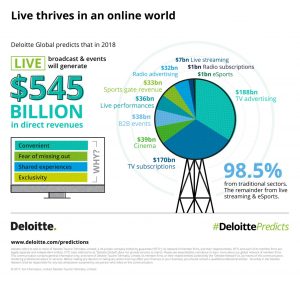
Deloitte TMT Predictions includes a number of consumer forecasts as well. Deloitte predicts that live broadcast and events will generate over $545 billion in direct revenues in 2018. Despite consumers’ capability to consume content on demand or attend events remotely, live consumption is thriving.

Also, in many cases, live content’s performance has been made more productive and profitable by digital. This indicates an increasing willingness from consumers to pay for digital content.

Deloitte also predicts that by the end of 2018, 50 percent of adults in developed countries will have at least two online-only media subscriptions, and by the end of 2020, the average will have doubled to four.

Kevin Westcott
Kevin Westcott, Vice Chairman – US Media and Entertainment Lead at Deloitte

Kevin Westcott, vice chairman, Deloitte LLP, and US media and entertainment leader, said, “The massive consumer interest in streaming, mobile, on-demand services and personalization are significant opportunities in 2018 for both content creators and brands. We see signs that consumers’ willingness to pay for this content will continue to accelerate in 2018 and beyond.”

The Future of the Smartphone

Smartphone adoption continues to grow.

By the end of 2023, more than 90 percent of adults in developed countries are expected to have a smartphone, with ownership among 55-75 year-olds reaching 85 percent. And Deloitte predicts that owners will interact with their phones on average 65 times per day in 2023, a 20 percent increase on 2018.

At the same time, Deloitte predicts 45 percent of global adult smartphone users and 65 percent of 18-24-year-olds will worry that they are using their phones too much for certain activities and may try to limit their usage in 2018.

Craig W. Wigginton
Craig Wigginton,
Global, US and Americas Telecommunications Leader, Deloitte

Craig Wigginton, Vice Chairman and Telecommunications Sector Leader, Deloitte & Touche LLP, said, “While traditional mobile services have matured in 2017, the opportunities presented by “made for mobile” content, IoT services, wearables and virtual reality represent a significant value proposition to both industry and consumers in 2018.’ Craig added, “The incredible connection between the mobile ecosystem and consumers shows every sign of accelerating in the year ahead.”

Now in its 17th year, Deloitte’s annual TMT Predictions provides an outlook on key trends over the course of the next 1-5 years in the technology, media and telecommunications industry sectors worldwide.

Overall, Deloitte Global’s predictions 2018 report provides valuable insight into transformation and growth opportunities over the next one to five years.

The Flow Bot Builder: An Uncompromising Approach To Bot Building

0
The Flow Bot Builder: an uncompromising approach to bot building

With the ubiquity of mobile devices consumers want to be able to reach business anytime, anywhere. Also, they don’t want to have to tinker with browsers and apps; they just want to be able to have a quick chat with someone right now that can answer their specific queries. Shoppers want the right answers to their questions and find what they need quickly. Buyers will want to make a purchase instantly. And customers will want their problems resolved quickly by customer support teams.

This requires businesses to have the infrastructure and teams to support always-on, instant chat with a large number of prospects and customers. This is driving the recent interest in conversational interfaces by marketers. Conversational experiences are set to transform virtually every business function from marketing to sales to support.

There are many tools available for building conversational experiences. However, many of them are built for developers with technical skills. Marketers and designers need simpler tools better suited to their requirements. They need the ability to create conversational flows quickly and easily and tie it into the air marketing campaigns.

To address this need, Gupshup recently launched the Flow Bot Builder. This is a graphical wysiwyg (what you see is what you get) tool that can be used by anybody irrespective of their technical skills. Designing a conversation with it is as simple as building a flow chart. Each node in the flowchart describes a bot statement or a potential user response. By creating a series of links between bot statements and user responses, you get a full conversation. Bot statements are not just plain text but can also include rich media such as images, audio, video and emojis. They can also include structured elements such as surveys, polls carousels and quick replies. This can take as little as a few minutes. Every step of the way, the marketer can quickly test the bot and iterate over incremental improvements.

Read More: Customer Support Could Be Key Differentiator To Win-Over Digitally Transformed Users

While there are other graphical tools out there, most of them integrate with just one or two messaging channels. By being built on the Gupshup messaging platform, bots built on the Flow Bot Builder can run on 30 plus messaging channels across text, voice, web and app.

Since there is an inevitable trade-off between graphical tools and programmability, most other graphical tools limit functionality in exchange for usability. Marketers that want their technical colleagues to program additional functionality or integrations find themselves severely constrained. However, the gupshup flow bot Builder is architected in a different way and side-steps the trade-off between usability and programmability. The Gupshup Flow Bot Builder is built on top of the Gupshup IDE Bot Builder. With one click, a user can convert the graphical flow into programming code and then have the full ability to make any programmatic changes to it. It is a fully integrated developer environment (IDE) that software developers are very familiar with. This means that large teams can collaborate where the marketer or the designer may use the flow Builder to create the conversational flow and the software Developers add the integrations and other advanced capabilities to it in parallel. This is a critical requirement for advanced marketers managing diverse campaigns.

The flow Builder is also fully integrated with common development tools such as GitHub. This means that bot builders can share their bots with others or clone bots built by others. This further drives reuse of previously built bots as well as collaboration among large teams.

The flow Builder can also be tightly linked with campaign tools. This means that marketers can run campaigns whose call to action links initiate a conversation that’s modeled by the Flow Builder. Now, campaigns can become conversational that is they can answer additional questions that users may have about the offer.

The flow Builder is a game changer and a huge step forward in usability, simplicity, extensibility, channel support and team support.

Recommended Read: There Can Be No Denying: Bots are Now Marketers

TechBytes with Chris Wareham, Senior Director, Product Management, Adobe Analytics

2
Chris Wareham
Chris Wareham Adobe Analytics

Chris Wareham
Senior Director, Product Management, Adobe Analytics

Data, data, and more data… modern marketers in 2017 are surrounded by more data types than previously known to the business group. Smart moves for data-driven marketing requires a clear distinction between audience data, customer data and B2B data… and of course, the impact they have on building intelligent automation. Rather than guessing with on-off data, top CMOs recommend marketers to rely on data management and analytics platform that provide a 360-degree view of customers for a better experience. A top-line customer intelligence platform, Adobe’s Analytics Data Workbench is a modern marketer’s greatest ammunition to develop customer propensity modeling, audience clustering and identify trends and relationships between large data sets. To understand how Adobe distinguishes between disparate data sets, we had the pleasure of talking to Chris Wareham, Senior Director of Product Management, Adobe Analytics.

Html code here! Replace this with any non empty text and that's it.

MTS: Tell us about your role at Adobe Analytics and the team you handle?
Chris Wareham:
I am the senior director of product management for Adobe Analytics. In that role, my team and I are focused on driving product strategy to meet the business needs of our customers and develop new analytics capabilities that are on the cutting-edge of what’s available in the marketplace.

MTS: How do you segregate disparate data and segment them into – Customer data, Audience data, B2B data?
Chris: 
When you have online and offline data coming in from a variety of sources, it’s key to build segment data in a way that helps create strong audience profiles to provide insights into your target demographics. The first step in this process is feeding both online and offline data into a centralized data-management platform (DMP). You can do this by matching up your offline information to self-identifying users online (syncing data when users log-in or identify themselves online in another way) or by working with third-party match providers, who can help you identify and match users within your offline data. Either way, fully leveraging your brand’s own customer data is essential to establishing a foundational data repository for audience targeting.

After you’ve gathered your own customer data (what we call “first-party data”), you can then start filling in information gaps with B2B and audience data (what we call second and third-party data) by identifying key use cases that you want to better understand and developing segments against those use cases. Suppressing your existing customers from prospecting and customer-acquisition campaigns alone will provide a massive lift in terms of return on investment (ROI) and demonstrate the value of the platform. While you may eventually have a DMP that contains hundreds or thousands of segments to define discrete portions of your customer base, it’s critical to establish broad pillars of audience definition so that more granular targeting is rooted in strong data.

MTS: How do you define these data sets at Adobe?
Chris: At Adobe, we think of these data sets as:

  • First-Party Data: We consider first-party data to be the data collected from a company’s CRM, website, analytics and any other touchpoints a customer has with a brand. This data is completely focused on the company’s unique customer journey when engaging the brand in channels the brand controls. This data is highly reliable because it consists of data from people who have voluntarily shown some level of interest in your products and services.
  • Second-Party Data: Second-party data is another brand’s first-party data, which is shared and accessible to a brand in a similar market or with similar audiences; for instance, a hotel chain might gain insights from data collected by a car rental agency. The customers of these types of companies share a similar consumer journey, so their behavior on each company’s site or app is useful to the other company’s marketing efforts. Second-party data sources have the potential to increase scale and accuracy.
  • Third-Party Data: Third-party data is data that marketers acquire from an entity that doesn’t have a direct relationship with consumers. Third-party data providers typically collect information from various interactions and use it to create audience profiles and provide insights as to preferences and behaviors of certain groups. Marketers can purchase third-party data to help supplement first and second-party data to build a more robust audience profile.

MTS: Tell us more about Analytics Data Workbench and how it paints the entire online + offline customer journey?
Chris: Analytics Data Workbench gives brands a platform to combine all their online and offline customer data. However, the real value comes with its predictive capabilities and real-time analysis, which allows brands to spot new opportunities quickly and easily. Data segmentation and audience clustering help brands sift and filter through vast amounts of data to discover unique insights, while churn analysis, propensity modeling and engagement scoring all help marketers understand customer behavior and the biggest influencers when it comes to purchasing decisions. With these insights in hand, brands can tailor and curate customer experiences that will resonate with its key audiences.

MTS: Despite cutting-edge customer intelligence available to them, why do marketers still find it hard to make accurate marketing attribution?
Chris: The challenge is two-fold: 1) having clear line of sight into customer interactions across channels and 2) being able to connect the business outcomes to the understanding of those channels. There are many tools available to marketers and they’re mostly characterized by archaic notions of what is important in driving business outcomes; The data exists to track users through their customer journey, so that our clients can build a cross-channel attribution strategy that is focused on driving business outcomes, not just trying to figure out which channel gets more marketing dollars.

MTS: How does Adobe Analytics make marketing attribution faster, easier and more accurate?
Chris: Adobe Analytics gives brands the power to visualize all data in one place, and allows them to accurately assign credit to every conversion. By going beyond static attribution and taking advantage of machine learning technology to shed light on the importance of every touchpoint on the way to a conversion, Adobe Analytics provides marketers with valuable insights on key moments throughout the customer journey.

MTS: What’s the next frontier for mobile-focused customer intelligence analytic platforms?
Chris: As the world becomes increasingly mobile-driven, we’ll see many new opportunities for consumer intelligence analytics platforms – perhaps most importantly, marketers will be able to leverage novel customer data through new interaction points, including voice assistants/search and IoT devices. With the increasing popularity of voice assistants (data shows that online sales of voice-enabled devices grew 39 percent year-over-year from 2016), it is increasingly important for brands to begin building their own voice-enabled customer experiences. And because voice-enabled devices and digital assistants allow consumers to engage through one of the most natural forms of communication, the data from these interactions allows for deepened insights into a customer’s relationship with a brand.

Mobile IoT devices like smartwatches, fitness trackers and more are another major frontier for customer analytics, as the data sets from these devices will provide the insights required for intensive personalization, increased use of beacon technology, further connection between online and offline data, and more.

MTS: How would marketing strategies change with the availability of real-time digital experience data?
Chris: That depends on the situation, but overall more data and more insight into what drives customers leads to greater ROI. Going beyond static attribution is key here as it helps marketers understand how different touchpoints add value, which then can inform strategies. That is the key – not just understanding what drove conversion, but seeing the full value of what led up to conversion, and adjusting spend and tactics accordingly.

MTS: Thanks for chatting with us, Chris.
Stay tuned for more insights on marketing technologies. To participate in our Tech Bytes program, email us at news@martechseries-67ee47.ingress-bonde.easywp.com

Also Read: TechBytes with Jeff Allen, Senior Director, Product Marketing, Adobe

Interview with Vijay Kasireddy, CEO, Fiind

0
Vijay Kasireddy, Fiind

[mnky_team name=”Vijay Kasireddy” position=”Co-Founder and CEO, Fiind”][/mnky_team]
[easy-profiles profile_twitter=”https://twitter.com/vijaykasireddy” profile_linkedin=”https://www.linkedin.com/in/vijaykasireddy/”]

“In the case of identifying a customer’s likelihood to buy, triangulation of multiple signals and effectively dealing with conflicting answers hold the keys to better contextual data management.”

On Marketing Technology

MTS:  Tell us about your role and how you got here? What inspired you to be part of an AI driven B2B martech company?
The idea of continuous learning or improvement is simple but profoundly magical. Consider the below examples.
• It takes just 7 years to double money at 10% annual growth rate, which happens to be the average return of S&P index since 1928
• It takes just 1 year to double marketing conversions at 6% monthly improvement, and some organizations get there much faster
• Put a coin in the first square of chess board, double in every subsequent square (2, 4, 8, 16 etc.), gets to 36 quintillion (that is 18 zero’s) in the last square, more than all the coins in the world
I had the good fortune to experience continuous improvement with magical results, personally and professionally, early on in my career at i2, at supply chains of several Fortune 500 companies, and latter at Microsoft, and now with some of our customers.
More often than not, I experienced the lack of continuous improvement, leading to a lot of waste and weariness. Imagine if marketing could be 2X better at 1/2X of cost. I am inspired by the potential of AI to make it easier to realize such benefits in marketing and sales through closed-loop intelligence.

MTS: How does Fiind fit into a modern CMO’s martech stack?
Fiind adds Intelligence & Planning layer to the current martech stack such as CRM and Marketing Automation. Fiind compliments the stack with closed loop intelligence facilitating continuous improvement. It starts with enriching the internal data across martech stack with external data to identify the best customer opportunities to plan and execute for the maximum return on investment. The resulting intel (segments, leads, buying signals, pitch points etc.) is published on everyday martech tools such as CRM, Marketing Automation, Email or a Browser for easy access and action.
The continuous learning engine is automatically executed with every cycle where the results are analyzed, models are refreshed, and intel is updated.

MTS: How do you see the technology evolving around contextual data management in the coming years?
Context is a function of the interpretation and validation. The interpretation technologies such as NLP are reasonably mature but the validation technologies need a lot of work, especially with false positives and false negatives. In the case of identifying a customer’s likelihood to buy, triangulation of multiple signals and effectively dealing with conflicting answers hold the keys to better contextual data management.
While the technology is important, it goes hand in hand with the process. It is as important to have a continuous learning engines and closed loop processes to allow for in-market feedback for validation (or invalidation).

MTS: What are the pain points for marketers in leveraging predictive intelligence platforms for refined sales enablement and automation?
Some of the common pain points or bottlenecks that we see with customers are:
1. Getting internal data from multiple sources
2. Bad data quality that takes time to correct
3. Human bias leading to trust issues of the models
4. Short term mindset without a continuous improvement process

MTS: 2018 is expected to be the ‘Year of Hyper-Personalization’. How should marketers firm up their action plan to better optimize marketing automation campaigns?
I would say the number 1 action plan is to have a long term continuous learning engine in place. The plan starts with a process that determines baseline metrics such as conversion rates, the ability to analyze results, refresh models and execute on changes. This ensures that the marketing optimization is always-on and not a one-time thing, allowing marketers to ride out the short-term ups and downs.

MTS: What startups are you watching/keen on right now?
Here are my top ones:
1. Essential. They are making next gen phones and home products
2. Cover. They make accessory dwelling units to solve housing supply issues
3. Astral AR builds advanced drones to save people in dangerous situations
4. Treehouse. Online tech school
5. The innovation from enterprise products such as Office 365, Azure, Slack

MTS: What tools does your marketing stack consist of in 2017?
Our marketing stack comprises the usual tools such as email, CRM, marketing automation, collaboration, workflow and Fiind of course. We are excited to be dogfooding our own technology to continuously innovate, learn and improve.

MTS: Could you tell us about a standout digital campaign?
One campaign that we ran was the customer user group campaign which caught like wildfire. The goal was to get existing customers come together at digital and physical events, to share their successes and challenges, with each other, prospects and product teams. The investment was minimal, the sign ups were almost 100%. The customer satisfaction, the existing customer revenues and the new customer adds all went up significantly. It has now become a self-sustaining engine expanding from few hundred members to tens of thousands globally.

MTS: How do you see the conversational intelligence platforms evolving with the maturity of AI/ML technologies?
I think that it is unlikely for one platform to hold the keys to all the data and the intelligence. This means there is a need for more openness and interoperability across platforms so one platform could harness the strengths of other platforms. An example is such a partnership is between Alexa and Cortana. The users benefit by accessing everything through their preferred platform.

This Is How I Work

MTS: One word that best describes how you work.
Learning – whether it’s the work with colleagues or customers or doing something by myself, this helps me to approach every situation with a fresh lens without bias. I try to strive for the first-day-on-the-job-freshness every day.

MTS: What apps/software/tools can’t you live without?
These are the everyday essentials like Office 365, WhatsApp, Google Maps. I try to be away from electronics/software from time to time but it gets harder.

MTS: What’s your smartest work related shortcut or productivity hack?
Meditation is my shortcut to productivity and wellbeing. This allows me to focus on one thing at a time, with minimal distraction, bias, and worries.

MTS:
What are you currently reading? 

I am reading a few books. Sapiens, A brief history of humankind by Yuval Noah Harari; and Shoe Dog by Phil Knight for the second time. I like to read and reflect, and sometimes re-read.

MTS: What’s the best advice you’ve ever received?
It’s not always words but actions that sometimes can have a great impact. The best action was the unconditional love from my parents.  I realized that if I did anything with a fraction of that love, it would be well done!

MTS: Something you do better than others – the secret of your success?
I bring solutions to the table very quickly. Since I spend most of my time understanding and solving cross-functional challenges, it goes back to the importance of collaboration in today’s environment. The pace of change that we’re all operating under requires teams to come to the right solution quickly and then collaborate, and hold each other accountable, to deliver solutions effectively and efficiently.

MTS: Tag people from the industry whose answers to these questions you would love to read:

Sanjiv Sidhu and Kevin Nazemi

MTS: Thank you Vijay! That was fun and hope to see you back on MarTech Series soon.

[vc_tta_tabs][vc_tta_section title=”About Vijay” tab_id=”1501785390157-b58e162d-0ae25a4b-c27aca64-108e51b0-80edaf37-bd3d0369-cfe1″]

Always Learning, Vijay is experienced in designing, incubating and scaling several enteprise software applications.

An engineer by education, Vijay started his career as architect of supply chain optimization applications at i2 Technologies (acquired by JDA) that were successfully adopted by Fortune 500 companies. As i2 grew to global leader, he got a chance to extensively travel to Asia and Europe, learning about different cultures while assessing and advising customers on supply chain strategies.

After i2, Vijay spent 10 years at Microsoft in various marketing and business leadership roles, incubating and scaling products such as Office 365 (from BPOS) and Dynamics 365 (from Axapta), with partners across industries and segments. During this incredible growth journey, he learned about and developed appreciation for using digital, cloud and data technologies for achieving better and easier ways to win customers and optimize customer value.

Seeing the opportunity to apply data and AI/ML in new ways, Vijay co-founded Fiind. Fiind helps businesses find their customers efficiently using AI – by enabling marketing and sales to tune into sales signals on every day tools. Fiind’s intelligent apps are sales acceleration engines across new, upsell and cross sell revenue streams with proven improvements in conversions by as much as 10X. Fiind specializes in sales signal store (data), intelligence with context (models) and easy access and action (users).

[/vc_tta_section][vc_tta_section title=”About Fiind” tab_id=”1501785390320-2d44fa50-740c5a4b-c27aca64-108e51b0-80edaf37-bd3d0369-cfe1″]

Fiind Logo
Fiind helps businesses find their customers efficiently using machine learning – by enabling marketers and sellers tune into signals that customers send prior to buying. Fiind’s library of over 100 million signals serves as a Customer GPS with answers to questions such as who is likely to buy (and what and why). The digital signals process data, structured and unstructured, social and nonsocial, for actionable insights. They are available anywhere, anytime on everyday tools such as CRM, Email and Browser – to help win the right customer at the right time with the right message. Fiind’s gifted data scientists, engineers and consultants are obsessed about winning customer trust. Your customers are sending signals. Are you tuned in?

[/vc_tta_section][/vc_tta_tabs]
[mnky_heading title=”MarTech Interview Series” link=”url:https%3A%2F%2Fmartechseries-67ee47.ingress-bonde.easywp.com%2Fcategory%2Fmts-insights%2Finterviews%2F|||”]

The MTS Martech Interview Series is a fun Q&A style chat which we really enjoy doing with martech leaders. With inspiration from Lifehacker’s How I work interviews, the MarTech Series Interviews follows a two part format On Marketing Technology, and This Is How I Work. The format was chosen because when we decided to start an interview series with the biggest and brightest minds in martech – we wanted to get insight into two areas … one – their ideas on marketing tech and two – insights into the philosophy and methods that make these leaders tick.
Facebook & Google: A Media Duopoly Under Scrutiny

0
Facebook & Google: A Media Duopoly Under Scrutiny

IDGFrom their humbler beginnings as a social media platform and a search engine, respectively, Facebook and Google have today become mass media for many audiences, providing content focusing on national politics, prominent brands and individuals, and much, much more. A 2016 Pew study found that at least 66% of Facebook’s 2 billion users rely on the outlet’s news feed as a news source.  For many, the “Big Two” even serve as their only sources of media. More than just a filter bubble, consumers are being fed information designed to drive clicks rather than to inform.

The Facebook-Google duopoly is expected to account for over 60% of all annual digital advertising revenue in 2017. These players have had a series of missteps years in the making come home to roost: targeted misinformation campaigns, transparency issues, emotional manipulation experiments, and the repeated misstating of advertising metrics. Once seen as the holy grail for marketers, advertisers’ trust and confidence in these platforms has now changed. The once smooth surface is developing cracks as both of these outlets have lost quite a bit of their luster and more questions arise for marketers.

Read Also: 5 Things You Gain by Closing the Marketing Operations Gap

Consumers have grown increasingly wary of Facebook and Google’s shortcomings as well. There will be increased scrutiny placed on these behemoths in 2018, more so because it is an election year. Throughout 2017, it became increasingly apparent that Facebook and Google have grown less reliable as content sources, with major issues surrounding emotionally-charged false viral videos, siloed shareable content, and bad actors gaming the system. How are consumers supposed to trust the information sourced from the duopoly that let them down on so many an occasion just one year prior?  Appropriately, the magnifying glass is now firmly trained on both the content and advertising sides of the house and it will take more than tweaked algorithms and transparency-focused publicity campaigns to regain trust. Simply put, audiences don’t know who to believe.

Without a doubt, marketers have taken notice of the growing skepticism of consumers to these players as media sources – marketing strategies still revolve around the consumer. An increased focus on transparency and trusted content lead back to familiar territory: driving growth and ROI.  This is a great development for marketers and brands. In 2018, vanity marketing, manipulative tactics and “clickbait” content will be replaced with value marketing, with an increased focus on what works for business. Ultimately, for brands and marketers alike it’s always been about return on investment, and the money will pour into whatever vehicle can best show a measurable ROI.

Read Also: Five Smart Campaigns To Make The Most Of GeoLocation

The “Big Two,” which once seemed too big to challenge, are increasingly being evaluated by the same standards as all media outlets – they’re no longer infallible. This is good news for both consumers and marketers. And it is a great way to enter 2018.

GDPR Will Drive A Coach And Horses Through The Online Advertising Ecosystem

0
GDPR Will Drive A Coach And Horses Through The Online Advertising Ecosystem

smartology

Smartology Explores Digital Advertising Industry Trends For 2018

GDPR, advertiser-agency relationships, YouTube and programmatic native trading will all be in the spotlight in 2018 believes Smartology.  The contextual digital advertising company has the following insight for the year ahead:

GDPR will change how companies sell to users

GDPR will drive a coach and horses through the online marketing and advertising ecosystem, which has been too dependent on third party cookie based tracking to date. Effectively it ensures the consumer has to give companies explicit consent to use their data and will change the way companies market and sell to users. Within the advertising industry, companies relying on user data for targeting ads, retargeting and capturing user data for lead generation will be most affected. However, companies that use more transparent methods to engage users will find greater traction.

Read More: Three Out of Four Companies Unprepared for GDPR: Openprise Poll

Small specialist agencies will support in-house teams

The numerous scandals to hit the advertising industry in 2017 have led to companies refocusing on where their ads appear and demanding transparency from partners, especially within automated buying. The trend for companies bringing their media buying in-house looks set to continue, with the future of the current agency model coming under increasing pressure. Smaller, more specialist agencies that support in-house teams ensure brands have more control on how their budgets are being spent and where their ads appear. Sophisticated advertisers will be using more metrics, with post-click analysis giving them a fuller picture of dwell time, on site interaction, outcomes and user value.

YouTube risks ‘News of the World moment’

Following the YouTube brand safety issues, brands moved back to advertising on platforms where content is curated by humans, rather than algorithms; ITV, Channel 4 and Sky have reported recent jumps in ad revenue for the video-on-demand platforms.  YouTube now faces a potential ‘News of the World moment’ as advertisers tire of repeated transgressions and pull their ads altogether. This is reinforced because news organisations and broadcasters have plenty of inventory to offer as well as a vested interest in exposing YouTube’s problems.

Native ad exchanges will fuel growth in native programmatic

Premium publishers will continue to strengthen their advertising business with native units that provide new revenue streams. Native programmatic combines the benefits of native branded content with automated buying; the increasing advent of native ad exchanges such as Triplelift and the ability to buy native inventory through more established exchanges such as AdX will bring about further growth of automated trading of native inventory in 2018.

Mark Bembridge, CEO at Smartology: “Smartology straddles the worlds of media owners, agencies and advertisers, so has a unique perspective on current and future trends in the market. 2017 has seen digital advertising suffer severe growing pains and these are unlikely to disappear in the near future.  However, they are paving the way for a more transparent, effective and robust industry, that will better serve the needs of advertisers, publishers and consumers.”

Recommended Read: Io-Tahoe Unveils Data Discovery Solution To Enable GDPR

Interview with Jen Spencer, VP, Sales and Marketing, SmartBug Media

0
Jen Spencer Smart Bug Media

[mnky_team name=”Jen Spencer” position=” VP, Sales & Marketing – SmartBug Media”][/mnky_team]
[easy-profiles profile_twitter=”https://twitter.com/jenspencer” profile_linkedin=”https://www.linkedin.com/in/jenspencer/”]

“The lines between content marketing and sales enablement are blurring daily, but a piece of sales enablement material should bridge the customer’s marketing to sales experience. “

On Marketing Technology

MTS: Tell us about your role and how you got here? What inspired you to be a part of an inbound marketing agency?
As Vice President of Sales and Marketing, my role involves leading SmartBug’s sales, marketing, and brand strategy; extending the company’s leadership among the HubSpot partner ecosystem; and providing a competitive entry into several new market segments.

While I’m new to the SmartBug Media team, I was previously a client over the course of three and a half years at both Allbound and nettime solutions. As a client, I always had a great deal of respect for SmartBug, and for the last few years, they made me look like a rock star. Now that I have joined their team, I am excited about this opportunity and look forward to serving our customers and collaborating with software vendors to help clients see the results they need.

MTS: With the growing importance of social messaging, how do you see personalized email campaigns fitting into inbound marketing?
Personalization just makes sense with inbound marketing. The goal of inbound is to attract your buyer personas and nurture them based on external factors that you gather about them and their company, and internal factors you can track using your entire marketing stack. The thing is, every communication needs to be relevant more than it needs to be personalized. It’s not enough to start your automated email message with “Hi {first name}, …” It’s what comes next that has to feel personal to that customer.

MTS: How should marketers leverage video assets to build their inbound marketing strategies?
When I was a teacher (high school English and theatre, a long time ago …) I made it a point to deliver content in many different mediums because I knew my students did not all learn the same way. Some needed to read and re-read a textbook. Others needed to discuss the topic out loud. A few had to associate the content with TV shows on their DVRs or songs on their iPods (Wait, did we have iPods then? Might have been a Discman.) Your customers are no different. You need to try to engage as many of their senses (and sensibilities) as possible. To ignore an entire medium such a video could be ostracizing an entire customer base. Instead, consider video one of many mediums you need to use to deliver your message.

MTS: How do you distinguish between content marketing and sales enablement assets?
The lines between content marketing and sales enablement are blurring daily, but a piece of sales enablement material should bridge the customer’s marketing to sales experience. Some of the most effective sales enablement assets aren’t customer-facing; rather, they are persona and pain-based talking points or follow-up questions a sales rep can use after a prospect attends a webinar.

MTS: What are the key aspects of promoting an event using inbound marketing capabilities? Would you share with us some unique examples from the industry that you witnessed or were part of?
One of my favorite examples of event promotion was a microsite that SymphonyTalent used to build momentum months prior to their exhibition at HR Tech, which is one of the largest conferences in the HR space. The team focused their efforts on inbound lead generation and tackled topics that would be addressed at the event. They generated leads for the event before the event using specialized content, not generic swag.

MTS: What startups in martech landscape space are you watching/keen on right now?
Right now our team is having a blast building out custom dashboards for our clients with Databox, which allows us to pull in metrics from HubSpot and Google Analytics to dive deeper into web stats. Plus there are about 50 other connectors we can start adding to give our clients all of their demand generation data on a single pane of glass.

The other platform that I’m itching to play with is Sigstr. They announced a HubSpot integration at INBOUND this fall, and I can’t wait to use it for event marketing to drive webinar registrations. With Sigstr’s platform, you can customize graphical calls-to-action in email signature lines based on a contact’s existence on one of your HubSpot smart lists.

MTS: What tools does your marketing stack consist of in 2017?
HubSpot, HubSpot, and HubSpot. We use HubSpot Marketing Platform – Enterprise, HubSpot CRM, and HubSpot Sales Pro. Our website is even HubSpot-hosted. We use PandaDoc for building, delivering, and tracking client proposals and contracts. We host our videos in Wistia. Zoom is our platform of choice for internal and external video conferencing, and we also use their webinar delivery solution. Finally, we use HotJar for tracking visitor engagement. If we make a change to our site, we take the time to see what impact that change had in helping us achieve our goals.

MTS: Would you tell us about your standout digital campaign? (Who was your target audience and how did you measure success?)
I have to tell you a story about one of our clients: Conversant Bio. They’re the leader in tissue procurement for pharmaceutical research, and the issue they were having was their messaging and marketing approach wasn’t aligned to attract the best prospects for them. The principal challenge lay in Conversant Bio reaching various audiences within the research community, where disease states are vertical. For example, cancer researchers are not interested in diabetic tissue content. We recommended an aggressive, targeted inbound marketing campaign to attract researchers by focusing campaigns in specific disease states. We delivered fully managed campaigns that included keyword analysis, development of persona-centric content, targeted and optimized blogging, social media promotion, and conversion paths to bring prospects into Conversant Bio’s sales cycle. The results were significant: A 250% month-over-month increase in lead growth and an increase in MQLs from 10% to 80% — so they generated more leads and they were much more qualified.

MTS: How do you prepare for an AI-centric world as a marketing leader?
With a mixture of juvenile excitement and jaded skepticism (but leaning towards excitement). Like any innovation, there are companies and people who will do it well, and there are those who will bastardize it. If implemented properly, AI can enhance our marketing strategies and bring us one step closer to being able to better serve our customers by creating unique, personal, relevant experiences at scale.

This is How I Work

MTS: One word that best describes how you work.
Passionately

MTS: What apps/software/tools can’t you live without?
HubSpot. I was sending an email campaign yesterday via another automation tool for Girls in Tech Phoenix (I’m a board member there), and it made me so sad.

MTS: What’s your smartest work related shortcut or productivity hack?
I have a well-organized set of Evernote notes (do we just call them Evernotes?) where I log random, one-off pieces of information that aren’t yet documented in our internal knowledge base. It’s been especially helpful in sales with quoting one-off projects that may not be part of our core offering. If I find myself returning to that note again, and again, it’s time to evaluate the need.

MTS: What are you currently reading?
Ready Player One by Ernest Cline. My sons and I are dystopian novel fiends. People tend to be surprised that I’m not much of a business book person. I prefer to escape in a book, but I seek business and leadership inspiration from podcasts.

MTS: What’s the best advice you’ve ever received?
Funny thing … most of the time when someone starts with, “Let me give you some advice …” what comes next is nothing short of horrific. The best advice I’ve been given is to ask myself, “Does this need to be done today?” I have a bad tendency to overload my calendar, say yes to way too much, and overextend myself to my own detriment. It’s good for me to have people in my life who remind me that tomorrow is another day.

MTS: Tag the one person in the industry whose answers to these questions you would love to read:
Noah Mithrush

MTS: Thank you Jen! That was fun and hope to see you back on MarTech Series soon.

[vc_tta_tabs][vc_tta_section title=”About Jen ” tab_id=”1501785390157-b58e162d-0ae25a4b-c27aca64-108e51b0-80edaf37-bd3df98b-67db”]

Jen Spencer is Vice President, Sales & Marketing for SmartBug Media, a leading intelligent inbound marketing agency that assists businesses in generating leads; increasing awareness; and building brand loyalty through inbound marketing, digital strategy, design, marketing automation, and PR.

Prior to her role at SmartBug, Jen was the VP of Sales and Marketing at Allbound, a partner sales acceleration software-as-a-service solution provider. She was responsible for developing and executing an inbound demand generation strategy, raising brand and market awareness for Allbound, and channel sales and marketing. She helped the company reach 50 percent growth in year-over-year traffic and a 363 percent increase in sales leads.

While serving as Director of Marketing at nettime solutions, acquired by Paychex in June 2014, Jen developed and executed inbound lead generation and content marketing strategy while supporting a channel of referral, reseller, co-branded, and white-labeled partners. Through her role, the company saw a 103 percent increase in website traffic, a 415 percent increase in direct sales leads, and an 89 percent increase in revenue.

Whether she’s writing a blog, delivering a speech, interviewing clients or managing agency relationships, aligning with her audience is always at the forefront of her mind. Jen subscribes to the notion that “we’re all in this together,” and great communication leads to great partnership.

[/vc_tta_section][vc_tta_section title=”About SmartBug Media” tab_id=”1501785390320-2d44fa50-740c5a4b-c27aca64-108e51b0-80edaf37-bd3df98b-67db”]

smartbug media

SmartBug Media is a leading inbound marketing agency enabling companies to get found online by qualified prospects and increase leads, customers and reach. We help companies achieve better marketing results by combining content marketing, social media, informational products and white paper marketing. We are also a HubSpot Certified Partner.

[/vc_tta_section][/vc_tta_tabs]
[mnky_heading title=”MarTech Interview Series” link=”url:https%3A%2F%2Fmartechseries-67ee47.ingress-bonde.easywp.com%2Fcategory%2Fmts-insights%2Finterviews%2F|||”]

The MTS Martech Interview Series is a fun Q&A style chat which we really enjoy doing with martech leaders. With inspiration from Lifehacker’s How I work interviews, the MarTech Series Interviews follows a two part format On Marketing Technology, and This Is How I Work. The format was chosen because when we decided to start an interview series with the biggest and brightest minds in martech – we wanted to get insight into two areas … one – their ideas on marketing tech and two – insights into the philosophy and methods that make these leaders tick.

5 Things You Gain by Closing the Marketing Operations Gap

0
marketing
5 Things You Gain by Closing the Marketing Operations Gap

Historically marketing focused on local and static connections through three major channels: print, TV, and radio. Brands dominated the conversation and customers were just recipients of this messaging. Those days are long gone. With the explosion of digital touchpoints, marketers today manage an average of 23 channels.Customers are demanding a more personalized, relevant experience brought to them on each of their chosen channels and who knows what tomorrow will bring, with the emergence of new channels like IoT and chatbots.

Where change and stagnation meet: Despite all this change, most marketing organizations are still operating in the old world. They have the same processes, the same levels of resources, and the same agencies of the past. But these old ways of working just don’t move fast enough or scale to meet their personalized, omnichannel goals. Targeting more channels with greater speed strains marketing operations. This scenario gives life to some common scenarios:

  • Ineffective processes. The last time you worked on a project, how much time did you spend finding the right assets? Could team members share and capture feedback easily?  How easily were you able to get brand approval for a specific campaign? Traditional marketing processes are usually ad hoc and therefore aren’t scalable for growing digital needs. Creativity and velocity lose out to these day-to-day inefficiencies. One brand I spoke with told me they had to cross the street, go to another building, and leave a post-it note on someone’s desk to get content approval. Another brand told me it takes them over 40 days to get any new experience approved, even though their customers wanted experiences delivered immediately.
  • Ineffective resource management. In your organization, does each person know the all of the tasks on their plate at any given time? Do marketing leaders easily have insight into who has capacity to work on more activities? Are workloads balanced among team members so no one burns out? Do you know which parts of the projects your teammates are managing?  Outdated operations lead to imbalances of work, lack of visibility into your organization, and missed deadlines.
  • Toxic work environment. One retailer told us that their current way of working is to be told Monday which campaigns to run; Wednesday being told that the campaign isn’t happening anymore; and then working late on Friday night to come up with a new campaign idea. This way of working—isn’t conducive to a strong and positive marketing culture and is a recipe for burnout. This is crucial because employees consider company culture a major component of their own professional success.

According to a Glassdoor survey, 76% of job seekers want details on what makes a company an attractive place to work. Knowing basic information such as what to do, who to ask, and how individual projects fit together provides the day-to-day structure allowing you to share your most inspired ideas. Not knowing these plus keeping up with unrealistic deadlines leads to frustration at co-workers and personal stress.

You can’t keep up in the current scenario, we call this the Marketing Operations Gap. So many of marketers today are preoccupied with the next best way to execute and deliver experiences, that they aren’t efficiently running their marketing operations so they can do more with the resources and budget they have.

Read More: Data Intelligence Company Thasos Brings Much Needed Transparency to Retail Foot Traffic in Its Report

Close the Marketing Operations Gap with New Technologies

A 2017 study from Sirius Decisions found 40% of CMO’s expect to invest in marketing resource management and business intelligence technology in the next two years. Why? Because digital technology is fundamental to the transformation needed to deliver valuable experiences to customers. It is the only way to increase the speed and agility required to bridge the gap between limited resources and increasing expectations, and it’s essential to gain an advantage over the competition.

5 Critical Benefits of Marketing Operations Technologies

Marketing operations technologies provide the following benefits when closing the marketing operations gap:

  1. Single source of truth. Do you or the members of your team waste time digging through email threads or logging into multiple applications for the information you need?  A single source of truth allows you to have the information you need at the click of a button. Whether you’re a CMO needing to report ROI, a designer looking for an approved image, or a project manager keeping things moving, you know where to go for accurate and current information. Bringing your content, data, people, and budgets together in one place not only saves time but ensures more efficiency and accurate marketing operations.
  2. Streamlined global processes. The number of people involved in a single campaign can be mind-boggling. When coordinating a creative campaign, it’s critical that everyone is on the same page from start to finish. Positive customer experiences require alignment across the entire organization. One central hub for content, data, people, and budgets allows marketers to share information seamlessly and eliminates time wasted when collaborating across multiple systems and creates a more streamlined global process.
  3. Marketing agility. Does launching a campaign feel like a disjointed, frenzied process? You know that meeting customer expectations requires an unprecedented amount of alignment and speed. Automating agile marketing will alleviate confusion on task ownership, prioritization, and give you clear visibility into tasks, projects, and schedules. Workflows today should be efficient, optimized, flexible, and intelligent. The ability to learn as you go and tailor workflows to the frameworks of past successes is critical to meeting the scale demanded by the consumer.
  4. Visibility and alignment. Have you ever burned the midnight oil to get a campaign out the door only to have it canceled at the last minute? Or worse, you get your campaign out, just to have it pulled back in due to misalignment with the business strategy? What about the digital creative that wasn’t aligned with the point of purchase materials, creating two different customer experiences? Marketing leaders need to close the gap to have better visibility into marketing groups’ activities and to make connections between channels, regions, and business goals.
  5. Empowered marketing culture. When you’re frustrated you are not doing your best work –  even worse, cultural decline, people burn out, and turnover ensues. Once you shift the control back to marketing through the use of technology you are poised to reach peak productivity. You know what to work on, you have the time in your day to give it your best, and you know how the project fits into the overall strategy. Finding assets and asking questions is easy because you know where to go. Quality and agility replace frustration and bottlenecks – so you can deliver exceptional experiences.

Recommended Read: Nielsen and JD.com Collaborate on Multi-Touch Attribution Solution for Marketers

TechBytes with John Steinert, Chief Marketing Officer, TechTarget

0
John Steinert TechTarget

John Steinert
Chief Marketing Officer, TechTarget

With greater accessibility to Big Data, modern marketers are exploring new ways to leverage data and scale targeting-related challenges at various stages of the buyer’s journey. Combining buyer’s profile with the intent data, marketers can build powerful automation channel and turn customer insights into a lead scoring machine. Powered by insight, Purchase Intent Insight by TechTarget is one such solution that amplifies intent behaviors from accounts and contacts active within your target segment to accelerate demand actions across marketing and sales operations. And then, TechTarget also partnered with the leading marketing and sales intelligence solution providers, DiscoverOrg and HG Data. To understand how marketers can master purchase intent in B2B marketing in 2018 and lift ABM performance with these partnerships, we spoke to TechTarget’s Chief Marketing Officer, John Steinert.

Html code here! Replace this with any non empty text and that's it.

MTS: Tell us about your role at TechTarget and the team you handle?

John Steinert: I am the Chief Marketing Officer at TechTarget. My team and I are responsible for bringing the power of purchase intent-driven marketing and sales services to technology companies. Our 1,200+ customers look to us to learn how to leverage TechTarget’s unique purchase intent insight and advanced portfolio of marketing products and solutions to create more demand, achieve better conversion rates, accelerate ABM effectiveness and deliver a more substantial contribution to sales.

MTS: How do you build Purchase Intent for audiences across the buyer’s journey?

John: Real purchase intent insight is actually made, not scraped from general-purpose websites. It begins with relevant, useful content that provides critical value to professionals as they look to solve business challenges and make buying decisions. By observing and learning from their content consumption patterns as they happen, marketers can market and sellers can sell at the right time with greater relevance. Our ability to deliver real purchase intent starts with our extensive content footprint and the hyper-relevant audiences that we’ve built.

By creating abundant, high-quality editorial content across more than 140 highly targeted technology-specific websites and over 10,000 topics, TechTarget attracts and nurtures communities of technology buyers researching their companies’ information technology needs.

This content is designed to aid enterprise technology buyers in making real purchase decisions.

By understanding these buyers’ content consumption behavior, as well as the recency and velocity of activity within specific technology segments, we are able to deliver deep purchase intent insights on both an account and contact level to fuel efficient and effective marketing and sales activities. We provide these insights to customers within our Priority Engine platform, a SaaS-based solution that provides direct, real-time access to ranked accounts and named prospects actively researching purchases in specific technology categories.

MTS: How do the new improvements to the Priority Engine accelerate sales conversions?

John: Priority Engine’s new improvements accelerate sales conversions by providing more key information that B2B salespeople need to penetrate and drive engagement with accounts that are on a buyer’s journey. The platform provides direct access to real buyers at a critical point in time by ranking accounts based on purchase intent within their very specific technology segment. It helps the sales team identify and focus on the accounts that matter the most and helps them better identify and reach the entire Target Buying Team involved in the purchase, including active researchers and relevant stakeholders. With even better account coverage and our rich behavioral insight to personalize outreach, sales teams are able to convert prospects into customers at a higher rate.

MTS: Would you provide us a clear insight into how the latest partnerships with DiscoverOrg and HG Data offer deeper sales intelligence and better audience targeting?

John: With DiscoverOrg, we are able to expand our coverage of key stakeholders and buyers at accounts who are involved in the final purchase decision. We can now combine TechTarget’s insights into account purchase intent and named, active prospect activity with DiscoverOrg’s deep reach into an account’s extended buying team, all in one unified solution. This is something that is very powerful for our customers because it provides large productivity improvements.

In addition to deep reach into active accounts, TechTarget Priority Engine provides advanced views on their topical interests as well as information on which vendors they are considering. This is based on the full breadth of their editorial and promotional content consumption within specific technology segments. Our direct feed to HG Data’s rich technographic data ensures that marketing and sales teams’ have the best information available for knowing where a prospect is starting from and where they are heading.

These new partnerships bring improved audience targeting, deeper sales intelligence and new account insights to our customers to help them achieve vastly improved ROI for ABM, demand generation and sales enablement.

MTS: What are your views on GDPR and its impact on how ABM platforms utilize data? Would it derail the way modern CRMs intend to unify data for marketing and sales?

John: We welcome GDPR at TechTarget, as the relevant compliance efforts will initiate a more unified environment for marketers and a stronger relationship with their customers. GDPR is all about complying with an evolving sense of best practice, so marketers will only have a problem if the data they’re sourcing is of unknown and unmanaged provenance. It doesn’t really affect ABM platforms per se, it’s about the data — and the sourcing and management of it — that is being used. If you’re identifying a company through an IP lookup and using an email in your database that is permissible, for instance, there’s no issue. But if you’re obtaining email addresses from other sources that aren’t GDPR-compliant, then you could have a problem.

What GDPR means for marketers’ futures remains to be seen, but the bottom line is that marketers need to know where their data came from, the source needs to be compliant and they need to be able to manage the data competently. This won’t derail the way current processes are handled, it will just require more rigor and process capability. If companies already have mature data handling processes, they shouldn’t have any issue.

MTS: How would the landscape of predictive-driven content marketing and display advertising campaigns evolve over the next five years?

John: Predictive success is all about starting with the best possible data and then using it to the fullest. It all depends on having the right inputs and then generating the right outputs. The model itself achieves nothing for a company, it’s what they do with it. Predictive modeling has been around for a long time. What’s really new is a combination of the toolsets that make it easier to do and the concept of applying it to B2B marketing and sales.

The key determinants in how predictive will evolve over the next five years will be the quality of the data sources that are used to feed it, the evolution of the methods used to present and synchronize the advertising across touchpoints, and the behavior of the targeted audiences in response to it. If the data doesn’t improve, models will remain too weak to be worth their cost.  This will cause provider consolidation (which we are already seeing). If synchronization of delivery methods remains out of reach for many in B2B, the lift that we’ve proved can be achieved will remain out of reach to many.

And if the advertising itself fails to add recognized value — or at a minimum, support a business model which customers value — we will continue to see growth in blockers and blocking behaviors of all kinds. Nothing will kill advertising and content marketing like bad advertising techniques and bad content. Although modeling techniques will continue to drive down the cost of bad marketing by making it very clear what doesn’t work, predictive on its own will have little positive impact on specific campaign performance. In reality, this is what marketers are really pursuing — unless they use better data going into the model and take better actions when it comes out. In short, what we’ll see is an accelerated performance separation between the good marketers and everyone else.

MTS: Thanks for chatting with us, John.
Stay tuned for more insights on marketing technologies. To participate in our Tech Bytes program, email us at news@martechseries-67ee47.ingress-bonde.easywp.com

The Coming of New Marketing Mix with GDPR: Automated Consent Management for Websites

0
Automated Consent Management
The Coming of New Marketing Mix with GDPR: Automated Consent Management for Websites

Using automated consent management solutions, organizations can document and provide evidence that you have the necessary consent, with the administrative, contractual, economical downsides and risks associated

It took four years of intense debate and preparation to finally approve the General Data Protection Regulation (GDPR). As the enforcement date approaches, global organizations operating in the EU are aligning their efforts to harmonize their data privacy and comply with the set standards. Microsoft and SAP have taken the correct measures to be GDPR compliant. However, 60% of companies have not taken the same initiative. Secureprivacy.ai is currently one of the only GDPR solution companies, which has received legal validation from EU lawyers. The new privacy requirements will be enforced as of May 25, 2018.

What you need now in 2018?

Automate your GDPR compliance with built-in tools and technologies that allow users to opt-in and opt-out of previously given consent in just one click and enable administrators to extract reports with visual screenshots of consent provided. All this ensures compliance without having a UX nightmare! Read how Securityprivacy.ai can help you overcome the GDPR-UX challenge.

On May 25, 2018 the EU will enforce the General Data Protection Regulation, which protects the rights of EU citizens to control their personal data.

Under the new requirements, any company that deals with private data from an EU citizen will need to follow the GDPR, which includes companies from around the world.

GDPR and Automated Consent Management

To understand how an automated consent management solution company can help organizations comply to new data privacy regulations, I spoke to Dan Storbaek, CEO and Founder of Securityprivacy.ai.

Tell us about the idea behind starting an automated consent management solution company?

Dan Storbaek: We run another company and were faced with GDPR ourselves. We have deep experience in software, technology and design. Therefore, it was a natural step to build a solution that would not only have the functionality and make us compliant with privacy laws, but one that’s also attractive and well designed. A solution we’d love to see on our own as well as clients’ websites.

The key challenge is to take something as complex as GDPR and make it simple. The gathering of consent becomes tricky when consent has to be specific, unambiguous and easy to understand. On the one side, we have to help companies become compliant. On the other side, we have to avoid an UX nightmare. So, working with some of the best designers and developers on this planet we have formed Secure Privacy and we’re now in the forefront of this industry.

What are the imminent challenges for businesses in the post-GDPR months?

Dan Storbaek: There are a staggering number of challenges facing small and large companies. Let me highlight a few key ones:

  • GDPR is the “New Normal”: It affects both the small local micro business with an online website and the large multinationals with worldwide presence. It goes beyond EU and targets any company in the world with EU private data. Many people compare GDPR to Y2K. They are getting same media attention – and hysteria. But GDPR is more significant than Y2K as Y2K was a one-time fix (once solved, all good) and GDPR is a “new-normal” era and poses a permanent risk. While Y2K was mostly a technological issue, GDPR is an organizational issue.
  • A “New Marketing Mix”: Marketers worldwide will have to think GDPR in their marketing mix moving forward. Behavioral- and transactional data are rich sources of private data and companies have to rethink how to acquire, use and share data. Let me give you an example: You have outsourced your Facebook advertisement to a marketing agency. They target ads based on profiles, which match those on your mailing lists. In this case alone, you’re both handing over data to 3rd party, but also profiling users and visitors. As a data controller, you are under maximum legal pressure to honour data subject’s rights.
  • Goodbye Big Data. Hello Lean Data: Was Big Data just disrupted by regulation? No. But just collecting data for the sake of big data is a recipe for disaster. Going forward data collection must have a specific and stated purpose. I much prefer to think of data collection in a GDPR area as becoming Lean. Ask yourself the Why -> What -> When -> Where questions when dealing with data.
  • The dead of cookie banners as we know them. Let’s realize the problem with cookie banners. When everybody puts up generic banners on their websites, companies can write anything in their privacy policies, and nobody notices if something is wrong. Moreover, GDPR doesn’t care about cookies. It cares about data, and data can equally be stored in a plugin, through a form link etc. For this, you have to install granular notifications and avoid implied and pre-selected options. Our solution is designed and engineered to help our clients with this.
  • Documentation of consent: Are you documenting user consent today? Most companies are not. This will be mandatory with GDPR. Are you using e.g. screen- grabbing technology to do so? It might be wise to implementing a solution, which does this for you.
  • The replacement of the cookie law: The upcoming ePrivacy regulation is yet to be finalized as it has caused quite some controversy. But what is known as the cookie law will be replaced by a new regulation – it’s only a matter of time.

How would adopting GDPR impact B2B relations, even as users choose to opt-out their consent from the website?

Dan Storbaek: Marketing to existing customers can qualify as legitimate interest, but not when you use third-party data. You need to be able to document and provide evidence that you have the necessary consent, with the administrative, contractual, economical downsides and risks associated.

Now, assume that a customer or user enforces her or his right to be forgotten. Then you have to delete all data records. If you received or shared the data to or from third party, you have to inform them about the erasure of the personal data unless it is impossible or involves disproportionate effort to do so.

With GDPR as the new normal, we are bound to see more creative use of marketing and advertisement. As companies already have a relationship with their customers, many will seek to expand on existing legitimate interest, which will be both lawful and provide the fastest ROI to expand on existing customer base where possible. This will also allow you to gain consent that you might be lacking.

While GDPR will impact B2B relations, it is also a perfect opportunity to increase data quality, build customer trust and finding lawful marketing processes with high ROI.

How do you see the automated consent management platforms evolving with the introduction of GDPR? What’s the next frontier for your platform?

Dan Storbaek: With GDPR, we’re now moving into more granular notifications that are more specific and easy to understand. At the same time, data controllers have a significant responsibility to document and be able to provide evidence of proper consent. While the upcoming ePrivacy regulation remains to become final, we will most likely see a mix of consent management handled from software, e.g. Internet Browsers, and Individual Websites.

Our platform is moving into Machine Learning and AI. For us, the Holy Grail is taking complex legal work and simplify it with technology. We are moving into machine learning and AI, which allows us to collect publicly available data about regulations, industries, language etc., and provide automated consent management optimized towards different audiences.

How Security Privacy Works on your Website?

In 2018, the target for every organization would be to make the website GDPR-compliant, showing necessary documentation upon request such as IP address, location, and more. Secureprivacy.ai has developed an automated consent management solution that provides companies the tools they need to keep their website GDPR compliant.

Secureprivacy.ai has developed an automated consent management solution that makes your company website compliant to GDPR regulations.

Once a company signs up, Secureprivacy.ai documents all their visitors consent on a dashboard. When a user agrees to consent, a seamless screen grab will be saved as documentation on the dashboard.

Companies can keep track and document all their consents, IP addresses, locations and manage visitors. These features help companies avoid a UX nightmare and fines.

Google

PP Image
GDPR Solutions Powered by Artificial Intelligence

Secureprivacy.ai has become the leader in GDPR solutions—with features like deep web scanning, an intelligent consent management platform, 1-Click opt-out features and more. Upcoming features will be automated GDPR compliance based on artificial intelligence.

When you sign-up for Secureprivacy.ai, there is a four step onboarding process and then you install a script onto your website. You only need to install this script once, and your company will be GDPR compliant online.

Secureprivacy.ai documents all of your visitors consents on your dashboard. When a user agrees to consent, a seamless screen grab will be saved as documentation on your dashboard. The dashboard allows you to keep track and document all of your consents, IP addresses, locations and manage visitors.

With Secureprivacy.ai, companies avoid a UX nightmare by using granular notifications. Which can be setup on different pages and with different triggers?

Users can also opt-out from their consent from the website, which is another important requirement by GDPR.

You can also export visitor and consent data for business purposes or to provide to authorities.

How GDPR Apply to US-based Companies

In essence, GDPR is applicable to organizations worldwide that deal with private data from EU citizens and is enforceable by law. So, if you run a startup based in Silicon Valley and you have a German consumer on your mailing list, then you are applicable to GDPR. If you run a SaaS platform and receive signups from Denmark, you’ll be applicable to GDPR.

Non-compliance to GDPR Would Earn Hefty Penalties

Companies can be fined up to EUR 20 Million or 4% of Annual Global Turnover – whichever is greater. Note, it’s turnover, not profit.

Secureprivacy.ai started in February, 2017, when Dan Storbaek faced the issue of having to implement GDPR in his own company within the next 1-5 years. The product is designed and built by experienced lawyers, designers, developers and management consultants. They also found themselves needing an automated and simple solution to staying compliant with GDPR and privacy regulations. They foresaw the potential issues down the road once the new rules rolled out.

Currently, Secureprivacy.ai helps organizations make their website GDPR & Data Privacy Compliant. Established by Dan Storbaek, former CEO at Skarpline and management consultant, board member at IoT People. You may use Secureprivacy.ai to scan your website for legal risks, plugins and data that make your company non-compliant or at risk of becoming. Use this information to setup intelligent banner notifications on different pages using different triggers.

Five Smart Campaigns To Make The Most Of GeoLocation

0
Five Smart Campaigns To Make The Most Of GeoLocation

Swrve LogoIt’s a truth so self-evident that sometimes it is overlooked: For marketers a key benefit – maybe THE key benefit – of mobile adoption is the ability to know where customers are at any time. Or at least, the ability to deliver campaigns and experiences based on the customer being present in a specific location.

That knowledge has led to some pretty poor marketing. “Hey, let’s send an untargeted push notification to everyone within five miles of our store telling them we have a sale on!” are words unlikely to be taking up residence in any marketing textbook any time soon. But the fact is that the ability to mesh our knowledge of the customer themselves with a knowledge of the environment they are currently in is extraordinarily powerful.

At the same time, it can be hard to know where to start. With that in mind, in this short article I want to highlight five simple use cases that can help use location to deliver great experiences to customers – and drive loyalty and revenue as a result.

Customer Satisfaction Surveys

Nobody needs to be told that customer satisfaction is an important metric for most organizations – hence the significant investment in Net Promoter Score and similar programs. Mobile is the perfect way to find out what customers thought of a ‘real world’ experience.

Visitors to a bank branch are surveyed about their experience as they leave that branch. Attendees at a concert get a message as they leave asking them to rate the event and provide feedback. By placing geofences around real world locations and delivering these surveys natively in the app, organizations can get live, accurate feedback that helps keep them at the top of their game.

Read More: Verve Adds Mobile Video to Its Location-Based Mobile Ad Suite

Selling In The Right Place

What do people do in car dealerships? They buy cars. What else do they do? They look for finance. That’s why one smart customer of ours built geofences around major car dealerships and prompted their customers entering those locations to consider finance with them.

It’s a perfect example of a situation in which location implies intent. Sure, there’s a risk the customer is just browsing – but really – how many people go into car dealerships when they are not actively considering a car? By prompting the user to consider car financing with their existing bank, in many cases campaigns like these help empower the consumer, give them greater choice, and work out nicely enough for the financial institution themselves!

Help At The Right Time

You’re newly arrived in a city and evening is drawing in. What’s the first item on the agenda? For many of us, the answer is dinner. And, also for many of us, not dinner in the hotel. With that in mind we worked with a restaurant reviews app to deliver a prompt when customers left an airport at a certain time of the day.

The message? A simple “if you need to find somewhere for dinner this evening, we can help”. A great example of how smart marketing in 2017 is more about understanding the current environment (I’m away from home, it’s late) that the customer is in rather than the customer themselves. After all – everyone, of any demographic, needs help finding somewhere to eat when in a strange city. Nobody needs that help when they are at home.

Smarter ‘Experiential Marketing’

If you’re delivering great real-world experiences as part of a brand promotion (think sponsored events, concerts and so on), location can be a great way to deepen that experience and make it extra special.

With the accuracy allowed with geolocation improving with every passing year, it is perfectly feasible to use location alongside the mobile app to enable users and attendees to search for and find secret locations within the event that lead to rewards, prizes, or some form of incremental VIP experience. And of course, all the time you are strengthening the relationship with the mobile app (or encouraging users to download it in the first place)

Move Customers Away From Costly Channels

Picture the scene. I arrive at a bank branch to pay a bill, or transfer money to another account. That process involves an awful lot of expense for the bank in the form of wages, rents and all the rest. So what if I could be ‘headed off at the pass’ with a push campaign that let me know the range of services available in the app, as I walked in the door of the branch?

That has the potential to save millions. And it doesn’t necessarily matter that I only read the message later – I will still learn that next time I don’t have to make the trek to the branch. That’s both an added convenience for the customer and a real saving for the bank. Another win/win delivered by location-aware marketing!

GeoLocation-Based Marketing Is Powerful When Used Correctly

Location-based marketing isn’t new. Yet, campaigns that don’t carefully consider when and how they are using geolocation capabilities are destined to yield unproductive results. Luckily, location-based marketing campaigns don’t need to be overly complicated. Consider these five ideas the next time your marketing team is planning to build some geofences and your next location-based endeavor should be a successful one.

Recommended Read: PlaceIQ’s LandMark Powers Location-Based Insight Innovation for Clients

Four Ways Marketers Can Strengthen Their Big Data Muscles

0
Four Ways Marketers Can Strengthen Their Big Data Muscles

While Many Marketers Are Exhausted By Big Data, A Focused Program Will Ensure Real Results

Big data dominated marketing-related headlines a few years ago, hitting its peak around the time the term was included in Gartner’s Hype Cycle for Emerging Technologies in 2013. Many marketers bought into the hype, believing the promise that big data would lead to deeper customer insights, more granular targeting and better campaigns.

But, marketers now realize that it’s called big data for a reason. With its daunting magnitude and complexity, most didn’t know where to start, and many who did struggled mightily. In fact, the “Marketing Flab to Fab” study released by Resulticks finds that 34 percent of marketers are exhausted by big data, and one in five have given up on big data completely. Further, a third of marketers believe that big data is overhyped, meaning the concept is more fantasy than reality.

For the best results with big data, marketers need to plan and train methodically just as they would with a fitness program. Here are four tips that can strengthen your big data strategy with realistic goals, the right approach and incremental increases in scope.

Phase your approach to big data

Marketers should take a phased approach to data consolidation and laying the foundation for an effective strategy. Start with clearly defining your business objective. Are you hoping to improve engagement rates? Sales for a new product? Average order value across all customers? The more specific the goal, the easier it is to determine the right data needed to work towards it.

Then, identify the first- and third-party structured and unstructured data you need to meet your goals, and determine the required volume of data and frequency of capture.

Finally, assess the best existing sources of data within your organization, the new data needed to fill any gaps, and map out the data collection points. With this, you can increase the complexity – and, subsequently, results – of your big data strategy.

Consider this example. A young professional is chatting with friends on Facebook about his plans to purchase his first condo. A mortgage lending company with conversation monitoring capability would pick that up and post an ad pointing the user to their easy, low-interest loans for first-time home buyers.

Push through data fatigue

There will be times when you question whether it’s worth the effort to continue investing time and resources into big data. Results don’t appear immediately, which can lead to burnout. In fact, SMBs should expect a a minimum of six months to big data working enterprises can reasonably expect 12 or more.

This time investment is warranted given all that a marketer must consider and enable during this period. To get to the next level of data-driven marketing performance, marketers should:

  • Identify disparate data that must be consolidated, such as stand-alone databases and Excel spreadsheets, and import all the data into a central hub as a one-time or ongoing activity.
  • Once the data has been consolidated, budget for data clean-up efforts to eliminate duplicate, redundant or erroneous data across the organization.
  • With any data integrity problems resolved, isolate the data and attributes that can best meet your business goals and drive measurable results.

The data-consolidation phase can be painful, but it’s a required step before moving into technology implementation.

Read More: BCS Technology Announces Strategic Partnership With SAS to Provide End to End Solutions in Big Data and Analytics

Find the right technology tools

Successful campaigns require technology tools designed to help businesses make the most of their data. Before making an investment, however, determine how well your current infrastructure can handle real-time data inflow, in terms of processing and reporting. From there, consider which option is best for your business’s unique needs. This could include an evaluation of big data platforms, SQL vs. NoSQL databases, analytical tools and integration solutions.

Track results and identify ways to improve

After a few months, take a step back to analyze the results of your data-driven marketing campaigns. Like with a strength-training plan, you may have to adjust your strategy to maximize results.

This is the time to identify new data collection points, augment existing profiles with progressive profiling and determine what data you still need to drive the best results. It’s hard to predict this upfront, which means testing and iteration are often necessary.

Over the past decade, marketers have grown weary of big data, while some have given up altogether. But if done right, big data can lead to new business insights that can be shared across the organization. Combining owned and earned data, like product ownership and social conversations can open up completely new and exciting opportunities for sales and data monetization. With the right regimen in place, marketers will finally be able to lift the weight of big data.

Recommended Read: Unifi Software Earns Frost & Sullivan Recognition as a Leader in Customer Value in the Big Data and Analytics Industry

Marketers With Successful Fraud Protection Solutions Have A Competitive Edge

0
Marketers With Successful Fraud Protection Solutions Have A Competitive Edge

Mobile Ad Fraud Is Evolving So Rapidly That Most Enterprise Marketers Fail To Identify The Costliest Types. AppsFlyer Provides Recommendations to Protect Your Brand

According to a Forrester Consulting thought leadership paper commissioned by AppsFlyer entitled Mobile Fraud: Marketers’ Massive Hidden Threat explores, only 1 in 5 enterprise marketers feel they are able to systematically monitor and prevent fraud. Marketers still rely heavily on legacy technologies and tools to combat mobile ad fraud and firms like an enterprise marketing software vendor (48%) and/or an ad verification vendor (38%) who are currently helping marketers, but they’re not specialized in analyzing mobile traffic or combating fraud.

Marketers With Successful Fraud Protection Solutions Have A Competitive Edge

But there are organisations who are going the extra mile to protect themselves.

Mature organizations have taken steps to detect and mitigate mobile ad fraud, and are seeing a direct positive impact on their mobile advertising efforts. As a result of better fraud monitoring and detection, they have;

  • Experienced greater ad campaign efficiency. 63% of advertisers and agencies said they’re beginning to see more efficiency on their ad spend when buying mobile ads.
  • Gained better campaign insights. With accurate data, comes better insights. 60% of advertisers and agencies cite better campaign insights from improving mobile ad fraud prevention. Better campaign insights mean marketers are able to better target an individual or segment with relevant content that matches their behavior and interests.
  • Improved ROI and engagement. Developing an understanding on what patterns can be used to identify the different types of fraud will only increase return on ad spend (55%) due to more accurate and less malicious mobile ads. In fact, accurate data results in increased engagement from the end-user (53%), which is the ultimate goal.

Marketers With Successful Fraud Protection Solutions Have A Competitive Edge

Cost of doing business

Mobile is an increasingly important channel for enterprise marketers. 70% of the enterprise marketers surveyed for this report are increasing their budgets for mobile advertising over the next 12 months.

Yet despite the increase in resources dedicated to mobile, marketers acknowledge that large portions of their ad budgets are exposed and/or lost to fraud. Fraud is currently accepted by the market as a cost of doing business, 69% of marketers cite that at least 20% of their budgets are exposed to fraud on mobile web and 71% for in-app advertising.

Marketers cite their main challenges as being a lack of visibility into their data, a lack of knowledge about programmatic media buying which is compounded by bad actors rapidly coming up with new and more sophisticated ways to perpetuate fraud. 43% of marketers in the report cite that the amount of fraud they are subject to has increased over the last 12 months.

Currently only 19% of enterprise marketers claim to have systematic fraud prevention in place. As a result of the prevalence of fraud in mobile advertising 92% of marketers who responded to the survey list combating mobile fraud as a high or critical priority for the next 12 months.

Systematic fraud prevention is a competitive advantage for mobile marketers. For the minority of enterprise advertisers that do have systematic fraud prevention currently, benefits include improved ROI, better campaign insights, easier optimization, and increased user engagement.

Also Read: Programmatic Media Buying Has Marketers Worried About Brand Safety, says CMO Council Report

Marketers With Successful Fraud Protection Solutions Have A Competitive Edge

Within the app environment

Mobile devices are fragmented platforms, where marketers have to plan ad campaigns across mobile web, apps, social networks and different operating systems. Today, the market is split between primarily two competing operating systems that function differently in terms of data capture and data sharing; Android captures 78% of the market globally and Apple’s iOS has 21% of the market share.1 A lot of that time is spent on social media apps, which are expected to attract nearly 40% of mobile advertising spend in 2018.2 At the same time, social networks are notorious for operating as ‘Walled Gardens’ which follow their own rules when it comes to reporting on usage data and makes it very difficult to measure cross platform campaigns that have touchpoints in social. When visibility is lost, the door is opened for fraudsters to operate in between the cracks of the data as consumers jump from social network to other apps or the app stores.

Lack of transparency and knowledge are primary challenges facing enterprise marketers.

Ari Rosenstein
Ari Rosenstein

“In the app economy, it’s not the size of the organization, but rather the popularity of the app that makes organizations targets. Many smaller organizations have built up app audiences using organic (non-paid) marketing efforts. Even with small advertising budgets, these apps are targets for fraud because of their popularity. No matter what your budget is, the best strategy to combat fraud is educating yourself on the risks and utilizing your data to better understand how you might be vulnerable,” said Ari Rosenstein, Senior Marketing Director at AppsFlyer.

Read More: Study Shows Ad Industry Anti-Piracy Efforts Have Cut Pirate Ad Revenue in Half

What you can do

The results of the survey among enterprise marketers show that currently only a minority (19%) have a systematic fraud prevention program in place, while 92% say that fraud is a high or critical priority for the next 12 months. Yet despite the exposure to fraud, 70% of marketers report that at least 20% of their budgets are subject to fraud and 34% claim expose of 40% or more, the majority of marketers are increasing their budgets for mobile advertising over the next 12 months and increasing their budgets. In a crowded app ecosystem, effective strategies for fraud prevention and detection pose a significant competitive advantage, which materializes in accurate campaign insights, more effective ad spend, better engagement, and ultimately in improved ROI.

Marketers With Successful Fraud Protection Solutions Have A Competitive Edge

To stay competitive advertisers and agencies must invest in educating marketers, arm them with the right tools to combat fraud, use due diligence when selecting inventory sources, and invest in the right data to be able to combat ad fraud. Forrester’s in-depth survey of 250 advertisers and agencies yielded several important recommendations:

  • Educate your mobile marketing teams on the different faces of mobile ad fraud and how it impacts their performance. The challenge in fighting fraud is that very few people actually understand the tactics being used by fraudsters and how to deal with those tactics on an effective level. It is mission critical to educate marketers who pay for advertising and take the first step in fighting fraud from the bottom-up.
  • Add independent, mobile-first tools to your arsenal of fraud detection capabilities. Advertisers will be able to transform their mobile ad campaigns with the help of business partners that have a track record, technical expertise and the relevant skills to combat mobile ad fraud.
  • Select your inventory sources with diligence. Before beginning mobile ad campaigns, advertisers and agencies must engage with their media sources about the approach being used to combat fraud. At the same time, be aware that fraudsters tend to scale by spreading their efforts across media sources — any ad network can be subject to fraud.

Wherever possible, work with clear definitions on what constitutes fraudulent traffic and how to resolve billing disputes.

Invest in your data. 32% of enterprise marketers said they require clarity from vendors on how they combat fraud. And the number one challenge enterprise mobile face is poor data which creates an environment where fraud proliferates. Companies that overcome poor data, will be able to identify and measure fraud protection effectiveness to gain a competitive edge over the market.

Recommended Read: OnAudience Report Finds US Publishers Lose over $15.8 Billion Revenue Annually Due to Ad Blocking

TechBytes with Peggy Chen, Chief Marketing Officer, SDL

0
TechBytes with Peggy Chen, Chief Marketing Officer, SDL

Peggy Chen
CMO, SDL

Personalized content provides more value to marketers through highly influential brand messaging and consistency achieved via reusable and scalable content. Multi-channel content that matches customer buying patterns and behavioral information help in establishing a real-time personalized connection with powerful web experience management. To understand how marketers can create a mix of marketing, commerce and product content in a programmatic manner for contextual consistency, we spoke to Peggy Chen, Chief Marketing Officer at SDL plc.

Html code here! Replace this with any non empty text and that's it.

MTS: What inspired the SDL to launch SDL Tridion DX?
For the past decade, the focus of digital experience initiatives has been on sales and marketing. Web content management, personalization and e-commerce solutions, to name a few – all centered on delivering a multi-channel experience in support of customer acquisition.

In parallel, for many years, technical documentation teams have been building product information, which serves customers after the purchase. This content was typically published in print or PDF format and predominantly served a different phase of the customer journey; the post-sale period, enabling customers to use a product or to resolve issues.

However, recent research conducted by SDL paints quite a different need in terms of what customers want.

It turns out that in-depth product information is a critical enabler for sales that actually serves customers in the research phase of their online journey. Product information allows buyers to conduct in-depth product comparisons, arming them with the information they need when they finally decide to get in touch with your sales department or an in-store sales rep. When it remains locked up in the support section of a website, sometimes behind a login, the value of all this great content remains untapped.

When customers look for product information, 61% of respondents chose your company website as the key trusted location, a close second position to search engines at 64%. Call centers dropped in popularity, with only 8% of respondents indicating they would contact a help desk to get the product information they need.

The siloed nature of companies causes an artificial divide between marketing content and product information. Customers, however, want to access all this information in one place. A whopping 94% want a single source of truth. The desire to search for sales, marketing and technical content within one cohesive online experience has never been greater, which is exactly what SDL Tridion DX addresses.

SDL Tridion DX is built to create continuous experiences across the pre-sale, sale and post-sale phases of the customer journey. It is designed to manage the global content lifecycle of both marketing content and in-depth structured DITA product information, while also unlocking content stored in third-party eCommerce, DAM and PIM systems.

This unified approach eliminates the disconnect that characterizes digital experiences today when visitors jump between sites to engage with marketing content, trying to buy products online while searching for support and product information.

In summary, SDL Tridion DX helps businesses create, optimize, personalize and push content across the entire digital landscape at any stage if the customer journey.

MTS: How does an API-first approach allow SDL to serve content better?
Today’s businesses need to reach customers across more and more channels and touchpoints. In the past, a company website was the key online delivery channel. Today, companies also need to serve up information to mobile apps, in-store kiosks, games and a variety of internet-enabled devices, like in-car entertainment/support systems. A well-known US-based manufacturer of electric vehicles, for instance, pushes all car-specific instructions and help information directly to each car using OTA (over the air) technology using SDL Tridion DX technology.

To do this, all the necessary content – that mix of marketing, commerce and product content – needs to be accessible to the content consuming “endpoint” in a programmatic way. This requires an API-first approach – also referred to as headless CMS – that makes sure content can be consumed while also supporting information like metadata, security/access levels for content, context (e.g., what device is requesting the content) and other relevant data to support a personal and fully optimized digital experience.

SDL Tridion DX’s architecture allows it to function as traditional content management system for companies that run myriads of websites, using enterprise capabilities like workflow, security, WYSIWYG authoring and localization management. It is also a core system for organizations to author DITA-based technical documentation for tens, hundreds or thousands of products, enabling simultaneous shipping of products worldwide.

In both these use cases, SDL Tridion DX ships with Digital Experience Accelerators for different use cases including Marketing Websites, E-Commerce Sites and Technical Documentation Sites, to get the system up and running in a matter of days or weeks, not months, supporting all of the required sophistication to manage, translate and distribute multilingual content on a global scale.

But over and above these traditional use cases, it serves as a touchpoint-agnostic “single source of truth” for any digital channel, so organizations can blend information that spans the entire customer journey using SDL Tridion DX’s API-first approach.

MTS: How do you see AI/ML technologies impacting the growth of content management systems by 2020?
More content is being created than ever before. Yet, the reality is that for enterprises to deliver truly personalized experiences to their end customers, even more content needs to be created, managed and intelligently delivered to the customers.

Content creation is a bottleneck today for most organizations. Companies suffer from the “multiplier” effect. A single piece of content needs to be served across touchpoints, requiring multiple variations. On top of that, each piece of content needs to be delivered in multiple languages, multiplying the number of pieces of content by the number of languages. And the need for personalized content adds yet another N personalized variations of each piece of information.

AI/ML technologies can help out solve this exponential content demand in three key ways:

  • By creating derivative content, based on source content. Using the language models developed for machine translation, AI can create derivative content such as summaries, keywords and alternative versions in a faction of a second. This is perfect for publishing a core message out across web, print, social and other channels, each of which has specific needs, tone of voice and writing guidelines.
  • By creating brand new content. Especially with structured information at the basis, computers can generate content using Natural Language Generation technology, directly in the target language. Great examples are weather forecasts and financial reports, but also website descriptions for hotel rooms, retail products and other items that are underpinned by a set of structured data points/attributes are viable candidates.
  • By translating content. Machine translation is rapidly improving thanks to recent developments in neural machine translation technologies. The ability to translate content at scale at acceptable costs is now within reach for many more types of information and a wider variety of business applications.

Achieving true personalization requires a lot more content, a lot more data, the ability to analyze it, and the means to combine it. Could humans figure it out? Conceptually – yes. But with marketing teams under more pressure than ever before to deliver more with lower budgets, AI and ML can help.

Traditional personalization relies on humans creating personalization rules that tell the delivery systems to choose a specific piece of content based on specified criteria. For example, if a visitor is from area X, and visits the site using device Y at time of day Z, show a video of topic T. While these simple rules may suffice for basic use cases, for more advanced personalization scenarios the number of rules explodes.

This is where adaptive personalization has a bright future. It relies on self-learning algorithms that take into account multiple data points including current behavior, past behavior (e.g., purchases), contextual data points (e.g., browsing device, time of day), and any other variables. The algorithms determine what the best next piece of information is, in real time. Adaptive personalization looks at the current visitor and also compares it with people with similar characteristics, behavior, trending content and related information to predict the best possible content to present.

Clearly, there is a bright future for AI/ML within content management systems as it will impact the future role and effectiveness of content management systems. Companies cannot ignore the added value that AI/ML brings to reduce the content authoring, translation and delivery workload while improving content effectiveness.

SDL is in a privileged position in its portfolio to play a pivotal role in this space, based on its Natural Language Processing track record and with the enterprise-class SDL Tridion DX offering.

MTS: How should CMOs plan their investments into AI-for-Content to improve their analytic on omni-channel customer journeys?
The digital experience is driven by content – it is the currency that creates and defines the value of the modern customer journey. From the comfort of your armchair, you can ask a wireless device to order almost anything you want and have it delivered within minutes (for pizza and taxis) to hours or a day for most other physical products.

Companies now need to cater for dozens of digital devices and deliver personal experiences. Doing all of this is tough, and that’s where AI can help. Rather than look at how to use AI for specific channels, it’s important to apply its value across all aspects of the customer journey.

Over the past two years, humans have generated more content than in the total history of humankind put together. There are simply not enough people capable of creating the amount of content to achieve one-to-one personalization and to deliver that content in each language.

So it is essential to harness a supply chain that uses technology to create content and rely on machine translation to translate it for your web and mobile properties, emails, e-discovery, forums, etc. For comparison’s sake, SDL translates 20 billion words a month using machine translation, while our human translators can only do 100 million.

Does that mean humans no longer have value in the digital experience space? No. What it means, however, is that humans play an increasingly strategic role, while AI and machine learning can complement humans to automate repetitive tasks at scale and help make relevant delivery of personalized content a more pervasive reality.

Companies should:

  • Prepare their content to be processed by AI/ML by ensuring that content is stored in a structured format that machines can understand.
  • Gather your customer data if you haven’t already as this will be a critical set of data for machines as they learn what the preferences are for your prospects and customers.
  • Invest in the existing technology that automates mundane tasks and non-creative tasks. For example, machine translation is a mature technology that speeds up time-to-market for translated content.
  • Investigate and experiment with emerging technologies such as Natural Language Generation and adaptive personalization and learn how they can help you increase customer engagement.

Companies need to measure the effect of these investments to understand how they impact customer engagement and how they impact internal efficiency.

Both the top- and bottom-line numbers tell you if you’re heading in the right direction. This exploration of automation opportunity and innovation is crucial for companies that want to maintain their lead through AI-assisted processes and tooling.

MTS: Thanks for chatting with us, Peggy.
Stay tuned for more insights on marketing technologies. To participate in our Tech Bytes program, email us at news@martechseries-67ee47.ingress-bonde.easywp.com

Is Data Slowing Down Your Sales Rep?

0
Is Data Slowing Down Your Sales Rep?

People don’t like it when their time is taken up by trivial tasks. That sentiment fuels every facet of a salespersons’ mindset concerning data entry and is a key reason why a CRM works against them. Sales teams stuck with a traditional CRM find themselves facing an uphill battle.

The average sales rep spends 4 hours per week updating data in a CRM. That’s 208 hours a year lost to entering information, most of which is irrelevant or misleading. Such mundane tasks often leave team members feeling uninspired, which impacts their productivity.

If stats need to be configured, the services of a data analyst should be acquired. Or, at the very least, an admin person to collect details. Expecting a rep to dedicate their time to data entry, rather than focus on acquiring new customers, is counterproductive.

Here is why those CRM metrics that you’re tracking don’t stack up and slow down the sales process.

Math for Dummies
CRMs measure the number of contacts salespeople are speaking to on a monthly basis. Call measuring can be inaccurate, however. A sales rep might make 500 calls per month but only convert 20. As far as the CRM is concerned, though, the sales rep has done an outstanding job by making so many calls.

A variety of problems arise from measuring such a method, such as reps increasing their numbers to meet monthly targets. Conversions are the only real identifier of success. Anything else is just background fridge buzz in a salesperson’s life.

Meeting attended tells a similar story. Just because a rep has roughly 20 meetings scheduled for the month, it doesn’t mean each one signifies a good lead. How likely are the majority of those meeting going to end in a deal? Reps need to vet potential clients and make informed choices about the likelihood of a sale.

If meetings are taking place with a decision maker, the chances of a conversion are higher. If it’s a customer representative, it’s likely to be no more than another skewed number without a sale as the conclusion.

Read More: Qstream Unveils Next-Gen Video Coaching Approach to Improve Sales Performance

The Lines are Busy
Tracking the amount of time salespeople spend on the phone might seem like a valuable indicator. But there are issues with placing trust in the method.

It’s possible to falsify the length of time spent on a call in CRMs. And even if conversation lengths aren’t being falsified, the time spent on the phone isn’t a barometer of a successful call. Perhaps the prospect only kept the rep on the phone because they don’t want to be rude.

Using such a metric to measure sales success is misleading. It might look like salespeople are doing their jobs, but in reality, they are being given the runaround by prospects who aren’t serious about buying a product or service.

If It Feels Good, Do It
Having access to such a vast amount of metrics in CRM software sounds like a good option for managers. But if salespeople aren’t updating the information correctly so the lead can move along the pipeline, problems arise.

What you are left with is outdated, incomplete or false information, which leads to incorrect projections. Nobody wins, but there can be plenty of losers. A sales rep needs to concentrate on sales, not spend their time on data admin that doesn’t provide a clear picture.

A Different Type of Process
The only data you can rely on your salespeople filling out is when a lead is won. If their bonus depends on it, you can bet they will enter the relevant info. Anything else is just a roadblock to the ultimate goal.

Put your salespeople in the driving seat with a tool that understands their needs, and tracks their performance with key metrics.

Recommended Read: Seismic Launches NewsCenter to Modernize Enterprise Sales Communications

Interview with Christopher McLaughlin, Chief Marketing Officer, Nuxeo

0
Interview with Christopher McLaughlin, Chief Marketing Officer, Nuxeo
Christopher McLaughlin, Chief Marketing Officer, Nuxeo

[mnky_team name=”Christopher McLaughlin” position=” Chief Marketing Officer, Nuxeo”][/mnky_team]
[easy-profiles profile_twitter=”https://twitter.com/cc_mclaughlin” profile_linkedin=”https://www.linkedin.com/in/ccmclaughlin/”]

“Brand ecosystems are driven by compelling, relevant content, which – increasingly – includes rich media assets like video. “

On Marketing Technology

MTS: Tell us about your role and how you got here? What inspired you to be part of a Content Services Platform provider?
At Nuxeo, I am responsible for both marketing and products. It’s really an ideal role, where I can shape our longer-term product and go-to-market strategy based on the needs of the market and then drive our roadmap to take our vision and make it a reality.

Before coming to Nuxeo, I spent the last six years at EMC, working for their Enterprise Content Division. Most recently, I was their divisional CMO, responsible for bringing their Documentum products to market. Before EMC, I was the CMO at Thunderhead, a UK-based start-up in the Customer Communications space. And, prior to that, I held senior management roles at FileNet, another enterprise content management company, and at Inforte, a consulting company.

As you can see, I have spent the better part of my career, working in and around the Enterprise Content Management market. However, in Nuxeo, I saw something that was fundamentally different. I saw a very modern product that offered the full breadth of content services, but without the complexity and high cost of ownership. And, let’s face it, this market is ready for change. Organizations are frustrated with their current vendors as well as the lack of new thinking. The time is right for next-generation solutions, like Nuxeo, to come to the forefront. And this is what I saw in Nuxeo – a young, innovative company that is poised to take on a large, established market and make a difference.

MTS: What are the major enterprise content problems that Nuxeo solves?
As I mentioned before, I think the enterprise content market is poised on the precipice of change. Yes, it’s a mature market. Much has been written about the demise of ECM and many of these technologies haven’t lived up to their billing or promise. But, the basic business problems associated with ECM still remain: most companies create a massive amount of content daily; they often struggle to even find information that already exists; and, most importantly, they often can’t extract insight from their information.

These problems aren’t going away and, in most cases, are more important now than ever before, particularly as companies look to stay competitive in a digital era. So, I don’t care if you call it ECM, Digital Asset Management or Content Services, there is still a massive opportunity to help companies better leverage their information and to gain new insights into their business.

MTS: How do you see the trends in customer experience management and social messaging influencing enterprise content strategies?
One of the biggest influences is that these digital channels are incredibly content-intensive. So, increasingly, our customers are thinking about how they can be more efficient and productive in creating new content, either to make the customer experience more personalized or to help build their brand ecosystem through social channels. And, in particular, social media is so immediate, so dynamic, that it’s critical that distributed marketing teams can quickly find and deploy new content across an ever-increasing number of social platforms. Content is so important to a compelling customer experience and, from a strategic perspective, our customers are being forced to rethink their entire content supply chain.

MTS: Tell us about the B2B dynamic achieved with top marketing cloud and automation platforms you’re leveraging?
Ultimately, it’s about providing a personalized, highly relevant experience for every customer and prospect, and I think marketing automation platforms play an important role here. Increasingly, we are thinking about the entire customer journey and how we can better partner with our customers throughout their lifecycle – from initial purchase, to successful deployment, to renewal and referenceability. Yes, customer acquisition is important, and we use automation to be as targeted and thoughtful as possible in providing relevant information to help inform the purchase process. But, as a subscription business, our success is predicated on our customers’ success. Therefore, it’s critical that we continue the partnership dynamic beyond the initial purchase experience and we are finding that our marketing automation tools play a critical role in customer success and retention as well.

MTS: How should brands reinvent themselves using content management solutions within a brand self ecosystem?
One of the primary use cases we address with the Nuxeo platform is digital asset management, so brand management is a topic that is close to home. Principally, brand ecosystems are driven by compelling, relevant content, which – increasingly – includes rich media assets like video. Content Management solutions, like Nuxeo, play a critical role in helping companies to streamline the creative process, making them much more efficient in creating new content. Additionally, we find that many companies, particularly globally distributed organizations, really struggle to get full value from their brand assets. We also help with asset distribution, making it easier for organizations to find and reuse valuable digital assets and content. The increasing importance of digital marketing is a key factor here. Channels are proliferating, which is only increasing the demand for new content, and the pace of play is accelerating dramatically.

MTS: What startups are you watching / keen on right now?
As a category, I am really fascinated by AI and think it will play an enormous role in the future of our market and information management as a whole. One company that I am keen on right now is BitVore – an AI technology that identifies risk and opportunity in the financial services space.

MTS: What tools does your marketing stack consist of in 2017?
For a small company, we have a pretty amazing MarTech stack at Nuxeo. Fundamentally, we are a company of technologists and, culturally, we love to explore new apps and solutions.

We have a sophisticated, multi-touch attribution system which allows us to identify hot leads and to quickly connect customers and prospects with the right resources in our company. We currently use Marketo and Pipedrive, combined with RainKing, for marketing and sales automation, though we are planning on implementing a new CRM solution next year. We also use AI to respond to common customer questions or provide appropriate content to a prospect. Conversica is our solution for this.

From a digital perspective, we use several tools to provide a more personalized experience on our website as well as other channels. From chat to content personalization or social media, we want to provide a consistent, compelling experience for customers. Evergage and Intercom are two key technologies we use here. Bambu is also a nice tool for employee advocacy.

One of the other things that we do, which I think is unique, is we actually use our collaboration tool externally and invite customers and partners to engage with us directly. We use Slack for this type of collaboration.

We also use Trello to collaborate on internal projects and ProdPad is a great product for managing our roadmap.

MTS: Tell us about one of your standout digital campaigns? (Who was your target audience and how did you measure success?)
We have been very successful this year in focusing on digital asset management and, in particular, brand management as a use case for the Nuxeo platform. Standout campaigns begin with a good understanding of your target audience, and my team has done a lot of upfront work to segment the market and understand key buyer personas. Our target audience, in this case, consists of both marketing and IT personas that support the creative process for brand assets. And, we segmented the market to focus on larger enterprise accounts in key industries in our target geographies. Measuring success could be a long answer. We literally measure the performance of every asset, every activity and every channel. However, the bottom line is always how are we impacting revenue outcomes and Marketing contribution to pipeline is a key metric for us. Year to date, 55% of our new pipeline has been sourced by Marketing.

MTS: How do you prepare for an AI-Centric world as a marketing leader?
I have to give you a two-part answer here, as a marketing leader and product owner. From a marketing perspective, much of what we do is about personalization, relevancy and immediacy. And, much of what we do today is rules-driven, i.e. if a prospect or customer takes a certain action, this is how we respond. I believe AI will enable us to be much more nuanced and, forgive the pun, more intelligent about how we personalize the customer experience. Ultimately, also, I think AI will actually fuel very dynamic customer interactions.

From a product perspective, we think AI will dramatically change how we work with information. I believe that one of the biggest challenges we face today, in business, is information overload. Not all information is valuable. But, with AI, we think we can better deliver the right information, at the exact right moment, to enable users to make better, more informed decisions. Additionally, we believe that we can increasingly automate routine processes and decision-making, allowing valuable knowledge workers to focus on more complex, more strategic activities.

This Is How I Work

MTS: One word that best describes how you work:
Purposefully

MTS: What apps/software/tools can’t you live without?
PowerPoint and Excel are still my tools of choice for planning and presentations. I am a growing fan of Slack, which we use for collaboration and quick exchanges at Nuxeo. And, while I am terrible at keeping up with it, LinkedIn is a fabulous tool for networking.

MTS: What’s your smartest work related shortcut or productivity hack?
I am a habitual early-riser and find that getting in early is a great way to start off each day with a couple of very productive hours, where I can focus on more strategic activities and getting larger projects done. Later, it’s just too easy to get caught up in meetings, phone calls, email, etc.

MTS: What are you currently reading? (What do you read, and how do you consume information?)
First, I love to read and you will usually find me, iPad in hand, whenever I have down time. I make time every morning to read the news. For business, I am currently reading Everybody Lies, which is a great book about big data. And, for pleasure, I just finished the latest Lee Child novel, The Midnight Line.

MTS: What’s the best advice you’ve ever received?
Learn to trust in your own informed intuition. As a product and marketing leader, being second isn’t really a great option. So, you often have to make important decisions and take new directions based on minimal inputs. Being first to market involves a certain degree of risk. But, when you are a student of the market you serve – more often than not – your first instinct is right.

MTS: Tag the one person in the industry whose answers to these questions you would love to read:
Jeff Bezos

MTS: Thank you Christopher! That was fun and hope to see you back on MarTech Series soon.

[vc_tta_tabs][vc_tta_section title=”About Christopher” tab_id=”1501785390157-b58e162d-0ae25a4b-c27aca64-108e51b0-80edaf37-bd3d9fb2-af47″]

Christopher McLaughlin is a Chief Marketing Officer at Nuxeo. He specializes in Marketing Strategy, Product Strategy and Marketing, Field Marketing, Financial Services and Insurance,Partnerships & Alliances.

[/vc_tta_section][vc_tta_section title=”About Nuxeo” tab_id=”1501785390320-2d44fa50-740c5a4b-c27aca64-108e51b0-80edaf37-bd3d9fb2-af47″]

Nuxeo logo
Nuxeo, maker of the leading, cloud-native content services platform, is reinventing enterprise content and digital asset management. Nuxeo is fundamentally changing how people work with both data and content to realize new value from digital information. Its cloud-native, hyper-scalable content services platform has been deployed by large enterprises, mid-sized businesses and government agencies worldwide. Customers like Verizon, Boeing, Electronic Arts, and the US Department of Defense have used Nuxeo’s technology to transform the way they do business. Founded in 2008, the company is based in New York with offices across the United States and Europe. Additional information is available at https://www.nuxeo.com/. In 2016 Goldman Sachs and Kennet Partners invested $30 million to help Nuxeo accelerate our rapid growth. We’re investing heavily in expanding customer success and support, boosting R&D, and increasing our global reach and market presence.

[/vc_tta_section][/vc_tta_tabs]
[mnky_heading title=”MarTech Interview Series” link=”url:https%3A%2F%2Fmartechseries-67ee47.ingress-bonde.easywp.com%2Fcategory%2Fmts-insights%2Finterviews%2F|||”]

The MTS Martech Interview Series is a fun Q&A style chat which we really enjoy doing with martech leaders. With inspiration from Lifehacker’s How I work interviews, the MarTech Series Interviews follows a two part format On Marketing Technology, and This Is How I Work. The format was chosen because when we decided to start an interview series with the biggest and brightest minds in martech – we wanted to get insight into two areas … one – their ideas on marketing tech and two – insights into the philosophy and methods that make these leaders tick.

Ads.txt Experiencing Growing Pains, and What About Apps?

0
Ads.txt Experiencing Growing Pains and What About Apps?

Ads.txt Experiencing Growing Pains and What About Apps?For the uninitiated, Ads.txt is an initiative launched by the IAB Tech Lab earlier this year. Ads.txt is a straightforward text file that publishers can upload onto their website listing certified inventory sellers for buyers. DSPs can select to bid on inventories only from authorised sellers and reject bids where the sellers are not listed on the Ads.txt file.

This solution has ambitions to eliminate domain spoofing and fake inventory fraud but totally disregards app inventories. Mobile apps account for 84.9% of total mobile time spent this year. Mobile users in the US are spending 2:25 hours a day in apps and only 0:26 in browsers on average. For advertisers and fraudsters alike, this means a large portion of investments into app environments for the mobile channel.

Ads.txt is completely domain based, so does not encompass apps. Take the example of major publishers like the Huffington Post or ESPN, they will have both browser and app inventory available. Buyers can access verified sellers via the Ads.txt text file for their browser inventory but have no way of verifying the app inventories from the same publisher. Today app domain names are still declarative in programmatic, leaving room to be spoofed. IAB Tech Lab should add a pre-requisite into Ads.txt files to link the declarative “app_domain” to publisher URLs to address app inventories.

Read More: The State of Ads.txt: Not a Big Clean-up Yet

Ads.txt remains an initiative that is based on self-regulation and network effect. We need an independent actor, such as the IAB to step in with a more proactive role as regulator. For example, if the publisher has not correctly implemented the text file, it is up to the DSP to find the flaw for now during the bidding stage. Or if the publisher and SSP have a miscommunication and forgets to pass the Publisher ID in the bid request, there will not be any matches for the demand side. Publishers have no way of knowing these errors and are dependent on the DSP to spot it in the bidding process and pass the information back.

For publishers selling multiple types of inventory, they need to implement distinct domains for each type to be Ads.txt compliant. These precise details take time to implement and it is also dependent on the DSP to find during bidding if there is a problem. Finally, Ads.txt is the first step to authorize sellers but we still need a system to authenticate each actor. A new rising Ads.txt fraud have also been reported where buyers pose as sellers to contact publishers for future arbitrage.

So far, the industry has seen a collective goodwill to self-regulate and challenge the “Buyers Beware” norm. However, an independent and active regulating body is imperative if we want to fully tackle and get ahead of anticipate increasingly sophisticated ad fraudsters. Today, the IAB is perfectly positioned to shoulder a regulator role for the industry.

Recommended Read: Don’t be the Guy Wearing the Fake Rolex: Support Ads.txt