

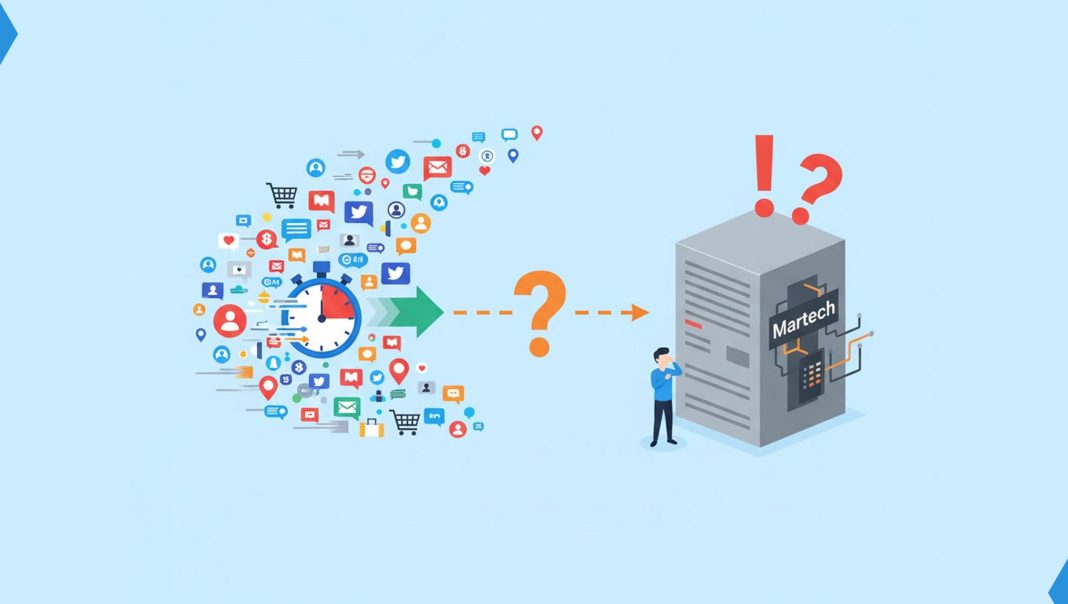
At one time, marketing technology was all about getting more: more stacks, more lakes, and more data. For a long time, it seemed like the key to success in digital marketing was how much information a company could gather and keep. The promise was clear: collect every click, impression, and transaction, and the information would come.
The people who win aren’t just the ones who gather the most data; they’re the ones who can make the smartest and quickest decisions. The marketing world has changed from one of storage to one of synthesis, from static repositories to smart systems that can sense, learn, and act in real time.
The marketing ecosystems of today work at the speed of how people act, which is dynamic, nonlinear, and multi-touch. Every customer’s journey is fluid, moving between devices, channels, and emotional states in a matter of seconds. But most MarTech architectures are still stuck in the past. They were made for a world that moved more slowly, where campaigns were planned every three months and personalization meant grouping people into big groups. As a result, the gap between how quickly consumers move and how slowly marketing systems respond keeps getting bigger. Marketers have access to powerful tools, but they are still limited by MarTech architectures that are too rigid, fragmented, and static to change while they are in use.
Customer Data Platforms (CDPs) and traditional data lakes were made to make sense of the mess. They promised a single source of truth, a place where all customer information could finally be stored. But in reality, they turned into digital warehouses: great at storing data but terrible at putting it all together.
These systems can gather and combine data, but they have trouble turning it into useful intelligence quickly enough to make personalization work. In a world where customer expectations change every second, delays are deadly. When insights come minutes, hours, or days after the decision is made, chances are lost. The marketing engine starts to slow down, no matter how advanced it is.
The main problem is with the DNA of traditional MarTech architecture. It was designed to be stable, not flexible; to report on what happened, not to guess what will happen next. Each tool in the stack has its own job: analytics keeps track of things, automation starts things, and CRM keeps records. But they don’t talk to each other very often. Instead of a neural network, data moves between them like a relay race, which makes decisions take longer. This broken design makes it hard for marketers to quickly respond to changes in customer needs, the environment, or the market. As AI and automation change how fast business moves, old systems start to feel more like roadblocks than helpers.
Companies need to rethink what MarTech architecture means to stay alive in this new marketing world. It’s not about how much data a company has anymore; it’s about how well that data is organized across the ecosystem. The future belongs to platforms that connect, interpret, and act all the time. These are architectures that are focused on making decisions rather than storing data. In this model, each piece of data is not just a record; it is also a signal that is part of an intelligent feedback loop. The system learns, reasons, and responds without needing human help. Some experts now call this the “decision ocean.” It’s a living, breathing ecosystem where data doesn’t just move around; it also thinks.
The end of the static marketing stack is marked by the move toward smart MarTech architecture. It calls for systems that can do more than just keep track of the past; they should also be able to predict the future. As businesses start to use AI, data fabrics, and real-time analytics, the new measure of success is not how much data they have, but how quickly they can make decisions.
It’s no longer time to collect; it’s time to think. The next step in marketing technology won’t be the biggest stack; it will be the smartest one. This is where MarTech architecture becomes the nervous system of businesses that are always on, adaptive, and driven by insights.
The Fragmentation Problem: What It Costs to Be Incoherent
In today’s hyperconnected digital economy, marketing success depends on being able to keep up with the customer in a way that is dynamic, data-driven, and personal. But most companies are still stuck in the old systems that don’t work. Brands have spent billions on marketing technology in the last ten years, but the truth is that a lot of this money is just sitting there, locked up in separate silos. Ironically, the very MarTech architecture that was meant to connect the business has become one of its biggest sources of problems.
Today’s marketers work with a maze of platforms that don’t connect. For example, CRM systems that don’t talk to analytics dashboards, loyalty databases that don’t sync with ad engines, and customer data platforms (CDPs) that take hours to process information when every second counts. This fragmentation issue is more than just a technical problem; it’s a strategic blind spot that hurts flexibility, consistency, and, in the end, customer trust.
Legacy Data Silos: When Systems Don’t Speak the Same Language
CRM, analytics, ad platforms, web behavior trackers, and loyalty systems are all separate ecosystems where marketing data still lives, each one working best on its own. What used to be called “best of breed” is now called “best at not integrating.” Legacy tools were never meant to handle the speed, variety, and amount of real-time interactions we have today.
What happened? Marketers have too much data and not enough insights. When identity resolution is inconsistent, the same customer shows up as ten different people on different platforms. Different channels measure campaigns in different ways, and attribution models don’t always agree with each other. Because of this broken MarTech architecture, customer journeys are not smooth, and messaging feels robotic and disconnected.
These silos cost a lot of money. Every dataset that isn’t in the right place costs money, time, and missed chances. Customers won’t put up with inconsistency anymore. This is where loyalty is lost: the difference between what they expect and what they get. When systems don’t understand each other, personalization efforts fail, and the brand story gets lost in the noise.
So, a modern MarTech architecture needs to go beyond just collecting data passively. It needs to connect, talk to each other, and do math. This will create a living ecosystem where signals can move freely and intelligently between all touchpoints.
The Hidden Cost of Incoherence
Marketers today spend more time putting together reports than coming up with plans. Teams spend hours every week manually exporting, cleaning, and aligning data from sources that aren’t connected. This operational drag leads to what experts now call decision latency, which is the time between gathering data and getting useful information.
Decision latency is a silent killer of campaign ROI in a time when personalization, flexibility, and automation are the keys to success. The audience has changed, the trend has changed, and the chance has passed by the time the report is done.
Ironically, most businesses don’t know how much money they’re losing because of their lack of coherence. Underneath the shiny dashboards and predictive models is a weak MarTech architecture that can store data but not combine it quickly enough to help with decision-making. Marketing leaders are in a tough spot that no one is talking about: more technology hasn’t made people smarter.
Static stacks make experiences that don’t change. You don’t feel campaigns; you plan them. Not acting on insights is what happens. As a result, the brand seems more reactive than relevant. As personalization becomes standard, not being able to change in real time becomes a risk. Customers now want experiences that are always relevant to them, but broken architectures make that almost impossible.
The Strategic Consequences
Incoherence doesn’t just hurt marketing; it hurts the whole business. When systems are broken up, they create organizational silos that stop marketing, sales, and service from working together. It’s hard for leaders to get a clear picture of how well things are going, and they often make decisions based on old or incomplete information.
A well-organized MarTech architecture isn’t just a technical need; it’s also a way to set yourself apart from the competition. It turns data from a hassle into a way to get ahead of the competition. It closes the gap between understanding and doing, allowing businesses to give people experiences that feel personal, timely, and human.
Incoherence also makes it harder for people to use AI. For machine learning models to work, they need data that is clean, connected, and up to date. Predictive engines don’t work when datasets are spread out across systems that don’t work with each other. The promise of marketing AI—real decision intelligence at scale—falls apart when integration fails.
Bridge: From Data Storage to Data Activation
To fix this, marketing technology needs to change from storing data to activating it. The next generation of MarTech architecture isn’t about gathering more data; it’s about building systems that can think, adapt, and make decisions.
Data activation means that all of the information is ready to be used to make a choice, tailor a message, or automate an experience. Having a lake full of customer data isn’t enough; businesses need an ocean that connects moving signals and lets new insights come to light all the time.
The new MarTech architecture needs to work like a neural network, not a filing cabinet. Instead of waiting for a human to look at the data, it should process relationships between data points in real time. This would let marketers predict intent, meet needs, and provide dynamic interactions on a large scale.
This change also needs a change in culture. Marketing teams need to work together in an agile way with leaders in IT, data science, and customer experience. We need to stop focusing on tools and start focusing on results. Instead of dashboards that show what happened, we need architectures that decide what happens next.
The main point of the evolution of MarTech architecture is not to get rid of old platforms, but to come up with new ways for them to work together. The goal is coherence: systems that work together and respond in a way that makes sense, guided by intelligence rather than habit.
Moving Toward Coherent Intelligence
The problem of fragmentation is not impossible to solve; it is just a matter of time. As companies update their MarTech architecture, they need to make sure that interoperability, data liquidity, and decision speed are at the top of their list of priorities. The people who win will be the ones who go from static storage to dynamic activation, where every byte of data powers real-time intelligence.
Marketing technology is no longer just a bunch of tools; it’s now a living system of information. When data speaks the same language on all channels, brands can finally give customers what they want: consistency, relevance, and authenticity.
The last ten years have been full of incoherence. The next big thing will be coherence, which will be made possible by smart MarTech architecture.
The Rise of Data Fabrics: From Data Storage to Data Activation
It’s no longer the age of static data. Companies that do marketing can’t just collect and store data anymore; they have to connect and act on it. The modern customer journey takes place at many digital touchpoints, each of which sends out signals that need to be captured, understood, and used right away. But most traditional MarTech architectures are still stuck in the past, when storage was more important than synthesis.
Businesses are moving from data warehouses to living data systems to stay competitive. These are smart, interconnected fabrics that combine all signals into one adaptive decision-making layer. This change is the next step in the evolution of marketing technology, moving from managing data to moving it, from dashboards to dynamic intelligence.
a) From Warehouses to Living Systems
Data fabric is more than just an architectural upgrade; it also means that companies need to change the way they think about data. A data fabric is like a real-time connective tissue that lets data flow easily between platforms, teams, and channels. Traditional warehouses stored data in static tables and took a long time to update.
The data fabric is like the brain of a modern MarTech architecture. It is always sensing, sending, and interpreting signals. It connects different systems, such as CRMs, CDPs, analytics engines, and ad platforms, into one intelligence layer that makes sense. This means that the information from a social campaign, a loyalty app, and an e-commerce site can now all come together and help make decisions right away.
A data fabric is different from traditional pipelines because it is event-driven, which means that marketers can get insights as they happen. This immediacy changes marketing from a reactive to a proactive activity. Brands can now shape outcomes in real time instead of waiting weeks to respond to trends.
For example, if a customer leaves a cart, a well-designed MarTech architecture powered by a data fabric can change offers, retarget customers with relevant content, and update sales forecasts in just a few seconds. This isn’t just a theory; it’s the new way that data-driven businesses work, treating data as a living, breathing asset instead of a static record.
Data fabrics also fix the problem of data fragmentation that marketing teams have had for a long time. They make sure that every system is consistent, fast, and secure by getting rid of the need for point-to-point integrations. The fabric doesn’t just connect data; it also connects purpose by bringing together technology, teams, and tactics into a single flow of intelligence.
b) Real-Time Decisioning and Contextual Flow
Context, not calendars, is what modern marketing is all about. Customers move from one device to another, use multiple channels to interact, and expect their experiences to stay relevant no matter where they go next. Static systems can’t deal with that level of complexity.
That’s when adaptive MarTech architecture makes real-time decisioning necessary. Event-driven architectures make sure that every click, view, and purchase instantly updates the decision models. They make something called contextual flow, which is a constant feedback loop in which data is not only looked at but also acted on as soon as it changes.
For instance, think of a travel company looking at people’s plans to book a trip. By 9:01 a.m., a customer looking for flights to Tokyo may see an AI-driven suggestion for hotels, and by 9:02 a.m., they may see a personalized loyalty offer. This isn’t marketing automation; it’s marketing cognition. The system doesn’t wait for people to tell it what to do; it constantly interprets, adapts, and carries out decisions.
This is possible thanks to a next-generation MarTech architecture that links event streams (like clicks, transactions, and engagements) with machine learning models that learn and change in real time. Instead of marketing teams planning campaigns, the architecture itself decides when and how to get involved.
The effect on the business is huge. The time it takes to make a decision, or decision latency, goes from days to milliseconds. Marketers no longer use historical dashboards; they use living systems that can think and act as quickly as the market changes.
This ability to respond to different situations also makes personalization better. Brands can send hyper-relevant content at the exact right time by reading micro-signals like scroll depth, sentiment, and even environmental data like location and weather. Real-time decisioning is no longer a luxury; it’s the new standard for a truly smart MarTech architecture as customer expectations rise.
c) AI as the Engine of Activation
AI is no longer just a tool for marketing; it’s the main engine that drives it. With AI orchestration, MarTech architectures change from systems that only report to systems that can recommend, predict, and even negotiate outcomes.
Traditional marketing relied on looking back: “What worked last quarter?” But AI systems ask a different question: “What should we do next?” Adaptive learning loops make this proactive intelligence possible. These are models that change all the time based on how people behave, how well the campaign is doing, and what feedback is given.
For example, AI-powered predictive engines can look at a customer’s past purchases, online activity, and feelings to figure out not only who to target but also how to reach them—what message to send, when to send it, and through what channel. These models get smarter over time, which makes a self-optimizing loop that improves results with each interaction.
This change changes what it means to “activate” data. In a traditional setup, activation meant sending data to downstream execution tools. In a modern MarTech architecture, activation is a cognitive process that uses AI decisioning to sense, interpret, and act in a loop.
AI doesn’t just run campaigns; it runs whole ecosystems. It decides how data moves between systems, how customer journeys change, and how strategy is shaped by performance feedback. This is what really makes a data fabric smart: it’s not just connected; it knows what it’s for.
AI also makes sure that marketing stays ethical and caring. AI agents can stop over-messaging and protect brand relationships while still getting conversions by reading signals from the environment, such as fatigue, preference, or a drop in engagement. A mature MarTech architecture puts intelligence at the center of experience design. It strikes a balance between automation and authenticity.
The Intelligent Fabric of the Future
The emergence of data fabrics signifies a pivotal transition from passive data management to proactive intelligence. The companies that do best in the future won’t be the ones with the biggest databases. Instead, they’ll be the ones with the most flexible decision systems—those whose MarTech architecture acts like a living organism instead of a storage vault.
The next generation of MarTech architecture will change how brands work by combining AI, event-driven design, and contextual understanding. It will turn every piece of data into a decision and every decision into value.
There aren’t any warehouses where the future of marketing is built. Smart fabrics that connect data, decisions, and direction are woven into it. This makes a world where marketing doesn’t just react to the customer journey, but changes with it.
Graph-Based Marketing Intelligence: From Straightforward Data to Real-Life Connections
The path that today’s customers take is not a straight line; it is a complicated web of interactions, small choices, and emotional cues that change in real time. In such a changing environment, traditional linear data models don’t show how complex the relationships are that affect how customers act. The next step in the evolution of MarTech architecture is to use graph-based intelligence, which means systems that not only know what happens but also how everything is connected.
Graph-based marketing intelligence changes the way businesses look at data. It doesn’t just look at customers as separate profiles or transactions; it maps out the connections between customers, campaigns, content, and contexts to make a living, breathing network of information. In this new way of thinking, relationships, not reports, drive marketing.
-
The power of Graph Databases
The graph database is at the heart of this change. It is a technology that can understand relationships, not just store data. Graph databases show data as nodes and edges that are connected, while traditional relational databases show data as rows and columns. This difference may sound technical, but it could change the way marketing works forever.
In marketing, relationships are everything: how a customer goes from one campaign to the next, how content affects behavior, and how channels affect each other’s effectiveness. Not only does a MarTech architecture built on graph databases keep track of these interactions, it also understands them.
For instance, think about a store that uses a traditional data warehouse. You can say, “Customer A bought Product X after Campaign Y.” But a graph-based system can tell you why: maybe Customer A watched three different product videos, read two reviews, took a friend’s advice, and then got a personalized offer that sealed the deal.
Marketers can find hidden patterns in this web of connected insights, such as how some influencers drive engagement, how certain behaviors predict churn, and how brand loyalty is affected by exposure across channels. Graph databases give you contextual intelligence instead of linear reporting. They show you a living map of how marketing really works in real time.
Graph databases are quickly becoming the main way that intelligent decision systems connect in modern MarTech architecture. They power everything from real-time recommendation engines to multi-touch attribution models that show how complicated the customer journey really is.
The result is a change in how you see things: from managing data to managing relationships. It’s not about having more data; it’s about knowing how the data interacts, reacts, and supports decisions across the ecosystem.
-
Real-Time Relationship Mapping
Static segmentation isn’t enough anymore. Customers don’t fit neatly into demographic groups; they move between groups with every click, share, or purchase. Graph-based marketing intelligence fixes this by letting you map relationships in real time.
Graph-based systems group customers based on real-time behavioral signals, unlike traditional MarTech architecture, which uses predefined audience lists. These can be things like the intent to browse, the history of purchases, the level of engagement with content, or even patterns of activity at different times of the day.
Picture this: a customer interacts with a fitness brand’s Instagram story, goes to the running shoes product page, and then looks for training plans later. A graph-based system instantly links these events, figuring out what the person wants and sending them a personalized message with a limited-time offer on performance gear.
This is adaptive audience segmentation, which means that marketing changes with each interaction. The system keeps recalibrating relationships all the time, so messages stay relevant and emotionally resonant instead of waiting for batch updates.
Marketers need to be able to respond quickly in a world where attention spans are measured in seconds. Regular data pipelines just can’t keep up. But with graph-based MarTech architecture, brands can instantly sense and respond to changes in behavior, changing marketing from reactive to predictive.
Also, real-time relationship mapping isn’t just for customers. It includes channels, campaigns, and content. Marketers can always improve their spending and creative strategy by knowing which content assets are affecting which audiences and on which platforms.
Graph-based marketing intelligence is like a living ecosystem where everything depends on everything else. When one connection changes, the whole system changes. This lets brands not only follow the customer journey, but also change with it.
-
Connected Insights for Connected Customers
Customers today are very connected; they can easily switch between devices, platforms, and experiences. But most companies still keep their data in separate silos: CRM in one system, social data in another, and advertising metrics in yet another. The result is a broken picture of the customer and strategies for getting them involved that don’t work together.
Creating a single graph of marketing truth is the answer. This is a key part of the next generation of MarTech architecture. This unified graph connects entities from CRM, social media, advertising, and e-commerce systems, giving you a complete and up-to-date picture of each customer relationship.
The graph doesn’t see these as separate events, for example, when a customer clicks on an ad, interacts with an email, and buys something in the store. It sees them as points connected by emotion, intent, and context. This lets marketers create interactions that are more consistent and meaningful, where every touchpoint tells the whole story instead of just a piece of it.
There are three main benefits to this connected intelligence:
- Engagement that knows what’s going on: Marketing actions aren’t the same for everyone anymore. The full context of past interactions shapes every message, making sure that communication feels timely, personal, and human.
- Predictive Decisioning: Graph-based MarTech architecture lets machine learning models look at more than just static variables; they can also look at how things are related to each other. This means the system can guess what customers want before they say anything, like making suggestions, predicting churn, or finding new ways to upsell.
- Continuous Optimization: Strategies change as relationships change. The graph keeps giving new information about how to improve campaigns, making sure that creative, budget, and targeting change along with how customers act.
In the end, connected insights are like the modern digital consumer, who is always changing. People don’t think in boxes, and now marketing doesn’t either.
The Strategic Advantage of a Graph-Based Martech Architecture
Adding graph databases to MarTech architecture isn’t just a new technology; it’s a big change in strategy. It changes the way businesses think about customer experience, marketing intelligence, and making decisions.
In traditional systems, marketers look at what worked in the past. In graph-based systems, they look to the side and the front to see how everything fits together and guess what will happen next. With this relational visibility, brands can not only predict outcomes but also how things will change.
For instance, a graph-based platform can find the exact story arcs that turn certain audiences into customers by looking at how different types of content, engagement patterns, and sales performance are related. This lets marketers copy what works in different markets, channels, and product lines.
Graph intelligence also makes it easier for people to work together. Different teams, like data science, creative, and customer success, can see and explore the same network of relationships. This helps them all work toward a common, changing truth.
The best thing about advanced MarTech architecture is that it can break down not only data silos but also organizational silos. When everyone uses the same living graph of insight, it makes decisions faster, smarter, and more in sync.
The Future: From Relationships to Resonance
The goal of marketing in the cognitive age isn’t just to understand relationships; it’s to make them resonate. The next generation of MarTech architecture will combine AI-driven decision-making with graph-based intelligence. This will make systems that not only map connections but also understand their emotional and strategic importance.
We’re getting closer to marketing ecosystems that can sense, learn, and change like neural networks—systems that can have emotional intelligence on a large scale. Graph intelligence gives the framework, and AI gives the thinking. Together, they make up the “living marketing organism.”
In this future, data doesn’t just tell you about customers; it knows them. Campaigns don’t just respond to behavior; they change with it. And brands don’t just get people to pay attention; they also build relationships that think, feel, and grow.
The final goal of MarTech architecture is to move from linear data to living relationships. This means moving from static systems to dynamic intelligence, from communication to connection, and from transactions to trust.
Data is no longer the end product in the world of graph-based marketing intelligence. It’s the start of every important interaction—the heart of marketing that really listens, learns, and leads.
The Composable MarTech Stack: Building for Agility and Scale
Agility is the new competitive edge in today’s business world. Marketing teams can’t rely on rigid, monolithic systems that take months to change anymore because customer behavior changes in real time. The answer is a new way of doing things: composable MarTech architecture.
Composable marketing technology does away with the big, one-size-fits-all platforms of the past and replaces them with modular systems that can change, grow, and adapt. With composable architecture, organizations can build a stack that fits their strategy instead of having one vendor tell them what to do.
In short, it’s like the difference between buying a car that is already put together and building your own car from parts that have been carefully designed to work together perfectly.
Marketing Technology News: Martech Interview with Aquibur Rahman, CEO of Mailmodo
a) Modularity Instead of Monoliths
The traditional MarTech stack grew by buying other companies. It was made up of different layers for CRM, automation, analytics, and personalization, all under one brand name. These suites are easy to use, but they often give up flexibility in order to work together. As technology changes, it gets harder, more expensive, and slower to upgrade or replace just one part.
The composable MarTech architecture turns this model on its head. It supports modularity, which lets businesses put together the best tools that work together by using shared data standards and APIs. You can change, upgrade, or add to any module, like a data fabric, decision engine, or automation layer, without affecting the rest of the ecosystem.
There are many benefits to this modular approach:
- Scalability: Businesses can start small and grow as their customers’ needs or budgets change.
- Resilience: If one tool doesn’t work as well as it should or becomes outdated, it can be replaced without having to rebuild the whole system.
- Innovation Velocity: Marketers can use new technologies like generative AI, predictive analytics, or new social platforms right away, without having to wait for vendor roadmaps.
For instance, a store might use one vendor to manage customer data, another to personalize the experience, and a third to do analytics, all of which would work together in the same MarTech architecture. This plug-and-play method lets marketing teams stay ahead of changes and make sure that technology is directly linked to business goals.
More importantly, composability makes innovation available to everyone. Marketing leaders don’t have to rely on IT-heavy implementations or long vendor cycles anymore. With a flexible architecture, teams can try new things more quickly, keep making things better, and respond right away to changes in customer behavior.
b) Orchestration, Not Overlap
Modularity is powerful, but it can quickly turn into chaos if not organized. Too many tools that don’t work together cause duplication, data silos, and confusion in workflows, which are exactly the problems that modern marketing wants to fix.
Orchestration is the key to a successful MarTech architecture. This means being able to connect all of your tools and datasets into one smart ecosystem.
Standardized APIs, data models, and shared semantics make it possible for each part to talk to the others smoothly. A unified orchestration layer makes sure that all systems speak the same language, so there are no extra integrations or manual data transfers.
In real life, orchestration means:
- When a campaign starts on the automation platform, it automatically updates audience segments in the data warehouse.
- Analytics dashboards get real-time information on how customers interact with each other across channels.
- AI decision engines get feedback loops in real time, which lets them optimize budgets and creative assets right away.
Brands get rid of tool overlap and make the most of their data by ensuring orchestration. It’s not about adding more software anymore; it’s about working together to make each part smarter.
Think of orchestration as the conductor in a symphony. Each instrument plays its part, but only when they all work together does music happen. A well-planned MarTech architecture does the same thing: it brings together creativity, data, and technology to turn a bunch of tools into a single intelligence layer.
In this ecosystem, marketing operations move from reporting on what happened to generating insights that help businesses plan for the future. Every click, purchase, and campaign interaction goes into a central intelligence core, which helps the whole company make decisions faster and more accurately.
c) AI as the Layer of Decision
Artificial intelligence is at the center of this composable revolution. It is the decision layer that turns raw data into action in real time. AI is not just a tool in modern MarTech architecture; it is the strategic brain that runs the whole system.
People’s intuition and analysis after a campaign were important parts of traditional marketing. But in today’s world, where everything is connected, that delay is a problem. AI changes this by constantly looking at data streams, audience signals, and contextual triggers to make decisions in a split second.
This is how AI works as the decision layer in a composable environment:
- Continuous Optimization: AI models keep an eye on how well the audience is engaging, how well the budget is doing, and how well the creative is doing in real time. When one campaign doesn’t do well, resources are automatically moved to channels that are doing better.
- Predictive Intelligence: AI can predict how people will act, such as when they will leave, when they will buy more, or when new audience segments will show up before your competitors do.
- Dynamic Personalization: AI systems change messages based on how people act, where they are, and how they feel, rather than using fixed content rules.
AI-driven decision-making turns a composable stack into a living, self-optimizing ecosystem in this way. The AI brain takes in information from every module, whether it’s a data warehouse, a CRM, or an automation tool, and then plans and carries out actions without any problems.
What happened? Intelligent MarTech architecture makes marketing strategies that change all the time, campaigns that get better on their own, and customer experiences that feel real.
This use of AI also solves one of the oldest problems in marketing: the time between collecting data and taking action. Traditional architectures build up huge data lakes that aren’t always used to their full potential. AI closes this loop by turning data into decisions right away, without any human delays.
As generative AI gets better, the decision layer goes beyond analytics and into creative orchestration. AI can now come up with new campaign ideas, change the tone and visuals, and even make experiences more personal at the story level. This connects art and science, letting brands show both efficiency and empathy on a large scale.
d) Building for Flexibility and Growth
The best thing about composable MarTech architecture is that it can be changed. In a market that changes quickly, the ability to change course quickly is what sets leaders apart from those who fall behind.
A composable system changes right away when privacy laws change, a new channel opens up, or customer expectations change overnight. Companies don’t have to deal with expensive migrations or vendor lock-ins anymore. Instead, they can keep changing, trading in old tools for new ones while keeping their operations running smoothly.
This flexibility also applies to size. A composable stack grows naturally by connecting new data sources, regions, and workflows without creating technical debt. This can happen when you enter new markets or start new product lines.
This change has deep cultural effects that go beyond technology. It gives marketing teams the power to think like builders, creating experiences instead of just running software. It encourages trying new things, working together across departments like marketing, IT, and analytics, and decentralization.
The Future of Marketing Flexibility
The composable stack is more than just the next step in MarTech architecture; it’s the basis for the future of marketing flexibility. It lets companies use new ideas without causing chaos, intelligence without making things too complicated, and growth without making things too rigid.
In this future, marketing systems will look like living things: they will be modular but still work together, and they will be able to change but still stay the same. AI will be the brain, data fabrics will be the connective tissue, and composability will be the bones.
They work together to create an ecosystem that not only keeps up with change but also leads it.
In a world where customers can reach you in a million ways and their attention is always changing, being flexible is the new smart. One module, one connection, and one smart decision at a time make up the composable MarTech architecture that makes it all possible.
What to Expect in the Future: Decision-Centric Businesses?
Marketing technology is changing in a big way right now. For a long time, success meant getting, cleaning, and storing as much customer data as possible. People thought that data lakes, customer data platforms (CDPs), and analytics dashboards were the main tools for digital transformation. But this way of thinking is changing as change happens faster.
People who just manage the most data won’t win the next age of marketing. Instead, businesses that make the best decisions with that data will lead the way. The future belongs to businesses that make decisions based on smart MarTech architecture that can see, think, and act in real time.
In these settings, data doesn’t just sit in silos; it moves through AI-powered systems that constantly analyze the situation and improve results. The marketing stack of the future won’t just be able to analyze data; it will also be able to think, change, and grow on its own.
a) From Data Lakes to Decision Oceans
The size of a company’s database won’t matter as much as how smart its decisions are in the future. Data lakes used to mean advanced technology, but now they mean being stuck. In today’s hyper-personalized, omnichannel world, just having a lot of data isn’t enough to make it useful. You need decision intelligence.
The next step in MarTech architecture is the idea of decision oceans. These smart systems combine three ongoing tasks:
- Sensing: Getting data from many sources in real time, such as the web, mobile devices, social media, stores, and IoT devices.
- Thinking: AI reasoning that figures out intent, sentiment, and opportunity from every signal.
- Acting: Automated execution that gives people personalized experiences, changes campaigns, or moves money around right away.
Data is never still in a decision ocean. It moves constantly between sensing and acting, with the help of contextual intelligence. Every interaction adds to a feedback loop that helps the system better understand how customers act.
Next-generation MarTech architecture must allow for this fluid, interconnected ecosystem. Instead of processing insights in batches after the fact, businesses will always be aware of what’s going on. This means that every click, view, or purchase by a customer will lead to smart decisions being made right away.
This change means that marketers will have to go from managing campaigns reactively to orchestrating customers proactively. The business doesn’t just look at data anymore; it uses it to think.
b) Continuous Intelligence as a Way to Get Ahead
Continuous intelligence is the ability to understand and act on data as it comes in. This is what makes a decision-focused business work. It’s not just about automating things; it’s about changing them.
Focused on decisions, MarTech architecture combines analytics, AI, and automation into a single layer that helps people make decisions. AI agents don’t wait for post-campaign analysis. Instead, they look at results as they happen and change their strategy right away.
Think about this: a brand starts a campaign on social media and through email. In the past, performance metrics would be looked at days later. AI can find low engagement in real time, test different creatives, move money around, and improve messaging—all in a matter of minutes in a continuous intelligence system.
This ability to respond quickly is what gives decision-centered businesses an edge over their competitors. They can:
- Figure out what customers need before they say it.
- Optimize campaigns on their own to cut down on waste and boost ROI.
- Change the way you talk about your brand to fit different situations so that it stays relevant and resonates.
- It’s a shift from using analytics to look back to using intelligence to look ahead.
This kind of intelligence will become standard as MarTech architecture gets better. AI won’t just help people make decisions; it will lead them, giving marketers more time to be creative, empathetic, and tell stories about their brands.
It’s no longer about who has the most data; it’s about who can turn data into action the fastest and smartest. Companies that know how to use continuous intelligence will be the best in markets where people don’t have a lot of time and want things right away.
c) The New KPI is Decision Velocity
In this new world, traditional marketing metrics like impressions, clicks, and conversions will take a back seat to a new performance measure: decision velocity.
Decision velocity tells you how quickly a business can turn incoming data into smart, useful action. In a world where real-time engagement is key, it’s the ultimate test of agility.
High decision velocity means:
- Faster personalization: Every offer and message changes right away based on how people act.
- Better use of resources: Budgets move around dynamically to focus on the best-performing segments or channels.
- Strong customer trust: Customers trust you more when you respond to feedback, problems, or concerns right away instead of waiting hours.
In a model based on decisions, speed is the same as value. The more quickly a business can understand signals and respond in a meaningful way, the more competitive it becomes.
But to be this responsive, you need more than just technology; you need a new way of thinking about culture. Collaboration between data, marketing, and operations teams, all connected by a common intelligence fabric, is what makes decision velocity possible.
MarTech architecture is very important here. It connects AI models, automation engines, and experience delivery systems into one ecosystem that works together. This integrated environment makes sure that decisions made in one part of the company are immediately shared with the rest of the company.
Think of a marketing platform that can find customers who are likely to leave a loyalty program and send them personalized offers to keep them across all channels. Or an AI system that can tell when demand changes with the seasons and changes the targeting of ads in real time. These aren’t things that might happen in the future; they’re already happening in decision-centric marketing today.
The Future Driven by Decisions
The rise of decision-centric businesses is more than just a change in technology; it’s a change in how organizations work. It’s not enough for the marketing department to just run campaigns anymore; they need to plan and organize intelligence.
Over the next few years, MarTech architecture will change from a bunch of separate tools into a living system of thought. Data will move like air, AI will be the brain, and automation will be the hands that do things quickly and accurately.
This coming together of sensing, thinking, and acting will change what it means to be agile in marketing and have strategic foresight. Companies that embrace this change will not only respond faster, but they will also be able to see it coming.
The smartest companies in the future won’t just have big data lakes; they’ll also have decision oceans.
And in these huge, smart waters, MarTech architecture will be the ship that keeps them moving, always sensing, learning, and acting at the speed of insight.
Final Thoughts:
The development of marketing technology has always followed the development of intelligence. For decades, businesses have spent billions on systems that promised to make things clearer but often made things more complicated. These systems were huge repositories that promised to make things clearer, but often made things more complicated. In the age of data lakes, success was measured by how much information could be gathered, combined, and accessed. But this model is reaching its limits as marketing moves into an era defined by real-time engagement and predictive personalization.
People who turn storage into strategy will be the ones who shape the future of marketing. They will design MarTech architecture not as a place to store information, but as an ecosystem of intelligence.
Moving from data lakes to decision oceans is more than just a technological change; it’s a change in how we think. Data alone doesn’t make a brand stand out anymore. Now, all businesses have access to the same tools, datasets, and automation features. The difference between leaders and laggards is how they use that information to make decisions quickly, accurately, and with purpose.
MarTech architecture isn’t built to hold information anymore; it’s built to think. It picks up signals from different channels, thinks about the situation, and moves quickly. The marketing organization of the future will be like a living, learning thing that changes all the time based on what people say, how they interact, and what happens.
In this smart world, the job of marketers changes too. There are no longer system operators who manage workflows or dashboards. Now, they are decision architects who design how brands interact with each other. Their success depends on how well they can teach algorithms to understand how people act and how well they can make sense of the stories that data is trying to tell.
The best thing about MarTech architecture is that it can bridge the gap between information and insight, and between observation and outcome. When systems can read intent, guess needs, and change experiences on the fly, marketing is less about targeting and more about understanding—less about campaigns and more about staying connected all the time.
Companies that embrace this change will find a new competitive edge: the speed at which they make decisions. The more quickly a business can understand a signal and do something useful with it, the more important it becomes to the customer. Decision speed is now the most important measure of success, replacing clicks, impressions, and conversions. MarTech architecture that combines AI-driven reasoning, automated execution, and real-time data synchronization into a single cognitive flow gives this speed. In this state, every time a customer interacts with the system, it gets smarter and better at predicting what will happen next.
In the end, decisions, not databases, will shape the future of marketing. The days of static reports and dashboards that only show one thing are over. The next generation of businesses will create ecosystems where data moves around freely, systems learn and change, and decisions are made in a matter of milliseconds.
The MarTech architecture will be the basis for this change, which will move marketing from reactive analysis to proactive intelligence. The time of data lakes was when people gathered information. The age of decision oceans is about organizing intelligence. In this new era, companies that don’t just store data but use it to make decisions will be the ones that succeed. These companies will build systems that can learn, reason, and change all the time.
Marketing Technology News: Beyond the Trend: How CMOs Are Using Cultural Intelligence to Lead Culture, Not Chase It