Vice President Of Customer Experience Consulting At Confirmit Makes The List Of Top Ranking Cx Industry Executives
Shelly Chandler, CCXP, Vice President of Customer Experience Consulting at Confirmit, has been named a winner of the 2017 CX Impact Awards by the Customer Experience Professionals Association (CXPA).
The CX Impact Awards are a part of Customer Experience (CX) Day, a global day celebrating the organizations and people who are delivering great experiences to customers. The program recognizes individuals that exemplify excellent Customer Experience and make a profound impact on their organization and its customers. From frontline employees to senior leaders, these awards showcase professionals from all backgrounds and industries who have successfully led or supported Customer Experience (CX), Voice of Customer (VoC), or other initiatives in pursuit of specific customer experience goals within his or her organization on behalf of clients.
Shelly Chandler
“Customer Experience is reaching its zenith – the industry has learned and achieved so much, and yet there is still significant room to grow,” said Chandler. “It is essential that those with successes share their methods to inform others’ strategies. Executives, take note: a long-term investment in Customer Experience will produce results – support transformational change and instill trust your customers!”
The award recognizes Shelly for not only knowing the value of integrating technical solutions to support a complete CX program, but also providing guidance in acting upon those insights gained from the program. In her current role, she advises clients on how to connect their customer insights to higher-level business goals and help ensure their CX programs support both operational and financial objectives.
Michael Wooh
“Shelly’s team provides consulting services to our customers in a manner that is truly customer-focused, making her more than deserving of this award,” said Michael Wooh, Chief Marketing Officer, Confirmit. “Shelly ensures her team is mission-driven, with the ultimate goal of being able to help Confirmit customers make the most of their insights programs, and use those insights to propel their customer experience maturity.”
A panel of judges – all regarded as thought leaders in the CX field – reviewed the award finalists and selected winners in two categories: Practitioners (who are bringing CX competencies and skills to organizations and brands), and Providers (those employed by companies who consult and/or provide technology, products and services in the CX space).
Oliver Schabenberger Appointed as Chief Operating Officer, SAS
An Introduction To SAS® Visual Analytics: How To Explore Numbers, Design Reports, And Gain Insight Into Your Data Covers Everything Users Need To Know About Data Visualization
This accessible, full-color guide to SAS Visual Analytics is perfect for both novice and experienced users looking to learn the latest functionality of SAS Visual Analytics on SAS 9.4 and SAS® Viya™. It covers everything from getting-started basics like accessing content and building custom dashboards and reports to customizing data visualizations with different chart types and using geospatial data. Later chapters explore administration and data loading and include a deep dive into SAS Visual Analytics 8.1.
With guidance from the authors – Tricia Aanderud, Director of the Data Visualization Practice at Zencos Consulting; Rob Collum, Principal Technical Architect at SAS; and Ryan Kumpfmiller, a SAS and Data Visualization Consultant at Zencos – users learn how to make sense of their complex data and incite smarter, data-driven decisions.
Tricia Aanderud
“We wrote this book as a common-sense resource for using SAS Visual Analytics, offering guidance from data visualization experts and information for administrators,” said Aanderud. “Better understanding data visualization principles enables users to transform drab, boring reports and analyses into effective and dynamic insights.”
SAS Visual Analytics is a self-service business intelligence, data visualization and analytics application that enables organizations to understand and analyze their data and collaboratively share ideas. The software helps businesses see the big picture, create interactive visuals and discover underlying relationships in their data. CrescentCare, 89 Degreesand Seacoast Bank are just a few of the customers using SAS Visual Analytics for interactive reporting and dashboards, visual data exploration, autocharting, self-service analytics, text and location analytics, self-service data preparation, and mobile business intelligence.
An Introduction to SAS Visual Analytics can be ordered from the SAS Publishing bookstore. Learn how industries like banking, communications, manufacturing, retail and utilities can benefit from data visualization by viewing the SAS Visual Analytics online demos.
Oracle NetSuite, one of the world’s leading providers of cloud-based financials / ERP, HR, Professional Services Automation (PSA) and omnichannel commerce software suites, announced that Shiftgig, the mobile technology platform that connects businesses with high-quality, vetted hourly workers on demand, has streamlined its business with NetSuite OneWorld. Since going live on NetSuite OneWorld in 2015, Shiftgig has been able to manage its mission-critical business processes including financials with advanced billing support, reporting, and multi-subsidiary management for its three subsidiaries in the US.
Founded in Chicago in 2012 as a job board for workers in the service industry, Shiftgig recognized a greater opportunity in serving the market for hourly workers that, as a whole, has a labor pool of 70 million in the US alone. The company saw rapid growth when it shifted its focus to offer a mobile app for people seeking flexible work opportunities with the businesses that needed help. It now provides over 30,000 on-demand workers access to available shifts with over 2,300 client companies in 14 US markets and handles approximately 100,000 transactions a month in NetSuite.
Changing the Way Work Gets Done in the Cloud
Shiftgig was intent on finding a software platform that could reliably handle its two biggest transactions — billing and payroll. NetSuite’s cloud-based system was able to immediately meet those needs without significant upfront investments in hardware or IT staffing.
In addition, NetSuite’s flexible platform enabled Shiftgig to meet its sophisticated client reporting requirements, broken out by event, shift and venue, as well as across schedules, reducing the time to compile reports from three hours to just 30 minutes. Shiftgig can now send out automated notifications for past-due accounts across its 2,300 clients, which previously had to be done manually.
The company has also realized efficiencies in financial consolidation. With NetSuite OneWorld, what once took hours consolidating financials across its three subsidiaries can now be done in minutes and the company can easily add subsidiaries as it expands. With support for 190 currencies, 20 languages, automated tax calculation and reporting in more than 100 countries, and customer transactions in more than 200 countries and territories NetSuite OneWorld provides a platform for Shiftgig to continue to grow.
Jack Murphy
“NetSuite OneWorld helps ensure we have more efficient processes around client billing and consolidation for our subsidiaries,” said Jack Murphy, Vice President of Finance at Shiftgig.
Lithium Technologies, the market leader in online community and social media management products, announced that it had closed the acquisition of the Jive-x external community business from Jive Software, an Aurea company. Originally announced on August 29, 2017, the transaction was completed on October 3, 2017. The terms of the transaction were not disclosed.
Rob Tarkoff
“I’m really excited to be bringing the Jive-x product and customers into the Lithium family,” said Rob Tarkoff, Lithium president and CEO. “Our focus as a company in the coming weeks will be to build a product plan with the input of key Jive-x customers that takes the industry to the next level. In addition, we will be delivering best practices, expertise and enterprise class customer support that Lithium is known for to all Jive-x customers.”
Over the past two decades, Lithium and Jive-x have helped brands stay at the forefront of digital transformation, building sophisticated online communities for some of the world’s biggest brands that have led to marked revenue increases, significant cost reductions, and innovation across the business. Looking forward, Lithium will be developing a new next-generation community product with all the best features of Jive-x and Lithium brought together, built on the Lithium platform and focused on maintaining a high bar for innovation and expertise.
Now With Customized Email Programs and Expertise In-House, DMS Extends the Value of its First-Party Data
Digital Media Solutions (DMS), an industry leader in providing end-to-end customer acquisition solutions that help clients win in their business ventures and realize their marketing goals, announced it acquired Mocade Media LLC, an email marketing firm that delivers engaging content and increases return on investment of email programs. Mocade’s sophisticated email optimization platform helps companies across industries ensure they are able to maximize the business value of their email programs.
Joe Marinucci
“Mocade has an incredibly talented team with a highly sophisticated and unique email system. This acquisition is a milestone for DMS as we continue to deliver on our mission to provide end-to-end customer acquisition solutions that help our clients grow their businesses and realize their marketing goals,” said Joe Marinucci, CEO of Digital Media Solutions. “DMS is continuing to expand its omni-channel messaging capabilities, now with a fully owned and operationalized email platform with this acquisition. This transaction is consistent with our strategic plan, and we are confident it will help us scale campaigns that drive meaningful engagement and business growth.”
Ellen Switzer
All Mocade employees will join Digital Media Solutions. That includes co-founders Andrew Westmoreland and Joshua Seide, as well as Vice President of Operations, Ellen Switzer. Mocade’s proven platform, tools and technical expertise make it seamless for advertisers in any industry to engage with consumers at the right time, with the right content.
“We are thrilled to join this winning team. DMS has the stage for a messaging division to produce a tremendous amount of value for both Mocade and DMS clients, which we are prepared to execute on,” said Andrew Westmoreland, Co-Founder and CEO of Mocade Media. “Under Ellen Switzer’s leadership, the Mocade team has risen to every challenge over the last three years and I am confident we will continue to deliver on this promise as well.”
Fernando Borghese
“Email is one of the most effective ways to build and nurture customer relationships today. Mocade will bring new, innovative capabilities to our digital marketing campaigns,” said Fernando Borghese, Chief Operating Officer of Digital Media Solutions. “The integration of Mocade’s expertise and platform will extend the value of our first party data to help our clients win.”
Provider of Open Marketing Cloud Announces New Product that Increases Scalability and Saves Time for Marketers Across the Entire Business
Mautic, the leader in modern marketing automation, announced the addition of Maestro, the industry’s first solution that enables seamless management of multiple marketing automation accounts. The company also announced an upcoming beta program for Maven, a marketing intelligence solution that will apply machine learning to help marketers optimize campaigns and content delivery, coming later this year.
These new products are major additions to the company’s Open Marketing Cloud, a suite of modern marketing tools that enable brands to connect all their digital properties and channels into a seamless customer experience. This means that companies can integrate their marketing website with their SaaS platform and their mobiles apps for session tracking, lead scoring and dynamic content. It also means brands can easily coordinate their marketing emails, product emails, mobile alerts and web notifications.
Matt Johnston
“The launch of Maestro and upcoming introduction of Maven further establishes Mautic as a disruptive force in the marketing technology space,” said Mautic CEO, Matt Johnston. “Mautic’s Open Marketing Cloud puts an end to siloed, slow marketing automation, and enables companies to create a seamless, personalized experience across all their digital properties and channels.”
As a first in the marketing automation market, Maestro removes the significant technical and financial barriers of having multiple marketing automation accounts – for different business units, country teams, or product lines – within an enterprise. The same is true for marketing or digital agencies who need to manage multiple client accounts. Core capabilities of Maestro include:
Active International and AlmondNet Group Form Long-Term Strategic Business Partnership
Active International Expands Its Suite Of Best-In-Class Ad Tech Products To Deliver Enhanced Analytics And Attribution Capabilities
AlmondNet Group subsidiaries, online data company Datonics and cross-device technology company Intent IQ, have entered into a long-term strategic business partnership with Active International, a global business solutions company. The partnership provides Active International with access to Intent IQ’s cross-device addressable driven solutions and Datonics’ enriched data. In return, Intent IQ and Datonics gain scale and reach in delivering their industry-leading technologies to the Fortune 500 through Active.
Roy Shkedi, CEO, AlmondNet Group, said, “We are excited about our partnership with Active International because as an industry leader, they provide us with an opportunity to showcase the benefits of our technology to a broader audience. Global brands will have access to our extensive suite of industry-leading targeted advertising solutions and products, and our patented cross-device dynamic graph. Through this partnership, our technology enhances their offerings and provides us with an incredible opportunity to scale our businesses.”
Alan Elkin, Chairman, CEO and co-Founder, Active International, said, “As a data-driven company, with media as a core competency, Active continues to seek and invest in best-in-class technology partners and platforms to enhance our capabilities and ensure our clients can maximize returns as well as the impact of their digital media investments and assets. Through our long-term business partnership with AlmondNet Group, and the addition of Intent IQ’s cross-device technology and Datonics’ data to Active’s portfolio of media products, we can provide a more robust suite of digital products and platforms, along with insights and expertise, to help our clients navigate the media marketplace to achieve more.”
Intent IQ’s premier offering is its patented Dynamic Device Graph, which is a hybrid of deterministic and non-deterministic methods that yield accuracy and reach, and provide clients with unmatched performance.
Datonics provides marketers with proprietary search, purchase-intent, life-stage, demographic and B2B data based on 180+ million US and Canadian users. The company’s data is made available to marketers through its many partners across the ad tech ecosystem, including DSPs, DMPs, SSPs, Trading Desks and more.
Award-Winning Tech Agency Deepens Bench from Coast to Coast
Bateman Group, an award-winning integrated public relations and content marketing agency, today announced two key additions to its senior management team, deepening the company’s already substantial benches on both coasts. Christopher Heine, most recently the technology editor at Adweek, was appointed director of content and media strategy working from the agency’s New York City office, effective today. In addition, Joe Franscella started on Sept. 5, 2017 as a senior vice president working out of the company’s headquarters in San Francisco.
Joe Franscella comes to Bateman Group from Bhava Communications, where he was a key strategist on the Cloudera account and an instrumental part of the team that guided that company through its IPO last year. At Bateman Group, Franscella will focus on co-leading and growing the agency’s Trust practice, working closely with agency co-owner and President Bill Bourdon and EVP Shannon Hutto; and the newly re-branded Future Stack practice, working alongside agency CEO and founder Fred Bateman and EVP Syreeta Mussante.
Christopher Heine is the latest in a succession of former journalists to join Bateman Group following in the footsteps of Elinor Mills, the inaugural Content Studio hire and now one of the senior vice presidents leading the practice, and Director of Content and Media Strategy James Niccolai, who joined in 2016. Christopher will bring his extensive experience covering trends and companies at the intersection of media, marketing and technology to Bateman Group’s Growth Tech clients, working closely with 5-year agency veteran and EVP Paula Cavagnaro, who oversees the practice area.
Fred Bateman
“The long-tenured, committed senior executives at Bateman Group have coupled an exceptionally high standard for excellence with an emphasis on cross-team collaboration to create an environment that’s very enticing to experienced PR pros like Joe Franscella,” said Fred Bateman, CEO and founder, Bateman Group. “What’s been even more gratifying is how our former journalists Elinor Mills and James Niccolai have also thrived here — and to the immeasurable, yet tangible benefit to our entire staff and client roster. I feel confident Chris will also play a vital role developing new content services for the entire agency while becoming an invaluable resource to clients in our Growth practice such as AdRoll, Amplitude, LinkedIn, Invoca, Optimizely, Segment and Urban Airship.”
Christopher Heine
“In my nearly two decades of covering the intersection between branding and technology, I came to know Bateman Group as an agency that truly cared about helping reporters do their jobs while regularly making its clients part of the industry narrative,” said Christopher Heine, newly appointed director of content and media strategy, Bateman Group. “I researched everything I could about the inner workings of the company before deciding to join its team of experts. One of the best discoveries was they completely ‘get’ the formula for being successful in the digital era.”
Chaitanya Chandrasekar, co-founder and CEO of QuanticMind, said, “This incredible milestone marks the next phase in QuanticMind’s continuing journey to help marketers step into the future, where their considerable talents are amplified by intelligent data science algorithms and machine learning-based automation. At QuanticMind, we believe the ingenuity of the world’s most brilliant marketers becomes exponentially more powerful when they combine and leverage every single piece of relevant data available.”
This round of venture capital funding follows a successful Series A round completed in September 2015 and caps a two-year period in which the company grew its customer base more than 300%.
QuanticMind will use the funding for strategic growth investments in both hiring and in product development. Specifically, the company will accelerate the artificial intelligence, predictive advertising, data science and machine learning capabilities of its data platform to conquer the increasingly complex challenges marketers face across digital’s constantly evolving channels – including Search, Shopping, Social and cross-channel customer journeys. These developments will also enhance the platform’s already-powerful ability to capture, connect and leverage the full power of disparate marketing data to surface truly actionable insights, inform smarter marketing decisions and ultimately drive phenomenal performance gains. Foundation Capital general partner Ashu Garg will also join the company’s board of directors.
Garg said, “QuanticMind is at the forefront of applying next-generation technology to solve the complex challenges of digital marketing. This investment will enable the company to continue leading the trend towards a predictive, machine learning-based future.”
The company already serves top-tier performance marketers from around the globe, including 1-800-Dentist, Rosetta Stone, and Dermstore.
Mark Mitchell, Managing Director at Safeguard and Board Member at QuanticMind, said, “Digital advertising is an intensely data-driven market that continues to take share from other advertising formats. Since Safeguard provided capital to the company in 2015, QuanticMind’s team has built out a scalable platform with a top-tier list of customers. QuanticMind’s data-centric platform delivers best-in-class results to customers and positions the company as a leader in the growing and increasingly complex digital marketing ecosystem.”
“QuanticMind epitomizes the best of Silicon Valley. Developed by a tight-knit founding team of three Stanford entrepreneurs and performance marketing veterans, the company has developed the best marketing technology platform leveraging big data, AI and cloud, and become a critical solution for any enterprise with a significant digital spend,” said Preetish Nijhawan, Managing Director and co-founder of Cervin Ventures. .
Currently, QuanticMind offers predictive management software for digital marketing channels, including paid search and social. By reinventing ad management point solutions through machine learning, distributed cloud computing, and in-memory processing, QuanticMind delivers the most intelligent, scalable, and fastest platform for maximizing digital performance for enterprises.
The gaming market is set to top $108 Billion in revenues in 2017. Versus Systems Inc, is looking to revolutionize advertising in the gaming industry
It’s been a shoot-and-miss trend for the gaming industry when it comes to advertising to players, their most engaged audience ever. But this may change soon. What AdWords and AdSense have done for Alphabet’s $656 Billion market valuation, a small company’s in-game prizing platform could do for brands with the world’s 2.6 Billion video gamers.
In the markets today, active companies include: Alphabet Inc, Sony Corporation, Zynga Inc, Shopify Inc, Raytheon Company, among others. The gaming market is set to top $108 Billion in revenues this year (Newzoo) and a small company, Versus Systems Inc, is looking to revolutionize advertising in the gaming industry.
Versus is offering brands a relevant way to access the 2.6 Billion people who play PC, console, and mobile games – driving engagement for brands and game developers – while allowing players to play the games they love for real prizes.
Versus’ prizing and promotions platform allows game developers and brands to come together to offer prize-based matches to players, all integrated directly into the games.
It’s a rare triple-win for the gaming industry: For gamers, it means no more annoying pop-ups, takeovers, or banner ads. It also includes relevant prizes, gift cards and discounts. For brands, it promises pure, targeted brand engagement using technology that matches prizes to players, encouraging them to buy more. For developers, it allows a new advertising revenue stream, and gives gamers more incentives to play for longer, and more frequently.
Versus is protecting its platform with patent filings. Since 2014, Versus has been filing patents, which are pending, which in the digital era are the foundations of some of the world’s biggest companies. Patents are essential to the valuation of technology companies.
There’s an immediate revenue driver for Versus: The company recently signed a deal to provide in-game prizing to 704Games, which has an exclusive license to produce video games for NASCAR, the biggest spectator sport in America.
But gaming is only one segment of the interactive market Versus targets: Versus is planning to bring the prizing platform to virtual reality, augmented reality, and streaming media in the near future.
Here are 5 reasons to keep a close eye on Versus Systems, Inc:
In-Game Advertising Worth $10 Billion A Year In The Next 5 Years
Research and Markets estimates that the global video games advertising market will grow nearly 14 percent by 2020, with a boost in female gamers driving much of it. Virtual reality games will be an entirely different market segment by 2020, when they are expected to account for $10 billion and nearly 9 percent of the market, according to Digi-Capital research.
Moreover, 2.6 billion people play video games worldwide, according to the ESA (Entertainment Software Association). Americans together spend over 50 million hours a day immersed in games. This represents a massive, highly-engaged, very desirable audience that could be worth multi-billions to advertisers all on its own.
Brands Get Engagement
Gamers get prizes. Brands and game developers get engagement. Versus shares revenues from prizes 50/50 with developers.
For brands, it’s about the exposure you get from real engagement. And there’s plenty of secondary exposure, too. The Versus study suggests that players who win prizes are more likely to share their experience online on Facebook, Snapchat, Twitter, and Instagram-providing authentic earned media for brands. Prize partners include RockStar Energy Drink, Han Cholo, and Tier 1 Accessories.
Bringing Advertising To The Gaming Industry
The Versus platform promises to be fast, flexible, and scalable – opening the gaming world to all kinds of brands – from the world’s largest beverage companies to local and niche advertisers. This means that big brands don’t have to spend millions on one-off deals that may or may not work, and smaller brands don’t have to dream of one day reaching the most engaged audience on earth.
This is made possible through Versus’ unique dashboard. Brands can easily upload prizes into the Versus dashboard; anything from digital goods to gift cards, to event and movie tickets, to haircare, skincare, snacks, energy drinks, and apparel. Those prizes can then be deployed into Versus-enabled games.
The system allows brands to create campaigns based on time, location, and inventory, and because each game appeals to a unique demographic, working with game developers on specific games will allow brands to reach the exact players that the brand seeks. The unique system takes care of player verification and dynamic regulatory compliance for in-game prizing.
Free To Play, Sponsored By Brands
The company’s primary business model is ‘free to play, sponsored by brands’. Under their model, Versus will get paid on a per-prize or per-coupon code basis for every prize and/or coupon distributed on the system.
Data Will Drive The Game
There’s a goldmine of data here, too. Versus collects information that could be valuable to brands and products. Take Rockstar, for instance. They usually don’t know who’s buying their drinks or why, or even when. With Versus, they know where you were when you won the prize they offered, what you were doing when you redeemed your prize, what flavor you like and what prize you wanted.
Bigtincan Unveils Bigtincan Hub, a Unified AI-Driven Sales Enablement Automation Platform, at SD Summit Europe
Bigtincan Extends Market Leadership by Unifying AI-based Sales, Marketing and Learning in New Sales Enablement Automation Platform Release
Bigtincan, the leader in mobile AI-powered sales enablement, has announced a major release of Bigtincan Hub, its Sales Enablement Automation Platform, empowering sales, marketing and service teams to work smarter and faster. With new AI-driven features, and automation that supports each phase of the sales and marketing lifecycle, Bigtincan Hub delivers a better customer experience, empowering sales and marketing teams to drive improved business results.
Anthony Turco, CTO, Bigtincan stated, “Bigtincan Hub leverages AI and machine learning to make reliable content recommendations, provide social learning opportunities, and clearly and quickly assess individual differences and similarities.”
The new release includes an expanded roster of Sales Enablement Automation capabilities that leverage Bigtincan’s market-leading AI and machine learning technologies (Sales AI). Bigtincan Hub’s feature set has been enhanced with more than 50 new features, including adaptive learning and onboarding, smart customer engagement analytics, social learning and collaboration, account-based marketing, and an open, developer-friendly environment called Bigtincan Add-ons that lets third-party developers create extensions and new functionality.
David Keane, CEO and co-founder, Bigtincan, said, “Bigtincan’s mission is to help its customers to work more efficiently by unifying sales, marketing and service teams, and using automation to guide them to more wins. We designed this new release to support the sales and marketing lifecycle from front to back. Sales Enablement Automation technology makes it easy for sales, marketing, and service teams to make the most of every interaction they have with customers and prospects. By doing so, Bigtincan Hub drives more pipeline impact, business wins, and ROI.”
The value of sales enablement within enterprises continues to grow. According to a recent SiriusDecisions survey of 250 B2B companies, 62 percent of sales enablement functions are centralized, while 74 percent of firms reported annual increases in sales enablement funding – the highest proportion ever seen. Additionally, their number-one priority is deploying and training on new sales technology.
“Technology provides optimal value to a sales organization when it addresses the broad range of capabilities needed to make a seller both more effective and efficient. These capabilities include the needs associated with role-based onboarding, continuous personalized learning, internal communications, collaboration, and content recommendations–often augmented by machine learning. Ultimately, technology can facilitate targeted learning, better customer interactions and more meaningful coaching sessions because there is clarity and transparency on both customer and rep behavior,” said Heather Cole, Service Director, Sales Enablement Strategies, SiriusDecisions..
Bigtincan Hub Infuses Automation Through the Sales Life Cycle
The new Bigtincan Sales Enablement Automation Platform adds more than 50 new features and upgrades to help sales people work smarter and faster. The platform was built specifically to empower sales and marketing teams at each step of the process, including:
Sales Content Management for all devices/OS’s including iOS 11:Bigtincan Hub’s new intuitive design leverages the latest advancements in mobile technology, including support for Apple’s new iOS11, ensuring that sales content is readily accessible from any device. Expanded Outlook and Gmail support, along with Salesforce AppExchange improvements, and overall performance improvements deliver productivity gains on any device.
Adaptive Onboarding, Coaching and Learning: The Bigtincan AI-powered engine makes onboarding faster and more efficient. It delivers formal adaptive learning content that adjusts to specific users’ personas, roles, skill levels, locations and more. The new “My Learning” channel provides custom content and structured learning materials. Its new video capabilities facilitate interactive coaching, peer and manager reviews, and sharing with customers.
Social Learning and Gamification: New social features – including easy-to-create discussion groups and “Deal Rooms” – enable teams to discuss sales strategies and follow the progress of specific opportunities. Teams can link content to specific discussions, and compare skills, actions, and outcomes to improve overall team performance. Bigtincan’s SalesAI machine learning system also recommends peers to follow and collaborate with.
Deeper Sales and Marketing Alignment:The new Platform features more complete integration with marketing automation and CRM systems. This optimizes account-based marketing (ABM) programs by automatically associating sales content with marketing campaigns, and enabling automated creation of leads and contacts based on ABM campaign rules.
Smart Customer Engagement: A new Smart Share system measures how customers engage with content, including forwards, replies, comments and more. With support for Virtual Reality (VR) content, sales reps can now learn and engage with customers in new ways that transform the selling process.
Dynamic Reporting and BI: State-of-the-art dashboards and custom reporting tools help sales and marketing users visualize, understand and communicate the status of activities occurring across their sales organization. Reporting is also enabled within Salesforce, allowing sales managers to get direct knowledge of their team’s performance.
Bigtincan Add-Ons: The new release provides a programmable, extensible environment that lets customers, third-party developers and content specialists create extensions and new functionalities on the Bigtincan Hub based on customer-specific sales needs or workflow requirements.
Turco added, “Our new release helps to optimize sales team performance by increasing speed, while at the same time reducing complexity. Bigtincan Hub does all this at scale so that busy sales executives remain productive through targeted ongoing learning, communication, collaboration and sharing.”
Currently, the new Bigtincan Hub Sales Enablement Automation release will be available within the next 30 days on iOS and Web, inside CRM and email with other platforms released as they are available.
Epsilon®, a global leader in creating connections between people and brands, announced that Brian Serino has joined as Senior Vice President, Managing Director, Sales, reporting to Wayne Townsend, President of Epsilon’s Technology Practice.
Brian Serino
Serino will be responsible for defining the strategic direction for the Technology Practice’s global sales organization and driving revenue growth through long-term new business agreements that combine Epsilon’s industry-leading database marketing services and digital messaging and loyalty engagement platforms, Agility HarmonyTM and Agility LoyaltyTM. Through a consultative-selling approach, Serino and his team will advise Fortune 1000 companies on how to deepen customer engagement and create sustainable business growth through integrated digital and data-driven marketing approaches.
Prior to joining Epsilon, Serino held senior leadership positions at Unica (acquired by IBM), Neloane (acquired by Adobe) and NetProspex (acquired by Dun & Bradstreet), helping to lead all three organizations to acquisition, delivering shareholder value.
“Brian is a seasoned executive with a proven track record in business-to-business technology solutions. We are pleased to bring his results-oriented focus to Epsilon’s Technology Practice,” shared Townsend. “I believe his entrepreneurial mindset will ignite new thinking in the organization and his industry acumen and customer focus will create the vision required to continue to drive profitable growth for our business.”
Serino’s appointment comes in the midst of a strong year for Epsilon’s Technology Practice, which announced expanded relationships with KeyBank, GNC, and Guideposts, among others.
Epsilon was also named a Leader in customer loyalty in the report: “The Forrester WaveTM: Customer Loyalty Solutions, Q3 2017,” and awarded Best Email Marketing Platform in the Digiday Signal Awards.
“It is difficult to remain competitive in today’s rapidly transforming industry, but with a rich heritage of innovation, Epsilon has evolved and transformed, while exceeding client expectations. I am thrilled to join Epsilon, an industry-leader in email, loyalty and customer experience. I look forward to not only helping the organization succeed through new market opportunities but also helping our clients succeed by bringing them integrated solutions that combine Epsilon’s unrivaled data intelligence, world-class technology and analytic and strategic services,” shared Serino.
Sales Enablement Leader to Also Give Attendees a Sneak-Peek Demo of Upcoming AI Innovations for Its Video Coaching Solution
Brainshark, Inc., delivering SaaS-based sales enablement and readiness solutions, today announced that its Chief Readiness Officer, Jim Ninivaggi, will be a featured speaker at the CEB Sales and Marketing Summit, occurring Oct. 17-19, at The Cosmopolitan of Las Vegas. The event – designed to help companies better adapt to critical changes facing B2B sales teams today – will draw more than 1,200 senior sales and marketing executives. Brainshark will also demonstrate its award-winning sales training and coaching solutions, along with upcoming artificial intelligence (AI)-powered sales innovations, at booth #25.
Details about Ninivaggi’s session include:
Title: “Perpetual Sales Readiness: The New World of ‘Always-On’ Learning for Sales”
When: Tuesday, Oct. 17, from 2:30-3:30 p.m. PT
Highlights: As sales leaders seek to improve their teams’ knowledge, skills and results, it’s important to foster an always-on learning environment. This session will provide ideas to help sellers prepare for more effective buyer interactions through video coaching as part of a perpetual learning model, with formal and informal elements to drive mastery. In addition to exploring the history and evolution of sales coaching, Ninivaggi will also share a glimpse into the not-so-distant future – where video, AI and machine learning will converge to augment and guide coaching efforts, and create competitive advantages.
During the event, Brainshark will also demonstrate its acclaimed solutions for sales training, coaching and content authoring – while giving attendees a preview of its cognitive analysis engine for coaching. This AI-driven solution complements Brainshark’s current coaching technology – capturing what reps say in their video-based “challenge” responses, determining how it was said (emotions and expressions conveyed, speaking rate, language complexity, etc.), and then quickly delivering unbiased analysis. With this technology, managers can zero in faster on reps’ areas for improvement, and better direct and scale their coaching efforts.
“The unfortunate reality today is that many reps – facing ultra-competitive selling environments, increasingly informed and empowered buyers, and rapidly evolving landscapes – simply aren’t delivering value in meetings with prospects,” Ninivaggi said. “The importance of effective preparation can’t be overstated. Today, that means combining people, process and technology to ensure reps are ready and continuously coached to mastery. Tomorrow, AI will also play an important and complementary role – aiding manual coaching from managers. Brainshark is at the forefront of these developments, committed to ensuring sales readiness and enabling teams to close more and bigger deals.”
Get a Standing Ovation from your Ad Audiences "by 4Cite CEO Bob Gaito"
Maximize ROI by getting the Right Message to the Right People (and Measuring Results)
Digital advertising is rapidly shifting toward audience-driven strategies. Brands can now focus on the audience they want to reach instead of blasting out ads and hoping they land on the right people. Social platforms are making it easy, with multiple ways to create an audience for each ad. But measuring audience effectiveness in terms of ROI is not always easy. According to marketing statistics by the DMA, measuring ROI from social media marketing ranked as the top challenge marketers faced in 2016. And it hasn’t gotten any easier in 2017, with Facebook plagued by measurement problems that overcharged marketers and eroded trust in its math.
Creating audiences based on website traffic is popular on Facebook, letting you target ads to Facebook users who visited your site and even looked at specific pages. It’s quick and easy because you don’t have to track web visitors on your end. But the easy road is often not the most effective. Strategies like these don’t take into account where each visitor is in the customer journey. A more effective – and more measurable – strategy is to develop your own custom audiences based on data regarding not just who’s been on your site, but exactly what they did there and what they’ve done before. Using people-based attributes and metrics that add insight about each customer’s interests and stage in the journey will result in higher levels of return on investment.
Think about it this way. Different customers are worth different levels of marketing investment. High value buyers who are stalling in their customer journey may be worthy of a higher ad spend, but low value buyers may not be. Or they might not be worth including at all. The point is, by finely carving consumers into smaller audiences based on worth will allow you to bid differently (and appropriately) on ad spending.
Your biggest advertising opportunity is leveraging your own data
With the right service provider actively managing your audiences, you can easily target audiences based on data including: 1) Who’s been on your website, 2) When they were there, 3) What they looked at, 4) What they purchased, 5) What they looked at and purchased in the past, and 6) Who’s engaging with your emails and who’s not. This can all be done in real time, so that as a customer interacts with your brand, the audiences are dynamically updated (i.e. the customer may get moved from one audience to another based on real time activity). You can also easily measure the effectiveness of each audience by using a percentage of that audience as a control group that receives no ads.
This will help you:
Control ad spending by creating audiences based on different levels of potential conversion. This lets you spend more on the audiences with the greatest potential and less on those with less potential. Spending the same amount on everyone will lower your overall ROI.
Determine content by creating audiences based on interests. An audience of consumers expressing interest in sports apparel will be most productive if the ads served feature sports apparel.
Target customers by creating audiences based on where they fall in the customer journey. For example:
Customers who created a cart will have the highest conversions – especially if you can serve product or category specific ads.
Cart abandoners you can identify by email address but can’t email (they either haven’t opted into your list or they opted out) are ripe candidates for Facebook ads because there are limited other ways to reach them – so you may want to bid higher on these consumers.
Any website visitors who previously opted-out of your emails are also likely worth a higher ad spend, since you can’t reach them by email.
Customers who were once high AOV customers but lately have unengaged are good targets – but perhaps at a lower cost.
Customers who were recently on your site multiple times but did not make a purchase are prime candidates for an incentive offer.
Using proven strategies for audience targeting on social media will leave your ad audiences calling for an encore!
Leading Brands Turn To Decibel Insight’s Digital Experience Analytics To Understand, Optimize And Measure Their Customer Experiences
Decibel Insight, a leader in digital experience analytics for enterprise businesses, announced that it has increased revenue by 250 percent and its customer base by 100 percent year-over-year. To support this rapid business growth, the company doubled its employee headcount across its London, Boston and Denver offices. This momentum comes on the heels of the completion of Decibel Insight’s $9 million Series A round last spring, with funds raised to scale the business and innovate its technology.
Ben Harris
“Brands can no longer afford to ignore their digital customer experience or their bottom line will suffer,” said Ben Harris, CEO, Decibel Insight. “As website and app experiences make or break customer loyalty, brands need a line of sight into digital behavior, and realize the value of being able to drive true change through that analysis. With unmatched algorithm sophistication, our digital experience metrics help pinpoint and prioritize opportunities, allowing brands to truly create a modern customer experience. Our customers’ ROI and strong business growth validate our approach on all fronts.”
By 2020, customer experience will overtake price and product as the key differentiator between brands according to research by Walker, while Gartner predicts that 50 percent of product investment projects in 2018 will be redirected to customer experience innovations. With creating a superior customer experience now a business imperative, the optimization of digital channels require a scientific approach to meet customer expectations. Empowering companies to thrive with a customer-first business strategy, Decibel Insight analyzes customer behavior on websites with a smarter set of metrics, delivering actionable insights that enable companies to quantify and improve customer experiences across the entire organization.
In the past year, Decibel Insight has added notable new customers to its roster in the financial services, retail, automotive, travel, media and publishing industries. The company’s client roster includes LEGO, Allstate, Sky and TUI; all of whom use Decibel Insight to drive tangible ROI in the form of increased customer conversions and revenue.
“Decibel Insight provides a critical line of sight into how we can make our website better for our customers, so much so that we found actionable, powerful insights just three days after integrating with our Voice of Customer tool,” said Alexander Hamilton, Head of Digital Analytics Fidelity International. “In this instance, Decibel Insight’s analysis and session replay capabilities identified the cause of an issue on our website causing significant frustration to customers. Due to the quick discovery, Fidelity International was able to immediately fix the problem to ensure that customers’ experience was maintained and any cost impact rapidly mitigated. Gaining visibility into the ‘why’ behind customer frustration on our website has delivered complete ROI from week one.”
As Decibel Insight continues to fine tune its offering of digital customer experience analytics, the company recently unveiled Page Discovery capabilities, giving customers a new way to analyze user behaviors to further optimize website performance. The Page Discovery functionality enables customers to investigate user behavior on a page-by-page basis, viewing lists of website pages ranked by where the most activity, frustration or desired behavior metric exists, and instantly hone in on areas of interest. Decibel Insight has also further deepened its integrations with existing partners, including Adobe, Optimizely, Tealium and Usabilla to give customers unprecedented visibility across their digital presence and access to the most extensive and informative data sets.
Modern businesses are increasingly relying on predictive analytics to become more proactive and forward-thinking to meet their goals. Instead of relying on hunches or assumptions, marketers now use the predictive intelligence models to identify the likelihood of future outcomes based on data science and historical data for optimizing marketing campaigns. We spoke to Atul Kumar, Chief Product Officer at Mintigo, to understand how predictive analytics models work.
Html code here! Replace this with any non empty text and that's it.
MTS:Tell us about your role at Mintigo and how you got here?
Atul Kumar: My role at Mintigo is to drive revenue growth for our customers with AI solutions. After spending several years building Martech, I realized that every piece of tech is as good as the data that powers it. We build our own company (SetLogik, acquired by ReachForce) on that premise. However, not having 3rd party data was limiting factor in driving results from predictive analytic applications such as predictive lead scoring. I set out to search for companies that have mastered the art and science of collecting data from the world wide web and translating that into meaningful insights. I researched various companies, and finally my search led to Mintigo. At that time, Mintigo was providing look-alikes using a limited amount of customer data and its own insights gleaned from a vast B2B data set. They had created the most comprehensive B2B data set and an AI engine to find most likely buyers for the B2B sellers and marketers. It is needless to say that tech team and the founders had the tremendous know-how and unique abilities given their background in Israeli Intelligence!
MTS:In your work with predictive analytics, what behavior or outcome do your models predict?
Atul: The way we think about predictive modelling is to ask the question; “what business needs do you want to address with predictive analytics?”. Our AI platform is incredibly flexible and built to answer a variety of business questions. Starting from basic marketing and sales needs such as “we’ve too many leads and we need a better way to prioritize” or “we don’t have enough leads and we need to get more” or “we are starting with ABM and we need to figure out the right accounts” or “we have a new product and we need to start finding right companies and folks for our new product launch” or “ we have hundreds of product, which product(s) will someone buy” to very complex questions such as “we want to use non-financial indicators to predict creditworthiness on the fly for e-commerce”. In short, we offer a very comprehensive AI solution platform that can help with the variety of business needs.
MTS:Enlighten our audience about the sources of data used in predictive analysis.
Atul: When it comes to data, more the merrier should be the mantra. There are four main types of data used in most predictive modeling for B2B; the first type is what commonly referred as ‘Fit’ – these type of signal include but not limited to technology ownership, hiring patterns, business KPIs, data quality validators, among many others; the second group is called the ‘1st party Intent’ – these signals are derived from customer’s own engagement data such as website visitations, responses to marketing offers, sales activities etc.; the third group is called ‘3rd party Intent’ – this is key to determine if some company (and Business Unit) in-market for a given product or service and the last one is customer install base information. These four data types are essential ingredients for robust predictions albeit our experience shows that 1st party intent is not that critical.
MTS:Do marketers still need to have a primary CRM/ DAM/MDM platform in place before investing in predictive analytics? Atul: It really depends on their business needs. Although I’ve seen great success where customers are using our AI platform without using a CRM, I highly recommend that customers have MAP/CRM solutions in place prior to investing in predictive. DAM/MDM are not critical.
MTS:How do you measure the predictive lift of your model or the ROI of the analytics inventiveness? Will AI bring higher ROI into ABM for MarTech customers? Atul: This is the million dollar question and one that everyone should be asking the predictive vendors before buying a solution. Predictive analytics, when applied correctly, is delivering tremendous ROI. More than 50% increase in conversion rates (from lead to Close/Won) and more than 40% increase in deal sizes are fairly common among our customers. We calculate ROI by looking at revenue you generate from predictively prioritized leads and accounts and take into consideration of marketing and sales CAC of a deal. As you can see from the figure below, the top-ranked (ranks A & B) accounts and leads generate in excess of 300% ROI while you are losing money on lowest ranked (ranks C, D, F) leads and accounts. The case of predictive has been made for B2C long time ago, now it’s B2B turn to benefit from predictive applications.
MTS:How can marketers leverage predictive analytics to customer experience at scale? Atul: Great question. Over last two decades, the digital revolution has resulted in many changes; first of all it has put ‘buyers in the driving seat’ – several research articles show that over 50% of a B2B buyer journey is completed before reaching out to vendors; second it created large amount of data which is untapped by conventional CRM/MAP systems. Given the transformation in buyer behavior and the explosion of data, the marketers and sellers have a big challenge and an even a bigger opportunity. Steve Lucas, CEO of Marketo, describes the “engagement economy’ eloquently in his blog post. Enterprises must engage their buyer in a most personalized manner at the right time and the right place. And you must do that at scale. AI and predictive solutions are the only way to engage buyers intelligently at scale. AI and predictive applications for B2B enterprises have an equivalent impact as growth hacking applied by likes of Airbnb, Uber, Netflix etc to boost their market share and revenue.
MTS:According to last year’s report by IBM Analytics, “Predictive analytics users retain 27% more of their customers.” How should CMOs plan their investments into predictive to retain more customers in coming months? Atul: CMO’s now have the tools, the big data and data scientists at their disposal. CMOs must lay out the bigger vision for AI for the company (across the entire customer journey) and partner with credible vendors to execute. Crawl, walk and run is the right way to plan and execute. However, just like with any new technology purchase, change management is critical. Aligning their peers up and down the c-chain is critical for the success. But then it can be said for any initiative!
MTS: Thanks for chatting with us, Atul.
Stay tuned for more insights on marketing technologies. To participate in our Tech Bytes program, email us at news@martechseries-67ee47.ingress-bonde.easywp.com
[mnky_testimonial_slider][mnky_testimonial name=”” author_dec=”” position=”Designer”]“Some of the hypotheses will be right and some may be wrong. What you need to figure out at any given time is where your changes have the most impact.”[/mnky_testimonial][/mnky_testimonial_slider]
On Marketing Technology
MTS: Tell us a little bit about Cien.ai. What inspired you to start a sales productivity platform? I am the CEO and co-founder of Cien Inc. We came up with the idea for Cien after scaling several previous startups. We would quickly grow sales teams from 1 to 100 reps and noticed that sales productivity would decline as you added more sales executives. It didn’t matter what caliber of sales rep you hired, or how you onboarded them or what tools they’d use: it’s as if sales teams were governed by an invisible law of diseconomies of scale. We wanted to figure out if the problem of declining sales productivity was a People, Lead, or Macro issue. It turns out that it is all three. Artificial Intelligence can help you pinpoint the low hanging fruit in your sales processes and address them. My business partner Ben Strum had a background in Machine Learning and we were keen on creating an “AI-first” company. Our 3rd cofounder Margot Carter has taken several companies public and sits on multiple corporate boards. She validated that these problems are frequent topics in the boardroom, since sales productivity is directly correlated to cost-effective growth and profitability.
MTS: What do you see as the single most important technology trend or development that’s going to impact us? AI of course! Just like the PC, the Web and Mobile, Artificial Intelligence is a massive technology wave. I’m convinced that in 5 years all business software will have AI components and people will use AI to make better decisions. This will have a massive impact on productivity, but will also cause some rapid changes in the work force. The people who will be most successful are the ones that work well with AI and offer complimentary skills such as creativity, EQ, and quantitative thinking.
MTS: What’s the biggest challenge for startups to integrate AI/ML into their marketing/sales stack? Specifically for startups, the challenge may be a lack of prior data. This is what’s called the “cold start” problem. At its core, AI is a pattern recognition technology. If you don’t have a lot of historical data, some patterns may be harder to detect. Cien is solving that problem, since in our models, we can match your current situation to similar situations experienced by similar companies and give you the benefit of their experience. Anonymously! of course!
MTS: Salesforce recently named Cien as a customer hero. Could you tell us how this came about and what this means for Cien as a company? I have used Salesforce.com in several of my previous startups and we made a decision early on to focus our product and go-to-market strategy on Salesforce users. We have been fortunate to get a lot of support from Salesforce and we hope to return the favor by showcasing how fast-growing startups like Cien can run a big part of their businesses on Salesforce.
MTS: What startups are you watching/keen on right now? When I am in the early stages of a new startup I have found that your best move is to be “heads down” and work on your product and how it solves your customers’ problems. That said, I really like the online survey company Typeform.com here in Barcelona. They are doing something really cool and useful that we use almost every day at Cien.
MTS: What tools does your marketing stack consist of in 2017? We are running most of our business on Salesforce, so we use Pardot for marketing automation. The sales team uses Sales Cloud and we also use Service Cloud to manage onboarding and support of our customers. We use a number of customer intelligence and data enrichment tools that make it easier for us to build relationships with other companies. Of course, we use the Cien App to guide our marketing and sales efforts to determine our playbooks and guide our activities.
MTS: Could you tell us about a standout digital campaign? (Who was your target audience and how did you measure success) I can’t tell you all the details but suffice it to say that at Cien we’re always on the lookout for leads with great fit. We figured out a way to automatically detect who those were, what was top of mind for them and how to engage them in a way that helped us break through the martech noise using the Cien App and various marketing automation tools.
MTS: How do you prepare for an AI-centric world as a sales and marketing leader? Start with the end in mind. What is it that really matters to win in your market. What is it that your customers look for in you? What does your team need to succeed? And then ask yourself: is data my company’s core competency? If it isn’t, then work with your legal team to figure out what your data policy is. Then develop your hypothesis around how you think your sales and marketing environment works. Now you can start testing those hypotheses. Some of them will be right and some may be wrong. What you need to figure out at any given time is where your changes have the most impact. An app like Cien can help you with that.
This Is How I Work
MTS: One word that best describes how you work. Passion
MTS: What apps/software/tools can’t you live without? Boring alert: I use Outlook, Word and Excel all day. And I use Salesforce and Cien to make sure our sales & marketing team are performing at an optimal level.
MTS: What’s your smartest work related shortcut or productivity hack? I read the book “Losing my Virginity” by Richard Branson where he talks about always making lists of what you want to get done, and adopted that habit many years ago. It has served me well. Thanks Richard!
MTS: What are you currently reading? (What do you read, and how do you consume information?) I have always loved reading, but after running startups for the last 15 years and raising a family, I found that I was unable to sit down and read books at home. Five years ago I started developing the habit of listening to audiobooks when I commute or exercise. I am able to read around 30 non-fiction books a year as a consequence. Three of my recent favorites are: Sapiens: A Brief History of Humankind by Juval Harari, Peak: Secrets from the New Science of Learning by Robert Pool & Anders Ericsson and Misbehaving: The Making of Behavioral Economics by Richard Thaler.
MTS: What’s the best advice you’ve ever received? Don’t always follow other people’s advice… Advice is only useful if the person giving it truly understands the details of your situation and have relevant experience from a very similar scenario. Learning from people’s experiences through reading and conversation can be super helpful though.
MTS: Something you do better than others – the secret of your success? I set my mind on something and stick to it… Also because I have had a lot of different roles in tech companies I can often see things from multiple angles. That has helped me a lot while doing deals.
MTS: Tag the one person whose answers to these questions you would love to read: Marc Benioff
MTS: Thank you Rob! That was fun and hope to see you back on MarTech Series soon.
Rob is an accomplished entrepreneur with 3 Successful MM exits in 10 Years. He is a versatile leader that has served as Startup CEO, Corporate Exec and Technical Founder, who is able to solve Technical, Business & Operational Problems at both Macro and Micro Level.
Cien gives sales leaders an immediate edge by using the power of artificial intelligence to increase the productivity of their teams. The mobile app automatically detects problems, predicts outcomes and recommends the shortest path to success. Contact us if you are interested in joining an A+ team, want to improve your current sales productivity, or partner with a next generation enterprise software company.
The MTS Martech Interview Series is a fun Q&A style chat which we really enjoy doing with martech leaders. With inspiration from Lifehacker’s How I work interviews, the MarTech Series Interviews follows a two part format On Marketing Technology, and This Is How I Work. The format was chosen because when we decided to start an interview series with the biggest and brightest minds in martech – we wanted to get insight into two areas … one – their ideas on marketing tech and two – insights into the philosophy and methods that make these leaders tick.
Integration Brings Retailers Closer To Unified Commerce, With Stitcherads’ Customers Now Attributing Up To 27% Of In-Store Purchases To Paid Social Media Engagement
StitcherAds, a global Facebook and Instagram Marketing Partner, today announces its unified commerce solution that integrates retailers’ point of sale data with Facebook’s offline API and new ad formats for driving in-store purchases. Through StitcherAds’ new feature, which deconstructs the complex relationship between social media ads and brick-and-mortar buying behavior, retail marketers now have access to accurate, identity-based data on how Facebook and Instagram ads impact in-store revenue, allowing them to target offline purchases online.
StitcherAds rolls out unified commerce solution that accurately attributes online ads to offline sales for retailers
A Gartner for Marketers report states that “advanced attribution and marketing mix modeling promise greater fidelity of spend analysis and optimization, but bring their own cost and additional complexity.” Most retailers lack in-house data scientists to break down this complexity, which creates a need for a partner like StitcherAds to process and report on in-store purchase data. By integrating data with Facebook to match brick-and-mortar customers with corresponding Facebook users, StitcherAds can determine which of these users saw and/or clicked on the digital ads for the items purchased, influencing the in-store sale.
This purchase data is then automatically leveraged to optimize campaigns that are focused on increasing foot traffic. StitcherAds is also able to use the data for audience building, including retargeting in-store customers and prospecting lookalikes of high value in-store customers with best-selling products. In addition to increased brick-and-mortar sales, retailers benefit from StitcherAds new capability by acquiring advanced insights on in-store customer segments related to general demographics, household income, spending behavior, and more.
Based on retailers’ early use of this new unified commerce feature, StitcherAds has been able to effectively match in-store customer details with Facebook users at accuracy rates of up to 93 percent. For some retailers, StitcherAds’ new capability has attributed as much as 27 percent of all in-store customers to engagement with Facebook ads in the previous 28 days. These retailers achieved these results with as little as 5 percent of total ad budget dedicated to an in-store objective, proving the upward potential of offline ad formats.
Declan Kennedy
“Driving in-store traffic is no longer a television and print advertisers’ game. Consumers live on their mobile devices, and we now have the technology to validate that the ads you see on your newsfeed are actually leading you into stores,” said Declan Kennedy, StitcherAds CEO. “This data opens up endless opportunities for retailers to build campaigns that convert across multiple channels. We’re excited to be at the forefront of the unified commerce frontier and defining what it means for the future of retail marketing.”
“StitcherAds is changing the digital advertising game for retailers in a huge way. Having the ability to take in-store customer data and plug it into Facebook’s infrastructure to measure, retarget and prospect new audiences means increased revenue opportunities retailers haven’t even begun to dream of,” said Tom Arrix, Managing Partner of Adjacency Partners and former Facebook VP of Global Marketing Solutions. “StitcherAds is leading the way into the future of marrying the offline and online worlds, and the future is looking very bright.”
Pegasystems Unveils Industry-First Cloud Choice Guarantee to Move Away from Vendor Lock-In Culture
Open Deployment Model Delivers “As A Service” Ease While Ensuring Flexibility To Run On Any Cloud
Pegasystems, the software company empowering customer engagement at the world’s leading enterprises, has announced the Pega Cloud Choice Guarantee program – extending Pega’s commitment to its clients to deliver enterprise-grade SaaS software, backed with the flexibility to run their Pega solutions on the cloud platform that works best for them with no vendor lock-in. The initiative provides Pega clients with “as a Service” speed while guaranteeing flexibility into the future – a combination that no other vendor in the software industry can match.
Frank Guerrera, Chief Technical Systems Officer, Pegasystems, said, “It’s difficult for organizations to blaze their own digital transformation trail when software vendors force their clients into proprietary cloud platforms – effectively taking any cloud choice out of their hands.”
Gartner predicts that “by 2020, 90 per cent of organizations will adopt hybrid infrastructure management capabilities.”
With the Pega Cloud Choice Guarantee, Pega delivers a software solution fully architected for this next generation of cloud. Bucking the vendor-centric trend that forces businesses into proprietary clouds, Pega gives its clients the option to subscribe to Pega solutions on its native Pega Cloud or to manage their own deployments on most other cloud infrastructures, based on their business needs.
Frank added, “Pega believes clients need maximum flexibility to adapt as markets continue to shift at an extraordinary pace. The Pega Cloud Choice Guarantee program frees companies from vendor lock-in so they can do what’s right for their business – and not just what’s convenient for the software vendor.”
For clients running Pega on supported third-party cloud platforms, the company goes beyond ‘permission to play’, providing ongoing support for Pega products on a growing number of cloud providers – including Amazon Web Services (AWS), Microsoft Azure, and Pivotal Cloud Foundry.
The Pega Cloud Choice Guarantee offers the following benefits for clients running Pega applications on supported clouds:
Full Global Customer Service support 24/7 for clients running Pega
No penalty for migration to or from any supported cloud environment
Reference architectures, related configuration, and support documentation for deploying and managing Pega technology
Available runtime components
Continuous certification of Pega solutions – including Pega Platform and all Pega applications – on currently supported cloud environments
Commitment to continue evaluating additional popular cloud platforms
For the increasing number of clients that choose to deploy on Pega Cloud, these users will receive new incentives such as no-cost platform upgrades and tuning for future versions of the Pega Platform and Pega customer engagement applications.
Unlike many other SaaS offerings, Pega customers would receive these upgrades on the schedule they select.
Pega Cloud users benefit from the speed and ease of an “as a Service” offering, including rapid previsioning, fully-supported seamless upgrades, and always-on performance monitoring.
In addition, all Pega Cloud subscription customers can take advantage of recent enhancements to the technology and operations, including expanded AI diagnostic capabilities via the Pega Predictive Diagnostic Cloud; a new self-service portal; a new Network Operation Center (NOC) in Krakow, Poland; and support in Germany, Japan, Canada, the UK and Brazil.
Demandbase Unveils Next-Gen ABM Platform with Cutting-Edge AI Features
Demandbase’s Latest Release is an Easy-to-Use Platform which is the First to Unify ABM Across the Entire Funnel
Demandbase, the leader in Account-Based Marketing (ABM), has announced the launch of its next-generation ABM Platform, the only comprehensive, end-to-end solution for B2B marketers. This new technology makes it simpler to set up and manage account-based campaigns across the entire funnel by combining Targeting, Engagement and Conversion solutions in one fully integrated platform.
Enhancements include an Artificial Intelligence (AI) layer to enable a 100% improvement in account identification rates, the ability to create B2B audiences based on buyer intent signals from thousands of websites, real-time personalization of website experiences based on interests and account identity, and the ability to improve close rates by providing sales teams with account and individual-based insights. The new platform also offers users a straightforward self-service interface that makes it easy to select target accounts, manage audiences across campaigns, integrate account information from a CRM system, and measure the performance of ABM programs based on pipeline and revenue.
AI at Core of ABM DNA
Christopher Golec, CEO, Demandbase
At the time of this announcement, we spoke to Demandbase CEO, Chris Golec, to find out what Demandbase’s customers could expect from this release.
In recent months, Demandbase has significantly improved their ABM platform by leveraging AI/ML technologies and semantic understanding for predictive lead scoring and segmentation. Chris said, “Demandbase has the most extensive AI technology in B2B, which grows by billions of B2B interactions every month. We currently have 25 employees on our data science team dedicated to pairing AI and machine learning algorithms with our B2B data to provide ABM solutions that can identify every B2B company in the world, map relationships between companies, generate useful insights, and deliver the right content to the right companies.”
End The Struggle Of Lead-to-Account Matching
Chris agreed that B2B marketers still get entangled with “Lead-to-Account” matching. With AI a part of its DNA, Demandbase’s next-gen ABM tool would help B2B marketers sail through the “big wave” of lead-to-account matching. Chris said, “At Demandbase, we have the largest B2B data asset along with sophisticated matching techniques that connect leads and accounts across advertising and martech ecosystems to your CRM, so that ROI can be measured across the funnel.”
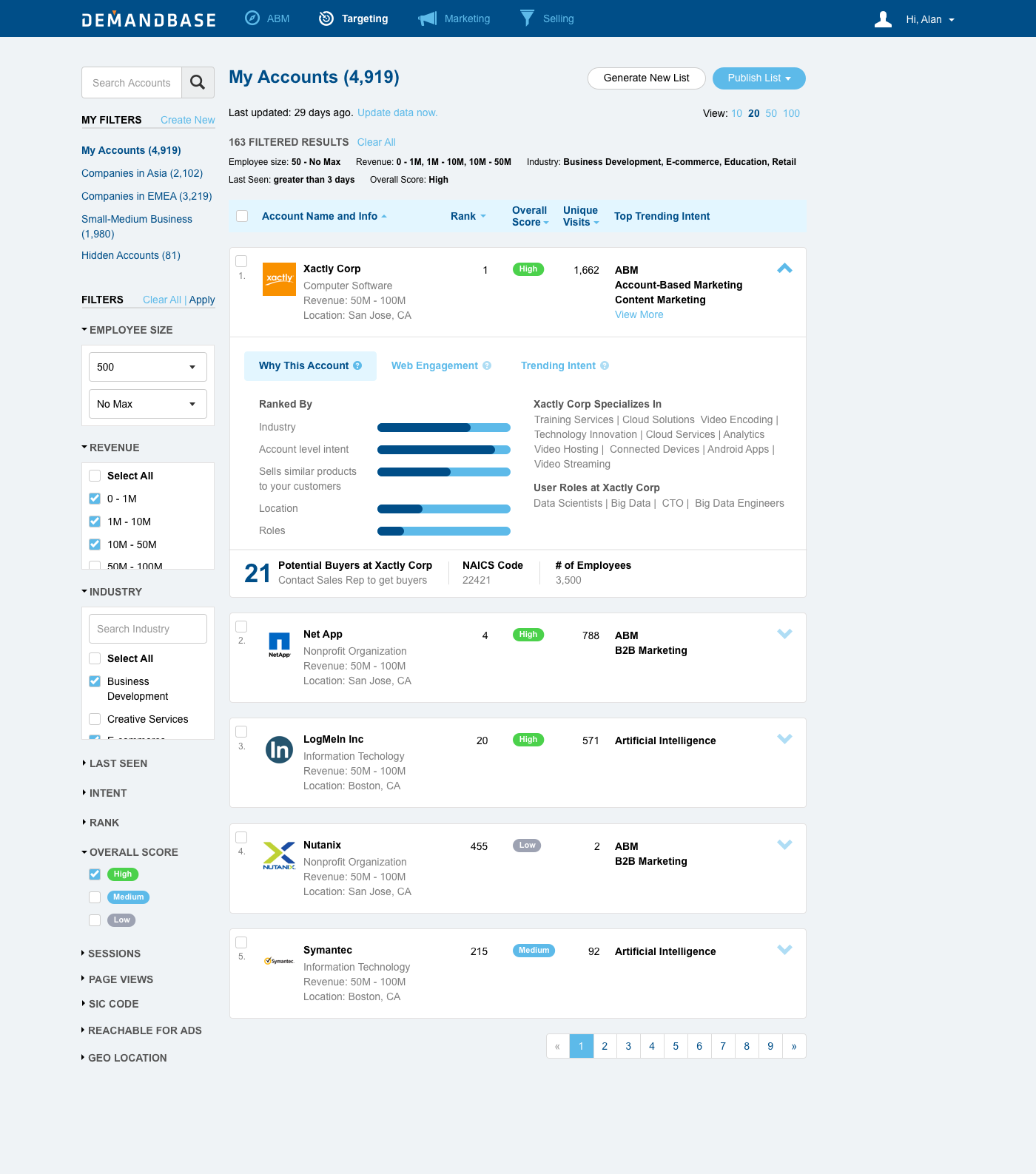
Caption: Account List Default (Image courtesy: Demandbase ABM)
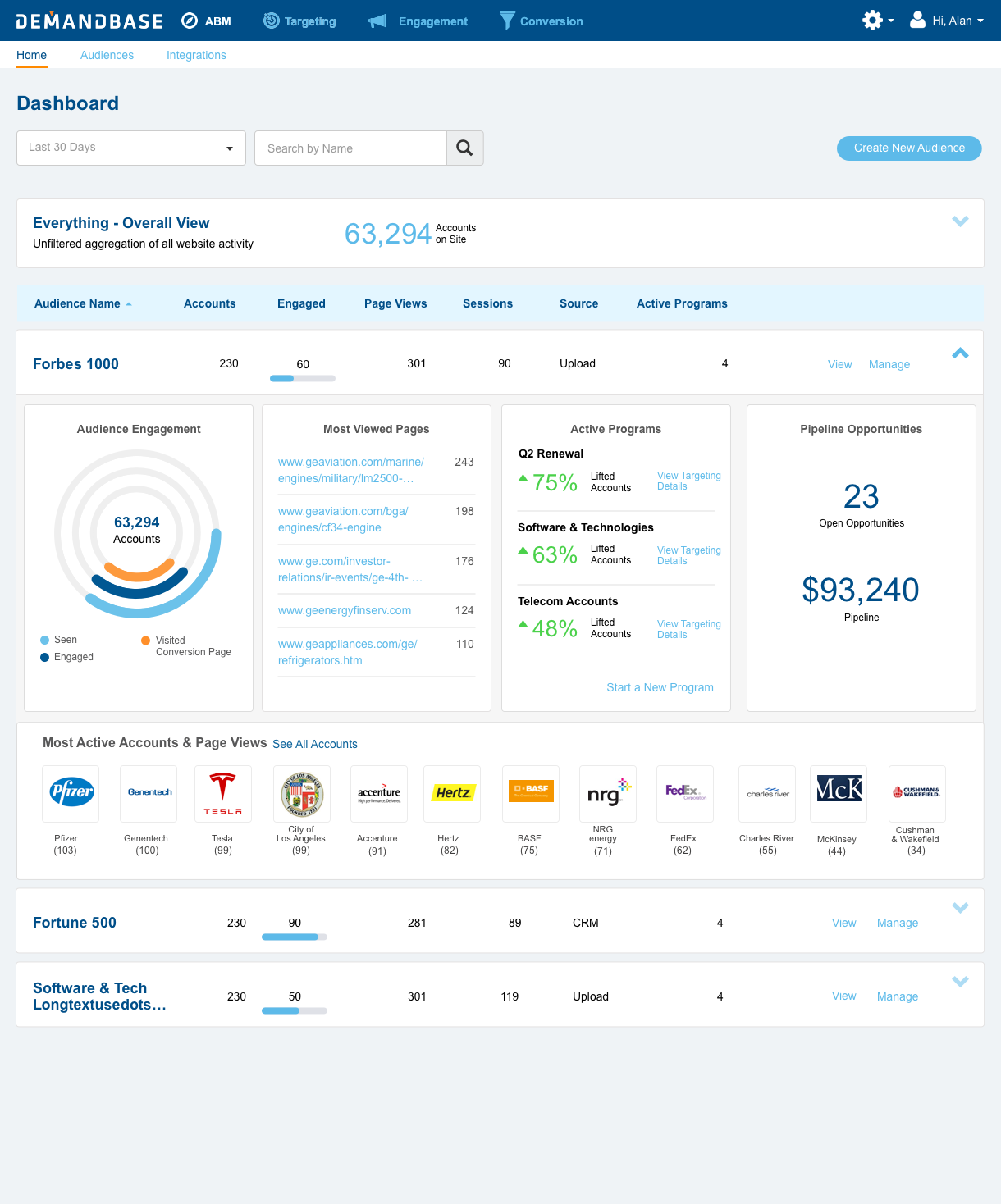
Caption: Audience List Expanded (Image courtesy: Demandbase ABM)
Chris added, “There are too many risks and technical barriers to overcome in trying to stitch together an ABM strategy using disparate technologies that don’t use a common data model to follow and measure a business audience throughout the entire funnel and lifecycle. What’s been missing from ABM technology is an integrated platform that makes it easier to implement, execute and grow your ABM efforts seamlessly. I’m confident the new AI-based platform introduced today with fully integrated targeting, engagement and sales conversion solutions will set us apart for many years to come.”
The Demandbase ABM Platform makes it easy to build target accounts from CRM data, by uploading a pre-existing account list, or by leveraging buyer intent signals generated by the only AI-powered ABM platform that learns from 50 billion B2B interactions every month.
Marketers can further segment and manage these audiences by a number of firmographic variables such as industry, size, location and others.
Website Optimization and Display Advertising Make ABM Automation More Efficient
Demandbase’s new platform is a fully integrated set of solutions which includes:
The Targeting solution triggers account-based advertising and retargeting campaigns, and consists of account selection and display advertising.
The Engagement solution optimizes the website experience for accounts and segments, and includes website optimization, forms, live chat and account-based marketing automation.
The Conversion solution delivers sales and SDR teams with stakeholder contacts’ information and insights from key accounts.
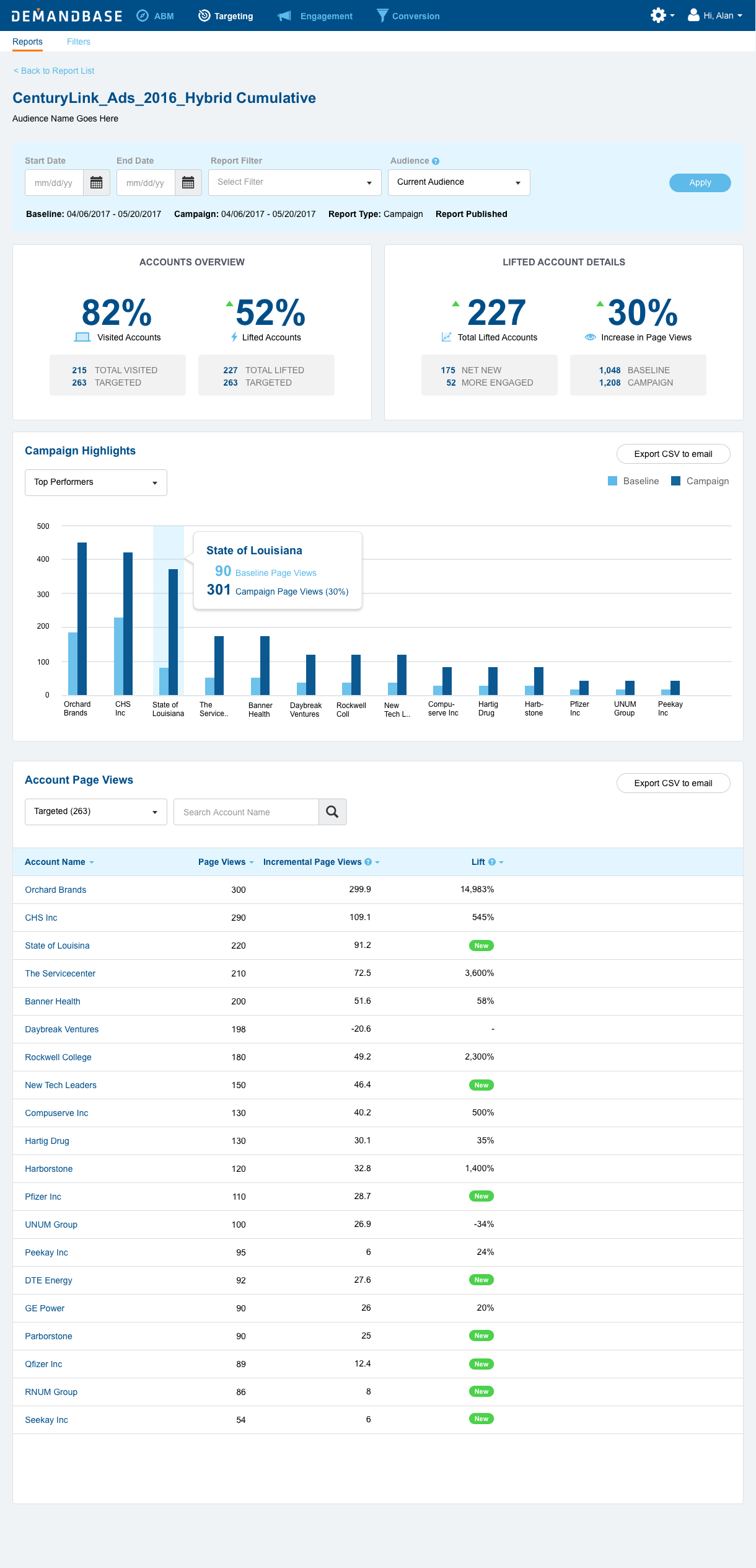
The ABM Platform also integrates with more than 50 of the most popular third-party analytics tools for program measurement, analysis and optimization. This integration maximizes the effectiveness of existing marketing tech stacks without data loss and gives sales and marketing teams access to high-level dashboards to quickly measure how well their company is doing attracting, engaging and converting target accounts from first touch to close.
As a result, the ABM Platform creates a better understanding of how well a particular audience is performing at each stage of the funnel and how well programs for that audience are performing.
Brandee Sanders, Director, Digital Marketing & Analytics,Blackline, said, “Account-Based Marketing is focused on alignment and joined targeting efforts, so when you have multiple point solutions that don’t integrate intelligently, it can create unneeded complexity or holes in our Sales and Marketing strategy. Demandbase’s ABM Platform gives us an easy-to-use, integrated view into who we’re reaching, why we’re reaching them and how we’re engaging them, allowing us to quantitatively measure results and answer to core KPIs.”
Balancing Act For Effective CRM Ops
B2B marketers would benefit from the fully aligned marketing-sales integration delivered through the new ABM platform which provides sales and marketing with visibility into what’s working and what’s not, and which accounts are the highest priorities.
Chris explained how the ABM Platform offers an easy-to-use interface that builds target accounts directly from CRM data, making the process of building an account list and having an effective CRM operation even easier. He added, “Marketers can upload a preexisting account list from their CRM solution, or they can leverage buyer intent signals generated from our AI-powered platform, which learns from 50 billion B2B interactions every month. With these capabilities, marketers can further segment and manage audiences by a number of firmographic variables such as industry, size, location and others.”
The next-gen AI-enabled ABM platform from Demandbase is positioned ahead of the market trend as it offers the flexibility to roll up those results up by territory, audience and campaign.