For an ordinary person and a final buyer, the global market means the opportunity to purchase what they need in any country at a targeted price. But for business, it is a new source of profit when people who buy their products and services live anywhere. Chinese business and, first of all, Chinese e-commerce is developing on a global scale. Its trading platforms are known all over the world and in fact have become common nouns: Aliexpress, GearBest, SheIN and many others.
No matter whether a business carries on trade in the country of its physical presence or in any other country in the world, the sale must be driven and the product must be promoted. We do not just think, but we strongly feel that CPA is one of the most efficient ways to promote products and increase sales.
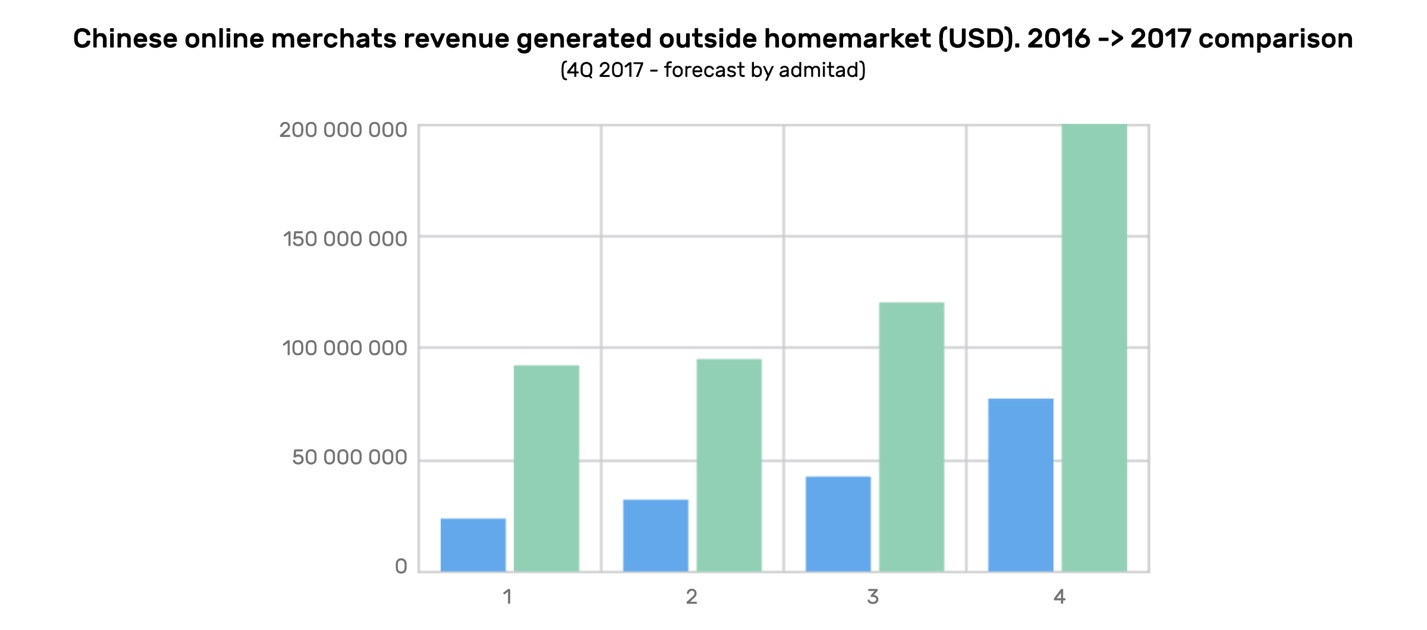
Admitad has calculated the amount attracted to Chinese business by sale in foreign markets through their affiliate program. The sum comes up to USD 310 million within nine months in 2017. This amount included more than 70 Chinese e-shops which place their offers through Admitad.
Image Courtesy-Admitad
The most important thing is that the end of the year – a holiday season in all the countries of the Golden Billion – has not yet come, however Chinese e-commerce had already obtained one third of a billion dollars from sales with CPA in Admitad.
Alexander Bachmann
Alexander Bahmann, Admitad CEO, said “One of the vectors that we have chosen for Admitad’s development is really ambitious. We want our company and the instruments we have created to become a hub, an access point where Chinese e-shops could attract buyers from all over the world. What is more, with the CPA payment model which is transparent, demonstrative, scalable, projected – there are a lot of advantages. On the other hand, we see that many European and American products are in demand in China. For this purpose, we have established an office in China in order to help non-Chinese global e-commerce to enter the Chinese market and find core solvent audience there. It is important to us to combine these courses: to help business to sell, and buyers to purchase desirable products.
Indeed, the world and business are becoming global and Admitad, being a global company, does its best to cooperate in that effort.”
Recent Successes Combine with New Technology Investment to Boost Innovation
Infor, a leading provider of business applications specialized by industry and built for the cloud, announced at ShopTalk Europe in Copenhagen, significant momentum for its European retail business. Infor’s retail applications for human capital management, converged commerce, merchandizing, demand management, enterprise asset management, supply chain management, deep analytics and risk and compliance, have contributed to 15 new or expanded relationships in 2017 throughout Europe.
Infor Retail is a suite of applications designed to support core operations, management teams, on-the-go district managers, and employees in a revolutionary new way that takes advantage of the latest consumer and business technologies: mobile, social, and cloud.
New European wins include Chausport (part of JD Sports Fashion Plc), New Look, MVideo and Direct Wines. Direct Wines, the world’s largest direct-to-home wine merchants, has implemented Infor Retail Demand Management to help it to better understand customer segments and drive more accurate forecasts and higher sales and margins.
“We have been using Infor Retail Demand Management for a while and upgraded to the latest release. We can see additional benefits coming from our partnership with Infor Retail as we look to bring our businesses onto a single platform for campaign, offer and assortment planning. The three-year commitment we’ve just made will enable us to continue to grow as a business and exploit the platform to its full potential,” said David Ives, Group CIO of Direct Wines.
Also in Europe, Chausport has chosen Infor CloudSuite Fashion to integrate the functions of the distributor’s information system: from purchases to inventory management and logistics to the management of its stores’ supplies. The solution will also cover the delivery of products bought by the customers through Ecommerce.
Dominique Dambre
Dominique Dambre, Project Sponsor at Chausport, said, “We aim to move from being a multi-channel player to an omni-channel distributor, which requires us to opt for a single management platform with a centralized database. Among the solutions we evaluated, Infor was able to demonstrate to us that the Infor CloudSuite Fashion solution is able to cover all the essential functions from back and front office, and to integrate them while taking into account our company’s specialities.”
With Infor, retailers are able to exploit the opportunities of huge recent investment in retail technology. This means customers can quickly scale operations through science and predictive tools that help get ahead of consumer demands, and allow users to stay agile and fight digital disruption.
Jason Berry
“We have made consistent and aggressive investments in retail and it is clearly reaping rewards. From the acquisitions of the likes of Starmount and Predictix to partnerships with Whole Foods and DSW, we have turned our industry focus full force onto retail. The net result has been disruptive and immediate across Europe. But we are not resting on these laurels. We are now already turning our attention to demand management and addressing the inventory issues that plague the industry, combining machine learning and artificial intelligence with a wider network perspective that will separate Infor and deliver truly next generation capabilities to today’s progressive retailer,” said Jason Berry, European vice-president, Infor Retail.
Global Investor Group Expands Company’s Reach and Traction
ScoreData Corporation announced the completion of its Series Seed round of financing. Participating in the round were the following angel funds: 500 Startups Silicon Valley, USA, Global Reach Investments Ltd, (GRIL), Elevate Innovation Partners VC, NYC, USA, and 3one4Capital, Bengaluru, India.
ScoreData is a company that helps businesses leverage their data to dramatically improve the quality of their engagement with their customers. Their solutions can be deployed across multiple touch-points such as mobile, web, kiosk and store. ScoreData’s Scorefast™ platform enables data scientists and business managers to create the most effective run-time consumer models and scores for fraud detection, churn-management, caller-agent mapping, recommendations and cross-sell applications.
The modern Digital Contact Center is an indispensable touch-point for customer engagement in the enterprise. ScoreData’s ScoreFast™ is revolutionizing how customers interact with agents at enterprise contact centers. ScoreFast-powered applications are yielding greater revenues, significantly improved operations, and superior customer experiences at Fortune 1000 customers.
Sridhar Chityala
“ScoreData is reinventing how customers engage with the enterprise. The vast majority of enterprise engagement centers use script and attribute based routing. ScoreData’s ScoreFast engine not only streamlines the process of routing customers to the appropriate touchpoints in the enterprise but also simultaneously empowers agents to deliver superior customer service resulting in outstanding customer experiences. Early validation by leading firms, the extraordinary management team, and attributable business impact of the ScoreFast-powered applications at the engagement centers, were important reasons why we invested in ScoreData,” said Sridhar Chityala, Chairman, Elevate Innovation Partners VC, NYC.
Individuals who invested in the round were Ashok Krishnamurthi (angel investor), Betsy Atkins (Board Member at several US and international publicly held companies), Andrea Weiss (Board Member at several US and international publicly held companies), and Asha Jadeja Motwani (well-known Silicon Valley-based angel investor) and Shalini Prakash (via 500Startups).
50 Percent Of All Viewing Will Be Done On A Mobile Screen, With Half Of This Done On The Smartphone Alone
Ericsson unveils the eighth edition of its annual ConsumerLab TV and Media report, which details the massive growth in TV and video viewing and the ongoing shift in the way consumers watch content.
Supported by eight years of extensive media insights, Ericsson ConsumerLab predicts that the growth of on-demand viewing will continue to soar through to 2020, making up almost half of total viewing. 50 percent of all TV and video viewing will take place on a mobile screen (tablets, smartphones and laptops), an increase of 85 percent since 2010, with the smartphone alone accounting for almost one quarter (an increase of nearly 160 percent since 2010). Additionally, VR will be on the road to becoming mainstream, with 1 in 3 consumers becoming VR users by 2020.
Anders Erlandsson
Anders Erlandsson, Senior Advisor, Ericsson ConsumerLab, says: “We can see that consumers are not only watching more video but also changing how and when they do so. This is also shown through the continued growth of mobile viewing, which has been a booming trend since 2010. This year also marks the first time that we have explored the level of consumer interest in VR in conjunction with media consumption, and the findings have been fascinating. VR has the potential to bring together people from all over the world and create deeper, more personalized, and more complementary media experiences. As consumer expectations for on-demand, mobile and immersive viewing continues to increase, the TV and media industry must focus on delivering highly personalized services in the very best possible quality available.”
Here are some highlights from the report and predictions that the Ericsson ConsumerLab TV and Media report makes about the video consumer to come.
The Content Discovery Crisis
According to the report, over 50 percent of Screen Shifters cannot find anything to watch on scheduled linear TV at least once a day, while slightly more than 30 percent say the same thing about VOD services. For this growing group of advanced users, the old-fashioned TV guide does not help. Their on demand experiences have set the bar too high – even though these services are themselves in need of improvement.
The total average time searching for content is also increasing; since last year, it has risen from 45 to 51 minutes per day (Figure 14). Interestingly, scheduled linear TV accounts for this entire increase, as searches on VOD services have remained constant since last year.
There are also interesting age differences both in terms of viewing and searching patterns. Millennials spend over 50 percent more time searching on VOD services than those aged 35 and up, and they spend over 80 percent more time watching VOD content.
Original Content Is In Demand
Over 70 percent of consumers agree that content and price remain at the top of their priority list when evaluating new TV services. However, three in four Netflix subscribers say the most important factor is access to exclusive original content – a sentiment shared by less than half of all consumers.
A More Social Reality
The future seems less lonesome for the video consumer of the future. The trend of increased solitary viewing due to the development of personal screens and on-demand viewing could be reversed thanks to the capabilities and promises of VR. Already, two in five VR users are watching TV and video together with other people on virtual sofas around the world.
The majority of current and potential VR users believe VR will be an essential component of TV and video in the future, which bodes well – a third of consumers are projected to be VR users by 2020.
Cloud Leader Offers Support For New VAT, Adds Dedicated Sales Team And Strengthens Partner Ecosystem To Meet Growing Demand For Cloud ERP In Region
Oracle NetSuite, one of the world’s leading providers of cloud-based omnichannel commerce software suites, announced the expansion of operations in the Middle East to meet the increasing demand for cloud ERP in the market. With the support of Oracle’s global resources, NetSuite added a dedicated sales team with new leadership; new solution provider partners to strengthen its existing partner ecosystem; and increased customer adoption of NetSuite OneWorld. Additionally, NetSuite will offer support for the new Unified Value Added Tax (VAT) Agreement, set to take effect for Saudi Arabia and the United Arab Emirates (UAE) next year with more Gulf Cooperation Council (GCC) countries expected to follow.
Mark Woodhams
“Local and global companies with regional headquarters in the area are already reaping the benefits of cloud ERP,” said Mark Woodhams, Oracle NetSuite Vice President, EMEA. “With today’s announcement, we’re signalling our ongoing commitment to the region and the success of our customers and partners here.”
NetSuite to Provide VAT Support, Enabling Businesses to Comply with New Tax Rules
With the Unified Value Added Tax (VAT) Agreement signed by the Gulf Cooperation Council (GCC) countries set to go into effect in the UAE and Saudi ArabiaJanuary 1, 2018, and with other countries in the region expected to follow, NetSuite will build support for the new changes directly into the system. The VAT will impact every part of the business, including cash flow, pricing of products and services, financial reporting, tax accounting and reporting and, of course, technology. NetSuite already has a highly flexible in-house tax engine that supports over 110 countries for VAT, both rules and reporting, creating a solid foundation on which to build out functionality specific to the GCC VAT. Tax codes for the standard rate, zero rates, reverse charges, as well as VAT on imports, will all be part of NetSuite’s International Tax Reporting SuiteApp. Existing customers will enjoy full business systems compliance with new changes in the value-added tax (VAT) rate without having to lift a finger. NetSuite’s cloud computing model and the flexible, powerful NetSuite Tax Engine inside NetSuite’s financial software ensure that NetSuite customers immediately benefit from this update.
NetSuite Adds Direct Sales Team and Leadership
NetSuite is extending its focus on the Middle East and the surrounding region with a dedicated sales team, pre-sales, country manager, marketing and other support functions, all operating out of a new Dubai office, which will be the center of East, Central Europe, Middle East and Africa (ECEMEA) operations. The dedicated sales team has been established and trained to address the UAE and Saudi Arabian markets. NetSuite will also continue to recruit local implementation partners with experience in ERP to support continued growth in the region.
Khaled Ismail
The dedicated sales office will be led by Khaled Ismail, Vice President, Oracle Digital Application Business, ECEMEA, who will manage sales and marketing strategy for the region. In this role, Ismail will manage an organization of 250 sales professionals with almost 20 managers and directors. He is also responsible for all the supporting functions for ECEMEA from pre-sales, sales development, marketing and customer success.
“The UAE has been a strong growth engine for NetSuite in recent years. Now, with the additional global resources of Oracle, we intend to continue that growth and expand not only our sales operations and partnership, but build out additional functionality specific to the region,” said Ismail
NetSuite Strengthens Partner Presence in the Region
NetSuite already has a strong partner presence in the region with 16 partners serving customers in the region. In 2017 alone, NetSuite added the following seven businesses to its Solution Provider Program: Azdan Business Analytics; Trinamix Business Solutions; Wolfrayet Business Consulting; Masterkey Software; Foresee Solutions; UnitedofOQ; and Digital Trends. As part of its expansion in the region, NetSuite will actively be recruiting qualified partners to continue to provide local businesses with a leading cloud ERP solution.
NetSuite OneWorld, a Game-Changer for Middle Eastern Businesses
Businesses seeking to gain efficiency, grow revenues, expand globally and enter new markets often find themselves held back by software systems siloed by department, geography or legal entity structures, leaving them unable to deliver an optimal customer experience and gain insights into their operations. The agility, flexibility and scalability that NetSuite OneWorld provides is difficult to achieve by businesses running legacy on-premise software. Meanwhile, other available cloud financial software solutions only offer basic product functionality that cannot scale and support changing business needs, growth and international expansion.
NetSuite OneWorld provides a unified and cloud-based suite of software that is flexible enough to meet the needs of diverse business models, legal structures and geographies. NetSuite OneWorld supports 190 currencies, more than 20 languages, automated tax calculation and reporting in more than 100 countries, and customer transactions in more than 200 countries.
Further, to help today’s B2B and B2C businesses with omnichannel commerce, NetSuite OneWorld delivers commerce-ready capabilities that can help both B2B and B2C commerce businesses to move from siloed online, in-store and phone consumer shopping channels to an integrated commerce solution, connecting ecommerce and in-store POS to order management, inventory, merchandising, marketing, financials and customer service, while delivering a seamless brand experience and exceeding customer expectations.
Creating Individualized Customer Experiences: Top Insights from The Personalization Summit 2017
I recently attended my first Personalization Summit – an event dedicated to helping digital marketers deliver highly relevant, individualized experiences to their audiences across channels. It’s no secret that we’re in the Age of the Customer – and personalization is especially important and strategic to our organization because we feel that our digital presence should provide the same warm experience that occurs when two humans are conversing. I was hoping to get a little bit of inspiration in addition to a whole lot of implementation strategies out of the annual event, hosted by Evergage.
Boy, was I impressed. The Summit had all the polish of events hosted by industry giants like Oracle and Marketo, but with the intimacy to actually feel like your questions are being addressed and your feedback has a direct impact on the product roadmap.
The other thing that struck me was how passionate everyone was about personalization for the end consumer – attendees and presenters alike. There is a lot of talk in the press and by personalization vendors about how today’s marketer needs to have this technology or that tool, and this process or that capability to be considered “best in class.” Karl Wirth, Evergage’s CEO, reminded everyone during his morning keynote that the idea of personalization in marketing has been around for almost 25 years, since the release of The One to One Future by Peppers and Rogers in 1993. The most important thing is to start with a vision and to be committed to creating experiences that help and delight customers.
With that idea in mind, it was interesting to hear Forrester Analyst Brendan Witcher talk about individualization as opposed to personalization. He describes personalization as the perception of the customer and not something the marketer can control. However, by thinking of it as “individualization” (treating each person as an individual and focusing on delivering relevant experiences to each person), the goal becomes much more achievable through the use of personalization tools and machine learning – which uses algorithms and predictive analytics to determine and deliver the most relevant content and experiences to each and every visitor. He also challenged all of us in the crowd with the notion that the expectations of our customers are constantly changing and that today’s best practice is tomorrow’s old way. To me, this makes it even more critical that we keep on top of trends in the marketplace and ensure we can empathize with our customers to deliver an exceptional experience.
While all of the keynote speakers did a nice job of keeping the customer at the center of the personalization discussion, it was the “fireside chats” from real-world users that made me realize just how powerful personalization technology can be in the right hands. From microelectronics to insurance to auctions and more, machine-learning personalization is being used to not only drive highly relevant individualized experiences that feel personal to the consumer, but also to bring real value to each of the businesses through increased revenues and customer lifetime value. I came away with many ideas on how I could leverage some of the approaches to improve our digital presence at Harte Hanks.
The day would not have been complete without a few breakouts to help clients like me learn more about how to leverage our personalization investments. The breakouts covered a wide variety of topics from planning sessions to technical ones around how Evergage computes correlation models for recommendations. I walked out of each session knowing more about how to make my marketing better than I did before I walked in, even if I still don’t fully understand the math behind collaborative filtering!
It’s clear the technology has finally caught up to the vision Peppers and Rogers painted almost a quarter century ago, and machine learning is driving that evolution and propelling us forward. I am already looking forward to next year’s Summit and to seeing what Evergage will cook up.
Modern marketers have shown an appetite for leveraging mobile marketing platforms to drive interactions with customers. These interactions are based on the analysis of consumers’ preferences on how they would like to communicate with brands. Chatbots and intelligent assistants have created a flourishing opportunity for marketers to influence consumer loyalty and improve experience across mobile marketing campaigns. To understand how brands can leverage mobile marketing to better customer acquisition and brand advocacy through mobile and social channels, we spoke to Steve Murphy, CIO of 3Cinteractive.
Html code here! Replace this with any non empty text and that's it.
MTS: Tell us about your role at 3Cinteractive and how you got here?
Steve Murphy: I lead 3C’s global technology organization, overseeing the existing platform and systems as well as championing the development of new, innovative products that support mobile marketing programs for the company’s clients. I am an experienced technology and business executive with more than 20 years’ experience profitably growing businesses by developing products for online, mobile and telecom companies—in both direct-to-consumer and business-to-business sectors. Over the years I’ve been fortunate to work on some innovative teams building great products which have resulted in 19 patents.
MTS: How do 3C and its clients use customer data to benefit the consumer in their journey with the brand? Steve: The more we engage with customers digitally, the more data we can gather from those interactions and, with the right analytics tools, we can gather useful insights to further our relationship with those customers. Whether targeting with the right offer to delight or using context to provide exceptional service, we operate in the age of data and can harness it to our advantage.
The key to data capture is not only the content but the context. When we engage our customers via mobile, we can bring added context to the conversation. The fact that they’re choosing to communicate with us on a mobile device is itself a contextual element.
Take location as an example: A change in location can be very powerful. If they’re moving at 60 miles per hour, it may not be the best time to suggest a sale on shoes at the store that’s now a half a mile behind them. If they’re on vacation visiting their hometown, they are probably in a different frame of mind than if they are in a strange city on business. It’s all context that can make a single interaction a moment of truth that defines your customer’s relationship with your brand.
MTS: How are mobile messaging platforms evolving with the changing dynamic of online engagement with customers? Steve: Recently, Forrester Research indicated that roughly six billion text messages are delivered every day in the US, resulting in about 8.6 trillion text messages in a single year. However, the native text messaging experience is currently limited to plain text and clunky interactivity at best. The changing dynamic of online engagement has created consumers that now expect a rich, dynamic brand experience with every single interaction, and the native text messaging experience has been running on technology that is due for an upgrade.
Although mobile carriers have upgraded their networks to keep up with demand for data and smartphones, the SMS technology infrastructure also needs to evolve to enable new, rich functionality in the messaging experience. As a result, mobile players have begun to adopt a new technology called Rich Communication Services (RCS), which leverages data connectivity to deliver next-generation messaging features like location sharing, high resolution image and video sharing, read receipts, and rich cards — all within the native messaging application on the device. RCS is essentially the evolution of SMS and MMS to a more dynamic messaging experience. In many cases, RCS capabilities extend beyond messaging. The technology could integrate with the device’s address book, to see who else in a person’s network is utilizing RCS, and enable users to share media and location even during a telephone conversation.
MTS: How does the Switchblade platform enable marketers to leverage and maximize the ROI from their CRM? Steve: The key to our platform is its flexibility and scale. We’ve found that many brands have customer data in many different places and in many different formats—making it difficult to create true 1:1 to engagements. Our platform is able to ingest these disparate data streams and leverage them to develop customer touch points that are real-time and relevant to the end user. Additionally, we do this at scale processing over 1 billion mobile events daily for some the world’s largest brands.
MTS: How can brands leverage mobile marketing to drive customer acquisition and brand advocacy through their social channels? Steve: According to Nielsen, 83% of consumers say they trust friend and family recommendations more than any other form of advertising. When it comes to promoting products and services, there’s no source quite like social media and word-of-mouth marketing to get the word out.
At 3C, we see several brands who are looking to drive customer acquisition and brand loyalty by integrating their mobile marketing efforts with their existing social media strategy. By delivering a seamless mobile marketing experience, and then enabling satisfied customers to easily share their positive brand experiences with friends and family on their social channels, brands are seeing supplementary program results like increased app downloads, loyalty program sign-ups, and increases in social followers, among others.
MTS: Thanks for chatting with us, Steve.
Stay tuned for more insights on marketing technologies. To participate in our Tech Bytes program, email us at news@martechseries-67ee47.ingress-bonde.easywp.com
[mnky_testimonial_slider][mnky_testimonial name=”” author_dec=”” position=”Designer”]“It’s very important to focus on acquiring the most complete and accurate marketing data you can. If the data is incomplete or inaccurate, neither the human nor the machine will draw the correct conclusion.”[/mnky_testimonial][/mnky_testimonial_slider]
On Marketing Technology
MTS:Tell us about your role and how you got here. What inspired you to be a part of a MarTech innovation company?
As a 5-time VP of Marketing in Silicon Valley, I always wanted to measure my marketing programs and their impact on revenue. I figured that if I could get great, detailed information on marketing performance I could be a better VP of Marketing. The trouble was I couldn’t get the data I wanted. When I got a call from a former colleague, Roan Bear, and she told me that she had a solution to this issue, I jumped on the chance to start Full Circle Insights.
MTS:Given the changing dynamic of online engagement with B2B customers, how do you see campaign attribution and funnel metrics transforming the Lead to Revenue management? Campaign attribution and funnel metrics are used to improve our ability and effectiveness in Lead to Revenue Management. Funnel metrics can be diagnostic of problems and opportunities in the Lead to Revenue cycle and campaign attribution can help us figure out what campaign mix is optimal to drive more revenue. The technology in our products connects dots in the data so we get a full picture of what actions drive what revenue outcomes, whether the outcome is between the funnel stages or the actual closed, won deal.
MTS:How does Full Circle Matchmaker enable the sales teams to connect individual leads to the right account for account-based everything?)
Being domain experts in B2B sales, we know that it’s important for sales teams (and marketing) to engage leads with the context of what accounts they represent. Matchmaker uses smart logic, fuzzy matching, and a customizable rules engine to match leads to the right accounts in your Salesforce database. We built Matchmaker knowing that salespeople take too much time manually matching leads within Salesforce. So, we tailored the product to address their problem, with the capability to run it continuously in the background as well as one-off in bulk batches, customize the rules to tweak the matching logic for your needs, and route or assign the leads to the right sales reps who own the specific account.
MTS:Would you tell us about the unique features of Customizable Attribution Models used for B2B marketing mix optimization?
Our Campaign Attribution product (also made available as part of our flagship Response Management product), is unique for a few key reasons. Firstly, the attribution runs natively inside Salesforce, enabling a marketing person to capture the impact of every campaign in Salesforce to revenue from each deal. Having this in Salesforce makes the numbers match and enable cross-organizational trust in the attribution figures. Second, with the application native in Salesforce, a marketer can run granular reports that slice and dice the data into any segmentation that exists in the fields they have already in Salesforce.
Finally, we built Campaign Attribution to support highly customizable models. Out-of-the-box, you can run the standard single-touch models and multi-touch models. Our product goes a couple steps further with multi-touch: you can self-customize the weighting as well as introduce variables into the weighting outside of just touch. For example, you might track the type of engagement or touch, such as online vs. offline, duration of engagement, etc. Our customizable weighting configuration allows you to customize attribution weightings along those variables as well.
MTS:How do you see predictive analytics driving the “Quick Dash” for Response Management? Is it possible for account-based marketers to customize their funnels with an accelerated deal velocity? Quick Dash is a set of out-of-the-box dashboards that are designed to be action-driven. Too often we don’t have enough insights, we just have data. Our flagship product Response Management is meant to address the need for marketers to get granular with data to gain context and drive actionable insights. Most businesses require methods of measuring a lead and account funnel that automates the tracking of progression down the funnel and matches how they define their funnel stages. That is why easy customizability of funnels inside of Response Management turbocharges the marketing and sales data being created inside Salesforce and enables marketers to make decisions that accelerate deals, improve conversion rates, and drive higher revenue.
MTS:What startups are you watching/keen on right now?
Docusign, Slack, Splitwise
MTS:What tools does your marketing stack consist of in 2017?
Salesforce, Pardot, Full Circle Insights, WordPress, HootSuite, Google Analytics, AdRoll, and Google Adwords
MTS:How do you prepare for an AI-centric world as a business leader in MarTech?
It’s very important to focus on acquiring the most complete and accurate marketing data you can. After all, if it’s a human interpreting a chart or an AI algorithm drawing a conclusion around a large data set, if the data is incomplete or inaccurate, neither the human nor the machine will draw the correct conclusion.
This Is How I Work
MTS:One word that best describes how you work.
Relaxed (mostly)
MTS:What apps/software/tools can’t you live without?
Docusign is my favorite (of course I can’t live without email, Powerpoint, Excel or Chrome)
MTS:What’s your smartest work-related shortcut or productivity hack?
Get exercise. Exercise has been proven to make the brain work better.
MTS:What are you currently reading?(What do you read, and how do you consume information?) Sapiens, The Washington Post, CNN and Fox News.
MTS:What’s the best advice you’ve ever received?
From Gary Kennedy, former VP of Sales at Oracle in the 80s. Follow these 3 work rules in a fast growing company:
Be responsive — respond to every email in 24 hours (now the time is shorter);
Do what you say you’re going to do — we’re all depending on each other to deliver
At the end of the day, when you leave the office, be sure you’ve done the most important things that day
MTS:Something you do better than others – the secret of your success?
Taking a very complex subject and making it easy for anyone to understand
MTS:Tag the one person in the industry whose answers to these questions you would like to read: Marc Benioff
MTS: Thank you Bonnie! That was fun and hope to see you back on MarTech Series soon.
Prior to joining Full Circle Insights, Bonnie Crater was a five-time vice president of marketing and executive at many software companies in Silicon Valley. Bonnie held vice president and senior vice president roles at Genesys, Netscape, Network Computer Inc., salesforce.com, Stratify, Realization, and VoiceObjects (now Voxeo). A ten-year veteran of Oracle Corporation and its various subsidiaries, Bonnie was vice president, Compaq Products Division and vice president, Workgroup Products Division. In 2013, Bonnie was named one of the “100 Most Influential Women” by the Silicon Valley Business Journal, in 2015 the Sales Lead Management Association named her one of the “20 Women to Watch” and in 2016 Diversity Journal honored her as one of the “Women Worth Watching.” Bonnie holds a B.A. in biology from Princeton University.
[/vc_tta_section][vc_tta_section title=”About Full Circle Insights” tab_id=”1501785390320-2d44fa50-740c5a4b-c27aca64-108e7775-d6ee”]
Full Circle Insights products give marketers full response lifecycle management solutions, ensure every deal is attributed to the right campaign so you can get accurate ROI, and answers all your marketing questions in one place. Our products are built 100% on the Salesforce1 Platform and are compatible with the leading marketing automation solutions. All your marketing data is in one place and so are the answers.
The MTS Martech Interview Series is a fun Q&A style chat which we really enjoy doing with martech leaders. With inspiration from Lifehacker’s How I work interviews, the MarTech Series Interviews follows a two part format On Marketing Technology, and This Is How I Work. The format was chosen because when we decided to start an interview series with the biggest and brightest minds in martech – we wanted to get insight into two areas … one – their ideas on marketing tech and two – insights into the philosophy and methods that make these leaders tick.
webSURGE Digital Marketing, a company that specializes in SEO, received the prestigious IMPACT Award for App Development B2B in recognition of its App Development for CooperVision. The Internet Marketing Association’s annual awards celebration was held on Sept. 29, 2017, at the Enclave in Las Vegas.
What is the Impact Award?
The mission of IMA, a global organization of professional partners, is to create a database of proven internet marketing strategies that provide a foundation of success for those in sales, marketing, business ownership, programming, and creative development. IMA created the IMPACT Award to reward those whose innovation, effort, or creativity made a dynamic improvement for their clients in their respective industry.
Sinan Kanatsiz
“The IMPACT Awards exemplify best-in-class creativity, expertise, and results achieved by the top practitioners of internet marketing across every business segment as well as non-profits, government, and education,” said IMA Chairman Sinan Kanatsiz. “IMA is a unique resource for top professionals. Our fundamental goal is to build the leadership that will continue to drive this dynamic industry.”
SEO Company Develops “Road to Adoption” App
webSURGE developed a sales analytics application for its client CooperVision. The app will be rolled out to various countries around the world to assist with CooperVision’s marketing and sales integration efforts.
The primary function of the app is to track the number of sales during the first 180 days following the release of a new product’s release to customers. If enough sales have been made, the product is considered adopted. If not, users are easily able to pinpoint and correct the problem. This sleek data visualization application is a valuable asset to CooperVision’s sales team in increasing account penetration and improving efforts to be more effective and efficient in increasing sales.
Executives Will Discuss Ways To Operationalize Predictive That Improve Sales And Marketing Efforts
MRP, a global predictive intelligence and customer acquisition company, will present case studies on its predictive analytics and account-based marketing services and how they help B2B companies align their sales and marketing approaches into one specific strategy at the SiriusDecisions 2017 Technology Exchange on October 31 in Austin, Texas.
Lauren Clancy
“We are looking forward to partnering with SiriusDecisions to speak directly to and share our insights with B2B companies about enhancing their marketing and sales approach,” said Lauren Clancy, MRP director of marketing. “Our latest Prelytix upgrade improves the real-time intelligence accessible to our clients and allows them to optimize their marketing outreach with a significant ROI.”
MRP client Digital River will present how using predictive analytics and account-based marketing can take marketing strategy from broad to specific. Mike Thyne, senior director for Digital River, will discuss how MRP Prelytix allowed the company to transition from broad-based demand generation to a highly targeted and effective sales and marketing approach that combines predictive analytics and account-based marketing.
Mike Thyne
“Digital River had embraced the concept of predictive analytics technology when it was fairly new and unproven, so we were eager to work with MRP to test the strategy first hand,” said Thyne. “Predictive has given Digital River the ability to focus on accounts that are most likely to buy and to deploy customized tactics to each account.”
Additionally, MRP will host a lunch and learn at the conference to discuss how operationalizing predictive analytics across an organization can generate impressive results. MRP marketing and sales executives will talk about what they learned from employing MRP’s own services on their marketing and sales efforts.
MRP is a proud sponsor of the 2017 SiriusDecisions Technology Exchange, a three-day B2B conference that focuses on how technology can and should be implemented in sales, marketing and product organizations to enhance alignment and develop optimized technology stacks.
Teradata Announces New Enhancements To Its Customer Journey Solution That Empower Marketers To Act Self-Sufficiently On Insights In Real Time, Without Assistance From IT
Teradata the leading data and analytics company, has been named a leader in Customer Journey Analytics in two Forrester WAVE reports – one for Visioning, and the other for Orchestration. Forrester is careful to emphasize that journey analytics is not a tool, but “an analytics practice that combines quantitative and qualitative data to analyze customer behaviors and motivations across touchpoints and over time to optimize customer interactions and predict future behavior.” The two reports are The Forrester Wave™: Customer Journey Analytics Visioning Platforms, Q3 2017 and The Forrester Wave™: Customer Journey Analytics Orchestration Platforms, Q3 2017.
Per Forrester: “[The visioning platforms evaluation is] weighted heavier on journey design and planning (sharing maps and insights, creating current- and future-state maps, co-creation and ideation, and discovery of segments and personas)” and the orchestration platforms evaluation is “weighted heavier on journey automation and orchestration (workflow automation, journey orchestration, and integration).”
Forrester positioned Teradata as a leader in the two Waves, and noted it for “combine(ing) analytic data sources, databases, and data from real-time digital interactions to identify problems in the journey, size them, calculate the business value of fixing them, and orchestrate(ing) actions across teams, for large volumes of data.” Forrester notes that the Teradata platform “…integrates well with big data sources; has strong real-time analysis, real-time decisioning, and predictive capabilities; and, according to reference customers, focuses on simplification and reducing time to insights.”
Chris Twogood
“I believe that Forrester’s evaluation validates the good feedback we hear from our customers. They acknowledge our significant strengths in data integration, advanced analytics and multi-channel interaction management. Customer Journey Analytics has become the most important space for technology enablement as consumers shop diligently across channels and expect quick, precise responses,” said Chris Twogood, Senior Vice President, Marketing at Teradata. “In addition, we are introducing new functionality, which facilitates action based on deeper insights at higher speed – so opportunities can become business outcomes in minutes, not days.”
As these WAVE reports were published, Teradata announced new enhancements to its Customer Journey Program. The new capabilities augment many of Teradata’s existing assets identified in Forrester’s report, such as a centralized command center for faster access to business insights and the self-sufficiency to access and act on analytic insights in real time, without the need to engage technical resources.
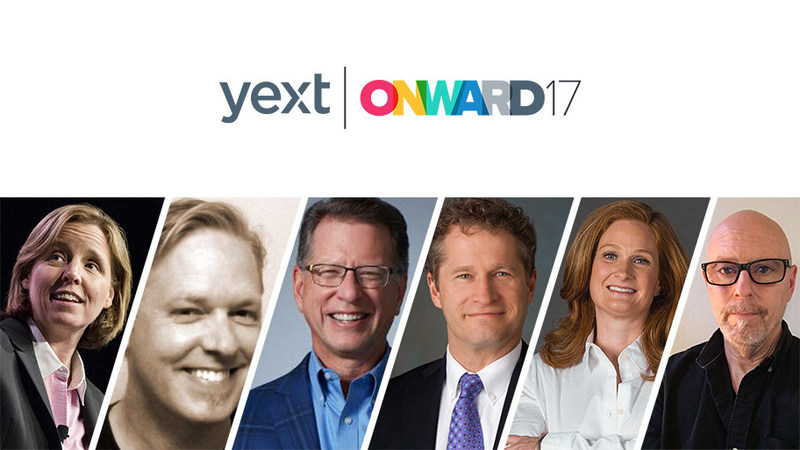
Architects of the Intelligent Future from Across Industries to Speak at ONWARD ’17
Yext, the leader in Digital Knowledge Management, has unveiled its first day of panels for its ONWARD 2017 global conference. Featuring talks by some of the world’s leading innovators, the day will take ONWARD attendees on a tour of the Intelligent Future.
Kicking off on November 1st at the Conrad New York, ONWARD will convene leaders in marketing and technology to explore how AI, digital assistants, and intelligent services will shape our world in the years to come.
Highlights from the first day of ONWARD include:
A keynote fromMegan Smith, former CTO of the United States, followed by a discussion of technology and philanthropy in the Intelligent Future with CNBC “Squawk on the Street” Co-Anchor & “Squawk Alley” Anchor Carl Quintanilla.
Ed Doran PHD, Co-Founder of Cortana and Director of Program Management, MSR Artificial Intelligence, at Microsoft, and Wally Brill, Chief Persona Designer for Google Assistant, will discuss how voice search is changing the business landscape as we know it on a panel moderated by Bloomberg News tech reporter Jing Cao.
Mike Linton, Enterprise Chief Marketing Officer of Farmers Insurance, will join Yext Chief Customer Officer Wendi Sturgis in a fireside chat about how Farmers is evolving to serve the consumers of the future, and what their vastly different expectations mean for financial services and the world at large.
Chris Karpenko, Executive Director of Brand Marketing for the United States Postal Service, will speak with Kasha Casey, CEO of global advertising agency Universal McCann, about how the USPS, the ultimate local presence, is innovating in an age of mobile and intelligent devices.
Jeffrey K. Rohrs
“ONWARD ’17 will feature incredible conversations with the key minds writing the next chapter of the Intelligent Future,” said Jeffrey K. Rohrs, Chief Marketing Officer of Yext. “We’re looking forward to bringing ONWARD attendees together to discover how intelligent services will change the way the world does business.”
Adtoniq Releases Comprehensive Products For Websites To Maximize The Value Of Their Blocked Audience
Google Analytics customers are missing data and information, cannot segment and differentiate their blocked audiences, often without realizing it, because ad blockers prevent Google Analytics from working properly. Adtoniq released the first in a series of breakthrough products designed to put website owners back in control of their blocked audiences and accurately measure Key Performance Indicators. The company is first to solve this problem with Adtoniq for Google Analytics (A4GA). The solution detects all known ad blockers, reliably ensuring Google Analytics continues to work and delivers previously disrupted information about blocked audiences. It provides tools to take action to maximize the value of websites while allowing customers to engage with and show deference to ad blocked users by offering them choices. All of this is accomplished without asking the user to disable their ad blocker or whitelist the website.
Gary Portney
“Ad blocking is negatively affecting many website owners. Without reliable information and insights, it is virtually impossible to make informed decisions and take appropriate actions,” said Gary Portney, CEO of Adtoniq. “Equally, publishers can’t answer questions that advertisers are asking about their blocked audiences, one of a host of issues that arise from ad blocking, and more importantly, they cannot implement strategies to increase KPI’s for their blocked audiences. We are excited about solving this massive problem and providing easy to use tools in a way that is acceptable to consumers and publishers alike.”
Adtoniq detects how an ad blocker is configured and sends that data to Google Analytics using custom dimensions, including whether the blocker is hiding parts of the page (element hiding), whether the blocker has “acceptable ads” enabled, and which services like ads or analytics are being blocked. With this rich and reliable information, Adtoniq’s Ad Blocking Best Practice Reports offer unique insights to help Google Analytics users understand the behavioral and demographic differences among different segments of their blocked audience and design and implement better monetization strategies.
A4GA is built on Adtoniq’s core technology platform, Adtoniq TruBlock™, which allows website publishers to communicate with their blocked audience to better understand their needs and uniquely enables them to control the entire end-user experience. “We urge companies to respect their ad blocked audience and the reasons they are using blockers, starting with explaining clearly what steps they are taking to address ad blocking, and what choices their blocked users have,” said David Levine, CTO of Adtoniq. “We think all web publishers should proactively disclose to their ad blocked audience that they are using Google Analytics when blocked, and let their audience know how to opt out of being tracked. We respect that choice.”
yellowHEAD Has Launched Alison, A Machine Learning Technology That Predicts How Mobile Advertising Campaigns Will Perform.
yellowHEAD, a leading provider of holistic mobile marketing solutions that include paid user acquisition (UA), app store optimization (ASO) and search engine optimization (SEO), debuts its proprietary technology Alison, which uses machine learning to enable advertisers to predict revenue opportunities.
Engineered by top university math professors in close cooperation with yellowHEAD’s campaign managers, the unique technology builds itself on precise analysis based on millions of historical data points. Alison examines over 70 parameters of campaign performance, identifies trends in real time and draws actionable conclusions using an advanced machine learning model. With a broad range of clients and products, as well as cross-platform and full funnel insights from large-budget campaigns across various ad platforms (including Facebook, Google and more), Alison is already delivering impressive results by predicting campaign performance for companies like Playtika, Zynga, Gett, Liveperson, Scientific Games and more.
Eyal Argon
Eyal Argon, Marketing Relations Director at Playtika, says, “Since we’ve been working on Caesars Casino with Alison and the yellowHEAD team, we’ve seen a 27% increase in ROAS from our User Acquisition campaigns.”
An intelligent subsystem constantly analyzes the accuracy of the results predicted and teaches itself how to improve based on previous experience. With Alison, yellowHEAD experts can take actions to optimize campaigns based on predicted results across ad platforms.
Alison adds the power and scale of machine learning to yellowHEAD’s holistic user acquisition approach that combines paid and organic solutions. In addition to bringing higher LTV users to the app, this gives advertisers the ability to uncover previously inaccessible insights and minimize advertising budget waste.
Gal Bar
“Since the inception of yellowHEAD, our solutions have been driven by the vision of full-funnel impact, understanding the user behaviour from the first impression of an ad all the way to becoming a top-value user. It demands continuously refined methodology, data-driven automation, and persistent innovation. The age of artificial intelligence is already here, marking the next generation of mobile advertising, and we’re happy to be a part of it,” said Gal Bar, Co-Founder and Co-CEO of yellowHEAD. “I have confidence that Alison will move the needle in the advertising space. This technology is a strategical supplement to our holistic solutions implementing the company’s vision of full-funnel measurement and lifetime value (LTV) prediction modeling. And we will continue to further intensify our technological development to better understand and predict the user journey from an ad click throughout the entire lifetime in the app.”
Automation Helps Assure Clearer, More Readable And Engaging Content
VisibleThread announced a strategic partnership with OpenText, the world’s leading software vendor in Enterprise Information Management.
OpenText, with $2.3b in annual revenue will now resell VisibleThread’s Language Analytics solutions. This allows their customer base to not just manage content, but vet the quality of the content using VisibleThread’s NLP (Natural Language Processing) platform. OpenText Customers can now create the most engaging and lowest risk web and doc content.
VisibleThread’s products are already in use by over 350 global customers including; Boeing Corporation, Fannie Mae, Accenture and the Australian Government. They use it to support organization wide plain language initiatives for better communications. Sales and contracts teams use it to quality check business documents such as RFPs and legal contracts.
VisibleThread’s functionality perfectly aligns with OpenText’s Enterprise Information Management (EIM) solutions.
It compliments OpenText’s WEM (Web Experience Management) offerings to help produce clearer, more engaging copy that converts. It helps legal teams spot risk in documents already stored in the OpenText eDocs platform.
Fergal McGovern
VisibleThread CEO Fergal McGovern said: “I am delighted that VisibleThread and OpenText have partnered together. OpenText recognised the unique value VisibleThread can bring to their existing global customer base.”
He continued: “We compliment both the WEM and Portfolio Management product lines, and add significant value to customers’ existing investment in OpenText solutions. We look forward to working with the OpenText team to demonstrate that value to their global customer base.”
Utilizing A State-Of-The-Art Titan Content Identifier (TCI) Encryption, Smart Content Platform ‘Titan Play’ Launches On Ios And Android Apps With A Growing Library Of Premium And Digital-First Content – Providing A New Transactional Platform
TiTAN Platform, a smart content and device company with offices in the US, South Korea, Singapore and China, officially launched its US product line. TiTAN Play and TiTAN Core are now available to consumers for the first time, pairing a secure smart content platform with a smart home device that will create a seamless, all-in-one experience for consumers and creators.
“The time has come for content, platforms, networks and devices to be unified. We will continue to expand our business here in the US and around the world providing smart services that will help users be more connected to their content and smart home devices,” said Jae Young Yoon, Founder, TiTANplatform Corporation Korea. “Backed by our TCI patented encryption technology, we have created a secure ecosystem through which consumers can safely integrate their entire home through one device, and content producers can reach viewers on a highly transactional platform that protects their intellectual property.”
Mr. Yoon was the opening speaker at last night’s launch event in Hollywood, California where TiTAN Platform demoed their integrated smart content platform and smart home devices for Hollywood creators, technology partners and investors.
TiTAN Play is a highly-encrypted, transactional content platform that allows content owners to securely upload their IP and have access to consumers through a secure content marketplace. TiTAN Core is a smart home hub device married with a lean-back living room entertainment experience, allowing consumers to manage their connected or smart Internet of Things (IoT) devices and appliances.
Behind TiTAN Play and TiTAN Core is TiTAN Platform’s exclusive content protection technology, TiTAN Platform Content Identifier (TCI) which protects all digitally uploaded content from illegal downloads and reproductions while allowing for advanced measurement, analytics and transactions to optimize the consumer experience.
Adrian Sexton
“With TiTAN Play and Core, we are creating a new ‘OS for the Home’ – a unified ecosystem that provides a smarter content experience and device connectivity. Consumers are increasingly buying smart IoT devices to improve their lives, yet few of these devices truly talk with each other,” said Adrian Sexton, CEO, TiTAN Platform US. “TiTAN Core’s open platform changes that and does it with security being paramount. With TiTAN Play, content creators and studios will be able to monetize their content with a major access point in China – a difficult entry market for YouTube, Netflix, Facebook and Amazon – thanks to our joint venture with China Unicom, a top Chinese telecom.”
Mr. Sexton, former head of digital at Lionsgate Entertainment, Participant Media and Endemol Shine, also announced content distribution deals with TV4 Entertainment (tv4ent.com) and Frequency (frequency.com). As a result of these deals, TiTAN Play users will have access to libraries of premium content including the ability to access content from TV4 Entertainment’s portfolio of passion or niche-based OTT channels and original productions; and watch videos from hundreds of the world’s top digital producers, including TV and multichannel networks from Frequency.
Disrupting the SVOD and OTT sectors, TiTAN content creators will also be able to quickly launch SVOD (Subscription Video on Demand) channels by uploading content directly through either the TiTAN Core smart device in their homes or via TiTAN Play on their mobile devices.
The free TiTAN Play apps are available on TiTAN Core as well as iOS and Android devices. The first prosumer or pro version of TiTAN Core – the TiTAN Core 5 – is available at shop.titanplatform.us, and will be sold at over 10 retailers including b8ta stores in Santa Monica, San Francisco and San Jose, on Indiegogo’s new ecommerce marketplace, Newegg, HSN, NEX / Navy Exchange and multiple flagship IoT department stores in advance of the holidays. A new, mass market basic version of the TiTAN Core line for big box retailers will also be released with wide distribution before the end of the year.
EXLRT, a global content and language technology agency, announced the expansion of its core offerings in alignment with the growing customer experience needs of multi-national enterprises around the world. The agency recently expanded its web and content technology capabilities to include language and translation management offerings that combine to help large organizations go global faster and more effectively.
“Enterprises today must market globally just to stay in the game. But to win the game, they must market locally too. That’s why we see the worlds of experience management and translation management converging. With EXLRT, leading global brands can now truly capitalize on ‘glocal’ marketing through a single technology partner,” remarked Karl Johnson, Managing Director, Americas at EXLRT.
Adolfo Hernandez
EXLRT will showcase its new combined offerings as the Gold Sponsor of SDL Connect, the premier annual event of content and language software and services firm SDL (LSE:SDL). SDL Connect will take place on October 25th and 26th in San Jose, CA with a keynote address from SDL CEO Adolfo Hernandez. EXLRT will also host a talk at the event showcasing its successful development of Turkish Airline’s global digital experiences that serve 250 countries in over 30 languages.
Heather Guntrum
“Going global means speaking to customers, across different languages and touchpoints, around the clock. This puts enormous pressure on companies to scale their content creation, translation, and delivery efforts to meet global ambitions. Companies like EXLRT are leading the way, providing customers with the content and language solutions that tackle these converging issues,” said Heather Guntrum, VP Partnerships, SDL. “We’re delighted to welcome EXRLT as a Gold Sponsor to SDL Connect, where businesses can see how the company helps unlock the value in their content – transforming it into personalized local experiences that customers love.”
To ensure EXLRT’s Fortune 1000 clients like Pentair, SCA, and Kaiser Permanente get the most out of these combined capabilities, the agency has also developed a customer experience strategy practice, led by Johnson, that develops an overall data-driven approach for personalized local customer experiences first before implementing the most appropriate technologies.
Anodot’s Real Time And Automated Anomaly Detection Technology Recognized For Making A “Striking Impact” In The Analytics Space
Anodot, the AI-powered analytics company, announced that Ventana Research declared it the winner of the 2017 Digital Innovation Awards in the Analytics category. Anodot’s technology was recognized as the best analytics innovation across business and IT.
“It’s an honor to be recognized by Ventana Research for shaking up the business intelligence world with a completely new paradigm,” said Anodot CEO and Co-founder David Drai. “Traditional BI and visualization are limited to answering the questions you think of asking, but there are infinite possibilities and knowing what to ask of big data is nearly impossible. Our patented machine learning algorithms solve this major business challenge and provide businesses with invaluable insights that would have otherwise remained hidden.”
The Digital Innovation Awards recognize technology providers that have introduced noteworthy innovations in technology that advance business and IT. The award showcases advances in the productivity and potential of business applications as well as technology that contributes significantly to improved efficiency, productivity and the performance of an organization.
Companies can easily lose millions of dollars from preventable glitches. Anodot uses its patented artificial intelligence to uncover hidden insights in vast amounts of business data by identifying outliers in key performance indicators and correlating across multiple data sources. Anodot’s practical and innovative AI analytics solution can track highly complex data patterns with its unsupervised machine learning algorithms.
David Menninger
“Our research shows that most organizations do not have the skills needed to create and manage machine learning algorithms,” said David Menninger, SVP and Research Director of Data and Analytics Research at Ventana Research. “We selected Anodot for the Digital Innovation Awards because of their ability to make machine learning more accessible via automation and offering it as a service, allowing more businesses to identify issues and opportunities in real time that otherwise could have taken weeks to discover.”
Industry-Education Report Outlines the Uses, Challenges and Evolution of TV and Video Ad Measurement
In addition to this, the Knowledge Lab explores the evolution of measurement in both TV and digital video, including a detailed timeline of the path of TV measurement, the path of digital video measurement, and where the two intersect. The lab found that that the convergence between TV measurement and digital video measurement occurred in the early 2000’s.
To help advertisers navigate the often-complex world of measurement, the Knowledge Lab also provides a detailed look at measurement opportunities that are available in TV and video today including brand, action, sales and audience verification studies.
“The reason all marketers advertise is to drive a given set of results, and accurate measurement is the only way to understand if those results are achieved,” said Aleck Schleider, SVP of Client and Data Strategy, Videology. “Fortunately, advances in measurement have accelerated in the past few years. We are approaching the Holy Grail where exposure to TV and video advertising can be tied directly to a variety of brand and business metrics. It’s important—and challenging—for advertisers to fully understand these fast-moving metrics in order to drive the greatest ROI from their advertising. We wrote this Knowledge Lab with that goal in mind.”
RTB Video Advertising Platform Feature Forward Continues Pursuit Of Technological Advancement For Publishers
Feature Forward, one of the largest players in the programmatic space, announced the launch of their header bidding technology code, pushing the advancement of ad technology by releasing its Header bidding adaptor to all publishers.
The code, already singular in its unique targeting and yield optimization abilities is now available for publishers worldwide for implementation. Partners can freely download and use said code to efficiently and easily access Feature Forward’s large-scale demand and increase monetization. This adapter release makes Feature Forward’s advertising solutions more seamless than ever.
Gal Topaz
“For over nine years, Feature Forward has supplied our partners with a scalable RTB platform powered by our AI algorithms. What’s great about this adapter is that it’s based on all proprietary Feature Forward technology, from the bidders to the decision-making algorithm. And it’s all based on our end to end stack, allowing publishers to make the most out of their inventory without sacrificing safety and response time; we’ve created a unique proposition for publishers, I’m very excited about that,” said Gal Topaz, CEO, Feature Forward. “For the first time ever, our publishers can utilize our solution through a simple pre-bid interface, creating a better, more efficient user experience.”
After recently onboarding a roster of acclaimed partners and double-digit growth in the U.S., Feature Forward intends to use these new partnerships to push their unique digital advertising capabilities to the next level.
Guy Poreh
“Feature Forward is first and foremost a tech company with a deep and talented tech bench,” said Guy Poreh, Feature Forward GM USA. “As our expansion gains momentum we intend to release more tech products that will increase programmatic ease of use for all players in the ecosystem.”