Home Blog Page 4360

Why Mobile Growth Is Actually About Retention: How Optimizing In-App Experience Leads To 2x Faster Growth

2

Trying to grow your active user base is a lot like trying to fill up a leaky bucket. The bigger the hole, the faster you have to add more water and the more time and resources you have to spend doing so.

And boy are apps leaky. 80% of all app users churn within 90 days. At $1.64 per install, an app losing 80% of its users in the first 90 days is actually paying over $8 per user that will still be around next quarter.  So when asking “how do I grow faster?” the simple answer of “figure out how to economically acquire more users” is likely not the right focus. While user acquisition is important, the real key to growing monthly active users is by creating a better in-app experience and plugging that hole. Through better onboarding and engagement, and thus retention, mobile teams have the potential to significantly accelerate sustainable growth.

Consumers now expect all apps to match the experience of innovative leaders like Facebook and Netflix. What do these apps have in common? They have tremendous resources to consistently experiment and launch new features. Experimentation is a critical component of the product development roadmap as it is the only way to causally measure how users will respond to changes in the real world.

Netflix notes in its technology blog that “every product change Netflix considers goes through a rigorous A/B testing process before becoming the default user experience.” Unfortunately, without the right tools, running mobile experiments is challenging and resource intensive. Simple visual changes require expensive engineering time, the app store approval process delays releases, and integrating with the rest of the mobile stack is complicated. Yet we believe that mobile teams of all shapes and sizes should follow the lead of Facebook and Netflix and have the ability to rapidly iterate to create amazing mobile experiences. This is the principal on which Apptimize was founded.

The results of running mobile experiments are compelling. What we’ve found based on our work with hundreds of leading apps is that organizations don’t have to have the engineering resources of Netflix to bake experimentation into the product development process. In fact, our research reveals that companies across their mobile journey who launch or experiment with eight or more new features per year grow at a rate over two times as fast as apps with slower and less innovative development cycles.

Let’s take a look at how some of the top apps have created better experiences through two simple experiments.

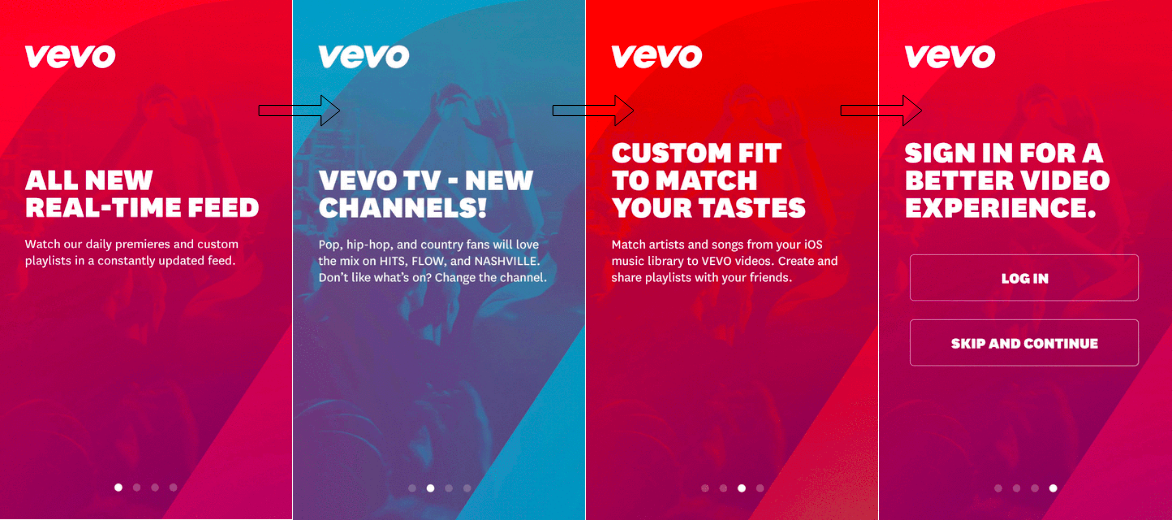
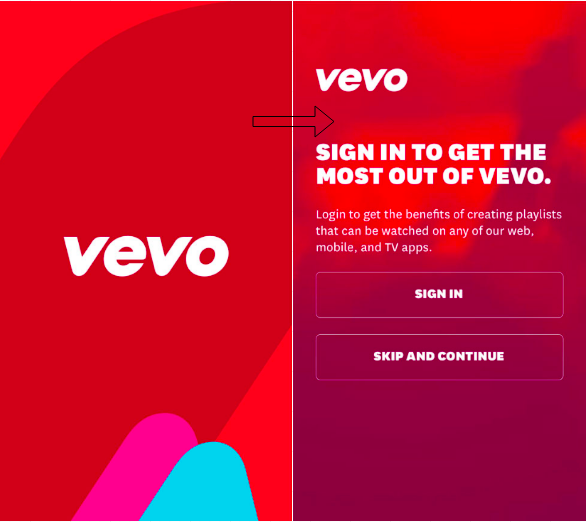
Improving onboarding: It’s no surprise that a better onboarding experience leads to significant reductions in initial drop-offs and significant increases in ongoing engagement. Vevo, the world’s leading all premium music video and entertainment platform with over 20 billion monthly views (over half of which are on mobile), previously used a four-step onboarding tutorial to convey value and encourage users to sign up or sign in. Vevo’s product team wanted to streamline the onboarding tutorial to maximize logins and new signups. The team tested reducing the number of screens in the onboarding flow from four to two, taking users directly to the login screen. The results were clear: Vevo saw an almost six percent increase in signups!
Vevo
Vevo’s initial onboarding flow
Simplified flow
Simplified flow

Converting and monetizing: Sometimes the simplest tests are the most valuable. One of the most respected media organizations in the world found this to be true. The organization tested three different options on the call-to-action screen prompting upgrades to premium membership. One option, which just included the benefits of a premium subscription, had no significant impact. Another version that included the benefits as well as the subscription cost was disastrous  — if they had released that option broadly they would have experienced nearly a 10% decrease in premium conversions. Meanwhile, one variant was a clear winner. Changing the description of the premium membership in a specific way led to more than a 15% increase in premium subscriptions.

With the right technological solution in place, running these types of experiments takes just minutes to set up. As a result, organizations are able to significantly increase their ability to run more experiments, testing dozens of ideas: some will be huge hits, some will have no impact, and some will be duds. Ultimately, the amalgamation of learnings leads to substantially better retention and thus growth.


Programmatic TechBytes with Kerry Bianchi, CEO at Collective

1
Kerry Bianchi

Kerry Bianchi

Last month, Collective announced the completion of more than 30+ integrations for its Visto™ Enterprise Advertising Hub. The latest integrations enable buying and management of digital ads across the entire digital media ecosystem through a single user interface, bringing greater clarity, control, and improved campaign performance. Kerry Bianchi, CEO of Collective, spoke to our Tech Bytes Series about Visto’s new integrations that offer a premier full-stack advertising and programmatic solution for brands, agencies and media companies.

MTS: How does Visto offer multi-platform marketers and advertisers more transparency and control over their media campaigns?

Kerry Bianchi: Digital advertising has evolved so quickly – and from so many different directions – that the technology stack is so complex, it’s no wonder we have problems with ad fraud along with viewability. The struggle is that there are too many disparate technologies all working in silos that limit the availability of data while also wasting too much ad spend. This is what Visto is eliminating.

We spent two years developing our technology to unify all the pieces of the ad tech stack into one dashboard, from which brands can view and manage all of their execution, data and measurement partners. It’s a clearer line of sight from which decisions can be made based on apples-to-apples comparisons from a single place.

Ultimately, Visto lets advertisers understand where their budget is going and what’s working so they can drive the best performance from their ad spend.

MTS: Please help us understand how programmatic can be scaled for accurate campaign measurement and audience targeting?

Kerry Bianchi: It comes down to having a unified view and established standards.

When everything is in silos, you can’t see all of your measurements, ad fraud protection, execution partners and data at the same time, plus you don’t know whether all of those vendors and technologies use the same standards. That’s why, earlier this year, brands called for measurement partners to be MRC (Media Ratings Council) accredited, and that all execution partners adopt IAB standards for viewability.

If you’re doing that, you can be confident that you’re hitting the right audience and that they’re seeing your ads.

MTS: How are you preparing against the growing concerns related to Ad Fraud?

Kerry Bianchi: At Collective, we believe the true root of so many ad industry problems like ad fraud are a result of the murky supply chain. With a clearer line of sight comes a greater understanding of just how wisely (or unwisely) their ad dollars are being spent.

P&G Chief Brand Officer Mark Pritchard famously demanded the industry, ‘Clean up the media supply chain’ at this year’s Interactive Advertising Bureau (IAB) Leadership Summit. That’s exactly what we’re doing with Visto.

Our unified interface and analytics finally let advertisers understand exactly where their budget is going and what’s working. No longer can vendors ‘grade their own homework,’ so to speak. We’re plugging the holes that would otherwise let fraudsters sneak in, and we’re opening doors to analytics that support optimized, not wasted, ad spend.

MTS: What would be your advice to CMOs who are yet to invest in programmatic technology/capabilities?

Kerry Bianchi: We as an industry need to step up to ensure the ongoing survival of a diverse targeting and data ecosystem, one that allows ad buyers and publishers to connect and integrate far and wide while using their data in the ways that best serve the consumer. I recommend looking at multiple vendors that can work together. We advocate for a wider range of integrations, but with strong connective tissue between them. This way, CMOs can access the unique features and benefits of their selected partners while also enjoying transparency and the ability to find the combination that works best.

MTS: Finally, how do you see programmatic advertising marketplace evolving in next 12 months? Would AI play a big role in making programmatic advertising more effective and accurate?

Kerry Bianchi: AI is controlled by data, but it also helps us understand data, if we have everything into one place, that is. IT so simple yet is really very complex. As our AI-based systems advance to handle the volume of data that’s now being collected across screen and devices, we’ve begun to lay the foundation for programmatic’s expansion to channels like TV and radio. In the next 12 months, I expect programmatic TV will be the hottest thing around, since those are the big ad dollars so many players in the ecosystem are chasing.

MTS: Thank you, Kerry for answering all the questions. We look forward to having you very soon at MarTech Series for more insights.

Stay tuned for more on business insights on marketing automation, content marketing, video ad tech, programmatic and header-bidding technologies. To participate in our Tech Bytes program, email us at news@martechseries-67ee47.ingress-bonde.easywp.com

CRM TechBytes with Sunny Paris, CEO at You Don’t Need a CRM

0
Sunny Paris

YouDon’tNeedaCRM actually makes every day feel like a Friday. The lead management software takes full control of the sales process, enabling salespeople to prevent leakage of critical customer information from the traditional CRM models. Last month, the popular CRM platform launched noCRM.io to simplify and improve the way SMBs manage their sales processes. We invited Sunny Paris, CEO at YouDon’tNeedaCRM, to our TechBytes Series to learn more about the new tool and its role in refining the sales processes.

MTS:  Tell us about your role at You Don’t Need a CRM, and how you got here.

Sunny Paris: I am the CEO and co-founder of You Don’t Need a CRM. As I have a MarTech background, I am involved in a lot of the decisions involving server architecture, customer acquisition, marketing, and fundraising.

I discovered the internet when I was preparing my Ph.D. in theoretical physics and I hosted my first website in 1996. I then founded Weborama, a European AdTech/MarTech leader in 1998 that went public in 2006. Following the success of Weborama, I founded Yoolink in 2008 which specialized in Corporate Social Networks. Now at You Don’t Need a CRM, I try to help salespeople to close more deals

MTS:  Tell us the idea behind conceiving noCRM.io.

Sunny Paris: Salespeople don’t use CRM. For a salesperson, 95% of the time a CRM = pain. CRM systems are never up to date and you always hear management complaining about “Did you fill the CRM? Why is it not up to date?”.

Salespeople tend to fill their CRM just before their weekly meetings. They’re not using it for prospecting, they’re using it for reporting. The worst part is that they are right in doing so because CRM systems were not designed for salespeople but for managers or marketers.

So we decided to create a tool that sales professionals will love to use. A tool that will be focused on closing deals, not collecting extensive data. So the lead is at the very center of nocrm.io. A user can create leads from a lot of different sources in a matter of seconds, including scanning business cards, forwarding emails, or creating them straight from LinkedIn.

Managing leads inside the app is really painless. Our users have task reminders synchronized with their calendar to ensure no follow-up is missed and use our visual pipeline to get a clear picture of the health of their pipeline and at which stage they are with every lead.

MTS:  What marketing and sales technology platforms does noCRM.io integrate with?

Sunny Paris: First of all, we have a great API so our tool can be integrated to any other SaaS service. Our mobile app is completely built on top of our API so it means that you can really perform a large range of actions with it. We also integrate with Zapier which allows us to connect with various marketing automation apps such as MailChimp and ActiveDemand.

nocrm.io separates clearly unqualified prospects from qualified leads. Prospecting is managed through our online spreadsheet that gives salespeople a pool of prospects to tap into to grow their sales pipeline.  So one example of a great integration would be to have the marketing automation used by our customer automatically add high-scoring prospects to their nocrm.io prospecting list.

Every morning, sales teams can start working on new potential leads within norcrm.io using features designed to facilitate the process.

MTS:  How can marketers and sales reps churn the maximum ROI from noCRM.io within their stacks?

Sunny Paris: Nocrm.io is really a tool for sales reps that need a proactive approach to sell a product or service. So basically, it is the ideal tool for salespeople who need to “manually” contact their prospects or personally meet them.

We are very focused on the selling process and we really help our customers in:

  1. Saving significant amounts of time entering data.
  2. Never missing a follow-up so that no important leads are dropped.
  3. Knowing exactly where they left off with each lead.

These three elements are key to raising a company’s revenue. So if a company correctly connects their marketing tools to feed their sales teams with leads and uses their business tools to manage the post-sales process, it will without a doubt maximize its ROI.

MTS:  How deep is noCRM.io into leveraging Artificial Intelligence and Machine Learning? How do you see SMBs adopting AI-based sales technologies/CRMs to generate more business out of their leads?

Sunny Paris: We are not leveraging the AI potential and Machine Learning at this stage because we think those technologies have a better impact in the marketing automation part of the business. To use AI you need to have a lot of data and we are much more focused on the human part of the sales job.

MTS:  Are you planning to invest in developing new tools for ABM and Social Selling?

Sunny Paris: We are always willing to connect to more apps to enhance the performance and efficiency of our clients, and if a salesperson can have more information about a company and about the stakeholders/decision makers, it can significantly affect and shape their strategy when selling to larger companies.

For social media, we already have tools to extract data from, for example, LinkedIn but we clearly want to go further. Not by developing the features ourselves, but by connecting seamlessly to great data providers. We have a quite vertical vision of SaaS software. We believe in great vertical products able to communicate with each other.

MTS: Thank you, Sunny for answering all the questions. We look forward to having you very soon at MarTech Series for more insights.

Stay tuned for more on business insights on marketing automation, content marketing, video ad tech, programmatic and header-bidding technologies. To participate in our Tech Bytes program, email us at news@martechseries-67ee47.ingress-bonde.easywp.com

Interview with Jason Hemingway, Chief Marketing Officer at Thunderhead

0
Jason Hemingway

[mnky_team name=”Jason Hemingway” position=” CMO at Thunderhead”][/mnky_team]
[easy-profiles profile_twitter=”https://twitter.com/Hemmers71″ profile_linkedin=”https://www.linkedin.com/in/jasonhemingway/”]
[mnky_testimonial_slider][mnky_testimonial name=”” author_dec=”” position=”Designer”]“Audiences for both B2C and B2B brands are bored of being marketed at.”[/mnky_testimonial][/mnky_testimonial_slider]

On Marketing Technology


MTS: Tell us a little bit about your role at Thunderhead and how you got here.

I lead the marketing team at Thunderhead. I oversee the many disciplines of marketing, and love the freedom and autonomy of working in the fast-paced Brit tech environment – no two days are the same. Marketing evolves rapidly as an industry and technology has a large role to play in the changing landscape. If we trace it back, I studied psychology, philosophy, and politics at university and as such I’ve always been interested in people and understanding what makes them tick. I didn’t start out as a marketer… my first proper job after university was at Dow Jones News – working on the sometimes bruising trading room floors. It was character building to say the least! I got into marketing fairly early on because it seemed interesting and varied.

MTS: Given the massive proliferation of marketing technology, how do you see the martech market evolving over the next few years?

The key word in your question is massive. There’s a massive amount of technology out there – I think Scott Brinker‘s Marketing Technology landscape presented 5,000 and I’m sure there are more.  It’s a challenge for marketing teams to wade through it – what they think they want, might not actually be what they need to achieve their objectives. And what they think they’re getting may be rhetoric and not capability. A good rule of thumb I use is to ask how each technology will benefit my customer, it’s a filter that really helps focus on what’s needed versus nice to have.

I don’t see the emergence of ‘new technologies’ slowing down, I see trends towards more real-time capability, machine learning, and predictive technologies. In general, audiences for both B2C and B2B brands are bored of being marketed at, they want a relevant conversation and the latest technology has the ability to deliver that.

Technologies that unify the customer journey are true differentiators. It’s all about putting the customer first and adding the human approach to the relationship to understand and predict ways to improve the experience – treat me like an individual and you’re on the right track.

MTS: What do you see as the single most important technology trend or development that’s going to impact us?

AI is important and seemingly front page news at the moment. Replacement of repetitive work will shape the workforce of the future, and I think that’s a good thing – freeing up brain power to think differently. Aside from the novelty, organizations should be focused on how AI can improve the relationships they have with their customers. I read a Brian Solis blog recently on AI, he said, “AI represents an opportunity to introduce intelligent, scalable engagement and more personalized experiences to help customers accomplish tasks or solve problems while also improving overall satisfaction.” I couldn’t put that better myself.

MTS: What’s the biggest challenge that CMOs need to tackle to make marketing technology work?

I think a key thing is to remember that technology is the essential enabler, it’s easy to get caught up in technology but the focus has to be on using technology to build better relationships with your customers. This means that you have to try to understand how your technology works together in unison to give customers what they want. Therefore, how your technology integrates for the benefit of your customers is the key challenge CMOs need to tackle.

Take siloed data as an example. This problem keeps CMOs up at night. It’s a barrier to achieving the holy grail of a single view of your customer, a key part of customer engagement. We suggest a four-step approach to tackling the problems that are a barrier – Rome wasn’t built in a day but with a clear focus and focused project teams gains will be made.

MTS: What startups are you watching/keen on right now?

Whil – a mindfulness app

Engagio – technology for account based marketing in B2B

GoHenry – pocket money for kids

MTS: What tools does your marketing stack consist of in 2017?

Thunderhead’s ONE Engagement hub to understand our customer journeys. Eloqua, Salesforce, Allocadia, Hootsuite, Audiense, Wistia, Crazy Egg, SEMrush to name but a few!

MTS: Could you tell us about a standout digital campaign? (Who was your target audience and how did you measure success)

Yes, you ask specifically about a stand out digital campaign, however, my feelings are that digital plays a part in a broader play. We have had the most success when our campaigns span digital, brand, experiential and communications.

We’re currently running a ‘Getting Started with Customer Engagement’ campaign, which is less of a campaign and more of an education piece to demystify Customer Engagement. We’ve received great feedback from prospects, customers and industry professionals alike.

What does success look like? Well as well as the obvious inbound, it’s the less obvious. Customers confirming we’ve hit the nail on the head, brands approaching us at events to tell us they love our approach and influencers and analysts engaging with our thought-leadership.

MTS: How do you prepare for an AI-Centric world as a marketing leader?
In the marketing industry no two days are the same, and being agile and flexible to change is the nature of the game. In this sense, I feel like I’ve already prepared for the shift to an AI centric world. Technology certainly has and it’s my job to be one step ahead in terms of how technology is applied, and the benefits it brings.

There’s so much being said about AI being a fundamental shift in the way customer interaction is changing. Companies, brands and service providers, across all disciplines, need to sit up and take note… A key role of data today is to identify the individual needs and pressure points of people and give companies the ability to respond to customers accordingly. For data to become intelligent and customer-centric, it needs to come from unified systems that collate data from siloed sources to tell a coherent story, and it needs to be interpreted and acted upon in real-time. Anything else will be a short lived experience for both the customer and the company.

This Is How I Work

MTS: One word that best describes how you work.

Breaks all the rules.

MTS: What apps/software/tools can’t you live without?

Pompey Player, WhatsApp, and Vivino.

MTS: What’s your smartest work related shortcut or productivity hack?

Tackle the hardest problems first thing in the morning and ignore emails whilst you’re concentrating.

Mindfulness has also helped me focus.

MTS: What are you currently reading? (What do you read, and how do you consume information?)

I balance books between work and personal. At the moment I’ve got three on the go, Scott  McKeeCreative B2B Branding, Politics: Between the Extremes by Nick Clegg and a historical novel The Reverse of the Medal by Patrick O’Brian.

Someone once told me you can listen to podcasts at double speed – it hasn’t worked for me!

MTS: What’s the best advice you’ve ever received?

Be yourself, don’t pretend to be something you’re not.

MTS: Something you do better than others – the secret of your success?

Make things simple.

MTS: Tag the one person whose answers to these questions you would love to read:

Dave Trott

MTS: Thank you Jason! That was fun and hope to see you back on MarTech Series soon.

[vc_tta_tabs][vc_tta_section title=”About Jason” tab_id=”1501785390157-b58e162d-0ae25a4b-c27a1fcb-e9ce”]

A marketing veteran with 15 years experience in B2B marketing, CIM qualified and member of the Marketing Society. I started my marketing career at Dow Jones Newswires in the bruising field of trading room systems and real-time news. After 7 years at Dow Jones I moved to IntraLinks
(enterprise solutions for secure cloud collaboration) and ran the European marketing department until shortly after the company’s IPO in 2010.

Joined Thunderhead in 2011 to run the EMEA regional marketing team, focusing on campaigns and activity across the region. I’m now the CMO and I’m responsible for the strategic direction of the Thunderhead brand and go-to-market execution, and leading the Thunderhead marketing team.

[/vc_tta_section][vc_tta_section title=”About Thunderhead ” tab_id=”1501785390320-2d44fa50-740c5a4b-c27a1fcb-e9ce”]

Thunderhead Logo

At Thunderhead we believe in a world that’s filled with happy customers. We help brands get closer to their customers by helping them to better understand and meet the wants and needs of each and every individual customer, regardless of where, when, and how they interact.

Our market-leading ONE Engagement Hub is a cloud-based customer engagement platform that’s been designed to discover customer insight in real-time, across every interaction throughout the entire customer journey. Through its advanced listening and learning capabilities, ONE surfaces real-time customer insight and journey behaviour, providing a completely seamless experience throughout each unique customer journey, enabling enterprises to optimize marketing and customer retention strategies, and drive conversation-led engagement, building stronger and more valuable relationships with their customers.

Sounds good right? Check us out at www.thunderhead.com and find out why we’re taking the customer engagement technology market by storm.

[/vc_tta_section][/vc_tta_tabs]
[mnky_heading title=”About the MarTech Interview Series” link=”url:http%3A%2F%2Fstaging.loutish-lamp.flywheelsites.com%2Fmts-insights%2Finterviews%2F|||”]

The MTS Martech Interview Series is a fun Q&A style chat which we really enjoy doing with martech leaders. With inspiration from Lifehacker’s How I work interviews, the MarTech Series Interviews follows a two part format On Marketing Technology, and This Is How I Work. The format was chosen because when we decided to start an interview series with the biggest and brightest minds in martech – we wanted to get insight into two areas … one – their ideas on marketing tech and two – insights into the philosophy and methods that make these leaders tick.

The Importance of Data Analytics in Marketing Strategies

0
Data Analytics

We are producing more data than ever before. Every credit card transaction we make, each GPS pinpoint taken by your smartphone, and every click of the mouse we make online contributes to an increasingly large and varied dataset.

Analytics is the software used to turn this data deluge into valuable insights – insights that are being put to use by a broad spectrum of industries all over the world. Over the last decade or so, marketing has been revolutionized by data analytics, allowing brands to deliver more targeted messaging and measure their return on investment (ROI).

Personalize your customer interactions

Businesses now have access to more information regarding their customers than ever before. As well as surface-level data about their gender, age, and geographical location, companies can now derive more detailed insights regarding consumer behavior and preferences. It’s becoming increasingly clear that not only are customers open to sharing their data with businesses in order to receive personalized marketing, they are encouraging it. A recent report by Salesforce, for example, found that 52 percent of customers are extremely or somewhat likely to switch brands if a company doesn’t make an effort to personalize their communications with them.

Today, brands are personalizing their marketing efforts in a whole number of ways, gaining fantastic ROI in the process. The likes of EasyJet, Marie Curie, and O2 have all used data from previous customer interactions or geographical profiling to deliver targeted messaging to their customers. When this kind of marketing is done well, customers feel like they are valued as a unique human being, not just another number on a spreadsheet.

Which channels are working and which aren’t?

Greater visibility is one of the main benefits of data-driven marketing. Before the rise of digital marketing and all its associated data, it was difficult for marketing teams to determine which of their efforts, if any, contributed significantly towards a purchase. Did that promotional campaign cause an uplift in sales, or was it just a coincidence?

By using data, marketers can now track customers along the journey from initial interest to final purchase. With insights driven by website cookies and click-through rate (CTR), marketers have a much clearer picture of what’s working and what isn’t, allowing them to prioritize expenditure in the right channels.

Gaining cross-channel visibility in an increasingly complex world

Interacting with brands is no longer confined to simply walking into a shop and viewing a product. Email communications, website visits and social media engagements all combine to create a complex picture. Keeping track of all these interactions can be a challenge – particularly when the average online user now has eight social media accounts – and using data analytics is often the only way to turn the broad spectrum of touchpoints into a cohesive customer profile. If brands can achieve this, then customers receive a high-quality, uniform experience, regardless of the channel they used to reach the business.

Full-funnel marketing in the digital age

The full-funnel approach to marketing is a well-worn strategy, but it does need some tweaking in the digital age. Consumers no longer make a linear journey from finding out about your product to purchasing it. Instead, consumers often conduct most of their research independently, using a variety of sources from corporate websites to social networks. The latter, in particular, is a hugely important part of the modern marketing funnel, with 43 percent of online users aged between 16 and 24 using social media for product research. Marketers must target and nurture their prospective customers across these new digital mediums if they are to truly adopt a full-funnel approach to marketing.

Data scientists can be just as useful as the data itself

Data alone is simply a collection of numbers. It is only through analyzing this data and turning it into insights that it becomes useful to companies. While software packages like analytics programs are certainly helpful when it comes to analyzing data, it is essential that brands do not underestimate the importance of highly skilled data scientists. It is true that technology can help process vast quantities of numbers in a fraction of a second, but real people are needed to develop marketing strategies and objectives that make use of this data.

Understanding your customers as people

No matter how often you directly interact with your customers there is only so much data you can collect. To understand them as the multi-faceted individuals that they are, many brands are choosing to augment their own first-party data with third-party data. Of course, this creates its own problems – namely, which third-party data, out of the masses available, is relevant and trustworthy?

The fact that 30 per cent of online users use a Virtual Private Network (VPN) makes reliable data even harder to come by, but it is not impossible. With cross-device ID tracking, brands can access trustworthy third-party data that gives them a truer representation of their customers.

The future is now

One of the most exciting developments in marketing is the use of predictive analytics to forecast consumer behavior before it takes place. By using audience profiling data to predict what customers want, marketers can be much more proactive, upselling products, creating long-term relationships with consumers and determining market shifts before rival brands.

Unfortunately, many marketing departments have been slow to adopt new technologies like predictive analytics, despite the benefits that they offer. It is, however, surely only a matter of time before this changes, with research findings indicating that 89 percent of brands plan to invest in predictive analytics at some point in the future. With market trends shifting so quickly, predicting new developments ahead of time is an essential part of modern marketing.

ABM TechBytes with Sam Smith, VP Product at Sigstr

0
Sigstr

Sigstr, a cloud platform for employee email personalization, unveiled an Account-Based Marketing (ABM) functionality for marketers to tap into employee emails and deliver 1:1 targeted content to specific accounts, industries, and regions. Sigstr’s ABM functionality is designed to increase account relevance, align email signature marketing activity with account strategies, increase campaign engagement and inspire customers and prospects with compelling content.

We interviewed Sam Smith, VP Product at Sigstr, who spoke about the new functionality.

MTS:  Tell us about Sigstr’s newly launched Account-Based Marketing functionality?

Sam Smith (Sam) : Our ABM functionality is a strategic approach to email signature marketing in which Sigstr campaigns communicate with individual prospects or customer accounts as markets of one. Utilizing our new Account-Based Marketing functionality, customers can choose to assign a signature campaign to email recipients who match one or more email domains. When Sigstr users email recipients who match an assigned domain, the specified campaign is served.

MTS: What prompted Sigstr to come up with an ABM functionality?

Sam: Account-based Marketing is a trend that has really taken the B2B marketing space by storm. As a platform that focuses on enabling B2B marketers and their content distribution strategies, it was a natural progression in product development. We can now help marketers ensure that the appropriate content is being distributed to the target audience you created it for.

MTS: Who are your targeted customers for this particular functionality?

Sam: We were primarily inspired by our customer Terminus, an Account-based marketing platform that focuses entirely on giving B2B marketers that ability to implement and execute a full-scale ABM strategy. The functionality is really applicable to any and all marketers that have either already implemented an ABM strategy and hope to incorporate corporate email into the mix. Or, marketing teams who are just starting to develop an ABM strategy.

MTS: How do your products help customers maximize their ABM strategy?

Sam: The ABM functionality is designed to increase account relevance, align email signature marketing activity with account strategies, increase campaign engagement and inspire customers and prospects with compelling content.

MTS: Why do you say employee email is a natural ABM channel?

Sam: The 1:1 emails your employees are sending to your customers, audience, and prospects are the most personalized communication touch points that you have access to. At it’s core, ABM is a strategic approach to marketing based on account awareness in which an organization considers and communicates with individual prospects or customer accounts as markets of one. Employee email is the only marketing channel that enables you to truly communicate with your prospects or accounts as markets of one. Your employees are already tailoring each email message to that one specific recipient. Now, your marketing department can ensure that the perfect piece of content is sent along with that message every time.

MTS: What purpose does it serve to include employee emails with ABM functionality into the marketing mix?

Sam: You have the undivided attention of your most targeted audience through the 1:1 email channel. Marketing departments spend so much time, energy and effort generating compelling content with the hopes of inspiring customers and prospects. Unfortunately, over 60% of that B2B marketing content goes unused. Including ABM functionality into employee emails ensures that content won’t go wasted! You’re getting the most value out of your marketing content by getting the right piece to the right person every time. You’re further aligning sales and marketing efforts by helping to increase relevance and engagement.

MTS: How do you see ABM and AI converging at Email Personalization?

Sam: I think it’s definitely coming. I believe the same predictive analytical algorithms that drive personalized recommendations for services like Netflix will naturally migrate its way into email personalization. At some point, we will be able to use our user data in conjunction with third-party data to better understand customers and prospects browsing patterns, backgrounds, and interests. We will be able to serve up the most relevant and personalized content through ABM campaigns in email personalization based on that aggregate data and wisdom.

MTS: Can ABM penetrate into Social Content and Media Intelligence strategies in the future? 

Sam: Absolutely. At the end of the day, ABM seeks to get the most relevant content possible, in front of the right audience. Social media is just another delivery mechanism for marketing content, and the fact that most users are logged in means you’ll definitively know who’s who. Enabling truly rich ABM experiences in social may require some help from the social platforms themselves, but ultimately, I don’t think any publicly available communication channel is safe from ABM concepts.

MTS: How can marketers use predictive analytics for CRM data cleansing and data standardization? What’s the ideal roadmap for CRM users to do this effectively?

Sam: There are a growing number of services available that aim to help enrich contact data-sets with metadata from a wide range of sources and proprietary capture methods. Some of these are standalone products and others may be offered as a service through existing CRM products. Either way, these provide marketers with a clearer, more accurate representation of their contacts, prospects, customers, and partners.

Employee Email is the direct line of communication to all of these personas, for every business. Sigstr is in a unique position to help marketers and sales organizations, by enabling Employee Email to be the direct source of CRM data enrichment.

MTS: How do you see location analytics and people-based marketing fitting into ABM strategies in 2017? Does it create more ROI opportunities for Employee Email platforms?

Sam: There are some creative use-cases that I think could be powerful with Location- or Contact-based marketing, and especially when intersecting Employee Email. Geofencing is already a common technique for push messages at events or providing a coupon to a nearby coffee shop. The same strategies can be applied to content in Employee Email to provide dynamic content based on the recipient’s location. This could incentivize physical presence at an event or tradeshow, or allow for better ABM targeting if you know your reader’s location, but maybe not exactly who they are.

MTS: What’s the message to B2B enterprises that use neither Predictive Analytics nor ABM?

Sam: There’s a lot of research, surveys, and findings out there about where ABM works, what’s right for B2B, and how Predictive Analytics work best based on who you market to. Ultimately, the function of marketing is inherently one of experiment, analysis, and fine tuning to strike the most effective balance. I think the message is clear that Predictive and ABM strategies are permeating cross-functionally in many organizations to make better use of data all around. I would highly encourage any marketer in a B2B organization to find ways to incorporate these principles to see how they perform, and especially within Employee Email.

MTSThank you, Sam, for answering all our questions. We look forward to having you back at MarTech Series for more insights.

Stay tuned for more business insights on video ad tech, programmatic. social media, marketing automation, and AI technology market.

To participate in our Tech Bytes program, drop us a line: news@martechseries-67ee47.ingress-bonde.easywp.com

“AI or ABM may point to new leads, but it’s on us marketers to deliver a meaningful experience”

0
Daniel Incandela, ReturnPath

[mnky_team name=”Daniel Incandela ” position=” CMO at Return Path”][/mnky_team]
[easy-profiles profile_twitter=”https://twitter.com/danielincandela” profile_linkedin=”https://www.linkedin.com/in/danielincandela/”]
[mnky_testimonial_slider][mnky_testimonial name=”” author_dec=”” position=”Designer”]“AI or ABM may point to new leads, but it’s on us marketers to deliver a meaningful experience that builds a connection”[/mnky_testimonial][/mnky_testimonial_slider]

On Marketing Technology


MTS: Tell us a little bit about your role and how you got here.

I was recruited to Return Path in January 2016 to be the head of brand and digital marketing. At the time, Return Path was looking to rebrand itself and rethink the overall digital experience. I enjoy big challenges, so Return Path presented a great opportunity for me. The rebranding and relaunch of Return Path’s digital presence were extremely successful, and I’ve since been promoted to run all of Return Path’s global marketing efforts.

I now oversee a global marketing team that is responsible for Return Path’s brand, content, communications and PR, demand generation, digital, events, marketing operations, and sales development. I set a vision and goals, and do my best to enable everyone to do their job. My philosophy is to remove obstacles and get teams the budget they need.

Prior to joining Return Path, I held a very similar role in brand and digital marketing at Salesforce Marketing Cloud. Return Path and Salesforce enjoy a very healthy partnership, so it was a smooth transition in many ways. My overall career in the digital space has spanned about 15 years, in an eclectic mix of businesses. I ran digital marketing at the Indianapolis Museum of Arts, the Indianapolis Motor Speedway, and the IndyCar Series.

MTS: Given the massive proliferation of marketing technology, how do you see the martech market evolving over the next few years?

The basis for any marketing has to begin with an authentic, meaningful message. I don’t want to lose sight of that because I think a lot of companies take it for granted. Having said that, data should be the driving force behind any type of messaging, campaign, or strategy. We have more data than ever, and it will only increase. Marketing leaders need to build out a digital strategy that will cut through the noise and provide instant, actionable insights. The roles of CMOs and CDOs will continue to blur.

MTS: What do you see as the single most important technology trend or development that’s going to impact us?

I still think there is a lot of work to be done with genuine storytelling and using data to access the right audience. AI or ABM may point to new leads or a customer base, but it’s on us marketers to deliver a meaningful experience that builds a connection. That’s still easier said than done.

MTS: What’s the biggest challenge that CMOs need to tackle to make marketing technology work?

Marketing technology should be a holistic ecosystem. I’ve seen a lot of cases where individual tools have been selected, which at the time, may make sense. But when you take a step back to see the bigger picture, you may realize you’ve built a disparate ecosystem, with conflicting digital philosophies. It starts with the website, and other digital marketing tools should be spokes coming from that hub. Moreover, selecting tools based on each team’s unique marketing talent allows them to take these tools to the next level.

MTS: What startups are you watching/keen on right now?

I love what is happening in the Midwest at the moment. I’m based in Indianapolis, so I look at what Indy-based venture studio High Alpha is doing on a daily basis. In Cincinnati, I serve as a mentor with The Brandery, where I get the chance to talk with new founders and offer advice. And finally, I love what’s happening in Detroit, so I typically study whatever Detroit Venture Partners is doing. I love talking with startups, because in many cases, they are looking to redefine business models. That’s inspiring.

MTS: What tools does your marketing stack consist of in 2017?

-Website Management Platform—elastic hosting and cloud-based development tools

-Open-source content management system

-Third party marketing automation platform for email marketing and lead management

-Email verification software for lead management

-Open-source Javascript and web frameworks

-Robust A/B testing tools

-Google Analytics software suite

-Salesforce CRM

-New advertising tools/ABM approach

-Marketing attribution & forecasting technology

-And of course, full use of our own Return Path tools—our email program would be lost without them.

MTS: Could you tell us about a standout digital campaign? (Who was your target audience and how did you measure success?)

I’m very proud of the Return Path marketing team because we make strategy decisions based on data and constantly test our initiatives. We’ve done a number of great campaigns around advertising, PPC and branding, but we’re especially proud of our email re-engagement campaign.

We had recently switched email service providers and noticed some quality issues with our subscriber list. So we decided to run a re-engagement campaign with our prospect and customer lists, and launch a new preference center simultaneously. We went with fun, lighthearted messaging and design, including animated characters and a Spotify playlist with songs related to “hello” and “goodbye.”

The campaign was wildly successful, with high engagement and open rates as high as 40%. We were able to significantly clean up our list, see what content people consumed, and opt in our legacy list for fresher, more accurate send data. Our creative was featured in a couple of blogs and webinars, and got a lot of love on social media. As a company focused on improving email performance, this makes me especially proud.

Outside of that, we are constantly striving to improve year-over-year and quarter-over-quarter increases in key marketing metrics like lead, opportunities, pipeline, and marketing sourced new business. Every quarter is a new battle.

MTS: How do you prepare for an AI-centric world as a marketing leader?

Let me ask my robot.

All kidding aside, I don’t really know. Marketing changes constantly, so I try to focus on keeping an open mind and being highly adaptable.

This is How I Work

MTS: One word that best describes how you work.

Calm.

MTS: What apps/software/tools can’t you live without?

Our internal and external messaging at Return Path is simple: We know email. So I definitely can’t live without email.

Day-to-day, I’m typically in Dropbox, Salesforce, and a bunch of Google Apps. I’m on my laptop and phone throughout the day.

In terms of personal Apps, I check Instagram, Twitter, Washington Post, and The Guardian each day. And I use Wunderlist for organizing all the stuff I need to do. I love that app.

MTS: What’s your smartest work related shortcut or productivity hack? (I try to do (2) things consistently each day.)

First, I like to start my day at 6 am by responding to emails and getting the day organized. This allows me to be more effective at work. Second, I am selective when it comes to the meetings I attend. It’s often more important that I work and keep things moving, especially since many meetings tend to have redundant attendees. Overall, I try to be in the best position each day to help my team—remove obstacles, get approvals, find budget, etc.

MTS: What are you currently reading? (What do you read, and how do you consume information?)

I am currently reading Old Man and The Sea by Hemingway. And JPod by Douglas Coupland.

On a day-to-day basis, I look at TechCrunch, MarTech, CMO.com, and other tech related sites. I also check in with a lot of companies that innovate with their brand, like Red Bull, Mercedes Benz, Manchester United, and more. I love stealing B2C ideas for B2B. I look up to companies that understand the value of their brand and what it can do for their customers, prospects, fans, advocates and so on.

MTS: What’s the best advice you’ve ever received?

One of my earliest mentors, Rhonda Winter, once said to me: “What are you waiting for?”

I’ve tried not to look back since.

MTS: Something you do better than others – the secret of your success?

I try to remove my ego from everything I do professionally. I still have lots of work to do, but I strongly believe this is one the most important attributes of great leadership. It’s not about you, it’s about something much bigger. I want to make the best possible decisions for my team and the business, not for me.

MTS: Tag the one person whose answers to these questions you would love to read:

I would love to hear from the head of marketing for Red Bull, Manchester United, or Mercedes Benz.

MTS: Thank you Daniel! That was fun and hope to see you back on MarTech Series soon.

[vc_tta_tabs][vc_tta_section title=”About Daniel” tab_id=”1501785390157-b58e162d-0ae25a4b-c27aff2b-9c2e”]

Daniel Incandela serves as Chief Marketing Officer at Return Path. As head of marketing, Daniel oversees global brand, content, creative, demand generation, digital, events, marketing automation & operations, product marketing, public relations and sales development.

Previously, he served as Senior Director of Brand and Global Digital Marketing at the Salesforce Marketing Cloud, where he drove creative & digital marketing strategy for the company across 5 continents, overseeing corporate marketing, event branding & experience, and all creative. His 50 person team was comprised of brand, content, creative, digital, development, email, mobile, social media, video production and all web, leading the marketing efforts for the Marketing Cloud.

Daniel formerly worked as Director of Online Strategies at the Indianapolis Motor Speedway & IndyCar Series, leading strategy for online marketing, social media, content creation, and online community development. Prior to that, Daniel spent five years as Director of New Media at the Indianapolis Museum of Art where he established the new media team, renowned for museum technology innovation, brand development, & digital content.

Among his accomplishments, Daniel counts the launch of ArtBabble.org, a forum to showcase high-quality video art content. He was honored to be the keynote speaker at the National Digital Forum in New Zealand, included in the Indianapolis Business Journal’s Forty under 40, and named a British American Project Fellow. He also contributed a chapter to The Digital Innovation Playbook: Creating a Transformative Customer Experience.

[/vc_tta_section][vc_tta_section title=”About Return Path” tab_id=”1501785390320-2d44fa50-740c5a4b-c27aff2b-9c2e”]

Return Path

Return Path is the expert in deliverability. Every day, our customers trust our data and insights to help them optimize their email marketing. Partnered with best-in-class email service providers, we help marketers take their email programs to the next level by driving more response and increasing revenue.

At Return Path, we know email.

Through the Return Path Data Exchange, we’ve brought together the world’s most comprehensive source of data from the email ecosystem. We partner with more than 70 providers of mailbox and security solutions, covering 2.5 billion inboxes—approximately 70 percent of the worldwide total. Also feeding into this data platform is our consumer network of more than 2 million consumers and purchase receipts from 5,000 retailers around the world, delivering unparalleled insight into purchase behavior, brand affinity, and consumer preferences.

Return Path was founded in 1999. Headquartered in New York, we have offices in Denver, Sunnyvale, Austin, Indianapolis, Toronto, London, Paris, Hamburg, Sydney, and Sao Paulo.

[/vc_tta_section][/vc_tta_tabs]
[mnky_heading title=”About the MarTech Interview Series” link=”url:http%3A%2F%2Fstaging.loutish-lamp.flywheelsites.com%2Fmts-insights%2Finterviews%2F|||”]

The MTS Martech Interview Series is a fun Q&A style chat which we really enjoy doing with martech leaders. With inspiration from Lifehacker’s How I work interviews, the MarTech Series Interviews follows a two part format On Marketing Technology, and This Is How I Work. The format was chosen because when we decided to start an interview series with the biggest and brightest minds in martech – we wanted to get insight into two areas … one – their ideas on marketing tech and two – insights into the philosophy and methods that make these leaders tick.

“Social media is a database that can help marketers understand their target audience”

0
Aseem Badshah

[mnky_team name=”Aseem Badshah” position=” Founder & CEO at Socedo”][/mnky_team]
[easy-profiles profile_twitter=”https://twitter.com/aseemb” profile_linkedin=”https://www.linkedin.com/in/aseemb/”]
[mnky_testimonial_slider][mnky_testimonial name=”” author_dec=”” position=”Designer”]“Social media networks are databases of user-generated content that can help marketers understand their target audience.”[/mnky_testimonial][/mnky_testimonial_slider]

On Marketing Technology

MTS: Tell us a little bit about your role at Socedo and how you got here.

I am the co-founder and CEO of Socedo. At Socedo, our mission is to help B2B marketers better engage and communicate with their audiences by leveraging intent data from the social web.

I’ve been in the social media marketing space for 10 years. My journey as an entrepreneur started out when I was a high school student. My first business was called Scriptovia– a social network specifically for students. This was the early days of social media when Facebook was just a year or two old. Students were putting a lot of time into their school work, but they weren’t publishing it. I saw a need for students to be able to share their schoolwork – papers, presentations, PowerPoints – with their peers and get recognition as publishers for the content they create. When I went to college, I doubled down on this business. To get the word out about this new social network, I posted on forums like Myspace and SparkNotes.

Because I had this experience of growing a social network for students, Microsoft’s Education Team took notice and asked me to consult for them. They wanted to get their software suites into classrooms. This was the very early days of Facebook when brands were first dipping their toes into social media. I was put in charge of Microsoft’s Facebook Page, which had little presence. I grew that to 150,000 fans over the course of my time there. That’s when executives at Microsoft took notice and started to see the value of social media for their business.

Through my work with Microsoft, I realized that most brands did not know how to use social media. Right after I graduated, I founded a social media marketing agency called Uptown Treehouse in Los Angeles. Microsoft was one of my my first clients.

I worked on another project for Microsoft. This time, the Microsoft Developer Evangelist Team wanted to get more developers to develop apps for the Windows Phone. They’d found that traditional marketing activities such as advertising wasn’t effective at reaching their target audience. My agency decided to reach out to developers on Twitter, talk to them one-on-one. We were doing a lot of social outreach and needed a way to keep track of our activities. We kept track of this data in a spreadsheet at first. But the manual spreadsheet was not sufficient. So, we decided to develop a prototype social CRM system. That’s the origin of Socedo. We built software to solve our own problem.

MTS: How do you see the social leads/demand gen marketing market evolving over the next few years?

Because social media marketing as a category was born out of the B2C world (think of brands like Coke and Nike), it’s traditionally been very focused on broadcast messaging. B2B marketers have traditionally approached social media as a way to generate brand awareness and build a community, not as a lead generation channel.

We’ve found that social media networks are really databases of user-generated content that can help marketers and salespeople understand the interests, needs, and priorities of their target audience. Everyone is on social media today, and thanks to the public nature of social networks like Twitter and LinkedIn, you can search the database to find your target prospects. In addition, social media is the place where you can have one-on-one conversations, which means that you can reach out directly to your target prospects on social and get on their radar. This is the thesis for why we wanted to build Socedo – to help B2B marketers connect with their target audience on Twitter and nurture them through automated, one-to-one conversations. With Socedo, you can follow target prospects and send automated Twitter DMs to those who follow your handle and provide relevant content.

Now, we’ve evolved beyond lead generation. At this point, social networks like Twitter and LinkedIn have their own lead generation/ad offerings. But what we’ve found is that social media isn’t just a way to get new leads into your system. Social media data becomes much more relevant when it’s combined with an organization’s internal data, the data in their CRM and marketing automation systems. When these data sources are combined, marketers start to get a more holistic understanding of the existing leads/prospects in their database – leads’ interests, topics they care about, and where leads are in a buying cycle. Marketers can use this intent data to identify warm leads, prioritize their leads, create more relevant, personalized content and messaging and alert their sales team about push relevant behaviors from leads to enable more engaging, relevant conversations. We see this – enriching marketers’ existing database with behavioral insights gleaned from the social web – as a much bigger opportunity than lead generation.

Traditionally, marketers have only used their internal data – collected through the course of doing business – to inform their campaigns. Marketers are typically tracking behaviors such as website visits, email clicks, and content downloads to gauge where leads are in the buying cycle and scoring these behaviors to figure out lead routing. At this point, B2B marketers are realizing that they have gaps in buyer insights and are starting to shift their focus to buying actionable intent data from external sources to improve their engagement and connect rates.

MTS: What do you think is the single most important technology trend or development that’s going to impact us?

The rise of Artificial Intelligence will have a huge impact on marketing and sales. Machine learning will improve marketing and sales software by giving it the ability to do things without a human explicitly telling it what to do. For example, tasks such as predictive lead scoring, content recommendations, and email acquisition will get a lot better. In the intent data space, we can see a day where the data we’re getting from the social web is analyzed alongside a company’s internal data (i.e. revenue-related information like the size of each deal, the velocity of each deal) so that we can predict which social media behaviors that are most likely to lead to a conversion or a sale and automatically route different leads to different people/campaigns to receive the right message.

MTS: What’s the biggest challenge for startups to integrate a demand gen platform into their stack?

Growing their website traffic to be large enough that it makes sense to send automated messages through a marketing automation platform. Before you invest in marketing automation, make sure you are getting enough traffic to your website and have enough content to nurture leads with.

The other major challenge is that you have to have a good understanding of the types of leads in your database and have enough insights to figure out who they are, what they care about, how valuable they will be to your company, so that you can segment them into the right tracks and treat them appropriately. Startups often start out by blanket-nurturing their leads because they don’t have a lot of data on lead fit and lead behavior. This is not effective.

MTS: What startups are you watching/keen on right now?

Amplero is doing some interesting things applying machine learning to B2C marketing and I’m interested to see how Conversica does with their AI based sales tool. Outreach.io is one I continue to hear great things about in the sales acceleration space.

MTS: What tools does your marketing stack consist of in 2017?

-Brand awareness / Lead generation
-Octopost to schedule social media posts.
-SproutSocial for response management on social media.
-Socedo to generate new leads via Twitter and to build lists of leads to sync into our marketing automation platform
-Marketing automation – Marketo
-Email alerts/ email marketing – Intercom for sending automated emails from the Socedo platform. YesWare for emails sent by our Sales Develop Representatives (SDR)
-CRM – Salesforce
-Data Enrichment – Clearbit
-Content Marketing – Moz (for Keyword research)
-Content Management System – WordPress for public website and blog
-Website Analytics – Google Analytics
-Customer Success – Desk (Salesforce) for issues tracking/product support/measuring customer satisfaction.
-Webinars – GoToWebinar, BrightTalk
-Loyalty Program – Rybbon

MTS: Could you tell us about a standup digital campaign? (Who was your target audience and how did you measure success)?

Here is one about how we put leads into topic-based nurture tracks and trigger real-time emails that get much higher engagement rates than typical email blasts: Conquer Email Marketing Like a Boss: How We Triggered Real-Time Emails from #ContentMarketing

MTS: How do you prepare for an AI-centric world as a business leader?

Every aspect of business will be made more efficient and effective through AI but we’re still in the early days. Right now my sense is that vendors are overpromising on the AI front. Try to be diligent in evaluating AI software today and use this as a way to prepare for evaluation in the future as you bring in AI into different business processes down the road. Start with the problem you want to solve and describe what success looks like before piloting an AI vendor. Ask questions about how the AI operates and try to avoid vendors that provide a “black box” for how their system works. AI is only as good as the data feeding it. Understanding what data sources are being used can help evaluate how good the AI might be.

This is How I Work

MTS: One word that best describes how you work

Curiosity

MTS: What apps / software/ tools can’t you live without?

Nothing fancy here. Gmail and Google Calendar is where I live every day. I love Boomerang Calendar for helping to suggest meeting times.

MTS: What’s your smartest work related shortcut or productivity hack?

There aren’t many shortcuts when it comes to productivity unfortunately. That said, having a great team and communicating with them effectively can be the best productivity hack. Overcommunicate and get people aligned. This tends to provide the best dividends but can feel like a waste of time in the moment.

MTS: What are you currently reading?

The Everything Store. There’s a lot we can all learn from Jeff Bezos and his approach to culture at Amazon.

MTS: What’s the best advice you’ve ever received?

Rally your team around one metric that matters. This gets everybody aligned and you’ll grow faster when your team knows where the scoreboard is!

MTS: Something you do better than others?  

Getting out of the building. I’m talking and meeting with customers every day to keep a pulse on the market and where our product fits in.

MTS: Thank you Aseem! That was fun and hope to see you back on MarTech Series soon.

[vc_tta_tabs][vc_tta_section title=”About Aseem” tab_id=”1501785390157-b58e162d-0ae25a4b-c27a3431-4b27″]

Aseem is working on products to help brands leverage new media to build relationships with their target audience. It’s clear that the marketing strategies of the 20th century are becoming less effective in an age of democratized influence. Aseem has made it his mission to help companies leverage social media to make a difference on the bottom line!

Named one of Inc Magazine’s Entrepreneurs, Marketers, and Thought Leaders to Watch in 2016: http://www.inc.com/travis-wright/33-entrepreneurs-marketers-and-thought-leaders-to-watch-in-2016.html

Specialties: Social Media Marketing, Search Engine Optimization, User Interface Design, Product Management, Demand Generation

[/vc_tta_section][vc_tta_section title=”About Socedo” tab_id=”1501785390320-2d44fa50-740c5a4b-c27a3431-4b27″]

via Socedo

Socedo’s mission is to help businesses better communicate with their target audiences by leveraging intent data from the social web.

Social intent data includes all the things that people do on social networks that provide insights into what they care about and whether they are in a buying cycle. Socedo has the largest source of B2B intent data from Twitter. B2B marketers can use our solutions to identify in-market prospects based on real-time behaviors. With Socedo, you can: -Find and connect with new prospects based on keywords found in Tweets, engagements with your competitors or any other entity on Twitter. -Get social media insights on your existing contacts and target accounts in real-time & accelerate existing prospects through your funnel

Socedo integrates with the leading marketing automation and CRM platforms in the market including Marketo, Hubspot, Oracle Eloqua, Pardot and Salesforce CRM.

Socedo works with marketing leaders within leading brands, including as Microsoft, Extreme Networks, Mercer, Lenovo, Google, Citrix, and Host Analytics.

[/vc_tta_section][/vc_tta_tabs]
[mnky_heading title=”About the MarTech Interview Series” link=”url:http%3A%2F%2Fstaging.loutish-lamp.flywheelsites.com%2Fmts-insights%2Finterviews%2F|||”]

The MTS Martech Interview Series is a fun Q&A style chat which we really enjoy doing with martech leaders. With inspiration from Lifehacker’s How I work interviews, the MarTech Series Interviews follows a two part format On Marketing Technology, and This Is How I Work. The format was chosen because when we decided to start an interview series with the biggest and brightest minds in martech – we wanted to get insight into two areas … one – their ideas on marketing tech and two – insights into the philosophy and methods that make these leaders tick.

New Report Reveals the Gender Gap in Use of Mobile Technology while Shopping

0
Mobile Technology

New survey by Euclid Analytics reveals women seek unique experiences, men expect convenience as key part of in-store shopping experience

Gender and in-store technology are more closely related than what was perceived earlier. According to the latest report by Euclid Analytics, women shoppers use mobile devices in more and diverse ways while shopping, compared to men.  Women are not just leading the pack in checking email promotions and taking pictures of products, they are also more likely to take and share pieces of advice socially than men. It is clear that advanced shopping technologies will soon deliver relevant personalized experiences. However, male and female shoppers still prefer interacting with human sales people while shopping. Does this mean that Amazon Go may not be the ubiquitous choice of retail shoppers after all?

Read More: PubMatic Integrates with Amazon Publisher Services to Expand Its Header Bidding Solutions

In a blockbuster deal of sorts, Amazon announced a few days back that it is buying Whole Foods for a record  . The plan to upscale the grocery store with Amazon Go opens up a new stream of marketing opportunities across all technology formats, including in-app, video and in-store. While marketers brace themselves to deliver shopping experiences through Amazon’s advanced technology, it was still unclear how shoppers would be queuing up to enter the stores supported by mobile apps. Until now!

Euclid Analytics, a provider of behavioral targeting, retail analytics and omnichannel engagement solutions has revealed the results of its Evolution of Retail, 2017 Men v. Women Shopper Report. Based on the findings made by Euclid Analytics in its recent survey, the disparity in genders, between the use of mobile technology and other omnichannel engagements are clearly identified. The report evaluates the differences between behaviors of the male and female shoppers and assesses how much technology in physical retail is desirable.

Image-4

Can Mobile technology actually disrupt shopping experiences?

The commissioned survey by Euclid Analytics polled over 1,500 consumers from the US and found that while there are differences in mobile engagement between men and women, both groups show a lack of interest in a store run solely by technology.

Read More: Now Place Auto-Play Targeted Ads on Amazon Using the Newly-Introduced Amazon Video Ads (AVA)

Brent Franson, CEO of Euclid Analytics, said, “Our study underscores that, despite technology’s increasing role in physical stores, customers still enjoy personalized human interactions while shopping. Ultimately, retailers that thrive will use data to inform immersive, tailored experiences for their physical locations – harvesting a deeper understanding of all their customers; delivering tailored, cohesive experiences across both digital and physical platforms with human interactions at the core.”

Mobile plays a central role in brick-and-mortar visits. But once a shopper enters the physical store, they are not looking for a tech-first experience. They want a break – an immersive, sensory experience that still incorporates human interaction at its core. While technology has a place in physical retail, it needs to enhance, not distract from the immersive experience of being in the physical location.

Read Also: Oracle MME Proves Customer Experience is the Holy Grail of Marketing Success

Euclid Analytics’ study reveals some of the consumer experiences that men tend to gravitate toward versus women and identifies the key aspects of the retail experience that create lasting impressions on each demographic.

Key Findings from the Report on Gender Gap in Use of Mobile Technology for Shopping

Amazon Go may be the most enticing opportunity for marketers to engage online buyers in converting them into in-store shoppers. The very fact that technology removes human interaction out of context is actually the reason why shoppers, both men and women, feel disconnected at stores.

How Shoppers use Mobile while Shopping

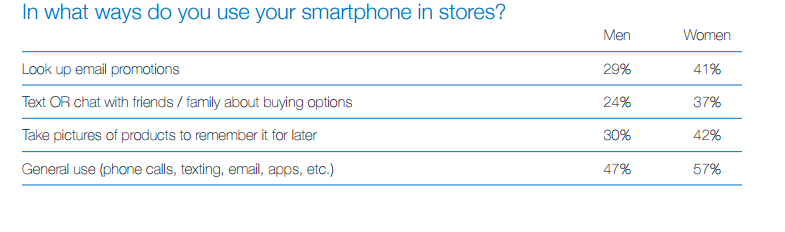
Women are more engaged on mobile while shopping: 37 percent of women text or chat with friends and family about buying options versus 24 percent of men; 41 percent of women look up email promotions versus 27 percent of men; and 42 percent of women take pictures of products to remember it for later versus 30 percent of men.

Image-2

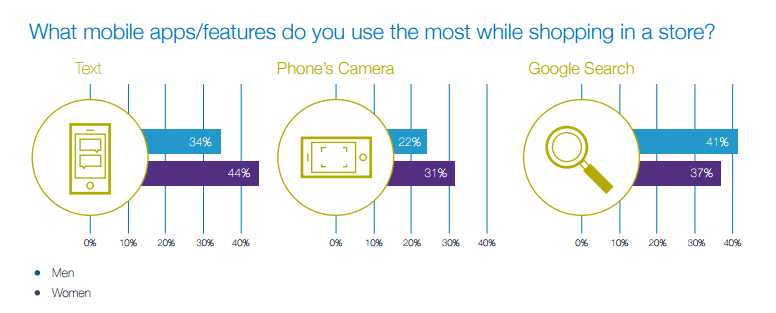
Unlike men, that depend more on Google Search for product recommendations, women prefer to use phone’s camera and text messages while shopping.

Shopping in physical store is ideal owing to personalized assistance

Shoppers from both genders acknowledged that it is easy to shop at in-store locations. Women value in-store shopping to confirm fit and style more than men. 65 percent of women shop in-store because of the ability to easily try on clothes and for tailored recommendations versus 55 percent of men.

Image-3Human interaction also plays a significant role in driving shoppers to physical stores, especially men. Men prefer to shop in-store owing to human interaction. 73 percent of men always or frequently interact with a sales associate at retail stores, compared to 65 percent of women. Interestingly, 28 percent of men consider the lack of responsiveness from an associate — their biggest pet peeve, when shopping in-store versus 23 percent of women.
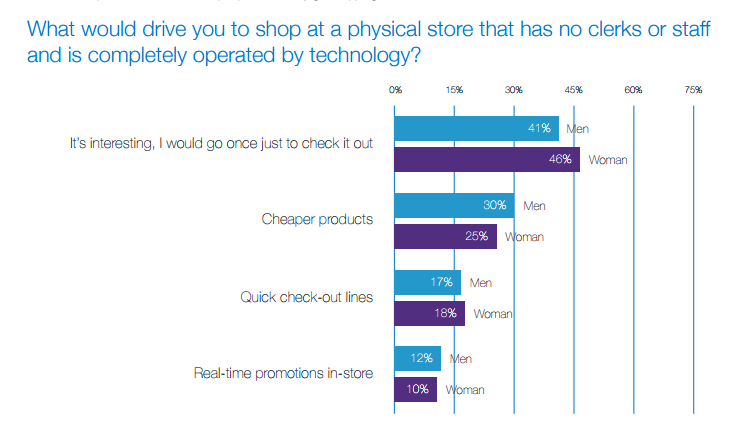

Majority Shoppers may not visit Purely Tech-Driven Stores

Despite differences in the use of mobile technology while shopping, both gender groups agree majorly on their choice of store locations. Both groups not ready for Amazon Go! Less than half of both genders– 41 percent of men, and 46 percent of women, would be interested in visiting a purely technology-operated store. However, these tech-based shopping experiences are mostly driven by incentives and recommendations available online.

Read Also: SPLICE Releases New Data-Driven Voice Apps for Alexa Skills

Key to Sales Success: Banking on Shopping Feedback and Deliver Relevant Recommendations

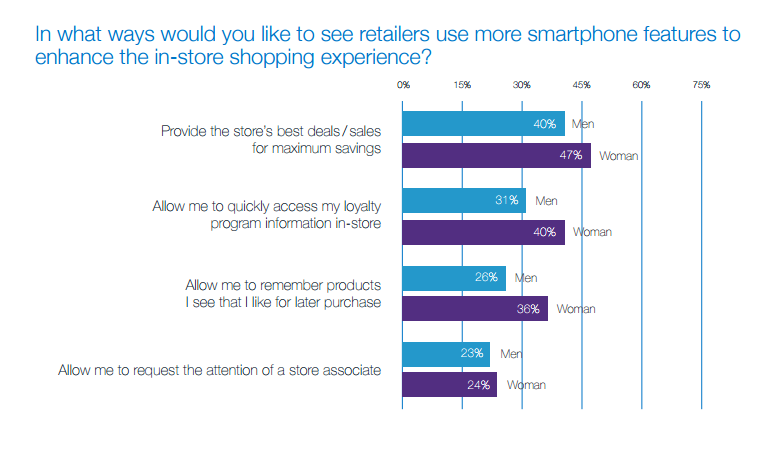
Shoppers want stores to provide best deals and saving options on their mobile even as they use smartphones to enhance in-store apps. Women lead all the way against men in seeking loyalty information in-store, product recommendations saved for later purchase and request attention from a store associate.

Image_1

The findings on the gender gap suggest that complete transformation of in-store shopping experiences may still be a distant thought for marketers to achieve maximum revenue. Customer experience may drive sales for Amazon Go, shoppers may still prefer personalized human interactions to believe what they buy actually makes sense when they walk out.

Recommended Read: Rant & Rave Builds Customer Feedback Integration with Amazon Alexa

“I see an AI-centric world full of opportunities, more than challenges”

1
Jacob Shama

[mnky_team name=”Jacob Shama” position=” CEO, Co-Founder at Mintigo”][/mnky_team]
[easy-profiles profile_twitter=”https://twitter.com/JacobShama” profile_linkedin=”https://www.linkedin.com/in/jacobshama/”]
[mnky_testimonial_slider][mnky_testimonial name=”” author_dec=”” position=”Designer”]“Startups must identify their highest priority when it comes to marketing their products and services, and craft their strategy and marketing platform integration accordingly.”[/mnky_testimonial][/mnky_testimonial_slider]

On Marketing Technology

MTS: What inspired you to co-found Mintigo and how did you get here?

Wanamaker said that half the money he spends on advertising is wasted and the trouble is that he doesn’t know which half. As someone with a science background, it always amazed me and I thought that I can use my skills in order to solve that. That’s what Mintigo is all about.  Mintigo leverages big data not only to find signals about customers and helps marketers spend money on what works, but also recommends the right actions to eventually convert them into sales.

MTS: How do you see the predictive marketing platform segment evolving over the next few years?

As people, organizations, and processes become increasingly digital, more data will continuously be produced. Data quantity is essential for companies, but what is more important is data quality. This explains why 80 percent of Global CEOs say data mining and analysis is strategically important to their organization, according to a PwC survey.

The growing relevance of and demand for predictive marketing will be driven by the need for a platform that can build accurate insights out of the large amount of customer data we have today—and turning these insights into actions. In fact, better analysis of insights can improve marketing return on investment by 10 to 20 percent and drive average profit growth of 14 percent, according to McKinsey.

Moreover, as customers are endlessly exposed to massive information from several sources, it is important for companies to distinguish themselves not only from competitors, but also from the general noise that our digital world has. By understanding customer needs in order to engage and convert them from potential leads to active customers, predictive marketing platform will be instrumental in enhancing overall customer experience.

Creating a customer-centric approach that anticipates customer needs and determines how to best deliver them by turning data insights into actions—at a faster pace and in real-time with AI technology—will drive the overall growth of the predictive marketing platform segment.

MTS: Tell us a bit about Mintigo’s Predictive Sales Coach?

Many identified AI as one of the emerging technologies that has the potential to disrupt marketing. In the same way, it is believed that AI will become integral to every competitive sales process in the coming years.

Already being leveraged in Mintigo, Predictive Sales Coach uses AI and predictive analytics to provide actionable sales intelligence such as predictive insights, purchase intent, and sales message guides to CRM systems. Essentially, the platform helps sellers engage the right prospects with the right message, at the right time. It is Mintigo’s contribution to marketing and sales alignment which has a lot of opportunities that can contribute to growth and revenue.

MTS: What do you see as the single most important technology trend or development that’s going to impact us?

We are only seeing the tip of the iceberg today but AI really has a lot of potential to impact marketing. The technology’s ability to understand, learn, and then act based on the information provided has numerous amount of use cases and room for growth. In fact, I agree that AI will be a business advantage of the future, along with 72 percent of business executives surveyed by PwC. Due to its general but dynamic nature, AI will definitely be a key factor not only in marketing but also in the growth of the whole organization in the long run.

MTS: What are challenges for startups while integrating a marketing platform in 2017?

The number one challenge, I believe, is choosing a marketing platform first and foremost. Back in 2011, there were only 150 marketing technology platforms. This year, there are almost 5,000 companies in the space. Choosing the right marketing platform is one of the most important decisions for startups as it can make or break the organization’s path to growth.

Startups, like customers, are surrounded by a lot of information about how things should be done. Learning how to tune out the noise, startups must identify their highest priority when it comes to marketing their products and services, and craft their strategy and marketing platform integration accordingly. Having specific goals in mind as well considering competition and limited budget, startups can choose the right marketing platform that not only best suit their needs, but can also guide them through the integration process.

MTS: What tools does your marketing stack consist of in 2017?

Our marketing stack can be divided depending on how it is used across our whole marketing strategy. For awareness, we highly invest in contents, social media and PR activities such as blog posts and webinars. All data from those campaigns go into our CRM which is Salesforce. It is then combined with other data to nurture leads into MQLs Marketo. Throughout this process, we analyze data with our algorithms to create better campaign and predictively score our leads. Our Sales team also works with Sales Coach to have better conversations with prospects.

MTS: How do you prepare for an AI-centric world as a business leader?

Technology is a constant driver of change. Doing business in today’s fast-paced, digitally-driven world, it is imperative for organizations and business leaders to keep updated on latest trends and developments, and be comfortable with change. It is expected that AI will further enhance or disrupt current business models and practices, so being proactive in staying competitive and relevant has become more vital.

As a business leader, I see an AI-centric world full of opportunities, more than challenges. It is easy to rely on AI and predictive analytics, but the greatest benefit comes when people within the organization can make smarter and data-driven decisions with the help of these technologies, rather than be replaced. In an AI-centric world, success lies in getting value from integrating human and computer intelligence.

This is How I Work

MTS: One word that best describes how you work.

Perseverance.

MTS: What apps/software/tools you love using for your daily life?

I use Evernote for notetaking in instances when I don’t have pen and paper. I like its indexing feature which makes it easier for me to search and access my notes on any device that I’m using. For work, I use Slack and Google Drive for team communication and collaboration.

MTS: What’s your smartest work related shortcut or productivity hack?

Planning and setting goals. I always prepare, the night before, all the things I should do the next day according to level of difficulty. Then I start off doing the harder tasks as I like the feeling that as the day ends, other things on my list are relatively easier ones to finish.

MTS: What are you currently reading? (What do you read/watch, and how do you consume information?)

I’m currently reading Culture Map: Breaking Through the Invisible Boundaries of Global Business by Erin Meyer. It’s a very informative book that talks about how cultural differences are the primary motivations behind many behaviors. As we continuously work in a global context, I believe being culturally aware of your potential partners and current employees can foster more success through better understanding and overall harmonious work relationship. As for shows, I’m presently hooked on House of Cards, and The Big Bang Theory for some laughs. In addition, I read newspapers and Quora, and watch TED Talks for inspiration.

MTS: What’s the best advice you’ve ever received?

While Mintigo was in its early stage, a friend told me to not overthink but to just listen. As a business leader, it is easy to overcomplicate things with information because. But one thing I believe that makes businesses thrive is their ability to actually listen to their market, customers, competition, and people. Combining this willingness to listen with evidence-based information is a well-tested recipe for success that Mintigo has done and will continue doing.

MTS: Something you do better than others – the secret of your success?

I believe I have this constant drive to provide value to organizations and people. I am passionate about my work and see it as an opportunity not only for organizational growth but also for personal development both for me and my team. Having this mindset, I see Mintigo as a cumulative and tangible effort of the ideas shared within the organization which success wouldn’t be possible without the determination and perseverance of everyone involved.

MTS: Thank you Jacob! That was fun and hope to see you back on MarTech Series soon.

[vc_tta_tabs][vc_tta_section title=”About Jacob” tab_id=”1501785390157-b58e162d-0ae25a4b-c27af96b-b2ce”]

Leader, entrepreneurial, with 20 years of experience in Big Data and Predictive Analysis, with 10 years of experience in executive-level management.

CEO, Co-Founder @Mintigo – A predictive marketing platform that help marketers find more customers faster. With Sequoia Capital backing and more than 100 industry-leading customers, Mintigo is leading the new era of Data-driven Marketing.

Holds DSc (Doctor of Sciences) in Communication.

Prior to Mintigo was VP Products and VP Operations at modu mobile, the modular mobile handset company.

Received his Doctoral D.Sc. degree from George Washington University and both his M.Sc. and B.Sc. with honors from Tel-Aviv University.

Specialties: Executive Management, Big Data analytic, Predictive Marketing, Information Technology.

[/vc_tta_section][vc_tta_section title=”About Minitigo” tab_id=”1501785390320-2d44fa50-740c5a4b-c27af96b-b2ce”]

Mintigo

Mintigo delivers intelligent customer engagement powered by predictive analytics and AI for enterprise marketing and sales. Mintigo’s predictive marketing and sales platform powered by AI helps enterprise marketing and sales teams use data and intelligence to find buyers faster. Enterprise companies including Oracle, Getty Images, Red Hat, Insight, CA, Workfront, Equinix, SolarWinds, Time Warner Cable and Neustar work with Mintigo to transform their marketing automation and sales processes. To learn more, please visit www.mintigo.com.

[/vc_tta_section][/vc_tta_tabs]
[mnky_heading title=”About the MarTech Interview Series” link=”url:http%3A%2F%2Fstaging.loutish-lamp.flywheelsites.com%2Fmts-insights%2Finterviews%2F|||”]

The MTS Martech Interview Series is a fun Q&A style chat which we really enjoy doing with martech leaders. With inspiration from Lifehacker’s How I work interviews, the MarTech Series Interviews follows a two part format On Marketing Technology, and This Is How I Work. The format was chosen because when we decided to start an interview series with the biggest and brightest minds in martech – we wanted to get insight into two areas … one – their ideas on marketing tech and two – insights into the philosophy and methods that make these leaders tick.

Interview with James McDermott, CEO and Co-Founder at Lytics

0
James McDermott

[mnky_team name=”James McDermott” position=” CEO and Co-Founder at Lytics”][/mnky_team]
[easy-profiles profile_twitter=”https://twitter.com/jamesnmcdermott” profile_linkedin=”https://www.linkedin.com/in/jamesmcdermott1/”]
[mnky_testimonial_slider][mnky_testimonial name=”” author_dec=”” position=”Designer”]“Today’s best tech companies have realized that customers want you to lead the way with innovation.”[/mnky_testimonial][/mnky_testimonial_slider]

On Marketing Technology

MTS: Tell us a bit about your role at Lytics and how you got here (what inspired you to co-found a martech company).

Lytics helps brands orchestrate meaningful, one-to-one interactions with people. Our vision is to make customer data the central nervous system for the world’s most successful companies.

Companies such as Atlassian use our customer data platform (CDP) to communicate with each user of its software products in a very tailored fashion — from in-product messaging to triggered emails. The Economist uses our machine learning to personalize its website to the content preferences of each visitor. Dr. Martens employs our data science to realize a 60 percent conversion increase with customers of its iconic shoes.

I first met my co-founder, Aaron Raddon, at Webtrends. Together, working with analytics customers we noticed a bevy of companies wanting to do something with their data, and not simply look at their results. They needed to take action with the data in their marketing tools. Raddon had previously worked for a large private university system — which at one point was one of the largest online advertisers — where he built a platform for reading signals and taking action on the behavior of students to help ensure retention. Together, we decided to launch Lytics to help more companies leverage customer data in their engagement efforts.

My job is to help ensure we’re keeping our eyes on our vision and growing internationally, while listening to customers and employees alike. We more than quadrupled growth in 2016 and are set to do it again this year.

MTS: How does the Lytics platform enable building custom audience segments using predictive insights?

Lytics helps brands orchestrate one-to-one interactions with their customers by serving as a central hub for all of a brand’s customer and visitor interactions — across sales, support, email marketing, web engagement, advertising, social media and more. In short, Lytics lets a marketer actually see what’s going on and finally access a comprehensive customer profile instead of having to piece together snippets from individual marketing tools. Having all of this cross-channel engagement data in one place not only allows a marketer to create custom audience segments and targeted campaigns but it also enables the Lytics platform to surface predictive and behavioral insights that marketers couldn’t otherwise access. Our built-in machine learning algorithms go beyond traditional marketing assumptions and heuristics (clicks, page views, etc.) and surface insights such as who is most “likely to engage” or what content a user shows affinity for based on hundreds of data points.

MTS: What is the range of analytics that Lytics provides?

Lytics provides traditional analytics around reach and conversion on the campaign level (we have native personalization tools that let marketers run digital campaigns within Lytics). From an overall audience perspective, Lytics provides analytics around audience segment growth and we integrate with analytics platforms such as Google Analytics so that marketers can compare analytics from specific audiences segments in Lytics against aggregate Google Analytics data. This enables marketers to filter down metrics and reports to a specific audience or group of audiences for a more refined analysis of user and customer journeys.

MTS: What startups are you watching/keen on right now?

The old-school way of doing things was to watch your competitors and just copy what they’re doing. However, today’s best tech companies have realized that customers want you to lead the way with innovation. So, we’re inspired by the most successful tech companies in the world.

In marketing tech, I’m watching Google and everything they’re doing with Google 360 and their innovation around AI. We’re thrilled to be one of the default tags in Google Tag Manager and we are deeply integrated with Google Adwords, Google Analytics, Google BigQuery and Doubleclick.  As part of their ecosystem, we see customers expanding their use and investments in Google, replacing some of their older and more extensive tools and leverage Lytics + Google as a new modern marketing platform.

In terms of companies outside of marketing software, I’m a huge fan of Snapchat. I’ve been using it with my family for years. And, now, Lytics is collaborating with them and agency RGA around some really cool stuff as part of their marketing tech venture program.

MTS: What tools does your marketing stack consist of in 2017?

We develop marketing technology, so we use our own software every moment of the day to build our business. Using the Lytics Customer Data Platform together with various marketing tools from Google and other partners, we can easily personalize our email, website, ads and so on. We have so many integrations with third-party marketing tools that we think it’s only right that we use each of them on ourselves. At any moment, we might be trying out five third-party email service providers (ESPs)!

Customers and analysts often say our machine learning is one of our stand-out differentiators, so we’re always looking for ways to improve all aspects of our business with it — from marketing and sales to content development.

MTS: Could you tell us about a standout digital campaign? (Who was your target audience and how did you measure success)

Our customers (as well as us) have used our data-science based insights to send more efficient email and ad campaigns. For example, most companies run blanket ad remarketing campaigns based on website visits regardless of how likely that user is to convert. By simply filtering this audience segment by those identified by Lytics as “likely to engage,” we’ve helped customers save money and significantly increase their return-on-ad-spend when compared against traditional marketing heuristics. One clothing retailer, Wildfang, made its online advertising 40 percent more efficient using our data science. Emma Mcilroy, CEO of Wildfang, says, “Lytics helped us grow our business by 73% in one year.”

MTS: How do you prepare for an AI-centric world as a business leader?

There is certainly a place for traditional marketing and a marketer’s intuition, however, AI gives marketers the ability to analyze large data sets at unimaginable speeds and surface insights that go beyond our human abilities. While it’s become a hot topic right now, AI and machine learning have been a part of the Lytics platform from day one. Our goal is to help businesses use machine learning and data science to understand individual customers first and let that guide their individual engagement experience based on their unique interests and personal engagement history — as opposed to starting with a piece of content and pushing it out to a large group of people.

This Is How I Work

MTS: One word that best describes how you work.

Persistent. I wouldn’t be an entrepreneur if I couldn’t put my head down and stick with it. In the people we hire we look for persistence as well. Persistence in making the company better, perfecting the platform, delivering results for our customers and helping our customers orchestrate more relevant experiences for their customers.

MTS: What apps/software/tools you can’t you live without?

Snapchat, Google Apps, LinkedIn, and our partners’ software!

MTS: What’s your smartest work related shortcut or productivity hack?

Evernote’s mobile app for making mobile lists — especially when I’m traveling on a plane or in transit.

MTS: What are you currently reading? (What do you read, and how do you consume information?)

I usually have 3 or 4 books going at once. Right now, I’m reading Voices from Chernobyl (The Oral History of a Nuclear Disaster), Will in the World (How Shakespeare Became Shakespeare), The Score Takes Care of Itself (Bill Walsh’s Philosophy of Leadership) and Anton Chekov’s A Nervous Breakdown.

MTS: What’s the best advice you’ve ever received?

Two things:
– Be curious and committed to learning; and
– Relentlessly focus on improvement.

MTS: Something you do better than others – the secret of your success?

Put the team ahead of myself and find ways to work with great people.

MTS: Tag the one person whose answers to these questions you would love to read:

Marc Benioff.  I love how he re-invents Salesforce every year and builds full commitment and momentum around the mission. I also enjoyed reading Behind the Cloud.

MTS: Thank you James! That was fun and hope to see you back on MarTech Series soon.

[vc_tta_tabs][vc_tta_section title=”About James” tab_id=”1501785390157-b58e162d-0ae25a4b-c27a4fc6-aabe”]

Experienced entrepreneur and technology executive with over 15 years of diverse business experience.

[/vc_tta_section][vc_tta_section title=”About Lytics” tab_id=”1501785390320-2d44fa50-740c5a4b-c27a4fc6-aabe”]

lytics

Lytics helps enterprises automate personalized marketing experiences through the industry’s most advanced Customer Data Platform (CDP). Popular retailing, media, consumer goods, banking, and tech brands use Lytics to execute one-to-one marketing programs that their customers welcome.

[/vc_tta_section][/vc_tta_tabs]
[mnky_heading title=”About the MarTech Interview Series” link=”url:http%3A%2F%2Fstaging.loutish-lamp.flywheelsites.com%2Fmts-insights%2Finterviews%2F|||”]

The MTS Martech Interview Series is a fun Q&A style chat which we really enjoy doing with martech leaders. With inspiration from Lifehacker’s How I work interviews, the MarTech Series Interviews follows a two part format On Marketing Technology, and This Is How I Work. The format was chosen because when we decided to start an interview series with the biggest and brightest minds in martech – we wanted to get insight into two areas … one – their ideas on marketing tech and two – insights into the philosophy and methods that make these leaders tick.

The $1 Trillion Dollar B2B Marketing Opportunity

3
B2B Marketing

When people think of ecommerce, companies such as Amazon, Walmart, or Apple come to mind, and for good reason: Retail sales for these business-to-consumer brands totaled over $201 billion dollars in 2016. Digital transformation that includes ecommerce is at the top of their priority lists because brands want to create a cohesive, connected customer experience that will exceed ever-increasing customer expectations.

However, there’s a bigger ecommerce opportunity on the horizon. According to Forrester, B2B e-commerce sales are expected to top one trillion dollars by the year 2020, making digital transformation especially important for B2B companies. With a wide-open market that is ripe for the picking, if B2B marketers can enable the right digital transformation strategies in the ecommerce realm, they can claim their piece of the $1-trillion-dollar pie.

Why B2B?

Advancements in technology have allowed B2C brands to personalize the customer experience like never before, which has raised online purchasing expectations for the work-related buyer. Traditionally, ecommerce strategies have been imperative to B2C success, but the B2B ecommerce experience has lagged behind. Now, brands have the opportunity to close that gap and provide the same ecommerce experience for B2B customers that they’re used to when they make purchases at home.

Given that brands are under constant pressure to realize efficiency gains, ecommerce is one of the first places that B2B companies should look when implementing transformation strategies. B2B Buyers conduct research online, and it’s important that brands optimize the experience to keep them in the sales funnel. Through optimization strategies, B2B companies can better move buyers through the purchasing cycle in a cost-effective manner. In addition, work-related buyers are always on the go and bring your own device (BYOD) is a standard practice, making business people the consummate mobile consumers of information. If B2B brands can meet them there, they have a massive opportunity for ecommerce growth.

Practical Steps for Implementing the Right Strategies

Take Notes from B2C Success

To stay relevant, companies must continue to reinvent themselves, and a shining example is General Electric. Under former CEO, Jeff Immelt, the 125-year-old company has been inspired by brands such as Amazon, and now, they’re embarking on a new Internet of Things journey where they are employing B2C strategies in a B2B brand. By looking at B2B ecommerce through a B2C lens, smart brands can follow in the steps of GE and reinvent models to better cater to the B2B market.

Capture the Entire Audience

Taking great notes from B2C success is important, but brands must also recognize the nuances that are specific to B2B purchasing. B2B has more roles per purchasing cycle, which means that B2B marketers are not just lucky enough to influence one role, they must influence multiple roles and understand and influence how they interact across the buying cycle. Not only that, they’re using multiple channels to research, connect, and purchase and those channels are both online and offline. These stakeholders may have different tendencies when they’re using a mobile device versus a desktop or even when they’re interacting with an account manager. By capturing every aspect of stakeholder behavior, B2B marketers can adapt ecommerce strategies

Have the Right Technology in Place

Because B2B buyers are expecting the same online customer experience as their home purchases, it’s important to deploy the right technology to learn about and engage with them in a personalized, contextualized manner. By collecting the right data online, brands can plan and componentize content and services elements around each stakeholder in the equation, and that content can guide them through the sales process. In addition, all of this data should be integrated into ERP, CRM, and other systems, which allows brands to take a fully integrated approach in the selling process.

For B2B brands, ecommerce strategies are the cornerstone of digital transformation because brands can capture insight and information about the thing that matters the most: the customer. From there, they can optimize and monetize the ecommerce experience in order to cash in on the $1 trillion-dollar opportunity.

Match Rate Challenge: What Every Marketer Should Know

0
Match Rate

Match rates have been one of the hot topics in the ad tech world for some time now and still comes up frequently in conversations with digital marketers. The topic continues to perplex because match rates are a widely misunderstood metric that are not entirely useful on their own.

In some ways, this is understandable. Match rates are an easily digestible metric by which a marketer can determine how well two distinct systems overlap with data, be it a DMP, a DSP, or an identity resolution service. It’s not dissimilar to how marketers used to ask for “click through rates” from ad networks.

However, match rates come with a dirty secret, a decay in their efficiency that threatens to undermine all the hard work. The average user owns 3.64 devices according to GlobalWebIndex, but likely has many more IDs, such as browser cookies, mobile advertising IDs, hashed email addresses and signups for connected TV services such as Roku and Apple TV.

In order to tell consumers a contextual, consistent story across devices, channels, and platforms, marketers must link these identities to a single customer. At that point, the marketer must match the ID across the places where they can find it – the elusive “match rate.”

The Match Rate Challenge

Today, daisy chaining identity solutions to determine a match rate is the marketer’s only option. For instance, if a marketer has a cohort of 1 million people who are addressable by email, it’s likely to only be able to match around 40% of those emails to cookie IDs.

This is because cookies are a changeable measure of identity. They expire as we move across devices, we delete them, and sometimes match pixels simply don’t fire as they should due to technology lapses or ad-blocking. That cohort then needs to be matched across the devices they use, which can account for another 50%. Once a marketer has run segmentation on the cohort in their activation platform, the total addressable audience could be as just 8% of the initial audience. Clearly, daisy chaining identity solutions is not the answer.

Match Rate

Beyond the Match Rate Challenge: First Party Data Matching

For a long time, many in the industry have thrown up their hands and said: “we can’t do anything about those cookies.” Others have been less than transparent and talked in terms of “matchable populations” so that they can get around admitting they can only match against a small subset of cookies.

The key to solving the match rate challenge for marketers lies in applying machine learning algorithms to first-party data sets. This can be accomplished by running a lookup against a cross-device graph, running a customer identity algorithm against the first party data, or a combination of the two. Either of these options will also need constant attention and optimization over time.

It’s vital to get match rates as high as possible, because low match rates make it hard to be sophisticated with data-led marketing strategies. Marketers want to be able to make the most of their first party data sets, and the match rate challenge forces them to ignore over half of that data.

For a long time, the industry has tried to address this through expanding cookie footprints. Many vendors have tried to pitch the “one ID to solve them all” panacea, with the result being simply another competing standard. The way to a real step change progression is through applying machine intelligence to first party data sets, in addition to traditional methods. Only then will marketers truly be able to solve the match rate challenge and maximize the value of their first party data.

Interview with Dror Ginzberg, Co-Founder & CEO at Wochit

0
Dror Ginzberg

[mnky_team name=”Dror Ginzberg” position=” Co-Founder & CEO at Wochit”][/mnky_team]
[easy-profiles profile_twitter=”https://twitter.com/drorgi” profile_linkedin=”https://www.linkedin.com/in/drorginzberg/”]
[mnky_testimonial_slider][mnky_testimonial name=”” author_dec=”” position=”Designer”]“AI has the potential to take the routine and mundane off of our plates but there is such a thing as overdoing it.”[/mnky_testimonial][/mnky_testimonial_slider]

On Marketing Technology


MTS: Tell us a little bit about your role at Wochit and how you got here. (what inspired you to co-found a video creation platform company)

I’m co-founder and CEO of Wochit, a platform used by media companies and other larger content creators around the world to produce social video quickly and at scale. It’s my second company. The first was PicApp, which we sold to YBrant Digital, also owner of Lycos, in 2011.

I started my career in technology while serving with the Israeli Defence Forces, working in the famous Center of Computing and Information Systems, also known as MAMRAM. It’s here that many of Israel’s greatest tech entrepreneurs have gotten their starts. Before becoming a founder, I’d worked for about 25 years in various senior roles, generally in something relating to online video. This long history enabled me to foresee and get ahead of the coming video takeover.

We identified social video as our focus early on, and that’s proven a great call. Essentially, now that all of the big social networks prioritize it, any publisher or media company looking to engage audiences on social needs to prioritize it, as well. We don’t rest on our laurels, though. We are always looking toward the future, aiming to be first-to-market with new features that allow our customers to leverage trends and drive their business objectives.

MTS: Video is unequivocally the best medium for marketers to create emotional attachments, how do you see this content creation segment evolving over the next few years?

 As mobile is increasingly the first – if not the only – screen, I expect short-form content to continue dominating social video. In fact, this “snackable” content will be what people think of when they hear the term “online video.” While the industry is growing more mature, I think there’s still a lot of experimentation and learning going on. But, as we in the industry get our hands on more analytics and develop deeper insights about what does and doesn’t work, the “art” of creating shareable moments will become more of a science.

For longer-form content companies, I see the continued path to differentiation through original content, which will make companies like Netflix, Hulu and YouTube look more and more like production studios or even OTT providers.

MTS: What do you see as the single most important technology trend or development that’s going to impact us?

For better or worse, I think the biggest game changer since the advent of the internet itself is Artificial Intelligence. AI is already an important part of our platform, and it continues to be a priority – where it proves to benefit our clients.  This is where the “or worse” comes in. While AI has the potential to take the routine and mundane off of our plates, there is such thing as overdoing it. At Wochit, we always caution our platform users about relying too much on automation, lest it look like they let robots create their videos.

MTS: What’s the biggest challenge for startups to integrate a video content creation platform like Wochit into their stack?

Executive buy-in? Really, we’re essentially a SaaS platform that’s incredibly easy to incorporate into their content creation workflow and social media engagement strategies. We’re incredibly user-friendly. After like an hour of training, anyone in an organization can be a video producer after signing on to Wochit.

MTS: What startups are you watching/keen on right now?

I’m not sure if it’s really accurate to call billion-dollar companies “startups,” but, since TechCrunch awarded Slack as “Best Startup” just this past February, I guess it still counts! I also find the evolution of Stripe, especially their Atlas product, to be really interesting.

In my industry, I’d say Cheddar, which grabbed onto the live streaming trend and quickly became a unique approach to newscasting that I expect will serve as an inspiration to a new generation of media entrepreneurs.

MTS: What tools does your marketing stack consist of in 2017?

When it comes to marketing Wochit, we drink our own Kool-Aid, so to speak, placing a heavy emphasis on social content. We create and distribute social video around trending topics to a number of different platforms and channels including YouTube and MSN, and this approach has served us very well as proof of concept. We also have other forms of content and power our content strategy with Hubspot. With more than 30,000 videos created monthly, we are able to author informative eBooks rich with insights with the goal of attracting, inspiring and educating both customers and potential customers.

MTS: Could you tell us about a standout digital campaign? (Who was your target audience and how did you measure success)

We’ve had great success with our #WochitWins campaign, which we’ve been doing for over a year. Every week, we highlight and promote one of our customer’s Wochit-created videos that has received more than 1 million views on Facebook. Each #WochitWin video is featured on our website and across our social media channels, and since our customers take pride in the honored, it gets a bit of viral boost from their end as well. Ultimately, we’ve found this to be a very simple way of rewarding existing customers while attracting new ones.

MTS: How do you prepare for an AI-centric world as a business leader?

As I noted previously, AI is an important part of our platform and it’s a major focus for our future development, with the caveat that everything we do has to be for our customers’ benefit. We don’t just develop to develop, and sometimes keeping that focuses, refraining from just using AI technology to do cool stuff because we can, can be a big challenge.

THIS IS HOW I WORK

MTS: One word that best describes how you work.

Determined.

MTS: What apps/software/tools can’t you live without?

With my frequent travels across a myriad of time zones, the basic utilities on my device are absolutely critical to getting me through every day. Navigation, Calendar, and Keynote are the three that I would be lost without.

MTS: What’s your smartest work related shortcut or productivity hack?

I have certain rules when it comes to email that I think help me stay focused and productive. For example, if the email involves a task that can be done in a few minutes or less, I take care of it right away. If it will take more time, I’ll assess the urgency and priority and put it on my calendar accordingly. This way, I can get it off my plate in the short term without the risk it will fall between the cracks.

MTS: What are you currently reading? (What do you read, and how do you consume information?)

With my crazy travel schedule and limited time with family, I’ve had little time to read as of late. I am a big fan of audiobooks, although I don’t have anything particular in process at the moment.

MTS: What’s the best advice you’ve ever received?

Always be thinking about things you can do to make your customers happier and your service more essential. The more your users incorporate a product or service into their lives, making that a habit, the harder it will be for them to leave you for a competitor.

 MTS: Something you do better than others – the secret of your success?

My big productivity secret is what I like to call “speed learning” when it comes to customer needs. I think I’ve honed the ability to see what people will find most valuable, which makes it easier for me to get first-mover advantage when fulfilling that need.

I’m also very flexible, efficient and I know how to balance the planned and unplanned to do list. I credit this talent to my ridiculous travel schedule. When people ask where I’m based, I often say “40,000 feet,” because I split my time between Tel Aviv and NYC and spend about 10% of my life in transit.

MTS: Tag the one person whose answers to these questions you would love to read:

Elon Musk

MTS: Thank you Dror! That was fun and hope to see you back on MarTech Series soon.

[vc_tta_tabs][vc_tta_section title=”About Dror” tab_id=”1501785390157-b58e162d-0ae25a4b-c27acbed-2f99″]

Mr. Dror Ginzberg Co-Founded Wochit Inc in 2012 and also its Chief Executive Officer since December 2011 and served as its President and Chief Operating Officer.

[/vc_tta_section][vc_tta_section title=”About Wochit” tab_id=”1501785390320-2d44fa50-740c5a4b-c27acbed-2f99″]

Wochit

Wochit is a video creation platform that empowers newsrooms, media companies and brands to expand audience engagement through the power of social video. Worldwide media brands such as Time Inc., Daily News, USA Today, Gannett, AOL, The Week, ProSieben, Singapore Straits Times, Focus online and Der Spiegel use Wochit to produce short-form videos around trending topics at the scale and speed required in the video-first, mobile era.

With rights-cleared assets from AP, AFP, Reuters, Getty, Bloomberg, and others, cloud-based editing tools and native uploads, horizontal and vertical videos are quickly created and distributed across all social and digital platforms. Wochit is among the 2016-2017 EContent Top 100 companies in the digital content industry as well as the the winner of both the Gutenberg Prize for its disruptive technology in the field of journalism and Digiday’s Best Video Technology Innovation for its significant impact on publishers’ bottom line.

The Company is backed by ProSieben, Singapore Press Holdings’ SPH Media Fund, Carlo de Benedetti, Redpoint Ventures, Marker LLC, Greycroft Partners and Cedar Fund. Wochit is based in New York, with offices in London and Tel Aviv. Find out more at www.wochit.com.

[/vc_tta_section][/vc_tta_tabs]
[mnky_heading title=”About the MarTech Interview Series” link=”url:http%3A%2F%2Fstaging.loutish-lamp.flywheelsites.com%2Fmts-insights%2Finterviews%2F|||”]

The MTS Martech Interview Series is a fun Q&A style chat which we really enjoy doing with martech leaders. With inspiration from Lifehacker’s How I work interviews, the MarTech Series Interviews follows a two part format On Marketing Technology, and This Is How I Work. The format was chosen because when we decided to start an interview series with the biggest and brightest minds in martech – we wanted to get insight into two areas … one – their ideas on marketing tech and two – insights into the philosophy and methods that make these leaders tick.

Interview with Nicole Amsler, VP, Marketing at Cloudinary

0
Nicole Amsler

[mnky_team name=”Nicole Amsler” position=” VP, Marketing at Cloudinary”][/mnky_team]
[easy-profiles profile_twitter=”https://twitter.com/Reniquity” profile_linkedin=”https://www.linkedin.com/in/nicoleamsler/”]
[mnky_testimonial_slider][mnky_testimonial name=”” author_dec=”” position=”Designer”]“A DAM solution should be the foundation for orchestrating unique customer experiences across various channels”[/mnky_testimonial][/mnky_testimonial_slider]

On Marketing Technology

MTS: Tell us a bit about your role at Cloudinary and how you got there?

I have more than two decades of experience shaping and implementing corporate marketing strategies. I built marketing engines and teams from the ground up at my previous positions as VP of demand marketing before Cloudinary, — including 5 startups, 2 of which went IPO and the third had a successful acquisition. I came to Cloudinary because they had never done a full marketing buildout before, but they were successfully growing on 100% inbound leads. This was unheard of and a dream situation for me as a marketer. My job was to build a marketing team and engine that could continue this growth as the company morphed from startup into a thriving SMB. I would say I’ve employed a brick-by-brick strategy. I keep what is working and growing, while simultaneously finding new bricks to keep the growth on an upward trajectory.

MTS: What are the features you like most about Cloudinary’s digital asset management (DAM) platform?

Managing a growing media library requires having a central hub for different teams to add and access files, tag, categorize and organize them in folders and subfolders, collaborate across different functions, and get usage analytics. All comprehensive DAM solutions out there offer these features, to a degree.

However, a DAM platform isn’t just for storage and asset consolidation. Since the main goal of using images and videos is to improve engagement, a DAM solution should be the foundation for orchestrating unique customer experiences across various channels. Cloudinary’s DAM solution enables this goal by facilitating optimal delivery of high-quality content, personalized for each and every user, irrespective of their device preference, bandwidth or location.

MTS: How has the massive shift towards video affected DAM platforms?

Videos are the heaviest form of media — they require the most bandwidth to transmit and they weigh more in bytes per page than other forms of media, like images. However, video is becoming an increasingly important part of websites because customers demand interactive, easy-to-consume content. DAM platforms must be able to handle video delivery with the same speed and efficiency as they do images. Enabling video delivery isn’t as easy as flipping a switch; it requires a lot of painstaking work.

In addition to bandwidth and large storage capacity, other factors that make videos difficult for DAM platforms are: Adapting videos to for different layouts across a wide range of devices; Advanced manipulations, such overlays, resizing and cropping, creating thumbnails, effects, caption and subtitles; Automatically switching to higher or lower quality streams depending on the bandwidth. As a result, DAM platforms have had to evolve to keep up with the demands videos place on them. Video is helping shape the future of DAM platforms.

MTS: Do you see video replacing traditional display ads in the next few years?

We’re already seeing video display ads on some sites. I don’t know that video will totally replace traditional display ads, but I think that as we make video delivery more seamless, we will notice an uptick in video usage for advertising purposes. The ubiquity of video will depend on the publishers’ ability to host that content, much in the same way that DAM platforms will be tasked with ensuring speedy delivery of heavier assets.

MTS: What do you see as the single most important technology trend or development that’s going to impact us?

It’s difficult to pinpoint one technology trend as the most important. While it’s approaching buzzword status, I think Artificial Intelligence is poised to be the single most impactful technology trend for marketing in the next year or so. AI makes marketing technology more intelligent: AI helps with ad targeting, it helps Google better understand content on webpages for search rankings. AI lets companies develop things like chatbots and more effective website layouts. All of these features that AI enables, help drive engagement and personalize prospective customer experiences, which are key to any successful marketing campaign.

MTS: What are the challenges while integrating with a digital asset management platform in 2017?

I see two big challenges for integrating with DAM platforms. One, it’s difficult to move all of your existing data from whatever current storage tools you use to a DAM platform. Managing all the data across different systems while trying to integrate with marketing systems is tedious. The other difficulty that may prove to be a larger obstacle is personalization. Personalization is a growing demand of consumers, but not all DAM platforms are equipped to handle building individualized campaigns. As we watch DAM platforms evolve, their ability to personalize will be key.

MTS: What startups are you watching/keen on right now?

These aren’t startups in the traditional sense, but they are startups in the capacity they’re fairly new and smaller projects for larger companies. Products like Google’s Cloud Vision API is using AI to do image recognition and auto-tagging. The idea is that the product’s AI will get smarter with every photo upload, taking a lot of the guesswork and tedium away from DAM processes. I’m curious to see how this product — and others like them — develop.

MTS: What tools does your marketing stack consist of in 2017?

Marketo
– Infer
Optimizely
– SFDC
Google Analytics
Datafox
Kiss Metrics
– A variety of SEM tools
-Facebook, Twitter, LinkedIn and Youtube
Buzzsumo
– Smartsheet

MTS: Could you tell us about a standout digital campaign? (Who was your target audience and how did you measure success)

In 2016, 90 percent of Cloudinary’s annual revenue was generated by leads from our marketing programs. This includes 100% of the leads Cloudinary obtains — a 171% year-over-year increase from before my arrival and a 270% increase in mobile visitor traffic. I’m proud of these results and the campaigns that drove the increase. However, one stood campaign stood out from the rest, content syndication.
We knew our blog was full of great information — Developers who read it responded well, and it remains a major touch point in our conversion funnel. We decided to use content syndication to generate ads to drive new prospects to our blog, including those who had never heard of Cloudinary. We used Google Analytics to track traffic back to the blog. Today, syndication drives 20% of our website traffic while maintaining a strong conversion rate among free users.

MTS: How do you prepare for an AI-centric world as a marketing leader?

Embrace it. This is the reason I keep tabs on AI-powered solutions. Data is the key to building and sustaining a successful marketing engine. Finding new solutions that use AI to dissect data in new ways, that offer more, useful insights will be fundamental to the success of future marketers.

This is How I Work

MTS: One word that best describes how you work.   

Strategically

MTS: What apps/software/tools do you love using for your daily life?             

Slack. As a developer founded and focused company, we all use Slack to keep in touch with offices and teams.

MTS: What’s your smartest work related shortcut or productivity hack?

I balance a lot of tasks and projects while trying to also ensure my team completes their tasks on time. For me, a list to manage all of this just won’t do. I need something to pop up and remind me of upcoming due dates. I found that adding tasks to my calendar is very helpful. The calendar will pop up and remind me when I need to have something done, or when I should be expecting something in my inbox. It is an app I always have open, so I don’t need yet another app just for task management.

MTS: What are you currently reading? (What do you read/watch, and how do you consume information?)

I keep up to date by reading a variety of blogs on marketing related topics, like MarTech.

MTS: What’s the best advice you’ve ever received?

Always close the loop

MTS: Something you do better than others – the secret of your success?

I can think about the big picture – where we want to go – and also define how we are going to get there. Execution is my strength.

MTS: Tag the one person whose answers to these questions you would love to read:

Wendy Schott, the CMO at PubNub

MTS: Thank you Nicole! That was fun and hope to see you back on MarTech Series soon.

[vc_tta_tabs][vc_tta_section title=”About Nicole” tab_id=”1501785390157-b58e162d-0ae25a4b-c27a4858-9624″]

PRODUCT MARKETING
More than 12 years of experience shaping and implementing corporate marketing strategies including building product roadmaps, developing and launching new and innovative products, creating product messaging and defining pricing strategies. Experience includes all aspects of market research including identifying market trends and opportunities and developing market and product specifications.

COMMUNICATIONS
More than 10 years of experience building and managing global corporate communications plans and strategies. Experience includes developing corporate brands and positioning, demand generation, managing public and media relations activities, developing social media strategies, managing investor relations, overseeing crisis communications, managing internal communications and overseeing event management.

Specialties: Marketing, Lead Generation, Communications, Public Relations, Social Media, Advertising, Brand Management, Strategic Planning, Corporate Messaging, Web Development, Media Relations, Product Management, Competitive Analysis, Product Development, Market Research, Investor Relations, Crisis Communications.

[/vc_tta_section][vc_tta_section title=”About Maropost” tab_id=”1501785390320-2d44fa50-740c5a4b-c27a4858-9624″]

cloudinary

Cloudinary, is a SaaS that streamlines a website’s entire image management pipeline. Cloudinary strives to be the standard for online images acquisition, manipulation and delivery.

Using Cloudinary you can easily move all your website’s images and other assets to the cloud. Automatically perform smart image resizing, cropping, merging, overlay, watermark, apply effects, rotations and perform format conversions. All this without installing any complex software. Integrate Facebook, Twitter, Google+ and Gravatar profile image extraction in a snap, fetch images from any online resource in any dimension and style to match your website’s graphics requirements, and much more. Simply put, if you have images in your web or mobile app, let Cloudinary manage them for you.

Cloudinary offers comprehensive APIs and administration capabilities and is easy to integrate with any web application. To simplify integration further we also have client libraries for Ruby on Rails, Python/Django, PHP, .NET, Node.js and more. In addition, alternative integration methods allow non-developers, bloggers and website administrators to enjoy Cloudinary with nearly zero code changes.

Cloudinary offers several paid plans in addition to a simple to setup, fully-featured free plan with plenty of room to grow.

[/vc_tta_section][/vc_tta_tabs]
[mnky_heading title=”About the MarTech Interview Series” link=”url:http%3A%2F%2Fstaging.loutish-lamp.flywheelsites.com%2Fmts-insights%2Finterviews%2F|||”]

The MTS Martech Interview Series is a fun Q&A style chat which we really enjoy doing with martech leaders. With inspiration from Lifehacker’s How I work interviews, the MarTech Series Interviews follows a two part format On Marketing Technology, and This Is How I Work. The format was chosen because when we decided to start an interview series with the biggest and brightest minds in martech – we wanted to get insight into two areas … one – their ideas on marketing tech and two – insights into the philosophy and methods that make these leaders tick.

The State of Affiliate Marketing By Oliver Roup, CEO of VigLink

2
Oliver Roup

Affiliate marketing should be part of every online business’s suite of digital products, and for good reason. In fact, the affiliate marketing industry is estimated to grow to 6.8 billion dollars by 2020. VigLink conducted a survey of 500 publishers and 100 merchants that currently use an affiliate marketing program. The survey also explored the current industry sentiment, and expectations for the future. The results showcase the high performance of affiliate service, and how publishers and merchants plan to increase their usage and spending over the next few years.  Sounds lucrative, right?Publisher Revenue Generation
It certainly can be, but affiliate marketing can also be intimidating. There’s a lot of misinformation out there, so let’s go back to the basics. In its simplest form, affiliate marketing takes the commercial links in your existing content and pays commissions to the participating publishers based upon customers completing a desired action (like a purchase from a merchant). It also happens to be a contending alternative for other forms of advertising such as display in the age of ad-blockers. As a matter of fact, the majority of publishers ranked affiliate marketing ahead of display advertising in revenue generation abilities.

There’s a common misconception that fashion and beauty sites are the only industries that can benefit from affiliate programs, but that’s just not the case. Any website can be monetized and any merchant can drive meaningful traffic to their site using an affiliate program. For example, home décor and remodeling sites offer plenty of opportunities to recommend interior design products and furniture, while travel sites can include booking links, flight information and hotel packages. The sky’s the limit in terms of what type of content performs well, and therefore publishers and merchants are both increasing their investment in affiliate programs going forward. According to the report, 86% of publishers expect their use of an affiliate marketing program to increase or stay the same in the future, and 91% of merchants plan to increase or keep their affiliate marketing budgets the same in the future.

02

03

There’s no reason why publishers and merchants can’t get started with affiliate programs right away. In fact, both should get in the habit of incorporating affiliate into their overall marketing strategy. For merchants, the cost of sale via affiliate channels is around 6% – a far lower-cost option than other marketing channels such as Google AdSense or display. It also tends to be much lower risk, as most merchants only pay for conversions. In the survey, an average of 67% of merchants said their affiliate marketing programs help influence their marketing strategies.

04

Overall, the survey disclosed some skepticism from both publishers and merchants, but also spoke to the clear benefits of using affiliate marketing that drive continued publisher engagement and merchant budget allocation.

05

06

While all the results point to a bright future for the affiliate marketing industry, sentiment towards current programs are still slightly mixed. This presents an opportunity for the industry to hone in on areas that could use improvement, such as ease of use, network quality and even simple things like managing expectations.

With the shifting online media and content landscape, including the proliferation of ad blockers and alternative media consumption platforms, we expect to see an increased focus on user experience and transparency in the coming year.

The Fearless Girl Campaign: She’s Fearless, but Is She Priceless?

0
The Fearless Girl Campaign: She's Fearless, but Is She Priceless?

Since the unveiling of Kristen Visbal’s bronze statue on International Women’s Day, ‘Fearless Girl’ achieved viral status for all the ‘right’ reasons. In April, it was reported that her virality has a price – to the tune of USD 7.4 million in free publicity to be exact. According to Bloomberg, she earned Boston-based State Street almost 70 percent of financial services media the next day, overshadowing giant Goldman Sachs Group Inc.

What does all this hype really mean? How does one measure the value of “free” publicity? In this case, USD 7.4 million equated to–

  • USD 201,075 worth of free radio advertising
  • USD 3,115,751 worth of free TV advertising
  • USD 3,729,926 worth of free online/print news advertising, and
  • USD 393,047 worth of free social media advertising
Fearless Girl Frenzy

In terms of social media advertising, it’s further broken down into spikes in social media mentions beyond the 10,000 mark on three separate occasions, and over 500,000 shares across social media networks such as Twitter, Facebook, and Instagram. While these figures sound wonderful, aren’t they all simply vanity metrics?

Vanity versus Value Metrics 

For those in the marketing, advertising, and PR camps, metrics often get given the more-the-merrier treatment. However, it doesn’t always make sound business sense. When we set our sights on too many vanity metrics, it’s easy to lose focus on the real data that matters. Ideally, metrics that are worth investing time, energy and money in, are those that help companies make decisions. Unfortunately, the majority of such key data can get lost in the media frenzy. As the name implies, vanity metrics give you a mood boost – it gives the illusion of succeeding, even if you’re not, simply because the numbers are growing.

Some examples of these (generally) are–

  • Number of likes
  • Number of shares
  • Number of followers/subscribers
  • Number of impressions/views

While seeing the figures for vanity metrics might make everyone feel good, they don’t actually offer clear guidance on what to do next (do we build another sculpture?).

Sound familiar?

However, that’s not to say that vanity metrics are completely pointless. For example, if your aim is to raise awareness for a brand or cause, then naturally, impressions and virality matter. In the case of “Fearless Girl,” it definitely seemed to help raise awareness for gender equity. But, if your KPI is to increase sales and revenue, the above list doesn’t really matter and would most probably annoy your stakeholders who are after more than just free advertising.

In short, what you define as a vanity metric also depends on what you define as a successful campaign. When it comes to listing KPIs for your campaigns, it’s more important and effective to focus on a few metrics that relate to your business goals and sales or marketing strategies. Of the list, sales – ROI and revenue – is probably the most common and important factor for companies, but it’s also the most challenging to measure and achieve. But placing focus on the right metrics can steer your campaign in the right direction for results.

Setting your KPIs

To set your KPIs, the first obvious question is – what’s your objective? Once you have made that concrete you can move on to identifying which metrics really matter. Known as actionable metrics, these can include:

Revenue and Campaign Performance

Setting a KPI for your revenue is a no-brainer, but it also involves factors like how much was spent, the ROI and which ad or channel was most effective. In this scenario, you have to wonder if the cost of commissioning the sculpture was taken into account in the calculations – this amount seems undisclosed.

Demographics and Behaviour

These days, demographics go beyond just age, gender, and spending power. You can track which groups are your most profitable customers, versus those who are one-off buyers, and even break it down to the time of day these customers are most likely to spend.

Customers and Conversions

Customers are not to be confused with visitors, or mere foot traffic i.e. people who stand around taking selfies with your statue. How many of the people who took selfies and posted on social media, then proceeded to nearby offices to open up an investment portfolio afterward?

True Success?

Bringing money into the equation and talking about ROI may seem crude for those whom “Fearless Girl” has turned into an empowering, feminist symbol. However, one cannot ignore the facts –

  • It was strategically unveiled on International Women’s Day
  • It was paid for by a company that faced lawsuit charges for fleecing its clients (nice distraction)
  • The “Charging Bull” is also an artwork which on its own, was a positive symbol of prosperity and strength on Wall Street, and had been since 1989

So while it is easy to demonize the poor beast, he was really quite harmless on his own. If the facing statue had been a hunter with a gun aimed at the bull, what would the message be then?

There are many metrics that provide valuable insights. Whether or not “Fearless Girl” is a successful campaign depends on State Street’s motivations and KPIs, which we’re clearly not privy to.

For the Consumer’s Sake: CMOs Must Unleash the Power of Marketing Technology

0
Marketing Technology

As an industry, we are constantly struggling to figure out “digital transformation,” because no matter what anyone tells you, no one’s really figured it out. But there’s a bigger problem with that: as we do that, we put ourselves at risk of forgetting the customer.

Faced with seemingly innumerable choices in the digital world, brands are aiming to blaze a sensible path through the siloed maze of web, social and mobile options. But instead of seeing digital marketing as one whole entity, many brands simply adapt to these new siloed channels first, adding on to their many layers of marketing technology (to reach consumers who are congregating there). Determining how to connect their customer experience strategy is almost always an afterthought — an interesting and dangerous paradox, given consumers’ overwhelming expectation that brand experiences be relevant and provide value.

There’s no shortage of data proving what consumers want from brands today. So CMOs leading these brands need to take a step back, think about customer experience first and then determine the channels, business processes, people and technology that will enable and support an experience that drives growth for their business. If marketing heads don’t figure out consumer expectations and drive business impact, they risk becoming caught in the ever-shortening tenure of the modern CMO.

A big part of what CMOs need to do to evolve their brand, and to keep their jobs, is to begin organizing and implementing a marketing technology strategy. The digital era has led to a surge in marketing technology budgets, and those marketers that are using their budget effectively to champion smart programs are seeing great returns.

Marriott, for example, has taken measured steps to remove silos that previously left multiple business units targeting the same traveler with little knowledge of what’s relevant, based on the individual’s travel stage. Now the brand has optimized cross-channel interactions through a centralized view of guests, a connected marketing technology ecosystem, and organizational alignment. As a result, Marriott can deliver personalized messaging across devices at scale for more than 120 global destinations and over 4,400 properties. According to predictions from Forrester Research’s Customer Experience Index Online Survey (CX index), their efforts will pay off. In the upscale hotel industry, a one-point improvement in the CX index can lead to a $65 million increase in revenue.

According to the State of Marketing Technology report by Walker Sands and Chiefmartec.com, 70% of marketers expected their companies’ marketing technology budgets to increase in 2017. Yet, only 3% of marketers get the most value out of their tools, likely because organizational silos still exist and few marketing applications are actually integrated, resulting in limited cross-channel visibility.

To drive strong customer experiences, CMOs should focus on leveraging data intelligence, technology integration and the right set of strategic services to reach consumers at moments of interest. Here are three key elements to shift your attention to that may help you achieve success

Identity Management: The concept of identity has changed dramatically. It’s no longer simply about identifying people, it’s about creating aggregated and centralized data sets to build rich customer profiles that are accurate and real-time ready. In order to be more personalized in every customer interaction, you must look at your customers persistently across devices, time and media. Marriott’s moves provide a good illustration.

Scale of cross-channel personalization: The processing power now exists for marketing communications to be automated at a much larger scale than once thought possible. This includes machine learning to determine customer audiences and adaptive response to ensure artificial intelligence is constantly optimizing the customer experience. This level of personalization requires the customer profiles cited above, but marketing technology implementation must also connect cross-channel applications to effectively reach consumers at scale. Again, look to what Marriott did as a guide to successfully leveraging tech to personalize.

Content Management: Data and decision-making must work across channels rather than within channels. Identity management and scale fuel this, but efforts will only be as good as the content a marketer is able to deliver to individual customers. Content management must be a central pillar driving the speed of content delivery, ensuring it is ready and able to find the consumer when they are most receptive to it.

Successfully navigating digital transformation isn’t about transforming to digital. It’s about aligning the business processes, people, and technology that will enable and support better customer experiences. Marketing technology is becoming a more critical tool for CMOs. When applied appropriately, it will without question help brands connect with consumers in very context-centric ways that elicit emotion and deepen their bonds.

Also read:  Is All That Big Data Making Your Head Spin?

Interview with Tony Chen, CEO at Channel Factory

0
Tony Chen

[mnky_team name=”Tony Chen” position=” CEO at Channel Factory”][/mnky_team]
[easy-profiles profile_twitter=”https://twitter.com/TonyChenCEO” profile_linkedin=”https://www.linkedin.com/in/tonychen3/”]
[mnky_testimonial_slider][mnky_testimonial name=”” author_dec=”” position=”Designer”]“Clients now want to see immediate campaign results, and a means to attribute their investment to their company’s ROI.”[/mnky_testimonial][/mnky_testimonial_slider]

On Marketing Technology

MTS: Tell us a little bit about your role and how you got here. (what inspired you to start a martech company)
I had quite a unique journey getting to my current role. I started in the SaaS and email industry and I quickly noticed an opportunity in the lack of an ESP with great deliverability and great customer service. It was with those two metrics in mind I began Maropost.
My original plan was to have a lifestyle business, with a few clients I could manage on the side. But good word travels fast and referrals started almost immediately. It wasn’t long before Maropost turned from a passion project to my full-time focus. Now, five years later, Maropost is the fastest growing company in Toronto, generating $30M in annual revenue.

MTS: Given the massive proliferation of marketing technology, how do you see the martech market evolving over the next few years?
Like the rest of the tech industry, martech is in the midst of a growth boom, with products and offerings evolving and innovating rapidly. That means more automation, more personalization, more machine learning. And we’re right there with the boom, having just launched “Da Vinci” our new machine intelligence.
Consumers are also becoming smarter about martech and with that, pickier. In the end, the product and service is always going to be the most important. It’s not enough to simply solve the customer’s problem, you have to set yourself apart by putting the customer and product first.

MTS: What do you see as the single most important technology trend or development that’s going to impact us?
Without a doubt, machine learning, or as its popularly known, artificial intelligence (AI). True artificial intelligence is probably still some way off, but our “Da Vinci” machine intelligence is the next best thing.

MTS: What’s the biggest challenge that CMOs need to tackle to make marketing technology work?
For CMOs, the real challenge is in planning for the future with martech industry trends in mind. According to Gartner, 20% of business content will be written by machines by 2018. This means a significant number of marketing jobs being replaced by AI. For management, this means teams need to be leaner, more agile, and more knowledgeable than ever. This comes with the daunting task of creating dynamic marketing strategies that can change at the speed of AI. Those who can’t adapt won’t survive.

MTS: What startups are you watching/keen on right now?
A great startup we share a home with here in Toronto is BrainStation, which focuses on technology training for people looking to expand their digital skillset. With how much tech is playing a part in every field of work, places like BrainStation are filling the gap left by traditional schooling.

MTS: What tools does your marketing stack consist of in 2017?
First and foremost, we use our own Maropost Marketing Cloud and Maropost Sales Cloud product for our ESP, CRM, and service software. Some other notable tools the teams uses are Google Analytics, Google Drive, SEM Rush, Heap, and the typical social networks.

MTS: Could you tell us about a standout digital campaign? (Who was your target audience and how did you measure success)
The campaign we’ve created around this year’s tradeshow season is my favorite. Obviously, we’re targeting people attending the conferences, but also those who fall into the look-a-like audience. With our new Maropost Sales Cloud launch, the announcement of our new AI–Da Vinci–and our continued success of Maropost Marketing Cloud, we have more to tell people about than ever before.

MTS: How do you prepare for an AI-centric world as a marketing leader?
By creating my own… Da Vinci.

This Is How I Work

MTS: One word that best describes how you work.
Tirelessly.

MTS: What apps/software/tools can’t you live without?
Maropost 😉

MTS: What’s your smartest work related shortcut or productivity hack?
“Never do tomorrow what you can do today. Procrastination is the thief of time.” – Charles Dickens.

MTS: What are you currently reading? (What do you read, and how do you consume information?)
I’m actually re-reading Ashlee Vance’s biography of Elon Musk right now, but for news I stay up to date through apps and Twitter.

MTS: What’s the best advice you’ve ever received?
Secret to success is to never stop understanding your own business. When things go wrong, you know how to fix it.

MTS: Something you do better than others – the secret of your success?
Diversifying my knowledge base. The more you understand, the more self-reliant you are when things go wrong.

MTS: Tag the one person whose answers to these questions you would love to read:
Elon Musk

MTS: Thank you Ross! That was fun and hope to see you back on MarTech Series soon.

[vc_tta_tabs][vc_tta_section title=”About Tony” tab_id=”1501785390157-b58e162d-0ae25a4b-c27adb64-99da”]

Tony Chen founded Channel Factory, an online video distribution and data company, in 2010 while studying economics and classical piano at Rice University. With predictive analytics, the platform helps advertisers and agencies more effectively and efficiently advertise on YouTube. Clients include Nestle, MediaCom and OMD.

[/vc_tta_section][vc_tta_section title=”About Channel Factory” tab_id=”1501785390320-2d44fa50-740c5a4b-c27adb64-99da”]

Channel Factory

Channel Factory is one of the leading Native Media companies that leverages Big Data to bridge Social Video Media Buying, Influencer Marketing, and Branded Content.

In this world of fragmented new marketing opportunities, our goal is to use data and technology to provide a unified solution.

[/vc_tta_section][/vc_tta_tabs]
[mnky_heading title=”About the MarTech Interview Series” link=”url:http%3A%2F%2Fstaging.loutish-lamp.flywheelsites.com%2Fmts-insights%2Finterviews%2F|||”]

The MTS Martech Interview Series is a fun Q&A style chat which we really enjoy doing with martech leaders. With inspiration from Lifehacker’s How I work interviews, the MarTech Series Interviews follows a two part format On Marketing Technology, and This Is How I Work. The format was chosen because when we decided to start an interview series with the biggest and brightest minds in martech – we wanted to get insight into two areas … one – their ideas on marketing tech and two – insights into the philosophy and methods that make these leaders tick.

A Letter To Adtech Vendors: Innovate Or Get Out Of The Way!

0
A Letter To Adtech Vendors: Innovate Or Get Out Of The Way!

Engaging new ad formats are here, and they’re ready to be deployed. However, there’s a bottleneck with regard to improving the overall inventory of the web (and especially mobile) advertising: adtech vendors.

Despite the availability of unique creative formats that delight users and engender positive brand experiences, the infrastructure isn’t there to support these ads hitting the marketplace en masse. Or rather, it’s there, but the proliferation of poor creative continues to drown these formats out in the marketplace.

Luckily, Demand Side Platforms (DSPs) appear to be fighting back against the cavalcade of poor inventory.

Bots and ad fraud are clogging the ecosystem, creating brand safety concerns. But more than that, it’s disruptive ads that create negative customer experiences that are holding back the pace of innovation. Supply Side Platforms (SSPs) have the tools to empower the marketplace with quality inventory, and brands and publishers WANT THESE FORMATS.

It’s time for DSPs to implore SSPs to innovate or simply get out of the way. DSPs are already taking some steps to simply move right around the sort of SSPs that are stalling innovation and pushing an ancient way of thinking about ad inventory and exchanges. Curating the best inventory helps ad exchanges, but that also costs DSPs money. By simply removing the contrived SSPs from the equation, you’re left with only the best ad buy options, and with less of the hassle of sifting through each and every ad.

For honest — MRC-accredited — SSPs, you’re not dead to this world yet, however. You can still change your ways and join with the countless brands and publishers altering the way consumers interact with ad content.

Best of all, these SSPs don’t have to alter their sales strategy much at all. Chances are they’re already serving up their inventory programmatically. Well, coincidentally, so are these innovative formats. Header bidding helps prioritize the SSPs that deliver quality ads, putting a premium on the sort of inventory that drives quality results.

And again, there’s an easy way to join the “party” so to speak: become one of the SSPs that’s exhibiting a penchant for cutting-edge, attractive formats and you’re in. Ad networks are shrinking, cutting costs by limiting relationships from hundreds of partners to a choice few. The requirements? Do you provide the sort of creative inventory that provides positive results? Do you reflect well on the buyer and enhance exchange’s relationships with brands and publishers?

If this sounds like a bit of an “in crowd,” you’re not mistaken. The new DSP/SSP dynamic is an exclusive club, but not an unattainable one. There are rules for success, that when followed, assist all parties. Either fall in line, or get out of the way. We’re innovating here, after all.