


The epicenter of cutting edge business trends is arguably neither Wall Street, nor Silicon Valley, but a bustling marketing agency, where everyone from the receptionist to the CEO will be chasing down the latest fashions. It will be no different for AI, where agencies will be the early adopters, paving the path forward for their clients on implementation, garnering efficiencies and building new business models.
To gauge where AI is headed this year, Duda, a leading white label website building platform for agencies and SaaS companies, conducted a survey to find agency sentiments and priorities regarding AI for 2026. The survey reveals that agencies will be implementing AI from the ground up in order to increase productivity and efficiencies, while freeing up consultants to focus on creativity and strategy.
Rebuilding from the Ground Up
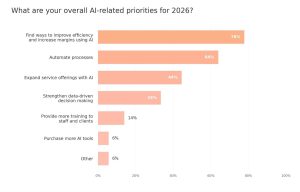
According to the survey, 78% of agencies are prioritizing improved efficiency and higher margins, while 64% will focus on process automation and 44% on expanding service offerings with AI. The 44% will be the space to watch, as creatives, writers and strategists let their imaginations run wild with new solutions to offer their clients. Simultaneously, SaaS companies have quietly been launching new AI tools embedded in existing platforms where creatives can organically explore AI within existing workflows and find productivity methods without the need for expensive, customized AI tools.
“AI is most powerful when it speeds up thinking, execution, and decision-making. We use it to support research, structure documentation, generate first drafts, surface insights, and reduce manual setup time. That allows our team to focus on strategy, creativity, and quality — where humans still matter most,” said Alex Mann, Managing Director, Big Boy Digital in Duda’s new 2026 Agency Growth Operating Framework eBook.
Creatives Tackle AI
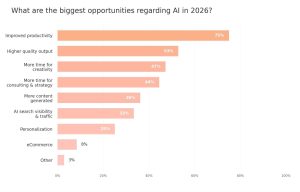
Creatives have a complicated history and view on AI. While many purists wouldn’t know what a prompt is, others are already experimenting with Seedance 2.0. The survey reveals that many of them see AI freeing up time for more artistic endeavors. While 75% of respondents view improved productivity as AI’s biggest opportunity, 47% said AI could allow them to spend more time on creativity, 44% on consulting and strategy and 36% saw value in generating more content at scale.
Leading brands learned the hard way that the use of AI in creative endeavors must be approached with care. In December, an AI generated ad by McDonalds in the Netherlands had to be pulled due to major negative backlash. Coca Cola and Toys “R” Us were no different.
For communications professionals, AI is proving to be an opportunity for new job opportunities, with tech companies notably hiring ‘storytellers’ including companies like Anthropic, which, ironically, tripled the size of its communications team in 2025. Nevertheless, 31% of respondents are worried about being replaced by AI, revealing overall anxieties around the future of consultants.
Quality vs. Quantity
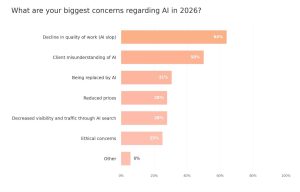
The survey further underscores questions surrounding the quality of AI output. While 53% believe AI can drive higher-quality output., 64% cite “AI slop,” as their top concern. And it’s not just agencies. Neal Mohan, the YouTube CEO, has declared managing AI slop as a top priority for 2026, with other tech companies seeking to clean up low quality content in order to maintain model performance.
Beyond quality, concerns around AI include worrying about clients misunderstanding it (50%), downward price pressures (28%) and cite ethical concerns (25%).
Marketing Technology News: MarTech Interview With Fredrik Skantze, CEO and Co-founder of Funnel
Design Trends
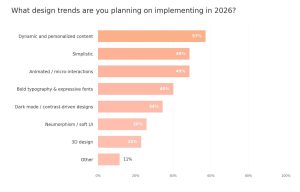
On the web design front, agencies plan to lean into dynamic and personalized content (57%), simplistic layouts and animated or micro-interactions (49% each), bold typography and expressive fonts (40%), and dark mode or contrast-driven designs (34%). One quarter of respondents also saw dynamic and personalized content on websites as an opportunity for AI in 2026. This goes beyond Netflix and Spotify showcasing personalized recommendations on their homepages or Amazon, who is a pioneer in this space. For brands with smaller budgets, AI can analyze user data, including browsing history and demographics, in order to tailor content, layouts and product recommendations in real time.
Everyone is still figuring out AI, and that includes agencies. However, there is no doubt that as early adopters, they will be the ones to hit the ground running. Agencies are betting on AI to transform their operations, boost margins, and unlock creative potential, but they’re doing so by weighing the risks of quality degradation and client confusion. As they rebuild their operations from the ground up, these early adopters will be defining what responsible, effective AI integration looks like for the broader business world.
Methodology
The survey was conducted between November and December 2025 among 36 Duda customers, including agencies located in North America (61%), Europe (22%), Asia (14%), and the Middle East (3%). Eighty-nine percent of respondents represent agencies with up to 10 employees, while 11% employ up to 100 people.
Marketing Technology News: The Death of Third-Party Cookies Was Just the Start. Are You Ready for Consent Orchestration?