

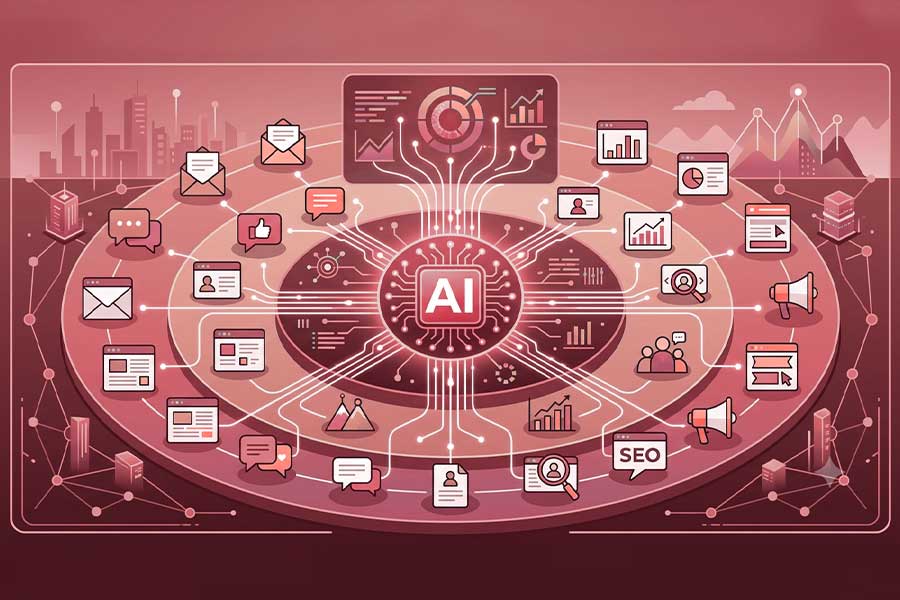
Marketing technology has grown from a small set of tools to a large and interconnected ecosystem, including customer relationship management, customer data platforms, advertising technologies, analytics, content management, marketing automation, commerce applications, personalization engines, experimentation platforms and artificial intelligence. Each type of technology has evolved to solve a specific marketing problem. CRM platforms manage relationships with customers, CDPs aggregate customer data, marketing automation platforms run campaigns, advertising platforms manage paid media, analytics programs monitor performance, and AI tools are increasingly being used to create content, personalize, predict, and make decisions.
This specialization has created huge capabilities for modern marketing teams but it has also brought on a new challenge – complexity. Organizations can operate dozens or even hundreds of Martech applications across departments, geographies, brands and customer journeys. Each system can provide valuable signals, but those signals could be siloed from the rest of the marketing ecosystem. A CRM might record a customer interaction that has no immediate impact on advertising choices. Website behavior may be independent of email activity. Commerce transactions may not even be connected to personalization engines. Campaign analytics can come too late to influence the decisions already made.
The result is a Martech landscape that may be technologically advanced but functionally fractured. Marketing teams often spend a lot of time moving information around from one platform to the other, reconciling data, setting up workflows, managing integrations, and figuring out which system should do what. Adding yet another specialized app will address an immediate problem, but at the same time create another integration point that will need to be managed.
That opens the door to a different model: the Martech Operating System. Instead of each Martech platform being a destination in itself, the Martech Operating System may utilize AI as an intelligence, decision and orchestration layer across the wider marketing ecosystem. AI is able to read customer signals from multiple systems, understand business objectives, decide which marketing capabilities should respond, coordinate workflows across platforms and continuously evaluate outcomes.
The Martech stack is not necessarily replaced by AI in this model. In fact, it can hover above and between specialized technologies, orchestrating their capabilities. A customer signal might trigger an AI-driven decision as to whether the right response is a CRM workflow, an email platform, an advertising system, a content engine, a commerce platform or personalization technology. The operating layer could then observe the outcome, and adjust further actions.
So, the move is from a bunch of Martech tools to a coordinated marketing operating system. Instead the architecture could enable intelligence to orchestrate technologies around customers and business objectives instead of marketers manually orchestrating technologies. Why an OS is Required for the Modern Martech Stack
The increasing complexity of Martech is widening the gap between technological capability and operational coordination. Organizations may have sophisticated tools for just about every marketing activity, but those tools don’t automatically work as one system. An operating layer may provide the coordination that is required to turn individual capabilities into connected marketing workflows.
Martech proliferation and technology complexity
Modern marketing organizations are built upon an ever-expanding technology ecosystem. Organizations use CRM systems to manage customer relationships, CDPs to manage customer profiles, advertising platforms to target audiences, analytics programs to measure behavior, content systems to manage digital experiences, and automation platforms to orchestrate campaigns. Additional capabilities are provided by commerce systems, loyalty platforms, recommendation engines, experimentation tools, and AI applications.
And not only the number of platforms , but the connections between them . Every new technology can bring with it APIs, data mappings, authentication requirements, workflows, governance policies, and maintenance responsibilities. Marketing teams must know what data is owned by what system, which platform should trigger an action, and how information should flow between applications.
With the growth of the Martech landscape, tech management can become a large component of marketing operations. Teams are spending more time getting tools aligned than working on customer strategies. An operating system approach tries to alleviate this complexity by providing an intelligent coordination layer across the ecosystem.
a) Fragmented Customer Data and Workflows
Customer information is often stored in CRM records, website interactions, mobile applications, advertising platforms, commerce transactions, email engagement, customer service systems, and loyalty programs. Each source is a different lens on the customer.
Effective connectivity is needed to keep these signals linked. For example, a cart abandoner, a few email openers, customer support contacts, and recent product searches could all be separate events across different platforms rather than one cohesive customer journey.
AI could help us make sense of these signals together. An orchestration layer may bring together behavioral, transactional, contextual, and engagement data to build a richer picture of customer intent and what should happen next. This can move marketing from siloed event-driven automation to contextual decision making.
b) Duplication of Capabilities and Integration Problems
Martech platforms are overlapping more and more. Many systems may provide customer segmentation, analytics, personalization, campaign automation, recommendations or AI capabilities. This causes organizations to pay for similar functions across multiple products.
Integration adds another level of complexity. Data often needs to be synced between systems and workflows need to be coordinated across platforms. One change to an application can affect downstream integrations and processes.
An AI-powered operating layer could abstract away some of this complexity. Instead of marketers manually figuring out which platform should do what, the orchestration layer could look at the capabilities available and direct the task to the right technology.
This would allow specialized platforms to survive, but to relieve the burden of coordinating them.
c) Disconnected Customer Journeys
Customers don’t experience a brand on individual Martech platforms. They see websites, applications, advertisements, emails, stores, customer service interactions, and product experiences as parts of one journey.
But disconnected tech can result in inconsistent experiences. The customer might see an ad for a product they already purchased, get the same message repeatedly on different channels, or receive different recommendations based on the platform they’re engaging with.
Customer experience orchestration with shared context could be a role for Martech Operating System. AI is able to look at the latest interactions, what customers like, their buying history, how engaged they are and business rules to determine the right communication or experience.
The aim would be to build more integrated, timely and relevant customer interactions rather than optimize in silos by different platforms.
d) Tool-Centric Marketing: The Limits
Traditional Martech approaches tend to focus on selecting the right tools for individual marketing tasks. Specialized technologies are still useful, but in a tool-centric approach, the technology stack itself can become the organizing principle of marketing operations.
This logic is reversed in an operating system model. The customer, business objective and desired outcome become the organizing principles and Martech platforms become capabilities that can be turned on as needed.
AI might be the glue that binds these capabilities together. It could read signals, orchestrate decisions, initiate workflows, mobilize resources, assess results and learn continuously from performance.
That doesn’t mean every marketing decision should be autonomous. Brand strategy, creative direction, ethics, customer relationships and decisions of high impact – all remain heavily dependent on human judgment. Instead, the Martech Operating System stands for a possible reordering of technology: from managing a growing collection of independent tools to orchestrating a connected ecosystem of marketing intelligence and execution.
The outcome might be a marketing environment where data, decisions, workflows and technologies act as parts of a larger system rather than isolated ones. As AI gets better at grasping context and orchestrating actions, the Martech Operating System can be the architectural blueprint for turning a disconnected marketing stack into a perpetually connected marketing engine.
What Is an AI-Powered Martech Operating System?
Increasingly, the modern Martech stack is a collection of specialized technologies, not a single platform. Customer data platforms are where customer data lives. Advertising platforms handle paid acquisition. Marketing automation tools run campaigns. Content platforms manage digital experiences. Analytics systems measure performance.
AI is now being stacked across almost every layer creating new capabilities for prediction, personalization, content generation, decision making, and automation.
However, simply introducing AI tools to an already fragmented environment doesn’t automatically create an intelligent marketing organization. When AI lives inside isolated applications, organizations end up with AI-powered silos, not coordinated intelligence. A different approach is an AI-powered Martech Operating System. That’s because it’s about intelligence and orchestration rather than individual technologies. It allows AI to understand information, know what to do based on context, coordinate actions, and to learn from outcomes on an ongoing basis.
The goal isn’t necessarily to replace existing Martech investments. Instead, the operating system can link them together into a more structured environment. It can determine which technology should be used for a particular task, what information should be provided to it, when an action should be performed, and how the outcome should influence the subsequent decision.
a) What is a MarTech Operating System (MTOS)
Think of a Martech Operating System as a smart coordination architecture that links marketing data, technologies, workflows, decisions and business objectives. It provides a layer that allows different Martech capabilities to work together around a shared understanding of customers and marketing goals.
The traditional Martech architecture is often a patchwork of applications connected by integrations. A CRM talks to an email platform, an advertising platform talks to a CDP and analytics programs pull information from multiple systems. The connections allow for data exchange, but do not imply intelligent coordination automatically.
The Martech Operating System adds another layer of intelligence. It can understand the purpose of different technologies and decide how they should participate in a particular marketing workflow.
For example, a customer who visits a product page multiple times, downloads related content and interacts with an email campaign will send signals across several platforms. The operating system could potentially aggregate those signals, infer what the customer might be trying to do, figure out the right next step and orchestrate the right Martech systems.
This leads to outcome-oriented rather than tool-oriented architecture. We can start from a customer or business goal and ask what combination of technologies will do it rather than starting from a platform and asking what it can do.
b) AI as Intelligence Layer
AI is the intelligence layer that decodes the massive amounts of information generated across the marketing ecosystem. Marketing systems generate behavioral, transactional, demographic, contextual, engagement, campaign and conversion signals as an ongoing process.
Taken individually, these signals may not mean much. When combined with the right context, they can provide a fuller picture of customer behavior and marketing performance.
AI is able to look at these signals to find patterns, spot changes in what the customer wants, segment audiences, see new opportunities coming and highlight anomalies. It can also relate current behavior to historic information and business context.
This way the intelligence layer can answer questions like:
- What’s the story with this customer?
- What indicates a change of intent?
- Which audience is more engaged?
- Which campaign is losing its punch?
- What is the channel that is driving the strongest incremental engagement?
- Which customers might need a different experience?
This intelligence can then be pushed into the decision and orchestration layers.
AI is able to also supply intelligence in the Martech ecosystem itself. It can identify duplicate tools, discover unused capabilities, monitor the performance of how well integrations are working, and see if or how certain technologies are actually helping to achieve business goals.
c) AI as Decision-Maker
Intelligence informs you what is happening but marketing operations also require a decision about what should happen next. AI may serve as a decision layer that evaluates customer signals, business goals, marketing rules, historical results, and available resources before recommending or taking action.
A decision layer could decide whether a customer should get an email, an advertisement, a product recommendation, a sales notification, a loyalty offer, or no communication at all.
This is important because the best action is not always the most obvious one. When a customer displays a high purchase intent, they may need a sales intervention rather than another automated email. The recent buyer may need post purchase engagement instead of another acquisition message.
AI-powered decisioning can grasp these contextual differences. Decisions can also be based on business objectives. A campaign can be acquisition, revenue, retention, customer lifetime value, product adoption or brand engagement. The AI decision layer can ingest these objectives and marry them with customer signals to determine what to do. This means that decisioning can become dynamic, instead of being entirely rule-based.
d) AI as the Orchestration Layer
Once a decision is made, it has to be carried out. This is where standard artificial intelligence can serve as an orchestration layer.
Then the orchestration layer ties the decisions to the right Martech systems. It can decide which platform to take the action, provide the required data, trigger the workflow, and trace the outcome.
For instance, an AI system may recognize that a customer needs a personalized retention intervention. The orchestration layer could connect the CRM, customer data platform, email system, personalization engine and analytics platform to deliver the right journey.
Similarly, a campaign optimization decision may require changes in advertising, content, audience segmentation and analytics systems. Instead of marketers having to manually orchestrate each platform, you can have an orchestration layer that manages the sequence.
This creates a closed loop:
Customer signals → Intelligence → Decision → Martech execution → Measurement → Learning → New decision.
The more this loop happens, the more valuable the operating system becomes.
e) From Martech Stack to Marketing Intelligence Infrastructure
The move from Martech stack to marketing intelligence infrastructure is a change in how organizations think about technology. A Martech stack is often referred to as a collection of applications. The marketing intelligence infrastructure is conceived as a system of interrelated components that converts information into decisions and actions.
The infrastructure can bring together customer data, identity, AI models, decision engines, workflows, content systems, advertising technologies, analytics, experimentation and governance.
The point isn’t to do away with specialization. Specialized Martech platforms can still have power because they bring deep capabilities in fields like advertising, commerce, content management, client engagement, and analytics.
Instead, the operating system coordinates across those capabilities.
This model can also make the Martech environment more pliable. New tools can be introduced as capabilities in the operating system rather than as completely separate operational islands.
Marketing Technology News: MarTech Interview with Jema Birkmeyer, VP @ Attentive
Martech Operating System Architecture
A Martech Operating System enabled by AI requires several layers of interconnection. Each layer has a specific purpose, but also contributes to a larger intelligence and orchestration framework.
a) Identity Layer and Customer Data
The customer data and identity layer is the foundation. It connects data from CRM systems, CDPs, websites, mobile apps, commerce platforms, customer service systems, advertising platforms, loyalty programs, and others.
This is especially important for identity resolution because the same customer can be presented differently across platforms. By linking identities, the operating system can recognize when multiple interactions are coming from the same person, account or household (as appropriate).
This layer also provides information on consent, preferences, customer attributes, behavioral history, transactions, and engagement.
b) Marketing Intelligence and Decision Layer
The intelligence and decision layer transforms raw data into actionable marketing context. It can assess customer behavior, identify segments, measure propensity, interpret intent, evaluate campaign performance and generate recommendations.
The decision engine then decides on the right actions based on business objectives, customer context, policies and the marketing capabilities that are available.
This layer is the bridge between information and action.
c) AI Models and Agent-layer
The AI model and agent layer supplies the necessary reasoning and specialized intelligence to the operating system. Models may have different functions. One model could analyze customer sentiment, another generate content, another forecast demand and another evaluate campaign performance.
AI agents can go one step further and perform multi-step tasks. If there is a campaign performance problem, the agent can identify what data to look at, propose changes, implement changes if approved, and generate a report.
Multiple agents can also work together across marketing functions under defined permissions.
d) Workflow & Martech Orchestration Layer
Intelligence is linked to execution in the orchestration layer. It decides what applications should do what . And it controls the sequence of actions .
This layer can orchestrate workflows from CRM, marketing automation, advertising platforms, personalization systems, content platforms commerce applications and analytical tools.
It can also handle dependencies. For example, an audience may need to be refreshed before an advertising campaign is changed, or a content recommendation depends on customer eligibility or inventory information.
e) Content, Campaign and Advertising Layer
This layer is where the marketing actions are executed. These include content management systems, email platforms, campaign management tools, advertising platforms, commerce systems, social channels and personalization technologies.
The operation system can feed these systems with customer context and instructions and can allow each specialized platform to do its core function.
That’s the difference between the smarts and the execution. AI may decide what should be done, but delivery is handled by dedicated Martech platforms.
f) Analytics & Experimentation Layer
Marketing intelligence needs constant measurement. Analytics platforms gather data on engagement, conversions, revenue, customer behavior, campaign performance, and channel efficiency.
Experimentation systems can test different messages, offers, audiences, channels, experiences and customer journeys.
The operating system can use these results to know what is working and adjust future decisions accordingly. This creates a feedback loop where the execution of marketing creates new information that in turn improves future intelligence.
g) Governance, Security and Privacy Layer
Governance needs to span the entire architecture. We need controls on access, consent, privacy, retention, classification and use of customer data.
Governance is also required for standardized artificial intelligence systems. Organizations need to know which models and agents can see what information, what they’re allowed to do with it, and when they need human approval.
Security controls include: APIs, applications, data pipelines, identities, models, agents and outputs. Auditability and lineage are also important because organizations need to understand the role customer data played in major marketing decisions.
How AI Fits Into the Whole Marketing Stack?
The value of an operating system is, at the end of the day, about how well it connects signals, decisions, technologies and outcomes.
a) Interpreting Customer Signals
AI is able to pull in signals from a variety of sources and make sense of them together. Website behavior, email opens, product searches, ad interactions, purchases, customer service activity, and mobile behavior all tell different pieces of the same customer story.
AI is able to spot patterns across these signals and discern if customer intent, engagement or preferences are changing.
b) Connecting Signals With Business Objectives
Customer signals alone are not enough to decide the right action. Marketing objectives give the basis for decision making.
AI is able to link customer behavior to objectives like: increasing conversion, retention, product adoption, reducing churn, or increasing customer lifetime value.
This allows a same customer signal to trigger different actions depending on the strategic objective.
c) Choosing the Right Martech Capability
Once the system understands the context and goal, it can decide which Martech capability should respond.
You might need an email workflow for a client engagement issue. High-value sales opportunity may require CRM and sales automation. A personalization opportunity may require a website experience engine. If the problem is in campaign performance, you might need to optimize your advertising and creative.
This allows the operating system to treat Martech technologies as capabilities, not separate destinations.
d) Orchestrating Cross-Platform Workflows
Complex marketing actions require many technologies. AI is able to coordinate these workflows by determining the sequence, dependencies, data needs, and execution steps.
For example, a personalized campaign distribution could involve: audience identification, content creation, compliance validation, channel selection, campaign activation and performance tracking.
Instead of leaving marketers to perform each system manually, an orchestration layer can connect these activities into one workflow.
e) Measuring Results and Learning Continuously
Every marketing activity produces new data. AI can evaluate campaign results, customer responses, conversion behavior, revenue impact, and engagement patterns to determine if an action met its objective.
The system can then use these results to alter future decisions. What worked can be applied to future campaigns . What didn ’t work can be tweaked or dropped .
This creates a learning cycle that is ongoing, not a campaign model that ends when a message is delivered.
f) Transitioning from Marketing Automation to Intelligent Orchestration
Traditional marketing automation is generally based on a series of rules, if an event occurs, do this. Intelligent orchestration provides more context awareness.
Rather than responding to an event, the system can evaluate multiple signals, consider business goals, choose an appropriate action, coordinate multiple platforms, measure results, and modify subsequent behavior.
It’s an important difference. Automation is executing predefined processes, intelligent orchestration is dynamically coordinating capabilities based on context.
That would turn the Martech stack from a collection of tools into an adaptive marketing infrastructure. AI becomes the connective intelligence that allows specialized systems to work together, while marketers retain strategic control over objectives, brand direction, customer trust and key decisions. The result is a potential operating model where technology is not only doing marketing but actively conducting the ecosystem around customers and measurable business outcomes.
AI-Powered Customer Intelligence & Personalization
The strength of an AI-powered Martech Operating System is in its ability to make sense of customers as changing, living people, not as static records, and to do so across different platforms. Customer information is frequently dispersed across traditional marketing systems—CRM databases, advertising platforms, websites, commerce systems, email tools, customer service applications, and analytics environments. AI is able to tie these signals together to create a more dynamic layer of customer intelligence.
The goal is not just to gather more customer information. It’s about understanding context – what a customer has done, what they seem to be interested in, how their behavior is changing, what interactions they’ve already received and what action might be relevant next. The combination of customer intelligence with personalization and execution can make marketing more responsive, while getting rid of repetitive or disjointed interactions.
a) Creating a Unified Customer View
A unified customer view brings together information that might otherwise be dispersed across the Martech ecosystem. CRM records may hold customer and account information, and websites and applications may supplement this with behavioral signals. The transaction data is sourced from commerce platforms, the interaction history from customer service systems, and the engagement information from advertising platforms.
Artificial intelligence can help to interpret these different sources and combine them into a wider customer context. Identity resolution is especially important as the same person may be interacting across multiple devices, channels, accounts or touchpoints.
A unified view could include purchase history, browsing behavior, content consumption, campaign responses, preferences, service interactions, product interests and relevant business attributes. Instead of asking what a customer did on one platform, marketers can look at the larger journey.
In this context, conflicting experiences may also be avoided. For example, if a customer has already purchased a product, they shouldn’t keep getting acquisition messaging for that same product when post-purchase engagement is more relevant.
b) Real-Time Customer and Intent Signals
Customer intent can shift quickly. A potential customer doing research on a product might be ready to purchase after checking out prices, reading reviews, visiting a product page multiple times or interacting with a sales rep.
A Martech Operating System can gather these signals in real-time. It can look at behavioral changes and distinguish between normal activity and real changes in intent.Signals include website searches, product views, content downloads, email engagement, ad engagement, shopping activity, support requests and changes in account behavior. The value is in combining these signals, not in treating each interaction as its own.
Real-time intelligence can enable marketing systems to react while the relevant customer context is still active. The system can recognize an emerging opportunity and decide if an action is needed immediately rather than waiting for a scheduled campaign cycle.
c) Dynamic Customer Segmentation
Traditional segmentation is typically based on relatively stable characteristics, such as demographics, geography, industry, purchase history or customer tier. These characteristics are still useful, however, AI creates a more dynamic segmentation.
Customers can be segmented by actual behavior, intent, engagement, predicted needs, interest in products, stage in the life cycle, or response patterns. These segments can be varied continuously with new signals.
For example, a customer after several interactions with high intent might move from an awareness segment to an active consideration segment. Engagement declines, another customer may move to a retention segment.
AI is able to identify these changes and automatically update audience definitions across all the connected Martech systems. This means less reliance on manual segments and campaigns can adjust to shifting customer behavior.
Dynamic segmentation also allows for better resource allocation. Marketing teams can apply high-value interventions to audiences that show meaningful signals, instead of applying the same strategy to the entire customer base.
d) Next Best Action Intelligence
The notion of next best action moves marketing past just knowing who a customer is. It asks what the most contextually appropriate interaction should be at a given moment. An artificial intelligence can assess customer history, present intent, past communications, channel engagement, business goals, eligibility rules and campaign constraints before determining a possible action.
The action could be an email, a product recommendation, a content experience, an offer, a sales notification, a customer service intervention, or a decision not to hear from you at all.
Crucially, next-best-action intelligence is not necessarily about maximizing the number of interactions. Sometimes waiting is the right thing to do. A customer who has been involved in a number of communications recently may want fewer messages, not another campaign.
This promotes a more contextual approach to engagement where timing and relevance are equally as important as message content.
e) Real-Time Personalization
Personalization becomes even more powerful when it can respond to changing context. Real-time personalization extends the customer profile with current behavior and immediate intent, rather than just relying on it.
Artificial intelligence can help determine what products, messages, recommendations, offers, images or content should be shown to various customers. A website experience can be different depending on a customer’s latest activity, and an email recommendation can mirror a customer’s latest activity. The same principles apply in commerce, content, advertising and customer service.
But you can’t go full tilt on personalization. Organizations need to make sure that the use of customer information is in line with consent, privacy expectations, and applicable policies. “The goal should be relevant experiences not over or intrusive targeting.”
f) The Cross-Channel Customer Journey
Instead of interacting with brands on one isolated channel, customers travel across channels. An advertisement could begin a journey, that goes through a website, into email, involves a mobile application, and ends with a commerce or sales interaction.
A Martech Operating System can orchestrate these touchpoints by keeping shared customer context. AI is able to decide whether a customer should stay on a current journey, switch to another journey, receive another message or pause communications. It can also deal with channel frequency and reduce the repeated transmission.
With cross-channel orchestration, customer journeys can be more coherent because decisions are based on a broader interaction history, not just activity in a single channel.
Autonomous campaign, content, and ad management
Customer intelligence gives you the context. But the Martech Operating System also needs to be able to turn intelligence into campaign execution. Artificial intelligence is able to play a larger and larger role in planning, audience selection, creative development, media allocation, optimization and experimentation.
The term autonomous does not necessarily mean that every marketing activity works without human intervention. Instead, it can describe workflows where AI executes multiple interrelated tasks within set objectives, policies, and approval boundaries.
a) AI Campaign Planning
Traditionally, campaign planning is a process requiring marketers to determine objectives, audiences, channels, messaging, creative assets, timelines, budgets and measurement frameworks.
Artificial intelligence can assist with this process by analyzing past campaign performance, customer behavior, market signals, available content, and business goals. It can create campaign scenarios and find potential audiences, channels, message and timing strategies.
The ultimate campaign approach can be maintained by humans, with AI minimizing the effort needed to assess options and coordinate execution.
b) Audience and Channel Selection
Choosing the right audience and channel can become an ongoing decision, not a one-off campaign set-up. AI can evaluate audience attributes, intent signals, engagement history, channel preferences, response to previous campaigns and business priorities. It can then decide which customer groups should be sent particular messages and which channels are appropriate.
A high intent customer may want a sales-oriented interaction, but an early-stage prospect may respond better to educational content. Likewise, some customers prefer to be contacted by email, while others are more engaged with web or mobile experiences.
c) AI Content and Creative Optimization
Generative AI is able to assist in the creation of campaign copy, variations, images, headlines, offers and other creative assets. The operating system can link content creation with customer intelligence and campaign goals.
AI is able to also analyze what creative elements perform better across various audiences and channels. It can detect patterns in messaging, format, timing and content engagement.
But brands need controls over automated content generation. Brand voice, legal requirements, factual accuracy, accessibility and creative standards should still be part of the workflow.
d) Dynamic Advertising and Budget Allocation
Another area where AI is able to orchestrate specialized capabilities in Martech is advertising. AI is able to look at performance signals continuously and identify where resources are getting better results instead of treating media allocation as a single campaign decision. It can consider: audience reaction, conversion performance, customer value, campaign goals, channel efficiency, experimental needs, budget distribution
A connected operating system may orchestrate changes across advertising platforms within pre-defined budget limits and approval rules. This can make media management more responsive without sacrificing financial controls.
e) Real Time Campaign Optimization
Campaign performance can shift rapidly due to customer behavior, market conditions, creative fatigue, inventory changes or competitive activity. AI is able to constantly monitor campaign signals and tell us when things are not performing as expected. It can suggest or make approved changes to audiences, content, channels, frequency or spend.
This allows for a feedback loop where the campaign execution generates more information which feeds into future decisions.
f) Continuous Marketing Experimentation
Experimentation can be built into the day-to-day grind of marketing activities, not a campaign activity.
Artificial intelligence can help identify test opportunities, develop hypotheses, identify appropriate audience groups, analyze results and recommend next experiments. Tests may include messaging, creative formats, offers, landing pages, channels, personalization strategies or customer journey sequences.
Continual experimentation can help the Martech Operating System discover which approaches translate into better results in different customer contexts.
g) Human Oversight in Autonomous Marketing
The more automation, the more important the role of human supervision. Marketing is about company image, customer relationships, privacy, ethical concerns, and strategic choices that can’t always be boiled down to optimization metrics.
So organizations can delineate boundaries for autonomous activity. AI might be allowed to move campaign bids or audiences around within certain parameters, but significant budget shifts, sensitive customer targeting, novel messaging tactics, or high-impact decisions might require human intervention.
Human marketers can continue to own objectives, brand direction, governance, exception handling, and strategic judgment. The emerging model is not necessarily marketing without marketers. It’s marketing where AI coordinates increasingly complex operational activities while humans provide the direction, creativity, accountability and oversight. With customer intelligence, personalization, campaign execution, advertising and experimentation working together in a single, aligned framework, the Martech Operating System can turn marketing from a collection of disjointed automation tools into a continuous and context-aware orchestration.
Sales, Revenue and Analytics Martech OS
The Martech Operating System goes far beyond campaign execution and client engagement to connect marketing activity with sales results, revenue creation and business intelligence. Instead of measuring success by clicks, impressions or engagement, marketing teams are increasingly being asked to show how campaigns impact pipeline, conversions, customer retention and revenue. An AI-enabled operating layer can close the loop between marketing signals and sales and financial outcomes, providing a more integrated view of the customer and revenue lifecycle.
a) Lead and Account Intelligence
Lead and account intelligence consolidates data from marketing, sales, CRM, website, advertising, content, and customer interaction systems to provide a more complete view of prospects and accounts. AI doesn’t just look at demographic or firmographic data to score leads. It can consider behavioral patterns, content engagement, product interest, account activity, past interactions and buying signals.
For B2B organizations, that can be anything from individual lead intelligence to account intelligence. AI is able to recognize patterns across multiple contacts at an organization and can even tell you if an account is becoming more engaged.
The Martech Operating System can then combine this intelligence with CRM and sales workflows, ensuring marketing and sales teams are working from a common context.
b) Buyer Intent and Lead Prioritization
Buyer intent can change quickly as prospects research products, consider alternatives, consume content, visit websites, interact with ads or speak with sales teams. AI can evaluate these signals to detect changes in potential buying activity.
Instead, lead prioritization can be dynamic instead of relying on fixed scoring rules. For example, a lead with recent high-intent activity might get more attention than a lead with a good historical profile but little recent activity.
AI is able to constantly change priorities as new information comes in. This allows marketing and sales teams to target prospects and accounts on real-time signals, rather than the assumptions.
c) Orchestration of Marketing-to-Sales
Marketing and sales typically have different technology systems and processes. The Martech Operating System can act as a coordination layer between them.
When Marketing discovers a qualified opportunity, AI is able to help determine whether that lead should be passed to sales, put into a nurture journey, or put into an account-based workflow, or monitored for additional signals.
The system can also coordinate support activities. A sales representative might be presented with recommendations for relevant content, recent client engagement, account-level signals and recommended next actions.
This allows a smoother handoff from marketing engagement to sales activity and closes the gaps that can occur when information is passed manually between teams.
d) Revenue Attribution
Attribution is one of the most difficult areas of marketing measurement, because customers often touch multiple channels before buying. A single conversion can be impacted by advertising, organic search, content, email, events, sales interactions, product experiences and customer referrals.
An AI-powered operating system can bring these interactions together and analyze their connection to conversion and revenue outcomes.
Instead of a single-touch attribution model, organizations may evaluate multiple interactions and their contribution to larger customer journeys. This can give marketing leaders more context when they are evaluating channel performance and resource allocation.
Revenue attribution also links campaign activity to customer lifetime value, retention and expansion, giving a more complete picture than short-term conversion metrics.
e) Customer journey analytics
Customer journey analytics monitors the paths customers take across marketing and business touchpoints. The Martech Operating System can bring together website activity, advertising interactions, email engagement, commerce events, service conversations, product usage, and sales activity.
AI is able to detect common journey patterns, friction points, drop-off stages and surprising pathways. It can also pinpoint differences among customer segments and where specific experiences lead to better outcomes.
This information can then be fed back into campaign orchestration and personalization. So journey analytics becomes a reporting capability but also an input into future marketing decisions.
f) Predictive Marketing Intelligence
Predictive marketing intelligence involves the use of historical and real-time information to predict potential future outcomes. AI is able to predict customer propensity, churn risk, purchase likelihood, engagement probability or campaign response.
For example, the system can identify customers who are beginning to show signs of disengagement and recommend retention activity. It could also spot prospects whose behavior shows increasing purchase intent.
Predictive intelligence allows marketers to shift from reacting to what has happened to pre-empting what might happen in terms of customer behavior change. But predictions should continue to be subject to appropriate validation, governance and oversight by humans, especially where they impact customer treatment or resource allocation.
g) Linking Marketing Performance to Business Results
The ultimate goal of marketing analytics is to link activity to meaningful business results. Impressions, clicks, engagement, conversions – these metrics are still useful, but more useful when tied to pipeline, revenue, retention, customer lifetime value and profitability.
The Martech Operating System can offer a frictionless link between marketing activities and business results. Decisions made during a campaign can be evaluated on their contribution to overall objectives and the insights gained from performance can feed into future marketing strategies.
This creates a feedback loop, where marketing is more and more connected to revenue intelligence, rather than a stand-alone communications function.
Technologies That Enable The AI Martech Operating System
The AI Martech Operating System is built on an ecosystem of technologies, not just one platform. Different technologies provide data, connectivity, intelligence, execution, measurement and governance capabilities. These components together form an operating model using an orchestration layer.
a) Customer Data Platforms (CDPs) and CRM
Customer data platforms and CRM systems provide critical customer and account data. CRM platforms will typically track customer relationships, sales activity, account information and interaction history. CDPs, however, can consolidate customer information from multiple data sources.
These platforms can be key sources of customer context for the Martech Operating System. AI is able to also analyze data from these systems, as well as behavioral, transactional, advertising and digital experience data.
The aim is not necessarily to replace them, but to make their information more useful to the wider marketing ecosystem.
b) API’s and Integration Platforms
APIs are the connective tissue that allow different Martech applications to talk to each other. Integration platforms can help transfer information between CRM systems, marketing automation, advertising platforms, analytics environments, content systems and commerce applications.
APIs can be the channels through which decisions turn into actions for an AI-powered operating system. An AI system might decide an audience needs to be updated, a campaign needs to be changed, or a customer needs to go down a certain workflow. APIs can enable the correct platform to carry out that action.
Therefore, a strong integration architecture is essential to transform intelligence into operational outcomes.
c) Event Streaming and Real-Time Data
Event streaming allows organizations to process customer and marketing events in real time. Send website interactions, purchases, application activity, campaign responses, and other events to systems that require instant visibility.
Real-time data is critical, especially as it pertains to responsive personalization and marketing decisioning. If the underlying signals come hours or days after the interaction, AIs can’t effectively orchestrate a real-time customer journey.
Event-driven architecture can thus offer the real-time basis needed for continuous marketing intelligence.
d) Generative AI and AI Agents
Generative artificial intelligence can help with content creation, summarization, campaign ideation, audience analysis and marketing communication. AI agents build on this by executing multi-step activities across linked systems.
An agent might review a campaign, identify a problem, pull customer data, make recommendations, make approved changes, and monitor the results.
There may also be several specialized agents working together. One agent could be focused on content, another on media, another on customer intelligence, another on analytics. The operating system can orchestrate these agents, based on business objectives and governance policies.
e) Knowledge Graphs and Decision Engines
Knowledge graphs can model relationships between customers, products, campaigns, channels, content, accounts and business concepts. This gives artificial intelligence systems a richer understanding of how different pieces of marketing information relate to each other.
Decision engines may utilize context to apply business rules, eligibility requirements, consumer tastes and strategic objectives in deciding actions.
Together, these technologies can turn disconnected data into contextual marketing intelligence.
f) Marketing Automation and Recommendation Systems
Marketing automation platforms execute preprogrammed or event-driven customer workflows. Recommendation systems recommend relevant products, content, offers, or experiences based on customer behavior and contextual information.
These technologies can become execution capabilities orchestrated by higher level intelligence within an AI-enabled operating system. Platforms provide the experience, but AI might determine what the right journey or recommendation is.
This makes a difference between decision-making and execution, yet allows specialized technologies to continue their core functions.
g) Platforms for Analytics and Experimentation
Analytics platforms enable visibility into campaign performance, customer behavior, channel effectiveness, and business outcomes. Marketers can use experimentation platforms to test a variety of experiences, messages, offers, audiences and approaches.
These systems are the learning loop of the Martech Operating System. Marketing actions produce results, analytics interpret those results, experimentation gives evidence about what works under certain conditions and AI is able to use the findings to inform future decisions.
The architecture becomes increasingly cyclical: customer data feeds intelligence, intelligence feeds decisions, decisions activate Martech capabilities, execution drives outcomes, and analytics feed outcomes back into the intelligence layer.
It’s this constant loop that distinguishes an AI-powered Martech Operating System from a traditional set of connected marketing applications. The value doesn’t lie just in having more technologies but in creating an environment where those technologies can work together around shared customer context, measurable business objectives and continuously evolving marketing intelligence.
Conclusion: From Martech Stack to AI-Orchestrated Marketing
The modern Martech ecosystem is moving from a set of standalone tools to a more integrated and intelligent marketing landscape. CRM systems, customer data platforms, advertising technologies, analytics systems, content platforms, marketing automation, personalization engines, commerce applications and experimentation tools all have useful functionality to offer. But the individual value of data, workflows and decisions can become limited when they are still disconnected. The Martech Operating System is perhaps a step in the direction of tying these technologies together through a common intelligence and orchestration layer.
Artificial intelligence can be a key part of this transformation, connecting customer signals to marketing decisions, workflows and execution. AI is able to understand signals from the wider marketing ecosystem and relate them to business goals, rather than simply reacting to disconnected events within individual platforms. Customer behavior, engagement, purchase activity, campaign interactions and account signals can feed into a continuous decision making process. The decisions that come out of this can then be translated into actions across the right Martech platforms.
One operating layer can connect data, content, campaigns, advertising, analytics and experimentation. This doesn’t necessarily mean replacing existing Martech investments. Instead, specialized platforms can continue to do what they do best, with AI orchestrating when and how their capabilities are utilized. The OS can understand which platform should perform an action, supply the appropriate customer context, track the result, and use the information for the next decision.
This model also opens up opportunities for real-time personalization and more autonomous campaign optimization. AI is able to respond to changing customer intent, adjust audience segments, choose channels, personalize experiences, optimize content and coordinate advertising efforts. Campaigns can be constantly adaptive, rather than static after launch. Experimentation and analytics can provide feedback that helps the system fine-tune its future decisions and improve marketing performance over time.
But more automation is not the same as less human marketers. Creativity, strategic judgment, brand direction, ethical decision making and customer understanding still matter. Objectives can be defined, boundaries can be set, high-impact actions can be approved, and unacceptable automated decisions can be overruled with oversight from humans. The future of AI-orchestrated marketing is therefore best seen not as the replacement of marketing teams, but as collaboration between human expertise and machine intelligence.
Privacy, governance, security and customer trust must remain a focus of the operating model. As more customer data is connected and AI has more access to Martech systems, identity controls, consent management, data governance, access policies, auditability, and responsible AI practices become even more important. Automation will need to be aligned with customer expectations and current business rules for organizations.
Longer term evolution may lead to AI-native, self-optimizing marketing ecosystems where specialized Martech platforms, AI models and agents are continuously coordinating around customer and business objectives. The management of marketing technology may shift from the management of individual applications to the management of an intelligent system that can sense, decide, act, measure and learn.
So the Martech Operating System can become a basis for continuous marketing intelligence. There is value not only in connecting more tools, but in creating a coordinated environment where customer information, marketing intelligence, decisions, execution and measurement all work as a continuous loop. As AI capabilities evolve, the marketing stack can become an increasingly adaptive operating system that links technology and customer context with business results.
Marketing Technology News: Martech Portfolio Intelligence: Using AI to Decide Which Marketing Technologies Deserve to Survive