
Home Blog Page 4252

TechBytes with Somrat Niyogi, VP Business Development, Clari

1
Somrat Niyogi Clari

Somrat Niyogi
VP Business Development, Clari


Clari scooped a major funding round this year, raising $35 million in financing led by Tenaya Capital. Following the funding round in March, the AI for Sales company is offering customers tools that take sales forecasting and leverage AI to add data-driven approaches to refine sales leads. To dive deeper into the core tenets driving Clari’s AI for Sales technology and the immediate roadmap for the Clari product marketing team, we spoke to Somrat Niyogi, VP Business Development, Clari.

Html code here! Replace this with any non empty text and that's it.

Tell us about your role at Clari and the team/technology you handle.

I run business development for Clari. As part of that, I’m responsible for building our channel business as well as strategic partnerships with a range of applications, implementation and sales transformation partners.

At Clari, what are the core tenets driving your technology and product marketing teams?

Our mission as a company is to make selling easier and more predictable. At the core of that is our commitment to customer success and our deep partnership to drive measurable value through high agility of roadmap execution. At the core to our product innovation is our strong heritage in applying AI to solve enterprise problems and delivering predictive insights through a set of practical applications for every member of the sales organization.

Could you tell us more about your recent integration with LinkedIn Sales Navigator?

Clari is among a very select group of partners that have access to Linkedin’s APIs, giving users faster access to LinkedIn company and profile data. As part of our initial integration with Sales Navigator, sales reps and managers can view the Linkedin profiles of accounts and contacts they are engaged with, directly from Clari, where they update their deals, manage their pipeline and call their number.

This is the first of a range of integrations with Linkedin designed to improve the way managers inspect the pipeline, how they collaborate with reps on plays and how they align on the key stakeholders. All critical components for driving accurate forecasts.
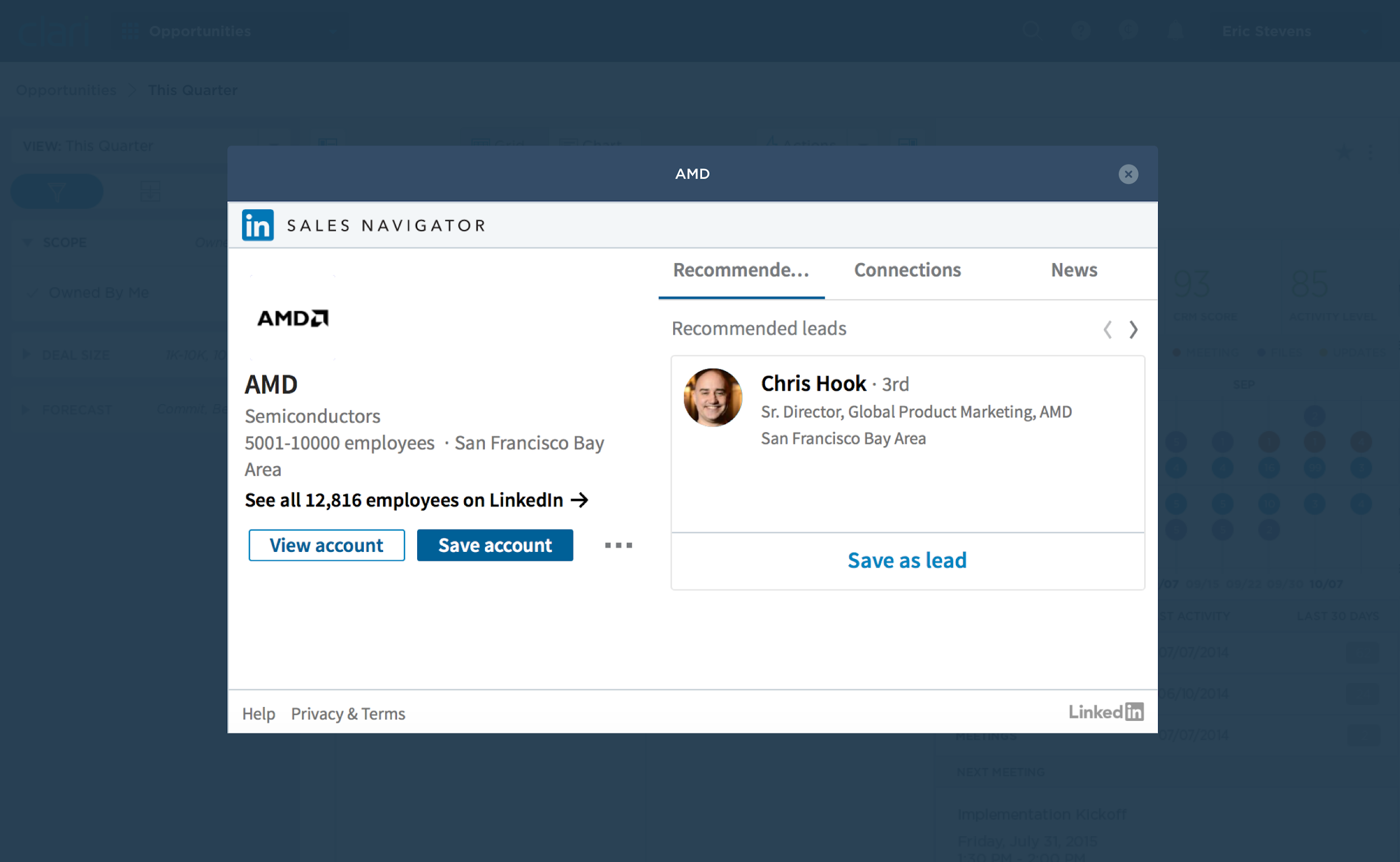
Sales Navigator

How would this integration help reps maximize their deal productivity?

With this integration, reps can do better prospecting into target accounts – they can immediately see where and how they are connected to expedite their way into the account or progress opportunities in flight. In addition, front-line managers get better visibility to inspect the pipeline and see how they can help move deals forward through their networks and connections. This ultimately improves the way sales teams collaborate on account-based strategies and joint plays:

  • Reps and inside sales teams know who in the organization has access to the power base
  • Reps can quickly identify key people to connect within their target accounts
  • Sales management and reps are unified on their target account strategies

What is the “State of AI-driven Sales” technology in 2018?  How would Data Science and AI/ML technologies influence better adoption and ROI from sales intelligence tools?

We are in the early days of how AI and machine learning are impacting the way we work and how sales teams operate. This is a massive and highly transformative change in the way teams process information, collaborate and make decisions. We’re seeing a shift from historical analysis, reports and queries to AI-based insights that push practical information and predictions into the hands of reps, managers and sales execs at key moments across the sales process.

For instance, Clari can help identify risk and upside on opportunities and project how the quarter will end. This not only transforms the way sales teams work together to drive their strategies but also the ability of business leaders to drive the actions needed to hit the number. With AI, we’re also able to project the forecast in future quarters and suggest the required pipeline to achieve those projections. The C-suite including COOs, CFOs, CMOs and CROs are now collaborating around the same set of data points and metrics in a far more integrated and productive way than ever before.

To what extent is this state influenced by the growing need to diversify CRMs and sales intelligence tools?

CRM is going through a renaissance. The original premise of CRM was around a single unified view of the customer – and at that time it was all about filling out forms and manually inputting data. Now data volumes are increasingly growing, coming from multiple sources outside of CRM. This is fueling a wave of new innovation in the way data is collected, analyzed and presented. It’s driving the unbundling of core sales processes and the emergence of new sales intelligence tools that leverage CRM data in addition to email, calendar and other data signals to drive better decision making in sales.

What are the major challenges that lie ahead for reps working without sales technologies? How do you think reps could better leverage Clari for their overall business goals?

Whether you’re a rep, manager, VP, or C-level exec, your goal is to grow efficient, predictable revenue for your business. Period. Specifically, reps need to understand where to strategically focus their increasingly limited sell time without getting bogged down by CRM updates.

Because Clari automatically captures rep activity and customer engagement data, it all but eliminates much of the administrative burden that typically bogs down the sales process and frustrates everyone.

With Clari, reps have fewer fields to fill and easier, more intuitive ways to document deal status on the fly. And, with fewer administrative tasks on their plate, reps have more time to do what they were hired to do in the first place — sell.  The majority (91 percent) of reps we surveyed, said using Clari gives them time back to sell, with nearly one-third boasting two or more reclaimed hours of precious sell time per week!

But the value does not stop with the reps. Clari provides the kind of visibility and insights a manager and a sales exec needs to accurately gauge pipeline health, identify risk and effectively prioritize where to invest to get the team back on track to hit the number.

How does Clari fit into a modern CMO’s tech stack?

The lines of the CMO’s tech stack and CRO’s tech stack are blurring. CMOs are increasingly interested in tracking their impact to the forecast and revenue and CROs are getting more knowledgeable about the way marketing teams are contributing to the overall revenue funnel. We see this as an opportunity to improve the way sales and marketing teams get aligned to achieve revenue goals and increase forecast accuracy. As we all know, a predictable sales forecast affects the levers for increasing or decreasing marketing program spend. Vice versa, if sales doesn’t know where and how marketing is influencing accounts and opportunities, it may affect driving a predictable forecast.

We are starting to address this today by giving marketing visibility into sales activity and improving contact data so they can understand campaign influence and identify where they need to focus to design and execute more impactful programs that support sales efforts. At the same time, Clari gives sales visibility into customer marketing engagement activity so they can better evaluate the true state of the deal and forecast more accurately.

Thanks for chatting with us, Somrat.
Stay tuned for more insights on marketing technologies. To participate in our Tech Bytes program, email us at news@martechseries-67ee47.ingress-bonde.easywp.com


Now, Pinterest Marketing Gets Easier with Hootsuite’s Latest Integration

1
Now, Pinterest Marketing Gets Easier with Hootsuite's Latest Integration

Integration Enables Pinterest Scheduling and Publishing from Hootsuite, Empowering Customers to Build and Manage Brands and Strengthen Relationships with Customers Through the Power of Imagery 

Leading social media management platform and a MarTech 150 RADARcompany, Hootsuite, has announced a global partnership with Pinterest. This partnership is resulting in the native integration of Pinterest into the Hootsuite platform. Following the trends uncovered in Hootsuite’s 2018 Social Trends Report showcasing the growing importance of the use of images to engage customers and followers, all Hootsuite customers are now able to schedule and publish content directly to Pinterest.

At the time of this announcement, Penny Wilson, CMO of Hootsuite, said, “We’re excited to bring to life the full native integration of Pinterest into the Hootsuite platform to empower organizations to harness the power of human connection with their customers at scale.”

Penny added, “The visual appeal of Pinterest has proven to be a strong e-commerce sales driver for consumer and lifestyle brands. Our strategic partnership with Pinterest advances Hootsuite’s industry leaders to help customers, large and small, to strategically grow their brands, businesses, and customer relationships with social.”

With more than 200 million monthly active users and growing, Pinterest is a driver of sales, with traffic from Pinterest 3.8 times more likely to convert into a sale. Pinterest’s success as a visual discovery platform delivers increased value for brands that offer e-commerce and rich product pages are evident in the company’s 40 percent year over year growth.

Now, all Hootsuite customers can collaboratively and securely schedule and publish visual content directly to owned Pinterest boards. Additionally, customers that have Hootsuite Impact will also be able to measure their Pinterest account growth and analyze the performance of individual Pins as part of their integrated marketing strategy and associated campaigns.

Hootsuite customers can post content and engage with customers on Instagram, Facebook, Twitter, LinkedIn, YouTube, Google+, WordPress, and Pinterest. As part of this strategic partnership, Hootsuite will be listed as one of Pinterest’s Content Marketing Partners.

Currently, Hootsuite is the most widely used social media management platform, trusted by more than 16 million customers and more than 80 percent of the Fortune 1000.

Interview with Itamar Benedy, CEO, Glispa

0
Itamar Benedy
Interview with Itamar Benedy, CEO at Glispa Global Group

[vc_wp_text]“For mobile ad tech companies there is no way around opening themselves up to a B2C approach because the end user is eventually the decision maker about trending technologies.”

[/vc_wp_text]

[easy-profiles profile_twitter=”https://twitter.com/BenedyItamar” profile_linkedin=”https://www.linkedin.com/in/itamarbenedy/”]

Tell us about your role and how you got here? What galvanized you to start Glispa?

Today I’m the CEO of Glispa. My story starts four and a half years ago when I joined as VP Strategy to lead the company’s transition from an affiliate to an ad tech company. Part of my role was to lead our acquisitions, in the course we acquired Avocarrot, RelevantTech, and justAd. I also focused on driving our global expansion and therefore opened an office in Tel Aviv. Starting out alone in Tel Aviv, I built a team of around 40 people in 2017. From a client perspective, global expansion involved increasing our international operations. Today, we are running campaigns in almost every country in the world. From that, I was appointed CEO to lead the full transition from an affiliate to ad tech at a product level, by shifting our strategy from acquiring to building new solutions. Furthermore, we improved Glispa’s brand and positioning with a huge rebranding effort, and also built the right teams to implement our strategy. We hired a lot of key people and aligned our go-to-market strategy with the biggest opportunities in the market and to match the demands of our clients and partners. We ultimately connected the product, brand and people to implement our strategy.

How is the mobile ad tech industry different from when you first started?

As one of the early adopters of mobile, I saw the industry changing dramatically in the past decade. From the early days, when developers didn’t really have many opportunities to monetize, acquire users, and utilize data (for the better or worse), we moved to a period in which the benchmarks of the product are becoming much higher, companies are investing in creative and building excellent applications. In the last decade, we saw great companies like Waze, Moovit, and Playtika emerging. An array of promising technologies has sophisticated the mobile ecosystem that became a very fragmented industry. To a large extent, Glispa’s strategy is based on aiming to control more components from that value chain to provide more value for the clients.

Tell us about your ‘Ideal Customer’ profile?

For me, the ideal customer is a big brand which I’m helping to enter the mobile world. Numerous amazing brands spend vast amounts of money for achieving a very strong presence in the digital world. From the mobile perspective, however, they are far away from maximizing their opportunities. Helping brands and app developers build a mobile strategy for reaching the right audiences is very exciting. What’s so unique about mobile as a platform is that there is a very high level of engagement because smartphones are popular, with people checking their phones around 150 times a day, spending more than three hours a day inside applications. In enabling customers to leverage the mobile space, we’re part of something bigger, a mobile revolution.

What is the current state of Mobile Marketing engagement in 2018? How much of that state is influenced by the maturity of data science and customer experience platforms?

Mobile marketing engagement undoubtedly grows in 2018 with people relying on and appreciating mobile even more. We can observe this trend in various ways: from the number of hours a day people spend on their smartphone to the number of applications they have. In parallel to the improving products, people gain more value from them and use them more often. Whereas data science is still in its early beginnings for maximizing mobile engagement. With mobile measurement completely differing from desktop, we’re just now starting to work with sufficient technologies that are highly useful from a data perspective of mobile. Particularly, location data gains importance, which we haven’t really utilized enough yet. I expect this to become a significant factor for mobile marketing engagement in the next five years. Having mentioned utilizing location data, it is crucial to elaborate on GDPR, which is going affect how we utilize data in a very positive way. It enables us to keep people’s personal data private while still using it in legitimate ways to create value. That is a big thing to look at already in 2018 and 2019.

How do you see the mobile marketing strategies evolving around omnichannel analytics? What factors should marketers consider to launch a mobile website?

To understand the context of omnichannel, we first need to look back at the progression of mobile. 2017 was the year of promising, new technologies that started to bring value in the mobile space, although still in a very fragmented way. I believe 2018 and 2019 will be the two years mobile is starting to consolidate as a standalone. Only after, we can start connecting other platforms to it like Smart TV, augmented reality or physical stores. When launching a new website, companies find themselves surrounded by of a lot of noise, with millions of websites and apps, and innumerable opportunities. We’ve come to the understanding that is important to first and foremost deliver a great user experience (UX). While this has improved in the course of the years, companies still have a long way to go. In managing a great website or app UX, they will eventually be the kings in deciding which products and technologies customers will be using. Websites are a great example for making the case for UX, since they always define B2C relationship, being directly tailored for people. If a company overemphasizes the monetization aspect in their website, it will harm the UX, and fail to bring real value for the customer and eventually the company.

Tell us about the new standards of B2B mobile ad tech. How does Glispa help customers optimize user insights for better mobile marketing campaigns?

For mobile ad tech companies – naturally B2B oriented –  there is no way around opening themselves up for a B2C approach because the end user is eventually the decision maker about trending technologies. Even if your client is the advertiser, the big brand, UX is paramount, as brands prioritize the needs of their client, the end user. Therefore, part of our strategy at Glispa is to identify how we as a B2B company can bring value to the end user. That’s why, we recently acquired justAd, a company touching the end user directly by creating engaging mobile ad formats. Of course, there is more to that. Really good targeting is essential for aligning people with the content they want to consume. Today, no one is accepting ad experiences that aren’t good. People are blind to ads that are not entertaining and not to the point and don’t convey which aspect of the product the ad is trying to advertise.

What marketing and sales automation tools do you use?

Automation is definitely a big topic today in the industry, and we’re dealing with it various ways. People tend to forget that programmatic is first and foremost an automation tool. In the past few years, programmatic has become the most popular ad format. Not only did it create a buzz, it actually increased ad revenue. To be part of the programmatic revolution, our strategy at Glispa included acquiring Avocarrot, a programmatic ad exchange, which comes with a more automated process and less manual work. Furthermore, automatic is related to personalization. How to run a successful email marketing campaign these days without highly personalizing it with the help of automatic services like Hubspot? Applying automation is part of being a high tech company, it’s part of increasing efficiency. My definition of a high tech company is a company that minimizes the amount of jobs people in the company do that are embarrassing for the cognitive part of the brain. The world is moving towards a future of machines replacing people in manual tasks, where they outperform people, while we benefit from shifting our focus on solving cognitively challenging tasks. That is actually automation.

Which startups in martech and adtech industries are you keenly following?

As an ad tech enthusiast, I’m excited about innovation and new technologies in this area. I’m paying a lot of attention to augmented reality (AR) and virtual reality (VR). I believe that’s going to be a very important platform down the road. Mobile is doing a good job in building the best applications with the current technologies out there. The next big thing in mobile is AR. I predict that in two or three years, 80% of the smartphones will have augmented reality capabilities. There will be a wealth of new applications improving the mobile experience via augmented reality technologies. Magic Leap is a noticeable company pioneering in mixed reality (MR) rather than augmented reality. Mixed reality enables a real interaction with physical elements and virtual pixels in the space. Magic Leap might leave the biggest impact in this field in the next few years.

How do you prepare for an AI-centric ecosystem as a business leader?

With AI out there as a buzzword for many years, we’re just now starting to understand what it means and how it can impact our business. Sure, AI is also still in its early days. However, if your company wants to utilize data in a better way, to become more of a high tech company, and to push the limits of what technology can do for maximizing value for clients, AI should definitely be part of the mobile marketing mix.

How do you inspire your people to work with technology at Glispa?

Glispa’s vision is about challenging and improving the mobile ecosystem via innovation, and innovation starts from connecting technology with opportunities. A lot of what we do at Glispa originates from this approach. We recognize opportunities in the market, and actively build solutions around them – be it in-house or via an acquisition. We see a lot of innovation opportunities from connecting our four products. Coupling Glispa Discover, a monetization solution for operators and carriers, with Glispa Connect, a programmatic exchange, we could bring programmatic to the operator’s and carrier’s business for the first time in the advertising world. At Glispa, we’re trying to hire smart people who challenge everything they do. I see them getting really excited and motivated about changing the status quo, and bring innovation to the market. Technology is the base for all of that.

What apps/software/tools can’t you live without?

All my life centers around technology and multiple apps navigate me through different moments. For someone who is flying a lot, Netflix really improved my life. In making it easier for me to manage a global company with people from different countries with different offices, Slack really brought a lot of value.

What’s your smartest work related shortcut or productivity hack?

I read that Jeff Bezos, CEO of Amazon, starts each meeting with 30 seconds of complete silence, with no one in the room speaking, which is supposed to lead to better productivity. I actually tried to implement that into our company, and it didn’t really improve our productivity. What really works for us: we’re trying to stay a startup, even though Glispa is becoming a much bigger company in terms of the number of offices, employees, and products we have. Part of being a startup is trying to avoiding bureaucracy and practices of big corporations, just by having our meetings very direct and to the point, for instance. I believe we’re more productive that way.

What are you currently reading? (What do you read, and how do you consume information?)

To start with the second part of the question, today we have access to information in a great number of ways: be it by reading, watching movies, attending lectures, having conversations in chats, checking social feeds, researching, Google. While we have overcome the limitations of accessing content, the challenge now becomes finding the needle in the haystack in terms of valuable information, since the filters are missing. Reading about ad tech exemplifies where this is leading to. The information you get from all the channels is very different from what’s actually going on. Most of what books, online content and talks at conferences tell us is inaccurate. Even more information becomes irrelevant when data is not updated as quickly as technology is changing our life, which creates a gap. On a higher level, I just recently read a book Daniel Kahneman, “Thinking, fast and slow”, revolving around the way our brain is structured in terms of thinking, decision making, and instincts. Exploring the big gap between how we think our brain works vs. how it really works, how people make irrational decisions on a daily basis without really knowing it’s irrational, that’s a field I’m really passionate about beyond technology.

What’s the best advice you’ve ever received?

Don’t be right, be smart.

Tag the one person in the industry whose answers to these questions you would love to read:

Jeff Bezos, the CEO of Amazon. Amazon didn’t start out as an ad tech company, but if I needed to bet on who is going to be the biggest mover in ad tech, I would definitely mention Amazon. The company is in a very interesting position from an ecommerce perspective, and ad tech, as I see it, leads the way for ecommerce, and is ultimately tied to it. Amazon has a vast amount of data, and their activities around Alexa, search, audio, and AI, are fascinating, and I would be very keen to hear his wisdom around the conversation we had today.

Thank you Itamar! That was fun and hope to see you back on MarTech Series soon.

[vc_tta_tabs][vc_tta_section title=”About Itamar” tab_id=”1501785390157-b58e162d-0ae25a4b-c27aca64-108e51b0-80edaf37-bd3d357a-6c46d712-3b68b6d8-2720″]

Itamar Benedy is the CEO of Glispa, a mobile ad tech player with 10+ years in the mobile marketing industry. Formerly serving as the CRO and VP of Strategy, Itamar is currently leading the transformation of Glispa from an affiliate company to a sophisticated ad tech company. In just two years, Glispa has had five strategic acquisitions and has integrated these innovative products onto a single platform. Itamar has also lead the massive rebranding efforts, bringing all these products under the Glispa brand.

Prior to Glispa, Itamar served as the VP Marketing at Sport.com and Yoga.com, leading the user acquisition, monetization, and analytics teams. With more than a decade of experience in mobile & app marketing, Itamar guided Sport.com to become a market-leading fitness company with over 40 million downloads across 30 native apps. Itamar was selected for the prestigious Forbes 30 under 30 for Israel, and currently resides in Berlin.

[/vc_tta_section][vc_tta_section title=”About Glispa” tab_id=”1501785390320-2d44fa50-740c5a4b-c27aca64-108e51b0-80edaf37-bd3d357a-6c46d712-3b68b6d8-2720″]

Glispa
Glispa is a mobile ad tech company. We are dedicated to empowering our partners with sophisticated solutions that make it simple for agencies and brands to connect with target audiences and for publishers to monetize their apps. Our product suite is tailored to design a more valuable experience for the user by creating real connections. This approach, combined with our deep understanding of the industry, provides our partners with the best set of tools to make mobile ad tech simple.

With a decade in the advertising industry, Glispa employs a diverse team of 50 nationalities speaking over 45 languages. Operating across 8 international offices, we combine an experienced global workforce with local market expertise. To learn more, visit glispa.com and follow us on social @glispa.

[/vc_tta_section][/vc_tta_tabs]
[mnky_heading title=”MarTech Interview Series” link=”url:https%3A%2F%2Fmartechseries-67ee47.ingress-bonde.easywp.com%2Fcategory%2Fmts-insights%2Finterviews%2F|||”]

The MTS Martech Interview Series is a fun Q&A style chat which we really enjoy doing with martech leaders. With inspiration from Lifehacker’s How I work interviews, the MarTech Series Interviews follows a two part format On Marketing Technology, and This Is How I Work. The format was chosen because when we decided to start an interview series with the biggest and brightest minds in martech – we wanted to get insight into two areas … one – their ideas on marketing tech and two – insights into the philosophy and methods that make these leaders tick.

PlaceIQ Selected for Best Attribution and Analytics Technology in the Ad-to-Action Awards

0
PlaceIQ

Ad Action Recognizes PlaceIQ Offerings to Produce Valuable and Advanced Customer Insight for Brands

PlaceIQ, is the company which is building a new consumer-behavioral model with location insights and data. PlaceIQ announced that its LandMark Data offerings and Place Visit Rate (PVR) have been named the best attribution and analytical technologies, in addition to also being the best location intelligence platform in the Ad-to-Action awards.

Ad-to-Action Awards

Ad-to-Action awards is produced by industry trade group Local Search Association (LSA). These awards highlight innovations in technology that help brands drive customer engagement, sales and create memorable experiences for customers. The category winners went through severe scrutiny with a panel of diverse judges which comprised of technology experts, advertising industry press and several media agency leaders.

Read Also: Keith Kaplan Joins Digital Remedy Board of Directors

Achievements by PlaceIQ

PlaceIQ’s PVR was named Best Attribution and Analytics solution in the award category which aimed to create, target, measure and traffic advertising in innovative ways. PVR was introduced in 2012, and it has a first-of-its-kind measurement metric that has become a standard for understanding the effect advertising has in the real-world situation. Users across retail, dining, CPG and automotive have all chosen PVR to precisely understand the impact advertising campaigns have on offline channels.

Landmark Data offering by PlaceIQ was named Best Intelligence Platform in an award category. The category was recognized as technologies helping brands, media companies and agencies analyze and create actionable insights from location data. Landmark gives media agencies and brands access to PlaceIQ’s premier audience, visitation and behavior data- so as to take a number of informed business and marketing decisions. The technology is highly powerful with location-derived insights about the real-time customer journey and it includes; retail site selection optimization, financial investments, cross-channel strategy, financial investments and media activation.

Read Also: Optimove Acquires DynamicMail Business to Expand Email Capabilities

“PlaceIQ has become synonymous with industry leading technology innovations in the location data realm,” said Duncan McCall, CEO and co-founder at PlaceIQ. “Our legacy is built on more than seven years of creating and refining offerings that deliver both insights and true value to brands. We’re honored to be selected by both LSA and a jury of well-known executives for the quality of our work. The Ad-to-Action Awards add to a long list of validation for our product portfolio from others in the technology ecosystem and exist as a testament to the dedication from many different teams within PlaceIQ that bring these solutions to market.”

Brands to Benefit from 2018 Mother’s Day Holiday; Rakuten Marketing Announces Shopping Trends and Insights

0
Brands to Benefit from 2018 Mother's Day Holiday; Rakuten Marketing Announces Shopping Trends and Insights

For the 2018 Mother’s Day Holiday, Rakuten Marketing Expects Consumer Spending to Increase by 20 Percent

Rakuten Marketing, a leading technology company that enables marketers to profit through digital marketing, today released industry data and insights for Mother’s Day 2018. Comparing year-over-year (YOY) holiday spend for the two weeks leading to Mother’s Day 2016 and 2017, Rakuten Marketing expects 2018 consumer spend to increase, making this Mother’s Day a sweet retail period for online brands.

Along with this news, the company also provides YOY comparisons on consumer shopping behavior, including cross-device shopping tendencies; marketing and advertising budget allocation over the Mother’s Day holiday period; top-performing product categories; and publisher shopping peaks. This data and insights equip brands, advertisers and publishers with valuable information to improve and deliver better online ad and shopping experiences.

For the 2018 Mother’s Day holiday, Rakuten Marketing expects consumer spending to increase by 20 percent, with revenue increasing across all key product categories. The company believes top-selling gift categories will include personal experiences (dinners, outings, movie, etc.), flowers, candy, jewelry and gift cards. Mother’s Day spend is expected to peak in late April with most consumers turning to content publishers early in their shopping journey to purchase. Gift orders (e.g., spa gift cards and gourmet gift baskets) from content publishers are expected to peak the Saturday before Mother’s Day and sales from loyalty coupon and rewards publishers peaking the week prior to Mother’s Day. The highest selling day for flowers is expected to occur May 10th, 2018, the Thursday before the Mother’s Day holiday. Sunday and Monday before Mother’s Day 2017 served as peak selling days for jewelry and Rakuten Marketing expects this trend to continue in 2018.

Also Read: Rakuten Marketing Announces Whitepaper on Global Data Protection Regulation; Offers Specific Recommendations for Brand Marketers

Key Insights from Mother’s Day 2017:

  • Loyalty rewards publishers saw orders peak the week of May 7, 2017, for department stores, flowers, food and drink, and gift and luxury. These verticals showed solid year-over-year (YOY) sales not only during the Mother’s Day holiday but during springtime shopping in general.
  • Shopping publishers focused on the sales period following Mother’s Day 2017, with apparel and accessories, department store and luxury retail orders peaking at the end of May.
  • Sales conversion rates peaked on May 8, 2017, for all publisher types.

Also Read: Rakuten Marketing Survey: Global Organizations Anticipate 26 Percent Marketing Budget Loss in 2018

Device Behavior and Advertising Spend

  • In 2017, mobile sales for Rakuten Marketing Affiliate advertisers were approximately 20-25 percent of total orders for the Mother’s Day holiday shopping period. Flower orders accounted for 20 percent of total orders and mobile device orders accounted for 30 percent of total flower orders.
  • With a heavy push for advertising on mobile this year, Rakuten Marketing expects mobile-driven conversions and revenue to increase by about 40 and 70 percent respectively.
  • Rakuten Marketing expects overall online revenue to increase by 20 percent.
  • In 2017, luxury items had the highest percentage of orders placed on tablet at 7 – 8 percent.
  • Rakuten Marketing clients running same-store display campaigns during Mother’s Day 2016 and 2017 saw YOY mobile average order value (AOV), conversions and revenue increase by 41 percent, 21 percent and 70 percent respectively. These clients also increased social and video budgets through this period by 74 percent and 43 percent respectively.
  • Personalized gifts are popular during Mother’s Day. Based on 2017 insights, Rakuten Marketing expects the top-selling product to be flowers, but more specifically flower arrangements designed for Moms and Grandmothers. More specifically, consumers tend to request spring flower arrangements, followed by tulip and rose arrangements.

Also Read: Rakuten Marketing’s Dr Neal Richter Receives IAB Tech Lab’s Esteemed Service Excellence Award

Rakuten Marketing Survey: Global Organizations Anticipate 26 Percent Marketing Budget Loss in 2018
Stuart Simms

“Individualism is at the heart of consumers, which means it should be at the heart of marketing. Advertisers and publishers should strive in tailoring their consumer online experiences and Rakuten Marketing can help deliver these kinds of experiences,” commented Rakuten Marketing President, Stuart Simms. “Through our data and insights, we encourage advertisers, brands and publishers to understand their consumers’ trends and behaviors so they can create the best kinds of advertising and content and, therefore, receive the best results.”

Rakuten Marketing prioritizes understanding and catering to consumers’ wants and needs in the digital advertising world to implement positive online experiences and increase performance for advertisers, publishers and brands. Rakuten Marketing data and insights are based on aggregated and anonymous data analyzed from leading U.S. retailers running Rakuten Marketing Display and Rakuten Marketing Affiliate campaigns.

Recommended Read: Interview with Tony Zito, CEO, Rakuten Marketing

Keith Kaplan Joins Digital Remedy Board of Directors

1
Keith Kaplan Joins Digital Remedy Board of Directors

Digital Remedy, a white-labeled ad operations and sales solution for publishers, advertisers and influencers, announced that Keith “Kappy” Kaplan has been appointed to the company’s Board of Directors, effective May 9, 2018. His appointment follows the acquisition of CrowdHere and the elevation of its former CEO Nick Pahade to COO and President of Digital Remedy. Kaplan most recently served as the Global President of Monetization for King Entertainment, a division of Activision Blizzard.

Also Read: Oracle’s Moat Is Now a LinkedIn Partner for Video Viewability and Analytics

“A longtime digital strategist who understands the pressures of the market from many different seats, Kappy is a natural fit for our board. His guidance will help us to realize our vision of delivering solutions that meet and exceed advertiser and publisher needs in a rapidly evolving digital ecosystem.,” said Mike Seiman, Chairman and CEO of Digital Remedy.

Keith Kaplan
Keith Kaplan

At King, a leading interactive entertainment company for the mobile world, Kaplan oversaw the global expansion of the company’s revenue by focusing on the growth and development of strategic accounts, agencies, and partnerships. His expanding team of regional sales, marketing, and account management focused on fostering deep relationships, developing partnership programs, and addressing top marketers’ challenges, including innovative solutions that ultimately connected brands with consumers in ways that enhanced their experience.

“I’m excited to join the Board of Digital Remedy to partner in the development of the organization’s long-term roadmap. I hope my industry connections bring invaluable insight to bear in this process, as I work to be an advocate and proponent for the company and all Digital Remedy has accomplished to date,” said Kaplan.

Also Read: Publishers Clearing House Delivers 92% Audience Data Match Rate

Kaplan brings 20 years of experience and leadership in effectively communicating brand and product offerings to a global audience. He held positions at Yahoo as Head of Revenue for Genome and Head of Global Agency & Client Development. Before that, he was the President and Chief Revenue Officer of Interclick and President of Adconion Media group in North America, which was acquired by Amobee. Earlier in his career, Kaplan served in senior roles at Cablevision Sports, Paramount Pictures, CBS Outdoor, L90 Interactive, MetroLights Outdoor Media and MaxWorldwide Inc.

“Keith has been a friend and colleague for the entirety of our careers, but I have never had the opportunity to join him on the board of a company we mutually admire. Our deep ties within the industry will be reinforced by our new positions, and I look forward to the connections we will make for the company,” said Nick Pahade, COO, President and Board Member of Digital Remedy.

Also Read: Optimove Acquires DynamicMail Business to Expand Email Capabilities

Publishers Clearing House Delivers 92% Audience Data Match Rate

0
Publishers Clearing House Delivers 92% Audience Data Match Rate

Publishers Clearing House Achieves Industry Leading Consumer Engagement At Scale Across Owned Properties, Apps And Social Media; Delivers Higher Match Rate Compared to Facebook, LinkedIn, and Adobe Ad Cloud

Publishers Clearing House (PCH) has announced a series of substantial growth and engagement milestones that showcase PCH’s engagement with consumers that equals and often surpasses well-known publishers and marketers.

Read More: ABM Company Azalead is Now Jabmo

Currently, PCH reaches more than 70% of all US households and is one of the only premium digital publishers to combine first-party user data with purchase data to help marketers and brands connect directly with their precise audiences.

To put PCH’s current scale in perspective, people visit PCH’s digital properties more than 4 million times a day, viewing nearly  2 billion pages each month. They spend more than 8 minutes a day on PCH’s digital properties, higher than The Washington Post, Meredith (both 2.7 mins) and Google Sites (5.9 mins), according to comScore. PCH sites have more monthly unique visitors than Vice, Houzz, Barnes & Noble, and GSN, all per comScore.

Recommended ReadNow, Keep Your Best Customers Happy with the Oracle Loyalty Cloud

PCH continues to grow its social audience on Facebook, with 4 million fans and over 6.6 million views of Inside PCH, a Facebook Live “TV” show that launched in July of 2017 and airs weekly.

Recommended ReadMadison Logic Partners with Marketo to Help B2B Marketers Quickly Convert Target Accounts

“As publishers of all stripes address the issues of audience fragmentation and seek to increase the level of engagement they have with consumers, PCH has successfully done so through the unique opportunities afforded by having a wide variety of properties and apps keeping millions of people entertained and playing for multiple chances to win,” said Mark Cullinane, SVP & GM Digital, PCH. “Critical to marketers trying to reach consumers in a multi-channel environment–and in keeping with its storied lineage in direct marketing–PCH’s 92% audience data match rate is higher than Facebook’s 20-30%, LinkedIn’s 75%, and Adobe Ad Cloud’s 90%.”

PCH is the leading destination for millions of people who are passionate about chances to win entertainment. By combining snackable content with fresh and innovative promotions, PCH offers its users an engaging and highly differentiated entertainment experience which is omnichannel across the desktop, mobile web, and mobile applications.

Read Also: ProsperWorks Study Reveals the True State of CRMs in the Relationship Era

Publishers Clearing House is a leading digital entertainment, commerce, and marketing company that has put consumer engagement and loyalty at the center of its client solutions for more than 60 years. The company is famous for its Prize Patrol which surprises winners on their doorsteps with oversized checks in amounts ranging from $1,000.00 to $10,000,000.00 while TV cameras are rolling.

Oracle’s Moat Is Now a LinkedIn Partner for Video Viewability and Analytics

1
Oracle's Moat Is Now a LinkedIn Partner for Video Viewability and Analytics

Now, Moat Shall Offer Video Viewability and Attention Measurement Across the Major US Digital Platforms

Oracle’s Moat, a SaaS analytics measurement provider for marketers and publishers that is part of the Oracle Data Cloud, today announced it has been selected to measure viewability and attention signals on the LinkedIn platform. The collaboration will focus on LinkedIn’s video for Sponsored Content. With the integration, Moat will be the first provider to offer video viewability and attention measurement across the major US digital platforms.

Read Also: SpotX Expands Horizon to Ensure Brand Safety by Filtering Out Fake News Content and Brand-Objectionable Categories


Moat-_-LinkedIn

Jonah Goodhart, SVP of Oracle Data Cloud and Co-Founder of Moat, said, “We are proud to collaborate with LinkedIn as we share a positive vision of the future of digital marketing. Moat measurement on LinkedIn marks a significant moment for marketers, who will have independent viewability and attention measurement in one place, on Moat, across all major US digital platform.”

 Recommended ReadB2B Buying Disconnect: Are You Targeting the Right Set of Customers?

At the time of this announcement, Tomer Cohen, VP of Product, LinkedIn Marketing Solutions, said, “In today’s video advertising landscape, marketers require independent viewability insights to truly understand how their campaigns perform.”

Tomer added, “Our work with Moat will enable marketers on LinkedIn to leverage Moat’s industry-leading digital measurement platform, so they can make more informed advertising decisions.”

The collaboration will equip marketers with a deeper understanding of their campaign performance and results garnered from LinkedIn video inventory – and intends to make these services available to customers later this year. This reinforces Moat’s vision of providing widespread trusted and independent measurement in order to empower brands to make smarter media and creative decisions.

Recommended ReadOracle Marketing Cloud Adds Infinity and Audience CX to Enable Pinpoint Targeting

MuleSoft Announces Titan, the Next Major Release of Anypoint Platform to Build Secure, Multi-Cloud Application Networks

0
MuleSoft Announces Titan, the Next Major Release of Anypoint Platform to Build Secure, Multi-Cloud Application Networks

Latest Release Strengthens Application Networks with New Runtime, Advanced Security and Monitoring Capabilities, and Flexible Multi-Cloud Deployment Model

MuleSoft, a provider of the leading platform for building application networks, announced Titan, the latest release of Anypoint Platform that features new capabilities to easily deploy, secure and monitor composite applications across cloud environments. Anypoint Platform unlocks the power of API-led connectivity, allowing organizations to connect apps, data and devices more rapidly and efficiently. With the Titan release, IT achieves greater agility and flexibility with a new multi-cloud container service for Mule runtimes, a modern security model for distributed architectures, and an advanced monitoring solution for end-to-end visibility. Powered by the next generation Mule 4 runtime engine, Anypoint Platform further enables a broader set of users to build their own applications at speed and drive new levels of innovation. The latest release accelerates MuleSoft’s vision to help businesses build powerful, secure application networks.

“At JetBlue, we’re focused on humanizing the travel experience and rethinking our approach to customer service, including deploying mobile payments and being the first airline to roll out onboard purchases using Apple Pay,” said Vitaly Faida, manager of IT product release engineering, JetBlue. “The tokenization capabilities within MuleSoft’s Anypoint Platform allow us to secure credit card transactions flowing through JetBlue eCommerce Platform, so that we can drive innovation and agility without compromising security.”

“With a combined network of more than 750 Pilot Flying J Travel Centers across North America, MuleSoft is critical to enabling us to deliver innovation at scale. MuleSoft’s Anypoint Platform allows us to securely build and share APIs with external partners, as well as experiment with new technology, to provide a frictionless experience for our guests, including professional drivers and traveling motorists,” said Mike Rodgers, senior vice president, chief strategy and information officer, Pilot Flying J, winner of the 2018 Tech Innovator Award for Most Transformative Customer Experience. “Anypoint Platform increases our developer productivity by allowing us to quickly and securely integrate systems that deliver new capabilities, as well as improve our speed to market.”

Also Read: API Management Platform MuleSoft Inc. Files for IPO

Today’s Complex IT Landscape Increases Security Risks and Restricts Innovation

According to Saurabh Sharma, principal analyst at Ovum, “The modern IT landscape is growing increasingly complex, and the pace of change for today’s IT team is unrelenting. The adoption of mobile, cloud services, microservices and the internet of things (IoT) have rapidly expanded the boundaries of the enterprise, while IT’s ability to gain visibility to detect security attacks, mitigate business risk, and operate at the same scale is constrained. A single business transaction now crosses over dozens of different systems, and legacy security and monitoring systems can’t keep up. By leveraging a unified hybrid integration platform offering self-service and API-led connectivity capabilities, such as MuleSoft’s Anypoint Platform, IT teams can achieve a more holistic view of the organization and across different IT environments, while enabling developers to securely self-serve and innovate for the business.”

Titan Drives New Levels of Security, Visibility and Flexibility for Building Multi-Cloud Application Networks

This new release accelerates digital transformation by providing increased security, visibility and flexibility, driving development speed and efficiency across the entire lifecycle of composite applications. Anypoint Platform now further enables IT to be a catalyst for transformation, allowing broader teams to focus on innovation.

Also Read: Salesforce-MuleSoft Deal: The Dynamic Shift in Marketing Cloud Equation

Titan highlights include:

A next-generation multi-cloud runtime drastically simplifies development and operations:

  • Mule 4 and enhanced Studio: New runtime version automates and simplifies common complex integration tasks and expands the scope of reusable assets to increase development speed.
  • Anypoint Runtime Fabric: Container service for Mule applications allows rapid deployment on most common cloud providers and on-premises, including Microsoft Azure, Amazon Web Services, virtual machines and physical servers.

A modern security model for distributed architectures:

  • Anypoint Security: Policy-driven, enterprise-grade perimeter gateways, and automatic tokenization and encryption simplify how advanced security is delivered across the application network.
  • Managing compliance: Enables customers to meet government-mandated compliance standards, including General Data Protection Regulation (GDPR), FedRAMP In Process, EU Data Residency and EU-US Privacy Shield.

New monitoring service enables actionable visibility across application networks:

  • Anypoint Monitoring: Real-time insights, dependency mapping and instant access to historical log data across APIs and integrations give operations teams the ability to speed up issue identification and root cause analysis.

More connectors expand MuleSoft’s ecosystem to scale application networks:

  • New MuleSoft certified connectors include SAP BusinessObjects BI, Docker, Microsoft Office 365, Google DFP, Edifecs XEngine Server, Zoho Books and Amazon DynamoDB.

“IT teams are struggling to manage the acceleration of new technology adoption, as well as the new capabilities and services being created inside of their organizations every day. With the Titan release, IT can fuel internal organization momentum to innovate and drive business outcomes faster, while maintaining security and control,” said Mark Dao, chief product officer, MuleSoft. “The release bolsters our API-led connectivity approach and commitment to our customers by delivering powerful and secure application networks that scale globally and can be deployed anywhere.”

Recommended Read: Move Over Conventional SEO Conferences, It’s Time We UnGagged!

Foap Expands Service Offering: Adds Video Creation to its Popular Missions Technology Platform

0
Foap Expands Service Offering: Adds Video Creation to its Popular Missions Technology Platform

Brands Around the World Now Have Access to One-Of-Kind, Authentic Video Content from the Foap Community of Nearly 3mm Global Content Creators

Foap, a marketplace that connects brands and marketers with its global community of nearly 3 million content creators to generate exclusive, authentic visual content, announced that they will be expanding its popular Missions platform to include video. Brands around the world have leveraged Foap Missions to generate one-of-kind images for social media and digital marketing campaigns, now they can leverage the Foap content creator community to generate videos.

Foap Video Missions is now available in a public beta and addresses the growing popularity and results generated from digital video. According to Technavio’s market report, social media posts containing videos attract three times more inbound links than text posts, and according to Wyzowl, 81 percent of people have bought a product or service because they watched a brand’s video.

Also Read: Millennials Feel Social Media is the Most Effective Advertising Medium — But Don’t Count TV Ads Out Yet, New Horowitz Study Finds

“Brands that leverage Foap Missions generate high-value content that drives increased campaign engagement and ROI on social media,” said Adrian Dubler, CEO of Foap. “Video is a natural extension of our platform and provides brand marketers a one-stop-shop to generate global and authentic visual content that resonates with their key audiences online.”

How do Video Missions work?

  • Brands will generate a creative brief that describes the assets the campaign requires
  • Submit the brief to Foap
  • Sit back and wait for Foap’s specialized intelligence tools to provide the best videos based on the brand’s campaign criteria that were generated by Foap’s content creator community

Foap is a marketplace that connects brands and marketers with its global community of photographers and videographers to create and access authentic visual content that increases campaign engagement and return on investment (ROI). Brands like Five Star (ACCO Brands), AirAsia and BuddyFruits as well as top agencies like ADROC and Digitas New York, leverage Foap’s technology platform to generate high-quality images and videos to make their digital and social marketing campaigns more effective and engaging. Foap offers brands a large and global lens by giving them direct access to a diverse community of nearly 3 million professional and amateur photographers and videographers from more than 100 countries.

Recommended Read: Top 3 Tips for Attracting New Customers and Retaining Existing Fans During a Rebranding

Nevion Announces Record Year, Reporting a Healthy 16% Overall Revenue Growth in 2017

0
Nevion Announces Record Year, Reporting a Healthy 16% Overall Revenue Growth in 2017

Virtualized media production solutions provider sees impressive growth, led by IP networking solutions and services

 Nevion, the award-winning provider of virtualized media production solutions, has reported 47% growth in IP and software defined networking solutions and 67% growth in its services business. Nevion’s overall revenue has grown by 16% year-on-year.

This growth reflects a shift in the market from pure hardware towards software-defined technologies and from product sales to solutions and value driven projects, as customers want to take advantage of the benefits offered by IP technology.

Geir Bryn-Jensen, CEO of Nevion, said: “2017 was a hugely exciting year for us as we continued to evolve our offering to respond to the evolution of the broadcasting industry. As the adoption of IP within broadcast continues to gather further pace, we are seeing more and more broadcasters and service providers turning to us for our services, consultation, and most importantly, our IP-based solutions.”

Marketing Technology News: Adobe Named a Leader in Gartner 2020 Magic Quadrant for Personalization Engines

In the past 12 months, Nevion has also gained 80 new B2B customers, completing major projects for the likes of TV 2 in Norway and Channel 11 in Thailand. It has announced partnerships with major IP companies, including Cisco and Mellanox.

Bryn-Jensen added: “These impressive results are the outcome of a successful transformation strategy we embarked upon a few years ago. We anticipated the industry’s move to IP, and understood the impact of the technology on organizations and their workflows. We set out our vision of bringing virtualization to real-time production and delivery, and used it as a guiding principle to build products, solutions, services and indeed our company to meet the needs our customers are now facing. We look forward to continuing the success in 2018 and beyond, and our first quarter is already confirming that. This is good news for us of course, but also for our customers and partners who are investing for their future.”

Marketing Technology News: Everest Group Recognizes Whatfix as a Leader in Digital Adoption Platforms PEAK Matrix Report 2020

Award-Winning Data Science Startup conDati Completes $4.75 Million A Round

0
Award-Winning Data Science Startup conDati Completes $4.75 Million A Round

The Conclusion of the Round Is the Latest in a Series of Recent Highlights for conDati

conDati  Inc., a provider of next-generation analytics for digital marketing, announced on Tuesday the completion of its Series A financing, bringing the total round to $4.75 million.

The conclusion of the round is the latest in a series of recent highlights for conDati, including receiving an award for applying machine learning to marketing ROI and bringing multiple customers into pre-launch deployments. The completed financing positions the company for a commercial launch of its Big Data as a Service (BDaaS) solutions for digital marketing later this spring.

“We already have companies in e-commerce, higher education, B2B and digital media actively using our solution,” noted CEO and founder Ken Gardner in an interview. “Our momentum is building, and we are eager to get to the broader market and help companies improve their return on marketing. The complete and current visibility we deliver in conDati Marketing Analytics gives marketers entirely new abilities to understand, predict and improve the financial performance of all their digital marketing campaigns.”

Also Read: Move Over Conventional SEO Conferences, It’s Time We UnGagged!

Founded in summer 2017, conDati’s latest financing was led by The Entrepreneurs’ Funds (TEF), of San Mateo, California. “Marketing departments have been forced to make do with screen-scraping, spreadsheets, and DIY projects for far too long,” notes Jeff Webber, Managing Director of TEF, who also led conDati’s previous financing. “conDati has made great progress in applying data science to Marketing to create what is going to be a transformational solution.”

“We focused the initial funding on applying our data science and machine learning techniques to marketing and building them into the application,” said Gardner. “With this second round of funding, we are ready to shake up the martech landscape.”

Recommended Read: The Great Rush: Preparing for the Data Science Success

Medallia Expands in Europe to Grow Customer Experience Market

0
Medallia Expands in Europe to Grow Customer Experience Market

Medallia, a Leading Cloud Software Provider, Opens Office in Germany as Part of EMEA Expansion Plans

Medallia Inc., the global leader in customer experience management, announced the opening of a new office in Munich, Germany, a production data center facility in Frankfurt, and the appointment of Thomas Kühlewein as Area Vice President Central EMEA. The expansion is part of Medallia’s strategy to extend its footprint throughout Europe to better serve the needs of its European customers including Generali, SAP, and Zurich.

Medallia’s expansion addresses the increasing focus on customer experience (CX) in EMEA. According to research by Forrester, between 50% and 68% of European companies are still in the earliest phase of CX management maturity. With market demand high, Medallia is planning to extend its reach within the region with future openings planned in Switzerland, Austria, Netherlands, Italy, and Spain later this year.

Also Read: Medallia and Facebook Define Next Generation of Collaborative Customer Experience Management

“The European market presents a major opportunity for Medallia to help more companies implement CX programs to address customer demands, meet privacy demands, and drive revenue for their business,” said Scott Aronson, Chief Revenue Officer, Medallia. “The appointment of Thomas to the team, alongside the opening of a new office, shows that we are committed to Europe and will continue to scale our operations to meet increasing demand in the region.”

Medallia’s EMEA office currently serves customers across the region including Generali, Zurich, ABN Amro, Vodafone, Liberty Global, Sodexo, Sage, and Shell. Medallia’s suite of products, including the flagship Medallia Experience Cloud, support multi-language and multi-country programs, enabling global businesses to deliver cutting-edge CX programs across their global operations.

Also Read: Medallia Appoints Susan Lovegren As The Chief People Officer

In addition, Medallia continues to evolve its products in line with customer requirements and legislative demands. With the upcoming implementation of the European General Data Protection Regulation (GDPR), Medallia has announced a number of features which enable compliance while still ensuring maximum value for global companies from their CX programs.

“It’s an exciting time to be joining the team at Medallia,” said Kühlewein, Area Vice President Central EMEA Medallia. “Its ambitious growth plans and commitment to providing best in class CX solutions to its rapidly growing customer base, make it one to watch over the year ahead.”

Recommended Read: Medallia Wins 2018 Temkin Group Customer Experience Vendor Excellence Award

ProsperWorks Study Reveals the True State of CRMs in the Relationship Era

1
ProsperWorks Study Reveals the State of CRMs in the Relationship Era

ProsperWorks Survey Shows that Business Relationships are Becoming More Complex Driven by Changes in Customer Adoption, Engagement, and Expectations, While CRM Innovation Languishes

ProsperWorks, has announced a new study that measured the attitudes of sales and marketing professionals toward the state of customer management and the state of CRM innovation. The new report, titled, “The State of Customer Management in the Relationship Era,” shows that today’s digital workforce isn’t satisfied with the rate at which CRM technology is evolving to align with fast-growing technology advancements and user demands.

Read More: Interview with David Elkington, CEO and Founder, InsideSales.com

The survey also revealed that more teammates are involved in managing customer relationships than ever before and communication between sales teams and customers has grown less formal with the rise of chat apps and mobile technology.

Currently, ProsperWorks is recognized as the CRM recommended and used by Google.

 Recommended ReadB2B Buying Disconnect: Are You Targeting the Right Set of Customers?

At the time of this announcement, Jon Lee, co-founder and CEO of ProsperWorks, said, “Today’s business users want tools that make their lives easier, deliver a consumer-like experience and fit within the way they live and work. Current CRM tools are clearly a burden of admin-ridden tasks that are negatively affecting customer success, customer support, marketing, finance and operations and more.”

Jon added, “We’re in an age where automation and collaboration can help team members be more customer-centric and focus their time on nurturing the customer relationship, all while bringing more value to the organization.”

The Way Companies Interact with Customers Is Changing but CRM Technology Is Too Manual

To uncover how businesses approach managing customers relationships today, ProsperWorks commissioned Lab42 to conduct a survey on sales relationships and CRM pain points from those that frequently use CRM systems. The survey was administered to more than 1,000 business and IT leaders with sales and marketing knowledge, including C Level executives, managers, and directors.

Read More: TechBytes with Noah Brier, CTO and Co-Founder Percolate

The findings show that the way companies interact with customers is changing but CRM technology is too manual, has not evolved and is not focused enough on fostering relationships. It’s no surprise that nearly 50% of respondents think innovation of CRM should be quicker.

Business Priorities Central to All Relationships

ProsperWorks study outlines the true state of customer relationships and business models. Businesses are no longer focused in making merely deals but also growing the customer base by delivering enriched customer experiences, powered by technology. The key findings from the study are —

Customer communication has grown less formal and more collaborative. 

The sales relationship is no longer a one-to-one interaction. According to the survey, 63% of survey respondents said three or more teammates are involved in customer relationships, proving it’s a more collaborative, relationship-focused effort. The form of communication between sales teams and customers has also shifted from in-person meetings to informal chat apps and mobile technology with 44% of respondents using chat and Slack.

Read more: The Art and Science of Retargeting for Marketers in 2018

However, there is still a heavy reliance on email to communicate—66% of respondents said that 40% or more of their customer communications happen via email.

CRM technology isn’t keeping pace.

77% of respondents still use spreadsheets to track customer data – a reflection that CRMs are not addressing the needs of today’s users. Furthermore, data entry (48%) and keeping data up to date (52%) are the biggest problems today’s workforce faces with CRM systems because it is still a very manual task. These time-consuming, manual tasks are stopping sales teams from focusing on what matters most: fostering the relationship and closing the deal.

Recommended Read: Mobfox Introduces Audience Analytics for Better In-App Monetization

Sales teams are looking for automation.  

The lack of automated tools are dictating processes and 80% of respondents still manually enter and update contact and account info. Users are spending too much time in CRM systems, with 57% using it all day, every day. It’s no surprise that organizations are still looking for the right fit — more than 56% of respondents said they have used three or more CRM tools in their careers.

ProsperWorks is the leading CRM for G Suite and recommended by Google’s G Suite Marketplace. It works instantly, has a beautiful user experience, and is designed to help teams and business build long-lasting relationships. ProsperWorks services more than 10,000+ paid businesses in more than 100 countries.

Read More: Mapp Digital Reaps Benefit of Combining the World of Ad-Tech and Online Customer Acquisition

Mapp Digital Reaps Benefit of Combining the World of Ad-Tech and Online Customer Acquisition

1
Mapp Digital Reaps Benefit of Combining the World of Ad-Tech and Online Customer Acquisition

Mapp Digital Reports Record Q1 in New Customer Growth Pegged on the Company’s Best-In-Class Marketing Software Cloud Makes Significant Strides in the Industry That Increased Customer Sales by 51%

Mapp Digital, a global marketing software technology provider, has announced significant growth in its sales for Q1 of 2018 – up by 51% from the previous year’s quarter. The success factor — the capability Mapp offers to customers by consistently answering the question of how to combine the world of ad-tech and online customer acquisition, with sophisticated automation tools built to engage new and existing customers. Because of this, Mapp subscription revenue continues to grow. Mapp Acquire, with its marketer-friendly Data Management Platform (DMP), showed strong adoption with leading businesses across the global markets served by Mapp.

Mapp Cloud, introduced to the market in the first quarter, ensures marketers can leverage all their data sources to understand customer behavior at an unprecedented level. 

Using Mapp Digital, marketers can also orchestrate customer engagement across digital channels such as email, mobile, social and web. Nearly a dozen new customers from across retail, consumer packaged goods, digital agencies, and publishing industries selected Mapp Acquire with its DMP to drive their customer acquisition, along with Mapp Engage for its leading email solutions.

At the time of this announcement, Jordi Desquens, Head of Strategy and Digital Channels at the Barcelona Metro Transportation System, TMB, said, “What caught our attention most was the flexibility offered by Mapp when adapting to the needs of our digital marketing strategy. We are satisfied with the service, the closeness, and professionalism of the team, as well as the training and support, received during the implementation of the solution.”

The rapid growth for Mapp is strongly correlated with its dedication to customer success. In the past quarter, Mapp Cloud was adopted by new customers including Telenor, the leading telecommunications provider serving Sweden, the Nordics, Central and Eastern Europe and Asia with over 200 million customers. Mapp Cloud was also adopted by the Red Cross of Spain, Cruz Roja, which serves to alleviate the impact of disasters and crises on the most vulnerable people across Spain.

Steve Warren, CEO of Mapp Digital, said, “Our customers are what make the difference at Mapp. We aren’t like the giant corporate marketing clouds, where you are a number without a face. At Mapp, we redefine marketing for companies wanting to unsilo their marketing and data to drive efficient customer acquisition and engagement. I couldn’t be more proud of our team for their continued focus on our customer’s success.”

Currently, Mapp Digital is a leader in global marketing technology, with Mapp Cloud and its acquisition, engagement, and intelligence solutions. Mapp technology is used by over 3,000 companies globally to solve for the inefficiencies of marketing, identify new value and opportunities, and take action to create more customer value.

INT Unveils Next Generation Display Solution for VR and AR Applications

0
INT Unveils Next Generation Display Solution for VR and AR Applications

O’Flex, a Foldable Display Technology, Is Another Proprietary Technology Developed by INT

5G is about to come. At 100 times super high data transfer rate over current 4G, 5G will fuel the growth of VR and AR devices. Ultra High Pixel Density (UHPD), INT Tech Co., Ltd.’s proprietary technology will be the catalyst making the above-mentioned breakthrough possible.

Currently, VR experience is dragged down by inherent display hindrances such as screen door effect, vergence-accommodation conflict (VAC) and field of view (FOV). David Chu and his team at INT are successful in making the very first 2,228 ppi AMOLED display on glass substrate, which greatly alleviates the screen door effect and VAC when combining with light field technological approach. Also compared with current high ppi display solution on silicon, glass-based display is much more economical and can be made in larger size, thus improve FOV significantly.

Also Read: 32 Percent Of Consumers Use Augmented Reality According to a Study by ARtillry Intelligence and Thrive Analytics

O’flex, a foldable display technology, is another proprietary technology developed by INT. It is more and more evident that smartphone market growth is getting onto a plateau of stagnation. Inevitably, a post-smartphone era is dawning. The foldable display will replace rigid form factor and display with curvatures. Its market size and impact are tremendous. O’flex uses a comprehensive integration on layer stacking to slim down the display thickness, reduce the bending radius and attain full function with creaseless bending even after half-a-million bending test in the lab, a significant achievement of folding feature on smartphone development.

INT, established in June 2016, focuses to fill the void of unmet market needs. David Chu, a veteran in the display industry, once led his team commercialized China’s 1st AMOLED display. Now in his own company, he adopted an asset-light knowledge-based business model, and set his aim on developing next-generation display technologies and transform the whole ecosystem. INT embraces inclusive collaboration and works closely with partners to get them on the trajectory of success through innovation and transformation.

INT will present UHPD display technology on May 24 at the Poster Session of the upcoming SID Display Week in LA.

Recommended Read: Meet the App That Just Made Augmented Reality Accessible to Everyone

404