Home Blog Page 4323

MediaVillage Hires New Head of Client Partnerships

0
MediaVillage

Darius Myers Joins To Expand Strategic Industry Partnerships During Period Of Significant Growth For MediaVillage

Darius Myers
Darius Myers

MediaVillage, the industry’s leading trade research, and marketing communications platform, has named Darius Myers, former SVP of Sales at TSN Advertising, as Head of Client Partnerships. Darius brings nearly 30 years of media, advertising, and marketing experience to MediaVillage. He will report to John McMenamin, President and Chief Operating Officer. Myers will develop and oversee new strategic partnerships with media, advertising, entertainment, and marketing companies that benefit from MediaVillage’s perception management platform and relationship capital solutions.

MediaVillage has reinvented B-to-B marketing and built a first-of-its-kind online community and trade marketing activation platform at MediaVillage.com. The MediaVillage Perceptions Engine, since its launch in 2015, has become the media community’s leading destination for thought-leadership, knowledge, analysis, and insights that set the market agenda and frame engagement around key issues.

Myers brings an expertise in establishing both traditional and digital media partnerships and collaborations to MediaVillage. Prior to TSN Advertising, Myers worked at Off Radar Media Group where he was the Global Head of Sales. He has previously worked in sales and marketing roles at Urban Media Network, Fortune, USA Today and The New York Post.

“Darius’ extensive background will help accelerate our growth through new partnerships that will expand the total network, reach and value of MediaVillage for our communit. His background in media and advertising is perfectly matched with the strategic direction of MediaVillage and the solutions we offer to our clients,” said McMenamin.

“I’m thrilled to join the MediaVillage team as they continue to reinvent business-to-business marketing. I’m excited to be joining a team that is leading the media and advertising industry through the most disruptive period in its history. I’m eager to introduce the innovative MediaVillage platform to companies that recognize the importance of understanding and managing how they are perceived in a constantly changing marketplace, and helping them maintain and enhance their client relationships,” Myers said.

Currently, MediaVillage is the industry’s leading trade research and marketing communications platform dedicated to helping media and advertising companies enhance their brand equity through strategic perceptions management. Through unique marketplace intelligence, strategic counsel, and an exclusive content creation and distribution platform, MediaVillage shapes the perceptions that influence key decision makers in the media buying, planning and selling process.

MediaVillage was founded by Jack Myers, a media expert, author and leading business analyst with decades of experience in the media and advertising industries. MediaVillage’s mission is to strategically improve the perceptions of its client’s organization, products, services, and executives.

enosiX Launches SAP Real-Time Business Process Integrator App On The Salesforce AppExchange

0
enosix

enosiX’s New App Promises to Deliver A Disruptive Approach To How Enterprises Provide SAP Data And Bi-Directional Business Processes To Salesforce Users

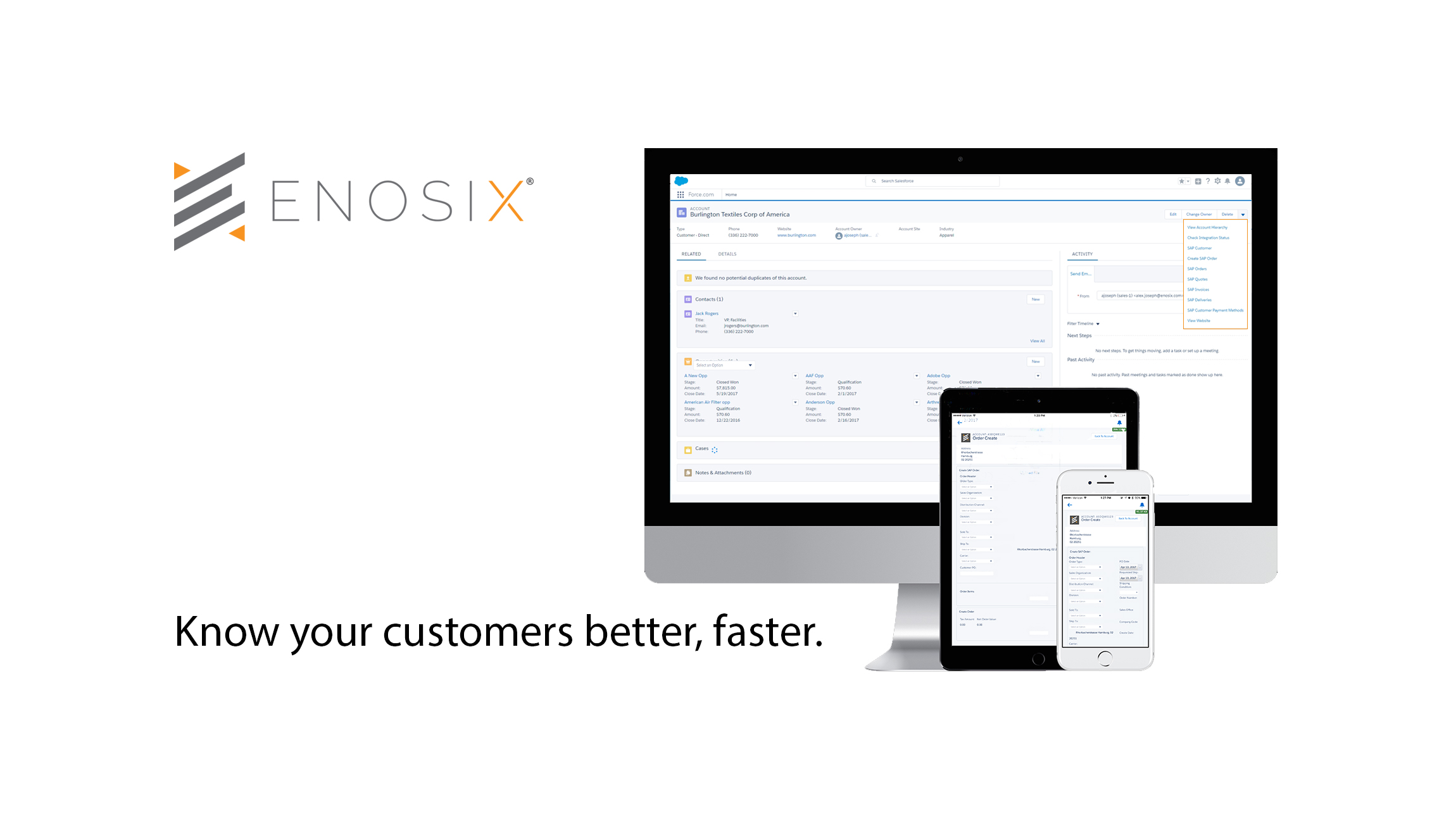
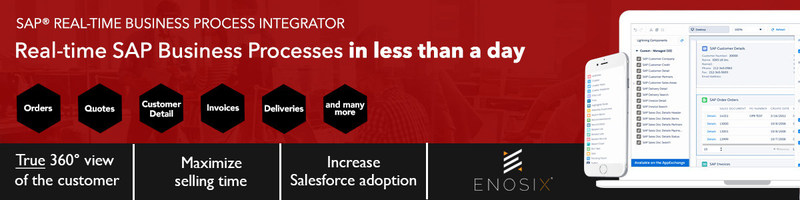
enosiX, a leading zero-code SAP integration accelerator firm, launched the SAP Real-Time Business Process Integrator app on the Salesforce AppExchange. The enosiX app’s genius is in its powerful enterprise-grade business process integration into Salesforce.

Built to enhance sales productivity, customer service and to simplify Salesforce Admin tasks, the enosiX SAP-certified add-on is currently available on the Salesforce AppExchange.

The ZERO-code approach enables rapid install to immediately increase selling time. Once installed, enosiX provides drag and drop capability to add live SAP data to the Salesforce experience. Salesforce Admins can select what SAP data to display with a click – no SAP expertise required. 15-plus pre-built display templates enable real-time integration from Salesforce to SAP. No middleware or additional infrastructure is required, drastically reducing risk and required resources. The Enterprise Edition for enosiX adds an additional 25-plus pre-built scenarios between SAP and Salesforce.

Gerald Schlechter, CEO, enosiX calls it an ‘SAP integration trailblazer’. “Typical integration approaches require deep ERP understanding and complex front-end building by the developer, take six to twelve months, introduce too much risk and inhibit innovation. Through our existing enterprise offering, we are already providing organizations with a true 360-degree view of their customers. Now, with our new SAP Real-Time Business Process Integrator app for Salesforce, we provide even faster, easier and more cost-efficient real-time access to critical SAP data. We offer zero implementation costs if you download our app before 12/31/2017,” he said.

enosiX is a software development firm focused on accelerating SAP integration. enosiX provides a SAP integration platform to quickly and easily provide real-time, business process-based integration between Salesforce and SAP. Much more than just data & display, enosiX takes the complexity of SAP and simplifies it in an intelligent, SAP-certified solution requiring no middleware or additional infrastructure.

Marketo Delivers New AI-Powered Personalization To Fuel Marketing And Sales Success

0
Marketo

New Solutions Provide Marketers And Sellers With The Insights To Effectively Engage With Customers Across Channels

Marketo, Inc, the leading provider of engagement marketing software and solutions, unveiled a suite of new and enhanced solutions that give marketers and sellers cross-channel personalization, enhanced email analytics, and account-based insights to engage more effectively with their customers. This latest product release reinforces the company’s commitment to delivering the best solutions for marketers and sellers to win in the Engagement Economy.

“Marketers are inundated with disparate solutions that claim to be cure-alls for delivering a seamless customer experience. In Marketo’s recent study, marketers reported that finding the best tools to help them engage with their customers is their number one challenge. Our latest release addresses this need by providing marketers with a wide range of enhanced analytics and personalization solutions to help them engage with their customers across all touchpoints and at every step of their journey,” Manoj Goyal, Chief Product Officer, Marketo said.

Analytics and Insights
The right analytics are critical for customer engagement, with 46% of marketers across the United StatesUnited KingdomGermany, and France of the belief that analytics and reporting have a significant impact on their ability to engage with their customers. Marketo’s new analytics and insights offerings include the following:

  • Account Insight is designed to strengthen the partnership between sales and marketing teams around account-based marketing (ABM) strategies by focusing sellers on the best accounts to target and giving them real-time insights into how and when a prospect is engaging with their brand in order to tailor follow-up interactions.
  • Email Insights Enhancements allow marketers to drive greater value from Marketo’s Email Insights solution through new ways to prepare, analyze, and share email campaign performance with marketing leaders.
  • Integration with Facebook Offline Conversions Enhancements allows marketers to map additional Marketo customer journey stages to Facebook offline conversion stages, so marketers can further optimize their ad spend based on more meaningful actions and insights into the customer journey.

Personalization
Today’s customers expect brands to interact with them in personalized ways across all channels. In The State of Engagement, 72% of marketers reported that personalized messages have a significant impact on customer engagement. Marketers can now take advantage of many personalization solutions delivered by Marketo to effectively engage with customers, such as:

  • ContentAI™ is the only solution that makes content personalization scalable for marketers by auto-discovering and cataloging website assets and using AI to determine the best content to display to each audience. Marketers can personalize their websites, mobile experiences, and email with ease through drag-and-drop content placement, while maintaining control over what is delivered through each channel.
  • Web Personalization Enhancements that give marketers new ways to create experiences based on visitor behaviors. For example, trigger Widget Campaigns from the top, bottom or side of the screen based on scrolling past a specific point or a certain amount of time passing. New ‘Call-to-Action’ labels let visitors see whether the offer is for content, a survey, an event and more before they expand the widget.

Sales and Marketing Partnership
The relationship between sales and marketing teams have evolved from alignment to genuine partnership. To support this collaboration, Marketo has delivered solutions that empower teams to create and standardize content to help them effectively engage with their customers:

  • ToutApp Templates is one of the recent products born out of Marketo’s strategic acquisition of ToutApp, the leading sales engagement company, earlier this year. ToutApp Templates enables marketers to categorize and share marketing-generated content with their sales colleagues to ensure consistent messaging and tailored engagement throughout the customer journey.
  • Sales Insight Enhancements include locked templates so that marketing and sales teams can standardize customer communications and companies in regulated industries have greater control of messaging through approved marketing-prepared templates.

Brandwatch’s Quick Search Brings Speed To Mass Social Data Analysis

0
brandwatch (1)

The New Offering Is The First Enterprise Social Intelligence Solution To Instantly Segment All Of Your Social Data

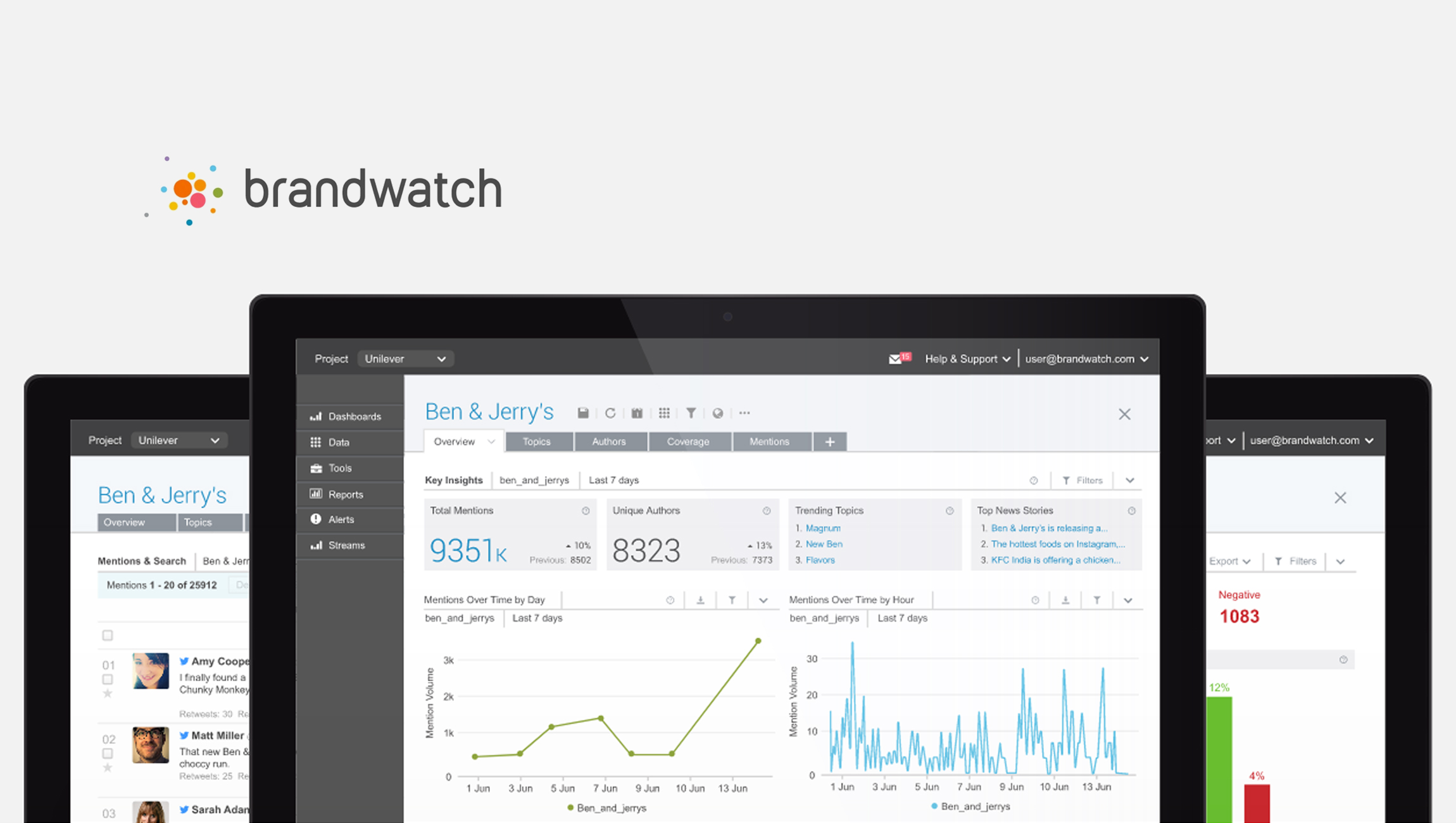
The world’s leading social intelligence company, Brandwatch, has unveiled Quick Search, the first enterprise social intelligence solution to instantly segment all of your social data. Revealing Quick Search at Now You Know™ Europe, the feature allows marketers to search through millions of online conversations in an instant, with no need for spreadsheets, formulas or boolean operators.

Available to all Brandwatch users, Quick Search is the fastest and easiest way for clients to find insights in their data. The feature is available to all Brandwatch Analytics customers at no extra cost. Whether you want to find the positive and negative sentiment behind Adidas’ products or the major trends at Google’s I/O conference, all you need is Quick Search.

“We looked at our customers and discovered something. You wouldn’t search the web without a search engine, so why should you analyze the web without a search engine. That’s why we’ve built Quick Search. To make difficult social data analysis search-bar simple,” Brandwatch CEO Giles Palmer said at the company’s NYK conference.

Delta, a Brandwatch customer, received early access to Quick Search and said this about the feature: “Being able to quickly segment conversations without creating new queries or dashboards is just excellent.”

Earlier last month, Brandwatch unveiled its Social Intelligence Maturity Model (SIMM), offering a way to measure the value of a business’s social strategy and guide its growth into the future.

Brandwatch is the world’s leading social intelligence group offering marketers a portfolio of social and content marketing technologies. The company’s flagship products, Brandwatch Analytics and the Vizia platform, fuel smarter decision making around the world. With the addition of BuzzSumo’s content marketing and influencer identification platform in October 2017, the company is positioned as a leading provider of insight-surfacing technologies across the enterprise as well as for SMB customers.

DAM Through the Ages – What’s Next?

0
DAM
DAM Through the Ages – What's Next?

WidenWhere does one begin when exploring the past four “eras” of technology? So much has changed! With digital asset management (DAM), it’s much easier to take a walk down memory lane.

DAM addresses an ancient problem: If we store information outside our brains, how do we make it useful? Cave walls were an answer. Libraries were another answer. With the advent of digital expression, DAM became the most compelling way.

Central Library Era

It all began in 1992 when Canto Software launched Cumulus. Organizations were accumulating digital files and needed somewhere to organize them. A digital library was a more elegant solution than shared drives and floppy discs.

After Cumulus debuted, consumer web browsers emerged. Mosaic appeared in 1993, and Netscape Navigator arrived in 1994. Dial-up modems were painfully slow. Nonetheless, some DAM contenders (including Widen) placed bets on web-based DAM.

Social-Mobile-Cloud Era

By 2006, web-based DAM had won, and so began the second era. I started at Widen in 2004, and I remember when our CEO, Matthew Gonnering, returned from his first Salesforce.com conference in 2007. He was raving about the “cloud” (Huh? What?). People seem crazy when they see the future that clearly!

Central libraries were becoming silos because it was easy to add content but difficult to deploy it. The cloud, by becoming the de facto destination for content, changed everything.

In 1999, there were only 23 blogs on the internet, reported the staff at Webdesigner Depot. By 2006, there were 50 million. Meanwhile, the rise of Friendster (2002), MySpace (2003), and Facebook (2004) sent a message: Publishing was becoming democratized. DAMs needed to get content from rest to work more efficiently.

However, the web changed with the introduction of the iPhone in 2007. DAM had to convert and adapt images for a dizzying combination of devices, channels, and operating systems. It was like cooking for several hundred picky eaters.

By 2012, marketing technology (a.k.a. ‘martech’) had triggered an arms race among companies. The web was poised to eclipse every other marketing medium (if it hadn’t already). The audience was enormous, but the influx of content and competition made it difficult to win attention. Companies needed combinations of martech to reach people, but most systems didn’t play nice.

Integration Era
DAM vendors spotted this limitation during the Social-Mobile-Cloud Era and began to address it aggressively during the integration era.

DAM vendors realized they’d become second fiddle to other martechs unless they could serve as a ‘central source of truth’ for all content-based platforms. These other platforms (e.g. content management systems) came with lightweight libraries that, while less powerful than a DAM, offered the basic functionality. In response, DAM vendors created dozens of ready-made integrations. APIs facilitated sophisticated martech stacks like those showcased in Scott Brinker’s Stackies & Hackies Awards.

We’re still in the Integration Era, but not for long.

Machine Learning and AI Era

The fourth era of DAM involves machine learning and artificial intelligence (AI). DAM consultant Mark Davey expects DAM to play a central role in the semantic web, where new metadata schemas will enable computers to ‘read’ websites.

AI-powered image recognition and metadata tagging have arrived. However, the current iterations are underwhelming. We are still in a ‘hype’ phase.

Next-generation DAM will not minimize the importance of people. Rather, people will need to be sharper in their DAM strategy because AI scales mistakes as efficiently as it scales good ideas.

DAM is an ongoing chapter in the story of how we organize information outside our brains. The ‘manual’ work will get easier with AI, but DAM will require more mindfulness. The price and reward of ease is deeper thinking.

5 Ways to Create a Compelling Landing Page

0
Landing Page

sigstrPicture this: A top prospect opens your latest email, clicks on the content campaign in your email signature, gets taken to a landing page, and…what happens next? The answer to that question determines the success of your entire email signature marketing strategy. Not only that, it determines the success of every marketing initiative you manage that has a source (Adwords, Facebook, Twitter, LinkedIn) and corresponding landing page.

Whether you’re using a landing page to generate leads, drive event registrations, or collect data, ensuring a high conversion rate is key. A marketing campaign is only as effective as the landing page it directs to, whether you’re using HubSpot, Pardot, Marketo, Act-On, or another provider. As such, it’s your duty to ensure your landing pages are the best they can be. To give you a head start, I’ve pinpointed the five key factors to an effective landing page:

Headline
The landing page headline is the first thing a visitor sees after he or she clicks on an email signature campaign, Facebook ad, etc. As such, it must be easy to read, straightforward, and intriguing. Once a visitor arrives to your landing page, it’s your headline’s job to hold the visitor’s attention and reassure him or her that they’ve come to the right place. Otherwise, the person might leave before completing the task at hand, also known as the conversion goal.

To establish continuity, you should also ensure that your landing page headline closely matches the headline in your source campaign. The same can be said for your call-to-action. If your marketing campaign promotes an upcoming conference or webinar, your landing page headline should do the same.

Page Design
If the headline is what holds a visitor’s attention, it’s the page design that focuses the visitor on the action you want he or she to take. Every design element on an effective landing page should be aligned to a conversion goal. For that reason, it is important to use minimal patterns, contrasting colors, and a prominently placed form field. Remember to be clear and concise. Clarity is often lost when marketers try to make the landing page design ultra cool or edgy.

When designing your landing page, another thing to remember is that you need to establish trust. How well does the initial above-the-fold landing page experience deliver on the promise made in the marketing campaign? The color palette, patterns, fonts, and general vibe of the landing page need to align to the design of the source campaign. You don’t want to surprise the visitor or make him or her think they’ve come to the wrong place. On the contrary, if the campaign and landing page compliment each other, the visitor is much more likely to stick around.

Form Fill
There are a number of strategies you can use with a form fill. Both short and long forms have been shown to perform quite well. The method you choose depends on whether you want to generate a high number of low quality form submissions, or a smaller number of higher quality submissions. Whichever strategy you choose, consider leaving form boxes unchecked. Otherwise, you’ll risk adding a lot of low quality subscribers to your contact base, which can hurt your business.

When creating a form fill, make sure every action you request of your audience leads naturally to the next step. This is especially relevant in multi-step form fills which visitors have a tendency to abandon mid-way through. If you’re implementing a multi-step form fill, consider adding a status bar so that visitors have a general idea of the form length.

Supporting Content

With supporting content, it’s important to make sure your most important information comes first and clearly presents the value you’re offering. A source campaign can only offer a limited amount of information in the banner/ad. That means that the corresponding landing page has to make up for missing context. It should compliment the copy from your ad, but also expand upon it and continue to persuade.

And speaking of persuasion, all supporting content should align to your conversion goal. You may have 10-20 goals for your homepage, but an effective landing page aligns to a single action. If you’re trying to get a prospect to download an ebook, every piece of content on your landing page should be steering the visitor toward the download.

For that reason, it may be a good idea to remove outside links and social share buttons. They divert visitors from accomplishing the main goal. The same thing can be said for testimonials, sub-headers, and bullets. They can be great tools to establish trust and credibility, but if they do not aid in persuasion or conversion, they are not appropriate.

The last thing to consider with supporting content is SEO. The added benefit of supporting content is that it gives the page an SEO boost because search engines have more content to crawl. Use the same SEO best practices you would apply to your company blog or website to your landing pages.

Imagery
It’s probably not surprising to hear that the images you use on a landing page have a huge impact on your conversion rate. After all, a picture is worth a thousand words. With that said, don’t just use images that you know garner an emotional response (i.e. cute babies). Images on an effective landing page align to the company’s brand, campaign and conversion goal. You have to strike a perfect balance between eye catching and distracting. If images are too bold then they could pull attention away from your main call-to-action which is the last thing you want. Instead, choose images that complement or even emphasize your main objective.

Another thing to keep in mind is that including people in your images can be a powerful influencer. As human beings, we have a tendency to look at faces. Not only that, if the people in an image are looking in a specific direction, our eyes have a tendency to follow. Use this kind of directional cue to your advantage when choosing a landing page image and direct your visitors attention to your call-to-action.

When creating a compelling landing page, it all comes down to outcome optimization. A great source campaign strategy means nothing if your landing page does not deliver. Use these five prominent factors to your advantage and watch conversion rates go through the roof.


TechBytes with Dave Myron, VP Product Marketing, Seismic Software

0
Dave Myron
TechBytes with Dave Myron, Vice President Product Marketing, Seismic Software

Dave Myron
VP Product Marketing, Seismic Software

Rated among the top sales enablement solutions, Seismic enables sales reps to build an effective, fast-paced engagement lifecycle using personalized content. “Designed for sales, approved by marketers” – the right content for sales enablement makes sales processes shorter and improves performance. We chatted with Dave Myron, Vice President Product Marketing at Seismic, to get an insight into their Actionable Insights and LiveDoc technology.

Html code here! Replace this with any non empty text and that's it.

MTS: Tell us about your role at Seismic Software and how you arrived at this position?
Dave Myron: I’m the vice president of product marketing and management here at Seismic, helping lead both the product roadmap and messaging around functionality and features. I’ve been with Seismic since 2015, previously having held similar positions at large tech companies such as Xilinx and Intel.

It was actually at those companies where I noticed major alignment issues between sales and marketing, along with content management and delivery processes that were actually slowing sales cycles as opposed to helping them. When I first saw the Seismic product, I immediately saw the incredible benefits it could bring to large companies and the teams I had worked on in the past, and I jumped at the opportunity to join.

MTS: How deep is Seismic into AI/ML technologies when it comes to Intuitive Content Management?
Dave: Seismic is deeply invested in artificial intelligence and machine learning innovation across the entire platform, and we see it as a core component of our product roadmap going forward. In fact, late last year we acquired a machine learning company to help further drive how we think about and approach AI at Seismic.

When it comes to sales and marketing enablement, the potential of AI is huge. It will help uncover insights into which pieces of content work and when, that are not detectable to humans; it will assist in onboarding new sales reps by providing them with a blueprint on how to interact with prospects in any situation; it will be a boon to content tagging and categorization.

Ultimately, when it comes to ensuring that sales reps are prepared for every interaction and are given the tools they need to succeed in them, the combination of man and machine will result in great gains for each and every sales rep, and each and every marketer whose job it is to support them.

MTS: Other than Sharepoint and Salesforce CRM, what are the other marketing/engagement platforms that support LiveDocs technology?  What would the next version look like and how soon?
Dave: LiveDocs technology is a fundamental capability within the Seismic platform that allows for the dynamic assembly of content by sales reps based on rules put in place by the marketing team. This gives confidence and assurance to marketers that all collateral being used by sales is on-brand and compliant while also allowing sales reps to personalize the content based on their intimate knowledge of the prospect. In terms of facilitating personalized sales content at scale and producing quality content at a breakneck pace, there is really no tool like it on the market. We have seen customers save upwards of 98 percent on time spent creating sales content because of LiveDocs technology.

While LiveDocs technology exists everywhere the Seismic platform exists, such as through CRM integrations and mobile apps, Seismic’s integration capabilities run the gamut across the spectrum of sales and marketing technologies. Customers use our LiveSend analytics functionality in lead generation campaigns through our marketing automation integrations. They serve up training and preparation materials alongside Seismic content through our integrations with sales readiness tools. Deep integrations with CRMs means that opportunity data is used to suggest the perfect piece of content in any interaction, and integrations with email clients such as Outlook mean that reps never have to leave the tools they’re most comfortable with to harness the full powers of Seismic. And this doesn’t even touch upon the fact that Seismic can integrate with virtually any content repository or data source, meaning that Seismic can raise the content management and data integration quality within any existing enterprise technology stack.

We’re constantly improving both LiveDocs technology and the entire Seismic platform, with major product releases going out multiple times per month. One-third of our 300-person company is on the product side of the company, giving us a huge edge when it comes to product innovation.

MTS: How do Content Engagement analytics differ for various omnichannel marketing campaigns? How does Seismic’s Actionable Insights help in creating a ubiquitous customer persona for web and social campaigns?
Dave: Content serves different purposes at different points in the buyer’s journey. Content created for top-of-funnel campaigns needs to speak to large audiences. When it comes to content used in sales interactions, it needs to speak to a prospect on an individual level, which is why a tool like Seismic and our analytics capabilities is so powerful. Sales reps can see exactly which pieces of content a prospect engaged with and for how long, down to the individual page level, making follow-up conversations much more productive and effective. Taken in aggregate, content creators such as product marketing can see which pieces of content are most effective and which sales reps are using them, allowing for intelligent adjustments and improvements, ultimately ensuring that they are doing their part to assist in sales cycle acceleration and closed deals.

When integrated with a marketing automation platform, Seismic provides a more complete picture of the customer journey, from start to finish. For the first time, marketing and sales teams can see which pieces of content work and don’t work for different prospects at every stage of the buyer’s journey, helping paint much more precise and accurate customer personas and vastly improve lead quality.

MTS: How often should sales teams evaluate their content assets for effective engagement, personalization, and success with their leads? Does Seismic provide a timeline for sales reps to filter their obsolete/ineffective content?
Dave: The great thing about Seismic’s LiveInsights analytics capabilities is that they allow for assessments and iteration of sales content at a near-constant cadence. Content creators have a real-time look into what content is being used by sales reps, which pieces of content are being engaged with by prospects, and which content creators are producing the highest quality content. So instead of regular, say annual or bi-annual content audits, teams can adjust on the fly.

That being said, we always recommend that there are formal processes and regular updates in place to ensure that teams take the time to view their current stockpile of content and make the necessary, holistic and large-scale changes as well. Ultimately, the more focus and attention is paid to content upkeep, the more effective content strategy will be.

MTS: Thanks for chatting with us, Dave.
Stay tuned for more insights on marketing technologies. To participate in our Tech Bytes program, email us at news@martechseries-67ee47.ingress-bonde.easywp.com

Interview with Judd Marcello, EVP, Global Marketing, Cheetah Digital

1
Judd Marcello
Interview with Judd Marcello, EVP, Global Marketing, Cheetah Digital

Judd Marcello
EVP, Global Marketing, Cheetah Digital

[easy-profiles profile_twitter=”https://twitter.com/JuddMarcello” profile_linkedin=”https://www.linkedin.com/in/juddmarcello/”]
[mnky_testimonial_slider][mnky_testimonial name=”” author_dec=”” position=”Designer”]“Technology is important, but customer engagement starts and ends with marketing data. Those marketers that have complete command of their marketing data can make winning decisions on how to create and deliver highly-personalized messages that drive customer engagement.”[/mnky_testimonial][/mnky_testimonial_slider]

On Marketing Technology

MTS: Tell us about your role and how you got here. (what inspired you to be a part of a technology innovation company).
I have always been a marketer at heart. My career has been filled with various marketing roles in both B2C and B2B marketing, spanning 23+ years and in four international markets. In 2007 I was living in Sydney, Australia working in B2C marketing for a global consumer electronics company as a brand manager. This was right about the time that the iPhone came out and digital channels were becoming shiny new objects for marketers to play with. I jumped right in.

In 2009, I moved to London where I was inspired to make the switch to B2B marketing, specifically in the marketing technology industry. I ran marketing in the EMEA region for ExactTarget, the leading marketing SaaS Company in the industry at that time. The opportunity to market to marketers was something that excited me then and still does.

I am still marketing to marketers to this day. Earlier this year I was brought in to lead a complete re-brand, repositioning and relaunch of my current company, Cheetah Digital. As the marketing leader I oversee a global team that is responsible for Cheetah Digital’s brand, GTM strategy, demand generation, marketing operations, digital, marketing communications, public and analyst relations, sales development and events.

My role as the marketing leader is to set the vision and remove barriers so that my team is successful in bringing that vision to life. As much as I love marketing, I truly enjoy positioning my team members for success and seeing them grow in their roles and careers.

MTS: Given the changing dynamic of customer engagement, how do you see the marketing technology landscape evolving in the coming years?
Technology is important, but customer engagement starts and ends with marketing data. Those marketers that have complete command of their marketing data can make winning decisions on how to create and deliver highly-personalized messages that drive customer engagement. Truly, it is all about the messages that marketers send. “Messaging over channels,” is what we like to say. In order to deliver hyper-personalized, unified messaging across all channels you have to know how to activate marketing data to create compelling messaging that shapes the customer experience for your personas.

MTS: What’s the biggest challenge that CMOs need to tackle to make their marketing decisions work?
There are three that stand out for me:

  1. Adapting to the changing expectations of the CMO role and the marketing organization to evolve from a lead generation focused organization to a revenue driven organization.
  2. How to build an integrated tech stack and calibrate it to create a more efficient, competitive and performance focused process.
  3. How to design the modern marketing organization to meet the changing expectations of the CMO. Ultimately, CMOs need to hire a team of marketers with a passion for using data and analytics in decision making, as well as the ability to incorporate creativity and innovation in all stages of the marketing process.

MTS: What startups are you watching/keen on right now?
I was part of the NYC start-up scene for a few years and there are a few startups I keep my eye on: Smartling (SaaS based global content translation platform), CB Insights (tech market intelligence platform) and Yext (location based knowledge management).

MTS: What tools does your marketing stack consist of in 2017?

  • Content experience
  • ABM Targeting & Advertising
  • Lead Capture
  • Data Management
  • Account Sourcing & List Building
  • Account Scoring & Predictive
  • Lead Routing
  • Lead Nurture / Marketing Automation
  • Sales Cadence
  • Budget & Planning
  • Customer advocacy
  • Translation management software

MTS: How do you prepare for an AI-centric world as a marketing leader?
With open eyes and ears. AI is evolving fast. What I would love to see is AI helps marketers spend less time on campaign design and more time on strategy and using real-time engagement data to improve the customer experience.

This Is How I Work

MTS: One word that best describes how you work.
Passionate.

MTS: What apps/software/tools can’t you live without?
At work it’s Trello, Evernote, Slack and assorted Google products; I am big user of productivity apps- maybe an obsessive user of productivity apps.

For personal use its Spotify (huge music fan), Instapaper, Feedly, iOS News App, Kindle, Audible. I’ll flip through Twitter and Instagram while waiting for the subway.

MTS: What’s your smartest work related shortcut or productivity hack?
I block out time on my calendar so that I can prioritize work that has to get done. It’s hard to stay true to those time blocks, but I do everything possible to do so.

I use a standing desk all day long. It’s a productivity hack because it keeps me active physically and mentally and focused on the task at hand.

MTS: What are you currently reading? (What do you read, and how do you consume information?)
I’m deep into two books right now: Petty , a Tom Petty biography and, Sweet Soul Music,by Peter Guralnick. I am listening to the Petty bio on audible and reading Guralinick’s book on the Kindle app. If you call yourself a music fan, Sweet Soul Music is a must read.

I am always reading the WSJ, HBR, Techmeme, Forbes CMO Network and a long list of other marketing related sites. And, I use Twitter and LinkedIn as news sources.

MTS: What’s the best advice you’ve ever received?
“The truth is easier.” That is actually a quote from Hunter S. Thompson, not advice that I was given. That said, it is sage advice and I refer to it all the time.

MTS: Something you do better than others – the secret of your success?
I don’t know or care if I am better at any one thing than anyone else. I just try to be better at what I do everyday. What I aspire to do, to the best of my abilities, is to have a positive lasting impact on others that inspires them to be better.

MTS: Tag the one person in the industry whose answers to these questions you would love to read:
Kyle Lacy, VP Marketing at Lessonly.

MTS: Thank you Judd! That was fun and hope to see you back on MarTech Series soon.

[vc_tta_tabs][vc_tta_section title=”About Judd” tab_id=”1501785390157-b58e162d-0ae25a4b-c27aca64-108e7ff2-6dd4″]

Senior executive with 20+ years of delivering high-impact B2C and B2B marketing leadership in the software, consumer packaged goods, consumer electronics and food and beverage industries across the United Kingdom, Americas, Australian and European markets.

[/vc_tta_section][vc_tta_section title=”About Cheetah Digital” tab_id=”1501785390320-2d44fa50-740c5a4b-c27aca64-108e7ff2-6dd4″]

Cheetah Digital
Cheetah Digital is the only independent, enterprise cross-channel marketing solutions provider dedicated to the marketer. Our unique combination of data, software and trusted industry experts helps marketers build meaningful customer relationships and create profitable brand outcomes. We provide marketing leadership for the world’s best brands, including Williams-Sonoma, Delta Airlines and Hilton. Cheetah Digital is a global company with 1,600 employees worldwide, operating in 17 countries, with headquarters in New York City. .

[/vc_tta_section][/vc_tta_tabs]
[mnky_heading title=”MarTech Interview Series” link=”url:https%3A%2F%2Fmartechseries-67ee47.ingress-bonde.easywp.com%2Fcategory%2Fmts-insights%2Finterviews%2F|||”]

The MTS Martech Interview Series is a fun Q&A style chat which we really enjoy doing with martech leaders. With inspiration from Lifehacker’s How I work interviews, the MarTech Series Interviews follows a two part format On Marketing Technology, and This Is How I Work. The format was chosen because when we decided to start an interview series with the biggest and brightest minds in martech – we wanted to get insight into two areas … one – their ideas on marketing tech and two – insights into the philosophy and methods that make these leaders tick.

BMC Announces Cognitive Service Management with AI, Machine Learning, and Predictive Capabilities

0
BMC to Acquire Compuware

New Offering Built With IBM Watson Technology Optimizes Service Management Experience In Multi-Cloud Environments For Employees, Agents, And Developers

BMC announced a partnership to seamlessly integrate AI technologies from IBM Watson, a leading AI platform for business, into BMC’s leading IT Service Management solutions for the digital enterprise. IBM Watson Conversation and Discovery capabilities enable service management teams to deliver a better service experience to employees across multi-cloud environments, using chatbots to simplify and enhance employee self-service. Watson technology also delivers speed and increases the accuracy of ticket classification and resolution, enabling agents to spend less time on repetitive tasks so they are more productive, while also driving down the cost of service delivery.

Nayaki Nayyar
Nayaki Nayyar

“Traditional ITSM solutions face immense challenges and heightened expectations when delivering service in today’s multi-cloud environments. BMC addresses these complexities by combining the power of IBM Watson with our Cognitive Service Management solutions to deliver intelligent, conversational, and predictive service management experiences for the enterprise,” Nayaki Nayyar, President, Digital Service Management, BMC said.

Beth Smith
Beth Smith

“The combination of BMC Cognitive Service Management and IBM Watson technology can help enable enterprises to transform their service management capabilities and add value to existing systems. This is yet another example of how organizations are enhancing business processes by infusing them with AI,” Beth Smith, General Manager, IBM Watson Platform said.

The BMC Cognitive Service Management approach enables IT to better manage today’s multi-cloud, multi-device, and omni-channel realities by:

  • Embedding cognitive capabilities into Remedy Service Management Suite to automate classification, assignment, and routing of incidents, and transform the way services are delivered by agents.
  • Using virtual agents and chatbots to create a self-service experience with BMC Digital Workplace that employees want to consume and engage with, and help enterprises scale beyond traditional channels.
  • Enabling developers and enterprises to embed predictive intelligence into applications during development, leveraging AI and machine learning capabilities from IBM Watson through a cognitive micro-service delivered on BMC Innovation Suite.

Cognitive Service Management is available on BMC Innovation Suite, with updates planned for BMC Digital Workplace and Remedy Service Management Suite this quarter.

Also Read: Pressing Engagement: The Art of Social Selling

Is 2018 the Year for Personalization?

0
Year for Personalization
Is 2018 the Year for Personalization

Your website is the culmination of years of experiments trying to maximize web visitor engagement. It has been optimized for design, messaging, positioning, layout, imagery and yet there is one fundamental flaw preventing you from a giant leap in engagement: relevance

Webster’s dictionary defines relevance as the ability to retrieve material that satisfies the needs of the user

Unless your website content dynamically changes based on the user/visitor, you are missing out on true relevance. SiriusDecisions cites end-to-end conversation rates of 1.42% as best in class. This means for every 100 inquiries, we roughly win one, just one! What happens to the remaining 99%? When did it become acceptable to win just 1% of our customers?

Relevance is the only way to increase your end-to-end customer conversion and personalization answers this call.

“Smart personalization engines used to recognize customer intent will enable digital businesses to increase their profits by up to 15%” – Gartner

Marketing Technology News: Paysafe Announces YouTube Partnership

Marketers have always wanted to personalize, but until recently technological limits have prevented mass adoption.The underlying components of personalization are now in place:

  • Readily available data sources to decipher known and unknown web visitors
  • Audience insights to understand your web audience
  • Technology to dynamically change the website experience in real-time
  • Marketing personnel to optimize ongoing campaigns

As we turn the chapter on 2017 and look towards our 2018, can your revenue goals wait for personalization?
If you’re a B2B marketer, I don’t have to tell you that B2B marketing is hard. Prospects are getting harder to engage with, buying groups are growing in complexity, and marketers struggle to find the right data to understand and resonate with buyers.

Marketing Technology News: Mono Solutions Joins Bauer Media Group to Strengthen SME Marketing Services Across the Globe

To address this issue head-on, we will be sitting down with Terry Flaherty, Senior Research Director Demand Creation Strategies at SiriusDecisions and Nina LoCicero, Manager of Global Demand Generation and Analytics at Rockwell Automation to offer expert views on successful demand marketing strategies. Terry and Nina will share their perspectives on opportunities the new Demand Unit waterfall create – for marketers like you to identify and engage your active buyers systematically. We will also discuss a few interesting personalization plays Rockwell has successfully run to help them engage prospects more effectively.

Join us for this informative webinar on October 18th at 1:00pm CT, detailing personalization plays revenue marketers are using to fill their demand waterfalls!  After the 18th, the webinar will be available on demand as well.

During this webinar, you will learn how to:

  • Align your web personalization strategy to the new Demand Unit Waterfall
  • Identify the personas of your anonymous web traffic
  • Leverage industry and role data to engage prospects better
  • Deliver relevant messages to your target personas

Marketing Technology News: Gartner Survey Shows Inside Sales Organizations Risk Losing 24% of Employees This Year

Save my Seat!

Baby Boomers are Being Ignored and Not Just by Their Kids

0
social media advertisers
Baby Boomers are Being Ignored — and Not Just by Their Kids

strike logoWe get it: Millennials are a shiny object to social media advertisers. With younger folks’ dedication to keeping their Snap streak alive (and the intrigue of advertisers to what makes this generation tick), 18- to 34-year-olds are an obvious choice. But while millennials shouldn’t be ignored, older generations aren’t getting the attention they deserve — and brands are missing revenue because of it.



YouTube is particularly popular with millennials, who tune into it more than any cable news network. Further, 39 percent of millennials regularly visit the platform, compared to 37 percent of Gen Xers (35- to 54-year-olds) and 24 percent of baby boomers (those 55+). Yet despite high levels of YouTube traffic across generations, advertisers spend a disproportionate amount of their budget (156 percent more) on targeting millennials.

In fact, baby boomers have a 10 percent higher view rate and are the most likely to engage with YouTube ads, according to Strike Social’s “Generational Divide” data report. While the focus of brands has been on younger generations, advertisers would do well to spend their time — and ad dollars — on boomers. Below are three things advertisers should look at when defining their social media advertising strategy.

Look at the platform and industry targeting trends

Baby boomers are engaging with and watching longer video ads on YouTube. They also account for 24 percent of U.S. traffic on the platform. But targeting this older generation shouldn’t be applied to YouTube alone.

Perhaps not surprisingly, Facebook is the most popular social network among boomers. On top of that, most social networks’ ad targeting can go up to 65 years old, enabling advertisers to target more niche groups. In contrast, Snapchat only has the capabilities to target up to age 35. We know millennials and centennials (aka Gen Z) are the main audiences targeted on this platform, and given its current ad capabilities, advertisers wouldn’t be wise to put a lot of budget there to reach boomers.

Something else to consider when targeting social media users is interest affinities by generation. Looking at YouTube affinity audiences, 32 percent of boomers are movie lovers, and 31.7 percent are art and theater aficionados. On the other hand, millennials and Gen X are approximately 29 percent foodies and 28.5 percent fast-food cravers, proving that the content used to target different generations is just as important as the platform itself.

That said, every brand’s audience is different. Advertisers should analyze if there is a known older presence on a platform, because then advertisers can go back and look at their own data to see what resonates with their audiences, including baby boomers. We know baby boomers are on YouTube and engaging with more content and longer videos, but advertisers should always be a step ahead of the consumer in how their interests change.

Target the right audience on the right device

While no device reigns supreme in targeting all generations, desktop computers see the ad highest view rate across devices for YouTube ads, at 31 percent, compared to almost 28 percent for phone and tablet.

Among boomers, desktops are still the most popular, with this group watching a full third of YouTube ads on computers. Millennials have a 30 percent YouTube ad view rate on desktop, which is still higher than phone or tablet for this generation too. What’s interesting is that despite their stereotype for being less tech savvy, boomers hold the top spot for watching ads on their phones and tablets as well, with view rates of 29 percent and 30 percent, respectively.

Understand why you are targeting a generation

Keep in mind that baby boomers are the parents of millennials and centennials — and many are adopting tech trends (including social media platforms) that their children have already taken up. Advertisers can help bridge the gap. When a boomer decides to work a social platform into his or her daily routine, or even try it for the first time, advertisers should provide compelling content that keeps mom and dad coming back for more.

What’s more, advertisers should note that baby boomers have significantly more purchasing power. True, millennials may be ubiquitous across social platforms, but they also have less money to spend. Boomers, on the other hand, represent nearly half of consumer expenditures in the U.S. This older generation’s high engagement, along with some rather deep pockets, should give advertisers a pretty strong incentive to test the waters.

Baby boomers and their affiliated older generations hold more power, wealth and influence than their teens (and clearly advertisers) think they do. With their desire to watch longer video ads, engagement with brands on social and increased spending capabilities, boomers should not be ignored. While most brands want to focus on the newest trends and targeting millennials, boomers are more concerned with quality content and ads that are helpful to their daily lives and interests. This is something for marketers to keep in mind as we see brands start to rethink their targeting strategy, one piece of content, video ad and boomer at a time.

Meet Accenture Interactive’s New Commerce and Intelligent Marketing Leaders

0
accenture interactive

Brian Walker To Lead Global Strategy For Commerce, Nikki Mendonça Joins As President Of Intelligent Marketing Operations

The new battleground for brands today is Customer Experience. Winning in an experience-led market means being hyper-focused on the customer and agile enough to offer new, connected experiences that flex to accommodate individual client needs.

Accenture Interactive is focused on curating customer experience and stands as the world’s largest digital agency by revenue according to a Bloomberg report. They offer brands connected offerings in design, marketing, content, and commerce.

The fact that they are a subsidiary of one of the largest management consultancy – Accenture – means easy access to IT solutions and top management. Accenture Interactive brought in $4.4 billion last year, roughly 13% of its parent company’s total revenue. Their projected revenue for 2017 stands at $6 billion and top leadership is coming in place to hit these targets.

Brian Walker

The company recently added Brian Walker and Nikki Mendonça to their cadre. Walker joins as Managing Director, Global Strategy Lead for Commerce and Mendonça takes up the position of President, Intelligent Marketing Operations.

Walker’s previous work experience includes being the Chief Strategy Officer at SAP Hybris and Vice President at Forrester Research. In his new role, he will be helping clients curate experiences for customers that span the entire commerce platform, bringing together marketing, sales and service to deliver a seamless, omnichannel solution. His role includes growing the commerce practice in North America, and managing leading edge partnerships and strategic relationships globally.

Nikki Mendonça

Mendonça brings  25 years of strategic marketing experience to Accenture Interactive. She moved from her title as EMEA President of OMD Worldwide where she led over 6,500 professionals across the region committed to delivering marketing performance for clients including McDonald’s, PepsiCo, Estee Lauder, Liberty Global and Walt Disney. She previously held leadership positions at Capital Radio and Leo Burnett. Mendonça believes in creating a new marketing manifesto for clients in a mobile first digital world. In 2015, she was appointed to the IAB Europe Board, which aimed to help accelerate new industry solutions to the changing needs of both advertisers and agencies across the region.

App Annie: Netflix and iQIYI Lead APAC Revenue Ranking in Online Video Apps in H1 2017

0
appannie

According to the global mobile app analytics and market data platform, revenue generated from top video apps in APAC has seen significant increase

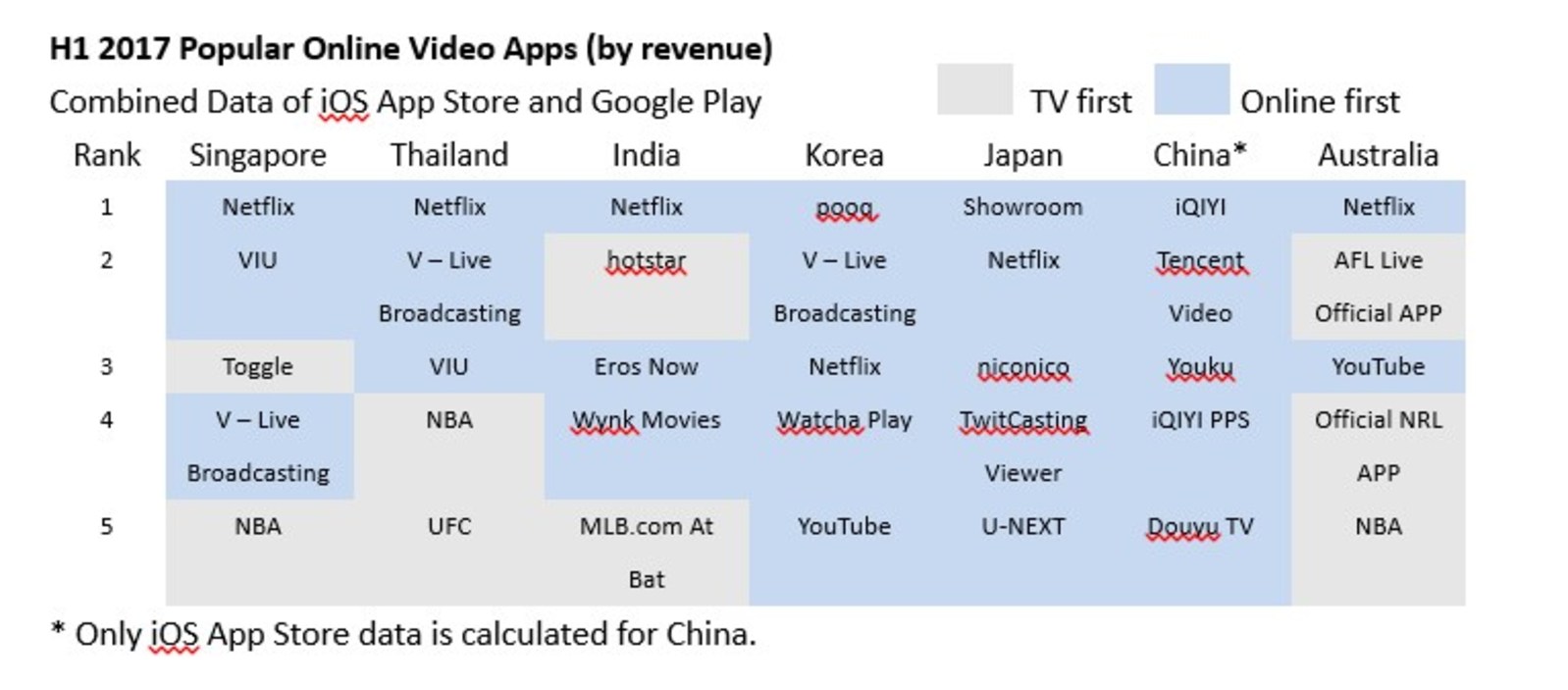
App Annie said in the Report on APAC Online Video Apps that the total revenue generated from the top 5 video streaming apps in China has increased by 185% compared with the same period of 2016. The report talks about the first half year of 2017, and points particularly to apps from China. This is seven times higher than that of Japan and makes China the biggest and fastest-growing market in the region.

H1 2017 Popular Online Video Apps (by revenue)

Of them, Beijing-based iQIYI currently takes a leading position in subscription revenue. During the first six months this year, iQIYI and iQIYI PPS App rank first and fourth respectively in the App Annies’ Popular Online Video Apps by Revenue for China region, which are followed by Tencent Video, Youku and Douyu TV taking.

App Annie said China’s online video apps have successfully expanded their user base by lowering paywalls. They provide most content free of charge, and offer flexible subscription programs at the same time to attract and retain premium users. App Annie also said that the growth in this market has shown local consumers’ increasing willingness to acquire premium content through in-app purchase, which is more convenient and easy-to-use than traditional payment methods such as credit card for online service websites.

In the first half of 2017, the Asia-Pacific region unseated American area to be the market with the biggest consolidated revenue from entertainment apps in both iOS App Store and Google Play worldwide. Online video apps are a major contributor. In fact, the revenue generated from entertainment apps in these two app stores has grown more than fourfold since the first half year of 2015, driven by the innovative monetization models and premium content.

In China market, original premium content has become a key driver for online video apps’ user number and revenue. For example, this summer iQIYI launched suspense hit drama Tientsin Mystic and music reality show The Rap of China, which has thrilled millions of Chinese fans and helped the hip-pop culture go mainstream in China.

From January of 2015 to June of 2017, the user time spent on ‘video playing and editing’ and ‘entertainment’ apps on Android devices in APAC tripled to nearly 40 billion hours. This figure is almost half of the total mobile video views globally in the first half of 2017, making the region the biggest mobile video consumer in the world. Although the gross revenue in APAC is still slightly less than mature markets, it’s convinced that there’re enormous monetization opportunities in the online video market in Southeast Asia and APAC as a whole.

TapInfluence Announces Industry-First, Dynamic Benchmarks for Influencer Marketing

0
tapinfluence

The Benchmarks Are Based On Based On Over Eight Years Of Repository Campaign And Transaction Data For Over 2,000 Brands 

TapInfluence, the industry’s leading influencer marketplace connecting brands with social media influencers, announced availability of its industry-first, validated benchmarks for influencer marketing, based on over eight years of repository campaign and transaction data for over 2,000 brands across tens of thousands of influencer marketing programs in multiple verticals and categories. Until now, there has been no general repository of historical data that could be analyzed dynamically across different categories and social platforms.

“Clients often ask how their influencer programming compares to the industry standard. In the past, it was a challenge to gauge. For programs, we execute within the TapInfluence platform, this Benchmarking tool gives us access to analytics from thousands of programs. It’s so exciting!” Deanna Dugo, Account Supervisor, Influencer Marketing, Ketchum said.

“The TapInfluence Benchmarks make it possible to understand how well influencer marketing campaigns are performing relative to tens of thousands of data points. This enables marketers to optimize their spend by benchmarking performance of programs by both social channel, category, and influencer. We built the Benchmarks for our customers, to be an iterative guide to maximize return on investment with sponsored content, and ultimately drive the one metric that really does matter – sales,” Jason Merkoski, CTO, TapInfluence said.

Francesca Cruz
Francesca Cruz

“Many marketers have difficulty articulating the value of influencer campaigns because they are comparing their results to other digital media campaign engagement metrics side by side. Influencers create content that can be re-purposed and metrics that accumulate over longer periods of time. This evergreen effect of social content makes it difficult to compare to digital campaigns that have distinct start and end dates. Marketers may undervalue an influencer marketing campaign that continues to perform over many months because it was measured based on its performance after an 8-week time-frame instead of over a longer period. Likewise, marketers might compare the cost of media buy with that of a content creation campaign—which is like comparing apples and oranges,” Francesca Cruz, VP Customer Success and Partnerships, TapInfluence said.

Flytxt Introduces Intelligent Voice Interface for Digital Customer Engagement

0
flytxt

Personalises Voice Conversations Through Amazon Alexa And Google Assistant  

Flytxt announced the availability of an intelligent voice interface for NEON-dX, its digital customer engagement product. NEON-dX will use analytics and Artificial Intelligence (AI) to personalise conversations on any digital touch point that supports Amazon Alexa and Google Assistant.

The product packages Analytics, Artificial Intelligence and Marketing Automation capabilities to help enterprises drive customer value management and generate measurable economic value faster and more efficiently. The product is deployed with more than 50 enterprises across 40 countries, analyzing data of over 600 million mobile consumers and executing more than 6000 analytical models per day.

Vinod Vasudevan
Vinod Vasudevan

“More than a quarter of all mobile searches in 2016 were done over voice. With speech recognition accuracy reaching over 95%, more and more consumers will adopt voice as the preferred medium to interact with their service providers. With this interface, our enterprise customers can now engage their consumers in natural conversations using voice. This will significantly improve consumer experience and generate higher returns for enterprises,” remarked Dr. Vinod Vasudevan, CEO, Flytxt.

NEON-dX has out of the box analytics and AI capabilities to translate data into actionable insights reflecting consumer’s persona, intent, and contextual needs. Enterprises can leverage these insights and recommend the right offers and actions during voice conversations seamlessly just like how a human agent would. The interface will start supporting other voice platforms like Siri in the near future.

Flytxt products enable Artificial Intelligence based autonomous customer value management, helping enterprises to accelerate their digital transformation journey and generate measurable economic value faster and more efficiently. The solutions powered by Flytxt’s products and services help enterprises to grow revenues, reduce churn and enhance customer experience. The company serves more than 100 customers across 50 countries including some of the largest Telcos, financial institutions and top global brands.

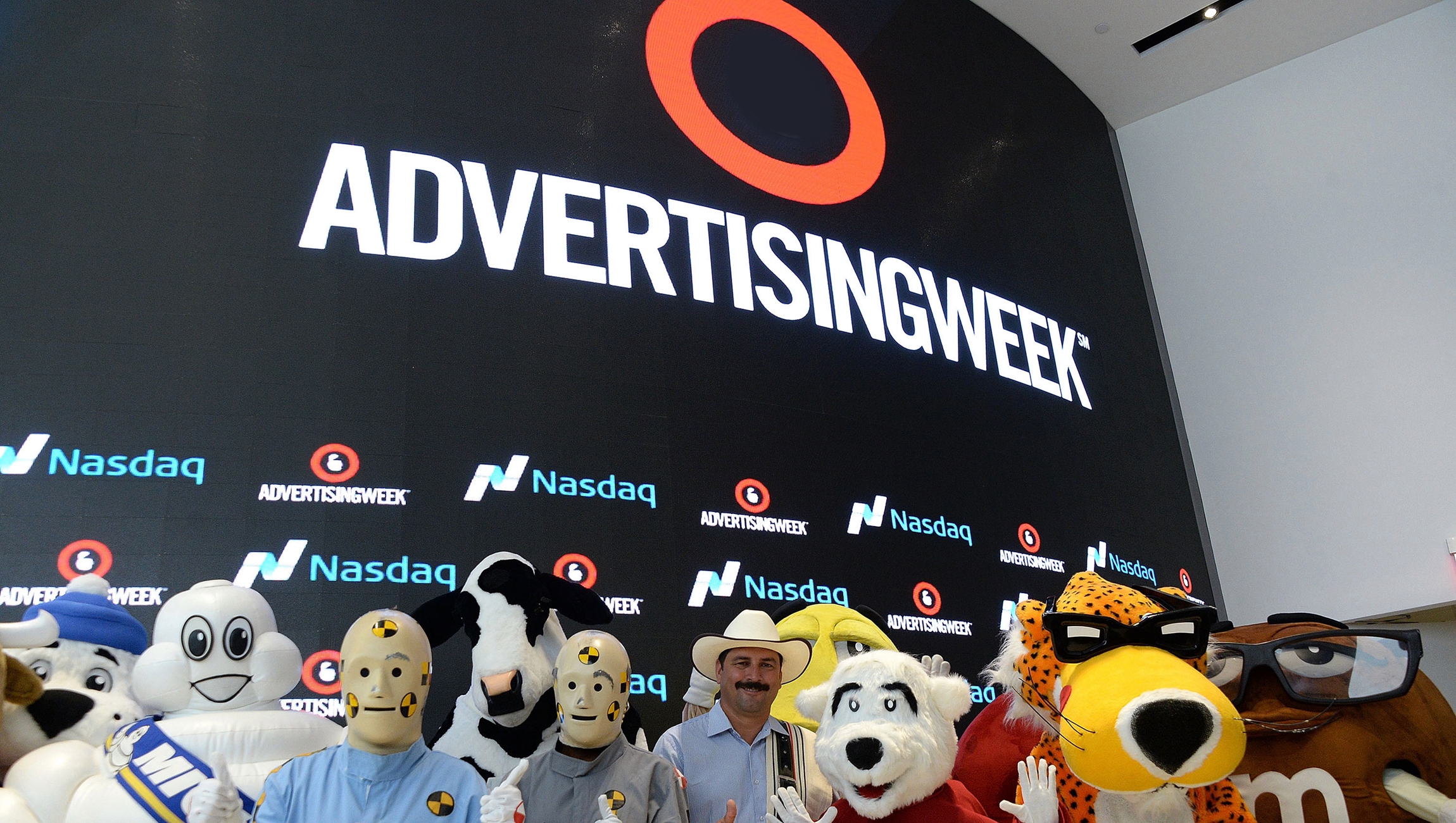
Trust and Transparency Took Center Stage at Advertising Week New York

1
Advertising Week New York
Trust and Transparency Took Center Stage at Advertising Week New York

openxWhile our heads are still spinning after Advertising Week New York – there were nearly 300 seminars – clear themes emerged on the current and future state of programmatic. Jason Fairchild, CRO and co-founder of OpenX, takes a closer look at three emerging themes and what they mean for the adtech/martech world:


Industry consolidation: No winter on the horizon

With M&A activity showing no sign of slowing down, consolidation in the adtech/martech space topped the Advertising Week agenda. But a panel discussion around whether winter is coming for adtech – including representatives from Sizmek, The Trade Desk and OpenX – concluded consolidation is actually a positive trend and a natural part of the cycle as the industry proves its worth.

The programmatic sector has enormous room for growth with the potential to move about 50% of global media spend to digital channels, or almost $300 billion of economic activity in the next five years, as more and more media – including linear TV – becomes programmatically addressable. When combined with relatively low valuations, this creates an attractive buying opportunity for massive international companies – from web portals and marketing clouds to telcos and private equity companies – who want to step into a fast-moving industry.

While these high profile acquisitions get the bulk of media attention, there is a second and equally vital level of consolidation, where scaled independent companies are buying niche solutions to strengthen their core offering. Independent companies are a hotbed for innovation, generating the innovations that drive the industry forward – RTB and header bidding for instance – and scaled businesses have the resources required to turn these concepts into reality.

Consolidation will continue to accelerate as acquirers realize the full growth potential of the industry – possibly including retailers who want to make use of their data or agencies looking to take control of the value chain – but there will always be a place for scaled independents to operate alongside the big players.

Trust and Transparency: Shining a light on the ecosystem

The adtech/martech ecosystem is bewildering, from both the buyer and seller perspective, resulting in an enormous lack of trust. Issues of fraud, viewability and brand safety, as well as a muddled supply chain, mean marketers are demanding increased clarity on exactly how their media dollars are being spent. All of this is exacerbated by the proliferation of “flea market” header bidding exchanges, further confusing the marketplace and obfuscating the supply chain. As a result, many market participants are voting with their dollars and pulling spend, taking programmatic in-house, or re-evaluating relationships with their technology providers.

But at the macro level, the programmatic ecosystem is moving in the right direction in the pursuit of transparency, and it’s a real possibility that programmatic can be the transaction system of record for over half of all global advertising  spend if we ensure that trust is built into programmatic systems.

To achieve true transparency, the full value chain needs to be exposed. All parts of the ecosystem need to take responsibility for shining a light on bad actors and shady practices, such as mislabeling and reselling inventory, and running shadow first-price auctions when buyers believe they are bidding in a second-price model.

Buyers and publishers must choose partners who operate in a well-lit environment, stay ahead of the moving target of fraud prevention, carefully curate inventory, and are open to third party verification. This means being prepared to pay for quality and choosing partners that have a transparent and sustainable fee structure, rather than just looking for the cheapest option.

If programmatic consolidates around quality, trusted platforms that can integrate into the industrial advertising complex, the ecosystem can scale and allow media dollars to flow into programmatic in a more efficient way. Only then will programmatic get to the promised land – the $300 billion opportunity.

Looking ahead: The future’s bright for programmatic

Despite hurdles the industry must overcome, the overall Advertising Week mood towards programmatic was overwhelmingly positive. Players in the industry are merely scratching the surface of what programmatic could really mean for the digital experience and that the technology could be used to deliver relevant, tailored content to consumers rather than just advertising.

One panel on ‘The Next Era of Programmatic’ suggested programmatic is now in its third inning, with more scale and scope than ever before, and the potential to become the default transaction system for digital media. The ability to deliver consistent, data-driven messaging across multiple devices, and to measure its results is game changing.

The inherent power of programmatic and real-time media buying is atomic targeting, or the ability to take a moment of consumer attention, value it based on data and intelligence, and deliver a message to that user in the exact right moment and context. Technology can then be used to determine how effective the impression is – whether it creates desire, elicits a response, or drives preference. This isn’t currently the case on major platforms such as Facebook and Google – where the decision at run time is not real-time and marketers buy a big block of consumer attention – but true programmatic execution will push these platforms to open up more.

Consolidation in the adtech/martech world isn’t a sign that winter is coming, simply a positive consequence of an industry that is growing up and becoming more vital to all participants. The message from Advertising Week New York was that if we can build trust into the system, programmatic will become the default transaction system for the majority of global advertising spend.

TechBytes with Einat Weiss, VP, Global Marketing, NICE

0
Einat Weiss
TechBytes with Einat Weiss, VP Global Marketing, NICE Systems

Einat Weiss
VP, Global Marketing, NICE

Last week, NICE announced the next iteration of its cognitive Robotic Automation platform featuring much-enhanced machine learning capabilities that can manage, consume and integrate more complex sets of unstructured data. The result—businesses deploying the NICE Robotic Automation platform can decrease manual effort by up to 85%! We spoke to Einat Weiss, VP of Global Marketing, NICE, to understand how the company brings together data science, analytics and automation technologies for better Customer Experience (CX).

Html code here! Replace this with any non empty text and that's it.

MTS: How does NICE bring together analytics, Big Data, AI and automation to deliver a single unified Customer Experience?
Einat Weiss: Companies today must be able to deliver faster, better service over a variety of channels. NICE’s Robotic Automation Solution combines artificial intelligence and automation, allowing organizations to create a more efficient and intelligent workforce that fuses the skill sets of humans and robots to meet their SLAs 100 percent of the time and create a new standard of service. The use of AI also enables organizations to identify which processes lead to poor customer satisfaction – by correcting these processes through automation, they can significantly boost customer satisfaction levels.

NICE’s next generation analytics technology also plays a central role in this process, allowing companies to gain insight into massive amounts of Big Data, including the unstructured data, from their customer interactions and then fuse this with AI to create automated workflows for the simplest to the most complex processes.

Failing to automate means longer customer wait times and compromised accuracy. As process automation takes over repetitive, routine manual tasks, human error is eliminated, and costly mistakes no longer happen. This leads to a better customer experience and a happier workforce.

MTS: How does NICE differentiate between technologies for speech analytics and natural language processing?
Einat: The NICE Nexidia Neural Phonetic Speech Analytics™ technology offers a unique and more accurate method of natural language processing by combining phonetic indexing and search with Large Vocabulary Continuous Speech Recognition (LVCSR). NICE Nexidia Analytics is the only interaction analytics solution that uses Deep Learning neural networks, which utilize machine learning and artificial intelligence to build predictive models that effectively operationalize findings. By analyzing the audio directly, accuracy of data results is much higher than more traditional analysis that is performed on text transcriptions of audio. With this capability, Neural Phonetic Speech Analytics produces word-level transcription of the audio, a phonetic index and AI-based customer sentiment scores in real-time or batch mode operation.

Additionally, NICE Nexidia Analytics offers omnichannel analysis that brings all interaction channels (for example: speech, text, email, SMS, social media) into one integrated analysis engine. Analysis results are far more complete if performed across all interaction channels and not just voice – NICE Nexidia brings these results together in one unified platform.

MTS: How do you see predictive intelligence proliferating further into customer experience platforms and ensure process optimization?
Einat: One of the key elements to delivering an exceptional customer experience is being able to accurately predict and address customers’ needs across the full customer journey, even before customers reach out to a service provider. By capturing and analyzing interactions across all channels and touch points, companies can understand repeating trends in customer behaviors. They can then apply predictive intelligence to these interaction scenarios in order to automatically trigger the correct action that will satisfy customer needs before an issue arises. Not only does this proactive response add a new level of intuition and personalization to the customer experience, the reduction in process time and accuracy of prediction contributes greatly to improving process efficiency.

MTS: To what extent would speech analytics and customer interaction analytic tools impact B2B and B2C marketing revenue by 2020?
Einat: The use of analytics to understand and support customer needs has become a top priority for businesses, as more and more contact centers are adopting this technology in order to improve the customer experience. Specifically, customer journey analytics delivers in-depth insights into where people are going along a businesses’ touch points, such as web, social media, or traffic patterns inside the IVR. These insights are of great value across organizations for many reasons, and one major area that can benefit is the marketing organization.

More granular customer journey individualization is becoming a mainstream focus in marketing programs, which means that journey and omnichannel analytics program insights will affect marketing programs more over time. The 2017 CMO Survey findings show that B2B and B2C sectors are spending less than 6% of revenue on marketing analytics, but in the next three years those businesses expect that spending to triple. The need for analytics insight is recognized, but will most likely just be gaining ground by 2020.

MTS: How should CMOs optimize their budget for Robotic Automation? Would this tie in with marketing and sales intelligence platforms?
Einat: Introducing automation into marketing processes can effectively augment the value of marketing and sales intelligence platforms. For example, creating a campaign report by extracting data from multiple sources is a marketing process that is ripe for automation. Software robots have the ability to seamlessly integrate into multiple different applications by logging in, extracting data, and placing the data into a specific location. Furthermore, process automation can be applied to targeted campaigns, web surfing, and building segmentations. To complete the sales transaction, robotic automation can bridge between the sales intelligence platform and backend systems.

MTS: Thanks for chatting with us, Einat.
Stay tuned for more insights on marketing technologies. To participate in our Tech Bytes program, email us at news@martechseries-67ee47.ingress-bonde.easywp.com

Interview with Ian Lowe, CEO, Adslot

0
Ian Lowe
Interview with Ian Lowe, CEO at Adslot

[mnky_team name=”Ian Lowe” position=” CEO, Adslot”][/mnky_team]
[easy-profiles profile_twitter=”https://twitter.com/adslot” profile_linkedin=”https://www.linkedin.com/in/ian-lowe-a405853/”]
[mnky_testimonial_slider][mnky_testimonial name=”” author_dec=”” position=”Designer”]“Brands should seek out solutions that help them move away from fraudulent and unsafe environments and that create opportunities for more of their media dollars to go towards working media and not technology fees.”[/mnky_testimonial][/mnky_testimonial_slider]

On Marketing Technology

MTS: Tell us about your role and how you got here. What inspired you to join an advertising trading platform?
I’ve worked in media and media technology for 25 years.  My first exposure to the industry was planning and buying media for a large multinational advertiser.  This pre-dated the internet but even then, the lack of any meaningful automation was staggering.  A few years later I worked publisher side, and was exposed to the same problem from a different perspective.  Nearly 20 years into the digital media journey, online display advertising has become an $80b global market, however the majority of this ($50b+) still trades via an almost entirely manual process.  The inefficiencies created are extraordinary, and have limited the industry’s ability to realize both the promise of digital (superior campaign effectiveness) and the growth trajectory of display segment generally.  Solving this problem with purpose built automation that benefits buyer and seller can deliver enormous structural benefits on a global scale…this feels like a vision worth chasing.

MTS: How has the digital campaign lifecycle evolved with the advent of new ad formats and programmatic capabilities?
While the over-arching campaign lifecycle hasn’t shifted, the level of complexity within it has expanded exponentially.  Some of this complexity is endemic and cannot be removed entirely, while other types of complexity can be eradicated via automation.  Inventory volume in the digital-online world is dynamic, and a good example of how digital is more complex in a way that touches almost every facet of every media transaction.  Equally, therein lies the automation opportunity.

MTS: Data-driven or Data-informed— According to you, which of these offers a more sustainable revenue-model for AdTech customers?
Data informed recognizes that the role of data is to enhance judgement.  This judgement may be algorithmic (RTB for example) or it may be human judgement.  I believe our industry needs to pursue the automation opportunity in both these realms.

MTS: What are the major challenges for premium ad buyers and sellers in a highly disruptive digital media trading industry?
Campaign execution remains a massive issue for agencies and publishers and ultimately brands.  I see it literally every day – strategic and tactical campaign decisions being constrained and defined by a broken, unscalable process.  My observations tell me the bar is low, very low.  The simplest of tactics are often abandoned as too hard, too time intensive or both.

MTS: How should brands determine the baseline to combat against issues confronting programmatic advertising and safeguards on such platforms?

Brands should focus their attention on creating media experiences that will captivate audiences. They should seek out solutions that help them move away from fraudulent and unsafe environments and that create opportunities for more of their media dollars to go towards working media and not technology fees. If brands consider this their baseline they will push their partners and vendors to support them and create these environments.

MTS: What startups are you watching/keen on right now?
The emergence of AI is fascinating  and as we start to see the technology operationalized at scale over the next few years, possibilities are intriguing.  I’m also interested to see adtech and martech coming together to create more holistic capabilities.  It’s an area that presents some exciting innovation potential and something I’m watching closely.

MTS: What tools does your marketing stack consist of in 2017?
We’re not a significant advertiser and so our marketing stack is more a shortlist of point solutions.  However being a software development company we are reliant on a number of technologies including cloud and data technology right through to software engineering and collaboration tools, project management tools and as we move into audience enabled capabilities, DMP technology.

MTS: How do you prepare for an AI-centric world as a business leader?
Firstly, I challenge the notion we are heading towards an AI centric world.  The companies investing heavily in AI are all keen to paint the picture of a future where AI takes on a significant majority of otherwise human decisions.  It all sounds a little reminiscent of the early years of RTB, where the zealots would have us believe that in the future we’d all by acquiring oxygen programmatically.  Technology needs to solve problems or you can’t really commercialise it in a sustainable way.

That said, preparing for AI is like preparing for anything.  Get involved.

This is How I Work

MTS: One word that best describes how you work.
Collaboratively.

MTS: What apps/software/tools can’t you live without?
I’d be lost without Google Maps, literally.  I’m terrible with directions.

MTS: What’s your smartest work related shortcut or productivity hack?
Hire good people and let them run.

MTS: What are you currently reading? (What do you read, and how do you consume information?)
The last book I read was Alice in Wonderland with my children.  What a rush.

MTS: What’s the best advice you’ve ever received?
Take the time to understand something, then back your judgement.

MTS: Thank you Ian! That was fun and hope to see you back on MarTech Series soon.

[vc_tta_tabs][vc_tta_section title=”About Ian” tab_id=”1501785390157-b58e162d-0ae25a4b-c27aca64-108ec54f-61f7″]

Ian has 25 years media industry experience and 15 years managing high growth media and media technology companies, both privately held and publicly traded. Prior to joining Adslot, Ian was CEO of Facilitate Digital Ltd, where he launched Symphony – the world’s first workflow and trading platform for media agencies – and led the company’s international expansion into Asia, Europe and North America and ASX public listing in 2007. Prior to Facilitate, Ian was CEO of ad measurement company Traffion Ltd, and Managing Director of Red Sheriff Ltd, a global pioneer of web measurement technology. Ian has held management roles in a number of media and media agency organisations including PMP Ltd and George Patterson Bates.

[/vc_tta_section][vc_tta_section title=”About Adslot” tab_id=”1501785390320-2d44fa50-740c5a4b-c27aca64-108ec54f-61f7″]

adslotAdslot is a leading global provider of Automated Guaranteed technology for premium online display inventory. Our vision is to automate the trading of media and to bring scale and efficiency to the digital media marketplace. To achieve this, we bring buyers and sellers together through our unique philosophy of openness, partnership and interoperability.

[/vc_tta_section][/vc_tta_tabs]
[mnky_heading title=”MarTech Interview Series” link=”url:https%3A%2F%2Fmartechseries-67ee47.ingress-bonde.easywp.com%2Fcategory%2Fmts-insights%2Finterviews%2F|||”]

The MTS Martech Interview Series is a fun Q&A style chat which we really enjoy doing with martech leaders. With inspiration from Lifehacker’s How I work interviews, the MarTech Series Interviews follows a two part format On Marketing Technology, and This Is How I Work. The format was chosen because when we decided to start an interview series with the biggest and brightest minds in martech – we wanted to get insight into two areas … one – their ideas on marketing tech and two – insights into the philosophy and methods that make these leaders tick.

Mellanox and Nevion Collaborate to Offer IP Media Network Solutions

0
Mellanox and Nevion Collaborate to Offer IP Media Network Solutions

Solutions enable broadcasters to move cost-effectively to IP in live production

 Nevion, award-winning provider of virtualized media production solutions, announced that it is collaborating with Mellanox Technologies, Ltd., a leading supplier of high-performance, end-to-end smart interconnect solutions for data center servers and storage systems. Together, Nevion and Mellanox are offering highly-scalable IP media network solutions for use in live broadcast production facilities and beyond.

The solutions are based on media nodes from Nevion and IP switching from Mellanox, all under the control of Nevion’s network management and service orchestration software, VideoIPath. The software-defined networking (SDN) solutions are designed to meet the scaling requirements of the world’s largest broadcasters, transporting video, audio and data in real-time with ultra-low latency and total reliability.

Marketing Technology News: Khoros Launches New Data Hosting Location in Sydney, Australia

Those solutions enable broadcasters to move incrementally and cost-effectively to IP technology and eventually to virtualization, thereby increasing their production nimbleness and reducing their costs.

Asaf Wachtel, VP of Enterprise Business Developmentat Mellanox Technologies explains: “Our technology is eminently suited to professional live media transport applications where performance, reliability and scalability are so mission critical. Nevion’s expertise in real-time video, audio and data transport, and their product offering are highly complementary with ours. Together, we can offer a standards-based solutions that are optimized for broadcast applications.”

Marketing Technology News: QU-in Helps Higher Education Campuses Reopen Safely

Andy Rayner, Chief Technologist at Nevion added: “For broadcasters and service providers, moving to IP is in part about having choice. For that reason, Nevion has been a keen supporter of open standards and has worked with vendors across the industry, including providers of switch fabric. For Nevion, working with Mellanox is of significant interest as they are keen to develop capabilities that are specifically designed for the real-time transport of media.”

Marketing Technology News: Sky Partners with TVSquared to Show True Picture of TV Effectiveness

Pressing Engagement: The Art of Social Selling

0
Social
Pressing Engagement The Art of Social Selling

Social media has proven itself as a great means of attracting consumer attention. But as our collective use of social media continues to evolve, it can mean so much more to businesses than just advertising. One aspect, that is quickly becoming an essential tool for sales teams, is Social Selling. Social Selling, in the right hands, can bring unprecedented opportunities for connecting and engaging decision makers.

For the most part, companies are beginning to wise-up to Social Selling.Forty-nine percent of B2B enterprises have developed a formal social selling programme, and 28% are in the process of doing so. But for those that have yet to formalize a Social Selling programme, it can be tough to understand what it is, and how can it benefit your business.

Let’s face the honest truth to begin with: apart from the odd exception, the days of wining and dining a business prospect are over. Of course, sales teams will always nurture relationships – that’s the beauty of the profession; but in our time-constrained world, it’s no longer just about meeting someone at the pub to see if you can eventually forge a deal.

Social Selling brings this relationship building into the modern era, by forging those initial bonds through social connections and networks, over time building rapport and trust to ultimately impact buying decisions. It’s about understanding buyers needs and having an active dialogue, becoming the defacto resource for information that leads to a buyer’s trust and buying power.

Reading Into Buying Signals

A good salesperson, or marketer, knows a customer’s needs before the customer does. Social media has opened up a world of opportunity when it comes to tracking every like, dislike, milestone, motivation and preference. Because of this, identifying pain points and buying signals can be a far more simplified process, but even before that opportunity begins social sellers, data in hand, have the ability to meaningfully place themselves in the prospect’s world. Further down the line, once a level of confidence and trust has been developed, they can then begin to influence purchasing decisions.

Time to Connect

Let’s say a potential customer looks at your LinkedIn profile. While this may seem like a signal for the salesperson to reach out and connect with that customer to attempt to build a sales lead, how would a Social Seller react?

First, it’s time to do some research. By looking at this person’s social channels, you can build a fairly accurate picture of their needs, desires, and interests. What are they tweeting about? What are they sharing on LinkedIn? What could have led them to your profile in the first place?

With this information at hand, there is an opportunity to begin to interact with these posts to get their attention. Perhaps you have a blog post pertaining to a problem or issue they’ve shared, or can lead them to a solution.If you receive an interaction in return, as a salesperson you know that you’re no longer interrupting them and it’s time to connect. Social Selling is about listening – understand enough about the prospect for you to appear to be the obvious choice.

Life’s a Pitch

The biggest mistake new Social Sellers will make is to go straight in with a pitch. You want to add value to this newly-formed relationship so that you get to the point where this person is coming to you for information. Always add value in excess of whatever you are asking for in return.

It’s about knowing enough about the prospect to gauge the relationship, and taking the conversation offline when it’s ready – this is usually a longer timeframe than other traditional sales channels, but it generates long-term rewards.

Begin by thinking about what you as a customer would be looking for from someone in your position. Share relevant news and updates on your own channels and start positioning yourself as an industry expert, a voice that people can begin to trust and value… The last thing you want is for people to unfollow or disconnect, so take the time to think about what you’re pushing out – and what it means to those you want to engage with.

Social media is not your sales platform, it’s a means of creating relationships with your customers. Strong salespeople are already in the game of building and maintaining relationships, so this avenue is just one more means of accomplishing this. Get to know the rules around this ever-evolving form of communication and the dreaded cold call can be a thing of the past.