Home Blog Page 4442

Gravy Analytics and AnalyticsIQ Empower Advertisers to Reach Affluent In-Market Consumers and Business Owners

0
analytics-iq

Exclusive Audiences Combine Predictive And Behavioral Consumer Data For Precise Ad Targeting

Real-world location intelligence provider Gravy Analytics and predictive consumer marketing data firm AnalyticsIQ announced their partnership in creating new, innovative digital audiences. By blending AnalyticsIQ’s predictive data with Gravy’s consumer behavioral data, marketers can now connect with high-value consumers, including affluent, in-market consumers and business owners, via programmatic advertising campaigns.

Enabled by LiveRamp’s Data Innovators program, the new audiences combine Gravy’s most popular location fueled in-market and enthusiast consumer segments with AnalyticsIQ’s sought-after financial data including purchase, spending and income information.  Now marketers can reach targeted in-market audiences such as ‘Affluent Auto Buyers’ and ‘Affluent Home Buyers’, and enthusiast audiences like ‘Affluent Sports Fans’, ‘Affluent Beauty Buffs’ and ‘Affluent Golf Lovers’.

“AnalyticsIQ’s rich and accurate predictive data is the perfect complement to Gravy’s verified attendance data,” said Anurag Mehta, General Manager of Audience Data Solutions at Gravy Analytics. “We’re combining information about where consumers go in their daily lives, with highly-accurate predictive data that signals where they’ll go next. Together, we’re enabling advertisers to launch targeted and effective marketing campaigns that simultaneously provide a superior advertising experience for consumers.”

These unique audiences give advertisers an opportunity to deliver personalized offers to specialized audiences at scale. And personalization is more important than ever before. According to Forrester, 77% of consumers have chosen, recommended or paid more for a brand that provides a personalized service or experience.

Anna Brantley
Anna Brantley

“By combining our accurate and unique data sets, together we are empowering advertisers to reach valuable prospects across devices with relevant offers and messages,” said Anna Brantley, Senior Vice President of Strategic Partnerships at AnalyticsIQ. “Our innovative audiences aren’t only great for B2C campaigns. For example, we’ve paired our occupational data with Gravy’s industry event attendance data to create new business-oriented audiences ideal for B2B marketers, too.”

The companies have also developed lifestyle audiences using Gravy’s branded retail and restaurant attendance data in combination with AnalyticsIQ’s coupon shopper and family data. Now advertisers can reach families with children who dine at top restaurant chains, or coupon users who frequent major department stores.

Cambridge Analytica Announces Launch of New TV Targeting Product at Advertising Week in New York

0
Cambridge Analytica

Cambridge Analytica’s brand-focused division, CA Commercial, announced the launch of its new TV targeting product SelecTV at Advertising Week in New York City.

SelecTV offers 100 percent target audience density through the one-to-one precision of addressable TV advertising. Using a well-established industry benchmark, CA estimates the value of complete target audience density to be an average 63 percent lift in incremental sales over and above age and gender targeting.

Media Analytics
Source: Media Analytics. Convenience sample of 2.7 million smart TVs. Ad exposure qualifier = 5 seconds. Tune-in qualifier = 5 minutes. Digital ad detection based on digital synch. TV ad exposure detection based on ACR technology.
Alexander Nix
Alexander Nix

“We’re really excited to be launching this service at Advertising Week New York, because addressable TV has finally reached a scale that has become very attractive to performance marketers,” says Cambridge Analytica CEO Alexander Nix. “It’s now in more than half of all 119.6 million U.S. TV homes, and it’s available in every U.S. market.”

CA is now able to streamline data and TV activation across all U.S. addressable TV platforms. In addition to being up and running in the U.S., CA’s SelecTV service is available in the United Kingdom. It will be rolled out to additional countries and markets over the coming months.

Lance Pillersdorf
Lance Pillersdorf

“Data is critical for advertising in today’s digital age, which is why Cambridge Analytica is a fitting partner for Advertising Week New York this year,” said Advertising Week co-founder and COO Lance Pillersdorf. “I know attendees enjoyed hearing about Cambridge Analytica’s cutting-edge technology and predictive analytic tools.”

As the market leader in data analytics, behavioral psychology and precision targeting, CA Commercial always endeavors to increase target audience density in every possible way. Research has demonstrated that when advertisers increase the target audience density delivered by their TV campaigns, they see significant increases in sales. It has also shown the benefit of having all media channels pulling against the same optimal target audience segments.

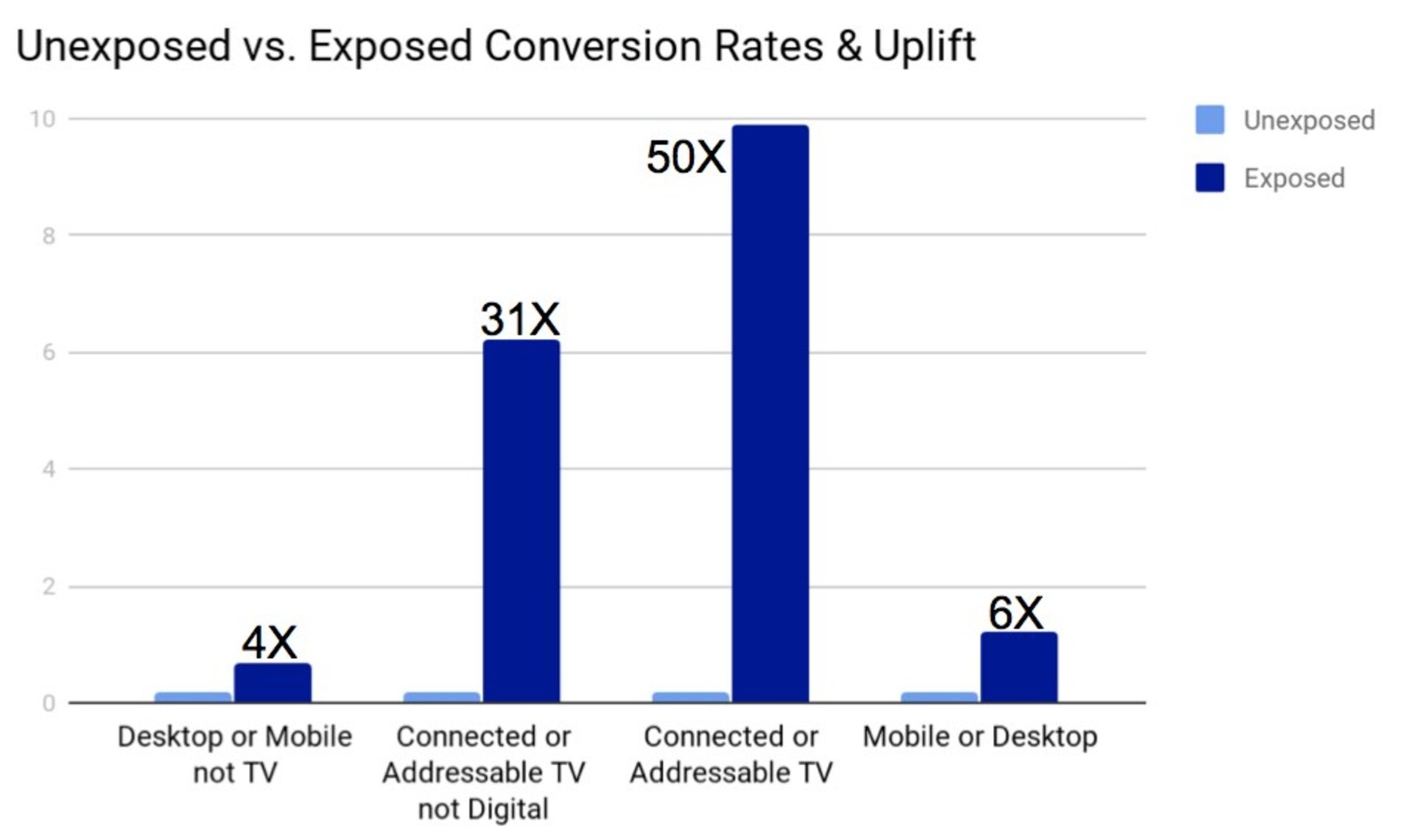
SelecTV results from a recent campaign to promote a new cable TV show, demonstrated a huge tuning uplift among homes exposed to addressable and connected TV, relative to unexposed homes (see graph below). This effect is additionally amplified when homes are exposed to both desktop and mobile advertising.

For this particular campaign, CA was able to harness highly valuable conversion results while the campaign was still ongoing.  Halfway through the campaign, CA knew which creative and audience segments were over and underperforming. CA specifically learnt that there was no benefit in this case to  :30 second commercials as opposed to :15 second spots, the latter costing half the price to place.

Salesforce Ventures Introduces New $50 Million Impact Investment Fund

0
Salesforce

New Fund Will Fuel The Growth Of Companies Using Salesforce Technology To Address Challenges Across Workforce Development, Equality, Sustainability And The Social Sector

First Funding Recipients Include Angaza, Ellevest, Hustle And Viridislearning

Salesforce, the global leader in CRM, announced the Salesforce Impact Fund from Salesforce Ventures, the company’s corporate investment group. The new $50 million fund will accelerate the growth of companies using Salesforce technology to address challenges across workforce development, equality, sustainability and the social sector. The first funding recipients include AngazaEllevestHustle and ViridisLearning.

Comments on the News:

  • “With the new Salesforce Impact Fund, Salesforce Ventures is investing in companies that are not only creating innovative solutions for customers, but also improving the state of the world,” said John Somorjai, EVP of Corporate Development and Salesforce Ventures, Salesforce. “We’re proud to broaden our focus on impact investing as part of our portfolio.”
  • “At Salesforce, we’ve been committed to doing good as part of our business model since our founding and pioneering of the 1-1-1 model,” said Suzanne DiBianca, EVP Corporate Relations and Chief Philanthropy Officer, Salesforce. “The Salesforce Impact Fund allows us to support a new generation of startups that are focused on driving positive social change.”
  • “Ellevest is committed to unleashing women’s financial power and ending the gender gap in investing and personal finance,” said Sallie Krawcheck, CEO and co-founder, Ellevest. “We’re excited to receive an investment from the new Salesforce Impact Fund, given equality is one of Salesforce’s core values, and partner with them as we grow.”
  • “The launch of Salesforce’s $50 million impact investing fund is yet another data point of the growing momentum of the field. With expertise in both venture capital and a fundamental commitment to impact, Salesforce is extremely well-positioned to achieve both financial returns and social impact at scale,” said Matt Bannick, managing partner, Omidyar Network. “We applaud Salesforce in launching this fund and look forward to continuing to provide support to and co-invest with the team.”

Salesforce Impact Fund to Fuel Companies Driving Positive Change on the Salesforce Platform
Salesforce believes that businesses can be powerful platforms for change and is committed to serving the interests of all stakeholders, including customers, partners, employees, investors, our communities and the environment. Salesforce Ventures is uniquely positioned to catalyze the growth of companies who are building products and solutions to benefit society across four key focus areas:

  • Workforce development: Companies enabling equal access to education to prepare students and the workforce for jobs of the future.
  • Equality: Companies developing tools that promote equal opportunity and economic empowerment for women and underrepresented groups.
  • Sustainability: Companies creating better access to clean energy, improving resource efficiency and increasing supply chain performance.
  • Social sector: Companies amplifying impact for nonprofits and NGOs through technology that increases efficiency and transparency.

The Salesforce Impact Fund builds on previous investments in companies driving positive social change and aligns with Salesforce Ventures’ charter to strategically invest in companies built on the Salesforce Platform, delivering unique capabilities to Salesforce customers. The first funding recipients include:

  • Angaza: A leading SaaS platform that enables manufacturers and distributors to make clean energy products more affordable to the world’s 1 billion off-grid consumers.
  • Ellevest: An investing platform designed for women that aims to solve the gender investment gap.
  • Hustle: A peer-to-peer text messaging platform enabling non-profits, educational institutions and advocacy groups to connect with donors and constituents at scale.
  • Viridis LearningA leading human capital SaaS platform that uses machine learning and predictive analytics to facilitate career discovery, create career pathways and ensure learning aligns with 21st century workforce needs.

Salesforce Ventures, A Leading Global Corporate Venture Capital Group
Salesforce Ventures—Salesforce’s corporate investment group—invests in the next generation of enterprise technology to extend the power of the Salesforce Intelligent Customer Success Platform to help companies connect with their customers in entirely new ways. Focused on building the world’s #1 cloud computing ecosystem, Salesforce Ventures is the most active investor in the Forbes Cloud 100 list. Salesforce Ventures has also been one of CBInsights’ top 4 most active global CVCs for the past 4 years.

Portfolio companies receive funding as well as access to the world’s largest cloud ecosystem and the guidance of Salesforce’s innovators and executives. With Salesforce Ventures, portfolio companies can also leverage Salesforce’s expertise in corporate philanthropy by joining Pledge 1% to make giving back part of their business model. Salesforce Ventures has invested in more than 250 enterprise cloud startups in 14 different countries since 2009.

Visual Content Platform Slidely Acquires Unstock, Solidifying Position as Video Creation Powerhouse for Businesses

0
slide.ly

As It Passes $1M In MRR, Slidely Fortifies Its Video Creation Platform PROMO With The Acquisition Of Video Marketplace Unstock, Accelerating Plans To Converge Its Business Platform And UGC Community

Slidely, the visual content platform and creator of PROMO, the #1 video creation solution for SMBs, announced that it had acquired Unstock, a mobile-first UGC (User Generated Content) video marketplace, expanding its ability to empower businesses of all sizes to easily create professional videos for successful marketing endeavors.

Last year, to meet the increasing demand for marketing-based professional video content, Slidely released PROMO, its instant video creation tool for SMBs. Since going live, PROMO by Slidely has attracted over 20,000 paying customers, based mainly in the US, and is set to pass $1M in MRR (Monthly Recurring Revenue) making it one of the fastest-growing marketing platforms for SMBs.

PROMO by Slidely provides access to millions of premium quality video clips from Getty Images, pre-edited licensed music and a user-friendly interface for customizing messages and logos. With PROMO, SMBs have the tools to create videos quickly, easily and affordably that can compete with the big brands’ videos. Over the last month, PROMO released numerous new product features, including Facebook Video Covers, as well as in-product integration with Facebook, HubSpot and Wistia. It was also recently named an official Facebook and Instagram Marketing Partner.

Handpicked as part of Angelpad #10, Unstock is a crowdsourced video marketplace that has quickly built a community of creators and clients.  As part of the acquisition, Unstock’s stand-alone service will cease and its technology will evolve to integrate seamlessly into PROMO’s cloud based service by early 2018. The partnership will allow Slidely to converge the UGC platform of Slidely and the business platform of PROMO into a greater AI-based video marketing ecosystem. The Unstock teams in Silicon Valley and Warsaw are joining the larger Slidely team.

Tom More
Tom More

“The acquisition of Unstock will accelerate our plans to expand into new video types and use cases that further provide value and positive ROI for our current and future customers,” said Tom More, Slidely’s Founder and CEO. “We are very excited about the addition of the talented Unstock team to the Slidely family and look forward to executing on PROMO’s mission to democratize professional video creation for businesses.”

Taylor Reach Group to Co-Produce 15th Annual SCORE Customer Experience Conference

0
SCORE-CONFERENCE

SCORE 2017 will focus exclusively on how companies can develop a Customer Experience Management (CEM) strategy as part of their corporate DNA 

Each year SCORE brings together hundreds of CX, CRM and customer care leaders for a conference and awards gala. SCORE 2017 will focus exclusively on how companies can develop a Customer Experience Management (CEM) strategy as part of their corporate DNA to lock in profitable, long-term customer loyalty. This year’s event will be held on November 1-2 at the Seaport Hotel in Boston, MA.

The Taylor Reach Group, Inc.’s CEO, Colin Taylor, will be a keynote speaker at the conference and will share his knowledge and experience in designing and implementing effective Customer Experience Management strategies. Colin is an acknowledged pioneer and innovator in the areas of Customer Experience, Customer Service, and Contact Centers. For more than 40 years Colin has been helping organizations achieve their Customer Experience and Customer Service goals. Colin’s clients have received more than 30 awards globally and Colin is a regular speaker having spoken on four continents. Other key-note speakers at the 15th annual SCORE Conference include; Bill Moore, Customer Experience guru for designing and delivering CX management best-practices, workshops and employee loyalty training and retention programs. Moore is the Vice President of the Customer Relationship Management Institute (CRMI) and has been operating in the Customer Service industry for 37+ years. Bill will address this year’s theme and “12 Key Components to Building a Successful CX Strategy”. Also speaking will be nationally recognized CRM industry pioneers including VP and CX Branding expert, Bill Bradley, Taylor Reach Group’s President, John Cockerill, and master of analytics, Duncan Heal.

“Customers – not products or services – are the source of all revenue and profits.”

The Taylor Reach Group, Inc.(TRG), a globally recognized Call Center, Contact Center, CEM and CX consulting firm, will be co-producing this year’s SCORE Conference. CEO and Chief Chaos Officer of Taylor Reach Group, Colin Taylor, said, “SCORE is a great opportunity to take your CEM initiatives to the next level and leverage your CEM investments to imbed CEM and the Customer Experience into everything you do. The conference presents best-in-class leaders with new and transformative concepts for customer satisfaction, building culture, employee engagement and customer retention and loyalty, all while demonstrating how these initiatives are linked to increased revenues and profits”.

DataSelf Corp To Release Annual BI Survey Results at Tableau Conference 2017

0
DataSelf

Dataself Corp, Leading Provider Of Analytics And Business Intelligence (BI) Solutions For SMBs, To Release Annual BI Survey Results At Tableau Conference 2017.

DataSelf Corporation, the leading provider of analytics and business intelligence (BI) solutions for small to medium-sized businesses (SMB’s), announced the release of the results of their annual BI survey at Tableau Conference 2017.

DataSelf, the data connection people, have a question for thousands of attendees at the Tableau Conference: Where does the data come from?

Few business users think about data sources. That’s one of the 2017 conclusions based on the annual survey of business intelligence users at mid-sized businesses—the seventeenth annual survey.

That’s why DataSelf thinks so much about data connections. First, to know the sources: Microsoft Dynamics, Sage ERP and CRM, Salesforce, Acumatica, NetSuite, Excel, and other less common ones.

More important, each source requires a connection capable of a full-throttle, pedal-to-the-metal flow of data straight into Tableau’s beating heart. It’s all plumb-and-play (a.k.a. “plug and play”). DataSelf hooks up the data plumbing, and the customer is all set for insights.

Can it be done without help? Yes, but it doesn’t have to be. The typical medium-sized businesses have complex data that can rival larger enterprises. Getting the data plumbing right is no walk in the park.

One more question.

Here’s another question: What’s done with company data? Tableau, the most intuitive visual analytics platform on the market, is a whiz at presenting it

Then what? There is now a nice, shiny data faucet. There are millions of choices for water and a million more for data. Will new insights help to compete? Control costs? Develop products? Exactly how will that data flow into user traction and valuable insights?

Joni Girardi
Joni Girardi

DataSelf is among the only providers of end-to-end connections, resulting in DataSelf connecting the data—and more. DataSelf founder and CEO Joni Girardi says, “Our clients rely on us to help them connect the dots.”

Linksys Velop Marketing Campaigns Honored With Five Mobile Marketing Association Global Smarties Awards

0
Linksys

Linksys Velop Mobile Marketing Campaigns Recognized for Creativity, Execution, Strategy and Effectiveness in the Global and North America Categories

 Linksys®, a leader in providing home and office Wi-Fi networking solutions, announced that it has won five Mobile Marketing Association (MMA) 2017 Global and North America Smarties™ Awards for its mobile marketing campaigns on Linksys Velop – whole home Wi-Fi modular mesh system.

The Global and North America Smarties Awards honor the marketing teams and creative talent driving business impact through the power of mobile. Mobile Marketing is defined as including advertising, apps, mCommerce, messaging, and Customer Relations Management (CRM) on mobile devices such as smartphones and tablets.  The Velop Location Based Services and Targeting campaign won Two Gold Smarties Awards – one Global and one North America.  The Linksys Velop Brand campaign was awarded globally as its Velop Relationship Building / CRM campaign was awarded globally and in North America with Silver and Bronze Smarties.

Kieran Hannon
Kieran Hannon

“The pioneering approach Linksys took with the innovation behind Linksys Velop is also reflected in the way the story is told through the medium of mobile,” said Kieran Hannon, Chief Marketing Officer for the Belkin International brand portfolio – Belkin, Linksys, WeMo.  “With our marketing partner Possible, the collective team is very proud of this honor, winning both golds – global and North America, recognizing a world-class home Wi-Fi brand with Linksys Velop.”

The 2017 Smarties recognized the best-of-the-best mobile campaigns from hundreds of marketing, media, technology and agency organizations worldwide, and placed a greater emphasis on the business impact of the entries than in previous years, making the Smarties Awards the first global, mobile-centric program to focus on such benchmarks.

This year’s winners were selected by the MMA’s independent jury comprised of 27 senior brand and agency professionals under the guidance of jury president Richard Kellum, CMO of Goodyear.

According to the MMA – The 2017 entries, which included campaigns from 30 countries, were first pre-screened by a council comprised of over 100 senior level mobile marketers prior to judging by the independent jury. For this year’s awards, the MMA revised judging criteria to make business impact 40 percent of each entrant’s overall score while creative, strategy and execution each made up 20 percent. The change expands beyond simply looking at the ROI of campaign performance to include overall impact of aggregated work for a company.

AtScale Appoints Former Goldman Sachs Executive Pete Perrone as CFO

0
atscale

Perrone Brings Financial Expertise To Big Data Leader As It Continues Its Hyper-Growth Trajectory

AtScale, the only company to provide enterprises with a universal semantic platform for BI on Big Data, announced today the appointment of Pete Perrone as Chief Financial Officer. In this role, Perrone will be responsible for developing the framework and processes necessary to continue supporting AtScale’s rapid growth.

Ryan Floyd
Ryan Floyd

“AtScale is a case-study for what rapid product-market fit and hyper-growth look like in the enterprise: the company has enabled the world’s most recognizable brands to achieve value from Big Data,” said Ryan Floyd, Founding Managing Director of Storm Ventures. “We are excited for Pete to join. He will help AtScale achieve its next milestone: becoming the de-facto standard for BI on Big Data.”

Pete Perrone
Pete Perrone

Perrone comes to AtScale with more than 20 years of finance, operations and investing experience in high growth, venture companies, and has also held CFO positions at public and privately held companies. He was previously Managing Director at Goldman Sachs and CFO of Limelight Networks and Percolate Industries. Pete earned engineering degrees from Duke University and Georgia Tech, and an MBA from MIT Sloan.

“AtScale has the opportunity to disrupt the Business Intelligence market in the same way Business Objects did it in the nineties,” said Perrone. “The company’s product addresses a huge technical gap and pain point in this vast market.  Its early customers are some of the most recognizable companies in the world and the company has realized enormous business benefits. I am excited to join this team and help with the continuing growth of the company.”

This appointment comes on the heels of major industry recognition for the company: CRN recognized AtScale as an Emerging Big Data Vendor for 2017 and credited the company for “its critical role in bridging the gap between popular, user-centric data visualization tools and big data sources, on-premises or in the Cloud.”  451 Research highlighted AtScale for its “highly differentiated offering” and for its ability to address “a wide variety of use cases and workloads.”

CRM Web Solutions Announces Equity Investment from Growth Street Partners

0
Growth Street Partners

Growth Street Partners has made a minority growth equity investment in CRM Web Solutions, the creators of ChildCareCRM®, the leading provider of customer relationship management and marketing SaaS for the early childhood learning industry. CRM Web Solutions’ SaaS solution, known as ChildCareCRM®, allows early childhood learning center owners, directors, and marketing teams to improve their marketing effectiveness and convert more inquiries into enrollments.

Chuck Gibbs
Chuck Gibbs

“The partnership with Growth Street is an important milestone in the company’s history. It will allow us to accelerate growth and to invest in our people and industry-leading product to deliver even greater value to our customers,” said Chuck Gibbs, who is the CEO of CRM Web Solutions and co-founded the business with Ryan Hodges and Seth Martin in 2009.

Gregory Helwig
Gregory Helwig

The company’s SaaS solution is used by over 2,200 early childhood learning centers throughout the U.S., CanadaAustralia, and, more recently, New Zealand and the United Kingdom. Customers include single center owners and nationwide operators. “We are excited about the Growth Street partnership. Our organization has been a very happy ChildCareCRM® user since 2013 and is looking forward to benefitting from the accelerated product innovation and investment in the team that this venture should bring,” explained Gregory Helwig, CEO of Kiddie Academy®.

Nathan Grossman
Nathan Grossman

“Growth Street is thrilled to partner with CRM Web Solutions,” said Nathan Grossman, Co-Founder of Growth Street Partners. “The partnership will help the company meet the tremendous demand for customer relationship management and marketing software in the early childhood learning industry.”

Stephen Wolfe
Stephen Wolfe

“The founders’ deep domain knowledge makes them great partners for Growth Street and uniquely positions the company to deliver value to the entire spectrum of child care center operators,” added Stephen Wolfe, Co-Founder of Growth Street Partners.

In conjunction with the investment, Stephen Wolfe and Nathan Grossman will join the Board of Directors, which will include Co-Founders Chuck Gibbs and Ryan Hodges.

Bluehost’s New Technology Offers Small Business Owners and Entrepreneurs a Quick and Easy WordPress Solution

0
bluehost

New Bluehost Experience Enables WordPress Users To Create A Scalable Website In One Simple Click.

Leading Web hosting provider Bluehost, an Endurance International Group company and top-rated web host by WordPress.org, has introduced a new user experience that greatly simplifies the process of publishing a WordPress-powered website. Designed for novice WordPress users, with all the features an expert needs, the new Bluehost platform provides intuitive steps that help small businesses get online fast.

Suhaib Zaheer
Suhaib Zaheer

“WordPress is the most popular online publishing platform but it can be a complex software for time-starved small business owners and entrepreneurs to master,” said Suhaib Zaheer, senior vice president and general manager, hosting brands at Endurance International Group. “Our customers and the WordPress community have asked for a solution that enables them to quickly and easily build and manage a WordPress site so they can spend more time doing what they do best: running their business. Our new technology does just that.”

The new interface guides customers through the entire journey of managing a website, including the initial registration process, building and publishing their site, and ongoing website management. All aspects of their Bluehost account, including websites, domains, and email, can be easily managed via a redesigned, easy-to-navigate control panel. As business grows and website needs evolve, advanced tools are available to amplify their web presence. For example, the new Bluehost platform boasts an integrated Marketplace, a one-stop shop to select WordPress themes, plugins, add-ons and services and support, so customers can continuously build, brand, and expand their online properties.

In addition, to ensure that customers are able to successfully implement these features and easily manage their websites, Bluehost offers access to a dedicated team of WordPress experts 24/7, as well as WP Live, a concierge-style support service package.

“We have received overwhelmingly positive feedback about these upgrades and are already seeing our customers publish more content using the new platform,” added Zaheer.  “This reinforces our belief that the new Bluehost experience provides a fast and easy solution to building a WordPress site, enabling our customers to grow their digital presence and share their ideas with the world.”

Connekt Emerges from Stealth Mode to Launch Transformative TV Advertising and Commerce Platform

0
connekt

Enters Market With Patented, AI-Driven Solution Built For Scale, Prominent Partnerships With LG And Gracenote, And An Experienced Executive Team

Connekt is emerging from stealth mode to unveil its technology solution that enables brands, distribution platforms and media companies to generate revenue streams from TV advertising and commerce. Powered by the industry’s only in-content transactional advertising engine using artificial intelligence (AI), Connekt allows consumers to directly engage with TV ads and content in real time and provides them with an instant path to purchase.

Founded by industry pioneers with extensive experience in the TV industry, Connekt has already forged partnerships with leading organizations in the media ecosystem, such as LG and Gracenote (a Nielsen company), and its platform is currently available in millions of connected devices across the country.

Innovation Driving the TV Advertising Opportunity
eMarketer projects there will be 97.7 million connected TV households in the U.S. by 2020. As consumers view more internet-enabled content on connected devices, it’s opening the door to unparalleled innovation and engagement. Connekt’s platform capitalizes on this opportunity by enabling advertisers and content companies to participate in a two-way conversation with consumers that ultimately drives them to purchase.

Mike Fitzsimmons
Mike Fitzsimmons

“Having been part of the team that pioneered some of the earliest innovation in the worlds of converged e-commerce and television advertising, I am excited to take on this challenge,” said Mike Fitzsimmons, Connekt co-founder and CEO. “The timing couldn’t be better to continue driving the transformation of TV advertising, especially with the tailwinds of AI and machine learning at our backs. We’re determined to transform TV from a one-way communication medium to a fully immersive experience for viewers and brands.”

According to eMarketer, TV ad spending will reach $71.65 billion in 2017, and the amount spent on addressable TV ads, in particular, will more than double in the next two years.

Bre Rossetti
Bre Rossetti

“Video is the most important medium for us in the advertising community,” said Bre Rossetti, senior vice president of innovation at Havas, a multinational ad agency. “Connekt makes ads more interactive and persuasive, and backs them with intelligence about TV viewers’ habits to help us make more informed decisions about where to spend. Connekt even goes a step further to offer a path from content to commerce. That’s a powerful proposition.”

The Connekt Platform, Powered by AI, Machine Learning and T-Commerce
Connekt’s advanced TV advertising platform is an end-to-end solution that enables marketers and content companies to unlock previously untapped revenue streams. Core products include:

  • CARL: Artificial Intelligence – The supercomputer behind the Connekt platform, CARL uses AI and deep learning to automatically process, transform and analyze billions of unstructured TV viewership, engagement and commerce data to provide reliable predictive targeting, ad delivery and measurement.
  • FLX: Ad Tools – Connekt’s proprietary ad delivery platform facilitates the creation, optimization and management of in-moment campaigns from one centralized interface.
  • Transakt™: T-Commerce – Connekt’s patented Transakt t-commerce technology enables viewers to engage directly with a TV ad or programming and seamlessly complete a transaction.
  • Datascope: Reporting and Analytics – Connekt combines real-time viewership data with first-party engagement and transaction data to provide partners with the audience insights and behavioral research necessary to measure the ROI of their TV media investment.
David Rudnick
David Rudnick

“We have built a cognitive engine that introduces an unprecedented level of intelligence into the TV advertising formula,” said David Rudnick, Connekt co-founder and CTO. “I’ve spent years innovating in this industry and can say this technological leap is truly changing how consumers interact with content, and enabling agencies and brands to bring the power of internet advertising to the big screen.”

Also Read:  For Publishers, Premium Will Always Be Preferred Over Programmatic Advertising

Celebrus Points the Way to GDPR Compliance with New Product Release

0
GDPR

Latest Update Delivers Host Of Crucial GDPR Compliance Enablers

Celebrus has announced general availability of the latest release of its leading enterprise Customer Data Platform (CDP). Offering an accelerated journey for organisations challenged by the EU’s General Data Protection Regulation (GDPR), the new Celebrus GDPR-compliant CDP delivers timely features in key areas of the legislation which is due to come into force in May 2018. It supports an enterprise storing all of the consent data provided by visitors to its digital channels, not only detailing a comprehensive view of the entire customer journey but also acting as an enabler for compliance by identifying the precise point at which consent was granted or amended.

The key components of the Celebrus GDPR-compliant CDP are:

  • Complete support for GDPR rights including access, erasure, rectification, and audit. This addresses the key concerns for EU citizens that the GDPR is designed to overcome.
  • Granular collection rules to support rich consent levels, including opt-out and anonymous data collection. This enables businesses to achieve unrivaled insight from their digital channels, even when no consent has been granted by visitors.
  • Control over initial consent when new visitors arrive on a site or mobile application with dynamic consent allowing real-time changes to permissions in-session. This consent status is also passed to downstream applications and facilitated across channels with database lookups.
  • Pre-built connectors to data warehouses for complete audit trail alongside assembly and sharing of captured PII data with visitors in a readable format.

Additional features are also being made available in this release, continuing the Celebrus heritage of innovation and leadership in the CDP marketplace:

Streaming Analytics, Feeding Industry-Leading Clouds
Enriching the Celebrus CDP’s existing streaming capabilities, this release makes available new connectors for clients using Java Message Service (JMS) and Kafka including those using cloud-based event queuing services like those available on Amazon Web Services, Google Cloud, and Microsoft Azure. These enhancements support the growth in demand among enterprises for real-time streaming of customer behavioral data into systems of insight and engagement for decisioning, personalization, marketing automation, fraud identification and other advanced analytics applications.

Database Enrichments, Unrivalled Customer Profiling
Reinforcing its status as the market’s most comprehensive real-time enterprise Customer Data Platform, this release of Celebrus delivers database enrichments that create new events on the Celebrus Event Stream from external data sources. This feature supports MariaDB, Microsoft SQLServer, MySQL, Oracle, Oracle OCI and Teradata, calling out to remote systems to gather information for captured events. This enhances a business’s ability to verify enterprise-wide consent information about an individual when they arrive on site as well as providing opportunities to gather data in real-time that delivers more accurate, personalized experiences.

Device Orientation Capture for CX, Pixel Tracking for Campaign Attribution
The Celebrus CDP already offers a patented, tagging-free capability to capture customer data from across all digital channels and this release extends that functionality to provide rich behavioral data about device orientation on mobile devices. This enables an enhanced view of customer experience and offers unrivaled support for developers of mobile apps and mobile-optimised websites. This will increase the quality of mobile interaction for Celebrus clients and optimise customer engagement on these channels.

For digital marketers, the Celebrus CDP now measures the performance of banner advertising with a new pixel tracking feature. Pixel tracking is triggered when a banner ad is placed on an advertiser’s website and allows Celebrus to join up current and future customer behavior with historic activity for a complete picture of campaign attribution and advertising performance. This can also leverage the data within an existing data management platform (DMP) to enhance the opportunities for analysis of campaign responses and customer behaviors.

Peter Kear, CEO of Celebrus’ parent company, D4t4 Solutions Plc, commented: “The latest update to the Celebrus CDP features so many advancements that it almost feels like a major release. The GDPR-compliant capabilities of our platform are an opportune addition to our clients’ GDPR initiatives and will accelerate their journey to compliance.” He added: “Thanks to innovations made by our talented product development team, we can also package a raft of additional enhancements in this release too. Our broadening of streaming analytics connectors makes real-time data available to more systems of insight and engagement than ever before while the new database enrichments provide our clients with greater opportunities to enhance customers’ experiences and increase loyalty through profiling. Finally, CX professionals will be delighted with the enhanced behavioral data on mobile device orientation while digital marketers will be able to drive increased ROI from their banner campaigns with our new pixel tracking feature.”

Button Welcomes Walmart To Its Mobile Marketplace

0
Consumers Want New Apps, Yet Mobile Marketers Fall Behind On Discoverability

At the third annual TAP Conference, mobile partnerships platform Button announced the addition of Walmart to its Marketplace. As one of the newest Merchants to join Button’s revolutionary marketplace, Walmart will now have the ability to rapidly scale and partner with Button’s affiliates on mobile.

Michael Jaconi

“Walmart joining Button’s Marketplace is one of the greatest accomplishments for the company to date. Enabling Walmart to expand the partnerships that matter most to them to the mobile channel is a core ingredient in their digital growth strategy.  Now, with Button playing an important role in that strategy, I’m confident our platform will deliver the highest-converting channel for mobile buyers that exists,” added Michael Jaconi, Founder and CEO of Button.

A Growing Marketplace of Leading Retailers

As mobile commerce continues to grow, with smartphone sales expected to reach more than $102 billion in 2017 alone, retailers are seeking new avenues to tap into the growth of the mobile economy and acquire new users for the highest converting channels they have – their apps. Most of the world’s leading brands have turned to Button to bring the “performance marketing world” properly into mobile. In addition to adding Walmart, the Button Marketplace has also added more than 30 diverse new retailers to the platform. These include fashion companies such as Gap, Express, and Under Armour; digital travel brands such as Hotwire, HomeAway, and VRBO; retail giants such as Target, QVC, Walgreens, and Sears; among many others.

“Our partners represent a diverse group of brands, all acting as the leaders in their respective industries. We see some Button Publishers strategically partner with retailers targeting travelers using Hotwire, some targeting the pet owners of PetSmart, or the breadth and depth of a retailer like Walgreens,” added Jaconi. “It’s exciting to see our Marketplace grow to provide our partners with even more possibilities – giving their users what they want, all at the touch of a button.”

New Merchants working with Button include:
Backcountry
Barnes & Noble
Charlotte Russe
Choice Hotels
Foot Locker
Hotwire
Lane Bryant
LivingSocial
Petsmart
Six:02
Vitacost.com
Walgreens

Button Gets a Taste of Buzzfeed

In addition to a host of new Merchant partners, Button has also welcomed a new Publisher to the platform: Buzzfeed. Known for their viral content and outstanding social following, Buzzfeed will now be able to tap into mobile commerce through a range of exciting new partners within the Button Marketplace.

“Buzzfeed is the king of merging content and commerce in the most authentic way. Incorporating mobile shopping for consumers within their properties is an exciting opportunity, and the variety of Button Merchants combined with Buzzfeed’s content creates endless possibilities for all partners – a win, win all around,” added Jaconi.

Merchants Increase Online Sales Revenue Using Ecomchain’s Artificial Intelligence Features

0
ecomchain

Retailers around the globe have been in a mode of constant innovation, but are challenged by many other electronic commerce competitors who have shown excellent results using various online solutions. Many of these online stores have been using Artificial intelligence (AI) to gauge the shoppers’ demand, interests to enhance the shopping experience and make them a repeat shopper. However there are very few eCommerce tools or platforms to launch AI features for an online store(s).

eComchain's Artificial Intelligence
eComchain’s Artificial Intelligence

Increase online sales revenue using eComchain’s Artificial Intelligence features such as Customer-centric search, enabling the search engine to think the way humans do, in addition to retargeting potential customers by identifying prospects. With the help of Omni-channel personalization and personalized chatbots, the online retailer can now easily increase the conversation rate of an online shopper.

So what does it takes to make your Online Store intelligent? Using eComchain, retailers can now use powerful and practical ways, assisting interactions with the end consumer, resulting in increased online revenue and profit.

eComchain uses Customer-centric search, enabling the search engine to think the way humans do, in addition to retargeting potential customers by identifying prospects. With the help of Omni-channel personalization and personalized chatbots, the online retailer can now easily increase the conversion rate of an online shopper.

Rob Hayes
Rob Hayes

“Every merchant using eComchain can avail of these cool AI features within their next fiscal quarter to increase their sales revenue. AI is already present in every device that we use on a daily basis, including Netflix or LG refrigerators. AI in eCommerce is maturing, and will quickly dominate many areas of online shopping,” says Rob Hayes, Business Development Director of eComchain, who has spent 30+ years in the retail industry having worked for Marshall Fields, Lands’ End and JC Penney before joining eComchain early this year.

Marketo Unveils ContentAI to Strengthen the AI-Powered Engagement Economy

0
Marketo Unveils ContentAI to Strengthen the AI-Powered Engagement Economy

Solution Built For Marketers Personalizes Cross-Channel Content At Scale For Better Customer Engagement

Marketo, the leading provider of engagement marketing software and solutions, has announced Marketo ContentAI™, an artificial intelligence-powered solution that engages each customer with the most relevant content across channels. In addition, the solution uniquely predicts the content most likely to convert each audience segment, helping marketers develop data-driven content marketing plans. This announcement reinforces Marketo’s commitment to providing marketers with leading-edge AI solutions that empower them to win in the Engagement Economy.

ContentAI is the only solution that makes content personalization scalable for marketers by auto-discovering and cataloging website assets and using AI to determine the best content to display to each audience. Marketers personalize their websites, mobile experiences, and email with ease through drag-and-drop content placement, while maintaining control over what is delivered through each channel.

These AI-driven capabilities help brands move toward the goal of one-to-one engagement without requiring a significant increase in resources to tailor experiences at scale. The solution is built natively on the Marketo Engagement Platform, leveraging the platform’s customer data repository for more precise and personalized experiences at every touchpoint.

“Today’s customers expect and demand that brand interactions are relevant, personalized, and delivered at right the moment. Marketo’s survey of more than 2,000 global marketers and consumers found that the number one reason customers do not frequently engage with brands is irrelevant content. With Marketo ContentAI, marketers make every interaction with each customer more valuable, and this engagement drives revenue. In fact, we discovered that, on average, brands who leverage the ContentAI solution experience a nearly 75% increase in clicks compared to a traditional, rules-based approach,” said Manoj Goyal, Chief Product Officer, Marketo.

The following ContentAI capabilities are now available as part of the Marketo Q3 2017 product release:

  • Automated content discovery for easy set up and fast time-to-value without burdening IT
  • The industry’s only AI-powered recommendation engine that predicts the best-performing content for each audience to guide content planning and improve campaign results
  • AI-powered content delivery, which automatically inserts the content most likely to engage and convert each recipient, across email, web, and mobile devices
  • Audience insights for every content asset, so marketers can better understand who their content attracts
  • Key metrics showcasing top content views, conversions, and more to measure the business impact of each content asset

“Marketo ContentAI is built for marketers, taking the guesswork out of determining what content will resonate best with each person who interacts with our brand. The solution enables us to engage with speed and precision by leveraging our audience insights to tailor each experience in the moment and at scale. This gives our marketing organization the control and transparency we need to test and trust the outcomes of our personalized customer experiences,” said David Van Everen, vice president, corporate marketing, Mirantis.

According to Marketo’s latest report, The State of Engagement, nearly 40% of marketers plan to leverage emerging technologies, such as AI and machine learning, to enhance content used throughout the customer journey. This AI-powered technology is essential, as 72% of marketers are expected to prioritize the use of personalized messages and content to engage with their customers.

Marketing Trends: Rise of the B2B Consumer

2
Marketing Trends
Marketing Trends Rise of the B2B Consumer

episerver logoWhen it comes to the business-to-business (B2B) world, marketers are rarely faced with the same fast-paced change that they have come to expect when dealing with consumers.

Traditionally speaking, B2B commerce has always relied on a much longer customer journey than its B2C counterpart. Whether incorporating a new business partner, investing in a new technology or finalizing a commercial deal, B2B decision makers will rarely make a purchase on a whim.

For this group, the age-old marketing tactics of Product, Place, Price, and Promotion remain true and are arguably still as effective now as they’ve ever been. But that’s not to say that the customers themselves in the B2B buying world haven’t changed.

Across the board, we are witnessing a consumerization of business, with consumer mind-sets bleeding into the B2B approach. The days of commercial decision making taking months or even years are slipping away.

Regardless of whether they are shopping for themselves or in a professional capacity, today’s customers have grown so accustomed to speed, convenience and a quality experience that they cannot help but expect a similar scenario in all aspects of their lives.

Today’s B2B customers are more susceptible than ever before to marketing, advertising, and branding, often valuing customer experience over the specific attributes of a product or service. While this is good news for B2B marketers, it also poses some challenges. The fickle nature of the new “B2B consumer” can be a double-edged sword, with B2B deals being increasingly susceptible to the “blink of an eye” switching decisions that B2C buying cycles have traditionally struggled with.

Marketing Technology News: Adobe Survey Says That Voice and Screen Combined Are the Future

There is an opportunity emerging, however, in digital commerce. As B2B decision makers grow increasingly consumerist in their approaches, they also become more open to making B2B purchases online. This fact is already starting to emerge in several clear ways:

  1. Email marketing is back in the game. For a long time, it has been assumed that email marketing does not have the same impact in the B2B space as it does with consumers, who will take action in an instant when they receive an appealing deal, offer or discount. As marketing guru Scott Stratten explains, “you can’t shortcut relationships: nobody ever bought an airplane after reading one email.”

With the consumerization of B2B decision-making, however, email marketing is once again finding its place in the B2B landscape. When used carefully and with skill, targeting senior decision makers with a personalized and professional message can have just as much impact in the B2B space.

  1. The B2B buyer journey is increasingly mobile. As with email, many marketers assume that large-scale B2B purchases are never going to be completed via a mobile phone. The reality is that more work than ever before is now being conducted on mobile devices and tablets. As such, B2B brands that ignore mobile marketing in favor of a static desktop approach are rapidly falling behind.

According to one study, 42 percent of researchers use a mobile device during their B2B purchasing process. Given this growing, mobile-first approach, B2B brands that fail to provide responsive, mobile-friendly content as part of their sales funnel will inevitably see a drop in traffic, a drop in leads and, ultimately, a drop in sales.

  1. Experiences are king. As B2B decision makers have grown more consumerist in their attitudes towards purchasing, their expectations of the customer experience have also shifted. Instead of using their own research, they now rely far more on on-site guidance and product information. This not only means the incorporation of static spec-sheets and product descriptions, but increasingly the use of rich content such as animated walk-throughs, interactive tours and streaming video content.

Marketing Technology News: OpenText Automates Invoicing for Rosneft Deutschland

At the same time, as the volume of content increases, B2B commerce sites must also start to provide ever-more advanced search capabilities. Today’s B2B customers must be able to find what they’re looking for in a matter of seconds, with the ease of the buyer journey being almost as important as the end product itself.

  1. The B2B buyer is ready to buy online. Fully attuned to digital purchasing in the B2C world the B2B buyer now expects quick orders and repeat orders to be carried out online. Gone are the days of reviewing a PDF catalog and then sending a Request For Quote (RFQ) over to a distributor or wholesaler even if the distributor who’s ultimately fulfilling the order.

Many B2B manufacturers are taking their first steps in this direction by moving from an online PDF to an interactive catalog, and others are launching new lines direct to consumer.

One thing’s for sure, the B2B world is evolving fast and embracing digital transformation as it goes. It may be a bigger overall market but competition is no less extreme. Ignore the new B2B consumer at your peril!

To find out more about how consumerization is changing B2B commerce and the decision-making approach, download Episerver’s Seven Mobile Commerce Trends report.

Marketing Technology News: Airbnb Introduces New Search Capabilities for Business Trips

Get Smart Content Rebrands Itself as Bound

0
Get Smart Content
Get Smart Content Rebrands Itself as Bound

As Bound, Get Smart Content Launches 360 Persona Technology to Help B2B Marketers Drive Digital Engagement at Scale

Leading website personalization platform Get Smart Content is now Bound. The experts in digital marketing personalization announced the changein identity, effective immediately. With the adoption of its new brand and logo, Bound has simultaneously launched its redesigned website– . The company has also unveiled its new personalization platform, 360 Persona Technology.

Bound’s 360 Persona Technology is designed to help marketers understand their anonymous web visitors and engage them with real-time web personalization. The technology binds together fragmented data sources into a 360-degree digital persona.

Jim Eustace, CEO of Bound, said, “Marketers no longer need to rely on a persona as a concept only. Revenue marketers are building live detailed personas based on data attributes including job function, size of business, industry, seniority, and buying intent.”

Recommended Read: Interview with Jim Eustace, CEO at Get Smart Content

Bound’s 360 Persona Technology leverages over 20 data sources including, Linkedin, ClearBit, Kickfire, Tealium, native website data, and marketing automation platforms including Marketo and Eloqua. The data is organized into five types of attributes – firmographic, demographic, offsite intent, onsite behavior, and marketing automation platform custom fields to develop a vendor’s 360-degree persona.

Using Bound’s 360 Persona Technology, marketers can answer questions like, “how many healthcare IT decision makers visited my website last month and how well did they engage with the content on my site?” Marketers can also view how those IT decision makers engaged with the site versus other personas in the buying group, such as business decision makers. 360 Persona Technology provides a foundation for validating a marketer’s web audience and launching personalized web campaigns to dramatically improve engagement for the various stakeholders in a buying group.

Alignment with SiriusDecisions’ Demand Unit Waterfall(™)

SiriusDecisions recognized the need for marketers to engage the entire buying group and recently updated its Demand Waterfall to include demand units, a new demand type that places personas at the center of driving demand. In addition, SiriusDecisions introduced several new stages to their waterfall including an ”Active Demand” stage that recognizes many prospects are in market for solutions but have not yet engaged with marketing programs. In web terms, this translates into 95 percent of web visitors never filling out a form and formally engaging into a buying cycle, yet many of those buyers do indeed play a role in the buying group.

Jonathan Tam, SiriusDecisions Research Director, Demand Creation Strategies, said, “The new SiriusDecisions Demand Unit Waterfall recognizes the importance of engaging buyers in the active demand stage. Personalization solutions that identify a visitor’s persona and guide them to relevant content can instantly lift demand to the engaged stage significantly.”

Most notably, Bound’s data partnerships enable marketers to leverage unique data to engage key influencers and decision-makers with role-based targeting, which is essential to SiriusDecisions’ persona-centric approach.  

Bound’s 360 Persona Technology allows marketers to segment their anonymous web audience by persona attributes and learn how those prospects engage with the content on a vendor’s site. Bound’s personalization solutions allow marketers to develop marketing campaigns specifically designed to engage personas along their buyer journey.

Currently, Bound would continue to provide audience profiling, segmentation, and personalization solution. Combined, the platform and personalization experts empower marketers to build advanced segments and deliver personalized experiences that increase ROI on digital channels, convert leads, upsell, and close deals.

TechBytes with Sean Zinsmeister, VP of Product Marketing, Infer

0
Sean Zinsmeister
Sean Zinsmeister, VP of Product Marketing, Infer

Sean Zinsmeister
VP of Product Marketing, Infer

Modern marketers rely heavily on predictive intelligence and AI in building a true, single-source definition of customer experience based on data and analytics. The biggest question in a competitive AI landscape is how human factors would influence the industry. To get a clear picture on everything-AI and intelligent sales platforms, we spoke to Sean Zinsmeister, VP of Product Marketing at Infer.

Html code here! Replace this with any non empty text and that's it.

MTS: Tell us about your role at Infer and how you got here?
Sean Zinsmeister
: Thanks so much for thinking of me for this series. I’m the VP of Product Marketing at Infer. I help craft the messaging and go-to-market strategy delivering AI products to some of the greatest businesses in the world.

Before I joined Infer, I was actually one of their first customers when I directed Global Marketing Operations at Nitro, a document productivity company known to many as the #1 alternative to Adobe Acrobat. Our team was in charge of architecting our marketing automation solution to grow revenue from our online buyers (smaller license deals, e-commerce) and demand for our direct sales team (volume license deals).

Nitro’s software is incredibly popular. So much so, we were dealing with over 100,000 inquiries every month of users who were either downloading content, activating a free trial and more. For a high-growth mid-market company, that’s an impressive amount of data. The challenges were how to effectively pipe all that through the system while not losing our shirts on data storage costs (a growing budget challenge for C-levels).

Infer was purchased by Nitro’s head of revenue at the time. The technology was dropped on my desk to “figure it out.”

A vague and sinuous directive I’ve become accustomed to in my career. Before I got into Marketing Operations and Product Marketing, I studied Music Composition & Theory, which I whimsically call my first introduction to artful algorithms.

From there, I worked professionally as a sound designer and audio engineer for many years – this stage marked my first introduction to systems thinking and design or as I call it “The Art of Signal Flow.”

It was ironic really. Sound Design has very similar goals to marketing. “Make it sound good” vs “Make a message that influences, resonates, or calls to action.” To me, they are one and the same. Audio engineering presupposes many different modules, a sequencer to edit events, and a focus on capturing the highest-quality inputs you can. My inputs at the time was audio, and fast-forward in time just before Infer to draw the correlation with Marketing Operations, quality sound and quality data are keys to the same goal – “Make it sound good.”

The second part that fell into place for me was the technological orchestration. A careful dance any marketing technologist must exercise. As I mentioned earlier, both Ops and Sound Designers must integrate a number of different modules, software, and controls to achieve the most optimal or desired outcome.

When Nitro purchased Infer, my eyes were open to an entirely new blueprint for automating the customer journey.

A way for our system to be more efficient, reduce costs and even provide guideposts for customer journey sculpture. It would feel like adding premium oil to your car, it breathes new energy into the machine. At that point so many locks burst open in my mind.

My imagination was in love with both the Infer team, and the incredible work they were doing in AI and predictive analytics. Infer says that you do “300+ million predictions using thousands of models.”

MTS: How are predictive models built for Sales and Marketing Intelligence platforms? What volume of data would give the most accurate results for sales teams to build their Predictive Behavior Models?
Sean: Before we start diving into model building, etc. I want to state from the outset that it really depends on the type of problem you are trying to solve. The onus is on the business – they have the domain expertise. It’s then up to our team to translate that into a machine learning problem. Machine Learning itself is a solution. To be most effective, we need to clearly understand the business problem you are trying or believe you are trying to solve.

In addition to defining the problem, it’s important to also help define success. For example, our problem at Nitro was that we had too many leads. Human capital couldn’t possibly slug through all of them, but we didn’t want to miss any of those that expressed intent and looking like a great fit for our product line. The solution was our predictive scoring model, and success for us was a conversion point defined as inquiry to SQL.

For model instruction, I like to think in “3’s” which is actually a simple method to think about how predictive models are constructed.

You have inputs, an AI engine, and outputs:
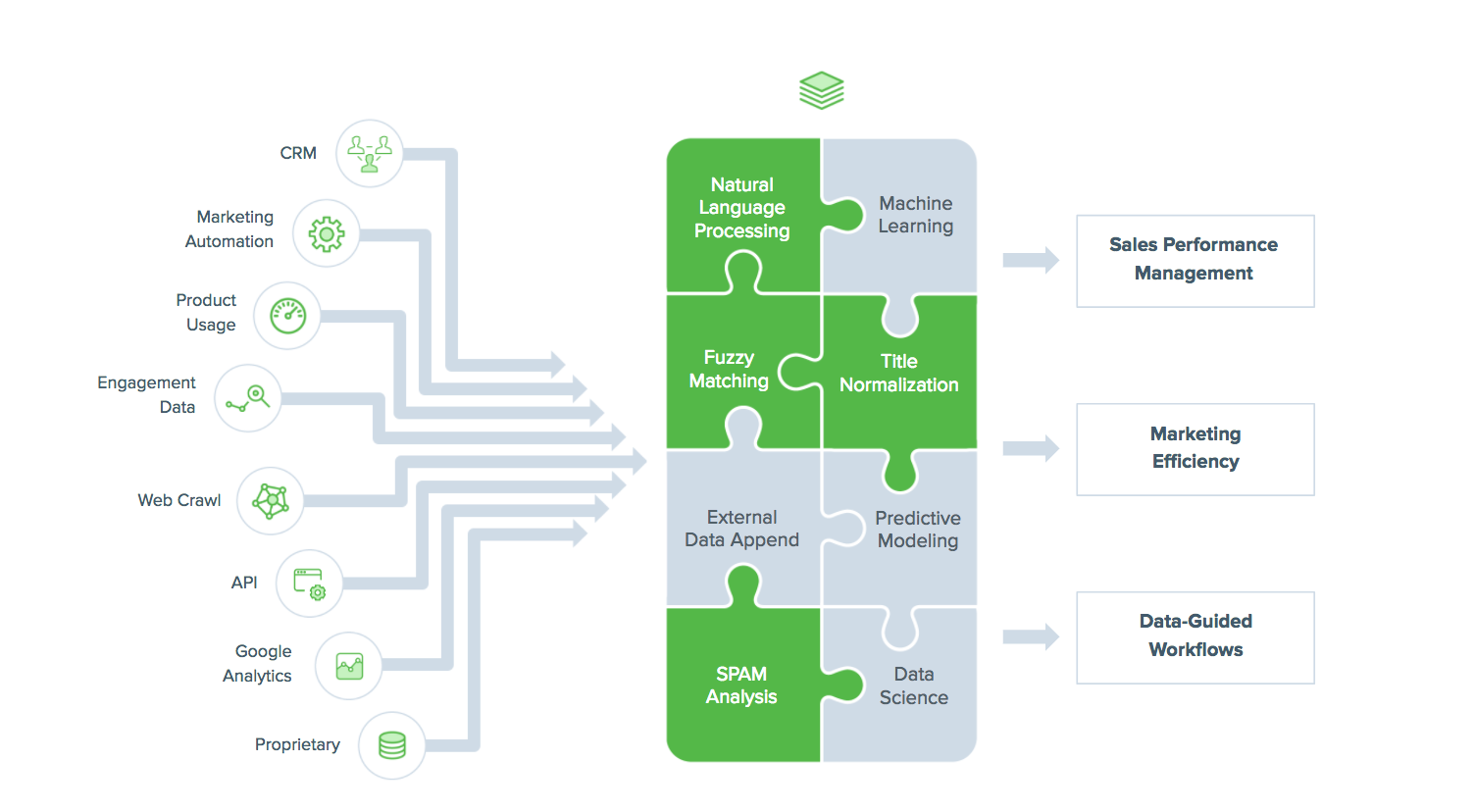
Depending on the type of model, you first need to synthesize all of the databases you want to use. This is where a fluid dialogue with the customer becomes vital. They might believe certain data sets are more valuable than others. Many times they are surprised when new signals are bubbled up, or not considered at all predictive in a model. Once you collect all of the data, which for many businesses starts with CRM and Marketing Automation (MAP) we then work to prepare the data. Datasets need to be sanitized after they are centralized (lots of -izes involved in this process certainly). Customer data is never clean. Most have missing values, incorrect values, and more clever issues. This means data needs to be normalized and enriched with 3rd-party sources in order for a trust-worthy model to be built with confidence.

We then divide the data into training and testing sets, and our platform also allows us to test multiple algorithms (something unique to Infer) to allow us to understand which is the best to be used – it could be Naive Bayes, Random Forest, just to name a few. A majority of the algorithms used are classification models, which makes sense given the common use cases for Sales & Marketing teams – filtering, prioritizing, segmenting and qualifying prospects.

There are two primary types of models that we build: Fit and Behavior. Fit Models consist of mostly static sets of data like technographics, firmographics, and demographics. While behavior models are time-based. The data set is not flat. This is why our data science team has separated these into two separate products that we offer. You can read more about this distinction here.


What we are monitoring for behavior data is a collection of content engagement (email), and website visitor traffic to conversion. We crack open the Marketing Automation system and web analytics to look at the full spectrum of activity data being collected. Typically we like to see at least 2–3 months of lead data to build a behavior model.

MTS: Account-Based Behavior Scoring remains the pain point in ABM. How does Infer help marketers gain insights into Full-Funnel Behavior Signals across existing Marketing Automation platforms?
Sean: It’s important to remember that behavior is people-based. The challenge is how you fuse the connection between those people and their accounts. We collect activity data on the people-level (leads and contacts) and then use our proprietary lead-account matching algorithm to roll them up into an Account-Based Behavior score.

This is incredibly powerful for companies that don’t generate a vast volume of inquiry data, or have a limited universe of accounts they are engaging. The key then becomes how you are engaging and then triggering action on the key member of your buying center. Being able to monitor and predict complicated buying center behaviors unlocks an incredible amount of potential for ABM programs to execute effectively, not to mention a quick-look into how well you are penetrating your target market of accounts.

MTS: How should CMOs invest in training marketers and sales reps to better utilize the AI-based sales intelligence and predictive platforms? Does Infer provide any resources for such training?
Sean: We certainly make education a core of our product experience. However, marketers, in general, require a higher-IQ in data education. I highly recommend that go to market professionals teach themselves basic SQL and Python to understand some of the syntax and mechanics behind these AI tools their job will continue to rely on. Before entering the world of Marketing Operations, I was focused on technical marketing primarily around web and SEO. Before getting lost in tactics, I made it a point to teach myself basic CSS and HTML. I wanted to have a basic understanding of the language. You don’t want to deploy my code…but it helped incredibly to bond and collaborating with web developers and designers. The same formula holds true in the AI realm. Over the past few months I’ve made it a point to learn basic Python and SQL. It’s challenging but a lot of fun. It’s given me not only a deeper respect and admiration for my technical counterparts, but a new way of thinking about our technology and the next horizons for AI.

Marketing is going to continue to be a more technical field. My advice is to make sure your team is building technical skills in order to develop a new way of problem solving and thinking. It’s invaluable.

MTS: “What’s the deal with Intent Data?” If marketers are yet to fully capitalize accounts within their addressable market, then how would they hunt down prospects that are not connected?
Sean: 3rd-party intent data is certainly an exciting new frontier. It’s encouraging to observe new vendors innovating in this space and business users experimenting with new use cases. However, if Sales and Marketing are doing their job – shouldn’t you already have a good idea of your TAM? Perhaps it’s not the complete picture where all these new tools can help fill in the gap, but these to me feel like coloring in the edges. There’s so much you can learn about your TAM with 1st-party data generated from owned media (whose signals are highly predictive), not to mention 3rd-party market research, customer interviews, analyst reports and more. Sometimes for the best data you have to hit the streets. Marketers are always looking for a “push-button solution” and my friends it doesn’t exist. Marketing is hard, and you need to take a portfolio approach to be successful. Intent data can be a part of your winning equation, but there are so many other areas to invest in before you get there.

MTS: How do you see historical algorithms, predictive analytics, and AI-based sales acceleration technologies converging to deliver better ROI on MarTech investments?
Sean: I like to think of Sales & Marketing as your GTM (go-to-market) team, which is why I’ve leverages that nomenclature throughout our discussion. They really are a part of the same strategy. What’s cleverly evolving is that things like ABM, and outbound have Marketers creeping down the funnel, while sales automation (mini-marketing automation platforms really) is allowing sales professionals to creep up the funnel.

Before you even jump into the stack I encourage C-levels to look at how their organizations are structured. What is the culture? How is success measured? Is there separation by design like in some large enterprises, or are sales and marketing joined at the hip.

Most importantly, how does work get done? How does an idea travel from boardroom imagination to project deliverable? You don’t need a lot of fancy tech to accomplish that part. Project Management is the unsung hero of organizations. The ones that truly “get things done” and execute effectively have what I call “The Marketing Supply Chain” down to a science. When evaluating your organization, start with your process, then figure out if there is a talent-gap or a technology-gap that needs to be filled.

MTS: Would voice-based search and AI-based sales assistants take over the human factor out of equation?
Sean:
Possibly, but it feels like we are quite a ways away from that. It’s more likely that early use cases aid the frontline, allowing customers to shorten the distance between question and answer. AI-sales assistants should be your best friend. You know, the one you call who has all the answers. But this doesn’t necessarily take the human out of the loop. In fact, I used to help design IVR (intelligent voice recognition) systems for companies (if you’ve ever called FedEx you’re familiar with my work) and many times people just mash “0” to hell in order to get to a human.

People in general are just after the best experience. If we can get there with AI or assisted by AI, then customers will rejoice.

If the technology creates more friction – similar to the phone tree forests we’ve navigated for years, than the focus needs to be shifted onto the product design and user experience for AI products.

MTS: Thanks for chatting with us, Sean.
Stay tuned for more insights on marketing technologies. To participate in our Tech Bytes program, email us at news@martechseries-67ee47.ingress-bonde.easywp.com


Interview with Beerud Sheth, Co-Founder and CEO, Gupshup

0
Beerud Sheth
Interview with Beerud Sheth, Co-Founder & CEO, Gupshup

[mnky_team name=”Beerud Sheth” position=” Co-Founder and CEO, Gupshup”][/mnky_team]
[easy-profiles profile_twitter=”https://twitter.com/beerud” profile_linkedin=”https://www.linkedin.com/in/beerud”]
[mnky_testimonial_slider][mnky_testimonial name=”” author_dec=”” position=”Designer”]“The messaging industry continues to evolve from Telecom messaging to IP based messaging. Chatbots enable the development of rich conversation experiences across any messaging channel. The two are very complementary.”[/mnky_testimonial][/mnky_testimonial_slider]

On Marketing Technology

MTS: Tell us about your role and how you got here. What inspired you to co-found an intelligent chatbot company?
I am the co-founder and CEO of Gupshup. Many years ago, we saw the emergence of messaging as a platform for advanced services, not just a tool for person-to-person communication. Initially, the only messaging channel available was SMS, but today you have many other IP and voice-based messaging channels. We have developed the most advanced platform to help businesses build conversational experiences. Gupshup has substantial product leadership and customer traction.

MTS: Tell us a bit about Gupshup’s IDE and Flow bot builder?
Gupshup offers different tools for different kinds of bot builders. For technical developers, we offer the IDE bot Builder. It is a cloud-based developer environment that helps developers build advanced bots quickly and easily. For non-technical bot builders, we have the flow bot builder. It is a graphical, WYSIWYG (what you see is what you get) tool that enables bot builders to design the flowchart of their conversation, and quickly publish it as a bot.

MTS: How does your training-free NLP platform work?
The training free NLP platform is ideal for building NLP Bots quickly and easily. It is already pre-trained with vast amount of common knowledge. When a developer provides a user query along with possible intents, the NLP platform will automatically classify the query to the right intent. When used in conjunction with an authoring tool – provided by Gupshup – it enables the development of sophisticated NLP bots quickly and easily.

MTS: Chatbot usage is on the rise, how do you see this affecting the omni-channel messaging industry?
The messaging industry continues to evolve from Telecom messaging to IP based messaging. Chatbots enable the development of rich conversation experiences across any messaging channel. The two are very complementary.

MTS: What is your take on the emerging commercial intent engines available today?
There are many tools, but they’re not easy to use. It requires developers to become NLP experts themselves. That’s the reason why we developed the training free NLP platform and the authoring tool.

MTS: What startups are you watching/keen on right now?
It is still early days, so hard to identify a particular breakout at once. We like startups that are focused on enabling incredible advances in technology. That is the approach we are taking ourselves.

MTS: What tools does your marketing stack consist of in 2017?
The marketing stack is going to be completely transformed to now include conversational experiences. We are leading the way by developing chatbot that explain our own products and services to our customers.

MTS: Would you tell us about a standout digital campaign?
A chatbot explaining Bot development and Gupshup products and services to our customers. Customer delight was measured through feedback, which was great.

MTS: As a business leader of an AI-centric firm, how do you see current AI systems evolving over the next five years?
Becoming a lot smarter, autonomous, self-learning, independent, collaborative (with other AI systems), etc.

This is How I Work

MTS: One word that best describes how you work.
Gritty

MTS: What apps/software/tools can’t you live without?
Smartphones, headsets, and bots.

MTS: What is your smartest work related shortcut or productivity hack?
Podcasts at drive time enable constant learning.

MTS: What are you currently reading? (What do you read, and how do you consume information?)
Burn math class (a fresh take on learning and teaching math).

MTS: What’s the best advice you’ve ever received?
The shortest path to success is not a straight line.

MTS: Something you do better than others – the secret of your success?
Innovating my way out of problems.

MTS: Thank you Beerud! That was fun and hope to see you back on MarTech Series soon.

[vc_tta_tabs][vc_tta_section title=”About Beerud” tab_id=”1501785390157-b58e162d-0ae25a4b-c27aca64-108e19df-b6c7″]

I’m a serial tech entrepreneur and investor who likes creating and investing in innovative products thatengage millions of users.

[/vc_tta_section][vc_tta_section title=”About Gupshup” tab_id=”1501785390320-2d44fa50-740c5a4b-c27aca64-108e19df-b6c7″]


Gupshup is a smart messaging platform that enables developers to build messaging bots and services that work across all channels. It offers bot developers cross-platform APIs, hosting, monitoring, and related services for bot building. Gupshup has delivered over 150 Billion messages and supports over 4 billion messages per month. It is being used by ~30,000 developers worldwide.

TeamChat is a smart messaging app. Unlike plain-text messages, smart messages contain structured fields and interactive elements that enable richer user interactions. It also enables more advanced bots and customizable workflows. Teamchat is available on all mobile and web platforms and is used by 2000+ orgs worldwide.

[/vc_tta_section][/vc_tta_tabs]
[mnky_heading title=”MarTech Interview Series” link=”url:https%3A%2F%2Fmartechseries-67ee47.ingress-bonde.easywp.com%2Fcategory%2Fmts-insights%2Finterviews%2F|||”]

The MTS Martech Interview Series is a fun Q&A style chat which we really enjoy doing with martech leaders. With inspiration from Lifehacker’s How I work interviews, the MarTech Series Interviews follows a two part format On Marketing Technology, and This Is How I Work. The format was chosen because when we decided to start an interview series with the biggest and brightest minds in martech – we wanted to get insight into two areas … one – their ideas on marketing tech and two – insights into the philosophy and methods that make these leaders tick.