

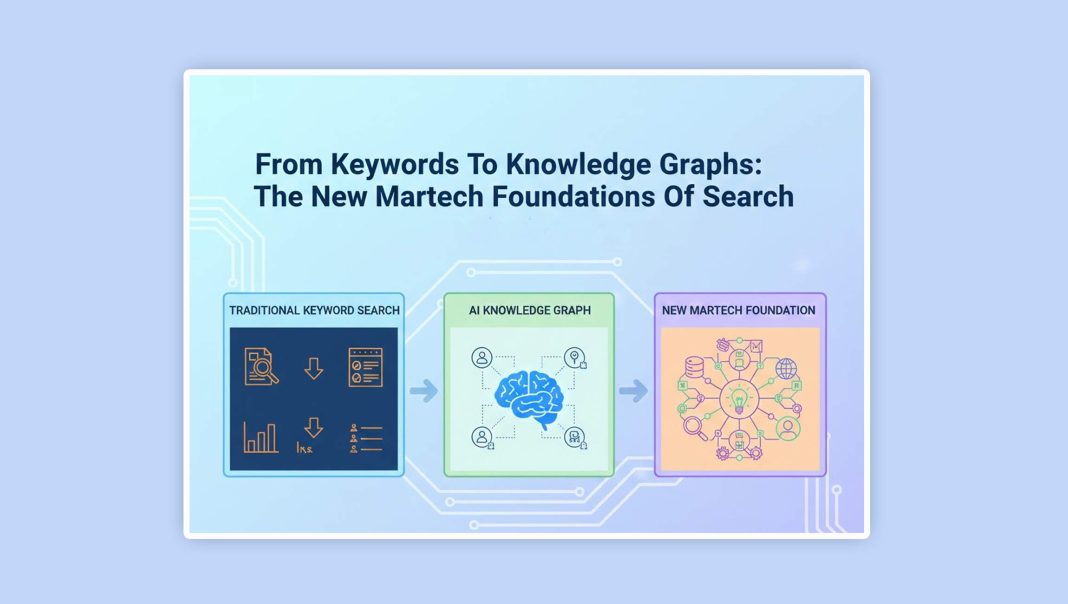
For more than twenty years, the main idea behind digital marketing strategy was to find the right keywords and get them to the top of search results. In the past, search engines gave higher rankings to pages that closely matched what users were looking for. Marketers built whole programs around keyword research, on-page optimization, backlinks, and technical SEO.
This method laid the groundwork for modern digital marketing by changing how websites were built, how content was written, and how performance was measured. In a lot of ways, keyword-first SEO became the way that the internet’s commercial layer worked. Martech stacks grew to support it with tools for tracking, optimizing, and growing keyword visibility.
But that model is no longer working. People are no longer using search engines as simple query boxes as AI-driven search experiences become more common. Instead of lists of links, they are asking questions in natural language, looking through conversational results, and getting synthesized answers.
In these situations, it’s much more important to understand what the user really means than to match exact phrases. Just targeting keywords won’t keep up with systems that can figure out what someone wants, what the context is, and how ideas are related to each other. The change shows a major flaw in traditional SEO: keywords only describe text, not reality.
Search is quickly changing from matching queries to finding meaning. AI-powered engines look at what users want, guess their goals, and connect information from different sources to give clear answers. Modern systems don’t ask, “Which page has this phrase?” Instead, they ask, “Which entities, attributes, and relationships best meet this request?” That evolution changes the rules for marketers. You can’t just say the right things over and over again to get noticed anymore. You have to become a trusted, organized source of information. Because of this, Martech is moving away from keyword tools and toward systems that handle context, semantics, and data relationships across channels.
This change also shows how people act. People now look for things while they’re moving, on different devices, and in conversations. They want answers, not directions. A buyer who is looking into a product might go from social media to AI assistants to search built into apps, never seeing a regular results page. In that journey, success depends less on how high a brand’s information ranks for a single phrase and more on whether AI systems can understand, use, and make sense of it. That means that Martech platforms need to do more than just publish content; they also need to help brands organize their knowledge.
Martech‘s role in this change is becoming more and more important. Companies shouldn’t think of SEO as a separate task. Instead, they should include search readiness in their data platforms, content operations, and customer intelligence. Modern stacks need to connect structured data, behavioral signals, content management, and analytics into a single layer that makes it possible to find meaning in the data. This means going from keyword dashboards to knowledge systems that show how AI sees the world in real life.
In the end, the end of keyword-based search doesn’t mean SEO goes away; it just means it gets better. Brands’ digital presence will determine their success in the next era. They need to encode meaning, intent, and authority into it. Martech connects what businesses know with how machines understand it as search engines become reasoning engines. People who stuff pages with keywords won’t win. Instead, those who use Martech to turn content into coherent, trusted, and AI-readable knowledge will win.
Why Keyword-First SEO Is Losing Effectiveness?
For a long time, how well marketers could find and target keywords was the most important thing for SEO success. Ranking for phrases that got a lot of traffic meant getting more traffic, which meant more chances. This logic was used to make whole Martech stacks, like keyword research tools, rank trackers, backlink analyzers, and on-page optimizers. The idea was simple: if you have the right words, you can control how visible something is. But that idea is now being challenged by how search behavior and technology are changing.
The Explosion of Conversational and Multimodal Queries?
Search is no longer just a short list of words you type. People can now talk, upload pictures, ask follow-up questions, and make their intentions clearer in real time. Questions are now longer, more like conversations, and often include more than one mode. Someone might start with a picture, then ask a question out loud, and then give more information about the situation. This huge increase in different types of queries breaks the old model in which marketers optimized for a set number of terms.
In this situation, traditional keyword research doesn’t work well because there are so many possible variations. It’s no longer possible to map out every phrase a user might use. People used to ask, “What are the best running shoes?” Now they ask, “What shoes are best for flat feet if I run on pavement in the rain?” Keyword-first SEO tries to track down these phrases one at a time, but modern search engines see them as expressions of intent. Because of this, Martech tools that are only based on keyword volume and ranking signals only show a small part of real demand.
AI Search Engines No Longer Rely on Exact Matches
In the past, search engines gave higher rankings to pages that used the same keyword over and over again in titles, headings, and body copy. AI-powered search engines now use large language models and semantic indexing to figure out what a person means, not just what they typed. They don’t just map words; they also map ideas, things, and connections.
This means that a page can be cited or ranked even if it doesn’t have the exact phrase at all. On the other hand, a page full of keywords may be ignored if it doesn’t have enough relevance, authority, or context. AI search systems check to see if a piece of content really solves the user’s problem. They care more about how things fit together than how often they happen.
This changes the focus for SEO teams. The better question is no longer, “Did we use the keyword enough times?” Instead, “Did we make the idea clear and complete?” Modern Martech needs to support semantic optimization, which means organizing content so that machines can understand what it means, not just how dense it is.
Declining Returns From Keyword Stuffing and Page-Level Optimization
The return on investment (ROI) of old-fashioned SEO methods is going down as AI search grows. Putting too many keywords in a page, making meta tags too specific, and making thin pages for every variation of a phrase don’t work as well anymore. Search engines now punish redundant and low-value duplication because they make the user experience worse and the quality of AI reasoning worse.
Page-level optimization used to be the place to be: change the title, change the headers, add phrases, and see the rankings change. In AI-driven environments, however, being chosen as a trusted source is often more important than being ranked as a link. No matter how well you place your keywords, your content won’t show up if it doesn’t add useful, structured knowledge.
This means that companies have to change how they use Martech. Teams don’t need a lot of separate SEO tools. They need platforms that bring together content quality, entity management, schema, internal linking logic, and performance feedback loops. Optimization isn’t just about mechanics anymore.
Why Ranking for Keywords No Longer Guarantees Visibility?
This is probably the most shocking thing for marketers: even if you are number one, you might not be seen. More and more, AI search experiences give users synthesized answers, summaries, and recommendations without making them click through regular result pages. Your content might change the answer without bringing in traffic, or it might be ignored altogether if another source explains the idea better.
Instead of asking “where do we rank?” people are now asking “are we included in the answer?” That’s a whole different issue. Keyword positions alone do not fix it. It needs to build trust in AI systems by giving them authority, context, and structured knowledge.
In real life, Martech teams need to go beyond dashboards that only show keyword movement and start using systems that measure semantic presence—where, how, and why a brand is mentioned in AI-driven experiences.
Search Is Shifting From Matching Queries to Understanding Meaning
What will take the place of keyword-first SEO if it is losing its power? The answer is semantic search, which is a type of search engine that sees search as a problem of reasoning rather than matching text. Modern engines don’t just line up words; they also line up ideas, goals, and results.
How AI Models Understand Intent, Not Strings of Text?
AI search models look at language the same way people do: by figuring out how ideas are related to each other. They look at verbs, things, limits, tone, and goals that aren’t directly stated. A question like “cheap flights to Paris next month” isn’t just about flights or Paris; it also includes time, budget, and the desire to travel.
AI models don’t match those words to pages. Instead, they ask, “What kind of problem is this?” Is it transactional, informational, comparative, or exploratory? Then they look for the best sources that match that type of intent.
This changes what content does for SEO. Pages are no longer competing on words; they are competing on how useful they are. So, a strong Martech stack needs to connect user data, content operations, and analytics so that teams can make content based on intent clusters instead of keyword lists.
Context, Nuance, and User Goals as Ranking Signals
In traditional SEO, context was limited to location, device, and a few personalization signals. When you use AI search, context gets deeper. Systems take into account things like past questions, behavior patterns, the time of day, domain knowledge, and even the flow of conversation.
For instance, if you search for “startup sales tools” and then ask “best CRM,” you will get a different answer than if you search for “enterprise software” and then ask the same question. The user’s journey changes what the question means.
This makes it hard for marketers to give customers not only content but also organized, reliable information across all channels. As a single semantic layer, martech platforms need to handle identity, entities, product attributes, FAQs, documentation, and behavioral signals more and more. Optimization isn’t just about tuning pages anymore; it’s about making sure everything works together.
Search as a Semantic Task, Not a Lexical One
Lexical search finds tokens that match. Semantic search finds similar ideas. That difference is why keyword-first SEO is losing ground. AI engines create mental pictures of the world, including products, brands, features, benefits, problems, and relationships. Then they map the questions onto those representations.
This model says that your digital presence will only help the machine understand your field if it does. Do you have clear definitions for your products? Are your services always described the same way? Are the connections between your topics clear and make sense?
Martech changes from being a publishing infrastructure to being a knowledge infrastructure here. Tools need to support schema, internal linking strategies, entity resolution, content lifecycle management, and feedback from AI-powered discovery channels. Not only is search success a problem with content, but it is also a problem with data architecture.
What This Change Means for SEO Strategies Based on Martech?
The move from matching queries to figuring out what they mean requires a new strategy. SEO is no longer just a small part of a business; it’s now a part of managing knowledge in the whole company. Instead of thinking in terms of “pages for keywords,” teams should start thinking in terms of “systems for meaning.”
First, Martech stacks need to combine content, data, and analytics instead of keeping them in separate silos. Search readiness depends on whether machines can consistently understand your brand, products, and expertise at all touchpoints.
Second, the way we measure things needs to change. Organizations need to measure semantic visibility, which includes citations in AI answers, entity authority, topical coverage, and consistency of information across platforms, instead of just rankings and traffic.
Third, changes to the workflow. Writers, SEOs, product teams, and data engineers need to work together. When you make content, it’s less about how much you write and more about how clear, well-structured, and authoritative it is. These teams should be able to work on a shared knowledge layer instead of separate assets with modern Martech platforms.
Finally, the strategy changes from control to contribution. You can’t use mechanical tricks to make AI systems rank you. You gain presence by being a reliable, organized, and useful source in your field. Martech becomes the engine that makes that reliability work on a large scale.
From Keywords to a Meaningful Presence
First, keyword SEO worked when search engines were just ways to find things. But AI search engines are systems that think. They don’t just get pages; they also read, summarize, and suggest. That means the old playbook isn’t complete.
How well brands encode meaning, intent, and trust into their digital architecture will determine how visible they are in the future. Companies need to build semantic authority instead of chasing phrases. They need to optimize systems instead of pages.
At this point, Martech stops being a tactical tool and becomes strategic infrastructure. It makes a layer that AI systems can understand by linking data, content, identity, and analytics.
As search continues to change, those who see Martech as a knowledge engine instead of a keyword machine will be the ones who succeed. A knowledge engine turns what a company knows into something that machines can understand. When search turns into understanding, how well your Martech stack reflects reality, not how well it repeats words, determines how visible it is.
AI Search Engines Prioritize Entities, Relationships, and Context
Search has quietly crossed a line. What used to be a huge list of words and pages is now turning into a model of the real world. Modern AI search engines don’t just see the web as a bunch of text that needs to be matched. They see it as a network of people, brands, products, places, services, and ideas that are connected by relationships and understood in context. This change changes how visibility works and makes Martech change from managing keywords to managing knowledge.
How Modern Search Engines Represent the World as Entities?
The idea of entities is at the heart of AI search. A company, a product, a feature, a concept, an event, or even a problem that users want to solve can all be called an entity. AI systems don’t just index pages by words. They also make knowledge graphs that keep structured representations of these entities and how they are related to each other.
A brand is no longer just a domain with pages; it is now an object with features like category, reputation, products, pricing models, integrations, competitors, and use cases. A product is not just a page with keywords; it is an entity that is linked to features, benefits, industries, compliance frameworks, and customer segments.
This is a big change. Search engines are not just crawling content; they are also modeling reality. AI systems have a hard time figuring out what you really offer if your organization’s online presence doesn’t clearly define its entities. That’s when Martech becomes very important. Platforms shouldn’t just publish pages; they should also help organize data, standardize names, and connect information into a consistent entity layer that machines can understand.
Understanding Relationships Between Brands, Products, Concepts, and Categories?
Entities by themselves are not enough. AI search gets better when it knows how things are related. A CRM is connected to sales automation, managing the sales pipeline, making predictions, and connecting with email platforms. A fintech product has to do with payments, compliance, risk, geography, and rules and regulations. Search engines can figure out what is relevant even when users don’t say everything they want because of these connections.
The engine doesn’t look for pages with those exact words when someone asks, “What tools help SaaS companies reduce churn?” It looks for things that are related to retention, customer success, analytics, onboarding, and managing a product’s lifecycle. AI answers show brands that are well-connected to that conceptual web more often.
Traditional SEO tried to make these links by using anchor text and linking to other pages on the same site. But AI search builds relationships through schema, mentions, data structures, cross-platform signals, and content consistency. A modern Martech stack must handle these connections on purpose, linking products to use cases, audiences to problems, and features to results.
Without this structure, content stands alone. AI systems trust and reuse content when it is part of a larger semantic network.
Contextual Relevance Across Queries, Sessions, and Platforms
Context is what makes static search into dynamic reasoning. AI engines don’t look at each question as separate. They look at things like past searches, location, device, industry, conversational flow, and even behavior across platforms. Depending on what the user has already looked at, a question means something different.
For example, asking “best analytics platform” after looking into ecommerce tools is not the same as asking it after looking into healthcare compliance topics. AI search engines understand the same words differently because the context changes what they mean.
This has big effects on how visible things are. AI systems need to see brands in the same way on many different surfaces, like websites, documentation, reviews, social media, APIs, and marketplaces, so they can get a clear picture of who they serve and how they fit into different paths.
At this point, Martech is no longer just a publishing engine; it is also a context engine. It brings together CRM data, content operations, customer journeys, and analytics into one system that shows how relevant they are across all channels. Optimization goes from making small changes to pages to making sure everything works together.
Why Entity Authority Is More Important Than Keyword Density?
Backlinks and domain strength were often used to guess authority in keyword SEO. In AI search, authority is becoming more about meaning. An entity acquires authority when it is consistently characterized, cited, and corroborated across credible sources and contexts.
AI systems want to know if this brand is always linked to this problem area. Are its descriptions the same on all platforms? Is it mentioned next to other reliable sources? Does it show depth, not just a surface presence?
In this model, a page that repeats a keyword ten times doesn’t mean much. What matters more is whether people in a domain network see the brand as a real business. This is why content strategies need to focus on building conceptual leadership instead of just covering keywords.
For Martech, that means helping with entity governance by using unified taxonomies, schema management, content standards, and AI-driven discovery feedback loops. It’s not about how often a phrase shows up anymore; it’s about how clearly the machine understands the organization.
How Keywords Don’t Work in a World Where AI Does the Searching?
Keywords aren’t going away; their function is changing. They are becoming signals on the surface instead of the basis of the search strategy. In an AI-driven world, using only keywords is like trying to find your way around a city with only street names and no map.
Keywords as Surface Signals, Not Knowledge Representations
A keyword is just a string of letters and numbers. It doesn’t show relationships, order, cause and effect, or intent. When people read “enterprise CRM,” they think of things like size, integrations, security, compliance, and workflow complexity. A keyword by itself can’t hold all of that meaning.
AI search models fill that gap by connecting questions to knowledge representations. They think of keywords as ways to get into bigger ideas. When you type “marketing automation,” it activates things like campaigns, personalization, analytics, data pipelines, and customer journeys.
This means that optimizing for keywords without building the knowledge structure underneath makes it harder to find. You may start the first lookup, but you won’t be chosen as a trusted answer. So, martech needs to go beyond managing keywords and start managing entities and concepts.
Marketing Technology News: MarTech Interview with Michael McNeal, VP of Product at SALESmanago
Inability of Keyword Tools to Capture Real-World Meaning
Traditional keyword tools show how many people are searching for a term, how much competition there is, and how much it costs to click on an ad. They don’t show how things are related, who is in charge, or what ideas are covered. They tell you what people type, but not what they really mean or how AI systems understand it.
A keyword tool might show traffic for “AI marketing platform,” but it doesn’t explain how that idea relates to personalization, customer data platforms, orchestration, privacy, and attribution. People can easily see how these things are connected. AI models need them to be clear.
When you only look at keyword data, you miss things. Teams make content better for phrases without knowing if they really solve the problems that users care about. To close this gap, modern Martech platforms need to include semantic analysis, entity mapping, and topic modeling.
In other words, keyword tools tell you “what,” but AI search needs to know “why” and “how.”
How weak are keyword-based strategies in AI-generated answers?
AI-generated answers are changing how things are seen. Users are seeing fewer blue links and more summaries, recommendations, and conversational responses. Only a few sources affect the answer in these formats.
Keyword-based strategies don’t work well here. Your page may rank well, but if your content isn’t clear, structured, or authoritative, the AI might not use it when putting together answers. You can be replaced by another source that has fewer keywords but a stronger semantic base.
This changes the risk profile. If keyword rankings are the only thing that affects visibility, it becomes less predictable. Brands need to make content that machines can read, trust, and put back together. That means having structured data, using the same words all the time, and covering all the concepts.
So, a Martech approach that is ready for the future sees SEO as more than just managing rankings.
Why Keywords Still Matter, but Not as Much?
Keywords are still useful. They still show how people show what they want. They still help find out what people want, how they talk, and what new topics are coming up. But they are no longer the plan; they are parts of a bigger system.
Instead of levers, think of keywords as sensors. They tell you what people are looking for, but they don’t tell search engines what to do. The decision layer is semantic, which means it includes things like entities, relationships, authority, and context.
Keyword intelligence and knowledge architecture are now both parts of effective SEO. Teams use keywords to find topics, and then they use Martech to turn those topics into structured, authoritative, and connected content systems.
That’s the real change: going from making words better to making meaning.
From Keyword Control to Knowledge Control
The move to AI search changes how people compete. You are no longer competing for words; you are competing for understanding. Search engines make models of the world, and brands do well when they are easy to find in those models.
This makes Martech grow up. It needs to manage entities, relationships, context, governance, and analytics all in one system. Content is less about how much there is and more about how precise the meaning is. SEO is less about tactics and more about architecture.
In the past, being able to control keywords was the key to success. In the world of AI, success means controlling knowledge, or how your business, products, and expertise exist in a way that machines can read.
As AI search grows, the people who win won’t be the ones who can repeat words the best; they’ll be the ones whose Martech systems make the most sense. Brands that stop asking, “What keywords should we rank for?” and start asking, “How does the machine understand who we are?” will get more visibility.
What Are Knowledge Graphs?
It’s no longer about finding pages. It’s about getting to know the truth. The knowledge graph is at the heart of this change. It is a structured, machine-readable picture of the world that lets AI systems think, connect, and answer. Brands can’t just publish content anymore because AI-driven search is taking over traditional search. They have to be part of the same knowledge architecture that search engines use. This is how Martech changes from a campaign engine to a knowledge engine.
Structured Representations of Entities and Relationships: What Do They Mean?
A knowledge graph is a type of database that keeps track of things and how they are related to each other. A company, product, feature, category, problem, solution, location, regulation, or idea can all be an entity. Relationships show how those things are connected: they offer, belong to, integrate with, compete with, solve, require, and more.
A knowledge graph doesn’t store text blocks; it stores meaning. For instance, instead of just having a page about “marketing automation,” a graph shows that marketing automation is a category that is connected to campaign orchestration, personalization, analytics, channels, compliance, and vendors. Each connection has context that machines can move through and think about.
Traditional websites are flat. Knowledge graphs are based on relationships. That difference is what lets AI search engines not only understand what you say, but also what you mean. Not only publishing workflows, but also this kind of structured intelligence must now be supported by modern Martech.
What is the difference between content pages and knowledge nodes?
People write content pages. It tells a story, shows pictures, and is often not organized. A knowledge node is something that computers can read. It is clear, consistent, and connected.
Think of a blog post that talks about a product. People guess about features, use cases, and where things fit in. That information needs to be spelled out for machines:
- Product → category
- Product → features
- Product → target audience
- Product → integrations
- Product → compliance frameworks
A page can mean these things. A node has to define them.
Knowledge graphs separate how something looks from what it means. Websites, chatbots, AI answers, search engines, partner portals, and APIs can all use the same knowledge node. This is a big change for Martech, which used to only optimize pages and not the knowledge structures behind them.
Teams used to ask, “What content do we publish?” Now they ask, “What entities do we manage, and how are they connected?”
How Knowledge Graphs Encode Meaning and Context?
Structure gives rise to meaning. Knowledge graphs encode meaning by explicitly modeling how concepts relate in the real world. For instance, “pricing strategy” is linked to things like optimizing revenue, dividing customers into groups, packaging, value metrics, and buyer behavior. Those links tell AI systems what the idea is, what it affects, and when it is useful.
Attributes and constraints add context by including things like geography, industry, maturity, compliance, lifecycle stage, and customer intent. This lets AI search change its answers on the fly instead of just matching text.
The engine doesn’t look for the exact phrase “best analytics tools for healthcare startups” when a user types it in. It looks for things that match:
- analytics platforms
- healthcare compliance
- startup-scale architecture
- security and privacy
Only brands with knowledge graphs that make those connections clear will show up. This is why Martech tools can’t be separate anymore. It needs to put together content, data, and semantics into one layer that machines can understand.
Why Knowledge Graphs Are Important for AI-Powered Search?
AI search engines don’t just find things; they also think. They make recommendations, draw conclusions, and compare and summarize. Structured knowledge is necessary for that to happen. Knowledge graphs are the base that AI uses to:
- understand topics
- disambiguate entities
- synthesize answers
- maintain consistency across sessions
AI models only use text probabilities when there isn’t a graph. They understand domains with a graph.
For brands, this means that page rank is no longer the only thing that matters for search visibility. It’s about whether your organization is seen by the machine as a whole, trustworthy thing. So, a modern Martech stack needs to do more than just manage marketing output; it also needs to manage brand truth.
How Knowledge Graphs Power Modern Search?
Search used to give you links. Now it gives back understanding. Knowledge graphs are the hidden layer that lets AI systems identify things, clear up confusion, and give answers that sound more like a conversation than a machine. This changes the meaning of “optimize” at its core.
Entity Recognition and Disambiguation
AI systems have to figure out what a search query means before they can help the user. Is “Mercury” a planet, a financial technology product, a logistics company, or a chemical element? That process is recognizing and separating entities.
These differences are clearly stored in knowledge graphs. They help AI figure out which words go with which things by looking at the context, history, and relationships. If someone searched for payment platforms before, “Mercury” is now a financial product, not an astronomy term.
This is why brands need to be clearly defined as separate things on all platforms. AI systems have a hard time figuring out who you are if your name, products, or categories don’t match up. Martech platforms now need to make sure that naming, taxonomy, and metadata are the same on all surfaces where your brand appears.
Answer Synthesis Instead of Link Retrieval
When you did a traditional search, it brought back documents. AI search puts together answers. It takes information from many sources, combines it, and gives answers in plain language.
That synthesis depends on having a structured understanding. AI doesn’t just read pages; it thinks about them. It looks at the properties of entities, compares relationships, and makes summaries. A tool might not be directly linked, but if its entity data is strong, it could still affect an answer.
This is why brands feel like they aren’t there even when they are. Ranking is not the same as choosing. Knowledge graphs help you choose. If your Martech strategy only includes optimizing pages, you’re missing the part where AI picks the entities that shape answers.
Modern optimization means designing content so that machines can find structured meaning, such as features, benefits, audiences, compliance, differentiators, and connections.
Cross-Query and Cross-Platform Understanding
People don’t search by themselves. They look around on different devices, platforms, and sessions. AI systems use knowledge graphs to keep things going by remembering what users care about over time.
The AI connects those steps through entity relationships when someone looks up ecommerce analytics, then asks about attribution, and then asks for tools. It knows how to follow the intent, not just the keywords.
Brands that show up a lot on those conceptual paths get more attention. You need to make sure that consistency is maintained across websites, documentation, social media, marketplaces, and product interfaces. This is where Martech becomes design. It combines CMS, CRM, DAM, analytics, and product data into one semantic layer.
Without that integration, brands break up across channels and stop being part of AI reasoning paths.
The Role of Knowledge Graphs in AI Overviews and Conversational Search
Graphs are very important for AI overviews and conversational search interfaces. When systems make summaries, comparisons, or suggestions, they don’t use raw text indexes; they use their own knowledge models.
These interfaces are better for things that have:
- clear definitions
- good relationships
- consistent traits
- authoritative positioning
If your organization’s knowledge is not complete, is spread out, or is contradictory, it is less likely to be included in synthesized responses. This is why Martech needs to help with more than just SEO. It also needs to help with keeping knowledge consistent. Being ready to search now means being ready to answer.
How Martech Helps Build Search-Ready Knowledge?
As search engines get better at understanding language, marketing technology needs to get better at building things. Martech is more than just campaigns, automation, and analytics now. It’s about figuring out how to make a brand exist in a way that machines can read.
Martech’s Role in Building Search-Ready Knowledge
Publishing content gives people answers. Knowledge engineering gives answers to questions that machines ask. AI wants to know:
- What is this company?
- What does it offer?
- Who is it for?
- How does it compare?
- Where does it belong?
These are questions about architecture, not about editing.
Modern Martech needs to help the organization create and manage entities, attributes, and relationships. That means connecting products to use cases, audiences to problems, features to results, and markets to rules.
Teams don’t think in pages and posts; they think in ideas and links. Content is like a presentation layer on top of a deeper knowledge system.
Tools For Managing Entities, Schemas, And Structured Data In Martech
Knowledge that is ready to be searched needs to be organized. Schema, metadata, taxonomies, and ontologies are now required. They tell machines what your brand means.
Now, advanced Martech stacks include:
- entity repositories
- schema management systems
- structured data pipelines
- taxonomy governance
- semantic tagging engines
These tools make sure that “platform,” “solution,” and “integration” always mean the same thing on all channels. This reliability helps people trust AI systems. It also makes things less confusing inside the company, speeds up publishing, and makes analytics better because everything is based on the same underlying truth model.
Connecting CMS, CRM, DAM, and Analytics Into a Unified Knowledge Layer
Most companies have separate systems for different things, like CMS for content, CRM for customers, DAM for assets, and analytics for performance. For AI search to work, these systems need to be able to talk to each other in a way that makes sense, not just in terms of how they work.
A single knowledge layer links:
- customer intent from CRM
- product data from PIM
- content from CMS
- visuals from DAM
- performance from analytics
They say not only what you publish, but also why it matters and who it matters to.
This is when Martech changes from a stack to a platform. It makes sense of everything in the company so that AI systems can understand your whole story, not just parts of it.
Martech as the System of Record for Brand Truth
In a world run by AI, inconsistency makes things less visible. AI systems lose trust when your website, documentation, partners, and social media all say different things.
Martech needs to be the place where brand truth is kept:
- definitions
- Positioning
- Categories
- Audiences
- Compliance
- value propositions
Organizations control knowledge from one place and share it with everyone, rather than letting each team publish on its own. This makes sure that AI sees one clear thing instead of a lot of conflicting signals. When Martech is used as a knowledge system, search is less about gaming algorithms and more about getting the facts right.
From Publishing to Participation in Machine Knowledge
Knowledge graphs are not just technical tools; they are also strategic tools. They check to see if your company is clearly visible in the AI’s model of the world. Search is not the same as retrieval anymore. It is logical. Keywords are no longer what visibility is about. It’s about people, things, and power.
This makes Martech change from automating marketing tasks to automating knowledge tasks. Instead of asking, “What should we publish?” teams start asking, “What should the machine know about us?”
Brands that see Martech as a way to manage meaning, not just messages, will be the ones who win in search in the future. When marketing turns knowledge into a product, visibility becomes long-lasting, scalable, and strong in a world where AI comes first.
In short, pages get clicks.
Graphs help people understand.
And Martech is now the framework that makes understanding possible.
Final Thoughts
Search is no longer a simple act of retrieval. For decades, search engines functioned like libraries: you asked a question, and they returned a list of documents that contained matching words. Today, AI-driven search behaves more like a reasoning system. It interprets intent, connects ideas, evaluates context, and synthesizes answers.
Search has become a meaning-making process rather than a keyword-matching exercise. Instead of asking, “Which page fits this query?” modern systems ask, “Which concepts, entities, and relationships best explain what the user wants?” This shift fundamentally changes how brands become visible and why understanding now matters more than indexing.
As search transforms, Martech must transform with it. Traditional keyword tools were built for a world where optimizing strings of text was enough to compete. But AI search engines don’t think in strings — they think in structured knowledge. They map brands, products, topics, and behaviors into interconnected models of reality.
This means Martech can no longer focus only on publishing and ranking pages. It must evolve into a knowledge system that manages entities, definitions, relationships, and consistency across every digital touchpoint. The job of modern Martech is not just to push content outward, but to maintain a machine-readable understanding of what a brand actually is.
In this environment, search success is defined by semantic authority, not keyword dominance. Ranking for a term matters less than being recognized as a credible, relevant entity inside AI reasoning. When users ask questions, AI systems assemble answers from trusted knowledge, not from the loudest pages.
Brands win when they are understood — when their expertise, context, and relevance are clear to machines across queries, sessions, and platforms. This changes optimization from tactical keyword placement into strategic knowledge modeling, where Martech supports how meaning is structured, updated, and validated over time.
The future of Martech lies in helping machines understand brands, not just index them. Visibility will no longer come from chasing algorithms, but from becoming a reliable source of knowledge inside AI systems. As search continues to evolve into conversational, contextual, and multimodal experiences, the brands that thrive will be those whose Martech stacks act as systems of truth — aligning content, data, and relationships into a coherent worldview. In the end, search is no longer about being found; it is about being understood.
Marketing Technology News: Complexity as a Cost Center: The Hidden Financial Burden of Fragmented Martech Stacks