Home Blog Page 4399

TechBytes with Dan de Sybel, CTO at Infectious Media

0
Dan de Sybel
TechBytes with Dan de Sybel, CTO at Infectious Media

Dan de Sybel
CTO at Infectious Media

According to an eMarketer report, programmatic display ad spend will reach $33 billion this year and would hit $46 billion by 2019. Earlier this year, Infectious Media partnered with Screen6 to offer targeted, cross-device digital campaigns on a global scale. We spoke to Dan de Sybel, CTO at Infectious Media, to explore how businesses can maximize programmatic performance using data science, analytics and brand safety strategies.

Html code here! Replace this with any non empty text and that's it.

MTS: Tell us about your role at Infectious Media and how you arrived at this position?
Dan de Sybel: As CTO, I determine how we deploy technology to achieve our goals, whether that’s buying it in or building up from scratch. I also manage the team that builds the tech once the decision is made to go down that route.

Although I originally wanted to work in banking, I first started working at a local data company due to family commitments. By the time I was ready to move on in 2002, relevant opportunities in the banking sector had largely dried up, so I stepped into a business analyst role at Advertising.com.

This was right at the point when digital advertising grew rapidly, almost exponentially. I joined a team of 12, and when I left we were at 1,000 employees across the world. I joined Infectious Media shortly after and was lucky enough to find many of the people I worked with had moved into the programmatic space. This proved invaluable when building Infectious Media’s Impression Desk platform.

MTS: How do you see bot traffic clashing with programmatic results? Do bots negatively affect the programmatic ROI?
Dan: The greatest thing about programmatic advertising is its flexibility and openness. Unfortunately, these are the qualities that bots have been able to take advantage of, albeit for nefarious purposes. It’s incredibly frustrating to see how much this has negatively impacted the perception of programmatic and ultimately the real ROI that it drives.

One of the main problems has been the fact that advertisers haven’t been given the knowledge they need to properly interrogate the numbers given to them by agencies and root out the influence of fraudulent traffic. Bots existed long before programmatic advertising, as have the systems involved in detecting them. It’s just there’s never been any motivation to tell the client about those risks. With programmatic continuing to highlight the true impact of bot traffic, that’s quickly going to change.

The tools required to better protect advertisers are out there and becoming more sophisticated by the day. It’s just going to take a more honest and open dialogue across the media supply chain to ensure everyone is benefitting equally and programmatic advertising is delivering on its full potential.

Read Also: AD/FIN and Infectious Media partner to bring Greater Accountability to Programmatic Media

MTS: What is the correlation between bot traffic and ad fraud metrics? How can programmatic capabilities resolve false reporting?
Dan: It’s safe to assume that higher bot traffic results in higher levels of fraud, but there’s no accepted standard to measure this. The closest we have is measuring the probability of fraud. The level of acceptable fraud varies from advertiser to advertiser – for our clients we aim for no more than 1%.

Programmatic is a great tool to minimize false reporting, thanks to the fact that much of its data is transparent and open to quick analysis. We’re now seeing an influx of new ad verification companies focused solely on processing other company’s data to identify and remove threats. Rather than having to spend months looking through huge amounts of data on their side, the right ad verification company allows brands and agencies to hand three months’ worth of data over and have it analyzed in rapid time. With these capabilities and added protection, it’s then that programmatic truly shines.

MTS: Most programmatic advertising platforms, networks, and exchanges have come together to provide a brand safe environment for advertisers. How do you see such collaborations helping the international programmatic ecosystem?
Dan: I think consortiums are a good idea as long as they can achieve something. It’s all very well to say that you’re actively handling brand safety, but if you do nothing but set up independent audits then it’s all hot air. What we need is some agreed best practice standards to work towards, that can be shared and used to effectively measure brand-safe environments for advertisers. Some consortiums, such as TAG, are developing these to provide a way for individual companies (and other consortiums) to measure their efficacy.

This actually rings true for fraud as well. In an ideal world, collaboration between advertisers, agencies and anti-fraud companies would be instant and seamless. If we received a request to purchase high-value inventory and we suspected it was fraudulent, we could then let others know via the real-time pipes of programmatic. If other people flagged it using these methods as well, then the consortium could act to block the inventory and use the signals to predict fraud and prevent it from happening again. But in the real world, sharing information can be problematic, not least because many companies earn money from developing new ways of detecting fraud who could lose their value, if such data was shared.

MTS: How can analytics and optimization tools allow advertisers to continually evolve their campaigns to maximize programmatic performance?
Dan: Ad tech is now hugely focused on data science. We now can interrogate every single data point, using smart analytics to turn that data into useful insights. Optimization allows you to act on that insight, with programmatic technology ultimately allowing you to automate the actions to deliver continuous performance with little human intervention.

The adaptability of programmatic means a single person can make changes to a campaign in seconds, based on the real-time data that’s constantly being fed back. Advertisers gain a much deeper understanding of what’s going on in their digital advertising, with programmatic continually improving performance.

MTS: What would be your advice to CMOs who are planning to invest in programmatic adoption in the near future?
Dan: Don’t think of programmatic simply as a new toy to invest in – instead, consider how it fits into your advertising strategy and how it can improve your offering. Go in with open eyes, and work with partners you trust.

That being said, don’t be afraid of making mistakes. Many agencies and advertisers are scared of programmatic due to concerns over brand safety, ad fraud or highlighting long-standing errors in the execution of their campaigns. These have always been concerns in the advertising industry; the transparency of programmatic simply makes them more visible. Brands shouldn’t be afraid of this visibility – we can certainly learn and achieve more because of it.

MTS: Thanks for chatting with us, Dan.
Stay tuned for more insights on marketing technologies. To participate in our Tech Bytes program, email us at news@martechseries-67ee47.ingress-bonde.easywp.com

Read More: Infectious Media and Screen6 partner to bring the promise of “Programmatic Everywhere”


Interview with Oliver Roup, Founder and CEO, VigLink

1
Oliver Roup
Interview with Oliver Roup, Founder and CEO at VigLink

[mnky_team name=”Oliver Roup” position=” Founder and CEO at VigLink”][/mnky_team]
[easy-profiles profile_twitter=”https://twitter.com/oroup” profile_linkedin=”https://www.linkedin.com/in/oroup/”]
[mnky_testimonial_slider][mnky_testimonial name=”” author_dec=”” position=”Designer”]“Affiliate marketing is just starting to make the leap from hard-coded links to a render-time decision, and the ability to utilize data to drive performance is going to have a huge impact.”[/mnky_testimonial][/mnky_testimonial_slider]

On Affiliate Marketing Technology

MTS: Tell us a little bit about your role at VigLink and how you got here? (What inspired you to start an affiliate marketing company)
Oliver:
I was looking for a business to start and became interested in affiliate marketing, but after logging into an affiliate marketing platform, the process as it existed seemed remarkably complex. I reasoned that, even with two CS degrees, if I still had a hard time figuring it out, the average blogger and content publisher would struggle as well.  In 2008, I wrote a crawler that looked for links to Amazon to see how many websites and content publishers were effectively using affiliate links, and I found that less than half of the commercial links were affiliated. At that moment, I knew there was a real opportunity to help both publishers and merchants gain the ability to effectively and profitably execute affiliate marketing strategies. In 2009, I founded VigLink, and have been running the company ever since.

MTS: Given how quickly automated affiliate marketing strategies have been accepted, how do you see this market evolving over the next few years?
Oliver:
Over the next few years, the techniques used in programmatic display advertising will be applied to affiliate in a big way. From both display and search, most advertisers are familiar with a demand curve, where if you pay more, you’ll drive more traffic to your intended destination. Affiliate marketing is a weak representation of this characteristic. Whereas in search you can change your bids and see the effects immediately, changes in affiliate pricing usually take months and a trip to Affiliate Summit before seeing a change in traffic flow (particularly from content). This delay, comparative to other marketing and advertising technologies, is changing.

MTS: What do you see as the single most important technology trend or development that’s going to impact us?
Oliver:
Content-driven commerce is on the same curve that display advertising  was on over the last few decades. Hard-coded creative yielded to ad servers and onto the auction-driven demand-side, supply-side and data management platform eco-system are pushing the landscape to where it is today. Affiliate marketing is just starting to make the leap from hard-coded links to a render-time decision, and the ability to utilize data to drive performance is going to have a huge impact.

MTS: What’s the biggest challenge for startups to integrate with a platform like VigLink into their stack?
Oliver:
At VigLink, we initially pitched ourselves as a “lights out” operation – install it once and forget about it, and just wait for the revenue to roll in. We focused on ease of installation and, if you want, you can still use VigLink that way. To really crank out the revenue, though, publishers and merchants both need to be watching their dashboards for what products are selling and trending via VigLink’s Trends Explorer. The challenge there can be that, to have the bandwidth and know-how to do so, it requires training and in some cases an editorial team incentivizing them to drive revenue.

MTS: What startups are you watching/keen on right now?
Oliver:
I’m a huge fan of Cloudflare. It was started by some classmates of mine and has grown tremendously – at this stage, they proxy about 10% of all web traffic. They have an amazing platform to give publishers a menu of services they can add.

MTS: What tools does your marketing stack consist of in 2017?
Oliver:
Intercom, Salesforce, Google Analytics, Hootsuite, and Looker.

MTS: How do you prepare for an AI-centric world as a business leader?
Oliver:
You prepare by being first. The lesson isn’t just that jobs can be automated into nonexistence, it’s that well trained computer systems can typically do the job substantially better than humans. Tesla’s relatively crude Autopilot system already decreases accidents per road mile by 10%, relative to the baseline. Functions such as ad operations and media buying seem highly prone to not just automation, but automation whose performance dramatically exceeds the performance of the humans it replaces.

This Is How I Work

MTS: One word that best describes how you work.
Oliver:
Single-threaded.

MTS: What apps/software/tools can’t you live without?
Oliver:
Gmail. 25 years later, email is still the core of how I communicate on the Internet.

MTS: What’s your smartest work related shortcut or productivity hack?
Oliver:
Tripit is a great simple tool for managing travel. I simply forward my emails to their platform and they curate a master itinerary for all my travel.

MTS: What are you currently reading? (What do you read, and how do you consume information?)
Oliver:
The Creator’s Code. It’s a smart book on what differentiates highly productive founders.

MTS: What’s the best advice you’ve ever received?
Oliver:
Never list your cell phone number on documents you file with the SEC. This tip has saved me from countless unsolicited phone calls.

MTS: Something you do better than others – the secret of your success?
Oliver:
Having an engineering background helps a lot. It lends credibility when recruiting engineers and gives me a sense of what’s possible on certain projects and in certain contexts.

MTS: Tag the one person whose answers to these questions you would love to read:
Oliver:
Elon Musk.

MTS: Thank you Oliver! That was fun and hope to see you back on MarTech Series soon.

[vc_tta_tabs][vc_tta_section title=”About Oliver” tab_id=”1501785390157-b58e162d-0ae25a4b-c27aca64-108e”]

I am the founder / CEO of VigLink. We are making the web better by making every link intelligent and valuable.

[/vc_tta_section][vc_tta_section title=”About VigLink” tab_id=”1501785390320-2d44fa50-740c5a4b-c27aca64-108e”]

viglink logo

VigLink technology instantly and automatically captures the value of content that drives commerce. We monetize ordinary links to over 40,000 retailers, whether they’re created by you or us. Our technology works across sites, apps, and social networks so you can focus on your business, earn more, and avoid the hassle of managing countless affiliate programs.

[/vc_tta_section][/vc_tta_tabs]
[mnky_heading title=”MarTech Interview Series” link=”url:https%3A%2F%2Fmartechseries-67ee47.ingress-bonde.easywp.com%2Fcategory%2Fmts-insights%2Finterviews%2F|||”]

The MTS Martech Interview Series is a fun Q&A style chat which we really enjoy doing with martech leaders. With inspiration from Lifehacker’s How I work interviews, the MarTech Series Interviews follows a two part format On Marketing Technology, and This Is How I Work. The format was chosen because when we decided to start an interview series with the biggest and brightest minds in martech – we wanted to get insight into two areas … one – their ideas on marketing tech and two – insights into the philosophy and methods that make these leaders tick.

Immersv Raises $10.5 Million in Series A Funding to Scale Mobile 360 and VR Advertising

0
immersv featured

Round led by Rogers Venture Partners, with participation from several other leading investors

Immersv, an interactive advertising platform for Mobile 360 and Virtual Reality, has raised a $10.5 million in a Series A financing. Rogers Venture Partners led the investment round, with participation from a top-tier group of institutional and strategic investors including Foundation Capital, The Venture Reality Fund, Initial Capital, East Ventures, HTC Vive, MCJ Co. Ltd., GREE, i-mobile, Metaps, and Gigi Levy. Rogers Venture Partners General Partner, Paul Sestili, and Gumi’s Founder and CEO, Hironao Kunimitsu, have joined Immersv’s Board of Directors.

Read Also: TwentyThree Integrates with HubSpot to Bring Video and Marketing Automation Together

Immersv Capitalizes on Growing Video Advertising Market

Immersv will use the funds to accelerate product development and deployment, rapidly expand its available inventory through direct publisher as well as SSP integrations, and bring Mobile 360 and Virtual Reality offerings to global brands and performance marketers.

Mihir Shah, President and CEO of Immersv, said,“We’re excited to partner with some of the finest institutional and strategic investors in the world. While the mobile video market continues to grow, we believe interactive advertising experiences will displace the current video advertising market in the next few years providing better results for advertisers, higher yield for publishers, and a significantly better experience for consumers.”

Recommended Read: 5 Ways to Disrupt Video Marketing in 2017

The Series A funding builds on a year of significant product and market momentum for Immersv, which combines interactive 360 advertising with a programmatic real time bidding platform. The company has recently signed programmatic deals with more than 15 of the world’s largest Demand Side Platforms (DSPs) and Supply Side Platforms (SSPs).

Read Also: Meet the Latest Facebook Marketing Partner for Video Content: Mosaicoon

Leading Video Firms and Brands Rely on Immersv

Immersv’s partners now include leading firms such as Tremor Video, YuMe, Bidswitch, ironSource, Supership and United in Japan.  Major brands such as Nissan, Hawaii Tourism Bureau, and Mountain Dew have executed successful campaigns using Immersv’s offerings.

David Arslanian Tremor Video
David Arslanian, VP Strategic Partnerships, Tremor Video

David Arslanian, Vice President of Strategic Partnerships at Tremor Video, said, “We’ve been really pleased with the Immersv partnership on our sell-side platform. We look forward to helping advertisers programmatically engage with 360 video at scale.”

Paul Sestili said, “Immersv is the leader in the next wave of interactive digital advertising. Mobile 360 and VR advertising provides some of the highest view completion rates, click through rates, and overall engagement rates for both brands and performance advertisers. As the central marketplace for buying and selling these new ad formats, Immersv is well positioned to drive significant value for both advertisers and publishers.”

Read Also: HubSpot and Brightcove Join Forces to Target Growing Video Analytics Space

Currently, Immersv is fully dedicated to driving new digital markets toward mass consumer adoption. Founded in 2015 by an experienced team of experts in app marketing and ad-tech, Immersv is built from the ground up to help advertisers connect with consumers through interactive mobile 360 and VR while enabling developers to drive both distribution and monetization for their content.

Read More: Screen6 Launches Advanced Householding for Advanced Attribution in Video Advertising

ThoughtSpot Unveils AI-Based Analytics SpotIQ, Powered by New $60 Million Investment

0
ThoughtSpot
ThoughtSpot Unveils AI-Based Analytics SpotIQ, Powered by New $60 Million Investment

Thoughtspot Launches SpotIQ To Put The Power Of 1,000 Analysts In Every Business Person’s Hands

ThoughtSpot, a leader in search-driven analytics for  enterprise, has announced that it secured  a fresh investment of $60 million. The latest funding brings its total capital raised to more than $160 million. ThoughtSpot has affirmed that it would use the capital to accelerate research and development for its AI-driven analytics platform, expand globally into Asia Pacific, and hire industry-focused customer success experts to nurture and grow key accounts. Leading analyst firm, Gartner Inc. had recognized ThoughtSpot on its 2017 Magic Quadrant for BI & Analytics Platforms in February 2017.

Read Also: Will Artificial Intelligence Exceed Human Performance in Marketing and Sales by 2025?

Latest Funding Follows Phenomenal Year of Growth and Customer Acquisition

In the past year, ThoughtSpot has achieved 270% customer growth with a significant percentage coming from the Fortune 500. Customers include Amway, Bed Bath and Beyond, Capital One, Celebrity Cruises, Chevron Federal Credit Union, DeBeers, Scotiabank and numerous other Fortune 500 customers. ThoughtSpot customers have now executed more than three million searches on the platform.

All of ThoughtSpot’s existing investors, led by LightSpeed Ventures (LSVP), participated in the new funding round and were joined by Capital One Growth Ventures, as both a new investor and a new customer.

ThoughtSpot Claims Working with Corporate Data to Get  Easier

Ajeet Singh
Ajeet Singh, Co-Founder and CEO,  ThoughtSpot

Ajeet Singh, Co-founder and CEO of ThoughtSpot, said, “One-by-one, enterprises are falling in love with ThoughtSpot. That’s because we make it effortless for non-technical business people to gain valuable insights from corporate data in seconds. 10% easier is not interesting to us. We’re making it 10,000% easier. Our mission is to deliver data insights at human-scale and SpotIQ is a massive leap forward. It puts the power of a thousand data analysts in the hands of every business person.”

Recommended Read: Salesforce Einstein Maps a New Path for Developer Success Using Intelligence Apps

Jaidev Shergill
Jaidev Shergill, Managing Partner, Capital One Growth Ventures

At the time of this announcement, Jaidev Shergill, Managing Partner of Capital One Growth Ventures, said, “Data intelligence drives our decision-making and allows us to consistently deliver intuitive customer experiences. With ThoughtSpot’s Relationship Search technology and SpotIQ, even non-technical teams can now quickly access and analyze data using simple language. We look forward to playing a role in its continued growth and evolution.”

ThoughtSpot Driven to Scale Analytics Market by 2020

The previously undisclosed investment round closed in January 2017, six months after ThoughtSpot’s $60 million series C funding that closed in July 2016. Investors seized on the opportunity to invest again after seeing the accelerated growth of Fortune 500 customers and the massive market potential for AI-driven analytics.

Co-founded in 2012 by its CEO Ajeet Singh and six other co-founders from Google, Microsoft, Amazon, and Oracle, ThoughtSpot’s mission is to enable analytics at “human scale” and put search-driven analytics in the hands of 20 million users by 2020.

SpotIQ Equals Work Done by 10,000 Analysts or 40,000 Man-Hours

ThoughtSpot’s next-generation analytics platform uses AI at its core to power its Relational Search solution. SpotIQ is an AI-driven solution built on the platform to leverage ThoughtSpot’s massively scalable high-performance computing backend.

Recommended Read: Biggest AI Collaboration Ever: IBM Watson and Salesforce Einstein Unified for Fast-Track Adoption of Cognitive Applications

SpotIQ works with Relational Search hand-in-hand to curate deep and relevant insights for users that they may not have thought to look for on their own. With a single click, SpotIQ can automatically ask thousands of questions about billions of data points and bring back dozens of insights in seconds. The equivalent would be hiring a thousand analysts, knowing exactly what questions you want them to answer, and then waiting a week for them to come back with reports and dashboards.

Sathish Koteshwar, VP of Business Intelligence at TrueBlue, said, “We are always trying to identify the factors that have the biggest impact on our business. It can feel like trying to find a needle in the haystack, given the amount of data we have to sift through. SpotIQ accelerates the process by automatically uncovering insights into what’s causing shifts in our business results, which allows us to be nimble in our decision making.”

Using the power of AI, SpotIQ accomplishes in a single click what could take 40,000 man hours. SpotIQ will be included in the ThoughtSpot platform for no additional charge and will be generally available on September 30, 2017.

SpotIQ Brings Transparency in AI Deployment and Processes for Businesses

Bruce Lee
Bruce Lee

In an interview with CIO MagazineBruce Lee, Head of Operations and Technology at Fannie Mae underscored the importance of SpotIQ’s transparent AI processes. He commented: “AI in things like credit decisions is fraught with a lot of regulatory hurdles to clear. So a lot of what we do has to be thoroughly back-tested to make sure that we’re not introducing bias that’s inappropriate and that it is a net benefit to the housing infrastructure. The AI has to be particularly explainable.”

Microsoft To Join Partners And Consumers IoT Expo and WCIT 2017

0
IoT Expo
Microsoft To Join Partners And Consumers IoT Expo and WCIT 2017

Jason Zander, Corporate Vice President Of Microsoft Azure, Shares Deep Insight On Intelligent Iot Deployment With Global Industry Leaders

Microsoft, the leading platform and productivity company for mobile-first, cloud-first world, has announced that it is joining its partners and customers at the IoT Expo 2017. As Internet-of-Things (IoT), artificial intelligence (AI), smart factories, and intelligent applications continue to advance, businesses are increasingly turning to these technologies to create new business solutions with greater agility and drive competitive advantage. The IoT Expo 2017 would provide opportunities for delegates to network and discuss on enterprise digital transformation using IoT technologies.

Jason Zander
Jason Zander, Corporate Vice President of Microsoft Azure at Microsoft

Jason Zander, Corporate Vice President, Microsoft Azure, overseeing the development and global deployment of cloud infrastructure and technology, including Microsoft Azure IoT, will deliver a keynote on “Leading Digital Transformation and Landing IOT Value with a Strong IoT Partner Ecosystem“.

In addition to sharing the success of Microsoft’s IoT Innovation Center and its partners, Zander will also provide Microsoft’s vision of the development of IoT and in-depth analysis on the integrated application solutions of the world’s leading IoT partners.

Jason will also speak about digital transformation at the WCIT on September 12th from 11:00-11:30, focussing on how businesses can accelerate the growth of the IoT ecosystem.

Microsoft IoT Expo: Connecting global partners to IoT opportunities

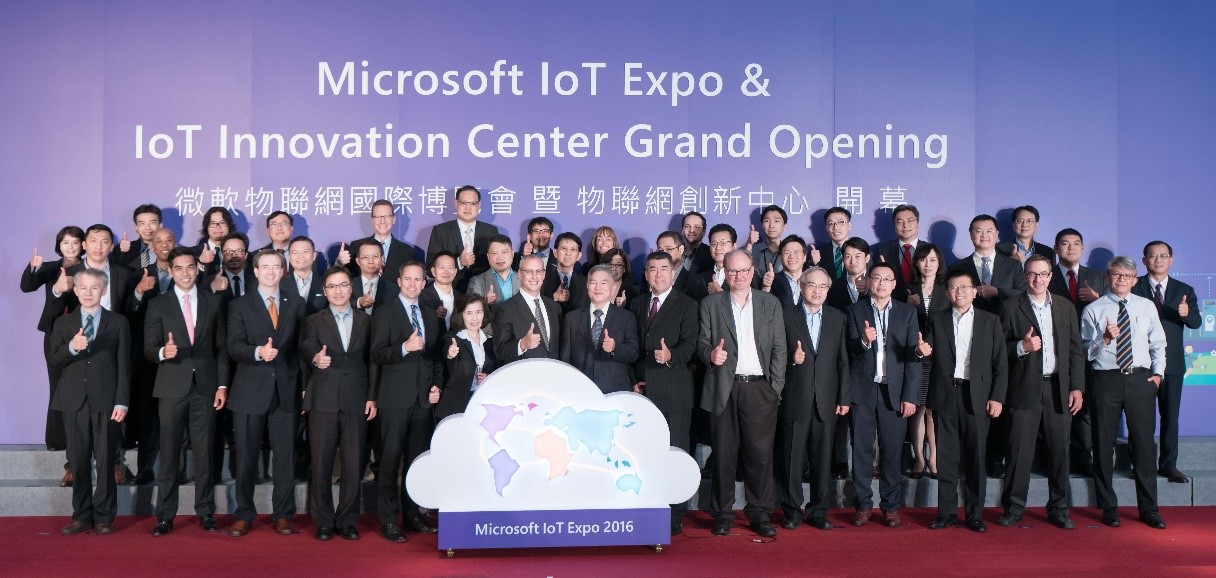
Microsoft launched its IoT Innovation Center in Taipei last October to spur development between IoT partners and international enterprises and organizations. In 2017, Microsoft will hold its second IoT Expo in conjunction with the World Congress on Information Technology (WCIT), a two-day event beginning September 11th.

Microsoft IoT Expo
The first Microsoft IoT Expo and IoT Innovation Center in Asia was inaugurated in October 2016, in Taiwan

The 2017 Microsoft IoT Expo X WCIT will be held over two days, from Monday, September 11th to Tuesday, September 12th, at Taipei International Convention Center (No. 1, Section 5, Xinyi Road, Xinyi District, Taipei City). The IoT Solution Expo will take place at Zone D, Taipei World Trade Center Hall 1 (No. 5, Section 5, Xinyi Road, Xinyi District, Taipei City), which will gather global and local IoT partners in Taipei, showcasing IoT solutions and technologies.

Extreme Reach says, Consumers are Spending 19% More Time Watching Video Ads in 2017

0
Extreme Reach
Extreme Reach says, Consumers are Spending 19% More Time Watching Video Ads in 2017

Q2 2017 Benchmark Report From Extreme Reach Shows Dramatic Improvement In Viewability, Completion And Time Spent Metrics For Video Ads

Extreme Reach

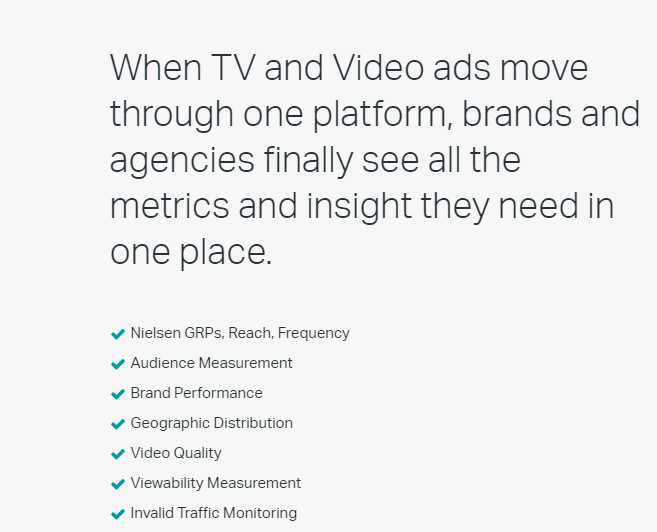
Extreme Reach, a cloud technology platform for TV and Video ad workflow management, today unveiled its Q2 2017 Benchmark Report. The quarterly numbers reveal a significant increase in consumer response to video advertising and also draw attention to an increasing advertiser focus on mobile.

Quality video ads are stories told to elicit a consumer response – this creative process won’t change.” – Dascha Bright, ExtremeReach

The report, which compares video ad serving metrics from Q2 2016 to Q2 2017, finds evidence that advertisers are putting out better video content and consumers are responding in kind. Specifically, viewability, completion rates and time spent metrics have all significantly increased from this time last year.

Recommended Read: Oracle Data Cloud adds More Muscle to Brand Safety and Viewability with Moat’s Acquisition

Key Highlights of the report

– The average amount of time viewers spent watching video ads has increased across the board by 19%.

– Viewability has seen an overall increase of 20% over 2016.

– Completion rates are up by 20%, with a 36% increase for premium publishers since this time last year.

 Great Ad Is Something People Are Willing to Watch Irrespective of Their Length

Dascha Bright, SVP of Account Management at Extreme Reach
Dascha Bright, Senior Vice President, Account Management, Extreme Reach

At the time of the announcement of this report, we spoke to Dascha Bright of Extreme Reach to understand how different video ad formats are making an impact on customer experience, viewability, and retention.

Dascha Bright has lead client service teams supporting ad technology for many years, including at Atlas, Microsoft, and Razorfish. Recently promoted from VP of Digital to Senior Vice President of Account Management, which is a new role, Dascha oversees all client relations across Extreme Reach’s TV, Video, and Talent accounts, getting the bird’s-eye view into how advertisers and agencies deploy their campaigns across screens.

Under-30 Seconds Ads Have Near-Identical Completion Rates on Video

Most advertising leaders feel that shorter videos make a larger impact. We asked Dascha how much of it does she attribute to video ads served on mobile. Dascha said, “While platforms like Snapchat and Instagram have made the idea of six-second ads popular, I’ve actually been noticing a tendency toward more creative 15 or even 30 second video ads that, despite being of a traditional TV ad length, tell stories in a way that’s meant to be viewed on a mobile screen. In an analysis conducted one year ago by eMarketer, 30, 15 and less-than-15 seconds ads actually had near identical completion rates on video, which says to me that a great ad is something people are willing to watch, regardless of length or platform.”

Media Vendors Are Accountable for Bad Inventory

We were curious to know how could video ad platforms demonstrate more accountability towards declining GIVT. Dascha explained to us that the advertisers and agencies are holding their media vendors more accountable for bad inventory. She mentioned, “At Extreme Reach, we have a very strong filter for GIVT and we actively help our customers work with media vendors to develop plans to blacklist sites and IP addresses that contribute to high-frequency, seemingly non-human traffic.”

01

She added, “Extreme Reach is registered and verified by TAG (the Trustworthy Accountability Group) which has many programs to reduce invalid traffic and fraud in the digital advertising ecosystem.”

In-Depth Behavioral Research Key to Delivering Relevant Ads

With stringent data privacy laws coming into the picture, we asked Dascha if the newer data privacy guidelines make it harder for video advertisers to deliver better Customer experience and relevant brand messaging with ads. Dascha told, “While data obviously plays a key role in delivering relevant ads to the right consumers, the creative brand messaging of an ad is often based more on in-depth behavioral research that goes far beyond simple online data mining.”

She added, “Quality video ads are stories told to elicit a consumer response – this creative process won’t change. But making sure that these ads are shown to consumers that will appreciate them the most do require an element of data-driven, targeted delivery.”

Thank you, Dascha for speaking to us.

Small Video Players like Mobile is on the Rise.

In addition to the above data highlighting an industry wide improvement in video ad impact, Extreme Reach’s benchmarks report also found evidence that:

– Changes in Click-through rate (CTR) demonstrate changing screen preferences. Media aggregators, which most commonly run the bulk of their impressions on the desktop, experienced a 54% increase in CTR. Premium publishers, which are running more impressions on mobile/tablet and Connected TV, saw a 37% decrease in CTR over the past year.

– Vendors are being held more accountable for bad inventory. General Invalid Traffic (GIVT) is down by 33% since Q2 2016.

– Mobile is on the rise. Small Video Players, which are defined as less than 400×300 in pixels, saw a jump in usage. These players are most popular for mobile impressions.

– In-banner video ads are on the decline. There was a 17% drop in video in-banner ads over the last year.

Read More: AppNexus, LiveRamp, and MediaMath Launch Technology Consortium to Enable Privacy-First People-Based Programmatic Advertising

Dascha Bright, added, “Through our most recent Quarterly Benchmarks Report, we’ve noticed trends that attest to the ever-changing face of video advertising. As the Ad Cloud and workflow platform of choice for thousands of brand advertisers and agencies across the country, we have a birds-eye view into video ad placements and consumer response, which are shaping the way ads are deployed.”

Read Also: Collaboration is Key in Conquering Brand Safety

This is the inaugural public release of Extreme Reach’s Quarterly Benchmark Report based on the company’s third-party video ad serving data, which is MRC accredited for Viewability. It is conducted with the goal of providing visibility into changes in video advertising usage and metrics. Extreme Reach is the creator of the premiere workflow management system for the advertising industry, which streamlines every stage of a video ad’s lifecycle. From its Ad Cloud, video assets are easily served to every screen and device, ensuring complete Talent & Rights compliance and giving brands and their agencies full control and over where those assets play.

Currently, Extreme Reach offers the only enterprise technology designed distinctly to bring together the TV and Video ad workflow and all aspects of Talent & Rights management in a single, easy-to-use cloud platform. The singular platform and one process make brand advertising easier and analytics more insightful, with the assurance of rights compliance wherever ads play.

Three Lessons for Advertisers from Game of Thrones

0
Three Lessons for Advertisers from Game of Thrones

The blockbuster HBO series Game of Thrones started its seventh season this summer, solidifying its place as a pop culture phenomenon. Variety reports the first episode drew more than 16 million viewers and more than 2.4 million mentions on Twitter, both network records. The excitement isn’t just limited to viewers wondering if Jon Snow can hold the North, or if Daenerys Targaryen will reclaim the Iron Throne. Increasingly, those in the advertising world believe this hit show has important lessons to teach the industry. Here are three examples of how this popular program is reinforcing key themes for advertisers:

Quality matters

As consumers spend more time watching video, they have growing expectations about its streaming quality. At a time when video consumption habits are shifting to a proliferating collection of devices like smartphones, tablets, connected TVs and laptops, broadcasters like HBO are scrambling to ensure they have the right technology and bandwidth to handle demand. The same demand for high quality holds true for advertisers as well, who need to use best-in-breed technology to ensure their creative looks perfect on all screens and devices.

Read More: New Videology Report Finds Canadian Advertisers’ Use of Cross-Screen Campaigns Rose Nearly 77% Since Q1 2017

Advertisers can always be part of the conversation

Given that Game of Thrones is available commercial free, it’s easy to assume there’s no opportunity for advertisers to associate themselves with this wildly successful show. But as we saw with the Rio de Janeiro Olympics in 2016, brands are getting more creative with their targeting strategies, allowing them to join the conversation even when media costs are high or no advertising inventory exists. Meanwhile, a show recaps and analysis have become a great boon for media outlets on all platforms, offering additional opportunities for advertisers to reach Game of Thrones fans. In addition, more brands are incorporating show cast members into ad campaigns, adding yet another option.

Mobile and social offer new opportunities for advertisers and content creators

Game of Thrones is a 60-minute-long show. But could we see 20-minute-long episodes in the future? One person that’s not ruling it out is AT&T CEO Randall Stephenson, the top executive for the company that may soon own the HBO network thanks to its pending merger with Time Warner. Stephenson has speculated that the show might have more traction on mobile devices in smaller time segments due to consumers’ shorter attention spans. A 20-minute cut down of the current Game of Thrones series is a long shot. But there’s a chance that future spin-off content based on the show could be designed with mobile viewers in mind, and new show-themed programming like Bill Simmons “Talk of Thrones” on Twitter will lead to new sponsorship opportunities for advertisers.

Game of Thrones is broadcast on a network that doesn’t display ads. But the influence of this insanely popular entertainment property is likely to have an impact far beyond the latest fan theories about Jon Snow and the Seven Kingdoms. For the advertising industry, lessons like the importance of video ad quality, new creative ways to be part of the conversation and growing opportunities on mobile and social will continue to resonate long after the show’s finale.

Read More: Placecast Partners With Sprint’s Pinsight Media to Launch the First Independent Location Verification Product for Advertisers

Singapore’s National Day Analytics: Meltwater Shows How the Citizen Picked Ads

1
Meltwater

The Battle For The Best National Day Ad Has Ended, And Here’s A Look At The Brands That Won Consumers Over, And The Ones That Didn’t – To Say The Least.  

Meltwater

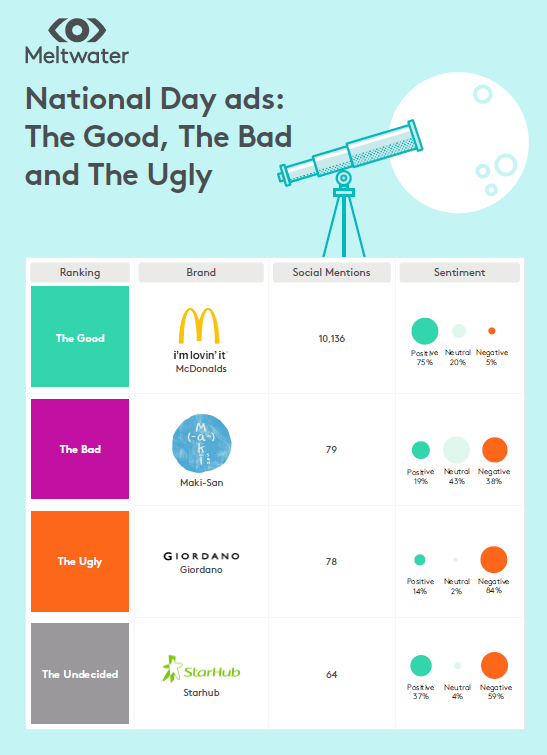
According to new data released by Meltwater, a global media intelligence firm, McDonald’s localized food menu campaign featuring a Nasi Lemak Burger racked up the highest level of social-media buzz on Twitter and Facebook in the run up to Singapore’s 52nd birthday.

The campaign saw a big spike in social media conversations on launch day (13 July) with 10,136 social mentions, of which 75% were positive. Mentions of McDonald’s peaked once again towards the end of July when the burgers sold-out, eliciting 105 social mentions.

“National Day is an important time for brands to unleash ads, hoping to grab a share of consumers’ spend”.

From our analysis this year, it is clear that the brands that stood out positively are the ones that were celebratory, did something unique, but weren’t over-the-top patriotic,” said Mimrah Mahmood, Regional Director of Enterprise Sales, Meltwater.

Sushi chain Maki-San drew flak online for naming a sushi roll ‘Maki Kita’, a play on the lyrics of Singapore’s national anthem. Unfortunately for the sushi chain, in Malay, the word ‘Maki’ means to curse or insult. The campaign drew 79 social mentions, with 38% of those negative, 43% neutral and just 19% positive. However, the furor quickly died down once the brand apologized.

“Reactions to this campaign started off quite negative, but within 7 hours Maki-San made a public apology – and that seemed to appease social media users. It also shows that responding quickly and offering a sincere apology is key to managing a company’s image,” Mahmood added.

Another campaign that divided Singapore netizens was StarHub’s diversity-themed video that featured Martin Luther King Jr’s renowned ‘I have a dream’ speech. While 37% of the sentiment was positive, 59% of social buzz was negative.

The sharpest reactions were reserved for retailer Giordano for releasing an ad featuring a family of three Caucasians and an Asian girl. 84% of its brand mentions on social media were negative. Netizens also pointed out that the image was part of an older ad and the Singapore-themed t-shirts were the result of Photoshop.

Meltwater also tracked campaigns between 1 July and 10 August. The hashtags covered included #onenationtogether, #NDP2017 and #sg52.
Currently, Meltwater helps companies make better, more informed decisions based on insights from the outside. More than 25,000 companies use the Meltwater media intelligence platform to stay on top of billions of online conversations, extract relevant insights, and use them to strategically manage their brand and stay ahead of their competition.

Lindsey Carnett, Marketing Maven’s CEO and President, Chosen for Forbes Agency Council

0
marketing maven

Marketing Maven, a leading public relations agency, announced that it was selected to be a part of the Forbes Agency Council. This is an invitation-only community for executives in successful public relations, media strategy, creative and advertising agencies.

Marketing Maven leads the industry in utilizing advanced metrics to measure their clients’ marketing reach and providing competitive analysis unparalleled in the industry.

Read Also: TMB Study Reveals How Social Media is Driving Returns on Digital Videos

Marketing Maven CEO and President Lindsey Carnett, a well-known business leader would lead the company in the Forbes Agency Council as a spirited trailblazer who prides herself on giving a voice to the underdog.

Lindsey Carnett
Lindsey Carnett, CEO of Marketing Maven

Carnett said, “Marketing Maven is honored to be chosen to become part of such a prestigious group of leading marketers and advertisers. As part of the Forbes Agency Council, we will be able to share our industry expertise to a larger business network.”

Marketing Maven was named to the 2017 Inc. 5000 List of “Fastest Growing Companies in America” and 2016 Entrepreneur 360 list of “Best Entrepreneurial Companies in America”. It specializes in PR, influencer marketing, social media advertising, direct response marketing, and reputation management.

Forbes Agency Council Offers Innovative Community Engagement with Personalized Support to Grow Business

Marketing Maven was selected to be part of the Council, a network of successful peers enjoying exclusive opportunities and resources, including the opportunity to submit thought leadership articles and lessons on media, PR, and advertising topics on Forbes.com.

Forbes Councils combines an innovative, high-touch approach to community management perfected by the team behind the Young Entrepreneur Council (YEC) with the extensive resources and global reach of Forbes. As a result, Forbes Council members get access to the people, benefits and expertise they need to grow their businesses — and a dedicated council member concierge who provides personalized support.

Carnett Featured in the Forbes Most Powerful Women Business Leader issue

Recently named AI Global Media’s Most Influential Female in Marketing, USA and honored as Folio: Magazine’s 2015 Top Women in Media, Carnett lectures at universities, conferences and professional marketing organizations globally. She has appeared in the Forbes Most Powerful Women Business Leader issue, on CCTV, Newsmax, Business Rockstars, NPR,  Telemundo, FOX Business, TheStreet.com, Huffington Post, and USA Today.

Read More: Cision Releases Exclusive Influencer Identification, Monitoring and Measurement Capabilities for Communications and PR Professionals

Forbes partnered with the founders of Young Entrepreneur Council (YEC) to launch Forbes Councils, invitation-only communities for world-class business professionals in a variety of industries. Members, who are selected by each Council’s community team, receive personalized introductions to each other based on their specific needs and gain access to a wide range of business benefits and services, including best-in-class concierge teams, personalized connections, peer-to-peer learning, a business services marketplace, and the opportunity to share thought leadership content on Forbes.com.

Recommended Read: Animoto and The Female Entrepreneur Association Survey Underscores Women’s Fluency with Social Media Marketing

Currently, Marketing Maven offers full-service marketing and communications services in direct response public relations. Marketing Maven has developed into a premier voice in brand strategy, social media, innovative media relations, event marketing, trade show support, multicultural marketing, reputation management and search engine optimization.

Interview with Piero Pavone, Co-Founder and COO at MainAd

1
Piero Pavone
Interview with Piero Pavone, Co-Founder and COO at MainAd

[mnky_team name=”Piero Pavone” position=” Co-Founder and COO at MainAd”][/mnky_team]
[easy-profiles profile_twitter=”https://twitter.com/piero_pavone” profile_linkedin=”https://it.linkedin.com/in/pieropavone”]
[mnky_testimonial_slider][mnky_testimonial name=”” author_dec=”” position=”Designer”]“Machine learning, by its very nature, is constantly ‘learning’ from actual behavior and actions – meaning advertisers can make real-time decisions based on data-driven targeting.”[/mnky_testimonial][/mnky_testimonial_slider]

On Marketing Technology

MTS: Tell us about your role at MainAd and what lead you and your fellow co-founders to start an AdTech company?
As Chief Operating Officer, I’m involved in all aspects of day-to-day operations – everything from business development to product R&D.

My fellow Co-Founders and I always envisioned starting a business together where we could work together harmoniously and effectively. It just so happened that the online advertising industry was booming at the time we created MainAd back in 2007 – from the moment the company was born we were in a sector with great potential. We pooled our individual skills and expertise to build our business from the ground up, making sure we complement, and not overshadow, one another’s strengths.

MTS: What is the driving force behind Logico? How much time did it take for MainAd to turn the idea into a reality?
Logico represents my dream product – I come from a programming background and this project became my personal venture. For years, I aspired to create a platform powerful enough to merge MainAd’s programmatic capabilities. Now we have one.

We wanted the final product to be perfect and, as a result, it took almost two years of extensive planning and research before we released the beta version. As online advertising is undoubtedly a fast-paced industry we needed to ensure our technology had the capability to keep up with ever evolving demands.

We wanted to align with the most influential technology provider, who could offer the fastest network and largest data pool – without a doubt that was Google. The bidder element of Logico is built on Google’s Open Bidder API and utilizes the Google Compute Engine, to allow custom real-time bidding (RTB) solutions to be personalized for the requirements of each client.

MTS: What is the ‘right’ programmatic strategy for advertisers and publishers in 2017?
Fundamentally, it is adapting your business to provide clarity and efficiency. We believe both advertisers and publishers should be open to all forms of collaboration within their programmatic strategy to further their businesses.

Ultimately, users should be targeted as individuals — rather than wider audience segments —, and advertisers must reach them in the right place, at the right time, using the correct logic to achieve the optimum result.

MTS: How do analytics and optimization tools allow advertisers to continually evolve their campaigns to maximize programmatic performance?
Maximizing programmatic performance boils down to a deep understanding of data and using this knowledge to make decisions in real time.

Machine learning, by its very nature, is constantly ‘learning’ from actual behavior and actions – meaning advertisers can make real-time decisions based on data-driven targeting. Using such insights to better engage individuals and reduce ad wastage can maximize programmatic performance.

MTS:  How does Logico bring programmatic and data analytics together?
The best results happen when data and creativity are used in harmony. Data-driven practices fused with a tailored approach to campaign management. This is what programmatic allows advertisers to achieve. Dynamic Creative Optimization (DCO) delivers both functionality and great design — which is often otherwise lacking from retargeted campaigns. Appealing aesthetics don’t have to be sacrificed for ad functionality and this can be something many brands and advertisers forget in the online space.

This idea of data-led campaigns is perfectly demonstrated by the Logico/Google case study. Logico has been proven to increase customer satisfaction with its accurate predictions, lower exposure to risk and wastage, and ultimately higher engagement. Logico leverages Google’s open source technology, speed, scale, and volume, to boost conversions, resulting in up to a 30% uplift.

MTS: What are the major components of managing a bespoke ad campaign?
Bespoke ad campaign management means being able to deliver an overall campaign without creating multiple strategies. It amounts to an understanding of all related variables and the capacity to tailor creative at any time to ensure a client’s KPIs can be met.

By using a fully managed service rather than a SAAS platform, advertisers benefit from an optimized approach, where performance is monitored and with the ability to react in real time.

MTS: Most programmatic advertising platforms, networks and exchanges have come together to provide a brand safe environment for advertisers. How do you see such collaborations helping the international programmatic ecosystem?
Since the start of our business, MainAd has exclusively worked with partners who observe strict compliance and only promote brand-safe environments. We are also equipped with our own viewability tool, so Logico itself is able to identify and eliminate fraudulent traffic, and avoid blacklisted sites.

By collaborating with leading partners internationally and taking a very client-driven approach across all markets, we have created a sophisticated ecosystem.

MTS: What would be your advice to CMOs who are planning to invest in programmatic in the near future?
It’s important to not let recent issues – such as brand safety and fake news – deter CMOs from adopting programmatic. In its most basic form, programmatic is just a process, how that process is managed is what makes the real difference.

CMOs must not be afraid to ask all the questions they need to be fully informed and ensure their company can operate transparently. Most importantly, CMOs should look to the ever-increasing pool of data available and utilize machine learning to fully understand the potential implications on their programmatic strategy.

MTS: Thank you Piero! That was fun and hope to see you back on MarTech Series soon.

[vc_tta_tabs][vc_tta_section title=”About Piero” tab_id=”1501785390157-b58e162d-0ae25a4b-c27aa077-4f08″]

As Chief Operating Officer & Co-founder, Piero is the driving force behind MainAd’s progress within the digital ad space. Piero has extensive experience as a software programmer with a key interest in new technical tracking systems. With never-ending curiosity, he leads innovation across all of MainAd’s business operations with a vision and strategy that allows it to maintain its competitiveness in the marketplace. In his spare time, Piero enjoys fast-paced activities such as motor biking and horse riding. His knowledge of how to combine the best of things to get the best results makes him the perfect host – a great trait he deploys both in and out of the office.

[/vc_tta_section][vc_tta_section title=”About MainAd” tab_id=”1501785390320-2d44fa50-740c5a4b-c27aa077-4f08″]

MainAd is an advertising technology company that specialises in global display and retargeting ad campaigns. The company’s flagship proprietary technology, ‘Logico’, utilises machine learning to extend the benefits of bespoke programmatic campaigns to brands, and when combined with the team’s tailored approach to campaign management offers improved performance. Using its data-based expertise, MainAd amplifies advertising performance while delivering transparent and fair results.

Founded in 2007, MainAd is a privately held company that services international brands across 80 markets, with offices in Pescara, Milan, London, Istanbul, Chile, Manila, Trivandrum and Bangalore. The company holds membership for the IAB UK, as well as IAB Italy, where MainAd’s CSO, Michele Marzan sits on the board of directors. For more information please visit www.mainad.com

MainAd is committed to supporting humanitarian and social causes. The company actively provides for projects in Mozambique and India through chosen charity Terre des Hommes and often backs entrepreneurial events local to MainAd’s HQ in Pescara, Italy.

[/vc_tta_section][/vc_tta_tabs]
[mnky_heading title=”About the MarTech Interview Series” link=”url:http%3A%2F%2Fstaging.loutish-lamp.flywheelsites.com%2Fmts-insights%2Finterviews%2F|||”]

The MTS Martech Interview Series is a fun Q&A style chat which we really enjoy doing with martech leaders. With inspiration from Lifehacker’s How I work interviews, the MarTech Series Interviews follows a two part format On Marketing Technology, and This Is How I Work. The format was chosen because when we decided to start an interview series with the biggest and brightest minds in martech – we wanted to get insight into two areas … one – their ideas on marketing tech and two – insights into the philosophy and methods that make these leaders tick.

TechBytes with Max Leletskyi, Head of Media Acquisition at GDM Group

0
Max Leletskyi
TechBytes with Max Leletskyi, Head of Media Acquisition at GDM Group

Max Leletsky
Head of Media Acquisition at GDM Group

New marketing technologies, largely driven by data analytics and mobile experiences, are gradually replacing traditional engagements. New-age mobile experience offers greater revenue by enabling publishers to monetize their inventory. Affiliate marketing, however, continues to run smoothly and remains aligned to legacy systems. We spoke to Max Leletskyi, Head of Media Acquisition at GDM Group, to understand how data-driven solutions for global advertising would drive automation.

Html code here! Replace this with any non empty text and that's it.

MTS: Why are some advertisers indifferent to their affiliates’ promotion methods?

Max Leletskyi: The rapid advancement in development of ad formats and their application over the last couple of years keeps even the most seasoned marketing experts on their toes, constantly checking the news. For many advertisers, the marketing stack required to comply with these advancements might get downright confusing. It would take up valuable time to get an in-depth perspective on all innovations in the field and even more time to optimize based on that perspective. That’s why advertisers often go to networks or private affiliates, as good communication streamlines the process.

MTS: How can advertisers make affiliates’ lives easier and vice versa?

Max Leletskyi: Addressing the previous point, proper communication is vital. It is common behavior among advertisers to make massive optimizations without sharing their reasoning beyond, “it doesn’t work for us.” While the actual cause is often valid, opening a dialogue could create new solutions based on both sides’ information and vision. Otherwise, trust diminishes and cooperation gets formulaic and rigid, which stifles innovation and progress.

MTS: Should advertisers enforce strict control over each step of their promotion or give affiliates space for more creative approaches?

Max Leletskyi: The answer is somewhere in the middle, leaning toward creative freedom. There are numerous tools monitoring the most threatening activities for the advertiser, but none serve up creative ideas for promotion. If the matter of concern is specific representation of the brand and meticulous crafting of its image – that’s a job for the in-house media buy team. As long as creativity stays within a brand-safe and legal space, there are foolproof methods of measuring traffic output according to each advertiser’s KPIs, which should give them a picture of what works and what doesn’t as well as a sufficient degree of control over the promotion of their brand.

MTS: What is the most mutually beneficial way of dividing risks between advertisers and affiliates/networks?

Max Leletskyi: Networks are fully responsible for traffic quality and compliance of ad creatives. Advertisers are obliged to pay for all traffic except fraud, up until they ask to pause that traffic + 2 business days for the network to execute. Again, regular feedback from advertisers as traffic matures is vital. Depending on the flow, rebill rate, frequency of traffic evaluation and other metrics on the advertiser’s side, it is important to not only analyze the first day traffic quality or the percentage of first time deposits, but also retention rate – weekly, biweekly, monthly and so on. Providing affiliate networks with this data will make the business more transparent, reduce low quality traffic volumes and distinguish high quality traffic faster.

MTS: Should advertisers take affiliates’ suggestions on improving their product and ad creatives?

Absolutely. Effective promotion is facilitated by a shared vision from both sides of the spectrum. Missing that perspective would be missing a huge chunk of data that would help the marketing campaign immensely, especially with creatives. Affiliates track performance on their end to see what converts, and they certainly want to make money. Why not listen to what they have to say? I personally know several cases of affiliates becoming official advertisers’ advisors or successful affiliate-to-advertiser transformations, which prove the idea that successful affiliates possess the skillset needed to create and sell services online.

MTS: What traffic sources would dictate the future of affiliate marketing?

Max Leletskyi: Video and native ads are at the forefront of online marketing right now, and they’re showing no signs of stopping. It also seems there is a trend of native ad networks actively implementing video ad formats. As the traffic ecosystem matures, it’s getting harder and harder to join the game. Bigger companies with budgets to spend take over the market, so traffic sources adapt to the changes and try to offer all types of appropriate inventory immediately. This industry evolves so quickly, it’s very challenging to predict what the market is going to demand in two years. That’s why a lot of startups never go live or don’t meet their goals after launch.

For now, there is no other traffic source as engaging to the user and as high quality as video ads. Perhaps VR will play a role in the next five years, but we’re not quite there yet.

MTS: When is automation going to take the human factor out of the advertising cycle?

Max Leletskyi: For those concerned that automation may take over affiliate advertising in the future, I don’t agree. It seems unlikely that automation will exclude the human factor completely, unless AI develops to the point of obtaining consciousness and creative thinking – at which point we will have different concerns altogether. Imagining a brand — its look and message — is exclusively a human task. Otherwise, the bots might as well run the company.

MTS: How could consumers be educated about fraudulent advertising?

Max Leletskyi: This is an important topic given the huge variety of ad formats and funnels. Email phishing looks like an ordinary reminder to reset your password, one-click flow pin submits may not warn you about the cost of the service, a sweepstakes pop-up ad might look like a discount on the site you subscribed to, or imitate a social media platform’s interface. The best advice is to analyze what you see and apply common sense. Make sure that you provide your private details to trusted services; it can save a lot of money and trouble. While some of the fraudulent funnels like content locking might be harmless unless you download .zip or .exe files to get to your pirated content, others may include auto-downloads or the blue screen of death, which leaves you no choice but to call tech support.

MTS: How can regular internet users be educated about fraudulent advertising techniques?

Max Leletskyi: This is difficult to answer. As the industry develops and provides new opportunities, fraudsters are close behind to take advantage. Most of the time we read articles about specific types of fraud only when they’ve had a massive impact, but usually by that time it’s too late. Of course, prevention is key, but it’s very hard to predict what’s around the corner in the online world.


MTS: Thanks for chatting with us, Max.

Stay tuned for more insights on marketing technologies. To participate in our Tech Bytes program, email us at news@martechseries-67ee47.ingress-bonde.easywp.com

Data Provider Datonics Integrates with AppNexus’ Data Marketplace

1
Datonics
Data Provider Datonics Integrates with AppNexus’ Data Marketplace

Datonics’ Proprietary Search, Purchase-Intent, Life-Stage, Demographic And B2b Data Now Available To Marketers And Advertisers Using Appnexus

Datonics
Datonics
, a leading independent online data provider, has been fully integrated into AppNexus’ Data Marketplace. This addition of Datonics data will allow marketers to accurately target audiences by incorporating Datonics’ proprietary search, purchase-intent, life-stage, demographic and B2B data into their online marketing campaigns.

Datonics is a subsidiary of AlmondNet, is the Internet’s leading independent aggregator and distributor of highly granular and proprietary search, purchase-intent, life-stage, demographic and B2B data.

Read More: LiveRamp Launches IdentityLink for Publishers as a Gold Standard in People-Based Marketing

Datonics offers marketers a plethora of options for audience segments, including 550+ pre-packaged and an unlimited number of custom keyword-derived segments, based on high-quality search, purchase intent, life-stage and B2B data on 180+ million US and Canadian users.

Datonics Offers Precise Audience-Targeting to Better Marketing Efforts

Michael Benedek
Michael Benedek, CEO, Datonics

Michael Benedek, CEO of Datonics spoke to us about this development. Michael said, “In addition to pre-packaged segments, Datonics offers partners the ability to create an unlimited number of custom segments based on keyword lists provided by their marketers, thus enabling a very granular approach to reaching the target audience of the marketer.”

Recommended Read: LinkedIn Matched Audiences Raise the Bar for Account Targeting and Campaign Management

Benedek added, “We’re happy to be fully integrated into AppNexus’ Data Marketplace. As a longstanding partner of AppNexus, we are seeing the value that our data is bringing to marketers. We are committed to providing marketers with the best quality, accurate, privacy-sensitive and safe third-party data, and look forward to continuing working with marketers through AppNexus.”

Daniel Smith
Daniel Smith, Strategic Partnerships at AppNexus

Daniel Smith, Director, Strategic Partnerships at AppNexus, said,“ “Having worked with Datonics for many years, we know the value that their data provides to marketers. We are pleased to have their data fully integrated into our Data Marketplace and extend the enhanced targeting capabilities Datonics’ data offers to our clients.”

Target Industry Professionals Based on Demographic Data

In addition to its roots in search and purchase-intent data, Datonics has become a leading player in B2B and demographic data. The B2B data has allowed marketers to target industry professionals based on occupation titles such as educators, travel professionals, financial services experts and many others. These segments are coupled with Datonics’ Career and Employment segments that classify users according to career levels like entry level, mid-level, and C-level positions.

Datonics’ demographic data incorporates age and gender segments along with additional attributes such as income, marital status, education level and language of origin.

Based on its overall data, Datonics now provides a comprehensive picture of online behavior, allowing marketers to pinpoint their campaigns to precise, target audiences that align with their marketing objectives

Apps: Good for Your Business and Your Health

2
Apps
Apps: Good for Your Business and Your Health

Mobile gaming in 2016 forever changed the way people use their smartphones. The reinvention of two different children’s media franchises, Pokémon and Mario, paved the way for some of the year’s biggest mobile advertising trends. However, it’s not just the popularity of Pokémon Go and Mario Run that is staggering. The important business implications and new opportunities for marketers to engage with audiences are the true game changers.

One of the first businesses to take advantage of the game as a marketing tool was Huge Cafe in Atlanta. This coffee shop is run by the Huge advertising agency as a pseudo-research facility, and the agency tested a new take on one of digital advertising’s most powerful units—value exchange. Customers were told to find a Pokémon near Huge that would be redeemable for a free cup of coffee. The agency saw an uptick in store traffic and sales, with an increase of over 27 percent in just one day. Many other cafes and restaurants eventually picked up on this out-of-game marketing tactic. In another instance, a local pizzeria in New York City saw sales increase by 75 percent by just spending $1.19 an hour on an in-game reward that lured Pokémon (and Pokémon Go players) to a single, physical location. By encouraging potential customers to engage with their business via a popular gaming app, Huge and other businesses saw higher amounts of in-store visits and sales.

Read More: Why Brands Will Pay Top Dollar for Your In-App Inventory

While some may argue that Pokémon Go is running out of gas and Mario Run hasn’t created the expected stock bump for Nintendo, the business implications of these gaming  phenomena will be long lasting. That, and maybe also the quirky fact that according to one report, Pokémon could even help you lose weight (1 lbs in 5 days by some estimates). Outside of helping customers achieve smaller waistlines, your brand can provide all types of value enhancing experiences via gaming and augmented reality (AR). The proliferation of these mobile gaming apps has taught us some great lessons on how to do it effectively:

1. Fish Where the Fish Are

Audiences are clearly spending quite a bit of time in mobile applications, with an average of three hours per day. Of that, on one day this summer, the average Pokémon Go player spent 33 minutes compared to 22 minutes on Facebook and 18 minutes on Snapchat. This statistic is not a Pokémon-only anomaly. Consumer time spent in gaming apps is sizable, representing a total of 15 percent according to Flurry. In fact, the average time spent in the popular app Game of War was measured at over two hours daily and users spent over 43 minutes per day playing Candy Crush. Importantly, users who spend time in games are more receptive to ads: according to Woobi, 66 percent of respondents want more opportunities to earn game rewards through ads.

2. Provide True Value to Consumers

With consumers spending so much active, engaged time in mobile apps, games become an ideal environment for advertisers to reach targeted audiences. And brands are still under-spending on mobile. On average, people spend 25 percent of their media time with mobile while brands only spend 12 percent of their ad budget in the medium. The solution requires more than an increase in mobile spending. Brands must spend the right way. They must create and deliver custom experiences that provide value. These experiences can include traditional product placement opportunities, as seen in games like Kim Kardashian’s Hollywood, that feature up-and-coming fashion and makeup brands. They can also include value exchange placements that provide custom rewards and missions.

Sephora’s chatbot in the messaging app Kik rewards people with exclusive mobile deals and discounts on products for completing short questionnaires. The benefit of this method is that the brand doesn’t need to create any additional infrastructure. The value exchange tactic encourages consumers to engage with the app in a way that is non-interruptive and on their own terms. Brands must be willing to work to create an immersive, emotional experience for audiences, and in exchange, they will receive genuine, human engagement.

Read More: The Secrets to Pharma’s Success in Mobile Advertising

3. Don’t be Afraid to Experiment

Pokémon Go became a bonafide global success because it fit seamlessly into the lives of its users. As people move around and make their way to work or school, Pokémon Go encourages them to find and battle Pokémon along the way. The app’s popularity shows how consumers are open and willing to integrate a mobile experience in their everyday lives. It has changed the way millions of people behave, which is something only a handful of companies can claim to have achieved.

How brands learn and apply lessons from these mobile apps remains to be seen, but the impacts have already been enormous. The AR technology application has disrupted the norms of mobile advertising, but also shown the flexibility of the mobile platform and the potential for even more creative ways for brands to engage with customers on the go. Mobile apps like Superhero Workout, where users have to do real-world exercises like arm punches and crunches to defeat enemies, and Ink Hunter, where users can create and try on custom tattoos, are also providing new opportunities for brands to reach their consumers using VR/AR technology. And with big companies like Facebook, Sony, Google, and HTC investing billions into VR hardware, this is just the beginning for VR/AR games.

As long as apps implement technology that is complementary and authentic to people’s real-world experiences, they will build a strong foundation for success. And if you weren’t convinced of the benefits of AR and gaming for your brand, at least now you know that Pokémon could help you lose weight too!

Read More: It’s 2017 and you still don’t know where your ads are running

How CMOs Can Turn Analytics into their Secret Weapon

1
CMOs
How CMOs Can Turn Analytics into their Secret Weapon

True consumer connection has always been a key aspect of marketing, but because the industry is changing quickly, consumers are looking for more than just an emotional connection to a brand. While the emotional connection is foundational, it’s also elusive. Analytics provide the data and statistics needed to more accurately measure audience reach.

Nearly every industry is seeing an explosion in the use of big data and analytics to drive business decisions, but the benefits of this phenomenon are no more marked than in the marketing industry. When it comes to marketing, the outcomes of big data are real and immediate, and they easily impact the bottom line. Marketers can better reach niche audiences and craft more personalized campaigns.

Big data poses a huge obstacle for marketers, as well. CMOs are increasingly pressured to make use of advanced technologies that have traditionally fallen out of their wheelhouse, but only one-fifth of CMOs feel prepared to take the leap. CMOs struggle to tap into big data’s enormous opportunities, and don’t always feel supported by the IT department.

Read More: Hyperpersonalize Your Campaigns in Five Steps

But don’t despair. There are crucial steps to managing the influx of big data that any marketing professional can take.

  1. Identify Problems for Analytics to Solve: Without focus, even the strongest data is pointless and unusable. Before marketers can jump into collecting as much data as possible, they must first define a problem for data to solve. If big data isn’t a fit for the business’ bottom line, then it becomes mere hype, which leads to disappointment, wasted resources, and bitter challenges in later adopting big data when it’s finally deemed to be useful. Marketing professionals who map out a direction and set goals for analytics data are always one step ahead than those who dive straight in. Think of the roadmap like a safety net that ensures that the business will achieve a high return on marketing spend. When every initiative is tied to clear, measurable goals, high ROI is anyone’s game. Data can save CMOs the hassle of relying on subjective emotions and in turn empower them to innovate their own decision-making processes. But none of this can be achieved without the understanding of problems whose answers lie in big data.
  1. Always Analyze the Significance of Any Data: Once CMOs gather data—whether it is consumer behavior patterns or other statistics—they must then weigh its significance. It’s no easy feat to mine through data and pick the strongest statistics, but it’s necessary because not every data calculation deserves a place at the table. CMOs should remember that quality is better than quantity when it comes to big data metrics. Especially in the age of hyper-informed consumers with shifting demands, carefully selected data helps CMOs keep pace without getting bogged down. How can marketing managers most effectively analyze the data? With clear communication and a regular transfer of information. It’s critical to deliver the right insights to the right marketers on the team, whether they’re PPC marketers or social media managers. Every stakeholder needs access to analytical information, and education in how the data can drive results. It’s pretty easy to reach data overload with big teams, and it’s important to carefully walk the line between sharing too much and too little data within the department—which comes back to the CMO continually improving their ability to pick and choose the most significant metrics. Otherwise, the whole marketing department will fall victim to big data overload and won’t be able to gather highly useful insights.
  1. Create a Team of Analytics Experts: Yes, technology paves the way for generating data, but it’s nothing without a solid team of both analytics and marketing talent. The numbers don’t interpret themselves. It takes a team of people who are passionate about analytics and knowledgeable about your market to evolve the business into one truly driven by data. Instead, companies are wise to partner with a firm or to create internal analytics positions who can assist not only marketing but other departments as well.

As big data analytics continues to evolve and become more accessible, CMOs who realize its importance are able to reach new heights of customer engagement.

Read More: 4 Reasons Your Business Needs Predictive Selling

Sprout Social Unveils Bot Builder Offering for Facebook Messenger to Personalize Human Conversations

0
Sprout Social ranked #3 on Battery Venture’s 25 Highest Rated Public Cloud Computing Companies to Work for

The New Bot-Builder Platform From Sprout Social Enables Brands To Create Customized Automated Conversational Workflows For Improved Customer Service On Facebook

Marketers are seeking chatbots–in fact, 80% of high-level marketers plan to implement bots by 2020. Sprout Social has cateredto this need, launching Bot Builder for Facebook Messenger. The tool enables brands to create, preview and deploy custom chatbots in a matter of minutes, without extensive developer knowledge or external resources.

There are currently 100,000 active bots on Facebook Messenger, and tools like Sprout’s Bot Builder, would mean that this number will only continue to rise. Implementing chatbots and embracing their potential enables brands to better serve their customers via Messenger and streamline customer support on that channel.

Bot Builder for Facebook Messenger A Personalized Customer Service Agent

Andrew Caravella
Andrew Caravella, Vice President, Strategy & Brand Engagement, Sprout Social

Andrew Caravella, Vice President, Strategy & Brand Engagement at Sprout Social said, “Turning to chatbots is well worth the investment in today’s e-commerce and social selling environment. Social media is consumers’ top choice for seeking customer service support and as a result, customer service teams are fielding an ever-increasing volume of requests.”

We asked Andrew if bots justify MarTech investments, especially for B2B engagement. He replied, “Chatbots alleviate that struggle by efficiently gathering all necessary details of each customer issue, then handing over a fully-formed case to a human customer service agent to offer support. It’s a perfect example of what happens when man and machine tag team in the right way.”

Bot Builder Opens New Avenues for Consumer Acceptance of Automation

Aaron Rankin
Aaron Rankin, Co-founder and CTO, Sprout Social

Aaron Rankin, CTO of Sprout Social, said, “At Sprout, we believe truly great technology simply enhances and facilitates human conversations, and that is what we set out to do with our Bot Builder. Our tool makes it easy for businesses to provide the instant response people are looking for while ensuring customer service agents can seamlessly pick up queries that require more nuanced assistance. The strong foundation that Facebook Messenger has built for chatbots has also made inroads in consumer acceptance of automation, so offering an accessible Bot Builder was a natural next step.”

SproutSocial

Sprout’s Bot Builder for Facebook setup wizard enables brands to take only a few short steps to customize and set up their bots, greatly reducing internal friction and the need for outside resources and support. Sprout debuted this tool for Twitter Direct Messages in July, after allowing early access to select customers, including Evernote, Monarch and Bloomsbury. In fact, since implementing Bot Builder, Evernote has served 80 percent more customers on Twitter per week while reducing the number of replies in each conversation by 18 percent.

Read More: Sprout Social Launches Self-Configurable Bot Builder to Automate Conversational workflows

SproutSocial 2
As with Sprout’s Bot Builder for Twitter, the Messenger version enables brands to turn to simple, rule-based logic to support customers and automate the delivery of personalized marketing experiences.

In a customer service scenario, upon entering the Messenger chat, the user is greeted with a preset opening reply with options for where to head next, depending on their query. By the time the case is handed over to the human agent, he or she has all the details needed and can efficiently assistresolving the query.

Andrew said that SproutSocial would most likely bring out the Bot Builder version 2.0 later this year. He said, “We plan to release a version 2.0 that will support more complex interactions and enable the brand to configure multiple pathways for the bot conversation that go several layers deep, all built with rules-based logic.”

Read Also: Lotame Empowers Marketers to Remove Bots from Target Audience List

Currently, Sprout Social offers social media management, analytics and advocacy solutions for leading agencies and brands, including Hyatt, GrubHub, Microsoft, Uber, and Zendesk. Available in the web browser, and as iOS, and Android apps, Sprout’s engagement platform enables brands to more effectively communicate on social channels, collaborate across teams and provide an exceptional customer experience.

Read More: Google and Facebook Adopting Marketing Mix Modeling

Bambu by Sprout Social, a platform for advocacy, empowers employees to share curated content across their social networks to further amplify a brand’s reach and engagement. Headquartered in Chicago, Sprout is a Twitter Official Partner, Facebook Marketing Partner, Instagram Partner Program Member, LinkedIn Company Page Partner and Google+ Pages API Partner.

Recommended Read: comScore Adds Facebook Demographic Metrics to vCE

Artificial Intelligence: Marketing’s New Ally

4
Artificial intelligence

It’s a feeling too many customers and prospects know: the sense that they’re simply spokes in a brand’s wheel, rarely recognized for the individuals they are. Marketed to as if they’re part of one big blob, static and unmoving, when what they crave most is personalization – messages timed to where they find themselves in a given day, tailored to their needs and interests.

Put yourself in their shoes, if you can. What would you do if you paid a website a visit and got back a generic email for your troubles? Something bland and impersonal that seemed to know nothing about you? Wouldn’t you delete it without a second thought and question whether that brand deserved your business?

Also Read: The Influencer Economy is Booming

It’s a conundrum we might’ve solved in eras past with segmentation and personas – identifying the characteristics common across a specific group (their habits, their preferences), adjusting our outreach accordingly – but trying to go beyond a one-size-fits-all approach, at the level expected by today’s buyers, is hard to scale. Customers engage with businesses across a variety of digital touch points (websites, social media, etc.), on multiple mobile devices. They expect a more customized experience throughout.

That’s what makes artificial intelligence and machine learning so compelling to the modern marketer, and why we’re likely to only see more of it in the technologies marketers leverage.

We can already see glimmers of this zeitgeist in some of the consumer applications now on the market – in any number of offerings from Google, for instance: Google Lens, which gives consumers the ability to learn more about a business simply by snapping a picture; Google Assistant and GoogleHome, which account for and respond to trends in buyers’ daily habits.

The thinking behind these products is simple – consumers require solutions that can adjust to their real-time movements, and want individualized shopping experiences. It only makes sense for B2B marketing technologies to follow suit, enabling personalized, one-to-one interactions in real-time across the customer journey.

If anything, AI and machine learning mark natural evolutions in these technologies. Marketing automation, for instance, has always served as a particularly efficient engine for gathering and activating engagement data (details on buyers’ histories, behaviors, general shopping habits), and is uniquely positioned to transform how marketers approach the customer journey. AI will empower marketers to build Adaptive Journeys™ that adapt to each individual and their preferred channel and send time and delivers the most relevant message in real-time as the customer goes about their research and discovery process. The journeys that buyers travel don’t keep to the straight lines we think; there are twists, there are turns, and marketers must make every effort they can to accommodate these in real time – to be proactive, where they once were reactive. That’s why it’s important for marketers to embrace this Adaptive Journeys concept, and for brands as a whole to leverage technologies capable of supporting these fluid, real-time customer journeys.

Also Read: Four Tips to Design an Analytics Product that Democratizes Data

We can look at the evolution of mapping technologies to explain the Adaptive Journeys concept, looking specifically at Waze technology that knows where the driver is on their route and can predict the best commute for them based on real-time traffic conditions and external factors; ultimately recommending the best path the driver should take to get to their destination most efficiently.

More importantly: this is the kind of continuous learning marketers require in order to deliver the customized experiences their buyers expect, and also the functionality they should prioritize in solutions they implement.

We need to be agile in how we respond to and care for our customers, and our customers, in turn, need to feel like more than just a number. AI and machine learning can allow for this, and make our lives easier in ways we don’t expect – serving, perhaps, as more of a recommendation engine for us than an outright replacement for the work we do; something that suggests the best path forward, which we then choose for ourselves, so that we’re freed up to be more creative, more strategic. The future of marketing is adaptive. Let’s greet it with open arms.

Also Read:  3 Questions Every Marketer Must Ask When It Comes to Brand Safety

Mindmatrix Brings Partner Relationship Management (PRM), Channel Marketing Automation & Channel Sales Enablement on a Single Platform

1
Mindmatrix Brings Partner Relationship Management (PRM), Channel Marketing Automation & Channel Sales Enablement on a Single Platform

Mindmatrix, a leading native Channel Enablement Software Provider in the industry, is offering all the 3 core elements of Channel Enablement on a single platform. These elements are —

– Partner Relationship Management (PRM)

– Channel Marketing Automation

– Channel Sales Enablement

Most other vendors either enable one or two of the three core elements; or have partnered with others to offer all the three elements. For Partner Relationship Management (PRM), Mindmatrix offers partner portals and tools for partner recruitment, training, onboarding and certification, incentive and rewards management, opportunity management, lead routing and MDF management.

Mindmatrix helps corporate marketing teams support channel partners more effectively through its channel marketing automation module. Mindmatrix’s channel marketing automation segment offers tools for centralized local marketing, lead generation, social media marketing and channel marketing asset management.

Mindmatrix also offers tools that simplify the channel sales model, making it easy for channel partners to sell. These features are a part of its sales enablement module for channels and include Playbooks, Distributed CRM Integration, E-Contract Signing, Guided Sales Solution Selling and CPQ Engine.

Maria Chien, Service Director of Channel Marketing Strategies at SiriusDecisions, says, “As suppliers invest in channel solutions to automate workflow, scale program capabilities and streamline processes, they should include interoperability as a key consideration for delivering a positive partner experience. A core tenet of a positive partner experience is the ease of doing business, which is largely driven by the optimization of the workstreams associated with each partner touch point. Channel organizations must evaluate current and future technology investments to determine which tools are necessary to support channel business needs, paying special attention to possible integrations with existing technologies.”

Currently, Mindmatrix is the only single, fully integrated platform offering complete sales and marketing enablement for direct and indirect sales. Mindmatrix combines Partner Relationship Management (PRM), Channel Marketing, Asset Management, Sales Enablement, and Marketing Automation for the complete enablement of your sales and marketing teams. This unified platform takes you through every step in the sales process from lead to revenue, enabling your sales channels to sell more, faster.

LeadMaster Selects ConnectLeader’s Sales Acceleration Platform for CRM Integration and Automated Workflow

1
ConnectLeader

ConnectLeader, a leading innovator in B2B sales acceleration technologies, announced that LeadMaster has selected its award-winning Sales Acceleration Platform for product integration. Both Click Dialer® and Personal Dialer® are now seamlessly integrated with LeadMaster’s CRM offering to provide a lead-generation solution with up to 100% more calling productivity while enabling a truly automated workflow for all sales levels.

Russ King, CEO of LeadMaster, said, “There are hundreds of CRM-based sales tools on the market today, but few offer a true workflow, e-marketing and custom forms that easily become part of an existing CRM platform–without requiring a major investment. ConnectLeader provides us with a set of premium sales tools, that look and perform like they are developed by sales representatives rather than a solution created by techs who have never worked the phones or nurtured leads.”

LeadMaster helps organizations to better manage clients, as well as automate and streamline their marketing processes. In addition, the company’s cloud-based CRM offering helps customers capture, nurture and convert leads while adapting to all business sectors such as call centers, healthcare, insurance, real estate and others.

In order to differentiate themselves in the market, LeadMaster knew they did not need just another auto dialing product. They needed a progressive solution, customizable by age groups, such as Millennials, to make prospecting more enjoyable while also providing analytics and data mining for more advanced lead-generation.

“We customize our offering to serve up an interface to match the preferences of any age group. No matter what we come up with, ConnectLeader’s sales automation seamlessly integrates to help us more than double the calls made manually,” King added.

ConnectLeader’s Sales Acceleration Platform is a patented Software as a Service (SaaS) solution that provides individuals in all types of sales roles the ability to increase their top line revenue by increasing productivity — up to 800%. LeadMaster is currently using the following platform offerings:

  • Click Dialer® – Click-to-call software residing within LeadMaster that allows users to simply click and dial any phone number, take notes, leave a voice message, send email, and quickly move onto the next prospect.
  • Personal Dialer® – Power dialing software that expands the Click Dialer features to allow users to seamlessly dial using a patented visibility and control capability while power dialing—improving sales productivity from 30% to 100% compared to manual dialing.

Additional sales acceleration features include–

  • Team Dialer® – An agent-assisted dialing solution that takes power dialing to the next level by allowing a group of human agents to make 125-150 dials per hour while filtering through non-productive dialing activities such as navigating voice mail systems, dealing with gatekeepers and leaving voice messages. Using Team Dialer, sales representatives are able to engage in 8 to 12 live conversations per hour with decision makers.
  • Adaptilytics® – Analyzes, prioritizes, and scores prospecting lists. The new offering further improves outbound prospecting results by enabling users to customize the prediction algorithm based on a prospect’s installed technology, intent to buy, contact data and the best time to reach.
  • Data Genie® – An innovative data-delivery solution that enables ConnectLeader users to add and update accurate contact data directly into their CRM.

“Our close working relationship with LeadMaster has produced impressive tools that give sales teams the ability to quickly target any vertical market, in any size company,” said Senraj Soundar, Founder and CEO, ConnectLeader. “We are proud to help LeadMaster grow and take advantage of the industry’s most recently awarded sales acceleration solution.”

Recently, ConnectLeader announced the availability of their TopRung sales gamification and performance management tool. TopRung uses the power of team competition to align, adopt, and accelerate sales activities, as well as drive sales process adoption and create more lead generation conversations that become pipeline opportunities.

TechBytes with Samir Addamine, Founder and Chairman, FollowAnalytics

1
Samir Addamine
TechBytes with Samir Addamine, Founder and Chairman at FOLLOWANALYTICS

Samir Addamine
Founder and Chairman, FollowAnalytics

In March 2017, Forrester Research recognized FollowAnalytics as a leading Mobile-First Commerce and Messaging platform. The allure of mobile marketing continues to grow with marketers increasingly looking out for powerful “Mobile Moments” that satisfy customer’s desires effectively. We chatted with Samir Addamine, Founder and Chairman, FollowAnalytics, to understand the trends in the mobile marketing automation market and the importance of ‘Mobile Moments’ in marketing campaigns.

Html code here! Replace this with any non empty text and that's it.

MTS: What are the different mobile marketing automation capabilities that FollowAanalytics provides for Mobile-First engagement?
Samir Addamine:
We offer three main areas of automation:

  • Analyze: Our customers fully understand how people use their app so they can make data-driven decisions about how to interact with their customers. Through event flows and funnels, they can see where users drop off so they can optimize customer journeys.  They also have a real time 360° view of their customer across devices, channels, and geographies.
  • Engage: Build personalized customer journeys that boost long term engagement. Contextual campaigns can be triggered by customer behavior, in-app and custom events, location, profile information and just about any set of inputs, all in real time. Plus because we have native connectivity to CRMs and other tools in your stack, we enable true omnichannel marketing.
  • Optimize: Our smart multivariate testing lets you make data-supported decisions that ensure you are always sending the right message to the right user. We leverage machine learning to take the guess work out of testing and to continue optimizing your campaigns. 

MTS: How suitable is a mobile marketing automation platform for re-engagement and re-targeting?
Samir Addamine:
Mobile Marketing Automation is your ace-in-the-hole for re-engagement. First, we suggest you start with good analytics.

By using funnel analysis and smart segments, you can identify groups that have gone quiet and analyze why. Perhaps the messaging wasn’t appropriate. Were you using millennial slang to a baby boomer crowd? Maybe the timing was wrong. Had you messaged them too soon and too frequently after a recent purchase?

Next, you can create re-engagement campaigns designed to bring them back into the fold.  A Good MMA suite should provide a full view of the customer, including CRM data, behavioral info, preferences, demographics, etc. So you can and should be creating personalized journeys that speak to each customer in the way they’re best able to receive your message. At FollowAnalytics we like to talk about segments of one. That’s how you should look at your customers. They’re individuals and automation done well gives you the ability to approach them that way.

How does FollowAnalytics make this possible? 

Our Analytics suite will surface where you have holes in your funnel. Our Engagement suite will help you build campaigns to re-engage your users and our Optimization tools will help you test and continue to improve them.

MTS: We have heard a lot about “Contextual Campaigns.”  How does FollowAnalytics help achieve contextual campaigns?
Samir Addamine:
There are basically two ways to campaign that use push and in-app notifications, transactional and contextual.  Transactional are the most basic. Think of them as system messages. You complete an action, you get a confirmation.

Contextual are the ones I find more interesting because they’re how we create personalized journeys. They let us build great communication based on variables and triggers. An example would be to send a coupon to customers in the midwest who like soft drinks when they are within a mile of a convenience store and the weather is over 75°F.

That campaign is going to do much better than a batch-and-blast because it’s personal—you know they like soft drinks; relevant—it’s hot out and they’re probably thirsty; and contextual—they’re near the store anyway.

MTS: How do geolocation and analytics govern customer experience in mobile marketing?
Samir Addamine:
Geolocation is important because it’s a huge determination of context.  (That’s why so many apps ask permission to know your location!)  How useful would a weather app be if it gave you updates for the wrong area?  Geo is one of the advantages that mobile apps have over the web.  Apps can get much more precise, down to what aisle you’re on in a store.  With this information, app owners can provide such extreme value (like helping users find something in that store).

Analytics are absolutely critical to understanding what’s working and why. You need to understand what messages are boosting conversions, which are creating opt-outs, where are people getting lost in the app, where are crashes happening, are there points in the funnel where users are dropping off?

MTS:  What are “mobile moments” which could enhance brand value?
Samir Addamine:
Forrester defines mobile moments as the “point in time and space where someone pulls out a mobile device to get what he or she wants, immediately, in context.” Our customer, Louis Vuitton is doing a beautiful job creating mobile moments with their City Guide app.  The app acts as a personalized tour guide providing curated experiences of 25 cities, worldwide. It pulls in CRM data to make recommendations based on user preferences and educated guesses based on segments. Then, when the traveler is near an attraction, it makes recommendations in real time.  The result is a customized tour that is unique to each user. The traveler gets this very elite and concierge-level service that is in alignment with the LV brand.  It’s quite elegant.

MTS: What is the next possible disruptive technology you see in mobile marketing and automation?
Samir Addamine:
Without a doubt, it’s going to be machine learning and AI.  When we start talking about personalization and 1:1 customer journeys we are talking about executing on something that gets extremely complex.  There is no longer a concept of one generic customer journey that marketers map on a white board and they’re done.  Every user is an individual and they interact with your brand across different paths, channels and devices, all in their own time and their own way.

Machine learning and AI are going to be necessary to help marketers keep up with this.

We’ve already introduced AI into our A/B testing tools in order to help marketers test messaging against the infinite number of ways they can segment their database and then continue to optimize the messaging.  We see the concept of the “Self Driving Campaign” as the future.

MTS: Thanks for chatting with us, Samir.
Stay tuned for more insights on marketing technologies. To participate in our Tech Bytes program, email us at news@martechseries-67ee47.ingress-bonde.easywp.com

Interview with Giovanni Strocchi, CEO, ADmantX

0
Giovanni Strocchi
Interview with Giovanni Strocchi, CEO at ADmantX

[mnky_team name=”Giovanni Strocchi, CEO at ADmantX” position=”CEO at ADmantX”][/mnky_team]
[easy-profiles profile_twitter=”https://twitter.com/gstrocc” profile_linkedin=”https://it.linkedin.com/in/giovanni-strocchi-97b145″]
[mnky_testimonial_slider][mnky_testimonial name=”” author_dec=”” position=”Designer”]“The connection between a brand and its audience is driven by emotion, which means that brands must be able to trigger consumers’ emotional senses to get them involved and forge a lasting bond with their audience.”[/mnky_testimonial][/mnky_testimonial_slider]

On Marketing Technology

MTS: Tell us a bit about your role at ADmantX and how you got here.
As CEO of ADmantX, I’m responsible for the company’s strategic direction and culture and as the company has grown, I’m also responsible for overseeing our expansion in international markets, developing new product offerings, and building key partnerships.

I’ve been involved in digital innovation, complex project implementation, and international business development throughout my career, both in multinational environments and in start ups.

Before joining ADmantX, I was the Group Business Product Director for the Vodafone Group (and previously, Strategy and Business Development Director, and Sales Director). Before that, I held similar roles at McKinsey, Technogym, Alcatel, and TIM.

I’m also an angel investor. I currently serve on a number of boards and am an investor in nine start ups. It’s in this capacity that I encountered ADmantX several years ago. After seeing the unique, semantic technology that underpins the company and the team behind it, I jumped in to drive the business. It’s been an exciting ride so far!

MTS: How does your semantic cognitive technology assist in advanced contextual targeting?
You can only achieve contextual targeting with a true understanding (not classification) of a page. The ADmantX semantic cognitive technology uses full Natural Language Processing (NLP) to read and analyze content as a human would to truly understand, the meaning of on-page content. The secret sauce is a “sematic network” – a cognitive network of 12 million cross connections – in which each of the 500,000 thousand concepts of our language is linked to one another by semantic relationships. When activated, a knowledge graph is created from the text of a specific page, allowing us to understand the meaning of every single concept on the page. This has a number of advantages, including increased contextual awareness, improved brand safety classification, and an understanding of the content audiences read and engage with for advanced profiling – ultimately leading to reduced waste, and maximized ROI.

NLP goes further than old “search” methods such as keyword classifications and simplistic text systems to actually deconstruct the content. By organizing and classifying the individual meaning of words and then reviewing them within the wider article environment, a clear contextual picture is created without the inaccuracies and mistakes made by simpler engines.

MTS: Is this what goes in to building your Intelligent Brand Safety Platform?
True understanding implies full contextual protection. By fully comprehending the meaning of words – not just their presence on a page – and concepts, our analysis allows full management of URL selection or deselection with no mistakes, including accurate sentiment and emotion identification. This enables brand safety at an exceptionally granular level, empowering advertisers to avoid placements alongside content that expresses adverse sentiment towards their specific brand or their sector as a whole, as well as ensuring they evade generally inappropriate or damaging content. You need scale to do it, but also precision and flexibility.

In addition to intelligent brand safety, we can create a “brand specific” brand safety solution and develop an “extreme speech and fake news brand safety” solution, both using our technology.

MTS: How does ADmantX analyze human emotion and sentiment?
By understanding the true meaning of content at page level, our technology can also discover its emotional context, identifying the feelings that content is likely to evoke. Emotions are a complex human concept that can not be described by keywords but by “emotional context” – it took us two years of working with a leading university to identify all of the emotional contexts associated with the 60 plus grades of human emotions and feelings. To extract those accurately, you need a deep linguistic solution and a cognitive technology. “I loved you so much. But I don’t love you anymore” is not a positive emotional context. You have to take into account the use of past tense and the full stop to understand that the subject of the second sentence is the same of the first.

In understanding the emotional frame of mind for the consumer, we can apply enhanced targeting in real time, ensuring that the right emotional context is considered – a champagne brand would love to advertise in an emotional context of “success”, even if it is associated with business success, sport achievements, graduation, etc.

The connection between a brand and its audience is driven by emotion, which means that brands must be able to trigger consumers’ emotional senses to get them involved and forge a lasting bond with their audience. Putting emotions at the heart of their campaigns, ensuring ads are well placed in the right emotional context, is crucial for enhancing engagement with their audiences.

Accurate emotional context is the top level of contextual relevance. This could mean avoiding content with an emotional context that could be damaging for a brand. By matching the emotional context of ad creative and page content we ensure the consumer is in the right frame of mind to engage with the ad, increasing metrics such as brand recall and maximizing ROI.

MTS: What startups are you watching/keen on right now?
As an angel investor I’m naturally a little biased towards those startups I have invested in. Some of them in the digital space include TOK TV, a rapidly growing sport social network, Inventia, a software company with an advanced video customer interaction platform, Mapendo, a smart performance partner for boosting mobile sales, as well as Artemest, a marketplace for luxury craftsmanship.

MTS: Youve said that programmaticis an industry buzzword you wish was banned – tell us more.
Today, the term programmatic adds an unnecessary impression of complexity to a relatively simple concept. No one will question that automatic media buying is the norm for reasons of efficiency and scale. However, there are many different programmatic definitions and models so the word can easily be misunderstood when used as a generic term.

MTS: How do you prepare for an AI-centric world as a business leader?
I’m in a lucky position as ADmantX is intrinsically linked with AI, which gives me a head start. We’ve developed a complete AI layer on top of our advanced cognitive semantic technology that has evolved from interest profiles – to understand what audiences like – to full propensity models that understand what audiences evaluate – this will tell a brand which users are ready to interact with a specific message or ready to accept a specific offer –  and now to real-time recommendations.

Innovations in AI are already fundamentally changing our working environments and its relevance will escalate over the coming decade, so in addition to developing the ADmantX offering, I read and learn as much as possible about the ongoing evolution of AI to make sure I’m as aware as can be.

This Is How I Work

MTS: One word that best describes how you work.
Committed.

You can engage with what you do and the people you work with, which is fine, but if you are “committed” then you are really “a part of” what you do. I’m committed to my customers’ needs, and these drive decision-making and business priorities. I’m committed to the success and welfare of my team because I must be able to rely on them completely. I’m committed to driving innovation in everything I do; it’s the only way to think ahead. I’m committed to concrete results and activities, as I believe if you do what is needed, and then do what is possible, you’ll be able to do what is impossible. Finally, but most importantly, I’m committed to my family.

MTS: What apps/software/tools cant you live without?
LinkedIn is essential for forming and maintaining business relationships and WhatsApp and Twitter are indispensable for keeping in touch internationally. The other tool I couldn’t be without is my calendar. I have a hectic schedule and continually need to balance work and personal commitments, so if it’s not on the calendar, it’s not happening!

MTS: Whats your smartest work related shortcut or productivity hack?
Don’t check your email for the first two hours of the day. Of course, it goes without saying that you shouldn’t ignore urgent messages or delay responding to an ongoing client conversation, but by keeping this to a minimum, you can think more clearly and plan your day proactively – rather than reacting to your inbox!

MTS: What are you currently reading? (What do you read, and how do you consume information?)
Every morning I’ll take a look at a selection of industry newsletters and feeds, as well as articles my friends or colleagues have shared to see what’s new and worth reading. In the evening I’m more likely to read a book. I am currently reading The Master Algorithm, by Pedro Domingos, and Roald Dahl’s Matilda – for my daughter’s bedtime reading.

MTS: Whats the best advice youve ever received?
It’s a combination of a couple of ideas – living in the present, and living every day to the fullest, as if it were your last – that resonate with me. At the same time, it’s important to maintain an eye on the future and to every day be taking one step forward in the direction of your goals.

MTS: Something you do better than others – the secret of your success?
Energy and vision for sure.

But, the fundamental ingredient is empathy – you can achieve nothing without your team or without your customers and partners and empathy is essential to really understand their needs and what drives them. Relationships based on trust are what drives long-term business results.

MTS: Tag the one person whose answers to these questions you would love to read
Gustav Mellentin, co-founder and CEO of Adform

MTS: Thank you Giovanni! That was fun and hope to see you back on MarTech Series soon.

[vc_tta_tabs][vc_tta_section title=”About Giovanni” tab_id=”1501785390157-b58e162d-0ae25a4b-c27a6430-9cee”]

Giovanni is a senior manager/executive with significant international experience in strategy, innovation, digital transformation projects, marketing, sales, complex international organization management, wide technology implementation and transformation programs, shareholder/board management. He is also an angel investor in digital start ups and a board member.

[/vc_tta_section][vc_tta_section title=”About ADmantX” tab_id=”1501785390320-2d44fa50-740c5a4b-c27a6430-9cee”]

ADmantX is a smart data provider that facilitates better brand planning and targeting within the digital advertising industry. With its unique ability to understand the meaning within online content, ADmantX allows publishers and advertisers to match ads to relevant online content at page level.

ADmantX is powered by its patented semantic Natural Language Processing technology that delves into the hidden context of content. Utilising over 20 years of expertise in advanced semantic and data science, ADmantX specialises in contextual targeting, intelligent brand safety, content insight reporting and planning, emotional and sentiment targeting, and first-party advanced profiling.

Founded in 2010, ADmantX works with global clients which include NBCUniversal, Financial Times, GroupM, Amnet, Simple Agency, Accuen, RCS Group, Mondadori and is integrated with leading DSPs such as AppNexus, Turn, and Adform. ADmantX operates globally – in 20 languages – and has business operations located in the UK, US and Italy with customers in 15 countries.

[/vc_tta_section][/vc_tta_tabs]
[mnky_heading title=”About the MarTech Interview Series” link=”url:http%3A%2F%2Fstaging.loutish-lamp.flywheelsites.com%2Fmts-insights%2Finterviews%2F|||”]

The MTS Martech Interview Series is a fun Q&A style chat which we really enjoy doing with martech leaders. With inspiration from Lifehacker’s How I work interviews, the MarTech Series Interviews follows a two part format On Marketing Technology, and This Is How I Work. The format was chosen because when we decided to start an interview series with the biggest and brightest minds in martech – we wanted to get insight into two areas … one – their ideas on marketing tech and two – insights into the philosophy and methods that make these leaders tick.