Home Blog Page 4398

Instapage Launches Advertising Attribution Solution

0
Advertising Attribution Solution
Instapage Launches Advertising Attribution Solution

Marketers Can Track Cost-Per-Visitor And Cost-Per-Lead For Their Paid And Organic Traffic, Using The Latest Instapage Solution

Instapage, the only landing page platform for paid advertising, has announced its Advertising Attribution Solution for teams that invest in paid marketing platforms like Google AdWords.

Recommended Read: Interview with Tyson Quick, Founder & CEO – Instapage

This first-of-its-kind offering delivers unparalleled insights into Google AdWords attribution across the entire marketing and sales funnel. Customers will be able to track cost-per-visitor and cost-per-lead for their paid and organic traffic.

Tyson Quick
Tyson Quick, Founder and CEO, Instapage

Tyson Quick, Founder and CEO, Instapage, said, “This is the next step in our effort to make digital advertising more efficient for everyone. Advertising attribution is a powerful means to understanding the true value of an AdWords campaign. With our advanced analytics, our customers will be able to make strategic decisions about their campaigns that have a direct effect on ROI.”

Read More: Instapage Announces Integration with HubSpot to Bring Best-In-Class Customer Experience on Landing Pages

90% of Instapage customers use Instapage in conjunction with their digital advertising. With this solution, customers have full visibility into paid advertising attribution. Users can:

  • Fully integrate with Google AdWords and Google Analytics to pass lead meta-data to down-funnel systems
  • Attribute conversion, pipeline, and revenue to specific Adwords campaigns
  • Track cost-per-visitor and cost-per-lead for paid and organic traffic
Chris Briggs
Chris Briggs, Creative Director, Verizon Digital Media Services

Chris Briggs, Creative Director, Verizon Digital Media Services, said, “Instapage has become an important part to scaling our AdWords campaigns. The ability to create, A/B test, optimize, and analyze the success of our landing pages has made our team smarter and faster.”

The Advertising Attribution Solution is part of a larger Instapage product release, the Advertising Conversion Cloud for teams and agencies that undertake advertising at scale. The product includes a full range of enterprise solutions and services including advanced security, implementation services, and customization.

Currently, Instapage, the most powerful landing page solution for marketing teams and agencies, is on a mission to continually lower the cost of online customer acquisition. Instapage provides an end-to-end solution that empowers marketers to quickly build, integrate, and A/B split test landing pages for every unique campaign. With Instapage, paid advertising is more relevant and effective for everyone.

Amplero Lifts Lid on AI’s Black Box for Marketers with New AI-Fueled Learned Insights Capability

0
Amplero Raises $17.5 Million in Series B Funding

Amplero, a recognized leader in core artificial intelligence marketing technology, announced enhancements to its pioneering AIM Learned Insights capability.

The announcement comes immediately following a $17.5 million Series B funding round co-led by Greycroft and Ignition Partners.

Powering personalized, cross-channel customer experiences at brands like Sprint, Xbox, Virgin Mobile, DoubleDown Interactive, the Amplero Artificial Intelligence Marketing (AIM) Platform adaptively optimizes every customer interaction to maximize customer lifetime value and loyalty at a scale that’s not humanly possible.

“Both the customer experience and the enterprise marketing infrastructure landscape are being transformed through the application of artificial intelligence at the core of the martech stack,” said Andrew Toner, Chief Technology Officer, Amplero. “The machine-intuited insights surfaced as part of the Amplero AIM Platform’s revamped Learned Insights feature provides marketers critical new visibility into campaign performance and customer behavior, while automatically and continuously optimizing toward the marketer’s specified KPIs.”

“For companies to deliver optimized customer experiences, there can no longer be daylight between systems of engagement and systems of record—measurement, insight and action must be synonymous. Based on the number of customer attributes and potential customer experiences, the average B2C enterprise has more testable permutations than the length of the universe in seconds. Rules-based, “bolt-on AI” testing platforms and traditional analytics technologies simply cannot run even a fraction of the simultaneous experiments necessary to keep up,” said Olly Downs, PhD, Chief Executive Officer and Chief Scientist, Amplero.

As part of the Amplero AIM Platform, the new Learned Insights capability provides powerful benefits to B2C marketers in enterprise organizations working to deliver personalized customer experiences at scale:

  • Makes AI real for marketers by lifting the lid on the “black box” approach prevalent among marketing vendors claiming AI. Marketers have access to key learnings related to both short-term engagement metrics and longer-term business KPIs such as incremental revenue and retention rates, without dependencies on data science or business intelligence teams for analysis and recommendations.
  • Transforms the marketing campaign process from one of journey building and hypothesis testing to one of dynamic discovery. The Amplero AIM Platform uses machine learning and multi-armed bandit experimentation to recursively test and continuously optimize thousands of marketing permutations at the nano-level to expose marketing performance drivers that otherwise may have been overlooked.
  • Proactively distills learnings into key themes that are surfaced to the marketer in an insightful and intuitive way, with deep links to relevant reports for further context and insight. This approach ensures that deep learnings being discovered and acted upon by the Amplero AIM platform may be understood by the marketer, shared and applied across the organization to shape future creative, offer and product development,  provide alerts to unexpected shifts in customer behaviors, and monitor campaign efficacy.

“With its ability to runs thousands of tests simultaneously and orchestrate decisions based on our entire customer data ecosystem, the Amplero AIM Platform optimizes our customer experiences and delivers deep-dive insights at a scale that’s not humanly possible,” said Angela Sigley-Rittgers, CMO of Sprint’s Prepaid Brands. “The numbers speak for themselves. After implementing the Amplero AIM Platform, we saw a 10 percent year-on-year increase in prepaid ARPU, resulting in millions of dollars in incremental revenue.”

Unmatched Sales Intelligence Powers DiscoverOrg to Seventh Consecutive Listing on Inc. 5000 List

0
DiscoverOrg
Unmatched Sales Intelligence Powers DiscoverOrg to Seventh Consecutive Listing on Inc. 5000 List

Joining the Elite Inc. “Honor Roll,” DiscoverOrg is Again Recognized for its Continued Growth and Leadership in Sales and Marketing Intelligence Technology

DiscoverOrg, the world’s leading sales and marketing intelligence provider, announced it has been named an Inc. 5000 company for 2017, the 7th consecutive year it has earned this award. As a 7-time honoree, DiscoverOrg joins the Inc. Honor Roll, a distinction given to less than 10 percent of companies named an Inc. 5000 company. The list, published annually by Inc. magazine, ranks the fastest growing privately held companies in the United States based on revenues over the past three years.

DiscoverOrg  co-founder and CEO Henry Schuck attributes the achievement to rapid growth in the company’s sales and marketing intelligence offerings, which have propelled DiscoverOrg to double-digit revenue growth every year since 2007. “Our mission remains focused on accelerating our customers’ pipeline and revenue growth—we can only grow when they grow,” said Schuck. “Since our inception 10 years ago, our customers have experienced the difference our unmatched data has on their own sales. Making the Inc. 5000 list for the seventh time is a reflection of their trust and of our mutual success.”

DiscoverOrg ranks number 1,977 on the 2017 Inc. 5000 list, one of only four sales and marketing intelligence providers and one of 62 companies from the Portland Metro Area. Over the last three years, DiscoverOrg’s revenue has grown by 191%.

“Only a tiny fraction of the nation’s companies have demonstrated such remarkably consistent high growth,” said Eric Schurenberg, President and Editor in Chief, Inc. Magazine. “This achievement truly puts DiscoverOrg in rarefied company.”

Currently, DiscoverOrg is the leading global sales and marketing intelligence tool used by over 2,500 of the world’s fastest growing companies to accelerate growth. The company itself has been named an Inc. 5000 fastest-growing company seven times.

DiscoverOrg’s award-winning solutions provide a constant stream of accurate and actionable company, contact, and buying intelligence that can be used to find, connect with, and sell to target buyers more effectively – all integrated into the leading CRM and Marketing Automation Tools in the market.

DiscoverOrg’s team of over 250 researchers refreshes every data point at minimum every 60 days – ensuring customers reach the right buyers with the right message at the right time.

HYPR Launches World’s First Unique Audience Tool For Influencers; To Open A Branch in London

0
HYPR
HYPR Launches World’s First Unique Audience Tool For Influencers; Opens A Branch in London Branch

New Tool from HYPR Allows Brands that Work With Multiple Influencers to Identify Duplication in Audience

HYPR, the world’s leading influencer search and discovery directory, providing real-time analytics for social media influencers, has announced the launch of its Unique Audience Tool. The Unique Audience Tool allows marketers to evaluate the level of contribution an influencer provides to a campaign by understanding how much of their audience has already been reached through other influencers.

On the heels of this latest development, HYPR has also announced the opening of its first European office in London.

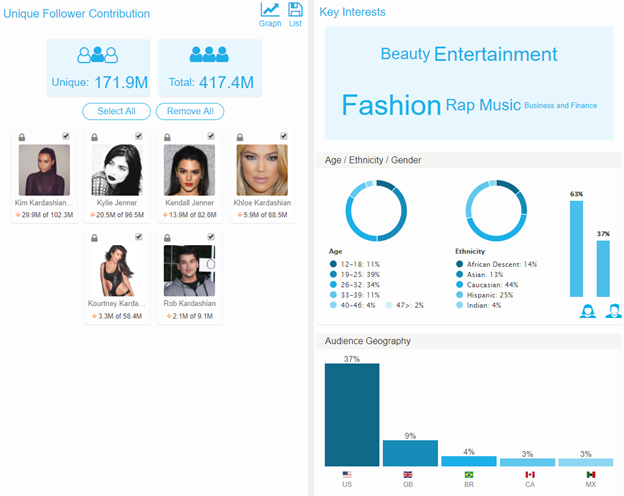
On one dashboard, users can view the key interests, age, gender, ethnicity, location, and the number of unique followers for a list of influencers — key information that’s essential to planning an effective and targeted influencer campaign.

HYPR

Gil Eyal
Gil Eyal, CEO and Co-Founder, HYPR

Gil Eyal, CEO and Co-Founder of HYPR, said,“Brands tend to treat influencer audience numbers as unique, but the truth is this varies greatly. If you activate all Kardashian Sisters, you’ll end up reaching a much smaller number of followers than you might expect. Of course, this varies greatly among groups, and other influencers might have completely unique followings.”

The Unique Audience dashboard displays the total reach for a number of influencers combined, as well as the unique reach. Key audience interests are displayed, as well as combined audience characteristics for gender, age, ethnicity and location. Additionally, a graph details the number of unique followers exclusive to each individual influencer.

This tool is the first to allow marketers to strategically curate a list of influencers with distinctive reach for specific campaigns, eliminating audience overlap and ensuring that unique followers are exposed to promoted products and brands.

“HYPR is committed to its mission of replacing vanity metrics in the Influencer Marketing space with actionable data and analytics. Influencer marketing is a form of digital marketing and it should be measured as such,” added Eyal. .”

 New Office in London

The opening of the London branch allows HYPR to expand on its geographic footprint, and to provide its European clients with a more robust service experience.

The office will be led by Jon Lawford, Business Development Director – Europe. With over a decade of experience working in sales for various social media companies, Jon’s primary focus is to expand HYPR’s UK and European operations, and growing the sales and account management teams.

“I’m very excited to announce the opening of our London branch. We believe there is a tremendous opportunity to introduce cutting edge analytics into the Influencer Marketing industry that is growing rapidly in Europe,” added Eyal.

Currently, HYPR’s in-depth influencer marketing platform houses profiles and audience demographic information for over 10 million influencers across major social channels—making it the world’s largest and smartest influencer index. Marketers can reach large audiences at scale by targeting influencers based on their audience demographics such as age, location and interests. Having access to these audience insights is essential to running a successful influencer marketing campaign.

What Makes Some Companies Heroes and Others Villains?

0
Narratives
What Makes Some Companies Heroes and Others Villains?: How Popular Narratives and the Way Businesses Measure Them Determines Success or Failure

How Popular Narratives and the Way Businesses Measure Them Determines Success or Failure

United Airline’s extremely public PR difficulties have overtaken the public conversation, unleashing a flood of ire toward the company and causing stocks to drop by what was at one point one billion dollars. It is a dire position to be in as a company, and though the need for response is obvious, the optimal response isn’t. United CEO Oscar Munoz issued three different statements, including one in which he assured United staff that protocol had been followed.

The intention was to demonstrate support internally, but instead, Munoz found himself facing off against thousands of vocal opposers who considered this statement a “non-apology.” Whereas a United employee might have been reassured by the statement, outsiders found it inefficient and therefore offensive. In today’s world, the same message can resonate completely differently when viewed through various filters.

In order to market the right message, companies need to understand the issues their audiences care about, how much they care and how it matters–something that’s become increasingly difficult with the amount of noise in the digital age.

Popular opinion is difficult to track, and changes often. There are many times multiple layers of belief patterns playing into the same issues. At the same time, a single action could be interpreted a dozen different ways.

A marketer or business leader’s job is to not only correctly identify and comprehend each of these trends but also make strategic decisions about how to interact with these narratives as a brand. New software breakthroughs for processing information hold the key to demystifying these decisions.

Traditional marketing and PR tactics are no longer effective. There are far too many factors to take into account for intuition or painfully limited historical market research methods to provide sufficient insight for action. Misreading the information can mean putting resources into sending the wrong messages–a business mistake that ranges from inconvenient to devastating.

Using software-powered analysis driven from multiple sources establishes a foundation of firm, data-supported truth from which marketers can make decisions that influence consumer perceptions and actions, win hearts and heal wounds when necessary.

Read Also: Introducing the Protagonist Platform, A Narrative Analytics Solution That Uses Data Science to Expose Comprehensive Market Landscapes Without Limit or Bias

Traditional Research Has Left Marketers Operating Blindly

The first step toward creating narratives that strengthen a brand is understanding where they come from. Companies aren’t deaf to the importance of understanding their audience or their brand and have invested heavily in research to help them do so. Unfortunately, that research can hurt more than it helps. Polls, surveys, and focus groups inherently access only a small part of the picture, and companies that take action based on them risk miscalculating and hurting their brand.

To Understand What Makes Polls Unreliable, Consider the Last Two US Elections

In 2012, Gallup miscalculated the forecasted results of the election so drastically that USA Today dissolved its partnership with the organization. The pollsters attributed the inaccuracy to factors including relying too heavily on limited populations.

In the recent election, the inaccuracy of the polls for predicting the results was record-setting. Like in 2012, most surveyors focused too heavily on the wrong populations, leaving massive portions of the voter base completely unconsulted.

And, the error went further; sometimes it’s not about asking the wrong people; it’s about asking the wrong questions. Many poll takers misreported their feelings about the election, and poll givers didn’t necessarily ask about the issues that were really driving voter behaviors. They weren’t mining for beliefs.

These same shortcomings plague the consumer studies that enterprises shell out for, resulting in untrustworthy results and subsequently ineffective marketing campaigns. At the enterprise level, most companies can access information about buying behavior or customer feedback from surveys, but that information does little to reveal which narratives really resonate with that audience.

Companies don’t have the luxury of having poll results to tell them how to win their customers back when they’re outraged. They have to rely on their own analyses, given the available information.

For years, polls were the best option for consumer insights. With new innovations, that’s no longer the case. Technology like natural language processing, data science and machine learning mean that companies can suddenly access a comprehensive analysis of their audience’s deeper beliefs, and can strategize accordingly.

Read Also: Interview with Robert Carroll, Chief Marketing Officer at Protagonist

The Age of Science-Based Marketing

There is more digital information available today than ever before, as social media profiles become universal, smartphones and connected devices collect information and companies as a whole produce and collect unprecedented amounts of customer data.

But that sheer volume of information wouldn’t actually be all that valuable on its own; more information is only valuable if there’s a way to process it at scale. Deeper beliefs aren’t exactly easy to quantify, so unless business strategists have nothing better to do than assessing each piece of data individually, the job has essentially boiled down to educated guesswork–until recently.

Natural language processing is computer programming that enables software to comprehend human language, and when combined with machine learning, the two can actually derive meaning from huge qualitative data sets. This process of applying technical breakthroughs to understand belief systems is called Narrative Analytics.

Both natural language processing and machine learning have experienced explosive innovation in the past few years in what Forrester’s Diego Lo Giudice calls a “renaissance of AI”–the first meaningful, dramatic advancement of cognitive capabilities in 30 years. The net result is that algorithms can expose trends and insights that can help answer the questions that have been plaguing marketers for decades — belief mining.

In the right hands, Narrative Analytics exposes trends and impactful belief patterns that might have otherwise been overlooked, uncovering opportunities for dramatic growth that businesses didn’t know they had…or threats they didn’t realize existed.

Narrative Analytics can actually deliver real answers to questions like:

How can I understand customer beliefs in my industry?

– How can I shape customer narratives about my brand?

– How can I anticipate the emerging threats to my company or recover from mistakes?

Culture globally is shifting rapidly, voices are rising from unexpected places and the business landscape is no longer consistent. Companies that grasp the value of the uptick in software capabilities and create messages that resonate will come out ahead in the battle for consumer hearts and minds; the ones that don’t will fall behind, and maybe out of favor entirely.

Read Also: Catapult PR-IR Won Two Industry Awards for Creating New Strategic Narrative Marketing Framework

Interview with Daniel Meehan, Founder & CEO, PadSquad

0
Daniel Meehan
Interview with Daniel Meehan, Founder & CEO at PadSquad

[mnky_team name=”Daniel Meehan” position=” Founder & CEO at PadSquad”][/mnky_team]
[easy-profiles profile_twitter=”https://twitter.com/meehandaniel” profile_linkedin=”https://www.linkedin.com/in/danmeehan/”]
[mnky_testimonial_slider][mnky_testimonial name=”” author_dec=”” position=”Designer”]“The CMO challenge for media buying is telling a brand story in a mobile first and fragmented world, and building differentiation for their products that leaves a positive effect on consumers.”[/mnky_testimonial][/mnky_testimonial_slider]

On Marketing Technology

MTS: Tell us about your role and how you got here? What inspired you to start PadSquad?
When the iPad launched in 2010, my first thought was that it would change content consumption forever.  That was the initial inspiration for PadSquad. A powerful device, with amazing graphics, that you can interact with content on a touchscreen was born! iPads flew off the shelves for the first 3-4 years after launch, then were sort of replaced by larger smartphones as the consumption device of choice. So in some ways, I totally got the iPad media thing wrong!

As that migration from tablet to phone as happened, so has the focus of our business changed. Coming from the publishing and media industry, I was focused on two critical topics that remain relevant today.

MTS: How would publishers and media owners format and design content for this new family of devices?  How can brands leverage these new touch-enabled devices to engage customers?
PadSquad was launched midway through 2012 to solve both of those challenges. We created a mobile software platform that formatted web content for smaller devices so publishers could deliver a better user experience for their audiences. In tandem, we focused our efforts on building the most amazing mobile creative campaigns for brands on mobile, so they can delight consumers in a polite way that is memorable.

MTS: Given the changing dynamic of engagement with online customers, how do you see the existing viewability and on-target audience benchmarks for mobile advertising evolving by 2020?
Viewability is sort of the lowest common denominator to solve for digital bad actors and fraud in my opinion. It’s not a metric I believe in when measuring any lasting effect of a brand message. The digital market has some interesting challenges to figure out when it comes to measuring audiences in a mobile first world. The app space allows for IDFA targeting, better attribution and high viewability, but for the vast majority of ad inventory, there is utility based and in gaming.

Mobile web is restricted based on browser settings, and lack of 3P cookies in Safari, but offers audiences that are typically in consumption mode engaging with content. My sense is that by 2020 there will be some sort of clearinghouse for mobile browser fingerprinting that can be matched to mobile IDFA to develop an industry standard so that data targeting and measurement can be more robust and accurate across devices, browsers, etc. This will lead to more intelligent benchmarks for marketers, and not the hodge-podge of third-parties that exist today, all only telling parts of the measurement story.

MTS: What are the emerging ad formats and bidding technologies that a CMO’s budget by 2020?
Vertical Video in mobile is a favorite ad format, and should take larger share of budget probably before2020 if I had to guess.  When done well, it’s an elegant ad format that tells a story in a polite manner. I’m bullish on it overall. PadSquad is transacting on mobile vertical video in programmatic more than any other ad product right now, and seeing really encouraging results for VCR and engagement. Snap helped pave the way for this ad format, and we’re having success with marketers because of programmatic execution and scale in the mobile web, combined with our creative abilities to edit and format video assets.

Further out, I’ll be interested to see how much traction Augmented Reality ad formats get for budgets. 2020 seems about right for some form of AR to be fully adopted, enough marketers to allocate dollars to, and enough Supply-Side partners to be ready for it. We can execute forms of mobile AR now in non-Safari browsers, and the launch of iOS 11 this Fall will pave the way for mobile AR in Safari and accelerate adoption if I had to guess. Should be exciting!

As for bidding technologies, certainly more progression in automated media transactions will continue by 2020. Over the next few years, machine learning and computer based intelligence will allow marketers much greater insight into media decisioning, hopefully allowing them to spend more time on ideation, messaging, and creative solutions.

MTS: Padsquad offers a premium marketplace for innovative mobile rich media experiences. How is it effective in driving engagement and intent?
We control so many components of most of our client campaigns, starting with ideation, creative design, format and feature development, then activation across content publishers we have directly sourced, vetted and optimized for our unique mobile ad units. The balance of technology and “hand-crafted” creative formats is a good one, and leads to delivery of mobile ads that consumers are intrigued by. We break the mold in many ways, so our uniqueness drives some consumer interest, and then the features, animations, utilities, movement and video used in the campaigns typically draw a user to interact with that message in some way.

MTS: With the growing prominence of programmatic, how does PadSquad bring innovative rich media formats with better experiences?
Transacting via programmatic has certainly exploded onto the marketplace, and we’re seeing some industry growing pains as marketers, media agency teams, and their respective DSPs adopt it. There is just not enough talent that has expertise in it as of yet, but that is changing very fast. Some larger clients we do business with programmatically have very robust and sophisticated in-house teams. We view programmatic as another way to execute for our clients, and can help them accomplish their campaign goals using automation in numerous ways. Since we’ve been singularly focused on creating unique mobile ad experiences, our team has developed code that allows non-standard mobile ad formats to render properly across hundreds of publishers at scale.

As some of the largest digital marketers are realizing that great creative is a differentiator for their brands, they are looking for partners who can execute great mobile creative at scale, the benefits of automation, data. We think PadSquad is uniquely positioned to do that, and the early results are that we’re winning new clients because of our programmatic solutions for high-impact advertising in mobile.

MTS: What’s the biggest challenge that CMOs need to tackle to make their media buying decisions work?
CMO roles are about much more than advertising, but media buying success ultimately comes down to ROAS (Return On Ad Spend), and selling the products and solutions which they are marketing. That’s the end goal eventually. Yet, I think most CMOs will share that the unbelievably fragmented media market, combined with a shorter attention span and more ad collision, has made the job of brand awareness and storytelling much more difficult. The 30-second spot used to be the go-to for storytelling, yet with time-shifting, cord-cutting and ad free streaming services that tool for CMOs is evaporating.

How do you tell stories and have your brand stand for something in today’s marketplace? Sure, we could talk about measurement across platforms, screens, and media. Or we could talk about attribution tracking, or fake news, or brand safety. These are all challenges. My opinion is the CMO challenge for media buying is telling a brand story in a mobile first and fragmented world, and building differentiation for their products that leave a positive effect on consumers. It’s hard, and probably why CMO tenures are at historical lows right now.

MTS: What startups are you watching/keen on right now?
I’m interested in Tenor, as the idea of mapping emotion and communication via mobile GIF sharing, then developing solutions for marketers to leverage that platform is fascinating. Recently I’m watching Albert, because using computing power to disrupt digital marketing, drive efficiencies and insights, resulting in more time for old fashioned creativity is most likely the future of our industry in some form or another.

MTS: Tell us about a standout digital campaign that you were a part of? (Who was your target audience and how did you measure success?)
A good example would be a campaign PadSquad developed for Timberland to introduce their SensorFlex Comfort System technology in boots targeted at both Male and Female audiences. The brand enlisted dancer/choreographer Virgil Gadson as the front man for the overall campaign.

PadSquad’s creative development team brought the SensorFlex technology to life in unique mobile ad formats custom designed to illustrate the ease of movement.  One of our formats allowed users to interact with Virgil and make him dance as they scrolled through mobile content on their device.  It was a very cool experience that led to users spending more than 7 seconds making Virgil dance, before engaging with him to open to a larger mobile experience with Timberland boots. Overall the engagement rate for the campaign was more than 5%, and drove ~500,000 total engagements. Even more interesting to me (and to the client), was the advanced analytics their custom format resulted in. We tracked interesting data such as 91,000 device tilts that flexed the Timberland boots, and that users tilted their device forward 92% of the time, only tilting back 8% of the time. Users spent more than 500,000 minutes engaging with the format during the short campaign.

These are the type of metrics that truly great creative execution, cool formats, and targeting can produce.  What’s more amazing?  The client tracked sales lift from the campaign internally, telling us it resulted in a 300% sales lift.  So you CAN have engagement, awareness and down funnel activity from great mobile campaigns.

This Is How I Work

MTS: One word that best describes how you work.
Hustle

MTS: What apps/software/tools can’t you live without?
It’s probably not a very cool or sexy tool, but I’m a huge fan of Microsoft’s Office 365 Cloud. I use it for email, document storage, sharing, notes, collaboration. PadSquad is a heavy Slack user for our team as well.

MTS: What’s your smartest work related shortcut or productivity hack?
I’m actually a big believer in a list of things to accomplish on a daily basis. Mine are typically categorized into sort of a “must accomplish”, for say 2-3 tasks that day, then an “on going” list of tasks that need to be accomplished in the near term. I try to use a large portion of my Fridays to make sure the list is completed for the week, and absolutely use a few hours on weekends to get a bit of a jump-start on the upcoming week.

MTS: What are you currently reading? (What do you read, and how do you consume information?)
As you walk into my office at home, you’ll see a bookshelf full of lots of the classics in first-bound hard cover editions… Dickens, Tolstoy, DeFoe, Chaucer. I don’t understand any of those books, but I think they make me look smart!  My favorite book of all-time is probably Redemption by Leon Uris. Our first son is named Conor, after the protagonist in that novel. I’m also a fan of printed magazines, and you’ll see copies of Vanity Fair, Rolling Stone, Sports Illustrated, Bloomberg BusinessWeek and The Atlantic laying around that same home office. The last book I finished was actually American Kingpin, the story behind the founder of The Silk Road dark web marketplace, which was pretty interesting.

MTS: What’s the best advice you’ve ever received?
Make decisions based on a thorough examination of data, but always, always trust your instinct. If it doesn’t feel right, it probably isn’t.

MTS: Something you do better than others – the secret of your success?
I’m decent at recognizing media trends, and mapping those to opportunities. My last business (Haven Home Media, acquired by Trusted Media Brands) leveraged the fragmentation of digital publishing in the Home/DIY category.  Prior to Haven Home, there was no easy way for marketers to buy custom digital media campaigns across a large audience deep into that category.  Specific to mobile, we’ve been talking about the power of creative execution and experiences for years, and now think the industry is moving off of the fascination with platforms and recognizing the power of great creative. Ideas are easy, execution is hard, as is having the guts to start things and finish them.

MTS: Tag the one person in the industry whose answers to these questions you would love to read:
I’d be interested in Jason Krebs, Chief Business Officer at Tenor. He thinks he’s very smart, and surprisingly enough he actually is.


[vc_tta_tabs][vc_tta_section title=”About Daniel” tab_id=”1501785390157-b58e162d-0ae25a4b-c27aca64-108e0566-0760″]

Daniel Meehan is the CEO and founder of PadSquad, a creative-first mobile advertising stack with a focus on user-controlled, in-line mobile ad formats that foster polite engagement with consumers across a premium publisher marketplace.

[/vc_tta_section][vc_tta_section title=”About PadSquad” tab_id=”1501785390320-2d44fa50-740c5a4b-c27aca64-108e0566-0760″]

PadSquad Logo

AT PADSQUAD, IT’S AN ART AND SCIENCE. We infuse creativity and emerging ad tech into immersive, hand-crafted mobile rich media brand experiences. We deliver innovative ad formats at scale and inline within premium publisher environments. Our work results in stellar performance, award winning recognitions and long-standing partnerships with Fortune 100 brands.

[/vc_tta_section][/vc_tta_tabs]
[mnky_heading title=”MarTech Interview Series” link=”url:https%3A%2F%2Fmartechseries-67ee47.ingress-bonde.easywp.com%2Fcategory%2Fmts-insights%2Finterviews%2F|||”]

The MTS Martech Interview Series is a fun Q&A style chat which we really enjoy doing with martech leaders. With inspiration from Lifehacker’s How I work interviews, the MarTech Series Interviews follows a two part format On Marketing Technology, and This Is How I Work. The format was chosen because when we decided to start an interview series with the biggest and brightest minds in martech – we wanted to get insight into two areas … one – their ideas on marketing tech and two – insights into the philosophy and methods that make these leaders tick.

TechBytes with Nishant Mungali, Co-Founder and Chief Product Officer at MindTickle

0
Nishant Mungali
Nishant Mungali, Co-Founder and Chief Product Officer at MindTickle

Nishant Mungali
Co-Founder and Chief Product Officer at MindTickle

We recently covered the appointment of sales veteran Cameron Essalat as VP of Sales at MindTickle. Their enterprise customers have very positive things to say on MindTickle helping them fill gaps in their sales productivity. We caught up with Nishant Mungali, MindTickle’s Co-Founder and Chief Product Officer to learn what goes into building a sales enablement powerhouse.

Html code here! Replace this with any non empty text and that's it.

MTS: Would you run us through MindTickle’s data-driven approach to know who, what and how to enable your sales team?
Nishant Mungali: Utilizing MindTickle, sales leaders can ensure that their teams are properly equipped, with the knowledge and skills required to win, in a buyer-driven market. MindTickle provides reports and insights to the sales enablement and sales management teams. The enablement reports focus on overall adoption and engagement of training programs and the effectiveness of the training materials. The sales management reports enable managers to identify knowledge and skill gaps of their reps, for effective coaching. MindTickle is outcome-driven, meaning it’s not just the completion of training or role-play that is important, but also the tracking of performance back to the end-goals of any sales rep.

MTS: What does MindTickle mean by “streamline your sales onboarding by creating structured learning paths that dynamically adapt to your rep’s needs”?
Nishant: The onboarding needs of sales reps are different based on their role, what is expected of them, and how fast they can learn. It is important that sales reps get the time to fully ramp, but if this process can be accelerated, they can contribute to pipeline and revenue quicker. We recommend orchestrating role-based learning paths for the reps. The modules, assessments, and exercises in these courses unlock as they progress and are dynamically assigned based on rules like what date they joined, tenure, and learning performance, so that the reps can come up-to-speed faster by focusing only on what they need next. Traditional LMS (learning management systems) and internal Wikis do not allow for customization and, as a result, can lengthen onboarding time needlessly or make new hires learn information not relevant to their role.

MTS: How does combining sales training investment with coaching and measurement enhance its long-term impact?
Nishant: The training program focuses on developing knowledge in a streamlined and scalable way, but what it doesn’t offer is the personal attention the reps need, so they stay on track and motivated while developing a certain capability. This is exactly where the traditional LMS and classroom training falls short. The training programs, complemented with role-play certification and on-the-job coaching, ensures reps not only learn key information but are tested and certified on the application of that knowledge in specific sales scenarios. The right measurement and tracking ensure that key stakeholders are aware of the readiness of their sales team over time and can track improvement.

MTS: How much more training effectiveness do role-play and gamification engender in enabling sales reps for success?
Nishant: Role-play and gamification have quite a significant impact because they help reps travel the last mile of becoming truly ready for sales execution. We have found that training modules with quizzes and gamification increase engagement and time spent on that module by up to 38%. In addition, a global leading pharma company saw 86% of their reps respond to mobile training notifications, resulting in engagement spikes. Sales reps are inherently competitive – it’s what helps them be successful as reps to begin with – and the ability to track their own progress with training against their colleagues can also be motivating.

MTS: How different is MindTickle’s approach between training B2B vs B2C sales reps?
Nishant: The B2B reps need more in-depth training as they are selling more complex products. B2C reps mostly require mobile-enabled micro-learning to stay up-to-speed. Also, the ramp-up time of B2C reps is much shorter than B2B reps. MindTickle can be used to create both long learning paths with in-depth training and shorter learning paths for micro-learning on mobile. Even during sales coaching, the B2B reps need more practice on selling, which means a lot more focus on command over the message. That’s why different types of role-play scenarios for B2B reps are important. For B2B reps, we recommend field coaching using coaching sessions. For B2C reps, they may experience changing promotions and new products on a regular basis, getting bite-sized updates straight on their mobile device is helpful to keep them engaged and updated.

MTS: Thanks for chatting with us, Nishant.
Stay tuned for more insights on marketing technologies. To participate in our Tech Bytes program, email us at news@martechseries-67ee47.ingress-bonde.easywp.com

BrightEdge Research Reports The Gap Between Mobile and Traditional Desktop Search Widening

0
BrightEdge
BrightEdge Research Reports The Gap Between Mobile and Traditional Desktop Search Widening

New Brightedge Data Shows Dramatic Differences In Mobile And Desktop Search Results And The Divergence Of The Desktop And Mobile Content Experience

New data released by BrightEdge, the leader in enterprise SEO and content performance marketing, reveals that mobile website traffic is outpacing traditional desktop traffic with mobile searches on Google now representing 57% of all search traffic. In addition, the research also indicates a significant shift to a new mobile-first index.

Read Also: Interview with Kevin Bobowski, SVP Marketing – BrightEdge

In October 2016, Google announced that it was running experiments to make rankings dependent on website mobile optimization, as well as show mobile site previews in search results. BrightEdge research data confirms that two distinctly different content experiences are already being presented to mobile and desktop users. Going forward, BrightEdge will continue to report on mobile and desktop disparity monthly.

Key finding #1: Mobile Traffic Outpaces Desktop as Mobile Revenues Accelerates

According to BrightEdge research, mobile searches represent 57% of all search traffic on Google. With Facebook recently reporting that mobile advertising drove 87% of ad revenue, mobile alters the traditional digital advertising landscape and presents challenges to marketers to deliver a consistent customer experience across devices and channels.

Recommended Read: Adoption of AI, Voice Search, and Hyper-Local in Content Keys to Marketing Success, says BrightEdge Report

Carlos Spallarossa, Director of SEO, L’Oréal, said, “Mobile traffic is huge for us and our industry—above the 57% BrightEdge is reporting. We are developing content with a mobile- first perspective to connect with our users with info, use advice, and reviews–especially when they are near a store where they can easily purchase.”

Key finding #2: Google’s Mobile-First Index Is Becoming More Prominent

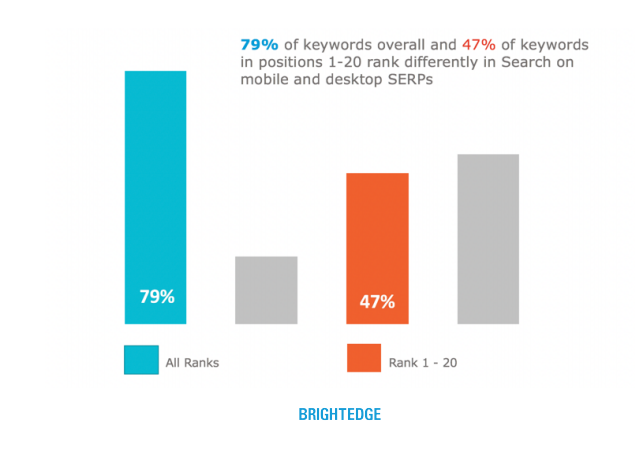
BrightEdge data tracked Google’s experimentation with the mobile-first index since the index was initially announced in 2016. In June, 79% of all searches were different across mobile and desktop. This indicates that marketers must optimize for both mobile and desktop to deliver the best customer experience.

Google’s Mobile
Key finding #3: Optimizing for Mobile & Desktop is Mission-Critical

The new research confirmed that emergence of two separate search indexes –– one for desktop and one for mobile –– with 47% of keywords in positions 1-20 rank differently on search on mobile and desktop SERPs.

Read More: BrightEdge Adds New Site Audit and Local Search Capabilities to Drive a Great User Experience

The nuances and implications of a mobile-first index are significant. For example, brands will find that their rank changes across mobile and desktop, driving changes in conversions and revenue.

Different types of content will appear for the same search term based on if the user is using a mobile device or traditional desktop computer.

Key finding #4; Winning with Micro-Moments Requires a Fresh Look at Content Strategy

Not only does Google rank differently across mobile and desktop, it is also surfacing different content across mobile and desktop 23% of the time.

The range across verticals is 14%-35%, a trend that is likely driven by the following factors:

  • Google is optimizing the customer experience –– which is different across mobile and desktop.
  • Brands thinking about micro-moments must identify customer intent, and through these findings drive content creation to win those specific micro-moments.
  • Even though marketers (stat) are moving toward responsive sites, it is important to recognize how devices are driving and influencing the search intent and providing insights into customer needs.

In June, BrightEdge analyzed the content shown for particular queries and found that the top-ranking page was different between mobile and desktop for an average 23% of the time among the top 20 ranking keywords.

  • This means that while a brand may appear on the first page for a desktop query, 23% of the time it will also return a different top-ranking page on the mobile SERP.
  • Brands that don’t track mobile carefully will have traffic arriving on pages that are almost certainly different than they expect.

BrightEdge Advisory: Making the most of the mobile opportunity

BrightEdge has found that not all mobile content is created equally; what works and reads well on one device type may not work on another (for example, mobile vs. tablet). Mobile content success is based on understanding the customer experience and serving content for the customer in key moments along their purchasing journey.

To take advantage of this opportunity, BrightEdge advises that marketers:

  • Design and optimize their websites for speed and mobile friendliness
  • Identify and differentiate mobile vs. desktop demand
  • Understand different online consumer intent signals
  • Produce separate mobile and desktop content that resonates on multiple device types
  • Focus on optimizing mobile content and mobile pages to improve conversions
  • Track, measure, and compare mobile and desktop results continuously

BrigtEdge report clearly suggests that marketers must focus on designing and optimizing website for speed, responsiveness and mobile-friendliness. With mobile-first indexing making its presence felt in marketing analytics, it’s imperative for businesses to understand the customer intent signals across desktop and mobile, tracking organic search rank separately for mobile and desktop separately.

Read Also: fishbat Breaks Down SEO with a Checklist for Small Business Owners

Former Google Engineering Director, Robin Williamson, Joins Teralytics’ Leadership Team

0
Robin Williamson
Former Google Engineering Director, Robin Williamson, Joins Teralytics’ Leadership Team

Robin Williamson Joins As Vice President Of Engineering

Teralytics, a venture-backed big data, machine learning location analytics specialist headquartered in Zürich, has appointed Robin Williamson as its new Vice President of Engineering. Teralytics understands how the world moves by uncovering trends and patterns within big data, helping cities and companies all over the world make better decisions for the future.

Robin Williamson
Robin Williamson, VP Engineering, Teralytics

Robin’s career began at IBM and he went on to hold executive roles in American software startups. Most recently, he spent 10 years as an Engineering Director at Google’s Research and Development Center in Zürich.

As Vice President of Engineering, Robin will be responsible for leading the Teralytics engineering team and helping them deliver exceptional, previously unattainable insights around the movement of people and populations to the company’s clients. Robin intends to transform the speed, scalability and client focus within the engineering team by improving the way Teralytics approaches its data architecture, elevating stratospheric internal standards to even higher levels, and by maintaining a balance of world class delivery in the here and now with the pre-existing culture of cutting edge innovation around data science and machine learning applied to rare and sensitive data.

Teralytics intends to sharpen its focus on providing data for mobility, transportation and smart cities, and Robin will be a driving force in that strategic process.

Luciano Franceschina
Luciano Franceschina, CTO and co-founder, Teralytics

Luciano Franceschina, CTO and co-founder of Teralytics, said: “At Teralytics, we’re always looking to hire world class talent to support our mission of understanding human behavior through data. With his previous experience delivering data to customers for other startups and producing software to the highest standards with Google, Robin is a valuable resource for our engineering team and a great addition to our company. We’re excited to have him working alongside us as we take bold steps into the future of data.”

Robin Williamson, VP of Engineering at Teralytics, commented, “I have worked with great teams and technology at other startups in this industry, and I am very impressed with the ideas, data and technology that Teralytics has developed. Teralytics’ technology is really exciting, as is the power of the company’s data, and I can’t wait to dig into it and focus on the value our data and analysis will deliver to our clients. I am thrilled to be part of the company as it enters an exciting new phase of its development.”

Before joining Teralytics, Robin spent 10 years as an Engineering Director at Google’s Research and Development Center in Zürich. Prior to that, he spent 10 years at software startups in the USA in executive roles responsible for engineering and product delivery. He started his career at IBM working in research, software development, and marketing. Robin received a bachelor’s degree in Computing and Electronics from the University of Durham in the UK and a PhD in Computer Science from Cambridge University.

Currently, with successful projects across three continents, the company has proven its ability to turn billions of signals into actionable insights. Teralytics is founded by graduates from top university ETH Zurich and backed by Atomico, Lakestar, and Horizons Ventures.

WorkSpan Announces $9M Series A to Unleash the Exponential Potential of Marketing Networks

0
WorkSpan
WorkSpan Announces $9M Series A to Unleash the Exponential Potential of Marketing Networks

WorkSpan, the Marketing Network where marketing teams span boundaries to work across internal teams, external go-to-market partners and agencies to orchestrate marketing campaigns and programs, today announced a $9 million series A funding round led by Mayfield. The company is now making its global debut following a very successful early availability program that included SAP, Intel, CenturyLink and Infosys.

“Companies need to engage with thriving ecosystems of partners to make themselves strategic and valuable for their ecosystem. This is a need that is being felt across industries – whether it be cloud providers and enterprise vendors in High Tech, or fast moving consumer goods in CPG, or multi-channel Retailers, or service providers in Financial Services,” said Mayank Bawa, CEO and founder of WorkSpan. “WorkSpan makes joint work with partners visible, accountable, innovative and impactful at scale.”

Read Also: Vision6 Adds Muscle to Email Marketing Automation with Personalized Text Messages via Twilio

“WorkSpan allows companies to redefine how they engage with strategic partners,” said Amit Sinha, WorkSpan Chief Customer Officer and founder. “Alliance, field and product marketing leaders no longer need to spend the bulk of their time connecting the dots. Now they have a network and collaborative apps to seamlessly coordinate marketing efforts, so they can focus on jointly winning shared customers and consumers.”

“At Mayfield, we champion entrepreneurs who bring unprecedented innovation to create massive impact,” added Navin Chaddha, Managing Partner at Mayfield. “Mayank, Amit and the team at WorkSpan have defined how marketers can work across company boundaries. We’re excited to partner with them to realize their vision of a Marketing Network that enables companies to unlock exponential potential in creating and shaping demand.”

Read Also: TwentyThree Partners with HubSpot to Integrate Video and Marketing Automation

A fundamentally new way to work across networks of people and companies

Companies on WorkSpan’s Marketing Network can rapidly execute joint marketing programs with any partner company (bilateral campaign) or group of partner companies around the world (multi-way cohort campaigns), which can differ campaign to campaign. On WorkSpan, partner companies can establish a shared system of record, align, create and share campaigns, and propagate them with high velocity to internal and external partners. Companies can also securely seek marketing funds or make funds available to partners, and solicit or submit campaign proposals—an industry first.

WorkSpan is built on a few key innovations:

  • Network Security Model: Built on a strong security model of Attribute Based Access Control, WorkSpan grants secure access to persons and companies on the network. Partners see only funds, campaigns and content to which they’ve been given explicit access.
  • Network SaaS Model: Multi-tenant network architecture gives each company a secure shared space with other partner companies in their network.
  • Network Apps: Cross-Company marketing processes for funding, activities and content approvals that require collaborative flows across companies.
  • Network Insights: Information across company boundaries is aggregated and presented to each user in the form of cross-company person recommendations, cross-company campaign and content search and cross-company marketing calendars.

These features bring unprecedented business value to “ecosystem marketing” programs:

  • Visibility into status of activities, campaigns and content
  • Accountability for performance, budget and funding joint projects
  • Velocity in proposing, approving, executing joint projects
  • Secure access to audiences, funds, content, people across company boundaries
  • Scalability to repeat successful campaigns with more partners across regions and industries

Read Also: Mindmatrix Brings Partner Relationship Management (PRM), Channel Marketing Automation & Channel Sales Enablement on a Single Platform

Companies on WorkSpan’s Marketing Network enjoy high engagement rates—nearing 100% engagement with top partner companies—a three-fold increase in demand and brand awareness, and access to partners’ combined audiences.

“With the WorkSpan Marketing Network, 200 Intel and 50 SAP marketers on five continents are working together better than ever before,” said Kathy Barboza, Director of Strategic Software Alliances at Intel.

“Using WorkSpan, we drastically reduced time spent on mundane coordination tasks, doubled the number of campaigns and tripled marketing impact,” said Steve Asche, VP Digital and Partner Marketing, Digital Enterprise Platform Group, SAP.

Added Claire Hockin, Associate VP of Marketing, Infosys, “Not only are we more productive and engaged, but we were up and running on WorkSpan in less than a week.”

5 Ways to Make Money for Your Company With a Messenger Bot

0
5 Ways to Make Money for Your Company With a Messenger Bot

Chatbots are an exciting and new phenomena in the tech, marketing and customer service worlds. Messenger bots allow you to program your Facebook page to conduct automated conversations with people that require no human interaction on your end. And the bot can do far more than merely converse — it can be programmed with artificial intelligence to recommend the best products for each user, send interactive content like videos and surveys, and even broadcast out relevant content to each user to re-engage them. And this all happens inside of Facebook Messenger, where there are two billion users ready to discover and talk to your bot!

But, as with all marketing channels, the really interesting thing about chatbots is their ability to generate profit for your brand. Here are 5 ways that brands can make money with a Messenger bot.

Read Also: Chatbots and Virtual Assistants are Fast Becoming the New Graphical User Interface

Smart, Personalized Messaging

As with email, sending individual customers the right messages at the right times can have a huge impact on getting them to the finish line of a purchase. Unlike email — which is oversaturated and has open rates dipping lower each month — messages sent through chat are opened by recipients at astronomical rates. Though data is scarce because the technology is so new, our chatbot platform at Headliner Labs sees an 80 percent or better open rate across our bots. We specialize in smart retargeting, and our e-commerce companies are seeing massive sales conversion from these. Brands on our platforms realize as much as 63 percent lift in overall direct-to-consumer sales in just four months. More than anything else, this represents the power of a bot messaging regime implemented strategically.

Selling Directly In-Bot

Plain and simple. Bots can be programmed to process payments without customers ever leaving Messenger. Currently, Messenger supports integration of your PayPal and Stripe accounts, enabling customers to input their information once and then have it saved for future transactions cross-bot. How does this play out? The bot sends user product recommendations with photos and key info, and a “Buy Now” button enables seamless checkout. The experience eliminates many of the major friction points in mobile sales, thereby primed to dramatically optimize conversions.

Promoting Sales, Discounts, and Promotions

Incentivizing purchases through sales, discounts, and promotions is one of the most effective methods for increasing sales. Unfortunately, to benefit from this, a company must be able to cut through widespread tendency to ignore marketing messages. As mentioned above, bot messages come into users’ chat platforms, where they spend much — if not most — of their mobile time. Furthermore, bots can be programmed to possess robust segmentation and AI capabilities that learn about your customers over time and can determine which discount or promotion they are most likely to convert on.

Read Also: Chatbots Market Estimated to Touch 3 Billion Dollars by 2021

Personalized Recommendations

Messenger bots can be programmed with artificial intelligence that learns about users over time through their in-bot behavior, and can even pull in their purchase history and other customer profile information. Robust algorithms then use this information to make personalized product recommendations that are more likely to convert the customer. Think of the efficacy that a personalized suggestion from a live sales rep can have; this is the equivalent, but scaled through bot technology and the appeal of one-click checkout (see #1 above).

Replenish Alerts

Many sales are made when customers restock items they already use. Right now, the most common method for notifying customers of restocks is via email. Messenger is a much more effective way of delivering news to customers. Messenger alerts ensure that customers are receiving these notifications so that they get the item that they want, and brands can make the sale.

Implementing a bot can have a major impact on your company’s bottom line. But implementing a bot is only the first step. The bot must be executed properly, imbued with the AI and algorithms that enable you to take the five steps described above. Luckily, there are platforms that can help you do all or some of this.
Read Also: Motion AI Simplifies the Creation of Chatbots with Bot Store

Viafoura Releases Next Generation Audience Development Platform for Media Companies

0
Viafoura
Viafoura Unveils Next-Gen Audience Development Platform for Digital Publishers

Enhanced Solution Empowers Media Brands To Drive Subscriber Rates And Online Engagement, Demonstrating Competitive Value To Advertisers

Viafoura, a leader in engagement, commenting and moderation tools, has announced the release of its upgraded Next Generation Audience Development Platform. Optimized to encourage audience participation, registration and subscription within online communities, the enhanced solution provides media brands with the tools and first-party user behavior data necessary to support their market value.

As the only Audience Development Platform for digital publishers, Viafoura understands the importance of establishing and cultivating an engaged and loyal online community. Clients using the next generation platform can expect to see a rise in their website’s engagement metrics due to the complete redesign of the real-time commenting user experience. This enhanced experience includes new engagement capabilities such as follow features, notification feed and news tray, web push notifications, automated moderation and more.

Viafoura Readies Businesses to Enhance Audience Development Strategy

The addition of follow features allows users to “follow” authors, other users, pages, sections and topics to receive real-time updates in their notification feed. The new web push notifications give brands the added ability to deliver breaking news alerts when users are off-site. They also give brands the opportunity to alert users of new replies, likes and followers, due to the platform’s one-of-a-kind integration with commenting features.
Jesse Moeinifar
Jesse Moeinifar, Founder and CEO, Viafoura

Viafoura’s founder and CEO, Jesse Moeinifar, said, “With these new integrated tools, media companies can use Viafoura to take their audience development strategy to the next level. Instead of leaving engagement to social media and, thus, losing out on invaluable first-party user data and on-site interactions, our platform empowers media brands to build relationships with customers directly on their owned channels. This is achieved by giving brands direct access to on-site engagement tools and user behavior data.”
The newly-added user behavior data provided by Viafoura includes pageviews, attention time and return visits. This complements the platform’s existing data collection on a brand’s audience, community and specific campaigns.

Vaifoura Directly Impacts Engagement among Target Audience

Viafoura API’s connect this first-party data with marketing and sales platforms (i.e. DFP, BI, Paywall, CRM, DMP) to drive actionable analytics and revenue. With this information, brands can deliver more relevant content, such as emails and repurposed, user-generated content, to cultivate continued engagement among their target audience, thus increasing revenue.

Currently, Viafoura’s Audience Development Platform empowers brands to increase engagement on their websites with user registration, engagement, moderation and analytics tools. These tools allow organizations to deliver a seamless user experience and capture first-party audience data, resulting in increased loyalty, revenue, and life-time value of customers.

It’s Not Just How Much, but Where and When We Are Connected That Matters

0
Connected
It’s Not Just How Much, but Where and When We Are Connected That Matters

The amount of time consumers spend on connected devices (mobile phones, tablets, and connected TVs) is increasing and we don’t foresee this trend changing. While there are only 24 hours in a day, the amount of time spent on devices increase year over year and the proliferation of new devices and connected technologies has made it possible for consumers to be online around the clock.

According to most industry analysts, the average American is consuming a record amount of digital content and now spends 12 hours, 7 minutes of each day behind one screen or another — further reflecting the need for marketers to prioritize mobile and connected devices in their media mix modeling.

As advertising campaigns are continuing to be deployed across multiple devices and as creative becomes more dynamic and personalized across platforms, marketers will need to think literally about the customer and their journey. The mobile medium, by its nature, makes for a multitude of new opportunities that brands can tap into to get the attention of consumers. Understanding the interrelationship between mobile devices and how and when consumers use them is critical to providing the best possible experience for both the advertiser and the consumer.

Read Also: Screen6 Partners with Grapeshot to Allow for Advanced Audience Segmentation

Marketers understand the importance of having a mobile marketing strategy but need to make necessary changes to avoid fumbling opportunities in today’s mobile-minded world. In order to serve the right ad on the right device at just the right time, marketers need to look extensively at usage patterns and preferences for mobile phones, tablets, and connected TV and optimize their campaigns. To accomplish this, they’ll need to stay ahead of the curve by monitoring where consumers are spending their time and how they are dedicating their attention.

To get a better sense for how consumers spend their time across platforms, Screen6 examined a massive amount of device ID data from more than 100 million mobile devices, mobile PCs, tablets and connected TVs in the United States. This data, provided by our data partners ShareThis, Kochava Collective, and Airpush, was analyzed in an aggregate and anonymous fashion, taking a deeper look at server interactions during the second quarter of 2017.

It should come as no surprise that people spend a lot of time on their mobile devices. According to some reports, as much as 4 hours per day. Based on our research, the amount of time people spend on their device increase steadily throughout the day and peaks in the evenings between 7PM and midnight. When thinking about targeted “day part” campaigns and ad serving, advertisers should consider this the new “prime time” for mobile usage and advertising.

Read Also: TechBytes with Keith Petri, Chief Strategy Officer, US at Screen6

In examining which days have the most mobile usage, it may come as a shock that weekend usage outpaces weekday usage. While the prevailing belief is that people tend to unplug and become less connected on the weekends, they are in fact more connected to their mobile devices on Saturday and Sundays.

When looking at the amount of time consumers spend using their mobile devices as compared to connected TVs, the total TV time outpaced that of mobile devices for a majority of the day. This should not come as too much of a surprise considering most mobile devices are used intermittently while connected TVs remain in an always on state.

While most campaigns will shift between mobile and connected devices, there are key times that marketers should be thinking about weighting their ad serving towards mobile. During the morning commute, 7-9AM and again later in the evening from approximately 9PM-12AM after prime-time television programing has ended, mobile usage was in fact greater than connected TVs.

Finally, what kind of device a consumer is using will dictate when they are the most active. When looking at Android versus iOS devices, the two operating systems tend to be used equally throughout the day. There are two exceptions: iOS users tend to catch the worm and iOS devices are used more often in the early hours of the morning (Midnight to 6AM) and Android is used more often during the morning commute beginning at 7AM until the early afternoon at approximately 3PM. iOS and Android have similar usage patterns in the evening.

Read Also: Screen6 Launches Advanced Householding for Advanced Attribution using Cross-Device Intelligence

The amount of time people spend on their mobile devices is less representative of binge behavior or “at work” compared to “at home” behavior, and more representative of a massive cultural shift. The cross-platform consumer has become a reality. There is a new definition of “prime time” for people’s attention and “must see” viewing now takes place during the weekends.

The good news for advertisers and content owners is that as addressable, programmatic and cross-device advertising strategies will undoubtedly continue to evolve, they’ll also provide marketers with assets and better ways to reach desired audiences irrespective of device.

Choozle Releases Creative Asset Library for Programmatic Advertising

0
Choozle Secures $6 Million in Series B Funding

Choozle, an independent and self-service digital advertising platform, released a new Creative Asset Library. The new Creative Asset Library is built for programmatic advertising and designed to help media and advertising agencies focus on campaign strategy versus the time-consuming task of uploading creative assets which was previously nine minutes for a single creative asset.

Driven by customer feedback, Choozle’s Creative Asset Library boasts a slew of new features that will allow users to bulk upload, manage, and edit their campaign assets in an efficient and streamlined manner. Some key benefits include the ability to upload 100 files, and various types of files at once, into Choozle’s single, simple interface. The new Creative Asset Library also allows users to sort creative assets by date, time created or modified, or file type. Intuitive and efficient organizational control helps users keep their creative assets in one central location. Once done with the campaign, users can select multiple assets to archive.

“Choozle’s Creative Asset Library makes our lives so much easier and more productive! I spent the better part of 24 hours adding creative in 2016. “With the new suite, I expect that total to be cut by over 80% as we can now add an entire ad pack of six creative in the time it would take to add one.  This sort of improvement goes beyond just a simple UX/UI change, it’s a game changer,” stated a Choozle customer.

These improvements were added to Choozle’s suite of offerings based on direct feedback from customers, as well as in an effort to keep creative and campaign management a priority. Now, instead of spending time managing assets on the platform, users can dedicate more time to impactful creative and programmatic campaign strategy, which will result in a significant reduction of time between digital advertising strategy and campaign launch.

Jeffrey Finch - image
Jeffrey Finch

“With marketers and their agencies more focused than ever on performance, control, and strategy, it was vital for Choozle to build a creative asset suite that met the growing needs of marketers and their desire to create engaging creative assets to drive performance with programmatic advertising,” Said Jeffrey Finch, co-founder and CPO

Choozle ran the Creative Asset Library in private beta from June 1, 2017, with customers such as Digital First Media and Small Army. Results from Choozle’s Creative Asset Library beta testing showed a decrease of 66 percent in time spent devoted to trafficking creative assets, and increased upload speeds by 92 percent.

“It’s exciting to see our feedback being implemented in Choozle’s UI with the Creative Asset Library. This improvement has already saved us a lot of time and it will continue to allow us to focus on strategy and optimizations instead of creative asset management,” said Kelly Hinds, Media Strategist at The Denver Post Media.

Choozle’s cloud-based platform blends the power of big data and real-time programmatic advertising into one simplified platform. Choozle provides access to industry leading data services including data management (DMP) and CRM matching as well as a complete buy-side suite of tools (DSP) to power video, mobile, display, and social ad campaigns.

Also Read: Redbrick Launches Cloud-Based Application for Influencer Marketing Campaigns

TechBytes with Amit Joshi, Director of Product & Data Science at Forensiq

0
Amit Joshi
TechBytes with Amit Joshi, Director of Product & Data Science at Forensiq

Amit Joshi
Director of Product & Data Science, Forensiq

We’ve covered more than a few firms working on combating ad fraud here on MTS. Adloox, eZanga, and S4M are some of the vendors using machine learning to invalid Traffic Datasets to fight ad fraud. We caught up with Amit Joshi, Director of Product and Data Science, Forensiq to understand how they tackle this overarching issue in online advertising.

Html code here! Replace this with any non empty text and that's it.

MTS: How do large online shopping events like Cyber Monday play into a cyber fraudster’s plan?

Amit Joshi: Online shopping events such as Cyber Monday are susceptible to large scale Cookie Stuffing attacks – a method by which an affiliate steals credit for an install they had no credit in driving (either organic or belonging to another channel/affiliate). This is accomplished by dropping a cookie on the user’s device without the user’s knowledge when they visit the bad actor’s website. Companies like Amazon are a prime target for Cookie Stuffing as the technique is accomplished through dropping cookies on a user to simulate a click and then hoping that the user converts within the given attribution window. Essentially this is a game of chance, and everybody uses Amazon, so the chances of successfully committing fraud are much higher. For non-affiliate (i.e. display/video buys) the fraudster may be able to more easily monetize botnet traffic as advertisers lower their risk tolerances and start buying more long-tail traffic in favor of reach.

MTS: What does Forensiq look for when determining online ad fraud?

Amit: Cookie Stuffing: Forensiq uses a multi-layered approach analyzing the user’s path from ad impression to conversion, looking at factors like time to conversion, click velocity, and distribution. We are also able to analyze how the landing page is loaded (i.e. forced clicks) by analyzing the page for anomalies, interaction, viewability and other factors.

  • Bots: Forensic uses a three pronged approach –
    • User level pattern analysis
      • Integrations with RTB ad exchanges and platforms where Forensiq is monitors every request and is able to get a full view of the ecosystem. Real-time machine learning algorithms are implemented at the user (device) and app level to build browsing profiles which are separated into human and non-human.
      • Velocity patterns to identify irregular activity from users. These patterns are consistent with ads being run in the background or through other automated means.
    • JS Tag: Forensiq’s JS tag captures the digital forensics of the user, which are stored on the IP level and aggregated in real-time for each request.
    • IP Analysis: Monitor for illegal activity like use of hosting providers/proxies to generate impressions from mobile ad farms and emulated devices.

MTS: What is Forensiq’s vision of a fraud-free advertising ecosystem?
Amit: A fraud free ecosystem is one in which the ability to commit fraud is minimized so that there is no material impact on advertisers. The reason we say ability to commit fraud, as opposed to fraud itself, is because where there is money bad actors will try and steal it. So, no fraud is unrealistic, but having ways to detect fraud that effectively mitigate the risk would be realistic!

MTS: What are some patterns of fraud that are hard to detect for vendors like you?
Amit: One struggle is integrating in a pre-bid environment where there is not necessarily a browser in which JS can be deployed. In these scenarios, we are reliant on the information being passed in the bid to detect fraud, however, this information may be faked e.g. domain or bundle ID spoofing.

MTS: Tell us a little bit about mobile device hijacking and the precautions a user can take to prevent it?
Amit: Mobile Device Hijacking is an app that serves ads, but may have been modified by the publisher or another incentivized party to serve ads at a much higher rate under certain circumstances, many of which are hidden from the user. Ad fraud characteristics are determined by a pre-set ad fraud refresh rate, in many cases with the app starting to request ads as soon as the device boots.
Precautions users can take:

  • Read both app store ratings and reviews before downloading
  • Monitor data usage from your apps

Read the permissions you are giving apps! (i.e. don’t allow it to run in the background unless if necessary, limit when the app is able to get location data etc)

MTS: Thanks for chatting with us, Amit.
Stay tuned for more insights on marketing technologies. To participate in our Tech Bytes program, email us at news@martechseries-67ee47.ingress-bonde.easywp.com

Interview with Bob Gaito, CEO at 4Cite Marketing

0
Bob Gaito

[mnky_team name=”Bob Gaito” position=” CEO at 4Cite Marketing”][/mnky_team]
[easy-profiles profile_twitter=”https://twitter.com/BobGaito” profile_linkedin=”https://www.linkedin.com/in/bobgaito”]
[mnky_testimonial_slider][mnky_testimonial name=”” author_dec=”” position=”Designer”]“Have we become so confused by the digital landscape that we actually focused on devices instead of people?  Sure, cookies and device IDs are important but only to the extent that they can be linked to a person.”[/mnky_testimonial][/mnky_testimonial_slider]

On Marketing Technology

MTS: Tell us about your role and how you got here? (What inspired you to be a part of a Marketing Automation company?)
I am one of the company’s co-founders and have served as CEO since its inception. Prior to launching 4Cite, our management team owned and operated another marketing service company – I-Centrix.  That business, also focused on retailers, built and managed Marketing Databases for its clients.  In addition, I-Centrix also had a strong list processing offering as well. We sold I-Centrix in 2007 and exited the organization in 2010. At that point I wanted to build another organization and leverage our deep retail history. This time around we chose to concentrate on real-time digital solutions. Our team was fortunate to have decades of retail experience and saw, first hand, where retailers were struggling to evolve in the digital world. We had the experience, the connections, and the where with all to launch a business to help address these needs. Today we serve hundreds of top ecommerce retailers including such well known brands as Staples, Vera Bradley and Harry & David and non-ecommerce companies in the automotive, financial services, healthcare, not-for-profit, hospitality and travel industries.

MTS: Given the changing dynamic of online engagement with customers, how do you see Marketing Analytics platforms evolving by 2020?
It has become clear, in my opinion, that Marketing Analytics is morphing from an ‘after the fact’ process designed to measure performance into an ‘inherently actionable’ process that drives results – in real-time.  Let me give you an example…let’s consider the following scenario: A marketer launches a Facebook campaign to drive site traffic.  Traditionally, Marketing Analytics might be used to measure the success of that campaign via any number of KPIs.  These metrics are difficult to measure with precision because of other, overlapping, programs that result is muddied waters in terms of sales allocation.  Don’t get me wrong, reporting and allocation is a vital role for Marketing Analytics platforms and will remain so in the future.  However, that will be only one aspect of the capabilities required going forward. We are seeing a shift toward real-time harnessing of Marketing Analytics data.  In the above Facebook example, we are using engagement data to build audiences and trigger messaging in real-time.  Ideally, the marketer will be able to know, in real-time, when a visitor comes to their site because of that Facebook ad.  Then, instantly look at that consumer’s previous engagement with the brand (i.e. has she been to the site before? Is she engaging with emails? What products has she viewed? Has she made prior purchases?).  With that data in hand, the Marketing Analytics platform should be able to make offer recommendations, product recommendations, and maybe even trigger a series of customized communications in other channels if this visit doesn’t result in a purchase.  You can see from this example that Marketing Analytics data is vital to the derivation of the marketing message.  Properly done, it will be used to drive sales – not just measure them.

MTS: How should B2B marketers leverage customer data analytics to improve marketing campaigns with greater authority?
Make data a part of each marketing program and use it in real-time to drive content. Expand beyond customer segmentation and contact planning.  Be sure to use it to drive offer recommendations, product recommendations, and channel execution.

MTS: How should CMOs visualize the disparate and complex data to build a unified, singular definition of a customer? Could you give us a preview of the dashboard analytics provided by Cross Link?
Establishing a unified definition of a customer is not a new concept, but the ever-changing options for consumer engagement has made it increasingly difficult.  It seems funny to us that one of the latest trends is ‘People Based Marketing’.  Wasn’t that always the goal?  Have we become so confused by the digital landscape that we actually focused on devices instead of people?  Sure, cookies and device IDs are important but only to the extent that they can be linked to a person.   In the digital world, we have seen a consistent trend toward using a hashed value of the consumer’s email address as the chief identifier.  If there is evidence in the offline data that a person has multiple email addresses, that data can be further aggregated.

It is important for CMOs to ensure that ALL digital identification is done deterministically.  This simply means that there is a direct correlation between the engagement data being captured to the email to which it is associated.  In an effort to provide ‘more data’ some providers use probabilistic identification.  As the name implies this technique relies on less reliable data points and use models to indicate that the activity in question is ‘probably’ for a particular consumer.  In my opinion CMOs should stay clear of using these techniques when building the customer views.

Concerning dashboards…4Cite’s services are geared towards identifying consumers and triggering real-time, relevant messaging – all within our customer’s existing vendor stack.  We are not looking to replace vendor relationships that our customers have and, in almost all cases, directly feed our clients existing platforms with our data.  This approach has been well received because our clients don’t have to learn how to navigate yet another set of interfaces or reports.  They can harness the same tools and technologies that they are already familiar with.

MTS: With the recent changes in data privacy policies, how do you see advanced visitor identification and tracking platforms delivering personalization?
Privacy is always a concern but keep in mind that most marketers are using data collection as a way to better communicate with their customers, not to offend them.  Consumers have expectations, too. They have come to expect to be communicated with in a way that is timely and relevant to them. They tend to respond better to marketing efforts that appeal to their wants and needs. Similarly, they are quick to opt out of campaigns that are generic and repetitive in nature.

From a data collection perspective, we advise staying away from intrusive technologies and make sure that consumers can opt out at any time. Privacy policies should also be clear and transparent. We advise against long and hard to understand policies and favor clearly worded, easy to understand policies.  The privacy landscape, as we see it today, favors marketers that respect the relationship they have with their customers.  They tend to operate in a permission-based mindset and make opting out a readily available option.

MTS: What startups are you watching/keen on right now?
We tend to watch new trends and potential channel opportunities more than we do individual startups.  We are currently exploring Amazon’s latest Advertiser Audience announcement.  We are also watching LiveIntent and their ability to deliver ads is unique in the industry.  We feel that both companies provide meaningful ways to deliver relevant, personalized messages.

MTS: What tools does your marketing stack consist of in 2017?
We believe our marketing stack provides our clients with a competitive advantage that is not available from other marketing service providers.   We are the only solutions provider that combines advanced customer identification services with multi-channel real-time message deployment. In addition, we do all of this without requiring our clients to change their existing vendor stack.

To help shed more light on these differences, let’s start with our customer identification service – CrossLinkTM.  CrossLinkTM leverages the data network we have built across our retail client base.  This is significant market differentiator for a few reasons.

  • First, there is massive scale. The network – branded The 4Cite Data NetworkTM – monitors over 1.3 Billion email sends and over 800 million retail page views per month.  Our approach is different than others in the space because we focus on traffic that is purchase oriented.  The visits and linkages we collect are not only substantial from a scale perspective but they also represent consumers that are showing shopping behavior.
  • Second, CrossLinkTM uses Deterministic techniques to identify visitors. That means that there is an extraordinarily high confidence level that the linkages we create are correct. Many of the other identity service companies use Probabilistic techniques.  They are by definition less accurate and although they may prove satisfactory for banner ad programs, they should not be used for CRM initiatives.

Identification is hugely important but by itself does not generate ROI. In order to be of value, once a consumer is identified they need to be communicated with in a relevant and timely manner. We find it interesting that most companies that offer Identification services don’t also provide services that enable their clients to generate revenue.

This is our other main point of distinction in the marketplace. Our Interaction HubTM is seamlessly integrated into CrossLinkTM and can trigger real-time campaigns in a number of outlets (email, light boxes, Facebook audiences, On-demand post cards, etc.).  We can even use it to generate product recommendations, offer recommendations and drive other dialogues via our LiveContentTM service.

When combined, our technologies have been a game changer in influencing purchasing activity. The potential use cases are almost endless and we have helped our clients in managing their acquisition, retention, and reactivation campaigns. We consistently hear from our clients that we increase their campaign revenues 20% after the first 30 days of implementation and more as the program continues.

Another unique aspect of our stack is that our services are really easy to implement. We have developed API integrations with the leading ESPs and our services use a variety of technologies that integrate with a host of other marketing providers for website customization, real-time marketing database updates, and social advertising. We even make identification and engagement data available to the browser so it can be leveraged by our client’s website development team as well as third party tools.

We see ourselves as an extension of our clients’ marketing stack and, in the end, we are partner agnostic. Our goal is to provide identity and engagement data to our clients to use however they see fit.  Whether we trigger campaigns on their behalf or simply provide data for them to execute themselves, our goal is to simply add value.

MTS: Could you tell us about a standout digital campaign? (Who was your target audience and how did you measure success?)
We had a retailer that was experiencing declining performance with their bulk email campaigns.  As the number of their mobile email opens grew, sales fell at almost the same rate. The client made a significant effort to improve the mobile experience but that had very little effect. This client came to 4Cite in hopes to find a solution. Before we get into the solution, I’d like to share some perspectives with regard to marketing on mobile devices. It is clear that almost every potential shopper has one. It is also clear that they spend a lot of time using these devices. That might lead you to conclude that emails read on a mobile device would perform well.  The truth is, that is not really the case. Think about all of the times you check email on your phone. Do you check it while waiting to pick you your son or daughter from soccer practice? At the airport while waiting to board a flight? Maybe even while walking to your next meeting? Now ask yourself if you actually had any shopping intent at those times. Probably not.

That’s why 4Cite created the Shopping Elsewhere™ Email Trigger.  This is a service that looks for your customers as they are exhibiting shopping behavior and triggers an email (in real-time) while he or she is in shopping mode. We accomplish this though The 4Cite Data Network (Keep in mind that our tags are in 1,300,000,000 emails per month and are fired more than 800,000,000 page views per month on retail websites).  The result, we see double digit increases in performance. Also, since we have API integration with the leading ESPs, we trigger that email on our client’s existing email platform. There is no need to warm up other IPs or worry about establishing another email sending reputation. We have a number of clients that are using this technology with great success.

MTS: How do you prepare for an AI-centric world as a business leader?
AI or Machine Learning is an area of opportunity for marketers.  As we discussed earlier, relevant and timely messaging is not only a good practice, it is becoming a consumer expectation. AI can assist with improving this type of personalization. That said, AI is 100% dependent on the accuracy and timeliness of the data that feeds it. In preparing for an AI-centric world, my advice would be to start today and evaluate all of your data collection processes. Start with customer identification and then move on to engagement details. If you aren’t properly identifying your customers, the data you associate with them is meaningless and worse yet, any AI generated messaging may actually perform worse than ‘unintelligent’ messaging. Data is king – focus on getting that right first.

This Is How I Work

MTS: One word that best describes how you work.
Organized. Like most executives today, time is in high demand and is in short supply. I like to set aside time to tackle big picture items in my mind and am diligent in making that happen. It is important to me to take time to reflect and contemplate on our business.

MTS: What apps/software/tools can’t you live without?
In addition to the Microsoft suite, which I can’t see anyone living without, I am somewhat partial to an app called Wunderlist. It is a basic but effective task management application.

MTS: What’s your smartest work related shortcut or productivity hack?
I always end the day with the same final task…ensuring that I lay out my work plan for the next day. That way I can go to sleep at the end of the night knowing exactly where to begin in the morning. The day may not go as planned, but I take solace in having a plan of attack before the actual work day starts.

MTS: What are you currently reading? (What do you read, and how do you consume information?)
I tend to do most of my reading online. I can’t say I am an avid book reader, instead, I search for opinion pieces on various ‘topics of the day’. As you can imagine, almost anything related to digital marketing always peaks my interest.

MTS: What’s the best advice you’ve ever received—your secret sauce?
Always keep your eye on the prize…providing services that your customers actually want and need. All too often I see companies that build great technology but it doesn’t completely resonate with the customer’s immediate needs. One of the best feelings is when a customer says “Finally, that is exactly what I was looking for. Why isn’t anyone else offering this?”

MTS: Something you do better than others – the secret of your success?
Echoing the sentiments above, I think we do a great job putting ourselves in our customer’s shoes when developing our capabilities. We have a long history servicing retailers and continually work with them to understand their needs and challenges. Although those discussions may not prompt an immediate thought for future product development, they have indeed been the inspiration for every success we have had.

MTS: Tag the one person in the industry whose answers to these questions you would love to read:
Jeff Bezos

MTS: Thank you Bob! That was fun and hope to see you back on MarTech Series soon.

[vc_tta_tabs][vc_tta_section title=”About Bob” tab_id=”1501785390157-b58e162d-0ae25a4b-c27aca64-108e97c4-35b4″]

With over 25 years of experience in servicing the direct marketing community, Bob is intimately familiar with the increasing challenges faced by today’s marketers. In early 2000, Bob set out to build a better solution to meet these challenges and founded I-Centrix, which was purchased by Haggin Marketing in 2007. In 2010, Bob helped found 4Cite Marketing, a multi-channel marketing service provider. Under his leadership, the company has shown continued growth and is recognized as a truly innovative marketing organization. Bob remains focused on ensuring that the company continues to develop solutions that directly impact its clients’ bottom lines. Prior to founding I-Centrix and 4Cite, Bob spent eight years with Experian.

[/vc_tta_section][vc_tta_section title=”About 4Cite Marketing” tab_id=”1501785390320-2d44fa50-740c5a4b-c27aca64-108e97c4-35b4″]

4Cite Marketing

4Cite is the first and only full-service, Real-Time Interaction Management services provider that uses proprietary web visitor identification, advanced data and analytics and Send-Time Perfection™ with Shopping Elsewhere Triggers™ email technology to enable e-commerce retailers to influence their customer’s purchasing activity and optimize conversion rates.

4Cite uses its proprietary 4Cite Interaction Hub™ to enable e-commerce retailers to identify customers and improve engagement with real-time, personalized offers that enable retailers to acquire, retain and reactivate customers, fostering brand loyalty and driving increased revenues.

[/vc_tta_section][/vc_tta_tabs]
[mnky_heading title=”MarTech Interview Series” link=”url:https%3A%2F%2Fmartechseries-67ee47.ingress-bonde.easywp.com%2Fcategory%2Fmts-insights%2Finterviews%2F|||”]

The MTS Martech Interview Series is a fun Q&A style chat which we really enjoy doing with martech leaders. With inspiration from Lifehacker’s How I work interviews, the MarTech Series Interviews follows a two part format On Marketing Technology, and This Is How I Work. The format was chosen because when we decided to start an interview series with the biggest and brightest minds in martech – we wanted to get insight into two areas … one – their ideas on marketing tech and two – insights into the philosophy and methods that make these leaders tick.

Why the DSP You Want May Not Be a DSP

0
DSP
Why the DSP you want may not be a DSP

It’s not surprising that according to Forrester’s recent DSP Wave analysis, finding significant differences among leading demand side platforms takes some work. “Differentiation is subtle,” concludes the report. That’s an understatement.

The crowded nature of this market and its very commoditization have led the more differentiated and specialized players to avoid the generic DSP moniker altogether. They see the name as constraining at the least and at worst misleading, because they offer services and capabilities that go far beyond data, inventory, and machine learning capabilities that characterize a DSP.

The Wave is focused on “helping marketers make a good choice” in the DSP market. But marketers should keep in mind that there are outstanding data partners off the Forrester radar precisely because the DSP label doesn’t fit.

Forrester used more than 35 criteria to evaluate platform providers on its list. We propose that advertisers and agencies perhaps ask some different questions:

Are you looking for a platform or for a problem to be solved?

Media buying is one part of an advertiser’s marketing operations used to achieve a broader business outcome. But are you looking for a media buying platform, or are you looking to achieve a goal? Look for a provider who starts with the business problem, then applies a data-driven strategy to resolve it.

Do you want reports, or insight?

There is a long, nuanced road between analytics and actionable insight. Vast amounts of first- and third-party data are just the fuel. How that data is interpreted and activated into strategy is the actual engine of marketing performance.

Is micro data enough?

User behavior and purchases are influenced not only by consumer interests, browsing habits, demographic information, and other “micro” data that is the currency of the typical DSP.  They are also heavily influenced in the moment by what’s happening around them. Macro data on factors ranging from trending social sentiment to real-time financial market news to current weather are powerful forces, and it’s increasingly important to find providers with the tools to tap into them.

Are you okay with black-box, third-party segments?

Forrester didn’t look closely at the transparency issue in its DSP analysis. Brands would be wise to seek out vendors with log-level integrations with their data providers. This provides visibility into individual users within a segment and a far more granular understanding of audience characteristics and, more important, their potential value.

Do you need more than technology?

DSP platforms may be a commodity, but data experts most certainly are not. Exceptional service, dedicated traders, in-house creative services and experienced strategic guidance are what makes one vendor shine over others and make a relationship exceptional.

Forrester’s report is valid. If you are shopping for a DSP, you should look for things like vast inventory and data support, flexible algorithms, and omni-channel and cross-device capabilities. But if you really want to move your marketing needle, you shouldn’t be shopping for a mere DSP in the first place.

The Creative Collaboration Report: How Today’s In-House Creative Teams are Collaborating

0
Collaboration Report

Collaboration Report
Research shows businesses that invest in creative are 85% more likely to be financially successful.  Consequently, marketing managers are asking creative teams to produce more.

Collaboration Report

But creative teams are already pretty busy.  In fact, more than 40% of in-house creative team’s report working on 1,000 projects or more each year.  That’s 3.8 projects per day – assuming 260 or so working days in a given year (and discounting PTO).

Collaboration Report

Sometimes these projects require extra creative handling too.  For example, while 62% of marketers say it’s easy to work with creatives, 68% of creatives say internal marketing client behavior is their greatest challenge.

Collaboration Report

Why?  The creative process – from request to delivery – isn’t exactly streamlined:
>20% of creatives say they get the information they need the first time
62% say it takes two or more rounds of review to get creative assets approved
73% say it takes two or more days to approve a creative asset

Collaboration Report

Creatives need marketing technology too!  The sort that automates these administrative tasks and allows creatives to spend more time actually creating.

Stream Yield: How to Make (Repeatable) Video Revenue

0
video revenue
Stream Yield: How to Make (Repeatable) Video Revenue

If you’re a publisher of online videos, you probably know which story on your site had the most total-views. That’s easy enough. Almost everyone has analytics that show which story or video was seen by the most visitors that day or week or year.
But the path to success, to truly optimize the value of your site’s content, involves many more steps. To create a sustainable online video publishing site, you’ll need to begin walking down that path.

To start, do you know which videos were watched the most on mobile? Which ones had the most viewership internationally, or were most popular in the specific part of your domestic market?

Do you know which other videos will appeal to that 24-year-old female news and fashion junkie from Seattle who visited your site late Friday afternoon? After she’s read the initial story that brought her to you, can you show other library content most likely to keep her there, and then coming back for more later?

The next step on your path involves your cost centers. How much did a given video that you might show her cost to make or acquire? Is it syndicated, so you pay a pricey video revenue share, or was it made in-house so you keep all the resulting revenue?

Read Also: TMB Study Reveals How Social Media is Driving Returns on Digital Videos

Can you determine each video’s true ROI, which can change depending on when and where that video pops up on your site? Can you adjust what video you serve to that young Seattle woman based on its ROI?

And, now let’s take a further step: What’s your cost of new-user acquisition? Which videos have a higher yield in customer acquisition? Which content should you show to that young Seattle woman? Can you create a virtuous circle of high-performance, controlled-cost content that turns visitors like her into regulars?

These aren’t obscure or idle questions. Publishers have been asking questions like this about the advertising on their sites for years. What they largely haven’t done, however, is ask those same questions about everything else on their site.

That’s crazy. When people visit your site, they’re not coming for the ads, though the ads are very much part of your site’s user experience. But, visitors experience everything you put before them: the original story, the ads, branded or sponsored material and of course, all the recommended additional stories and videos you may dangle to keep them sticking around.

Read Also: Pinterest to Go with Auto-Play Video Ads to Drive Revenue

It’s all part of your user experience. Ideally, it’s tuned for optimal appeal to each visitor who comes to your site.

But too often, publishers haven’t begun that journey. Unless you’ve gone down the path I’ve suggested here, you haven’t achieved a holistic understanding of (and fine-grained control over) all the material your users actually experience. That holistic understanding or “stream yield” is an approach that encompasses the broadest sense of what works for your audience and your bottom line, maximizing the potential payoff for both. Thinking about stream yield represents an essential shift in mindset in this complicated era of bottomless content and fractured audiences.

When you think about stream yield, you’re bringing together the issues, needs and sometimes conflicting goals of your team running editorial and the team responsible for revenue. If you’re running a digital media company, focusing on-stream yield, bridging those two teams, should be your first priority.

By measuring and managing your entire stream’s yield, you can optimize all cost and video revenue drivers to realize the cumulative value of your content. You’re finally truly maximizing ROI. Stream yield means thinking about cost centers, such as OVP streaming, user acquisition, CDN expenses and content creation and acquisition. Those costs are balanced against revenue drivers such as pre-roll ads, sponsorships, and branded content. But, it also means you’re thinking about highly granular audience-engagement metrics such as video views, “recommended” views, lift, bounce rates, views per experience, time on site and average session viewing time. And, it means slicing and dicing your content by filters such as geography, device, genre or category, and time of day so you can glean the highly granular insights you need.

But, it also means you’re thinking about highly granular audience-engagement metrics such as video views, “recommended” views, lift, bounce rates, views per experience, time on site and average session viewing time. And, it means slicing and dicing your content by filters such as geography, device, genre or category, and time of day so you can glean the highly granular insights you need.

Read Also: Verve Adds Mobile Video to Its Location-Based Mobile Ad Suite

Maybe that Seattle visitor wants stories specific to her region, or wants another news story instead of one about sports. Maybe as a mobile user she doesn’t have the time or inclination to dive into a deep read.

And there’s another important step on this path.

Once you begin asking these questions routinely, you can begin improving the stories you create in the future because you know what content is truly most valuable for your site, and for your visitors. You can optimize new stories based on what you absolutely know works for each actual visitor.

The path to stream yield isn’t a simple one. It requires you to ask far more sophisticated and granular questions about the content you create and the user experience you provide. But, once you begin down this path, using those answers to shape and optimize your stream yield, you can win the future of online-video publishing.

Read Also: Tapjoy Partners With Moat to Measure Video Ad Performance Across In-App Inventory

error code: 1010