Home Blog Page 4365

The 2020 Media Plan: It’s Time to Diversify Your Data Portfolio

2
The 2020 Media Plan: It's Time to Diversify Your Data Portfolio

The media plan of 2020 will be drastically different from the media plan of 2017. This accelerated evolution is being driven by data –both its enhanced management and broader availability. In 2020, the media plans that truly harness the potential of data will have been built with one core principle in mind: diversification.

Diversification is at the heart of Investing 101. Good financial investors know it’s not wise to put all of their eggs in one basket. And so they build robust, varied portfolios of assets in order to weather potential financial storms and maximize their opportunities to find the true asset gems that make all the difference in ultimate success.

Data is an investment, and marketers need to approach it as such. If a media plan relies on too few sources, it puts itself at risk. Likewise, if marketers are not experimenting with a broad array of diverse segments, they’re leaving money on the table.It’s time for advertisers to rethink their data portfolios and the way in which they approach audiences.

Diversification of Audience Segments

Today’s data management platforms are providing marketers with the ability to manage their data portfolios as an investor would a stock portfolio. Rather than building out one, two or three audiences and leaning heavily on those, marketers can build out 20, 30, even 100 different segments with which they can experiment to see who is engaging and who is not.

Data management is facilitating an explosion in the extrapolation of the media planning capability. Properly diversifying a data portfolio means evolving from media plans built on a single piece of creative split across five line items, and moving into an environment where hundreds of line items. Those segments cannot only be leveraged for testing and rapid refinement but can also be aligned with hundreds of pieces of creative to get to the true one-to-one communications that we’ve all been discussing for so long.

Diversification of Audience Sources

Diversification from a data perspective isn’t just about output. The successful media plan of 2020 starts with the diversification of inputs. This begins with leveraging a brand’s first-party data – audience information from websites, mobile apps and all other owned properties – to gain access to new variations on the data.

Then, of course, it’s time to go beyond owned data to evaluate the plethora of third-party data segmentation options at a brand’s disposal. But marketers shouldn’t stop there. They need to also consider working with publishers, retailers, influencers and others parties with bespoke data segments that can be drawn into their portfolios. In the case of smaller publishers with which brands might not see benefit from media buys, they might still see massive value in partnering with the publications to capture their specialized audience insights. This partnership mentality offers a huge opportunity for agencies that can step in to support these types of arrangements and relationships.

The Changing Role of Agencies

The relationship between brands and agencies is changing – faster than agencies would like, in some cases. The growing chasm between modern brands and the old-school agency approach is evident in each party’s current mindsets regarding data management. Many agencies, by virtue of the pressure that is put on them to turn around and execute media plans on a dime, have been forced into a short-term view of data: What do we have access to, how hard can we put it to use immediately, and how quickly can we move onto the next campaign?

Many agencies, by virtue of the pressure that is put on them to turn around and execute media plans on a dime, have been forced into a short-term view of data: What do we have access to, how hard can we put it to use immediately, and how quickly can we move onto the next campaign?

Meanwhile, brands are taking the long view on their data transformations. They recognize that the road to proper data management is a long one, spanning 18 months to two years in many cases. They’re willing to take the time to experiment and accept that failures are a necessary part of getting things right in the end. Once again, the agencies that can recognize this disconnect and adapt are the ones that will succeed in the long term with their brand clients. By embracing the diversification of data, both in terms of segments and sources, agencies will be able to capture the bigger opportunity presented by data management platforms and provide the consultations that their brand clients so sorely need.

By embracing the diversification of data, both in terms of segments and sources, agencies will be able to capture the bigger opportunity presented by data management platforms and provide the consultations that their brand clients so sorely need.

About Miles Pritchard

Miles is Global Head of Marketer and Agency Solutions at Lotame. His primary focus is to solidify Lotame’s market position and product solution roadmap, working in conjunction with the marketer and agency clients. Pritchard has extensive media industry experience, having worked with the client-side, agencies, agency trading desks, and DMPs.

Prior to his current role, Pritchard served as Lotame’s Director of Market Solutions, where he worked with various teams to address emerging DMP use cases and product requirements, iterate and evolve product capability, and lead solutions-based approach to data management. He has also acted as Lotame’s Director of Client Strategy. Prior to Lotame, Pritchard was a Brand Relations Manager at VivaKi and held positions at the 7stars media agency.
Pritchard is based in London and holds a BSc from the University of Leeds.

Interview with Irv Shapiro, Founder & CEO – DialogTech

0
Irv Shapiro MIS featured image

[mnky_team name=”Irv Shapiro” position=” Founder & CEO – DialogTech”][/mnky_team]
[easy-profiles profile_twitter=”https://twitter.com/irvshapiro” profile_linkedin=”https://www.linkedin.com/in/irvshapiro/”]
[mnky_testimonial_slider][mnky_testimonial name=”” author_dec=”” position=”Designer”]“Most CMOs today spend as much, if not more, time thinking about data and marketing stacks as they do building creative content.”[/mnky_testimonial][/mnky_testimonial_slider]

On Marketing Technology


MTS:
Tell us a little bit about your role and how you got here. (what inspired you to start a martech company)

The role of a high-tech founder evolves over time. When I started Ifbyphone, now known as DialogTech, I did it in response to a personal experience. In 2006, I was shopping for a professional grade digital camera and found the majority of e-commerce sites I visited did not offer the option to call to ask questions. This struck me as strange, given I was shopping for camera equipment worth thousands of dollars. DialogTech was founded to remove the friction inherent in voice communications and so marketers can easily add calls to their customer journey. As a cloud-based solution, the DialogTech suite of services works with any telephony infrastructure without installing any onsite hardware or software to deliver marketing insights to business of any size.

To get started in 2006, I sat down and began experimenting with new voice technologies, specifically VoiceXML and Asterisk. After receiving seed capital for the business and adding employees at the beginning of 2007, we launched a minimum viable product and started to look for venture capital. At this stage I was still very hands on with the technology and sales teams, and I ran marketing. In July 2007, we raised our “A” round and were off to the races.

As the company matured from an idea to a viable business my role evolved from founder to leader. As a founder you often do a bit of everything. As a leader you begin to hire great people; people that are often smarter than you, and you only need to provide direction. At this stage you are still running 150 miles and hour and you have not yet evolved into the ultimate CEO role: the coach.

Now with 150 employees, nearly 5,000 customers, and a focus on business expansion versus proof of concept, my role has firmly settled into the role of a coach. While at times it’s still possible to lead by example, as a coach you should be hands off of most day-to-day business functions. Your job is to make everyone around you better, to help your team see they can accomplish more than they think is possible. It’s to win the Super Bowl, the World Series, and the World Cup without ever carrying the ball. In many ways the role of coach is the CEO’s most difficult responsibility.

MTS: Given the massive proliferation of marketing technology, how do you see the martech market evolving over the next few years?

Humans are complex beings, and it’s unrealistic for marketers to expect consumers to follow a single path to purchase.  So then why is it that marketers  still believe people follow a single path to purchase through an online experience and a shopping cart?

Over the next couple of years marketers will fully embrace the rich, complex journeys their customers take to purchase. These customer journeys will involve a range of interactions, complex dialogs, and multiple technologies throughout a customer’s interactions with your brand.

Take voice, for example. We think of voice today in terms of virtual assistants, voice search, and phone calls. The latter is especially critical as our smartphones and mobile marketing evolve the customer journey. By 2019 US businesses will receive 162 billion phone calls annually, up 114% in only five short years.

The companies that fully embracing how customers want to engage with their business will be the ones that grow the fastest.

MTS: What do you see as the single most important technology trend or development that’s going to impact us?

I see voice as a window into a brand. The device in your pocket is called a smartphone for a reason. We use it for everything. Whether it’s to engage with advertising, messaging, applications, to make a phone call (yes people will continue to make phone calls), or a range of augmented virtual experiences, smartphones are our lifelines.

And voice is finally making it into the big leagues with the help of Siri, Alexa, and Google and using smartphones as a portal into voice-driven engagement. Layer in the fact that people still need to have conversations with businesses for complex, considered purchases and marketers have a better understanding of how that smartphone is still a phone.

MTS: What’s the biggest challenge that CMOs need to tackle to make marketing technology work?

Most CMOs today spend as much, if not more, time thinking about data and marketing stacks as they do building creative content. The biggest challenge is to avoid abandoning the creative process. The media, message delivery systems, and analytics models are constantly changing, but creative ideas and content will always rise to the top.

MTS: What startups are you watching/keen on right now?

I am very interested in the blurring of the marketing and sales channels. Companies like DialogTech instrument the top of the funnel (marketing), while other companies like Gong or Chorus instrument the bottom of funnel (sales). The line between marketing and sales funnels are arbitrary divisions along the customer’s journey. As these lines merge, and marketing and sales professionals engage in overall customer journey management, companies that support them will rise to the top.

MTS: What tools does your marketing stack consist of in 2017?

Here at DialogTech we use Marketo, DialogTech, Google Analytics (of course), AdWords, and Salesforce, with Tableau as an additional analytics layer.

MTS: Could you tell us about a standout digital campaign? (Who was your target audience and how did you measure success)

While it should not be surprising, simple still beats sophistication. We have been doing webinars on a variety of topics for years. Often we focus on advanced topics like Omni-Channel Campaign Optimization. Recently our Director of Digital Marketing presented a webinar on viewing phone calls in Google Analytics. This entry level webinar, covering a topic we always assumed everyone already knew about, broke all of our records for attendance. More importantly it lead to strong top of funnel opportunities across companies of every size.

Sometimes to move ahead you need to just simplify and step back. We often forget that potential new customers did not see all of the content we distributed last year, or the year before and it is important to mix the basics in with your advanced campaigns.

MTS: How do you prepare for an AI-centric world as a marketing leader?

Embrace change. In today’s technology-driven world the rate of change continues to accelerate. We can no longer assume the way we measured and managed marketing campaigns in the past will be the same in the future. AI will help us automate many traditional quantitative marketing roles, but it’s unlikely to automate creativity for long time, if ever.


This Is How I Work


MTS: One word that best describes how you work.

Focused. I am a unitasker.

MTS: What apps/software/tools can’t you live without?

Mixmax, a Gmail/Chrome extension.

MTS: What’s your smartest work related shortcut or productivity hack?

I work from home or offsite a couple of days a month to catch up. In fact, I am working from home today.

MTS: What are you currently reading? (What do you read, and how do you consume information?)

I read business-related material on my iPad using the Kindle application. I read fiction hard copy. Right now I am reading Radical Candor by Kim Scott, and A World in Disarray by Richard Haass.

MTS: What’s the best advice you’ve ever received?

Listen first.

MTS: Something you do better than others – the secret of your success?

Risk does not bother me. I thrive on change.

MTS: Tag the one person whose answers to these questions you would love to read:

Elon Musk. I wish I had his intelligence and energy.

MTS: Thank you Irv! That was fun and hope to see you back on MarTech Series soon.

[vc_tta_tabs][vc_tta_section title=”About Irv” tab_id=”1501785390157-b58e162d-0ae25a4b-c27ad715-d3b7″]

Irv is a senior executive with over 35 years of computer technology industry experience and deep technology and management expertise. He is passionate about the delivery of technology solutions that improve peoples lives.

Currently as the CEO/CTO at Ifbyphone he is working with a very talented team to build the leading company in the delivery of Voice Based Marketing Automation solutions.

[/vc_tta_section][vc_tta_section title=”About DialogTech” tab_id=”1501785390320-2d44fa50-740c5a4b-c27ad715-d3b7″]


DialogTech’s platform solves one of the most pressing challenges in today’s mobile-first world by eliminating the black hole inbound calls create in understanding true marketing performance. As marketers face mounting pressure to drive not only leads but revenue, DialogTech’s platform empowers them with the call attribution data needed to confidently invest in campaigns that drive calls, as well as the conversion technology necessary to convert callers into customers.

[/vc_tta_section][/vc_tta_tabs]
[mnky_heading title=”About the MarTech Interview Series” link=”url:http%3A%2F%2Fstaging.loutish-lamp.flywheelsites.com%2Fmts-insights%2Finterviews%2F|||”]

The MTS Martech Interview Series is a fun Q&A style chat which we really enjoy doing with martech leaders. With inspiration from Lifehacker’s How I work interviews, the MarTech Series Interviews follows a two part format On Marketing Technology, and This Is How I Work. The format was chosen because when we decided to start an interview series with the biggest and brightest minds in martech – we wanted to get insight into two areas … one – their ideas on marketing tech and two – insights into the philosophy and methods that make these leaders tick.

Interview with Shlomi Gian, CEO – PacketZoom

1
Shlomi PacketZoom featured image

[mnky_team name=”Shlomi Gian” position=” CEO – PacketZoom”][/mnky_team]
[easy-profiles profile_twitter=”https://twitter.com/sgian” profile_linkedin=”https://www.linkedin.com/in/shlomigian/”]
[mnky_testimonial_slider][mnky_testimonial name=”” author_dec=”” position=”Designer”]“Get as much insight about your target market as possible: what motivates them, what frustrates them, when are you losing them and what can be done to gain back their trust.”[/mnky_testimonial][/mnky_testimonial_slider]

On Marketing Technology


MTS:
Tell us a little bit about your role and how you got here.

I have spent the past twelve years building and selling solutions that improve the digital experience on mobile devices. In the past few years mobile became the dominant channel, and I witnessed how speed and reliability of mobile networks were starting to present an immediate threat to business growth.

We started researching the issue at Cotendo in 2011 but the acquisition by Akamai slowed things down. At Akamai we tried working with Telco titans such as Ericsson and multiple network operators, but none of the ideas matured into viable products. In 2016, when I first met Chetan Ahuja  (PacketZoom’s founder), I realized that he had the tech and the vision that I had been searching for.

Once I saw the results and heard key customers raving about the possibilities of the product PacketZoom had built, leaving Akamai was a relatively easy decision. I believe that PacketZoom holds the key to one of the biggest challenges presented to mobile application publishers. Given the immense growth in the marketplace I have no doubts that PacketZoom is going to keep me busy and excited for years to come.

MTS: Given the massive proliferation of marketing technology, how do you see the martech market evolving over the next few years?

PacketZoom’s technology is essentially about speed and efficiency — allowing mobile app users to interact with more content in less time. Many of the martech solutions are about efficiency — collecting and segmenting smart data, targeting consumers at the most relevant time with the most relevant content, and saving valuable search or wait time. Companies and content publishers are finally starting to appreciate how smart and knowledgeable consumers are. The more sophisticated the market gets, the more efficient, targeted and time-saving the marketing technologies continues to evolve.

MTS: What do you see as the single most important technology trend or development that’s going to impact us?

I believe that the combination of mobile devices and Augmented Reality is going to make a significant impact in multiple areas such as Ad-Tech, Gaming, Retail, Travel and others. There are numerous use cases where mobile and AR  together are proving to change the user experience in a positive way. However, mobile networks will have to catch up with the demand for this new content and the load it will introduce.

MTS: What’s the biggest challenge that CMOs need to tackle to make marketing technology work?

CMOs have already embraced mobile in a big way. Almost every company is already taking advantage of the smart devices placed in our pockets. Aside from brand awareness, mobile applications generate significant revenue streams when implemented properly either through in-app purchases, mobile ads or cross-channel promotions (the app economy is expected to reach $188 billion in 2020). Given the high variability of network quality in different geographies, CMOs will notice that as they try to grow their businesses globally these factors also affect revenue from each geographic region.

MTS: What’s your advice to CMOs as they plan to invest in marketing technologies?

My advice is to get as much insight about your target market as possible: what motivates them, what frustrates them, when are you losing them and what can be done to gain back their trust, etc.

At PacketZoom, we talk to app publishers that are somewhat aware of the mobile performance challenge and its affect on their user experience. However, they still feel like they’re shooting in the dark: they often don’t know how their mobile app really performs, how its performance compares with similar apps in their category, why users’ conversion is low and what can be done to rectify the problem.

For example, we know that often it’s the network conditions that compromise the user experience. However, users typically “blame” the app itself and may abandon it due to slow download times and never come back. Understanding customer/user behavior is a critical step towards addressing and resolving them.

MTS: What startups are you watching/keen on right now?

I was at the ShopTalk conference recently and I am very impressed with what companies like Perfect Corp, Boxed and ThredUp are doing and how they change the way people shop.

Perfect Corp, for example, presented its Augmented Reality beauty app that’s also being deployed in physical stores around the world to create a stunning beauty experience for consumers. This AR-powered consumer journey begins on the mobile app and continues at the makeup counter with magic mirror consultation kiosks to help shoppers select products and colors quickly and easily in-store. These are exactly the type of apps that inspire PacketZoom to potentially educate and empower the engineering team on the importance of understanding and optimizing app performance to ensure their user experience remains continuous and engaging across any network or geographic region.

MTS: What tools does your marketing stack consist of in 2017?

As a young startup we’re all about the “lean and mean” approach — we don’t use fancy marketing tools but try to stand out in our space for sharing knowledge and success stories. We also use messages and content that triggers conversations and helps us claim our position us a market leader. We communicate with our network frequently via email, social media and blog posts that feature fresh, thought-provoking content.

MTS: Could you tell us about a standout digital campaign? (Who was your target audience and how did you measure success)

We recently published a CDN Marketshare study that demonstrated major shifts in the enterprise space and how mobile-only and mobile-first companies are changing their CDN providers and essentially choose to move away from the traditional CDNs. The campaign targeted anyone who is operating a mobile application and prompted them to ask “Am I using the right solution for my mobile application or do I treat it like another website?”

The campaign created the desired momentum and is helping us educate the market in selecting the right solutions to make their mobile app as engaging as possible.

MTS: How do you prepare for an AI-centric world as a marketing leader?

Artificial Intelligence is starting to impact many aspects of our lives. At PacketZoom it’s always been a core component of our solution. PacketZoom redefined mobile networking for apps using an In-App technology. We can make better content transfer decision at the protocol level.

Since a protocol is basically a sophisticated algorithm, big data is needed to have it perfectly operate in multiple networks as each network has a different profile. For the past three years we have been collecting data to profile mobile networks. This data, and the intelligence that uses it, allows us to provide our customers with the impressive results we do such as 2-3x content download speedup and up to 90% connection rescue.


This Is How I Work


MTS: One word that best describes how you work.

Strategically.

MTS: What apps/software/tools can’t you live without?

Slack and WhatsApp.

MTS: What’s your smartest work related shortcut or productivity hack?

A good morning Yoga session.

MTS: What are you currently reading? (What do you read, and how do you consume information?)

Thank You for Being Late by Thomas Friedman. I read and watch mostly on my smartphone.

MTS: What’s the best advice you’ve ever received?

Count till two before responding.

MTS: Something you do better than others – the secret of your success?

Believe. Almost anything could be accomplished with passion and hard work.

MTS: Tag the one person whose answers to these questions you would love to read:

Peter Szulczewski, CEO of Wish

MTS: Thank you Shlomi! That was fun and hope to see you back on MarTech Series soon.

[vc_tta_tabs][vc_tta_section title=”About Shlomi” tab_id=”1501785390157-b58e162d-0ae25a4b-c27ad800-9ed0″]

Shlomi Gian is the CEO of PacketZoom, prior to which he was Head of Market Development for the Emerging Mobile BU at Akamai technologies.

[/vc_tta_section][vc_tta_section title=”About PacketZoom” tab_id=”1501785390320-2d44fa50-740c5a4b-c27ad800-9ed0″]

PacketZoom Logo

We redefine mobile application performance through in-App Mobile Networking Technology. PacketZoom Mobile Expresslane allows mobile application content to download 2x-3x faster and rescue up to 80% of app connection drops. We do so while significantly reducing the CDN costs. Better networking translates to better user experience, higher retention and conversion, overall – better business!

[/vc_tta_section][/vc_tta_tabs]
[mnky_heading title=”About the MarTech Interview Series” link=”url:http%3A%2F%2Fstaging.loutish-lamp.flywheelsites.com%2Fmts-insights%2Finterviews%2F|||”]

The MTS Martech Interview Series is a fun Q&A style chat which we really enjoy doing with martech leaders. With inspiration from Lifehacker’s How I work interviews, the MarTech Series Interviews follows a two part format On Marketing Technology, and This Is How I Work. The format was chosen because when we decided to start an interview series with the biggest and brightest minds in martech – we wanted to get insight into two areas … one – their ideas on marketing tech and two – insights into the philosophy and methods that make these leaders tick.

Interview with Jacco de Bruijn, Head of Marketing & Sales – Libris

2

[mnky_team name=”Jacco de Bruijn” position=” Head of Marketing & Sales – Libris”][/mnky_team]
[easy-profiles profile_twitter=”https://twitter.com/jjdebruijn” profile_linkedin=”https://www.linkedin.com/in/jaccodebruijn/”]
[mnky_testimonial_slider][mnky_testimonial name=”” author_dec=”” position=”Designer”]“I believe the best marketing is a balance of science and art, which the proliferation of marketing technology supports.”[/mnky_testimonial][/mnky_testimonial_slider]

On Marketing Technology


MTS:
Tell us a little bit about your role and how you got here.

As the Head of Marketing and Sales for Libris by PhotoShelter, my responsibilities range from building our brand and generating revenue, to managing a team of 20+ marketing and sales experts. This range is a result of the varied experiences that led me to PhotoShelter. After college, I started on the consultancy side at Globrands in Amsterdam and Davis Brand Capital in NYC, advising companies on building brands. Over the last seven years, I’ve scaled tech startups and their revenue, first as VP of Marketing at Signpost (AI driven CRM and Marketing Automation) and now for Libris by PhotoShelter (Digital Asset Management for Visual Media).

MTS: Given the massive proliferation of marketing technology, how do you see the martech market evolving over the next few years?

The innovation in technology offerings helps to better track, quantify and analyze everything from the customer journey to campaign results. This in turn then informs more targeted, and hence more effective and efficient, marketing efforts. It is no surprise that we so often speak about the marketing “machine” that generates expected output for every additional unit of input. However, I do believe the best marketing is a balance of science and art, which the proliferation of marketing technology also supports. So I also see an increasing amount of tools to enable more creativity and ways for marketers to better express and build their brand.

MTS: What do you see as the single most important technology trend or development that’s going to impact us?

Artificial Intelligence no doubt. In our industry of digital asset management for photos and videos, potential and existing clients are most interested in automated ways to help improve their work processes and results. It’s a desire across industries to collect more data and do more with less resources, specifically minimizing time spent on repetitive tasks.

MTS: What’s the biggest challenge that marketing leaders need to tackle to make marketing technology work?

Integration of all the different tools and processes to properly track the customer touchpoints and results. As a marketing leader today you are ahead if you’ve had the hands on experience managing and integrating different tools with the goal to get valuable insights and increase conversions. I believe it will become easier as the industry acknowledges this challenge, but for now it means that not just marketers but also marketing tools have an advantage if they are part of the overall marketing technology ecosystem enabling out of the box integrations.

MTS: What startups are you watching/keen on right now?

Always taking a customer-centric approach I’m intrigued by customer messaging apps like Intercom and Drift, both regarding their own marketing communication and the ability for brands to enhance the relationships with customers using their software. In the creative realm I like what Canva and Ceros are doing, simplifying how marketers create appealing assets to tell a story and build their brand.

MTS: What tools does your marketing stack consist of in 2017?

Our marketing stack has three pillars: Generate (content and awareness), Nurture (leads and relationships) and Sell (prospects and customers) built on top of a cross-pillar Analyze foundation.

– Generate is built around WordPress where we host our blog which is our home base for all marketing. As our Libris platform powers brand’s visual storytelling we live this mantra internally so we generate a lot of visual content, that we manage with Libris, educating the market how best to develop, manage and use photos and videos to boost brands. We create assets with Adobe Creative Cloud and Canva, and publish our content using Buffer and Wistia.

– Nurture is using Marketo as our way to track and engage potential and existing clients. Other tools that are integrated with Marketo are SurveyMonkey to learn more about these organizations, Unbounce for landing pages hosting forms, and Litmus to test emails before sending.

– Sell is facilitated by Salesforce and several different solutions that sync with it. We use ZenProspect to find more new leads, Salesloft to reach out to potential clients and LinkedIn to augment data of our contacts.

– Analyze is done within the different tools, but also by Google Analytics tracking interactions with our content and InsightSquared making it easier to learn from Salesforce data.


This Is How I Work


MTS: One word that best describes how you work.

Empowering.

MTS: What apps/software/tools can’t you live without?

Google Apps. I’ve come across and tried many new shiny apps and tools that are recommended, but every time I gravitate back to the Google ecosystem in order to keep everything in one place. Working in Google Apps across Chrome and my Google Nexus phone has always solved my needs so far. As far as apps on my phone I hardly use much more than the Google Apps, Audible and Twitter.

MTS: What’s your smartest work related shortcut or productivity hack?

The art of scheduling a meeting. While it’s becoming time for me to let go and use an AI assistant to book my appointments, until then I find myself productive in my approach to coordinating meetings. Considering I schedule a lot of meetings every week, even more so when recruiting to fill open roles, I prefer to spend time preparing myself and others instead of finding the right time. By clearly communicating and cutting out steps when scheduling a meeting, you make it so much easier and more enjoyable on both sides.

MTS: What are you currently reading? (What do you read, and how do you consume information?)

I’ve been reading The Real Madrid Way by Steven Mandis about how a clear vision and cultural values helped build the biggest sports team brand worldwide. I love reading (or most often listening to, as I use Audible for audiobooks) the creation and building stories of founders and their companies, whether those are technology companies or not, online or offline.

My top 3 in no particular order are Shoe Dog about Nike’s founding, Elon Musk about his story and the founding of Tesla and SpaceX and Creativity Inc. about Pixar’s founding. These stories are not only inspiring and entertaining, I often learn about things to apply in my day to day experiences.

MTS: What’s the best advice you’ve ever received?

It’s a combination of two things. First, my brother in law is a successful serial entrepreneur and has often told me “If it was easy, others would have done it already”. That helps put things in perspective that there are no overnight successes (every founder’s story I’ve read can confirm this) and actually inspires to put in the hard work to overcome any challenges.

Second, my former CEO was very good at learning quickly by getting in front of experts in an industry or subject matter and asking the right questions to those who learned something already. If you think about the combination of these two pieces of advice, it encourages me to constantly keep learning from others to overcome or even get ahead of challenges in building a marketing technology business.

MTS: Something you do better than others – the secret of your success?

Empathy. It has always served me well in marketing as well as in teamwork to see the situation from someone else’s perspective. Now that we’re building out a team I believe it helps me with effective communication and making sure my team has everything they need to perform. Otherwise there are no secrets and it’s just a matter of working hard and leading by example.

MTS: Tag the one person whose answers to these questions you would love to read:

Bill Macaitis, former CMO Slack and Zendesk.

MTS: Thank you Jacco! That was fun and hope to see you back on MarTech Series soon.

[vc_tta_tabs][vc_tta_section title=”About Jacco” tab_id=”1501785390157-b58e162d-0ae25a4b-c27af32a-6316″]

Jacco is a customer-driven marketing executive and team builder with extensive domain expertise across all marketing disciplines. He’s a passionate advocate of the customer experience, helping companies achieve long-term growth by building customer-centric brands and acquiring and retaining valuable customers.

[/vc_tta_section][vc_tta_section title=”About Libris” tab_id=”1501785390320-2d44fa50-740c5a4b-c27af32a-6316″]

Libris is the simplest and fastest digital asset management platform built for visual media. With Libris, you have easy access to photos and videos so you can engage your audience anytime, anywhere. Our platform gives your team control and flexibility so everyone can upload, organize and share assets in a way that works for them. Trusted by hundreds of brands across industries and having over 12 years of experience managing half a billion assets, we power your brand’s visual storytelling.

[/vc_tta_section][/vc_tta_tabs]
[mnky_heading title=”About the MarTech Interview Series” link=”url:http%3A%2F%2Fstaging.loutish-lamp.flywheelsites.com%2Fmts-insights%2Finterviews%2F|||”]

The MTS Martech Interview Series is a fun Q&A style chat which we really enjoy doing with martech leaders. With inspiration from Lifehacker’s How I work interviews, the MarTech Series Interviews follows a two part format On Marketing Technology, and This Is How I Work. The format was chosen because when we decided to start an interview series with the biggest and brightest minds in martech – we wanted to get insight into two areas … one – their ideas on marketing tech and two – insights into the philosophy and methods that make these leaders tick.

Programmatic Tech Bytes with David Kashak, Founder and CEO of Connatix

0
Programmatic Tech Bytes with David Kashak, Founder and CEO of Connatix

Last week, we covered the launch of Connatix Programmatic Syndication, the first-of-its-kind programmatic solution in the market. Yes, we mentioned that the new solution will provide an end-to-end audience extension for publishers, giving them the ability to scale their programmatic video monetization by distributing content and programmatic demand as a package across Connatix’ brand safe network.

To know what the company has in store for the programmatic space, we interviewed David Kashak, Founder and CEO of Connatix.

MTS: How deep are you into programmatic? How do you see ad tech changing/evolving further as the programmatic market grows?

David Kashak (David): Connatix is 100% focused on serving publishers, as one of their greatest pain points is achieving scale to deliver on programmatic campaigns and meet agency expectations. To fully exploit programmatic demand, it’s critical that publishers are able to find their audiences off site without paying for unnecessary impressions. We were first to market with an end-to-end audience extension product for distributing video content and programmatic demand as a package across Connatix’s brand-safe network.

MTS: Which industry in digital media, according to you, benefits most from programmatic technology?

David: Up until recently, programmatic technology seemed to benefit the advertiser far more than the publisher. This is because the creators of premium video content were treated as equals by the advertiser to the creators of lower-quality video and sometimes even unsavory-video content. Now, publishers who produce quality content can provide buyers with a brand-safe environment to bid on programmatically and are rewarded with higher CPMs.

MTS: On a scale of 1-10, how much value would you attribute to data science in Native Programmatic?

David: The science itself is in ad-decisioning*. Using our yield-optimization algorithm, publishers can get the most out of their programmatic demand, prioritizing demand partners with higher fill rate and better eCPMs.

(Editor’s insert- So, we essentially have a 10/10 score for data science’s involvement in Native Programmatic based on ad decisioning)

MTS: When you talk of improved web and mobile video viewability, what are the factors you consider to make programmatic work effectively?

David: Viewability and player size are two main factors for programmatic buying, while other KPIs like completion rate, click-through rate, etc. are also important to other buyers.

In order to maximize their revenue, publishers must package different segments of their inventory to meet these KPIs. Connatix’s technology utilizes a machine learning algorithm to automatically optimize inventory and yield.

MTS: What is the kind of expectation you have from SSPs and programmatic Ad Exchanges to justify your innovation?

David: Our innovation is driven by the needs of our publishing partners. Mashable, for example, has used us to syndicate their direct sold video campaigns. We then heard from similar publishers about their need to syndicate their programmatic campaigns. And, since programmatic tags respond as little as 10 percent of the time, until now, there was no way for a publisher to fulfill the campaign without buying 100 percent of the impressions.

MTS: How is mobile marketing changing with video formats?

David: Marketers understand that as audiences consume more video content on mobile devices, they must also find a way to engage those audiences with sound and motion. The experience on mobile is different because the screen is smaller, and most of the time users are viewing videos with no sound and their attention spans are very short. To boost performance, marketers need to adapt to the experience by creating shorter video formats using engaging visuals and experiment with vertical video formats.

MTS: Investments into video formats are still negligible compared to other martech categories. What is the one thing you would say about videos that CMOs should listen-heed-and-buy?

David: Facebook is already eating into TV-ad budgets, and this is just the tip of the iceberg.

MTS: Location-based analytics and people-based marketing are critical to the adoption of programmatic. How do you see stack analytics boosting mobile targeting and retargeting in 2017?

David: The goal is to deliver the right content, to the right audience, at the right moment. That requires constant ingesting, analyzing and acting on live-data streams.

MTS: Thank You, David, for answering our queries. Your programmatic tech bytes are informative and we hope to see you back on MarTech Series very soon.

Stay tuned for more on business insights on video ad tech, programmatic and header-bidding technology market.

To participate in our Programmatic Tech Bytes program, email us at news@martechseries-67ee47.ingress-bonde.easywp.com

Interview with Andy Zimmerman, CMO – Evergage

0

[mnky_team name=”Andy Zimmerman” position=” CMO – Evergage”][/mnky_team]
[easy-profiles profile_twitter=”https://twitter.com/ahzimmerman” profile_linkedin=”https://www.linkedin.com/in/andyzimmerman/”]
[mnky_testimonial_slider][mnky_testimonial name=”” author_dec=”” position=”Designer”]“Those products that efficiently integrate into existing tech stacks and can capture, analyze, interpret and act on customer data will have the biggest advantage.”[/mnky_testimonial][/mnky_testimonial_slider]

On Marketing Technology


MTS:
Tell us a little bit about your role and how you got here.

I oversee the marketing function at Evergage. I first learned about Evergage as a client at my previous company. Once I got to know the platform and the people behind it and came to appreciate the huge market potential for the company, I worked with the CEO to come on board in mid-2014 as CMO.

MTS: Given the massive proliferation of marketing technology, how do you see the martech market evolving over the next few years?

Martech is moving at a blazing speed, no doubt. The barriers to entry for vendors are low, and demand for automation and optimization of all facets of marketing is huge. But, like most competitive markets, only the best quality and highest value-delivering solutions will prevail. Those products that efficiently integrate into existing tech stacks and can capture, analyze, interpret and act on customer data will have the biggest advantage.

MTS: What do you see as the single most important technology trend or development that’s going to impact us?

Everyone is talking about machine learning and artificial intelligence (AI) these days – and for good reason. We have so much technology, and generally so few people to operate it, that we need to find ways to leverage solutions than can operate with minimal intervention, and can automatically and continually self-optimize. That’s what machine learning and AI offer.

MTS: What’s the biggest challenge that CMOs need to tackle to make marketing technology work?

The biggest challenge CMOs face with martech these days seems to be hiring and educating staff to make it all work. Machine-learning-driven solutions, therefore, are key to addressing this challenge.

MTS: What startups are you watching/keen on right now?

Well, besides Evergage, which provides real-time 1:1 personalization (and is on a tear), I’m keeping an eye on account-based marketing (ABM) companies like Engagio, funnel analytics companies like FunnelWise, customer advocacy solutions like Influitive, and sales enablement platforms like Brainshark.

MTS: What tools does your marketing stack consist of in 2017?

Although not a complete list, here are highlights:

CRM: Salesforce
MAP: Act-On
CMS: WordPress
Personalization: Evergage
Analytics: Google Analytics, FunnelWise
Sales Enablement: Brainshark
Prospecting: SalesLoft, LinkedIn
Data: Synthio, RainKing
Video Hosting: Wistia
Social: Hootsuite
Adwords Management: WordStream
Event Management: Eventbrite
Web Conferencing: GoToMeeting/GoToWebinar

MTS: Could you tell us about a standout digital campaign? (Who was your target audience and how did you measure success)

One of our best-performing campaigns is our industry-specific home page personalization, which has helped reduce our bounce rate by over 15 percent and increase conversions by 20 percent. Based on the industry a visitor is in – which we determine via reverse IP lookup, the email or ad campaign they responded to, and/or the industry-specific pages and blog articles they spend time reading on our site – we present a home page experience with imagery, copy, calls-to-action and client logos pertinent to that industry. This significantly reduces the number of exits and helps more visitors find and download information relevant to them.

MTS: How do you prepare for an AI-centric world as a marketing leader?

AI will help us do more and do it more efficiently. The first step is to learn what AI is and how it’s being applied in marketing. Examples already in use today include real-time decisioning, personalized recommendations, campaign optimization, behavioral pattern recognition and more. The key is understanding how and whether these technologies can help your business and selecting initial projects based on a thoughtful analysis of the likely benefits.


This Is How I Work


MTS: One word that best describes how you work.

Thoughtfully.

MTS: What apps/software/tools can’t you live without?

For our business: Salesforce, our website and Evergage (because how could we not use our own software?!)
For me personally: my Macbook and iPhone

MTS: What’s your smartest work related shortcut or productivity hack?

Using Google Docs with my team instead of endlessly emailing around document attachments.

MTS: What are you currently reading? (What do you read, and how do you consume information?)

Play Bigger – great business book.  But I normally read – or, rather, listen to – historical fiction, thrillers and science fiction books at a rate of about one per month. It’s the best way to “enjoy” a Boston commute.

MTS: What’s the best advice you’ve ever received?

“Drive the bus”
was an expression a manager of mine early in my career taught me. I loved it. Basically, it means if you think something needs be done, then don’t wait for someone else to do it. Make it happen.

MTS: Something you do better than others – the secret of your success?

I’m a very good listener. Is it a coincidence that “listen” and “silent” have the same exact letters? Something to ponder, right?

MTS: Tag the one person whose answers to these questions you would love to read:

Mike Troiano, CMO – Actifio

MTS: Thank you Andy! That was fun and hope to see you back on MarTech Series soon.

[vc_tta_tabs][vc_tta_section title=”About Andy” tab_id=”1501785390157-b58e162d-0ae25a4b-c27a66e6-a349″]

As CMO of Evergage, Andy leads the marketing team, which produces content and programs that drive brand awareness, demand generation and sales enablement. Andy has more than two decades of experience in marketing, sales, business development and alliances at enterprise software companies.

[/vc_tta_section][vc_tta_section title=”About Evergage” tab_id=”1501785390320-2d44fa50-740c5a4b-c27a66e6-a349″]

Evergage Logo 01

Evergage, the real-time personalization platform company, empowers B2B and B2C marketers across industries to increase customer engagement, accelerate conversions and grow revenue. Its cloud-based platform delivers true 1:1 personalization, based on deep behavioral analytics, customer data and machine learning – so every site visitor or app user gets a relevant, individualized experience.

[/vc_tta_section][/vc_tta_tabs]
[mnky_heading title=”About the MarTech Interview Series” link=”url:http%3A%2F%2Fstaging.loutish-lamp.flywheelsites.com%2Fmts-insights%2Finterviews%2F|||”]

The MTS Martech Interview Series is a fun Q&A style chat which we really enjoy doing with martech leaders. With inspiration from Lifehacker’s How I work interviews, the MarTech Series Interviews follows a two part format On Marketing Technology, and This Is How I Work. The format was chosen because when we decided to start an interview series with the biggest and brightest minds in martech – we wanted to get insight into two areas … one – their ideas on marketing tech and two – insights into the philosophy and methods that make these leaders tick.

The Rise of Outstream Video: From Fraud to Darling

0
Sharethrough guest post Featured image

As a format, outstream video has made a remarkable rise, coming out of nowhere to what is now an almost $1 billion market. Its journey from what was considered a few years ago to be a fraudulent selling practice to now being seen as a major driver of future video growth in the $12 billion digital ad market, holds some important lessons about where the industry can go wrong, and how markets inevitably get back on track.

The birth of outstream

Outstream originated as a basic arbitrage opportunity. When instream video started to benefit from programmatic and the first wave of DSPs and SSPs started catering to it at scale, the average CPM for instream video (much of which was brands directly translating their high budget TV spots for online) was north of $15. In contrast, the CPM for an average 300×250 display ad was between $.70 and $1. The massive delta between the two gave rise to a host of bad actors in the market, who were taking an instream video ad, buying an in-banner placement on an exchange, and running the video inside the banner. They were taking advantage of the expectation of instream and a high value CPM and distributing out of stream in a smaller window (with a worse experience). Some of these actors even delivered these in banner video units off the side of the page where a user was not likely to see them. The economics of it were lucrative. They could charge the advertiser 10 times or so more than what the banner CPMs were costing them, but there was a total lack of transparency to the buyer.

The switch

Advertisers quickly wised up and labeled this what it was: fraudulent behavior. Outstream today though is a more transparent version of the same basic idea. The switch started with different groups stepping in to clear up misleading buying practices. Verification providers started looking at the problem, helping brands make sure that they were getting what they paid for. The IAB defined in-banner video as an ad unit separate to instream video and a traditional banner ad. Brand Safety providers developed methods for detecting small 300×250 video players. This led the supply side to create a more tailored and transparent version of a video running in an outstream display placement. The user experience is improved and the transparency is there, paving the way for above-board products and tremendous growth..

What does this tell us?

  • Supply-constrained markets are more vulnerable. When you have a lot of demand for an ad unit, like instream video, but supply is limited, it can lead to some funky behavior. Prices go up and a scarcity is created, which leads to an imbalance in the market. A few years ago there was so much video demand and so little video supply, that demand needed to find another channel. Being able to buy cheap views and sell them to someone who is willing to pay a premium, as these early outstream sellers were doing, represented another outlet for demand, but was a short sighted business practice that couldn’t last as the value was not being created for the advertiser due to the poor user experience.
  • Markets can self-repair from bad actors. When you’re leaching out of the middle like these early outstream movers were, what happened in the market to correct the practice shows just how well the market can autocorrect and work to repair itself. Processes were built for brands to know exactly where their video ads were ending up and in what form. The industry set standards, and brand safety and verification providers gave advertisers the confidence to continue to buy instream in the way they intended.
  • Transparent value exchange is essential to a well-functioning market. As the market started to tidy itself up, companies like Teads and Unruly stepped in, creating a standard nomenclature to ensure more brand safe outstream video ad placements. Properly labeling the video units created a transparent understanding of the value exchange between all participants. Advertisers knew what they were buying, publishers were making space on their sites, and there were no third parties taking advantage of being in the middle, beyond the normal practices of exchange based buying and selling.  It’s worth noting that some DSPs are still catching up to create a distinction in their buying platforms between instream and outstream, but this is quickly evolving.


Sharethrough guest post imageNative outstream video completes outstream’s ascent
The next evolution of outstream and the digital video ad market is native outstream video: video ads that play out of the stream of other video content, but run inside content-feeds, the architecture of the modern internet. Evolving from the original form of outstream video, the native outstream video takes further advantage of how the modern consumer is browsing today through their feeds, with an appreciation for ads that autoplay silently, running with a headline and description to add context, so they can decide to engage further with it based on the headline, or move along.

Native outstream video demand and supply will explode in 2017 as the pipes are put in place for it to be traded programmatically. Outstream’s ascent from fraud to darling will soon be complete.

Shining a Light on the CMO and CFO Relationship Using Marketing Performance Management

0
Adobe and the Premier League Kick Off a Creative Revolution for Global Fanbase
via Pexels

One relationship that has dominated our discussions of marketing leadership for the past 15 years is that between Marketing and Sales. So, what actually CMO and CFO share amongst each other to get the business run like a fine machine? How is this relationship critical to Marketing Performance Management?

Today, in an age where marketing investments are under greater scrutiny than ever, and when CMOs are held accountable for their ability to deliver revenue, it’s time to focus on the relationship between Marketing and Finance. This overlooked partnership matters – not only because Finance holds the purse strings, but also because the CFO continues to take on a much more strategic role in organizations.

In a perfect world

 Our team at Allocadia recently published an empirical study on the topic of Marketing Performance Management (MPM) – a practice that includes planning, budgeting, and measuring results of marketing investment. We collected responses from over 200 organizations across 13 industries, spanning an equal number of B2B and B2C participants. 30% represented revenues of over $1 Billion, and nearly half have revenue over $200 Million.

We found that companies who excel at MPM expect their marketing budgets to increase, see significant revenue growth (at least 10%+ YoY), and have a higher confidence in their return on marketing investment than the average marketing department.

Alignment between Marketing and Finance is one of the key characteristics of high-performing organizations. These companies with well-optimized MPM practices ensure that Finance is a trusted strategic partner to marketing and sales. Their departments are aligned on market expectations and work to create predictable expenses and revenue.

The gap between CMO + CFO

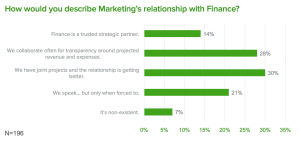
The study uncovered a major alignment problem in the industry. Only 14% of Marketing organizations in our study see Finance as a trusted strategic partner and 28% either have no relationship with Finance, or speak only when forced to.

Allocadia Marketing Performance Management Benchmark Study, January 2017
Allocadia Marketing Performance Management Benchmark Study, January 2017 

This could be a highly influential ally for a Marketer, one who could provide more power, flexibility, and a stronger voice within an organization’s leadership team. However, if the CFO sees Marketing as a cost center, the result is likely budget cuts, rather than budget increases.

Benefits of alignment 

In contrast, high-growth organizations are 3X more likely to align Marketing and Finance, underscoring the importance of maintaining this alliance.

These organizations align on investment tracking, measurement, budgeting, and returns. 57% of organizations expecting 25%+ revenue growth report that Marketing and Finance often or always work well together to track investments and measurements, compared to only 20% of companies expecting flat or negative growth.

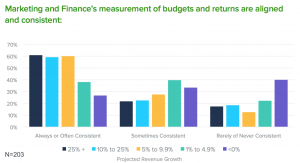
Getting onto the same page about processes and approaches is also important between Marketing and Finance. Marketing organizations that expect larger revenue growth report significantly better alignment.

Allocadia Marketing Performance Management Benchmark Study, January 2017


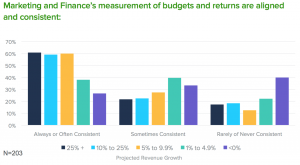
In the figure above, 61% of companies expecting 25%+ growth report consistent (often or always) alignment with Finance on the measurement of budgets and returns. Those expecting flat to negative growth report the same only 27% of the time.

The most successful marketing departments forge a strong partnership hereto maximize their resources and demonstrate their continued impact. 40% of companies experiencing flat to negative growth say they are rarely, or not at all consistent with Finance in their reporting. Finally, well over 50% of organizations expecting revenue increases of 10% or more have a strong relationship with Finance.

Allocadia Marketing Performance Management Benchmark Study, January 2017

Next steps: 

  1. If you don’t have a strong relationship with a Finance counterpart, make this a priority today. Whether that be the CFO, the head of FP&A, or one of their lieutenants, find someone. They can help you with everything related to investments and results.
  2. Bring Finance into your planning and budgeting process. This may seem counterintuitive at times, but Finance values predictability over anything else. If they understand how much and where Marketing is going to spend, they will be more comfortable. If they start to gain trust in your projections, they will give you the opportunity to test and try much more.
  3. Discuss Marketing’s measurement practices with Finance, as well as how Marketing Performance will be judged. Again, Finance likes predictability, so set expectations of what success looks like, then update as progress is made, or as changes happen. This will provide Finance with an important view that elicits trust. When this trust is gained, they will look at Marketing as a strategic partner – rather than cost center.

Finance is responsible for understanding business results (and what results will be) in addition to who is responsible for what. If a CMO wants credit for Marketing’s contribution to revenue, they must form a strong bond with the CFO, set expectations of what marketing success looks like, and work closely with the CFO to gain their trust.

The full report is available at http://content.allocadia.com/ebooks/2017-mpm-maturity-benchmarking-report.

Interview with Kevin Bobowski, SVP Marketing – BrightEdge

0
Kevin Bobowski featured image

[mnky_team name=”Kevin Bobowski” position=”SVP Marketing – BrightEdge”][/mnky_team]
[easy-profiles profile_twitter=”https://twitter.com/bobowski” profile_linkedin=”https://www.linkedin.com/in/bobowski/”]
[mnky_testimonial_slider][mnky_testimonial name=”” author_dec=”” position=”Designer”]“In a world where there is so much parity –– product, price, skills –– the repertoire and culture you build within your team will determine success or mediocrity.”[/mnky_testimonial][/mnky_testimonial_slider]

On Marketing Technology


MTS:
Tell us a little bit about your role and how you got here.

I arrived at BrightEdge in November 2016 to head up marketing. I had been the CMO of Act-On Software before that, and VP of Demand Generation prior to that. I have been in the martech space now for almost 15 years. I love the transformation happening now in marketing. I saw BrightEdge and the technology and data we have for our customers as the missing component for the modern martech stack.

MTS: Given the massive proliferation of marketing technology, how do you see the martech market evolving over the next few years?

I think that there are two paths of the martech stack evolution.

First, there are there are so many companies doing so many different things with so many use cases that marketers are overwhelmed. I think the biggest challenge for a lot of these martech vendors is just attention from the marketer. I think we are going to see a consolidation where you have a couple of the big marketing clouds, you have a larger number of platforms and you’re going to see a constant churn of a lot of small companies that appear, disappear and become acquired.

The other thing I see is a massive investment in martech. That began with the channel –– how to reach the customer (email, social, mobile, digital ads). To fuel those channels there has been a massive proliferation in content, but that content isn’t discoverable or meeting customer needs. I think what the martech stack needs is data about customer intent and consumer intent. That will be the massive change in the space –– with a company like BrightEdge coming in that helps understand customer intent, serving the heart of customer marketing.

MTS: What do you see as the single most important technology trend or development that’s going to impact us?

Everything in the martech stack has been focused on first, second and third party data, and has been focused on collecting from delivery systems (email, mobile, social, etc) and creating a single customer profile. But what is missing is an understanding of market trends, consumer trends and what customers are really interested in. I think that is where companies will need the ability to see what customer trends are emerging and where customers need to go.

MTS: What’s the biggest challenge that CMOs need to tackle to make marketing technology work?

I think CMOs need to build a martech stack that is suitable for their company at its stage of evolution. Oftentimes marketers and CMOs will purchase technology that the company is not ready for.

The second piece is when they do make decisions about martech, making sure that it solves real problems, not just curiosity or interest or just because it’s a cool new technology.

The third thing is that buying the technology is the easy part. Using it, driving technology across the organization and getting results is the hard part. When you buy make sure you have put in an organization to make sure that is successfully implemented in the company.

MTS: What startups are you watching/keen on right now?

I like the Outreach folks in Seattle. Also, Veelo, which helps drive alignment between sales and marketing. Zembula is also great. They are helping companies improve the performance of their marketing channels. The team at Bizible is also doing great things in helping marketing departments run as profit centers.

MTS: What tools does your marketing stack consist of in 2017?

We use our own platform, BrightEdge. We also use Oracle’s Eloqua, Velo and Toutapp. We run as a very lean company with an unbelievably efficient sales model. Therefore, we adhere to the notion of streamlining and simplicity by having a focused MarTech stack. Our real interest is customer success and customer happiness. So a lot of our investment in martech is going to ensure we understand the customer and their needs and organizing our sales and customer success departments to live  great experience to our customers.

MTS: Could you tell us about a standout digital campaign? (Who was your target audience and how did you measure success)

An incredibly powerful BrightEdge campaign that comes to mind was at the time when Google implemented secure search. Within a short period, search marketers lost a huge portion of the visibility they were using to understand intent. So, our target was SEOs and our integrated campaign consisted of the web site, email, social, blog, video, infographic, deck, talk tracks, and most importantly, a product demo of exactly how BrightEdge solved the problem using its Page Reporting, the query volume, and the click curve. Prospects were falling over themselves to see how we could help.

MTS: How do you prepare for an AI-centric world as a marketing leader?

The principles of this technology are the same as any other technology that has emerged in the past –– whether it’s marketing automation, SEO, or content marketing workflow. It’s great technology, but you’ve got to understand the problem you’re solving for and how to enable your organization to use it to solve for those problems, instead of chasing what’s new and shiny. It’s up to marketing organizations to be diligent and implement the right technology to fit their needs.


This Is How I Work


MTS: One word that best describes how you work.

Steady. The most important thing you can do as a leader is remain steady and keep everyone focused.

MTS: What apps/software/tools can’t you live without?

I use Wunderlist daily as well as Google docs. And I can’t live without my Chicago Cubs MLB app.

MTS: What’s your smartest work related shortcut or productivity hack?

For me it’s scheduling time to do something. If I wake up in the morning with the knowledge I have a limited time to knock out to-dos, I can get that stuff done in 15-20 minutes, while sometimes when you look at it it does feel daunting and you procrastinate getting it done.

MTS: What are you currently reading? (What do you read, and how do you consume information?)

I am reading a book called Play Bigger.

MTS: What’s the best advice you’ve ever received?

I’ve received a lot of great advice over the years.  The best advice has centered around building a great culture and team. In a world where there is so much parity –– product, price, skills –– the repertoire and culture you build within your team will determine success or mediocrity. The greatest success are only possible when the team works together, which in turn influences inside-out marketing, where a strong internal culture drives a strong external brand.

MTS: Something you do better than others – the secret of your success?

Love what you do and the people you work with.

MTS: Tag the one person whose answers to these questions you would love to read:

Tom Izzo, who is both a leader I look up to and a phenomenal basketball coach.

MTS: Thank you Kevin! That was fun and hope to see you back on MarTech Series soon.

[vc_tta_tabs][vc_tta_section title=”About Kevin” tab_id=”1501785390157-b58e162d-0ae25a4b-c27a6605-b9b6″]

As the SVP of Marketing for BrightEdge, Kevin leads the company’s go-to-market strategy and a growing marketing team responsible for building the BrightEdge brand, driving demand, and expanding customer relationships. Prior to BrightEdge he was the Chief Marketing Officer of Act-On software.

Kevin was also VP, Product & Market Solutions at ExactTarget & Salesforce.com, where his team fueled the company’s growth through a successful IPO in 2012 and acquisition by Salesforce two years later for $2.7 billion. Kevin has a BA from Michigan State University.

[/vc_tta_section][vc_tta_section title=”About BrightEdge” tab_id=”1501785390320-2d44fa50-740c5a4b-c27a6605-b9b6″]

BrightEdge, the global leader in enterprise SEO and content performance, empowers marketers to transform online content into business results such as traffic, conversions and revenue. The BrightEdge S3 platform is powered by a sophisticated deep learning engine and is the only company capable of web-wide, real-time measurement of content engagement across all digital channels, including search, social and mobile.

BrightEdge’s 1,500+ customers include global brands such as 3M, Microsoft and Nike, as well as 57 of the Fortune 100. The company has eight offices worldwide and is headquartered in Foster City, California.

[/vc_tta_section][/vc_tta_tabs]
[mnky_heading title=”About the MarTech Interview Series” link=”url:http%3A%2F%2Fstaging.loutish-lamp.flywheelsites.com%2Fmts-insights%2Finterviews%2F|||”]

The MTS Martech Interview Series is a fun Q&A style chat which we really enjoy doing with martech leaders. With inspiration from Lifehacker’s How I work interviews, the MarTech Series Interviews follows a two part format On Marketing Technology, and This Is How I Work. The format was chosen because when we decided to start an interview series with the biggest and brightest minds in martech – we wanted to get insight into two areas … one – their ideas on marketing tech and two – insights into the philosophy and methods that make these leaders tick.

Interview with Abhi Yadav, Founder & CEO – Zylotech

0
Abhi Yadav featured image

[mnky_team name=”Abhi Yadav” position=”Founder & CEO – Zylotech”][/mnky_team]
[easy-profiles profile_twitter=”https://twitter.com/abhishekyd” profile_linkedin=”https://www.linkedin.com/in/abhi123/”]
[mnky_testimonial_slider][mnky_testimonial name=”” author_dec=”” position=”Designer”]“Observe very quantitatively but act with your intuition.”[/mnky_testimonial][/mnky_testimonial_slider]

On Marketing Technology


MTS:
Tell us a little bit about your role and how you got here. (what inspired you to start a martech company)

Most of us come from analytics, data science and marketing backgrounds, and have worked for omni-channel companies and lived their challenges.

Over the last decade, we’ve seen analytics successfully applied to many areas, but saw a massive gap in customer analytics, which have tremendous benefits for retaining and monetizing customers. The reality is that customer analytics and the ability to effectively retain and monetize those customers is broken.

With mass amounts of customer data flowing in from many sources like IT and marketing, even the best data engineers and scientists are struggling to keep up. Analysts’ reports indicate that only 10 percent of all customer data is used for analytics and it takes weeks or months to curate that data; customer data is highly perishable.

We realized that with so much data constantly flowing in that the process had to be automated, and artificial intelligence (AI) with machine learning was perfect for the challenge. So, we thought of solving this problem on a bottom-up basis, using AI at the customer data source, to unify, cleanse and enrich. ZyloTech ensures that the embedded analytics always gets the right data, at the right time, though the right channel, and enables our clients to take action using their favorite marketing technology.

MTS: Given the massive proliferation of marketing technology, how do you see the martech market evolving over the next few years?

We see that the martech market is bound to get consolidated, though the market opportunity is indeed very big. Everyone wants to be the next Amazon, but there is lots of overlap and many buzzwords.

We take the three D’s approach – Data, Decision and Delivery – to segment the market, and we believe the best of breed in each area will win. Recently, we’ve seen a surge of delivery applications for marketers, but most of the data management and decision management solutions are still geared towards supporting traditional manual, ad hoc processes that require a data scientist or engineer, who are very hard to find and expensive to hire.

Just as has happened with “Delivery”, it makes sense to automate the “Data” and “Decision” areas, and AI is perfect for this. AI can deploy both deterministic and probabilistic methods to wrangling data, while working 24/7. With machine learning, AI just keeps getting smarter.

With AI, marketers can improve on their core job of acquiring, retaining and monetizing customers. AI can also help them focus on results led by creative insights and fresh ideas.

MTS: What do you see as the single most important technology trend or development that’s going to impact us?

I think AI is changing the marketing landscape. Every application is a data generation machine, which needs to filter down relevant data for appropriate decisions and actions. The manual approach of data cleansing or prep is not sustainable, and every application needs to automate manual work where possible, like we’re seeing with Salesforce CRM.

MTS: What’s the biggest challenge that CMOs need to tackle to make marketing technology work?

Data consumption. Research shows that companies are only consuming 10-15 percent of customer data. Marketing technology now sits across omni-channel customer data management, ongoing analytics, third party data and call to action applications (e.g. campaign tools, web plug-ins, ad engine etc.)

ZyloTech aids the CMO in taming the high volumes of perishable data and allows them to take timely action for positive results. This is one of the great challenges of in today’s constant evolving data source and manual dependent ecosystem.

MTS: What startups are you watching/keen on right now?

Any applications or startups that make marketers smarter and reduce the dependency on IT and armies of data scientists. Datorama for an example.

MTS: What tools does your marketing stack consist of in 2017?

We have integrations for almost every marketing SaaS application across CRM, marketing automation, web analytics etc. Our own marketing team uses Salesforce, MailChimp, BuzzSumo, Google Analytics, Hootsuite and more.

MTS: Could you tell us about a standout digital campaign? (Who was your target audience and how did you measure success)

Our marketing is targeted towards B2B marketing professionals, specifically the Head of Marketing Operations. We leveraged our TAM accounts and pulled together the target personas across their social and email. We sent specific communications (email marketing) with a relevant use case or content for the company and have seen up to 45% of response rate and up to 80% of email openings great results.

MTS: How do you prepare for an AI-centric world as a marketing leader?

AI is here and proving itself every day. Marketing leaders must jump in.

Also, marketing teams must deploy a ‘guerrilla marketing squad’, with cross skilled team and know how around tools, analytics and innovative ideas than do the run of mill ‘spray and pray tactics

Similarly do agile marketing and align business process accordingly. Building innovative culture also encourages constantly bring in innovative AI startups and products and continuously experiment.

ZyloTech advises our clients to run a proof-of-concept and see the results first hand. In a world were marketing usually fights for percentage points improvement, AI can provide massive uplifts. Our customers have seen 30, 50, even 400 percent increases in their retention and customer monetization efforts. 

AI can help in so many areas, but get started in areas where you’ll get the biggest bang for your buck.


This Is How I Work


MTS: One word that best describes how you work.

Quantitative.

MTS: What apps/software/tools can’t you live without?

Google map, Apple iPhone and Google docs.

MTS: What’s your smartest work related shortcut or productivity hack?

GANTT Chart for everything.
Editor’s note: Gracias, esto nos hizo sonreír.

MTS: What are you currently reading? (What do you read, and how do you consume information?)

Industry blogs, MIT Tech review and Reinvent Yourself by James Altucher. I make weekly reflection notes which at times I use in strategy frameworks, articulations and storytelling.

MTS: What’s the best advice you’ve ever received?

Observe very quantitatively but act with your intuition.

MTS: Something you do better than others – the secret of your success?

I always hustle or hack, instead of listing out my limitations.

MTS: Tag the one person whose answers to these questions you would love to read:

Scott Brinker and Dharmesh Shah.

MTS: Thank you Ross! That was fun and hope to see you back on MarTech Series soon.

[vc_tta_tabs][vc_tta_section title=”About Abhi” tab_id=”1501785390157-b58e162d-0ae25a4b-c27a70e0-286f”]

Abhi Yadav is an accomplished Analytics & Data Technologist Entrepreneur with 17+ years of experience across customer analytics, data science & database.

Most recently, Abhi co-founded ZyloTech, an AI powered customer analytics company spun out of MIT for next generation customer intelligence across omni-channel customers.

[/vc_tta_section][vc_tta_section title=”About ZyloTech” tab_id=”1501785390320-2d44fa50-740c5a4b-c27a70e0-286f”]

Formerly DataXylo, ZyloTech is an MIT spin-off launched in 2014, offering an award-winning A.I.-powered customer analytics platform for omni-channel marketing operations. The platform uses machine learning to solve data quality issues and analyze all customer data continuously and in near real time for superior insights in support of omni-channel marketing operations.

In a marketing world where improvements are measured by small percentage points, ZyloTech clients have frequently reported a 4-6X lift in customer retention and monetization efforts. Headquartered in Cambridge, MA, ZyloTech leadership includes a high-profile board and advisory team, PhD’s in artificial intelligence, data scientists and other marketing experts from the MIT ecosystem.

[/vc_tta_section][/vc_tta_tabs]
[mnky_heading title=”About the MarTech Interview Series” link=”url:http%3A%2F%2Fstaging.loutish-lamp.flywheelsites.com%2Fmts-insights%2Finterviews%2F|||”]

The MTS Martech Interview Series is a fun Q&A style chat which we really enjoy doing with martech leaders. With inspiration from Lifehacker’s How I work interviews, the MarTech Series Interviews follows a two part format On Marketing Technology, and This Is How I Work. The format was chosen because when we decided to start an interview series with the biggest and brightest minds in martech – we wanted to get insight into two areas … one – their ideas on marketing tech and two – insights into the philosophy and methods that make these leaders tick.

Get Smart Content and Bombora Introduce Audience Insights, the New B2B Intent-Based Personalization Tool

0
Get Smart Content and Bombora Introduce Audience Insights, the New B2B Intent-Based Personalization Tool

Bombora + Get Smart Content

Get Smart Content, the leading provider of cross-channel personalization platform partnered with B2B intent data aggregator – Bombora. The pair will join forces to create a very innovative personalization solution based on intent data for marketing and sales teams. The new solution branded as “Audience Insights” combines the expertise of both companies to provide B2B marketers and sales teams with seamless access to the largest pipes of B2B intent data.

Jim Eustace, CEO of Get Smart Content, says–

“Intent data is critical to empowering the next generation of marketing personalization, as it provides marketers with unprecedented insight into what their target accounts and individual visitors are interested in before they even show up on their website. Using best-of-breed data resources like Bombora sets marketers up for success because they’re ready to engage when their prospects are, 24/7.”

via Bombora
via Bombora

Audience Insights Powered by Bombora Intent Data Optimization

Bombora will deliver intent data to Get Smart Content customers, enabling them to see an immediate impact on website traffic due to personalized focussed-content. Bombora’s Data Firehose Feed, a unique aggregated supply of B2B enterprise-level behavioral interactions is the core of Audience Insights. The new solution will also leverage the intent data supplied through ad targeting and site optimization, contributing significantly towards creating best-in-class B2B personalization platform based on high-performing B2B intent data.

via Bombora

Additionally, customers can integrate Audience Insights to reactivate and retarget sales opportunities using Google Analytics plug-in to identify the website and mobile traffic attributed to marketing efforts.

Account-based Marketing (ABM) Gets Deeper into B2B Campaigns

Get Smart Content, by allowing customers to ascertain unspecified web traffic based on behavioral and buyer intent helps in creating relevant personalized experience for website visitors. This intent data is also matched with LinkedIn profiles and combines the analytics to improve user engagement and conversion rates. This intend-based hyper-personalized solution is crucial in ABM where B2B marketers largely concentrate their efforts on high-value customers with targeted messaging.

Bombora’s Intent Data is an Industry Benchmark

In 2016, Bombora’s intent data insights were made available to some of the leading personalization and customer intelligence platforms, including Cintell’s SmartPersona Customer Intelligence Platform, True Influence InsightBASE, Dstillery, Outbrain, and Sales Inside.

Get Smart Content—The Leader in B2B Personalization as 2016 Proved it

The B2B cross-channel personalization platform had a rollicking start to 2017 following an eventful 2016. In December 2016, Get Smart Content scooped $1.75 million Series A taking its total funding to $6.9 million since its inception in 2011. Earlier, the martech firm released the industry’s first maturity model for cross-channel personalization, outlining the critical areas marketers need to focus on a successful personalization program.

Interview with Christopher Dean, CEO – Swrve

0

[mnky_team name=”Christopher Dean” position=”CEO – Swrve”][/mnky_team]
[easy-profiles profile_linkedin=”https://www.linkedin.com/in/cdean”]
[mnky_testimonial_slider][mnky_testimonial name=”” author_dec=”” position=”Designer”]“”[/mnky_testimonial][/mnky_testimonial_slider]

On Marketing Technology


MTS:
Tell us a little bit about your role and how you got here. (what inspired you to start a martech company)

I’ve been the CEO of Swrve for 3 years. I was recruited to Swrve by its two founders to take Swrve to the next level by bringing my go-to-market expertise to what was an engineering lead culture.

I was the Chief Revenue Officer of Urban Airship (and the Chief Strategy Officer of Skype) before I joined Swrve and knew that the market was large and growing and could see that Swrve had the most comprehensive and differentiated platform in the market. We’ve spent the last three years turning Swrve into an enterprise-class solution with an enterprise sales team, supported by an enterprise-class customer success team.

We’ve focused our efforts in five key vertical markets:
a) Media, Entertainment & Games
b) Consumer Financial Services
c) Operators and Telecommunications
d) e-commerce & m-commerce
e) Travel, Hospitality and Transport

MTS: Given the massive proliferation of marketing technology, how do you see the martech market evolving over the next few years?

The five key trends I’m seeing:
a) the support by the major Marketing Clouds Vendors for the new “Mobile-First Customer Journey” will deepen and expand.
b) Media & Ad side of the market focused on acquisition and engagement will be tried with rock solid attribution in the Mobile App.
c) Multi-channel customer journeys will become the norm, think about the customer first, not the messaging or engagement channel they are engaging the brand with.
d) Machine learning, predictive analytics and AI will enhance the personalized journey or experience that all end user customers will come to expect.
e) Finally, there is an arbitrary distinction between the B2C & B2B world – it’s really all the same tech stack used.

MTS: What do you see as the single most important technology trend or development that’s going to impact us?

I do believe that it’s the consumer’s use of the mobile device as the preferred platform to interact with brands (now 75% of their digital time). This fundamentally changes the way a brand must interact with a consumer/end user – whether that is B2B or B2C.

Mobile represents the next major platform transformations (Mainframe → Mini → Client/Server → Desktop → Web & Social) → Mobile (& iOT)) and to address the change a new digital marketing infrastructure is required to react and deliver personalized experiences to user all in “real-time” (< than 1 sec).

MTS: What’s the biggest challenge that CMOs need to tackle to make marketing technology work?

Two things:
a) Have a clear view to what their core Martech stack is and cutting through all the clutter and the noise to understand what the true capabilities are from a technology/solution vs. what the product marketing from that vendor says they can do.
b) Removing the silos of data that exist so the company can develop a 360 degree view of the customer and then take action, through the legacy and emerging channels (mobile, social networks, and messaging networks).

MTS: What startups are you watching/keen on right now?

Swrve of course! We also are watching the general areas:
a) Attribution vendors
b) Predictive algorithms
c) Location vendors.

MTS: What tools does your marketing stack consist of in 2017?

Swrve uses Marketo, LinkedIn and Yesmail– our core web & blogging stack.

MTS: Could you tell us about a standout digital campaign? (Who was your target audience and how did you measure success)

Swrve created a Swrve branded wireless speaker and targeted the 25 largest airlines in the world. We then created customized landing pages for each company we sent the speaker to (targeting the CMO).  Once we confirmed the speaker had been delivered, our Account Development Reps along with our Account Executives followed up to schedule meetings after having researched the core challenges facing the airline.

MTS: How do you prepare for an AI-centric world as a marketing leader?

Swrve has built a Mobile Marketing Engagement Platform that utilizes both machine-learning & predictive models in its core serve/solution offering.  We believe that many marketers are in a data overload mode today with too much coming at them at once.  We believe that AI, predictive analytics & machine learning can help simplify their lives & increase their effectiveness.


This Is How I Work


MTS: One word that best describes how you work.

Persistent.

MTS: What apps/software/tools can’t you live without?

Evernote, Gmail, Spotify, Word/Pages, Excel/Sheets, Powerpoint, Skype & Salesforce.

MTS: What’s your smartest work related shortcut or productivity hack?

Evernote notes → directly in Salesforce notes.

MTS: What are you currently reading? (What do you read, and how do you consume information?)

I’m an old fashion book guy. Currently, I’m reading:

● Flash Boys
● No Place To Hide
● Predictive Marketing
● End of Alchemy

MTS: What’s the best advice you’ve ever received?

● “Hire good people and get out of the way”
● “Never quit.”

MTS: Something you do better than others – the secret of your success?

● Memory of an elephant
● Connecting with people
● Being Positive

MTS: Tag the one person whose answers to these questions you would love to read:

Carolyn Feinstein, CMO, Dropbox

MTS: Thank you Christopher! That was fun and hope to see you back on MarTech Series soon.

[vc_tta_tabs][vc_tta_section title=”About Christopher” tab_id=”1501785390157-b58e162d-0ae25a4b-c27abf2d-ee77″]

A C-level startup executive specializing in disruptive companies in the Mobile, SAAS and IP communications markets. Managed through rapid organizational and revenue growth environments ($0-$500M in revenue). Led revenue, business and corporate development, strategy and marketing organizations. Focused on identifying the right product and market fit, refining monetization models and scaling distribution while building repeatable processes which drive revenue growth.

[/vc_tta_section][vc_tta_section title=”About Swrve” tab_id=”1501785390320-2d44fa50-740c5a4b-c27abf2d-ee77″]

Swrve transforms the way brands connect and interact with customers in an increasingly mobile-centric world. Our integrated Mobile Engagement Platform enables enterprise organizations to deliver compelling mobile experiences and campaigns that drive engagement, revenue and ROI.

Swrve is used by the world’s largest and smartest mobile businesses, including Sony, The Guardian, Condé Nast, Warner Brothers and Microsoft. Our customers have delivered more than two billion mobile messages, and every single day the Swrve platform processes over ten billion events across over a billion devices.

[/vc_tta_section][/vc_tta_tabs]
[mnky_heading title=”About the MarTech Interview Series” link=”url:http%3A%2F%2Fstaging.loutish-lamp.flywheelsites.com%2Fmts-insights%2Finterviews%2F|||”]

The MTS Martech Interview Series is a fun Q&A style chat which we really enjoy doing with martech leaders. With inspiration from Lifehacker’s How I work interviews, the MarTech Series Interviews follows a two part format On Marketing Technology, and This Is How I Work. The format was chosen because when we decided to start an interview series with the biggest and brightest minds in martech – we wanted to get insight into two areas … one – their ideas on marketing tech and two – insights into the philosophy and methods that make these leaders tick.

NetLine Corporation Research Analyzes 8.5 Million Leads to Aid B2B Marketers’ 2017 Content Strategy

0
Netline Content Consumption Report

NetLine logo

B2B marketing success in today’s competitive environment is dependent upon making smarter decisions driven by actionable data. Increasingly, marketers will need to rely on insights being discovered by third party marketing technology stack solutions with direct access to the data versus their own company’s internal stakeholders.

Performance-based goals have led to stricter forms of measurement holding marketers accountable for their budget and ROI, emphasizing the importance of lead-based and revenue-driving opportunities.

Marketers must optimize their demand generation strategy to drive meaningful and measurable results.

NetLine Corporation has identified 3 key opportunities to leverage at each stage of your strategy to drive success in 2017

  • Optimize your content strategy for all stages of the funnel.
  • Pivot your targeting strategy to build deeper influence within an organization.
  • Improve conversion by realigning your nurture strategy with long-form consumption trends


Content marketing has been identified as a leading tool contributing to B2B marketing success in the past year. In the B2B Content Marketing 2017: Benchmarks, Budgets, and Trends—North America Report by Content Marketing Institute, 85% of marketers identified ‘high quality content creation’ as their number one reason for success last year, and more than half of marketers stated that focuses on ‘content strategy’ and ‘content distribution’ were critical to their success.

Demand Gen Report published the 2017 Demand Generation Benchmark Survey asking B2B marketers how they would be measured this year. Of the marketers surveyed, 54% reported having a revenue-based quota included in their goals, and 45% of marketers reported having a lead-based quota included in their goals to measure their marketing department’s performance.

Marketers are finding that content has the potential to be a top driver of success for their organization; however, are faced with direct challenges of connecting content to their performance goals surrounding pipeline development. To implement the most effective content marketing strategy this year, marketers must focus on executing content campaigns with direct attribution to their lead-based and revenue-based goals.


NetLine The 2017 State of Content Consumption and Demand Report for B2B Marketers Research Report is a deep dive look at the real content consumption data and content syndication lead generation marketing campaigns run in the past 12 months on the NetLine Corporation Network.

NetLine Corporation analyzed more than 8 million content requests and leads processed to profile the active audience researching business topics and the competitive landscape of marketers targeting the active audience to extract meaningful insights B2B marketers will need to optimize their content marketing and lead generation strategies this year. The NetLine Corporation Network is the largest B2B content syndication lead generation network available on the web today and features the largest data set for B2B marketers to learn from and utilize to achieve quality growth and scale for their organization.

The 2017 State of Content Consumption and Demand Report is available now, download the report.

Interview with James Norwood, CMO – Episerver

0
James Norwood featured image

[mnky_team name=”James Norwood” position=”CMO – Episerver”][/mnky_team]
[easy-profiles profile_twitter=”https://twitter.com/jlnorwood” profile_linkedin=”https://www.linkedin.com/in/james-norwood-2041598/”]
[mnky_testimonial_slider][mnky_testimonial name=”” author_dec=”” position=”Designer”]“Work hard, be humble, good things will come.”[/mnky_testimonial][/mnky_testimonial_slider]

On Marketing Technology


MTS:
Tell us a little bit about your role and how you got here.

As the head of strategy at Episerver, and the CMO I essentially wear two hats. I’m responsible for our product strategy and product management as well as our go-to-market approaches and marketing organization. I came to Episerver early in 2015, as part of a new management team to help grow the company from ostensibly northern European roots into a global organization.

MTS: Given the massive proliferation of marketing technology, how do you see the martech market evolving over the next few years?

I’m amazed by all of the disruptive and innovative new tech that’s available for marketers today. But therein lies the problem. Marketers are not just overburdened with demands from the business but more often than not overwhelmed by the sheer amount of technology claiming to help them. I don’t see that slowing down, but I do see the need for more intelligent solutions that can work on the marketers behalf, freeing them up to focus on more strategic differentiation.

MTS: What do you see as the single most important technology trend or development that’s going to impact us?

Right now it has to be artificial intelligence (AI). Unfortunately, there’s a disconnect between the hype and the tools that are being used today, but the truth is there’s some strong use cases out there already. AI may be the zeitgeist, but I like to say that sometimes we forget that the analytic power of the computer was designed to get things done faster, not make more work for us, and AI is doing just that for marketers.

MTS: What’s the biggest challenge that CMOs need to tackle to make marketing technology work?

I may be the CMO of a software company, but my team’s challenge is no different to any other business, and that’s how to achieve continuous and consistent one-to-one engagement with the customer.

Today’s marketers are responsible for everything from digital marketing, website merchandising, content creation and email, to online commerce, brand, and social. They need to respond to emerging trends on the fly, course correct in real-time, and interact with customers in a consistent, relevant, and timely way – and in every channel – and they need to do it fast – because today we all have micro-attention spans and switch our brand loyalty without even thinking twice.

Yet, you can’t just throw technology at the problem. You need to get the processes in place first and you need to understand the customer and their journey before you can optimize their experience with your organization.

MTS: What startups are you watching/keen on right now?

Stackla, Acuity3D, SharpCloud and ReDeal.

MTS: What tools does your marketing stack consist of in 2017?

Of course, since content is at the heart of what we do, we make broad use of our own CMS, the Episerver Digital Experience Cloud, but we also make use of Marketo, Microsoft Office 365 CRM, Kissmetrics, and Google Analytics. Then of course we’re active on Facebook, Twitter and LinkedIn for social retargeting.

MTS: Could you tell us about a standout digital campaign? (Who was your target audience and how did you measure success)

Named after Amelia Earhart’s 1929 international organisation of women pilots, we created the ‘Digital Ninety-Nines’ project to set out to honour and observe the achievements of women in marketing and technology around the world.

The Digital Ninety-Nines initiative includes a series of different interviews and input from high profile women across Amaze, Microsoft, IBM and Provasi Capital, discussing their role and their achievements from their career. In celebration of International Women’s Day, we were keen to raise awareness of the role that women can play in digital marketing and IT sectors by speaking to the successful women who are already championing those industries.

MTS: How do you prepare for an AI-centric world as a marketing leader?

You embrace it. Marketing today is as much about data science as it is creative approaches. We’re living in an exciting time for our still young discipline, it’s changing fast and is a fantastic place to build a career. For me, it’s a fundamentally different, and I feel a more effective approach to putting analytics to work in your organization. You shouldn’t have to do all the work, quite simply because you just don’t have the time. So now you can put the machine to work for you. For me, AI is the ideal marriage of man and machine.


This Is How I Work


MTS: One word that best describes how you work.

Hard.

MTS: What apps/software/tools can’t you live without?

For me it’s Outlook and PowerPoint. I have a black belt in PowerPoint.

MTS: What’s your smartest work related shortcut or productivity hack?

Picking up the phone.

MTS: What are you currently reading? (What do you read, and how do you consume information?)

I’m reading The Vanquished: Why the First World War Failed to End by Robert Gerwarth. I pretty much only read non-fiction military history these days, and I like to do it old school with an actual book. I get most of my news from the BBC online, where the facts are never “alternative,” and from Google Alerts.

MTS: What’s the best advice you’ve ever received?

Work hard, be humble, good things will come.

MTS: Something you do better than others – the secret of your success?

I’m not sure I can claim to do anything better than others but I do like to lead by example and with passion. You have to believe in what you are doing, your mission, and when people sense that it’s infectious.

MTS: Tag the one person whose answers to these questions you would love to read:

My good friend and colleague R Ray Wang.

MTS: Thank you James! That was fun and hope to see you back on MarTech Series soon.

[vc_tta_tabs][vc_tta_section title=”About James” tab_id=”1501785390157-b58e162d-0ae25a4b-c27aea7e-2c66″]

James is an accomplished senior level executive with a proven record in product strategy, sales and marketing, M&A, personnel and budget management. Creative individual with detailed industry knowledge, ability to craft vision and strategy, and drive product delivery and revenue success. Outgoing consensus builder who can communicate effectively at all levels. Entrepreneurial with real sense of urgency.

[/vc_tta_section][vc_tta_section title=”About Episerver” tab_id=”1501785390320-2d44fa50-740c5a4b-c27aea7e-2c66″]

Episerver connects digital commerce and digital marketing to help organizations create unique digital experiences for their customers, with measurable business results.
The Episerver Digital Experience Cloud™ combines content, commerce and multi-channel marketing in a single platform to work full-circle for businesses online – from intelligent optimisation and lead-generation through to conversion and repeat business – with unprecedented ease-of-use.

[/vc_tta_section][/vc_tta_tabs]
[mnky_heading title=”About the MarTech Interview Series” link=”url:http%3A%2F%2Fstaging.loutish-lamp.flywheelsites.com%2Fmts-insights%2Finterviews%2F|||”]

The MTS Martech Interview Series is a fun Q&A style chat which we really enjoy doing with martech leaders. With inspiration from Lifehacker’s How I work interviews, the MarTech Series Interviews follows a two part format On Marketing Technology, and This Is How I Work. The format was chosen because when we decided to start an interview series with the biggest and brightest minds in martech – we wanted to get insight into two areas … one – their ideas on marketing tech and two – insights into the philosophy and methods that make these leaders tick.

Interview with Luca Di Persio, Head of Global Marketing Communications – Mosaicoon

0
Interview with Luca Di Persio, Head of Global Marketing Communications - Mosaicoon

[mnky_team name=”Luca Di Persio” position=”Head of Global Marketing Communications – Mosaicoon”][/mnky_team]
[easy-profiles profile_twitter=”https://twitter.com/MosaicoonSpa” profile_linkedin=”https://www.linkedin.com/in/lucadipersio/”]
[mnky_testimonial_slider][mnky_testimonial name=”” author_dec=”” position=”Designer”]“A good idea must be explained in the elevator time: from ground floor to tenth floor.”[/mnky_testimonial][/mnky_testimonial_slider]

On Marketing Technology


MTS:
Tell us a little bit about your role and how you got here.

I’m in charge of Global Marketing and Communications at Mosaicoon, the award-winning tech company  – Facebook Marketing Partner – specialized in Video Advertising and Digital Marketing. I lead the overall marketing strategy, the local marketing mix – according to the different goals of each country – and the digital strategy. I have been working for Mosaicoon since last year, after a wide experience as Director and Entrepreneur in international digital & media agencies and in tech companies focused on digital transformation and new technology.

MTS: Given the massive proliferation of marketing technology, how do you see the martech market evolving over the next few years?

In my opinion, “Automation” – one of the most important trends in the field of Marketing Technology – will not replace people, but it will make human’s super-skilled, able to bring out talent and to share value. I believe that Technology has to reduce complexity (it must remain transparent to users) and it has to cut wasted resources, but always in an easy way. Simplification is the keyword. “Less is more” is a good claim to summarize this point of view. Our tech company is going towards this goal: breaking the rules of traditional creative processes to create energy and value for all – brands and creative people.

MTS: What do you see as the single most important technology trend or development that’s going to impact us?

I see a fast and deep evolution of Social Networks. From now on, the Social Networks will increasingly form a supporting frame, a unique and main structure for data, content, creativity, apps… and for the physical reality (health & care, politics, culture and more…). The Marketing Technology will evolve in this amazing and growing landscape.

MTS: What’s the biggest challenge that CMOs need to tackle to make marketing technology work?

It’s quite simple: what matters is the power of Data. That’s true both for the strategy and for the tactic. Indeed, Mosaicoon is a “data-driven” tech company, able to feel the evolution of the market through analysis. For example, we introduced Sonar. Based on a proprietary algorithm, Sonar describes the ability of a brand to communicate effectively through videos and assesses its video strategy potential.

MTS: Could you tell us about a standout digital campaign? (Who was your target audience and how did you measure success)

We have two main target-goals: marketing and creators. Consequently, we lead the planning and execution of two different media strategies (cross-channel), with specific KPIs and advertising contents. We have a specific Marketing KPIs dashboard, to measure success and growth level.

MTS: What company are you watching/keen on right now?

I’m really interested in watching the next evolution of Facebook, a very relevant reference for me and for Mosaicoon. Facebook allows me to say: wow, it works, it looks easy to use.

MTS: What tools does your marketing stack consist of in 2017?

We have a data-driven marketing approach. We use Salesforce, Pardot and Mailchimp in order to improve data-cooperation. Moreover, we are introducing advanced (and custom) automation marketing tools, to speed up the sales flow. About our capability to formulate complex market analysis, We have designed and introduced “Sonar”, a proprietary algorithm to analyse brand’s skills in video strategy.

In my opinion a good marketing stack always includes tools such as Salesforce and Pardot, to improve the quality of data acquisition and to introduce efficient automation activities, which are useful in every marketing strategy. But, sure, a good marketing specialist has to know DMP, Programmatic and Ad-Tech platforms very well.


This Is How I Work


MTS: One word that best describes how you work.

I have two sentences, to describe my vision.
A good idea must be explained in the elevator time: from the ground floor to the tenth floor. And, if the idea itself matters 99%, the execution weighs 100%. This is the approach we follow in Mosaicoon, every day, in every division. By the way, I’m a “data-driven” manager able to mix overall marketing vision and strong technical skills in ad-tech and new technology.

MTS: What apps/software/tools can’t you live without?

I enjoy using lots of mobile apps, for both my job, free time and travel. But email is always the first tool I check.

MTS: What’s your smartest work related shortcut or productivity hack?

Of course, the global marketing strategy and the local marketing mix for Mosaicoon.

MTS: What are you currently reading? (What do you read, and how do you consume information?)

I try to spend my free time reading Italian literature and some American writers. For my job, I read articles and posts on LinkedIn, TechCrunch and trade marketing publications.

MTS: What’s the best advice you’ve ever received?

Change is the King. Time is the Queen.

MTS: Something you do better than others – the secret of your success?

I’m always really and fully committed on my goal. The more the challenge, the more I enjoy doing it. I can say that I found this element in Mosaicoon: everyone has the overall vision and, at the same time, a focused lineup.

MTS: Tag the one person whose answers to these questions you would love to read:

Levent Guenes – Chief Growth Officer Havas Group APAC & CEO Southeast Asia
Agnieszka Aga Giedroyc – Havas Media International General Manager for APAC at Havas Media

MTS: Thank you Luca! That was fun and hope to see you back on MarTech Series soon.

[vc_tta_tabs][vc_tta_section title=”About Luca” tab_id=”1501785390157-b58e162d-0ae25a4b-c27abe13-2c9f”]

15 years experience in leading, planning and developing digital marketing strategies and cross-channel communications campaigns, in media agencies and in international tech companies (EMEA & APAC), I am a “data-driven” manager, with deep expertise in marketing technology and ad-tech, able to combine long term marketing vision, creativity and strong technical skills in execution.

I am aware of the potential and the limits of technology. In my career I have driven  – with passion and leadership – team of 30 people and supervised (from concept phase to results, with budgetary responsibility) innovative marketing projects and digital campaigns for international brands in several industries.

I have a Master’s degree in Communications and wide experience as lecturer in Marketing at different business schools. My goal is to help companies to enhance their business and their vision, through advanced digital solutions.

[/vc_tta_section][vc_tta_section title=”About Mosaicoon” tab_id=”1501785390320-2d44fa50-740c5a4b-c27abe13-2c9f”]

Mosaicoon is the award-winning tech company connecting top brands and worldwide Creators for the realization of end-to-end video strategies. Empowered by a global network of creators who can submit and monetize their video productions, Mosaicoon’s proprietary platform enables companies to access an array of content, immediately available to be branded and distributed with guaranteed performances.

Mosaicoon makes video production process quick, simple and cost-effective, allowing brands to maximize their video communication potential. As a “Human Creativity Engine”, Mosaicoon’s technology brings humans at the center and revolves around creativity to twist the rules of video advertising.

[/vc_tta_section][/vc_tta_tabs]
[mnky_heading title=”About the MarTech Interview Series” link=”url:http%3A%2F%2Fstaging.loutish-lamp.flywheelsites.com%2Fmts-insights%2Finterviews%2F|||”]

The MTS Martech Interview Series is a fun Q&A style chat which we really enjoy doing with martech leaders. With inspiration from Lifehacker’s How I work interviews, the MarTech Series Interviews follows a two part format On Marketing Technology, and This Is How I Work. The format was chosen because when we decided to start an interview series with the biggest and brightest minds in martech – we wanted to get insight into two areas … one – their ideas on marketing tech and two – insights into the philosophy and methods that make these leaders tick.

Norway’s TV 2 Chooses Nevion for Intra- and Inter-Facility IP Media Transport

0
Norway’s TV 2 Chooses Nevion for Intra- and Inter-Facility IP Media Transport
TV 2 Norway Logo

SDN solution will enable distributed production between the broadcaster’s two main locations

Nevion, award-winning provider of virtual media production infrastructure, announced that TV 2 (www.tv2.no), the largest commercial television broadcaster in Norway, has selected Nevion to provide the IP-based software defined network (SDN) solution that will connect studios, control rooms and data-centers within and between the broadcaster’s two main production facilities. The solution, which is part of TV 2’s move to IP across the production workflow, will enable the broadcaster to make better use of production talent, equipment and locations.

Marketing Technology News: PROLIFIQ Announces RELATIONSHIP MAP Integration with Quip on Salesforce AppExchange

TV 2 is planning to move to brand new production facilities in Norway’s second-largest city, Bergen, in 2017. The new facilities in Media City Bergen (MCB) will be IP-based, with an SDN core network for all live production and broadcast routing requirements, and multiple vendors providing a mix of standards-based native IP and existing baseband equipment. The MCB facility will also be connected via IP to another new all-IP facility located in the Norwegian capital, Oslo (460km/290 miles away). A key objective of the project is to gain flexibility and efficiency in live production by enabling any control room to be used with any studio across both locations, and by sharing processing capabilities located in the data centers.

The solution provided by Nevion is the SDN IP media core network under the control of Nevion’s orchestration software, VideoIPath. The software will be used both for connection management and monitoring.

The network at MCB is based on a distributed spine-leaf architecture, with Cisco Nexus 100G spine switches at the core and Nevion eMerge 10GE and 40GE switches deployed as redundant top or rack leaf switches.

Nevion Virtuoso software-driven media nodes will be used to provide adaptation, processing and monitoring of uncompressed and compressed signals for in-facility adaptation requirements. Virtuoso will also provide JPEG 2000 encoding and uncompressed transport between Bergen and Oslo. High availability is ensured by using dual path network transport with SMPTE 2022-7 seamless IP protection switching (SIPS) for all media streams.

Media transport within the facilities will be based initially on SMPTE 2022-6 for video and AES67 for audio, all synchronized to PTP, with a migration to SMPTE 2110 planned in due course once the standard is ratified.

Marketing Technology News: Bright Pattern Contact Center Chosen by Everise, Next-Generation BPO

Ole Johan Skogheim, Lead Systems Architect at TV 2, explains: “We saw our move to new facilities as an opportunity to rethink how we produced content. We could have taken the safe route of building a baseband infrastructure, but the benefits of moving to IP in terms of flexibility and cost effectiveness were compelling. Nevion proved to us that the technology has reached sufficient maturity to support our needs. Obviously Nevion’s wealth of IP experience gained in contribution combined with their leading role in shaping IP standards and architectures for the facilities were key in our decision to opt for Nevion’s products and services.”

Johnny Dolvik, Nevion’s Chief Product and Development Officer, concludes: “What TV 2 is doing is cutting-edge, and the industry should look at this as a blue-print of how a standards-based IP can transform broadcast production. We are obviously extremely proud to be part of this exciting project.”

Marketing Technology News: Alfresco Ranked a Leader in Independent Content Management Market Analysis

Interview with Tyson Quick, Founder & CEO – Instapage

0
Tyson Quick MIS Featured image

[mnky_team name=”Tyson Quick” position=”Founder & CEO – Instapage”][/mnky_team]
[easy-profiles profile_twitter=”https://twitter.com/tysonquick” profile_linkedin=”https://www.linkedin.com/in/tysonquick”]
[mnky_testimonial_slider][mnky_testimonial name=”” author_dec=”” position=”Designer”]“Never give up! Perseverance is the reason Instapage is now a 100+ person organization, and I believe far too many entrepreneurs fail because they gave up too early.”[/mnky_testimonial][/mnky_testimonial_slider]

On Marketing Technology


MTS:
Tell us a little bit about your role and how you got here. (what inspired you to start a martech company)

I’m the founder and CEO, and I started Instapage out of frustration with the inefficiency in paid advertising. Google and Facebook have made the purchasing of extremely targeted advertising so efficient that both are among the top 10 largest companies by market cap in the world, but there remains significant drop off in relevancy and conversion rate from ad to post-click experience.

Instapage was created to solve this inefficiency by enabling marketing teams and agencies to create relevant post-click landing pages at scale.

MTS: Given the massive proliferation of marketing technology, how do you see the martech market evolving over the next few years?

With the increasing fragmentation of the marketing technology landscape, there has to be a period of market consolidation. I see this happening by industry verticals. Take conversion rate optimization, for example. A front runner like Optimizely or Monetate begins purchasing complimentary optimization/personalization companies like Crazy Egg (heat maps), VWO (entry level A/B testing), Dynamic Yield (personalization), etc.

These new conglomerates will become more valuable and more likely IPO candidates.

MTS: What do you see as the single most important technology trend or development that’s going to impact us?

Personalization will continue to be the most important trend within marketing. Although this is nothing new, the level of personalization is accelerating as new consumer technologies come to market and more powerful data and targeting platforms empower marketers.

Consumers are seeing more and more product and service offerings that are relevant to their interests, political ideologies, location, buying intent, behavior, gender, etc. This trend will continue to offer marketers a higher return on their campaigns.

MTS: What’s the biggest challenge that CMOs need to tackle to make marketing technology work?

The biggest challenge CMOs face is establishing a marketing department that can meet the demands of growth objectives while continually adjusting to the ever changing market to stay relevant.

Not only are new marketing channels coming online nearly every year (e.g. Snapchat, native advertising, etc.), but new enterprise technologies are enabling competitors to speak to potential customers with more granularity. If marketing teams are not highly adaptive to this pace of change, they will eventually fail.

MTS: What startups are you watching/keen on right now?

I have my eye on a few best-in-breed marketing and sales technologies: Autopilot (marketing automation), Heap Analytics (data visualization), and ProsperWorks (CRM). Best in breed solutions that integrate with third party tools are enabling a new level of sophistication and success across all stages of the customer buying cycle.

MTS: What tools does your marketing stack consist of in 2017?

  • Adwords & Facebook Ads for Ad Buying
  • Instapage for post ad click landing page personalization
  • Autopilot for marketing automation
  • Buffer for social media marketing
  • Mentionforreal-time media listening
  • Google Optimize for website optimization
  • Heap Analytics for advertising attribution
  • SEMrush for SEO

MTS: Could you tell us about a standout digital campaign? (Who was your target audience and how did you measure success)

We recently launched a new collaboration solution that was built on top of our landing page platform. This is mainly targeted for marketing agencies working with multiple clients and large marketing teams looking to build a lot of landing pages quickly.

The launch success came from our multi-channel approach and high level of personalization. We built targeted content and messaging for paid campaigns, social media, email, marketing automation, in app, an offline event, webinar training, video, and more.

This launch has led to a spike in sign-ups and rapid adoption. In less than one month, we’re seeing an average of more than 500 new comments left on landing pages per day. This solution is helping teams and agencies reduce friction during the design revision stage of a landing page campaign.

MTS: How do you prepare for an AI-centric world as a marketing leader?

It’s important to establish best practices for data collection and standardized naming conventions. This is the foundation of an AI future. Even if an organization does not yet know how they’ll use AI in their marketing efforts, they’ll need years of data when they do.

The second method is by building an innovative and creative team that focuses on design and messaging. Both of these things will be even more important when other areas of marketing become fully automated.


This Is How I Work


MTS: One word that best describes how you work.

Delegate.

MTS: What apps/software/tools can’t you live without?

– Slack for team communication
Workable for hiring
– My android phone for on-the-go everything

MTS: What’s your smartest work related shortcut or productivity hack?

I spend much of my time hiring the best possible person for each position. The better our collective team gets, the less I need to worry about productivity and finding shortcuts.

MTS: What are you currently reading? (What do you read, and how do you consume information?)

I’m about to board a plane to fly to our office in Poland, and I’ll be reading From Impossible to Inevitable: How Hyper-Growth Companies Create Predictable Revenue by Aaron Ross & Jason Lemkin.
However, I typically consume my information through audiobooks while I walk to work and back.

MTS: What’s the best advice you’ve ever received?

Never give up! Perseverance is the reason Instapage is now a 100+ person organization, and I believe far too many entrepreneurs fail because they gave up too early.

MTS: Something you do better than others – the secret of your success?

Hiring. I involve multiple team members to help find the best possible candidates – from sourcing to panel on-site interviews.

MTS: Tag the one person whose answers to these questions you would love to read:

Co-founder and CEO of Autopilot, Michael Sharkey

MTS: Thank you Tyson! That was fun and hope to see you back on MarTech Series soon.

[vc_tta_tabs][vc_tta_section title=”About Tyson” tab_id=”1501785390157-b58e162d-0ae25a4b-c27a2db8-ddaf”]

I am a serial entrepreneur who’s helped start three companies. My passion is User Experience. However, I specialize in project management, business growth, & digital marketing; from PPC advertising to advanced conversion rate optimization.

I believe that despite all of our advances, advertising still sucks and am therefore focused on making post ad click personalization mainstream. Every promotion needs its own page.

[/vc_tta_section][vc_tta_section title=”About Instapage” tab_id=”1501785390320-2d44fa50-740c5a4b-c27a2db8-ddaf”]

Instapage is the most powerful landing page platform for marketing teams & agencies. Our Mission: Continually lower the cost of customer acquisition. We’re a team of entrepreneurs, coders, marketing experts and change makers.

We want to create a world where all businesses can efficiently acquire customers online by offering personalized advertising experiences for every promotion.

[/vc_tta_section][/vc_tta_tabs]
[mnky_heading title=”About the MarTech Interview Series” link=”url:http%3A%2F%2Fstaging.loutish-lamp.flywheelsites.com%2Fmts-insights%2Finterviews%2F|||”]

The MTS Martech Interview Series is a fun Q&A style chat which we really enjoy doing with martech leaders. With inspiration from Lifehacker’s How I work interviews, the MarTech Series Interviews follows a two part format On Marketing Technology, and This Is How I Work. The format was chosen because when we decided to start an interview series with the biggest and brightest minds in martech – we wanted to get insight into two areas … one – their ideas on marketing tech and two – insights into the philosophy and methods that make these leaders tick.

Interview with Anthony Reynolds, CEO – Altify

1
Altify Anthony featured image

[mnky_team name=”Anthony Reynolds” position=”CEO – Altify”][/mnky_team]
[easy-profiles profile_twitter=”https://twitter.com/areynolds5796″ profile_linkedin=”https://www.linkedin.com/in/anthonyareynolds/”]
[mnky_testimonial_slider][mnky_testimonial name=”” author_dec=”” position=”Designer”]“Be Fearless. A mentor early in my career told me that I could tackle anything I set my mind to and that perseverance would always win.”[/mnky_testimonial][/mnky_testimonial_slider]

On Marketing Technology


MTS:
Tell us a little bit about your role and how you got here.

I began as CEO for Altify in February of this year. Before joining, I evaluated Altify for five months and examined all aspects of the operation. Over that period, I became was deeply impressed by the passion of the Altify people. I also fell in love with the company’s vision to create the best cloud based sales performance management solutions for our customers. With a team this dedicated and a product this strong, I felt sure this was the right place for me.

I’ve spent the past 18 years working professionally in enterprise software. I started as a product manager with Crystal Reports in Vancouver, Canada and then moved from Canada to San Jose, California to work for the CEO of Business Objects 11 years ago. The majority of my career has been focused on analytics, mobile and cloud applications, having spent six years at SAP after they acquired Business Objects in 2007. Since then, I’ve travelled all over globe in a number of different roles: general manager, operational and sales focused roles while at SAP. My last job was EVP Operations and Chief Customer Officer at Anaplan, where I helped the company grow  from 250 to over 600 people and up to $100M+ in revenues.

MTS: Given the massive proliferation of marketing technology, how do you see the martech market evolving over the next few years?

Altify recently published the Business Performance Benchmark Study 2017, which found that when sales and marketing are aligned, win rates increase by 26% and sales cycles decrease by 18%. The focus of the market in the coming years should be to continue to develop technology that furthers the alignment between these two critical parts of the revenue engine. This is a major area of concern for us at Altify.

Core to the Altify sales methodology and software platform is enabling salespeople to have meaningful business conversations with their customers, such that they are delivering real value to the customer, educating them on different perspectives as to how their business problems can be solved. Marketing plays a key role in enabling sales people to have the right messages for the right business problem at the right time, and we will continue to develop sophisticated technologies that allow marketing to land those messages into the field at the most impactful time.

MTS: What do you see as the single most important technology trend or development that’s going to impact us?

Augmented Intelligence is the single most important trend that will drive sales and marketing performance in the next decade. Here’s how it applies in sales: every sales organization has star performers, and every sales manager is constantly seeking ways to get every seller to perform at this same level. Augmented Intelligence can shift the bell curve by dynamically serving best practice knowledge and guidance in the context of each individual deal as they arise, so that every salesperson has the best chance of success working the right opportunities in their portfolio. With Augmented Intelligence, software and salespeople can evolve and grow in tandem.

MTS: What startups are you watching/keen on right now?

I spent a lot of time looking at other players in the sales performance management space when I was looking at Altify. I became a Board Advisor to OpsPanda, which I think is doing some interesting things around sales planning. Given my background in analytics and performance management, I’m always looking at new applications for combining company data with social and other external data sources.
Visier is a company that is focused on Workforce Analytics and has some of the brightest product minds in the business—I’m very interested to see where they go.

MTS: What tools does your marketing stack consist of in 2017?

Our marketing stack consists of Salesforce CRM, HubSpot for marketing automation, and then we leverage our own platform to deliver sales enablement and content management capabilities.

MTS: Could you tell us about a standout digital campaign? (Who was your target audience and how did you measure success)

Account Planning is a sales best practice that allows companies to maximize revenue in key accounts. In December 2015, Altify launched a 6-month focused campaign to deliver Account Planning education through an Account Planning email course, delivered every day for 7 days, to educate sellers on the key benefits and the steps required to implement Account Planning.

The campaign targeted sales, front line sales management, sales operations and sales enablement. Success was measured by engagement and achieved an overall open rate of 49%  and engagement of 17%. Although we aren’t able to attribute all opportunities directly to the campaign, overall our Account Planning sales for that fiscal year were a larger percentage of revenue than previous years. We were pretty happy with this outcome.

MTS: How do you prepare for an AI-centric world as a marketing leader?

I see AI as opportunity rather than a threat. AI will deliver more consistent and accurate data which will fuel marketing’s ability to hone campaigns and better target relevant and impactful content and messages, so that we can identify qualified opportunities more effectively.  For long complex B2B sales, AI is a welcome addition to the technology stacks of both marketing and sales.


This Is How I Work


MTS: One word that best describes how you work.

Quickly. I walk fast, talk fast and try to make decisions quickly.
I like the quote: “It is not the big that eat the small, but the fast that eat the slow” by Jason Jennings.

MTS: What apps/software/tools can’t you live without?

Here are the mobile apps on the home screen on my iPhone:Facebook, Sonos, Uber, LinkedIn, Evernote, Skype, Sharks Hockey, DoorDash, OpenTable, Expedia, Ring…my wife would probably have Amazon on there as well!

MTS: What’s your smartest work related shortcut or productivity hack?

Evernote is pretty nifty at keeping notes organized. I’m big on taking notes; it helps me remember things. I have it connected from my iPhone to my iPad to my Mac so I never let things slip.

MTS: What are you currently reading? (What do you read, and how do you consume information?)

The Undoing Project: A Friendship That Changed Our Minds by Michael Lewis. I just cracked it and looking forward to the read. It’s generally about how the mind makes decisions.

I’m a big sponge for information and am enjoying learning everything there is to know about the Altify business.

MTS: What’s the best advice you’ve ever received?

Be Fearless. One of my mentors early in my career told me that I could tackle anything I set my mind to and that my perseverance would always win. I’ve found that to be very true.

MTS: Something you do better than others – the secret of your success?

Work harder. I know it’s a cliché being a Canadian in Silicon Valley, but I just maintain a feverish pace.

MTS: Tag the one person whose answers to these questions you would love to read:

@jeffbezos Amazon is changing so many industries. He is just a really smart guy.

MTS: Thank you Anthony! That was fun and hope to see you back on MarTech Series soon.

[vc_tta_tabs][vc_tta_section title=”About Anthony” tab_id=”1501785390157-b58e162d-0ae25a4b-c27a6af3-8064″]

Mr. Reynolds is a forward thinking business executive with 18 years of experience in enterprise software. He has a proven record of leading large cross-functional teams across multiple geographies. He is an excellent communicator who has worked in senior sales management, operations and product focused roles with deep involvement in a multitude of M&A and strategic partnering initiatives. Mr. Reynolds is able to learn complex technical topics and synthesize quickly in simple terms.

He has hands on experience in working with hundreds of customers and internal deployments with Analytics, Big Data, Data Science, Enterprise Performance Management, Cloud and Mobile applications.

[/vc_tta_section][vc_tta_section title=”About Altify” tab_id=”1501785390320-2d44fa50-740c5a4b-c27a6af3-8064″]

For B2B sales organizations, Altify provides proven enterprise sales methodology in software sellers want to use. The Altify platform helps sales teams win the deals that matter and increase wallet share in existing customers.

With Altify, sales people, managers and executives achieve revenue growth consistently. Altify does this natively on Salesforce for more than 250 customers, including: Autodesk, BMC, BT, GE, HP Enterprise, Johnson Controls, Optum, Salesforce and more.

[/vc_tta_section][/vc_tta_tabs]
[mnky_heading title=”About the MarTech Interview Series” link=”url:http%3A%2F%2Fstaging.loutish-lamp.flywheelsites.com%2Fmts-insights%2Finterviews%2F|||”]

The MTS Martech Interview Series is a fun Q&A style chat which we really enjoy doing with martech leaders. With inspiration from Lifehacker’s How I work interviews, the MarTech Series Interviews follows a two part format On Marketing Technology, and This Is How I Work. The format was chosen because when we decided to start an interview series with the biggest and brightest minds in martech – we wanted to get insight into two areas … one – their ideas on marketing tech and two – insights into the philosophy and methods that make these leaders tick.

404