

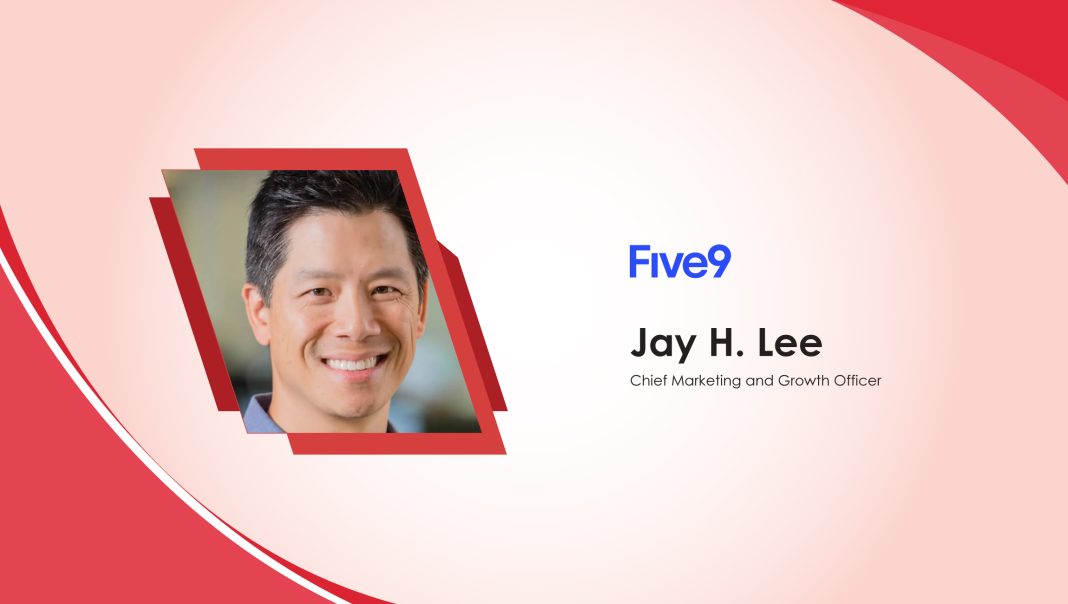
Will marketing operations eventually turn into AI Operations? Jay H. Lee, Chief Marketing and Growth Officer at Five9 shares his perspective in this martech catch-up:
__________
What’s the best part of being a modern-day SaaS CMO?
The best part of being a CMO in SaaS is the compounding nature of work. Unlike more static business models, SaaS rewards consistency and iteration as everything you build stacks. Each campaign, piece of content, customer insight, and data signal feeds into a larger system that gets more efficient with time. Instead of just executing in the moment, you’re building a flywheel that accelerates with every turn.
There is also an abundant density of signals to gauge. In SaaS environments, within a short period of time, you are able to know whether a campaign, message, or pricing change is working. This quick feedback is made possible through a consistent stream of behavioral data from their first touch through customer engagement. That immediacy sharpens decision-making and allows for rapid optimization.
Finally, the connection between marketing and business performance is wonderfully direct. In SaaS, marketing isn’t a support function, it’s a measurable contributor to Annual Recurring Revenue (ARR), Net Revenue Retention (NRR), and customer lifetime value. That level of accountability brings gratification and discipline to the role. I think this is a really exciting time to be a marketer. All disciplines in Marketing are more important than ever to corporate performance.
As a CMO; how have you helped marketing teams build a 360-degree view of their customer across disparate platforms (CRM, product, support) to better enable personalization?
Regardless of the maturity level of the SaaS company, the information that marketing teams need to be effective is spread across many different systems. With customer and prospect data held in the CRM and support information in another, customer engagement information comes across several channels. In addition, data such as provider intent signals, inquiries from partners, and field team data must all be pulled together to develop a useful 360-degree view.
Having a customer data platform that contains everything needed to score, prioritize, and personalize outreach through your martech and GTM infrastructure to ensure relevant engagement is critical to success. In my experience, outreach prioritization governance is key to avoid overwhelming or confusing customers. Done right, it drives action and measurable lifts across GTM.
How are you using AI and automation to scale marketing productivity and enhance personalization without losing the human touch?
I think about AI in marketing across three distinct layers, and the human touch is important in each.
The first layer is team productivity. At this point, AI should be embedded into the day-to-day work of every marketer. Whether building account research briefs, analyzing campaign performance, or refining messaging, AI can dramatically increase speed and efficiency. It’s less about replacing human thinking and more about removing friction so teams can focus on higher-value strategy.
The second layer is orchestration. This is where AI and automation start to run the marketing engine itself. Modern marketing teams are increasingly powered by agents that manage workflows like data hygiene, segmentation, routing, and identifying funnel risks. I often think of a world-class marketing team as a Michelin-starred kitchen where everything operates with precision that is invisible to the customer.
The third layer is personalization and engagement, and this is where I’m a bit more measured. AI is incredibly useful for preparing content and pulling from approved data sources. However, I still see significant value in human review for customer-facing interactions to ensure quality. That said, the AI output from our marketing tools at Five9 is becoming increasingly sophisticated and reliable.
Ultimately, the goal isn’t to replace the human touch, but to create robust experiences. It’s about producing experiences that help customers understand the value and move toward deeper engagement – whether that’s a discovery call, an executive briefing, or an insightful Customer Advisory Board (CAB) conversation.
Tell us about a time you used an existing marketing technology in your stack to solve a new business challenge. What was the tool, and what was the outcome?
At a previous employer, we used 6sense in a very standard way—driving top-of-funnel intent data and prioritizing accounts for new business. At the same time, we started noticing some concerning signals within our existing customer base. In response, I wondered: could we use that same intent data from 6sense to understand when our own customers might be exploring alternatives?
Instead of treating the platform purely as a net-new acquisition tool, we flipped the use case and began monitoring our existing accounts for spikes in research activity around competitor categories or adjacent point solutions. When those signals appeared, we flagged those accounts to the customer success team and paired that outreach with targeted content designed to reinforce our differentiation, often surfacing value propositions or capabilities the customer may not have fully adopted yet.
It was a case of asking a different question of an existing tool. I’ve found that we as marketers are often not using the full extent of the marketing tools that we have purchased.
Marketing Technology News: MarTech Interview With Fredrik Skantze, CEO and Co-founder of Funnel
Five thoughts on the future of AI and marketing and the overall shift it will lead to in martech?
- The Martech stack will consolidate: AI will allow key systems to quickly expand their functionality and replace former point solutions. Marketing software that doesn’t incorporate robust AI feature sets could quickly be replaced by other adjacent competitors, or frankly, internal AI teams who make these tools themselves.
- Marketing operations will become AI operations: This shift is already occurring. Talent across marketing operation teams will shift to those who can design agent workflows, engineer excellent prompts, evaluate model output, and create/manage AI-driven campaigns end-to-end.
- AI-driven discovery will be the predominant customer action: As buyers are shifting to research via their favorite LLM, they are developing little patience for studying content, forms, and perhaps even watching videos. Marketing teams must redesign their tools to ensure their company ends up in a customer’s AI research.
- Brand and data will become critical to the company moat: In this overly saturated AI era, differentiation comes from a unique POV, proprietary data, insights, and brand equity. Brand is becoming more important than ever as AI cuts creative cycle time, putting greater weight on the reputation customers have of a company when making high-stakes decisions.
- Marketing measurement shifts from deterministic to probabilistic and causal: As mentioned, today we have rich intent signals and tons of customer data to analyze. However, as the web gets darker, and customer discovery moves to AI, our understanding and gauge of customer influence will need to evolve. Moving forward, marketing must move to even greater test and control models in order to measure wider outcomes and come up with more probabilistic models that measure influence and ROI.
Five martech innovators and innovations you’d like to highlight more about in this martech conversation before we wrap up?
The pace of innovation in marketing right now is extraordinary. Between rapid advancements in AI automation and ongoing consolidation across the Martech landscape, the environment is evolving at a speed that is challenging to stay on top of. That’s why it’s difficult to single out any one innovator, as the list will likely be different just 6 months from now.
What’s more important than any individual company is the broader shift happening across the current ecosystem. Tasks that require long cycle times, like data analysis, lead scoring, and list augmentation, are now being automated and orchestrated at a rapid pace. Marketing teams are now able to quickly design relevant customer journeys to their target accounts and contacts.
Regardless of the specific innovation or innovator, deploying these journeys with impactful execution across marketing channels, partner channels, and sales organizations will be the measure of success in the current martech ecosystem.
Marketing Technology News: The Death of Third-Party Cookies Was Just the Start. Are You Ready for Consent Orchestration?
About Five9
Five9 empowers organizations to create hyper-personalized and effortless AI-driven customer experiences that deliver better business outcomes. Powered by Five9 Genius AI, the Five9 Intelligent CX Platform is trusted by 3,000+ customers and 1,400+ partners globally.
About Jay H. Lee
Jay H. Lee is the Chief Marketing and Growth Officer at Five9. A growth-focused leader in enterprise software and fintech, Jay brings more than 20 years of experience driving go-to-market transformation, scaling global marketing organizations, and delivering measurable business outcomes.
Prior to joining Five9, Jay served as Chief Marketing Officer at Icertis, where he led the company’s global marketing organization and helped position the business for its next phase of growth.