Home Blog Page 4342

Game-Changing Startups Recognized at RILA’s Retail CEO Forum

0
Game-Changing Startups Recognized at RILA's Retail CEO Forum

Three Companies Spurring the Future of Retail Showcase Technologies for Industry’s Most Recognized CEOs

The Retail Industry Leaders Association (RILA), the trade association for America’s most recognized and innovative retailers, today announced the winners of the (R)Tech Retail CEO Innovation Awards. The three winners, IamBot, Multifold, and Persado, selected by RILA’s Board of Directors, the CEOs and heads of innovation for America’s largest retail brands, were featured in a showcase at RILA’s Retail CEO Forum this week in Tucson.

Game-Changing Startups Recognized at RILA's Retail CEO Forum
Adam Siegel

“It’s an incredible opportunity to have CEOs and chief innovation officers from America’s most well-known brands interacting directly with emerging companies that, through their own commitment to innovation, are enabling the future of our industry. We’re excited to recognize these three companies, who have embraced the charge from our consumers to deliver ubiquitous and ultra-personal shopping experiences and in turn, have developed game-changing technologies,” said RILA Senior Vice President of Research, Innovation, and Sustainability Adam Siegel.

RILA’s (R)Tech Center believes that one trend is driving change in the industry more than any other: the trend toward ubiquitous and ultra-personal shopping. The winners were hand-picked by America’s leading chief executives for their groundbreaking work in promoting the industry’s move towards shopping wherever, whenever through artificial intelligence and augmented reality.

Also Read: AI and Machine Learning to Redefine Content Creation and Delivery, Predicts SDL

These are the winners:

IamBot helps brands and retailers sell directly to customers through messaging platforms. It is the comprehensive conversational commerce solution based on the state-of-the-art artificial intelligence. It seamlessly integrates with stores’ messaging channels to provide customers with the ubiquitous and super convenient shopping experience. “We’re honored that IamBot was selected by this prestigious group of executives. We believe that conversational commerce is a key element of the industry’s future, and we are glad that these CEOs see that as well.”

Multifold Retail believes that Augmented Reality will change the way that consumers shop. They offer all the tools retailers need: content creation (3D model creator, editor & library), viewers (Augmented Reality & 360 degrees), marketing and advertising tools (social media, catalog, in-store/OOH campaigns) and tracking/analytics. “We are so honored to have been selected for this award by such a distinguished group of CEOs. Multifold aims to make it easier for companies to create, manage and launch Augmented Reality experiences for their customers. Our patent-pending web-based AR solution results in a more streamlined user experience and works across the majority of smart devices. We look forward to sharing our story with RILA members.”

Also Read: 28 Ways Artificial Intelligence Will Affect Your Business and Life in 2018

Persado is the Marketing Language Cloud; AI generated language that resonates the most with any audience, segment or individual. Imagine having a data scientist and a copywriter for each person in your audience; you get the language that performs and the analytics explaining why, resulting in more business and unseen insights. Comprised of the world’s largest database, with over a million words and phrases tagged and scored for consumer marketing, Persado’s Marketing Language Cloud enables brands to increase acquisition and retention while building long-term consumer relationships. “Persado is proud to be selected as a winner of the inaugural (R)Tech Retail CEO Innovation Awards. We’re excited for the opportunity to showcase our technology and challenge retail leaders to introduce data-driven decision-making in new areas of their organizations, specifically within marketing content creation. Today’s consumers seek to build lasting relationships with their favorite brands –– at Persado, we’re helping brands navigate these relationships and shape the future of marketing through the effective use of AI-generated language that resonates with any audience or individual.”

RILA is the trade association of the world’s largest and most innovative retail companies. RILA members include more than 200 retailers, product manufacturers, and service suppliers, which together account for more than $1.5 trillion in annual sales, millions of American jobs and more than 100,000 stores, manufacturing facilities and distribution centers domestically and abroad. RILA, in partnership with Accenture, launched the (R)Tech Center for Innovation in 2017 to help retailers navigate the industry’s transformation.

Recommended Read: Facebook Viewed As Least Brand-Safe Platform, LinkedIn Most Safe, According to GumGum Research


Interview with Shachar Orren, Chief Storyteller, Playbuzz

0
Shachar Orren PlayBuzz

[easy-profiles profile_twitter=”https://twitter.com/shacharo” profile_linkedin=”https://www.linkedin.com/in/shachar-orren-45b18876/”]
[mnky_testimonial_slider slide_speed=”3″][mnky_testimonial name=”” author_dec=”” position=”Designer”]“Advertisers are increasingly looking to creative automation and machine learning (AI) solutions to optimize ad campaigns.”[/mnky_testimonial][/mnky_testimonial_slider]

Tell us about your role and how you got here. What inspired you to be part of Playbuzz?

I began my career as a journalist and editor in Tel Aviv, and though I was incredibly passionate about writing, after 9 years I felt that the industry was not evolving as fast as its readers, which left me feeling stuck and ready for a change. I was looking to feel inspired but not lose the creativity that a role of a writer allows for.

Luckily, I stumbled upon Playbuzz which at the time, was looking for a content expert for their storytelling platform so publishers and brands could see the benefit of interactive stories and the audience engagement they bring. As the 6th employee, I’ve been able to grow with the company, relocate to New York and today, I oversee the content, marketing and communication efforts globally.

Being on the other side – working for a disruptive platform that helps media tell stories in a way that’s accessible to readers and that aligns with their consumption habits – perfectly connects my previous career to my current one. As a former journalist, I know that publishers and brands can lack the resources that Playbuzz provides, and I’m proud to work with the likes of HuffPost, MTV, BBC, Sky News, CBS and more to bring interactive storytelling to audiences worldwide.

As a leading storytelling platform,  how do you keep a tab over brand safety and transparency issues? What controlling factors would you recommend content marketers and brand safety managers?

Over the past year, we have watched the industry scramble to react to this uniquely digital issue of brand safety. This runaway train has caused a temporary ‘back to analog’ approach, best evidenced by Google’s recent commitment to hire 10,000 people to monitor content on YouTube.

Advertisers and consumers have started to fight back. Direct traffic, no fraud, brand-safe placements, real eye-balls – it’s all part of the trend to clean up the internet. While many would argue that this step took too long, it provides a big opportunity for those platforms and publishers who can deliver real engagement. This year, I predict that companies offering better AI-verification services will have a significant impact on brand safety.

At Playbuzz, we pride ourselves on being at the forefront of engagement and brand safety, with 99% human, non-fraudulent traffic to Playbuzz-powered content across our network, as confirmed by WhiteOps. To get there, we put parameters and algorithms in place to ensure our traffic is real. My best advice is to invest resources in working with companies that can provide the validation that will soon become the standard we’re all obligated to.

In 2018, how would CMOs benefit from leveraging smarter personalized content in B2B & B2C campaigns?

As targeting and personalization become more sophisticated, readers expect their content and ads to be more relevant to them than ever. Using engagement data to learn more about your audience, to then create content they will care about, is a great way marketers can leverage interactive content. But not only that – interactivity can also make the consumption experience feel more personal. When readers are asked a question or voice their opinion in a poll, they are way more involved in the content consumption journey itself, and thus more likely to share the content they consumed with their friends, family, and social circles. In fact, interactive storytelling tools specifically enable marketers to offer custom, personalized content to readers. And with interactive content being 81% more effective at grabbing customers’ attention than static content, it’s no wonder Playbuzz’s portfolio of partners has increased by 100% compared to two years ago.

A great example of this is Netflix’s Playbuzz-powered branded content campaign produced to promote their latest season of ‘Orange Is The New Black’ in order to create awareness, boost social shares and test upcoming storylines. They created an immersive, interactive story that gave users the opportunity to participate in a scenario-led game, challenging them to break out of the prison depicted in the show.

The campaign was well-received across a variety of publisher partners, achieving a dwell time 7X over the industry average.

What are the key business metrics that modern content marketers should have at their fingertips?

Though it’s easy to rely on old-school (read: archaic) metrics like clicks and views as measurements of success, they, unfortunately, do not showcase whether readers had a meaningful experience with your content.

Content consumption habits have dramatically changed and with content fatigue, the move to mobile and FOMO (fear of missing out), it’s important to incorporate new KPIs into the mix that are engagement-based. These include dwell time, completion rates, engagements within stories, comments and more. Metrics like these can help guide marketers on how to optimize their content for the future.

Thus, marketers should rely on platforms that enable them to measure such data as insights gathered can be used to optimize content in real-time and based on consumer behavior, can act as guidance for future content creation.

Which startups in the martech and media sectors are you watching/keen on right now?

I’m a fan of the Skimm for obvious reasons – it presents news content in a way that enables readers to easily consume it on the go. I even have the app on my phone and find it ideal when I want to quickly catch up on news. The company’s goals very much align with ours – mainly being, how do we get readers to consume important information in a digestible, engaging way.

Another startup I’m into at the moment is Flipboard, mainly because the news aggregator is attempting to prioritize high-quality content to beat fake news and the spread of misinformation in 2018. It’s a big task and one that is not only fixed with human and automated monitoring but also one that can help be resolved by focusing on creating content that has engagement at its core.

For example, our data shows that if you blend a news story with an interactive element, the time that people spend on that story jumps by 20%. If readers spend more time on a story and actively engage with it, they are more likely to be able to evaluate the information presented to them. More engagement could, therefore, lead to a safer news environment and reduce the spread of misinformation.

What tools does your marketing stack consist of in 2018?

A few of my favorites include:

  • Marketo – The main tool we use for our email marketing efforts with partners – whether it be product updates or ways in which to get inspired.
  • Muck Rack – A great tool to assist with PR outreach, tracking mentions and analyzing your communication outreach. Not to mention, great customer service.
  • Playbuzz Analytics – Our marketing efforts include practicing what we preach, which means creating Playbuzz-powered content for co-marketing partnerships, internal company newsletters, speaking opportunities and events. Our analytics tool enables us to track these items’ performance to see if those who read these stories truly engaged with them, and optimize.
  • Splash – This event marketing platform is ideal for us as we host several local events throughout the year. It’s super intuitive and gives us the freedom to create visual-first landing pages as well as invites.

Would you tell us about your standout digital campaign at Playbuzz? (Who was your target audience and how did you measure success?)

As part of the ACT ‘Make Nothing Happen’ campaign to combat terrorism, the UK’s National Counter Terrorism Police (NCTP) (through Mediacom) partnered with us to craft an interactive, Playbuzz-powered branded content campaign that would harness readers’ fleeting attention spans.

With the UK specifically on a high terror alert throughout the past year, and with the news cycle constantly inundated with acts of terrorism worldwide, it’s more crucial than ever to educate civilians on how to identify and report suspicious activity.

To do just that, we glean the real-life stories of individuals who had reported suspicious behavior related to potential threats of terrorism, utilizing them to craft fictional dilemmas that could very well become a reality. These stories were packaged into interactive articles – clearly labeled as sponsored – using our storytelling tools in order to compel engagement throughout the reading process. Such interactive elements included polls, flip cards, and trivia quizzes.

There were three main challenges when building this branded content campaign:

  1. Addressing such a serious and sensitive topic without intimidating readers or being alarmist, ensuring they consumed the content items from beginning to end.
  2. Ensuring content was sincere, relatable and engaging whilst still maintaining an appropriate tone.
  3. Overcoming readers’ overall content fatigue to get them interested in the topic.

And with 75% of marketers claiming that education is the primary reason for using interactive content, it’s no wonder the campaign achieved a dwell time 4X more than the industry average.

How do you prepare for an AI-centric world as a marketing leader? How do you leverage AI capabilities at Playbuzz?

We’ve worked with top publishers over the past 5 years, putting us in a unique position to familiarize ourselves with their pain points and thus, create technology to solve them. Having the time and resources to create a healthy amount of visual-first, great content – while on a deadline – has been one of these pain points.

Over the past year, we added several features to our platform to ease the content creation process for publishers – this includes a Getty Image integration, Giphy integration, seamless video creation, and the addition of new interactive storytelling elements to further increase engagement within articles.

It’s only natural that the next step will be to expand our machine learning and AI capabilities beyond the existing optimization of engagement, into AI-driven authoring assistive technologies. This integration into the platform is meant to help journalists source visuals, social mentions from key influencers, video clips and more based on the story’s title and content that they input while creating content. The goal is to also provide interactive element suggestions for them based on their search terms – like suggested polls and quotes.

Such addition to our platform will help promote what we call the multimedia journalist – reporters who no longer have to rely simply on text and images, but who are now able to widen their toolbox to include interactive storytelling tools.

One word that best describes how you work.

Most people around me will likely say 24/7. They’re not wrong. However, I think the best word to describe how I work is passion. I believe having great passion for what you do is as important as having great skills or experience. This is one of the traits that characterize Playbuzz employees in general, and something I always look for in any person I interview for any position. If you’re not passionate, creativity and innovation will be hard to achieve.

What apps/software/tools can’t you live without?

Storytelling is what excites me the most, and keeping up with new forms of storytelling is a big part of my routine. The forms of storytelling I rely on most in my day to day are ones that help digest the overload of information I am interested in consuming. My mornings start with theSkimm app, going over the major news stories of the day; Podcasts and audio books take me through my commute to work and back (WSJ Tech News; then NPR’s Up First, followed by whatever else I’m currently into) and in the evening – I spend at least an hour with Instagram stories, which are a great way to make every ordinary day into a thrilling narrative.

What’s your smartest work related shortcut or productivity hack?

In a global company like Playbuzz, with 8 offices worldwide, using Slack has been the best way to improve communication and increase productivity. Especially for creative teams like ours, we need a space to brainstorm and share ideas even though we’re almost never all in the same room or even the same country. We’ve tried many ways to make this process more streamlined, and they all felt forced and were quickly let go of until we started using Slack. It has become an integral part of our day-to-day.

What are you currently reading? (What do you read, and how do you consume information?)

I find that the best way to read is actually not by just reading. It’s through interacting with written or visual content – the kind publishers use Playbuzz’s platform to create – that is so much more than just scrolling through paragraphs. It’s a much more efficient way to acquire information that actually sticks. I also like to switch up the platforms to keep myself engaged, so I end up reading three books at a time, one physical, one e-book, and one audiobook. I just finished Turtles All the Way Down by John Green (physical), started listening to Forest Dark by Nicole Krauss (audio); and I’m half-way through the Neapolitan Novels series by Elena Ferrante (ebook).

What’s the best advice you’ve ever received?

Never go into an empty subway car.

Tag the one person in the industry whose answers to these questions you would love to read:

I’m curious to hear from Emily Weiss, Founder, and CEO of beauty brand Glossier. Their marketing to young women is some of the smartest and coolest I’ve seen, and I love that she started with a beauty blog and turned it into a company with more than $34 million in funding – shows that success starts with great content.

Thank you Shachar! That was fun and hope to see you back on MarTech Series soon.

[vc_tta_tabs][vc_tta_section title=”About Shachar” tab_id=”1501785390157-b58e162d-0ae25a4b-c27aca64-108e51b0-80edaf37-bd3d357a-6c460569-dc85″]

Shachar Orren is the Chief Storyteller at Playbuzz. Working from the company’s NYC headquarters, Shachar is serving as Playbuzz’s evangelist, in charge of empowering the company’s partners to achieve storytelling greatness, and heading up both the content and brand marketing departments, globally. Before becoming Playbuzz’s sixth employee, Shachar worked for over nine years as a journalist and senior editor in Israel’s leading publications, and holds a BA from Tel Aviv University.

[/vc_tta_section][vc_tta_section title=”About Playbuzz” tab_id=”1501785390320-2d44fa50-740c5a4b-c27aca64-108e51b0-80edaf37-bd3d357a-6c460569-dc85″]

Playbuzz Logo
Playbuzz is an authoring and distribution platform for interactive storytelling. Publishers, brands, agencies and content creators worldwide utilize the suite of Playbuzz-powered storytelling tools for editorial and commercial purposes to engages users, increase time spent on-site and boost social interactions and shares. Over 13,000+ publishers and brands in over 55 countries rely on the Playbuzz platform to transform how they tell stories online.

[/vc_tta_section][/vc_tta_tabs]
[mnky_heading title=”MarTech Interview Series” link=”url:https%3A%2F%2Fmartechseries-67ee47.ingress-bonde.easywp.com%2Fcategory%2Fmts-insights%2Finterviews%2F|||”]

The MTS Martech Interview Series is a fun Q&A style chat which we really enjoy doing with martech leaders. With inspiration from Lifehacker’s How I work interviews, the MarTech Series Interviews follows a two part format On Marketing Technology, and This Is How I Work. The format was chosen because when we decided to start an interview series with the biggest and brightest minds in martech – we wanted to get insight into two areas … one – their ideas on marketing tech and two – insights into the philosophy and methods that make these leaders tick.

Showcasing Marketing Innovation Matters and Top Trends to Watch in 2018

0
Showcasing Marketing Innovation Matters and Top Trends to Watch in 2018Showcasing Marketing Innovation Matters and Top Trends to Watch in 2018Showcasing Marketing Innovation Matters and Top Trends to Watch in 2018Showcasing Marketing Innovation Matters and Top Trends to Watch in 2018Showcasing Marketing Innovation Matters and Top Trends to Watch in 2018
Showcasing Marketing Innovation Matters and Top Trends to Watch in 2018

The 2nd “Leaders in Tech” Digital Marketing Innovation Forum was hosted in New York City on January 20th. Dedicated to bringing together marketing professionals from all ends of the U.S and China, the conference hosted a diverse collective of creative discussion and aided in building meaningful network growth through:

  • Discussing the latest in cutting-edge MarTech tools that marketers can leverage
  • Exchanging innovative strategies from advertisers, publishers and agencies

Leaders in Tech(LIT) is an organization bridging the technology communities from the United State and China, fostering meaningful connections for tech professionals from these countries. The community comes together to discuss insightful topics in the tech industry, such as digital marketing and product innovation, entrepreneurship opportunities, and developing trends in technology.

Also Read: One-size-fits-all marketing solution needed, says State of Salesforce report

Showcasing Marketing Innovation Matters and Top Trends to Watch in 2018
John Katzman

John Katzman, the founder of Princeton Review and 2U was the keynote to share his story as a serial entrepreneur and speak on marketing innovation opportunities in education technology.

Wang Liao, a billion-dollar hedge fund investor, shared the flywheel approach to investing in e-commerce companies using Priceline, GoDaddy and JD.com as an example to show marketers which metrics to optimize from an investors perspective.

Ruiwan Xu, the conference chair, a tech entrepreneur and former Marketing Manager for Amazon, discussed how marketing technology is swiftly shaping the future of the trillion-dollar fashion industry, along with how the quick response to market changes by forward-thinking tech entrepreneurs is helping bring fresh life to the table for consumers and investors alike

Showcasing Marketing Innovation Matters and Top Trends to Watch in 2018
A speaker at Leaders In Tech

Over 20+ speakers from major companies such as Amazon, Adobe, Spotify, MongoDB, Grubhub, Casper, BMW, L’Oreal and CommonBond discussed the top marketing trends to watch in 2018 according to the top CES themes and career opportunities riding the wave in digital marketing, marketing analytics and mobile product design including:

Artificial Intelligence in the New Age

Marketers are already incorporating A.I. powered chat tools to reach out to customers, and as the technology continues to improve, more brands will embrace the benefits of live A.I. chat support to provide better service to their audience.

Improvements in Personalized Content

As account-based marketing becomes a mainstream method of connecting with target audiences, newly updated platforms providing content tailored to specific accounts is on the rise contributing to better customer satisfaction & loyalty.

Machine-Learning Platforms Take Over

New machine-learning platforms are changing the way ads are managed for businesses, replacing digital marketing agencies with promises of optimized ad spending through advanced algorithms set by the marketer’s campaign parameters allowing the platform to identify ideal audiences.

Instagram Changes the Game

After outdoing Snapchat with their own brand of stories only a year after release, Instagram is reporting higher engagement rates compared to other social outlets- with its easy to use advertising tools putting it at the frontlines of social media marketing.

B2B Marketers are Rethinking Lead Routing

Thanks to advancements in predictive lead scoring technology, marketers are better equipped in identifying possible prospects. With little personal information needed these tools are able to watch over buying signals, identifying qualified leads and bringing the right opportunities to sales.

Recommended Read: 28 Ways Artificial Intelligence Will Affect Your Business and Life in 2018

Inbound Marketing Agency SmartBug Media Adds SMB Growth Expert Kevin Coll as Marketing Strategist

0
Inbound Marketing Agency SmartBug Media Adds SMB Growth Expert Kevin Coll as Marketing Strategist

Kevin Coll Studied Communications and Business Administration at Fontbonne University and Has More Than 10 Years of Experience in Business and Marketing

SmartBug Media — a leading intelligent inbound marketing agency that assists businesses in generating leads, increasing awareness, and building brand loyalty through inbound marketing, digital strategy, design, marketing automation, and public relations—announced the addition of Kevin Coll as its newest Marketing Strategist.

Inbound Marketing Agency SmartBug Media Adds SMB Growth Expert Kevin Coll as Marketing Strategist
Kevin Coll

Coll previously served as Director of Marketing and Communications for First Touch Payment Solutions (FTPS), a financial technology software startup helping merchants with payment processing analytics. As its lead marketing executive, he positioned the FTPS brand to become a primary growth-driver for that organization.

“In the first 24 months leading my team, we experienced 300 percent growth while creating the entire organization’s marketing department and processes from scratch,” explains Coll. At SmartBug, Coll aims to use that experience to help clients meet their revenue goals, as well as implement successful strategies and tactics.

Also Read: SmartBug Media’s Website Recognized by AWWWARDS for Outstanding Design

“I’m elated to be joining the team at SmartBug Media,” Coll adds. “I am very passionate about the inbound marketing methodology, so to be a part of an organization that strives to help companies build that into their marketing practice is exactly where I want to be.”

Inbound Marketing Agency SmartBug Media Adds SMB Growth Expert Kevin Coll as Marketing Strategist
Amber Kemmis

“As SmartBug grows, we are constantly looking to expand our skill set. Kevin will help to expand our expertise in branding, specifically, how branding can integrate with the inbound marketing methodology. In addition to that, Kevin’s experience in video and film will only fuel our video marketing capabilities, which are essential for marketing plans in 2018 and beyond,” says Amber Kemmis, VP of Client Services.

Coll studied Communications and Business Administration with an emphasis in marketing and advertising at Fontbonne University. He has more than 10 years of experience in business and marketing.

Recommended Read: Interview with Jen Spencer, VP, Sales and Marketing, SmartBug Media

Machine Learning Company Soteria Intelligence Releases New Social Media Analytics Tools, Website

0
Machine Learning Company Soteria Intelligence Releases New Social Media Analytics Tools, Website

Soteria Intelligence’s New Tools Empower Companies by Delivering Social Media Analytics and Intelligence Solutions That Use Natural Language Processing (NLP) to Build Context Around, and Extract True Meaning From, Posts on Social Networks

After being in stealth mode for the past six months while working on R&D focused on applying deep learning to social media analytics, Soteria Intelligence announced the release of powerful new tools for brand reputation management, customer service and marketing as well as a new website that graphically represents the company’s vision of machine learning.

Soteria Intelligence’s new tools empower companies by delivering social media analytics and intelligence solutions that use Natural Language Processing (NLP) to build context around and extract true meaning from, posts on social networks. Additionally, since a picture is worth a thousand words, image recognition capabilities allow organizations to discover a social media world they never knew existed.

One of the key things that make Soteria Intelligence unique is the creation of intuitive interfaces that guide users to provide human input that will ultimately make the software more intelligent and effective over time – a true marriage between man and machine. This supervised learning approach helps eliminate false positives and white noise while delivering actionable insights.

Machine Learning Company Soteria Intelligence Releases New Social Media Analytics Tools, Website
Aaron Schoenberger

“We are at a pivotal point in time where artificial intelligence is starting to take over all facets of everyday life, and we see a future where humans and computers work together as a team to solve problems,” stated Aaron Schoenberger, Founder and CEO of Soteria Intelligence.

Also Read: New Year Resolution: Make Social Media More Meaningful

The new solutions announced solve many of the problems organizations have faced in the past when analyzing social media, and are ideal for spotting brand reputation issues on the horizon, cultivating insights for advertising campaigns or product development, and monitoring social media to understand conversations and sentiment after the fact.

Soteria Intelligence’s revamped website was created to not only showcase the company’s products and services, but also take something as complex as artificial intelligence (AI), specifically machine learning, and bring it down to earth via compelling, educational illustrations.

Recommended Read: How AI Will Make Marketing More Personalized In 2018

Small Businesses Use Social Media Instead of a Website: Survey By Clutch

0
Small Businesses Use Social Media Instead of a Website: Survey By Clutch

New Survey by Clutch Indicates 1 in 5 Small Businesses Use Social Media in Place of a Website. Many Assume a Website Is Cost-Prohibitive and May Not Consider the Risks of Not Having One

More than one-third (36%) of small businesses do not have a website, according to the websites section of the fourth annual Small Business Survey conducted by Clutch, a B2B research firm. One in five small businesses (21%) selectively use social media instead of a website in an effort to engage customers.

The survey indicates that small businesses consider cost a bigger concern than the potential repercussions of not having a website.

Social media platforms such as Facebook and Instagram attract small businesses by cultivating a highly engaged user base.

However, relying solely on social media may be a risky strategy for businesses.

“Whenever you put all of your eggs into someone else’s basket, it’s risky,” said Judd Mercer, Creative Director of Elevated Third, a web development firm. “If Facebook changes their algorithm, there’s nothing you can do.”

Also Read: Clutch Announces Leading Web Designers in Seattle and Portland

Facebook recently announced changes that potentially increase the risk of using social media in place of a website. The social media platform plans to prioritize posts from family and friends over posts from brands.

This new policy may make it more difficult for small businesses to reach their audiences through social media. As a result, websites are expected to regain importance among businesses – as long as cost is not considered an obstacle.

Among small businesses that do not currently have a website, more than half (58%) plan to build one in 2018.

Some Small Businesses Say Website Cost is Prohibitive, But Others Cite Costs of $500 or Less

Small Businesses Use Social Media Instead of a Website: Survey By Clutch
Small Business Investment in Building a Website

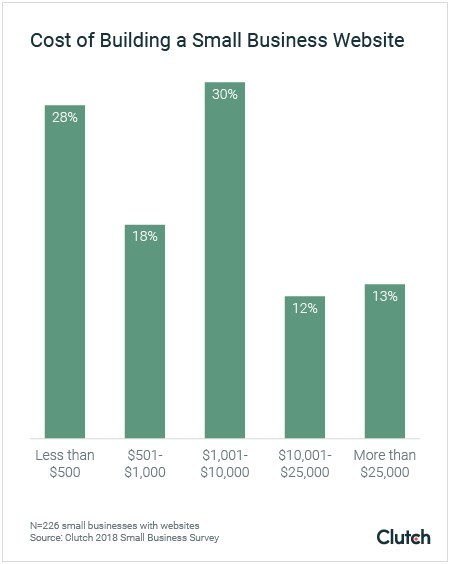
More than a quarter (26%) of small businesses surveyed say cost is a key factor that prevents them from having a website. However, nearly one-third of small businesses with websites (28%) report spending $500 or less.

Small businesses may not be aware that some web development agencies offer packages that defray costs by dividing website construction into multiple phases or sliding rates for small businesses. “You don’t necessarily need to launch with your first-generation website. Maybe just start small,” said Vanessa Petersen, Executive Director of Strategy at ArtVersion Interactive Agency, a web design and branding agency based in Chicago.

Also Read: Clutch Announces Top New York City Agencies & Developers of 2017

Mobile-Friendly Websites Becoming Standard

Small Businesses Use Social Media Instead of a Website: Survey By Clutch
Percent of Small Businesses Without Websites and When They Plan to Build Them

Businesses that do have websites are moving en masse to mobile-friendly ones, the survey found. Over 90% of respondents said their company websites will be optimized for viewing on mobile devices by the end of this year.

In addition to the 81% of company websites that are already optimized for mobile, an additional 13% that say they plan to optimize for mobile in 2018.

Clutch’s 2018 Small Business Survey included 351 small business owners. The small businesses surveyed have between 1 and 500 employees, with 55% indicating that they have 10 or fewer employees.

Recommended Read: Interview with Tim Wilson, CEO, and Principal at Qutee

Wibbitz Releases New Study Revealing Content Consumption Trends for Business Video

0
Wibbitz Releases Video For Business: Content Consumption Trends; New Study Reveals Preferred Business Video Types

Videos Under One Minute of How-Tos, Educational or Informative Content, as Well as Product Demos Were Top Ranked with Survey Respondents, 50 Percent of Whom Increased Their Digital Video Consumption in 2017

Wibbitz, the leading AI-powered video creation platform, released the findings from its latest study, Video For Business: Content Consumption Trends, analyzing how and where consumers are motivated to consume video in addition to the type of content they prefer.

In late 2017, Wibbitz surveyed over 1,000 people finding that among various business use cases inclusive of how-to videos, educational or informational videos, product demos, and reviews and testimonials, 51 percent of viewers prefer how-to videos. The finding underscores a key tenet of content marketing, which is delivering value and actionable information to consumers. This statistic confirms business video as an emerging format for customer communications that can reduce service and support-related activities.

Also Read: YouTube Partner Program Tightens Monetization Rules

Additional insights from the study include data on overall consumption trends that support the importance of businesses creating multiplatform video strategies for 2018 and beyond:

  • 65 percent of respondents engage with videos by sharing, commenting, or liking, with 10 percent engaging with nearly every video they watch.
  • Over 40 percent of millennial and Generation X respondents listed Facebook as their preferred platform for video content. More than half of millennials ranked Snapchat as their second favorite platform, whereas 30 percent of Generation X respondents prefer Instagram second to Facebook.
  • Mobile devices were the most common platform for consuming video content (31 percent) over desktop (26 percent) and streaming devices (25 percent).
  • 38 percent of respondents prefer short-form videos – defined as under one minute in length – emphasizing the importance for businesses to create shorter, more engaging videos.
Wibbitz Releases New Study Revealing Content Consumption Trends for Business Video
Zohar Dayan

“In the coming years, the majority of internet traffic will be video, therefore, it’s critical to understand how and where consumers access video, in addition to the types of content they prefer to consume. With this knowledge, businesses are better equipped to consistently deliver beautiful and engaging video content. The data gathered in this report conveys a powerful message that video is the future of online storytelling not just for publishers, but brands as well. It represents a clear choice for brands as they seek to unlock new ways to connect and resonate with consumers,” said Zohar Dayan, CEO and Co-Founder, Wibbitz.

Also Read: SiriusDecisions 2017 B-to-B Buying Study Reveals Buyer Behavior and Preferences in Decision-Making Process

Wibbitz provides an automated video creation platform enabling businesses to deliver high-quality video content across all platforms. By leveraging AI and automation to power video creation, businesses are able to quickly integrate beautiful video stories into their strategies and improve their customer relationships as a result.

Recommended Read: 60% of Customer Success Teams Are Unaware of Critical Client Issues

Lumavate Adds IT Veteran Bill McConnell to Its Board of Managers

0
Lumavate Launches Content Management System Making it Simple for Organizations to Manage and Reuse Various Types of Content

Lumavate, a leading platform for building cloud-based mobile apps, is pleased to announce that former IU Health and Boston Scientific senior leader, Bill McConnell, has joined Lumavate’s Board of Managers.

Bill McConnell
Bill McConnell

Recommended ReadMarketing Strategies Turn To Mobile For Data And The Role Of AI In 2018

McConnell’s career in IT and life sciences spans more than 20 years. Previously, he was the senior vice president and CIO at IU Health, SVP at Boston Scientific, vice president and CIO at Guidant, and COO at RCI. Currently, McConnell is the managing director of his own consulting firm.

“We are thrilled to welcome Bill McConnell to Lumavate’s Board of Managers,” said Lumavate CEO and Chairman of the Board, Mark Hill. “Bill’s extensive IT experience and background in life sciences will be extremely beneficial in helping us continue to grow our mobile solutions.”

Read MoreHow Will AI Feed Account Based Marketing?

The Lumavate platform capitalizes on the transition from native mobile apps to cloud-based mobile apps – a major shift happening in mobile tech that is disrupting the way companies interact with consumers. Through the Lumavate platform, companies can deliver highly-personalized mobile experiences faster and at a fraction of the cost of native mobile apps.

“The Lumavate platform is truly transforming how brands interact with consumers on mobile,” said McConnell. “I’m looking forward to working with the Lumavate team as they continue to scale their offering.”

In January, Lumavate announced that Mark Hill and Bill Godfrey have joined as the Chief Executive Officer and as vice president of business development, respectively. Currently, Lumavate offers an enterprise SaaS platform for building cloud-based mobile apps at scale. Through the Lumavate platform, companies deliver highly-personalized mobile experiences that can evolve throughout the entire customer journey. These mobile experiences drive increased adoption and long-term engagement via smart activation methods.

Recommended ReadDare or Drop: Top Challenges for Marketers Set to Intensify in 2018

Shutterstock Celebrates Over 1 Billion Image, Video and Music Licenses Sold

0
Shutterstock to Acquire GIPHY, the World's Largest GIF Library and Search Engine

To Mark This Milestone, Shutterstock Rang the Closing Bell at the New York Stock Exchange

Shutterstock, Inc., a leading global technology company offering a creative platform for high-quality assets, tools, and services, announced that it has licensed more than 1 billion royalty free images, videos and music tracks across all of its businesses. Shutterstock was founded in 2003 and this milestone reflects licenses granted over the past 14 years. Shutterstock’s library now offers more than 170 million commercial images, 40 million editorial images and 9 million video clips.

Shutterstock licenses more than 5.5 images every second directly from its website and through innovative API integrations with companies such as Facebook, Google and Microsoft. Shutterstock not only empowers businesses, marketing agencies, media organizations and production companies around the world through its e-commerce and enterprise offerings but also by seamlessly embedding into its customer’s workflow, wherever that may be.

Also Read: Shutterstock Custom™ Launched to Scale Custom Branded Content Creation

Shutterstock Celebrates Over 1 Billion Image, Video and Music Licenses Sold
Jon Oringer

Jon Oringer, Founder and CEO of Shutterstock, said, “Shutterstock’s continued commitment to developing innovative technology, offering an unparalleled customer experience and providing high-quality content to customers globally has led to unique partnerships providing access to customers directly from the tools they use most often. Reaching 1 billion licenses signifies the prominent role visual communications plays in media, advertising and film every day. I look forward to the next decade of technology advancements embedding Shutterstock everywhere while continuing to enhance our creative platform helping customers best create and communicate their story.”

Also Read: Shutterstock to Deliver Customized On-Brand Content with Flashstock Acquisition

Shutterstock has been a publicly traded company for over five years, and to mark the sale of over 1 billion licenses, Shutterstock rang the closing bell at the New York Stock Exchange on Wednesday, January 31.

In October last year, Shutterstock announced the release of its Composition Aware Search in beta, enabling an entirely new search experience. Built on Shutterstock’s next-generation visual similarity model, this tool allows users to specify one or more keywords, or to search for copy space, and arrange them spatially on a canvas to reflect the specific layout of the image they are seeking.

Recommended Read: Shutterstock Launches Image Editing and Licensing Capabilities into Google Slides

Meet Kloojj: A Platform that Changes How People Engage with Online Videos

0
Meet Kloojj: A Platform that Changes How People Engage with Online Videos

Valley Entrepreneurs Say Kloojj Solves a Major Problem Faced by Many When Interacting with Web-Based Videos

Kloojj is a new iPhone, Android and Web app that makes it easy for anyone to interact with the important moments found inside of web-based videos. Most people are familiar with the frustration and difficulty caused when trying to search for a specific clip buried somewhere inside a previously viewed video on YouTube or Facebook. More often than not, users are unable to find the video, let alone the specific segment they’re looking for. Kloojj was created to solve this problem by simplifying the process of saving, finding and sharing clips inside videos.

According to Cisco’s Visual Networking Index, by 2019, global consumer Internet video traffic will account for 80% of all consumer internet traffic. Every minute, 300 hours of video are uploaded to just YouTube alone and almost 5 billion videos are watched on YouTube every single day! With so much new video content coming online each day, Kloojj makes sure users can easily find and interact with videos and video segments.

Also Read: Why Brands Need to Adopt a Vertical Mindset

Through the use of a simple app (iPhone, Android or Web), Kloojj allows users to capture segments of videos from YouTube, Vimeo, Facebook, and many other video publishing websites and mobile apps. Each segment, called a Kloojj, is saved, categorized by the user, and indexed using Kloojj’s unique hashtag engine, making searching and filtering video clips surprisingly simple and fast.

Users are already excited about this concept and singing it’s praise as a revolutionary new way to interact with video online. “I love Kloojj because I can organize everything without organizing anything,” said one Digital Marketing CEO who is already buzzing about Kloojj.

Also Read: Retargeting Ad Company Zigglio Wins Facebook’s 2017 Accelerator Program

“Finally there is a hashtag that actually means something,” described Co-CEO Ted Haig, adding, “Each person can create virtual folders on-the-fly using Kloojj’s unique colon-based hashtags (i.e., #Puppies:BerneseMtnDogs:Adorable). When combined with search, anyone can find a specific Kloojj quickly, regardless of when they Kloojjed it.”

Meet Kloojj: A Platform that Changes How People Engage with Online Videos
David Hirschfeld

“We know we have something unique,” Co-CEO David Hirschfeld remarked, adding, “Kloojj fixes many of the things I dislike about social networks. Kloojj literally brings social media to each video, rather than having to upload a video to a social network. Kloojj turns social media inside out.”

Recommended Read: Tweet Your Way to Success: A Guide to Social Media Marketing & Strategic Thinking

Dare or Drop: Top Challenges for Marketers Set to Intensify in 2018

1
Dare or Drop: Top Challenges for Marketers Set to Intensify in 2018

Executives from Top Marketing Technology Companies Participated in Our Predictions Series 2018 and Identified the Top Challenges That Marketers Would Face in 2018

In 2018, what would be the best “personality” to define you as a marketer– an angler, a crossbow hunter, a weekend rockstar, or a Zen monk. Well, whatever quality best suits you may not make that much of a difference if you (your marketing campaigns) fail to deliver customer experiences with a context, within set rules of transparency, data privacy, and of course, the next big thing in the B2BCustomer Success.

Read MoreHow Will AI Feed Account Based Marketing?

We spoke to executives across the globe to identify the top challenges that marketers would face in 2018. The common message was — “It’s time to delight the customers. Dare or risk dropping out of the league.”

GDPR is Coming: Marketers Must Prioritize Transparency

Top business leaders from the data management industry have spoken to us on how GDPR would impact the ecosystem and customer experiences along the buyer’s journey. GDPR is definitely one of the top challenges for marketers in 2018.

Alice Lincoln, Vice President, Data Policy & Governance, MediaMath,
Alice Lincoln, Vice President, Data Policy and Governance, MediaMath

Alice Lincoln, Vice President, Data Policy and Governance, MediaMath, said, “With GDPR set to take effect in May 2018, many companies are preparing to adjust their business processes and technology accordingly – especially marketers. In the new year, we’ll see the increased scrutiny of major 1P players’ privacy, security, anti-fraud, brand safety, and election-related practices (Facebook, Google, etc.)”

Alice continued, “This level of scrutiny will also extend to 3P companies, and improved industry standards will emerge to proactively address these concerns. There will also be continued momentum in terms of walled gardens’ evolution to provide marketers with transparency that resembles that of 3P companies. Further, we’ll see ongoing developments in improved industry-wide standards to accommodate emerging technologies, including connected TV and IoT.”

Content Distribution Should Diversify for Better Branding and Trust

Vipul Mistry, Intermarkets, Inc.

Vipul Mistry, Senior Business Development Manager at Intermarkets, said, “In response to all the recent changes from Facebook, publishers are doubling down on channels they can more directly influence such as direct, referral and email. We always recommend publishers have a well-rounded and diverse footprint for distributing content — whether it’s Facebook, Google, Twitter, Apple News, partnerships, email, search or another route.”

Vipul added, “We expect to see a resurgence of pre-social era strategies which emphasize the power of the brand and trust. Publishers creating engaging content and meaningful relationships with their readers will have the greatest success.”

He continued, “It is also possible this update from Facebook could push more publisher content in News Feeds of users who want to get their news and information on Facebook.”

State of Mobile Advertising in 2018: The Battle Between Cost of Business and Ad Fraud Would Intensify

Ran Avrahamy, VP Global Marketing at AppsFlyer
Ran Avrahamy, VP Global Marketing, AppsFlyer

Ran Avrahamy, VP Global Marketing at AppsFlyer, said, “In 2018, marketers will spend more than ever on mobile advertising – big surprise, right? What is staggering is that marketers are accepting ad fraud as a cost of doing business, and are increasing ad spend in spite of fraud.”

The global marketer from AppsFlyer added, “Marketers frequently don’t know what the various types of fraud are or where bad actors are coming from, much less how to stop them. As mobile advertising continues to evolve and become more sophisticated, so too does fraud.”

Recommended ReadMarketing Strategies Turn To Mobile For Data And The Role Of AI In 2018

Ran added, “Between 2018 and 2020, we will see advertisers and agencies invest more in acquiring the right knowledge, skills, and tools to battle mobile ad fraud, increasing their ability to understand it and minimize its impact so marketers get better performance from their campaigns. 2018 will be full of fresh, exciting opportunities for marketers – especially with the arrival of the iPhone X – and the marketers who are better able to combat mobile ad fraud will have a competitive advantage.”

What is Context in Content; How to Deliver Context!

Rosemary Waldrip, VP Marketing at Music Audience Exchange (MAX)
Rosemary Waldrip, VP Marketing, MAX

Rosemary Waldrip, VP Marketing at Music Audience Exchange (MAX), said, “Considering that Google Chrome will implement ad-blocking on February 15, marketers will need to increasingly draw audiences in rather than relying on more traditional advertising techniques. With more and more brands having to rapidly adapt to shifting audience behaviors, the most successful marketers will need to strategically forecast media consumption trends and plan their efforts accordingly.”

Rosemary added to the challenges for marketers, “While there’s not yet a definitive advertising model for the expanding smart speaker market, voice search trends should be top-of-mind for every marketer. Ultimately, as our physical and digital lives grow increasingly intertwined, marketers will win by successfully integrating personalized messages across touchpoints – in other words, content with context.”

Would Customer Success Stories Dry Up in 2018, if Not for Customer Experience and Optimization?

The power of customer experience is no longer a hidden aspect of doing business. In B2B relationships, success would depend heavily on how marketers deliver customer experiences along the buyer journey.

Haresh Gangwani, CEO and co-founder, Bolstra
Haresh Gangwani, CEO, Bolstra

Haresh Gangwani, CEO and co-founder, Bolstra, said, “Even though many of us in the industry (purveyors of Customer Success solutions) may wish for us all to be on the cusp of optimization, we see 2018 as the ‘Year of Adoption’.”

Read AlsoHow Will AI Feed Account Based Marketing?AI-Powered ‘Intelligent’ Marketing Will Keep It Real

Haresh added, “Enterprise organizations are placing a priority on solving real problems around how they manage their customer relationships. However, we aren’t quite optimizing customer success organizationally. Optimization can only happen AFTER an enterprise (in its entirety) embraces the real value of customer retention and the work required to do this right. While the right technology will help with adoption (and ultimately, with optimization), we see 2018 as the year where the kinks of gaining internal traction are ironed out, and enterprises adopt a Customer Success mindset (and processes) across the organization – from how call centers interact with customers to how account management is defined, to how customer feedback is processed.”

The co-founder of the leading Customer Success Software maker confided, “We are definitely not starting from ground zero. We have tremendous momentum. If we think of 2018 as the Year of Customer Success Adoption, we see real opportunities that will contribute to an actual boost in the subscription economy.”

AI and Machine Learning: the Answer to ‘Most’ Questions that Marketers Have

Elliot Sedegah, Group Product Marketing Manager, Adobe Experience Managersaid, “We’ve been talking about AI and machine learning as a ‘wouldn’t it be nice’ scenario in content marketing for a while now, but 2018 will be the year it becomes a ‘required’ scenario.”

Read MoreDeep Learning Speech Startup Babblabs Raises $4 Million

Elliot added, “Consumers are no longer impressed that you’ve personalized your website based on what they’ve clicked on in the past; that’s become an expectation. They now require a holistic, consistent experience as they move from channel to channel and device to device in their journeys with your brand. Machine learning and AI technology can automatically facilitate and assist in many mundane aspects of content creation management and experience delivery, giving marketers and creatives the time they need to be more strategic and creative about delivering the most relevant experiences to customers.”

Read AlsoAvaya A.I.Connect Initiative Evolves With New Members

Do You Have a Dedicated Budget for CX Optimization and AI in 2018?

While AI may still take its “sweet time” to become the ubiquitous technology as an automation powertrain for marketers, it promises to deliver definite benefits if adopted early. Most CMOs are already on the cusp of accepting and promoting AI as a key differentiator in their customer experience initiatives. Now a lot depends on how you have planned your martech budget for 2018 to beat challenges for marketers. Does your strategy for overcoming the challenges for marketers revolve around CX optimization and data transparency? If not, prepare today.

The MarTech RADAR 2018 from MarTech Series revealed the top martech companies that have developed heap-loads of content and marketing campaign to achieve the best CX optimization. Dare or drop, speak to us about your CX optimization strategies!

What does your martech budget look like in 2018? Drop us a line at news@martechseries-67ee47.ingress-bonde.easywp.com

Getting Promo Codes Right

0
Getting Promo Codes Right

clicktaleJustin is buying a pair of sneakers online. He gets to the checkout page and sees a coupon code box asking him if he has a coupon. He doesn’t, but thinks, “Why should I pay the full price for these sneakers when I can get them cheaper?” He leaves the checkout so he can Google a coupon. Five minutes later, Justin is buying his sneakers from a different online retailer because he found a coupon for the same shoes on that site.

This is frustrating for the retailer, who’s discounts and customer loyalty efforts have just ended up losing – rather than retaining – them a valuable customer. Justin was right there, ready to seal the deal, oh so close…but dropped off when prompted for a promo code he didn’t have, but really wanted. Who doesn’t want a discount if they see it’s an option?

The retailer was trying to encourage the purchase on their site via a promo code. Instead, this attempt caused them to lose the sale.

Also Read: Why Your CRM Is Lying to You

Clicktale analysis has clearly observed how visitors can get visibly frustrated trying to fill in promo codes with no success, and abandon at the checkout stage. One example is a major service provider’s site. In the middle of signing up for the service, a visitor tries to fill in a promo code several times. Nothing happens. With no change to price or no error message giving an explanation or alternative code, the visitor gives up and leaves the page without completing the form. The service provider has lost a new customer because their promo code process was defective.

Promo codes are becoming more widespread in digital commerce, but the jury is still out on whether their impact is positive or negative. The need has become more pressing to find the right balance between enticing digital commerce consumers with a promo code on the one hand, and on the other hand, ensuring that when they’re alerted to the possibility of a discount on their purchase, they don’t drop off to find one.

Overall, promo codes can help conversion, but with more and more people abandoning their carts to coupon hunt, you must be smart about how and when to apply them so they don’t turn into a roadblock.

Also Read: AI Primer: How Smart Technology Makes Businesses Better

Here are a few do’s and don’ts that will help you make the most out of your promo codes.

  1. Don’t make the call for a promo code too prominent in the checkout flow. For customers who weren’t planning on using a promo code, the presence of the promo code option can backfire and instead, prompt them to leave your page in search of a coupon. As a result, they could make their purchase on a different site altogether.
  2. Do add a link alongside the promo code field that will take visitors directly to a list of valid coupon codes from the checkout page, or add coupon promos directly to the cart page. 
  3. Do present the price and benefits more prominently, and ideally present the price as already discounted in some way (e.g., via crossed-out price to visually indicate the already-reduced pricing). Consumers are less likely to search elsewhere for a lower price if they’re presented with a discount, no matter how small. 
  4. Don’t use a large open field for the promo code. It will create a distraction for customers who weren’t necessarily looking to use a coupon.
  5. Do add a link or present the promo field within an accordion so it will be less distracting for those not actively seeking out a promo code field – but still serve those with an active promo code at hand.
  6. Don’t say promo codes have been accepted when eligibility for that code is very limited or no longer active. If the code is limited, be sure to explain this upfront to avoid inflating user expectations and creating further frustrations and pain points down the road.
  7. Do hide the coupon entry field unless visitors arrive on the page via an affiliate link or email campaign, whose URL includes a parameter indicating they have a promo code stored in their session. At the checkout page, display the promo code box for that customer only, so all ineligible customers don’t see the box at all.
  8. Don’t leave your customers hanging when their promo code is invalid. This will make them angry. Chances of them confirming their order will seriously diminish, and they could go elsewhere to buy.
  9. Do give them any other promo code when theirs doesn’t work. This will get them over that hurdle and stop them from abandoning.
  10. Do include a link to a list of current deals on the website and place it alongside the voucher field or in the error message for high visibility so customers don’t feel the need to abandon and look elsewhere for deals.
  11. Don’t let these speed bumps turn into show stoppers.
  12. Do A/B testing of presenting a promo code on the cart page directly.

Using the best practices we’ve detailed above, you can avoid the kinds of pitfalls that often send customers in a new direction, away from your site, and create additional revenue opportunities.

Recommended Read: Battle of Two Giants in 2018 Will Inspire Everybody Else to Think Differently

BIMA and Microsoft Announce a New Partnership to Deliver New-Age Transformative Technologies

0
BIMA and Microsoft Announce a New Partnership to Deliver New-Age Transformative Technologies

The Partnership with BIMA Connects Microsoft with the UK’s Thriving Digital Agency Community – Giving Them Access to Transformative Technologies Including AI and AR/VR

British Interactive Media Association (BIMA), the UK’s digital trade body, has announced a strategic partnership with Microsoft to provide the UK’s digital community with the market-leading creative technologies. Additionally, BIMA also announced new funding initiatives and input on the design and direction of future technologies.

BIMA + Microsoft (1)
BIMA and Microsoft Partnership

At the time of this announcement, Paul Bolt, SMB Director at Microsoft, said, “Microsoft has always been a partner-led company and we’re proud to join forces with BIMA and help the UK’s already thriving digital sector get under the hood of disruptive and game-changing technology.”

BIMA is “Buzzing with Excitement”

The partnership, effective immediately, will present BIMA members with new opportunities that already have the BIMA team “buzzing with excitement.” As Tarek Nseir, Co-President of BIMA, explains, “Microsoft created a vision for how they could engage with BIMA and the benefits of this new initiative are really exciting.”

Paul added, “I’m sure that this time next year we will be reflecting on a truly transformative partnership, for BIMA, our members and the output of the British digital industry.”

The partnership is set to deliver a range of engagement initiatives this year, from briefing events and technology roadshows, to access to Microsoft’s experts and wider partner network, and new funding incentives. BIMA members will also have early access to software in development, meaning digital agencies will now have a direct influence on how core Microsoft software, including AI and other digitally transformative technologies, are developed.

Through the partnership BIMA members will also have direct access to Microsoft customers outside the industry who may require digital support, allowing them to expand their own network, win new business and boost profits.

Microsoft Partnership Enables Digital Agencies to Contribute to UK’s Growing Economy

BIMA and Microsoft recognize the hugely important contribution that digital agencies provide to the UK’s economy, especially the creative and technology sectors. This partnership will enable Microsoft to connect with those companies at the creative cutting edge, providing market-leading technology, education, and support from a vendor they know and trust.

This new initiative opens opportunities to build genuine agency partnerships with Microsoft and utilise cloud platforms that offer significant value for the end brands they serve through technologies such as Artificial intelligence, Machine Learning , IoT, Blockchain and Conversational UI. Agencies of all sizes can benefit from our commitment to building platforms that deliver meaningful customer outcomes, with our full support, and drive the digital agenda by having disruptive, creative technology at the heart of their businesses.

Read More: On-Demand Microsoft CRM Training Now Offered in Evolve 365

Tarek Nseir added, “Microsoft has created a truly groundbreaking set of capabilities in data, cloud computing, and cognitive services. What’s more, they are making a significant investment in partnering with progressive agencies, consultancies, brands, and start-ups to make the best use of their technology.”

Tarek continued, “By partnering with Microsoft, our members can nurture their existing tech talent, empowering everyone, from employees to customers, to be more collaborative and creative. All agencies, irrespective of size, will now have access to the same market-leading technology to help positively shape the culture of the modern workplace, and the UK economy as a whole.”

Currently, BIMA is focussed on driving innovation and excellence in the digital industry.

Read AlsoNetElixir Expands C-Suite by Appointing Paul Wilson to New CGO Role


Unleashing Digital Video’s Potential for One-to-One Marketing

0
Technology
Unleashing Digital Video’s Potential for One-to-One Marketing

conversant mediaThe trend in eyeballs migrating away from the traditional TV and toward video isn’t going away anytime soon. As consumers spend more time viewing digital video across their devices, forecasts indicate 82% of internet traffic will be video-based by 2021. However, many marketers have been slow to make video a larger piece of their omnichannel strategies. That’s not to say marketers aren’t taking video seriously – they know and understand its growing role in consumers’ lives – but they often lack the sophisticated data and measurement tools required to make it effective and validate their spend.

There’s significant untapped potential for one-to-one marketing with digital video.

Also Read: Addressability in OTT Is More Than Just Checking The Box

In 2018, it’s imperative that marketers evolve their approach to reflect consumer media habits and engage with them where they spend their time. For an effective video strategy that delivers results, marketers must focus on four key areas:

  1. Acquiring the right data. First and foremost, marketers need to ensure their video advertising reaches the right consumers. In order to do so, they must have the most accurate data and understand their consumers across multiple dimensions including product interests, preferred device and viewing platform, video usage, language, etc. Engaging individuals with the highest likelihood of being interested in your message or product is much more efficient than delivering the same video ad to consumers based on broad demographical data. Acquiring consumer insights can be one of the biggest challenges for marketers, but it’s essential for having relevant one-to-one conversations with consumers via video.
  2. Ensuring relevancy across devices. The proliferation of mobile devices has made it more difficult to reach audiences as they switch from device to device throughout the day. At the same time, consumers increasingly expect brands to provide a seamless experience and relevant content no matter which device they’re using. In order to reach the right consumer with the most relevant message, marketers need to be able to accurately recognize and match the same user across all their devices. This is particularly important for the sensory-driven experience of video – irrelevant or repetitive messages can be a big turn-off. Cross-device matching ensures brand-consumer interactions are always meaningful.
  3. Personalizing the message. A recent Epsilon study found 80% of consumers are more likely to do business with companies that offer personalized experiences and 90% find personalization appealing. Incorporating one-to-one personalization into video can make all the difference in driving conversions, and it has to be done in real time in order to be contextually relevant to an individual. Many marketers are relying on data and machine learning to accurately predict the best offer to bring to consumers and ensure it’s personalized according to their unique preferences.
  4. Measuring the impact. Measurement is key to any effective strategy, particularly when validating investment in digital video. To get an accurate view of its impact, closed-loop measurement is an approach that connects digital video to the online and offline sales it influenced. Closed-loop measurement illustrates the true impact of digital video and allows marketers to optimize their strategies. Marketers should focus on the platforms that can provide this type of measurement and yield return on ad spend. While content consumption is steadily shifting to OTT and connected TVs, these environments are still in their infancy and cannot provide the type of measurement that video advertising on desktop/mobile/tablet provides. OTT viewing is proliferating, but most environments are not ad-supported…yet. I highly recommend testing and learning, but encourage brands to invest video advertising budgets where their ads are scalable and measurable.

Also Read: Always On, Cross-Device Multitaskers: Understanding the Mobile Consumer

In practice

There’s a perception that digital video is only applicable for branding, but that’s not the case. If these four areas are addressed, digital video can be effective in driving both brand awareness and performance. For example, one of my retail clients used a combination of TV viewership data, purchase data and individualized profiles to find the right consumers – in their case, digitally savvy consumers who had previously purchased at their store – and deliver dynamic video ads.

These ads were personalized to each individual and redirected shoppers to their local store, which in turn increased in-store traffic and sales. In addition to metrics such as video completion rate, click-through rate, and viewability, the campaign produced meaningful insights on the consumers who received the ad and ultimately made a purchase.

In conclusion

Digital video is at an inflection point, and the marketers that test and learn will come out ahead in the long run. As digital video consumption increases, it will continue to be an important facet of any omnichannel approach as long as marketers have the right data, cross-device capabilities, personalized messaging and proper measurement.

Recommended Read: 4 Ways to Make T-Commerce Work for You in 2018

TechBytes with Jonathan Kay, Founder, Apptopia

0
Jonathan Kay Apptopia

Jonathan Kay
Founder, Apptopia

Mobile Growth Summit 2018 – the largest mobile marketing growth conference will kick off next week in SF, California. The two-day event, on 7 -8 February, would witness a footfall of 1000+ mobile marketers from more than 600 diversified business groups. To demonstrate how business leaders see next-gen technologies in mobile marketing in 2018, we spoke to a bunch of CEOs, Marketing Executives, Product Officers and Mobile Growth-Hackers.
We spoke to Johnathan Kay, Founder, Apptopia to learn more about cross-device experience management.

Html code here! Replace this with any non empty text and that's it.

Tell us about the vision driving Apptopia. What technologies are you particularly fond of?

The vision driving Apptopia has always remained the same. Our goal is to demystify the app economy and add transparency for developers and publishers of all sizes. The more data and information one has, the better decisions they are able to make.

How do customer intelligence, mobile app performance data, and customer experience reporting converge at Apptopia?

It’s really simple because we’re a company of 50 people, so there is no red tape and the levels of hierarchy are limited. Communication happens quickly which leads to quicker results for our customers and therefore our business. Our customer success, sale, data and product teams all speak with current and prospective customers. Those insights are shared at company meetings and we make adjustments across the board based on what we hear and what each department needs.

How do you see the Mobile Growth Summit 2018 making a difference to mobile technology ecosystem? What part of the conference are you particularly keen about?

From what I can see, there’s a lot of smart people here who know their craft well. They understand the history of the industry and where it’s going. Everyone is going to learn a lot from everyone else here and I think there are two outcomes from that. One is that competition in the space increases because we’re all going to implement better, smarter tactics after learning from each other. Two is that it leads to innovation because with tougher competition comes the need to get ahead and true innovation is born from need, not want.

Which technology marketing lessons would you like to re-evaluate at the Mobile Growth Summit 2018?

We’re not a brand marketing to consumers. We help brands market to their audience by understanding which apps their audience is already engaged with.

How should mobile tech platforms better leverage customer data and cross-device experience management technologies?

It’s difficult to be good at servicing users unless you know what other things they are into and like doing. For example, Uber can capitalize massively, and probably already does, from location data. Knowing where your users like to go and when helps Uber deliver the right features and/or push notifications at the right times to the right people.

What are your predictions for B2B mobile apps and mobile advertising trends for 2018?

They will make more inroads within an organization they are trying to sell to. As a salesperson, it’s always been important to have the right contact to go after. The typical strategy says to go for the decision maker. Advertising to various people below or around the decision maker is proving to be important as well. It has a strong effect when you build internal advocates for your business. Give these people the free trials rather than the decision maker as the decision maker is oftentimes not the end user. Building inroads through advertising will be a smart move in 2018.

Would AI/ML have a profound impact on mobile app commercialization and customer experiences? Please elaborate on your views.

Machine learning has begun to play a role in user acquisition and it will only become more helpful. With AI/ML, decisions about what shapes and colors to use with which target segments can all be done quicker and smarter than humans can. It will allow more segmented and customized advertising at a quicker rate.

Thanks for chatting with us, Jonathan.
Stay tuned for more insights on marketing technologies. To participate in our Tech Bytes program, email us at news@martechseries-67ee47.ingress-bonde.easywp.com

Also Read: TechBytes with Colette Nataf, CEO and Co-Founder, Lightning AI

Interview with Daniel Zamudio, Founder and CEO, Playboox

0
Daniel Zamudio, Playboox

[easy-profiles profile_twitter=”https://twitter.com/Playbooks” profile_linkedin=”https://www.linkedin.com/in/danielzamudio/”]
[mnky_testimonial_slider slide_speed=”3″][mnky_testimonial name=”” author_dec=”” position=”Designer”]“A common complaint from Heads of Marketing and Sales is lack of consistency in messaging.”[/mnky_testimonial][/mnky_testimonial_slider]

Tell us about your role and how you got here. What inspired you to conceive a Sales Enablement platform?

As the founder of Playboox, we saw an unmet need in the market to enable sales organizations to more effectively and consistently execute their sales process.

To achieve sustainable, scalable and repeatable sales success, it’s essential that sales organizations excel at sales process execution. We define this as the ability to define, execute, reinforce, monitor and continually evolve a repeatable sales process based on what top performers say, ask, do and use at each stage of the sales process.

Research shows sales organizations that excel at this outperform those that don’t across key performance metrics like win rates and quota attainment. The problem is the tools at the disposal of the Head of Sales are ill-suited to the task, namely, conventional Sales Training and CRM.

Sales Methodology training is a common way to try to get everyone in the sales organization on the same page. Unfortunately, without proper reinforcement, its effects are short-lived. And CRM systems are not designed to drive consistent application of your sales process and best practices. Our application coupled with the MindTickle platform uniquely addresses this need.

How do playbooks fit into a CMOs tech stack? Do they impact the performance of a Sales CRM?

The objective of a playbook is to capture and codify what top performers say, ask, do and use at each stage of the sales process. Done right, a sales playbook can help middle-of-the-pack reps replicate a top performer’s best practices and enable new-hires to come up to speed more quickly.

To maximize their utility, it’s essential that the playbook is technology-enabled,  so salespeople can easily access them and apply them to assess and advance specific leads and deals. The other benefit of technology-enabling the playbook is that the playbook authors have a way to continually evolve the playbook and easily build multiple playbooks for different vertical markets, as an example.

In 2018, how would CMOs benefit from leveraging smarter personalized content for playbooks in B2B campaigns?

Heads of Marketing care about enabling consistent and personalized messaging across the sales organization. A common complaint from Heads of Marketing and Sales is lack of consistency in messaging. Providing the playbook stakeholder, both sales, and marketing leadership, with a mechanism to ensure the salespersons have access to use case or buyer persona specific conversations and discovery talks tracks are essential.

What are the key business metrics that modern Content Marketers should have at their fingertips?

Modern Content Marketers should care about the same metrics Heads of Sales care about, namely, measures like win rates, average deal size, sales cycle duration and percentage of reps at plan.

Without Sales Enablement tools, what are the major challenges that martech customers would face in 2018?

The major challenge is messaging scalability. By this, I mean the ability to quickly and effectively execute and iterate sales messaging that drive compelling executive-level buyer conversations, especially early in the sales process. In the absence of an effective Sales Enablement system, it’s difficult to ensure the field is adopting and utilizing the most recent and proven best messaging.

Which startups in the martech industry are you watching/keen on right now?

Our primary focus is the Sales Enablement space, so we like to track what other vendors in the space are doing. Gong.io and Conversica provide innovative solutions that we see as being complementary to our own. MindTickle, our partner, is someone whose vision and values we deeply believe in. We believe that the combination of our and MindTickle’s offerings are the best way for reps and managers to quickly learn, master and consistently apply their sales organization’s best practices and tools.

Which tools does your marketing stack consist of in 2017?

We are big fans of Yesware for personalized email prospecting. We also used SalesLoft and ConnectAndSell to drive a cadenced approach to prospecting.

Would you tell us about your standout digital campaign at Playboox? 

Our target audience are the Heads of Sales, Sales Enablement, and Sales Operations. We use a cadenced approach consisting of calling, emailing, and social. Our key metric is the number of meetings per week with a target buyer that meets our ideal prospect profile.

How do you prepare for an AI-centric world as a business leader? How do you leverage AI capabilities at Playboox?

Because we are a native-Salesforce application, we will explore how to leverage Einstein, Salesforce’s AI engine.

One word that best describes how you work.

Checklists.

What apps/software/tools can’t you live without?

Playboox Playmaker! Evernote, Google Docs.

What’s your smartest work related shortcut or productivity hack?

I only review email 3x per day at specific times.

What are you currently reading? 

Radical Candor

What’s the best advice you’ve ever received?

My dad taught me to always give more than expected

Tag the one person in the industry whose answers to these questions you would love to read:

Mohit Garg Co-Founder MindTickle

Thank you Daniel! That was fun and hope to see you back on MarTech Series soon.

[vc_tta_tabs][vc_tta_section title=”About Daniel ” tab_id=”1501785390157-b58e162d-0ae25a4b-c27aca64-108e51b0-80edaf37-bd3d357a-6c46b86e-5e93″]

Daniel is the founder and CEO of Playboox, the Sales Excellence Enablement leader. He is a thought leader on the convergence of process and technology to drive sales productivity and effectiveness, and has consulted for global enterprises and fast-growth startups in the areas of sales leadership, sales process, sales messaging, and sales enablement.

[/vc_tta_section][vc_tta_section title=”About Playboox” tab_id=”1501785390320-2d44fa50-740c5a4b-c27aca64-108e51b0-80edaf37-bd3d357a-6c46b86e-5e93″]

Playboox
Playboox is a Sales Enablement consultancy and software company. The company specializes in developing and delivering customized sales process playbooks and training powered by technology. It is the only Sales Enablement software vendor to offer a native-Salesforce.com sales process playbook application that enables reps and managers to instantly access and consistently apply deal, conversation, and forecast management best practices and tools at each stage of the sales process to assess and advance specific leads and opportunities. With Playboox, Sales Enablement leaders can easily build and maintain a library of sales process playbooks customized by vertical markets, market segments, or product categories.

[/vc_tta_section][/vc_tta_tabs]
[mnky_heading title=”MarTech Interview Series” link=”url:https%3A%2F%2Fmartechseries-67ee47.ingress-bonde.easywp.com%2Fcategory%2Fmts-insights%2Finterviews%2F|||”]

The MTS Martech Interview Series is a fun Q&A style chat which we really enjoy doing with martech leaders. With inspiration from Lifehacker’s How I work interviews, the MarTech Series Interviews follows a two part format On Marketing Technology, and This Is How I Work. The format was chosen because when we decided to start an interview series with the biggest and brightest minds in martech – we wanted to get insight into two areas … one – their ideas on marketing tech and two – insights into the philosophy and methods that make these leaders tick.

On-Demand Microsoft CRM Training Now Offered in Evolve 365

0
On-Demand Microsoft CRM Training Now Offered in Evolve 365

Enable Your End-Users to Be Self-Sufficient and Productive by Educating Them on How to Use Microsoft CRM and Your Custom Applications the Way They Were Intended

Planet Technologies, the leading services provider of Microsoft cloud, security, and collaboration solutions for government, releases Microsoft Dynamics CRM training videos on their Evolve 365 Learning Platform.

Today, most organizations use CRM and Dynamics CRM to develop and sustain automated processes like Sales Force Automation, Business Process Automation, or custom Line of Business and xRM Solutions.

With CRM for Evolve 365, your end-users will quickly learn to navigate standard application features and functionalities, as well as your business specific custom applications and processes in real-time. Empower your team to learn at their pace by giving them access to on-demand training videos and playlists, with immediate support as they need it. This allows them to stay more productive and ensure they have the latest and most relevant content at their fingertips.

Also Read: SBS Group to Launch SalesConnect 365, a New Solution for Microsoft Dynamics 365 for Sales

Experts will work with you to develop customized “playlists” that bundle videos together for specific job roles and product features, helping you manage a diverse sales team, track all your sales and marketing activities, or build out a custom business process. Features include:

  1. Dynamics CRM Training Videos – designed to educate on specific features and tools within CRM, from basic to advanced
  2. Dedicated Trusted Advisors – to help with on-going support, continued engagement and Custom Course and Playlist support
  3. Customized Line of Business Application Training – to support your business specific apps & services
  4. Virtual Classes – designed to walk users through specific processes and step procedures

Also Read: Research Finds UK Sales Reps Lose Six Weeks a Year To Admin Tasks

On-Demand Microsoft CRM Training Now Offered in Evolve 365
Jennifer Mason

“We know that the capabilities of CRM automation can be critical to your organization’s productivity, but we also know that users need to be able to easily navigate standard application features and custom functionality. CRM for Evolve 365 makes that easy for your users. What makes this platform unique and invaluable is the ability for us to produce training videos and playlists for your specific business automation processes,” states Jennifer Mason, Planet Technologies’ Director of Innovation and Strategic Solutions.

The new addition of Microsoft CRM training videos to Evolve 365 continues to round out the already successful training platform for Microsoft Office 365 solutions.

Recommended Read: Data in the New Year: Five Steps for Success in 2018

BlueVenn Enables Single Customer View for Leading Publisher GateHouse Media

0
bluevenn

GateHouse Media, one of the largest publishers of locally-based media in the United States, has extended its relationship with Customer Data Platform vendor BlueVenn, by deploying a Single Customer View (SCV) and utilizing a collection of BlueVenn services to optimize audience growth, subscriber engagement and monetization.

GateHouse has a longstanding relationship with BlueVenn and was looking for ways to leverage BlueVenn’s software to increase subscription and advertising revenue by providing more targeted offerings to subscribers, advertisers, and other partners. This required the ability to view consumers across all online and offline touchpoints, in an effort to deliver consistent, timely, relevant and personalized experiences to them.

The implementation of the Single Customer View enables GateHouse Media to unify its online and offline subscriber data sources into a reliable, consolidated view of each customer. This gives the company a deeper understanding of customer behavior, as well as the ability to develop accurate metrics to measure the performance of various customer initiatives.

In particular, GateHouse Media wanted the ability to probe deeper than the traditional household level, to build learnings and understanding of its subscribers at an individual level.

By merging five of its data systems into the BlueVenn SCV, GateHouse will have the ability to track its customer base across print subscriptions and key digital channels such as email campaigns and online interactions.

“BlueVenn SCV gives us the ability to create digital marketing strategies for multiple people in each household,” said Irina Platonova, Director of Consumer Sales and Marketing at GateHouse Media. “More importantly, we can now track how anonymous web users convert into prospects, understand who those prospects are, and gauge the likelihood of them subscribing or consuming our services. This allows us to deliver integrated, one-on-one communication with our customers with the right message at the right time, through traditional or digital marketing channels.”

“Through the implementation of a Single Customer View and our range of LEAP Media Solutions audience engagement services, GateHouse has the tools to meet its business objectives,” said BlueVenn President Curt Bloom. “This includes creating personalized content, and the ability to develop and maximize the value of behavioral-based customer segments across the business. We’re delighted to add even more value to our already beneficial partnership.”

Also Read:  How Marketers Can Optimize $682 Billion in Expected Spend in 2018

DemandLab Appoints Hayden Jackson as Director of Content Strategy

0
DemandLab Appoints Hayden Jackson as Director of Content Strategy

An Experienced Content Strategist and Award-Winning Copywriter, Hayden Jackson Will Lead the Delivery of Content Strategy, Content Creation, and Content Performance Services to Demandlab’s B2B and B2C Clients

DemandLab, a technology-focused marketing consultancy based in Philadelphia, is pleased to announce that Hayden Jackson has been appointed as Director of Content Strategy. Hayden brings to the role 20 years of content marketing and copywriting experience, including 10 years of agency experience. She is tasked with leading the delivery of the firm’s content strategy, content creation, and content performance offerings.

DemandLab Appoints Hayden Jackson as Director of Content Strategy
Hayden Jackson

Prior to her appointment, Hayden was a copywriter and content strategist at DemandLab for six years, during which time she worked primarily with clients in the technology and financial sectors, including Ipreo, Indeed, LLR Partners, Corcentric, CO-OP Financial, Monetate, and Stylesight. Before joining DemandLab, Hayden was a writer and client-service manager at Edelman, where she worked with government and nonprofit clients. She has also provided writing and strategic support on contract for her own clients, including a leading membership-only warehouse club, Roam Mobility, SDS USA, HRSG, CAHRC, and Simplot.

Also Read: HubSpot Revolutionizes SEO with Innovative Content Strategy Tool

Hayden’s writing has been recognized with Summit International Bronze and Silver Awards, a Killer Content Award, and an IABC Silver Leaf Award of Merit.

DemandLab Appoints Hayden Jackson as Director of Content Strategy
Rhoan Morgan

“DemandLab has always championed the importance of great content to fuel the marketing machine. By appointing someone of Hayden’s experience and caliber to this leadership role, we are signaling our continued commitment to excellence in content marketing, and we look forward to offering our clients expanded services that drive the customer journey,” said Rhoan Morgan, CEO.

In addition to delivering content services to DemandLab’s clients, Hayden will work closely with the CEO to enhance and expand DemandLab’s content offerings, identify partnerships and growth opportunities, and grow the company’s content delivery team.

Recommended Read: AI and Machine Learning to Redefine Content Creation and Delivery, Predicts SDL

PartnerTap Unleashes its Revolutionary Sales Collaboration and Intelligent Partnering Technology with Scribe’s Data Integration Platform

0
PartnerTap Unleashes its Revolutionary Sales Collaboration and Intelligent Partnering Technology with Scribe’s Data Integration Platform

Partnertap Selects the Scribe Software Ipaas to Customize Communication between a Sales Organization Using the Partnertap Collaboration Platform and Their Channel Partners

PartnerTap, the world’s first B2B account-based partner collaboration solution, and Scribe Software, a global data integration leader, announced a partnership that will allow organizations to easily connect to PartnerTap using Scribe’s growing list of CRM connectors. The partnership allows more sales organizations to take advantage of PartnerTap’s groundbreaking and entirely practical innovation for sales/channel collaboration which provides value to the buyer throughout their journey and empowers sales professionals to reach their sales targets.

Moving forward, PartnerTap will use Scribe’s integration platform as a service (iPaaS) to integrate the PartnerTap platform with a wide variety of CRM systems, including Microsoft Dynamics 365/CRM, SugarCRM, NetSuite, SAP, and HubSpot. This enables PartnerTap to create the critical communication link between a sales organization and their channel partner and to customize the PartnerTap deployment for each of their customers.

PartnerTap Unleashes its Revolutionary Sales Collaboration and Intelligent Partnering Technology with Scribe’s Data Integration Platform
Cassandra Gholston

“This partnership is about serving our customers. The Scribe iPass is powerful, flexible, and essential to getting this innovation into the hands of more organizations. In addition, this partnership allows us to focus our development team on creating more value for our enterprise customers.” said Cassandra Gholston, CEO of PartnerTap.

Also Read: How Marketers Can Optimize $682 Billion in Expected Spend in 2018

PartnerTap is unique in its ability to give modern, engaged, top-performing sales professionals unprecedented transparency into the mutual sales accounts they share. In addition, visibility to real-time in-account activity, by business partners, empowers sales pros to know precisely the right time to engage, exchange, access, and influence to optimize value for their customers. Business-to-business partnering is entirely transformed by PartnerTap and supported in a way that produces the most outstanding impact on the customer experience.

Also Read: Outreach Meetings Simplifies Scheduling Workflow With Prospects

Peter Chase, Founder, Executive Vice President, and Chief Customer Officer of Scribe Software, added, “Software buyers want their new cloud applications to integrate into an increasingly complex and diverse technology stack. PartnerTap has recognized the importance of delivering data integration solutions that work the way their customers want to work and the flexibility and control the Scribe platform provides.”

Overall, this partnership aims to allow more customer collaborations to transcend the logistical barriers associated with account-based partnering and account-based channel marketing strategies. The Scribe-PartnerTap alliance will enable forward-thinking leaders to focus on cultivating strategic relationships to engage and reciprocate to produce outstanding results.

Recommended Read: Research Finds UK Sales Reps Lose Six Weeks a Year To Admin Tasks