The IAB Tech Lab is an independent, international, research and development consortium charged with producing and helping companies implement global industry technical standards. Its goal is to congregate the industry, avoid friction and maintain the safe and secure growth of the industry.
In the recent years, IAB has been actively involved in trending industry developments. It just launched a new measurement compliance program, urging companies implementing critical industry measurement standards. It also works to battle against fraudulent traffic which harms the entire business ecosystem.
Members of the Tech Lab were grouped according to each’s strength. Yeahmobi joins the OpenRTB working group, which aims to continuously update the OpenRTB protocol. The RTB protocol used by all DSP around the globe could be traced back to the work done by the group. It highly recommends technological work, and participants have to be product owners or have other technical leads.
Yeahmobi is a leading player in mobile performance marketing field. It is designated to help mobile technology companies reach global growth, acquire active users and monetize inventory. It has proprietary tech products, such as YeahTargeter and YeahDSP. YeahTargeter is a retargeting tool specifically designed for ecommerce advertisers, while YeahDSP integrates premium traffic sources, enabling real-time bidding at advertiser’s side.
With the technological development achievements, Yeahmobi has proved capability to work on developing the latest OpenRTB specification, along with other group members like Amazon, Google, Twitter, FOX Networks, etc.
After joining the IAB Tech Lab, Yeahmobi will be able to closely follow the industry standard and update tech products to fit the global technological criterion.
Daisy Wu
Yeahmobi VP & Director of International Business Daisy Wu said, “Yeahmobi integrates global ad traffic and serves clients all over the world. After becoming a member of the IAB Tech Lab, we could closely keep track with the latest technology trends and communicate with leading players in the mobile advertising and marketing industry.”
Google’s DoubleClick Bid Manager Integrates with Rubicon Project for Programmatic Guaranteed Buying
Rubicon Project, the Global Exchange for Advertising, has announced that it has opened up its exchange to DSPs for programmatic buying in guaranteed private marketplaces. Google’s DoubleClick Bid Manager is the first DSP to integrate with Rubicon Project’s exchange for programmatic guaranteed buying.
Rubicon Project is the only third-party exchange to currently offering programmatic guaranteed buying for all deal types within the DoubleClick Bid Manager Marketplace Interface.
Tom Kershaw, Chief Technology Officer at Rubicon Project, said, “Programmatic guaranteed buying in private marketplaces represents a massive opportunity in our industry, providing DSPs the ability to access premium inventory that is guaranteed by publishers and supplying them with the detailed signals that dictate precisely how they need to behave in the PMP to win.”
Rubicon Project’s exchange offers a forum for high-quality buyers around the world to transact in private marketplaces with guaranteed inventory and committed volumes. Rubicon Project is providing integrated partners with detailed signals in the bid stream for guaranteed buying in private marketplaces, ensuring that the hundreds of thousands of buyers utilizing DSPs, like DoubleClick Bid Manager, are provided a highly predictable and repeatable process to be best positioned to win the auction.
At the time of this announcement, Paul Cocks, EMEA Head of Product for Inventory & Programmatic Direct at Google commented, “We are constantly looking to identify the most efficient and effective ways to use the power of real-time and data-driven decisions and we are excited to now combine this with access to reserved publisher inventory with Programmatic Guaranteed. As we bring Programmatic Guaranteed to market we look forward to working with many partners who play an important role in facilitating and expanding opportunities for advertisers and publishers to connect and transact in one simple platform.”
Rubicon Project’s CTO Tom added, “Today, most DSPs are still merely exploring the world of guaranteed buys, which is why we are proud to be the only third-party exchange currently offering programmatic guaranteed buying for all deal types in the DoubleClick Bid Manager Marketplace Interface as a result of DoubleClick’s integration into our exchange.”
Rubicon Project is currently in the process of signing up other major DSPs for guaranteed private marketplace integrations in the near future. Rubicon Project continues to actively invest and innovate in private marketplaces as the company strives to deliver more control, clarity, precision and friction-free solutions to clients around the world.
Currently, Rubicon Project is one of the world’s largest advertising exchanges. The company helps websites and apps thrive by giving them tools and expertise to sell ads easily and safely. In addition, the world’s leading agencies and brands rely on Rubicon Project’s technology to execute billions of advertising transactions each month.
LeanData Routing Platform Adds News Capabilities for Faster Revenue Conversion
Opportunity Routing Capability from LeanData Enables Customers to Accelerate Revenue Growth Through Flexible Account-Based Sales and Marketing Strategies
LeanData, a leader in Lead to Account Matching, Routing, and Marketing Attribution solutions, has announced enhancements to the LeanData Routing Platform with a new capability: Opportunity Routing. With this new capability, the LeanData Routing Platform is the industry’s most comprehensive solution available today, delivering effective and flexible lead management execution, faster revenue conversion and a streamlined buying experience.
At the time of this announcement, Evan Liang, Chief Executive Officer and Co-Founder, LeanData, said, “LeanData’s robust Lead Routing Platform allows fast-growing B2B enterprises to orchestrate all of their sales and marketing inbound and outbound initiatives to drive significant revenue on behalf of their organizations.”
CRM systems have fundamental design limitations in their ability to connect leads to accounts and opportunities. LeanData Routing Platform matches and connects leads with the right representative every time, providing sales and marketing teams with the intelligence they need to improve the buyer’s journey and accelerate time to revenue.
Evan added, “The new Opportunity Routing capability connects CRM data, including Leads, Contacts, Accounts, and Opportunities, to those stakeholders who are responsible for ensuring increased sales productivity, while strengthening sales and marketing team alignment. Today’s announcement underscores our vision to facilitate meaningful connections between data and people to connect business to revenue faster.”
Over 350 of the world’s fast-growing companies, including Palo Alto Networks, Marketo, and Bluewolf (IBM), currently depend on LeanData Routing Platform to drive effective sales and marketing strategies with Matching and Routing capabilities, as well as optimize their marketing initiatives using the Attribution capability. These solutions significantly impact how companies convert their incoming leads to revenue and also how fast they do so. The LeanData Routing Platform allows Sales and Marketing teams to —
Automatically match Leads to Accounts and streamline the assignment of leads to the right sales representatives
Effectively convert named accounts by managing Lead, Account, Contact, and Opportunity flows between ABM campaigns, Sales Development Reps (SDRs) and Sales Executives
Add new Contacts from existing Accounts and route them to the relevant account owner for possible upsell opportunities
Automatically route new upsell Opportunities to the appropriate account owner
“Routing leads was a manual process, and we have a very high volume of inbound leads,” said Cindy Hancock, Head of Revenue Operations and Systems, SalesLoft.
Cindy added, “Leads could slip through the cracks, and nobody wants that. That’s just like leaving money on the table. It was a real pain point for us, which is why we implemented LeanData. Since then, LeanData has also been very helpful in our account-based pivot.”
The latest LeanData Routing Platform announcement comes on the heels of the significant momentum LeanData has experienced over the past year. The company continues to deliver the industry’s most innovative solutions including Lead Routing Platform, Account Matching, Marketing Attribution, to over 350 customers, which include Marketo, Palo Alto Networks, Cloudera, Bluewolf (IBM). Furthermore, the company has made significant investments in building a strategic partner ecosystem, which includes market-leading brands such as Marketo, DemandGen, Revenue Pulse, to deliver joint-innovative solutions to high-growth companies. The company expanded the leadership team with the addition of several senior-level executives to further build on the company’s growing momentum.
Nielsen Launches Audience-Based Forecasting Solution For Linear Television
Provides Media Owners and Buyers Ability to Forecast TV Viewership for Advanced Audience Segments to Drive Media Spend ROI
Nielsen recently announced the launch of its Advanced Audience Forecasting tool that will provide clients with forecasts of TV audiences defined by advanced audience segments, which have been gaining traction in the marketplace.
By leveraging Nielsen’s advanced audience segment definitions, media owners and marketers alike will now have the ability to accurately and more directly forecast inventory for a precise target across all nationally measured television networks. These audience segments can be defined based on any unique combination of person-level attributes, including in-store and online credit/debit transactions (e.g., big box store shoppers), psychographics (e.g., pet owners), and shortly CPG loyalty card data (e.g., laundry detergent buyers).
This new tool, built through a collaboration between Nielsen and clypd, will accelerate the industry’s evolution towards audience-based buying on TV by providing more consistency and transparency. In addition to supporting custom advertiser-defined segments, the tool will surface more than 80 pre-defined audience segments curated by the Advanced Target Standards Group (ATSG) across key advertising verticals (including CPG, Automotive, Finance, and Telecom), providing preliminary insights into the total addressable inventory for these segments on all measured National TV Networks.
“Discovery is committed to providing clients with complete transparency so it’s imperative that we have access to reliable tools that not only guarantee on advanced audiences but provide full visibility. With Nielsen’s new solution we will accomplish that in a more timely manner which is critical in today’s competitive marketplace,” said Keith Kazerman, Group SVP, Client Solutions, Discovery Communications.
This new capability will enable media buyers and sellers to have more transparent pricing and scheduling discussions as they head into the upfronts. Nielsen will also provide a representative person-level measurement for these advanced segments throughout the 2018 television season, bringing the same level of confidence to this new form of buying as advertisers have had in the currency ratings for decades.
Kelly Abcarian
“The way marketers and media companies use data to plan, target, transact and measure advertising is evolving. In today’s world of growing content options across devices and platforms, reaching the consumers that matter most—be it first-time car buyers or home improvement enthusiasts—is critical for both TV networks and advertisers. To keep up with the changing landscape, advanced tools — like this solution — are now required to accurately forecast TV audiences beyond age and gender,” said Kelly Abcarian, SVP, Product Leadership, Nielsen.
Expansion of Leadership Team Comes as Ansira Looks to Enhance Company Culture
Ansira, one of the largest agencies in North America specializing in CRM, Loyalty, Marketing Solutions and Digital Strategies, with a focus on driving results at the local and national level, today announced that the Company has appointed Cindy McEntire as Chief People and Culture Officer, as well as promoted Adam Vandermyde to Executive Vice President of Operations.
The expansion of Ansira’s leadership team and a strong focus on company culture follows the launch of the Company’s new Parent Perks Program, which aims to support employees following the birth or adoption of a child.
“We are thrilled to welcome Adam and Cindy to Ansira’s leadership team,” said CEO Daina Middleton.
Daina added, “Operational excellence, culture, and talent are all strategic initiatives for our organization today and in the future.”
Cindy McEntire is a recognized human resources leader with more than 20 years of experience in the sector. Prior to joining Ansira, she worked for Sabre Corporation and Nortel, where she led teams focused on talent acquisition, talent management, learning and development, M&A, and cultural transformation initiatives.
At Ansira, Cindy will be responsible for enhancing the full spectrum of the Company’s human capital agenda, developing and implementing talent and organizational strategies and processes that support the Company’s overall business plan and strategic direction.
At the time of her hiring announcement, Cindy said, “I have been very impressed with Ansira’s strong focus on employee development and engagement.”
Cindy added, “I am joining the team following the successful launch of the Company’s first Parent Perks Program, and I look forward to continuing to develop and implement innovative company culture initiatives.”
Vandermyde joined Ansira in 2017 as Senior Vice President of Corporate Development. In his new role, he will oversee the Company’s trade promotion management offering and optimize solutions and processes across all office locations. Before joining Ansira, Vandermyde spent nine years providing strategy and operations consulting to PwC and Deloitte, where he focused on analytics, customer strategy, and marketing.
“I am thrilled to be expanding my role at Ansira,” said Vandermyde. “Working with such a talented team over the past year has been a wonderful experience, and I am looking forward to further supporting the Company’s continued growth across all offices in the months and years ahead.”
Ansira is the recognized leader in brand to local marketing activation; designing, executing and optimizing data-driven performance marketing programs down to the local level that drive customer engagement and foster profitable long-term relationships. With transparency, accountability and a keen focus on continuous improvement, the company delivers measurable results for 25+ Fortune 500 brands, achieving a 96% client retention rate over the past several decades.
Crunchbot Allows Users to Talk To and Get Answers from their Data Viz Apps
Startup CrunchBot.Ai Comes out of Stealth Mode for a BETA Release of Their Product Designed to Improve How Users Get Answers from Data Visualization Software
Crunch Data, an Enterprise Information Management solution provider has spun off Crunchbot.ai, a product designed to help customers get more value from their data visualization software investments. Crunchbot, also known as AIDA (Artificially Intelligent Data Analyst), quickly culls massive amounts of information across multiple business analytics systems to render natural language insights on command. Crunchbot leverages best of breed AI platforms combined with proprietary natural language generation technology and machine learning to accelerate how bots are implemented for use with business intelligence and data visualization software.
Nish Patel
“Chatbots are the future of how we communicate with our most critical business asset – enterprise data. CrunchBot solves a major problem today by accelerating the time to implement chatbots on top of the most popular dataviz technologies like Qlik, Tableau and Power BI. CrunchBot can take weeks off an analytics chatbot implementation because we kick-start how the bot platform learns about what key performance indicators are important. Our technology finds the questions that need answering and we inject thousands of permutations of those queries directly into the bot platform, without the need for human interaction. This process rapidly accelerates how AI can help with decision support; pairing the right dataviz content to the right question the business user may have about that dashboard,” says Nish Patel, CTO of Crunch Data, the parent company of Crunchbot.ai.
How it Works: CrunchBot is an artificially intelligent data analyst that identifies and consumes critical meta-data across business applications and database tables. Her proprietary AI engine interprets information into questions business users may use to ask and get answers to critical business questions via a chat experience. The Bot also leverages advanced cognitive services to enhance answers with “rest of world” internet data that can be accessed and integrated instantly.
Data resides across multiple business analytics, data visualization and database applications including Qlik, Tableau, Microsoft Power BI. According to research firm Gartner, of the more than $32 billion dollars in BI / Analytics investments, only 32 percent of that software is used which equates to $11 billion dollars in wasted investments. The CrunchBot allows you to talk to and get answers from those unused software applications via the most popular messaging services including Slack, Skype, iMessage, Facebook, Salesforce and others.
[mnky_testimonial_slider slide_speed=”3″][mnky_testimonial name=”” author_dec=”” position=”Designer”]“When it comes to MarTech tools, It is less about “state of the art” and more about “is this tool going to give me results and will the tool increase ROI?” We ask “what unique purpose does it address?” and “how does it integrate with stack we already have?” “[/mnky_testimonial][/mnky_testimonial_slider]
Tell us about your role and how you got here. What inspired you to be a part of the Prezi team?
In my role as Vice President of Marketing at Prezi, I oversee the marketing team including Brand, Demand Generation, International, Product Marketing, and Marketing Ops. One of the things I value most at Prezi is the ability to combine technology, data, and innovative storytelling to develop an authentic brand. Previously I held leadership roles at E2open, Salesforce.com, Agile Software, and IBM.
I was inspired to join Prezi as I realized the area of visual communication was ripe for change. I struggled to find the presentation tools at other companies that would provide a better way for me and my team to communicate our story and inspire and educate our audiences both internally and externally. I used Prezi at another company and felt it really helped us stand out on our website and in our sales meetings.
I saw a lot of potential and thought the platform and leading marketing at Prezi, could be useful to other marketers who wanted to design and deliver the most effective, engaging and persuasive stories. Prezi is also right in step with the massive trend toward more personalization in sales and marketing.
How would you define “Digital Transformation’ and “Digital Innovation” respectively, in the context of present standards of Customer Experience?
Digital is a core part of part of any marketer’s mix. Digital innovation is using cutting-edge tools at select points in the marketing journey; digital transformation is looking across the entire journey and seeing how it all connects together. As marketers, we need to be mindful of the overall customer journey–the way our brand is presented initially in ads, in content, and on your website; and, later, through touchpoints like email, chat, and other experiences. The more we know about our users and visitors, the more we can make each touchpoint useful and delightful.
How liberating is it for a marketing team working with top of the line MarTech capabilities? Do you think the state of MarTech adoption defines the maturity of an organization?
When it comes to MarTech tools, It is less about “state of the art” and more about “is this tool going to give me results and will the tool increase ROI?” We ask “what unique purpose does it address?” and “how does it integrate with stack we already have?” We constantly review the tools we use as our organization matures and develops. We are always evaluating new capabilities with these filters in mind.
How do you prepare for an AI-centric world as a marketing leader? How, if at all, do you leverage AI capabilities at Prezi?
We are applying AI to help us find the best leads at the best times to surface to our sales reps. We believe there is a lot of potential beyond lead scoring that AI holds for marketing.
What’s Prezi’s Go-To-Market strategy in 2018? How do you envision the Customer Acquisition roadmap for 2018-2020?
At Prezi, we are really lucky, because we get a lot of virality through the sharing of our content. Prezi hosts the largest database of over 325 million public presentations, that have been shared by more than 85 million users worldwide–and our users’ presentations have been viewed over 3 billion times.
As a marketing organization, we need to partner closely with our product team, as these roles are getting more blurred. We also believe advocacy is the main channel for expansion–we have advocates in our accounts that can help us fuel our expansion.
Finally, we’re focused on providing a “wow” experience for our customers. Prezi’s unique format is designed for visual storytelling, using space and motion to create a cinematic presentation experience like no other.
What startups in the MarTech industry are you watching/keen on right now?
Right now we are watching startups in the visually immersive category, which includes AR and VR. This is because we believe augmented reality (AR) has a strong place in the future of work and learning—and see AR as becoming a must-have for B2B marketers who want an immersive experience for remote activities, including webinars and meetings. This is the kind of technology that can support that shift by empowering immersive storytelling in a way that moves people.
Would you tell us about your standout digital campaign at Prezi?
At Prezi, our goal is to make presenters deliver the most effective, engaging presentations possible and to make presenters more memorable and dynamic. Recently, we introduced a campaign entitled “Vanquish the Beasts of Boredom.” As our target market was sales and marketing professionals attending Dreamforce, we introduced this campaign at Salesforce’s premier conference. The intent was to create a cohesive and fun experience for both our customers and the campaign was used at our Dreamforce booth; in digital and out-of-home advertising; and for post-event customized follow up activities, including direct emails and direct mail.
For the campaign, we used very targeted media (bus ads around the event, targeted digital ads, and sponsored Wi-Fi at airports as people traveled to Dreamforce.)
Instead of saying “We aren’t boring like our competitors,” we identified boring presentations as dull, uninspiring beasts, and Prezi as the one tool needed to “slay” them. We chose visuals of four creatures–called the Beasts of Boredom– that signify dull, boring, sleepy or blah presentations. The campaign highlights how these beasts can be defeated so our users can “present like a hero”–by using visual storytelling, collaboration, analytics, and conversational presenting, hallmarks of Prezi.
The campaign encapsulates what we learned from a recent Harvard study, that concluded Prezi is more engaging, persuasive, and effective than PowerPoint.
The campaign was extremely successful–Prezi’s booth was chosen as the Best Booth and Most Memorable Exhibit Booth at Dreamforce and we had a significant uptick in leads from our target audience (sales and marketing professionals) for all facets of the campaign.
How do you bring people and technology resources together?
We have a defined set of tools we use for team communications and productivity, but nothing replaces meeting face-to-face. My entire team meets live each week so we can share ideas, best practices and have meaningful learnings. The meetings are not designed for “status updates” and the preparation lives in productivity tools we use (Jira cards, Confluence, etc.)
We also make sure that what we produce in marketing aligns with what our sales team consumes. I work closely with our VP of sales to ensure that we are closely aligned. The dynamic between sales and marketing must move from a partnership in practice to a partnership in process using technologies that bring together the focus and alignment across the who and how for prospects and targets, and then augmenting but not replacing the fundamental interaction between people. Finding visually interactive and immersive experiences to engage prospects and customers will be more important than ever–and will make new products and technologies even more successful.
What’s your smartest work-related shortcut or productivity hack?
I voice note my to-do lists during my commute.
What are you currently reading? (What do you read, and how do you consume information?)
I’m currently reading Radical Candor by Kim Scott. I consume a lot of my information online through online media (like Wall Street Journal, LinkedIn shares) and enjoy reading blogs by presentation luminaries like Carmine Gallo.
What’s the best advice you’ve ever received?
Believe in yourself and you need to own who you are and what you are capable of. Make sure you love what you do because your time is your most valuable asset.
Tag the one person in the industry whose answers to these questions you would love to read:
Julia Goldin, Global Chief Marketing Officer at The LEGO Group: I am impressed with how Julia took storytelling from a classic product and developed new channels and expanded the reach and audience of Lego (i.e. Movies, themed sets–Women of NASA, etc.) and created innovative approaches to brand expansion.
Thank you, Nadjya! That was fun and hope to see you back on MarTech Series soon.
As Vice President of Marketing at Prezi, Nadjya is laser-focused on combining technology, data, and innovative storytelling to develop an authentic brand. She loves building all-star teams with the power to drive global market leadership. Nadjya has previously held leadership roles with E2open, Salesforce.com, Agile Software, and IBM, and was a management consultant at Gemini. She holds an MBA from the University of Chicago Booth School of Business, with an undergrad degree in Industrial Engineering (BSIE) from the University of Michigan.
Prezi is the presentation platform that helps you connect more powerfully with your audience and customers. Unlike slides, Prezi’s single, interactive canvas encourages conversation and collaboration, making your overall presentation more engaging, persuasive, and memorable. Prezi’s latest offering, Prezi Next, is a full-lifecycle presentation platform so everyone can easily create visually stunning presentations, deliver them in a more natural and conversational way, and analyze their effectiveness. Founded in 2009, and with offices in San Francisco, Budapest, and Mexico City, Prezi now fosters a community of more than 85 million users and over 325 million Prezi presentations around the world. For more information, please visit www.prezi.com.
The MTS Martech Interview Series is a fun Q&A style chat which we really enjoy doing with martech leaders. With inspiration from Lifehacker’s How I work interviews, the MarTech Series Interviews follows a two part format On Marketing Technology, and This Is How I Work. The format was chosen because when we decided to start an interview series with the biggest and brightest minds in martech – we wanted to get insight into two areas … one – their ideas on marketing tech and two – insights into the philosophy and methods that make these leaders tick.
Bright Pattern Announces Groundbreaking Spring 2018 Release of its Cloud Contact Center Platform
With Spring 2018, Bright Pattern Enters the Next Frontier in Business Continuity with Active-Active Disaster Containment Option
Bright Pattern announced the Spring 2018 release of its cloud contact center suite featuring an all-new architecture that strengthens Bright Pattern’s platform with the numerous capabilities that have been introduced over the last 18 months.
These innovations propel Bright Pattern Contact Center forward in a number of key directions:
New Paradigm of the Agent Workplace. The decluttered Agent Desktop dynamically selects the most relevant data elements to be shown in the visible part of the workspace. Built for speed and intuitive switching between channels, Bright Pattern’s new Agent Desktop increases agent efficiency by placing all omnichannel customer interactions together as conversations, in their context, and linking those conversations to multi-sourced customer data.
Customer Recognition and Context Retention. The system looks up incoming interactions across both internal and external databases automatically to identify customers and enable new levels of personalization. Identified contacts remain persistent, allowing agents to recognize customers on any channel. This feature provides the added benefit of federating customer context from multiple CRMs and applications.
Unique Disaster Containment. Active-active mode, unlike the commonly used primary-backup approach, allows for superior business continuity at all times. This approach ensures that all sites of the overall geographically distributed system share the transaction load. This ensures all parts of the system are operational and ready to pick up the failed site’s portion of transactions immediately.
Enterprise Process Automation. The contact center can now play a larger part of any enterprise business process, performing human and scripted workflow actions driven by incoming interactions, outbound contact lists, APIs, and a number of triggers, such as customer sentiment, across all channels.
Modular Artificial Intelligence (AI) Assist. Intelligent agent reply suggestion capabilities, bot-driven self-service, quality management efficiency improvements, sentiment routing, and much more, are enabled by pre-built and out-of-the-box AI and bot integrations, including Alterra, IBM Watson, and Reply.ai.
Konstantin Kishinsky, CTO of Bright Pattern, added, “Spring 2018 is our most important release to date. With its unprecedented reliability levels, we are uniquely positioned to address the needs of large enterprises for cloud contact center solutions.”
Stop the Bleeding: Retailers Losing Millions in Unprofitable Promotions
Revionics-Commissioned Analyst Study and Promotion Performance Analysis Reveal Why Science-Based Pricing, Promotions and Markdowns are Must-Haves for Retailers
Recent results from a Revionics-commissioned global shopper study by Forrester Consulting revealed that 52% of the weekly or monthly promotions retailers offer to go to customers who would happily have paid full price – a stunning cause of lost margins that retailers can ill afford.
Revionics experts will engage with leading retailers at Shoptalk 2018, March 18-21 at the Venetian in Las Vegas, to give retailers insight into why the time is now to leverage the power of Artificial Intelligence‘s (AI) machine learning science to drive optimal decisions and results for pricing, promotions and markdowns to structure a sustainable business in today’s hyper-competitive market. Today retailers must deliver compelling prices to shoppers when and where they matter while recovering margin and impacting the bottom line on other items in the assortment. Revionics, which has been a pioneer in advancing AI’s machine learning solutions in pricing, will explore the topic in its talk on the exhibit floor at 3:39 p.m. on Tuesday, March 20, as well as providing solution demonstrations at booth #2809 throughout the event, including its recently introduced Promotion Performance Analysis offering.
Revionics’ experts will explore how leveraging solutions that blend data science, retail science, and AI’s machine learning help innovative retailers worldwide translate shopper insights and competitive response into high-impact results and a healthy ROI – which is critically important as the retail industry faces unprecedented upheaval. As shoppers’ preferences evolve at the speed of social media, competition across all channels is becoming fiercer, profits are shrinking and shoppers enjoy a growing range of options from Amazon and discounters. It’s imperative that retailers ensure their pricing, promotions and markdowns keep pace with shoppers’ ever-changing preferences and shopping behavior.
The quantitative results Revionics’ solutions deliver drive recognition like its rankings in the 2017 RIS Software LeaderBoard, where Revionics was ranked among the top vendors, based on survey results from retailers, in Customer Satisfaction, Total Cost of Operation, Software Reliability, Technology Innovation, Return on Investment, Recommendation, Quality of Support and Quality of Service.
As RIS News editorial director Joe Skorupa explains, the LeaderBoard results are a ‘Data-Based No-Spin Zone’: “While other industry reports are based on analyst votes, the LeaderBoard uses an independent research firm to aggregate the hundreds of retailer evaluations and then delivers a summarized report to RIS…. Congratulations are due to Revionics for its many achievements in this year’s LeaderBoard. Perhaps one of the voters in the survey said it best in a comment made to explain why he voted the way he did: ‘Revionics is what SaaS should be like. SERVICE in capital letters. They have a very user-centric approach and deliver incredible ROI in an easy to digest manner.'”
Robin8 Profile Utility Token (PUT) Appoints Artur Petrovych as Blockchain CTO
Next Generation Decentralized Search Engine and Social Media Platform on Blockchain Will Build Blockchain Team in Ukraine and New York
Robin8, a new wave of social media on Blockchain, has announced the appointment of a new blockchain CTO.
Ukrainian executive Artur Petrovych has over 15 years of leadership experience in software development and hosting provider companies. He has led teams of 55+ specialists, managed multiple projects simultaneously and supervised more than half a dozen technical departments.
Miranda Tan
“Artur has a proven record of directing teams in the digital economy and is also highly experienced in launching new ventures as well as expanding existing projects in the Blockchain technology industry. Robin8 meanwhile has developed a strategy to build parallel blockchain teams based in Kiev and New York, and we will shortly launch a proof of concept for our profiling data management by the close of Q1 in 2018,” says Miranda Tan, Robin8 CEO.
Petrovych added, “I am excited to join Robin8, an amazing team of industry experts to build the next generation social media platform on the Blockchain. The Robin8 Blockchain team will be in Ukraine and New York to start. We have already started working on our proof of concept for the Robin8 Profile Utility Token that we plan to share with the community in the next 4-6 weeks.”
Robin8 launched its profile utility token (PUT) with a successful Initial Coin Offering in January 2018. The offering was completed in less than 1 minute. Founded in 2015, Robin8 is a decentralized search engine and content marketing platform powered by big data and Artificial Intelligence (AI) that provides consumer insights and analysis in the fast-growing Chinese social media ecosystem. Robin8’s proprietary recommendation engine allows marketers to find the best influencers and take control of and monetize their behavior online.
Speakeasy AI Releases The World's First and Only Active Listening Pilot
Speakeasy AI, the world’s first and only provider of Speech-to-Intent solutions, today announced its revolutionary, low barrier to entry Active Listening Pilot. The pilot process enables customers to utilize Speakeasy AI’s Speech-to-Intent solution to connect to real-time audio streams within IVR or other voice channels to truly understand customer intent. The pilot provides real-time vision into what customers are asking, allowing enterprises to know how its customers are already interacting with its business utilizing AI.
Frank Schneider
Speakeasy AI’s technology allows businesses to hear what customers are asking for in both real-time and with historical analysis to understand customers’ needs and how they are currently being addressed before building out the answers and corrective actions needed. “Conversational AI should be no different than human communication. Active listening requires you to make a conscious effort to hear not only the words that another person is saying but, more importantly, try to understand the complete message being sent before responding,” said Speakeasy AI CEO Frank Schneider.
Speakeasy AI’s Active Listening Pilot removes the risks of traditional AI pilots by providing immediate insights into customers’ needs and allowing for true understanding before deploying self-serve solutions. Speakeasy AI’s Chief Customer Officer, Kyle Scofield added, “For too long, launching a new AI platform required a willingness to provide inferior support while the system ‘learned’ on the backs of the customer. Our Active Listening Pilot changes that dynamic, allowing a company to build and validate an effective platform before opening it to their users.”
Active Listening Pilots with Speakeasy AI
Show customers’ questions, wants and needs
Don’t disrupt current customer experience until ready
Require minimal to zero upfront content development
Ensure 100% confidence in system build and engine before taking the next step
Require limited investment of resources to get started
Pega Launches First AI-Powered Sales Coach to Teach Smarter Selling
New Pega Sales Automation Capability Provides Real-Time, One-To-One Coaching While Predicting Sellers’ Future Success
Pegasystems Inc., the software company empowering customer engagement at the world’s leading enterprises, announced Pega Sales Coach, an industry-first capability within Pega Sales Automation that helps sales managers develop better salespeople and predict their future success. Powered by artificial intelligence (AI), Pega Sales Coach provides personalized coaching suggestions in real time so managers can more easily help each seller beat their quota.
For most organizations, understanding why a seller succeeds or fails can be a dark art. This is because they rely on sales force automation (SFA) tools that simply track the seller’s basic actions – such as the volume of calls, meetings, and offers. While typical SFA tools show what sales reps are doing, it doesn’t reveal why it leads to certain outcomes or suggest how to improve them. Managers then fall back on fuzzy metrics, such as pipeline volume, that doesn’t give a true picture of seller effectiveness. Meanwhile, they typically need 12 to 18 months to accurately evaluate a new seller’s performance – which can add up to lost time, wasted training resources, and missed sales.
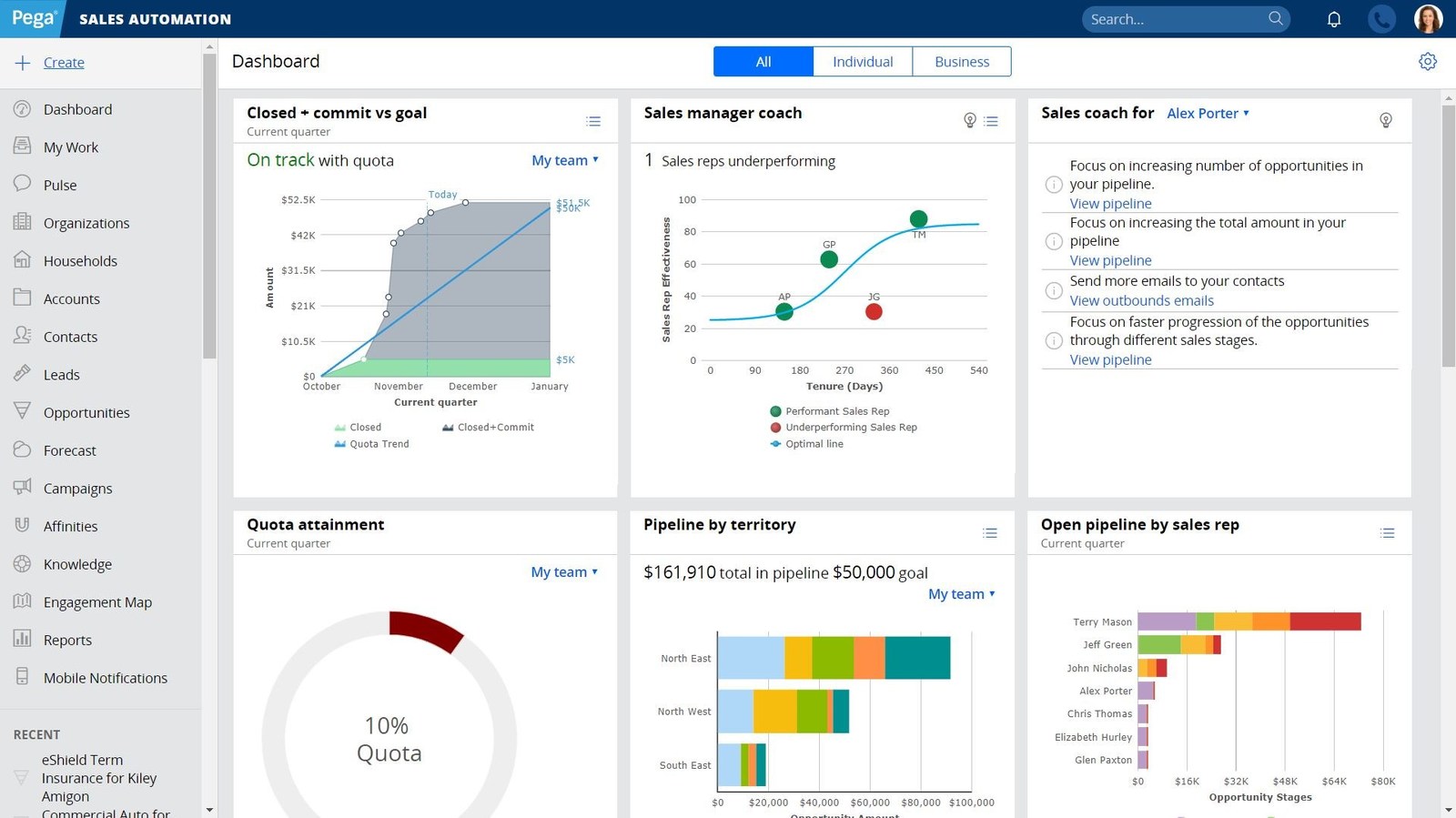
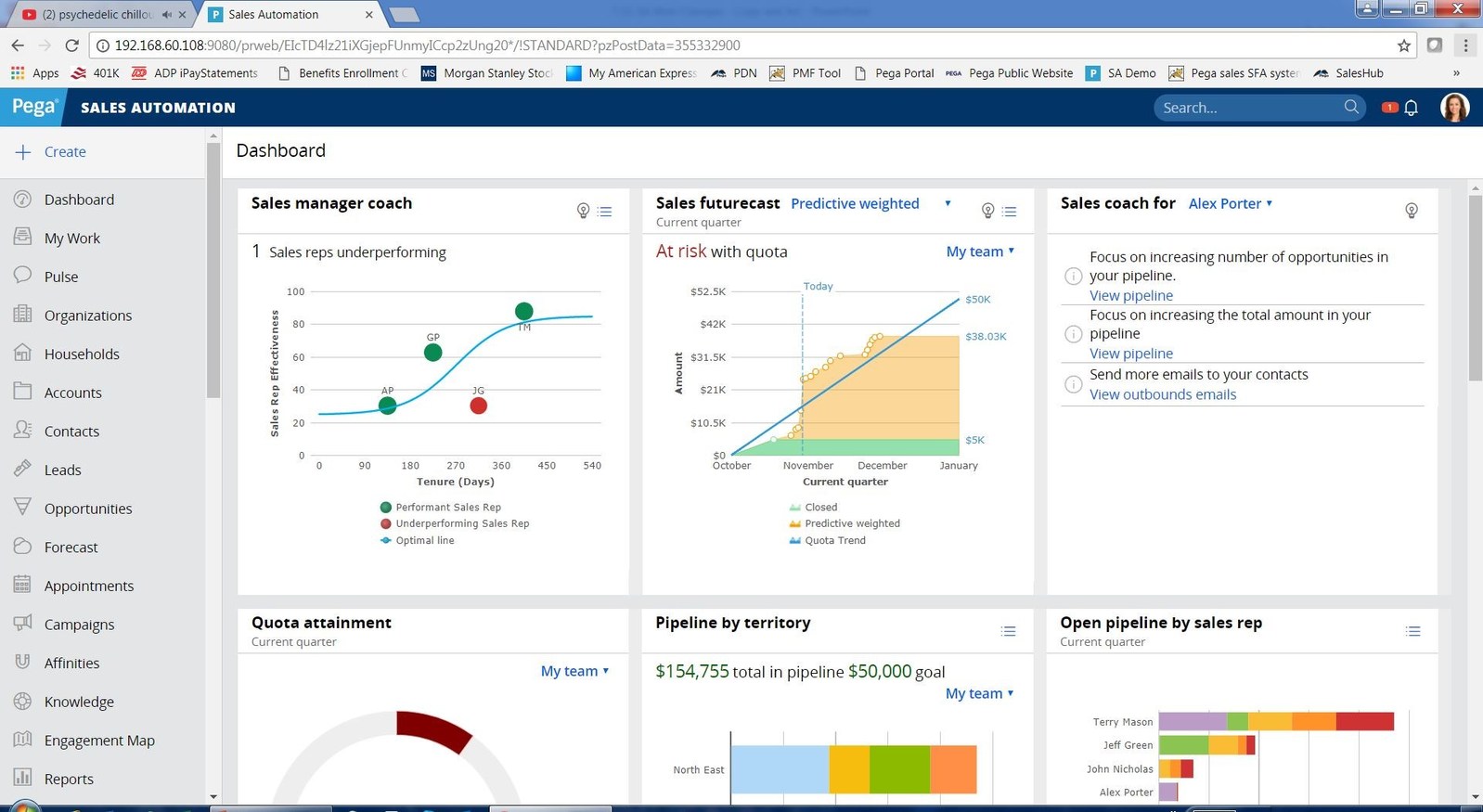
This screenshot shows the Pega Sales Coach dashboards within Pega Sales Automation from Pegasystems. Pegas real-time Sales Coach provides one-to-one coaching actions and predicts the success of a new seller within a defined time period
Pega Sales Coach uses AI to evaluate a seller’s performance by analyzing more than 50 distinct actions a typical sales rep takes each day. The software proactively alerts managers to underperforming sellers and generates real-time coaching tips to help them initiate progress, and close more deals. An intuitive set of dashboards gives managers an at-a-glance view into their entire team’s performance and tracks progress against coaching plans. Pega’s predictive analytics can give insight into the likelihood of success for new sellers in as little as three months – enabling organizations to react faster to underperformance trends.
Pega Sales Coach is now a standard feature within Pega Sales Automation, which helps organizations sell smarter, bust quotas, and simplify sales. While traditional sales tools typically serve as a Rolodex of miscellaneous sales data, Pega Sales Automation uses built-in AI to intelligently and dynamically guide each sales professional through every sales situation. Pega Sales Automation connects sales with other enterprise systems, such as in marketing and customer service, so decisions aren’t made in silos. This enables organizations to accelerate lead-to-cash timeframes and streamline work across the entire business. Forrester Research has named Pega Sales Automation the top-ranked current offering in its latest The Forrester Wave report evaluating Sales Force Automation solutions.
This screenshot shows the Pega Sales Coach dashboards within Pega Sales Automation from Pegasystems. Pegas real-time Sales Coach provides one-to-one coaching actions and predicts the success of a new seller within a defined time periodDon Schuerman
Don Schuerman, CTO, and vice president, product marketing, Pegasystems, added, “Until now, the only clear and reliable sign of an organization’s sales performance came when the sale was won or lost. Using predictive analytics, each sales rep can now get real-time coaching that will impact deals in progress and uncover hidden leads and opportunities. We’re redefining sales automation from a static database into a dynamic assistant that makes good salespeople great.”
In addition to Pega Sales Coach, other features included in this latest Pega Sales Automation release include:
Pega Knowledge, which intelligently delivers accurate and consistent content to sales teams based on the specific sales stage, industry, or competitor of focus.
AI-based lead ranking, which integrates 19 predictors that span lead, contact, organization, and sales representative data to help individuals prioritize lead qualification and follow-up.
Pega Sales Coach is available today for Pega Sales Automation customers with current support contracts. It will also be demonstrated at the PegaWorld conference to be held on June 3-6 in Las Vegas at the MGM Grand.
InsideSales.com Announces Next-Gen AI Technology for Sales
InsideSales.Com to Showcase a Breakthrough AI-Based Technology for Organizations to Identify Untapped Sales Value
InsideSales.com, a leading AI growth platform for sales, showcased the next generation of AI technology to help sales leaders get actionable insights on their performance as compared to industry and cross-industry data. This groundbreaking technology will offer leaders a real-time view of performance and actionable AI recommendations to build pipeline and close deals.
At the time of this announcement, Dave Elkington, CEO of InsideSales.com, said, “We’re continuously raising the bar on what the future of sales performance looks like.”
Dave added, “We want teams using artificial intelligence to be able to see, in real time, how they are doing compared to other companies in their industry—and how AI is making a difference to their sales efforts.”
Elkington continued, “This technology will tap into the trillions of anonymized data points we’ve collected from thousands of companies to create benchmarks for key performance indicators in each industry. Sales leaders and professionals will be able to see instantly how their team is performing and what the AI engine recommends they change to be successful.”
Suaad Sait, President of Growth, InsideSales.com, said, “With the seismic shift in buyer behavior, InsideSales.com goes beyond the limitations of CRM reporting and the confines of business intelligence solutions to help sellers sell in the way buyers buy.”
Currently, InsideSales.com offers the leading AI-fueled sales acceleration platform. Powered by Neuralytics®, a predictive analytics and AI engine with the industry’s largest collection of sales interaction data, the platform helps sales teams close more sales by efficiently engaging with the right prospects, at the right time, in the right way.
180byTwo LOCi Account-Based Audiences Unveiled as an Industry-First Location-Based ABM Solution
180byTwo LOCi ABM Audiences Deliver Resolution, Insights and Activation Through DAAS Partners Lotame, LiveRamp and adsquare
In a major push to the ABM ecosystem, 180byTwo, a leader in Audience Solutions, has announced the launch of its next-generation Audience Solution Product “Location Based ABM”, helping Account Based Marketers reach key accounts across the ecosystems programmatic channels.
180byTwo LOCi ABM Audiences are now part of the company’s Audience Suite, one of the industry’s most comprehensive set of targeting solutions developed specifically for marketers in mind. This new product provides marketers with the ability to target key accounts at the individual level, making it possible to reach the right target accounts, at the right business locations, with the right message, at the right time.
LOCi ABM is now available in the Lotame Data Exchange, Liveramp Datastore, the adsquare Mobile Marketplace as well as direct through all major programmatic and social media activation platforms.
At the time of this announcement, Eric Shaffer, Founder and CEO of 180byTwo, said, “Account-Based Marketing can no longer be restricted to the confines of IP based targeting or behind walled gardens. It’s all about the accessibility of precise ABM audiences that will lead to increased exposure and engagement tying all the way back to the top of the funnel.”
According to a recent study conducted by SiriusDecisions, 93 percent of respondents consider Account-Based Marketing (ABM) extremely important to their overall organizational success. What started out as pilots in pockets of organizations has now been woven into the fabric of high-performing b-to-b organizations. More than 60 percent of organizations with ABM programs are planning to invest significantly in the areas of Data and Technology.
Now more than ever ABM leaders need to identify, leverage, and secure accurate and actionable data to operationalize and optimize their programs, from a small number of prospect accounts with one-to-one treatment to a larger number of grouped customer accounts.
Eric added, “The LOCi Account Based Audience Solution is a brand new way to activate accounts with a precision level that wasn’t previously available; making it possible for marketers to understand the movement behavior, habits, and patterns of professionals while making it possible to target key accounts in a powerful new way.”
180byTwo is supporting ABM Marketers by going beyond the typical ‘Spray and Pray’ account targeting tactic by providing a hyperlocal set of Account Based Marketing audiences. Marketers and Publishers can also leverage 180byTwo LOCi ABM through real-time business entity resolution within mobile app environments which utilizes more than 15 million confirmed US business listings, and 10 plus billion weekly processed location signals.
Ben Goldman, CRO at 180byTwo, said, “Our location-based ABM Audience Solutions provide our partners and clients with the ability to match, identify, and engage their target accounts in a more meaningful and accurate way.”
Ben added, “Prior to launching our new ABM solution a major B2B agency used our LOCi ABM audiences for key prospect account targeting and our solution provided a 35% increase in CTR and a 22% increase in site engagement.”
Currently, 180byTwo provides global audience solutions, leveraging multi-sourced offline, online, mobile, location, signal, proximity, and various other data points across industry verticals designed to help marketers and platforms more efficiently and effectively target businesses, consumers and professionals across channels and devices wherever they are.
The foremost question at the ongoing Webinar World’18 is -‘How to put the personal back in marketing,’ – with a focus on how to build context-based campaigns and deliver events that put the customer first and foster authentic engagement between the audience and the brand. In the run-up to the event, we spoke to martech thought leaders speaking at the event.We spoke to Annie Lei, Chief Revenue Officer, AmpLive to understand how she leverages technology to reach out to customers.
Html code here! Replace this with any non empty text and that's it.
I’m excited for the opportunity to educate people about new ways of targeting and expanding audiences for live content. In particular, I’m excited to get the word out about live stream audience growth and distribution. Marketers spend a lot of time thinking about content, promotion, and registration, but there are better, more efficient ways to make sure people see your live content.
What do you believe is necessary to foster authentic engagement between your customers and your brand?
Two major things are vital to foster authentic engagement between our customers and our brand. First, it’s important to put yourself in your customers’ shoes, and really think about what it is that you would need to learn and achieve from the product. I try to always re-read or review content and think about what value I would have taken from it if I hadn’t known anything about it beforehand.
Second, we try to always listen and pay attention to our audience. They’re always communicating, either through words or actions and ignoring how people react to our message would be counterproductive. With our most recent product update, for example, our customers were a huge driving force in the new features that we added. Listening to our customers and letting them drive our product’s evolution has allowed us to build a sense of collaboration and community that continues to help us grow the live ecosystem.
What are you hoping to take away from Webinar World 2018?
Personally, I’m looking forward to learning more about how other people are taking advantage of the live medium. It’s an exciting and creative time for live content, and Webinar World will be a great place to see what people have come up with.
How should marketers leverage marketing technologies to empathize with customers?
Marketing technologies provide important insight that can help marketers step into the shoes of their customers. Social media lets us ask our customers how they feel about things, and automation platforms let us see how they react and engage with our content, which teaches us about their tastes and personalities. All of these things help us know our customers and empathize with them.
For example, AmpLive provides insight into what types of audiences are engaging with different kinds of live content, which helps companies get more strategic about how they interact with audiences. Marketing technologies that allow marketers to deliver content live provide a unique opportunity for people to communicate with their audiences directly and in real-time. In order to empathize with customers, you have to know them. What better way to learn about what motivates your customers than to have real conversations with them?
How do you leverage webinar marketing tools to engage with your online audience? How does it help you build a strong sales pipeline?
Webinar marketing tools are great because they allow you to reach a large number of people all at once, in a particularly human way. You get to put a face on your brand, engage with your audience, and learn from them all while teaching them something useful that (hopefully) leads them back to your product or solution. I think webinars help us establish ourselves as authorities on certain subjects, help us build trust with our audiences, and help us reach a lot of new people (especially through distribution). Of course, they need to be approached strategically, and the impact of a webinar on sales pipeline can vary depending on the promotion, distribution, and retargeting efforts of marketers and organizers.
AR/VR/Webinars and Event Automation– How do you predict online experiences will change with rising technologies, from promotion to event engagement to follow-up?
We can already see things becoming much more targeted and dynamic. Our online experiences will become much more individualized and tailored to our unique interests. Promotion, event engagement, and follow-up will all adapt to this new level of personalization. Also, we are discovering that live content can be incredibly powerful when it’s part of a larger, longer game involving tracking and retargeting audiences based on engagement. Taking live content to the next level requires tools, which we’re always striving to refine and strengthen.
Unless you’ve been hiding under a rock for the last few months, chances are you already know what GDPR is. The General Data Protection Regulation is a legal framework that sets guidelines for the collection and processing of personal information of individuals within the European Union. To underscore this: As long as you have EU data in your company database, GDPR applies to you. US companies aren’t “spared.” Ignore it, and you’ll risk hefty penalties of up to €20M or 4% of your company’s annual revenue, whichever is greater.
GDPR will take effect in May 2018. But despite the disappearing runway, many of us still aren’t ready. In fact, when Openprise surveyed 500 professionals on GDPR readiness last November, 60% admitted they hadn’t even started planning or taking any preparatory steps towards compliance. In this article, we’ll examine why so few are prepared for this regulation and provide an easy-to-follow GDPR compliance plan to help you get started.
First off, why are we dragging our feet and procrastinating? Shahram Heshmat, Ph.D., published an article on Psychology Today that suggests five common reasons:
– The absence of structure: Fire drills demand our immediate attention. A Slack message from the product team. The latest Harvard Business Review article that you want to retweet. Distractions are everywhere and it’s easy to lose sight of priorities in the face of urgency.
– Timing. Tackling GDPR now, at this very moment, seems much more painful than tackling it mañana…so it’s tempting to put it off.
– Unpleasant tasks. Very few of us would consider GDPR a “fun” exercise. If we’re honest, we might even call it “boring” and “dry.”
– Anxiety. Procrastinators tend to avoid challenging tasks in order to relieve stress, even if those tasks are high priority. Sounds familiar?
– Self-confidence. Are you avoiding having to deal with GDPR compliance because you aren’t sure how? Join the club. In fact, even in Europe, 51% of the companies believe the regulation is too complex, according to a new research conducted by the European Business Awards on the subject.
But fear not. GDPR isn’t as tedious as you might expect.
Follow the three simple steps in the GDPR compliance plan below. Its bite-sized action items will make the exercise less daunting, reduce stress, and boost your confidence in becoming GDPR compliant before the regulation takes effect in May.
Step 1: Understand GDPR’s impact on marketing
Allow two to four weeks for this step.
As a marketer, you’re not responsible for appointing a Data Protection Officer within your company. However, because a lot of personal data resides in marketing and sales databases, you should —
– Work closely with your Data Protection Officer to build a scalable process.
– Train your in-house team and contractors on the policies and processes.
– Understand the impact of technologies on your business operations.
Step 2: Review your company’s data collection policy, processes, and practice
Allow four to six weeks for this step.
– Take inventory of your databases for EU citizen data.
– Make sure you obtain consent from the people already in your database and implement a double opt-in process for new leads.
– Review and document your data collection policy to ensure you have a relevant and defendable business reason for the data you do collect.
– Determine whether it makes sense to create a separate process for EU data, or apply that same process to your entire global database. We recommend the latter, as the other parts of the world are quickly following suit, and the need to protect EU personal data is universal.
– Document, monitor, and audit the flow of data among your systems and between data processors.
– Create processes so you can promptly respond to data owner requests within 30 days, per GDPR requirements.
Step 3: Identify gaps and implement changes to ensure GDPR compliance
Allow six to eight weeks for this step.
– Assess your data, processes, training, and technologies to identify compliance gaps.
– Understand what kind of control you already have in place, make sure it’s up to date and can adequately handle GDPR mandates.
– Implement changes accordingly. There are data orchestration platforms out there that can help streamline the process and ensure GDPR compliance.
Ultimately, GDPR is about building a culture of privacy. It impacts every company who holds EU citizen data. You must respect the privacy rights of individuals; run a disciplined database comprised of engaged, targeted, and opted-in individuals; have control over the handling of EU personal data; instill pervasive awareness in everyone who touches the data; and establish accountability and credibility.
The regulation to monitor the use of personal data is necessary, and in just a few months it’ll become mandatory. While it’s tempting to procrastinate as the task might seem daunting, don’t cave in. Turn off social media. Mute your phone.
Stop checking emails every five minutes (no, it’s unlikely things will come crashing down). Invest a few hours to think through GDPR compliance and what it means for your company.
It’s an exercise that could save you a minimum of €20 Million in potential fines—that alone should be reason enough to make it a priority. Don’t be a company that makes the PR-disaster headlines.
Follow the suggested steps and tackle GDPR compliance head on, get ahead of the game, build a trustworthy data practice and a reputable brand in the process. It’s worthwhile to work that will pay off in the long run.
Technekes And XSInc To Broaden Reach Of Incentive Platform
B2B Players to Collaborate, Co-Market to Clients and Prospects
Technekes LLC, a leading B2B marketing technology company, and XSInc, the number one provider of data collection, integration and analytic services in the agriculture industry, are partnering to market and sell Incent, an incentive and rebate program management platform.
Steve Amedio
“Together, Technekes and XSInc provide end-to-end capabilities to help clients plan and execute every aspect of the channel and end-user incentive programs, from scenario planning and data collection, to program fulfillment and payment reconciliation,” said Steve Amedio, Technekes’ President and COO.
Incent was developed by Technekes for real-time processing of rebate and loyalty incentives. These types of programs are central strategies to drive marketing and sales for manufacturers and distributors in the agriculture, construction supply and equipment industries. Incent features a highly configurable calculation engine users can leverage in many ways.
“Once we built Incent’s calculation engine – a huge leap forward in simplifying the process for program managers – we then focused our efforts on Incent’s API (Application Program Interface). Our API gives users the flexibility to deploy Incent in virtually any way that makes sense for their organization – as a standalone platform or embedded in multiple business systems such as ERP or CRM,” said Jack Ross, Technekes’ Chief Technology Officer.
“XSInc collects and processes data for the ag industry and specialty market’s channel and end-user sales transactions. Directly or indirectly, XSInc processes data from an overwhelming number of the Crop Life Top 100. The data we collect fuels our clients’ rebate and incentive programs. We’re collecting data and collaborating on Incent to bring a wholly new level of capabilities to the markets we serve,” said Thad Armbruster, XSInc’s CFO.
“We’ve delivered incentive and rebate programs for more than 15 years. In the last couple of years, we’ve seen three key trends emerge. First, manufacturers and distributors want more real-time options to collect and process transactional data. Second, they’re looking for fully integrated solutions to manage and fulfill their incentive programs. And, third, they’re aligning their incentive programs with in-season marketing and sales efforts to create more demand,” said Amedio.
StreamScape Named an Innovator in Data Insight by Forrester Research
StreamScape Called a Technology Leader That Is Challenging Traditional Analytic Norms
StreamScape, a leader in real-time analytics and data integration that lets businesses automate and improve decision making, has been named an Innovator in Data Insight technology by Forrester Research.
In a recent study, Forrester Research introduced Insight Platforms — a new class of software that connects data to actions. The report offers critical vendor comparison and names StreamScape a technology leader that is challenging traditional analytic norms with an innovative insight solution.
“We are excited to be recognized for something unique that we offer. As businesses struggle to keep up with the pace of technology and data volumes, it’s getting harder to break through the noise and understand what available solutions let you get the most value from your data and let you turn information into action,” says StreamScape founder and CEO Dmitry Lelchuk.
Businesses that adopt Insight Platforms as a way to drive customer-centric outcomes often see big gains in their bottom line, from increased sales and consumer loyalty to new service offers that can assist customers with their decision making in real time. Leveraging new insight systems from vendors like StreamScape helps companies of all sizes level the playing field.
Purpose-built for modern Business Intelligence and Data Science needs, StreamScape develops Real-Time Decisionware technology that lets companies integrate, store and analyze big data in-flight as it’s being created. the company’s flagship product the Reactive Data Fabric combines in-memory processing with streaming analytics and data virtualization into a powerful real-time insight engine that seamlessly blends traditional analytic techniques with streaming data, connecting information and action.
Anodot to Showcase Raw Streaming Data to AI-Based Analytics and Exhibit at O'Reilly's Strata Data Conference
Anodot and AWS Will Discuss Complexities and Best Practices for Creating a Real-Time Machine Learning-Based Data Analysis Pipeline with Kinesis
Anodot, the AI-powered analytics company, will exhibit and demonstrate its unique AI analytics solutions at the O’Reilly’s Strata Data Conference in San Jose, CA on March 6-8. Additionally, its Co-Founder and Chief Data Scientist, Ira Cohen, will speak alongside Amazon Web Service’s Solution Architect and Principal Business Development Manager, Roy Ben-Alta at its session on Thursday, March 8th, 2018.
The session will focus on the complexities of collecting, storing, and processing billions of events per second in real time. Cohen and Ben-Alta will detail various design patterns as well as a solution that was implemented using Amazon Kinesis as a real-time event data processing pipeline to feed Anodot’s AI-based analytics service. This solution successfully discovered and alerted to anomalies in the data in real time, avoiding costly business incidents.
Cohen and Ben-Alta’s presentation will take place from 1:50 pm to 2:30 pm at the San Jose Convention Center in Expo Hall 1. At Anodot’s booth at the convention, number P17, attendees can gain more insight into how the company’s exceptional technology leverages machine learning to predict problems and capture otherwise lost revenue and opportunities for organizations.
In December last year, Anodot announced a Series B round, bringing its B funding total to $23 million. The additional $15 million investment was led by Redline Capital Management together with existing investors Aleph Venture Capital and Disruptive Technologies Venture Capital. In 2017, the company more than tripled its revenues, with customers such as Foursquare, Lyft, Microsoft, Pandora, Kenshoo, Appnexus, Comcast, Upwork and Waze (Google).
Ira Cohen
Explaining the company’s plan for 2018, Ira said, “Companies in retail, software, gaming and other industries have access to so much real-time data and for the most part, the insights are hidden from view among dozens of dashboards, or they are overwhelmed with alerts. In 2018, we aim to educate the market that they do not need to wonder how they can build a solution to detect anomalies in their data by themselves; Anodot’s AI-powered analytics can do it for them.”
LiveRamp IdentityLink for Television Is Aimed at Transforming The World’s Largest Marketing Medium; Brands, Agencies, Programmers, and Technology Platforms Can Now Execute People-Based Marketing at Scale in $224 Billion Television Industry
LiveRamp, a leading provider of Omnichannel Identity Resolution and a MarTech RADAR 150 Company, announced the extension of its IdentityLink™ platform to television. For the first time, brands, agencies, programmers and technology platforms will be able to execute people-based TV media planning, buying, and measurement that is scalable and secure the TV ecosystem. In turn, consumers will be able to benefit from more relevant brand interactions that are coordinated across digital and traditional channels.
At the time of this announcement from LiveRamp, Jocelyn Lee, Head of Media Strategy and Ad Technology at Heat + Deloitte Digital, said, “TV remains one of the most influential advertising channels today – but it’s also the least sophisticated for targeting and measurement. As we move towards an increasingly cross-screen world, we need the ability to target and measure everywhere. We’re excited to see IdentityLink extending to the TV for true omnichannel marketing.”
What LiveRamp IdentityLink for TV Can Help Achieve
Amanda Martin, Director Enterprise Partnerships, Goodway Group, said, “Television is no longer just television— it’s simply not enough to reach consumers through traditional linear TV since the living room is now any device.”
Amanda added, “In today’s world, creating a relevant and seamless consumer experience across channels is critical, and we’re thrilled that LiveRamp is bringing IdentityLink to TV to further improve targeting and the user experience.”
“IdentityLink has already transformed marketing in digital channels, allowing our customers to leverage the power of identity resolution to create more relevant interactions with consumers,” said Allison Metcalfe, General Manager of TV at LiveRamp.
Allison added, “We’re excited to bring these same capabilities to the world of television – including addressable TV, OTT services, connected TV, TV everywhere, video on demand and audience-based buying for linear television.”
Brands and agencies work with many partners in the marketing ecosystem to create, deliver, and measure the effectiveness of TV advertising. These partners also benefit heavily from people-based marketing practices.
Viewership on Connected TVs and Apps Continues to Grow at Exponential Rates
Robert Schroko
Robert Schroko, Vice President of Data Strategy at A+E, explained, “As content consumption and viewing behavior continues to evolve, it is more important than ever to know the viewers, understand the household, and be able to deliver against our partners’ goals of targeting, effectiveness, and measured outcomes.”
Robert said, “As viewership on connected TVs and apps continues to grow at exponential rates, A+E Networks needs to be able to capitalize on the full reach of our content and the aggregate audiences across platforms, regardless of how a viewer is choosing to engage with us. LiveRamp is well-positioned to help solve for this with its identity solutions, platform integrations, and the ability to solve for attribution.”
“TV viewing behavior is changing, and measuring advertising effectiveness in an omnichannel world is more difficult than ever before,” said Greg Hampton, Vice President of Inscape.
Greg added, “Inscape and LiveRamp are collaborating to empower brands to make more intelligent, data-driven decisions when it comes to targeting and measurement, and we look forward to our continued partnership in solving for audience fragmentation.”
Nishat quipped, “Consumers want the right message at the right time in the right place, so we’re excited to integrate LiveRamp’s IdentityLink into our end-to-end media solutions. This technology will help consumers receive the relevant messaging they desire in a proven creative format and enable advertisers to have the insights they need to plan better campaigns, target and activate the right audiences, and measure and optimize results in TV.”
LiveRamp Improves Targeting and Measurement Efforts in Advanced TV
Walt Horstman, TiVo
“TiVo is laser-focused on offering a superior, feature-rich, and personalized user experience to our customers across devices, and mapping the customer journey is key to meeting their needs,” said Walt Horstman, Senior Vice President and General Manager of Advanced Media and Advertising at TiVo.
Walt added, “As traditional TV becomes more fragmented, LiveRamp is uniquely positioned to provide leading people-based solutions to improve targeting and measurement efforts in advanced TV, and we’re excited to be a part of this platform solution.”
TV Audience Data and the Idea of Clear Customer Journey Analytics
John Hoctor
John Hoctor, CEO of Data Plus Math, said, “CMOs are increasingly being asked to show the ROI for each component of their media spend.”
John said, “LiveRamp is uniquely positioned to help Data Plus Math’s attribution platform link customer actions to TV impressions, enabling a much clearer picture of the customer journey from product awareness to eventual purchase.”
Sean Muller, CEO at iSpot.tv, said, “Matching iSpot’s device graph and real-time ad attribution systems with LiveRamp’s identity resolution services is a big enhancement to the cross-platform marketing movement.
Sean added, “Now brands can extend their advanced digital segments into smarter TV buying and better ad measurement.”
Anneka Gupta, Co-President, LiveRamp
Anneka Gupta, Co-President of LiveRamp, said, “Our goal is to power the creation of an omnichannel view of the consumer, which everyone in the marketing ecosystem can leverage to improve the consumer experience.”
Anneka added, “Linking TV data into that view is the next key step in this journey, and we’re excited to be the first to bridge the divide between digital and linear channels.”
According to International Data Corporation (IDC), TV currently accounts for $224 billion in global marketing spend. However, audience fragmentation in TV is becoming more prevalent due to the proliferation of devices and content sources.
As more than 60 percent of adults under the age of 30 primarily use streaming services delivered via over-the-top services (OTT) and connected TVs, advertising on those channels is projected to account for nearly half of all TV revenue by 2020.
In addition, U.S. addressable TV ad spending is expected to double over the next two years. All these variables make the job of reaching a single consumer exponentially more difficult.
Currently, LiveRamp, as an Acxiom Company, offers brands and the companies they work with identity resolution that is integrated throughout the digital ecosystem and provides the foundation for omnichannel marketing. IdentityLink transforms the technology platforms used by our clients into people-based marketing channels that improve the relevancy of marketing, and ultimately allow consumers to better connect with the brands and products they love.