[mnky_testimonial_slider][mnky_testimonial name=”” author_dec=”” position=”Designer”]“A lot of marketing automation companies claim to have AI abilities, but very few use real machine intelligence that can significantly change the marketing game.”[/mnky_testimonial][/mnky_testimonial_slider]
On Marketing Cloud Technology
MTS: Tell us a little bit about your role at Optimove and how you got here. What inspired you to start a marketing cloud company?
I am the founder and CEO of Optimove, a successful software company built on big data technologies. Back in 2009, when I initially started the company with my partner – who had just earned his Ph.D. in data mining – I didn’t even know exactly what data was all about. But I was looking to start a business and “big data” sounded like an interesting basis for a high-tech company. So we started meeting with corporations, crunching their customer data and presenting them with all kinds of insights which we hoped would be useful to them.
MTS: Is customer experience management the only difference between typical marketing clouds and Optimove’s customer marketing cloud? How do you see this segment evolving over the next few years?
The most significant difference between Optimove and other solutions is Optimove’s focus on enabling the marketer to move at the speed of the customer. Through very advanced science and automation Optimove maintains the marketer one step ahead of the customer, thus enabling him to anticipate the customer’s next step and be at the right place and at the right time to communicate the most significant message. This empowers marketers to execute many concurrent campaigns to very homogenous customer groups. Optimove’s scientific measurement gauges every campaign, and Optibot, our AI bot, let’s the marketer know what’s working and what needs improving.
MTS: What do you see as the single most important technology trend or development that’s going to impact us?
With the danger of sounding like a cliché, the answer is AI. Today, there are simply too many marketing communication channels, dimensions, and combinations for the marketer to handle. AI is starting to bridge this gap. The only problem is that a lot of marketing automation companies claim to have AI abilities, but only very few use real machine intelligence that can significantly change the marketing game.
MTS: What’s the biggest challenge for startups to integrate a marketing cloud into their stack?
There are really many challenges. Actually, the number one reason for martech failure is bad integration. On the technical side, the system needs to be integrated with all other technologies, and that’s an undertaking in itself. Then there’s the Human challenge. People often resist change, and realigning teams around new technology is prone to troubles. The make or break of martech is often at the hands of the new technology’s “owner” within the business. The person who can align and educate the team, solve the problems and break the resistance. Without an internal champion for the new technology, integration can be very hard.
MTS: Could you tell us about a standout digital campaign? (Who was your target audience and how did you measure success)
We are great believers in content marketing. Since the market still needs a lot of education about customer retention – we are there to provide it. We believe that there’s a huge payoff for teaching, and are marketing is invested in doing just that. We’ve brought in great content talents to manage our content factory, which is in constant growth. As with any other content initiative, measuring the success is very difficult. We see however a steady growth in the number of our blog visitors and newsletter subscribers, and we constantly receive great feedback.
MTS: How do you prepare for an AI-centric world as a business leader?
Bake it into our product, making sure not only that we are not falling short, but that we’re way ahead of the curve.
This Is How I Work
MTS: One word that best describes how you work.
Agile
MTS: What apps/software/tools can’t you live without?
As funny as it might sound, Word and the voice recorder on the phone. Lots of thoughts flood my head by the second, and I always need somewhere to jot my best ideas. If I’m on the move, I record myself. If I’m in front of my computer, I open a Word doc, and start jotting down.
MTS: What’s your smartest work-related shortcut or productivity hack?
Implementing governing rules on my time allocation; what’s the percent of time I dedicate to mentoring my teams, to developing the product, to my family, etc. And making sure that I keep in line of this plan, and revisit it every now and then.
MTS: What are you currently reading? (What do you read, and how do you consume information?)
I mainly consume information from people around me. I talk to a lot of people and have a great mechanism of picking up what’s important and meaningful, and leaving behind all the rest. I recently watched Kung Fu Panda again, and I think that there’s a lot that entrepreneurs and people can learn from it about self-confidence and its significance.
MTS: What’s the best advice you’ve ever received?
Whatever someone else can do only a bit less good than what you can, delegate to them. Trust your team and treat them well.
MTS: What’s something you do better than others — the secret to your success?
I have superpowers! I think that I’m able to utilize both the right and left sides of my brain to their utmost. This helps me sometimes to find very creative solutions to almost impossible challenges.
MTS: Thank you Pini! That was fun and hope to see you back on MarTech Series soon.
Pini is founder and CEO of Optimove, provider of the industry’s leading Customer Marketing Cloud. Pini’s extensive experience in analytics-driven customer marketing, business consulting and sales, along with his innovative approaches to entrepreneurship and business-building, have earned him recognition as a thought leader. Pini has led Optimove to become a market leader, with hundreds of brands using his company’s software and services to orchestrate and automate highly-effective personalized CRM.
Optimove is the leading Customer Marketing Cloud, helping over 250 brands drive their entire customer marketing operation.
Optimove combines the science of data with the art of marketing to deliver personalized, real-time, multi-channel CRM campaigns. Optimove’s unique technologies enable marketers to maximize customer engagement, brand loyalty and lifetime value.
The company’s software and services are used by leading customer-centric brands of all sizes from a variety of industries, including 1-800-Flowers, AdoreMe, Lucky Vitamin, Bwin.party, Scopely, Outbrain, and eBags. The company has offices in New York, London and Tel Aviv.
[/vc_tta_section][/vc_tta_tabs]
[mnky_heading title=”About the MarTech Interview Series” link=”url:http%3A%2F%2Fstaging.loutish-lamp.flywheelsites.com%2Fmts-insights%2Finterviews%2F|||”]
The MTS Martech Interview Series is a fun Q&A style chat which we really enjoy doing with martech leaders. With inspiration from Lifehacker’s How I work interviews, the MarTech Series Interviews follows a two part format On Marketing Technology, and This Is How I Work. The format was chosen because when we decided to start an interview series with the biggest and brightest minds in martech – we wanted to get insight into two areas … one – their ideas on marketing tech and two – insights into the philosophy and methods that make these leaders tick.
MarTech Series speaks to Ray Grady, newly appointed Chief Customer Officer and President at CloudCraze, the native e-commerce platform which recently raised $20 million in funding.
On the heels of a $20 million funding announcement to kick off 2017, Chicago-based CloudCraze has made their first major investment post-funding, adding four new faces in key leadership positions to its executive team. Funding from notable martech investors such as Salesforce Ventures and Insight Venture Partners indicates the confidence VCs have shown in CloudCraze’s native Salesforce platform model.
CloudCraze is focused on solving the complex needs of B2B companies including several iconic brands, such as Coca-Cola, Avid, AB InBev, Barry-Callebaut, Ecolab, GE, Land O’ Lakes, Kellogg’s, and WABCO. The growth of SaaS, and in particular Salesforce as a giant in the SaaS economy, is a key reason behind CloudCraze’s success, as they build off their strong foundation as one of the first players on the B2B scene and only native platform on Salesforce.
“It’s an exciting time to be part of this organization,” said Chris Dalton, CEO of CloudCraze. “Our recent funding round is a testament to the industry’s expectations for the transformative power of our platform and opportunity for continued growth of the business.”
Ray Grady, Chief Customer Officer, CloudCraze Commerce
We have rigorous plans to supercharge our market penetration over the next two years and this group of seasoned SaaS professionals adds to the already talented team of CloudCraze commerce experts who will lead the charge.
Former Executive Vice President, Ray Grady, will now serve CloudCraze as President and Chief Customer Officer (CCO). Since joining the company in 2015, Grady has successfully led the global expansion in the US and EMEA, playing an integral role in the company’s significant growth. As president and CCO, Grady will oversee customer engagement and success, business development, professional services, and continued European expansion.
MarTech Series spoke to Ray about the plans for growth and what we can expect to see from CloudCraze in the coming months. Here is the full interview —
MTS: Please tell us a little bit about the CloudCraze journey so far.
Ray: CloudCraze is an e-commerce platform native to Salesforce and the foundation of the platform is built from the customer view, which lets us think about e-commerce very differently. The CRM data model of Salesforce forms the spine of our overall data model for CloudCraze, and that’s our number one innovation because it’s this CRM DNA that makes CloudCraze the eCommerce platform that can power customer-specific functionality with the least amount of engineering. From a customer interaction perspective, all of the rich data that flows within a CRM system, whether it is through their Service Cloud, call center activities, direct sales or email campaigns, is tracked within one system and informs our commerce platform.
CloudCraze’s cloud-based, micro-services is a B2B-oriented platform providing enterprise companies an e-commerce solution that can be iterated based on customer feedback and implemented and deployed quickly. Legacy systems, on the other hand, are hampered by their monolithic stack architecture, which prevents them from providing the flexibility and scalability that modern B2B organizations require.
Our appeal to B2B enterprises can be seen by our global Fortune 500 customer base, many of which you mentioned earlier. We’ve seen significant success as the industry has transformed over the last few years; the business was recapitalised in mid-2015 and as you know, we closed a funding round before the end of 2016.
MTS: As Salesforce partners, how has the experience been? With Salesforce’s rollout of the Einstein AI platform, does CloudCraze see opportunities to innovate?
Ray: We picked Salesforce for a number of reasons. We didn’t want to be in the business of infrastructure, tuning, and set up when that could be handled by a partner. Salesforce also brings next-generation technology such as Einstein that we can apply to our platforms so not only do customers benefit from CloudCraze’s innovation, they also benefit from Salesforce innovation.
As an example, Salesforce has a product called Process Builder which allows customers to create complex workflows without any engineering. They roll these innovations out as a part of their core platform, and we get to apply them to commerce use cases. We have set up robust workflows for things like cart abandonment or buy-1-get-1 free workflows. Our customers get that innovation for free.
We are also in the process of integrating some solutions with Salesforce Einstein. If you are in e-commerce you can see that there are use cases with Einstein that can be very specific to an e-commerce buyer. For example, using big data to change pricing if certain data elements change, or to buy more products in stock during specific weather conditions.
Cloudcraze and our customers absolutely benefit from these innovations. Our Salesforce nativity allows us to take those features and apply them to our roadmap, which we think is also a pretty unique benefit of partnering with Salesforce.
MTS: Any plans to use the funding for product developments?
Ray: I talked about the big data solutions that we are going to do with Einstein. We have a live customer using CloudCraze with IBM Watson in Kellogg’s, and we will continue to invest in machine learning technology. We are rolling out what we call attribute-driven commerce which is a predictive model on how you can deliver solutions to customers.
The functionalities that we look to add will be more machine-learning based in areas where we can optimize our commerce platform. Some areas we are exploring are optimizing the customer experience and product catalogs and price based on data and insights. That’s where we want to take our product in future.
MTS: In terms of geographies and verticals, what is the focus for CloudCraze?
Ray: We are laser focused on the United States and European markets. We are really excited about the opportunities we have in Europe. I’ve got a great team there and plan to add additional talent across our customer success, platform solutions, alliances and sales disciplines. You can expect to see CloudCraze growth coming from these markets and have recently brought our global head of sales to fuel that growth. Brian Wagner is a seasoned guy with a strong understanding of the Salesforce ecosystem, so we are excited about him joining the team.
Besides that, we will be opportunistic. If we see trends in a particular region like Asia or Latin America you may see us go there in the future.
In terms of verticals, we are the B2B answer for Salesforce, and they have very good penetration in industries where we can win. B2B is very strong in manufacturing, distribution, wholesale, consumer goods, software, chemicals, oil & gas, and that’s where our customers exist. We will continue to expand in those areas.
MTS: The B2B commerce market is expected to grow to more than $1.1 trillion by 2020. How do you see the B2B commerce market taking shape and what will it mean for the way we do B2B marketing?
Ray: The B2B commerce market is growing rapidly. In fact, the B2B commerce market is estimated to be seven times bigger than the direct to consumer market. We are in relatively early innings for a lot of businesses getting into B2B commerce and in many areas, it’s still taking shape. We are speaking to customers who say they are leaving hundreds of millions of dollars on the table because their customers cannot order replacement parts or subscription-based services around the offerings online – they still have to contact a sales rep. We haven’t done anything in those areas yet and with B2B commerce, these are multi-billion dollar roll-on businesses.
So it’s still early for B2B commerce but the opportunity is big. What you will see is that those companies who get into it will afford themselves the chance to find new lucrative opportunities.
For example, industrial manufacturing companies may develop a subscription-based business model. Subscriptions could be based on the data that the combined machine and sales engine are generating. B2B companies will be able to take this data, package it, and modify it in a way that they can identify entirely new revenue schemes based on where the technology is going. And, we will be right there to help them enable such transactions.
MTS: Any opportunities are you looking at in terms of acquisition?
Ray: We are opportunistic and we feel as a part of Salesforce ecosystem and platform, we can accomplish a lot from a platform standpoint by just leveraging the power of Salesforce. For example, if we want to start a CPQ (configure, price, quote) business, as opposed to going out and buying a venture, we go ahead and partner with Salesforce CPQ. We will continue to invest in partnerships and if the right deal comes along in certain categories we could look to do something.
As it stands, we are quite comfortable with taking a greenfield approach. We feel we have a ton of opportunities in the areas where we can succeed and win.
MTS: Looking at the martech sector, what are your thoughts on how the marketing clouds will evolve?
Ray: The marketing cloud is certainly one of the fastest growing lines of business for Salesforce. The days of the point solutions are leaving us in my opinion, especially for mature categories like marketing. You will see more standardization from a platform standpoint. I expect you will start to see the likes of SAP and Microsoft try to figure out the way there, but I think we will continue to see Salesforce take share.
I think the front office wars will probably look very similar to the ERP wars of the 80 and 90s.
Business leaders and CIOs want to have fewer technologies in their environment, and if they can get everything done in a best in class way – native, on the cloud, and having all the systems interoperable – that is quite a compelling proposition to a lot of people and that is what Salesforce brings to the table.
And when is comes to B2B commerce, we feel like CloudCraze is the answer, so we think we are in pretty good position there.
MTS: Thank you, Ray, for speaking to us. We look forward to having you very soon again at MTS for more insights on MarTech.
[mnky_testimonial_slider][mnky_testimonial name=”” author_dec=”” position=”Designer”]“The market should unite and fight all kinds of fraud, bots, adware”[/mnky_testimonial][/mnky_testimonial_slider]
On Marketing Technology
MTS: Tell us a bit about your role at HIRO Media and how you got here (what inspired you to start a programmatic video company).
10 years ago, I founded HIRO and have been the company’s CEO since inception. HIRO is an online video SSP. We work with content owners, publishers, agencies, and advertisers in using programmatic to improve their performance in online video advertising.
The idea for HIRO came from a successful exit in mobile. At the time, I wondered what the next big thing will be, and it was clear to me that the answer was online video.
As the technology was still young, we tried to legally monetize peer to peer (P2P). It was a nice ride with all the big names in P2P, but, P2P was never going to reach critical mass.
As the industry evolved to programmatic we understood this presented an opportunity we were waiting for and decided to leverage our experience with online video advertising and were one of the first to jump on the wagon to become an SSP and created a unique technology for programmatic advertising and distribution.
MTS: What does the HIRO platform offer its customers?
Safety. HIRO is a programmatic Supply Side Provider(SSP). Our first concern is the user experience. We apply proprietary filtering tools that block all suspicious ad creatives and ensure the best user experience. This ability opens for us a publisher’s inventory that is not open to any other programmatic video SSP.
MTS: How do HIRO’s Syndication Technology and prediction methods work?
As user experience is a core value for us, we try to reduce the bandwidth needed for programmatic video advertising. We have several tools to solve this challenge. One of them is our patented prediction-based Real Time Bidding (RTB).
Thanks to our volume and reach, we can sample creatives every 10 seconds and know in advance which creatives are most likely to be presented on each inventory.
It is actually running the RTB offline, and then in real time, we just call the ad that we chose already online. As previously mentioned, this is just one of our tools for upgrading the user experience.
Our syndication is based on the fact that on one hand, most publishers have unused inventory; unsold display, native advertising, or just unused space of an article etc. while on the other hand, advertisers are looking for quality video inventory.
We offer publishers a means to transform their unused inventory to a high-quality video unit (we partnered with leading content owners such as FOX, BBC, Discovery, and others for supplying top-tier content) and to the advertiser we offer brand safe quality video content.
People should note that playing video in a site that wasn’t designed for that is not trivial; in most cases, it will crush the page. Thanks to our prediction-based RTB and ad filtering, we are the only company that can actually protect our publisher from undesired activities.
MTS: What challenges does the future hold for programmatic advertising ecosystems?
The market should unite and fight all kinds of fraud, bots, adware etc. We also think that the market should create a data certification. Today when you buy data, you don’t know how accurate and updated it is. And never forget, that we still need to bring the right ads to the relevant audience by exposing the ad in the right context.
MTS: What startups are you watching/keen on right now?
Several. First is Utab, they’re a social network for aspiring artists. Another is Apester as they have some interesting solutions in the native field. The other is Viewerslogic, I like that they have a unique and interesting data solution.
MTS: What tools does your marketing stack consist of in 2017?
We just launched our first content marketing activity – HIRO stream, series of interviews with opinion leaders. We had also a good experience with writing a market research with Nielsen, probably we will issue another research this year. This is a natural extension of our usual social media and PR work.
MTS: Could you tell us about a standout digital campaign? (Who was your target audience and how did you measure success)
Our customers prefer that we will not share such information. But in general terms, we succeed in creating an ongoing campaign for one CPG (Consumer packaged goods) brand that increased the intention to buy and recommend by 30% while the costs were cut by 75%. We did so by using a combination of small players in comScore’s top 1000 sites and relevant content. This allowed the brand to create a yearlong campaign at the cost of a seasonal campaign.
MTS: How do you prepare for an AI-centric world as a marketing leader?
HIRO was created as a data first company and in many senses, we are an AI centric company. We were one of the first companies to implement machine learning and auto trading. Strategically we think that video bots will be central to the mobile experience and we launched our first video advertising bot in London last week. We also work with our publishing partners on creating first party data pool that advertisers can use.
This Is How I Work
MTS: One word that best describes how you work.
Holistic
MTS: What apps/software/tools can’t you live without?
Tidal and Netflix – I like its efficiency, both are friendly and offer high quality and variety. Plus, no matter where you are at any given moment – your music and episodes/documentaries are with you (was considered as a dream just 10-15 years ago).
I also love the fact I can match a soundtrack, images or both to each moment I experience and to places I visit. It’s kind of making a layer of art to life.
MTS: What’s yoursmartest work related shortcut or productivity hack?
I try to work with people I know and like. I also use an iPad and not a PC. I believe in short meetings with fewer people. It’s much more efficient.
MTS: What are you currently reading? (What do you read, and how do you consume information?)
I read both on my iPad and paper (hard copy) but most of my daily info is consumed mainly through my iPad. Currently, I’m reading Fierce Invalids Home from Hot Climates by Tom Robbins
MTS: What’s the best advice you’ve ever received?
It’s more difficult to define the question than finding the answer.
MTS: Something you do better than others – the secret of your success?
I am very quick and precise in analyzing situations.
MTS: Tag the one person whose answers to these questions you would love to read:
Ariel is a veteran entrepreneur with two decades of experience within media and communication supporting technologies. He has held a number of board and senior management positions within the Israeli hitech industry. Ariel was named as one of ‘Ten Innovators to Watch’ by Variety and recently recognized as one of the ten most promising startup entrepreneurs in Israel
HIRO’s proprietary technology — together with its team of industry experts — have created one of the leading online-video ecosystems in the marketplace, enabling all of partners to thrive, prosper, and improve their performance. As a global Internet media company, founded in 2006, we serve three symbiotic clients: advertisers, publishers, and content creators.
We drive value via a multitude of offerings and services, including the following:
Our online-video advertising reach of over 100 million unique viewers and 4 billion ad-views;
A turnkey profit-optimization strategy for publishers;
A new revenue resource for content owners to profit from our programmatic content-distribution platform.
HIRO is dedicated to delivering a world-class Internet entertainment media network for viewers, who watch content on any Internet-connected screen.
Simply put: We represent an end-to-end video solution that helps advertisers, content owners, and publishers optimize their profits and performance.
[/vc_tta_section][/vc_tta_tabs]
[mnky_heading title=”About the MarTech Interview Series” link=”url:http%3A%2F%2Fstaging.loutish-lamp.flywheelsites.com%2Fmts-insights%2Finterviews%2F|||”]
The MTS Martech Interview Series is a fun Q&A style chat which we really enjoy doing with martech leaders. With inspiration from Lifehacker’s How I work interviews, the MarTech Series Interviews follows a two part format On Marketing Technology, and This Is How I Work. The format was chosen because when we decided to start an interview series with the biggest and brightest minds in martech – we wanted to get insight into two areas … one – their ideas on marketing tech and two – insights into the philosophy and methods that make these leaders tick.
BT announced that it has developed a trial of a software-defined network (SDN) architecture to enable a next generation highly flexible broadcast network, in a first for the company. The technology is being trialled at Innovation Week during 12 – 16 June, in BT’s Labs at Adastral Park, Ipswich.
BT will demonstrate how multiple HD uncompressed video flows can be transported across a SDN through to a production studio via high-bandwidth network pipes. This will enable live footage to be captured remotely, allowing broadcasters the opportunity to cover events without needing to send multiple camera crews, potentially saving millions of pounds in the future as they look to move away from having studios on-site full of equipment.
The technology will allow broadcasters increased flexibility, with the ability to change the format of footage at the touch of a button as it passes across the infrastructure.
BT is using equipment and software provided by Nevion and Cisco for this specific piece of research. Nevion’s media nodes encapsulate raw video into the desired format before transmitting it over the IP network which is built using Cisco switches. The core SDN technology is provided by Cisco, with Nevion’s VideoIPath software providing the SDN management and orchestration.
Mark Wilson-Dunn, vice president of BT Media & Broadcast, said: “This is a really exciting development for our researchers, as we continuously look to innovate and upgrade our broadcast networks, which carry footage all over the world. We’re keen to explore how a broadcast infrastructure based on true SDN and related technologies could potentially allow us to build a brand new next generation and multi-tenanted global network in the future in the same way as we led the way on MPLS and IP based media networks previously. This is the first step towards that and I’m pleased that we can continue to lead the industry on this.”
Peter Karlstromer, Senior Vice President, Global Service Provider, Europe, Middle East, Africa and Russia, Cisco, said: “BT and Cisco have been working closely together for a number of years to develop innovative software-defined solutions that bring unprecedented flexibility to telecom services, including how broadcast content is distributed and shared. This ground-breaking technology offers a host of benefits, including the ability for BT to automate processes to capture, edit and distribute live footage faster and more efficiently than ever before.”
Geir Bryn-Jensen, CEO of Nevion, said: “Nevion has been working closely with BT on the orchestration and control of software defined networks since our first joint deployment five years ago of a cutting-edge UK-wide IP contribution network. BT is a truly innovative service provider, always pushing the boundaries of technology and its applications to the broadcast industry. Through Nevion’s close collaboration with BT, we have evolved our VideoIPath orchestration tools and our IP media nodes to meet the latest and most exacting requirements of the industry – something we are very proud of.”
The research builds on BT’s recent announcements, with the company’s Media and Broadcast division delivering a state of the art network to the BBC, in a seven year contract worth more than £100 million. This will enable the BBC to support more innovation and to explore emerging, data-hungry formats such as Ultra HD (4K) and 360 degree content. The network links all BBC UK sites and will also connect to the main overseas bureau and partners for playout of the BBC’s TV channels. It will carry video, audio and data traffic, as well as fixed line telephony, ISDN and broadband services.
BT has also successfully provided the UK’s first uncompressed video contribution network connecting all 20 Premier League football stadiums in a three year deal with the League’s international broadcasting outlet, Premier League Productions (PLP).
When it first burst onto the market way back in 2006, programmatic was often touted as the answer to finally take digital marketers away from their one-size-fits-all approach. Digital advertising was a blunt instrument that needed to be more targeted, more relevant and much more efficient. Ten years on though, this original promise still hasn’t quite been realized.
There’s certainly no call to be pessimistic about what’s been achieved over the last decade. Companies like Rubicon Project, AppNexus, MediaMath and others have laid the foundations for the digital advertising ecosystem we know today and the benefits have been huge.
But with the pipes laid, we’re now moving into a new phase. Thanks to the increasing sophistication of analytics and growing expertise in data science, we’re beginning to make available the almost limitless number of data variables accessible by programmatic advertisers.
This is driving digital campaigns towards a period of ultra-configuration when advertisers will finally get what they’ve always wanted from programmatic. It will also give rise to a new generation of programmatic pioneers.
Get Ready for a Shift to the Programmatic Agency
Whilst the big ad-tech firms almost exclusively drove the technology at the start, a new generation of media agencies will be the driving force behind the move towards ultra-configuration in programmatic. Indeed, it will be these specialized agencies – with programmatic deep in their DNA – that will thrive, whilst more traditional agencies and ad-tech platforms struggle to adapt.
At the heart of this trend is the powerful role that STEM’s (Scientists, Technologists, Engineers, and Mathematicians) are playing at the next generation of agencies. Rather than having to rely on off-the-shelf programmatic trading platforms, agencies will increasingly be expected to build their own, modular technology stacks, allowing for a far more adaptable approach to campaign configuration.
Armed with these new capabilities, along with the close connection they’ve traditionally had with advertisers, agencies are in a unique position to forge a much more collaborative relationship with brands around programmatic.
Advertiser’s Digital Revolution
As advertiser businesses around the world go through processes of digital transformation and re-organise themselves around their data assets, they are starting to look for a new type of agency partner that can help them leverage these data assets for more effective marketing communications. The traditional media agency value proposition of ‘buying power’ is quickly being replaced by a demand for configurable technology and consultancy services that help brands leverage their own data asset in the media ecosystem.
At the same time, Advertisers will also start to own (or contract) elements of the technology stack themselves. This could be a DMP or Ad-server or even DSP’s ad verification solutions. As this happens, agencies need to be able to configure their service and technology offering around the operating model of the advertiser.
A New Client and Agency Relationship Blossoms
As these new programmatic capabilities grow, it will be vital for agencies to build a long-term, sustainable relationship with their client. That means that their campaigns need to be designed around the advertisers’ data assets and measured in ways that reflect their incremental contribution to business objectives. Both service and technology operating models need to evolve to become more modular. It’s no longer a binary choice for advertisers between agency or in-house, so agencies need to be able to configure their offering to work with an advertiser’s preferred set up.
In essence, agencies will need to become micro-consultancies in their own right, capable of advising on and feeding into broader technology and media strategies. The next phase of programmatic growth will offer the chance for agencies to become the backbone of a company’s growth, with their influence being felt throughout an entire organization, from the top down.
Global Networks Become Redundant
Another huge benefit this age of ultra-configuration will bring is creating greater efficiency in unnecessarily large global trading networks. The global agency groups, some with literally hundreds of offices around the world, will be familiar with this setup.
As programmatic becomes more sophisticated, and the ability to configure campaigns based on these variables matures, these vast global networks just won’t be necessary anymore. They will gradually be replaced by a smaller number of programmatic hubs in key regions.
The efficiencies this will bring for the agency will be huge. Equally impressive though will be the improvements it brings for the brand, being able to cut back on the fragmented teams they have to build in order to manage that relationship. It allows advertisers to integrate their digital marketing operations within smaller teams, giving a select number of marketers oversight over their global programmatic activities.
The exciting stage we find ourselves now illustrates how far we’ve come in digital. It’s been a period of continual growth and there’s no doubt that programmatic advertising is already here to stay. But as this next phase unfolds, it will become increasingly clear the last decade was really just programmatic’s beta launch. It’s now, with ultra-configuration, that things start to get really interesting for digital marketing.
Modern customers act differently across various digital channels. 2016 was the year of the mobile, and 2017 is most likely to be no different either, thanks to the proliferation of AI and newly added definitions of mobile customer experience. According to this report, with over $25 billion in spending in the US alone, mobile internet advertising now accounts for a 3rd of all internet ad spend. In spite of this, most marketers continue to fall short in deciphering customer needs and creating micro-moments throughout the journey. Aki Technologies, the first ad platform built for mobile moments, announced in April that it has created a Strategic Accounts division, appointing Polly Lieberman as SVP of Strategic Accounts and Cristi Basch as VP of Strategic Accounts. This new division will be dedicated to serving the growing number of brands and agencies that are making “moments” a key pillar in their marketing strategies.
Scott Swanson, CEO, Aki Technologies
MTS spoke to Scott Swanson, CEO at Aki Technologies to know more about the changing dynamics of mobile advertising and the necessity to deliver “Mobile Moments”.
MTS:Scott, tell us about your role at Aki and how you got here?
Scott Swanson (Scott): I’ve worked in digital advertising my entire career and have always found the opportunity for making advertising work in a new, digital medium to be a fascinating challenge. In 2010, I founded a company called Mobile Theory, whose goal it was to see if we could convince brand advertisers to spend in mobile. At the time, it was primarily ‘ringtone’-type advertisers who spent in mobile…that wasn’t very long ago! Well, of course, we and many others successfully got the brands to migrate their budgets to mobile and Mobile Theory was acquired by Opera Mediaworks in 2012. I served as President of Opera’s advertising sales & operations division but I felt like there was more to do to solve the most important problems of this industry.
Primarily, brands had come to mobile but weren’t taking what a person was doing or feeling into account when delivering them an ad on a mobile device. I felt like there was a ton of opportunity to help solve this problem, and so we decided to launch Aki Technologies to help.
MTS:Help us define – “Mobile Moments” and “User Experience”. How is User Experience related to Mobile Moments?
Scott: A person engaged with his or her smartphone might be watching a video, engaging on social, getting directions, reading news, checking the weather, shopping… the possibilities are endless. While the versatility and convenience are great for consumers, it poses a challenge for advertisers—if you’re approaching your audience at a time when they’re not in the right mindset for your message, you’re wasting your investment, maybe even creating a negative impression.
Mobile moments solve this by providing a framework from which to better understand and approach consumers. By analyzing the full range of mobile data signals, moments tell advertisers more than simply whether a person is within their target segment or at a relevant location. Instead, brands can interpret an individual’s mindset to determine if this is, indeed, a productive time to connect. Mobile moments give brands greater emotional intelligence, so they can approach consumers with greater empathy, drive stronger engagement and ultimately eliminate friction in the user experience.
MTS:What are the Three Tiers of Optimization as mentioned by Aki?
Scott: At Aki, we look at optimization from three angles. First, we examine the full range of mobile data signals—everything from location, to session length, context/apps, demographics, even external factors like weather, as well as CRM and third-party data—to interpret the type of experience or moment a consumer is having. This helps us understand if the consumer is in the right mindset for an advertisement from a particular brand. Then we drill down to determine what type of ad format is most likely to drive the intended result—for example if the consumer is in a ‘lean-back’ moment, our data has shown they are more likely to respond to a rich media ad.
The third tier is creative—what type of message, imagery, etc. is most likely to drive a response. These optimizations are fueled by data we’ve gained through our own moment insights and targeting and powered by machine learning. It’s a process that happens instantly and, as a result, allows us to consistently exceed expectations on campaign KPIs.
MTS:What are the key metrics in Mobile Advertising that helps marketers to decipher user behavior?
Scott: In the early days of mobile, there was a lot of emphasis on the same metrics the industry leans on in digital, like click-through, engagement, and video completion rates. Today, it’s exciting to see more brands and agencies recognize that mobile’s impact isn’t limited to on-screen engagement; for example, there’s a tremendous opportunity to drive in-store conversions. This brings us back to the versatility of mobile—as an advertiser, you can achieve a really broad range of objectives on devices but the challenge comes in crafting campaign strategies that influence the desired metrics. This is where moment targeting and optimization really delivers.
Driving performance in the right direction begins with reaching your audience while they’re in the mindset that correlates to a particular response.
MTS:Audience Segmentation and Predictive Analytics are keys to building creative mobile-centric marketing & advertising campaigns. Enlighten our readers with some examples from Aki’s own digital experiences.
Scott: At Aki, we spend a lot of time analyzing the mobile experience to understand which variables have the greatest impact on ad performance, and we’ve zeroed in on ‘ad receptivity’ as a really critical but typically neglected factor to mobile success. When it comes to the device experience, a person might be more receptive to an ad at one moment than another; they might be more receptive to an ad for a specific product or brand at a given moment; they might be more likely to engage with a specific type of ad format. This means that audience segmentation, while naturally essential to a campaign strategy, isn’t enough to ensure ad impact and drive efficiency.
We use predictive analytics, applying machine learning to the deep insight we’ve gained enabling moment-targeted campaigns, to help advertisers gauge which moments represent the strongest levels of receptivity, and understand how that receptivity plays out in terms of creative and response. This additional level of insight goes a long way in eliminating wasted impressions and friction in the user experience.
MTS:Brand Safety and Audience enhancement are benchmark mobile advertising metrics. How does Aki help customers acquire audience enhancement for maximum ROI in a brand-safe ecosystem?
Scott: The vast majority of Aki’s clients are interested in branding, and require brand-safe environments for their advertising to run in. First, we run all ads exclusively in-app, and there are safeguards built in to running in-app only. Apple and Google have high content standards for apps to be included in their app stores.
In addition, we conduct a weekly review of the apps we work with to audit content and traffic guidelines we have in place with the publishers we partner with.
MTS:We hear a lot about “Real-Time” data analysis for mobile retargeting and engagement. Scott, help our readers understand what should they expect when a mobile advertising platform promises to deliver mobile targeting and insights?
Scott: Today, there’s no shortage of technology that can help you reach your audience segment in x or y geographical areas, during certain times of the day, with different ad formats, so it may be tempting to imagine that the window to differentiate in mobile targeting has closed. But a lot of this is really device-centric.
What was missing—and, as such, really limiting the opportunity for impact and ROI in mobile ads—was a platform that took all of this data and interpreted it in a way that offered a higher level of insight on the consumer.
That’s what got us into moment targeting in the first place. We wanted to use data in a way that made advertisers smarter and more effective at building connections, to raise the bar on the consumer experience. Along the way, we’ve had the opportunity to gain a ton of insight on the variables in consumer response across different moments, for different verticals and audience segments.
But, the learning doesn’t stop, and that is perhaps the most important expectation of a mobile targeting solution—it’s not just what can it do today to improve performance, but also how it evolves in time with consumer behavior. Mobile advertising is a long game, and the advertisers who understand that are the ones who are going to succeed.
MTS: How do you see mobile targeting technology evolving further with AI and Machine Learning?
Scott: For all the complexity of AI and machine learning, the benefit is simple: It helps advertisers extract more value out of data. The ability to process more information, faster; to recognize patterns in consumer behavior; to speed up the optimization process for campaigns while also continually optimizing itself—all of this offers a meaningful competitive edge in a tough, complex landscape.
Of course, as more advertisers embrace one or another AI-powered solution, the advantage belongs to the advertiser with the most relevant data and the technology that is most effective at processing that data to predict receptivity. At Aki Technologies, we’re working hard to deliver on both counts.
MTS:How deep is Aki into programmatic? How do you see the impact of programmatic in mobile advertising on Mobile Moments?
Scott: There’s a common critique of programmatic that says, essentially, the intense degree of automation works against the opportunity to build meaningful emotional connections in advertising. Mobile moment targeting offers a really consumer-centric approach to advertising, bridging the gap between data and empathy in a way that addresses programmatic’s shortcomings. It’s a natural and advantageous match.
MTS: Ad Blocking and Customer Experience – why do you think customers install ad blockers despite being offered top-end CX?
Scott: Today, control is a major theme in user experience—we’re empowered to customize what apps display on our screen, what content providers we engage with, when and how we engage with them—so it’s not surprising that ad blocking has become popular. It is another really effective means of taking control of the mobile (and desktop) experience. But, that’s only part of the story here.The other part is that the customer experience is not consistently “top-end” in mobile.
There are countless websites that are luring audiences in with click bait and serving clunky, click-optimizing experiences to drive revenue. Even the savviest mobile consumers sometimes get trapped in this “desperate web” and that experience can poison the well for sites and brands that operate on a higher level of integrity.
Ad blockers offer a band-aid for the problem, but the real solution comes from advertisers and sites working together to raise the bar on experience.
MTS:Can AI/ML help advertisers and publishers overcome the Ad Blocking challenges? Trends and Future Insights
Scott: Yes, and it all comes back to making smarter decisions with data. Right now consumers are frustrated because they know what their mobile device is capable of, they understand at least the fundamentals of advertising, and yet they’re still getting ad experiences that aren’t relevant during a given moment or even at all. It’s understandably frustrating.
With AI, advertisers can more effectively deliver on the long-standing promise of digital and mobile advertising so consumers finally get the right message, the right experience, during the right moments. This brings more value to brands and publishers and can help reverse the Machiavellian approach to clicks and ad revenue that propels the ad blocking trend.
MTS: According to you, what are the biggest challenges within Mobile Advertising in 2017 and beyond?
Scott: Right now the biggest and most costly gap is caused by a lack of understanding of consumer behavior. Fragmentation, the warp-speed evolution of tech, the rise of new platforms—there are many reasons why it’s difficult to keep pace with consumer change. That’s why every advertiser and publisher must constantly ask—and then revisit—the question of how to understand their audience better, particularly in the context of mobile.
How, when, where, and why do they use their devices? When and how are they most likely to engage with an ad? How does mobile fit into their path to purchase? When are they most likely to visit a store? These are the insights that drive performance and business growth today.
MTS: Bots versus Real Human Connections – Do you see bots disrupting mobile moment?
Scott: Mobile moments are all about interpreting data to understand the consumer mindset and needs of a given moment. For this reason, bots are deeply dependent on the kind of insight that comes from a mobile moment framework. Brands will increasingly build mobile moment profiles as a standard component of their audience personas.
MTS:Location-based analytics and people-based marketing are critical to the success of mobile-first campaigns. How do you see CMOs adopting mobile targeting and retargeting technologies in 2017?
Scott: We see CMOs starting to see the improved results from approaching mobile in the right way. So I feel like they are going to get smarter about retargeting. Those that don’t, won’t succeed.
MTS: What startups within AI/ML and programmatic are you watching/keen on right now?
Scott: We’re really intrigued by what the folks over at Parsec media are doing around time-based pricing models for digital advertising. The concept that there are more valuable and less valuable impressions is something that’s close to our value proposition, but because advertising has been bought with this cost-per-thousand pricing model for decades, it’s going to be a challenge to introduce a time-based model. We really respect the folks that are trying to disrupt that model and may follow suit ourselves.
MTS:We recently did a piece — Modern Marketers Awry About Turning into Data Scientists! What is your opinion on this?
Scott: We’re well past the point where a marketer can eschew data in their day-to-day operations and overall strategy—it’s a standard part of the competitive mix now. That said, it’s reasonable if marketers feel overwhelmed by the pressure to drive a greater value of data and the general rate of change in the industry. The solution is identifying the right resources—team, partners, technology—to help navigate the landscape and, today, a data scientist should be among those resources.
MTS: Thank you, Scott, for your insights on mobile advertising. We look forward to having you again at MTS soon.
Do you look at customer reviews before selecting a restaurant, hotel, or service? Odds are, the answer is yes. It’s common and accepted to do a little research to see what your peers are saying before booking that vacation or hiring a handyman. After all, real-world experiences tell you more about a product or service than a menu or list of features.
When it comes to software, finding valid (and validated) user reviews can be more of a challenge. But, when you’re selecting something as mission critical as a sales enablement platform, knowing what customers think of the platform, how easy it is to deploy and maintain, and any potential roadblocks can make all the difference to long-term success—and therefore, more sales.
If you’re in the market for a sales enablement solution, it’s a good idea to read reviews ahead of time. Features don’t mean much if integration with CRM systems is clunky, or if reps don’t like the user interface. When you’re selecting a platform that you want your team to adopt (after all, adoption is key to realizing results) it’s important to know what you’re getting from a user satisfaction perspective.
Software and Services review site G2 Crowd recently published its 2017 Grid Report for Sales Enablement, which ranks 15 leading sales enablement providers on a variety of factors, all directly from verified user reviews. To qualify for inclusion in the sales enablement category of this report, solutions must:
Act as a repository of marketing content to be used by sales representatives
Track prospect and customer engagement on content and sales pitches
Allow users to upload a variety of collateral or build content directly within the tool
Assist in the preparedness of salespersons during presentations or pitches by having easy access to relevant marketing content
This report is a great tool because it lets you read first-hand what people like—and don’t like—about their sales enablement platforms. You’ll find valuable content around user satisfaction with a side-by-side comparison of how solutions stack up. (In the interest of full disclosure, Highspot ranked as a Top Performer, with the highest customer satisfaction ranking of any provider—96%).
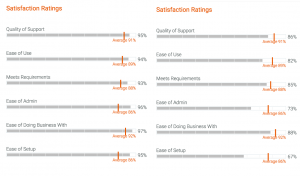
Here’s a satisfaction snapshot showing two organizations in the Grid Report. You can quickly see the marked differences in areas like ease of use, ease of administration, and ease of set up. When it comes to bringing a solution online, these are critical areas to consider. You want to make sure the solution you’ve picked can be deployed and implemented without undue hassle—and is easy to maintain over the long term.
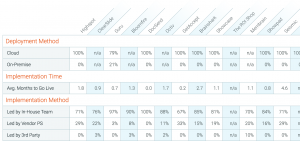
When we drill down on the ease-of-use satisfaction area, we can see details about deployment methods, implementation times, and implementations methods—all critical to understanding alignment with your organization’s expectations. Do you want to be up and running within one-two months, or, do you have more time—say four-to-five months from project kick-off to deployment? Every solution brings different parameters to the table and understanding those parameters can be of significant value when it’s time to make a final decision.
Interested in learning more?
Download the full report to read reviews of each of the 15 companies, as well as their strengths and weaknesses across a gamut of factors. If you’re shopping for a sales enablement platform, use this research as a tool to help you select the best solution for your organization. You’ll save time and money by getting it right the first time—and your sales team will be more productive in the long run.
[mnky_testimonial_slider][mnky_testimonial name=”” author_dec=”” position=”Designer”]“I completely believe in team work and a people-driven culture. As a company, we have an extremely collaborative framework and this is the reason we are able to attract, grow and retain talent.”[/mnky_testimonial][/mnky_testimonial_slider]
On Marketing Technology
MTS: Tell us a little bit about your role and how you got here. (What inspired you to start a martech company?)
For the last 10 years, business analytics and its evolving applications across a variety of industries to create business impact has been my key focus area. It’s also the core of what we do at LatentView Analytics. Prior to that, I spent the better part of a decade helping global businesses adapt to the technology challenges faced by the emergence of the internet, and the disruptive new business models it created. While solving those technology problems, I met marketing, strategy and other business leaders who were seeking insights from data that could help them make better business decisions, and that’s how LatentView was created.
MTS: Given the massive proliferation of marketing technology, how do you see the martech market evolving over the next few years?
In the past year, I have seen more conversations about automation. In the analytics industry, there is greater acknowledgement that is the direction things are going. It’s partly a function of reaching a maturity level with analytics from a knowledge perspective, but leadership support is still needed to move further into automation. Automation is a way to have consistency in the way you measure. That being said, not everyone is ready to go all the way to implementing AI.
MTS: What do you see as the single most important technology trend or development that’s going to impact us?
In my view, the emergence of Artificial Intelligence (AI) is the most interesting innovation, and is going to be a fundamental game changer. Firms that have leadership, knowledge, skilled people and strong business imperatives will likely be early adopters. They will create automated solutions that use AI and other emerging computer science innovations that will wipe out traditional business models.
MTS: What’s the biggest challenge that CMOs need to tackle to make marketing technology work?
The lack of talent and the pace of technology is always a challenge. Companies need to be conscious of their analytics strategy and that starts with having the leadership support needed. A chief analytics officer needs to be in place to direct how to gain value from the analytics strategy. Without that, it’s much harder to centralize. It needs to become mainstream to make analytics-driven decisions.
MTS: What companies are you watching/keen on right now?
Companies like Google, Amazon, Apple, and Microsoft are using intelligent virtual assistants like Google Assistant, Alexa, Siri and Cortana which work on voice instructions. From a marketing perspective, this is a potential area where marketers are using voice data for targeted marketing. These companies are pushing the boundaries of how consumers are finding answers. In the future, marketers will use this technology to discover how accelerated insights can help to get more definite answers.
MTS: What tools does your marketing stack consist of in 2017?
We primarily work in three layers: Metrics layer, Insights layer, and the Action/Communication layer. Metrics are the type of tools that we use; Google analytics is one such example which provides statistics like number of followers, customers and other online traffic related details. We also use campaign management and response tools. When it comes to the Insights layer, the focus is on brand awareness, perception, and advocacy. Finally, the Communication layer deals with engagement – how to get people to talk positively about you. None of these layers can function in isolation. It is imperative for the three layers to work together to deliver results.
MTS: Could you tell us about a standout digital campaign? (Who was your target audience and how did you measure success)
There’s no doubt that analytics can provide valuable insight to drive business value. But having the right analytics is just one part of the equation – enterprises must be able to capture and use it effectively. When it comes to advanced analytics, how mature is your organization?
We recently conducted a survey to address this very question. The Analytics Maturity Assessment campaign was a free online assessment to find out in which stage of analytics maturity an organization falls, and how they stacked up against the competition. We also put together a guide that provides recommendations to help companies move forward to the next stage.
MTS: How do you prepare for an AI-centric world as a marketing leader?
As with other technology innovations, we tend to underestimate how far reaching and common place AI will be in five to 10 years, while we overestimate the impact in the short term. AI is real, and will allow us to create higher value jobs for people that prize their creativity, empathy, judgment and leadership abilities.
AI is man plus machine rather than man versus machines. As machines get better, the roles of human workers would change and would be focused on tasks that require critical thinking and judgment. Computers are getting smarter all the time, and tasks or processes that can be more easily automated are those where the volume is very high but the cost of error is low.
THIS IS HOW I WORK
MTS: One word that best describes how you work.
It has got to be – people. I completely believe in team work and a people-driven culture. As a company, we have an extremely collaborative framework and this is the reason we are able to attract, grow and retain talent. We believe in the philosophy of the ‘Right people for the right roles.’
MTS: What apps/software/tools you can’t live without?
When it comes to work, I use LinkedIn quite extensively to keep in touch with my connections and look to further business conversations. I think it is a great platform to connect professionally.
On the personal front, my latest possessions include a Spire – a wearable that monitors your breathing patterns and gauges your state of mind. I also wear a FitBit activity tracker.
MTS: What’s your smartest work related shortcut or productivity hack?
While travelling, I do not use my laptop, I prefer to work with people. That is where I want to keep the focus. I rely completely on my smartphone and this allows me the gift of time. I also take at least an hour off during the day to switch off and make it a point to not look at my work mails.
MTS: What are you currently reading? (What do you read, and how do you consume information?)
I am currently reading a book called Sapiens: A Brief History of Humankind by Yuval Noah Harari. Next in line is Homo Deus: A Brief History of Tomorrow, by the same author; it is the continuation in the same series and deals with the future of mankind. I read a lot of non-fiction, curated content related to technology, most of which I consume digitally. While travelling, I read on a Kindle, if the physical book is handy I carry it with me.
MTS: What’s the best advice you’ve ever received?
The best advice I received till date is – no resistance to persistence. A lot of people have reached where they are not because they are intelligent or talented, but simply because they refused to give up.
MTS: Something you do better than others – the secret of your success?
I think my strength lies in my networking skills. I love meeting new people. I seek them out, listen to their stories and experiences and try to learn from them.
MTS: Tag the one person whose answers to these questions you would love to read:
LatentView Analytics is one of the largest and fastest growing data analytics firms globally. As technology transforms our lives and a new generation of digital consumers emerge, companies must fight to stay relevant.
LatentView provides its customers with actionable insights from digital data, which helps create brands, products and services that engage with consumers, across touch points.
At LatentView, we believe that Business + Data + Math = Actionable Insights.
LatentView has won numerous awards recognizing its growth and expertise. Most recently, we were named ‘Analytics Company of the Year – 2015’ by Frost & Sullivan. We are also on the exclusive list of Advanced Consulting Partners to Amazon Web Services (AWS), validating our expertise and experience in Big Data Analytics. LatentView has also been named a ‘cool vendor’ in data analytics by Gartner.
LatentView is headquartered in Princeton, New Jersey and has offices in four countries.
[mnky_heading title=”About the MarTech Interview Series” link=”url:http%3A%2F%2Fstaging.loutish-lamp.flywheelsites.com%2Fmts-insights%2Finterviews%2F|||”]
The MTS Martech Interview Series is a fun Q&A style chat which we really enjoy doing with martech leaders. With inspiration from Lifehacker’s How I work interviews, the MarTech Series Interviews follows a two part format On Marketing Technology, and This Is How I Work. The format was chosen because when we decided to start an interview series with the biggest and brightest minds in martech – we wanted to get insight into two areas … one – their ideas on marketing tech and two – insights into the philosophy and methods that make these leaders tick.
When it comes to customer acquisition, best practices abound. While there is tremendous lip service around customer centricity, companies struggle to execute effective customer retention and monetization programs in this era of big data.
To help, here are 10 key steps to total customer monetization and effective retention marketing.
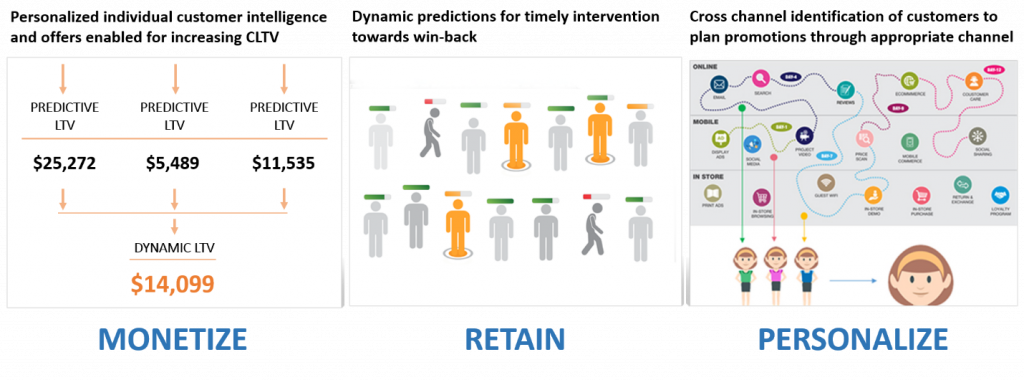
Know your customer – True identification of customers beyond data and technology challenges. (i.e. Active, Inactive, Loyal, Profitable, Type, Kind, One timer, Lost, VIP etc.)
Today it’s possible to pre-define the active customer, the inactive customer, and everyone in-between; gaining dynamic knowledge about each individual. With a one-time setup, marketers can leverage all their existing customer data points across demographics, psychographics, and behavior and intent to ensure campaigns are tied to each customer and then further tracked.
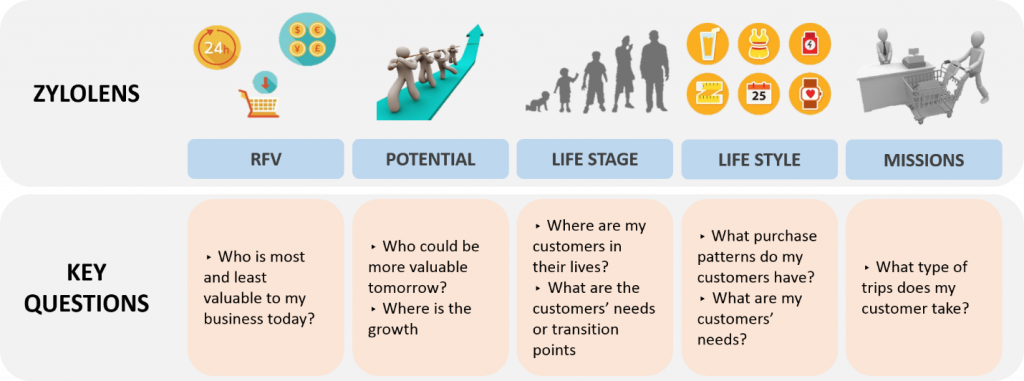
Dynamic Segmentation – Dynamic segmentation across 5 key lenses (Lifestyle, Life stage, Propensity, Mission, RFM.)
Customer segmentation is complex and requires numerous lenses for looking at customer data without getting overwhelmed. These five lenses serve most companies well.
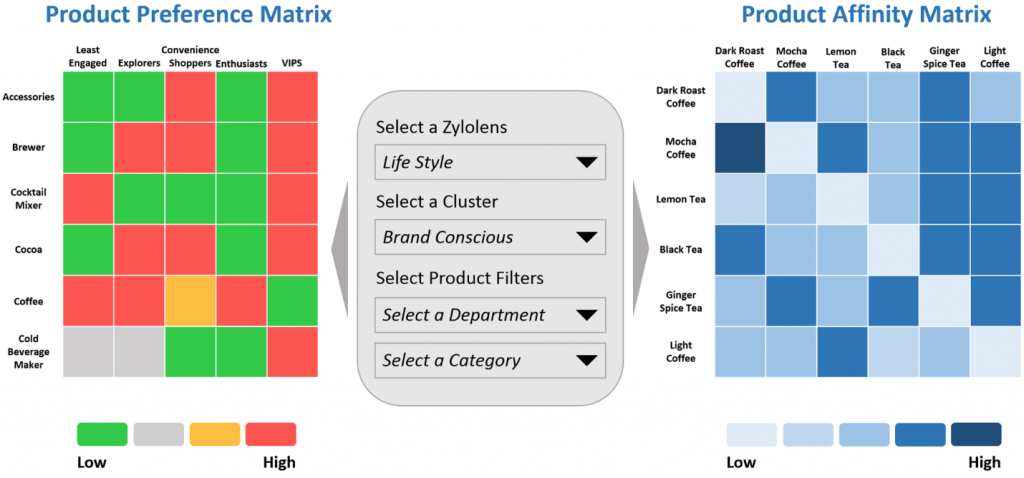
Micro-Segmentation – A micro-segmentation playbook across multiple lenses and product category combinations to further develop insights with reference to each customer segment. All this must be done without worrying about coding or data prep or running SQL queries in a self-service manner.
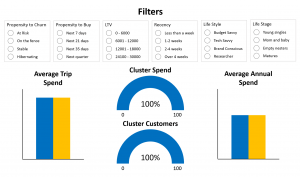
Dynamic Cohort – Self-service and auto cohort building at each customer level across filters (i.e. LTV, Propensity score, Churn score, Activity, Demographics, Behavior, etc.)
While machine learning is advanced enough to go beyond the typical segments and look for interesting, non-obvious patterns in customer cohorts, marketers still know their business best and must be empowered to select numerous filters to make their own cohorts to do further A/B testing.
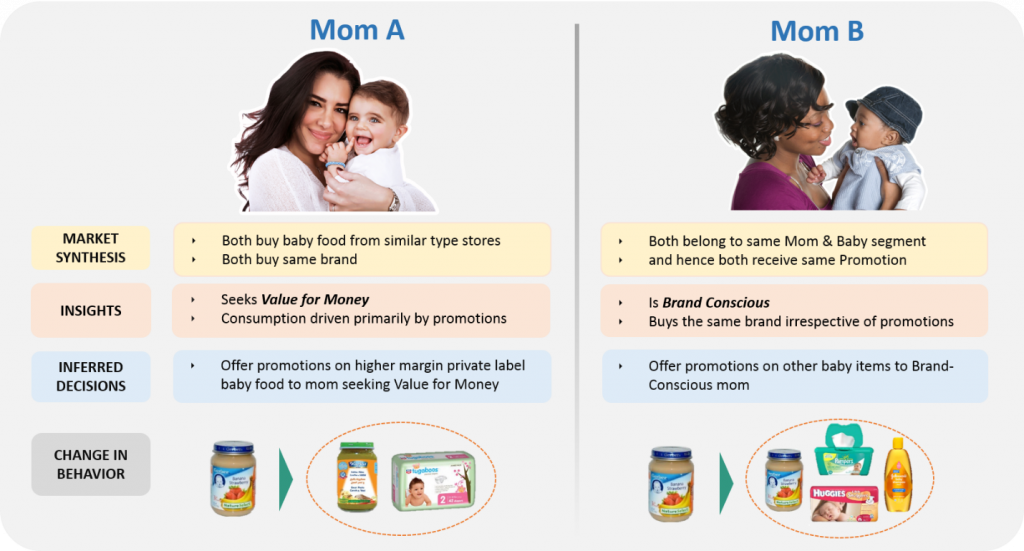
Behavioral Economics – Desired customer behavior vs. gaps, and incentive to bridge gaps. Knowing the customer thoroughly across their behaviors gives marketers a deeper understanding about interesting trends. They can see where promotions are performing poorly, or where they are doing well. At the same time, it helps in reviewing which products have higher and lower margins to further plan promotions with regards to customer behavior.
Change Customer Behavior – Through targeted promotions and personalized offers at the right time, via the right channel while bridging gaps. If we can measure this, then we can manage it well. So if we can track the customer behavior, we can always offer personalized, yet timely recommendations along the lines of Netflix and Amazon.
Tracking Each Customer’sPropensity to Buy and Churn Score – Every customer can be dynamically tracked today and assigned a next best offer, a propensity to buy as well as a propensity to churn score, and a next best action, based on those scores.
1:1 Remarketing – Enabled through your favorite marketing automation/campaign tools.This is where your favorite campaign tools come in handy, from Mailchimp to sophisticated marketing cloud tools. These tools can action content or remarketing across the right channel of customer and track from there on, while also sending campaign behavior data back to your decision engine to close the loop.
Ongoing Behavioral Awareness – True customer 360 view and continuous actionable insights.This involves mapping individual customer information across its raw data points like demographics, to metrics like propensity, churn score, LTV, segment, type, etc., to create dynamic and easy to action for business users.
Results – Total customer monetization and retention is not a destination, but part of a continuous journey, with defined approaches, steps and milestones.Customer LTV average can be measured and tracked over the time to measure overall customer lift.
Today, advancements in artificial intelligence (AI) can ensure this freedom, and put the power back in the hands of marketers, without worrying about data management, curation, models, hiring armies of data scientist or performing ad hoc analytics projects.
The ZyloTech CAP platform supports the automation of these 10 steps using sophisticated Automated machine learning (AML) techniques to ensure total monetization of your customers with complete freedom for marketers and businesses.
Nik Pai, CoFounder LiftMetrix, A HootSuite COmpany
Last month, Hootsuite announced the launch of Hootsuite Impact and Hootsuite Value Realization services to help enterprises understand how to best measure and maximize the business impact of their investment in social media. In February 2017, the leading social media management platform acquired LiftMetrix, a social media ROI solutions provider for mobile. Nik Pai, the co-founder and CEO at LiftMetri, spoke to MarTech Series on how marketers can leverage social media analytics to improve B2B engagements and impact the company’s bottom line.
MTS: What is the inspiration behind Hootsuite Impact?
Nik: Hootsuite Impact is the logical evolution of LiftMetrix. Given the growing need for full-stack social media solutions and the demand for transparent, measurable social media efforts that can map back to business impact, we saw opportunities for deeper integration with Hootsuite. In one platform, marketers can now execute, measure, and evaluate their social initiatives.
MTS: How can marketers leverage Hootsuite Impact to generate more ROI?
Nik: Hootsuite Impact is integrated into the HootSuite Platform to give organizations a complete view of their owned, earned, and paid social initiatives in one dashboard. It integrates with web analytics solutions like Google Analytics and Adobe Analytics, along with business intelligence (BI) tools such as Tableau so marketers can track the effects of social media not just on their own accounts, but horizontally across the greater social sphere and vertically into the company’s own systems. With Hootsuite Impact, marketers will be empowered to identify, measure, and track campaigns in order to dedicate time and resources efficiently, and deliver the largest impact to the bottom line.
MTS:Is Hootsuite Value Realization a part of Hootsuite Impact? Should CMOs have Hootsuite Impact and Hootsuite VR, both, in their social media stack?
Nik: Hootsuite Value Realization is a separate consultation service. Our team of experts will assess a client’s needs, people, processes, and technology, then create a measurement framework for their social strategy that aligns with their goals. We will then help to strategize and track performance to maximize ROI on social. Value Realization and Hootsuite Impact work hand in hand to help measure and maximize social ROI.
MTS:How do you see social media technologies integrating with content marketing campaigns?
Nik: Social is a great way to amplify and sustain the conversation around great content. 72% of the general public trust social media content shared by friends and family, according to a global study by Edelman. Leveraging the team to share branded content establishes thought leadership and encourages their contacts to start conversations.
MTS:What are the metrics that social media marketers should focus on to measure real-time
social media performance?
Nik: One of the greatest opportunities with social analytics today is the ability to go beyond vanity metrics and link back to ROI. Each organization will have different metrics that best measure social’s impact on their bottom line, but engagement metrics such as video watch time, comments, shares, tags, and conversion metrics such as app installs and purchases can be valuable indicators of social media performance.
MTS:Brand Safety and reputation management on social media are the biggest challenges for marketers today. How should marketers maintain and mitigate risks around their social media campaigns?
Nik: According to analyst firm, Forrester, 81% of global businesses are concerned / very concerned about brand and reputational risk. However, marketers cannot afford for their organizations to not be on social in this day and age. An organization CAN be on social securely through a sound engagement, monitoring, and security strategy.
MTS:What are your thoughts on bots used to engage audiences in social media? Does Hootsuite Impact measure bot interactions as well?
Nik: Chatbots have tremendous potential to humanize the customer experience. For instance, Public service chatbots in APAC such as Bus Uncle have seen millions of messages to date and can deliver real-time transport information. Hootsuite Impact can measure any social account, enabling companies to identify points of automation and gauge feedback on a chatbot.
MTS: Bots versus Human Interactions: How do you see marketing campaigns losing their ROI due to mismatched analytics in real-time conversations?
Nik: There are as many breakpoints as there are parts in the marketing funnel. Tags or tracking pixels could misfire, leading to inaccurate attribution. That means the wrong campaign could be credited for results, or an inaccurate ROI amount could be credited. These errors would hinder the decision-making process.
MTS:Hootsuite Impact performs Competitor Benchmarking. Can Hootsuite measure the performance of Influencers and Brand Advocates too?
Nik: Competitor Benchmarking can track competitors, but customers are free to use the feature to track other accounts from influencers to brand advocates for a high-level overview. For day-to-day mentions and campaign tracking, Hootsuite’s main platform enables marketers to directly reply to mentions and track link clicks on the ow.ly shortener.
MTS:Leadership Hack: How can marketers use Hootsuite Impact to best leverage their influencer networks?
Nik: One of the features I am most proud of is our social auto-tagger. As marketers, we are always struggling to identify which content will generate the most buzz within our own networks. Imagine if everytime you posted content, a system could automatically understand what that content is about, measure the performance against your business goals, and then give you insights on which themes perform the best with your audience. This is what we built and it enables every leader to be data-driven in their approach to content creation and syndication.
MTS: In 2017, what are the 5 Marketing Technologies for social media that you think every marketer should be familiar with?
Nik: – Social Media Listening solutions using AI or machine learning to filter the most relevant signals —
– Business Intelligence tools that help tie the value of social media to business results
– Tools to enable your entire company w/social ie- Amplify. The future is in enabling social across the entire enterprise.
– Social advertising tools that leverage social data ie- using Marketo/CRM data to inform social ad campaigns and vice versa
– Technology that enables a unified view of the customer ie- CRM integrations with social relationship platforms
– Influencer marketing platforms that help customers to discover and activate relationships with influential creators
MTS: How do you see Artificial Intelligence impacting Social Media Marketing technologies? Does Hootsuite Impact leverage AI in anyway? Does Hootsuite plan to use AI in the future?
Nik: Artificial intelligence is a hot topic these days and you see it being defined in many ways. To me, artificial intelligence is the ability to perform tasks that previously required human intelligence. In social media, there are a number examples of this – from sentiment analysis, image recognition of brands to classification systems for tagging.
In Hootsuite Impact, we use AI in a number of ways, from how we auto-tag content to providing natural language insights that explain your performance on social media as if an analyst wrote it. Making marketers more data-driven in their decision making is a core focus of ours and AI will play a huge role in that.
MTS:What was the most outstanding social media campaign that you led or were part of? How did it shape up? What are the key lessons from that campaign that you would want every marketer/CEO to take note of?
Nik: When we first launched our Google Analytics integration, we worked with one of our alpha customers to help them measure the overall business results of their most recent social media campaign which was around driving bookings on their website using different coupon codes and offerings.
Up to that point, they were just doing social for the sake of doing social. We advised them to start using Google Analytics UTM parameters. Quickly, they realized that social was actually driving significant revenue and could even understand which coupon codes/offerings were doing the best.
They then started to buy ads to generate more ROI. We saw them use the data around offerings to then optimize their offerings on other marketing channels which they told us helped to generate even more ROI for them.
It was awesome to see them mature on social media so quickly and being a key player in that transformation.
The key lessons from the campaign are that social media can drive direct business value and the insights you learn from your social media campaigns can be used to optimize ROI in other areas of the business as well.
MTS: What startups within martech are you watching/keen on right now?
Nik: The risk of phishing, malware, scams and other challenges that could affect a company’s social accounts and brand safety is very real today. Cyber security solutions for social media is a fast-growing field as marketers look to prevent issues before they happen. ZeroFox is one fast-rising startup providing cyber security for social media. Within three years of founding, they have already been named by Forrester as a leader in digital risk monitoring.
As the number of marketing channels grows, the content funnel is also becoming more complex. Content management solutions such as Opal can bridge the gap between strategy and execution. By integrating a multitude of marketing and content tools, they’re enabling teams to harmonize messaging and reach billions.
MTS: We recently did a piece — Modern Marketers Awry About Turning into Data Scientists! What is your opinion on this?
Nik: Data-driven marketing is a tremendous opportunity for APAC. Combined with significantly lower advertising costs, there is much more room for APAC marketers to innovate. Where marketers in other regions have a learning curve, there is an opportunity in APAC to show how data analytics can make marketing more creative and transparent.
MTS:Tag the one Martech CEO/CMO who you would like to see featuring on our TechByte
Series: (Twitter/LinkedIn handle)
[mnky_testimonial_slider][mnky_testimonial name=”” author_dec=”” position=”Designer”]“Social media management technologies need to keep pace with the increasing adoption of social across job functions.”[/mnky_testimonial][/mnky_testimonial_slider]
On Marketing Technology
MTS:Tell us a little bit about your role at Hootsuite and how you got here.
I’m the chief marketing officer at Hootsuite, where I focus on improving the customer journey and experience across the entire organization. I began my career in the financial services industry, working in IT at Merrill Lynch and transitioned into marketing enterprise software. I served as the CMO at Macromedia and Juniper Networks, focusing on creating a customer-centric approach to marketing.
My career has been focused on helping companies align their technologies with customer’s needs – which coincidentally, is an absolute priority at Hootsuite. I met with Hootsuite CEO, Ryan Holmes, and learned more about the company’s focus on helping organizations create human connections at scale, which immediately caught my interest. My focus for the year is helping our customers understand how they can use social and Hootsuite throughout their organization to impact their bottom line.
MTS: How do you see the social media management market evolving over the next few years?
The social media management market is constantly evolving. Businesses are relying on social channels such as LinkedIn, Twitter, Facebook, and Instagram to communicate with their customers at a deeper and more personal level. We’re also seeing social used across the organization from marketing to sales, customer service, and more.
Social media management technologies need to keep pace with the increasing adoption of social across job functions. From social marketing to social selling, our solutions must adapt to social’s rapidly evolving needs. For example, to combat the rapid decline of organic reach, marketers are investing in paid social advertising strategies. To meet this need, Hootsuite acquired AdEspresso, to enable marketers to easily manage Facebook and Instagram advertising from a single platform. As social matures, marketers will need to be able to quantifiably justify how social impacts the bottom line. Hootsuite acquired leading social analytics company LiftMetrix to meet that need.
It’s extremely important for social media management platforms to connect with the customers using existing technologies. We have hundreds of best-of-breed partners and applications in our open ecosystem and plan to continue the momentum. Our open ecosystem helps to boost the adoption of social across the entire organization by integrating with the technologies that our customers are already familiar with.
MTS: What do you see as the single most important technology trend or development that’s going to impact us?
Video is going to continue to play a larger and larger role in business. Social video is evolving and growing at a rapid pace. Companies are tapping into live video capabilities, such as Facebook Live, to connect with customers and turn them into deeper brand advocates.
MTS: What factors should a startup consider before deciding to integrate a social media management platform into their stack?
Regardless of size, organizations should consider how to relate to their customers to the best of their ability, with social being a key component. A recent Harris poll, sponsored by Hootsuite, shows that more than four out every five Americans (83 percent) have a social account, and nearly a third of Americans who have a social media account would rather engage with a brand or organization on social media than visit a physical location.
As social continues to become a huge part of how businesses reach their customers, a social media management platform like Hootsuite helps to simplify the process. Hootsuite can help businesses gain valuable customer insights and strengthen relationships, increase brand awareness and loyalty, generate leads, increase sales and create a competitive advantage.
MTS: What startups are you watching/keen on right now?
I usually watch for startups in specific categories versus specific companies. Right now I keep track of startups who are innovating in AI and marketing as well as neuroscience.
MTS: What tools does your marketing stack consist of in 2017?
A few marketing tools we’re using in 2017 include:
– Marketo, for marketing automation. Marketo leads can be created directly from Twitter and Facebook activity discovered through Hootsuite. We are also now using Marketo for our ABM needs
– Lattice Engines for Predictive Scoring and ABM account selection
– Demandbase for targeted ABM advertising and various data enrichment activities
– High Spot for sales enablement
– Zendesk, which can be used through Hootsuite to create customer service tickets.
Our MarTech stack is robust and continuously evolving to take advantage of advances in technology and to keep up with the pace of our growth.
MTS: Could you tell us about a standout digital campaign? (Who was your target audience and how did you measure success)
One of our standout digital campaigns was our Social Trends campaign which covered the top five social media trends for 2017. This was a thought leadership campaign that included a global webinar, microsite, social advertising, vertical-specific content, and sales enablement materials.
The campaign was aimed at marketing directors, strategists, and managers in enterprise organizations. Our goal was to drive leads.
The campaign began with our editorial team. Social is always changing—so our customers look to us to help them prioritize their strategies and make sure they aren’t being left behind on new opportunities. We interviewed experts, analyzed data, and built a compelling narrative that was supported by global data.
With this core story, we were able to repurpose it to extend our reach and impact. For example, we partnered with We Are Social, a global social media agency, and released Digital in 2017, a report of social media and digital trends around the world. We expanded the original webinar content with follow-up guides, social ads, and a Facebook Live event. We also ran a training event for our sales team and built sales enablement materials, helping sales people tell this story to our customers.
The campaign was successful as it allowed us to take one story and produce multiple types of content that appealed to a global audience. The Social Trends campaign exceeded our expectations for traffic, leads, and net-new revenue.
MTS: How do you prepare for an AI-centric world as a marketing leader?
There’s a lot of potential for AI to be integrated into social platforms. Hootsuite has some basic AI that helps optimize different things behind the scenes, but it’s an area that we’re currently exploring.
By 2018, Gartner predicts that 20 percent of all business content will be authored by machines. Some ways we’re anticipating AI playing a role in the marketing world is through automating high-quality enterprise content at scale. This has the potential to not only help save time, but also deliver a better customer experience; AI could potentially find patterns in data and help spot customer trends quickly. At the end of the day, it’s the people that matter. Marketing leaders must take into account this human connection and how we can use social media to connect with each other on a broader scale.
How I work:
MTS: One word that best describes how you work.
Confident
MTS: What apps/software/tools can’t you live without?
I can’t live without my iPhone, my Ipad, and my laptop. My life revolves around those three devices on which I have many apps that help me organize my life, my work and things I enjoy like social, news and health.
MTS: What’s your smartest work related shortcut or productivity hack?
My smartest productivity hack is to get up early and exercise every morning. It is worth setting that alarm for 5:30 every day. Gives me energy, reduces stress and makes me happy.
MTS: What are you currently reading? (What do you read, and how do you consume information?)
For pleasure I am driven by my book club’s choices. I have a personal passion for neuroscience, and stories about people who think differently are my favorites.
MTS: What’s the best advice you’ve ever received?
Don’t be afraid to fail. Advice from my Dad. It has always helped me try new things and learn new things.
MTS: Something you do better than others – the secret of your success?
Listening. Effective listening is a really important trait. Listening to your customers can lead to substantial improvements in your business. And listening to your employees is key to productivity, culture and ultimately profitability.
MTS: Tag the one person whose answers to these questions you would love to read:
Penny is a senior marketing and operating executive with over 30 years of international experience in the technology industry. She has Proven track record of delivering business growth through strong customer focus and building powerful teams. Penny has worked at Cisco, Merrill Lynch, and Macromedia in the past.
Hootsuite is the most widely used social media management platform. Their battle-tested technology, extensive ecosystem, and social DNA help organizations create human connections at scale.
[/vc_tta_section][/vc_tta_tabs]
[mnky_heading title=”About the MarTech Interview Series” link=”url:http%3A%2F%2Fstaging.loutish-lamp.flywheelsites.com%2Fmts-insights%2Finterviews%2F|||”]
The MTS Martech Interview Series is a fun Q&A style chat which we really enjoy doing with martech leaders. With inspiration from Lifehacker’s How I work interviews, the MarTech Series Interviews follows a two part format On Marketing Technology, and This Is How I Work. The format was chosen because when we decided to start an interview series with the biggest and brightest minds in martech – we wanted to get insight into two areas … one – their ideas on marketing tech and two – insights into the philosophy and methods that make these leaders tick.
Today’s marketers have more data available to them than ever before. From social media statistics to click through rates (CTRs), email opens to loyalty points, marketers would be hard pressed to argue that they don’t have enough customer information to play with when it comes to building their campaigns. Yet despite all this data, many marketers are still struggling to target their customers effectively.
According to recent research from customer data platform vendor BlueVenn, as many as three in five consumers believe that brands are not targeting them effectively with their marketing efforts. Given both the availability of data and the abundance of analysis and personalization tools, this represents a surprising disconnect between how marketers are collecting customer information and the ways they choose to use it.
So why does this disconnect exist, and what is it that continues to hold targeted marketing back?
Across much of the marketing community, there is still a belief that it is consumers who are fighting against the progression of targeted marketing, particularly an unease with the concept of personalization and targeted outreach, finding it ‘creepy’ or invasive. While it is true that an overuse of personalisation can encourage a backlash from customers, BlueVenn’s research shows that in reality, nearly half (46%) of consumers would like to see more personalization introduced, on the condition that it provides a tangible benefit to them or their online shopping experiences.
Given this growing acceptance among consumers, it’s hard to argue that targeted marketing efforts are falling down. Instead, it seems more likely that failed targeting is down to marketers themselves and how they choose to use customer information.
So, where are marketers going wrong? They have the data available, they have the tools needed to personalize their campaigns, and consumers are open to the idea of individually targeted marketing. What more could they possibly need?
For many brands, the associated issues lie far further up the chain – somewhere between the collection of customer data and the distribution of personalized output. It is here, in the analysisof customer data, that so many brands are encountering issues.
While most marketers feel confident in both their data collection and in their ability to customize that data through personalisation platforms, without effective analysis between these two steps, targeted marketing campaigns will be forever doomed to fail (often before they’ve even started).
Often this comes down to marketers’ inability to develop a consistent Single Customer View. Having collected data on their customers’ various buying habits, many marketers still struggle to tie these behavioral traits together into a consistent narrative. Instead of combining multiple data sources into a clear, consistent image of their end customer, the majority of brands still find themselves working with fragmented, duplicated and incompatible customer data in silos. This issue is complicated further by the wide variety of devices and channels that consumers are using throughout the sales journey (both online and offline).
So how can marketers breach this data analysis gap? While some believe that they must reskill entirely – taking on more of a “data scientist” role – this is not necessary to build an effective targeted campaign. Instead, marketers should focus on building a single database within which all of their customer information can be utilized, analyzed and managed. Through the use of a Customer Data Platform (CDP), brands can help break their customer data out of silos, producing in-depth, cross-device analyses without the need for a data science degree. This is future of targeted marketing – not reskilling but retooling for the big data age.
“Marketing is the new finance.” And, Quantifi has taken the first step towards making it true. The marketing R&D and digital ad experimentation platform announced its launch and the $2 million seed funding today. Of course, the latest funding is the result of a phenomenal team that Quantifi has. However, I wanted to know more about their journey. So, I went a step ahead to ask the pilot himself, who is at the helm at Quantifi— R. J. Talyor, the CEO (R. J.).
Here is what played out last evening between me and R. J.
MTS: Tell us about what Quantifi does?
R. J. Talyor (R. J.): Quantifi is a marketing R&D platform for digital ads. We enable marketers to rapidly explore hundreds of combinations of the audience, channels and creative across paid social and emerging ads platforms, including Facebook, Instagram, Twitter, Pinterest, LinkedIn, and Reddit.
MTS: How did Quantifi plan this funding round? What are the factors that prompted your investors to believe in your product and company culture?
R. J.: At Quantifi, we sought investment from VCs and strategic angels that believed in the promise of Marketing R&D. We sought out experts in digital advertising, digital marketing, SaaS and AI. Our investors consistently gave positive feedback on the top-notch team building Quantifi, our vision for owning Marketing R&D, and the backing of High Alpha.
MTS: How are you planning to use this newly acquired capital?
R. J.: We’ll continue to build out our team, with a focus on AI/data science, engineering, and marketing/sales.
MTS: Are you looking to invest in new markets and technologies?
R. J.: Yes, we are increasing investments in data science, incorporating new machine learning libraries including Tensorflow, as well as image analysis and natural language processing (NLP). In addition, we’re continuing to increase our usage of production environments to match the demand of our software.
MTS: Do you plan to launch or integrate your platform with any Marketing Automation software as part of your growth plans?
R. J.: Yes, in the future, we plan to integrate Quantifi with content platforms, DMPs as well email, mobile and other marketing technology (MarTech) solutions to drive experimentation based on customer contact profiles.
MTS: How do you see AI pushing the ceiling in marketing and advertising?
R. J.: Marketers typically try testing with an A/B test–but there are thousands and thousands of potential options that they’re not testing. With AI, marketers can prioritize what to test, then run thousands of possibilities at the same time to discover what works best for their brand–for each individual consumer.
R. J.: At Quantifi, we’re delivering AI-powered coaching for marketing–in order to translate data into actionable insights. Today, marketers need data to be successful but don’t necessarily want to be data scientists. Instead, marketers need coaching on the what analytics matter to help them make the strategic decisions to drive revenue.
MTS: Thank you, R. J., for answering our queries. We look forward to having you again at MTS very soon.
[mnky_testimonial_slider][mnky_testimonial name=”” author_dec=”” position=”Designer”]“Muddled thinking leads to muddled technology implementation and subpar results.”[/mnky_testimonial][/mnky_testimonial_slider]
On Video Marketing Technology
MTS: Tell us a little bit about your role at ViralGains and how you got here
I am the CEO and Chairman of ViralGains. Dan Levin, President and Co-Founder of ViralGains and I shared a common vision of building a world where brands and consumers can build authentic connections through the power of video storytelling.
MTS: Given how quickly video marketing strategies have been accepted, how do you see this market evolving over the next few years?
There will be a sea change in thinking focused on the power of video to deliver true engagement. Today’s metrics of frequency and reach will fade, and be replaced by far more sophisticated metrics around genuine engagement and movement toward purchase.
MTS: What do you see as the single most important technology trend or development that’s going to impact us?
Artificial intelligence for predicting engagement will replace crude ad networks and price-based buying of ad inventory. Old models and companies will fail, replaced by better accountability and better results.
MTS: What’s the biggest challenge for startups to integrate a video marketing and distribution platform into their stack?
The biggest challenge is being clear about what you are trying to accomplish. Muddled thinking leads to muddled technology implementation and subpar results. If you have clear goals for your marketing programs, which move the needle strategically, then the next two biggest challenges are data quality and creative quality.
MTS: What startups are you watching/keen on right now?
Anyone who is focused on engagement rather than reach is focused on the right things. One of my favorites is Moat, which was just bought by Oracle. They really understand the need for different metrics for evaluating video.
MTS: What tools does your marketing stack consist of in 2017?
We currently use a combination of Marketo, Salesforce, Engagio, Yesware, Sprout Social, WordPress, Wix, Winmo and Google Analytics.
MTS: Could you tell us about a standout digital campaign? (Who was your target audience and how did you measure success?)
We just completed story.tech—our first in-person, custom event in Boston. At the outset, we hoped to attract 50 attendees from major Boston brands and agencies, with the combined goal of generating brand awareness in our community, as well as driving meaningful conversations for our sales team.
Through a combination of strategically segmented email campaigns, social promotion and precise, geofenced audience targeting that enabled us to invite only the highest-quality individuals, we were able to register more than 150 people — the majority of whom were in a position to directly influence digital ad budgets. Not only that, but as a result of the conversations we had throughout the evening, we were able to close a significant amount of both new and returning business. It was an unquestionable success, and we hope to repeat the digital campaign to support future events across the country.
MTS: How do you prepare for an AI-centric world as a business leader?
I’ve been involved in AI my entire career … even taught the subject at Harvard for eight years. The key to thriving in an AI-centric world is to focus on racing forward alongside machines; to focus on areas where the combination of human creativity and machine pattern recognition are greater than the sum of the parts. I like to think of this as human+machine learning, which is far more powerful than machine learning alone.
This Is How I Work
MTS: One word that best describes how you work.
Passionately
MTS: What apps/software/tools can’t you live without?
Waze, which harnesses the power of the crowd to get me around traffic. Airbnb, which lets me experience new places like a native. Uber, which takes me everywhere on the road. Amazon, which is pretty much the only place I buy things. Insight Squared, which helps manage our growth with a data-centered strategic view of the business. Keynote, which provides tools for real storytelling. And of course, ViralGains, which is ushering in a world of deeply felt and authentic connections between advertisers and consumers.
MTS: What’s your smartest work related shortcut or productivity hack?
Practicing love and respect in the workplace by not accepting substandard work, pushing it back until it’s done at 110 percent with pride and excellence.
MTS: What are you currently reading? (What do you read, and how do you consume information?)
I read and consume online video voraciously. A recent thought-provoking favorite – Scott Galloway on How Amazon is Dismantling Retail
MTS: What’s the best advice you’ve ever received?
Do what you love and the rest will follow.
MTS: Something you do better than others – the secret of your success?
I genuinely care about people– their lives, their stories, and what motivates them to achieve their personal visions of themselves.
MTS: Tag the one person whose answers to these questions you would love to read.
CEO at ViralGains, the leader in consumer-driven video distribution. The biggest brands in the world use ViralGains to build the closest connections with their consumers. ViralGains empowers the voice of brands and of people, creating authentic and lasting connections.
I enjoy creating and rapidly growing great, disruptive businesses, building high-performance teams, and quickly scaling businesses into leaders.
These have included a $40M software-as-a-service leader (Peoplefluent), a public robotics company (iRobot), and a artificial intelligence / machine learning consulting firm (Foundation Technologies).
ViralGains is a video ad journey platform that enables marketers to engage people with relevant brand stories in the venues and contexts that people most favor. Using the platform to engage in a two-way conversation, brands discover exactly what people want — and how they feel — and build a unique journey that connects highly qualified prospects with relevant messages that generate awareness, motivate intent, and impact purchase decisions. ViralGains is headquartered in Boston’s Innovation District, with regional offices in New York, Chicago, Detroit, San Francisco, Atlanta, and Los Angeles. For more information, please contact us at www.viralgains.com.
[/vc_tta_section][/vc_tta_tabs]
[mnky_heading title=”About the MarTech Interview Series” link=”url:http%3A%2F%2Fstaging.loutish-lamp.flywheelsites.com%2Fmts-insights%2Finterviews%2F|||”]
The MTS Martech Interview Series is a fun Q&A style chat which we really enjoy doing with martech leaders. With inspiration from Lifehacker’s How I work interviews, the MarTech Series Interviews follows a two part format On Marketing Technology, and This Is How I Work. The format was chosen because when we decided to start an interview series with the biggest and brightest minds in martech – we wanted to get insight into two areas … one – their ideas on marketing tech and two – insights into the philosophy and methods that make these leaders tick.
[mnky_testimonial_slider][mnky_testimonial name=”” author_dec=”” position=”Designer”]“Technologies like predictive analytics, big data, behavioral targeting and the Internet of things are just a few of the technologies a modern CMO requires to survive.”[/mnky_testimonial][/mnky_testimonial_slider]
On Marketing Technology
MTS: Tell us about your journey as a marketing leader
I founded Marketsmith, Inc. in 1999 and the agency is now a leader in data-driven direct marketing strategy. Marketsmith was ranked by Inc. Magazine as the #1 Woman-Led Company in the New York metropolitan area and #5 nationwide. In August 2015, Marketsmith was ranked #97 in the Inc. 5000.
Recognizing that my agency and its clients needed a faster, more efficient way to churn and analyze vast amounts of data, I founded i.Predictus, a predictive analytics-based platform in 2011, which currently is the definitive leader in marketing and media automation. On average, our users see 30 percent increase in ROI. In 2015, I purchased Brushfire, an industry-leading creative agency. Today, all three companies allow for unfettered collaboration and innovation.
For three straight years, I have driven over $1.5 billion in retail sales annually and am responsible for the management of $200 million of media spend annually (about 10% of all DRTV inventory), and am one of only a few women who has successfully raised capital in the tech arena. I was also a finalist for the 2014 Ernst and Young Entrepreneur of the Year.
MTS: Tell us about your journey as an investor:
For the most part, I have invested in technologies that would take my business to a new level.
MTS: What is the inspiration behind starting i.Predictus?
When I first invested in i.Predictus, it was because I was looking for a way to have the people on my team use their time to make decisions from information rather than having them use it to create information. You see, we were spending an extraordinary amount of time trying to find answers in large meta-data sets. It was an untenable situation because we were going through data line by line but still couldn’t guarantee our clients a better outcome on next week’s spend. I knew I had to find a better way.
That said, I invested in the development of a product that would leverage my own business model and give me the ability to use my human capital more efficiently. What I realized later was that I was looking to automate the marketing function before marketing automation technology existed.
MTS: How much time did it take for i.Predictus to realize Jules as a tangible platform for marketers?
All told, it took three years from concept through development and trial for us to realize the final product. The issue we struggled the most with was attribution.
MTS: Help us understand the difference between Audience Data, Device Data, and Identity Management. How is analytics different for each of these?
In terms of audience data, the consumer is one of many, but there are similarities between them. There are similar personas in each group with like preferences and traits, so they are grouped by the similarities. Device data looks at individual devices and focuses primarily on micro data such as key stroking, geo-location, and other factors such as the number of apps that they may have and what those apps are, how they’re used, etc. Finally, identity management collects information about individual consumers. We focus on all three, but we look at them differently depending on the analysis we are trying to get to. As a direct marketing agency, we hyper focus on individuals, and we score against many audiences. We also use outside data sources to understand a particular person or cohort and what they are actually reacting to.
MTS: There is a lot of ambiguity around data privacy from a consumer POV, as well as from a marketer’s POV. Could you help with a benchmark definition?
I don’t believe there is a benchmark definition because currently there is no absolute on data privacy. You could say that privacy is in the eye of the beholder. There is a myriad of privacy statements that are constantly undergoing revision, and there is no one aggregated source. You’ll always be at the mercy of the last statement you read.
MTS: Do you think the B2B market is ready for customized audience data? If yes, why so?
The B2B market is clearly ready for customized audience data, and it is available for analysis and actionable insights in this space – but the challenge is in communicating with CMOs. The CMO position has a fluidity now, more than ever before – so the longer-term commitment needed for true data analysis has become much more elusive.
MTS: What do you see as the single most important technology trend or development that’s going to impact us?
According to Gartner’s latest CMO Spend Survey the technology spend of the CMO is on track to eclipse that of the CIO this year with the average CMO’s tech budget representing 27% of their overall budget. This is no surprise with digital advertising budgets rising significantly and the Martech and Adtech explosion.
On the marketing side, this highly competitive, fast-paced, data-driven digital world forces the CMO to remain on top of a myriad of technologies. Technologies like predictive analytics, big data, behavioral targeting and the Internet of things are just a few of the technologies a modern CMO requires to survive. This puts a strain on enterprise IT departments that tend to move at a slower, more deliberate pace and focus on things like security and scalability.
To bridge this chasm between marketing and IT, a new type of leader is emerging in many companies, the chief marketing technologist (CMT). Like the ancient Roman God Janus, the CMT is simultaneously looking in two directions. Part IT and part marketing, the CMT is the fulcrum, and with a mission and vision to drive marketing’s agenda while embracing IT’s processes and controls.
I believe another trend will be the continuous reduction of costs in terms of data warehousing. We will soon be able to access more data faster and cheaper than ever before.
MTS: Could you tell us about a standout digital campaign?
I’d like to direct you to our case study for Ninja Coffee Bar. We directly went after people that were spending significant amounts of money at Starbucks and Dunkin’ Donuts. We were able to create a $100 million business model within 90 days.
MTS: How do you see data visualization transforming B2B commerce in 2017?
Data visualization has replaced ADTECH and SaaS as the most important marketing economy. I predict that ADTECH business models will fall by the wayside as data visualization gives B2B marketers the ability to create the way they want to see and report with complete control and understanding of their data. Visualization is here to stay and will get more competitive and innovative with time.
MTS: Do you think mobile-first brands have to find better ways to tackle data privacy issues related to the consumer?
Absolutely!
MTS: What are the possible action plans for such marketers?
Interestingly, we find that younger consumers don’t have the same expectations of privacy as do the boomers. I think these marketers should be researching Gen X, Gen Y and Millennial data sets with go-to-market tactics to explore the issue.
Clearly, today’s CMOs find the amount of available data to be overwhelming. This is why we’ve invested so heavily in a visualization platform that allows marketers to quickly and easily understand the value of their data. We believe it eliminates the pain of “analysis paralysis” and gets you to your insights faster than ever before.
MTS: Will ID management ever become part of marketing automation like LinkedIn is trying to do? Or, will it continue to be a stand-alone category for CMOs to choose and invest in?
ID management is 110% specific to strategic business models. CMOs have to look at it individually in terms of where their company is headed.
MTS: Do you think regulatory policies prove a restrictive barrier for marketers in providing hyper-personalized experiences to customers owing to adherence of data privacy?
I feel it is necessary, but not restrictive. I don’t believe they are overreaching. In fact, this is where a creative marketing agency like ours has the ability to shine. We are able to source and comprehend the data that is legally available, to create and execute personalized programs that impact our clients’ businesses.
TRENDS, CHALLENGES, AND INSIGHTS
MTS: How do you see account based marketing evolving with the proliferation of AI?
There’s a lot of talk right now about AI, but AI is what direct marketers have been using since the beginning of time, but didn’t have a name for. Simply put, AI uses and maintains data that has value and the ability to solve marketing challenges. It’s nothing we haven’t done before; we’ve just automated it.
AI and data go hand in hand because we are now able to aggregate data at the speed of light. We just did a project where we collapsed to three years of data and produced a modeling report in 48 hours. Back in the day, such a project would’ve taken four months.
MTS: What’s the message to B2B enterprises that neither use PA nor ABM in their stack?
Get with the program or prepare to face extinction! What many B2B enterprises fail to realize is that predictive analytics is less expensive than they think it is, and it’s also more accessible and noncommittal, so there’s really no risk.
MTS: How can marketers use PA (Predictive Analytics) for CRM data cleansing and data standardization? What’s the ideal roadmap for CRM users to do it effectively?
All of this language is really direct marketing 2.0. Data cleansing is where most companies seem to get it wrong. They are just not focused on it because of the sheer amount of human error is so high. We are better because we spent so long building up data cleansing and error management algorithms. Marketers need to realize that you don’t need to spend a large amount of money to get your data clean.
The roadmap is to start with comprehensive data discovery and, as we like to say, find the dead bodies and eliminate them. You have to assess the situation and determine where your data is, what it looks like, and where is the highest risk for errors. This is usually a result of where the data is or how it was acquired.
MTS: What is the biggest challenge for startups that are yet to integrate an automated marketing analytics platform like i.Predictus?
What we see most often is that startups seem to be frozen because they are unsure about what to do with their data and they mistakenly believe the solution requires an enormous budget. I think they find it overwhelming because they tend to look at enterprise solutions that are far too large, when, in fact, a scalable solution like i.Predictus — combined with marketing support services — would be a much better fit.
MTS: What tools does your marketing stack consist of in 2017?
We rely on our proprietary technology like error management, warehousing tools, and machine learning/AI.
MTS: How do you prepare for an AI centric world as a marketing leader?
AI is clearly a faster way to process data, but it is not a foreign concept to us as marketing leaders. That said, we’ve already prepared…our challenge now lies in educating and preparing others.
THIS IS HOW I WORK
MTS: One word that best describes how you work.
Fierce.
MTS: What applications or software tools can’t you live without?
Waze
MTS: What is your smartest work related shortcut or productivity hack?
Our Collective. I have two leaders from each area within the agency that I bring together to help me solve challenges.
MTS: What are you currently reading, and how do you consume information?
I am a voracious reader. I’m currently reading a book titled Option B: Facing Adversity, Building Resilience, and Finding Joy by Sheryl Sandberg and Adam Grant.
MTS: What is the best advice you have ever received?
Read.
MTS: What is something you do better than others, the secret of your success?
I’m an excellent coach. I know how to create great teams and nurture each player to bring out the best of what’s inside them so they can rise to their full potential.
MTS: The one person whose answers to these questions you would love to read:
In my world, outcomes are critical. I am driven by the idea that part of my personal journey is to make an impact for this world. I wake up every day with great desire and unbounding energy to drive outcomes for my clients, my team and those in need. I believe that those of us who have found success owe it to this world to give back and share what we have gained.
I love what I do, who I do it for and who I do it with. I am extremely dedicated to the idea that stereotypes, biases, bad habits and otherwise dysfunctional human practices have no place in the workplace. I believe the workplace should be filled with joy, kindness and laughter.
My mission is to share these beliefs to create massive change in the business environment; to grow our economy by relentlessly improving upon successful business models; and to embrace diversity of all kinds–gender, racial and neuro–in the workplace and in the “C” Suite.
I believe that our economy is a global economy; that it is critically important that everyone should continue to build on and keep sharpening skills, no matter how successful or experienced a person may be in a career. That is why learning, growing and evolving is inherent in the DNA of our company culture.
That’s also why I share my story, without holding back, of how I became a successful woman entrepreneur with learning disabilities. It is my belief that people underestimate their abilities all the time. My job is to inspire and lead my team of extraordinarily talented and passionate people.
Founded in 1999, Marketsmith Inc. is a fast-growing, woman-owned integrated marketing agency born out of direct-to-consumer response marketing. Our goal is to use data to optimize brand communication and deliver greater ROI across all channels using the patented algorithms of our iPredictus marketing analytics platform. WBE Certified, we employ a diverse mix of talented professionals and handle over $200MM in media billings. We believe that Technology is the New Creativity – and most importantly, we do great work so we can do good things. We are also recognized as one of NJ’s 2017 50 Best Places to work, and Coolest Places to Work by NJBIZ.
[/vc_tta_section][/vc_tta_tabs]
[mnky_heading title=”About the MarTech Interview Series” link=”url:http%3A%2F%2Fstaging.loutish-lamp.flywheelsites.com%2Fmts-insights%2Finterviews%2F|||”]
The MTS Martech Interview Series is a fun Q&A style chat which we really enjoy doing with martech leaders. With inspiration from Lifehacker’s How I work interviews, the MarTech Series Interviews follows a two part format On Marketing Technology, and This Is How I Work. The format was chosen because when we decided to start an interview series with the biggest and brightest minds in martech – we wanted to get insight into two areas … one – their ideas on marketing tech and two – insights into the philosophy and methods that make these leaders tick.
[mnky_testimonial_slider][mnky_testimonial name=”” author_dec=”” position=”Designer”]“To build great teams, prioritize EQ over IQ”[/mnky_testimonial][/mnky_testimonial_slider]
On Marketing Technology
MTS: Tell us about your role at Social Native and how you got here.
I am the CEO at Social Native. My primary role is to ensure everyone on our team loves their job. We all have good and bad days, but when I think about every job I’ve had in my life, this is by far the best. That blessing carries with it the responsibility to ensure my team, investors, and clients, all love their experience with Social Native.
How? Relentless tenacity and commitment.
Since we launched in early 2015, we recruited industry experts Jeff Ragovin, Co-Founder of Buddy Media, acquired by Salesforce for $745M, and Eytan Elbaz, Co-Creator of AdSense, acquired by Google for $104M. We grew from 5 employees at the start of 2016 to 30 at the end of the year. We partnered with the leaders in digital marketing including Facebook, Instagram, and Salesforce. And we’ve enabled brands like Walgreens, Coca-Cola, and Polaroid to create over 700 images in 24 hours, create 500 short-form videos in 72 hours and increase the performance of paid ads by 4x.
MTS: Given the massive proliferation of marketing technology, how do you see the martech market evolving over the next few years?
Personalization. Technology limitations of the early advertising space required a one-size-fits-all strategy. Imagine a world where no two people receive the same ad experience. A world where a female who loves surfing, gets an ad of a female surfing, drinking a Coca-Cola and a father who loves building, gets an ad of a father in a workshop, drinking a Coca-Cola.
Today this breakthrough in advertising is seemingly impossible. How could Coca-Cola possibly create content for every target segment? How would this content be tagged and communicated to advertising distribution partners like Facebook or Google?
We’re closer than you think. With the proliferation of gig economies, consumers’ ability to create content, the wealth of data on consumer behavior/demographic, and advertisers’ ability to distribute content in real time, we are on the cusp of redefining every step of the advertising funnel.
MTS: What do you see as the single most important technology trend or development that’s going to impact us?
Mobile’s impact on marketplaces. The online marketplace has transformed nearly every industry, think Uber for transportation and Airbnb for hospitality, there’s a long list of other industries ripe for transformation. The unparalleled access and abilities unlocked by empowering consumers to become service providers will turn antiquated businesses upside down.
MTS: What’s the biggest challenge that CMOs need to tackle to make marketing technology work?
The biggest challenge CMOs are currently up against is how to maintain relevance within their target audiences. People are ultra-connected. Markets constantly shift. New trends emerge. Competitors enter and shake things up. Customers expect more from the brands they buy from. It’s not about just being the most convenient option or the cheapest option.
With a world of data available to consumers at their fingertips, and all products available with the click of a button, brands will win this game by building relationships with consumers – cutting through the noise to connect with consumers through authentic, personalized and relevant marketing.
MTS: What would be your advice to CMOs when they start planning to invest in Marketing Technologies?
Who are you investing with? Marketing technologies can be like shiny toys, it looks fun and exciting but are they built to last? Think about the manufacturer – are they reliable? Is the senior team focused on margin or value add? Regardless of what technology we’re evaluating – the right partners always drive value.
MTS: What Start-ups are you watching/keen on right now?
I’m watching/keen on a lot of startups right now – actually I’m pretty much obsessed with learning about new and more mature startups – how they evolved, where they are headed, pain points, successes/failures etc… I’m most interested in LA based startups, specifically folks who managed to earn the unicorn title. Personal favorites: Robinhood, DollarShaveClub & Scopely.
MTS: What tools does your marketing stack consist of in 2017?
We currently invest heavily in CRM, email marketing, and analytics. Going into 2017 we’re looking into program management, ABM, content management, and additional inbound and advertising technologies. We use Social Native for content creation.
MTS: Could you tell us about a standout digital campaign? (Who was your target audience and how did you measure success)
Polaroid needed to increase the volume of content they ran on paid to minimize the impact of content fatigue and as a result, decreased performance.
The brand partnered with Social Native, a technology company for cost-efficient, high-quality authentic brand content that’s paired with rich performance data.
Instead of running white backdrop product images in Facebook ads, Polaroid leveraged Social Native to create custom, personalized content for every consumer segment. By running personalized and leveraging the Social Native Optimization Engine to adjust for performance in real-time, Polaroid achieved:
– 213% higher click through rate
– 200% higher return on ad spend when using Social Native content
– 180% lift in sales
MTS: How do you prepare for an AI-centric world as a marketing leader?
Recognize that almost all processes are going to change and embrace it. The most successful marketing leaders are those who can adapt and evolve with the changing market landscape. Social Native has built machine learning into our matching technology and is focused on ensuring that AI plays a role in future evolutions of our product. We’ll never know what tomorrow holds, so the best preparation is to a create a frame of mind where you’re ready for whatever is thrown your way.
This Is How I Work
MTS: One word that best describes how you work.
Relentless
MTS: What apps/software/tools you love using for your daily life?
MTS: What’s your smartest work related shortcut or productivity hack?
Weekly review. Simply, but profound. Where did I allocate my hours this week? Write it down. What could have been delegated? What could only be completed by me? Learn, Repeat, Learn, Repeat.
MTS: What are you currently reading? (What do you read/watch, and how do you consume information?)
I consume most information from people in the industry. Our category is running faster than publications can type and distribute – if you want to consume relevant information, surround yourself with relevant people.
MTS: What’s the best advice you’ve ever received?
“Don’t chase success. Recognize that you are already successful.”
Believe, more than anything else, that you will figure it out. When the times get tough – and they always do – remember you were made for this challenge and that how you handle this challenge defines you. With time, endless hard work and that unbreakable commitment, the unimaginable will be accomplished and even bigger dreams will keep you up at night.
MTS: Something you do better than others – the secret of your success?
Commitment. Both myself and my team have an unwavering commitment to being number one. If you’re committed, you’ll find a way.
MTS: Tag the one person whose answers to these questions you would love to read
Jeff Ragovin – Co-founder Buddy Media, former Chief Strategy Officer Salesforce, Founder at Ragovin Ventures
MTS: Thank you, David! That was fun and hope to see you back on MarTech Series soon.
As CEO of Social Native, David drives company growth, increasing market penetration and identifying new business opportunities. David entered the digital ecosystem when he founded GroopBuy, a digital marketing agency. Within 6 months he signed 450+ clients. David later moved on to found AmplifyBuzz, a social media agency for dozens of top tier brands including Crocs, Kraft, and Warner Brothers.
[/vc_tta_section][vc_tta_section title=”About Social Native” tab_id=”1501785390320-2d44fa50-740c5a4b-c27a8d4a-e102″]
Social Native is the technology platform for creating high performing branded content. Social Native connects brands with a diverse network of content creators, globally, to create custom content on demand. Headquartered in Los Angeles, California, Social Native is backed by veterans of Google, Salesforce, Scopely, Applied Semantics, & Buddy Media, whose past startups have created over $6B in equity value. Visit socialnative.com to learn more.
[/vc_tta_section][/vc_tta_tabs]
[mnky_heading title=”About the MarTech Interview Series” link=”url:http%3A%2F%2Fstaging.loutish-lamp.flywheelsites.com%2Fmts-insights%2Finterviews%2F|||”]
The MTS Martech Interview Series is a fun Q&A style chat which we really enjoy doing with martech leaders. With inspiration from Lifehacker’s How I work interviews, the MarTech Series Interviews follows a two part format On Marketing Technology, and This Is How I Work. The format was chosen because when we decided to start an interview series with the biggest and brightest minds in martech – we wanted to get insight into two areas … one – their ideas on marketing tech and two – insights into the philosophy and methods that make these leaders tick.
Developers can tap into Microsoft Cognitive Services Intelligent APIs like computer vision, text sentiment analysis, and Bing image recognition on InterBot
Developers can now incorporate the intelligent capabilities of Cognitive Services to build bots for Microsoft Teams, Skype, and Skype for Business, Cortana and more. The move will bring computer vision, text sentiment analysis, and Bing image recognition to InterBot.
“Our mutual customers rely on platforms like InterBot to provide the necessary tools to create intelligent and engaging bots,” said Irving Kwong, Group Program Manager, Microsoft Corp. “We are pleased to see Gupshup make Microsoft Cognitive Services available on InterBot, and help further our goal of bringing greater intelligence and simplicity to the bot development process.”
Launched in April 2017, InterBot can be used only after bots are uploaded on the channel. Developers can also use other bots that have been uploaded on InterBot.
Beerud Sheth, the CEO, Gupshup, explained, “InterBot helps developers make their bots smarter by enabling them to tap into the collective intelligence of other bots and services, such as those offered by Microsoft Cognitive Services. Microsoft has openly embraced the developer ecosystem, and we are proud to collaborate with them to bring the power of Microsoft Cognitive Services to the InterBot platform.”
Developers can leverage InterBot’s simple interface to create or import bots to the platform and then connect them to other bots in order to provide completely new functionality and services.
In the bot ecosystem, Gupshup has worked with Cisco, Google, Facebook, and now Microsoft. It is used by more than 30,000 developers building services that process over 4 billion messages per month and more than 150 billion messages cumulatively.
OPA integrates demand partners into Outbrain’s native ecosystem on which customers can bid on CPM basis
Outbrain, a content discovery platform, launched Outbrain Programmatic Access (OPA), on AppNexus.
Brian O’Kelley, CEO, and Co-Founder, AppNexus
Being the first strategic launch partner for OPA, AppNexus marketplace customers can now bid on Outbrain’s inventory on CPM basis. Available to customers worldwide, OPA integrates programmatic demand partners into Outbrain’s largest premium programmatic native ecosystem.
Brian O’Kelley, CEO, and Co-Founder, AppNexus, said “Outbrain has focused on building a leading premium native platform. It has a clear vision of where the industry needs to go and strong values when it comes to brand safety and trust. This collaboration unlocks opportunity for all of our customers around premium native.”
The content discovery platform has always operated as a closed marketplace but the OPA program allows select partners to participate in the marketplace using their own data and technology stacks. OPA also makes it easy for marketers to leverage Outbrain’s proprietary data and technology to access their audience in a native way.
Yaron Galai, Co-Founder & CEO, Outbrain
In the months to come, Outbrain plans to grow the adoption of OPA, by marketers and premium brands across its major territories.
Yaron Galai, Co-Founder & CEO, Outbrain, commented “Outbrain and AppNexus are the two largest and arguably most visionary companies in the world of digital advertising and together we offer a true bridge between the programmatic display world and the programmatic native world for premium brands. Through this first cooperation, we are able to bring a new premium solution to the marketplace and continue to deliver on our mission to help people discover the most interesting things online – combining respect for the placement and trust of the most premium publishers in the world with true value for users.”
The integration with AppNexus builds on Outbrain’s promise and investment in developing new innovations in targeting, analysis, measurement, and data-driven discovery solutions, complementing their search and social strategies.
InteractiveUX leverages machine learning and NLP to deliver personalized and efficient digital marketing campaigns
XCEL Corp launched InteractiveUX, an Artificial Intelligence, and Predictive Analysis Digital Marketing Platform to enable businesses to analyze data, draw insights, and make relevant business decisions.
InteractiveUX brings AI-powered technologies and industry standard best practices together to create personalized and efficient digital marketing campaigns. It offers a wide range of services for all business domains, including design services, web development, digital marketing, mobile application development, business intelligence analytics, security and much more. The subscription to each of these app modules is on-demand.
Reaching out to targeted customers at incredibly low cost
Jit Goel, CEO of XCEL Solutions Corp, said, “The launch of the platform will mark the beginning of an exclusive and a predictive digital marketing solution globally. Drawing from our international pool of talent, we provide out-of-the-box digital solutions that are highly efficient and incredibly low cost.”
The company said that this platform meets the challenge of reaching out to the targeted customer by navigating through the enormous database with the help of AI and Predictive Analysis in digital marketing. Millions of dollars are being spent by enterprises to understand what their consumers need and how their brand is perceived. AI offers those enterprises increased number of leads with better ROI. InteractiveUX leverages machine learning and natural language processing to create, optimize, and improve marketing campaigns.
Through CX strategy consulting, contact optimization, Omni-channel and digital experience, Verint customers can now take actions on the VoC
Actionable Intelligence solutions provider, Verint Systems Inc. has announced a series of advanced Customer Experience (CX) consulting and packaged services which are specifically designed to help companies enhance their own customer experiences across interaction channels and customer touch points.
Ben Smith, Global VP and GM of CX solutions, Verint.
“In addition to offering even more extensive, holistic customer experience consulting and strategy support, we’re focused on helping our customers define and implement their CX strategies, and their ability to effectively listen, analyze, and act on the voice of the customer across digital, voice, text and social interactions,” says Ben Smith, Global VP and GM of CX solutions, Verint.
The new consulting and services capabilities being offered are:
CX Strategy Consulting
Verint helps customers develop clear, insight-driven CX strategies and roadmaps. Those include guidance to prioritize investments in CX strategy, CX research, journey mapping, and experience design. It also provides service and marketing related to CX, contact center or digital transformation.
Contact Optimization
This includes applying cross-channel analytics and managed services for Voice of the Customer (VoC) feedback. In addition, contact analysis offers customers specific, actionable intelligence for improving the CX. This enables them to capitalize on their most important customer interactions and reducing costs.
Omni-channel and Digital Experience
Best-practice capability assessments and customer research are done to develop roadmaps that prioritize project investments across retail, digital and other channels. Customers can then develop tactical strategies for creating simple, consistent experiences across channels.
Strategic Program Implementation
While bridging the gap from strategy development to implementation, customers receive project management assistance, to help ensure that strategic objectives and program benefits are realized from inception through implementation.
“By expanding our portfolio to include an important set of CX consulting and packaged services offerings, we can help our customers and their customers achieve desired outcomes across assisted and self-service channels while cultivating deeper long-term relationships,” Smith said.
Founded in 1994, publicly listed Verint has made nine acquisitions mainly in the customer care and engagement space; with the recent one being OpinionLab that provides cloud-based Omni-channel voice customer feedback solutions.