Home Blog Page 4314

Adobe Advertising Cloud Search Unveiled for Simplified Search Advertising

2
Adobe Advertising Cloud Search Unveiled for Simplified Search Advertising

Updated UI and AI Features Powered by Adobe Sensei To Boost ROI for Advertisers

Adobe has introduced new Adobe Advertising Cloud Search with easy-to-use workflows, unique data access and AI to address the challenges in Search Advertising. Part of the Adobe Experience Cloud, the offering is designed to save time and increase ROI for advertisers.

Recommended Read: Adobe Unveils Next-Gen Content Intelligence to Transform Customer Experiences

Search advertisers face increased complexity in planning and optimizing campaigns. Billions of data points and decisions inform a typical search campaign, from thousands of keywords across multiple properties to targeting parameters like the audience, device, geography, time of day and more. It’s impossible for humans to sift through all that data and make optimal decisions on budget allocation and bid optimization to get the best possible results.

Adobe Advertising Cloud solves all these with the new search advertising capabilities!

Adobe Advertising Cloud Search Simplifies Audience Targeting in Search Marketing

Adobe Advertising Cloud Search is simplifying the process for using audience targeting in search marketing. The advancements are the first in the industry to couple audiences from a leading marketing technology stack, Adobe Experience Cloud, with AI and machine learning to drive higher returns for advertisers.

At the time of this announcement, Justin Merickel, Vice President of Adobe Advertising Cloud, said, “The next generation of search advertising will be powered by better data, sophisticated data science, and greater transparency.”

Justin added, “Adobe Advertising Cloud Search is delivering on that promise and amplifying what humans can do through greater automation.”

Adobe Sensei, the company’s AI and machine learning framework, is at the center of new optimization capabilities. With granular engagement metrics from Adobe Analytics, as well as audiences from Adobe Audience Manager and Adobe Campaign readily available, Adobe Advertising Cloud Search leverages Adobe Sensei to inform bid optimization, simulations and forecasting decisions.

Read More: Fierce Pace of Tech Disruption Has Forced Companies to Innovate via M&As

New AI-based Features Adorn the Adobe Advertising Cloud Search

Adobe Advertising Cloud Search also features a new user interface (UI), built from the ground up to ensure ease-of-use and make workflows more efficient and effective. Updates include an array of new bulk-edit features, including the ability to copy-and-paste directly from the UI into Microsoft Excel – and vice versa – with changes reflected immediately.

Advertisers can also quickly search, navigate and organize complex campaigns for faster management. Finally, customized reporting filters and columns help to simplify complex data to speed decision-making.

In optimizing campaigns, Adobe Sensei scans for discrepancies between modeled and actual performance, automatically adjusting keyword bids multiple times per day to maximize returns. Adobe Advertising Cloud Search delivers this optimization with the highest level of transparency of any search platform.

Read More: The UK’s Largest Hubspot Partner – The B2B Marketing Lab – Moves Into New Central London Office

Advertisers have complete visibility into forecast models and their accuracy, with reports available at any time for advertisers to drill into click, cost, and revenue models.

“We’re impressed with the level of performance we’ve achieved with Adobe Advertising Cloud Search,” said Adam Allamar, senior director of Digital Marketing – Digital Acquisition at Barclays.

Adam added, “The benefits of AI and machine learning technology for bid optimization, forecasting, and media budget allocation are readily apparent.”

Currently, Adobe Advertising Cloud is the industry’s first end-to-end, independent platform for managing to advertise across traditional TV and digital formats. By focusing on brand safety, improving transparency and leveraging the full power of Adobe Creative Cloud and Adobe Experience Cloud, our platform enables advertisers to gain greater control of their global advertising spend and achieve their business objectives. The platform already manages roughly $3 billion in annualized ad spend on behalf of more than 1,000 global clients, including Allstate, Ford, Johnson & Johnson, Kraft, L’Oréal, MGM, Nickelodeon and Southwest Airlines.

Currently, Adobe Sensei is a framework and set of intelligent services built into the Adobe Cloud Platform which dramatically improve the design and delivery of digital experiences. Adobe Sensei leverages the company’s massive volume of content and data assets, as well as its deep domain expertise in the creative, marketing and document segments, within a unified artificial intelligence/machine learning framework.

Recommended Read: [24]7.ai Removes Time, Cost and Risk Barriers to Chatbot Deployment

CX Leader TTEC Wins Nine Stevie Awards for Customer Experience Excellence

0
CX Leader TTEC Wins Nine Stevie Awards for Customer Experience Excellence

Receives Gold for Contact Center or Customer Service Outsourcing Provider of the Year in the Sales and Customer Service Category

TTEC, a global customer experience company that designs, builds and operates captivating omnichannel customer experiences on behalf of the world’s most prestigious and innovative brands was recently recognized for customer service excellence, earning a total of nine Stevie Awards during the 12th annual Stevie Awards for Sales and Customer Service program.

The company received awards spanning a breadth of customer experience categories, including:

Gold Stevie

  • Contact Center or Customer Service Outsourcing Provider of the Year
  • Customer Service or Call Center Consulting Practice of the Year

Silver Stevie

  • Customer Service or Call Center Training Practice of the Year
  • Award for Innovation in Customer Service

Also Read: Adestra Wins Silver in 2018 Stevie Awards for Sales & Customer Service

“We are honored by the recognition of the Stevie Awards for the results that we achieve in partnership with our clients. It speaks to the value of the business outcomes we deliver together. We are proud to serve as a strategic partner in customer experience operations, helping clients increase revenue, reduce costs and build customer lifetime value and affinity by combining the compassion and creativity of human talent with the convenience and efficiency of technology,” said Marty DeGhetto, Chief Operations Officer, TTEC.

Robert Jimenez, Executive Vice President, TTEC Digital, added, “In this hyper-connected world, companies need the ability to design a customer experience strategy and bring it to life through ‘best in class’ training and development programs. Enterprises are drowning in the amount of data and content that their employees are having to connect. Our training and development platform is focused on orchestrating knowledge management, content management and CRM systems into centralized, usable repositories. This Gold Stevie award recognizes the importance of combining strategy, technology and operations to empower the brand ambassadors who deliver captivating customer engagement each day.”

Also Read: ZoomInfo Named Finalist in 2018 Stevie Awards for Sales & Customer Service

Additionally, the company was recognized with Bronze Stevies for:

  • Sales Outsourcing Provider of the Year
  • Sales Training Practice of the Year
  • Incentive, Rewards, or Recognition Provider of the Year
  • Sales or Customer Service Solutions Technology Partner of the Year
  • Best Use of Technology in Sales

Also Read: EventMobi Wins Back-To-Back Silver Stevie Award in 2018 Stevie Awards for Sales & Customer Service

As noted by the judges during the review process, TTEC has an “Impressive track record for customer service excellence and an amazing list of awards with training programs that are critical for great customer experience. Great company, great solutions.”

This is the seventh year that TTEC has been recognized by the Stevie awards program.

The Stevie Awards for Sales & Customer Service are the world’s top honors for customer service, contact center, business development and sales professionals. The Stevie Awards organizes seven of the world’s leading business awards programs, also including the prestigious American Business AwardsSM and International Business Awards.

Recommended Read: Customer Experience Pioneer and Leader TTEC Launches New Look to Complement New Name

TechBytes with Josh Baumrind, SVP of Partners and Corporate Development, Evergage

0
Josh Baumrind Evergage

Josh Baumrind
SVP of Partners and Corporate Development, Evergage

The ‘Power of 1‘ in omnichannel marketing. Sounds very promising to marketers, but could be the hardest to achieve, especially when there is an ever-growing number of marketing channels to focus on in 2018. Is it merely delivering a more effective, dynamic customer experience; or does it go beyond the contemporary standards of “in-the-moment” engagements with the customers! To better understand the “Power of 1” concept by Evergage, we spoke to Josh Baumrind, SVP of Partners and Corporate Development, who dove deeper into how the company helps to drive content experience technology for in-store marketing platforms.

Html code here! Replace this with any non empty text and that's it.

Tell us about your role at Evergage?

As Evergage’s SVP of partnerships and corporate development, I lead the company’s strategic alliances with firms across the value chain including agencies, consultancies, system integrators and technology providers.

How do marketers monetize integrated online and store personalization technologies? Tell us about Evergage’s omnichannel CX capabilities?

You’ve hit on the key problem. Often marketers for retail brands are using different technology vendors, integrators and consulting services for their digital operations versus their stores. This leads to a proliferation of tools and silos of customer data that prevent a retailer from having a complete view of a customer’s engagement online and in stores so they cannot fully personalize and monetize it.

Through our recent alliance with Sophelle and One Step Retail Solutions, customer purchase activity and insights from retail store operations will be synchronized with that customer’s behavior across digital channels. Initially, we are focused on point-of-sale equipment but will move quickly to clientele apps, kiosks, and even in-store beacons. The key is that all the online and in-store data is synchronized in a single customer data platform with unique profiles that drive omnichannel personalization at the 1:1 level in real time. Evergage already does this across websites, web and mobile apps, onsite search and email – but through the alliance, we bridge the gap to bring in-store data.

As an example, say you’ve been shopping on a clothing store’s website for a new winter jacket, but you also looked at a pair of gloves and some hats. You then go to that retailer’s store and purchase the winter jacket. Through our work with our partners, when the retailer emails your receipt it can include offers for the gloves and hat you viewed or recommendations on other complementary winter gear you might need based on your preferences and interests. Most importantly, you wouldn’t get recommended to purchase the jacket you already bought!

How does your alliance with Sophelle and One Stop Retail plug the ‘omnichannel gaps’ in modern marketing campaigns?

The ‘omnichannel gap’ represents a disjointed experience for customers when they engage with a single brand across its various channels. This is a challenge for any company that has multiple customer touchpoints between their website, email or apps, but it is especially pronounced in retail where a consumer often has an entirely different experience between a retailer’s digital channels and their stores. Forrester Research has pointed out the increasing importance of closing this gap, as they found 72% of retailers say personalization is their top priority for improving the customer experience in stores.

This alliance is specifically designed to close the omnichannel gap by combining Evergage’s personalization platform with in-store and online data from One Step Retail Solutions and Sophelle’s agency services – to create compelling customer experiences and integrate the digital and in-store customer journey.

What are the core principles driving the content experience technology for in-store marketing platforms?

By far the biggest challenge is the data integration – that is, the ability to synchronize customer data from in-store sources, combine and process it in milliseconds with data from digital channels, and make real-time personalization decisions based on it. While difficult, this is the strategic goal for retailers – to have a single customer data platform that unifies preferences, insights, and intent for each customer at the individual level across both stores and digital channels.

How do you see contemporary CX management platforms fitting into a modern CMO’s tech stack?

As customer experience and personalization become a strategic imperative for businesses regardless of size or industry, we are seeing these technologies evolve. Whereas organizations previously purchased and integrated “point solutions” with separate customer data sets used by individuals across different channels – such as the website or email, for example – they now need platforms with more comprehensive functionality. Now, CMOs recognize the immense value of having a unified customer data platform that can power personalization consistently across all their customer touchpoints. This has always been our vision and the platform approach that Evergage delivers.

What role does your recent acquisition of MyBuys play in your retail strategy?

Retail has always been one of our key areas of strength and focus, from a vertical industry perspective, the acquisition of MyBuys accelerates our position. The acquisition gives leading e-commerce companies that use MyBuys — a first-generation product recommendations technology — access to more robust personalization and recommendations capabilities by transitioning them to Evergage’s next-gen personalization platform. Hundreds of leading e-commerce companies use MyBuys technology to deliver product recommendations on their websites and via email to millions of shoppers, utilizing online and offline data, which also speaks to bridging the omnichannel gap we’ve been discussing.

Equally important, we’re excited to welcome employees with retail knowledge, skills, and experience, including Jason Shriver, the former head of client success at MyBuys, and Rick Berman, MyBuys’ CTO.

Looking ahead, what mistakes should marketers avoid in 2018?

Gartner predicts that by 2020, smart personalization engines used to recognize customer intent will enable digital businesses to increase their profits by up to 15%, which underscores why personalization is critical for just about every company. That said, the mistake we see repeated is that personalization is not done strategically and holistically and instead is being handled by individuals or teams at the channel level. This is a mistake as it leads to a proliferation of point personalization tools, and, more importantly, it puts customer data into silos and then when each silo is unaware of the broader channel data, they have no ability to deliver omnichannel insights. That is why marketers are increasingly looking to invest in a customer data platform — with unified customer profiles — to deliver 1:1 experiences across all channels, including stores.

Thanks for chatting with us, Josh.
Stay tuned for more insights on marketing technologies. To participate in our Tech Bytes program, email us at news@martechseries-67ee47.ingress-bonde.easywp.com

Also Read: Interview with Andy Zimmerman, CMO – Evergage

New Adobe Target Mobile Capabilities Enable Always-On Personalization 

0
AdobeTargetPersonalization

Your company stands apart from the crowd or gets lost in it depending on the types of experiences you offer your customers—no matter where and when they connect with your brand. In a blog post, my colleague described some of the more advanced technologies, such as server-side optimization and Node.js, that brands are using in their testing and personalization programs to drive those critical customer experiences.

Also Read:  Mobile CDN: What Is It and Why Is It Essential for MobileApps?

Now, let’s take a look at our newest features in Adobe Target that allow your brand to personalize beyond the web.

New Visual Experience Composer for Mobile Apps

Mobile apps play a critical role in the customer experience. For many brands, they’re as important to the experience as the product itself. By downloading your app, customers essentially express their intent to have a relationship with you—to engage with you no matter where they are or what they’re doing. As a result, they also expect you to treat them as though they’re special from the moment they download the app, with mobile experiences customized for them.

Any digital marketer can tell you that personalizing mobile app experiences based on how a customer engages with the app is no easy feat to accomplish at scale.

What makes personalizing mobile app experiences so challenging? Zeroing in on what works by running personalization experiments is time-consuming.

First, you have to have a developer code any change you want to make. Next, you have to submit the change to the app store, and then you run your test. Need to iterate on that experiment?

Start the cycle again. This can take weeks to accomplish and the lengthy development effort can overshadow the benefits of testing.

Adobe Target’s new visual experience composer for mobile apps makes running personalization experiments on your mobile apps a lot easier. With it (and without asking your developers for help), you can easily swap text and images in your native mobile app and quickly run A/B/n tests on those changes.

Essentially, the visual experience composer for mobile apps removes friction and lets you take charge of optimizing your mobile app experiences. Ultimately, this allows you to drive more value to your customers—and your business—faster. Adobe Target’s new visual experience composer for mobile apps will be available in beta this spring.

Also Read:  How AI Will Make Marketing More Personalized In 2018

New Batch Experience Prefetch

According to Adobe’s 2017 Mobile Maturity Study, mobile apps now account for almost 60 percent of our total digital time. That’s huge, but not surprising given that mobile devices offer you the convenience to connect with a brand anytime, anywhere. Except wait a minute, maybe that anytime, anywhere bit is not entirely true. Let me explain.

Most weekdays, I commute by train into work to avoid the crazy San Francisco traffic. To pass the time, I read the LinkedIn news, maybe catch up on Top Chef, check out new travel deals, and read my emails—all from my favorite apps on my mobile phone.

When my train goes through one of the many tunnels or walled sections on the route, my network connection cuts out, interrupting my experience. It’s frustrating. What if I was interacting with your brand when that connection dropped?

You’ve just lost the opportunity to deliver me a personalized experience. There’s a good chance I won’t come back to whatever it was I was doing. You need an always-on personalization solution capable of personalizing the experience whether your visitors are online or off.

Adobe Target’s batch experience prefetch for mobile apps solves this interrupted connectivity issue while improving speed and performance. Using the latest Adobe Mobile SDK, you simply set up your app so that each app launch makes a single call to Adobe Target that requests all experience variations from live optimization activities and a snapshot of the visitor profile. Target then caches those variations and the profile snapshot either on the EDGE network, locally, or both.

Anytime a visitor interacts with your app, Target quickly determines and delivers the relevant experiences at the activity locations throughout your app. That means that no matter where your visitors are—and with no effort on their part—they can always enjoy a personalized experience from your brand.

Optimize Your Node.js Websites and Applications Server-Side with the Node.js SDK

More companies are building Node.js websites and mobile apps. That’s because whether they’re developing client- or server-side, they need only one language—JavaScript—to port the website or application code between the two. On top of that, Node.js is an open source environment, so developers can reuse the numerous libraries contributed by other developers to speed up their development cycle.

Our new Node.js SDK opens the door for you to optimize your Node.js website or application server-side. In addition, the unified Visitor ID service is built in, so you can leverage our native integration with Adobe Analytics for a single source of data truth in your server-side deployment.

Visually QA Mobile App Experiences

Let’s say you’re a global brand that wants to test and personalize the experiences for your mobile app visitors based on their regional preferences. The new mobile experience preview lets you easily perform end-to-end quality assurance (QA) on your mobile app activities without having to activate them. You can view the regional variations right on your device.

Using mobile experience preview is super easy. You just generate a preview link and send it to your mobile device. When you’re ready, click or paste that link into the browser to see the experiences. Share it with key stakeholders for review and approval. They’ll be able to preview those experiences—individually or in combinations that they choose—in the applicable apps before you launch the activity live.

Also Read:  Adobe Unveils Next-Gen Content Intelligence to Transform Customer Experiences

Adobe Target Never Stops Innovating

In the personalization era, experience matters. Our product team understands that. That’s why we keep adding innovative features to Adobe Target that let you deliver the personalized experiences that keep your customers coming back and help your business reach new levels of success. For example, our one-click personalization capability in Adobe Target powered by Adobe Sensei lets you tap into artificial intelligence and machine learning to deliver each visitor the experience that wins for them. That feature, Auto-Target, recently won the DMA innovative award for personalization. It’s that type of industry recognition that gives me confidence that we’re headed down the right path.

Also Read:  TechBytes with Chris Wareham, Senior Director, Product Management, Adobe Analytics

Mobile Performance Marketing Platform Yeahmobi Joined the IAB Tech Lab

0
Mobile Performance Marketing Platform Yeahmobi Joined the IAB Tech Lab

Mobile performance marketing platform Yeahmobi has announced that the company has officially joined the Interactive Advertising Bureau (IAB)’s Tech Lab, as a member of its openRTB working group.

The IAB Tech Lab is an independent, international, research and development consortium charged with producing and helping companies implement global industry technical standards. Its goal is to congregate the industry, avoid friction and maintain the safe and secure growth of the industry.

Also Read: IAB Tech Lab Launches New International Digital Measurement Compliance Program

In the recent years, IAB has been actively involved in trending industry developments. It just launched a new measurement compliance program, urging companies implementing critical industry measurement standards. It also works to battle against fraudulent traffic which harms the entire business ecosystem.

Members of the Tech Lab were grouped according to each’s strength. Yeahmobi joins the OpenRTB working group, which aims to continuously update the OpenRTB protocol. The RTB protocol used by all DSP around the globe could be traced back to the work done by the group. It highly recommends technological work, and participants have to be product owners or have other technical leads.

Also Read: IAB Launches Programmatic Training Program for Marketers, Media Buyers & Ad Sales Professionals

Yeahmobi is a leading player in mobile performance marketing field. It is designated to help mobile technology companies reach global growth, acquire active users and monetize inventory. It has proprietary tech products, such as YeahTargeter and YeahDSP. YeahTargeter is a retargeting tool specifically designed for ecommerce advertisers, while YeahDSP integrates premium traffic sources, enabling real-time bidding at advertiser’s side.

With the technological development achievements, Yeahmobi has proved capability to work on developing the latest OpenRTB specification, along with other group members like Amazon, Google, Twitter, FOX Networks, etc.

Also Read: IAB Tech Lab Introduces Header Bidding Technology Standard

After joining the IAB Tech Lab, Yeahmobi will be able to closely follow the industry standard and update tech products to fit the global technological criterion.

Mobile Performance Marketing Platform Yeahmobi Joined the IAB Tech Lab
Daisy Wu

Yeahmobi VP & Director of International Business Daisy Wu said, “Yeahmobi integrates global ad traffic and serves clients all over the world. After becoming a member of the IAB Tech Lab, we could closely keep track with the latest technology trends and communicate with leading players in the mobile advertising and marketing industry.”

Recommended Read: Interacting with Consumers Without Writing a Word

Rubicon Project Now Offers Programmatic Guaranteed Buying Marketplace to Third-Party DSPs

0
Rubicon Project

Google’s DoubleClick Bid Manager Integrates with Rubicon Project for Programmatic Guaranteed Buying

Rubicon Project, the Global Exchange for Advertising, has announced that it has opened up its exchange to DSPs for programmatic buying in guaranteed private marketplaces. Google’s DoubleClick Bid Manager is the first DSP to integrate with Rubicon Project’s exchange for programmatic guaranteed buying.

Rubicon Project is the only third-party exchange to currently offering programmatic guaranteed buying for all deal types within the DoubleClick Bid Manager Marketplace Interface.

Tom Kershaw, Chief Technology Officer at Rubicon Project, said, “Programmatic guaranteed buying in private marketplaces represents a massive opportunity in our industry, providing DSPs the ability to access premium inventory that is guaranteed by publishers and supplying them with the detailed signals that dictate precisely how they need to behave in the PMP to win.”

Read More: Latest Katabat Customer Experience Management Releases Target Customer Centricity

Rubicon Project’s exchange offers a forum for high-quality buyers around the world to transact in private marketplaces with guaranteed inventory and committed volumes. Rubicon Project is providing integrated partners with detailed signals in the bid stream for guaranteed buying in private marketplaces, ensuring that the hundreds of thousands of buyers utilizing DSPs, like DoubleClick Bid Manager, are provided a highly predictable and repeatable process to be best positioned to win the auction.

Read More: TechBytes with Tom Rassweiler, VP, Content Reinvention, Arkadium

At the time of this announcement, Paul Cocks, EMEA Head of Product for Inventory & Programmatic Direct at Google commented, “We are constantly looking to identify the most efficient and effective ways to use the power of real-time and data-driven decisions and we are excited to now combine this with access to reserved publisher inventory with Programmatic Guaranteed. As we bring Programmatic Guaranteed to market we look forward to working with many partners who play an important role in facilitating and expanding opportunities for advertisers and publishers to connect and transact in one simple platform.”

Rubicon Project’s CTO Tom added, “Today, most DSPs are still merely exploring the world of guaranteed buys, which is why we are proud to be the only third-party exchange currently offering programmatic guaranteed buying for all deal types in the DoubleClick Bid Manager Marketplace Interface as a result of DoubleClick’s integration into our exchange.”

Rubicon Project is currently in the process of signing up other major DSPs for guaranteed private marketplace integrations in the near future. Rubicon Project continues to actively invest and innovate in private marketplaces as the company strives to deliver more control, clarity, precision and friction-free solutions to clients around the world.

Read Also: Convey Launches Platform to Replace Static Contacts with Live, Dynamic Connections

Currently, Rubicon Project is one of the world’s largest advertising exchanges. The company helps websites and apps thrive by giving them tools and expertise to sell ads easily and safely. In addition, the world’s leading agencies and brands rely on Rubicon Project’s technology to execute billions of advertising transactions each month.

Recommended Read: Kenscio Partners With eDataSource to Launch ‘Email Analyst’ for Competitive Intelligence

Nielsen Launches Audience-Based Forecasting Solution For Linear Television

0
Nielsen Launches Audience-Based Forecasting Solution For Linear Television

Provides Media Owners and Buyers Ability to Forecast TV Viewership for Advanced Audience Segments to Drive Media Spend ROI

Nielsen recently announced the launch of its Advanced Audience Forecasting tool that will provide clients with forecasts of TV audiences defined by advanced audience segments, which have been gaining traction in the marketplace.

By leveraging Nielsen’s advanced audience segment definitions, media owners and marketers alike will now have the ability to accurately and more directly forecast inventory for a precise target across all nationally measured television networks. These audience segments can be defined based on any unique combination of person-level attributes, including in-store and online credit/debit transactions (e.g., big box store shoppers), psychographics (e.g., pet owners), and shortly CPG loyalty card data (e.g., laundry detergent buyers).

Also Read: Nielsen Launches New Performance Testing Solution For Mobile Video

This new tool, built through a collaboration between Nielsen and clypd, will accelerate the industry’s evolution towards audience-based buying on TV by providing more consistency and transparency. In addition to supporting custom advertiser-defined segments, the tool will surface more than 80 pre-defined audience segments curated by the Advanced Target Standards Group (ATSG) across key advertising verticals (including CPG, Automotive, Finance, and Telecom), providing preliminary insights into the total addressable inventory for these segments on all measured National TV Networks.

“Discovery is committed to providing clients with complete transparency so it’s imperative that we have access to reliable tools that not only guarantee on advanced audiences but provide full visibility. With Nielsen’s new solution we will accomplish that in a more timely manner which is critical in today’s competitive marketplace,” said Keith Kazerman, Group SVP, Client Solutions, Discovery Communications.

Also Read: Nielsen Branded Integration Intel Unveiled to Measure Performance of Product Placements

This new capability will enable media buyers and sellers to have more transparent pricing and scheduling discussions as they head into the upfronts. Nielsen will also provide a representative person-level measurement for these advanced segments throughout the 2018 television season, bringing the same level of confidence to this new form of buying as advertisers have had in the currency ratings for decades.

Nielsen Launches Audience-Based Forecasting Solution For Linear Television
Kelly Abcarian

“The way marketers and media companies use data to plan, target, transact and measure advertising is evolving. In today’s world of growing content options across devices and platforms, reaching the consumers that matter most—be it first-time car buyers or home improvement enthusiasts—is critical for both TV networks and advertisers. To keep up with the changing landscape, advanced tools — like this solution — are now required to accurately forecast TV audiences beyond age and gender,” said Kelly Abcarian, SVP, Product Leadership, Nielsen.

Recommended Read: Nielsen And Tribune Broadcasting Sign Multi-Year Agreement For National And Local TV Measurement

Ansira Names Cindy McEntire as Chief People and Culture Officer; Promotes Adam Vandermyde to EVP of Operations

0
Ansira

Expansion of Leadership Team Comes as Ansira Looks to Enhance Company Culture

Ansira, one of the largest agencies in North America specializing in CRM, Loyalty, Marketing Solutions and Digital Strategies, with a focus on driving results at the local and national level, today announced that the Company has appointed Cindy McEntire as Chief People and Culture Officer, as well as promoted Adam Vandermyde to Executive Vice President of Operations.

Read More: Fierce Pace of Tech Disruption Has Forced Companies to Innovate via M&As

The expansion of Ansira’s leadership team and a strong focus on company culture follows the launch of the Company’s new Parent Perks Program, which aims to support employees following the birth or adoption of a child.

“We are thrilled to welcome Adam and Cindy to Ansira’s leadership team,” said CEO Daina Middleton.

Daina added, “Operational excellence, culture, and talent are all strategic initiatives for our organization today and in the future.”

Cindy McEntire is a recognized human resources leader with more than 20 years of experience in the sector. Prior to joining Ansira, she worked for Sabre Corporation and Nortel, where she led teams focused on talent acquisition, talent management, learning and development, M&A, and cultural transformation initiatives.

At Ansira, Cindy will be responsible for enhancing the full spectrum of the Company’s human capital agenda, developing and implementing talent and organizational strategies and processes that support the Company’s overall business plan and strategic direction.

At the time of her hiring announcement, Cindy said, “I have been very impressed with Ansira’s strong focus on employee development and engagement.”

Cindy added, “I am joining the team following the successful launch of the Company’s first Parent Perks Program, and I look forward to continuing to develop and implement innovative company culture initiatives.”

Vandermyde joined Ansira in 2017 as Senior Vice President of Corporate Development. In his new role, he will oversee the Company’s trade promotion management offering and optimize solutions and processes across all office locations. Before joining Ansira, Vandermyde spent nine years providing strategy and operations consulting to PwC and Deloitte, where he focused on analytics, customer strategy, and marketing.

Read More: The UK’s Largest Hubspot Partner – The B2B Marketing Lab – Moves Into New Central London Office

“I am thrilled to be expanding my role at Ansira,” said Vandermyde. “Working with such a talented team over the past year has been a wonderful experience, and I am looking forward to further supporting the Company’s continued growth across all offices in the months and years ahead.”

Ansira is the recognized leader in brand to local marketing activation; designing, executing and optimizing data-driven performance marketing programs down to the local level that drive customer engagement and foster profitable long-term relationships. With transparency, accountability and a keen focus on continuous improvement, the company delivers measurable results for 25+ Fortune 500 brands, achieving a 96% client retention rate over the past several decades.

Recommended Read: [24]7.ai Removes Time, Cost and Risk Barriers to Chatbot Deployment
Crunchbot Allows Users to Talk To and Get Answers from their Data Viz Apps

0
Crunchbot Allows Users to Talk To and Get Answers from their Data Viz Apps

Startup CrunchBot.Ai Comes out of Stealth Mode for a BETA Release of Their Product Designed to Improve How Users Get Answers from Data Visualization Software

Crunch Data, an Enterprise Information Management solution provider has spun off Crunchbot.ai, a product designed to help customers get more value from their data visualization software investments. Crunchbot, also known as AIDA (Artificially Intelligent Data Analyst), quickly culls massive amounts of information across multiple business analytics systems to render natural language insights on command. Crunchbot leverages best of breed AI platforms combined with proprietary natural language generation technology and machine learning to accelerate how bots are implemented for use with business intelligence and data visualization software.

Crunchbot Allows Users to Talk To and Get Answers from their Data Viz Apps
Nish Patel

“Chatbots are the future of how we communicate with our most critical business asset – enterprise data. CrunchBot solves a major problem today by accelerating the time to implement chatbots on top of the most popular dataviz technologies like Qlik, Tableau and Power BI. CrunchBot can take weeks off an analytics chatbot implementation because we kick-start how the bot platform learns about what key performance indicators are important. Our technology finds the questions that need answering and we inject thousands of permutations of those queries directly into the bot platform, without the need for human interaction. This process rapidly accelerates how AI can help with decision support; pairing the right dataviz content to the right question the business user may have about that dashboard,” says Nish Patel, CTO of Crunch Data, the parent company of Crunchbot.ai.

Also Read: Build, Train And Deploy: How AI Chatbots Can Transform the Customer Experience

How it Works: CrunchBot is an artificially intelligent data analyst that identifies and consumes critical meta-data across business applications and database tables. Her proprietary AI engine interprets information into questions business users may use to ask and get answers to critical business questions via a chat experience. The Bot also leverages advanced cognitive services to enhance answers with “rest of world” internet data that can be accessed and integrated instantly.

Data resides across multiple business analytics, data visualization and database applications including Qlik, Tableau, Microsoft Power BI. According to research firm Gartner, of the more than $32 billion dollars in BI / Analytics investments, only 32 percent of that software is used which equates to $11 billion dollars in wasted investments. The CrunchBot allows you to talk to and get answers from those unused software applications via the most popular messaging services including Slack, Skype, iMessage, Facebook, Salesforce and others.

Recommended Read: Bots Are Failing And Here’s Why

Interview with Nadjya Ghausi, VP, Marketing, Prezi

0
Nadjya Ghausi
Interview with Nadjya Ghausi, VP of Marketing - Prezi

[easy-profiles profile_twitter=”https://twitter.com/nadjc” profile_linkedin=”https://www.linkedin.com/in/nadjya-ghausi-28114/”]
[mnky_testimonial_slider slide_speed=”3″][mnky_testimonial name=”” author_dec=”” position=”Designer”]“When it comes to MarTech tools, It is less about “state of the art” and more about “is this tool going to give me results and will the tool increase ROI?” We ask “what unique purpose does it address?” and “how does it integrate with stack we already have?” “[/mnky_testimonial][/mnky_testimonial_slider]

Tell us about your role and how you got here. What inspired you to be a part of the Prezi team?

In my role as Vice President of Marketing at Prezi, I oversee the marketing team including Brand, Demand Generation, International, Product Marketing, and Marketing Ops. One of the things I value most at Prezi is the ability to combine technology, data, and innovative storytelling to develop an authentic brand. Previously I held leadership roles at E2open, Salesforce.com, Agile Software, and IBM.

I was inspired to join Prezi as I realized the area of visual communication was ripe for change. I struggled to find the presentation tools at other companies that would provide a better way for me and my team to communicate our story and inspire and educate our audiences both internally and externally. I used Prezi at another company and felt it really helped us stand out on our website and in our sales meetings.

I saw a lot of potential and thought the platform and leading marketing at Prezi, could be useful to other marketers who wanted to design and deliver the most effective, engaging and persuasive stories. Prezi is also right in step with the massive trend toward more personalization in sales and marketing.

How would you define “Digital Transformation’ and “Digital Innovation” respectively, in the context of present standards of Customer Experience?

Digital is a core part of part of any marketer’s mix. Digital innovation is using cutting-edge tools at select points in the marketing journey; digital transformation is looking across the entire journey and seeing how it all connects together. As marketers, we need to be mindful of the overall customer journey–the way our brand is presented initially in ads, in content, and on your website; and, later, through touchpoints like email, chat, and other experiences. The more we know about our users and visitors, the more we can make each touchpoint useful and delightful.

How liberating is it for a marketing team working with top of the line MarTech capabilities? Do you think the state of MarTech adoption defines the maturity of an organization?

When it comes to MarTech tools, It is less about “state of the art” and more about “is this tool going to give me results and will the tool increase ROI?” We ask “what unique purpose does it address?” and “how does it integrate with stack we already have?” We constantly review the tools we use as our organization matures and develops. We are always evaluating new capabilities with these filters in mind.

How do you prepare for an AI-centric world as a marketing leader? How, if at all, do you leverage AI capabilities at Prezi?

We are applying AI to help us find the best leads at the best times to surface to our sales reps. We believe there is a lot of potential beyond lead scoring that AI holds for marketing.

What’s Prezi’s Go-To-Market strategy in 2018? How do you envision the Customer Acquisition roadmap for 2018-2020?

At Prezi, we are really lucky, because we get a lot of virality through the sharing of our content. Prezi hosts the largest database of over 325 million public presentations, that have been shared by more than 85 million users worldwide–and our users’ presentations have been viewed over 3 billion times.

As a marketing organization, we need to partner closely with our product team, as these roles are getting more blurred. We also believe advocacy is the main channel for expansion–we have advocates in our accounts that can help us fuel our expansion.

Finally, we’re focused on providing a “wow” experience for our customers. Prezi’s unique format is designed for visual storytelling, using space and motion to create a cinematic presentation experience like no other.

What startups in the MarTech industry are you watching/keen on right now?

Right now we are watching startups in the visually immersive category, which includes AR and VR. This is because we believe augmented reality (AR) has a strong place in the future of work and learning—and see AR as becoming a must-have for B2B marketers who want an immersive experience for remote activities, including webinars and meetings. This is the kind of technology that can support that shift by empowering immersive storytelling in a way that moves people.

We are also closely watching startups in the areas of AI-assisted marketing tools, as well as startups who provide natural language marketing tools.

What tools does your marketing stack consist of in 2018?

A sample of tools in our marketing stack includes:

Would you tell us about your standout digital campaign at Prezi?

At Prezi, our goal is to make presenters deliver the most effective, engaging presentations possible and to make presenters more memorable and dynamic. Recently, we introduced a campaign entitled “Vanquish the Beasts of Boredom.” As our target market was sales and marketing professionals attending Dreamforce, we introduced this campaign at Salesforce’s premier conference. The intent was to create a cohesive and fun experience for both our customers and the campaign was used at our Dreamforce booth; in digital and out-of-home advertising; and for post-event customized follow up activities, including direct emails and direct mail.

For the campaign, we used very targeted media (bus ads around the event, targeted digital ads, and sponsored Wi-Fi at airports as people traveled to Dreamforce.)

Instead of saying “We aren’t boring like our competitors,” we identified boring presentations as dull, uninspiring beasts, and Prezi as the one tool needed to “slay” them. We chose visuals of four creatures–called the Beasts of Boredom– that signify dull, boring, sleepy or blah presentations. The campaign highlights how these beasts can be defeated so our users can “present like a hero”–by using visual storytelling, collaboration, analytics, and conversational presenting, hallmarks of Prezi.

The campaign encapsulates what we learned from a recent Harvard study, that concluded Prezi is more engaging, persuasive, and effective than PowerPoint.

The campaign was extremely successful–Prezi’s booth was chosen as the Best Booth and Most Memorable Exhibit Booth at Dreamforce and we had a significant uptick in leads from our target audience (sales and marketing professionals) for all facets of the campaign.

How do you bring people and technology resources together?

We have a defined set of tools we use for team communications and productivity, but nothing replaces meeting face-to-face. My entire team meets live each week so we can share ideas, best practices and have meaningful learnings. The meetings are not designed for  “status updates” and the preparation lives in productivity tools we use (Jira cards, Confluence, etc.)

We also make sure that what we produce in marketing aligns with what our sales team consumes. I work closely with our VP of sales to ensure that we are closely aligned. The dynamic between sales and marketing must move from a partnership in practice to a partnership in process using technologies that bring together the focus and alignment across the who and how for prospects and targets, and then augmenting but not replacing the fundamental interaction between people. Finding visually interactive and immersive experiences to engage prospects and customers will be more important than ever–and will make new products and technologies even more successful.

What apps/software/tools can’t you live without?

Prezi, Infogram, Slack and our in-house analytics tools.

What’s your smartest work-related shortcut or productivity hack?

I voice note my to-do lists during my commute.

What are you currently reading? (What do you read, and how do you consume information?)

I’m currently reading Radical Candor by Kim Scott. I consume a lot of my information online through online media (like Wall Street Journal, LinkedIn shares) and enjoy reading blogs by presentation luminaries like Carmine Gallo.

What’s the best advice you’ve ever received?

Believe in yourself and you need to own who you are and what you are capable of.  Make sure you love what you do because your time is your most valuable asset.

Tag the one person in the industry whose answers to these questions you would love to read:

Julia Goldin, Global Chief Marketing Officer at The LEGO Group: I am impressed with how Julia took storytelling from a classic product and developed new channels and expanded the reach and audience of Lego (i.e. Movies, themed sets–Women of NASA, etc.) and created innovative approaches to brand expansion.

Thank you, Nadjya! That was fun and hope to see you back on MarTech Series soon.

[vc_tta_tabs][vc_tta_section title=”About Nadjya” tab_id=”1501785390157-b58e162d-0ae25a4b-c27aca64-108e51b0-80edaf37-bd3d357a-6c46e1cf-cf76″]

As Vice President of Marketing at Prezi, Nadjya is laser-focused on combining technology, data, and innovative storytelling to develop an authentic brand. She loves building all-star teams with the power to drive global market leadership. Nadjya has previously held leadership roles with E2open, Salesforce.com, Agile Software, and IBM, and was a management consultant at Gemini. She holds an MBA from the University of Chicago Booth School of Business, with an undergrad degree in Industrial Engineering (BSIE) from the University of Michigan.

[/vc_tta_section][vc_tta_section title=”About Prezi” tab_id=”1501785390320-2d44fa50-740c5a4b-c27aca64-108e51b0-80edaf37-bd3d357a-6c46e1cf-cf76″]

Prezi Logo
Prezi is the presentation platform that helps you connect more powerfully with your audience and customers. Unlike slides, Prezi’s single, interactive canvas encourages conversation and collaboration, making your overall presentation more engaging, persuasive, and memorable. Prezi’s latest offering, Prezi Next, is a full-lifecycle presentation platform so everyone can easily create visually stunning presentations, deliver them in a more natural and conversational way, and analyze their effectiveness. Founded in 2009, and with offices in San Francisco, Budapest, and Mexico City, Prezi now fosters a community of more than 85 million users and over 325 million Prezi presentations around the world. For more information, please visit www.prezi.com.

[/vc_tta_section][/vc_tta_tabs]
[mnky_heading title=”MarTech Interview Series” link=”url:https%3A%2F%2Fmartechseries-67ee47.ingress-bonde.easywp.com%2Fcategory%2Fmts-insights%2Finterviews%2F|||”]

The MTS Martech Interview Series is a fun Q&A style chat which we really enjoy doing with martech leaders. With inspiration from Lifehacker’s How I work interviews, the MarTech Series Interviews follows a two part format On Marketing Technology, and This Is How I Work. The format was chosen because when we decided to start an interview series with the biggest and brightest minds in martech – we wanted to get insight into two areas … one – their ideas on marketing tech and two – insights into the philosophy and methods that make these leaders tick.

Bright Pattern Announces Groundbreaking Spring 2018 Release of its Cloud Contact Center Platform

0
Bright Pattern Announces Groundbreaking Spring 2018 Release of its Cloud Contact Center Platform

With Spring 2018, Bright Pattern Enters the Next Frontier in Business Continuity with Active-Active Disaster Containment Option

Bright Pattern announced the Spring 2018 release of its cloud contact center suite featuring an all-new architecture that strengthens Bright Pattern’s platform with the numerous capabilities that have been introduced over the last 18 months.

These innovations propel Bright Pattern Contact Center forward in a number of key directions:

  • New Paradigm of the Agent Workplace. The decluttered Agent Desktop dynamically selects the most relevant data elements to be shown in the visible part of the workspace. Built for speed and intuitive switching between channels, Bright Pattern’s new Agent Desktop increases agent efficiency by placing all omnichannel customer interactions together as conversations, in their context, and linking those conversations to multi-sourced customer data.
  • Customer Recognition and Context Retention. The system looks up incoming interactions across both internal and external databases automatically to identify customers and enable new levels of personalization. Identified contacts remain persistent, allowing agents to recognize customers on any channel. This feature provides the added benefit of federating customer context from multiple CRMs and applications.

Also Read: Bright Pattern Selected for IBM’s Watson Build Challenge

  • Unique Disaster Containment. Active-active mode, unlike the commonly used primary-backup approach, allows for superior business continuity at all times. This approach ensures that all sites of the overall geographically distributed system share the transaction load. This ensures all parts of the system are operational and ready to pick up the failed site’s portion of transactions immediately.
  • Enterprise Process Automation. The contact center can now play a larger part of any enterprise business process, performing human and scripted workflow actions driven by incoming interactions, outbound contact lists, APIs, and a number of triggers, such as customer sentiment, across all channels.

Also Read: Bright Pattern Expands Executive Team With Brian Hays to Accelerate Growth

  • Modular Artificial Intelligence (AI) Assist. Intelligent agent reply suggestion capabilities, bot-driven self-service, quality management efficiency improvements, sentiment routing, and much more, are enabled by pre-built and out-of-the-box AI and bot integrations, including Alterra, IBM Watson, and Reply.ai.

Konstantin Kishinsky, CTO of Bright Pattern, added, “Spring 2018 is our most important release to date. With its unprecedented reliability levels, we are uniquely positioned to address the needs of large enterprises for cloud contact center solutions.”

Recommended Read: Customer Data Is the Next Competitive Battleground Shaping the Future of Digital Marketing

Stop the Bleeding: Retailers Losing Millions in Unprofitable Promotions

0
Stop the Bleeding: Retailers Losing Millions in Unprofitable Promotions

Revionics-Commissioned Analyst Study and Promotion Performance Analysis Reveal Why Science-Based Pricing, Promotions and Markdowns are Must-Haves for Retailers

Recent results from a Revionics-commissioned global shopper study by Forrester Consulting revealed that 52% of the weekly or monthly promotions retailers offer to go to customers who would happily have paid full price – a stunning cause of lost margins that retailers can ill afford.

Revionics experts will engage with leading retailers at Shoptalk 2018, March 18-21 at the Venetian in Las Vegas, to give retailers insight into why the time is now to leverage the power of Artificial Intelligence‘s (AI) machine learning science to drive optimal decisions and results for pricing, promotions and markdowns to structure a sustainable business in today’s hyper-competitive market. Today retailers must deliver compelling prices to shoppers when and where they matter while recovering margin and impacting the bottom line on other items in the assortment. Revionics, which has been a pioneer in advancing AI’s machine learning solutions in pricing, will explore the topic in its talk on the exhibit floor at 3:39 p.m. on Tuesday, March 20, as well as providing solution demonstrations at booth #2809 throughout the event, including its recently introduced Promotion Performance Analysis offering.

Also Read: Google Ranking Factors Study: Fast-Loading AMP Pages Dominate Google’s First Page Results

Revionics’ experts will explore how leveraging solutions that blend data science, retail science, and AI’s machine learning help innovative retailers worldwide translate shopper insights and competitive response into high-impact results and a healthy ROI – which is critically important as the retail industry faces unprecedented upheaval. As shoppers’ preferences evolve at the speed of social media, competition across all channels is becoming fiercer, profits are shrinking and shoppers enjoy a growing range of options from Amazon and discounters. It’s imperative that retailers ensure their pricing, promotions and markdowns keep pace with shoppers’ ever-changing preferences and shopping behavior.

The quantitative results Revionics’ solutions deliver drive recognition like its rankings in the 2017 RIS Software LeaderBoard, where Revionics was ranked among the top vendors, based on survey results from retailers, in Customer Satisfaction, Total Cost of Operation, Software Reliability, Technology Innovation, Return on Investment, Recommendation, Quality of Support and Quality of Service.

Also Read: Searchmetrics Study: Did Google Shopping Really Gain an Unfair Advantage over its Competitors in the EU?

Stop the Bleeding: Retailers Losing Millions in Unprofitable Promotions
Joe Skorupa

As RIS News editorial director Joe Skorupa explains, the LeaderBoard results are a ‘Data-Based No-Spin Zone’: “While other industry reports are based on analyst votes, the LeaderBoard uses an independent research firm to aggregate the hundreds of retailer evaluations and then delivers a summarized report to RIS…. Congratulations are due to Revionics for its many achievements in this year’s LeaderBoard. Perhaps one of the voters in the survey said it best in a comment made to explain why he voted the way he did: ‘Revionics is what SaaS should be like. SERVICE in capital letters. They have a very user-centric approach and deliver incredible ROI in an easy to digest manner.'”

Recommended Read: 87% of Retailers Agree Omnichannel is Critical, Yet Only 8% Have ‘Mastered’ it, Brightpearl Study

Robin8 Profile Utility Token (PUT) Appoints Artur Petrovych as Blockchain CTO

0
Robin8 Profile Utility Token (PUT) Appoints Artur Petrovych as Blockchain CTO

Next Generation Decentralized Search Engine and Social Media Platform on Blockchain Will Build Blockchain Team in Ukraine and New York

Robin8, a new wave of social media on Blockchain, has announced the appointment of a new blockchain CTO.

Ukrainian executive Artur Petrovych has over 15 years of leadership experience in software development and hosting provider companies. He has led teams of 55+ specialists, managed multiple projects simultaneously and supervised more than half a dozen technical departments.

Robin8 Profile Utility Token (PUT) Appoints Artur Petrovych as Blockchain CTO
Miranda Tan

“Artur has a proven record of directing teams in the digital economy and is also highly experienced in launching new ventures as well as expanding existing projects in the Blockchain technology industry. Robin8 meanwhile has developed a strategy to build parallel blockchain teams based in Kiev and New York, and we will shortly launch a proof of concept for our profiling data management by the close of Q1 in 2018,” says Miranda Tan, Robin8 CEO.

Also Read: Technology and Transparency: The Growing Horizon of AI, Cybersecurity, Blockchain and the Battle Against Ad Fraud

Robin8 Profile Utility Token (PUT) Appoints Artur Petrovych as Blockchain CTO
Artur Petrovych

Petrovych added, “I am excited to join Robin8, an amazing team of industry experts to build the next generation social media platform on the Blockchain. The Robin8 Blockchain team will be in Ukraine and New York to start. We have already started working on our proof of concept for the Robin8 Profile Utility Token that we plan to share with the community in the next 4-6 weeks.”

Robin8 launched its profile utility token (PUT) with a successful Initial Coin Offering in January 2018. The offering was completed in less than 1 minute. Founded in 2015, Robin8 is a decentralized search engine and content marketing platform powered by big data and Artificial Intelligence (AI) that provides consumer insights and analysis in the fast-growing Chinese social media ecosystem. Robin8’s proprietary recommendation engine allows marketers to find the best influencers and take control of and monetize their behavior online.

Recommended Read: Blockchain Will Transform the Global Economy. But What Will it Mean for Advertisers?

Speakeasy AI Releases The World’s First and Only Active Listening Pilot

0
Speakeasy AI Releases The World's First and Only Active Listening Pilot

Speakeasy AI, the world’s first and only provider of Speech-to-Intent solutions, today announced its revolutionary, low barrier to entry Active Listening Pilot. The pilot process enables customers to utilize Speakeasy AI’s Speech-to-Intent solution to connect to real-time audio streams within IVR or other voice channels to truly understand customer intent. The pilot provides real-time vision into what customers are asking, allowing enterprises to know how its customers are already interacting with its business utilizing AI.

Speakeasy AI Releases The World's First and Only Active Listening Pilot
Frank Schneider

Speakeasy AI’s technology allows businesses to hear what customers are asking for in both real-time and with historical analysis to understand customers’ needs and how they are currently being addressed before building out the answers and corrective actions needed. “Conversational AI should be no different than human communication. Active listening requires you to make a conscious effort to hear not only the words that another person is saying but, more importantly, try to understand the complete message being sent before responding,” said Speakeasy AI CEO Frank Schneider.

Also Read: Wysdom.AI Joins Microsoft Partner Network

Speakeasy AI’s Active Listening Pilot removes the risks of traditional AI pilots by providing immediate insights into customers’ needs and allowing for true understanding before deploying self-serve solutions. Speakeasy AI’s Chief Customer Officer, Kyle Scofield added, “For too long, launching a new AI platform required a willingness to provide inferior support while the system ‘learned’ on the backs of the customer. Our Active Listening Pilot changes that dynamic, allowing a company to build and validate an effective platform before opening it to their users.”

Active Listening Pilots with Speakeasy AI

  • Show customers’ questions, wants and needs
  • Don’t disrupt current customer experience until ready
  • Require minimal to zero upfront content development
  • Ensure 100% confidence in system build and engine before taking the next step
  • Require limited investment of resources to get started

Recommended Read: AI, Big Data And Digital Transformation – And The Potential ‘Buzzword Backlash’

Pega Launches First AI-Powered Sales Coach to Teach Smarter Selling

0
Pega Launches First AI-Powered Sales Coach to Teach Smarter Selling

New Pega Sales Automation Capability Provides Real-Time, One-To-One Coaching While Predicting Sellers’ Future Success

Pegasystems Inc., the software company empowering customer engagement at the world’s leading enterprises, announced Pega Sales Coach, an industry-first capability within Pega Sales Automation that helps sales managers develop better salespeople and predict their future success. Powered by artificial intelligence (AI), Pega Sales Coach provides personalized coaching suggestions in real time so managers can more easily help each seller beat their quota.

For most organizations, understanding why a seller succeeds or fails can be a dark art. This is because they rely on sales force automation (SFA) tools that simply track the seller’s basic actions – such as the volume of calls, meetings, and offers. While typical SFA tools show what sales reps are doing, it doesn’t reveal why it leads to certain outcomes or suggest how to improve them. Managers then fall back on fuzzy metrics, such as pipeline volume, that doesn’t give a true picture of seller effectiveness. Meanwhile, they typically need 12 to 18 months to accurately evaluate a new seller’s performance – which can add up to lost time, wasted training resources, and missed sales.

Also Read: Pegasystems Launches Robotic Accelerators for Pega Customer Service, Making It Easy To Improve Agent Productivity

Pega Launches First AI-Powered Sales Coach to Teach Smarter Selling
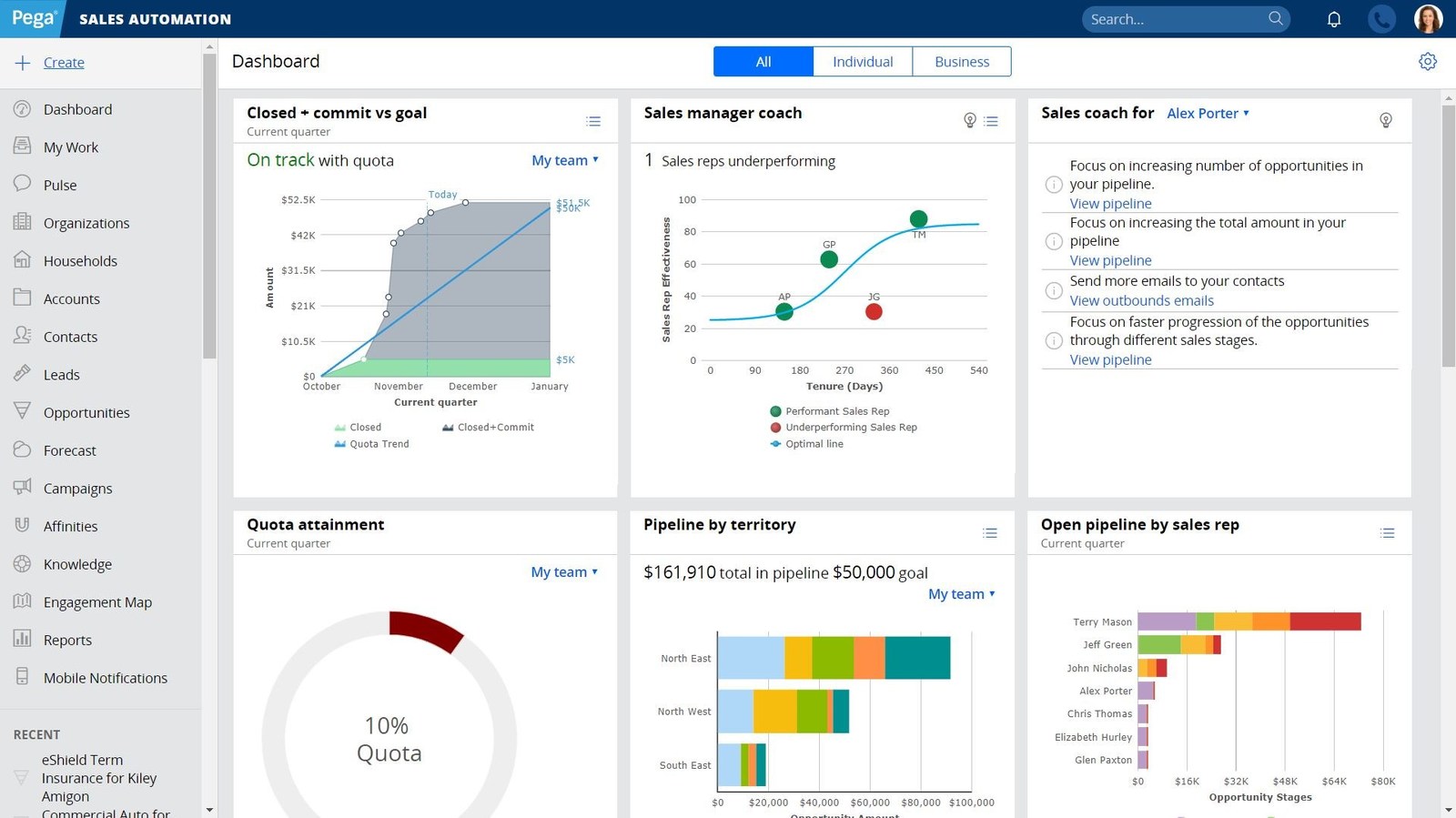
This screenshot shows the Pega Sales Coach dashboards within Pega Sales Automation from Pegasystems. Pega’s real-time Sales Coach provides one-to-one coaching actions and predicts the success of a new seller within a defined time period

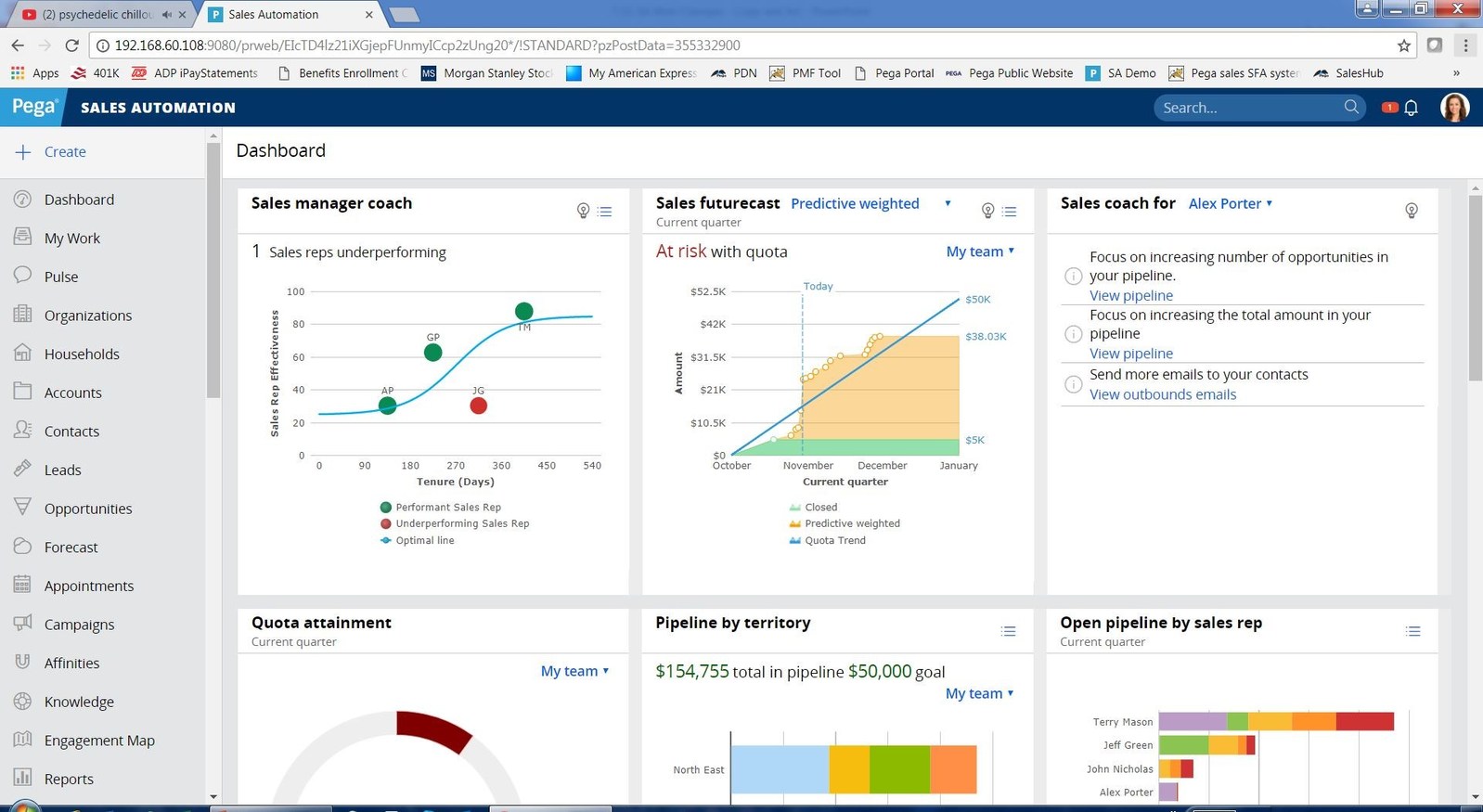
Pega Sales Coach uses AI to evaluate a seller’s performance by analyzing more than 50 distinct actions a typical sales rep takes each day. The software proactively alerts managers to underperforming sellers and generates real-time coaching tips to help them initiate progress, and close more deals. An intuitive set of dashboards gives managers an at-a-glance view into their entire team’s performance and tracks progress against coaching plans. Pega’s predictive analytics can give insight into the likelihood of success for new sellers in as little as three months – enabling organizations to react faster to underperformance trends.

Pega Sales Coach is now a standard feature within Pega Sales Automation, which helps organizations sell smarter, bust quotas, and simplify sales. While traditional sales tools typically serve as a Rolodex of miscellaneous sales data, Pega Sales Automation uses built-in AI to intelligently and dynamically guide each sales professional through every sales situation. Pega Sales Automation connects sales with other enterprise systems, such as in marketing and customer service, so decisions aren’t made in silos. This enables organizations to accelerate lead-to-cash timeframes and streamline work across the entire business. Forrester Research has named Pega Sales Automation the top-ranked current offering in its latest The Forrester Wave report evaluating Sales Force Automation solutions.

Pega Launches First AI-Powered Sales Coach to Teach Smarter Selling
This screenshot shows the Pega Sales Coach dashboards within Pega Sales Automation from Pegasystems. Pega’s real-time Sales Coach provides one-to-one coaching actions and predicts the success of a new seller within a defined time period
Pega Launches First AI-Powered Sales Coach to Teach Smarter Selling
Don Schuerman

Don Schuerman, CTO, and vice president, product marketing, Pegasystems, added, “Until now, the only clear and reliable sign of an organization’s sales performance came when the sale was won or lost. Using predictive analytics, each sales rep can now get real-time coaching that will impact deals in progress and uncover hidden leads and opportunities. We’re redefining sales automation from a static database into a dynamic assistant that makes good salespeople great.”

Also Read: Pegasystems Appoints Jeff Taylor as Senior VP of Strategy and Go-To-Market Operations

In addition to Pega Sales Coach, other features included in this latest Pega Sales Automation release include:

  • Pega Knowledge, which intelligently delivers accurate and consistent content to sales teams based on the specific sales stage, industry, or competitor of focus.
  • AI-based lead ranking, which integrates 19 predictors that span lead, contact, organization, and sales representative data to help individuals prioritize lead qualification and follow-up.
  • Pega Sales Coach is available today for Pega Sales Automation customers with current support contracts. It will also be demonstrated at the PegaWorld conference to be held on June 3-6 in Las Vegas at the MGM Grand.

Recommended Read: Pegasystems and Idio Join Forces for AI-Driven B2B Content Intelligence

InsideSales.com Announces Next-Gen AI Technology for Sales 

0
InsideSales.com Announces Next-Gen AI Technology for Sales 

InsideSales.Com to Showcase a Breakthrough AI-Based Technology for Organizations to Identify Untapped Sales Value

InsideSales.com, a leading AI growth platform for sales, showcased the next generation of AI technology to help sales leaders get actionable insights on their performance as compared to industry and cross-industry data. This groundbreaking technology will offer leaders a real-time view of performance and actionable AI recommendations to build pipeline and close deals.

Recommended Read: [24]7.ai Removes Time, Cost and Risk Barriers to Chatbot Deployment
At the time of this announcement, Dave Elkington, CEO of InsideSales.com, said, “We’re continuously raising the bar on what the future of sales performance looks like.”

Dave added, “We want teams using artificial intelligence to be able to see, in real time, how they are doing compared to other companies in their industry—and how AI is making a difference to their sales efforts.”

Read More: The UK’s Largest Hubspot Partner – The B2B Marketing Lab – Moves Into New Central London Office

Elkington continued, “This technology will tap into the trillions of anonymized data points we’ve collected from thousands of companies to create benchmarks for key performance indicators in each industry. Sales leaders and professionals will be able to see instantly how their team is performing and what the AI engine recommends they change to be successful.”

Suaad Sait, President of Growth, InsideSales.com, said, “With the seismic shift in buyer behavior, InsideSales.com goes beyond the limitations of CRM reporting and the confines of business intelligence solutions to help sellers sell in the way buyers buy.”

Currently, InsideSales.com offers the leading AI-fueled sales acceleration platform. Powered by Neuralytics®, a predictive analytics and AI engine with the industry’s largest collection of sales interaction data, the platform helps sales teams close more sales by efficiently engaging with the right prospects, at the right time, in the right way.

Read More: S4M Co-founder Stanislas Coignard Takes Over As US CEO to Focus On US Expansion

Webinar World TechBytes with Annie Lei, Chief Revenue Officer, AmpLive

0
Annie Lei AmpLive

Annie Lei
Chief Revenue Officer, AmpLive

The foremost question at the ongoing Webinar World’18 is -‘How to put the personal back in marketing,’ – with a focus on how to build context-based campaigns and deliver events that put the customer first and foster authentic engagement between the audience and the brand. In the run-up to the event, we spoke to martech thought leaders speaking at the event. We spoke to Annie Lei, Chief Revenue Officer, AmpLive to understand how she leverages technology to reach out to customers.

Html code here! Replace this with any non empty text and that's it.

What are you excited to speak about at ON24 Webinar World 2018?

I’m excited for the opportunity to educate people about new ways of targeting and expanding audiences for live content. In particular, I’m excited to get the word out about live stream audience growth and distribution. Marketers spend a lot of time thinking about content, promotion, and registration, but there are better, more efficient ways to make sure people see your live content.

What do you believe is necessary to foster authentic engagement between your customers and your brand?

Two major things are vital to foster authentic engagement between our customers and our brand. First, it’s important to put yourself in your customers’ shoes, and really think about what it is that you would need to learn and achieve from the product. I try to always re-read or review content and think about what value I would have taken from it if I hadn’t known anything about it beforehand.

Second, we try to always listen and pay attention to our audience. They’re always communicating, either through words or actions and ignoring how people react to our message would be counterproductive. With our most recent product update, for example, our customers were a huge driving force in the new features that we added. Listening to our customers and letting them drive our product’s evolution has allowed us to build a sense of collaboration and community that continues to help us grow the live ecosystem.

What are you hoping to take away from Webinar World 2018?

Personally, I’m looking forward to learning more about how other people are taking advantage of the live medium. It’s an exciting and creative time for live content, and Webinar World will be a great place to see what people have come up with.

How should marketers leverage marketing technologies to empathize with customers?

Marketing technologies provide important insight that can help marketers step into the shoes of their customers. Social media lets us ask our customers how they feel about things, and automation platforms let us see how they react and engage with our content, which teaches us about their tastes and personalities. All of these things help us know our customers and empathize with them.

For example, AmpLive provides insight into what types of audiences are engaging with different kinds of live content, which helps companies get more strategic about how they interact with audiences. Marketing technologies that allow marketers to deliver content live provide a unique opportunity for people to communicate with their audiences directly and in real-time. In order to empathize with customers, you have to know them. What better way to learn about what motivates your customers than to have real conversations with them?

How do you leverage webinar marketing tools to engage with your online audience? How does it help you build a strong sales pipeline?

Webinar marketing tools are great because they allow you to reach a large number of people all at once, in a particularly human way. You get to put a face on your brand, engage with your audience, and learn from them all while teaching them something useful that (hopefully) leads them back to your product or solution. I think webinars help us establish ourselves as authorities on certain subjects, help us build trust with our audiences, and help us reach a lot of new people (especially through distribution). Of course, they need to be approached strategically, and the impact of a webinar on sales pipeline can vary depending on the promotion, distribution, and retargeting efforts of marketers and organizers.

AR/VR/Webinars and Event Automation– How do you predict online experiences will change with rising technologies, from promotion to event engagement to follow-up?

We can already see things becoming much more targeted and dynamic. Our online experiences will become much more individualized and tailored to our unique interests. Promotion, event engagement, and follow-up will all adapt to this new level of personalization. Also, we are discovering that live content can be incredibly powerful when it’s part of a larger, longer game involving tracking and retargeting audiences based on engagement. Taking live content to the next level requires tools, which we’re always striving to refine and strengthen.

Thanks for chatting with us, Annie.
Stay tuned for more insights on marketing technologies. To participate in our Tech Bytes program, email us at news@martechseries-67ee47.ingress-bonde.easywp.com

How to Beat Procrastination with a GDPR Marketing Compliance Plan?

2
GDPRMktgCompliancePlan

Unless you’ve been hiding under a rock for the last few months, chances are you already know what GDPR is. The General Data Protection Regulation is a legal framework that sets guidelines for the collection and processing of personal information of individuals within the European Union. To underscore this: As long as you have EU data in your company database, GDPR applies to you. US companies aren’t “spared.” Ignore it, and you’ll risk hefty penalties of up to €20M or 4% of your company’s annual revenue, whichever is greater.

Also Read:  Dreamforce TechBytes with Ed King, CEO, Openprise

GDPR will take effect in May 2018. But despite the disappearing runway, many of us still aren’t ready. In fact, when Openprise surveyed 500 professionals on GDPR readiness last November, 60% admitted they hadn’t even started planning or taking any preparatory steps towards compliance. In this article, we’ll examine why so few are prepared for this regulation and provide an easy-to-follow GDPR compliance plan to help you get started.

Also Read:  You Are in Control… How GDPR Will Revolutionize Location Marketing

First off, why are we dragging our feet and procrastinating? Shahram Heshmat, Ph.D., published an article on Psychology Today that suggests five common reasons:

 The absence of structure: Fire drills demand our immediate attention. A Slack message from the product team. The latest Harvard Business Review article that you want to retweet. Distractions are everywhere and it’s easy to lose sight of priorities in the face of urgency.

Timing. Tackling GDPR now, at this very moment, seems much more painful than tackling it mañana…so it’s tempting to put it off.

Unpleasant tasks. Very few of us would consider GDPR a “fun” exercise. If we’re honest, we might even call it “boring” and “dry.”

Anxiety. Procrastinators tend to avoid challenging tasks in order to relieve stress, even if those tasks are high priority. Sounds familiar?

Self-confidence. Are you avoiding having to deal with GDPR compliance because you aren’t sure how? Join the club. In fact, even in Europe, 51% of the companies believe the regulation is too complex, according to a new research conducted by the European Business Awards on the subject.

But fear not. GDPR isn’t as tedious as you might expect.

Also Read:  Marketing Op’s Guide to GDPR Compliance

Follow the three simple steps in the GDPR compliance plan below. Its bite-sized action items will make the exercise less daunting, reduce stress, and boost your confidence in becoming GDPR compliant before the regulation takes effect in May.

Step 1: Understand GDPR’s impact on marketing

Allow two to four weeks for this step.

As a marketer, you’re not responsible for appointing a Data Protection Officer within your company. However, because a lot of personal data resides in marketing and sales databases, you should —

– Work closely with your Data Protection Officer to build a scalable process.

– Train your in-house team and contractors on the policies and processes.

– Understand the impact of technologies on your business operations.

Step 2: Review your company’s data collection policy, processes, and practice

Allow four to six weeks for this step.

– Take inventory of your databases for EU citizen data.

– Make sure you obtain consent from the people already in your database and implement a double opt-in process for new leads.

– Review and document your data collection policy to ensure you have a relevant and defendable business reason for the data you do collect.

–  Determine whether it makes sense to create a separate process for EU data, or apply that same process to your entire global database. We recommend the latter, as the other parts of the world are quickly following suit, and the need to protect EU personal data is universal.

– Document, monitor, and audit the flow of data among your systems and between data processors.

– Create processes so you can promptly respond to data owner requests within 30 days, per GDPR requirements.

Step 3: Identify gaps and implement changes to ensure GDPR compliance

Allow six to eight weeks for this step.

– Assess your data, processes, training, and technologies to identify compliance gaps.

– Understand what kind of control you already have in place, make sure it’s up to date and can adequately handle GDPR mandates.

– Implement changes accordingly. There are data orchestration platforms out there that can help streamline the process and ensure GDPR compliance.

Also Read: The One Value that Salesforce and GDPR have in Common 

Ultimately, GDPR is about building a culture of privacy. It impacts every company who holds EU citizen data. You must respect the privacy rights of individuals; run a disciplined database comprised of engaged, targeted, and opted-in individuals; have control over the handling of EU personal data; instill pervasive awareness in everyone who touches the data; and establish accountability and credibility.

The regulation to monitor the use of personal data is necessary, and in just a few months it’ll become mandatory. While it’s tempting to procrastinate as the task might seem daunting, don’t cave in. Turn off social media. Mute your phone.

Stop checking emails every five minutes (no, it’s unlikely things will come crashing down). Invest a few hours to think through GDPR compliance and what it means for your company.

It’s an exercise that could save you a minimum of €20 Million in potential fines—that alone should be reason enough to make it a priority. Don’t be a company that makes the PR-disaster headlines.

Follow the suggested steps and tackle GDPR compliance head on, get ahead of the game, build a trustworthy data practice and a reputable brand in the process. It’s worthwhile to work that will pay off in the long run.

Also Read:  3 Reasons Why Marketers Should Welcome GDPR (Other Than Because It’s Required!)

error code: 1010