Home Blog Page 4368

Openbridge Launches Premier ‘Data Marketplace’ for Integrations and Tools

0
Openbridge
Openbridge Launches Premier "Data Marketplace" for Integrations and Tools

Openbridge Released a New Marketplace with over 600 Data Integrations and Analytics Tools to Accelerate Insights Efforts.

Openbridge, a leading provider of data pipeline solutions, introduced new data marketplace for integrations and tools that will accelerate the way companies harness data to deliver insights to decision-makers.

The new Openbridge marketplace solves one of the biggest challenges companies face today – an increasingly diverse and complex data and tools ecosystem. As more companies attempt to create a unified view of their consumers, they are finding data locked away in various marketing, mobile, social or media platforms. As a result, the data that fuels the insights decision-makers need is often out of reach.

Also Read: Openprise Launches ‘Openprise Data Marketplace’ to Normalize Data Ingestion and Unification

The Openbridge data marketplace makes it easy to discover data integrations and tools that are critical to the insight efforts of marketers, analysts, data scientists, and developers. These teams can now discover diverse data integrations and analytics tools they need across multiple data product and service providers.

The marketplace represents a rich catalog of social media, advertising, support, e-commerce, analytics, and other marketing technology categories. It includes 600+ data sources like Google Analytics 360, DoubleClick, Instagram, YouTube, Adobe Analytics, Facebook, Salesforce, Marketo, Zendesk, Hubspot and more. The marketplace will also include tools for data analysis, visualization, reporting and analysis like Tableau, Looker, Chartio, Mode Analytics, Microsoft Power BI, Qlik and others.

Also Read: Base Snap Marketplace Brings Plug-and-Play Integration to Sales Automation

Thomas Spicer
Thomas Spicer

“Being data-driven means having immediate and usable access to data, regardless of where it may be located today,” said Thomas Spicer, founder and CEO of Openbridge. “The Openbridge marketplace ensures simple and easy access to the largest possible selection of data integrations, analytics, query and visualization tools. By focusing on streamlining complex and time-consuming data pipeline processes for companies we can help them deliver more value to business users and decision-makers.”

The marketplace also provides product and service companies with a pipeline of qualified leads, revenue-generating customers and access to sought-after enterprise accounts. Beginning today, more than 600 data integrations and tools will be available via Openbridge for companies to easily connect with the data they need.

Recommended Read: Adobe Unveils New Advanced Analytics Products for Faster, Better Customer Intelligence

Infusing Military Tactics Into Marketing to Win Customers

0
Infusing Military Tactics Into Marketing to Win Customers

DemandJumpWhen you think of marketers, you likely don’t think of them using military strategies as one of the tactics in their business. But, that’s exactly what marketers at some of the top e-commerce companies in the world are doing. Businesses are using the flank military strategy to win over customers. The flank military strategy is a strategic and concentrated movement where someone surrounds a particular area to achieve an advantageous position over an enemy. But how does this apply to marketing?

New entrants to a retail space, or any brand looking to seize market share from dominant competitors, will uncover powerful traffic sources that may be under-leveraged or unknown to category leaders. We often see dominant brands in an ecosystem investing most of their time and resources into only the largest sources of traffic, such as Google, Facebook and massive affiliate websites. But new entrants are finding success with hugely powerful specialty blogs, niche websites, and highlight targeted affiliates. Previously, some of these websites could have been deemed too small or unimportant. The flank military strategy helps new entrants build brand awareness, grow revenue and eventually prepare brands, both financially and from a branding perspective, to start going head-to-head with traditional players on larger marketing and advertising platforms.

It’s now easier than ever for anyone to start a website and start selling something online. This means that everyone is a competitor, and there are new competitors added every single day. This information is especially important as we approach the holiday shopping season, as it can represent as much as 30 percent of annual sales for many retailers. So when planning out a holiday marketing strategy, it’s never been more important to look at all of your competition. Big box chains who think they’re only competing for customers against other big box stores are wrong, and they will lose a huge mass of potential customers.

How did this happen?

This type of strategy has been impacting stores for a long time, but it’s steadily increased over time. Let’s talk about Walmart versus Target. When Target started trying to take Walmart’s customers, specifically in the ‘90s, they didn’t even scare Walmart. They couldn’t compete with the size of the Walmart footprint alone. They couldn’t offer the things that Walmart did, and Walmart didn’t think they’d ever lose customers or market share to someone like Target. So Target picked a couple of categories they wanted to dominate – financial services and fashion. One by one, Target started beating Walmart in these categories, and more. They peeled off one layer of customers at a time, and converted them from Walmart-lovers to faithful Target shoppers.

It’s no surprise that these days everything is online. From ordering fine jewelry to toilet paper, you can do it with the click of a button on your computer or your smart phone. And while major retailers like Walmart, Target and Amazon are winning a large share of the marketplace, they’re not the only brands that companies need to be concerned about.

Read More: ThirdChannel Series-A Funding Accelerates Growth of Digital Retail Intelligence Hub for Physical Stores

Examples of category killers

Let’s take a look at men’s shirts. Who do you think sells the most? Macy’s, JC Penney, Nordstrom? Well, you’d be right. But, there are new entrants to this space who are using specialized blogs to reach a nice audience ahead of these top department stores. Bonobos, Club Monaco and UnTUCKit are gaining traction on these stores by gaining traction on these stores to the tune of 18 million people. While Nordstrom is getting traffic from more than 475 million people, and yes, that’s a lot, why would they want to miss out on the other 18 million people who could be potential customers? That’s a lot of shirts, and a lot of money in their pocket.

Savvy retailers are building partnerships with new-age media partners, and it’s paying off big. UnTUCKit is the only competitor in the men’s shirt space that’s leveraging Barstoolsports.com – a highly targeted and widely followed sports media company. This is turning into a highly profitable decision for them, driving more than 6 million people to their website in the past 12 months alone.

The bottom line is that new entrants are competing – and winning – across a variety of traffic sources. There’s opportunity everywhere – including social media (both paid and organic). Users consistently show that they’re willing to engage with new brands, especially when the offering is new, exciting or different.

How can department stores prepare?

Now that we know the problem, how can department stores prepare for these category killers and protect their business? They must focus on three main areas: margin, traffic and brand/relationship, and defend these areas at all costs.

  • Margin: If you think that your only competition is other big box retailers, you will dissapear. It’s important to know which categories your store controls, and make sure you keep controlling those categories.
  • Traffic: Know which traffic sources are driving people to your website, and know which of those people are turning into customers. Also thinking about which products you are selling that are bringing actual foot traffic into the store. Utilizing tools with prescriptive attribution and analytics will help determine these traffic sources, and help you make the most impactful use of your marketing dollars.
  • Brand/relationship: Keeping a positive reputation with your customers is key. Customer service isn’t the same as it was 20 years ago – it’s evolving, and you have to be evolving with it. Each time customers see evidence of design and technology that makes their lives easier, they expect to find it everywhere. Don’t lose your customers due to poor or outdated customer service.

Identifying your competitors is a much more difficult task than it once was. It’s important to stay aware of all emerging competitors, and diligent about finding the right ways to target the right type of customers. Keep your focus specific, know your customers, and cater to them, and win this holiday shopping season.

Recommended Read: 2018 Checklist for Marketers: Social Media Intelligence

TechBytes with Daniel Waas, Director of Marketing, LogMeIn

0
Daniel Waas LogMeIn

Daniel Waas
Director of Marketing – LogMeIn

Webinar marketing has become a buzzword of sorts in martech.We spoke to Daniel Waas, Director of Marketing, LogMeIn to understand the nuances of webinar marketing.

Html code here! Replace this with any non empty text and that's it.

MTS: Tell us about your role at LogMeIn and the team you handle?
Daniel Waas: Here at LogMeIn I serve as the director of product marketing for GoToWebinar. My background is in demand gen. I used to run the marketing for the GoTo products in EMEA. Back in Europe, I had three teams. One each in the UK, Germany, and France. My team ran up to 100 webinars per quarter across three languages and we saw great success with the program. That ultimately got me so interested in GoToWebinar that I wanted to go beyond just marketing the product. I wanted to get involved with the product roadmap and that’s what I’ve been working on heavily since moving to the US in late 2014. As a demand marketer, one of the opportunities I saw was to make better use of on-demand content as a constant source of new demand. That idea is the core of our newest product, GoToStage.

MTS: What was the idea behind releasing the Big Book of Webinar Stats?
Daniel: My team engages with our customers every day, be it through our webinar program or in 1:1 conversations and there are a couple of questions we get all the time – questions like “What’s a good attendance rate?”, “What’s the best time to host?”, “How can I be more successful with my promotions?” With the Big Book of Stats, we wanted to provide definitive answers to these questions that are based not on anecdotal knowledge, but on the massive dataset of actual webinar data we have. Our 55,000 customers run millions of webinars on our platform every year, reaching more than 60 million viewers and that number is growing. That puts us in a unique position as nobody else in the industry has a comparable footprint.

MTS: What are the most astonishing revelations from the book that you would like to share with our readers?
Daniel: When I presented our findings at INBOUND this year there were a couple of insights that stood out to the audience. One of the most surprising was the level of engagement. We found the average attendee spends 61 minutes in a webinar. Where else do you get to spend 61 minutes live with a prospective buyer?

The other big aha moment was the limited impact of the attendance rate. Webinar organizers obsess about their attendance, yet our research has shown that 26% of registrants never even intend to show up live. They’re signing up with the explicit goal of getting access to the recording and want to watch on-demand, on their own time. A trend and need we’re servicing with our new on-demand platform, www.GoToStage.com. And to add to that, we found that 42% of the top 100 webinars run on our platform in terms of attendance actually had a sub-par attendance rate. So what really matters is how you promote the event, not the attendance rate. Accordingly, what most resonated with the audience were our insights on how to boost registrations: the effectiveness of co-marketing, simple tweaks to your webinar title that can increase registrations by up to 43% and of course the optimal times to promote and host.

Also read: Interview with Aseem Badshah, CEO, Socedo 

MTS: What would be the next frontier for in live events, on-demand video or content marketing?
Daniel: I see on-demand video as the next frontier in B2B and in the content game. Research shows video is the preferred way for how people want to learn. In an ocean of written content, remarkable video content is a great way to stand out. From a webinar perspective the move with to on-demand with GoToStage is also interesting because it allows our customers to scale beyond the live event. Live is great for customer engagement and interaction, but by adding a stronger on-demand component marketers can get a better return on great content they already have.

MTS: Are webinars the new-age B2B customer advocacy programs?
Daniel: Webinars can certainly play a role in advocacy. Existing customers frequently join our webinars and this is the easiest way we can truly connect with them at scale. We want to be as authentic as we can possibly be when we’re engaging on video live and to have as much fun as we can get away with. To me that is the key difference between a webinar and other content tactics. Only on a webinar will you be able to build rapport. That said customer advocacy to me is more of a second-tier goal for most of our customers. Generating awareness and new demand is the number one goal we hear from customers, followed by fostering customer engagement and loyalty.

MTS: 2018 is already seen as the “Year of Hyper-Personalization”. How should marketers firm up their action plan to optimize marketing campaigns around webinars?
Daniel: There are two elements to this. One is the promotional side. You’ll want to make sure you have great audience/topic fit and a tight targeting in your promotional efforts. We’ve had great success using 30-60s promo videos for each of our webinars, where we deliver a concise what’s-in-it-for-me that pulls people in. The second element is the interaction during the webinar. The easiest way to personalize your delivery to the audience is to get their feedback early and often. So actively asking the audience open-ended question via the chat and making ample use of polls and Q&A to get an understanding of where the audience is at, so you can respond to their needs on the fly. The polls and surveys are also a great way to ask qualifying questions that you can re-use in your marketing automation system to further personalize your email communication.

MTS: How do you utilize data science and machine learning algorithms to create customer value?
Daniel: On our new platform, GoToStage, we use machine learning extensively to personalize content recommendations for our audience. And as for data science, the Big Book of Webinar Stats is a great example of how we use the smarts of our data team in combination with the data in our system to generate valuable insights.

MTS: Thanks for chatting with us, Daniel.
Stay tuned for more insights on marketing technologies. To participate in our Tech Bytes program, email us at news@martechseries-67ee47.ingress-bonde.easywp.com

Also Read: How will AI Feed Account Based Marketing?

Informa Engage Identifies Key B2B Marketing Trends in 2018

0
Informa Engage

Based on a Direct Survey of Companies in Sectors Like Automotive, Technology, Aviation, Manufacturing, Infrastructure, Wealth Management and Others, Informa Engage Compiled an Incisive Look at What’s on the Minds of B2B Marketers 

Informa Engage, the global leader in marketing services, releases a new “B2B Marketing Trends Report,” which examines the key trends, challenges, and priorities facing B2B marketers in 11 high-growth markets.

Results show that marketers’ priorities differ by industry. For example, the percentage of vertical marketers who rely on content marketing ranges from a low of 23% to a high of 80%. The top three verticals that rely on content marketing and are planning to increase their spending in 2018 are Technology (80%), Industry & Infrastructure (65%) and Financial Services (61%).

Also Read: Why Video is Your Safest Platform to Increase B2B Sales Opportunities

Key B2B marketing trends:

  • Marketers at enterprise companies prioritize events (83%), social media (72%) and content marketing (68%) as their top tactics to engage decision makers.
  • Measuring success/ROI is the top content marketing challenge for 55% of marketers.
  • Nearly half of enterprise marketers (45%) plan to increase their content marketing investment in the coming year and 42% plan to increase social media spend.

Also Read: How B2B Marketers Can Prove Their Effectiveness to the C-Suite

3 Top Areas to Watch in 2018:

  • Content marketing will become more sophisticated
  • Marketing will become more data-driven and personalized
  • Measurement gets closer to single view of user

#1 Content marketing will become more sophisticated

B2B marketers will put their knowledge of the buyer’s journey into action and shift from generalized content creation to developing journey-based strategies where content is mapped to each stage. Seventy percent of B2B enterprise marketers use content marketing as their top solution today and 45% expect to see an increased investment in 2018. This refined approach requires a deep understanding of audience needs and industry motivators. To succeed, marketers will need to work with knowledgeable partners, such as publishers, to leverage their deep data resources. Additionally, topic-focused digital environments will emerge with a range of trusted editorial content, capitalizing on the “binging” behavior people have already demonstrated with entertainment content.

Also Read: B2B Marketing SaaS Platform CaliberMind Joins Terminus Cloud for ABM

#2 Marketing will become more data-driven and personalized

Sixty-three percent of respondents said that audience quality is a critical consideration when selecting a media partner and 46% consider campaign performance and/or a proven ROI. Almost half of B2B marketers struggle with finding decision makers in the right place on the buyer’s journey. Marketers cite that better data–as well as personalized messaging–will play a key role to ensure the right content reaches the right people and creates more authentic engagement. Also, choosing the right partners, and looking at new ways to use data and algorithms for activities like programmatic media buying is expected in 2018.

#3 Measurement gets closer to single view of user

Over half of B2B marketers experience challenges in measuring the success of their content marketing programs. Demand for data that integrates into large enterprise systems will be expected as will more technologies to provide a single view of a customer. What marketers measure, however, will continue to evolve. Easier-to-measure tactics are proving their returns on investment and receiving increased funding. And vendors that supply marketing services will need to improve their ability to prove ROI on marketing campaigns to become valued partners.

Recommended Read: 5 Missteps To Avoid While Managing B2B Data

Interview with Peter Friedman, CEO, LiveWorld

0
Peter Friedman LiveWorld

[mnky_team name=”Peter Friedman” position=”CEO, LiveWorld”][/mnky_team]
[easy-profiles profile_twitter=”https://twitter.com/PeterFriedman” profile_linkedin=”https://www.linkedin.com/in/peterhfriedman/”]

“The advancement of AI solutions is a powerful tool for a company to better understand customer data and the effectiveness of a company’s operations.”

On Marketing Technology

MTS: Tell us about your role and how you got here? What inspired you to start a content marketing company?
I’m the Founder, Chairman, and CEO of LiveWorld, which is a social customer experience company. We believe the most compelling content is the conversations with and among customers. My career has been centered around developing online and social network communities for people to communicate. Building software and services solutions that allow companies to participate in dialogue with their customers —even before social media platforms were used worldwide by billions of people. Prior to founding LiveWorld, I worked at Apple for 12 years and held the position of VP & GM of Apple Internet Services Division when I left the company. There our team pioneered many elements of what has evolved to social media today. We created AppleLink, which if it were here today would be considered a global Apple industry social network. We had a hand in creating AOL and Salon. Our last major program was eWorld, a critically acclaimed community-centric online service. But those were the days Apple was in chaos and they couldn’t see it through. Our core team left to create an Internet-based company that would do for other Fortune 500 firms what we did for Apple. Leverage the power of online community to deepen customer relationships. We also created a Facebook precursor, Talk City. But it was too early and we had to let it go in the great crash of 2001.  Since then we’ve been focused entirely on the other part of our business software and services to help large brands manage their customer conversations in online communities and social media.

MTS: Why do both automation and human review matter in ad moderation?
The rise of social media and messaging apps has taught me quite a bit about our evolving culture. As a society, we are increasingly facing the opportunity and challenge to balance automation and human labor. Whether that’s factories, cars, or social media.  The key success factor will be managing that balance fluidly as it will constantly change. It’s important to note that automation is a powerful way to scale moderation of advertisements and user content and to bring richer experiences to customers. But it still requires human oversight and some human engagement to make sure the content is appropriate and the customer experience is as desired

A blend of automation and humans is also valuable for marketing campaigns. Chatbots enable brands to scale simple interactions with customers and when automated solutions reach their limits they can be programmed to handoff the dialogue to a live agent. One of messaging’s strengths is its ability to provide personal conversations and create deeper relationships with customers by opening a two-way dialogue. The combination of chatbots and humans enable brands to be not just always on, which is about access, but also always present. Always present is about being there to help the customer in their daily lives, whether for purchase decisions or when engaging marketing content.

MTS: In a highly sensitive brand safety industry, what are the most effective ways to create more transparency to prevent dark post advertisements?
Facebook, Twitter, and Google have certainly come under scrutiny recently for dark post advertisements. Companies are being held accountable now more than ever for the ads that are posted across social media channels. Dark post advertisements must be labeled as “sponsored post” or “promoted post” and with links to the advertiser providing them to create more transparency on the messages being shared across social media platforms. A higher standard for transparency should be implemented. Brands and social media companies need to share details with users such as who paid for the post, how long it has been posted, who the ad is targeting, and how much was spent will provide greater insights about the impact of dark post advertisements.

MTS: What would it take the business leaders to fully leverage social media intelligence tools for better ROI and stay competitive?
The challenge for businesses is there is all this terrific real-time consumer information but they tend to point a tool at the ocean of data to see what they’ll find. Then, drown in that ocean. First one has to decide what decisions will be impacted and then design a focused social intelligence program to derive the information to support it. In order to capitalize on it you must have more than social media intelligence tools. The software applications are great for measurement and organizing data, but you also need humans to determine how to organize it relative to your industry, category and customer. Additionally, a person with domain expertise needs to analyze the data and funnel it back to the organization in order for them to respond and take advantage of these opportunities.

At LiveWorld, we fill the gap left by software platforms with adept social media marketers, analysts, and strategists. Working with brands we’re delivering reports to company executives, teams within the marketing department, and sometimes customer service. Based on the company’s ability to respond to that information, those reports range from daily to quarterly.

Staying competitive today requires knowing what drives the conversation in social media and not merely the easy metrics.

MTS: How does LiveWorld enable customers to build a strong Brand- Agency-Audience relationship?
We specialize in handling the speed and scale requirements of brands to engage customers 1-on-1 in real time and deliver personalized interactions with a human touch. Our software is designed to track and manage dialogue across any digital channel, with chatbots and live agents and integrate that customer data with enterprise systems. Companies are able to increase engagement, more quickly resolve customer issues, and improve ROI of social media, messaging app programs in marketing or customer service.

MTS: What are the impending challenges for brands in leveraging social media messaging platforms effectively?
Brands must adapt to the “always-connected” customer and shift their mindset from always-on to always-present. That might sound like a subtle change, but it isn’t. Rather than creating content that is available 24/7 for consumers to engage, brands now must find ways to proactively deliver value through education, entertainment, and assistance, so that you can be present throughout the day. Failing to meet this standard opens the door for competitors like Amazon that are eager to fill the gap.

Consumers want to interact with a brand in real-time when it fits their schedule, and meets their demands. The impending challenges for brands is how to scale conversations with consumers without losing the human touch the customer seeks.  It may sound like a daunting task, but it’s not when pairing chatbots with humans to respond to incoming messages. The selection of an advanced solution enables brands to communicate with individuals across social media and messaging channels on the preferred platform of each customer.

MTS: How do chatbot integrations influence full-funnel sales journeys? How should modern sales teams better utilize chatbots for social conversations?
Chatbots compress the sales cycle because it allows consumers rather than digital marketers to determine how quickly they move through a buying process. Conversational commerce will accelerate marketing, sales, and customer service because now your brand is in the pocket of more customers that ever downloaded your app. Messaging apps make these conversations 1-on-1 and private enabling more personalized messaging, proactive brand engagement, and ultimately more transactions.

Sales teams can leverage chatbots to initiate dialogue with customers and determine how they can best help them with their decision-making process. The key is to think of these automated brand conversations as more than simple a bot, but many different bots, or many different planned conversations. When built right, the marketing group is matching a bot and planned conversation with the correlating marketing tactic. These entry points for brand conversations can be advertisements, social media posts, consumer driven inquiries, etc. Once the conversations are initiated, then organizations need a simple way to connect customers with the experts in their company, so the bot can hand them off to close a sale that might be transactional but wasn’t completed with the chatbot. Digital marketers sometimes overlook that humans need a human connection and validation from the brand that what they’re buying is what they want.

MTS: What startups are you watching/keen on right now?
I’m always interested in learning about startups that are impacting the social media, messaging, and customer service industries and how companies are integrating AI and bots to advance solutions.

WeChat, the most popular messaging platform in China has made huge waves with being an essential part of the daily lives of people to communicate with brands, family, and friends. Just like Facebook’s Messenger, WeChat continues to evolve to be much more than a messaging app with the introduction of new features to advance payment and photo solutions.

Also, Unmetric, a social media intelligence platform company has been advancing the way brands can analyze, track, and discover content across social channels to provide their clients an edge over competitors.

MTS: What tools does your marketing stack consist of in 2017?
At LiveWorld we use a consolidated set of tools for marketing automation, email, search marketing, web and landing pages. We’ve integrated our marketing tech stack with sales automation, lead identification and a series of other tools to clean and update our contact database. We use a couple of social media listening and management tools that provide marketing analytics and insights to help sharpen our focus on audience targeting and content strategy. We also use cloud services to produce and edit video and deliver webinars.

MTS: Would you tell us about your standout digital campaign? (Who was your target audience and how did you measure success?)
One of our standout digital campaigns for a client was the original Dove Campaign for Real Beauty in 2004-2006. The campaign drove sales up by 51% – but the power of the campaign was more than sales. The strength of the campaign came from the overwhelming word of mouth chain reaction, fueled by social media and Dove’s online communities. It was discussed everywhere including Oprah, The View, and countless national consumer magazines.

Social media gave Dove the opportunity to interact with its female customers and create an environment that inspires loyalty. The campaign built a powerful brand narrative through shared stories and experiences, first among its customers and then with the brand.

Empowering women to tell their stories and build relationships was center to the success of the campaign. It was a powerful example of customer-centric emotional marketing versus product message marketing.

Ogilvy is the advertising agency behind the brilliant creative concept and ads, but we developed and managed the original online community and social media aspect of the campaign.

A more recent campaign is the Walmart Twitter Elves program. The campaign enabled Walmart to open friendly, charming, helpful, season-appropriate engagement — spreading the holiday spirit by interacting socially with people for a positive customer holiday experience.

Starting in November 2011, Walmart “Elves” on Twitter began a process of round-the-clock active listening to reach out with good cheer, solve customer issues, put customer experiences in the forefront, and allow customers to find and acquire what they needed. The elves were committed to helping customers navigate a harried shopping season, rather than just pushing promotions or answering questions. The personality of the program brought an element of unanticipated charm to interactions with shoppers, who clearly appreciated it.

Over the course of the holiday season the elves sent more than 8,000 tweets, reached over 700,000 users, directly engaged with more than 2,000 customers, and resolved or escalated to Walmart customer support 3,000 customer service inquiries.

MTS: How do you prepare for an AI-centric world as a business leader?
Technology is always evolving. AI is the future and must be embraced. As a business leader, the advancements of AI solutions are powerful tools for a company to better understand customer data and the effectiveness of company operations. However, the rise of AI shouldn’t eliminate the human interactions that take place within the company. There are many aspects of business that do and will require a human touch.  Not the least of which is customers, employees, and partners emotionally want a human touch. While change may be welcomed by some, resistance is also very common by others. It’s not enough to have a new technology no matter how great it is. The people in your organization have to be willing to embrace, accept, and leverage it. The value of AI can be tremendous, so keep the entire company involved in the transition to keep an open dialogue about the shift to new AI solutions.

Also Read: How Are Tech Marketers Managing Content?

This Is How I Work

MTS: One word that best describes how you work.
Persistent

MTS: What apps/software/tools can’t you live without?
I can’t live without Facebook, Messenger, Instagram, iMessage, and email. I’m always interacting with people across social media and messaging channels. Photography is a personal passion of mine, so I also cannot live without my photo apps. Currently iCamera, Leonardo and Whitagram.

MTS: What’s your smartest work-related shortcut or productivity hack?
My productivity hack for work is to organize what will and also what won’t get done each day. This approach enables me to prioritize on the tasks to focus on and complete every day.

MTS: What are you currently reading? (What do you read, and how do you consume information?)
When not exploring the news landscape on News & Guts, I enjoy biographies, science fiction novels, and assorted photography books. Currently, in those categories I’m reading: Leonardo da Vinci by Walter Isaacson, Death’s Mistress by Terry Goodkind, and Mastering Photoshop Masks by Robin Whalley.

MTS: What’s the best advice you’ve ever received?
The best advice that I received was from Steve Jobs when he said, hire people on the edge of greatness, and push them over that edge.

MTS: Tag the one person in the industry whose answers to these questions you would love to read:
Marc Lore

MTS: Thank you Peter! That was fun and hope to see you back on MarTech Series soon.

Also Read: How Can We Take Facebook Marketing to the Next Level?

[vc_tta_tabs][vc_tta_section title=”About Peter” tab_id=”1501785390157-b58e162d-0ae25a4b-c27aca64-108e51b0-80edaf37-bd3d3b23-ba35″]

Peter Friedman is a social media visionary and veteran with 32 years of online community and social media experience helping companies engage 1:1 with customers at scale. He is the founder, chairman, and CEO of LiveWorld, a trusted social media partner to the world’s largest brands, and author of The CMO’s Social Media Handbook: A Step-by-Step Guide for Leading Marketing Teams in the Social Media World. Friedman earned his MBA from The Harvard Business School and bachelor’s degree in American History from Brown University.

[/vc_tta_section][vc_tta_section title=”About LiveWorld” tab_id=”1501785390320-2d44fa50-740c5a4b-c27aca64-108e51b0-80edaf37-bd3d3b23-ba35″]

LiveWorld Logo
LiveWorld is a social content marketing company providing moderation, insight, and engagement. LiveWorld is a trusted partner to the world’s largest brands, including the number-one companies in retail, CPG, pharmaceutical, and financial/travel services.

We revolutionize the management of user content through innovative proprietary technology, leading edge services, and deep integration with client marketing and customer support teams. Scaling human review of user content and human touch points, LiveWorld removes obstacles that brands face, allowing them to engage more deeply in social media. In an innovative approach that encompasses review, management, and analysis of user content, LiveWorld provides 24/7 brand protection through “always on” moderation and engagement across social channels, applications, and sites.

The LiveWorld solution provides brands a competitive advantage through management of user content in sheer volume, resulting in amplified brand presence, and proven to improve social media marketing and increase customer loyalty.

[/vc_tta_section][/vc_tta_tabs]
[mnky_heading title=”MarTech Interview Series” link=”url:https%3A%2F%2Fmartechseries-67ee47.ingress-bonde.easywp.com%2Fcategory%2Fmts-insights%2Finterviews%2F|||”]

The MTS Martech Interview Series is a fun Q&A style chat which we really enjoy doing with martech leaders. With inspiration from Lifehacker’s How I work interviews, the MarTech Series Interviews follows a two part format On Marketing Technology, and This Is How I Work. The format was chosen because when we decided to start an interview series with the biggest and brightest minds in martech – we wanted to get insight into two areas … one – their ideas on marketing tech and two – insights into the philosophy and methods that make these leaders tick.

Best-in-Biz Awards Cites SAVO For Best Enterprise Product

0
SAVO
Best-in-Biz Awards Cites SAVO For Best Enterprise Product

SAVO Secured the Highest Distinction Awarded to Any Sales Enablement Platform as a Silver Winner in the Enterprise Product of the Year at the Best-In-Biz Awards

SAVO Group, the leading provider of enterprise-grade sales enablement solutions, has been named a silver winner in the Enterprise Product of the Year, Best-in-Biz Awards, the only independent business awards program judged each year by prominent editors and reporters from top-tier publications in North America.

SAVO secured the highest distinction awarded to any sales enablement platform and was one of only two sales enablement winners in the broad enterprise category.

Best-in-Biz Awards’ entrants range from innovative start-ups to large, global brands. Best-in-Biz Awards 2017 honors were presented in 65 categories, including Company of the Year, Fastest-Growing Company, Most Innovative Company, Best Place to Work, Support Department, Executive of the Year, Most Innovative Product, Best New Product, App, Event and Website of the Year.

Also Read: SAVO Introduces Dynamic Data Integration

Best-in-Biz Awards Cites SAVO For Best Enterprise Product
Jeremy Schultz

“We continue to make significant investments to provide an enterprise-grade solution including global language, high-security standards, system support for 1+ million sellers and more,” said Jeremy Schultz, EVP, Strategy, SAVO Group. “It’s gratifying to see Best-in-Biz recognize SAVO in this area while other sales enablement winners were recognized in the SMB category – a completely different level of support, security and functionality.”

Jason Liu
Jason Liu

“SAVO has been investing in product enhancements and we’re seeing the market respond with both recognition and business,” said Jason Liu, CEO, SAVO Group.

Also Read: SAVO’s Acquisition of KnowledgeTree Helps Consolidate the Sales Enablement Market


Most recently, SAVO has made significant product upgrades including:

  • A comprehensive technology upgrade signifying a move to Amazon web services.
  • The launch of a new reporting and analytics platform as part of its Sales Content Pro and Smarter Content line of products.
  • The release of next-generation capabilities in its core Sales Content Pro / Smarter Content products including a more modern, streamlined interface.
  • The launch of Dynamic Data to enable easy integration of real-time data into custom sales assets.
  • The launch of a new, context-rich web application for its SAVO|KnowledgeTree product.
  • New releases across its integration with Salesforce, enabling prescriptive content delivery to be more easily accessible across the full range of its sales content curation capabilities.

Winners of Best-in-Biz Awards are determined based on scoring from independent judging panels composed of prominent editors and reporters from well-respected media outlets. Best-in-Biz Awards’ uniqueness stems, in part, from this distinct composition of its judging panels, allowing it to best leverage the judges’ unparalleled expertise, experience, and objectivity to determine award winners. The 2017 judging panel included: Accounting Today, AdWeek, Associated Press, Atlanta Tribune, Business News Daily, Consumer Affairs, Entrepreneur, eWeek, Forbes, Harvard Business Review, Healthcare Innovation News, Inc., Investment Advisor Magazine, Laptop, MediaPost, Pittsburgh Business Times, Security Products Magazine, Wired, WLRN and Yahoo Tech.

Also Read: SAVO Moves to Merchandise Mart, Closer to Chicago Tech Center

“Reviewing this year’s entries in Best-in-Biz Awards was like going to an NBA All-Star game — you end up shaking your head in admiration, smiling and saying, ‘Oh man, that’s good,'” said Dale Dauten, King Features Syndicate, returning to judge the awards for the sixth year. “And then the next one is even better. It’s a top-that competition.” For a full list of gold, silver and bronze winners in Best-in-Biz Awards 2017.

The Best-in-Biz Awards is just one more award SAVO is adding to their prestigious trophy case. Earlier this year, they were also recognized as a Sales Tech Award winner, Smart Selling Top Sales Tool, 2X Stevie Award Winner, Software & Technology Awards 2017 for Best Global Sales Enablement Platform and Ventana Research 2017 Digital Innovation Finalist.

Recommended Read: How B2B Marketers Can Prove Their Effectiveness to the C-Suite

Cyara Honoured with Frost & Sullivan Excellence Award

0
Cyara Honoured with Frost & Sullivan Excellence Award

Cyara Selected as Global Customer Experience Testing Platform Vendor of the Year

Cyara, provider of the leading customer experience (CX) assurance platform, announced that it has been selected as a Frost & Sullivan Excellence Award recipient. The Frost & Sullivan Excellence Awards recognize companies around the globe that have risen above the competition and demonstrate outstanding performance.

Audrey William
Audrey William

“Frost & Sullivan recognizes best-in-class companies and Cyara is a standout in the rapidly growing CX market “Cyara is bringing leadership and product innovations to the CX market, and we are impressed with the long list of global brands using their solutions to drive innovation in CX. It is impressive to see an Australian start up scale and expand its footprint globally,” said Audrey William, Director and Head of Research of Information and Communication Technology, Frost & Sullivan, Asia-Pacific.

Read More: Monetate Partners with WBR Insights for Personalization Development Study

Alok Kulkarni
Alok Kulkarni

“This Frost & Sullivan accolade comes at an exciting stage of our growth, and we’re honoured to be recognised. “We continue to strengthen our presence around the world, as more and more leading global brands rely on Cyara to ensure an excellent customer experience,” said Alok Kulkarni, CEO and Co-founder, Cyara.

Frost & Sullivan’s Australia Excellence Awards, in its 12th consecutive year, evaluated companies on a variety of market performance indicators including revenue growth; market share and growth in market share; leadership in product innovation; marketing strategy and business development strategy. Frost & Sullivan analysts compare market participants and measure performance through in-depth interviews, analysis, and extensive secondary research.

Cyara helps its customers achieve success by enabling them to rapidly innovate in the customer experience lifecycle so that they achieve better outcomes while minimizing the risk of change, dramatically reducing the cost of testing, and reliably delivering precisely the experience they’ve designed.

Recommended Read: Adoreboard’s Emotion AI Feted For Enabling CX Improvements

What Does It Take to Be a Growth Hacker?

0
What Does It Take to Be a Growth Hacker?

Industry Experts at The Growth Marketing Conference Share Insights on How a Marketer Can Grow in His Business

Whether you’re a startup looking to attract more funding, or an enterprise creating a platform for innovation, it’s all about growth. From Silicon Valley dorms to New York City boardrooms, digital marketing teams are quickly becoming growth marketing teams. With everyone looking to scale, and some already succeeding, what are the secrets to growth success?

The Growth Marketing Conference that concluded on December 7 had more than its fair share of stalwarts looking to share what they have learned from their experience in the industry. Attendees were treated to hands-on workshops that tackled concepts like Advanced Conversion and Onboarding, User Acquisition, Advanced User Acquisition, Mobile Growth and B2B Growth Tactics.

We asked the experts to share some advice for marketers;

What Is Your Definition Of Growth Marketing?

Ada Chen Rekhi
Ada Chen Rekhi

Ada Chen Rekhi – Founder & COO at NotejoyGrowth marketing is a data-driven application of quantitative and qualitative tactics to drive customer acquisition, conversion, and retention with a product. Growth marketers think about the entire customer funnel to drive retained and engaged high-value customers, and typically work in a cross-functional team with product, design, engineering, and analytics teams.


Brandon Redlinger
Brandon Redlinger

Brandon Redlinger – Director of Growth at Engagio: Growth marketing is a process by which you run small tests at low risk as fast as possible to generate quick wins, then iterate and grow a specific business metric. Growth marketing is about creating a predictable and repeatable process through the collaboration of cross-functional teams, the use of qualitative research and quantitative data analysis, and the rapid generation and testing of ideas to uncover opportunities.


Hana Abaza
Hana Abaza

Hana Abaza – Head of Marketing at Shopify: Growth Marketing comes down to the ability to identify opportunities for growth and capitalizing on them. The actual tactics matter less than the single-minded allegiance towards the overarching goal and the approach. The best growth marketers I know are intentional and systemic in how they think about where to focus their time.

Read More: Understanding Customer Sentiment at Scale: The Secret to Digital Maturity

What Are The Key Skills Marketers Need To Become Growth Marketers?

Ada: As table stakes, growth marketers need to be quantitative. However, being quantitative is not enough. In addition to that, they need to be able to adopt an insights-driven approach that will enable them to build repeatable business processes that translate to growth at scale.

Brandon: There’s an age old debate about being a generalist versus a specialist. I advocate for Brian Balfour’s theory of the “T-shaped marketer” where you have a broad range of marketing skills but a deep depth of knowledge around a few skills. Some of the most important skills for growth marketers include:

  • Technical Chops– This is where the “hacker” mindset comes in. Though you don’t need to be a full stack developer, you do however, need to be able to use the tools effectively to carry out your tests. The quickly evolving technology today allows non-engineers to do very technical things.
  • An Analytical Mindset– Everything must be measured, analyzed, and more importantly, turned into insight. If you can’t measure it, you shouldn’t do it. This keeps all your growth efforts honest and accountable.
  • Creativity– Ideas are the currency of growth. Creativity can be fueled and enhanced, leading to an outpouring of fresh ideas from people and their teams.
  • A Deep Understanding of Behavioral Psychology– Humans behave in very irrational ways. Once we understand the subtle underlying influences in human behavior, we can understand and start to predict with more accuracy what they’ll buy, when they’ll buy it, and why.
  • Strong Communication– You must be able to articulate your ideas clearly to your consumer. Good copywriting can give you an unfair advantage over your competition.
Oli Gardner
Oli Gardner

Oli Gardner – Co-founder of UnbounceI actually prefer a name like “growth hustler”, because to me it’s about having a maker mindset, coupled with a restless desire for change, experimentation, and a lust for the new. The best growth marketers can make things, which requires some  development skills. Not hardcore programming chops (although that’s great), just enough required to build functional prototypes and MVPs. After that, you need to be a full stack marketer. You should be able to write, do a bit of design, understand basic analytics, and know how to use and integrate a wide variety of tools (email, CRM, messaging, CMS, Google Analytics, Google Sheets, Data Studio, etc.).

Recommended Read: Adoreboard’s Emotion AI Feted For Enabling CX Improvements

Adobe Breaks Down Wage Gap, Achieves Pay Parity in US

0
adobe wage gap parity US

Adobe announced that the company has achieved equal pay between men and women in the US, an important milestone in Adobe’s ongoing efforts to create an innovative and productive work environment for all employees.

“It means a lot to our US employees, and we’re excited to extend that same commitment to our global employee base in the upcoming year.”

Women are now making $1.00 for every dollar earned by male employees in the US, up from 99 cents a year ago. As previously announced, non-white employees are earning as much as white employees.

Over the last year, Adobe undertook a review of its job structure and analyzed its compensation practices, and then made small adjustments based on this review. Adobe is committed to maintaining pay parity and will disclose its US pay parity results annually as part of the Adobe corporate responsibility report.

“We were already close to pay parity in the US through our strong people practices, and now we are proud to have achieved and documented this last step of full parity,” said Donna Morris, executive vice president of Customer & Employee Experience at Adobe. “It means a lot to our U.S. employees, and we’re excited to extend that same commitment to our global employee base in the upcoming year.”

Building on this U.S. milestone, Adobe will continue to work to achieve global pay parity. The company is poised to achieve pay parity in India, its next largest employee population, early next year. The company first outlined its US and India parity timelines in September 2017.

In November, Adobe has unveiled its Adobe Cloud Platform to break down siloes and deliver connected experiences across Adobe and non-Adobe marketing tools. Adobe has added several new extensions from leading technology providers including 33 Sticks, Clicktale, Decibel Insight, DialogTech, Dun & Bradstreet, Evidon, ForeSee, LinkedIn, PebblePost, QuestionPro, and TrustArc.

NewVoiceMedia wins Frost & Sullivan Excellence Award

0
NewVoiceMedia wins Frost & Sullivan Excellence Award

NewVoiceMedia Won a Frost & Sullivan Excellence Award in the Cloud Contact Centre Services Growth Excellence Leadership Category

NewVoiceMedia, a leading global provider of cloud contact center and inside sales technology that enables businesses to have more successful conversations, has won a Frost & Sullivan Excellence Award in the Cloud Contact Centre Services Growth Excellence Leadership category.

Founded in 2006, The Frost & Sullivan Excellence Awards is now in its 12th consecutive year and seeks to recognize companies and individuals that have pushed the boundaries of excellence – rising above the competition and demonstrating outstanding performance in the Australian market.

Also Read: NewVoiceMedia celebrates double win in Corporate Vision’s 2017 Technology Innovator Awards

The award, which was presented at a ceremony in Sydney on 7 December, follows several recent victories for NewVoiceMedia including being named by Forbes as one of the world’s top private cloud companies and honored in the Sunday Times Hiscox Tech Track 100.

NewVoiceMedia’s cloud contact center and inside sales platform deliver more successful conversations to help organizations worldwide build a more personal relationship with every customer and prospect. The technology joins up all communications channels without expensive, disruptive hardware changes and plugs straight into an organization’s CRM platform for full access to hard-won data. NewVoiceMedia now serves more than 700 customers worldwide, including MobileIron, Lumesse, Vax, JustGiving and Canadian Cancer Society.

Also Read: Microsoft and SAP Join Forces to Give Customers a Trusted Path to Digital Transformation in the Cloud

NewVoiceMedia wins Frost & Sullivan Excellence Award
Dennis Fois

“This achievement underscores our commitment to offering the best possible technology on the market for driving more successful conversations for sales and service teams. Our cloud contact center and inside sales platform is attracting some of the world’s highest-growth businesses as we continue to drive innovation that transforms the way they connect with their customers and prospects,” said Dennis Fois, President and COO of NewVoiceMedia.

NewVoiceMedia’s cloud contact center and inside sales platform deliver more successful conversations. The leading vendor’s award-winning customer contact platform helps organizations worldwide build a more personal relationship with every customer or prospect. It joins up all communications channels without expensive, disruptive hardware changes and plugs straight into your CRM for full access to hard-won data. With a true cloud environment and proven 99.999% platform availability, NewVoiceMedia ensures complete flexibility, scalability, and reliability.

Recommended Read: Salesforce Platinum ISV Partner NewVoiceMedia Named Finalist in Top 10 Technology Awards 2017

Connekt Brings Interactivity and T-Commerce to Hisense Smart TVs

0
Connekt Brings Interactivity and T-Commerce to Hisense Smart TVs

Hisense Smart TV Viewers Now Able to Purchase the Brands They Love through Connekt’s ShopTV App

Connekt, the AI-driven technology company transforming TV advertising for the connected world, announced the integration of its ShopTV application into new Smart TVs made by Hisense, a global technology leader and consumer electronics manufacturer.

The integration means that consumers can interact and engage with brands and content on their Hisense Smart TV platform, and personalize their interactions by opting to receive offers and deals from the featured brands. Viewers can also go a step further and purchase the products that interest them through the ShopTV app.

Also Read: When Will Bots Have Their ‘Mobile Moment’?

Connekt Brings Interactivity and T-Commerce to Hisense Smart TVs
Mike Fitzsimmons

“Hisense is a great partner for Connekt. Together, we’re offering brands and advertisers more meaningful ways to engage with their targeted TV audience. For viewers, we’re giving them the power to browse and buy what they see on TV, the largest screen in the home,” said Mike Fitzsimmons, CEO of Connekt.

ShopTV, Connekt’s owned-and-operated application, drives the convergence of TV, advertising, and commerce – offering over-the-top (OTT) video and brand channel opportunities for advertisers to create interactive experiences for connected TV viewers.

Also Read: Twitter Debuts First-Ever #HolidayIsHappening Insights Campaign

Connekt Brings Interactivity and T-Commerce to Hisense Smart TVs
Christopher Clarke

Christopher Clarke, director of Partnerships and Emerging Media at Essence, a data-driven global agency that is part of GroupM, added, “We’re finding that our clients are aggressively seeking additional ways to innovate in the linear video space. This relationship allows us to make a large step and is a significant development for advanced TV.”

Connekt is an AI-driven technology company that is making TV advertising Smarter. Purpose built for a multi-screen, internet-connected world, Connekt enables its media and advertising partners to make TV ads more targeted, engaging and measurable. It does this by leveraging proprietary artificial intelligence, in-content ad delivery, and a patented t-commerce platform. With a Smart TV footprint of millions of U.S. devices and growing, Connekt is transforming TV advertising for the connected world. Current partners include CBS, HBO, LG, Nielsen, Showtime, Sony and TiVo, among others.

Recommended Read: Adobe Unveils New Advanced Analytics Products for Faster, Better Customer Intelligence

Confirmit Adds Machine-Learning Power and End-To-End Usability Enhancements

0
Confirmit
Confirmit adds machine-learning power and end-to-end usability enhancements

Latest Release of Confirmit Horizons Also Endorsed for Its Unmatched Security and Availability

Confirmit has released end-to-end usability enhancements, together with machine-learning powered analytics, that will benefit all companies deploying Market ResearchEmployee Engagement, or Customer Experience programs. Alongside these new innovations in Version 23 of Confirmit Horizons, Confirmit is proud to announce that its software has been successfully audited for SOC 2 compliance, and that it is prepared for the upcoming General Data Protection Directive (GDPR). In addition, Confirmit has achieved AAA rating from Dun and Bradstreet for the ninth consecutive year.

Terry Lawlor
Terry Lawlor

Terry Lawlor, EVP Product Management at Confirmit, explains: “With our latest release, we are targeting the critical market need for better survey engagement. That’s why we’ve included highly responsive survey layouts for more engaging mobile survey experiences, a streamlined Survey Designer drag-and-drop interface, and a new Dynamic Open Text question type for richer insights from open-end responses.”

Confirmit Horizons Version 23 offers new machine-learning powered text analytics in Confirmit Genius, responding to the growing need for using the right analytics to make smarter, faster decisions.

Additional usability enhancements include powerful new features in Confirmit SmartHub for advanced hierarchy management, for respondent upload and for feedback source mapping. This release also introduces Confirmit Go, an app for business users who need easy, on-the-go access to case management using Confirmit Action Management.

The new developments within the platform have been welcomed by Confirmit’s growing customer base. This year, the company has welcomed a record number of new clients to its ranks as well as signing renewals with long-standing customers such as BuzzBack, ICM Direct, LexisNexis, Mathematica, RS Components, and Virgin Money.

The complete range of new capabilities of the platform has been developed in direct response to market and customer requirements, and reflects Confirmit’s commitment to continual, market-leading research and development whilst meeting the latest security and compliance standards.

This commitment has been recognized across the industry, most recently with the successful completion of the Service Organization Control SOC 2 Type I examination for Confirmit and the Horizons software, in addition to the SOC 2 Type II examination already in place for the SaaS infrastructure on which the software is hosted. Conducted by Armanino, LLP, ranked #1 in “The Top 10 Fastest-Growing Firms” in the U.S., this comprehensive audit validates Confirmit’s strong commitment to the security, confidentiality and availability of the Horizons software and SaaS platform.

Ken Østreng, President and CEO, Confirmit concludes: “The enhancements to the Confirmit Horizons platform are a direct result of our close relationship with customers to ensure we help them develop the insights they need to drive their companies forward. As we head towards 2018, I’m excited by the opportunities ahead of us based on our outstanding technology, strong financial base, and exceptional customer roster.”

Also read: How B2B Marketers Can Prove Their Effectiveness to the C-Suite

PublicRelay and PR News Survey Highlights Critical Deficiencies in Media Data

0
PublicRelay Launches Industry-First Predictive Analytics Offering

Survey of Communication Leaders Reveals Lack of Confidence and Absence of Insightful Data

PublicRelay, in partnership with PR News, released the results of the study ‘The State of Data-Driven Communications Strategies,’ which surveyed corporate communications professionals at both Vice President/CCO and director levels to identify how they perceive metrics and the role data is playing in their communications strategies.

The study found that, when asked how prepared they are with data to make actionable decisions, nearly 75 percent of director-level communicators felt that while they sometimes have good data, the quality is not consistently reliable. Only 19 percent said they are prepared with accurate data they can trust.

The high-quality data outputs that practitioners are looking for include accurate share of voice comparison among peers and competitors, author and publication intelligence, information about industry influencers, how traditional media is being shared across social media, and sentiment for brand and reputational drivers. Considering that over 60 percent of VP-level and above communicators are asked by the CEO and Executive Board for this type of data-driven analysis, the survey found that 40 percent of practitioners find it difficult to understand the media analysis they receive and therefore spend a significant amount of time cleaning it up to discover and interpret the true insights.

Other key findings from the study highlight:

  • Accuracy and Insightfulness are Essential. 61 percent of respondents desire to make media intelligence more insightful. The most important changes VP-level and director-level communicators desire from their media relations intelligence process is better accuracy and insight, above speed, lower cost and comprehensiveness.
  • Inefficient Use of Time. Nearly 40 percent of director-level communicators find it difficult to understand the media data they receive and spend a large amount of time cleaning up the data to seek out legitimate insights. More than half of respondents are spending more time on media analysis and intelligence this year compared to last.
  • Desire to Focus on Other Activities. 69 percent of communicators said they’d rather spend time building strategic messaging plans and 65 percent said they’d prefer to spend efforts pitching or focusing on influencer outreach rather than media analysis.
Eric Koefoot
Eric Koefoot

“These findings clearly demonstrate the need for a fundamental shift in the way communicators generate trustworthy media intelligence to deliver on broader business goals. Senior communications executives are behind the eight ball as CEOs and boards are demanding decisions supported by data and not just gut instinct. What is deeply concerning is the prevalence of irrelevant metrics and a staggering lack of reliable data. It is clear that technology alone, including AI, is not even close to delivering the needed insight from marketplace conversations. Communicators need to invest in solutions that give them trusted data-driven answers that are board-worthy,” said Eric Koefoot, President and CEO of PublicRelay.
PublicRelay is a media analytics solution for communications and marketing.

Recommended Read: Data: Four Out of Five Millennials Purchased From Amazon in the Past Month

Radial and Blue Ridge Partner to Get Inventory Closer to Customers

0
Radial
Radial and Blue Ridge Partner to Get Inventory Closer to Customers

With Improved Forecasting and Logistics, the Partnership Helps Minimize Overstocks, Understocks and Time in Transit

Radial, the leader in omnichannel commerce technology and operations, announced that they have partnered with Blue Ridge Global, a provider of cloud-native supply chain planning solutions. Combining operational and logistics expertise with advanced machine intelligence, the partnership allows retailers to intelligently place inventory across locations and more accurately match supply with demand. Radial Inventory Optimization powered by Blue Ridge is part of Radial’s solutions that are designed to help retailers differentiate themselves and scale in today’s difficult retail economy.

As retailers face mounting competition, it’s more important than ever that they do everything possible to retain their customers. In the past year, more than 75 percent of Americans reported coming across out-of-stock items and 79 percent said that they would turn to a competitor if the product they are looking for is not available. It’s critical that retailers connect customer demand to the supply chain to reduce customer turnover, enhance customer experience, drive sales success and recoup up to $1 trillion per year in lost profits due to overstocks and out-of-stocks.

Together, Radial and Blue Ridge offer retailers a complete solution to solve two of their biggest challenges – inventory optimization and profitable order fulfillment. The solution:

  • Reduces stock outs through precision forecasts that blend predictive and statistical models of demand with supply chain signals for maximum accuracy.
  • Reduces excess inventory due to overstock and obsolete inventory through automated planning that continually optimizes for business objectives and produces action-ready recommendations that respect the unique logistics of the supply chain.
  • Reduces time-in-transit and exceptional transportation costs to offer more profitable fulfillment and improve customer experience by allocating optimal inventory across products, nodes and time.
Stefan Weitz
Stefan Weitz

“Optimizing inventory placement continues to be one of our client’s biggest challenges,” said Stefan Weitz, executive vice president, technology services, Radial. “Retailers could face significant losses because of their difficulty to accurately predict customer demand. Radial Inventory Optimization marries Radial’s fulfillment expertise with Blue Ridge’s expertise in data science and supply chain planning to provide a complete solution for retailers, so that they reduce losses related to overstocks and understocks.”

Jim Byrnes
Jim Byrnes

“As today’s retail climate grows increasingly competitive, companies need to be able to spot and plan for changes in customer demand before they even happen,” said Jim Byrnes, CEO of Blue Ridge. “By teaming up with Radial, we have been able to provide customers with unparalleled certainty to forecast customer demand, the speed to react to market conditions and position inventory where it should be, and the assurance of ongoing analysis and action-ready recommendations from expert practitioners.”

Also read: How B2B Marketers Can Prove Their Effectiveness to the C-Suite

Nielsen Launches New Performance Testing Solution For Mobile Video

0
nielsen

New Offering Provides Clear Understanding of Network Performance Impacting Consumer Experiences with IP-Based Video Delivery

Nielsen announced the launch of Nielsen Mobile Video Performance, the industry’s first and most complete video performance evaluation solution for IP-based video content delivery. Developed for mobile operators, Internet service providers, device manufacturers and content providers, Nielsen Mobile Video Performance evaluates streaming video quality on mobile and WiFi networks, benchmarks data across the industry and rates individual players on the factors which contribute most to positive customer experiences.

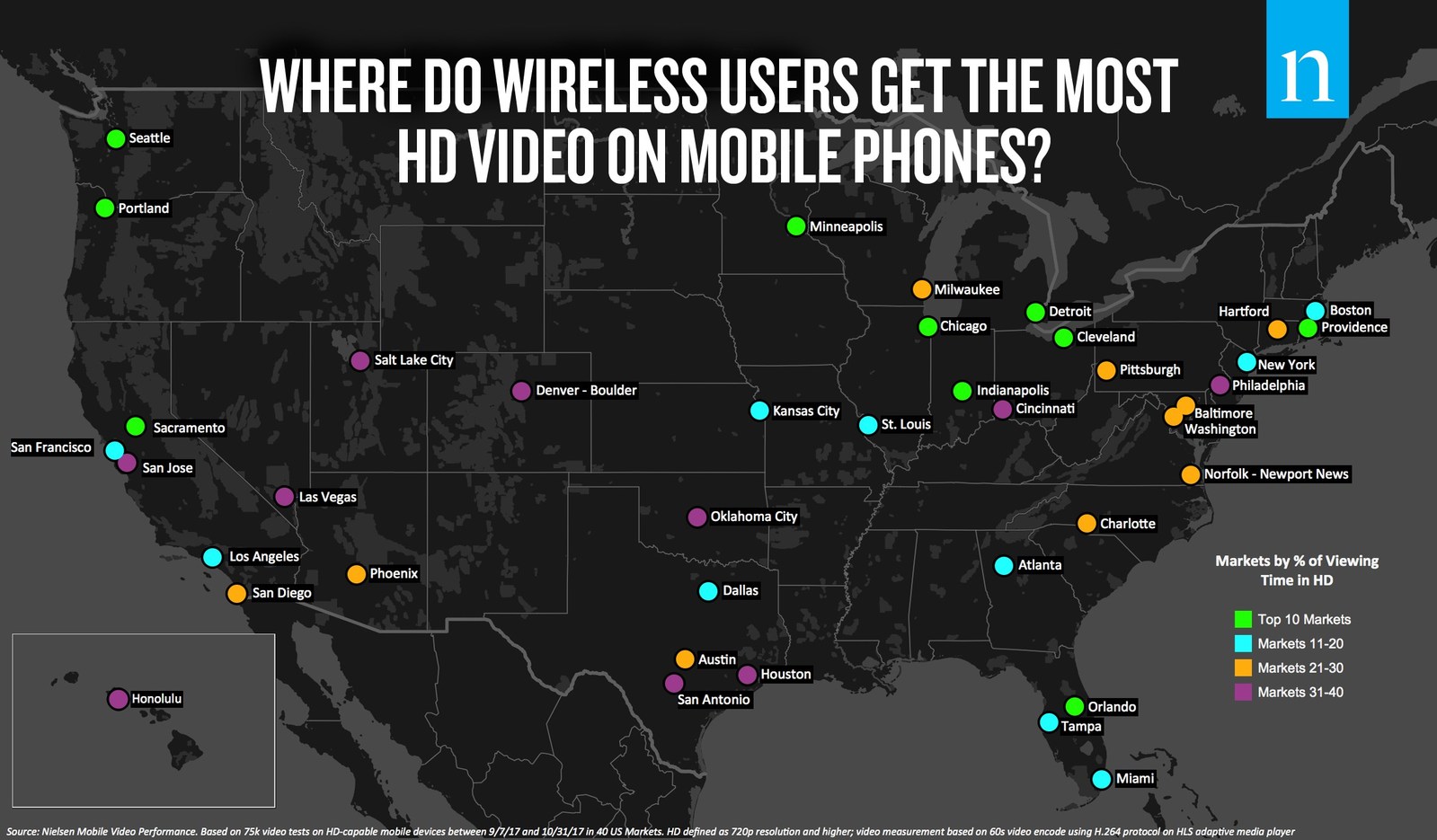
Where do wireless users get the most HD video on mobile phones?

According to the first quarter 2017 Nielsen Total Audience Report, monthly U.S. video consumption on smartphones jumped 81.5% year-over-year from 151 minutes in 2016 to 274 minutes in 2017. With mobile video viewing on the rise, the quality of the video experience is more important than ever. Companies that can consistently provide better streaming experiences than competitors have a distinct advantage in the fierce battle for subscriber acquisition and retention.

Nielsen Mobile Video Performance focuses on four key performance indicators that can make – or break – the video experience in the eyes of connected consumers:

  • Video resolution: Percent of viewing time in different viewing resolutions ranging from mobile (Low Definition) to HD (High Definition)
  • Startup time: The number of seconds it takes for video to load and play
  • Rebuffering: The total duration in seconds that the video stalls during playback
  • Video success rate:  Ability to launch and play a video in 60 seconds

Nielsen Mobile Video Performance leverages a panel of 70,000 U.S.-based participants to conduct a combination of active and passive video tests on mobile devices around the country. Nielsen’s passive testing method captures critical data on daily consumer mobile usage including network speeds of popular video platforms. Proprietary active testing techniques focus on the delivery and execution of pre-selected content centering on resolution, startup-time and stalls. Combined, these tests provide mobile operators, Internet service providers, device manufacturers and content providers a holistic view of network performance by region, consumer consumption intelligence as well as marketing insights to maximize ROI, inform product development and refine market segmentation.

Mike Greenawald
Mike Greenawald

“With the growth in mobile video usage, operators need to know how well they are meeting consumer demand,” said Mike Greenawald, Senior Vice President of Nielsen Service Quality. “Our initial results point to some wide variances in the ability to deliver high quality video content consistently. As the industry’s first solution to evaluate video performance using active and passive techniques, mobile operators will now have the advantage of translating the benefits of fast speeds into high-quality consumer experiences.”

According to data gathered by Nielsen, the industry’s most notable mobile operators deliver HD (720p or greater) quality video 69% of the time. By contrast, services at the opposite end of the spectrum deliver HD quality video only 39% of the time. With the industry average at 53%, Nielsen Mobile Video Performance solution identifies which players are over-delivering and those that are heavily under-performing high quality video experiences.

Diving deeper, Nielsen Mobile Video Performance data, based on 120,000 tests conducted on mobile devices from September through October 2017, reveals the following:

  • Consumers in OrlandoPortland and Seattle enjoy the best video viewing experiences, receiving HD video more often than consumers in New YorkLos Angeles and San Francisco.
  • Consumers in Salt Lake CityLas Vegas and Houston actually receive HD video less often than the national average.

By providing an understanding of how mobile operators measure up against competitors and industry benchmarks in addition to how well they work in specific locations and on individual devices, Nielsen Mobile Video Performance enables customers to focus network, product and partnership initiatives effectively as well as highlight key benefits in marketing efforts. Using this intelligence, the mobile industry can directly address slow video load times, rebuffering and playback failure, which is a critical step to increasing video consumption and usage.

Also read: How B2B Marketers Can Prove Their Effectiveness to the C-Suite

Frost & Sullivan Recognizes Zoom as Company of the Year in Video and Web Conferencing

0
Frost & Sullivan

Zoom’s Strong Focus on the Core Principles of User Experience and Pace of Innovation Is Eliminating the Traditional Barriers to Adoption and Successfully Disrupting the Market

Based on its recent analysis of the global video conferencing industry, Frost & Sullivan has recognized Zoom Video Communications with the 2017 Global Company of the Year Award. The advent of a new breed of cloud services is uprooting established business models and prompting businesses to view video conferencing as a key part of their digital transformation strategy. Zoom has led the cloud video services revolution and is disrupting the industry.

Zoom is a leading market vendor that has successfully transformed the audio, video, and web meeting experience, opening up the world of next-gen communications to the masses. Since entering the market in 2011, Zoom has seen rapid-fire growth to reach an impressive $1 billion valuation by January 2017. Its industry-leading technology and innovative go-to-market strategy pose a threat to established conferencing and collaboration vendors that have dominated the industry for decades.

Roopam Jain
Roopam Jain

“Zoom unifies cloud video communications, chat, and a software-based conference room solution into one platform,” said Roopam Jain, Industry Director, Enterprise Communications & Collaboration at Frost & Sullivan. “This single platform approach offers a simple and consistent user experience across all meeting spaces – desktops, executive offices, open spaces, huddle rooms, and large conference rooms, as well as includes top-notch mobile experiences.”

Zoom has led with an open platform built from the ground up that allows developers the customization flexibility needed to meet their needs and integrate Zoom into their existing workflows. The platform contains leading-edge features and functionality. Recent enhancements include:

  • Conference Rooms Plus – Zoom has extended their already popular software-based conference room solution Zoom Rooms. First, they added Scheduling Display functionality, which resides on a tablet outside a meeting space to show upcoming meetings and allow users to quickly reserve the room on-the-fly. Zoom also announced Digital Signage (available later this year) as a feature of Zoom Rooms, allowing customers to display images, videos, or websites in their lobbies, elevator banks, cafeterias, gyms, hallways, and other locations.
  • Enhanced Enterprise Management – With many customers having hundreds or thousands of Zoom Rooms deployed, this saves the account administrator time by configuring all their rooms group-by-group instead of one-by- one. Zoom’s Tiered Settings also allows admins to set defaults or lock their users’ settings for meetings, webinars, and audio conferences.
  • Recording Transcripts (Limited Availability) – Converts all speech from a cloud recording into text and even identifies each speaker. It allows users to search the resulting transcript for keywords, then jump to that keyword in the video playback. Ideal for training, content creation, legal depositions, sales calls, shareholder meetings, and more.

“Zoom’s mission to change the video communications industry has caught the attention of high-profile investors leading to impressive funding,” noted Jain. “In January 2017, Zoom raised $100 million in Series D funding from Sequoia, which brought its total funding to $145.5 million and put its valuation over the $1 billion mark. Zoom also plans to aggressively expand its international presence with the new funding.”

Also read: How B2B Marketers Can Prove Their Effectiveness to the C-Suite

The Arise Platform Ends Year in Record Territory

0
Arise
The Arise Platform Ends Year in Record Territory

Arise Virtual Solutions Inc., the leader in on-demand customer management solutions, is ending the year on a high note as a result of a record number of new client wins and call center users. These wins have positioned Arise for rapid revenue growth in 2018.

on-demand platform

Daren Gonzalez
Daren Gonzalez

“With an on-demand platform that uniquely enables industry leading flexibility and quality across the United States, Canada, and Europe, we’re experiencing a surge in clients and call centers engaging with Arise as the platform economy gains traction,” said Daren Gonzalez, Senior Vice President, Sales & Marketing.”Moreover, with the growing importance of an exceptional customer experience, companies are taking notice of the premium onshore solution available via the Arise platform with highly competitive economics.”

Since 1997 Arise has been a leader in the customer management industry, pioneering the platform economy even before companies like Uber and TaskRabbit. The Arise platform enables clients to adopt an on-demand customer service capability, and the flexibility and quality that comes with it. In 2017, major companies engaged with Arise, deciding to take advantage of the unique and innovative technical solutions the Arise Platform offers.

Arise’s nine new clients in 2017 crossed many verticals, including e-commerce, luxury retailers, home improvement, healthcare, and travel and hospitality. They represent industry leaders in the Fortune 500.

Robert Padron
Robert Padron

“This has been a record year,” said Robert Padron, Chief Customer Officer. “We have been working hard to provide the best customer management solutions and it is exciting to see these companies take notice and engage with the Arise Platform. Almost immediately, they see the flexibility and quality of service, and wonder why they didn’t do this sooner. We look forward to seeing what 2018 brings.”

Also read: How B2B Marketers Can Prove Their Effectiveness to the C-Suite

image credit for article belongs to Seeya.com

Pathmatics Launches First Panel-Based Paid Social Ad Intelligence

0
Pathmatics
Pathmatics Launches First Panel-Based Paid Social Ad Intelligence

Ad Intelligence Collected from Opt-In Social Panel Enriches Decision-Making by Brands and Agencies with a Cross-Channel Perspective

Pathmatics, a leading provider of advertising intelligence solutions, today announces the availability of social ad tracking in its platform. The new reporting, powered by data continuously collected from an opt-in panel of mobile users, provides Facebook ad intelligence for the U.S., with other social networks and regions to follow in 2018.

Pathmatics Social Ad Intelligence
Pathmatics Social Ad Intelligence. Monitor Facebook advertising for a cross-channel perspective on competitive campaigns, spend, and targeting.

Pathmatics Social Ad Intelligence. Monitor Facebook advertising for a cross-channel perspective on competitive campaigns, spend, and targeting.

Reporting for each advertiser provides creatives, impressions, and spend plus additional breakdowns for mobile device targeting, creative type distribution, and U.S. state and metro targeting. Included are so-called “dark posts” that don’t run on an advertiser’s Facebook Feed.

Gabe Gottlieb
Gabe Gottlieb

“We are pleased to be the first and only ad intelligence platform to offer this kind of visibility into the social advertising landscape,” said Pathmatics CEO and founder Gabe Gottlieb. “As the incredible rate of digital ad spend flowing to social (and especially Facebook) continues, it fuels demand for access to competitive intelligence. Pathmatics subscribers now get unprecedented views into their competitors’ campaigns to improve ad strategies for themselves or for their clients.”

The addition of paid social to Pathmatics’ digital advertising coverage provides brands and agencies with a broad cross-channel perspective on competitive campaigns, spend, and targeting. The ad archive dates to December 2016 and is updated daily.

Pathmatics social tracking is powered by passive monitoring of a proprietary, opt-in mobile panel of users on iPhone, iPad, Android phones and tablets.  Pathmatics mobile panel includes hundreds of thousands of users within the U.S. and is demographically representative of the U.S. social network population. No personally identifiable information (PII) is collected.

Sam Bloom
Sam Bloom

“Our clients,” said Sam Bloom, General Manager, Interactive at Camelot Strategic Marketing & Media, “operate in very competitive environments and compressed seasonality, so we do everything we can to help them obtain an edge, which Pathmatics provides.  And because one-in-four digital minutes is spent in Facebook, it is ground zero.  Pathmatics has built a robust product that makes us smarter every day.”

Also Read:  Arm Your Marketing Campaigns With Opinions That Matter

planetRE Adds Apple iCloud Calendar® Synch to Socialite CRM

0
planetRE
planetRE Adds Apple iCloud Calendar® Synch to Socialite CRM

Apple Desktop and Iphone® Users Can Now Synch Multiple Calendar Events to the CRM Automatically.

planetRE, the nation’s leading enterprise cloud vendor for online real estate, announced integration of Apple iCloud Calendar to its flagship Socialite CRM Marketing Cloud.

With this new feature, the patented CRM enables all Apple subscribers – both desktop and mobile, to synch events to the CRM automatically marking a new era of an automated gateway for centralized calendar and event management. Today the CRM synchs events from Google®, Facebook®, Office 365®, Transaction Management and other important calendar sources. Addition of Apple calendar is one more major step for calendar unification.

Starting with a simple setup under Apple iCloud® that uses two factor authentications and takes a few minutes, the synch can be setup with any choice of user Apple calendar. Once authorization is complete, the synch is bidirectional, meaning events will synch from Apple Calendar to CRM and back, without any loss of information. Socialite CRM subscribers can thus rely on the central CRM calendar inside the program to see both events and alerts –  shown with multiple color coding including on the native iOS CRM App.

Subrao Shenoy
Subrao Shenoy

“Saying Apple systems are all around us is an understatement,” said Subrao Shenoy, CEO of planetRE. “Agents lose out on major business events since their calendars are typically distributed in many places that do not connect and show. This patented CRM offers the ultimate automated gateway by synching and showing all events and tasks, personal and business, from diverse platforms making sure no event or reminder is lost – which is a huge value add.”

Also Read:  Why The Best Marketers Are Adding Online Experiences to IRL Events

Salesforce 3.75M Users Now Have Access to Fastbase, Inc.’s Powerful Lead Generation Software

0
Fastbase

Fastbase, Inc., the Google Analytics add-on that has attracted more than half a million users, including thousands of leading brands and hundreds of Fortune 500 companies, is now available to the 150,000 companies and 3.75M users of Salesforce.com. Salesforce clients can now sign into Fastbase, Inc.’s powerful lead database to view their business lead’s information, including LinkedIn profiles and email addresses to help businesses turn website leads into prospects that can be instantly added to the company’s CRM database.

Fastbase, Inc.
Fastbase, Inc.

Launched in 2016, Fastbase, Inc.’s Webleads Google Analytics add-on has achieved massive success by providing the B2B industry with invaluable website visitor data. The new Salesforce.com integration provides powerful business intelligence data as companies are now able to transform each website lead into actual prospects, allowing businesses to understand their website’s audience and ultimately close more deals faster.

Matin Movassate
Matin Movassate

Marketing analytics software like Fastbase, Inc., have grown in popularity as businesses seek to identify where customers are coming from, what marketing activities are working best, and what digital marketing activities should be explored next. Cofounder and CEO at Heap Analytics, Matin Movassate, emphasizes the importance of using marketing analytics, stating, “Analytics software is uniquely leveraged. Most software can optimize existing processes, but analytics (done right) should generate insights that bring to life whole new initiatives. It should change what you do, not just how you do it.”[2] With Salesforce clients now able to access Fastbase, Inc.’s powerful analytics database, businesses will now be able to not only generate powerful insights, but will also have instant answers on who the best customers are to create better decisions and maximize ROI.

The Fastbase, Inc. Webleads software combines a website’s analytics data with real-time visitor information, allowing businesses to eliminate the guesswork around who is visiting their website. Salesforce clients will be able to access Fastbase, Inc. and export leads to their CRM databases using simple API integration. This software empowers organizations with insights to improve marketing campaigns and understand website visitor behaviors. Fastbase, Inc. products are easy-to-use and implement and give organizations the ability to engage with potential customers, create new market segments, and ultimately increase sales.