Home Blog Page 4370

Identity Is The Next Competitive Battleground: Signal’s 2018 Prediction

0
Identity Is The Next Competitive Battleground: Signal’s 2018 Prediction

An Increasing Number of Identity-Driven Marketers Will Invest in Building and Maintaining Customer Data Graphs That They Own And Control Says Signal About the Coming Year

Customer data continues to separate winners and losers across every sector, from retail to publishing to politics. In 2018, this trend will accelerate even further as brands look to develop direct relationships with their customers in order to thrive in increasingly competitive business landscapes. This forecast is among the findings outlined in Signal’s new special report, “Identity Is the Next Competitive Battleground: 2018 Marketing Predictions.”

Signal, the first and only Customer Identity Solution for the enterprise, annually publishes trend reports forecasting  customer data’s transformative influence across all facets of business. 2017 resoundingly confirmed predictions by the company’s in-house team of experts and thought leaders, as the year became a critical turning point for the maturation and adoption of identity-based technology.

New predictions for 2018 include:

  • Brands will reinvent themselves as identity companies. Successful organizations will aggressively acquire, build and leverage proprietary identity assets, taking back ownership of the direct customer relationship. The quality of data assets will determine who thrives in a future where large platforms like Amazon, Google, and Facebook already hold an intimidating head start.
  • Companies will seize control of customer data — and take control of their future. Only with control of its data can a brand control its future. An increasing number of identity-driven marketers will invest in building and maintaining customer data graphs that they own and control. These enterprise assets will empower businesses to deliver laser-targeted ads, personalize brand sites for 1:1 engagements, accurately measure marketing performance and close the loop on attribution.
  • In a new era of corporate collaboration, brands will learn to share. As the year unfolds, more companies will band together in strategic alliances to forge powerful, mutually-beneficial data assets, sharing their respective first-party insights to scale and strengthen identity graphs.
  • First-party data will yank retail back from the brink of collapse. Retailers will capitalize on the promise of first-party data with unprecedented focus and fervor in 2018, and not a moment too soon: it’s the best bet for survival in a marketplace turned topsy-turvy by digital disruption.
  • Segmentation is yesterday. The new target is a demographic of one. Progressive brands will vault beyond segmentation in 2018, leveraging their first-party data to recast each customer as a demographic of one. Marketers will embrace next-generation services and solutions to customize consumer interactions on a micro-level – and as a result, will capture even deeper, richer data insights to enable increasingly nuanced engagement with every subsequent interaction.

Read More: zvelo Launches Beta of IoT Security Solution for Device Profiling and Anomaly Detection

Mike Sands
Mike Sands

“In 2018, companies will turn all attention to identity to build a weapon for success in the customer-first revolution. Brands have discovered that a new approach is needed to retain customers and drive loyalty. With a centralized identity foundation that can ignite insights and fuel relevance across the enterprise, marketers will have an unprecedented ability to fulfill a customer’s every need,” said Mike Sands, CEO of Signal.

Signal is the first and only Customer Identity Solution for the enterprise. Signal’s platform offers an independent identity solution for brands that transforms the customer experience by connecting an always-active profile to customer engagements across all human, physical, and digital touchpoints.

Today, Signal’s technology runs on more than 45,000 digital properties in 158 countries. The platform facilitates billions of data requests monthly, supporting top brands around the world that generate more than $1.5 trillion in commerce, including Allstate, Audi, Crate & Barrel, JetBlue Airways, Starcom MediaVest Group, Starwood Hotels and Resorts, and many more.

Recommended Read: Trusona Brings The #NoPasswords Revolution To the Asia Pacific
HG Data Announces Its HG Data App on the Salesforce AppExchange

0
HG Data Announces Its HG Data App on the Salesforce AppExchange

HG Data Is a New Lightning Data App That Allows Customers Access to Technographics in Salesforce

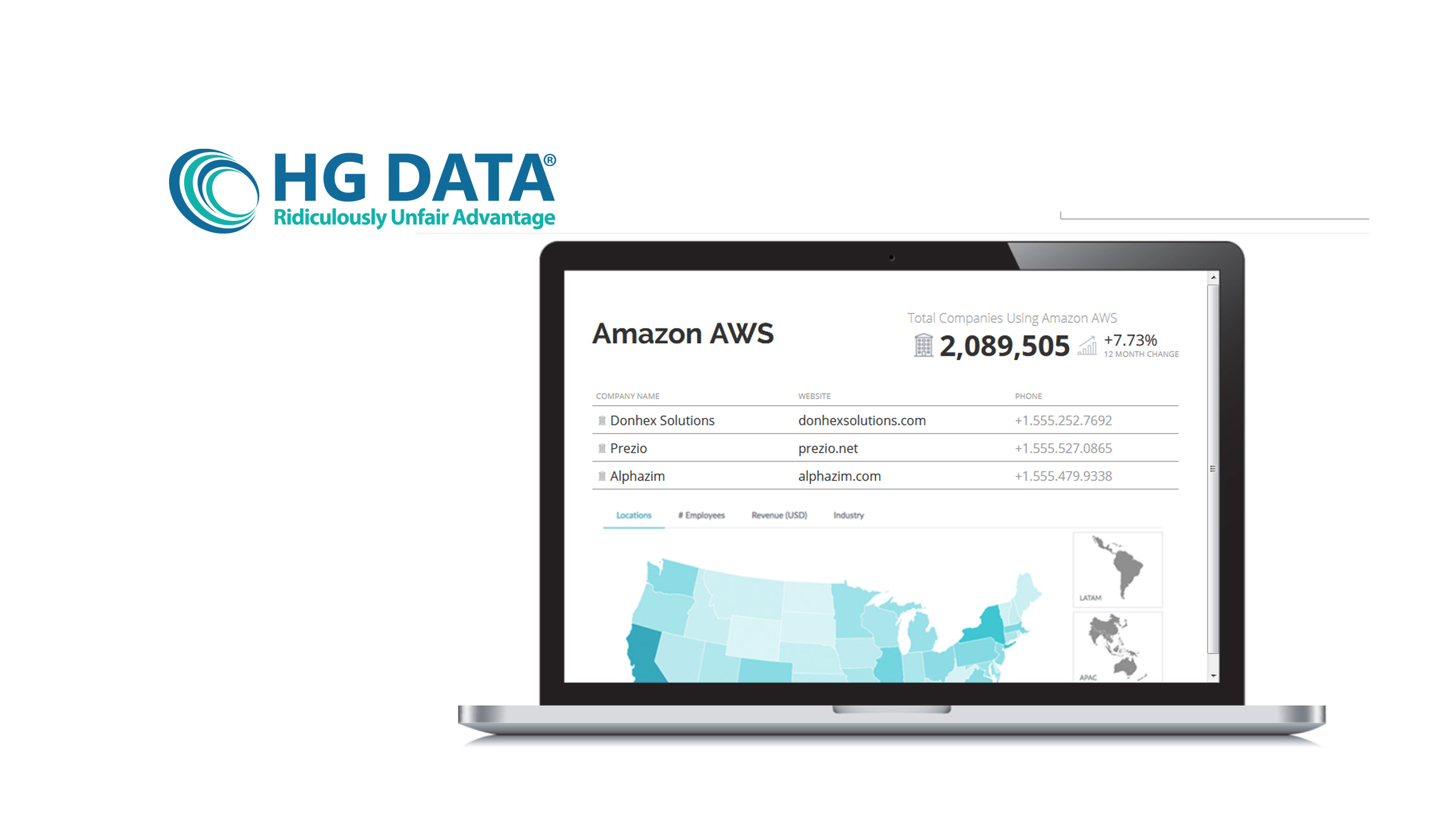
HG Data, a global leader in company intelligence for B2B technology marketers, announced the launch of its newly enhanced HG Data App on the Salesforce AppExchange, empowering businesses to connect with their customers, partners, and employees in entirely new ways. Techno-graphic data provides sales and marketing teams with valuable insights on the competing and complementary software and hardware products used by their customers and prospects so that they can focus their outreach on the right accounts and deliver a relevant message.

Also Read: Prezi Announces App On The Salesforce AppExchange

What exactly is the HG Data App?

HG Data App, formerly known as HG Connect, embeds techno-graphics directly into Salesforce so that sales and marketing teams can easily sort, filter and use the data to create campaign segments, score and rank accounts, generate reports, and implement workflows and triggers to build more intelligent business processes. The latest release adds new searchable and sortable pages so users can include techno-graphics in their Account, Contact, and Opportunity page layouts.

Also Read: Nintex Announces Nintex Workflow on the Salesforce AppExchange

This is what the industry experts have to say about the app

HG Data Announces Its HG Data App on the Salesforce AppExchange
Barbara Winters

Barbara Winters, Vice President of marketing at HG Data, informed, “B2B technology companies want better intelligence for their outreach, but they want the information to be easy to access and use in the systems and workflows they already have in place. Our collaboration with Salesforce makes our premium techno-graphics easily accessible and actionable to sales and marketing teams using Salesforce, so they can use our tech install intelligence to quickly find and target the right opportunities. We’re happy to be among the first providers of Salesforce Lightning Data apps on the AppExchange.”

HG Data Announces Its HG Data App on the Salesforce AppExchange
Brian Vass

For Brian Vass, the VP of Sales and Marketing Technology at Paycor, it is the most popular data initiative they’ve launched ever, “We struggled for years to find high-quality data for installed technologies within our prospect base. HG Data not only provides us with great data, but they make it easy for our sellers to consume within Salesforce.”

Also Read: Data Dwell Launches Sales Athlete On The Salesforce AppExchange

HG Data Announces Its HG Data App on the Salesforce AppExchange
John Donlon

“More and more, organizations are turning to techno-graphics for the tremendous insights they deliver – marketing leverages them for precise audience segmentation, and sales uses them to drive highly meaningful conversations with prospects. As with any insights, the best enablement play is to embed them natively in the applications already in use by their intended audience to maximize adoption and use,” said John Donlon, Senior Research Director of Marketing Operations Strategies at SiriusDecisions.

HG Data Announces Its HG Data App on the Salesforce AppExchange
Kori O’Brien

Kori O’Brien, SVP, ISV Sales, Salesforce added, “Everyone and everything is getting smarter and more connected than ever before, and companies are looking to transform the way they connect with customers, partners and employees. By leveraging the power of the Salesforce Platform, HG Data provides customers with an easy way to use and access techno-graphic data to better inform their marketing and sales programs.”

Recommended Read: Making A Splash On The Salesforce AppExchange

Mass² Launches Deal IQ to Help Brands Generate Precise Attribution Models

0
Mass² Launches Deal IQ to Help Brands Generate Precise Attribution Models

Advertiser Solutions Provide Clarity of First-Party Data to Curate Audiences Specific to Campaign Needs

Mass², a wholly-owned subsidiary of Nexstar Digital LLC, and premium provider of multi-screen digital advertising announced the launch of its Deal IQ technology. Built on data science and machine learning tech, Deal IQ leverages proprietary audience and inventory data from Nexstar’s owned and brand safe supply of 171 local broadcast stations and 2,000 direct publisher integrations. This unique approach maximizes ROI and unlocks predictive relationships for top brands, agencies, and network demand partners.

Much of the industry’s 3rd party, off-the-shelf data lacks a clear methodology for classification and the recency to develop accurate audience models. Building off of the data foundation from Nexstar Media, in 100 different markets and providing 500MM+ impressions per month, Deal IQ’s first-party data is collected and updated in real time, allowing their data science team to analyze the attributes of its clients desired audience and create a model to predict similar users.

Mass² Launches Deal IQ to Help Brands Generate Precise Attribution Models
Marika Roque

“One of the biggest issues plaguing brand marketers right now is a lack of transparency. With the launch of Deal IQ, we are eliminating those barriers brands have to their engaged audiences with quality data that allows us to start from strength, not scratch when modeling towards their desired actions,” said Marika Roque, VP, Digital Operations at ‎Mass².

Also Read: Meltwater Acquires Algo to Supercharge its Industry-Leading Media Intelligence Platform

Mass² suite of Deal IQ solutions is creating a new, trusted foundation for data and inventory exchange across the ad tech value chain. They include:

  1. Reach: Unlock scale and KPI efficiency through automated optimization.  Declare your KPI and let our machines do the heavy lifting.
  2. Inventory: Anticipate where converting audiences spend their time. Our data science team also creates exclusion groups to avoid targeting users that have already converted or are unlikely to convert.
  3. Audience: Expands target audiences with predictive audience matching. The audience solution takes a customized data strategy approach that is 100% transparent and defined in the front end to set parties up for success.

“To put all of this into context, a global insurance brand recently came to us with the primary goal of driving conversions in the form of quote requests. Using conversion rate as the KPI metric within the Deal IQ platform, our proprietary modeling approach performed 54% better than the standard audience and contextual targeting methods,” continued Roque.

Also Read: Marriage Counseling: How Video Can Bring MarTech and AdTech Together

Since the Mass² official launch in February, the ad tech company has been committed to building the right team of data scientists and engineers to help create best-in-class products for their clients– addressing the industry need when it comes to transparency, access to first-party data, and marrying the right type of data and inventory. The company has established an unparalleled foundation built on data, enabling advertisers to reach real people by getting closer to their audiences and relying less on targeting based off of cookie ID’s.

Recommended Read: The State of Ads.txt: Not a Big Clean-up Yet

Certain Acquires Gather Digital, Investing in the Next Generation of Mobile Event Applications

0
Certain Acquires Gather Digital, Investing in the Next Generation of Mobile Event Applications

Certain’s Acquisition of Gather Digital Will Help Marketers Understand All the Touchpoints Between Marketer and Attendee/Buyer in the Context of the Event

Certain, the leader in enterprise event automation, announced that it has acquired Gather Digital, a mobile event application suite for enterprises, associations and educational institutions. With this acquisition, Certain is further strengthening its mobile development and data integration capabilities, taking advantage of the experience that Gather Digital’s extended team brings, and offering customers unprecedented insight into the mobile journey to determine the event attendee’s true sentiments.

Based in Chapel Hill, North Carolina, Gather Digital creates native and mobile web event applications with integrated personalized agendas, event content, live polling, surveys, continuing education credits, group meetings, lead retrieval and gamification. Gather Digital’s engagement apps allow the company’s clients to leverage mobile as a channel to capture intent throughout events, and build deeper relationships with their event attendees.

Mobile Intent Data + Platform Integration = Future of Event Automation

Events are often the largest slice of marketing budgets and a major driver of revenue creation for companies of all sizes. Seventy percent of U.S.-based senior marketers reportedly planned to increase their marketing spend on events in 2017 with more marketers looking for ways to leverage data before, during and after their events. Certain’s acquisition of Gather Digital will help marketers obtain new levels of knowledge and engagement and further understand all the touchpoints between marketer and attendee/buyer in the context of the event.

Peter Micciche
Peter Micciche

“Certain is focused on enabling our customers to gather the most relevant data from event attendees to drive better business results from events. By acquiring Gather Digital and the impressive mobile capabilities the team has developed, we’re continuing to invest in our data strategy – and the people at the forefront of delivering innovative technology for world class enterprises,”  said Peter Micciche, CEO, Certain.

Gather Digital’s customers include five of the world’s largest financial services companies, the nation’s leading pharmaceutical/ life science organization and premier technology and Fortune 1000 corporations. With the acquisition, Certain will continue to grow its US presence and tap the North Carolina Research Triangle’s burgeoning tech hotbed for sales, marketing and product talent.

Read More: ARATIS Events Returns to ACTIVE Network to Elevate Experiences for its Event Participants

Jon Phillips
Jon Phillips

“Gather Digital and Certain joining forces brings the best of both worlds in event automation to our existing customer base. We look forward to working with Certain to bring our mobile technology, which is focused on personalized experiences for enterprises and event attendees, to even more users,” said Jon Phillips, co-founder, Gather Digital.

Gather Digital will be integrated into Certain and Gather Digital’s employees around the globe will join Certain in locations in North America, Asia and Europe. Co-founders Jon Phillips and Wendy Phillips will move into newly created roles at Certain with Jon as Vice President, Mobile Products and Wendy as Vice President, Corporate Sales. Certain will establish a center of customer excellence in the Chapel Hill building on Gather Digital’s access to outstanding universities and the Research Triangle. The financial terms of the transaction were not disclosed.

Certain is the leading enterprise Event Automation platform that helps data-driven marketers and event professionals integrate rich buying signals and attendee insights into omni-channel marketing campaigns to improve sales and marketing results and deliver event ROI. Certain partners with hundreds of companies across tens of thousands of events with millions of attendees.

Recommended Read: Why The Best Marketers Are Adding Online Experiences to IRL Events

Adoreboard’s Emotion AI Feted For Enabling CX Improvements

0
Adoreboard's Emotion AI the Future of CX Measurement

October 2017 Forrester Report – The Future of CX Measurement, Names Adoreboard for Using Common Sense Reasoning with Effective Computing

Adoreboard, a leading Emotion AI software solution, has been named for using “common sense reasoning with effective computing,” for customer experience improvements, according to the October 2017 Forrester report, The Future of CX Measurement.

Adoreboard is cited in a section of the report entitled “Upgrade to Analytics That Drive Action”. Adoreboard’s Emotion AI solution, Emotics, produces what is known as Decision Ready Insights, enabling executives to use Artificial Intelligence to make CX-impacting decisions in a more informed and responsive way.

Geckolyst Hosts Webinar on Future of Customer Feedback and CX Measurement
Maxie Schmidt-Subramanian

The Forrester report, written by Principal Analyst, Maxie Schmidt-Subramanian, explains, “Emotion analysis vendor Adoreboard uses common sense reasoning with affective computing, an AI technology to create an index for each primary emotion in Plutchik’s wheel.”

Also Read: CloudCherry in Gartner’s 2017 Market Guide for Voice-of-the-Customer Solutions

Adoreboard's Emotion AI the Future of CX Measurement
Yannis Kotziagkiaouridis

Yannis Kotziagkiaouridis, Global Chief Analytics Officer of Wunderman, who has been successfully applying Adoreboard’s Emotics solution worldwide, says it provides a disruptive technology-led approach by revealing previously unattainable insights on customer emotion. “When it comes to harnessing emotion to improve customer experience, Adoreboard is a true innovator. We believe data should lead to deeper understanding of consumer emotion and motivation. The decision-ready insights Adoreboard provides are a great complement to our work in delivering experiences for consumers in the moments that matter most to them.”

Adoreboard’s Emotics solution can understand how emotions are expressed in any text contained in product reviews, surveys, social media posts or online comments by customers. This opens up new possibilities for CX professionals to improve the customer journey by making changes that can be prioritized by the strength of emotional response.

Also Read: Vitalyst Announces Appointment of Paul Rigby to Chief Experience Officer

Research by Adoreboard shows that the customer’s voice has a new champion sitting at the highest levels of power in businesses with the mandate to improve customer experience. The number of Fortune 100 companies with the role of Chief Customer Officer has increased by 20 percent in the last 3 years.

Adoreboard's Emotion AI the Future of CX Measurement
Michael Crossey

“With mass-market products and services becoming increasingly commoditized, Customer Experience is the new competitive battleground for brands and enterprises. Working with some of the world’s leading brands and agencies, we have seen first-hand the impact that the deep, granular insights provided by our Emotics solution can have on improving customer experience. Adoreboard reveals highly detailed, often previously unknown issues that impact customer experience, allowing executives to take immediate action to fix current problems, and prioritize CX investments for maximum business impact over the medium to long-term,” said Michael Crossey, Board Member and Director at Adoreboard.

Adoreboard, which began 6 years ago as a Queen’s University Belfast spin-out, has been adopted by agencies across the top 5 largest ad networks globally, including Wunderman, Havas, McCann, along with major brands such as Unilever, Three and Telstra Wholesale.

Recommended Read: Beyond Personal – Why Individualization Is the Key to Marketing Success

Why Does the Programmatic Auction Type Matter

0
Why Does the Programmatic Auction Type Matter

AerServAs buyers continue to push for greater transparency, greater attention is being focused on the programmatic buying process, particularly in regards to the auction mechanics. Full disclosure of the inventory being offered is crucial to transparency and the ads.txt initiative will push the industry further in this direction. Beyond verifying the authenticity of the inventory, how the auction is conducted is one of the other areas where greater transparency is needed.

But why does the auction type matter and what can be done to make it more transparent?

Programmatic auctions conducted within the Open RTB protocol provide a way for the supplier of the inventory to specify the auction type. Typically the auction type is specified as either a First Price or Second Price Auction. The protocol allows for custom auction types to also be used, but those are very rare and must be agreed upon between the supplier and buyer so both parties understand how it will work.

In a first price auction, the highest bidder pays the price they bid while in a second price auction the highest bidder pays one cent higher than the second highest bid. On the surface, both of these auction types appear to be straightforward and transparent, but because all of the different bid prices are not typically revealed to all bidders within an auction, the second price auction can easily be manipulated to increase the winning price.

The first step towards auction mechanics transparency is to make sure that the auction type is clearly stated and sent with every auction. The auction type is not a required field and for that reason, many auctions are held without specifying it. It is impossible to have auction mechanics transparency without a clearly defined auction type, so buyers should make this a requirement for every auction they participate in.

Even if the auction type is specified, it does not guarantee that the auction will be held according to the stated auction type mechanics. A buyer is able to confirm that a first price auction is being performed properly because the buyer knows they must pay what they bid if they are the highest bidder. This is one reason why more programmatic auctions are being held as the first price.

With a second price auction, the bidder has no insight as to what others have bid so it is open to abuse. Most second price auctions operate within a black box where the highest bidder has no visibility as to what the second highest bid was so it is difficult for them to confirm that the winning price was settled correctly.

The lack of insight into the bids submitted in a second price auction leads to three common ways of abuse: the addition of hidden fees, adjusting the price floor and fake bids. Further adding to the lack of transparency is when a bid floor (the minimum price a buyer must bid in order to be eligible to win the auction) is not specified in the bid request. If only a single bid is received, then the bid floor is used as the second highest bidder to calculate the winning price, but if that is not provided then a buyer has even less visibility as to what the final price could be.

Read More: AerServ Joins Google’s Exchange Bidding Program to Drive Real-Time Competition in Mobile

The first type of abuse are hidden feeds. Some exchanges apply fees that are clearly stated in their agreements, but others do not disclose them but just add them on top of the final price so they are very difficult to detect. Since the highest bidder does not know what the second highest bidder bid, it is easy for an exchange to tack on some hidden fees without the highest bidder ever knowing. For example if there are two bidders in a second price auction, one at $5 and one at $3, the highest bidder should pay $3.01 according to second price auction mechanics, but since the highest bidder does not know that the second highest bidder bid was $3, the exchange could add an additional $0.25 to the final price and charge the highest bidder $3.26 instead of $3.01. It would be very difficult for the highest bidder to detect this since they have no insight to the other bids and would assume that the second highest bid was $3.25.

The second type of abuse is adjusting the price floor after all the bids are received. This will typically occur if the second price auction is sent without a bid floor. An example of this would be if there was only a single bidder at $5 for an auction. On the exchange side, they have a bid floor entered into their system, they just do not disclose it in the auction. So for example if the non-disclosed bid floor was $2 then the final price should be $2.01, but if the exchange detected that there was only a single bid they could change the bid floor to $3 so the final price would be $3.01. The buyer would have a hard time detecting this since the original bid floor was not disclosed in the auction.

Also Read: Demystifying Header Bidding

The last type of abuse is generating fake bids. In this scenario, the exchange artificially creates a fake bid below the highest bidder but above the bid floor so it drives up the final price. For example, if the bid floor was $2 and there was a single bidder at $5, the final price should be $2.01, but an exchange could generate an artificial bid at $4 which would make the final price $4.01. Without the highest bidder having insight as to what the other bids were it would be very difficult to detect the fake bid. Even if all the bids were made visible it could still be difficult to detect this abuse since the artificial bid may be difficult to identify.

If the programmatic industry continues to hold second price auctions then at a minimum it needs to list the auction type and bid floor for every auction. Beyond that buyers should work with every seller to make sure all of the other potential abuses are not taking place.

Aside from moving to first price auctions, requiring the changes above will enable the programmatic ad industry to operate second price auctions with more transparency and trust.

Recommended Read: Feature Forward Releases Its Header Bidding Solution for Publishers

Arm Your Marketing Campaigns With Opinions That Matter

0
Arm Your Marketing Campaigns With Opinions That Matter

surveymonkeyWhile there’s a proliferation of data for marketers and communicators today, the time for analyzing them has shrunk tremendously. And then, there’s the human factor. Individual reactions can sometimes be very different from what the data says, making it critical to capture voices and opinions of people that matter most to your business (existing customers, prospects, peers, employees) before launching any marketing campaign.

We call this ‘market-powered data’—combined with the stats that you already have from various tools and sources, it paints the full context you need to make decisions quickly and confidently. And getting it could be as simple as asking the right questions to the right people at the right time.

As it turns out, many businesses aren’t doing that, missing on the opportunity to validate their ideas and assumptions and better connect, engage and stand out with their marketing efforts. The majority of small business owners (62%) say they “never” conduct surveys of their customers, according to our recent CNBC| SurveyMonkey small business survey.

Sometimes, you can get away without asking. Other times, the lack of curiosity can lead to epic marketing fails—like the ones that happen around us every day, blowing up on social media and generating countless unfavorable headlines. These were the inspiration for the Shoulda Used SurveyMonkey ad campaign. The situations we show are humorous and exaggerated, but they’re based on real-life business cases where asking questions could have prevented costly mistakes.

No matter your industry, the stakes are high: 95% of new products launched each year will fail. In the hospitality industry, it only takes one bad experience for 25% of customers to defect to competitors.  And, prevention is far cheaper and sometimes easier than cure. Whether it is fixing a product after development, replacing a bad design, or addressing negative publicity in the marketplace. This campaign is a reminder that asking questions can be the difference between a good idea and a terrible one, or sometimes a proud moment and an embarrassing incident.

Read More: Breaking Down the Data Silo: How Social Media Data Has Crossed Department Lines to Provide Insight Throughout an Organization

So, what are some easy ways for you to arm your marketing with market-powered data and increase engagement and effectiveness —

  1. Identify high-value use-cases for your product/service. Surveys are a great tool to understand how exactly your products/services are being used and what value you deliver to your customers. With the Shoulda campaign, surveys of existing customers led us to focus the campaign and media spend around dominant use-cases where the perceived value of asking was the highest.
  2. Ask for feedback from the people that matter most to your business. Once the ads were created, we tested them with our own employees, agency personnel, and an external panel of business professionals through SurveyMonkey Audience to get real-time feedback. Getting this feedback becomes even more crucial for companies like GoPro who have a global and diverse customer base. Especially, if they can gather customer opinions in hours or days in over 100 countries, and without involving an expensive 3rd party consultant or market research partner.
  3. Incorporate your customers’ voices into your campaigns. Reflecting your customers’ opinions and voices in your marketing content is not only a powerful endorsement but also a more engaging way to showcase your value. There are great tools that allow you to deploy short surveys to get third-party validated customer testimonials and easily transform them into shareable and engaging content assets.

Fortunately, with most business endeavors, you’ve got an opportunity to be curious, ask questions, and get feedback before you launch anything new.

In fact, 10 years of research show that companies who put human-centered design methods at the core of their growth strategy see a 228% higher ROI than the S&P 500. The great management guru Peter Drucker once said, “My greatest strength as a consultant is to be ignorant and ask a few questions.”

I second that: staying curious and arming your marketing campaigns with market-powered data will not just prevent mistakes but will also ensure that you have a holistic view, embrace diverse perspectives, and foster innovation.

Recommended Read: Strengthening Predictive Analytics with Intent Data

TechBytes with Robin Williamson, VP Engineering, Teralytics

0
Robin Williamson Teralytics

Robin Williamson
VP Engineering at Teralytics

Location data is turning out to be an important datapoint for marketers. We spoke to Robin Williamson, VP, Enginnering, Teralytics to understand the nuances of this emerging technology.

Html code here! Replace this with any non empty text and that's it.

MTS: Tell us about your role at Teralytics and the team you handle?
Robin Williamson:
As VP Engineering, I manage some of the top data scientists, software engineers and machine learning experts in the world. Our global team contains PhDs, alumni from some of the biggest tech companies and a number of grads from ETH Zurich, the highest ranked computer science school on a global basis. It’s a pleasure to work with such bright minds on complex problems.

MTS: How does Teralytics empower mobile marketers with end-to-end journey analysis?
Robin: We understand human journeys better than anyone else and our primary focus is to service smart cities, travel and transportation organizations. We help cities decide what infrastructure to build when and where, and we help transport operators allocate resources and operate more efficiently. While mobile marketing platforms are not our focus, our solutions can also open up opportunities for cities and mobility businesses to target specific audiences based on their travel behaviors and demographics. For instance, if ride-sharing companies want to understand their market share of total mobility in a city or region, we can help them. Similarly, if a city wants to understand which venues are most frequented by tourists, we can help them find the answers.

MTS: At Teralytics, how do you distinguish between mobility data and location data? What are the similarities/ differences between the two?
Robin: Location data is the general term that’s used widely across industries. We differentiate between cellular, WiFi and GPS data based on the original data source. Cellular data is derived from mobile networks, WiFi data comes from hotspots and GPS data is received from ad networks, apps, vehicles and other connected devices. Each of these data sources has strengths and brings challenges.

We have identified cell tower signals from telecom operators as the most valuable data for understanding human mobility. It allows us to build solutions tailored to solve a variety of problems. We can see how many people travel from point A to point B by which mode of transportation and how long it takes. Our technology also uses data to observe neighborhood demographics, where people live, where people work and if there are changing patterns. We can understand if people in the area are visiting, commuting, resting or traveling through on their way to another destination. We can even analyze data to understand who is affected by unexpected events, such as natural disasters, train outages or traffic incidents and we reveal how they move before, during and after an event.

MTS: How do you unlock the potential of data on human mobility for B2B commerce?
Robin: Understanding how people move is an essential element for various use cases. Depending on the customer’s needs, real-time and historic data on human mobility can help improve the efficiency of operations or the return on infrastructure investments.

As self-driving cars and the internet of things become a reality, in my view, we’ll need to transform the existing infrastructure and transport systems in our society. Toll road operators, public transit agencies, city governments and car OEMs are all feeling the paradigm shift we’re experiencing. They need to better understand how people move first before we introduce and embrace the complexities of modern mobility services. That’s where we come in: We provide the dynamic information foundation for the future of cities and mobility systems.

MTS: What are the pain points for mobile marketing platforms that are yet to adopt commercial AI technologies?
Robin: While we don’t focus on mobile marketing platforms, the challenges we observe with our customers are probably similar: There is so much information out there that it becomes increasingly harder to differentiate between noise and signal. That’s the case for our customers and I’m sure it’s similarly difficult for marketing businesses. In order for Teralytics to help cities, transportation operators and mobility service providers better understand human journeys, we apply leading edge technology, machine learning and data science to filter out the noise and provide highly valuable intelligence. With this information, we are building the infrastructure, mobility services and public safety capabilities of the future.

MTS: What’s the next frontier for IoT applications within the commercial mobility sector? In such a scenario, how do you see marketers expanding their creative vision to connect to consumers effectively?
Robin: Ride-sharing is taking over and self-driving cars are just around the corner. Connected and automated vehicle fleets will also be a reality soon. These new technologies will have to integrate with old infrastructure including roads, public transportation systems, cities and more.

These technological trends will pose significant challenges to everybody involved and are also an exciting opportunity to use data for social good. We believe that understanding how people move must be the first step in preparing for the future and designing the cities, roads, public transit networks and mobility services of tomorrow and providing the mobility services that people want and need.

MTS: Thanks for chatting with us, Robin.
Stay tuned for more insights on marketing technologies. To participate in our Tech Bytes program, email us at news@martechseries-67ee47.ingress-bonde.easywp.com

Also Read: Interview with Jeremy Fain, CEO, Cognitiv

Datonics Partners with Kochava Collective, Allowing Mobile Marketers to Reach Desired Audiences

0
Datonics Partners with Kochava Collective, Allowing Mobile Marketers to Reach Desired Audiences

Data from Datonics Is Integrated within Kochava’s Mobile Data Marketplace, Giving Marketers Access to More Audience Data, Helping Reach Desired Audiences

Online data company Datonics has partnered with Kochava, an industry leader providing holistic measurement solutions for connected devices. This new agreement provides mobile marketers with access to even more audience data to help them reach specific consumers who are most likely to be interested in their products.

Mobile marketers can access Datonics data through the Kochava Collective, the world’s largest independent mobile data marketplace. Datonics data, which is based on high-quality search, purchase intent, life-stage and B2B data on 180+ million U.S. and Canadian users, enables marketers to run mobile campaigns that are both granular and scalable.

Also Read: Data Provider Datonics Integrates with AppNexus’ Data Marketplace

“Increasingly, consumers are using their mobile devices for researching, browsing and purchasing products, including more expensive items than in years past. Marketers are eager to capture the attention of consumers on mobile. We are delighted to partner with Kochava and help marketers reach their desired audiences as they turn more to mobile on their consumer journeys,” said Michael Benedek, CEO of Datonics.

Datonics Partners with Kochava Collective, Allowing Mobile Marketers to Reach Desired Audiences

The Kochava Collective houses data from four sources: first-party data collected from the Free App Analytics SDK from over one billion devices globally, integrated mobile networks, direct app and game publishing partners who choose to contribute their data, and data providers such as Datonics.

“Marketing campaigns are strengthened by the scale and accuracy of data. It’s our goal to supply marketers with these two attributes. We are happy to partner with Datonics and extend its rich data to marketers using the Kochava Collective,” said Grant Cohen, GM, Kochava Collective.

Also Read: Kochava Collective Scales 1 Billion Addressable Mobile Devices

The Kochava platform for mobile and connected devices combines potent features and global coverage with thousands of network and publisher integrations, allowing advertisers to target audiences and measure campaign performance with precision.

Datonics, a subsidiary of AlmondNet, is the Internet’s leading independent aggregator and distributor of highly granular and proprietary search, purchase-intent, life-stage, demographic and B2B data.

Recommended Read: The Emperor Has No Clicks: Don’t Stick with Clicks

NGDATA Raises $19 Million to Fuel Global Growth

0
NGDATA Raises $19 Million to Fuel Global Growth

HPE Growth Capital Leads Latest Funding Round; Capital to Accelerate Customer Experience Management Company’s International Expansion and Continued Product Innovation

NGDATA, the customer experience management solutions company, announced that it has raised just over $19 million in Series C funding. HPE Growth Capital led the round with participation from existing investors including Idinvest Partners, Pamica, SmartFin Capital, Capricorn Venture Partners and Nausicaa Ventures.

This latest investment comes on the heels of tremendous momentum for the company. In January 2017, NGDATA closed a $9.4 million funding round and experienced record business, customer and product revenue growth. Its May 2017 acquisition of Eccella added valuable data management expertise and expanded the company’s global footprint across North America, Europe and Asia. NGDATA also made significant updates to its next-generation customer data platform, Lily, adding new Attribution and out-of-the-box Next Best Experience capabilities to help marketers better use customer data to engage customers more effectively while tracking their marketing efforts more accurately and optimizing marketing spend.

Also Read: Monetate Partners with WBR Insights for Personalization Development Study

The funds will primarily be used to further accelerate global growth and to continue to build out NGDATA’s vision to be the best partner for digital transformation, ecosystem investment and enhancing customer centricity in organizations.

NGDATA Raises $19 Million to Fuel Global Growth
Manfred Krikke

“We have been looking at various companies in the big data management and marketing software segments for a while. What we love about NGDATA is that they offer their customers, such as large banks, telecom, media and utility companies, a sophisticated data infrastructure that combines all customer data from its internal systems with third-party data sources and provide analytics capabilities in real time, so that they can deliver exactly the right message at the right time to the right consumer, without overburdening them with offerings. This is a strong value proposition, as it leads to happier customers, improved customer conversion rates, and much greater marketing efficiency,” said Manfred Krikke, a Partner at HPE Growth Capital.

Also Read: V3D Technology to Optimize Customer Experience on Orange’s ‘Mon Réseau’ App

NGDATA Raises $19 Million to Fuel Global Growth
Luc Burgelman

“Consumer behaviour is changing, and companies are just starting to realize the value of customer data platforms and using them to drive meaningful experiences. For the past five years, NGDATA has been steadfast in helping marketers improve every touchpoint across the customer journey, and we’ve designed and continually improved Lily to deliver smarter, more informed customer experiences. This funding not only validates our success in achieving these goals, but it also supports our commitment to be the leading global customer data platform provider,” said Luc Burgelman, CEO, NGDATA.

Lily powers organizations’ customer experiences by combining data, generating insights and steering actions. It eliminates organizational, system and data roadblocks, enabling large companies in data-driven industries (e.g. financial services, telecom, utilities, hospitality, etc.) to become truly customer-centric. Lily provides insights into historical and real-time customer interactions, from all sources, so companies gain a holistic and individual customer view, enabling them to deliver superior customer experiences to increase NPS (Net Promoter Score) and solidify customer lifetime value.

NGDATA Raises $19 Million to Fuel Global Growth
Michel Akkermans

Michel Akkermans, chairman of NGDATA, added, “NGDATA continues to drive toward its vision of enabling companies to deliver customer-centric marketing. The investors are impressed with the company’s significant momentum, and this latest investment is testament to NGDATA’s clear drive to corner this important and growing market.”

Recommended Read: Customer Profile Management and Customer Data Platform Key to Cross-Channel Business Success

Interview with Mark Stoddard, Head Of Sales, Asia, Hubspot

0
Mark Stoddard HubSpot

[mnky_team name=”Mark Stoddard” position=” Head Of Sales, Asia, Hubspot”][/mnky_team]
[easy-profiles profile_twitter=”https://twitter.com/mdstoddard” profile_linkedin=”https://www.linkedin.com/in/markdstoddard/”]

“What it really is going to mean, (hopefully) is moving a lot of that lower level work to bots which then means salespeople will be able to double down in truly bringing value and sell more. “

On Marketing Technology

MTS: Tell us a little bit about your role at HubSpot and how you got here?
I run our go to market sales team at HubSpot for Asia. It includes working with the sales team to device strategies and expand our footprint through Asia. How I got there? I’ve spent the last 6 years expanding in different markets. Starting out in the US and then Europe and now in Asia.

MTS: Which are HubSpot’s top three markets in the APAC? Over the next five years, which countries would drive growth?
Currently, our larger markets include Australia, Singapore, HK, India and Japan. If I’m thinking about the next 5 years to drive growth, I’ll be looking at India, emerging SEA such as Vietnam, Indonesia, and Thailand, North Asia – on how to expand into Korea and Taiwan. There are plans for China but our focus is not quite there yet considering western marketing technologies such as Facebook and Google do not exist there.

MTS: Which of the following sectors– SMB, Mid-market or Enterprise– are you seeing the highest traction from and why?
We primarily sell to SMB and mid-markets. B2B and high consideration B2C such as healthcare and education. We’re mainly focused on those markets as our value proposition is an all-in-one inbound marketing and sales platform. SMB and mid-market companies like the idea of having it all on one platform. These companies tend to have a few people in both sales & marketing and not enough resources to purchase multiple platforms or manpower to work on integrations. Having one platform helps them to get more traction on how to scale their business. In terms of enterprise markets, they can afford to buy multiple tools and have a team behind it.

MTS: For someone in sales, what is the biggest draw of a platform like HubSpot?
Fundamentally, when we built the HubSpot sales platform, we kept one question in mind. “What do salespeople do today and what do they need to get that job done?” There are core selling functions that salespeople use such as CRM, emails, phones, calendars etc. They have a tough time identifying which prospects to call and which ones are their highest priority. We used this information and put all this in one place. So they can call, email, schedule and keep in touch with their prospects and prioritize their clients all in one platform.

MTS: What startups are you watching/keen on right now?
I’m keeping an eye on AI tools to help develop and optimize the time for salespeople. As a salesperson, there’s a bunch of admin work that takes up a lot of our time instead of us focusing on selling. I’m hoping that predictive analytics will help to ease up some of the admin work so that we can just work on selling more. Most of our time is spent trying to decide who to call – if we can get rid of that issue with AI analytics, we’ll be able to sell more effectively based on our priority leads.

MTS: What tools does your sales stack consist of in 2017?
My sales stack is a combination of HubSpot, Salesforce, and Gmail.

MTS: How do you prepare for an AI-centric world as a sales leader?
You gotta understand what it is. You’ve got to dig into it. There are a bunch of tools to figure out what AI is and what it does. On the surface level, it sounds scary for sales as there are functions to move them closer towards bots. What it really is going to mean, (hopefully) is move a lot of that lower level work to bots which then means salespeople will be able to double down in truly bringing value and sell more. If the low-level work gets eliminated, they would have to brush up their skills at helping and connecting with prospects.

This Is How I Work

MTS: One word that best describes how you work.
Aggressive.

MTS: >What apps/software/tools can’t you live without?
Keyboard Maestro, Evernote, Slack, Salesforce

MTS: What’s your smartest work related shortcut or productivity hack?
Keyboard maestro – I set up my shortcuts and I can open all the tools and sheets once I get into the office without finding where they are.

MTS: What are you currently reading? (What do you read, and how do you consume information?)
I’m making a deliberate change over the last 3 months. I was a heavy user on ipad, kindle and iphone to consume information and I get easily distracted when I was doing that. So I made the change back to paperback. I’m currently reading Radical candor, history of SEA and my subscription to economist all in paperback. I’ve subscribed to the economist for 2 years, I’ve read it about 3 times on my ipad. But in the last 6 weeks when I get it in the paper, I read it every week. Aside from that, I also follow specific industry people on Twitter and have a gmail filter setup for sales thought leader blogs such as the Sales Hacker blog.

MTS: What’s the best advice you’ve ever received?
“Learn how to make decisions.” It’s drastically helped me to learn how to be decisive and make relatively quick decisions when I need to. It’s the whole idea of being ‘decisive’.

MTS: Something you do better than others – the secret of your success?
It may sound weird, but I love public speaking. I’m probably better at speaking in front of a (large) crowd instead of a one-on-one conversation. I’m in my element when speaking in front of a crowd, which is odd. But I learned that it’s something I should take advantage of.

MTS: Tag the one person, from the Martech sector, whose answers to these questions you would love to read:
Everywhere I go in Singapore, I hear about Hari Krishnan. He was the first hire of LinkedIn for APAC (they’ve built a great business in APAC) and now the CEO of PropertyGuru. I see where LinkedIn is now and that’s where I’d like for us to be in a few years. I’d like to chat with the guy who has lived it.

MTS: Thank you Mark! That was fun and hope to see you back on MarTech Series soon.

Also Read: Interview with James Gilbert, Head Of Marketing, APAC, Hubspot

[vc_tta_tabs][vc_tta_section title=”About Mark” tab_id=”1501785390157-b58e162d-0ae25a4b-c27aca64-108e51b0-80edaf37-bd3d593a-a030″]

Mark is an entrepreneurial sales leader. He is the Head of Sales for HubSpot in Asia. He has a track record of building and scaling sales teams towards success. Starting out at HubSpot in Cambridge, he moved onto start HubSpot’s sales team in Europe. Seeing his potential and proven track record, he then moved on to Singapore to start HubSpot’s first ever Asia sales team.

[/vc_tta_section][vc_tta_section title=”About HubSpot ” tab_id=”1501785390320-2d44fa50-740c5a4b-c27aca64-108e51b0-80edaf37-bd3d593a-a030″]

HubSpot Logo
HubSpot is the world’s leading inbound marketing and sales platform. Since 2006, HubSpot has been on a mission to make the world more inbound. Today, 31,000+ customers in more than 90 countries use HubSpot’s software, services, and support to transform the way they attract, engage, and delight customers. HubSpot is a global company with offices in Cambridge, MA; Dublin, Ireland; Singapore; Sydney, Australia; Tokyo, Japan; Berlin, Germany; and Portsmouth, NH. HubSpot has been recognized by Inc., Forbes, and Deloitte as one of the world’s fastest-growing companies. HubSpot’s software has helped companies worldwide change how they market and sell, while our innovative approach to company culture has helped redefine transparency and autonomy in the modern workplace.

[/vc_tta_section][/vc_tta_tabs]
[mnky_heading title=”MarTech Interview Series” link=”url:https%3A%2F%2Fmartechseries-67ee47.ingress-bonde.easywp.com%2Fcategory%2Fmts-insights%2Finterviews%2F|||”]

The MTS Martech Interview Series is a fun Q&A style chat which we really enjoy doing with martech leaders. With inspiration from Lifehacker’s How I work interviews, the MarTech Series Interviews follows a two part format On Marketing Technology, and This Is How I Work. The format was chosen because when we decided to start an interview series with the biggest and brightest minds in martech – we wanted to get insight into two areas … one – their ideas on marketing tech and two – insights into the philosophy and methods that make these leaders tick.

Socialbakers Launches Video Performance Benchmark for Social Networks

0
Socialbakers Launches Video Performance Benchmark for Social Networks

Video Performance Benchmarks Gives Marketers A Deeper Look At Their Overall Video Content Performance Within A Competitive Context Of Industry, Region Or Country

Socialbakers, the leading AI-powered social media marketing platform, announced the addition of the world’s first video performance benchmarks for social networks to its Socialbakers Suite. Socialbakers video performance benchmarks let marketers view their video performance metrics in a competitive context against industries, countries and regions. These benchmarks go beyond the simple measures available on social platforms about the brands’ own content.

Benchmarking is essential for every marketer in optimizing performance, justifying budgets and maximizing the impact on social media. These video benchmarks come in addition to Socialbakers’ ad performance & cost benchmarks, based on live data from actual ad spend by the world’s top brands.

More than 8 billion videos are watched on Facebook every day. Adoption of native video across media is almost 100%, and across brands above 80%. 

The impact of video content is growing. To meet audiences with content that resonates with them, it’s now a must to integrate video into the wider social media strategy. However, many marketers are still unsure what video KPIs they want to tie to larger marketing objectives. With video performance benchmarks marketers can navigate the relationship between the obvious potential value of video, the oversaturated environment in which they compete, and the actual investment it takes to make an impact. Metrics indices for video performance benchmarks include: overall score, video views (total, 10 and 30 seconds), video viewers (unique, unique 10 and 30, time watched, average time watched), and view types (repeated, click to play, auto).

Yuval Ben-Itzhak
Yuval Ben-Itzhak

“Videos are highly engaging pieces of content and on Facebook alone Live videos generate 10 times the number of interactions and comments as other videos. Marketers are investing more and more of their budgets into video and at Socialbakers we want to make sure they are not investing blindly. With the addition of video performance benchmarks marketers can now integrate their benchmark insights into their larger digital performance analysis, regardless of social media platform, all within the Socialbakers Suitem,” said Yuval Ben-Itzhak, CEO, Socialbakers.

Read More: Programmatic ‘Treble’ You Can’t Miss: Liquidus Brings AdvancedTV Advertising Solutions for Enhanced Cross-Platform Experience

Monitoring their own video insights over time gives marketers a very limited picture of their performance and public video metrics of their competitors don’t tell the whole story either. When vying for attention in a high-stakes game, marketers must dig deeper for answers. Now, Socialbakers customers can integrate video performance benchmarks insights with other social media intelligence provided by the Socialbakers Suite to learn whether they need to improve their content, modify their targeting or post their content at better times to maximize audience engagement.

Deanna Sandmann
Deanna Sandmann

“Video content is becoming increasingly important across social as consumer behavior and content preferences shift. Platforms, noticing this shift, are now prioritizing video over other content types. In fact a look across some of our clients shows that Facebook video posts generate twice the organic reach of other content formats. This is a trend we expect to see continue and short form video should play a pivotal role in any brand’s social strategy. Being able to benchmark video performance against industry benchmarks and competitors will be invaluable to understanding performance and informing those strategies,” said Deanna Sandmann, Director of Insights, 1000 Heads.

Socialbakers is the trusted social media management partner to thousands of enterprise brands and SMBs. Leveraging the largest social media data-set in the industry, Socialbakers’ social media marketing platform helps brands large and small ensure their investment in social media is delivering measurable business outcomes. With over 2,500 clients across 100 countries, Socialbakers is the leading social media management platform, tracking 10 million social profiles across all major social platforms including Facebook, Instagram,Twitter, YouTube, LinkedIn, Pinterest, Google+, and VK.com. Socialbakers has been a Facebook Marketing Partner since 2011, a Pinterest Marketing Partner since 2017 and a LinkedIn Marketing Partner since 2017.

Recommended Read: Now Place Auto-Play Targeted Ads on Amazon Using the Newly-Introduced Amazon Video Ads (AVA)

Goodway Group Named One of the 2017 Best Workplaces for Diversity

0
Goodway Group Named One of the 2017 Best Workplaces for Diversity

List Considered More Than 440,000 Employee Surveys at Great Place to Work-Certified Organizations
Great Place to Work and FORTUNE have called out Goodway Group as one of the 2017 Best Workplaces for Diversity. The ranking considered more than 440,000 employee surveys from organizations in a wide range of industries across the U.S. Great Place to Work, a research and consulting firm, evaluated more than 50 elements of team members’ experience on the job. These included professional development, behaviors linked to innovation, leadership confidence and consistent treatment among employees of different backgrounds. The ranking also accounted for the share of women, people of color, Baby Boomers and LGBT individuals in the workplace. Goodway Group took the No. 84 spot on the list.

Goodway Group is the programmatic partner agencies and advertisers trust to drive campaign performance and media efficiency. Proud to be completely independently owned and operated, Goodway provides programmatic expertise that meets its clients’ needs — and no one else’s. Through managed planning and buying services across all paid digital media, Goodway delivers trustworthy marketing expertise and authentic results because Goodway knows the truth is what matters most.

David Wolk
David Wolk

“At Goodway Group, we strive to create an inclusive and diverse environment where employees feel valued and are able to build their careers. We are committed to providing a workforce model that caters to each team member’s needs and allows employees to develop both professionally and personally,” said David Wolk, President, Goodway Group.

Read More: VertaMedia Honored As Stevie Award Winner In 2017 Stevie Awards For Great Employers (SM)

The Best Workplaces for Diversity stand out for their consistent leadership and the meaningful ways that all employees contribute to their organizations. Tenure for women and people of color was higher at the leading employers than at their peers. In several business sectors, the winning organizations also reported turnover two to three times lower than industry averages.

Michael C. Bush
Michael C. Bush

“The Best Workplaces for Diversity have achieved something beyond basic fairness. They find ways to connect with each and every employee, listening to their challenges and building on their talents,” said Michael Bush, CEO, Great Place to Work.

The Best Workplaces for Diversity is one of a series of rankings by Great Place to Work and FORTUNE based on employee feedback from Great Place to Work-Certified organizations. Goodway Group also was ranked as a Best Workplace for Women and a Best Small & Medium Workplace by Great Place to Work and FORTUNE.

Great Place to Work based its ranking on a data-driven methodology applied to anonymous Trust Index survey responses from 442,624 employees at Great Place to Work-Certified organizations.

Recommended Read: Fortune Magazine and Great Place to Work Name Panopto One of 2017’s Top 10 Small Workplaces

NuORDER and Agenda Partner to Bring Digital Experience to Physical Trade Shows

0
NuORDER and Agenda Partner to Bring On-Demand Digital Experience to Physical Trade Shows

NuORDER Online Trade Show Allows Agenda Brands and Retailers To Discover & Conduct Commerce 24/7 Even After the Tradeshow is Done

NuORDER, the leading B2B eCommerce platform, and Agenda, the leading action sports & lifestyle trade show, announced a partnership that will provide show sponsor brands and attending retailers with a digital companion to complement the physical events. This collaboration enables brands and retailers to connect anytime and help them compete and win in this complex, rapidly evolving retail market. To support this initiative, NuORDER built Online Trade Show, a digital B2B marketplace where wholesale buyers can discover new brands, browse complete brand showrooms and easily place orders on demand, 24/7 year-round.

NuORDER and Agenda Partner to Bring On-Demand Digital Experience to Physical Trade Shows

At Agenda, January 4-5, 2018 in Long Beach, CA and February 12-14, 2018 in Las Vegas, NV, 50 brand sponsors and 500 attending retailers will receive access to NuORDER’s Online Trade Show platform to extend the show floor to computers and mobile devices. Brands can upload their catalogs and linesheets to NuORDER to transact directly with buyers at the event and stay connected in the months following to provide a complete B2B experience.

Aaron Levant
Aaron Levant

“We’re excited to provide our Agenda community with a digital extension of our trade shows to enhance their experience both during and after the show. Trade shows are essential tools for brands and buyers to form relationships through product discovery, but we’re always looking for ways to extend and deepen those interactions. NuORDER’s companion solution will merge physical and virtual show floors so they can extend their sales opportunities beyond the two-day show,” said Aaron Levant, Founder of Agenda.

As the retail landscape continues to evolve, retail buyers are shifting more budget from pre-season to in-season purchasing. NuORDER’s Online Trade Show platform creates a 24/7/365 opportunity for brands and buyers to connect and conduct business, allowing both to meet the demands of their “always on” customers. The platform is available as both a complement to physical tradeshows, as well as a year-round community for all brands and wholesale buyers. As part of this partnership, NuORDER is creating a dedicated environment online for Agenda brands and retailers.

Heath Wells
Heath Wells

“Trade shows are critical to the wholesale buying process as they provide unique opportunities for brands and retailers to connect in-person, and for retail buyers to physically engage with brands’ products. However, the shows are only a couple of days a year, so Online Trade Show allows brands and retailers to continue collaborating, even after the physical show ends,” said Heath Wells, co-founder and CEO at NuORDER.

Read More: Announcing Attendify Audiences – First-Ever Data Management Platform for $565 Billion Event Industry

Online Trade Show includes features designed to empower brands to gain new business and strengthen buyer relationships seamlessly, including:

  • Brand discovery: Allows buyers to browse brands with ease by searching by category, similar brands, tags and high-resolution logos.
  • Unique profiles: Arms brands with multiple ways to tell their story through customizable visuals and assets, including hero images, digital line sheets or catalogs, Instagram feeds and downloadable assets, such as a credit application and PDFs of look books.
  • Preview mode: Brands curate custom portals for buyers, allowing them to browse top products while hiding competitive information, such as wholesale pricing.
  • Mobile friendly: The platform is optimized to be accessed on the go from any mobile web browser.

NuORDER provides sales teams and buyers one central place to browse products and catalogs, access up-to-the minute sales and inventory data, and place orders from their computer or our mobile app – 24/7/365.

Agenda is the most diverse and creative lifestyle fashion trade show in the world. Since 2003, Agenda has emerged as the premier destination for brands and retailers to converge. Agenda’s portfolio now includes four shows, in two cities, expertly curated with over 1,000 brands, a recurring brand-building conference and an annual B2C music festival. Buyers, brands, investors, distributors, and media hail from around the globe, gathering at Agenda to build partnerships, participate in the community, and grow their businesses.

Recommended Read: Pepperi Enhances B2B Sales and Merchandising Business Insights with Microsoft Power BI

G2 Crowd Appoints Ryan Bonnici as Chief Marketing Officer

0
G2 Crowd Appoints Ryan Bonnici as Chief Marketing Officer

Seasoned Marketing Executive with Experience Leading Marketing at Hubspot, Salesforce, and Microsoft Joins G2 Crowd to Lead Global Marketing Strategy

G2 Crowd, the world’s leading business solutions review website, announced the appointment of Ryan Bonnici as Chief Marketing Officer. Bringing more than a decade of experience developing cutting-edge sales and marketing programs for some of the world’s leading enterprise technology companies, Bonnici will serve a key role as a member of G2 Crowd’s executive team, focused on strengthening the company’s positioning in the B2B reviews marketplace.

Speaking about the brand and Bonnici’s appointment, Tim Handorf, CEO and co-founder of G2 Crowd, said, “Having exceeded a quarter of a million reviews in less than five years, we are accelerating faster than many predicted. With growth comes a need to maintain a laser-focus on how we build our brand. Our vision is for G2 Crowd to be an industry standard for B2B buying and a dynamic marketing strategy is a foundational pillar to achieving that goal. Ryan brings expertise in leading some of the world’s preeminent technology companies to deliver clear, consistent and successful brand awareness as they’ve scaled. We believe he has what it takes to do the same for G2 Crowd, which is why we’re excited to have him onboard as we prepare for the future.”

Also Read: G2 Crowd Scoops $30 Million to Grow Global Community of B2B Software Reviewers

Prior to joining G2 Crowd, Bonnici served as a senior marketing leader at many of world’s most innovative technology companies, from HubSpot to Salesforce, Microsoft and ExactTarget. In his most recent position as senior director of Global Marketing for HubSpot, he helped create triple-digit growth for the company’s marketing-generated sales revenue.

In his new role, Bonnici will oversee all planning, development, and execution of the company’s marketing programs, with a special focus on growing G2 Crowd’s brand. He will also be focusing on achieving aggressive growth targets and evangelizing the company’s efforts to revolutionize B2B buying. The company is at an exciting point in its growth curve and is looking to build on its record expansion in 2017 with more rapid increases in 2018 and beyond.

G2 Crowd Appoints Ryan Bonnici as Chief Marketing Officer
Ryan Bonnici

“Having served in sales and marketing leadership roles for many years, I’ve seen first-hand the need for real-time user reviews to help businesses make better buying decisions. Now, I have an opportunity to help spread the message that companies shouldn’t have to sit through demo after demo or review outdated reports from analysts to discover which business products or services are going to meet their needs. There’s a better way. And, today, as the new CMO of G2 Crowd, I have an opportunity to tell this story. I couldn’t be more excited to get started,” said Ryan Bonnici, CMO of G2 Crowd.

Also Read: The Best Digital Analytics Software According to G2 Crowd Fall 2017 Rankings, Based on User Reviews

Former CMO Adrienne Weissman is moving into a new role within the organization. Her focus will be on Chief Crowd Officer and EVP of Partnerships.

Coming off a milestone year, the recent CMO appointment follows a successful series B funding round of $30 million, led by Accel, with participation from LinkedIn. G2 Crowd’s exponential growth has included many new faces, and some more familiar,  including the return of co-founder Godard Abel as executive chairman. In addition to the team growth, G2 Crowd expanded beyond business products into services. The company also launched a charitable giving program, G2 Gives, which has raised tens of thousands of dollars for charities and nonprofits nationwide. While impressive, none of these achievements have exceeded the milestone of reaching a quarter of a million user reviews, which G2 Crowd announced this fall.

Recommended Read: Salesforce, HubSpot, Zoho Top G2 Crowd’s Fall 2017 Best CRM Software Rankings

RedPoint Global Launches Data Management 8.0, A Platform For Optimizing Customer Engagement

0
Redpoint Global Launches Data Management 8.0, A Platform For Optimizing Customer Engagement

Extended Open Garden Connectivity and Universal Cloud Support Provides Brands with the Most Flexible and Scalable Solution for Operationalizing Data

RedPoint Global, a leading provider of data management and customer engagement technology, today announced the availability of RedPoint Data Management 8.0 within the RedPoint Customer Data Platform. With RedPoint Data Management 8.0, organizations can harness massive amounts of data from an ever-growing number of touchpoints to create a truly unified customer profile – all in an expanded open garden environment. With superior real-time performance and business-friendly configuration, RedPoint Data Management 8.0 provides the foundation to support the optimization of customer engagement, now universally available in the cloud.

According to a Gartner estimate, “8.4 billion connected things will be in use worldwide in 2017, up 31 percent from 2016, and will reach 20.4 billion by 2020.” By some estimations, the amount of data produced annually worldwide will hit 163 zettabytes by 2025, a fact that will only increase the challenges that most organizations face in terms of incomplete and inconsistent versions of customer data across sales, marketing, customer service and other business functions and systems. With RedPoint Data Management 8.0, collecting, cleansing and transforming data from structured and unstructured sources can all be executed both on premise and in the cloud – creating the most flexible and open platform for building the most persistent and complete view of a customer.

Also Read: The Commerce Data Opportunity: How Collaboration Levels the Retail Playing Field

“The increase in data volume, variety and velocity means that data and analytics leaders must seek out modern data quality tools with advanced analytics, intelligent capabilities, diverse deployment options and alternative pricing models,” according to Gartner, RedPoint Global customers have already implemented RedPoint Data Management 8.0 and are achieving as much as 99% reduction in data cycle times enabling them to effectively orchestrate engagement with their customers in real-time.

Redpoint Global Launches Data Management 8.0, A Platform For Optimizing Customer Engagement
Dale Renner

RedPoint Global CEO, Dale Renner, informed, “Brands must have the most accurate, complete and clean data available to deliver on the promise of engaging customers with highly relevant and contextual messages. The linear customer journey as we’ve known it is dead, replaced with a journey of often fragmented experiences that can only be managed with proper data discovery, management and, ultimately, orchestration. Brands that do not compete on the basis of delivering superior customer experiences will not fare well in this age of real-time expectations.”

Also Read: Beyond Personal – Why Individualization Is the Key to Marketing Success

RedPoint Data Management 8.0 features include:

  • RESTful Web Services capabilities, which provide the performance and ease-of-use necessary for pervasive customer data and data quality projects. Easier automation enables improvements for real-time and incremental changes, and design flexibility allows for the use of multiple web services.
  • Universal support for cloud platforms, environments, and databases, delivering performance and connectivity in every cloud, on-premises or hybrid environment our customers want. RedPoint Global customers can utilize Amazon AWS, Microsoft Azure, Google Cloud or their own private cloud, confident in RedPoint’s support of the databases, file systems and big data services they need.
  • The ability to easily handle even more enterprise systems with CRM and back-office native connections as well as data warehouse performance improvements. Connector tools mean more robust connectivity with enterprise back-office message service.

Recommended Read: How Can We Take Facebook Marketing to the Next Level?

Point Inside Announces Retail Chatbot to Help Shoppers Find Products In-Store

1
Point Inside Announces Retail Chatbot to Help Shoppers Find Products In-Store

New Retail Chatbot Leverages StoreMode Platform for In-Store Product Location and Integrates Natural Language Understanding (NLU) Providers to Decipher In-Store Shopper Questions

Point Inside, the leading provider of digital mapping and indoor location-based services for top retailers, today announced their StoreMode-enabled chatbot. Available to all shoppers, the chatbot streamlines communication between retailers and shoppers, offering a seamless conversational in-store shopping experience. Shoppers can now answer the frequent ‘Where is…’ question without the help of a store employee; increasing store sales while reducing store labor expense.

Also Read: The Line Between Etailers and Retailers is Blurrier than Ever

Point Inside expands the reach of self-service technology beyond native applications and web by applying its retail chatbot to commonly used messenger platforms. Available via Facebook Messenger or SMS, the chatbot can assist retail shoppers that want to quickly locate the aisle of desired products in a brick-and-mortar store. Leveraging NLU to decipher shopper questions and Point Inside’s machine learning to describe the location of keywords, or products, within the store, it can answer questions such as “where are the coffee makers?” and “can you help me find the lawn and garden section?” with the aid of a map.

Point Inside Announces Retail Chatbot to Help Shoppers Find Products In-Store
Josh Marti

Josh Marti, co-founder and CEO of Point Inside, commented, “Today’s consumers expect instant answers and fast resolution. Time is invaluable and giving back that time immensely improves the shopping experience. According to Forrester Research, 73% of adults say that valuing their time is the most important thing companies can do to provide them with good customer service. “While store associates will remain an important piece of the retail customer experience puzzle, retailers need to consider how they can leverage technology to better meet their customer’s needs.”

The chatbot is powered by StoreMode’s store-specific search service to give shoppers the best results, which are returned in both text format and a dynamic link which can be directed deep into the retailer’s app or to the web. This shopping tool maximizes the efficiency and increases the satisfaction of a consumer’s shopping experience while decreasing cost and driving more sales for retailers.

Also Read: Tegla Retail Introduces Shopper Tracking Analytics To The Struggling Brick And Mortar Industry

Point Inside Announces Retail Chatbot to Help Shoppers Find Products In-Store
Robin Lewis

Industry expert Robin Lewis, CEO of The Robin Report, added, “Chatbots operate as a support resource that offers consistent and accessible customer service, meeting shoppers’ needs at any point of the customer journey. From the time a shopper taps a key on their digital device or walks through a retail door, they are beginning a journey that provides multiple touch point opportunities for interaction between the retailer and shopper. Arguably the most important touch points are when the shopper is seeking discovery and when making the decision to purchase. And, this is even more critical in the physical space. These two dynamics can be the most angst-ridden part of the experience or conversely, the most satisfying. The shopper-to-chatbot engagements not only optimize the in-store experience but also reveals unique and new shopper insights as well. Chatbots are just another miracle of technology, the latest tool in the ongoing effort to unify the online and brick-and-mortar experience.”

By using tools like Watson’s Conversation API’s to understand which product or services the user is looking for, Point Inside’s chatbot has already achieved 95 percent accuracy in identifying more than 35,000 potential product search questions for a single retailer that, on average, has over 100,000 unique product locations in-store. Having integrated the latest NLU capabilities from Google API.ai, Amazon Alexa, and IBM Watson, among others, retailers can now plug this chatbot into their existing speech to text services with very little effort. In addition to assisting with product location, the chatbot solution can help shoppers locate in-store landmarks like a restroom, in-store pickup or customer service desk.

Recommended Read: New Report Reveals the Gender Gap in Use of Mobile Technology while Shopping

V3D Technology to Optimize Customer Experience on Orange’s ‘Mon Réseau’ App

0
V3D Technology to Optimize Customer Experience on Orange’s ‘Mon Réseau’ App

EQual One Allows Precise, Reliable Performance Measurements Directly From the Devices, Reflecting Real-Time Customers’ Perceptions of the Network and Its Services

Orange, the leading French group operator with more than 269 million subscribers in the world, has implemented EQual One solution from V3D. This solution provides their customers an unmatched Quality of Customer Experience for network coverage, on a daily basis and wherever they might be – even indoor or in a private location.

EQual One allows precise, reliable performance measurements directly from the devices, reflecting real-time customers’ perceptions of the network and its services.

V3D provided their technical expertise to evaluate network coverage and performance within Orange App “Mon Réseau”, once users have authorized data usage for this purpose. This application is a tool for Orange customers to get the best of Orange networks.

EQual One collects in real-time QoE (Quality of Experience) data, gains a better understanding of subscribers’ problems and expectations, hence improving operating time and costs saving compared to more traditional tests solutions.

Philippe Vial-Grelier

“We were very enthusiastic that Orange is using our solution both to reinvent his customer experience of network coverage and to deploy V3D technology to a large number of active Orange subscribers. This proves that EQual One software solution is complementary to the tools already in place and also suitable for the performance measurement and optimisation requirements of a top-tier player like Orange”, comments Philippe Vial-Grelier, Chief Executive Officer of V3D.

Read More: How Precisely Accurate Is Your Geo-intelligence?

Specialized in mobile technologies, V3D Solutions enables Mobile Operators to monitor true network Quality of Experience (QoE) straight from the subscribers’ perspective. This approach to traditional measurement methods of network performance offers technical and business benefits to various departments of an operator, from CEM & Marketing to Network Operations or Customer Care.

V3D portfolio focuses on customer experience and mobile network service performance. EQual One solution is based on a combination of Device Quality Agents (DQA) deployed on commercial devices and a powerful server interacting over-the-air with the DQAs and potentially integrated with existing systems. V3D headquarter is based in Lyon, France.

Recommended Read: CMOs Struggling To Meet Needs Of Local Audiences And Geographies With Adaptive Marketing Creative, Says New CMO Council Study

Don’t Fall for These “Urban Myths” About Email Marketing!

0
Don’t Fall for These “Urban Myths” About Email Marketing!

Returnpath LogoWe’ve all heard the story about the snake that survives being flushed down the toilet and now lives in the sewers of New York City… or the one about the traveler who wakes up in a bathtub full of ice and discovers he’s missing a kidney. These urban myths live on through word of mouth and their sensational twists and turns never fail to thrill— but some people actually believe they’re true.

The world of email marketing has its own set of urban myths — beliefs and “conventional wisdom” that have been passed down over the years, regardless of how the channel has evolved. The problem is, believing these Urban Myths about email marketing can cause real damage to your email program.

Read More: Why Mobile Is About More Than Push

Following are just a few of the “urban myths of email marketing” I’ve heard, along with the truth to “bust” those myths.

Myth: If I have deliverability problems, the simplest solution is to just change to a new IP address.

Truth: Doing this will cause far more problems than it will solve. Jumping from one IP address to another is a common tactic of spammers. As a result, mailbox providers are very cautious about IP addresses with no sending history, and will typically block or limit volume from a new IP address until they can learn more about the sender’s reputation.

Instead, it’s critical to identify the root cause of your deliverability issues and solve them directly. Running away from the problem will only make it worse.

Myth: I have a low complaint rate, so my mail will be delivered to the inbox.

Truth: A low complaint rate can be misleading. Your complaint rate is calculated using two numbers: the number of complaints and the number of messages delivered to the inbox. So if your mail is being delivered directly to the spam folder instead of the inbox, your complaint rate won’t reflect the amount of mail that’s getting filtered.

Complaint rate is useful for measuring how subscribers are reactive to content, and it can serve as an early warning of potential deliverability problems. But it should always be analyzed in the context of other performance metrics, rather than as a standalone measure of email success.

Myth: Delivered rate is the best metric for measuring my program’s deliverability.

Truth: The “delivered rate” is one of the most misunderstood measurements in email marketing, as it does not tell you anything about how many of your messages are reaching the inbox. Instead, it simply measures how many emails pass the initial gateway filters without being bounced or rejected. From there, email can be delivered to the inbox or the spam folder.

Inbox placement rate is a much more useful measure of deliverability. As the name implies, this metric tells you how much of your mail is landing in its intended destination — the inbox.

Recommended Read: Why Nobody is Reading Your Cold Email and How to Get Them To Respond

US Firms To Spend Over $10 Billion On Third-Party Audience Data In 2017, says report

0
U.S. Firms To Spend Over $10 Billion On Third-Party Audience Data In 2017

Research from IAB Data Center of Excellence and Data & Marketing Association Shows Largest Share of Budgets for Third-Party Activation Solutions Going to Accuracy and Brand Safety

The IAB Data Center of Excellence and the Data & Marketing Association (DMA) have released “The State of Data 2017,” a study showing that U.S. companies will have spent $10.05 billion on third-party audience data in 2017 for advertising and marketing efforts. However, slightly more – $10.13 billion – will have been spent on third-party solutions to support its activation.

The research, compiled by Winterberry Group,  and based on an analysis of financial information provided by a range of the nation’s leading commercial data providers, estimates that of the money spent on third-party solutions, $4.3 billion is expected to be spent in 2017 on supporting data integration, processing, and hygiene. These types of services help maximize the accuracy and actionability of audience data while providing contextual brand safety. Spending on hosting and management solutions is anticipated to hit $4.2 billion by end of the year. Analytics, modeling, and segmentation solutions are expected to take in $1.63 billion.

Also Read: Eyeota Annual Index Report Shows Surge in Audience Data Demand Globally

The study revealed that of the $10.05 billion expected in third-party audience data more was spent on Omnichannel than others, reflecting the value marketers are placing in reaching consumers on multiple devices:

  •     Omnichannel ($3.53 billion)
  •     Transactional ($2.99 billion)
  •     Digital ($2.07 billion)
  •     Specialty ($0.88 billion)
  •     Identity ($0.56 billion)
U.S. Firms To Spend Over $10 Billion On Third-Party Audience Data In 2017
Orchid Richardson

“Audience data is only powerful when you can put it to work, and this research shows that U.S. companies are turning to outside help to tap into that power. These findings must be seen as a call-to-action for more guidance and education across the ecosystem. The IAB Data Center of Excellence is ready to answer the call with an unwavering commitment to working with publishers, brands, and other stakeholders to ensure that they have the skill sets and insights necessary to take full advantage of the audience data they collect and acquire,” said Orchid Richardson, Vice President and Managing Director, IAB Data Center of Excellence.

U.S. Firms To Spend Over $10 Billion On Third-Party Audience Data In 2017
Neil O’Keefe

Neil O’Keefe, Senior Vice President of Content and Marketing, Data & Marketing Association, added, “As customers come to expect a hyper-personalized experience, marketers, and advertisers are focused on fully optimizing their third-party audience data, and they’re willing to invest in that optimization. Companies are spending significant sums on services and technology to assist with key data functions—more money than on the data itself. A key challenge to reign in these costs will be stronger budget oversight and increased focus on developing data talent that can rise to the occasion.”

Also Read: Gravy Analytics Provides Exclusive Audience Data to LiveRamp Partner Network

U.S. Firms To Spend Over $10 Billion On Third-Party Audience Data In 2017
Patrick Dolan

“Data has become the fundamental currency in marketing, and it’s no surprise to see it command a significant share of marketer and publisher investment,” said Patrick Dolan, Executive Vice President and COO, IAB. “In a world where old business models are being disrupted by new, audience-centered direct-to-consumer brands, it will be interesting to see how these expenditures grow over time.”

U.S. Firms To Spend Over $10 Billion On Third-Party Audience Data In 2017
Jonathan Margulies

“This research report provides credible, practitioner-informed insights into how U.S. companies are investing in audience data and its associated support functions. It will help practitioners benchmark their own spending against industry norms and establish a firmer basis for future investments,” said Jonathan Margulies, Managing Director, Winterberry Group.

U.S. Firms To Spend Over $10 Billion On Third-Party Audience Data In 2017
Tom Benton

“The modern data and marketing industry is thriving because of customer relationships built on truth, results, and trust,” said Tom Benton, CEO, Data & Marketing Association. “This research demonstrates that modern marketers are strategically investing in solutions to ensure their third-party data is not only ethical and secure, but effective and accurate.”

“The State of Data 2017” was released at the IAB Data Symposium in New York City.

Recommended Read: Audience Data TechBytes with Terry Lawlor, EVP Product Management at Confirmit