Home Blog Page 4309

PowerPost Launches PowerIQ – First Virtual Assistant for Content Marketers

0
PowerPost Launches PowerIQ - First Virtual Assistant for Content Marketers

PowerIQ To Deliver AI-Driven Content Technology

PowerPost, a leading content marketing platform, has today announced the launch of PowerIQ Virtual Assistant, a unique content intelligence technology that takes the guesswork out of content marketing. PowerIQ provides brand marketers access to real-time intelligence, competitive insights and identifies the most successful content produced by competitors and industry influencers.

PowerPost Launches PowerIQ - First Virtual Assistant for Content Marketers
Dan Curran

“PowerIQ is a cross between a virtual research assistant and a content coach. For the first time, brands will now be able to identify relevant content topics on-demand, create hyper-targeted campaigns and have access to expert brand journalists—all from a single platform. PowerIQ is the first ever virtual marketing assistant powered by AI,”  says Dan Curran, President of PowerPost.

Also Read: PowerPost Scoops $2 Million in Funding to Transform Brands into Social Media Power Publishers

With PowerIQ, brands can now tailor content topics more precisely to attract consumer attention. Data-driven editorial decisions are essential to brand success. Early client feedback has demonstrated an increase in social engagement by more than 50 percent by leveraging PowerIQ.

The launch of PowerIQ represents a crucial milestone towards leveraging predictive technology and artificial intelligence techniques to help create fully-optimized branded content.

PowerPost Launches PowerIQ - First Virtual Assistant for Content Marketers
Mike Kaput

“Artificial intelligence is transforming how marketers plan, produce, personalize, promote and perform. Using AI in content marketing is one of the biggest opportunities for marketers to move the needle in a meaningful way, starting today,” according to Mike Kaput, Director of Marketing Artificial Intelligence Institute.

Also Read: PowerPost Drives Growth with Chicago Acquisition

Nearly 100 PowerPost clients, representing verticals such as insurance, finance, and CPG are currently leveraging PowerIQ to build successful content programs and outperform their competition.

PowerPost provides brand marketers with access to three intelligent content marketing solutions. PowerIQ delivers access to real-time intelligence to create surgically-precise branded content.

Recommended Read: How AI Will Make Marketing More Personalized In 2018

talkshoplive Launches the First Ever Live-Streaming Social Selling Network

0
talkshoplive™ Launches The First Ever Live-Streaming Social Selling Network

talkshoplive Video Platform Includes All the Tools and Resources Needed by Vendors 

talkshoplive launched an offering for everyone from small business owners to mainstream brands and influencers a platform to create their own live streaming home shopping shows. The first network of social selling shows powered by user-generated content and it is also a full-service storefront and an intimate shopping exchange never before experienced in online purchasing for sellers and buyers.

The innovative platform is set to disrupt the online retail revenue model. talkshoplive is the first social media platform to offer an interactive and immersive live shopping experience. This allows entrepreneurs to host their own live product demonstration shows, chat in real-time with potential customers, and close sales by driving to a one-click buy button. Complete with order management and pre-paid shipping labels, It also allows anyone, anywhere, to run their own live shopping business irrespective of the budget size. Every live stream show has a ‘BUY’ button and can be shared to play live on other social media platforms, including Facebook mobile and Twitter.
talkshoplive™ Launches The First Ever Live-Streaming Social Selling Network
Bryan Moore

“The traditional home shopping show is losing relevance because it does not incorporate user-generated content. The experience doesn’t just allow for modern and authentic commerce, it provides a true measurement of influencer impact. As influencer marketing has kicked into high gear, talkshoplive offers a tangible look at ROI from influencers that no other social media platform can offer a brand. It is not about how many real or bought impressions they can garner, but rather how many items they can move,” said Bryan Moore, talkshoplive, co-founder.

“We facilitate a dialogue between buyers and sellers in a live setting that has not yet been available online. We’re creating economic opportunity for both small sellers and large brands alike, with buyers having direct access to creators of products and the people who love them. We created a platform to help people actualize their own American dream, and make it come true,” added co-founder Tina Moore.

From dressmaker Julie Mollo (best known as the creator of pop star Katy Perry’s iconic fruit-inspired ensembles) to America’s favorite Tupperware queen in Alabama to a succulent wall designer in Los Angeles to digital stars Megan Nicole (with a clothing and accessories line) and Chloe Lukasiak (with her book), talkshoplive’s inaugural brands and sellers are sure to pique interest and offer unique products – all while proving that this platform is for everyone.  Look for legacy retailers, celebrities and more exciting independent sellers to be announced in the coming weeks.

Also Read: Talkwalker Launches Its New Social Media Search Engine Quick Search

The talkshoplive video platform includes all the tools and resources needed by vendors to create their own live shopping show and bring their products into the homes of their customers around the world with ease and creativity. It provides sellers with their own digital storefronts, without the overhead costs of brick-and-mortar. This platform is available to both sellers on the website and for sellers on the iOS marketplace. It allows sellers to highlight product features and benefits by using a ticker that scrolls across the screen with pre-loaded text. Live shows can be linked to social media accounts and a seller’s email list that alerts his/her followers when he/she is live and selling.  After a sale is complete, the ease of shipping for sellers is unparalleled, they simply print the label, ship and get paid.

Shoppers have unlimited access to channels and live product shows with a talkshoplive Shopper account. Order processing and shipping are saved to profiles, making purchasing truly one click away. It makes it easy for buyers to follow profiles of brands and sellers they like, and to be notified when their favorite sellers have live shows or sales.

talkshoplive is a platform for brand new products. Sellers are not permitted to re-sell previously used the merchandise. All items sold on talkshoplive have a minimum of $10 value, and live video streams remain on the user’s page until the item has sold out, up to thirty days or until the seller chooses to end the sale. Each show has a duration of up to 15 minutes. talkshoplive shopping categories include Appliances, Automotive, Beauty & Health, Clothing, Eco-Products, Electronics, Home & Kitchen, Jewelry, Pet Supplies, Sports & Outdoors, Toys & Games and more.

Recommended Read: Video intelligence Launches Contextual Video Platform

Dropbox and Salesforce Form Strategic Partnership

0
Dropbox and Salesforce Form Strategic Partnership

The Partnership Leads to the Creation of Branded Customized Dropbox Folders Within Salesforce Commerce Cloud and Salesforce Marketing Cloud with the New Digital Asset Engagement Solution

Dropbox and Salesforce, announced a strategic partnership to connect Salesforce’s #1 CRM platform with Dropbox’s leading collaboration platform, enabling companies of all types and sizes to collaborate and more deeply connect with their customers across sales, service, marketing, commerce and more.

The companies will initially deliver two new integrations to drive brand engagement and boost team productivity:

Fusion with Commerce Cloud and Marketing Cloud: This partnership saw the creation of branded customized folders within Salesforce Commerce Cloud and Salesforce Marketing Cloud with the new Digital Asset Engagement solution. Folders can be accessed by both internal teams and external partners. With two-way workflows, content stays relevant and up-to-date, whether the user is working in Dropbox or Salesforce. For example, a retailer using Commerce Cloud may create a Dropbox folder to access product images or creative briefs from an external creative agency. The retailer is notified if the agency makes changes or additions and can then update their online storefront in order to deliver a superior shopping experience.

Fusion with Quip: This blend has facilitated ease of access to content such as photos, video, and slides, directly within Salesforce Quip. Dropbox will also add support for Quip documents, allowing joint users to work on Quip files that live in Dropbox, furthering their effort to build a unified home for work.

In addition to these new integrations, Salesforce will use Dropbox Enterprise and Dropbox will significantly extend its use of Salesforce products including Salesforce Service Cloud, Marketing Cloud and PRM across its business.

Also Read: Salesforce Is #1 in Fortune’s List Of ‘100 Best Companies to Work For’

Expanded Partnership with Continued Focus on Customer Success

This announcement builds on the existing relationship between the two firms, including the Dropbox for Salesforce app available on the Salesforce AppExchange. Additionally, Salesforce Ventures, Salesforce’s corporate investment group, has been an investor since 2014.

Dropbox and Salesforce Form Strategic Partnership
Ryan Aytay

“Customer success is core to everything we do at Salesforce and it inspires our partnerships. When you bring together the world’s leading CRM and collaboration platforms, the possibilities to create more value for our customers are endless,” said Ryan Aytay, EVP, Global Business Development & Strategy, Salesforce

Also Read: Salesforce.org Partners With United Way To Launch Salesforce.org Philanthropy Cloud

Dropbox and Salesforce Form Strategic Partnership
Quentin Clark

“This deeper partnership with Salesforce is a great opportunity to build new value for our mutual customers. We’re looking forward to delivering these new integrations so our customers can get the most out of their tools,” said Quentin Clark, SVP of Engineering, Product and Design at Dropbox.

“Salesforce has completely changed the way businesses connect with their customers through the use of cloud, social, mobile IoT and AI technologies. Together, we have the opportunity to fundamentally change how people work,” said Dennis Woodside, Chief Operating Officer at Dropbox

Recommended Read: Dropbox IPO Gaining Momentum After the $1 Billion Revenue Announcement

Transform Your Marketing Team Into A 3D Organization

2

However beautiful the strategy, you should occasionally look at the results,– Winston Churchill

Pedowitz GroupNever has the need for data-driven decisions been more critical to optimizing marketing performance than they are today. Digital transformations have created more and richer data about our customers and prospects. Marketing teams that are serious about contributing to the business are serious about turning that data into customer insights. Generating more urgency is the rise in business accountability.

Gartner reports in their 2017 CMO Spend Survey that 76% of marketing organizations at least share accountability for a P&L. Yet, Aberdeen finds that only 19% of marketers have comprehensive tracking and reporting practices in place. This leads me to conclude that most marketers are managing by gut feel, a wholly insufficient practice in today’s data-rich environment.

Also Read: The Right Time for the Millennial Marketer

The Four Fundamental Elements of Data-Driven-Decisions

Transforming into a data-driven organization requires four fundamental elements are in place. Without any one of these, you limit the insights available to your organization and cast doubt on the validity of the insights that are available. Address all four competently and you’ll create the environment to produce robust insights.

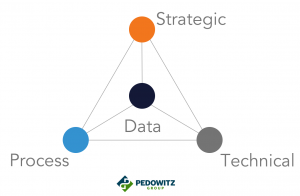
The four fundamental elements are– Strategy, Process, Technology, and Data.

TPG - The Four Fundamentals
TPG – The Four Fundamentals

Strategy: This is your organization’s plan for how you’ll transform and specifically how you’ll use data to generate meaningful insights.

Technical: Putting the right tools and systems in place to capture, store, measure, and analyze data and then share the resulting insights to your organization.

Process: Ensuring all your processes enrich rather than pollute your data set.

Data: Making sure you have the right data architecture, quality and completeness to generate the insights your organization needs to move the business forward.

As you can understand, lacking any of the four fundamental elements will leave your organization wanting. Without the right data, you won’t generate any insights or the ones you do will be called into question. The lack of processes, or inconsistent processes, will corrupt your data set.

Without the proper technology (and no, this isn’t a green light to get a BI tool) you simply won’t be able to generate or share the insights you need. And without a strategy tailored to your organization, you won’t know what tools, processes, and data you need because you won’t know which insights are critical to maintaining your business health.

Also Read: How Marketing Ops Runs Marketing Like a Business

A Methodology for Putting this into Practice

Start the Transformation

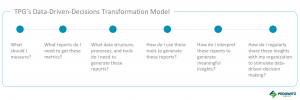
After years of consulting on decision-making, I’ve uncovered six critical, largely sequential, questions all organizations must effectively answer if they’re to move to data-driven-decision making. These questions appear whether you’re just starting out in your measurement maturity or you’re well on your way to advanced measurement.

These questions are–

  • What should I measure?
  • What reports do I need to get these metrics?
  • What data structure, processes, and tools do I need to generate these reports?
  • How do I use these tools to generate these reports?
  • How do I interpret these reports to generate meaningful insights?
  • How do I regularly share these insights with my organization to stimulate data-driven-decision making?
TPG_Transformation
TPG_Transformation

As you can see, these questions address the four fundamental elements directly and also address the insight generation and institutionalization elements that move your organization to data-driven marketers in practice.

As you’ll also notice, selecting what you’re going to measure (strategy) is the first step for a reason. It guides answers to all the other questions. This step is so critical that I recently conducted a half-day workshop on it at B2B Marketing Exchange for a packed room.

In answering this question, you must develop a KPI Roadmap to set the strategic direction for your team. Let’s explore why this is so critical.

Also Read: How Marketing Operations Affects Marketing Accountability

The Criticality of a KPI Roadmap

Here, we’re going a bit meta, as we’re addressing the strategy for determining which results to pay attention to. Marketing is a science and an art, with the science side of the equation getting a lot of focus lately, especially in the area of marketing ops. The primary implication is that marketers will act like scientists: they will experiment, collect results, analyze those results and then make decisions based on the insights. These data-driven-decisions, or 3D, are the hallmark of a science-based marketing team.

Choosing KPIs Is a Fundamental Function of Leadership

As marketing leaders, our purpose is to maximize the potential of our teams. The selection of Key Performance & Predictive Indicators (KPIs) directly impacts our fulfillment of that purpose. Done correctly, the right KPIs foster harmony and collaboration. They empower our teams and focus their effort where they have a meaningful impact. A misstep here, though, and the wrong KPIs create dissonance and drain creativity out of our teams.

A KPI roadmap is the strategic plan of specific KPIs your team should adopt for data-driven-decision making. These KPIs are phased over time to capitalize on advancing maturity and to ensure the team is able to consume and use the KPIs you’re measuring. Too much data can be as, if not more, detrimental than too little data.

A KPI roadmap is the framework for defining process and data structures that support the KPIs and ultimately generate reliable insights. You can’t lean on the data if you don’t trust your data. This roadmap guides analysts in their report selection. It also informs the timeline for when a BI tool will be necessary, avoiding the premature purchase of a shiny new system.

Also Read: Fireside Chat with Jeff Pedowitz

Keep It Inquisitive

At the workshop, it was clear that KPI adoption is still a sensitive issue. Across multiple organizations, participants told me stories of resistance to measurement and a fear of the transparency good KPI measurement and reporting enables. This fear is very real and unfortunately, in some organizations, very justified.

If the leadership doesn’t engender a culture of experimentation and inquisitiveness and instead uses this new transparency for data-driven persecution, you will fail to establish a data-driven culture. The team will resist and sabotage the effort at every turn.

An effort that could have been directed to generating and acting on insights will be wasted on defense and disruption (not the market-defining kind). It’s imperative as a leader to instill confidence in your team that this new transparency will be used to uncover insights that will improve the performance of individuals and the organization as a whole. There is a world of difference between a failure and a mistake. Failure is the natural result of experimentation while failures can be controlled and minimized.

You must address the human needs of your people if you’re going to implement a data-driven culture, which accepts the results of many experiments as key learnings that should be captured and shared, improving the results of the entire team.

Also Read:  Core Organizational Ingredients of the Ever-Expanding Marketing Operations Function

Briz Media Group Launches Connectors – A New Twist on Influencer Marketing

0
Briz Media Group Launches Connectors - A New Twist on Influencer Marketing

dbray Media Rebrands Agency as Briz Media, Launches ‘Connectors’ 

Briz Media Group, formerly named dbray Media, recently announced the formation of Connectors, a network of the best and brightest influencers and power players in the communications and marketing industries. These high-profile executives are committed to bringing new innovative ideas, thinking and guidance to Briz Media Group, its clients, and the communications industry in general.

Agency changes include a new logo and website that better reflect the broad scope of the agency’s work and capabilities across a number of industries, including martech, adtech, digital, cryptocurrency, and telecoms, among others.

Through Briz Media Group’s Connectors, companies have access to industry power players who can make connections to propel a business to the next level. Connectors can also help advise companies on key business initiatives—from raising capital to the best route to successful exits.

Also Read: Agency 451 Names Social Influencer Marketing Group Leadership

Briz Media Group Launches Connectors - A New Twist on Influencer Marketing
David Bray

“Connectors is Briz Media Group’s stake in the ground as leaders in the marketing communications industries. To own a category you need to be a leader— to be intimately linked to that category and define it,” said David Bray, founder & Chief Executive Officer (CEO) of Briz Media Group.

Briz Media Group Launches Connectors - A New Twist on Influencer Marketing
Melody Wolff

Melody Wolff, Chief Everything Officer at Briz Media Group, added, “Companies are still grappling with understanding how to utilize technology to effectively communicate with their customers. It is incumbent upon us, as communications professionals, to be up to speed on the latest developments in the market so we can fill in the gap and advise clients. We look forward to introducing customized, industry-specific networks that companies can use to bring new, fresh concepts to their own industries.”

Also Read: Impact Radius Unveils ‘Dynamic Payouts’ for Influencer Marketing Campaigns

The “Connectors” roster includes:

  1. Greg Coleman, President of Buzzfeed
    President & CRO at The Huffington Post & NYU Stern School of Business Adjunct Professor, Digital Marketing, former president of Criteo
  2. Ron Berger, CEO, Executive Chairman at EURO RSCG
    Co-founder & Chairman Emeritus at Advertising Week & Chairman of the 4A’s
  3. Chris Cunningham, Founder of C2Ventures
    Start-up investor via C2.Ventures, Bowery Capital limited partner, BoD at Cornell Tech iTrek, BoA at Build.org
  4. Aurelie Guerrieri, Founder & CEO of Akila One
    President Emeritus of Women in Wireless, author of The Mobile Native’s Guide to Marketing, published with App Annie. In 2016, she was named one of 25 Mobile Women to Watch by Mobile Marketer.
  5. Marc Parrish, CMO of ActionIQ
    Investor & Advisor at Appluence Inc., former COO and advisor at Braze (formerly Appboy)
  6. David Honig, Vice President Strategy, Corporate Partnerships at Dynamic Signal
    Business Development at Buddy Media, Co-founder of Media6Degrees,
  7. Andrew Budkofsky, CRO at Digital Trends
    EVP Sales & Partnerships at Break Media

Also Read: Influencers Who Work Harder Deserve Deeper Rewards

Commenting on the re-brand, Bray stated, “Our new name is intended to communicate and reinforce that we’re a bold and innovative agency representing clients that challenge conventional wisdom and match our core values and mission.”

Bray concluded, “Over the past five years we’ve been hyper-focused on our clients and building credible awareness for them. We decided to practice what we preach and invest in our own public perception by putting a spotlight on our unique value proposition and industry approach. Our decentralized model mirrors the innovation of the companies we represent. Our competitors follow a model that was established decades ago which calls for high overhead, and believes that everyone can become adept at all aspects of the profession. At Briz Media Group, everyone that touches a client’s business is an expert in their respective field, be it publicity, writing, or events.”

Recommended Read: How NOT to Handle a Collaboration Request When it Comes to Influencer Marketing

Interview with Tom Edwards, Chief Digital & Innovation Officer, Agency, Epsilon

0
Tom-Edwards-MIS

[easy-profiles profile_twitter=”https://twitter.com/BlackFin360″ profile_linkedin=”https://www.linkedin.com/in/tedwards/”]
[mnky_testimonial_slider slide_speed=”3″][mnky_testimonial name=”” author_dec=”” position=”Designer”]“Brands will continue to seek out marketing partners who really know their customers and are able to drive business growth.”[/mnky_testimonial][/mnky_testimonial_slider]

Tell us a little bit about your role at Epsilon?

As the Chief Digital and Innovation Officer for the Agency business unit of Epsilon, I am responsible for brand planning, strategy, research, data design, analytics, experience design, digital and engagement strategy, media and innovation. Within my role, I have a unique opportunity to monitor trends and emerging technology and quickly apply and act on new and compelling uses of data, technology, and hardware, to influence consumer behavior.

What draws you to the MarTech Conference?

I am passionate about the intersection of marketing and technology. The MarTech event series always delivers on this topic, offering compelling, highly relevant content and great speakers.

Which sessions at the Martech Conference would you recommend to and why? 

I recommend the “Gen Z, Computer Vision and the Evolution of Experience session” as I know the speaker. Just kidding! In all seriousness, I am looking forward to hearing Adelyn Zhou of TOPBOTS talk about separating fact from fiction in marketing AI.

What is the one piece of advice you have for B2B marketers in 2018?

Omnichannel is the key. Marketers need to consider how and where their customers want to be reached, considering all channels, from digital to traditional to AI.

How do you see the B2B Marketing landscape evolving, in the years to come?

Brands will continue to seek out marketing partners who really know their customers and are able to drive business growth. I predict more B2C companies will seek out end-to-end marketing solutions, where data, platforms and multichannel approaches come from one provider.

Which sectors is Epsilon looking to target to expand its reach in 2018? 

Epsilon’s focus is on growing our clients’ business through a packaged, prescriptive approach. This means making marketing easy for our clients, through platforms, experts, and end-to-end solutions.

What startups are you watching/keen on right now?

One of my favorite start-ups is Oculus360. I love their innovative approach to machine learning solutions and partnerships.

As a futurist, how do you believe marketing technology and data will come together to deliver better personalization?

In the very near future, we will see a convergence of experiences and interfaces that will redefine our version of reality and how brands market to consumers. The acceleration of intelligent systems, such as virtual assistants, will evolve to anticipate human intent. This, combined with other facets of AI such as computer vision, will add on to existing interfaces of desktop, mobile, and voice to include vision and touch. In a nutshell, our environment will quickly evolve from us controlling technology to technology adapting to our needs seamlessly.

What does Epsilon’s martech stack currently consist of?

As my colleague Wayne Townsend, President, Technology has previously shared with MarTech Series, Epsilon has a full stack of products that manage, identity, loyalty, digital media and email on behalf of clients. We spend the majority of our time integrating these solutions into our client’s infrastructure that may include other heterogeneous components from partners like Adobe and Oracle. There is a lot of promise that comes with marketing technology but if you don’t have integrated systems that are implemented appropriately and can communicate in real-time to activate insights you will never realize the full potential of your marketing technology investments.

Could you tell us about a standout digital campaign?

Epsilon developed and launched an integrated advertising campaign to promote the launch of Cracker Barrel’s seasonal Campfire Meals. The program included the production of an online video series, “The Worst Camper in the World,” and a multi-touch email campaign designed to deliver high engagement with video links, downloadable apps, social content, e-commerce links and directions to the nearest Cracker Barrel restaurant. Epsilon’s digital media arm, Conversant, created animated banner advertisements for a 4-week digital media campaign using proprietary custom audiences and location intelligence data to drive traffic to restaurants. A social campaign was deployed as well, targeting custom Facebook audiences, as well as Cracker Barrel’s Facebook and Instagram followers. The integrated campaign resonated with the target audience, bringing 13,000 new unique website users, 2X higher than average casual dining video ad CTR and a strong click-to-open rate for all deployed emails.

How do you prepare for an AI-centric world as a business leader? 

It all starts with fully understanding the core business objectives. The next step is to identify the ideal data attributes and dimensionalizing that information to be actionable through AI-based systems. The key is understanding the type of data that we will be working with, then aligning the ideal algorithms to drive predictive responses, whether it’s processing large amounts of unstructured data or creating a framework “scene design” for virtual assistants and IoT. My team and I have been leveraging various forms of AI for the past 24 months and have developed working models that drive business results.

One word that best describes how you work.

Exponential.

What apps/software/tools can’t you live without? 

Camtasia and iMovie. I travel quite a bit and record screen sessions all the time. Having the ability to quickly capture, edit and publish makes my life easier. I have used high-end video editing services but sometimes it’s just easier to move quickly with basic software.

What’s your smartest work related shortcut or productivity hack?

It may sound counterintuitive but record your presentations. It is incredibly helpful to simply screen capture your recording and listen to the flow, the inflection of your voice and how you are delivering content. This extra step saves me time in the long run.

What are you currently reading? 

I write more than I read, but I am currently reading multiple books, including Exponential Organizations by Salim Ismail, The Master Algorithm – How the Quest for the ultimate learning machine will remake our world by Pedro Domingos, The Inevitable by Kevin Kelly and Altered Carbon by Richard K. Morgan.

What’s the best advice you’ve ever received? 

It’s incredibly important to have a mentor AND a sponsor. A mentor who is outside of your industry. A sponsor serves as your advocate through various levels of the organization or industry.

Something you do better than others – the secret of your success? 

I put in the time to write and ensure that my perspective on the industry is published on a fairly regular basis. This is above and beyond my normal day job, but nothing has impacted my career in a positive way more than starting a marketing technology/innovation blog 11 years ago.

Tag the one person whose answers to these questions you would love to read:

Adelyn Zhou

Thank you Tom! That was fun and hope to see you back on MarTech Series soon.

Register for The MarTech Conference with promo code – martechseries10 to avail a 10% discount

[vc_tta_tabs][vc_tta_section title=”About Tom” tab_id=”1501785390157-b58e162d-0ae25a4b-c27aca64-108e51b0-80edaf37-bd3d357a-6c4602ae-6a2c”]

Tom, recently named by Advertising Age as a Marketing Technology Trailblazer, is a data-driven, digitally centric marketing executive and professional futurist. He specializes in the integration of emerging technology, digital transformation, thought leadership, innovation and leading strategic teams. He has developed a significant base of experience across multiple industries which has led to strategic interactive and innovation led consulting engagements with hundreds of Fortune 1000 organizations.

Tom leverages experience from previous initiatives to create buzz, drive awareness, develop new business, contribute to the direction of great products and create captivating marketing programs that span early adoption through to mass mindshare. He has a proven track record advising start-up & early stage organizations by providing strategic guidance, direction, insight & access to investor networks. He is experienced as both a formal advisor or board member.

[/vc_tta_section][vc_tta_section title=”About Epsilon” tab_id=”1501785390320-2d44fa50-740c5a4b-c27aca64-108e51b0-80edaf37-bd3d357a-6c4602ae-6a2c”]

Epsilon Logo
Epsilon is an all-encompassing global marketing innovator. We provide unrivaled data intelligence and customer insights, world-class technology including loyalty, email and CRM platforms and data-driven creative, activation and execution. Epsilon’s digital media arm, Conversant, is a leader in personalized digital advertising and insights through its proprietary technology and trove of consumer marketing data, delivering digital marketing with unprecedented scale, accuracy and reach through personalized media programs and through CJ Affiliate, one of the world’s largest affiliate marketing networks. Together, we bring personalized marketing to consumers across offline and online channels, at moments of interest, that help drive business growth for brands.

[/vc_tta_section][/vc_tta_tabs]
[mnky_heading title=”MarTech Interview Series” link=”url:https%3A%2F%2Fmartechseries-67ee47.ingress-bonde.easywp.com%2Fcategory%2Fmts-insights%2Finterviews%2F|||”]

The MTS Martech Interview Series is a fun Q&A style chat which we really enjoy doing with martech leaders. With inspiration from Lifehacker’s How I work interviews, the MarTech Series Interviews follows a two part format On Marketing Technology, and This Is How I Work. The format was chosen because when we decided to start an interview series with the biggest and brightest minds in martech – we wanted to get insight into two areas … one – their ideas on marketing tech and two – insights into the philosophy and methods that make these leaders tick.

TechBytes with Neal Sinno, GM and VP Operations, Playbuzz

0
Neal Sinno

Neal Sinno
GM and VP Operations, Playbuzz

Modern marketing technologies are created with two strategic aspects at their core — first, to deliver unprecedented customer experiences; and then, manage the performance and validity of the CX performance based on audience conversions. Video monetization products catapult marketers and advertisers to achieve both, in a programmatic ecosystem. To understand how should app-marketers and mobile advertising platforms make better use of Video Monetization and news streaming technologies, we spoke to Neal Sinno, GM and VP Operations, at Playbuzz.

Html code here! Replace this with any non empty text and that's it.

Tell us about your role at Playbuzz and the team and technology you handle.

As GM of North America at Playbuzz, I lead our US operations including Business Development and Account Management. Our primary goal is to build new relationships – and maintain existing ones – with publishers who value driving audience engagement via interactive editorial, as well as innovative monetization solutions that uphold a positive UX.

Our portfolio of publishing partners includes MLB, HuffPost, BBC, Sky News and more, all of whom devote percentages of their editorial creation to Playbuzz’s storytelling tools to cover topics ranging from sports to politics.

The Playbuzz platform enables editorial teams such as those at the aforementioned to craft interactive articles that compel users to engage, and thus result in reader loyalty and longer dwell times. In fact, our data shows that incorporating interactive storytelling tools into content can boost dwell time by 20%, and the higher the dwell time, the better the monetization opportunities.

What is your Stream product? How do these ads justify media buying budgets in a programmatic ecosystem?

Stream is our new video player that enables publishers to create their own video content on our platform using the Playbuzz Video tool and then monetize that content. Publishers enjoy the ability to not only quickly create, distribute and monetize with Stream, but also the incremental revenue that comes along with implementing the product.

How should app-marketers and mobile advertising platforms make better use of Video Monetization and news streaming technologies?  

Video monetization products like Stream allow both publishers and advertisers of all sizes to create new revenue streams – a luxury that’s more crucial than ever in an everchanging industry that finds itself in constant Facebook and Google duopoly turmoil.

The Stream video content publishers create on the Playbuzz platform can be used to cross-promote new editorial and products – while also acting as the mechanism for driving additional revenue earned via the ads shown before, during, and after, the content player.

For advertisers, the creation of new video content enables them to reach their target audience in a manner that users don’t need to tolerate as ads are relevant and give control to users with features like sticky mode and autoplay control.

How do you compare the benefits of native versus programmatic advertising?  Which technology would be most beneficial for B2B marketing teams looking for brand safety, transparency and optimized ROI in 2018?

Programmatic advertising enables you to reach the most eyeballs at the lowest price – but it’s not necessarily the best avenue to create a meaningful dialogue.

Native advertising is more of a curated approach – smaller scale but greater opportunities to package campaigns in a visual-first, interactive manner that feels more natural to users. These types of ads, which can feature engagement at their core, is where teams should be investing as studies show that 79% claim interactive content enhances retention of brand messaging when combined with traditional marketing tactics.

If done correctly, both methods offer safety, transparency and viewability for brands. At Playbuzz, we are proponents of native methods as they enable you to be more selective with placements of campaigns that align with the brand’s intended experience and expectations.

Our native ad offerings – which include branded, interactive narratives and branded elements – have yielded results well above industry standards based on their engagement-first approach, including:

  • 97%+ in-item viewability confirmed by MOAT
  • 2-4 minute average session times (as compared to the 15-second industry average)
  • An average CTR of 4.6+%
  • An average 86% brand lift, as reported by Nielsen.

How do media monetization technologies work? How is Playbuzz different from other content monetization platforms? 

Playbuzz is a storytelling platform that promotes the creation of content – editorial and commercial – that aligns with users’ consumption habits. At our core, we believe that ads should be thoughtfully placed, positioned and delivered to users as part of a larger story. Lead with your editorial, and then bake in monetization that is contextual.

Products like Stream enable you to do just that, as it is first and foremost a content player with a monetization layer simply added in. Premium publishers like ESPN and CBS utilize this tool to add video to their editorial while simultaneously delivering ads in a way that is intuitive to users whilst not harming their reading experience.

What are your predictions for B2B storytelling and marketing tools in 2018? How would these technologies enable businesses to draw better sales revenues?

In the era of FOMO and Snapchat, publishers must rely on new storytelling techniques to harness fleeting attention spans. This means that they will start utilizing more third-party tools that allow for personalization, customization, and interactivity.

The same thought process must be applied to monetization. We can no longer expect users to click on dull, static ads and not be turned off. And with the EU’s GDPR deadline approaching, and Google and Facebook consistently changing their algorithms to promote a positive user experience, publishers must experiment with new video and interactive monetization opportunities or risk becoming irrelevant.

Thanks for chatting with us, Neal.
Stay tuned for more insights on marketing technologies. To participate in our Tech Bytes program, email us at news@martechseries-67ee47.ingress-bonde.easywp.com

Cognitiv Taps Marketing Veteran Jana Jakovljevic As VP of Strategic Partnerships

0
Cognitiv
Cognitiv

Jana Jakovljevic Joins Cognitiv After Successful Outings at Rubicon Project, Spotify, and IPONWEB

Cognitiv, a provider of neural network technology for marketers, announced the appointment of Jana Jakovljevic as VP of Strategic Partnerships. In this newly created position, Jakovljevic will be responsible for building Cognitiv’s partner network to enable deep learning through Cognitiv’s NeuralMind, a self-learning technology that automatically creates custom algorithms that continuously grow more accurate over time.

Jana Jakovljevic
Jana Jakovljevic

Jana Jakovljevic will report directly to Jeremy Fain, the CEO and co-founder of Cognitiv.

At the time of this announcement, Jakovljevic said, “Today’s marketer needs to use all the data points available to them but as these data sets multiply and become more complex it is increasingly difficult to make sense of it all. A neural network as trained by Cognitiv can make accurate predictions with all of that data, well beyond any technology which exists today. They have proven their NeuralMind can optimize campaigns more efficiently having already increased ROI for marketers across several verticals.”

Cognitiv solves a formerly unsolvable problem for marketers: How to use Big Data to precisely buy ads that target the right consumers, at the right time, in the right place.

Jana added, “I look forward to supporting Cognitiv’s innovation and growth by identifying additional opportunities to help marketers harness the power of this cutting-edge science.”

Read More: AI-as-a-Service in Martech: Focus on Virtual Assistants, Voice Search, and Location Data Intelligence

“Jana is an industry veteran in programmatic and emerging advertising technology solutions,” said Jeremy Fain.

Jeremy added, “Jana’s experience will help Cognitiv to further its goal of using Deep Learning to predict human behavior for marketers.  Her work, bringing in new and innovative data partners as well as finding new uses for our NeuralMind technology, will drive the continued improvement and effectiveness of all our capabilities, including Cognitiv’s programmatic media and dynamic audience scoring products.”

Read More: Interview with Jeremy Fain, CEO, Cognitiv

Prior to Cognitiv, Jakovljevic was VP of Business Development at IPONWEB, where she worked with enterprise businesses to develop technical solutions to their advertising infrastructure challenges. Before that, she was the Global Head of Programmatic Solutions for Spotify, where she helped pioneer programmatic audio by launching the streaming music leader’s global strategy and offerings. Jakovljevic also worked at Rubicon Project, where she played a foundational role in building their international buy-side partnerships among agencies, exchanges, DSPs, and mobile partners. Before Rubicon Project, she held digital media roles at Fox Interactive Media and CIS Internet.

Currently, Cognitiv is the technology powering IBM Watson Advertising products and is the first neural network technology that unearths patterns of consumer behavior so marketers can accurately pinpoint consumers who want to buy or further engage with their products.

Recommended Read: IBM Study: 61 Percent of CMOs and Sales Leaders Say Cognitive Computing Will Be a Disruptive Force

Mpire Refreshes Brand Following APAC Launch

0
Mpire Refreshes Brand Following APAC Launch

Global Adtech and App User Acquisition Company Have Refreshed and Revamped Their Brand Identity by the Launch of a New Network With The Truncated Name Mpire Network.

Global adtech and app user acquisition company, Mpire Network, launched a comprehensive brand refresh. At its center is the introduction of a new, truncated name, Mpire, to reflect the Company’s evolution beyond the category of ad network. Accompanying the new name will be a renewed visual brand identity for the company and a new website.

Also Read: Rakuten Marketing to Host the Premier Conference for Online Performance Marketing Leaders at the 2018 Rakuten Marketing DealMaker Event

Since launching in North America in 2014, Mpire has invested heavily in technology to optimize mobile app user acquisition for its global client base. Increasing concerns about fraud in mobile advertising led to the development and launch of the company’s proprietary invalid-traffic (IVT) mitigation solution, TrafficGuard in 2016. The company believes the value delivered by this technology to Mpire’s advertiser clients, extends beyond a typical ad network.

Also Read: Vungle Announces Self-Serve Platform for Mobile Advertisers, With Creative Automation to Scale High Quality Customer Acquisition

Mpire Refreshes Brand Following APAC Launch
Lee Hunter

“With the increasing sophistication of our proprietary tech, we no longer simply connect supply and demand. In mitigating IVT and using big-data to drive optimization, we do a lot more than an ad network to drive superior online advertising performance, and have, therefore, outgrown the classification of “network,” said Lee Hunter, CEO of parent company Tech Mpire.

He added, “With the launch of our APAC expansion, we took the opportunity to refresh not just our logo, but the entire way we communicate our brand and market position. We are proud to be setting the pace in tech development for mobile app marketing, and our new brand reflects how far we have come.”

Recommended Read: Why The World Needs 5G And How It Will Impact The Programmatic Advertising & Publisher Industries


U.S. Customs and Border Protection Agency Picks Salesforce as Digital Modernization Platform

0
Salesforce CEO Marc Benioff to Participate in World Economic Forum Annual Meeting 2018

CBP Will Use Salesforce’s Community Cloud and Analytics to Recruit and Support New Agents in the Field and Service Cloud to Drive Efficiencies Around US Border Activities

Salesforce, the global leader in CRM, announced that US Customs and Border Protection (CBP)—the largest federal law enforcement agency of the US Department of Homeland Security—is deploying Salesforce Analytics, Community Cloud and Service Cloud to modernize its recruiting process, from hire to retire, and to also manage border activities and digital engagement with citizens.

Using Community Cloud, the agency will embark on an aggressive transformation effort to increase core human resources information technology capabilities for current and prospective employees, while at the same time, driving efficiencies throughout the process. Current employees will also be able to access information such as onboarding materials, benefits, payroll and more. In addition, CBP will use Analytics dashboards to get a quick view of its recruiting efforts, which can then be segmented by demographics, regions and more, helping them better understand where there is a recruiting need and more accurately target potential employees.

Also Read: Salesforce.org Partners With United Way To Launch Salesforce.org Philanthropy Cloud

CBP will use Service Cloud to drive efficiencies around how U.S. border activities are managed and handle feedback from citizens across a variety of channels.

“In this competitive hiring environment, it is critical for law enforcement agencies to embrace new technologies as a tool for accomplishing their mission—and CBP is no exception. We are committed to investing in innovative technologies and solutions, such as Salesforce, to improve our business in the most cost-effective and efficient manner possible,” said Linda Jacksta Assistant Commissioner, Human Resource Management, CBP.

U.S. Customs and Border Protection Agency Selects Salesforce as Digital Modernization Platform
Dave Rey

“There is a huge opportunity for government agencies to modernize so they can meet the expectations of today’s digitally savvy employees and citizens. By deploying Salesforce, CBP is empowering its employees with a modern CRM platform that will boost engagement, information sharing and productivity,” said Dave Rey, EVP, Public Sector, Salesforce.

Recommended Read:  Salesforce Einstein Analytics Unveils Conversational Queries to Simplify Data

Cellebrite Arms Forensic Examiners with Unparalleled Access and Analysis of Digital Evidence

0
Cellebrite Arms Forensic Examiners with Unparalleled Access and Analysis of Digital Evidence

Cellebrite Introduces New Extraction Capabilities in UFED Ultimate, Allowing for Robust Examination from Key New Sources in a Single Environment, Complimentary Inclusion of Public Social Media Data via UFED Cloud Analyzer

Cellebrite, the leading provider of digital intelligence solutions, has introduced a comprehensive upgrade to its portfolio of offerings to provide examiners with new capabilities that provide unrivaled access to evidence from locked or encrypted mobile devices via UFED Ultimate. In addition, by providing a complimentary UFED Cloud Analyzer public domain product license available to all active UFED Ultimate customers, teams can enrich digital examinations with rapid access to public social media data.

With the enhanced analysis capabilities in Cellebrite Analytics Desktop — available with UFED Ultimate UFED Cloud Analyzer as part of the UFED Pro Series suite — Cellebrite’s newest enhancements enable examiners to perform extraction, analysis, and case review of digital evidence from mobile, public social media, and private cloud sources in a single solution.

Also Read: Ugam Joins the Newly Launched Qualtrics Partner Network

Improved extraction capabilities within UFED Ultimate give examiners intimate contact with data from locked and encrypted mobile devices, featuring new and exclusive tools that enable forensic examiners to:

  • Harness an automatic EDL capability to bypass locks to extract and decrypt physical data from several leading Android OS-based devices using Qualcomm chipsets using a Decrypting Boot Loader.
  • Unlock screens on some of the most popular and advanced Samsung Android-OS smartphones and tablets, including Galaxy S7, S7 Edge, J7, J5, A7, A5 and more.
  • Use Smart ADB to perform physical extraction on unlocked Android OS devices running 6.0 up to 7.1.1.

With Cellebrite’s announcement of providing complimentary access to its state-of-the-art Cloud Analyzer, examiners can rapidly access public social media and cloud-based data. Practitioners can quickly reveal evidence hiding in plain sight on Facebook, Instagram and Twitter by automatically extracting and preserving public-domain forensically-sound data in one workflow without a warrant to:

  • Obtain location information, profiles, media files, and communications.
  • Eliminate the time consuming, manual process of gathering, organizing and viewing disparate public cloud sources.

Also Read: Over Half of Millennials Check Snapchat Daily, Much More Than Boomers and Gen Xers

In order to better address the needs of forensic examiners who also investigate cases or must support the investigative team with analysis or case review, Cellebrite is also introducing new usability improvements to Analytics Desktop. Updated features support additional media classification categories, UI improvements and a more streamlined workflow from UFED Physical Analyzer that will help examiners dig through data faster to surface and capture relevant evidence to help address growing areas of crime, such as homicide, terrorism, border security, organized crime, and child exploitation.

Digital forensic practitioners can now build stronger cases by deploying a UFED Pro Series solution that combines the powerful capabilities of UFED Ultimate, UFED Cloud Analyzer and Analytics Desktop to analyze data from multiple devices, public and private cloud and other digital sources.

Cellebrite Arms Forensic Examiners with Unparalleled Access and Analysis of Digital Evidence
Ron Serber

“This new solution enables examiners to strengthen cases through superior access to more device and public social media data while ensuring that it is obtained in a forensically sound method. As agencies face growing challenges from encryption and backlog, the innovation and breadth of our UFED solutions help examiners access the inaccessible and streamline the lab workflow to help break more cases faster,” said Ron Serber, Global Co-CEO of Cellebrite.

Recommended Read:  Cellebrite Introduces Advanced Machine Learning Technology to Analytics Solution to Accelerate Evidence Discovery

The Big 5: Top MarTech Updates from Last Week

0
The Big 5: Top MarTech Updates from Last Week

What Better Way to Start Your Monday Than Wheeling Through The Top Five Martech Updates That Occurred in the Previous Week. This Is Your Weekly Monday Dose

Twitter Hires Parag Agrawal as their New CTO

Social blogging platform, Twitter, has appointed Parag Agarwal as their new Chief Technology Officer. A Microsoft alumnus, Parag did his schooling from Atomic Energy Central School and his engineering from the IIT-Bombay. Parag succeeds Adam Messinger in his new role, leading the technology strategy, for the micro-blogging platform.

Recommended Read: Adobe Advertising Cloud Search Unveiled for Simplified Search Advertising

Urban Airship Revolutionizes In-App Engagement for Consumers and Brands

In a major industry-first announcement, Urban Airship has unveiled an in-app automation engine. The latest in-app automation engine from Urban Airship helps brands to create rich, interactive in-app messages that instantly display based on customers’ multiple behavioral and lifecycle events.

This ensures that the messages are seen at the exact moment that matters most to each individual – in-session, in-context and on specific screens.

Salesforce and Dropbox Expand Strategic Partnership to Boost Team Productivity

In the latest partnership deal, CRM leader Salesforce and Dropbox would work together to make all-size businesses to deeply connect with their customers across all operations. The new arrangement would see the integration of Salesforce’s Commerce and Marketing Cloud with existing Dropbox platform.

Read More: The UK’s Largest Hubspot Partner – The B2B Marketing Lab – Moves Into New Central London Office

This is aimed at letting end users create branded, customized Dropbox folders within Salesforce Commerce Cloud and Marketing Cloud with the new digital asset engagement solution.

Buzzsumo Report: Social Sharing Of Content Has Been Cut In Half Since 2015

In a startling revelation on social media content marketing statistics, BuzzSumo has found that social traffic referrals have declined drastically since 2015. After analyzing 100 million posts published in 2017, the leading social media monitoring platform found that “brands and publishers are gaining less organic referral traffic from Facebook and less engagement with their Facebook posts.”

Read More: Fierce Pace of Tech Disruption Has Forced Companies to Innovate via M&As

Teradata Names Martyn Etherington as Chief Marketing Officer to Bolster Its Cloud Strategy

The leading cloud-based data and analytics company has a new CMO. Martyn Etherington is hired as Chief Marketing Officer following his distinguished track record of driving top-line results, growing market share, improving customer experience and enhancing brands, will report to Oliver Ratzesberger, the COO of the company.

Both roles are newly-created and showcase Teradata’s ongoing evolution as a company that prides itself on innovation and driving high-impact business outcomes for its customers.

Recommended ReadLessons for Content Marketers from a Successful Cupid

Interview with Mikko Honkanen, Co-founder, Vainu.io

0
Mikko Honkanen
Interview with Mikko Honkanen, Co-founder at Vainu.io

[easy-profiles profile_twitter=”https://twitter.com/MikkoHonkanen” profile_linkedin=”https://www.linkedin.com/in/mikko-honkanen-195a3920/”]
[mnky_testimonial_slider slide_speed=”3″][mnky_testimonial name=”” author_dec=”” position=”Designer”]“Using sales prospecting tools, CMOs can run very effective account-based marketing campaigns and make sure they spend their marketing efforts with the likeliest prospects.”[/mnky_testimonial][/mnky_testimonial_slider]

Tell us about your role and how you got here. What inspired you to launch Vainu?

Our founding team has collectively spent many years in the technology sector, specifically leading sales teams and managing accounts at major organizations. No matter where we were, we face a consistent challenge — finding the ideal prospects to go after and sell our services. With limited time and resources, it’s impossible in a B2B setting to go after every possible business who may need your services. You need to be able to allocate time to the right prospects and customers. That’s where idea for Vainu began.

How do you bring ‘super accurate’ marketing qualified leads, and real-time buying signals to B2B sales and marketing team?

Our name Vainu is actually Finnish for “scent of the hunt” — through the use of the right online buying signals companies send, we have built a product that helps B2B sales people target and reach the right prospects at the right time. The accuracy comes from the the actionable insights we gather from open data in our database of more than 100 million companies. Through machine learning, our platform is constantly learning, refining and expanding the depth of our database’s knowledge.

Perhaps the best way to show the power of our platform is through what our customers have experienced. For example, one of our customers, a SaaS vendor in the HR space, spent 67% less time on prospecting while conducting 27% more sales meeting and increase revenue by 36% — all within a six month period.

Sales teams work smarter and have more time to spend on doing what they do best — talking to people about the value of their product or service. Vainu is the tool that helps them find the people most in need of having that conversation with them.

What are the differentiating factors separating Vainu from other sales intelligence products?

We know more about companies any anyone else and have built a very powerful prospecting search engine on top of our extensive database. Our tool is built and designed by sales people, for sales people. Our sales intelligence platform isn’t built on static or annual data, unlike other platforms. And, our information isn’t combed through having team members tediously call companies and gather information that way. It is all done through open data and machine learning — we teach our Vainu platform to gather relevant insights from companies. Through 100-plus filters, our customers can find their Ideal Customer Profile through simple searches and maintain an evolving list of them by setting up automated sales trigger updates. And, our platform feeds into a customers’ CRM so that there is a seamless process from researching prospects to maintaining leads. And, customers can feed lists in their CRM back into Vainu to build a list of like-minded companies in the Vainu database and call on those prospects.

How do you prepare for an AI-centric world as a business leader? How do you leverage AI technologies at Vainu?

AI really is in our DNA at Vainu — our platform evolves and builds on itself through it. We have a team of developers, led by our CTO Tuomas Rasila, who are constantly looking to take our machine learning a step further. As an example, we just launched new updates that allow users to find corporate structures of all the companies in our database. Moreover, we are, with A.I., able to know industrial domains of all the companies by detecting those from how they communicate openly. This is huge in the US, where this is a problem. Our AI is now also crunching the numbers of all the financial statements on full auto pilot. This means that a customer of ours who conducts sales at a bank can sort all of the companies in the order in which they need financial services. We also just released a new way of how our customers can create their own AI instances within Vainu to search customers like their examples — in short, take a list of best customers and search more like them.

The intent for these AI expansions is to make the life of sales and marketing people more efficient, saving them time and energy.

In 2018, how would CMOs benefit from leveraging sales prospecting tools?

CMOs are often measured by number of leads, their conversion rate and total return on marketing. Using sales prospecting tools, CMOs can run very effective account-based marketing campaigns and make sure they spend their marketing efforts with the prospects that have the highest likelihood of becoming customers. CMOs can also use account insights to make their lead scoring algorithms even more accurate. There are both positive and negative company attributes that can be extracted from public web and those data points improve lead scoring algorithms that typically are mainly based on behavioral data.

What are the major challenges for B2B teams in dealing with multi-channel data along the prospect’s journeys?

In the past, data quality was always a challenge for almost any B2B teams. Nowadays, data quality has improved a lot but at the same time the amount of data available has exploded. All teams need to make sure they have mapped out their customer journey and built a systematic sales playbook for their teams. With those  it’s easier to map out different data sources that are most useful in different parts of the sales funnel. At the end of the day, B2B teams don’t just need data but insights that help them to do the right thing at the right time.

What startups in the martech industry are you watching/keen on right now?

There is a lot of activity in the startup and marketing technology industries across the Nordic region (our European headquarters is in Helsinki). Here are some rising martech companies in the Nordics that people may want to keep their eye on as they continue to grow and refine their technologies:

  • Smartly.io – This Finnish company helps marketing teams to automate and optimize their Facebook and Instagram advertisements. I believe they will become one of the leaders in that space globally.
  • Flowbox and Stackla: Flowbox is from Sweden and Stackla is actually not from the Nordics but Australia. They both help marketing teams to utilize User Generated Content more effectively in the marketing process. I believe UGC is a great opportunity for many companies and it’s exciting to see the progress of these fast growing startups.
  • Unacast: A Norwegian company and one of leading proximity and location data platforms. Their Real World Graph™ helps marketing teams to understand how people and places are connected.

What tools does your marketing stack consist of in 2018?

We use a number of tools across our team in multiple offices, countries and continents. Here’s what our stack looks like in 2018:

  • Vainu – We use our software for sales prospecting, inbound lead scoring and account based marketing campaigns.
  • Hubspot – This is our marketing automation tool
  • Outreach.io – Sales engagement platform for the US market where it’s more challenging to get connected with decision makers
  • Pipedrive – This is our CRM and it’s integrated with our own Vainu tool
  • GetAccept – For eSignatures and sales & marketing collateral analytics
  • Slack – Our team collaboration tool
  • TrenDemon – A Hubspot plugin that helps us to understand what type of content resonates the best with customers

Would you tell us about your standout global digital campaign/ customer success story at Vainu?

Perhaps our biggest success story is how our own platform has really helped us to target prospects and sell directly to them. We launched our company just several years ago as an idea between three founders. For the first six months, we worked out of my house and did not take a salary to build our product. We did not take outside funding; rather, we started selling from Day One. And as soon as we had our initial database, we were using that to aggressively target prospects who would also stand to benefit from our services.

Since we first started developing Vainu in 2014, we have grown to more than 140 employees, six offices and $1 million per month in online bookings and recurring revenue. And we have still been able to do all of it with no outside funding.

In terms of measuring our successes in sales and marketing, we turn to the Sales Velocity Equation to get a better understanding of how effective our team is. The equation goes as follows:

You multiply the number of sales opportunities by average deal value and also win rate percentage. Then, you divide that by (the length of the sales cycle). That sales velocity number can then be measured over time to see how well your team is doing.

How do you manage people and technology converging at Vainu? How should businesses adjust management style when reaching new markets?

Our entire company really revolves around the Vainu SaaS offering and our entire team — from product development to sales to customer support — is laser-focused on providing the best possible experience of the Vainu platform to our customers. In a sense, the more energy we spend refining Vainu and learning best practices on how to use the data to effectively sell, the better we will be able to support our customers and convince prospects that the tool is essential for the modern salesperson.

Our sales team is constantly working on the Vainu platform searching for prospects who would be ideal customers for us. Technology and people have been converging since Day One here at Vainu — everyone at our company is helping us learn more about Vainu and constantly refine and expand on our sales intelligence platform.

Perhaps the biggest leap so far for us has been to expand to the United States and open our New York office. To launch, we did what we have done in other offices — we bring several experienced team members to the new market and build around them. These are people that we know understand our brand and culture and who can teach that to new team members.

While you may need to make some adjustments when managing in new markets, you will always want to maintain your company DNA. That’s the most important element of entering a new market. You will need to learn the nuances of the new market, but you will always want to hold to the most important elements that have defined company success to date.

What apps/software/tools can’t you live without?

Zapier is a great app that connects many of the apps I use daily. There are so many useful applications these days and they don’t always have powerful integrations with each other. Zapier solves that problem for users. One way we use it to connect our lead scoring models on Hubspot with our own Vainu data, which saves us a lot of time.

What’s your smartest work related shortcut or productivity hack?

In a way, becoming a parent is the most effective productivity hack one could think of. I want to spend a lot of time with my 15-month old daughter and it helps me to get started with my work-related tasks right away in the morning because I don’t want to end up working until very late in the evening every other day. So, I guess productivity is all about your mindset at the end of the day!

What are you currently reading?

I typically have several books that I’m reading more or less at the same time. Right now the ones that I’m really enjoying are:
Fanatical Prospecting, Jeb Blount – a great book about the importance of always building a fresh pipeline in sales.

Outside Insight, Jorn Lyseggen – this is a fascinating story of how external data can be used in corporate decision making. The author is my former CEO in the company I worked for before launching Vainu.

-Alex, Alexander Stubb – An autobiography from a former prime minister and Ironman triathlon finisher Alexander Stubb.

-When Breath Becomes Air, Paul Kalanithi – A non-fiction autobiographical book written by Paul Kalanithi. It’s a memoir about his life and illness, battling stage IV metastatic lung cancer.

What’s the best advice you’ve ever received?

Start selling from Day One. We really made this part of our mantra in launching Vainu. I believe that the best way to try out if an idea is good enough to take off is to speak to 100 unaffiliated potential customers as soon as possible. If people are willing to spend their time and money on something, it’s the best feedback you can get.

Tag the one person in the industry whose answers to these questions you would love to read –

Kristo Ovaska, Founder & CEO of Smartly.io

Thank you, Mikko! That was fun and hope to see you back on MarTech Series soon.

[vc_tta_tabs][vc_tta_section title=”About Mikko ” tab_id=”1501785390157-b58e162d-0ae25a4b-c27aca64-108e51b0-80edaf37-bd3d357a-6c46b7e1-c76c”]

Before launching Vainu, Mikko Honkanen was a multi-national director for global media monitoring company Meltwater. He gained experience across the Nordics as an area director and country director for Finland and grew the company and a team in Silicon Valley as regional director for the North America West division.

Through his experience working in the media landscape and with Big Data, Honkanen realized a need for a broader B2B service that allowed business development professionals from many different industries the kinds of targeted insights and triggers they need to make smart, efficient prospecting decisions.

[/vc_tta_section][vc_tta_section title=”About Vainu.io” tab_id=”1501785390320-2d44fa50-740c5a4b-c27aca64-108e51b0-80edaf37-bd3d357a-6c46b7e1-c76c”]

Vainu

Vainu.io is a data-driven prospecting and lead generation sales intelligence platform used by more than 1,000 organizations to identify actionable insights and sales leads. On mission to collect, read and understand all the information ever written about every company in the world, and with more than 100 million companies in its platform already, Vainu has helped its clients streamlines sales and close more deals by finding the right time and method to contact prospects. It was named a 2017 top 100 European startup in Wired U.K. and “Best Bootstrapped Startup” in the 2017 Nordic Startup Awards.

Used by companies like FedEx, UPS, Manpower, Dell and Microsoft, business development leaders in countless industries capitalize on the ever-increasing amount of big data through Vainu. The user-friendly platform integrates with many major sales tools including Gmail, LinkedIn, Salesforce, Slack, Pipedrive and Microsoft Dynamics, among others. Vainu recently launched an app to provide its same customized sales and prospecting solution to users on the go.

With more than 140 team members worldwide, Vainu’s European headquarters is in Helsinki. It also has European offices in Amsterdam, Oslo and Stockholm. The company’s U.S. headquarters is in New York City.

[/vc_tta_section][/vc_tta_tabs]
[mnky_heading title=”MarTech Interview Series” link=”url:https%3A%2F%2Fmartechseries-67ee47.ingress-bonde.easywp.com%2Fcategory%2Fmts-insights%2Finterviews%2F|||”]

The MTS Martech Interview Series is a fun Q&A style chat which we really enjoy doing with martech leaders. With inspiration from Lifehacker’s How I work interviews, the MarTech Series Interviews follows a two part format On Marketing Technology, and This Is How I Work. The format was chosen because when we decided to start an interview series with the biggest and brightest minds in martech – we wanted to get insight into two areas … one – their ideas on marketing tech and two – insights into the philosophy and methods that make these leaders tick.

Marketers Cannot Overlook Mobile Casual Gamers Anymore!

0
Aptoide Powers Ahead With Expanded Top Grossing Games Catalog, 75% Revenue Growth and Strategic Investment From Digital Turbine

Perception is the reality when it comes to marketing, and perception is challenging to alter once it is formed. For example, even though 203 million Americans will play mobile games regularly in 2018, most Americans do not identify themselves as gamers. Industry data proves that people of every age, demographic and household income play mobile games. Interestingly, over 20 percent of gamers in a recent study were older than 55. While 60 percent of women in another study said they play mobile games daily, 72 percent of women do not consider themselves gamers, even though 59 percent of them play at least 10 times per week.

Also Read: Advertisers Have Finally Found A Way To Break Into Gaming

The Gamer Image Is A Myth

Let’s face it, the popular concept of a gamer (read: a teenager blowing up zombies in his parents’ basement) is antiquated. Many advertisers have at least partially held back exploring mobile games as an advertising medium because the gamer image turns them off. However, in 2018, the majority of mobile games played are actually casual games: puzzles, word games, quiz games, brain teasers, etc. In other words, brand-safe and family-friendly. Mobile games are so successful that they now eclipse Hollywood’s global box office revenue at $50 billion versus $40 billion.

Additionally, monster hits such as Pokémon Go, Words With Friends, HQ and others have begun to change perceptions. The industry is also remarketing itself to brands, coining the term “MOCA”-a combination of “mobile” and “casual”-to better represent a person who casually plays mobile games. The term originated from Jun Group as a way to rebrand mobile games for the new generation.

Also Read:  Mobile Gaming Apps Provide Higher Brand Engagement Than Social Apps

Mobile Gaming beats Hollywood in Revenue

Mobile games are so successful that they now eclipse Hollywood’s global box office revenue at $50 billion versus $40 billion.Pulling back the curtain on mobile games reveals an environment ideal for brand advertising. For example, the popular coloring book app Recolor surfaced with millions of daily active players who spend 10 minutes a session on average and generate over 68 million app sessions per month. Over 60 percent of Recolor players earn a household income of over $75,000, according to Facebook Analytics.

The success of casual game apps explains why they were predicted to be a more than 50 percent increase (to $655 million) in brand ad spend on mobile games over the past three years. Ninety-three percent of that spend went to video ads, and as brands continue to pull their video spend from unsavory sites and sites with uncontrollable content, they are beginning to see games as a safe and immersive way to reach their customers.

Despite this recent uptick, spend in the category still pales in comparison to the billions of dollars spent on social networks.

Leading industry organizations like the Mobile Marketing Association are working to change that. A recent white paper on mobile games illustrates the opportunities in-game ads present for brands. The reality is that 25 percent of all apps downloaded from iTunes and Google Play are games, making games by far the number one app category. Mobile games typically represent 20-40 percent of the most popular apps in iTunes and the Google Play store. Mobile games are so popular that people spend on average three times more time with them than they do chat apps, as reported by comScore.

Also Read:  Ad Blockers: Take a Page from Video Game Advertisers

Change Advertisers’ Perception

Also of interest to advertisers is the fact that people report feeling more engaged, relaxed, focused, and happy with mobile games as compared to with social media. And people who are in an upbeat and positive mood are 40 percent more receptive to digital ads. Conversely, the mood of a social media goer may be less savory. Studies have revealed feelings of depression and anxiety, especially among millennial audiences-likely not the most receptive of moods for brand messaging.

So, while adopting a new term like MOCA to describe people who casually play mobile games is not a silver bullet for everything that ails digital advertising, it does go a long way to help change advertisers’ perception of the space. It helps to refocus the conversation on an exciting source of brand-safe and high-performing ad inventory. MOCA gaming reflects a growing pastime for hundreds of millions of Americans from all walks of life. Expect to see more people identify themselves as MOCAs in 2018-and look for advertisers to scale their spending accordingly.

Sitetracker’s “Capture the Future” Contest Aims at Bringing Vital Infrastructure to Light

0
Sitetracker
Sitetracker

Sitetracker Launched A Photo Contest That Enables Project Managers To Forecast Accurately Based On Real-Time Data

Sitetracker, the full lifecycle project and asset management platform, launched a photo contest, designed to empower field employees and contractors to be more efficient and productive by ensuring that project managers can forecast accurately based on real-time data.

Sitetracker launched a photo contest to put a spotlight on the often overlooked technology and infrastructure that powers our society. “From small cell installations to smart meter technology, air quality sensors, and solar farms, we wander past these marvels of tech every day without paying them any attention, And yet, we couldn’t live without them — let alone the workers in the field installing this essential gear. We are celebrating them with the launch of this contest,” said Brett Chester, Vice President of Marketing, Sitetracker.

Also Read: Profisee Announces Attendance at Gartner’s Data & Analytics Summit 2018

The first purpose-built full lifecycle project and asset management platform recently launched a game-changing native mobile application that dramatically streamlines workflows, enhances productivity, and strengthens collaboration with stakeholders across organizations. With a special focus on remote and field workers, Sitetracker Mobile includes on-location one-click project and task close out functionality. This industry-first improves both “speed to close” as well as speed to revenue recognition.

“In industries like telecommunications and utilities, where margin compression is the reality, Sitetracker Mobile will directly impact the bottom line. Legacy project and asset management tools continue to fail their users. Sitetracker is committed to innovation and keeping up with the evolving needs of our great customers,” remarked Giuseppe Incitti, Sitetracker CEO, Incitti

Some of the first-to-market features of the Sitetracker Mobile application include:

  • Upload video and photo assets either live or via Wi-Fi at a later stage
  • One click task completion
  • Easy to view project, site, and asset history
  • Live and editable checklists
  • Real-time uploads to ensure data quality

Recommended Read: Tracking First Joins Adobe Exchange Partner Program to Enhance Data Governance and Reporting

Mobile World Congress 2018: What’s Next for Industry Innovation?

0
MWCIndustryInnovation

TealiumMobile World Congress 2018 (MWC 2018) has always been much more than just a launch pad for the latest handsets and gadgets, and 2018 didn’t disappoint. Of course, new cellphone models were released — including Samsung’s long-anticipated Galaxy S9 — but the focus of MWC was on major trends that are transforming the industry, and what innovations we can expect in the next 12 months.

There were three key topics that stole the show: data security, the dawning of 5G, and mitigating the challenges of Artificial Intelligence (AI).

Here’s a quick-fire overview of the highlights from the Mobile World Congress 2018–

Tightening Data Defenses

With the globally- applicable General Data Protection Regulation (GDPR) almost upon us, it’s no surprise that data security was high on the agenda. By now, most companies are nearing compliance — or should be — so conversations about GDPR revolved around how newly-adjusted data processes can be used to enhance campaigns, and the mobile experience.

For example, to meet requirements — such as providing a copy of all data held about individuals on request — many organizations have embraced consolidation: merging fragmented online, offline and cross-device insight in one place. But these central stores don’t just allow marketers to disclose data rapidly.

By collating all insight related to specific consumers, they also provide the basis for building a 360-degree view of individuals and their journey across every screen; mobile included. The result is a comprehensive understanding of each consumer that marketers can use to deliver tailored, engaging, device-appropriate, and impactful messaging.

But, alongside this emphasis on legislative benefits, there was also a focus on strengthening mobile data security. In particular, a session that brought together telecoms giants, as well as Vice-President of the European Commission, Andrus Ansip, put a spotlight on the need for robust transatlantic digital policy.

Centering on the importance of adapting regulation to fit evolving economic, political and citizen needs, it took an in-depth look at current challenges and the effect future laws might have. Was this a small step towards global data policy? Maybe.

Forging an Ethical AI Future

As with any tech event, there was palpable enthusiasm for AI and its efficiency driving potential. At a presentation led by Rob High, IBM Fellow, VP and Chief Tech Officer for smart system Watson, attendees were captivated by examples of practical AI; with tangible results used to demonstrate how effective it can be in the mobile environment.

VineSleuth Founder and CEO Amy Gross spoke confidently of the human benefits of AI, commenting, “We’ve seen an increase in the use of effective Artificial Intelligence, making lives better and creating — not taking away — jobs.”

Yet this enthusiasm was balanced by anxiety around AI ethics. In a discussion featuring experts from IEEE and the UK’s Oxford University, fears were raised about whether tech development is moving more quickly than our ability to manage it responsibly — especially regarding areas such as social profiling and privacy.

Although the advantages of AI were recognized, session leaders called for action on AI governance before possible issues become real and present dangers; advising that flexible standards are urgently required to keep AI useable and safe.

These sentiments were closely echoed in a conversation dedicated to adapting and updating the digital rulebook for a new age of AI, Robotics, and Big Data Analytics. Taking a truly global view — with participants including Argentina’s Minister of Modernization and the Minister of Posts, Telecomms and IT for Bangladesh — the panel covered how policymakers around the world are creating dynamic guidelines to protect the mobile industry and sustain its future growth.

Future proofing proved to be a consistent theme across various MWC discussions; many businesses are keen to raise the data quality bar now so that AI tools will be continually fuelled by premium value insight that guarantees a reliable output.

Also Read: The Future of a Modern Workplace: “HumAIns” are Coming

The Possibilities of 5G

The next revolution in Mobile Connectivity has been an imminent promise for several years, but it looks like 5G may finally be on its way — and it might arrive faster than anticipated, with T-Mobile announcing its ambitions to build a 5G platform able to serve 30 cities across the globe.

As a result, the buzz at MWC was all about the massive impact the fifth generation network would have. During a keynote on the economics of 5G, speakers suggested it would change the way users engage with content, as rising adoption of 5G-enabled mobile devices drives higher consumption and an expectation that operators will be able to manage the traffic increase.  This means there will be more pressure on telecoms firms to upgrade if they want to minimize latency issues.

Also Read:  Why The World Needs 5G And How It Will Impact The Programmatic Advertising & Publisher Industries

The possibilities for 5G to improve the user experience – superfast speeds and immersive, creative ads, powered by detailed data insights – were hot topics. Yet companies should be making the most of existing connections – from Wi-Fi, 2G, 3G, 4G and NB-LTE – instead of waiting for 5G to improve user experience, as explained by Sue Siegel, CEO, Business Innovations, GE.

For some, updating tech is only the first step — at a session investigating the effect of 5G on Chief Information Officers (CIO), speakers argued upskilling would be essential to move with the tide of digital transformation.

For CIOs to successfully implement 5G and influence strategic goals, they’ll need a higher level of tech capability. This is supported by research by Gartner, which forecasts 100% of IT roles will require an intermediate level of business acumen by 2020.

Progress often brings challenges, and at MWC 2018, the focus was squarely on recognizing future issues — and resolving them. While better security, AI-powered data analytics, and 5G will open new opportunities for mobile, we must create standards and processes to ensure they contribute to growth, not hinder it. The next few years will be a time of vast transformation: the industry needs to be ready to meet and harness each change.

Also Read:  Interview with Adam Corey, VP, Marketing at Tealium

Aegis Included in Gartner’s Market Guide for Key Customer Management BPO Service Providers 2018

0
Aegis

Aegis Customer Support Services Private Limited, a global outsourcing and technology services company, announced that it has been included in the Market Guide for Key Customer Management BPO Service Providers 2018 report by Gartner Inc.

Aegis has been included as one of the Customer Management Business Process Outsourcing (CM BPO) service providers with vertical/industry coverage in the report.

“At Aegis we are committed to continue offering innovative services and solutions to our clients that positively enhances their growth, customer experience and bottom line. The Customer Management BPM industry is witnessing a paradigm shift through Automation, AI, SMAC, digitization et al. Thus, there is an opportunity to display both vision and innovation along with a strong ability to execute.” said Sandip Sen, Global CEO, Aegis.

Also Read: Futuri Media’s TopLine Adds Appointment Prep Reports

As per the Gartner report- The CM BPO market continues to bridge legacy services – human agent-based voice service offerings and new automated, digital or multichannel and cloud-delivered services. CM BPO providers, that are able to optimize and leverage technology, adapt to change, improve processes (including redesigning processes), improve competitive advantage and identify sustainable growth opportunities for buyers, will continue to thrive. By 2020, the adoption of mobile apps and chat in the CM BPO sector will grow nearly to 80% by revenue, up from 30% in 2017.

Aegis has emerged as a thought leader in building Omnichannel capabilities. The company has made significant investments in its business models, center of excellence and SMAC (Social, Mobile, Analytics, and Cloud) enabled BPM solutions. Aegis is also engaged in key CM projects across Asia/Pacific (APAC), specifically – in the areas of financial inclusion, citizen services, ecommerce, and Telecom services. Most of these complex engagements leverage digital and analytics services as a key deliverable in the customer CX strategy. Aegis continues to invest in digital and social media business engagement and solutions, through its product – Aegis LISAⁿ

The Gartner report cites that – the level of complexity for traditional voice-based services is expected to increase, hence the increasing cost per call. Therefore, buyers are seeking to increase services across alternative channels such as web chat and virtual assistants, along with video services and video chat, leading to continued growth in non-voice multichannel and digital services. Buyers are investing and increasing their focus on customer experience (CX) – customer journeys and customer engagement life cycles, as a key differentiator.

Recommended Read: Insightly Adds Enterprise-Grade CRM Dashboards and Insight Cards

Aegis’ Business Analytics solutions help customers to gain the right business intelligence quotient and transform values of business insights into decision drivers. The services are positioned as a credible domain centric value driver for BA BPO services. The synergy with existing services positions Aegis uniquely in the market based on turnkey value. The power of this synergy is best captured in Aegis’ multi-pronged engagement with brands across telecom, automotive, aviation etc. among others, where diverse engagement model and integrated offering has become an important attribute for seamless and consistent customer experience delivery.

Ford, Toyota, and Chevrolet Earned The Top Three Spots in the L2 Digital IQ Index; Auto 2018 Report

0
l2inc

Digital Benchmarking Firm L2 Inc Releases Its 6th Annual Digital IQ Index: Auto 2018 Report.

The L2 report benchmarks the digital performance of 43 Auto brands operating in the US, with a specific focus on key digital strategies and best practices for auto manufacturers to follow consumers into a mobile-first world. The Digital IQ Index methodology examines a brand’s strengths and weaknesses across the four digital dimensions of Site, Digital Marketing, Social, and Mobile. Index brands are classified as either Genius, Gifted, Average, Challenged, or Feeble.

“Estimates point to a slowdown in the auto industry by 2019. Combine this with developments in big tech and the race to create the first driverless car and auto brands are faced with even more uncertainty of what the future holds,” noted Grant Torres, Director of Emerging Sectors Research at L2.

Also Read: SOCi Achieves 100% Revenue Growth as Location-Based Social Marketing Business Excels

Key findings from L2’s report include:

A Mobile Minute: In 2017, an average of 61 percent of traffic to Index brand sites came from mobile devices. The average visit to an Index brand mobile site was two and a half minutes shorter and spanned four fewer pages than visits to desktop sites, reinforcing the need for brands to streamline and simplify their mobile touchpoints.

Dare to Compare: Auto brands are ramping up their online vehicle information pages as 95 percent of Index brands now offer product videos on their brand sites, 49 percent provide interior photos and 47 percent give 360-degree views. However, the number of brands who offer brand comparison tools dropped 16 percent between 2017 and 2018 indicating that Index brands may be wary of highlighting vulnerabilities.

Instagram Vs. Facebook: Index brands generated 2.33 times as many Instagram interactions in Q4 2017 as in Q1 2016. While auto brand engagement on Instagram is accelerating, interactions on Facebook have stalled. In 2017, Auto Index brands generated almost four times as many interactions on Instagram as on Facebook.

“Non-Luxury brands have made clear investments in digital to stay top of mind of the evolving consumers. Winning brands optimize their discovery and sales process for mobile by cutting extraneous features that clutter a page, while at the same time layering on mobile-specific features like pinch-to-zoom.” explained Cody Stack, Senior Research Associate at L2.

Recommended Read: Data Science Firm Civis Analytics Extends Partnership with comScore

Interview with Jason Shu, SVP, Data Science, Aki Technologies

0
Jason Shu Aki Technologies

[easy-profiles profile_twitter=”https://twitter.com/akiunlocks” profile_linkedin=”https://www.linkedin.com/in/jasonwshu/”]
[mnky_testimonial_slider slide_speed=”3″][mnky_testimonial name=”” author_dec=”” position=”Designer”]“I believe that we are going to see far more emphasis on developing models that identify the best ads to match the mindset of a consumer, without a care for whether they click on an ad or not.”[/mnky_testimonial][/mnky_testimonial_slider]

Tell us about your role at Aki?

At Aki Technologies, we connect brands to audiences during their most receptive and relevant moments. Naturally, a lot of what we do relies on data and the smart interpretation of data, which is where my team comes in. We’re focused on optimizing the delivery of marketing to mobile users and innovating new methods for reporting on how well those ads affected desired outcomes.

We are proud of the Machine Learning algorithms we’ve built to understand users’ mobile mindsets, but AI is just part of what we do. We’ve built an end-to-end solution that enables us to build marketing strategies for clients and to look beyond the click to objectively measure how well those strategies work.

How would you define a ‘mobile moment’?

A mobile moment is a combination of circumstances that help marketers understand the mindset of a mobile consumer. It is no longer enough to simply look at the time of day and location to infer what a user is doing – the nuances of the always-on mobile experience require a deeper understanding. We’ve built models to help marketers understand how to deliver an ad that is relevant to the way that consumer is feeling during that moment.

How does Aki’s platform help drive the ROI of marketing campaigns? 

By interpreting the mindset and receptivity of a mobile consumer during a given moment, Aki is able to predict when and how a consumer will respond to a marketing message. For example, if a consumer is in a “lean-back,” relaxed mode at home, Aki can optimize performance by delivering a rich media or video ad. Conversely, if the consumer is on the go, Aki can serve more cost-effective “reminder” banner ads. Aki uses a combination of deep audience insights and AI-powered targeting to ensure the best possible experience for the customer and the most efficient path to strong performance.

Which industry verticals does your product find the most resonance in and why?

Today’s marketers recognize that mobile advertising requires a deeper understanding of consumer behavior. Smart marketers are mapping out the moments that are most relevant to their brands and specific campaign objectives to drive greater impact and eliminate waste on poorly-timed impressions. Aki’s moment marketing science provides a framework for this, which is why it is being used with great success across different verticals, from auto to travel to finance to entertainment, restaurants, CPG. The list goes on.

CPG is a great example of a vertical that’s seen a lot of success, partly because moments are such a natural extension of “need states.” Automotive too, because the long consideration cycle requires smarter and timelier engagement. Pair this with Aki’s ability to measure foot traffic in real time, and it’s not surprising we’re seeing a lot of demand in both areas, among others.

In terms of martech, what direction do you see AI/ML moving in?

Machine-learning models love nice clean outcomes (or “labels” in ML parlance) which is why click-through rates have remained the darling of martech. For too long, the industry has blindly focused on how to optimize CTR without any thought about actual marketing strategy or what an ad was intended to do.

Clicks are a relic of the old e-commerce model in which getting someone to visit a website was the only way to make a sale. This doesn’t work in mobile. The point of mobile is to inform, engage, and remind—not immediately get someone to checkout. Brands are starting to understand this difference and are adapting their expectations. Martech has to respond to these new expectations.

I believe that we are going to see far more emphasis on developing models that identify the best ads to match the mindset of a consumer, without a care for whether they click on an ad or not. Obviously, this is much harder than optimizing on clicks, but it is at the heart of what Aki is doing with mobile moments.

What startups are you watching/keen on right now?

Deep Learning is all the rage in the AI/ML space, but its complexity has made it difficult for non-experts to easily prototype new ideas. Libraries such as Keras and TensorFlow have been the go-to tools to help simplify the model-building process, but even these tools have their limits. PyTorch is a new library developed by fast.ai, an organization teaching Deep Learning through the University of San Francisco’s Data Institute. This library expands the breadth of problems that can be solved, while also further simplifying the development and model training processes. I’m excited to see what marketing experts can do, given more time to solve problems and less time to worry about the nuts and bolts of Deep Learning models.

What apps/software/tools can’t you live without?

Search is a Data Scientist’s best friend. It’s the old adage: “If you have a question, there’s a good chance someone else in the room is wondering the same thing.” Why re-invent the wheel if someone else has already solved your problem? This is why I let candidates use Google when they are going through their on-site interviews.

Other than that, iPython is my most indispensable tool for doing analysis or prototyping. When it’s combined with a good Integrated Development Environment (I use both Spyder and PyCharm), I can crank out analyses really really fast.

Which technologies within the AI/ML ambit, do you believe have the most potential?

Advancements in Deep Learning are coming at an incredible pace. The unique things they are capable will result in smarter models capable of predicting outcomes far more impactful than simple clicks.

One word that best describes how you work.

With integrity.

What’s your smartest work related shortcut or productivity hack?

The internal framework that I built has significantly decreased the time it takes us to prototype ideas. It also drastically decreased the learning curve that new team members have to go through before delivering meaningful work. Our framework is simple yet powerful, and our data scientists love contributing to the code base as a way of easily sharing their own learnings and productivity hacks.

What are you currently reading? (What do you read, and how do you consume information?)

I’m currently reading “Thinking Fast and Slow” by Daniel Kahneman and it covers a lot of ideas that can really help data scientists improve the way they approach data and problem-solving. There’s a common assumption that good data scientists just need to know algorithms and be really good at math, but to generate real value you need to do more than simply pass data through models. A great data scientist needs to be perpetually curious, and then be able to deliver on that curiosity with exceptional critical thinking skills—Kahneman’s book provides a lot of insight to that end.

Besides books, my major source of information is actually my Linkedin feed. I’ve connected with so many thought leaders in the Data Science community, and I something new from them almost every day.

What’s the best advice you’ve ever received?

“Hire people with fire in their belly.”

Early in my career, I asked my boss why he chose me over some of the other (clearly more qualified) candidates he had in his pipeline. His response: “You had a raging fire in your belly. I could teach you skills you don’t yet have, but I couldn’t teach the other candidates how to be hungry.”

And while this isn’t advice as much as inspiration, at Aki, we often talk about the importance of grit. We’re working to address the limitations and frustrations in mobile advertising for both brands and consumers. It’s the kind of work that requires a deep commitment and a lot of resolve, and we’ve got plenty of both at Aki.

Tag the one person in the AI/ML sector, whose answers to these questions you would love to read:

I think everybody could learn a thing or two from Henry Humadi – Data Science Lead at Vungle. Henry and I served on the Advisory Board for the Data Institute at the University of San Francisco. He’s a tremendous talent and leader.

Thank you Jason! That was fun and hope to see you back on MarTech Series soon.

[vc_tta_tabs][vc_tta_section title=”About Jason” tab_id=”1501785390157-b58e162d-0ae25a4b-c27aca64-108e51b0-80edaf37-bd3d357a-6c46ef98-a17c”]

Jason Shu is the SVP of Data Science for Aki Technologies, the moment marketing science platform that connects brands to consumers during their most receptive and relevant moments. Jason most recently served as Head of Data Science and Analytics for Womply, a leading FinTech big data solutions provider for small and medium-sized merchants. Prior to Womply, Shu spent twelve years at The Boeing Company in a variety of functions spanning engineering, operations research, corporate strategy, and business development. He holds a B.S. in Mechanical Engineering from the University of Illinois, an M.S. in Systems Engineering from the University of Southern California, and an MBA from Georgetown University. He also holds an M.S. in Analytics from the University of San Francisco, where he served as an Advisory Board Member during the launch of their Data Institute.

[/vc_tta_section][vc_tta_section title=”About Aki” tab_id=”1501785390320-2d44fa50-740c5a4b-c27aca64-108e51b0-80edaf37-bd3d357a-6c46ef98-a17c”]

Aki Logo
Aki Technologies revolutionizes how marketers engage mobile consumers. Through Katana, Aki’s AI-powered moment marketing science platform, Aki predicts when and how a consumer is most likely to respond to a marketing message. Leading brands use Aki Katana’s insights, mobile ad targeting and optimization to dramatically improve awareness, engagement and in-store traffic. The company has offices in San Francisco, New York, Chicago, Detroit, Seattle and Los Angeles. Visit http://www.a.ki or follow @akiunlocks to learn more.​

[/vc_tta_section][/vc_tta_tabs]
[mnky_heading title=”MarTech Interview Series” link=”url:https%3A%2F%2Fmartechseries-67ee47.ingress-bonde.easywp.com%2Fcategory%2Fmts-insights%2Finterviews%2F|||”]

The MTS Martech Interview Series is a fun Q&A style chat which we really enjoy doing with martech leaders. With inspiration from Lifehacker’s How I work interviews, the MarTech Series Interviews follows a two part format On Marketing Technology, and This Is How I Work. The format was chosen because when we decided to start an interview series with the biggest and brightest minds in martech – we wanted to get insight into two areas … one – their ideas on marketing tech and two – insights into the philosophy and methods that make these leaders tick.

Women’s Day Exclusive: Momentum Worldwide Announces New Flex Work Initiatives for Healthy AdTech Ecosystem

0
Momentum Worldwide

New Woman-Friendly Initiatives Support Flexible Schedules and Remote Working and Offer Health and Wellness Programs

In honor of International Women’s Day, Momentum Worldwide, the world’s first global Experiential Advertising Agency, is announcing key flex work initiatives for its employees in the United States. The initiatives aim to help employees have options for flexible work arrangements as well as access to quality programs that improve health and wellness. 

New initiatives by Momentum are being implemented as a direct reaction to the challenges the advertising community faces retaining talent, fostering a diverse workforce and helping women advance and sustain leadership positions.

For example, a recent survey conducted by Momentum found a full 83 percent of respondents saying they would leave the advertising industry if they could not find a work-life fit and a further 40 percent admitting they would leave even without another job lined up. 

Donnalyn Smith, Momentum Worldwide

Donnalyn Smith, North American President at Momentum, said, “As leaders in the advertising industry, we felt a strong need to adopt industry-leading initiatives that create truly supportive working environments for women and working parents. Our industry is losing too many talented people to unreasonable demands that put unnecessary strain on families. At Momentum, we’re tapping the most advanced technologies to help meet client demands, and we’re also using technology to provide our staff with the kind of support they need to thrive at Momentum and help us do the incredible work (that) we are recognized for.”

Donnalyn added, “As a mother of three, I’m proud of the new policies we’re initiating and look forward to working with all our staff on putting them into practice.” 

Momentum, with the support of its executive team, has long been a trailblazer in the advertising industry with their flexible and supportive work policies for employees. The most recent initiatives include the introduction of Flex Working Arrangements, a telepresence robot, and MFit. 

Also Read:  The Next Brand Sponsorship Frontier: Enhancing the eSports Fan Experience 

  • Flex Working Arrangement (FWA)

A solution for managing the work-life fit employees seek. It comes to life as either flex hours or work from home. All solutions are bespoke based on an individual employees’ needs and are structured between the employee and their manager. 

  • Robot

A freestanding robot that allows employees to be “live” even if they are not in the same room. The robot moves, sees and speaks, allowing people to travel less and connect more. This is particularly useful for employees who need to attend important meetings but cannot physically be in the office. 

  • Mfit

A unique health and well-being program, designed to cover four key areas of health and well-being—physical, mental, time and financial. The goal is to increase employee health and fitness levels and promote teamwork, as well as overall engagement and productivity, while also helping to reduce levels of stress. All are achieved through a wide variety of Momentum-sponsored classes, team events, activities, and speakers as well as options to book personal or small group training sessions. 

Momentum’s CEO, Chris Weil, concluded, “In the agency world, we have two key assets – our clients and our talent. It’s easy to become so focused on clients that we forget that without our talent we would have NO clients. We have to be as creative, innovative, respectful, and as service-focused on our talent as we are on our clients and our work. At Momentum, we know that talent is our greatest asset and we must treat them that way. Our new initiatives further our commitment to our staff and allow us to lead by example for the much-needed change in our industry.”

Also Read:  How Strong Culture Translates to Strong Partnerships