Home Blog Page 4338

“The Butterfly Effect”: Rich Data & AI for Richer Personalized Customer Experience in 2018

0
"The Butterfly Effect": Rich Data & AI for Richer Personalized Customer Experience in 2018

In Part Seven of Our Predictions Series 2018, We Explore How the ‘Butterfly Effect’ Is Going to Disrupt the Martech Community

Small drops, big oceans… Minor flutter, gigantic tornado!!! In our scientific parlance, the “Butterfly effect” within martech demonstrates a great metaphorical effect on the way B2B technology ecosystem is shaping up in 2018.

An extension of the Chaos Theory, the butterfly effect is “the sensitive dependence on initial conditions in which a small change in one state of a deterministic nonlinear system can result in large differences in a later stage.”

Any resemblance to the contemporary marketing technologies, impacted by the proliferation of the automation, AI/ML and a bunch of other self-driven, human-fed data-powered capabilities! To further our efforts in bringing the most contemporary insights from the martech community, we are featuring senior executives from Adobe, Aki Technologies, Animoto, Contently, eZanga, Equals 3HG Data, Indicative, Reply.io, Thunder, and Quantic Mind.

Hey Marketer! Do You See What AI is Doing to Your Customer Experience Efforts, Under the Hood?

Kevin Lindsay, Director of Product Marketing, Adobe Target, calls on modern marketers to dive deeper into AI-powered technologies that run personalization campaigns.

Kevin Lindsay, Director, Product Marketing, Adobe
Kevin Lindsay, Director, Product Marketing, Adobe Target

Kevin states, “Whether marketers are new to personalization and optimization or run a highly mature, sophisticated program around it, 2018 should be all about exploring AI-driven personalization. But it’s not just enough to have AI running in the background; marketers need visibility into what the machine learning algorithm powering AI is doing under the hood.”

Tech + Human: Marketing Navigation 101 to Delight The C.U.S.T.O.M.E.R. in 2018

Kevin added, “Having this insight answers questions about why the algorithm decided to deliver the experience it did, what attributes of the visitor it deemed most predictive, what experience resonated best with what audience, and so on. This information can guide marketers in determining the types of experiences they create and what specific audiences to target in an effort to drive the most accurate personalized experiences at scale.”

Rich and Timely Benefits for Data-savvy Marketers

Jeremy Levy, CEO and Co-Founder, Indicative, predicts, “2018 will be the year of data-savvy marketers. Marketing teams will be expected more than ever to leverage data to optimize their activities.”

Jeremy Levy, CEO, Indicative

Jeremy goes on to add, “This doesn’t mean that marketers will suddenly be required to be data scientists. It means they will be equipped with easy-to-use tools that empower them to simply perform complex analyses. With behavioral analytics platforms like Indicative, marketers will be able to input and assess their own data, without waiting on their data teams to do it for them.”

MarTech RADAR 2018: Top 150 B2B Technology Companies You Should Follow

Dramatic Rise of DMPs and CDPs

Victor Wong, CEO, Thunder

Victor Wong, CEO of Thunder, said, “Martech leaders will begin to grapple with their investment in data starting with their data management platforms. The first generation of solutions are now simultaneously facing challenges by Customer Data Platforms and questions on the real reaches of audiences because of match rates between systems. Even tougher questions will come around what exactly they are doing with this data to change the customer and brand experience when they are able to activate it since that was the whole point of the investment.”

… Don’t Leave the Content Marketers Behind in the Race to Deliver Customer Experience

Content will continue to drive rich personalized experiences. However, the theme has gradually shifted from high-volume content to high-value “contextual” content for better personalization, something that drives sustained engagement and ROI.

Henry Bruce, SVP of Marketing, Contently

Henry Bruce, SVP of Marketing, Contently, said, “For CMOs and marketing leaders,  content transformation will continue to gain momentum as a critical aspect of digital transformation. While content is the currency of digital marketing, many companies have not prioritized transforming the content lifecycle according to SiriusDecisions, 75 percent of B2B enterprise organizations have not formalized how they approach content creation.”

Henry added, “There are plenty of opportunities for marketing leaders who take content transformation seriously. According to the CMO Council, 32 percent of a B2C organization’s budget and 28 percent of a B2B organization’s budget is spent on content”–suffice it to say, improving the efficiency and performance of content has the potential to drive significant business results. To accomplish this, senior marketers need to holistically rethink the strategy, process, and technology behind how they create content and adapt them for an always-on, digital world where audiences are increasingly dispersed across an array of disparate channels.”

Facebook News Feed Update: Will the Revamp Add to your ‘Price of Opportunity’?

A Definitive Move Towards MarTech Simplification for Better Customer Experience

Barbara Winters, VP of Marketing, HG Data, reveals how 2017 was a real eye-opener for the company.

Barbara Winters, VP of Marketing, HG Data
Barbara Winters,
VP of Marketing, HG Data

Barbara said, “As we talked to our customers about what they for their sales and marketing outreach, we quickly realized that they all shared two things in common–

1) all of them wanted comprehensive, accurate and constantly updated data to help them target their sales and marketing programs

2) but none of them was particularly interested in adding another platform to their marketing stack. In fact, the common refrain we heard from our customers was the need for data to simply reside and work in the systems and workflows they already had.”

Barbara added, “In the second half of 2017, we took our first step in delivering on our customers’ request for simplification with the release of our HG Data for Salesforce product, an app that makes our data more accessible and easy to use in Salesforce, a CRM millions of people use each day.”

The leading businesswoman from HG Data predicted, “Moving into 2018 with more than 5,300 vendors now comprising the MarTech ecosystem, we believe the trend toward simplification will continue. And we look forward to creating more data products that support this trend.”

Predictions Series 2018: The Predictive ‘Buying Center’ in the Middle of B2B Demand Gen Revolution

Quality Assessment and Condensing of MarTech Tools

Richard K. Kahn, CEO at eZanga.com via LinkedIn
Richard Kahn, CEO, eZanga.com

Rich Kahn, CEO of eZanga.com, believes, “In 2018 we’ll see a quality assessment done of tools being used in organizations and the subsequent condensing of tools and vendors. We’ve been quick to jump on new tools and services, hoping to refine small parts of our processes, without necessarily looking at the quality of the analytics and data it pumps out.”

Rich adds, “As such, organizations will be focusing on solid, accurate, quality assessments of their data and will eliminate subpar tools in favor for those that tell the most accurate story. In doing so, it should modernize their focus areas, provide a direct impact on the bottom line and streamline initiatives. This consolidation will really set apart the true performing tools from those that don’t.”

Segmentation and Personalization Will Become Smarter

Olivia Milton, CMO, Reply.io

Olivia Milton, CMO of Reply.io, said, “While 99.9% of sales/marketing emails are already personalized, 2018 will be the year this matures into part of a truly tailored sales funnel. This move will largely be powered by smart integrations. Presently we have the big data, but due to the sheer quantity of it all we’re not able to use it as effectively as we’d like.”

Olivia added, “Most likely with the aid of AI (see above), we’ll be able to implement meaningful segmentation of customers on a much larger range of data. For example, using specific localized weather forecasts integrated with data on customer behavior to offer umbrellas the day it’s due to rain? Priceless.”

Olivia continued, “I also believe we’ll see a more personalized experience throughout the sales funnel, not just in the emails. Websites with personalized content will become the norm. The secret will be walking the fine line between valuable and creepy.”

The 2018 AI Roadmap: Cutting through Hype Cycle to Extract Value

Scott Litman, Founder, Equals 3

Scott Litman, Founder and Managing Partner, Equals 3, provides a middle-path to adapt to and manage AI/ML technologies in 2018. For Scott, nothing can stop the “the intertwine of Big Data & AI”.

Scott said, “Businesses have been investing in infrastructure to capture and license more data, but they still struggle to put it to good use. Valuable data is too often trapped in silos but now tools are becoming available that leverage modern AI that allows marketers to get data from myriad sources in the hands of those who need it most.”

AI Drives Value, AI Drives Hype

Scott added, “AI is everywhere.  In a good way, we’re going to see 2018 as the year that AI becomes more mainstream in marketing and we’ll start to see clear and compelling stories of the value it brings.  But, equal to where AI brings value will be the dis-information around the hype. Businesses large and small are going to feel the need to keep up with the Jones’s and will slap the AI or ML moniker on anything/everything to capitalize on the trend.”

Time to Dig Deeper into Mobile Experiences – The Mobile ‘Moments’

Scott Swanson CEO, Aki Technologies
Scott Swanson, CEO of Aki Technologies

Scott Swanson, CEO of Aki Technologies, said, “Modern marketers are struggling to make meaningful connections with consumers on mobile devices—not because they can’t identify their audience, but because, given the 24-7-365 marketing cycle, it’s really difficult to identify the right moments to engage.”

Scott added, “Demographics, the phase of a day—even location—fall short when it comes to distinguishing when a consumer would be receptive to a video ad versus a banner ad versus, honestly, no ad at all. Marketers need to be able to dig deeper into the mobile experience, understand receptivity and response patterns based on every data point and, then, target the optimal formats and messages accordingly. In 2018, they’ll look for technology that can offer more sophisticated interpretations of mobile activity (with support from AI and machine learning) and seek out new data points to help paint a clearer picture of a given moment.”

More Power to Videos as Primary Information Carriers

Jason Hsiao, Chief Video Officer, Animoto

Jason Hsiao, co-founder and Chief Video Officer of Animoto, predicts, “Websites will continue to become less relevant, working as locations for making transactions rather than information centers. With the advancements in content creation for social media, you now have the ability to walk people through their consideration process and convince them that they need your product or service long before they visit your website.”

The co-founder of the video marketing technology platform added, “Marketing in 2018 will no longer be about hoping and waiting for people to come to you. It will be about taking your message to where the conversation is happening and talking directly to the specific people that will want to hear it in a way that captures their attention. And increasingly, the way people want to get their information and the medium that captures their attention is video.”

Diminishing Lines of Omnichannel Marketing Spheres: The Power of Ad Blocking

It’s probably fitting that AdTech’s theme this year is “innovations in the post-advertising era…

Chaitanya Chandrasekar, CEO, QuanticMind

Chaitanya Chandrasekar, Co-founder and CEO, QuanticMind, points out that living in a multichannel world of both online and offline has a huge impact on the way customers accept information. As Chaitanya puts it, “Social and mobile are both incredibly prominent traffic sources for digital advertising. However, we also live in a world where 1 in 10 consumers use a digital ad blocker and Google will soon add a built-in ad-blocker to the world’s most popular browser Chrome.Does this mean that advertising itself is going extinct? Not by a longshot.”

The CEO of smart advertising platform added, “Four out of five shoppers actually want digital messaging that’s tailored to them. This past year, digital ad spend surpassed that of TV and this wasn’t an accident. Smart advertisers understand that the customer journey is changing and that it’s much more important to be found by in-market customers with the right message at the right time. This is why higher-engagement, higher-intent channels such as Search and Social are still ascendant. It’s also why, between them, Google and Facebook captured 89% of all endemic ad growth in the past year.”

It’s probably fitting that AdTech’s theme this year is “innovations in the post-advertising era,” because advertising as we once knew it is effectively gone. We once lived in a world where, with enough budget, advertisers could blanket a handful of all-encompassing channels. If you covered print, radio, outdoor and a handful of TV stations, you generally reached your audiences and even controlled where and when your message was viewed. No longer!!!

For customer experience marketers, this is “an equally fantastic and exciting time to be an advertiser. There’s a ton of upside for those who are ready and willing to adapt to current and future changes.”


IBM and Salesforce Strengthen Strategic Partnership

0
IBM and Salesforce Strengthen Strategic Partnership

Companies To Deliver New Solutions To Enterprise Customers Leveraging IBM Cloud and Watson Services with Salesforce Quip and Salesforce Service Cloud Einstein

IBM and Salesforce, the global leader in CRM, announced an expansion of their strategic partnership, bringing together IBM Cloud and Watson services with Salesforce Quip and Salesforce Service Cloud Einstein to enable companies to connect with their customers and collaborate more effectively with deeper insights.

With this expansion, Salesforce has named IBM a preferred cloud services provider and IBM has named Salesforce its preferred customer engagement platform for sales and service.

Ginni Rometty

“Naming IBM as a Salesforce preferred cloud services provider demonstrates the power of the IBM Cloud to help companies fundamentally change the way they do business,” said Ginni Rometty, Chairman, President and CEO, IBM. “This expanded partnership builds on the combined power of Watson and Einstein to help enterprises make smarter business decisions.”

Read More: Less Than Half of US Companies Providing SaaS Use Marketing Automation: Vainu

Marc Benioff Brings WSJ Veteran Monica Langely to Salesforce; Vines Suggest Twitter Acquisition Will Get a Move
Marc Benioff

“The success of our customers drives everything we do at Salesforce, including our strategic partnership with IBM,” said Marc Benioff, chairman and CEO, Salesforce. “The combination of IBM Cloud and Watson services with Salesforce Einstein and Quip will deliver even more innovation to empower companies to connect with their customers in a whole new way, leveraging the power of the cloud and AI.”

As a part of this extended strategic partnership, IBM will build newIBM WatsonQuip Live Apps, bringing the power of Watson and Quip together. These interactive custom-built applications will be embedded directly into any Quip document to increase the effectiveness of sales teams across the lifecycle of an opportunity. With Quip’s document creation and editing platform, customers are able to bring relevant content, for any project, into a centralized document, removing the need to toggle between multiple windows and apps to get work done.

Building on the first IBM and Service Cloud integration, the companies will bring together the power of IBM Watson and Service Cloud Einstein to deliver new AI-driven recommendations for next best actions. Now, with AI driven predictive analytics, companies will be able to create personalized, customer-triggered interactions based on the latest call or messaging chat they had, to help build stronger connections with their customers.

Today’s news strengthens the partnership previously announced by IBM and Salesforce to deliver joint solutions that leverage the power of AI and enable companies to make smarter decisions, faster than ever before. With more than 4,000 joint customers, the partnership has already helped companies, such as Autodesk, implement new Watsonsolutions to connect more deeply with their customers.

“There is a perfect marriage between Salesforce and IBM,” said Rachael Cotton, senior manager, machine assisted service engagement, Autodesk. “Salesforce is where many companies like Autodesk house enormous amounts of customer data, most of which goes untapped. Combining the AI power of Watson and IBM Cloud with insights from Salesforce has helped Autodesk better understand its customers and ultimately create a transformed customer experience.”

Recommended Read: SproutLoud Disrupts Co-Op Marketing with Intelligent Funds Management

Programmatic Clean-Up on Brand Safety: It’s Just a Conscious Process

0
Programmatic Clean-Up on Brand Safety: It's Just a Conscious Process

ADmantX LogoProgrammatic ad buying declined in the first quarter of this year, which comes as no surprise after its reputation was blighted by issues of brand safety, fake news, and poor user experience, as well as an industry call to action for a return to quality over quantity.

But it’s all too easy to point the finger at tech and machines that promise scale and efficiency in ad execution. Programmatic is just a mechanism after all – a technological process that performs a task based on instructions. While the technology must be constantly reviewed to ensure it is working efficiently, it is the industries surrounding it that need to drive its effectiveness.

Misconception 1: Safe Ad Placements Are Tech Responsibility

There is a common perception that tech alone is fully accountable for the context in which ads are placed, and the content they appear next to. This is true only if the tech is selected and used with great care. In reality, proper planning & targeting, delivery, and control are the key elements to be managed.

If programmatic is used to deliver the right ad to the right user, based on user data, with little regard for the content, then the problem is in the planning and targeting. With programmatic, it is largely the profile of the user accessing the content that governs which ad is served, not the content itself. In this case, the technology is used to efficiently find the user rather than to decipher what content they are viewing.

Media owners, big brands, and agencies must take responsibility for fully understanding the digital context to ensure advertising is not supporting inappropriate content. Only by choosing advanced AI-based techniques that read the text as a human brain would and move away from primitive keyword filters, blacklists and whitelists will it be possible to reveal the true meaning of the content and determine if each impression is brand-safe before a programmatic bid is placed.

To make progress in cleaning up the ‘murky media supply chain’ surrounding programmatic, engagement, agencies and brands must look at the general attitudes and false perceptions that surround its processes. By utilizing AI and brand safety technologies, advertisers can still make use of the scale, efficiency and targeting precision of programmatic, whilst avoiding potentially damaging placements that may reflect badly on their brand or the industry in which they operate.  

Also Read: DMEXCO 2017 Roundup for Marketers: Marc Pritchard, Data Science, AI and “The Art of Narrative Disruption”

Misconception 2: Programmatic Alone Always Generates the Best Results

Programmatic is designed to optimize marketing performance, deliver correct ad placements, continually measure campaign success, and use insights to improve results against predetermined KPIs. But like all algorithmic processes, programmatic is only ever as accurate as the data used to drive it – namely its customer data. Simply buying multitudes of third-party data – which may be inaccurate, out of date, or biased – and expecting programmatic to come up with the right answers, is unfair and unrealistic.

To get the best out of programmatic, big brands must look to and activate their own first-party data to gain a deeper understanding of audience interests, how they consume content, and their propensity to interact with a particular message or offer. Using new techniques such as semantic analysis, behavioral analytics and propensity modeling, advertisers can enrich their own data and unearth valuable insights hidden within it.

By building these into actionable, 360-degree audience profiles, and adding engaging creativity and the selection of the context at the page level to the process, marketers can close the loop in generating interest and engagement with prospects and customers.

Misconception 3: Machines Are Smarter Than Humans

Even with huge advances in machine learning, we are still far from a time where technology is more intelligent than the human brain. Machines can undoubtedly be quicker and more efficient at performing a single task, for instance automated media buying, but they can only achieve this according to the rules, and within the parameters, set by human programmers.

Human review and intervention are still necessary to complement smart technologies in matters such as fake news. In highly subjective areas like fake news, machines with advanced linguistic capabilities can be the real-time barrier to filter controversial and extremist communication. However, in other elements, such as true fact and fiction checking and satirical communication, the human element is absolutely vital.

Even Google, which believes machine learning is more effective than people at identifying and removing extremist content on YouTube, is still using human reviewers alongside automated technologies.

What programmatic can do is inform the human process, reducing the workload of data analysis and campaign optimization, so the human workforce can focus its energies on more impactful areas such as the creative ad experience. Assisted Learning, in which machines are supported and guided by human team members is the true reality. 

Programmatic may have suffered a setback but the gains advertisers can make in scale, efficiency, and precision targeting are too great for them to abandon it altogether with almost four in every five US digital display dollars is still expected to be spent programmatically this year.

By attaining a better understanding of how automated media buying works, and gaining a more realistic view of what it needs to function as well as what it is capable of, advertisers can employ the additional technologies and techniques required to make the most of the programmatic process.

Recommended Read: Interview with Giovanni Strocchi, CEO, ADmantX

Reklamstore Accepts Payments Through Cryptocurrencies For Their Latest Product

0
Reklamstore Accepts Payments Through Cryptocurrencies For Their Latest Product

ReklamStore, a leading data-driven digital advertising platform, announced recently that they have started accepting payments with cryptocurrencies for their newest product ReklamStore DSP. It is an easy to use advertising platform that everyone can create their own campaigns across all online channels. ReklamStore DSP uses real-time bidding technology and programmatic advertising in its core features.

Reklamstore Accepts Payments Through Cryptocurrencies For Their Latest Product
Sencan Ozen

“We created this product for everyone who wants to promote their products/services. And we really think that it’ll be useful for a lot of marketers, agencies, ad networks and affiliate marketers,” informed Sencan Ozen, Founder of ReklamStore.

Ozen also mentioned the importance of the cryptocurrencies, “Today cryptocurrencies have become a global phenomenon known to many people. Most of us probably think of finance when we think of cryptocurrencies, but the blockchain technology which is powering cryptocurrencies has tremendous power to disrupt other sectors, too. So we decided to integrate cryptocurrency payment method to all products of ReklamStore. We started with our newest product which is a self-serve advertising platform.”

Also Read: AdMaster 2018 Digital Marketing Trends Report: 70% of Advertisers Continue to Increase Digital Marketing Budget

Advertisers can run their ads on the self-serve demand-side platform, use domain list templates and pay with credit card, PayPal or major cryptocurrencies such as Bitcoin, Litecoin, Ethereum, and Dash.

ReklamStore has been innovating new technologies in ad tech industry since 2007. Celebrating its 10th anniversary, ReklamStore is also well known by its affiliate network and SSP. It has significant existence in global ad tech market with its offices in Istanbul, Dubai and Tel Aviv and exports the technologies it developed to almost all of the continents such as North America, Middle East, Asia and Europe.

ReklamStore offers data-centric performance solutions for advertisers and publishers. It provides online advertising solutions for advertisers to target the right audience with the right ad model by analyzing users’ demographics, interest, and behavior according to their web browsing history. Through this, advertisers can easily execute effective and efficient online marketing strategies to reach their targets.

Recommended Read: Who’s Responsible for Solving the Billion-Dollar Ad Fraud Problem?

Following Apple’s Updated Guidelines, EventMobi Gives Event Planners More Options

0
Following Apple's Updated Guidelines, EventMobi Gives Event Planners More Options

This Announcement Introduces Even More Flexibility for Event Planners Looking to Create Exceptional Attendee Experiences That Are Engaging, Meaningful, Memorable, and Delivered on Budget

Mobile app options available to event planners and meeting professionals are expanding today with the addition of the EventMobi App and Events Pages to EventMobi‘s existing portfolio of native branded and multi-event apps.

The EventMobi App is an Apple-approved universal app (sometimes referred to as a container app), offering a new way for attendees to access each event’s unique content and engagement opportunities in one place while allowing planners to take advantage of rich native functionality such as push notifications.

Following Apple's Updated Guidelines, EventMobi Gives Event Planners More Options
Bob Vaez

“The new EventMobi App is all part of our strategy to continue making event apps affordable, simple, and accessible,” says Bob Vaez, CEO of EventMobi.

Also Read: Event Tech Startup Hubb Wins Best Event Technology at the 2017 Event Awards

Building on the flexibility of the EventMobi App, an Events Page is a brandable space for an organization to display a list of upcoming, current, and past events within the app. This gives planners a simple way to keep event participants up-to-date on current events, promote and drive registration for upcoming events, and provide access to information from past events.


Following Apple's Updated Guidelines, EventMobi Gives Event Planners More Options
Find the EventMobi App in the App Store

“Using the new EventMobi App for our conference is a no-brainer. All the functionality of a native app without the cost!” says Karen Mellor of the Canadian Society of Addiction Medicine (CSAM).

The EventMobi App offers several unique benefits:

  • Gain the functionality of a native app without the price tag
    The option to access an event app through the new EventMobi App is now available at no additional cost in all EventMobi packages.
  • Save time and hassle
    Apple’s new guidelines require native branded apps be submitted through the event planner’s Developer account. Using the EventMobi App allows planners to avoid applying and paying for a Developer account and eliminates the App Store approval process for their event.
  • Increase event app adoption
    The EventMobi App offers a streamlined, intuitive attendee journey via the introduction of the Smart Launch link. Attendees can use this dedicated link to install the EventMobi App and access the event’s unique content and features. Gone are the days of searching the App Store for the event app.
  • Keep focus on your brand
    Unlike many container event apps on the market, the EventMobi App is not a discovery platform for other events. Ensure the focus stays on your brand and avoid confusing event participants with a list of unrelated or even competitive events

The EventMobi App joins EventMobi’s lineup of mobile options:

  1. Native Branded App: Allows event planners to create a custom branded native or multi-event app, submitted directly under their own Developer Account, thus enabling them to have a branded icon on the attendees’ smartphone home screens.
  2. Web-Based App: Enable attendees to bypass the App Store entirely and easily access the event app, even when offline, through any web browser on any desktop or mobile device.
  3. NEW EventMobi App: Leverage the benefits of native functionality, while removing the cost and hassle of the App Store submission and approval process.
Following Apple's Updated Guidelines, EventMobi Gives Event Planners More Options
Martin Kuplens-Ewart

“These product offerings are the result of many conversations with Apple, along with our own research on the direction of the event technology industry and the evolving needs of event professionals,” explains Martin Kuplens-Ewart, Senior Product Manager at EventMobi.

More than 10,000 event professionals have already chosen EventMobi as their event app provider, and this announcement introduces even more flexibility for event planners looking to create exceptional attendee experiences that are engaging, meaningful, memorable, and delivered on budget.

Recommended Read: Understanding the Link Between Auto-redirects and Ad Fraud

Inside the One-Two Punch Video Posting Strategy

0
Video

When it comes to posting videos, timing is everything.

Should a marketer plan posting times by observing regular patterns of usage or evolve the placement in real-time based on results? The answer is a combination of both approaches, or what I like to call the one-two punch video posting strategy.

Here’s why posting online videos requires both the use of traditional dayparts along with a real-time approach:

Scheduling your videos based on traditional day-parts still works

Studies show that viewership of YouTube videos peaks on weekday evenings. Those posting videos should do so in the early afternoon, like 2 pm, to give YouTube time to index them properly. Viewership tends to ramp up further on Thursday nights and continue until Sunday night when the workweek once again looms strong.

Broadly speaking, people use their smartphones and desktops in the morning. An eMarketer study showed that at 9 AM, more people are turning to their smartphones than to their other devices, probably because many are commuting. Of course, we turn to our smartphones throughout the day. 11 AM is another peak time. So is 11 PM.

Primetime for desktop, meanwhile, continues to come during the day as many of us are trying to get work or shopping done. At night, tablet and connected TV use spikes, indicating that many consumers are in “lean back” mode and arguably are more receptive to advertising because they’re in less of a hurry.

Also Read: GlassView Brings High-Frequency Trading and Analytics to Video Media Buying

Real-time posting creates new opportunities

Of course, there are limits to the use of dayparts.

In practice, marketers must double down on placements that are working and easing back on ones that aren’t. For instance, though I tend to grab my smartphone first thing in the morning, some mornings I jump to my laptop first because I need to get something pressing done. Sometimes, when traveling or in meetings, I have more time to check my phone or tablet.

This way, marketers can get real-time results like completion rates that indicate that a video is hitting the mark. In such an instance, it’s a good idea to throw out the rulebook and seize the moment.

Also Read: GlassView Harnesses Audience Emotion to Supercharge Awareness and ROI

Emotion is one reason to loosely follow dayparts but be flexible about targeting.   Every day is different and consumers’ emotions also play a big role in how they receive ads. You can serve an ad at 8:05 AM one day and the consumer will be rushed and in a bad mood. You can serve another at the same time and the consumer might be in a great mood. As we get better at reading consumers’ emotions, we’ll be able to refine our placements based on such data.

The other variable is the strength of the creative. A really compelling video will change usage patterns. A viral video will travel from Facebook to email to YouTube on various devices. At such times, there’s no point in sticking to a static script about usage patterns.

Moving forward

Part of the reason that there’s no standard guidebook for posting times is that digital media is still pretty new and cross-device usage is still evolving. In effect, we are still writing the script as we go. We learn from every campaign and every interaction.  For now, following the one-two punch video posting approach is the way forward.

Recommended Read: What You Need To Know About Video

SteelHouse Releases Technology that Disrupts Manual Media Buying

0
SteelHouse Releases Technology that Disrupts Manual Media Buying

Auto-Resizing Creative and Real Time, Cross-Channel Optimization Solves Big Problems for Big Brands

Following the recent release of Connected TV (CTV) advertising, SteelHouse, a leading advertising software company, has added significant innovations to its automated advertising platform. New features include automatic ad resizing to more than thirty sizes in multiple formats ready to launch through six channels.
The SteelHouse Advertising Suite offers marketers a single source for branding, prospecting, and retargeting, all with the transparency that brands have come to expect. Its technology is able to purchase media, scale creative, and optimize performance efficiently — alleviating the need to manually perform these activities. The SteelHouse platform reflects the growing trend among progressive brands, many of which are bringing their media buying and management in-house.
SteelHouse Releases Technology that Disrupts Manual Media Buying
Marwan Soghaier

“Technology should enhance creativity. Our goal is to let advertisers and designers focus on real creative instead of the grueling, repetitive task of producing all necessary ad sizes. The number of channels will continue to grow, the latest addition being CTV, which means there’s a race to keep up with all the various formats and sizes needed to reach your audience. With ads automatically created for every channel, marketers never have to miss another advertising opportunity again,” says Marwan Soghaier, Chief Product Officer at SteelHouse.

SteelHouse Releases AI Technology that Disrupts Manual Media Buying
Mark Douglas

SteelHouse CEO, Mark Douglas, added, “With the SteelHouse platform, marketers use the Ad Builder to create an ad either from scratch or by customizing one of the hundreds of professionally-designed templates, adding elements like video, images, text, and animation. The SteelHouse technology handles the rest—automatically creating ads for every channel.”Technology is clearly taking on complex, human tasks that most people couldn’t imagine would ever be done by computers. Advertising is an $80 billion industry, and media buying is that next frontier. If computers can drive cars, they can buy advertising.”

FreshAddress Launches Free Email List Cleaning Tool

0
FreshAddress Launches Free Email List Cleaning Tool

Free List Check Lets Marketers Scan Their Email Lists For Spamtraps & Other Deliverability Threats

FreshAddress, Inc. the leader in email marketing database services, announces the release of Free List Check, a health scan for your email addresses.

Free List Check is a new email hygiene tool that lets marketers quickly assess the health of their email lists. Marketers can use it to check their email lists for problems that ruin their email marketing ROI.

The process is fast, easy, free, and 100% secure. No costs, no obligation, no credit card required, and no risk. Input an email list and within minutes, Free List Check will notify you if it contains any warning signs of:

  • Spamtraps; Even one spamtrap hit can hurt your sender reputation and reduce inbox placement dramatically. Free List Check inspects your list for any appearance of known spamtraps by leveraging our constantly expanding knowledgebase of trap providers as well as our monitoring of over 100MM retired email accounts.
  • Forced-sign-ups: Confirming that list members truly wanted to opt-in is also an effective way to protect your email campaigns from complaints. Free List Check looks for the frequency of addresses associated with reluctant registrations, including temporary/disposable accounts, bogus entries, etc., to determine the likelihood of complaints due to bogus/unwanted signups.
  • Invalid email addresses: High bounce rates put your email campaigns at risk, and attempting delivery on invalid email addresses is a waste of system resources. Free List Check identifies undeliverable addresses, problematic domains, and syntax errors, leveraging our vast co-op database of recent email sends supplemented by real-time account checks.
Austin Bliss
Austin Bliss

“Proper email list hygiene can make or break any company.  Free List Check is a powerful first step towards ensuring that your email lists are problem-free and safe to send,” said Austin Bliss, FreshAddress President.  “As the leader in the email list hygiene space, we’re excited to share our email address expertise for free with email marketers worldwide.”

Problematic and bouncing email addresses wreak havoc on your email marketing ROI. How many of them are on your email list? Scan your list now with Free List Check and uncover these problems before it’s too late.

FreshAddress, Inc. is an email marketing intelligence company that helps businesses clean, correct, grow, and leverage their email lists for maximum return on their investments and relationships. Offerings include our industry-leading, patented Email Change of Address (ECOA) service, SafeToSend Email Validation, and a full suite of appending services.

Recommended Read: Vidalytics Releases Mobile & Latest-Safari Auto-Play

TAG Anti-fraud Certification Will Require Publishers to Implement Ads.txt

0
TAG Anti-fraud Certification Will Require Publishers to Implement Ads.txt

Expanded Anti-Piracy Program Provides First Path to Certification for Ad Buyers, Publishers

The Trustworthy Accountability Group (TAG), an advertising industry initiative to fight criminal activity in the digital advertising supply chain, today released updated certification guidelines for its Certified Against Fraud and Certified Against Piracy Seal Programs.

The updated Certified Against Fraud Guidelines now require publishers to adopt and implement the ads.txt specification released by the IAB Tech Lab last May, while the updated Certified Against Piracy Guidelines offer the first opportunity for direct buyers and publishers to be awarded TAG’s Certified Against Piracy seal. In addition, TAG unveiled a new enforcement process for all of its certification programs that enables individuals and entities to submit allegations of non-compliance for review and potential action by TAG.

Mike Zaneis
Mike Zaneis

“As an industry-led initiative, TAG continuously adapts our programs and requirements to incorporate new best practices, block evolving criminal attacks, and meet the needs of our dynamically changing marketplace,” said Mike Zaneis, CEO of TAG. “These new guidelines put teeth in the ads.txt initiative by requiring publishers to adopt it in order to receive TAG’s Certified Against Fraud Seal, and they move the ad buying and publisher communities from support to action in the fight against ad-supported piracy by giving each a simple path to certification.”

Read More: AdMaster 2018 Digital Marketing Trends Report: 70% of Advertisers Continue to Increase Digital Marketing Budget

Ads.txt is an initiative designed to increase transparency around programmatic advertising by allowing publishers and distributors to publicly state which companies they have authorized to sell ads on their sites or via their inventory. According to the IAB Tech Lab, “participating publishers must post their list of authorized sellers to their domain. Programmatic buyers can then crawl the web for publisher ads.txt files to create a list of authorized sellers for each participating publisher. Then programmatic buyers can create a filter to match their ads.txt list against the data provided in the OpenRTB bid request.”

To obtain TAG’s Certified Against Piracy Seal, ad buyers and publishers must meet the following requirements:

  • Direct buyers must complete TAG Registration, be a TAG member in good standing, have a designated TAG compliance officer, attend annual anti-piracy training, comply with and fully operationalize TAG’s Anti-Piracy Pledge, and employ pirate mobile app filtering for all advertising displayed in a mobile app environment.
  • Publishers must also meet the TAG Registration, good standing, compliance officer, and training requirements, as well as ensuring that their properties do not block or unduly restrict the use of anti-piracy software. Additional requirements differ depending on the degree to which publishers host user-generated content (UGC), including attestations regarding whether a publisher owns or licenses the rights to all content on owned and/or operated media properties, and addressing whether a publisher employs commercially available means to ensure that it does not host nor stream infringing content.

The new requirements will go into effect and be subject to TAG enforcement on July 1, 2018.  Companies that currently hold the Certified Against Fraud and/or Certified Against Piracy Seals must come into compliance by that time, while new applicants for those certifications will be evaluated against the updated guidelines going forward.

Independent studies have recently validated the effectiveness of TAG’s Certified Against Fraud and Certified Against Piracy Programs in fighting those criminal activities. A December 2017 study from the 614 Group found the use of TAG Certified distribution channels reduced fraud by more than 83 percent from broader industry averages, while a separate October 2017 study conducted by Ernst & Young LLP found that the anti-piracy steps taken by the industry have reduced revenue for pirate sites by between 48 and 61 percent. (Both studies were commissioned by TAG.)

The Trustworthy Accountability Group (TAG) is the leading global certification program fighting criminal activity and increasing trust in the digital advertising industry. Created by the industry’s top trade organizations, TAG’s mission is to eliminate fraudulent traffic, combat malware, prevent Internet piracy, and promote greater transparency in digital advertising. TAG advances those initiatives by bringing companies across the digital advertising supply chain together to set the highest standards. TAG is the first and only registered Information Sharing and Analysis Organization (ISAO) for the digital advertising industry.

Recommended Read: Jellyfish Dynamix Launches As Technology Solutions Provider for DoubleClick, Google Analytics 360 Suite and Google’s Cloud

FollowAnalytics Host Event to Help Organizations Prepare for GDPR Compliance

0
FollowAnalytics Host Event to Help Organizations Prepare for GDPR Compliance

Mobile Data Wallet Puts Both Companies & EU Citizens in Control over their Private Data; FollowAnalytics to Host ‘Mobile Acceleration & Data Privacy’ Event

FollowAnalytics, a leading mobile business acceleration platform for marketers, has announced the launch of its new Mobile Data Wallet feature, helping brands to become fully compliant with The General Data Protection Regulation (GDPR). GDPR is a regulation that requires businesses to protect the personal data and privacy of European Union (EU) citizens for transactions that occur within (EU) member states.

Recommended ReadTechBytes with Samir Addamine, Founder, FollowAnalytics

On January 18, 2018, FollowAnalytics hosted an event, Mobile Acceleration and Data Privacy, a one-day event in Paris. The event brought together some of the best and brightest minds in mobile marketing to help marketers tackle the challenges and opportunities GDPR and other current mobile marketing topics present to them and their respective businesses.

Read MoreFollowAnalytics Launches Mobile Optimization Suite, An AI-Based Mobile Messaging Technology

At the time of this announcement, Samir Addamine, founder of FollowAnalytics, said, “With GDPR, companies are challenged to put systems and processes in place to comply with GDPR in a fairly short timeline. As expected, the new strict rules and standards are creating a fair amount of fear, confusion and new expectations among companies that collect data on citizens in EU countries.”

Speakers included Oliver Derrien and Kamel Khelil of Salesforce, Thomas Husson of Forrester, Beatrice Oeuvrard of Microsoft, Yvan Delegue of Orange, and many more others.

FollowAnalytics Data Wallet is intended to companies identify data identify the data collected by FollowAnalytics and any other digital systems, make the information available in all their digital channels while also enabling users to understand quickly and easily understand their data collection, transfer and remove their data.

Read MoreForrester Researcher Names FollowAnalytics as a Mobile-First Messaging Platform

Addamine added, “At FollowAnalytics, it’s our mission to make every business a successful mobile business. We are committed to helping organizations solve the mobile marketing challenges they face in order to meet all of the GDPR official requirements so they can focus more time on building their businesses.”

The Mobile Data Wallet will provide custom alerts and insight into data usage:

– What data is collected?
– Why are they collected?
– For whom?
– For how long?
– How are they secured?

FollowAnalytics Mobile Data Wallet pulls from digital sources including iOS, Android, Connected Watch, Web Mobile, and the desktop web.

According to an Ovum report, about two-thirds of U.S. companies believe that the GDPR will require them to rethink their strategy in Europe. Even more (85 percent) see the GDPR putting them at a competitive disadvantage with European companies.

Currently, FollowAnalytics offers an enterprise-class mobile marketing platform that makes it easy for marketers to boost engagement through their mobile apps by creating personalized customer journeys. Trusted by brands including, Wells Fargo, KFC, Michelin, Sanofi, Cartier, Louis Vuitton, Allianz, AXA and BNP Paribas, FollowAnalytics is headquartered in San Francisco, with offices in New York, Montréal and Paris.

Adobe Flies High, Named As Leader In Gartner’s 2018 Magic Quadrant for Digital Experience Platforms

0
Adobe Maintains Its Fly-High Position in 2018 Gartner Magic Quadrant for Digital Experience Platform

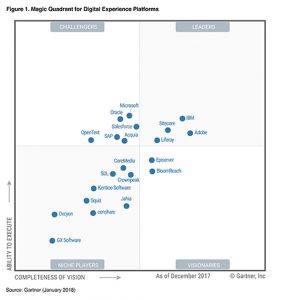
Adobe has announced it has been named by Gartner as a Leader in the 2018 “Magic Quadrant for Digital Experience Platforms” research report. This report evaluated 21 vendors, and Adobe was among four vendors in the Leaders quadrant, based on the ability to execute and completeness of vision.

Adobe Experience Cloud Ties in All The Contemporary Standards Expected from the Digital Experience Platforms

Of all the vendors evaluated, Adobe was furthest to the right for completeness of vision, where evaluation criteria include market understanding, marketing strategy, sales strategy, offering (product) strategy, business model, vertical/industry strategy, innovation and geographic strategy.

Recommended ReadTechBytes with Chris Wareham, Senior Director, Product Management, Adobe Analytics

2018 Gartner Magic Quadrant for Digital Experience Platforms.
2018 Gartner Magic Quadrant for Digital Experience Platforms

Suresh Vittal, Vice President, Adobe Experience Cloud, said, “In virtually every industry, brands have to reimagine each part of the organization to laser focus on delivering stand-out experiences or risk failing in no time. No other company offers a more complete and integrated set of digital marketing, ad tech, analytics and data management solutions that lets brands delight customers with every interaction. The integration of Adobe Experience Cloud with Adobe Creative Cloud Enterprise ensures maximum impact of customer content through big data.”

Michael Marino, Chief Experience Officer, Caesars Entertainment Corporation, said, “Our partnership with Adobe helps us get the right message in front of the right customer at the right time. We are moving in an exciting direction—a place where we can display targeted content across websites and screens on properties to enhance experiences and increase engagement.”

Adobe Delivers Data-driven, Tailored Experiences Across All Customer Touch Points

Within Adobe Experience Cloud, tightly integrated solutions offer a complete set of cutting-edge technologies that enable brands to deliver data-driven, tailored experiences across all customer touch points. This includes experience management and personalization across all screens and devices, experience delivery through advertising, video as well as other channels and analytics.

Recommended ReadAdobe Unveils Adobe Cloud Platform Launch for Connected, Compelling Customer Experiences

The tie-in with Adobe Creative Cloud makes it easy to quickly activate creative assets across all marketing channels and customer touch points.

The evaluation criteria for ability to execute include product or service, overall viability, sales execution/pricing, market responsiveness/record, marketing execution, customer experience and operations.

The world’s most popular brands rely on Adobe Experience Cloud to run their businesses, including Carnival Corporation, Citibank, Sydney Opera House, Caesars Entertainment Corporation, Home Depot, Marriott Hotels, NBCUniversal, Nissan Motor Co., T-Mobile and many others.

Adobe Experience Cloud helps clients manage more than 150 trillion data transactions annually, including 41 trillion rich media requests, over 150 billion emails and $3 billion in ad spend. Major brands, including two-thirds of Fortune 100 companies, leverage Adobe Analytics Cloud for customer intelligence.

Read More5 Things You Should Know About Adobe and Microsoft Cloud Partnership

Adobe Experience Cloud: The Most Comprehensive Set of Cloud Services

Currently, Adobe Experience Cloud is a comprehensive set of cloud services designed to give enterprises everything needed to deliver exceptional customer experiences. Comprised of Adobe Marketing Cloud, Adobe Advertising Cloud, and Adobe Analytics Cloud, Experience Cloud is built on the Adobe Cloud Platform and integrated with Adobe Creative Cloud and Document Cloud.

Leveraging Adobe Sensei’s machine learning and artificial intelligence capabilities, Adobe Experience Cloud combines world-class solutions, a complete extensive platform, comprehensive data and content systems, and a robust partner ecosystem that offer an unmatched expertise in experience delivery.

Read MoreAdobe Unveils New Advanced Analytics Products for Faster, Better Customer Intelligence

Source: Gartner, “Magic Quadrant for Digital Experience Platforms,” Jim Murphy, Gene Phifer, Gavin Tay, Mike Lowndes, 17 January 2018.

Interview with JC Ramey, CEO, DeviceBits

0
JC Ramey
Interview with JC Ramey, CEO - DeviceBits

[easy-profiles profile_twitter=”https://twitter.com/DeviceBits” profile_linkedin=”https://www.linkedin.com/in/jcramey/”]
[mnky_testimonial_slider slide_speed=”3″][mnky_testimonial name=”” author_dec=”” position=”Designer”]“Artificial Intelligence with the ability to better predict what the customer wants and needs by studying, tracking and analyzing previous interactions and behaviors will truly help set the course for marketing automation moving forward.”[/mnky_testimonial][/mnky_testimonial_slider]

Tell us about your role at DeviceBits and how you got here? 

With a career that began in enterprise software and telecommunications, I started in research and development of 3G and 4G wireless networks at Bell Labs, and I moved my career to the executive ranks of both private and publicly held companies based in Silicon Valley. Today I focus on the rapidly growing market for Artificial Intelligence in customer service solutions. My expertise in commercializing and operational efficiency of software products has led to the successful acquisition of four ventures in the past decade. At DeviceBits, I am the Chief Executive Officer and Founder, where I am focused on rapidly expanding the brand value of the organization. Today, we are building a world-class team based in Columbus and San Francisco to serve the needs of the entire AI driven customer service industry.

Given the changing dynamic of B2B content, how do you see the marketing automation and analytics market evolving by 2020?

I see it evolving beyond just content. Sure, self-support content will play a key role in the evolution of marketing automation. However, Artificial Intelligence with the ability to better predict what the customer wants and needs by studying, tracking and analyzing previous interactions and behaviors will truly help set the course for marketing automation moving forward. Add to this the emergence of chatbots and virtual agents that also learn from previous customer interactions, as well as learning from historical usage of self-support materials, and you begin to see the power that AI will bring to organizations of all sizes.

How should CMOs leverage predictive content management and marketing tools to drive their digital transformation with greater authority?

CMOs should realize that the integration of AI principals will help their organizations better understand their customers’ needs and wants, ultimately creating better relationships with customers. Through digital self-support materials that can be accessed at the customer’s convenience, and then understanding each of those interactions, organizations can begin to use the data to better “predict” what each specific customer will want, need or be interested in, not only for existing support but also for future support, sales and cross-sales.

How should CMOs plan their MarTech stack integrations to maximize the benefits from intelligent self-service customer service solutions?

With sticking to the 3 stages (Pre-Sales) (Sales) & (Post Sales) recent conversations reinforce my belief that successful customer service (especially self-service) starts with data capture, data integrity, and categorization. Your customer data will never and should never be 100% complete, but if it is, you’re not collecting enough to understand them. So as CMO, your stack integration needs to be planned for adaptability and scalability. While Sales is seen as the “golden child” because it brings in revenue…one thing I know for certain after nearly two decades in sales engineering and sales is that we cut corners to get deals done. This happens at every company at every level of sales. So plan for that constant and instill practices that fill in gaps when possible in Pre & Post Sales Marketing. Planning for the data you won’t get will help create a self-service strategy that also helps fill in those gaps.

What startups in the MarTech ecosystem are you watching/keen on right now?

DeviceBits has participated alongside a number of startups as part of the UpRamps Fiterator® program. Fiterator is a graduate program for later-stage startups which already have a product, and are now looking for market opportunities in the global cable/broadband industry. There are very interesting companies from this program focused on the analysis of huge datasets to predict new opportunities to households but also companies focusing on Net Promoter Score (NPS) impact. These companies that are thinking about the how to add shareholder value will see success in the marketplace. Using this sort of deep understanding of telemetry, usage and personalization will be a great addition to other markets beyond cable/broadband. I think you will see companies transform from sales/marketing automation to customer experience focused organizations very soon.

What tools does your marketing stack consist of in 2017?

Being a young (and bootstrapped) company means we’ve tried and failed plenty in this regard.

PreSales/Marketing we use HubSpot, LeadLander, and Hootsuite – They have a very easy “plug-and-play” feel that won’t overwhelm a smaller Sales & Marketing team. Plenty of integrations but it gets a bit annoying that some basic features are either limited by count or pay-to-play. We are finding unique ways to build an “Agile Sales Process” around these innovative platforms and seeing great results.

The Sales Team (myself included) uses LinkedIn Sales Navigator which is a great tool and the perfect use case for “social media” for people who want to be successful. I encourage everyone, sales or not, to join. It’s an investment in yourself connecting with others to project a career or business.

Could you tell us about a standout digital campaign? 

DeviceBits is working with Azumi Mobile to help create great relationships with their customers by helping predict consumer behaviors. As an example, one of the first things Azumi started seeing after implementing self-support materials and the support community is that customers who use Android rather than ios devices have different/more questions about their devices. Through DeviceBits, Azumi can tell which questions are being asked, by certain demographics of customers, which types of devices and can ensure Azumi is offering specific sets of support materials depending on individual customer characteristics. As another example, Azumi offers their devices through Amazon, and they noticed certain customers were having similar questions about specific devices. Azumi was able to upload a video that DeviceBits provided, sent it directly to Amazon so that consumers can see the video and get better familiarity with a specific type of device.

Azumi Mobile engaged DeviceBits with specific objectives in mind for creating the Azumi Community destination for its customers. Azumi recognized that before entering the competitive US unlocked device marketplace it needed to differentiate itself from other competitors. DeviceBits has enabled Azumi to jump-start its entrance in the marketplace by leveraging the expansive Support Predict Android knowledgebase by establishing a higher benchmark for customer satisfaction and improved “Out of the box” experience.

Azumi GTM Strategy is providing a high-quality device and components at an attractive price point. Azumi Mobile’s new device line up compares to the more popular Apple and Samsung devices for 50% less in price, targeting not only value-driven consumers but specifically the exciting “Millennial” marketplace. We see this market segment as a high growth area and recognized in partnership with DeviceBits that we had to create a destination that serves these customers across all channels of communication with predictive support capabilities. These new customers want to be served differently and we have accomplished this so far.

Specific results that have been recognized in using the DeviceBits AI platform so far have been the following:

  1. Improved “out of the box ” user experience”
  2. Increased Customer Satisfaction Rates.
  3. Improved Net Promoter Scores.
  4. Decreased call volumes into our call centers.
  5. Decreased NTF Returns (No Trouble Found)
  6. Established High Profile Brand Equity in the unlocked device marketplace.
  7. Has provided valuable insights on improved sales acquisition strategy.

How do you prepare for an Artificial Intelligence-centric world as a marketing leader?

The true value of AI derives from the old cliché “work smart, not hard” mentality, but that doesn’t necessarily mean building a robot to do my work for me. AI has quickly become a commodity as a platform whether to support chatbot, virtual agent or deep learning frameworks and the real impact (and Intellectual Property) will be seen in the application of those platforms in domain-specific ways.

We’ve coined the term “Practical AI” that we talk about all the time. I hear businesses every day discussing solutions so far outside their reach for today, that they overlook simple solutions that are practical and impactful NOW. We have moved AI from an academic thinking to a near plug & play within our platform and will continue to expand that over the next several quarters with domain knowledge that is novel and practical.

So I would prepare by first being realistic. Yes, it may be all possible in the technology, but take into account the current state and/or readiness of your company, your team, your customers, etc…

When I am discussing our solution with businesses and I hear asks that I believe to be “Pie-in-the-Sky”, I always like responding “Is that what your customers want or expect from your customer support today?”

9 times out of 10 the answer is “Well, no, but we want to exceed expectations.”

Which is more than understandable but our engagements show that most customers don’t expect magic, they just want resources available when and where they demand it.

One word that best describes how you work.

Impactful

What apps/software/tools can’t you live without?

Virtual Assistant (Siri for me) and the dozen or more communication tools I use.

What’s your smartest work related shortcut or productivity hack?

Priority is key especially as it comes to meetings and calls.

What are you currently reading? (What do you read, and how do you consume information?)

I read hundreds of new articles a week, and yes many tech related.  But today I am currently reading a book by Phil McKinney called Beyond the Obvious

What’s the best advice you’ve ever — your secret sauce?

That’s tough because my mentors have provided some enormous guidance over the years…. I think it would still be to surround yourself with not only people that make you better, but with people that you enjoy showing up to work with every day.  These are the people you go to battle with and that allow DeviceBits to have a very autonomous culture and climate.

Tag the one person in the industry whose answers to these questions you would love to read:

#Potus45

Thank you JC! That was fun and hope to see you back on MarTech Series soon.

[vc_tta_tabs][vc_tta_section title=”About JC” tab_id=”1501785390157-b58e162d-0ae25a4b-c27aca64-108e51b0-80edaf37-bd3d357a-6c464a3f-77a0″]

Sales and Delivery Executive with  Strong Technical Aptitude, Entrepreneurial Execution and Organizational Development skills.

JC leads a worldwide field organization in sales, technical sales and business development. His team’s focus includes partnering with large SI companies, synergistic technology companies as well as the direct sales to clients in the Global Fortune 2000, Public Sector, and Private Sector. Leveraging my own experiences in leading software organizations and my team’s experiences in broader domains we bring credibility to a new market while evangelizing both the space and product offering.

[/vc_tta_section][vc_tta_section title=”About DeviceBits” tab_id=”1501785390320-2d44fa50-740c5a4b-c27aca64-108e51b0-80edaf37-bd3d357a-6c464a3f-77a0″]

DeviceBits

Leading a team of exceptional people focused on changing the way people buy, download, adopt and service in the world of digital communications and delivery. Our team is delivering value to the world’s largest companies in the area of customer services saving them millions of dollars each year and improving their brand value through better customer service.

DeviceBits is a software company focused on the advancement of Customer Service for Telecommunication Providers, Service Providers and App Developers through Artificial Intelligence and Machine Learning techniques applied in our Academy and CareAssist offerings. Our Mission is to change how customers buy and receive support for consumer electronics and apps through guided user journeys that leverage the vast amount of data available in knowledge-base systems and available online. With this approach, we can predict consumer behavior and adapt self-help destinations and agent-assisted programs that are provided in DeviceBits’ industry-leading products.

[/vc_tta_section][/vc_tta_tabs]
[mnky_heading title=”MarTech Interview Series” link=”url:https%3A%2F%2Fmartechseries-67ee47.ingress-bonde.easywp.com%2Fcategory%2Fmts-insights%2Finterviews%2F|||”]

The MTS Martech Interview Series is a fun Q&A style chat which we really enjoy doing with martech leaders. With inspiration from Lifehacker’s How I work interviews, the MarTech Series Interviews follows a two part format On Marketing Technology, and This Is How I Work. The format was chosen because when we decided to start an interview series with the biggest and brightest minds in martech – we wanted to get insight into two areas … one – their ideas on marketing tech and two – insights into the philosophy and methods that make these leaders tick.

Anuj Kucheria Named Chief Revenue Officer of CrossInstall

0
Anuj Kucheria Named Chief Revenue Officer of CrossInstall

Digital Advertising Veteran Joins Fast-growing Mobile Ad-tech Company to Oversee All Business Teams

CrossInstall, a leading creator of programmatic interactive mobile ads, today announced Anuj Kucheria’s promotion to Chief Revenue Officer from his previous role as Vice President of Business Development.

Anuj Kucheria, CRO, CrossInstall

At the time of this announcement, Anuj said, “CrossInstall is pioneering a better approach to ads as all the pieces of our business become integrated,” said Kucheria. “Our tech, people, and understanding of the mobile ecosystem will help us grow across all areas of the business. I look forward to taking a holistic approach towards our performance business, brand business, and creative partnerships to ensure that we continue to deliver value to our clients.”

With over twelve years of experience in advertising sales and business development, Anuj Kucheria will oversee all revenue generation at the company, which includes three main businesses — the DSP Performance Business, Brand Sales, and Creative Partnerships. Kucheria will lead CrossInstall’s business teams and ensure they are operating efficiently during a time of rapid growth for the company.

Read Also: Salsify Product Content Management Platform First to Connect to Amazon’s New Vendor Central API

Jeff Marshall, CEO of CrossInstall, said, “We’ve experienced massive growth within the last two years, and Anuj has been one of the core drivers of it. He has a keen sense of how to advance the various lines of business and execute a thorough revenue generation strategy. He delivers when it counts as a forward-thinking leader, and I am excited about his expanded role in the business.”

Since Kucheria joined CrossInstall, the company is now working with over 90 percent of the top grossing apps while diversifying revenue and quadrupling the headcount. Prior to his tenure at CrossInstall, Kucheria worked at Chartboost as Head of Advertising Sales for the Americas and also held roles at Google, AdMob, and Causes.com. Kucheria graduated from the University of California, San Diego with a Bachelor’s degree in Political Science.

Currently, CrossInstall offers programmatic interactive mobile ads enabling advertisers to deliver personalized messages to the right audience. CrossInstall serves more than two billion unique devices worldwide per month enabling more than 130 million weekly interactive experiences.

Recommended ReadTechBytes with Adrian Velthuis, Chief Revenue Officer, Mobile Posse


Exclusive Talk Fusion Product Council First to Test New Video Chat Features Arriving in Q1

0
Exclusive Talk Fusion Product Council First to Test New Video Chat Features Arriving in Q1

Award-winning video communication company Talk Fusion announced recently that members of their new and exclusive product-testing group, the “VIP Product Council”, will be first in the world to experience a fully-upgraded Video Chat application before its official release this quarter. This will be the first of multiple, significant product enhancements Talk Fusion makes this year, and the VIP Product Council will play an integral role in each WebRTC-powered innovation.

VIP Product Council members will soon act as the inaugural audience of Video Chat’s brand new interface. With a vast feature list—including lightning-fast file sharing, desktop sharing, audio calls, vanity URLs, permanent chat rooms, unlimited group messaging, an easy-to-add contact management system, and more—Video Chat is setting the pace for Talk Fusion’s innovative year ahead.

Also Read: Brands Can Now Track Twitter Buzz with Talkwalker Alerts

Talk Fusion Founder & CEO Bob Reina announced, “Every single product that we have will welcome new features, new functionality, and new designs in 2018. I’m very excited that we’re kicking things off with Video Chat. You’re going to love what we have in store.”

Talk Fusion Video Chat was named the WebRTC Product of the Year and Communications Solutions Product of the Year in 2016. The company is confident that this forthcoming version will receive further acclaim for its dynamic functionality and ease of use.

Also Read: Talk Fusion Integrates WebRTC Into its Live Meetings Product

“One of the great things that I love about technology is that you always have an opportunity to improve upon yourself. Our VIP Product Council members are very lucky because while everyone else is simply curious, they will know from firsthand experience just how Talk Fusion plans to take the world’s first all-in-one Video Suite to the next level,” Reina said.

With a vast customer base in over 140 countries, the company received an influx of council applications within hours of the announcement but only a select 300 individuals were chosen. Members will gain access to Talk Fusion’s top-secret product-testing interface, in addition to receiving timely sneak peeks of all upcoming enhancements, feature lists, and new innovations via a private mailing list, so that ample consumer commentary and testing may be conducted on an international scale.

Also Read: Data in the New Year: 5 Steps for Success in Business Processes in 2018

“As both the developer and marketer of our products and technology, we find feedback to be extremely important. We wanted to put together a council of enthusiastic individuals from all around the world, to exchange ideas and get their valued take on each new feature and function before releasing the new product to the public. I can’t wait to see all that the VIP Product Council helps us to achieve in 2018,” Reina shared.

Current and incoming Talk Fusion Associates and Customers are encouraged to remain on standby on the company’s Facebook page for future opportunities to gain council membership.

Recommended Read: How to Develop and Offer Products That Delight Customers


AdMaster 2018 Digital Marketing Trends Report: 70% of Advertisers Continue to Increase Digital Marketing Budget

1
AdMaster 2018 Digital Marketing Trends Report: 70% of Advertisers Continue to Increase Digital Marketing Budget

The Marketing Industry Is Undergoing an Evolution. In the Next Few Years, Data and Intelligent Technology Will Be Key, Reports AdMaster

As new focal points emerge daily in the ever-changing world of digital marketing, advertisers are constantly searching for new ways to excite and engage customers. From short videos to branded mid-roll ads, from marketing cloud to news feed advertising and audio marketing, the industry in 2017 has been keeping up with changes in the environment and the consumers by constantly reshaping itself to present its consumers with a brand-new look.

For two consecutive years, leading digital marketing technology company AdMaster has surveyed hundreds of advertisers to forecast next year’s market and ensure brands receive higher returns from advertisement investments. Two weeks into 2018, AdMaster, in conjunction with TopMarketing, is pleased to present the “2018 Digital Marketing Trends Report”, which will provide placement guidance for advertisers and industry professionals.

The Focus of Advertisers: Content-first, Data-driven

Short videos, content-first, data-drive, artificial intelligence, context marketing, measurement and anti-fraud will continue to be the focus of marketers in 2018. Particular attention will be paid to content and data.

Brand content is being spread in unprecedented ways worldwide and valued by consumers. Content quality is more important than ever in increasing consumer stickiness and encouraging consumers to actively spread content. Content marketing and content-driven media buys are both increasing.After years of discussing “big data”, its significance and value are gradually becoming more specific. Answers to questions such as: Which range of data does corporate marketing require? How can isolated “islands” of data be connected and how can operations be performed on them? What value can be gained from data? How can data be integrated into marketing and the entire business chain? Are finally growing clear.

Also Read: Taboola Announces Global Self Service Business Has a Run Rate of Nearly $100 Million in Its First Year

18% Growth Expected in Digital Marketing Spends; Will Continue to Incline to Mobile

Digital marketing is flourishing. According to AdMaster’s data, 70% of advertisers have indicated that they will increase their digital marketing budget for 2018. The average budget will grow by 18% and almost 60% of brands will increase their budget by 10% or more. Approximately 6% of advertisers will shrink their budget, a slightly higher number compared to 2017’s 3%.Regarding marketing budget allocation, advertisers will continue to lean towards mobile devices. 87% of advertisers indicate that they will increase their mobile marketing budget. On the other hand, PC placement has shown a continuous decrease each year: over 60% of brands have chosen to reduce advertisement placement or even not place at all.CTV advertisement placement is a polarizing issue for brands. While 36% of brands will increase placement, another 38% will not choose to place. Advertisers are now more cautious about CTVs compared to last year.As medium fragmentation increases and new technologies emerge, advertisers have an increasingly diverse selection of platforms to choose from. 40% of brand marketers will increase spending in “other smart devices”.

Also Read: Ringing The Bells On Mobile Marketing

Major Placement Channels: Social and Video Platforms

AdMaster data indicates that, whether on mobile or PC, major placement always centers on social and video platforms. Social platforms are the primary channel for mobile placement and video websites for PC placement.

Content Marketing to Focus on Web Variety Shows, Web Series, and Sports

Web variety shows and web series will become key arenas for content marketing. Regarding content marketing, 41% of advertisers will invest in web variety show placement, 41% in web series, and 31% in sports. All grew significantly compared to last year.

Also Read: What You Need To Know About Video

Social Media Marketing to Focus on KOLs and Short Videos/Live streams

Today, KOLs are as influential as traditional celebrities. AdMaster data indicates that 71% of brands will increase spending in social media marketing (SMM); on average, spending will increase 21%.67% of brands indicated that they would focus on KOL promotion. As the influence of “we media” grows, KOLs’ popularity and influence are expected to increase as well. Utilizing a combination of internet celebrities and KOLs will become standard procedure in SMM.As short videos and live streams flourished in 2016, major brands were quick to join in. 62% of advertisers will focus on short videos/live streams for SMM in 2018, a major increase from last year.Aside from promotion, the retention and conversion of users are also critical. Therefore, official WeChat account operation and social media CRM will be key tasks in SMM.

Also Read: The Influencer Crowd

DMP and AI to be Key Technologies

According to AdMaster, 54% of advertisers stated that among various digital marketing technologies, they would be most interested in DMP in 2018.In the digital age, corporations require both large amounts of data and the ability to manage it. DMP (Data Management Platform) enables companies to connect and integrate data from various sources and create commercial value from the vast amount of internal and external data “islands”, even in the face of rapid technological evolution. AdMaster believes that the connection between brands and consumers will become highly intelligent, and DMPs are the “brain” that will make this a reality.In the past year, Alpha Go brought AI into the public eye, reminding society that AI wasn’t far away from daily life, and Alibaba’s design AI product Luban, capable of designing 8000 banner ads per second, was released. So far, AI has been ubiquitous in voice recognition, medicine, transportation, and metropolitan life. Possible marketing applications may be endless.

The marketing industry is undergoing an evolution. In the next few years, data and intelligent technology will be key. AdMaster CEO Calvin Chan says: “When data becomes a necessary component of marketing when brands’ needs are based on business, there will surely be more innovations and radical changes. By using data and technology ahead of the curve, we have always aimed to help brands maximize marketing ROI and help corporations optimize every link in their connections with consumers and create commercial value.”

Recommended Read: 4 Ways Customer Data Will Transform Performance Marketing in 2018

Businesses Invest in Social Media Marketing to Support SEO Strategy

0
Businesses Invest in Social Media Marketing to Support SEO Strategy

Clutch Survey says that More Than Two-Thirds (68%) Of Businesses That Focus On Paid Search Hire An SEO Company, Compared To Just 37% That Rely On In-House Staff

Social media marketing is the leading SEO service priority among U.S. businesses in 2018, according to new research from Clutch and Ignite Visibility. Over 90% of businesses that invest in SEO also invest in social media.

The survey of 303 marketing decision-makers at US businesses reveals that most tend to shape their SEO strategy based on the SEO services they prioritize and the challenges they face.

Two factors impact the direction of a business’ SEO strategy: The shifting customer journey and whether the business focuses on paid search or organic SEO services.

Organic SEO services include:

  • On-site optimization – web design, site infrastructure, blogging
  • Off-site optimization – content marketing, social media marketing
  • Over 40% of businesses that invest in SEO focus on organic services, compared to 19% that focus on paid search.

Businesses that focus on organic SEO are more likely to use in-house staff for general marketing, such as content marketing and social media. Over three-fourths (76%) of businesses that focus on organic services use in-house staff.

On the other hand, businesses that focus on paid search are more likely to hire an SEO company. More than two-thirds (68%) of businesses that focus on paid search hire an SEO company, compared to just 37% that rely on in-house staff.

Paid search complements organic SEO by providing feedback on keyword research, audience targeting, and effective ad copy, said Eythor Westman, head of paid media at Ignite Visibility.

How businesses adapt to shifts in the customer buying journey is another factor that shapes SEO strategy. The rise of mobile search drives changes to the customer buying journey. SEO experts agree that customers use their mobile devices to learn about a company through social media and site content before converting to make a purchase.

John Lincoln
John Lincoln

“Now, somebody Googles a keyword. Then they click on a top ranking term like, ‘SEO company.’ They read our blog and click around social media,” said John Lincoln, CEO of Ignite Visibility. “Then, they convert three weeks later after they feel comfortable with you.”

Read More: Tweet Your Way to Success: A Guide to Social Media Marketing & Strategic Thinking

In response, businesses prioritize SEO services that facilitate the customer journey. Along with social media (20%), businesses rate creating content to earn links (15%), and mobile search optimization (14%) as their top SEO priorities.

A B2B research, ratings, and reviews firm in the heart of Washington, DC, Clutch connects small and medium businesses with the best-fit agencies, software, or consultants to tackle business challenges together and with confidence. Clutch’s methodology compares business service providers and software in a specific market based on verified client reviews, services offered, work quality, and market presence.

Ignite Visibility is a premier Internet marketing company based in San Diego, dedicated to providing the highest level of customer service in the industry. By establishing mutually beneficial, long-term relationships with clients, Ignite Visibility creates custom solutions uniquely tailored to meet the specialized business objectives of each client. Because a company is only as good as the promises it keeps, Ignite Visibility holds itself accountable to clearly defined key performance indicators established at the outset of every campaign. Ignite Visibility’s core services are SEO, social media, paid media, email marketing, Amazon marketing, and conversion rate optimization.

Recommended Read: DiscoverOrg Acquires RainKing; Adds Firepower to B2B Marketing and Sales with Predictive Intelligence

Vennli Finds 70% of Marketers Expect Primary Research in New Agency Pitches

0
Vennli Finds 70% of Marketers Expect Primary Research in New Agency Pitches

Survey from Vennli Highlights Keys for Agencies Looking to Differentiate from Their Competition

Vennli, the leading voice of the marketplace solution, has announced the results of a recent survey of agency and in-house marketing professionals.  The results include findings from a survey of 200 US-based agency and marketing professionals. The survey results delivered crucial insights into the factors that separate agencies from their competition when pitching for new business.

MarTech RADAR 2018: Top 150 B2B Technology Companies You Should Follow

At the time of this announcement, Mary Claire Mandeville, business development manager, Vennli, said, “In-house marketers are expected to deliver data that prove return on investment for all marketing efforts. It follows that they expect the same from an agency partner. Agencies pitching without data-driven insights into the client’s business and competition face an uphill battle for new business.”

Read MoreVennli Announces ‘Release 4.0’ Launch, a Visually Powerful Competition Analytic Dashboard

Vennli’s study highlighted the fact that 70 percent of marketers expect primary research in new business pitches, while 89 percent of agency professionals that reported pitch win rates above 50 percent said that they typically use primary research when developing a pitch.

Recommended Read: Interview with Mark Smith, President, Kitewheel

According to the data, there are five key ways for agencies to differentiate their pitches. Agencies that are data-driven, conduct client research, develop innovative solutions, plan for long-term commitments, and are experts in their field are far more effective and credible, with much higher success rates compared to those that are not.

Other key takeaways from the report include:

– While 34 percent of agencies said that they think one of the most common reasons they win a pitch is because their “brand is recognized and respected in the market,” only 15 percent of marketers said this played a role when selecting an agency partner

– Only 13 percent of agencies said that they are winning pitches because of the “high value for cost” they project in their pitches, but 42 percent of marketers said that this plays an influential role when choosing an agency partner

– Thirty-six percent of agencies said that they are always re-thinking the client’s entire strategy when developing a pitch, but only seven percent of marketers reported seeing this happen.

“Agencies that understand what marketers want from a pitch have a much higher success rate,” said Mary.

“If an agency can differentiate itself from its competition in ways that are meaningful to potential clients, it will not only impress in-house marketers but build a critical path to long-term success,” added Mary.

Data for this study was gathered by Vennli through an online survey containing quantitative and qualitative responses. Survey respondents were screened to ensure their role required involvement in the pitch process.

Read MoreInterview with Chalva Tchkotoua, CMO, etouches

Respondents from agencies were screened for agency type (all types except for media planning and buying agencies were included) and their agency had to have annual revenues greater than $1 million. Respondents from the marketing department at organizations were screened for an annual marketing budget greater than $250,000.


Connected2Fiber Raises $8 Million in Series A Funding

0
Connected2Fiber Raises $8 Million in Series A Funding

Company Plans to Expand Innovation and Continue Fueling Growth in the Connected World

Connected2Fiber, a provider of the leading SaaS platform used by B2B connectivity providers to manage and transform market data, announced that it has closed $8 million in additional funding from Ascent Venture Partners, Nauta Capital, NXT Ventures and Osage Venture Partners. The Series A round follows a period of sustained and rapid growth for Connected2Fiber over the past two years, as location management and marketing has increasingly become a must-have for modern marketers in the connectivity industry.

Founded in 2015, Connected2Fiber empowers network operators to visualize, manage and engage their market through a purpose-built SaaS platform, The Connected World, that accelerates revenue, engages B2B buyers through the funnel, and unleashes growth. Its location management platform easily enables sales and marketing teams to see serviceability and create OnNet and NearNet building lists in the data formats required by their customers and partners, and directly integrates into top procurement tools – all without the need for developer resources.

Connected2Fiber Raises $8 Million in Series A Funding
Ben Edmond

“Network operators are under tremendous pressure to meet increasingly aggressive business goals – the old playbook is not getting it done. In a buyer-centric world, B2B sales and marketers need to identify the optimal sales targets, deliver dynamic B2B and location intelligence, and extend their serviceability information into the buying process with their prospects. Connected2Fiber’s platform makes that vision a reality for network operators who are connecting millions of locations to create billions of dollars in the pipeline through our automated workflow engine on our platform and with our API stack, accelerating revenue through better targeting and participation,” said Ben Edmond, CEO and Founder of Connected2Fiber.

Also Read: Less Than Half of US Companies Providing SaaS Use Marketing Automation: Vainu

The investment will be used to support Connected2Fiber’s strategic growth initiatives, including accelerating product development and innovation, sales growth, and the expansion of our strategic customer success team.

Connected2Fiber has already achieved a number of important successes:

  • Five of the top 10 largest MSO’s are currently using Connected2Fiber as a component of their go to market strategy.
  • Connected2Fiber customers have published more than 5,000 automated building lists to convey serviceability to their prospects, partners and customers.
  • Connected2Fiber covers more than 4 million unique locations connected by its clients’ network, including OnNet, NearNet and OffNet reach.

Matt Fates, General Partner, Ascent Venture Partners, commented, “We are thrilled to help drive Connected2Fiber’s incredible growth and look forward to working closely with Ben and his team to capitalize on their many opportunities. In short order, The Connected World SaaS platform has gone from initial customers to become a cornerstone for successful B2B sales and marketing teams at companies of all sizes in the connectivity industry. Connected2Fiber is the ‘next generation playbook’ for connectivity B2B marketers and rightfully recognized as the emerging platform of choice.”

Recommended Read: How to Find the Right AI Platform for B2B Marketing and Sales Success

Yext Launches Conversational UI In Winter ’18 Release

0
Yext Launches Conversational UI In Winter '18 Release

The Winter ’18 Product Release Includes the Yext Knowledge Assistant, New Support for ATMs, Kiosks and Other Specialized Business Entities, Yext’s WeChat Integration, and New Competitive Intelligence and Sentiment Analysis Tools

Yext, Inc., the leader in Digital Knowledge Management, announced early access for its Winter 18 Product Release. Packed with powerful, next-generation updates, the Winter ’18 Release offers Yext users an entirely new way to update their digital knowledge, deep insights to help them make informed decisions, and more.

Yext Launches Conversational UI In Winter '18 Release
Howard Lerman

“We are witnessing a major platform shift fueled by the rise of intelligence. As services strive to give you a more thoughtful, direct answer, they need more knowledge about your business. Today’s launch is about giving businesses new ways to control their essential digital knowledge, in more places, and across more types of entities,” said Howard Lerman, Yext Founder and CEO.

Also Read: Yext and Zoës Kitchen Partner to Manage Digital Knowledge for Restaurants Across the U.S.

With the new Yext Knowledge Assistant, updating Yext is now as easy as texting a friend. First unveiled onstage at ONWARD 17, the Knowledge Assistant is a breakthrough conversational UI that allows Yext users to update the public data about their businesses. Businesses can use Facebook Messenger or SMS text messaging to make crucial updates to the Yext Knowledge Manager — like uploading a photo, changing store hours, or responding to reviews — in real time, without needing to log in or install an app. The Knowledge Assistant is smart, and can even text the user to remind them of an upcoming holiday that might warrant a change in store hours, so customers don’t show up to a closed storefront.

Yext Launches Conversational UI In Winter '18 Release
Marc Ferrentino

Marc Ferrentino, Chief Strategy Officer at Yext, added, “Digital knowledge is changing constantly, so to unlock its full power, businesses need a way for their teams to easily and conveniently update their knowledge. The Knowledge Assistant lets you simply text Yext updates using a smart, conversational interface, and will fundamentally improve a business’s ability to manage its digital knowledge.”

Also Read: Smartling Deepens Integration with Yext for Easy Translation of Online Business Listings


Yext Launches Conversational UI In Winter '18 Release
Yext Launches Conversational UI In Winter ’18 Release

The Winter 18 Release also includes:

  • New platform support for ATMs, drop boxes, charging stations, and retail kiosks: A new, tailored experience to control and manage key information about these entities. Banks can leverage this update to ensure consumers see accurate information about their ATMs, including the branches or offices in which those ATMs are located. Automotive companies can now highlight vehicle charging stations. Delivery and logistics companies can help customers find drop boxes and self-service locations. Retailers can now control data about coin-counting machines, self-serve rental stations, electronics trade-in stations, or other in-store kiosks.
  • WeChat Location Mini Programs: Customers with locations in Mainland China, Hong Kong, or Macau can now use Yext to reach consumers in China on their platform of choice. With this new integration, businesses can manage and push out digital knowledge about their Chinese stores in Mandarin on WeChat via Yext, ensuring WeChat users in China can find their business locations.
  • Sentiment Analysis: Customers with Yext Reviews can now gain deep insights from their reviews via natural language processing. Sentiment Analysis helps identify trending keywords and see how those keywords correlate with a positive or negative sentiment, so Yext customers can better inform their business decisions.
  • Competitive Intelligence: Businesses can see how their ratings and search performance stack up against the competitors of their choice, and use this information to make more informed marketing decisions.

“We are committed to innovating on behalf of our customers, and the new features in the Winter 18 Release represent a major step forward. Today’s release offers businesses more control of their brands across the intelligent services of the future, and more insights to inform their business decisions,” Ferrentino said.

Recommended Read: Yext Announces ONWARD ’17 Day One Mainstage Speakers