

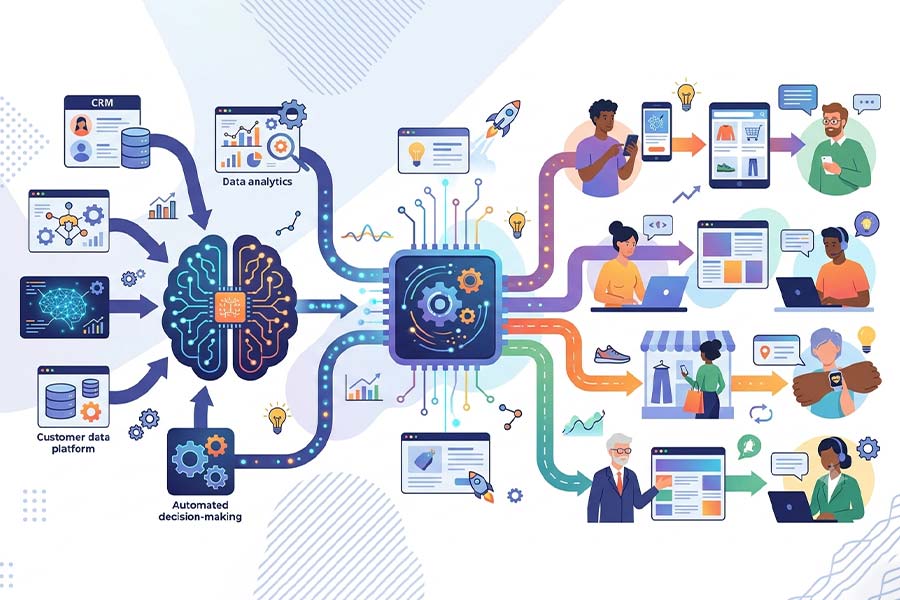
Marketing has entered a new age where traditional personalization is no longer sufficient to keep pace with rapidly changing customer expectations. For years, brands have used predefined customer segments, demographic profiles, and rule-based automation to deliver tailored experiences. These approaches were more successful than mass marketing in engaging customers, but often lacked the agility to respond in real time to customers’ changing preferences, behaviours, and contexts. Today’s consumers expect their interactions to be timely, relevant, and customized to their immediate needs, not just based on historical data.
The explosion of digital channels has hugely increased the complexity of customer journeys. A customer may find a product on social media, research it on a company website, compare prices on a marketplace, chat with customer support, and finally buy it through a mobile application. Every interaction gives you valuable behavioral signals to inform future engagement opportunities. However, static personalization models cannot keep pace with these dynamic journeys, creating a need for more intelligent and adaptive marketing approaches.
Artificial intelligence is reshaping this landscape by enabling continuous optimization of the customer experience. Instead of using predefined rules, AI analyzes customer interactions as they happen, recognizing behavioral patterns, predicting intent, and automatically modifying marketing strategies. These capabilities enable organizations to deliver experiences that change for each customer, rather than remaining static throughout the buying journey.
Thus, MarTech is shifting from campaign management platforms to intelligent experience orchestration systems. AI-powered customer data, predictive analytics, automation, and decision engines are used by modern marketing technology to orchestrate personalized interactions across multiple touchpoints in parallel. These platforms don’t just run campaigns; they continuously learn from customer behavior and optimize their engagement strategies in real time.
This evolution has given rise to hyper-adaptive customer experiences-the next generation of customer engagement. Unlike traditional personalization, hyper-adaptive experiences respond in real-time to customer actions, preferences, emotions, and context changes, making each interaction more relevant over time. Organizations that adopt this approach are better positioned to develop stronger customer relationships, increase loyalty, and generate meaningful competitive differentiation in an increasingly digital marketplace.
What is a Hyper-Adaptive Customer Experience?
Hyper-adaptive customer experiences are a more sophisticated form of personalized engagement where every touchpoint is dynamically adapted based on customer behavior, preferences, and contextual information. Organizations dynamically tailor recommendations, content, offers, and communication channels to each customer’s real-time activities instead of sending pre-set messages to specific audience segments.
This goes beyond traditional personalization, where each customer journey is unique. AI is continuously evaluating browsing activity, purchase history, engagement patterns, location, device use, timing, and many other behavioral indicators to determine the most appropriate next touch. Marketing experiences automatically adjust to changing customer preferences without the need for manual intervention.
Hyper-adaptive engagement understands that customer intent can change in minutes, unlike static personalization models that depend heavily on historical customer profiles. A shopper who is casually browsing products today might be ready to buy tomorrow, requiring a totally different set of messaging and recommendations. Hyper-adaptive customer experiences keep organizations responsive at every stage of this changing journey.
It’s not just personalization, it’s continuous optimization. Each interaction generates new intelligence that enhances future customer experiences, resulting in a continuous feedback loop between customer behavior and marketing decisions.
Marketing Technology News: MarTech Interview with Theresa Pham, Head of Product @ Wayvia
-
From Personalization to Hyper-Adaptation
Old-school personalization was heavily reliant on segmentation strategies that segmented customers by demographics, geography, and historical buying behavior. Marketers set up pre-determined rules that would trigger an email, promotion or advertisement when a customer met certain criteria.
These rule-based approaches worked well in the early days of digital marketing, but they often lacked flexibility. Customer segments were largely static, making it difficult to detect shifting interests or rapidly changing purchase intentions. Marketing campaigns are often still sent out with irrelevant messages, simply because customers were still classified in old segments.
This process has been transformed by artificial intelligence. AI doesn’t just rely on pre-set rules; it looks at behavioral signals as they happen to learn how customers behave across websites, mobile apps, social media, email, customer service, and brick-and-mortar retail.
Behavioral adaptation enables marketing systems to modify customer experiences immediately after each interaction. Recommendations for products, special offers, educational content, loyalty rewards, and timing of communication are all dynamically tailored to the changing needs of the customer.
Continuous learning is what separates hyper-adaptation from previous personalization models. Each click, search, purchase, conversation, or abandoned cart adds more intelligence to help make future recommendations better. The more a customer engages with marketing systems, the more accurate marketing systems become. Experiences should not be static; they should evolve organically over time.
This shift is part of a larger trend from reactive marketing to predictive engagement, where companies anticipate customer needs before customers tell them.
-
Why Hyper-Adaptation Is Now Occurring?
Several technology and market developments have accelerated the adoption of hyper-adaptive customer experiences. Unparalleled growth of customer data is one of the biggest drivers. Every second, massive amounts of behavioral data are generated from digital interactions on websites, mobile devices, connected products, payment systems, customer service platforms, and social media.
Historically, organizations lacked the computing power to analyze these streams of data effectively. New capabilities in artificial intelligence, cloud computing and predictive analytics now allow companies to analyze millions of customer interactions in real time, giving behavioral insights that were not possible to uncover before.
Predictive analytics has been playing an especially important role in this evolution. But today’s AI models do more than just describe what consumers have done in the past, predict what they will do in the future, tell you when they are primed to buy, assess their risk of churn, and advise you on the best ways to engage them before the opportunity is lost.
And customer expectations have changed dramatically. Consumers who live in the digital world first are comparing every interaction to the most personalized experiences available anywhere in the marketplace. Customers want organizations to instantly understand their preferences, not have to provide the same information over and over, whether they’re buying retail products, financial services, healthcare, travel, or entertainment.
The omnichannel customer journeys are becoming more complex, which also strengthens the need for adaptive marketing. Customers seldom buy through one channel. Instead, they fluidly shift between smartphones, desktops, physical stores, voice assistants, social media, messaging apps, and connected devices. To keep engagement relevant at all of these touchpoints, you need marketing technology that continuously synchronizes customer intelligence in real time.
Competitive pressures are also behind this trend. Companies that fail to deliver the experiences customers want risk losing engagement to competitors that can provide more intelligent, responsive, and personalized interactions. This makes hyper-adaptive engagement not just a marketing innovation, but a strategic business imperative.
-
From Campaign-Driven to Experience-Driven Marketing
Marketing strategies have traditionally been campaign-based with a clear launch date, promotional goals, target demographics, and end date. Success was driven mostly by campaign performance metrics like impressions, click-through rates, conversions, and revenue generation.
Promotional campaigns are still valid, but customer expectations are now broader than a single event. Brands are judged by today’s consumers on the quality and consistency of their experiences across the customer lifecycle.
Experience-centric marketing recognizes that every interaction contributes to the long-term relationship with customers. Organizations are always managing customer journeys that change based on evolving behaviors and preferences, rather than focusing on individual campaigns alone.
Continuous journey orchestration allows organizations to orchestrate customer engagement across multiple departments, technologies, and channels simultaneously. Marketing automation, customer service, loyalty programs, ecommerce platforms, recommendation engines and AI decision systems work together to create unified customer experiences instead of disjointed interactions.
Experience optimization takes place at every point of the relationship. Customer onboarding is tailored to each person’s objectives. Product recommendations are based on your browsing activity. Educational content is in tune with the knowledge levels of customers. Loyalty rewards shift with buying behavior. Customer support is proactively anticipating problems before they become complaints.
This is possible through artificial intelligence that constantly monitors customer interaction and identifies the next best engagement opportunity. Marketing systems don’t wait for campaigns to be scheduled, but respond immediately to customer behavior to ensure every interaction is relevant and contextual.
This change fundamentally shifts the role of marketing technology. Modern MarTech is a campaign execution platform, not an intelligent experience management ecosystem orchestrating every customer interaction across the entire lifecycle. While organizations are continuing to invest in predictive analytics, automation, and AI-powered personalization, hyper-adaptive customer experiences will be the foundation for building stronger customer relationships, increasing engagement, and sustaining long-term competitive advantage in the digital economy.
The Core Capabilities of Hyper-Adaptive MarTech
Intelligent marketing capabilities are constantly observing, analyzing, and reacting to customer behaviour to build hyper-adaptive customer experiences. Traditional marketing systems run pre-defined campaigns, but MarTech today learns from every interaction and adjusts engagement strategies on the fly. This helps organizations to provide highly relevant experiences while improving customer satisfaction, operational efficiency, and marketing performance.
1. Real-Time Customer Intelligence
Hyper-adaptive marketing is built on real-time customer intelligence. With customer preferences, intentions, and behaviors rapidly changing across digital channels, organizations can no longer rely on historical customer records alone. Today’s MarTech platforms collect customer interactions continuously and convert them into actionable insights, almost in real time.
Marketers monitor behavior on an ongoing basis to learn how customers browse products, interact with content, engage with emails, abandon shopping carts, and respond to past campaigns. Marketing teams get real-time visibility into customer activity instead of waiting for reporting cycles to come around.
Key capabilities are:
- Ongoing tracking of behavior across multiple digital channels.
- Location, device, timing, and activity context-aware customer insights.
- Real-time audience updates as customer behaviour changes.
- One unified view of cross-channel customer engagement.
- Immediate detection of buying signals.
These capabilities enable organizations to identify opportunities while customers are still actively engaged, and not when opportunities have already disappeared.
2. AI-Driven Decisioning
Artificial intelligence enables marketing platforms to skip human decision-making and automatically decide what the best action for each customer. Instead of static campaign rules, AI analyzes thousands of behavioral signals at once and then chooses personalized recommendations.
AI-powered decision engines constantly examine customer intent, purchase history, browsing behavior, engagement frequency, and contextual data. Based on this analysis, the system suggests the best next action to maximize customer value.
Core decisioning capabilities include:
- Intelligent next-best-action recommendations
- Automated engagement decisions across channels of marketing.
- Constantly optimized according to customer feedback.
- Dynamic offer selection.
- Timing of individual communication.
With every interaction with customers, AI learns and improves its recommendations, making each interaction more relevant and effective.
3. Omnichannel Experience Management
Consumers don’t talk to brands through one channel. They move seamlessly between websites, mobile apps, email, social media, messaging, retail stores, and customer service channels. Hyper-adaptive MarTech coordinates these interactions into one seamless experience.
Omnichannel orchestration ensures that customer data follows individuals throughout their journey, regardless of where they engage. So if a customer starts doing research on mobile and then goes to a physical store, marketing systems can catch that and keep the conversation going.
Organizations get:
- Cross channel journey coordination.
- Simplified customer communications.
- Messaging aligned with every touchpoint.
- Personalized, channel-specific engagement.
- Synchronize customer data in real time.
Modern MarTech does not treat each channel in isolation, but builds a single, connected customer experience that evolves naturally over the buying journey.
4. Dynamic Content Customization
In the past, personalization was about adding customer names to emails or showing predetermined product recommendations. Hyper-adaptive MarTech is not just personalization; it’s about dynamically creating experiences that are constantly changing based on customer behavior.
The content varies depending on the customer’s interests, browsing behavior, purchase intent, location, weather, time of day, and many other contextual cues. Every interaction is individually tailored to the current customer situation, not based on historical assumptions.
Key capabilities include:
- Personalized messaging
- Custom creative generation.
- Recommendations that are context sensitive.
- Flexible landing pages
- Marketing content generated by AI.
Dynamic personalization keeps content relevant throughout the entire customer journey, instead of being outdated after the initial segmentation, to increase customer engagement.
5. Predictive Customer Journey Management
Hyper-adaptive marketing is about anticipating the customer’s need before it’s even expressed. Predictive journey management combines past actions with current interactions to predict what customers might do next.
Organizations can identify customers who are likely to buy, customers who are at risk of attrition, and customers who are ripe for upselling or cross-selling. Marketers do not react to customer decisions, but attempt to influence future decisions in a proactive manner.
Predictive journey management enables:
- Anticipating customer needs.
- Early churn prediction.
- Opportunity identification.
- Personalized retention strategies.
- Intelligent customer lifecycle planning.
Predictive intelligence shifts customer engagement from reactive marketing to proactive relationship management.
6. Continuous Learning & Optimization
One of the most important capabilities of hyper-adaptive MarTech is perhaps its ability to continuously improve. Each customer interaction provides more learning to build on for future engagement strategies.
Instead of forcing marketers to redesign campaigns manually after reviewing reports, intelligent systems automatically refine recommendations, timing of communication, personalization strategies, and content selection based on the performance they see.
Continuous optimization is based on:
- Feedback loops for learning.
- Automating experiments.
- AI-based performance optimization.
- Recommendations are always getting better.
- Adaptive marketing workflows
As marketing platforms evolve, they become more targeted, more personalized, and less manual.
Technologies Enabling Hyper-Adaptive Customer Experiences
Hyper-adaptive marketing relies on an integrated ecosystem of advanced technologies that operate in real time. Together, artificial intelligence, predictive analytics, customer data platforms, and connected MarTech ecosystems empower organizations to deliver customer experiences that are constantly changing.
1. AI and Machine Learning
Artificial intelligence is the engine of intelligence for hyper-adaptive customer engagement. Machine learning algorithms can study customer interactions, recognize patterns in their behavior, and make better suggestions about marketing—all without the need to program them by hand.
Behavioral prediction enables organizations to anticipate future customer actions before they happen. Recommendation engines identify products, services, or content that are most likely to appeal to the preferences of an individual customer. AI also intelligently segments customers and updates audience definitions based on changing behaviors, rather than relying on static demographic categories.
Instead of following strict rules, AI allows marketing systems to constantly learn, so that each future interaction is more relevant than the last.
2. Customer Data Platforms (CDPs)
Customer Data Platforms get you the single view of the customer you need to deliver hyper-adaptive experiences. Fragmentation of data is one of the biggest barriers to personalization today, as customers generate information at dozens of touchpoints.
Customer data platforms (CDPs) collect customer data from all sources to create a single, comprehensive, always-updated profile that includes transactional history, behavioral interactions, communication preferences, and engagement activities.
The major capabilities are:
- Combined customer profiles.
- Cross-channel identity resolution
- Customer insights in real-time
- Connected histories of behavior.
- Centralized management of customer data.
With accurate customer profiles in real time, marketing systems can deliver highly personalized experiences wherever engagement takes place.
3. Generative AI
Generative AI has dramatically improved marketers’ capacity to personalize the customer
experience at scale. Rather than handcrafting each piece of marketing content, organizations can generate personalized emails, ads, product descriptions, chatbot responses, landing pages, and promotional messages automatically.
Conversational AI goes a step beyond engagement, enabling intelligent customer interactions via virtual assistants and digital chat experiences. Customers receive immediate, context-aware responses that evolve with the conversation.
Automated creative optimization enables marketing assets to constantly improve based on customer engagement, keeping communications personalized and effective.
4. Predictive Analytics
Predictive analytics uses historical customer data to generate insights that look ahead. Predictive models forecast what customers are likely to do next instead of what they have already done.
Organizations use predictive analytics to predict purchase intent, customer lifetime value, quantification of churn risk, and prioritization of high-value opportunities. Marketers can use these predictions to intervene before customers make critical decisions.
Behavioral modeling adds even more accuracy to these predictions because it can detect subtle patterns of engagement that human analysts may miss, allowing for highly targeted marketing interventions.
5. Real-Time Decision Engines
Hyper-adaptive engagement is orchestrated by real-time decision engines that decide the right marketing action at each customer touchpoint.
As customers visit websites, open emails, interact with advertisements, contact customer support, or browse products, decision engines immediately evaluate available customer intelligence before selecting personalized responses.
Their capabilities include:
- Event-based engagement.
- Context-sensitive recommendations.
- Immediate customization.
- Automated selection of offers.
- Dynamic communication optimization.
Decisions are made in milliseconds, so organizations can respond while the customers are still active, which greatly improves conversion opportunities.
6. API-Enabled Marketing Technology Ecosystems
No single marketing platform can handle all customer interactions. Hyper-adaptive customer experiences rely, therefore, on API-driven ecosystems that link various technologies into one integrated environment.
Application Programming Interfaces (APIs) are the backbone that enables data sharing in real-time across CRM systems, customer data platforms, marketing automation platforms, ecommerce systems, analytics tools, advertising platforms, customer service software, and AI engines.
API driven ecosystem offer:
- Platform interoperability.
- Connected customer data.
- Real-time information exchange.
- Scalable marketing automation.
- Flexible technology integration.
Such integrated ecosystems bust the information silos and make sure all marketing technologies are working with the same customer intelligence. As organizations continue to invest in intelligent automation, API-driven MarTech environments will be critical to the delivery of seamless, hyper-adaptive customer experiences that continually evolve with customer behavior.
Business Benefits
Hyper-adaptive customer experiences are the next big thing in marketing today. They allow organizations to move from static engagement strategies to continuously evolving customer relationships.
MarTech platforms leverage artificial intelligence, predictive analytics, customer intelligence, and real-time automation to provide businesses with the ability to deliver relevant interactions along the customer lifecycle. These capabilities provide measurable business value by improving customer satisfaction, marketing effectiveness, and long-term competitive position.
1. Higher Customer Engagement
One of the most immediate benefits of hyper-adaptive MarTech is a much deeper level of customer engagement. When brands deliver relevant information, personalized recommendations, and timely communications, customers are more likely to engage. Rather than blanket campaigns, adaptive marketing makes sure each interaction is aligned with what customers are interested in and doing now.
Artificial intelligence constantly observes what customers are doing so that organizations can change their messages, offers, and channels of communication in real time. This results in more meaningful conversations that enable customers to stay actively engaged through their buying journeys.
Organizations typically increase engagement by:
- More meaningful interactions with customers.
- Greater engagement through digital channels.
- Better personalized experiences
Customers who receive information that closely matches their immediate needs will feel more engaged, which builds stronger relationships and improves overall satisfaction.
2. Increased Customer Loyalty
Promotional campaigns are no longer enough to secure customer loyalty; loyalty is increasingly built on consistent, personalized experiences. Hyper-adaptive MarTech allows organizations to establish and maintain relationships by understanding customer preferences, reacting to behavioral changes, and continuously optimizing interactions over time.
Personalised engagement shows that the organisations are able to understand individual customer needs rather than treating all customers equally. As AI learns from customer behavior, recommendations become more accurate, which builds trust and drives repeat engagement.
Adaptive loyalty is more than just rewards programs. The customer values proactive support, tailored educational content, personalized product recommendations, and frictionless experiences across all touchpoints. Regular interactions build confidence in the brand and increase emotional connection.
Hyper-adaptive marketing, when implemented successfully, often results in stronger customer retention, as relationships evolve with changing customer expectations rather than remaining static.
3. Better conversion rates
Hyper-adaptive customer experiences that provide very targeted engagement at the right moments directly enhance conversion performance. Intelligent MarTech platforms don’t rely on broad audience segmentation, but rather continuously assess customer intent and change recommendations based on real-time behavioral signals.
AI sees shoppers who are browsing items, comparing choices, abandoning shopping carts, or returning to previous purchases and offers tailored actions to help them make a purchase. Marketing messages are far more relevant, reflecting the customer’s immediate interests rather than generalized assumptions.
Few capabilities deliver higher conversion performance:
- Better accuracy on targets.
- Better product and content suggestions.
- Simplified buying journeys.
Adaptive marketing also offers the benefit of reducing unnecessary communications and customer fatigue while also ensuring promotional efforts are targeted to those most likely to convert. This translates into better customer satisfaction and higher campaign efficiency.
4. Enhanced Marketing Effectiveness
Traditional marketing is very manual in campaign planning, segmentation, testing, reporting, and optimizing. This operational complexity is dramatically reduced with hyper-adaptive MarTech that automates many of the decision-making processes and continuously optimizes campaigns without needing constant human intervention.
It uses artificial intelligence to analyze the audience, select the content, schedule communication, and optimize performance automatically. They spend less time on repetitive operational tasks and more time on strategic planning, creative development, and customer innovation.
Operational improvements, including:
- Automated campaign optimization.
- Reduced manual campaign management.
- Faster marketing decision-making.
Automation also speeds up experimentation. Instead of periodic isolated A/B tests, AI analyzes customer responses and adjusts engagement strategies in real time, enabling organizations to improve marketing performance at a much faster pace.
As marketing operations get smarter, businesses are able to manage larger customer populations with highly personalized engagement without corresponding increases in staff or operational expenses.
5. Greater Customer Lifetime Value
Customer lifetime value has proven to be one of the most important metrics of the long-term success of a business. Hyper-adaptive MarTech increases lifetime value by driving ongoing engagement at every stage of the customer relationship.
Rather than just driving the first purchase, adaptive marketing helps customers with onboarding, education, product adoption, loyalty building, renewals, cross-selling, and advocacy. Every touch point provides opportunities to nurture relationships and grow revenue opportunities over the long term.
Organizations increase lifetime value through:
- Constant customer interaction
- Smart cross-selling and up-selling.
- Develop long-term relationships.
Predictive analytics can also help you identify customers who might need extra attention or tailored offers before they start to drift away. These proactive interventions help to retain customer satisfaction, reduce churn, and encourage ongoing loyalty.
The AI is constantly improving and optimizing recommendations so the customer experience becomes more and more personalized over time, further reinforcing the business relationship.
6. Competitive Market Differentiation
In today’s markets, customer experience has become one of the most powerful ways to stand out from the competition. Products and prices are easy to copy, but smart, constantly evolving customer experiences are much harder for competitors to replicate.
Hyper-adaptive MarTech allows organizations to react faster to changing customer expectations, market trends, and competitive pressures. Marketing strategies are developed in an iterative way based on customer behavior and business goals, not quarterly planning cycles for campaigns.
Stronger brand positioning, long-term loyalty, and positive customer advocacy are created by better customer experiences. Companies that can consistently deliver personalized engagement often outperform competitors who are still using static marketing methods.
Innovation-driven growth also becomes more sustainable as companies learn from customer interactions and continuously improve their products, services, and customer engagement strategies.
Challenges and Risks
While the business benefits of hyper-adaptive customer experiences are clear, organizations will need to overcome several technical, operational, and ethical challenges to enable successful implementation. It is not only about deploying advanced technologies, but organizations must also develop responsible governance, maintain customer trust, and ensure long-term scalability.
1. Privacy of Data and Customer Trust
Hyper-adaptive marketing is very data-dependent. To personalize customer experiences, organizations amass behavioral data, transaction history, browsing behavior, communication preferences, and contextual signals. These capabilities drive engagement, but they also create new responsibilities for data privacy and customer trust.
The responsible use of customer data is now a major business imperative. Customers are increasingly expecting organizations to be able to explain how their information is collected, stored, analysed, and used for personalization. Open communication decreases privacy concerns and builds trust.
Organizations also need effective consent management systems that allow customers to control how their information is used. Businesses must demonstrate responsible data governance and protect customer rights under regulatory frameworks such as GDPR, CCPA, and other privacy laws.
Trust isn’t built by personalizing customer experiences – without strong privacy practices, it can actually break trust.
2. Bias in AI and ethical personalization
Artificial intelligence offers highly effective personalization, but the problems of biased data, incomplete information, or flawed algorithms are also inherited by AI systems. If these issues are not addressed, marketing recommendations could unintentionally privilege some customer segments over others.
Organizations must regularly review recommendation engines, predictive models, and customer segmentation algorithms for fairness and consistency to enable ethical personalization.
Priorities are:
- Recommending fair to the customers.
- Reducing algorithmic bias.
- Building ethical AI governance.
Organizations must blend AI automation with human oversight to guarantee that personalization strategies are transparent, inclusive, and aligned with broader business values.
3. Complexity of Integration
A lot of enterprises run very fragmented MarTech environments that include customer relationship management systems, marketing automation platforms, ecommerce applications, analytics tools, customer service software, advertising technologies, and data warehouses. The significant challenge here is the difficulty of deploying these systems as a single ecosystem.
Legacy applications might not have the same integration capabilities as modern applications, leading to data silos that diminish the effectiveness of personalization. Additional complexity is introduced through the use of different data structures, synchronization methods, and platform architectures.
Successful hyper-adaptive marketing requires careful planning, API-based integration, standardized data models, and ongoing technology governance to maintain consistency across enterprise marketing systems.
4. Real-Time Data Quality
Hyper-adaptive customer experiences are built on accurate, up-to-date, reliable customer information. Poor data quality greatly diminishes the accuracy of personalization and can result in irrelevant recommendations or inconsistent customer experiences.
Organizations need to constantly maintain:
- Accurate customer information.
- Real-time data freshness.
- Reliable identity resolution across channels.
Marketing performance can be hurt by duplicate customer profiles, stale behavioral data, inconsistent customer identifiers, and lagging synchronization. Hence, smart personalization needs to be supported by continuous data governance.
5. The Dangers of Over-Personalization
Customers want relevant experiences, but over-personalization can be invasive and cause discomfort. The highly detailed recommendations stemming from sensitive behavioral information may create perceptions of excessive surveillance, rather than improved customer service.
The challenge for organizations is to strike the right balance between personalization and customer comfort. Marketing interactions should be helpful but not intrusive. It’s important for customers to always know why they see certain recommendations and to have meaningful control over their personalization preferences.
This balance maintains customer trust over the long term while retaining the advantages of adaptive engagement.
6. Organization Readiness
Technology alone will not deliver hyper-adaptive customer experiences. It takes organizational readiness across people, process, leadership, and culture to make it successful. Marketing teams will need to develop new analytical skills, understand how to work with AI-assisted decisioning, and adjust to greater automation in workflows.
Talent shortages in artificial intelligence, customer analytics, data engineering, and marketing technology could hamper implementation efforts. Organizations must invest in workforce development and encourage collaboration across marketing, IT, analytics, customer service, and compliance teams.
Employees will understand how hyper-adaptive marketing benefits operations and delivers strategic value through effective change management. Organizations that combine advanced technology with skilled talent, strong governance, and customer-centric cultures will be best positioned to capture the full value of intelligent customer experience orchestration.
Future Perspectives
The future of customer engagement will be driven by intelligent marketing ecosystems that are always learning, adapting, and optimizing every interaction. Next-generation MarTech platforms will be living systems that can respond instantaneously to changing customer behaviors, preferences, and business objectives, rather than relying on periodic campaigns or predefined customer journeys. With AI, predictive analytics, and automation creating experiences that grow with each customer, marketing will move from reactive communication to continuous relationship management.
1. Orchestrating Autonomous Experience
The next generation of MarTech platforms will automate customer journey management more and more through autonomous experience orchestration. AI will orchestrate multi-channel interactions without the need for constant hands-on marketing teams. For every customer action, intelligent workflows will be triggered to determine what is the most relevant communication, content, offer, or recommendation in real-time.
Rather than managing individual campaigns, marketers will oversee AI-driven ecosystems that constantly refine customer engagement aligned with business objectives and behavioral insights. Intelligent orchestration will enhance consistency, simplify operations, and provide customers with a personalized experience, no matter where or when they engage with a brand.
2. Emotion-Aware Customer Experiences
AI is moving past behavioral analysis and starting to incorporate customer emotion and sentiment. Future MarTech platforms will increasingly be able to read emotional signals from customer conversations, written communications, engagement patterns and digital interactions. Such a capability will enable organizations to customize communications based on customers’ emotional states as opposed to just transactional information.
Emotion-aware engagement will allow organizations to deliver empathetic customer service, change marketing tone on the fly, and offer more relevant recommendations at critical decision-making moments. By incorporating emotional intelligence into marketing strategies, businesses will be able to establish stronger relationships with their customers while providing more authentic and human-feeling experiences.
3. Predictive Customer Ecosystems
Predictive customer ecosystems will change the customer experience, moving the focus of marketing from reactive engagement to proactive relationship management. Rather than waiting for customers to express needs, future MarTech platforms will anticipate likely behaviors before they happen.
Predictive advanced models will predict buying intent, surface customers at risk of churn, surface opportunities for product recommendations and surface personalized engagement strategies before the customer actively seeks help. AI will constantly be analyzing customer signals across multiple channels, giving organizations the ability to intervene at just the right times.
4. Hyper-Personalized Omnichannel Experiences
By engaging with customers before issues or opportunities are apparent, these predictive ecosystems will enable businesses to improve customer satisfaction, increase retention, and optimize marketing efficiency.
Customer journeys will become more fluid across digital and physical environments. Future MarTech solutions will provide hyper-personalized experiences that are seamless and consistent, whether customers engage with us through websites, mobile applications, retail stores, contact centers, social platforms, or connected devices.
Unified customer intelligence ensures that every interaction reflects the most recent customer behavior, preferences, and context. As customers move between communication channels, recommendations, promotions, customer service, and educational content will automatically change, creating one continuous relationship rather than disconnected experiences.
This seamless orchestration will build customer trust, while reducing friction across increasingly complex buying journeys.
5. Self-Learning Marketing Tech Platforms
AI will make MarTech into self-learning systems that learn from every interaction with the customer. Future platforms will not be subject to periodic optimization by marketing teams. Instead, engagement results will be automatically assessed, recommendation models refined, customer segmentation improved, and communication strategies optimized in real time.
It will make the marketing platform smarter with every customer interaction. Successful campaigns will automatically affect future engagement decisions, and underperforming strategies will be adjusted without waiting for manual analysis. Continuous behavioral learning like this will greatly improve the accuracy of personalization and reduce operational effort.
Self-learning capabilities will enable organizations to scale highly personalized customer experiences without a corresponding increase in marketing resources.
6. MarTech as an Intelligent Experience Operating System
The future of MarTech is not about individual marketing technologies, but about unified customer experience operating systems. Future solutions will combine these capabilities into one smart ecosystem, rather than standalone automation, analytics, CRM, and advertising platforms.
Customer data, predictive analytics, content generation, campaign management, customer service, loyalty programs, and sales enablement will all be managed by artificial intelligence, powered by centralized decision engines. Every touchpoint with the customer will help build a continuous understanding of individual preferences, allowing organizations to deliver highly coordinated experiences across the entire customer lifecycle.
These smart experience operating systems will make marketing an adaptive business capability that continuously aligns customer engagement with evolving customer expectations and organizational goals.
Conclusion: MarTech Is Transforming Customer Engagement into Continuous Adaptation
The marketing technology evolution is arguably one of the biggest changes in customer engagement over the last 10 years. Marketing was heavily dependent on pre-defined campaigns, static audience segments, and periodic optimisation cycles. These approaches gave measurable improvements over mass marketing, but they weren’t agile enough to keep up with today’s rapidly changing customer behaviors.
Modern MarTech platforms are fundamentally changing this model, enabling constant adaptation instead of occasional personalization. Now, every customer interaction is an opportunity to improve future experiences, allowing organizations to respond to changing customer preferences.
Artificial intelligence has been the engine of this transformation. Intelligent marketing systems look beyond the customer’s past, using behavioural signals to predict future intent and automatically adapt communications, recommendations, and customer journeys in real time. Continuous optimization replaces traditional campaign cycles to create living customer experiences that get better with every interaction.
This means that organizations can better sustain their customer relationships while responding much faster to the changing market conditions and consumer expectations.
-
AI is powering experiences that adapt to customer behavior
AI is helping marketers understand customers like never before, with unprecedented depth and accuracy. Behavioral analytics, predictive modeling, customer data platforms, and automated decision-making can help organizations be proactive in predicting customer needs rather than reactive. This turns marketing from a communications function into an intelligent relationship management capability.
Real-time behavioral intelligence ensures customer experiences are contextually relevant, no matter where customers engage. Dynamic journey orchestration enables marketing systems to coordinate interactions across websites, mobile apps, email, social media, ecommerce platforms, and customer support channels while delivering a consistent customer experience. Intelligent personalization is always on, not just periodically, so every recommendation, promotion, and communication reflects the customer’s most current interests and intentions.
As AI capabilities evolve even further, organizations will continue to deliver experiences that are less automated marketing and more personalized advisory relationships based on constant understanding and adaptation.
-
Hyper-adaptive engagement is about to redefine customer loyalty
Customer loyalty is changing and moving beyond traditional reward programs and promotions. Today’s consumer is more loyal to organizations that consistently ‘get’ their needs, make decision-making easier, and create meaningful value throughout the customer journey. Hyper-adaptive engagement fosters these relationships by delivering highly relevant interactions that evolve with customer expectations.
Intelligent marketing platforms recognize that preferences, priorities, and purchase intent are always changing and don’t take a one-size-fits-all approach to every customer. Organizations that are able to react to these changes immediately will be able to develop stronger trust, enhance customer satisfaction, and decrease churn. And personalized engagement will be one of the most sustainable sources of competitive differentiation because it creates experiences that competitors cannot replicate easily with pricing or product features alone.
The ability of an organisation to learn constantly, to anticipate needs and to deliver personalised value in every interaction will become a defining feature of longer-term customer relationships.
Final Perspective
The future of MarTech will be driven by intelligent experience ecosystems that learn, predict, and personalize every single customer interaction in real time. By combining artificial intelligence, predictive analytics, generative AI, and real-time decision engines, marketing environments will be able to automatically adapt to changing customer behavior. Organizations that adopt these technologies will experience higher engagement, stronger loyalty, better operational efficiency, and enhanced marketing agility.
As customer expectations continue to rise, businesses will increasingly compete not just on products or pricing, but also on the quality, relevance, and adaptability of the experiences they deliver. The next evolution of digital marketing is hyper-adaptive customer engagement, where each interaction helps to build more and more personalized relationships that get stronger over time.
Organizations that invest in intelligent MarTech platforms today will be best positioned to build customer experiences that are relevant, responsive, and competitive in an increasingly AI-driven digital economy.
Marketing Technology News: Idle data is as good as no data