Home Blog Page 4180

Hootsuite Adds New Features, Partnerships and Integrations to Help Enterprises Succeed With Social

0
Hootsuite Adds New Features, Partnerships and Integrations to Help Enterprises Succeed With Social

New Boost Feature Enables Customers to Promote Top Performing Content; Pinterest Integration Helps Retail, CPG and Hospitality & Tourism Clients Thrive on Social; And Hootsuite Amplify Integration with Workplace by Facebook Deepens Value for Enterprises

Hootsuite fortified its position as the leader in social media management by adding new features, strategic partnerships, and integrations that help enterprise organizations strategically grow their brands, businesses, and customer relationships with social.

“The customer journey across social is a diverse landscape that requires enterprises to engage over a number of platforms to effectively listen and engage with customers, build and manage their brands, and extend the value of social across the enterprise,” said Penny Wilson, CMO of Hootsuite. “Our latest advancements — including new product functionality and integrations with Adobe, Facebook and Pinterest — help our customers accelerate their growth and increase their return on investment.”

Also Read: Hootsuite Launches Boost to Amplify Power of Organic Facebook Content

New innovations announced in Q2 2018 to help all Hootsuite and Hootsuite Amplify customers succeed with social include:

  • Hootsuite announced Boost, a new feature that allows customers to easily identify and promote top performing Facebook content to reach new audiences. An agency customer noted in a Facebook post, “Good news, Hootsuite lovers! You can now boost your Facebook content directly through the scheduling platform!”
  • Direct scheduling and publishing to Pinterest within the Hootsuite platform. All Hootsuite customers can now collaboratively and securely schedule and publish visual content directly to owned Pinterest boards. Two customers posted their excitement to social media, noting: “YAS the news that I can schedule Pinterest pins with Hootsuite is SUCH good news” and “Happy days! You can schedule posts in Pinterest using Hootsuite.”
  • Integrations between Hootsuite Amplify and Workplace by Facebook to empower an organization’s employees to share branded content quickly and easily with Facebook contacts.

Hootsuite’s Q2 2018 momentum also included the following highlights:

Award Recognition:

  • Hootsuite was awarded Adobe Exchange Partner of the Year for EMEA following receiving the same recognition in North America in Q1. Adobe Head of Platform Partners and Strategy, Cody Crnkovich noted: “This award recognises the value Hootsuite brings to Adobe Experience Cloud customers and how they can truly leverage the power of social. The insights Hootsuite provides are a true differentiator for our joint customers to achieve competitive advantage.”

Corporate Responsibility:

  • Hootsuite was recertified as a B Corp. Hootsuite has been a proud B Corp member since 2015.

Recommended Read: Only 31% App Developers are Satisfied With Their Current Ad Revenues, Highlights Latest App Developer Survey Report 2018 by Chocolate


Marketing Evolution Awarded Patent Recognition for Latest Innovation

0
Marketing Evolution Awarded Patent Recognition for Latest InnovationMarketing Evolution Awarded Patent Recognition for Latest Innovation

US Patent No. 10,032,121 Recognizes Development of Best Practice Engine

Leading provider of marketing analytics and attribution, Marketing Evolution, announced it was recently awarded a new patent by the United States Patent and Trademark Office. This patent, US Patent No. 10,032,121, recognizes the development of technology that gives Marketing Evolution and their customers a system and method for identifying and monitoring best practices of an enterprise.

“This latest patent extends Marketing Evolution’s commitment to innovation and technological advancement”

In order to remain competitive, many organizations seek to employ “best practices” and standard operating procedures in providing services and products to customers and in internal operations. Typical approaches to storing and retrieving the steps of these processes, however, have several shortcomings, including lack of centralization, organization, timeliness, and may be overly reliant on users to recognize the need for and to seek out a best practice.

Also Read: Interview with Rex Briggs, Founder and CEO, Marketing Evolution

“This latest patent extends Marketing Evolution’s commitment to innovation and technological advancement,” said Rex Briggs, founder and CEO of Marketing Evolution. “This newly-patented process, combined with our other patents and innovations, gives our customers a unique and actionable process to learn and implement approaches that consistently focus on the highest and best use of company resources. It clearly demonstrates our ongoing commitment to be a leader in helping brands achieve higher returns on investment in their marketing, product development, and business operations – to the benefit of shareholders and ultimately consumers everywhere.”

Marketing Evolution has been granted four patents, including in the areas of methods for determining advertising effectiveness and for apportioning marketing resources to find the combination of message, creative, placement and tactic to drive the highest returns on marketing investment.

Global demand for the company’s AI-based technology for marketing optimization has been growing rapidly. Marketing Evolution’s current customers represent some of the strongest brands in the fastest growing segments including automotive, entertainment, financial services and retail.

Recommended Read: PubMatic Announces Tech Veteran Thomas Chow As New General Counsel

Information Security – a Major Concern for Mid-Market Leaders: Deloitte Survey

0
Information Security - a Major Concern for Mid-Market Leaders: Deloitte Survey

Deloitte, in Its Sixth Annual Report, Explores Technology Trends That Drive Mid-Market and Private Companies in the Us Economy

In a recent survey of mid-market companies, conducted by OnResearch, Deloitte examined trends that would determine how technology influences business decisions in this market. Titled ‘Technology in the mid-market: Embracing technology’, the survey tackles the talent dimensions of IT investments.

This is the sixth annual report by Deloitte Private, for which the company surveyed 500 executives from mid-market companies with annual revenues ranging from $100 million to a little more than $1 billion. While half of the respondents were C-suite executives, the remaining executives held other management roles.

“What we found is that in many cases, technology is augmenting workers rather than rendering them obsolete. The nature of work is shifting from low-value, routine tasks to higher-order analysis and invention. And through this process, private companies are enjoying myriad benefits, from increased productivity to better customer engagement to forming whole new business lines,” write Roger Nanney, National Managing Partner, Deloitte Private; and Doug Beaudoin, Deloitte Private Consulting Leader.

Also Read: Digital Desertion: 60% of consumers less loyal to brands after poor website and app performance, survey reveals

The survey found that rather than being left out, employees are sharing in technology’s bounty in a number of ways:

  • New jobs: Nearly half of the survey companies report plans to hire more than they did before implementing new technologies, and only a quarter think they will require fewer people.
  • New skills: The private companies say reskilling employees has the greatest impact on their efforts to technologically augment their workforce.
  • New flexibility: Companies plan to increasingly rely on “gig workers”— contract-based or non-full-time, flex employees—to help meet their strategic goals for technology.

Priorities are straight – Data security

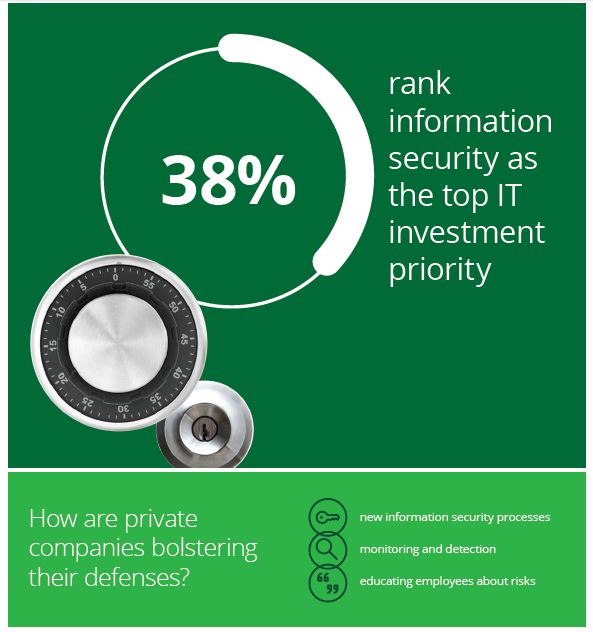
The survey reveals that protecting data and systems remains top of mind. Information security ranks as the top IT investment priority, at 38 percent, and it’s expected to have the biggest impact on business over the next 12 months. Private companies are doing a number of things to bolster their defenses, from implementing new information security processes to preventing threats through monitoring and detection, to educating employees about risks.

Also Read: Audiences Trust Premium Publishers Over Social Networks For Online News Content, According to New Survey

More than half of respondents i.e. 55 percent ranked the reduction of operational costs as one of the top three most significant impacts of digital disruption. Customer pursuits continue to drive analytics investments—almost 60 percent of respondents say they are using analytics for sales and customer management activities. And the share of respondents who say they are using analytics for marketing is 48 percent.

Information Security - a Major Concern for Mid-Market Leaders: Deloitte Survey
Courtesy: Deloitte

Machine learning, automation, and predictive analysis

Around 57 percent respondents said that they are using machine learning for predictive analysis of business outcomes, while 41 percent use it to read and encode human communication for data processing. However, the use of these tech tools is flat or has decreased across several business dimensions, survey responses show.

But humans still have to manage the technology. Two-thirds of respondents say they are focusing their use of robotic process automation (RPA) on high-volume, labor-intensive tasks. Notably, there was a significant decline in the share of the respondents using machine intelligence to read and encode human communication, an indication of the ongoing challenges of coding for difficult and nuanced human communication.

The survey report highlights a few ways CFOs can rise to the challenge and help their companies convert technology investments into a competitive advantage:

  • Invest in workforce analytics technologies that require people to take action on findings.
  • Relentlessly review cloud integration, security, and customization when investing in IT infrastructure.
  • Recognize that cognitive technologies involve far more than automating work, and maintain an open mind about investments that can ultimately transform the business.

Also Read: 60% of Customer Success Teams Are Unaware of Critical Client Issues

High on Cloud

Back-office investments such as cloud innovation and cloud integration continue to be areas that will have a significant impact on their companies in the near future. The respondents listed cloud applications as the second most influential technology affecting their workforce and the third most influential when it comes to their customers.

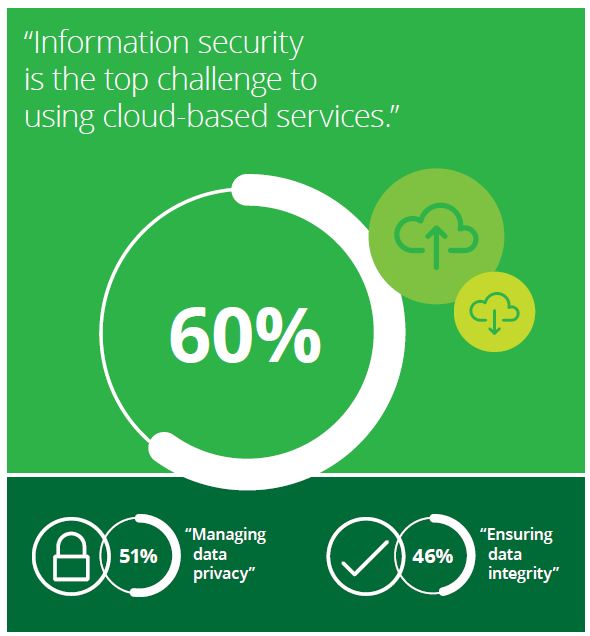
Almost 60 percent of the respondents mentioned that information security is now the top challenge the executives cite in using cloud-based services while managing data privacy (51 percent) and ensuring data integrity (46 percent) also rank high.

The Internet of Things (IoT) makes one out of every five executive’s list of tech-related trends expected to have a significant impact on their business over the next 12 months. More of the respondents see IoT technologies impacting their customers (40 percent) than their employees (36 percent).

Information Security - a Major Concern for Mid-Market Leaders: Deloitte Survey
Courtesy: Deloitte

Deloitte provides industry-leading audit, consulting, tax and advisory services to many of the world’s most admired brands, including more than 85 percent of the Fortune 500 and more than 6,000 private and middle market companies.

Recommended Read: OneTrust Leads Global Privacy Management Software Market: Ovum Report

It’s Not Just What You Say, It’s When You Say It – Timing is Everything When it Comes to Social Media Marketing Success

3
Timing is Everything When it Comes to Social Media Marketing Success

trySensai logoSocial media marketing has become overwhelming and confusing for many marketers. As social platforms like Facebook have changed their algorithms, many brands, companies and small businesses have struggled to adapt. It’s left them with one really big question: Is social media marketing still a good investment of time and money for your small business brand?

The short answer is “Yes, but…”

Yes, social media marketing still works. It’s one of the most efficient and authentic ways to find customers and engage them as fans.

But that doesn’t mean your strategy can stay the same. The same set of tactics that worked a few months ago might not work today. Social media marketing success in the Age of Algorithms requires a more adaptable approach – there is no single right way to do social anymore, and what works for other companies might not work for you. So much depends on your audience, your type of business, your industry, and your overall preferred styles of communication and engagement.

We at Sensai monitor what types of small business posts engage customers most effectively. The results surprised us. It turns out that the workday isn’t always the best time to post on your socials. Sometimes you should be scheduling them for the middle of the night!

Below are a few key strategies to help you re-evaluate the timing of your social media marketing efforts:

Timing is of the Essence

One of the most underappreciated aspects of today’s social media marketing landscape is the matter of timing. Social media platforms are more crowded with posts than ever before, and so the major platforms fight this overcrowding with algorithms. Just because you think your customers are consuming your content in the morning, it doesn’t mean you should post then. In fact, the best time to post to Instagram, on average, is 2am ET/11pm PT. Your best time will vary, but you should experiment with scheduling posts for different times of the day and night. You may be surprised what happens.

Also Read: Why the Tug-of-War Will Continue in 2018 Social Marketing

Engagement Drives Duration of Views

All the major social media platforms are increasingly driven by algorithms, and the algorithms reward the posts that are driving engagement. This means: getting your timing right – posting at the optimal times of day or days of the week – is even more important. Because if you can reach more of your audience right away and grab their attention when they’re most receptive to hearing from you, they will be most likely to engage with your post by liking, commenting, or sharing. Engagement creates momentum all its own – and the best way to drive engagement is to get your timing right in the first place.

Also Read: Gaining the Millennial Stamp of Approval on Social Media

Some Days Are Better Than Others

You might assume that you should be posting on social media every day, to have a consistent, reliable presence. This might not be the best strategy for your business. Depending on your audience, some days of the week are much better for driving engagement – more of your audience will see your posts if you post on a day when more of your audience is checking their social media feeds. For example, one of our customers, who’s a platinum-selling recording artist, was posting for years on Saturdays, assuming that his fans were most active on the weekends. But when we did an analysis of his social media performance, we found that music-related activity peaked on Tuesdays. This surprised him, until he remembered that Tuesdays are the traditional days that record labels ship new LPs to record stores. When this musician switched his promotion to Tuesdays, he saw his engagement increase dramatically.

Again, there is no single “magic day of the week” that works for everyone; it all depends on your industry and your audience. But it’s worth doing some experimentation to see if certain days of the week give you a bigger boost in engagement.

Also Read:  Forget Mobile First, It’s Now Social First

Timing Can Confound Your Assumptions

Optimal time of day can be wildly counter-intuitive. Just because you think your audience is active at a certain time of day doesn’t mean they actually are! I had always assumed that I should post to Twitter on weekdays around lunchtime, but Sensai’s A.I. told me that I should post around midnight instead. I tested it, and it actually worked! More of my followers were active late at night than during the workday, and the Twitter algorithm served these posts to them when they woke up in the morning.

Getting your social media timing right is not the only factor in social media success, but it’s becoming more important than ever before – and the answers might not always be obvious. With careful analysis and testing, you can figure out which time frames are the best moments to post on social media in order to reach more people and engagement. Regardless of what you post, you can get better results if you get better at knowing when to post it.

Also Read: 5 Reasons Why Social Media Influencers are the Future of Digital Marketing

DocuSign Set To Acquire SpringCM for $220 Million

0
DocuSign set to Acquire SpringCM for $220 Million

SpringCM, a Sales Software Startup Is Being Acquired by Docusign; A San Francisco Based Electronic Signature Company for Approximately $220 Million in Cash

DocuSign, the digital transaction, and e-signature firm announced that it plans to acquire SpringCM as a part of its vision to modernize the companies’ Systems of Agreement. SpringCM is a startup in Chicago, specializing in securing documents and it also enables convenient document collaboration across work organizations.

DocuSign has decided to acquire SpringCM for $220 Million as a definite part of the deal.

DocuSign has strongly created its SaaS business structure around building its niche e-signature capability. SpringCM’s capabilities apart from document generation include advanced document management, redlining, and a secure end-to-end workflow agreement. These added functions further strengthen DocuSign’s hold on the startup which can significantly contribute to the company’s solution which goes beyond e-signing, to other functions such as preparation of signing, acting-on tasks, and agreement handling.

Also Read: 
Leveraging the Power of Social Media to Garner More Customer Reviews

Comments

Dan Springer, CEO of DocuSign says, “DocuSign pioneered the e-signature category, and has built a strong SaaS business around that capability. We’ve also started to offer solutions that connect and automate the entire agreement lifecycle. We’ve done this with SpringCM as a partner across hundreds of joint commercial and enterprise customers. And we have many more DocuSign customers asking us to provide these capabilities natively as part of our platform. That’s why we believe today’s announcement makes such great business sense.”

Dan Dal Degan, CEO of SpringCM says, “SpringCM shares DocuSign’s passion for transforming and automating the foundation of doing business—the agreement process. That’s what we have been focused on since inception, it’s why we power the contract lifestyle management process for more than 600 of the world’s leading companies—including ADP, Aetna, Facebook, Hilton, Lenovo, Spotify, and the US Department of Agriculture. By joining forces with the market leader, we can continue to simplify and accelerate the process of doing business, and drive innovation both before and after the agreements have been DocuSigned.”

Also Read: Ten Ways to Transform Your Employees into Social Ambassadors

How Does This Acquisition Benefit DocuSign?

DocuSign previously had come into a partnership with SpringCM largely due to the reason of offering customer joint tools which would be ideal for an agreement lifecycle management. But now, DocuSign’s CEO is looking forward to moving these tools in-house along with broadening SpringCM’s core solutions and expanding the market which is addressed today.

With this acquisition, DocuSign also plans to be the provider of services which fall under the System of Agreement Processes that include managing documents, including e-signatures and acting on the same.

The acquisition post-announcement is expected to close by Q3 of DocuSign’s fiscal year. DocuSign has successfully made its first acquisition with SpringCM since April when it first went public.

Also Read: Eight Psychological Pricing Techniques to Test on Your E-Commerce Store

Carusele Now Optimizes Influencer Programs in Real Time Based on Live Sales Data

0
Megola, Inc. Announces Social Mobile App for TheShare.TV Network

Program Driving Measurable Sales Lift from Influencer Marketing

Carusele, a leading influencer marketing agency, announced a new optimization strategy for influencer marketing: Conversion Optimization. Carusele programs for e-commerce brands can now be optimized in real time based on constant feedback of real-time sales data. This is the latest step Carusele is taking to drive measurable, predictable business results from influencer marketing.

“For too long, influencer marketing has been about faith that the branded content will drive sales behavior among consumers,” said Jim Tobin, Founder and President of Carusele. “We’ve long been able to distinguish between high-performing content and average content, but now we can determine what content, what format and what targeting best drives real sales from influencer marketing and then continually optimize off that data.”

Also Read: Carusele Wins 4 Influencer Marketing Awards in 2018 Communicator Awards

The first client to use Conversion Optimization helped drive over $2.50 in measurable sales for every dollar invested in the program, including all costs. Another e-commerce giant looking for program sign-ups in lieu of initial sales found that the conversion rate from the Carusele optimized influencer program outperformed owned media conversions driving toward the same result. In fact, Carusele’s performance was 22% better than the highest performing owned media target group and 174% more likely to convert than the average target group.

“As we managed these programs throughout, they were really interesting to watch. We were able to optimize to reach those who were converting instead of browsing and then switch up aspects of the influencer campaigns based on the real results we received,” Tobin said. “It was great to see this concept we believed would work pay off for our clients in a meaningful way in terms of real business results.”

Carusele’s ability to optimize influencer marketing comes from their unique approach, combining the power of influencer marketing, content marketing, and paid media to develop meaningful campaigns that deliver guaranteed results for major consumer brands and retailers.

Recommended Read: Tunity Launches SDK for Audio, Increasing Usage of Businesses’ Consumer Facing Mobile Apps

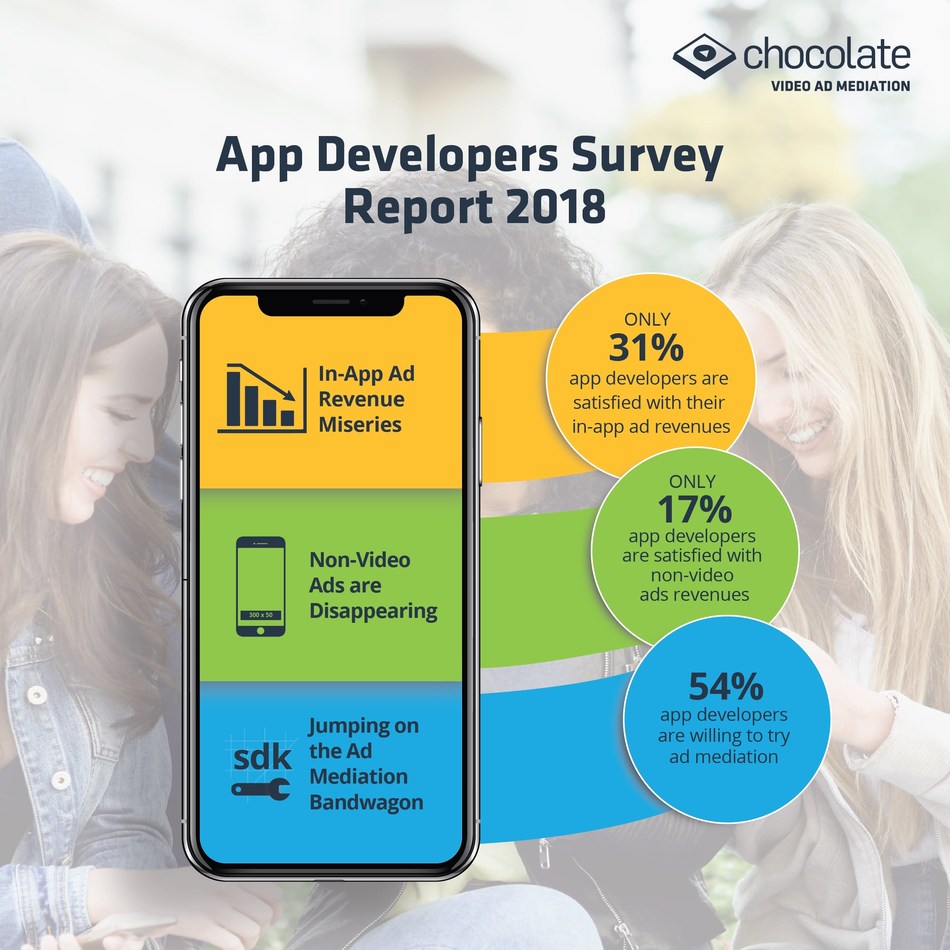
Only 31% App Developers are Satisfied With Their Current Ad Revenues, Highlights Latest App Developer Survey Report 2018 by Chocolate
1
Only 31% App Developers are Satisfied With Their Current Ad Revenues, Highlights Latest App Developer Survey Report 2018 by Chocolate
Chocolate, a global leader in mobile video advertising, announced the launch of App Developer Survey Report 2018. Focusing on app monetization, the survey report reveals insights about app developers’ satisfaction with current ad revenues, perceptions towards ad mediation and impact of in-app video ads like rewarded videos in boosting ad revenues.

Ad Mediation Report 2018

Key highlights of the report include:

  • In-app ad revenue miseries: Only 31% app developers are satisfied with their in-app ad revenues
  • Non-video ads are disappearing: Only 17% app developers are satisfied with their in-app ad revenues from non-video ads
  • Jumping on the ad mediation bandwagon: 54% app developers are willing to try ad mediation to boost in-app ad revenues
  • Factors for picking an ad mediation partner: No. of ad networks and ease of integration are the top two factors in choosing an ad mediation partner

Also Read:  New York Website Design Company, Lounge Lizard, Talks About Designing an Engaging User Experience

“The survey report clearly states the fact that app developers are not satisfied with their current ad revenues and considering a majority of developers rely on ad-based monetization as their primary source of revenue, there is a critical need of putting power back in the hands of app developers,” said Saurabh Bhatia, CEO, Chocolate. “Our ad mediation technology provides multiple demand sources in a programmatic environment layered with unified auction technology, ensuring no bias towards any ad network, thus, delivering the highest bid every time. All this through a single intelligent SDK and a single sign-in, ensuring app developers spend no time managing multiple ad networks and maximum time at what they do best – creating fabulous apps.”

“We are excited to launch our latest update of Salad Hunt to include 10 additional languages for both Android and iOS App stores,” said Telly Lee, CEO, Salad Hunters. “For free-to-play apps like ours, ad-based monetization is critical for the business. We were looking for monetization partners who can offer rewarded video ads and guarantee a high Fill-rate. Chocolate’s user-friendly dashboard and a bundle of multiple demand partners gave us the confidence to partner with them.”

The survey report is based on responses from 102 app developers spread across 22 countries including top mobile app countries like the US, CanadaGermany, UK, AustraliaIndia and more. The survey was conducted between Nov’17 and Jun’18.

Recommended Read: Narrative Science Instantly Explains Tableau Dashboards as Written Stories to Enhance Analysis and Communication

Nielsen Launches Local Media Impact, A New Cross-Platform Media Planning Solution

0
Nielsen Launches Local Media Impact, A New Cross-Platform Media Planning Solution

Nielsen Media Impact Enables Advanced Audience Buying & Optimization in the 25 LPM DMAs

Nielsen announced the launch of Local Nielsen Media Impact, a solution that makes local media planning and cross-channel optimization streamlined and efficient across local TV and Radio. Nielsen Media Impact is a powerful planning system that allows users to understand cross-media reach, frequency, and duplication on a local scale using advanced audience segments from Nielsen Scarborough. In addition, this new offering enables advertisers, agencies, and media owners to reach their desired audience in the 25 US Local People Meter (LPM) Designated Market Areas (DMAs).

Local Nielsen Media Impact is built with respondent level data to allow in-depth cross-platform analyses for both local TV and Radio separately, as well as TV and Radio together.  Combined with Nielsen Scarborough local consumer insights, these combinations of TV, Radio plus Scarborough provide cross-media optimization at a persons-level and enable granular advanced audience segmentation.

“On the agency side, Local Nielsen Media Impact helps us to understand the local media landscape and determine the best properties and combinations of media channels, driving unique reach for our media plan,” says Kyle Allen, Partner / Media & Research Director, The Company.  “This solution will help us optimize our planned budget and to cost effectively deliver against our objectives.”

Also Read: Nielsen Marketing Cloud DMP Ties in With Snapchat’s Ad Buying Platform

“Local Nielsen Media Impact offers a unique lens to the industry, enabling effective decision-making about where and when to engage audiences with content and advertising on local levels,” said Jay Nielsen, VP, Product Leadership, Nielsen. “Similar to the solution clients have widely adopted on the national level, this local solution unlocks access to new insights on media allocation and schedule optimization to better reach a cross platform-based audience.”

“On the radio side, Local Nielsen Media Impact offers empirical data supporting radio’s ability to amplify and complement TV campaigns, ” says Bob McCurdy, Beasley Media Group.  “This is the first time radio is included in this type of multi-channel media mix that enables users to derive cross media insights with currency grade accuracy. Nielsen Scarborough data within the NMI solution allows us to assess campaign scenarios against consumer insights.”

As audience-based advertising evolves across platforms, Nielsen is leveraging the unique power of Scarborough, true in market local data, that offers audience segments beyond basic demographics including behavioral, attitudinal, and cross-platform media behavior attributes. With the aim of driving greater return on investment for media buys while also simplifying the planning process, Local Nielsen Media Impact is a vital tool for understanding how to reach, and activate audience based buying on a local level across TV and radio with more media types to come in the future.

Recommended Read: Nielsen Launches First-To-Market Friday Morning Data Delivery For Retail Measurement

Triton Digital Integrates with Tru Optik to Bring Enhanced Targeting, Measurement, and Attribution to Streaming Audio and Podcast Advertising

0
Triton Digital Integrates with Tru Optik to Bring Enhanced Targeting

Triton Digital, the global technology and services leader to the digital audio industry, announced the integration of the Triton Ad Server, Tap, with Tru Optik, the audience intelligence and data-management platform at the forefront of addressable Over-the-Top (OTT) and Connected TV (CTV), to bring enhanced audience targeting, measurement, and attribution to streaming radio and podcast advertising.

Triton Digital Integrates with @TruOptik to Bring Enhanced Targeting, Measurement, and Attribution to Streaming Audio and Podcast Advertising

With more than 73 million Americans listening to podcasts monthly and broadcast radio accounting for 17 of the top 20 audio streaming services, there is an increased demand for advanced targeting across streaming audio. Through this partnership, audio publishers that use Triton Digital’s Tap ad server will have the ability to leverage a custom Streaming Audio Data Marketplace to facilitate audience targeting across more than 75 million households in the US Audience segments include demographic, behavioral, and purchase data from leading third-party vendors. Categories such as avid gamers, sports fanatics, auto enthusiasts, fine diners, concert goers, globetrotters, big box shoppers, tech enthusiasts, and more will be actionable for leading broadcasters, podcasters, and streaming music services across desktop, mobile, smart speakers and other internet connected devices. This enhanced targeting will enable audio publishers to increase both the value of their audio inventory, and the return on investment for their advertisers.

Also Read: Outside TV Features Boosts Distribution Gains by Adding Top Cable, Satellite and vMVPD Providers

“As pioneers of audio advertising solutions, we remain committed to the continuous advancement of our technology, and to providing our clients with solutions that make leveraging the power of digital audio both simple and effective,” said John Rosso, President, Market Development at Triton Digital. “We are pleased to be integrated with Tru Optik, and to expose their audiences in Tap for the benefit of our streaming and podcast publishers, as well as their advertisers.”

“With the rise of smart speakers and other connected devices, advertisers cannot rely on device IDs or cookies alone to ensure they are connecting with the right audiences,” said Andre Swanston, Chief Executive Officer and Co-Founder at Tru Optik. “Tru Optik’s data management platform and household graph have led the way in solving the targeting and measurement challenges across the Over-the-Top TV ecosystem. We look forward to partnering with Triton Digital to empower brands and publishers with the precise audience insights needed to more effectively reach millions of streaming audio and podcast listeners.”

Recommended Read: Zaius Segment Builder 2.0 Adds Flexible Customer Segmentation with a Simple CRM Interface

Tapad’s Proprietary Graph Now Integrated With Adobe Audience Manager

0
Tapad's Proprietary Graph Now Integrated With Adobe Audience Manager

The Tapad Graph Now Offered in Adobe Audience Manager, Part of Adobe Analytics Cloud

Tapad, the company advancing personalization for the modern marketer, announced that its proprietary Tapad Graph is now integrated with Adobe Audience Manager, part of Adobe Analytics Cloud, helping marketers expand their view of consumers and boost results through Tapad’s probabilistic solution.

Tapad has been working closely with the Adobe Audience Manager team on this integration. With the Tapad Graph integration, customers based in the US and Canada can use the Tapad Device Graph to expand the reach of audiences defined and activated in Adobe Audience Manager to extend first- and third-party data and deliver personalization across paid, earned and owned channels, publisher sites, programmatic, and more. Tapad worked closely with Adobe to develop the integration, allowing marketers to enable first-party data that has been previously tied to cookies and mobile. This offering has been beta-tested by leading organizations across retail, financial services, telecom providers, and more.

Also Read: Tapad Partners with Twine Data to Bring Portable CRM Onboarding Capabilities to Its Cross Device Solution

“We’re excited to publicly announce the solution our team has been closely designing over the past 12 months with Adobe,” said Chris Feo, SVP, Global Data Licensing and Strategic Partnerships at Tapad. “This solution will give marketers in the US and Canada the ability to unlock increased value from Adobe Audience Manager through the power of the Tapad Graph and its ability to expand customer prospects.”

Tapad has repeatedly proven its ability to provide marketers with a unified view of the customer across channels and screens. With the Tapad Graph, a global identity graph that currently supports more than 100 enterprise customers and 200 integration partners, marketers can extend their reach and customize messages based on user and household-level data.

Recommended Read: Tapad Appoints Abhay Doshi to Head Up Asia Pacific Operations

SPLICE Software’s Dialog Suite Shortlisted for Business Intelligence Category in SaaS Awards

0
SPLICE Software's Dialog Suite Shortlisted for Business IntelligenceSPLICE Software's Dialog Suite Shortlisted for Business Intelligence

International Software Program Announces Finalists

SPLICE Software is a finalist in the 2018 SaaS Awards Program in the category of Business Intelligence or Analytics.

With awards for excellence and innovation in SaaS, the Software-as-a-Service Awards program accepts entries worldwide, including the US, Canada, Australasia, UK and EMEA. The SaaS Awards program is now in its third year of recognizing and celebrating innovation in software.

Categories for the 2018 awards program include Best Data-Driven SaaS Product, new categories for SaaS security and ticketing and events management, and the hotly-contested Best Enterprise-Level SaaS Product.

Categories for Best Enterprise-Level Product, Best Product for Small Business, Best Product for Productivity and Best Data-Driven Product also include non-US categories to highlight the growing number of international innovators in the cloud space.

“For SPLICE Software’s Dialog Suite and Data-Driven Dialogs to be shortlisted in the Business Intelligence or Analytics category is clear evidence of our innovation and success in the global marketplace for voice-based solutions,” said Tara Kelly, President & CEO. “As voice continues to expand as the user interface of the future, we’re committed to giving businesses even more control of their unique brand voice in the marketplace.”

Also Read: TapClicks Shortlisted for 2018 SaaS Awards

SaaS Awards and Cloud Awards organizer Larry Johnson said: “In our third year promoting SaaS exclusively alongside its sister awards program, the long-running Cloud Awards, we have seen a huge variety of submissions from the US joining those from CanadaEuropeAustralia and the East – from organizations whose turnovers rank the highest in the world, to innovative not-for-profits seeking to provide essential productivity tools to their users.

“All entrants demonstrated considerable commitment to innovation in software solutions, and to make the shortlist itself is a huge achievement. With such a concentrated level of success in the shortlist, our judges have a significant task ahead of them to arrive at our final award winners.”

Final SaaS Awards winners will be announced on Tuesday 28 August 2018 and the program will return in Spring 2019. Over 300 organizations entered, with international entries coming from North AmericaCanadaAustralia, UK, Europeand the Middle East.

A sister program to the SaaS Awards, The Cloud Awards, is currently accepting submissions for a new 2018-19 program, continuing its recognition of excellence in cloud computing, with a final October deadline.

Recommended Read: Telestream Integrates Live Video Production with Microsoft Stream and Office 365 via Wirecast S

Goodway Group Appoints Jay Friedman as President

0
Goodway Group Appoints Jay Friedman as President

Current President and Third-Generation Family Owner David Wolk to Assume New Role as CEO

Goodway Group, the digital partner advertisers trust to deliver campaign performance and media efficiency, announced the appointment of Jay Friedman as President, effective immediately. Friedman previously held the role of COO. David Wolk, formerly President of Goodway Group, will move into the role of CEO.

Since joining in 2006, Friedman has helped transform Goodway Group into a fast-growing digital media company and led it to become one of the largest independent players in the programmatic advertising industry. Most recently, Friedman played an integral part in rolling out the RealValue™ Advertising Platform, which uses predictive intelligence to drive campaign performance and deliver advanced analytics. A graduate of the University of Wisconsin, Jay is a nationally recognized and accomplished digital media expert, speaker, author and writer who regularly speaks at top industry conferences and writes for leading industry websites. He is the lead author of Goodway’s signature publication “30 Days to Digital.”

As President of Goodway Group, Friedman will focus on enhancing the company’s already strong platform and client base, with a continuous emphasis on operational excellence. With more than 10 years of senior leadership experience at Goodway Group, Friedman has led a diverse and growing remote workforce team while strategizing platform developments and leading product enhancements to ensure advertisers get the most value from their spend.

Also Read: OneTrust Leads Global Privacy Management Software Market: Ovum Report

“Jay is a proven leader and strategist. Goodway Group is a family owned operation, and Jay has quickly become an integral part of our company’s family,” said  David Wolk. “With Jay’s help, Goodway Group has developed into a leading partner for advertisers looking to drive performance and value. We were able to transform from a direct marketing company focused on print to a cutting-edge digital media company.”

As CEO, Wolk will continue to guide Goodway forward, working closely with Friedman and the company’s leadership team. He will continue to focus on building a thriving company culture while also maintaining strong existing customer relationships and cultivating new business.

“Goodway Group has undergone an incredible transformation and our success is a direct result of our strong leadership team and the Wolk family’s commitment to our team and our clients,” said Friedman. “I am honored to take on the role of President and will continue to collaborate with the entire Goodway Group team.”

Recommended Read: Domo Named to the 2018 SaaS Awards Shortlist

PubMatic Announces Tech Veteran Thomas Chow As New General Counsel

0
PubMatic Announces Thomas Chow As New General Counsel

AdTech Legal Veteran from Snap Inc. To Further Support PubMatic’s Success

PubMatic , the publisher-focused sell-side platform (SSP) for an open digital media future, announced the appointment of Thomas Chow as the general counsel and secretary, brought on to oversee the company’s global corporate, commercial, intellectual property and legal affairs. Chow joins the leadership team during a period of growth for PubMatic as the company has plans to add 40 new employees globally in the second half of 2018, with the majority of headcount growth focused engineering and product teams to support mobile app monetization as well as sales and customer success teams around the world.

“At a time when businesses in our industry are consolidating, we are thrilled to be growing atsuch a rapid pace and to be adding Thomas’ wealth of experience to our leadership team,” said Rajeev Goel, co-founder & CEO of PubMatic. “Thomas’ years of legal advisory for major tech companies, such as Snap Inc., lends well to our growing organization as we continue to empower publishers in the multi-screen programmatic world.”

Also Read: PubMatic Launches PubMatic Cloud to Evolve the SSP Business Model

Prior to joining PubMatic, Chow led the adtech and measurement legal group at Snap Inc. and was the general counsel, chief compliance officer and secretary at Exponential Interactive. He also held senior leadership roles at Vindicia and TechSoup.

“PubMatic is at the forefront of the rapidly evolving ad tech ecosystem with industry-leading technology, header bidding solutions, high quality inventory, and top-notch client services for publishers,” said Chow. “I’m honored to join PubMatic and look forward to supporting its growth with Rajeev and the leadership team so publishers can continue to make great content available to consumers.”

Chow is located at PubMatic’s headquarters in Redwood City.

Recommended Read: PubMatic and Ringier Partner to Drive Programmatic in the Romanian Market

Panopto Named a Leader in the 2018 Aragon Research Globe for Enterprise Video

0
Panopto Named a Leader in 2018 Aragon Research Globe for Video

Video Platform Vendor Is Recognized Two Years in a Row Based on Completeness of Business Strategy, Performance, and Global Reach

Panopto, a leading enterprise video platform provider, announced that it has been named a Leader by Aragon Research in its 2018 Research Globe for Enterprise Video. Panopto was evaluated as a Leader based on its business strategy, performance, and global reach of its video platform.

“In the last year, Panopto has substantially expanded its partner network and the core capabilities of its product,” said Jim Lundy, Aragon Research founder, CEO and author of the report. “These investments have allowed Panopto to extend its footprint in both the enterprise and higher education, with a focus on video-based learning and live event streaming.”

Aragon identified Panopto as a Leader due to strengths such as “robust video search” and “integrations with learning management systems, content management systems, and web conferencing solutions” among other capabilities.

Also Read: Vonage Acquires TokBox, the Leading Programmable Video Provider

“Video has become the preferred medium for communicating and sharing knowledge online,” said Eric Burns, co-founder and CEO of Panopto. “Video platforms are enabling businesses and universities to tear down traditional barriers to communication by simplifying video capture, publishing, and management. In the last year, we’ve experienced a surge in demand across all vertical industries, and we’re honored to be named among the leaders in our market.”

Panopto is the easiest-to-use video platform for businesses and universities. It provides an integrated solution for managing, live streaming, recording, and searching video content. Fortune 1000 companies use Panopto to deliver online training, broadcast corporate events, improve employee onboarding, and create secure “Corporate YouTubes” of their video assets.  Within universities, Panopto is the leading solution for centralizing and managing video content, recording lectures, flipping the classroom, streaming campus events, and integrating video with learning management systems.

Recommended Read: Apester Launches a Story Suite for Online Publishers and Businesses

Just 35 Percent of Responding Organizations Are GDPR-Compliant With EU Data Privacy Rules

0
Just 35 Percent of Responding Organizations Are GDPR-Compliant With EU Data Privacy Rules

Even Fewer Know What Data Third Parties Hold and Have Addressed Third-Party GDPR Compliance in Contracts

The European Union (EU) General Data Protection Regulation (GDPR) took effect May 25, 2018, yet only 34.5 percent of nearly 500 professionals involved in GDPR compliance efforts say their organizations can defensibly demonstrate compliance with the new data privacy rules today, according to a recent Deloitte poll.

Litigation, regulatory and internal investigation challenges could abound for others. One-third of respondents (32.7 percent) hope to be compliant within 2018. And, 11.7 percent plan to take a “wait and see” approach amid uncertainty over how EU regulators in various countries will enforce the new regulation.

“The fact that the GDPR effective date has come and gone and many are still scrambling to demonstrate a defensible position on GDPR compliance reflects the complexity and challenges as the world of privacy rapidly changes,” said Rich Vestuto, a Deloitte Risk and Financial Advisory managing director in discovery for Deloitte Transactions and Business Analytics LLP.

Third-party contract management for GDPR compliance

Only 13.6 percent of respondents are confident that their organizations know what data third parties have and are leveraging artificial intelligence (AI) and other technologies to analyze and manage third-party contracts for GDPR compliance.

Also Read: Deloitte and ForgeRock Announce Alliance to Provide Advanced, Global Customer Identity and Access Management Solutions

A majority (56 percent) aren’t done discerning what data third parties have or the potential implications of GDPR on third-party contract management. Some (10.2 percent) have yet to begin addressing third-party GDPR compliance at all.

Vestuto added, “Among the biggest GDPR compliance challenges is third-party contract management. Under GDPR, organizations are responsible for ensuring privacy protection of EU-regulated data shared with or used by vendors and service providers, which requires those organizations to know who their vendors are and precisely what data those third parties hold. Updating or renegotiating contracts and agreements may help ensure third parties are GDPR-compliant when using your organization’s EU-regulated data.”

Discovery challenges loom for 30 percent 

Discovery will be harder for their organizations now that the GDPR is enforceable, according to 30.6 percent of respondents. Surprisingly, 18.6 percent expect discovery to actually become easier under GDPR. Some (17.2 percent) expect no change to their organizations’ discovery practices, as a result of GDPR taking effect.

“Even those professionals closely involved in GDPR compliance may not fully appreciate the implications the new rules may have for discovery related to regulatory inquiry responses, litigation and internal investigation proceedings—as well as other aspects of their businesses,” Vestuto cautioned.

Scalability is key as more jurisdictions add data privacy rules

Nearly half of respondents (48.2 percent) say their organizations’ data privacy programs are scalable to address pending rules in other jurisdictions even if their immediate focus is GDPR. Also, 19.8 percent report that their organizations’ programs are focused solely on GDPR without scalability, potentially leaving them unprepared to deal with new rules elsewhere.

Vestuto concluded, “Other jurisdictions beyond the EU are enacting more stringent data privacy protections. Data privacy programs should be scalable and requirements rationalized on a global basis to ensure that organizations are able to address current and pending rules in various jurisdictions as needed.”

Recommended Read: Monetate Names Stephen Collins as Chief Executive Officer

Tunity Launches SDK for Audio, Increasing Usage of Businesses’ Consumer Facing Mobile Apps

0
Tunity Launches SDK for Audio, Increasing Usage of Businesses' Consumer Facing Mobile Apps

Businesses Can Now White Label This First of Its Kind TV Audio Streaming Technology For Their Mobile First Strategy

Tunity, a technology that allows users to hear live audio from muted televisions directly on their mobile device, announced the debut of Tunity SDK for Audio.

Tunity SDK for Audio gives any customer facing business, from restaurants to gyms, airports and universities, the ability to implement a white labeled version of Tunity’s patented deep learning TV audio streaming technology. This allows users to hear live audio from muted televisions directly on their existing mobile devices. Tunity SDK adds multiple touch-points for businesses with their patrons on and off premise.

With Tunity SDK for Audio, businesses’ can improve customer engagement in multiple ways:

  • Increase App Usage- Customers using an app with Tunity SDK now have the power to listen to live TV wherever they are. Customers who use Tunity spend on average over 40 minutes of ongoing in-app engagement. Market research has long established that the longer a customer views an in-house television the greater the likelihood of increased sales for the business.

Also Read: Audio Measurement Platform Veritonic Raises $3.5 Million Seed To Scale Data-Driven Approach To Audio Marketing

  • Retain Customers- Even if a customer is at a competitor’s gym, bar, or restaurant, by using your app to watch TV, there is direct access to send them deals and discounts, adding off-site touch points and probability they return. With the SDK in place, businesses get a more complete picture of how valuable each customer is.
  • Upsell Customers- Tunity SDK for Audio means more onsite touchpoints with a company’s app. This means greater opportunity to push marketing engagement, upsell campaigns, and produce real-time tailored brand engagement.
  • Acquire New Customers- The added functionality and versatility of Tunity SDK means existing customers are more likely to download the company’s app and talk about it with non-customers. This contributes to higher user app ratings, word of mouth, and sharing via social media.

The advantages of Tunity’s SDK for Audio adoption are not just limited to customer impact. Because Tunity uses a cloud-based platform coupled with a user’s mobile device, businesses do not need to make the financial investment of additional hardware, or deal with the hassle of constant upkeep and repairs. If a business has a TV then they can engage with Tunity.

Research has shown that the addition of televisions to almost any establishment results in increased customer activity and retention. Tunity SDK for Audio not only gives companies a way to extend that engagement and touchpoint with customers when on site, but it provides them with a feature they can use wherever they go. This creates a path to reach potential customers throughout their day in a meaningful and targeted manner.

Recommended Read: Outside TV Features Boosts Distribution Gains by Adding Top Cable, Satellite and vMVPD Providers

5 Reasons Why Games Offer the Most Brand-Safe Environment for Digital Advertisers

1
Why Games Offer A Brand-Safe Environment for Digital Advertisers

TAPJOY LOGOThe Internet is a scary place. With everything from divisive politics and hate speech to terrorism and pornography to worry about, it’s no wonder that digital advertising professionals ranked brand safety as the most important media quality metric to measure in 2018. Over two-thirds of US marketers say they’ve suffered from brand safety issues, and more than half of them say it has happened more than once.

So marketers are fighting back the best way they know how: with their budgets. Companies such as Unilever and Procter & Gamble, which represent some of the biggest brands in the world, are pulling back hundreds of millions of dollars from digital media properties that can’t guarantee safe placements for their campaigns. Other brands are following suit, which begs the question, if brands can’t run their ads where they might be associated with objectionable content, where can they run them?

The safest environment for brands these days might be one of the last places they’d expect. It also happens to offer one of the most effective environments to help them hit their objectives, whether they’re seeking to drive brand awareness or measurable conversions — or both. That environment is mobile games.

While some brands have been reluctant to embrace games (for reasons we’ll get into below), those that have are garnering eye-opening results. Let’s examine why.

Also Read: Banner Ads: Alive and Thriving in Casual Mobile Games

Gaming content is developer-controlled

User Generated Content (UGC) is the scourge of advertisers looking to avoid questionable content. There’s simply too much risk involved when publishers let their users post their own content. That’s why some of the largest social and video properties are so frightening to advertisers. But games offer advertisers an environment that is free from UGC because their content is typically 100% controlled by the developers themselves. As opposed to sites that rely on UGC — or even those that enable comments, which can often get out of hand — the entire mobile gaming experience is developer-controlled. Not to mention, all games must be approved in advance by the App Store or Google Play, which weed out restricted content. So advertisers have no reason to fear that their campaigns will appear next to content detrimental to their brand.

Games are made of high quality IP

Well-known IP is an advertiser’s best bet because they know exactly what they’re getting. For example, Disney IP is practically guaranteed to offer wholesome, family-friendly fun; NFL IP is a sure-fire way to attract sports fans; and a TV show like Seinfeld will appeal to just about everyone. Some of the most successful gaming franchises are based on well-known IP. Many — like Jurassic World™ Alive, Garfield: Survival of the Fattest, and MARVEL Contest of Champions — are based on pre-existing IP from other media, while original games such as Clash of Clans, Angry Birds and Subway Surfers have become so popular that they’ve formed their own IP. Advertisers who associate with any of these types of games can be sure they’re entrusting their brand to a large, well-known brand itself.

Also Read: How to Grow Your Presence on Twitch in 2018

Gamers represent desirable demographics

Old misperceptions used to hold that gamers are mostly teenage boys in their parent’s basement, and even today this myth tends to hold some advertisers back from investing in mobile games. Of course, we now know that this couldn’t be further from the truth. Today’s gamers aren’t just one particular demographic of players: mobile gamers come in all ages, genders and income brackets. In fact, a majority of mobile gamers are women, and many are middle aged — the very demographics that so many advertisers covet because they hold the pursestrings to most households. Better still, a majority of gamers come from households with incomes above the US average.

Games put consumers in an open, receptive mindset

Most advertisers would rather reach someone when they are happy and relaxed than when they are bored and stressed out, and research shows that consumers report being twice as likely to feel relaxed while playing mobile games than they are when using social apps. They are also more focused (35 percent vs 11 percent), happier (34 percent vs 21 percent), and more engaged (35 percent vs 20 percent) when on gaming apps than social networking apps. At the same time, they are 2.4 times more likely to express boredom on social apps than gaming apps, and 60 percent more likely to report being stressed out. Advertisers who continue to pour budgets into social over gaming are barking up the wrong tree.

Also Read: The Role of AI in FIFA World Cup 2018

Game developers are sophisticated

Game developers were the first mobile publishers to embrace the freemium model, the first to embrace AI-based automation, and the first to embrace attribution-based advertising. The point is that mobile game developers are probably the most sophisticated publishers in the digital industry. They understand the whims of the market and the needs of their audiences. And they know what it takes to attract brand dollars to their sector. They are not only willing to work with brands to incorporate ad campaigns, but they have sophisticated ideas for how to do it effectively. Whether through product placements, interactive rich media, rewarded ads or some new, unforeseen ad format, mobile game developers offer a variety of ways for brands to connect with their audiences.

Need more reasons to advertise in mobile games? How about the fact that over 2 billion people worldwide are playing them. Or that the average US adult spends 23 minutes a day playing mobile games? Currently, a vast majority of the ads displayed in mobile games are ads promoting other games. This presents a tremendous opportunity for well-known brands to step in and essentially own the entire gaming category.

Advertisers need to go where their audiences are. Fortunately for today’s brands, that happens to be the same place offering the most safety and best performance for their ad campaigns.

Recommended Read: Mobile Gamers Expect to Play More Games This Holiday Season, Tapjoy Research Finds

TechBytes with Roger Kjensrud, Co-Founder and CTO, Impact

1
Roger Kjensrud

Roger Kjensrud
Co-founder and CTO, Impact

Continuing on our mission to bring first-hand insights into GDPR and its impact on global operations, we spoke to Roger Kjensrud, Co-Founder and CTO, Impact. Roger tells us about how GDPR could impact martech companies, particularly the ones based in the US but with a sizeable clientele in the EU.

Html code here! Replace this with any non empty text and that's it.

Tell us about your role at Impact and the technology/team you handle.

I am a co-founder and the CTO of Impact. I lead all technology teams that build and operate a scalable and comphrensive software platform for digital marketers around the world.

Why was GDPR needed?

The consumers expect brands and companies to protect their personal data, and to obtain permission to use the data. Transparency on how to collect and use the data is key. For the businesses, it is to simplify and standardize the regulatory environment.

Yes, I believe it is needed. We have seen numerous examples of lax practicies around protecting and usage of data (Facebook – Cambridge Analytica, Equifax).

How would GDPR impact US martech companies who have customers based in the EU?

On one hand, it is impacting the requirements of their their technology and software. Any personal data (the defintion is pretty broad, including IP addresses) needs to be handled and stored in a secure manner. This requires them to categorize all data collected and processed to understand what is considered personal. The consumer can request the erasure of the personal data, which means the technology needs to support that as well.

One the other hand, it is impacting processes and procedures the companies need to follow. This includes: employee training and awareness, documented procedures to respond to data breaches (e.g., notify within 72 hours), appointing a Data Security Officer.

How should such companies prepare for post-GDPR era, including what type of requirements will be needed moving forward?

It starts with understanding the requirements of the GDPR. And that it is not a one-time thing. GDPR compliance is continuous journey where they have to ensure compliance as new products are built, as new employees join the company, as new customers come onboard and as the law and requirements are changing.

How GPDR will ensure martech companies’ data is in compliance with the new regulations?

Each EU member state has a supervisory authority, the so called Data Protection Authorities (DPA). The DPA is tasked with monitoring the application of GDPR. The details on exactly how it is enforced is sparse, but it is clear that if data breaches are not handled properly for example, there is a potential for fines. Also, if there is suspicion of violation (reported by a consumer) the DPA can order the company to provide information showing compliance. Furthermore, there could be audits, including access to premises.

What are the benefits of martech companies performing pseudonymization on any personal data before the data processor collects it?

This plays into the handling and storing the data in a secure manner, and the right to be forgotten. The martech company controls that the sensitive data is secured properly. It also forces the martech company to think about which data really needs to be shared with the data processor. In case of right to be forgotten, it is easier and less error prone if the martech company instructs data processor to erase based on the actual data shared versus data that needs to be pseudonymized by the processor before erasure can take place.

Why is it better for martech companies to not process personal data?

Because GDPR applies to companies that process and stores personal data. If personal data is not processed, then GDPR does not apply.

Why the EU is enforcing the new rules as a necessity for data protection? Will it affect the martech industry?

I believe this has to do with building trust with the consumer. If the consumer has trust, it benefits the business as well as the digital economy as a whole. Which is a refreshing idea when you consider a lot of the “hidden” or non-transparent data brokering and sharing in the tech industry.

Yes, it will affect the martech industry as I have touched upon in the previous questions.

Thanks for chatting with us, Roger.

Stay tuned for more insights on marketing technologies. To participate in our Tech Bytes program, email us at news@martechseries-67ee47.ingress-bonde.easywp.com

Salsify Raises $43 Million in Series D Funding Round Led by Greenspring Associates

0
Salsify Raises $43 Million in Series D Funding Round Led by Greenspring Associates

Continued Customer Growth Drives Latest Investment for Accelerating R&D and Continued Global Expansion

Salsify, the only product experience management (PXM) platform that lets brands deliver compelling shopping experiences across every digital touchpoint, announces it has secured $43 million in Series D financing. This latest round of funding was led by Greenspring Associates, with participation from existing investors Matrix Partners, Venrock, Underscore VC and North Bridge Venture Partners. The new investment will further advance Salsify’s investments in R&D, help the company grow both its global footprint and partner ecosystem, and continue delivering solutions that drive the life cycle of commerce on the digital shelf.

Over the course of the past year, Salsify’s full suite of PXM functionality has resonated with brand manufacturers looking to successfully navigate the complex challenges of the modern commerce landscape. New customers in 2018 have included a wide range of the world’s leading brands, including Anheuser-Busch, Perry Ellis, Michelin, and Asics.

Also Read: Gladson Launches Product Data Transparency Solution

“By 2022, 58% of all retail sales are expected to be influenced by digital. In order to drive market share and margins, winning brands need to deliver and continually optimize a differentiated product experience for buyers at every touchpoint across the digital shelf,” says Jason Purcell, Salsify CEO and Co-Founder. “This latest round of financing, along with our increasing market momentum, underscore how Salsify’s capabilities are comprehensively addressing this major challenge for brands in a way no other platform can match.”

Delivering on an aggressive product development roadmap is what drives Salsify’s growth and the company’s increasingly global customer base. To support these efforts, Salsify invested approximately 40% of its revenue in R&D in the first half of 2018, and this focus will be further bolstered by the Series D investment.

“Salsify’s platform is extremely powerful, and is meeting a tremendous need in the marketplace that is only going to grow larger over time,” says John Avirett, Greenspring Associates’ General Partner. “The company’s leadership team has a visionary, strategic view of the rapidly evolving commerce marketplace and has developed a supportive and innovative company culture that is focused on helping brands drive sales on the digital shelf. We’re proud to partner with the Salsify team as they continue their rapid growth.”

Recommended Read: SAS Survey: A Quarter of UK and Ireland Consumers Have Already Exercised GDPR Rights

HubSpot Brings Bots, Live Chat, and Team Email to Growing Businesses for Free with Launch of Conversations

0
HubSpot Brings Bots, Live Chat, and Team Email to Growing Businesses

Conversations Is a Universal Inbox Built on Top of a CRM, an All-In-One Setup That Gives Businesses the Tools They Need to Better Connect with and Delight Their Prospects and Customers

HubSpot, a leading growth platform, extended its commitment to help millions of businesses grow better with the launch of Conversations. The new tool is available as part of HubSpot’s free CRM and gives all businesses, big or small, the power to build better one-on-one relationships through features including a unified inbox, live chat, and chatbots. Conversations is comprehensive and easy to use, making it an effective solution for growing businesses looking to expand their messaging strategy beyond a siloed departmental effort into a truly business-wide strategy that harnesses existing data to form better connections with prospects and customers.

“As consumers, we have high expectations of the organizations we buy from. We expect businesses to be always on and clued in to our context – to know the history of our relationship. It’s been tough for businesses to meet those expectations, especially with disparate tools that aren’t integrated,” said Dharmesh Shah, co-founder and CTO at HubSpot. “HubSpot’s Conversations solves this problem by providing organizations with one single view of the customer and one unified ‘inbox’ across all channels of communication.  This helps ensure that every interaction an organization has with its customers is contextual and, ultimately, delightful. And the best part is that it’s all available for free.”

Also Read: HubSpot Launches Marketing Hub Starter to Give Growing Businesses the Tools They Need

Built with ease of use in mind, Conversations provides users with unlimited chats, unlimited users, and chatbot functionality, making it more accessible to the average customer than other similar offerings on the market today. Key features of the tool include:

  • A collaborative inbox built for all sources and all teams, allowing users to manage email and chat conversations from one central place.
  • Chatbots to automate the delivery of information and facilitate more high-quality conversations, built on technology from HubSpot’s recent acquisition of top chatbot platform Motion AI.
  • Targeting and lead routing working seamlessly with HubSpot CRM, allowing for sophisticated targeting and lead routing that connects the right people at the right time.

“As a growing business, one of our biggest pain points has been getting the full view of our customers and prospects. The majority of the communication tools we’ve encountered on the market just haven’t been developed with our needs in mind,” said Kevin Hancock, founder of Frame My TV. “With Conversations, we’re finally able to tap into the valuable data we’ve collected in our CRM to better connect with and serve our audiences, saving us time and driving meaningful results.”

Conversations is a core feature of HubSpot CRM and is available across all of HubSpot’s product offerings – Marketing Hub, Sales Hub, and the recently released Service Hub.

Recommended Read: HubSpot Announces HubSpot Agency Directory to Help Clients Reach Agencies Around the World