Home Blog Page 4193

New Kenshoo Research: Mobile Ads Overtake Desktop in Paid Search for the First Time, Now Lead Spending in Both Social and Search

0
New Kenshoo Research: Mobile Ads Overtake Desktop in Paid Search for the First Time, Now Lead Spending in Both Social and Search

Social Impression Volume Increased Year-Over-Year for the First Time in Four Quarters; Mobile Shopping Ad Impressions Surged in Paid Search in Q2 2018

Kenshoo, a global leader in marketing technology, released a new infographic, Kenshoo Digital Marketing Quarterly Trends Report: Q2 2018, detailing spending growth in social (40%) and paid search (10%) year-over-year (YoY) in Q2 2018. Key findings include:

  • Social spending increased 40% YoY and decreased 1% quarter-over-quarter (QoQ)
  • Social impressions increased 15% YoY and decreased 10% QoQ
  • Social clicks increased 94% YoY and decreased 13% QoQ
  • Social click-through rate (CTR) increased 69% YoY and decreased 3% QoQ
  • Social cost-per-thousand (CPM) impressions increased 21% YoY and 8% QoQ
  • Paid search spending increased 10% YoY and 4% QoQ
  • Paid search impressions increased 20% YoY and 6% QoQ
  • Paid search clicks increased 24% YoY
  • Paid search CTR increased 4% YoY

Also Read: SaaS and Technology Industry Revenue Acceleration Expert Jeff Loeb Joins Chief Outsiders’ Northeast Group

Social Spotlight

  • Facebook’s inventory refinements — including the removal of right-rail ads — caused three quarters of consecutive decline in impression volume; nearly a year later, impression volume increased YoY for the first time (+15%).
  • Instagram spending doubled YoY with Instagram Stories accounting for 11% of spend on Instagram ads.
  • Video ads contributed to the QoQ increase in CPM, while Carousel ads were a primary driver of the uptick in CTR.

Search Spotlight

  • Mobile accounted for the plurality of spending, accounting for 48% of search spending, while desktop accounted for 44% and tablet 8%.
  • Rapid adoption of inexpensive mobile shopping ads depressed cost-per-click (CPC) for advertisers (-12% YoY).

“Social advertising continues to evolve and it’s changing the way many advertisers use it to reach consumers. Event-driven video campaigns, for example, now extend beyond traditional verticals of gaming and entertainment, reaching into e-commerce and even finance, while more specialized ad types capture the resulting demand,” said Chris Costello, senior director of marketing research for Kenshoo. “Meanwhile, search marketers have fully embraced consumers’ adoption of mobile devices, shifting spend to mobile campaigns to ensure they’re present across the full funnel of consumer search activity. For the first time, spending on mobile search ads surpassed desktop and is near capturing the majority of ad spending.”

Kenshoo leads the way in digital marketing innovation, enabling success for marketers by maximizing customer lifetime value. Built upon Kenshoo’s industry-leading and award-winning digital marketing platform, Kenshoo delivers infinite optimization to re-engage and grow customers across the world’s leading publishers and all devices.

Recommended Read: CAKE by Accelerize Achieves Record Growth in the Asia-Pacific Region

ResponseTap Appoints David Turner as the New VP of Engineering

1
ResponseTap Appoints David Turner as the New VP of Engineering

Call Intelligence Platform Strengthens Management Team with the Arrival of David Turner 

Manchester-based Call Intelligence platform, ResponseTap, has appointed David Turner as its new Vice President of Engineering. David Turner joins ResponseTap having spent 15 years working with start-up businesses, from angel investor level through to hedge fund backed companies. He has also served as Chief Technical Officer for Takealot.com, South Africa’s biggest e-commerce website, Wakelet, and CANDDi.

At the time of this announcement, David Turner said, “This is a fantastic opportunity to be part of a rapidly growing company and I’m excited to help the team realize their true potential. I want people to see ResponseTap as a place where they can further their career and be part of a very talented team. A lot of developers work on projects for a short space of time and then move on, however, I’d like to build a team who in years to come are still part of the process and responsible for its continued success and developing their skills with continued personal development.”

Richard Hamnett, co-founder and Chief Technical Officer at ResponseTap, said, “I’m delighted to welcome David to ResponseTap. His knowledge and experience within the industry are second to none and I have no doubt that he will add great value to our team. It’s an exciting time for the business and I look forward to working with David to help shape and implement our vision for the future.”

In his role, David will focus on leading the engineering and product teams to deliver the company’s vision for the future and identify areas for potential growth. He will be exploring new markets and technical opportunities, as well as expanding and adding value to current ResponseTap accounts.

Helpshift Moves Into New San Francisco Office Space to Accommodate Accelerated Growth — and More Community Events

1
Helpshift Moves Into New San Francisco Office Space to Accommodate Accelerated Growth — and More Community Events

New Space Will Foster a Highly Collaborative Environment, Make Room For New Hires and Provide a Rooftop Venue for Social Events

Helpshift, the company revolutionizing the customer service industry through its AI-powered conversational messaging platform, announced that it has moved into a new office space in the heart of San Francisco’s financial district. The new office will provide the company with space for its continued expansion, a more collaborative environment, and a rooftop venue with a peekaboo view of the San Francisco Bay for hosting staff happy hours — or as the team calls them: wine downs — and other social events.

“Six months from now, I want to look back and be astounded by how much we have grown and accomplished”

“Six months from now, I want to look back and be astounded by how much we have grown and accomplished,” said Brenda Campbell, Vice President of People and Places. “I started at Helpshift nearly three years ago as employee number 18, and it’s been incredible to watch the growth of the team; we’re at more than 150 employees now. This space will be a testament to what we’ve accomplished so far and a tremendous place for us to grow — both internally and externally.”

Also Read: Helpshift Unveils SensAI: AI Tech Designed Specifically for Customer Service

This move follows a year of rapid expansion for Helpshift. In the past four months alone, the company has landed global enterprise brands, launched SensAI — the first artificial intelligence natively built for customer service — and made key executive hires including Vice President of Sales Scott Edmonds and Vice President of Customer Success Jeff Saenger.

“We are thrilled to be growing at a rate that demands a space of this size and are looking forward to making this Helpshift’s new Bay Area home for the foreseeable future,” said Helpshift CEO Linda Crawford. “This is such an exciting time for our industry and our company, and our successful SensAI adoption is proof that AI and conversational messaging are what today’s customers want. We are also rapidly expanding our development headquarters in Pune, India, so we can continue to lead the customer service market in AI innovation.”

Helpshift is currently looking to hire additional team members in sales, marketing and customer success in San Francisco, and engineering and data science team members in Pune, India. The company is also hiring for remote positions.

Recommended Read: Qlik Acquires Podium Data

ZPPR Raises $1.2 Million, Debuts Content Operating Platform at Outdoor Retailer

0
ZPPR Raises $1.2 Million, Debuts Content Operating Platform at Outdoor Retailer

ZPPR, a tech startup based in Bozeman, MT, recently closed a seed round of $1.2 Million led by Adjacency Partners, LLC out of New York City. Tom Arrix, Managing Partner at Adjacency Partners and former VP, Global Marketing Solutions at Facebook, has joined the ZPPR team as Chief Growth officer. Tom joins the Board of Directors alongside Bryan Johnston, Managing Partner/CEO at Adjacency Partners and former Global Marketing Director at GoPro and CMO at The UFC, and John DiCola, a senior marketing industry expert, digital media veteran and former Group Manager, Retail at Google.

ZPPR was created to provide new efficiencies in communication and content marketing media flow. With over 50 years of media experience, the founding team identified major breakdowns among brands’ visual content workflow and set out to build a platform that streamlines the media flow cycle, bringing measurable value to the process while saving time and money. ZPPR is showcasing the new platform at Elevate in Deer Valley, UT July 22-23 and Outdoor Retailer Summer Market in Denver July 23-26.

Also Read: Secure Trust Bank Selects nCino to Enhance the Customer Journey and Automate Business Processes

“Brands are struggling to keep pace with the flow of digital content and are fatigued by content formats and multiple tools,” said Kina Pickett, ZPPR CEO. “Additionally, fragmented media flow and antiquated production processes result in a slow and expensive content cycle. The shift towards customer experiences, personal and authentic storytelling and content on demand requires a fresh approach to content gathering, approval and distribution.”

ZPPR benefits to brands

  • Allows brands to create, publish, and measure visual content all from one efficient, collaborative platform.
  • Enables connected teams, improved organization, curation and distribution of media.
  • Empowers creator teams to develop more strategically aligned content and move faster, with more agility.
  • Reduces “non-working spend” through scalable media collaboration.
  • Delivers a better brand experience by creating native content intended for mobile, leading to better business results.
  • Accelerates content marketing speed to deployment.

ZPPR is simply… content collaboration without the chaos.

Recommended Read: Rakuten Marketing Powers Programmatic Prospecting Ad Solution with New Artificial Intelligence and Machine Learning Technology

adsquare Implements Unacast’s Transparent Location Data to Build Cutting-Edge Mobile Marketing Measurement, Insights and Targeting Solutions with Unprecedented Clarity

0
Unacast Turbine Offers Location Data Processing on Google Cloud Marketplace

Movement Data, Based on Real-World Consumer Behavior, Leads to Accurate Footfall Traffic Analysis and Powerful Audience Segmentation

Unacast, the leading transparent location data platform, announced a new client utilizing its location data – adsquare, the mobile-first data exchange bringing together data buyers and sellers in a transparent and secure environment. Unacast’s data will power adsquare’s measurement, insights and targeting solutions both in the US and the EU with explicit consent data.

“The effectiveness of mobile campaigns relies on the best quality data, so marketers are constantly searching for trustworthy sources of insights,” said Tom Laband, CEO and Co-Founder at adsquare. “We are always looking to provide more digital location and movement data which is accurate and at scale, and Unacast’s transparent data is one of the best sources available. Incorporating the Unacast data into our products helps our marketer clients adjust the measurement, insights and targeting solutions to their specific needs, setting them up for continued advertising success.”

Through the partnership, adsquare will use Unacast’s movement data within its insights and measurement solutions, including its Audience Insights, Footfall Insights, and Footfall Measurement tools. The incorporation of the Unacast data means these tools will be built on top of transparent opt-in data about consumer action and movement in the real world, providing a clear picture of how many consumers visit physical retail locations.

Also Read: Canary Selects Bright Pattern’s Cloud Contact Center Solution to Provide Top-Tier Omnichannel Customer Service

Additionally, Unacast’s visit data will be available within adsquare’s targeting solutions. Unacast creates visit data from billions of disparate data points, analyzing and validating the data before assigning data points to a venue and enriching results with additional insights. This transparent, contextualized data allows adsquare’s clients to build custom geo-behavioral segments, look-back windows and customized/individual points of interest (POI) with their own data. For example, thanks to the addition of Unacast data, adsquare clients can change look-back windows to target consumers by using Mobile Advertising IDs, POI, and timestamp information to determine an audience that has visited a location in the past.

“Advertisers are investing heavily in targeted mobile campaigns aimed at specific audiences, but they need solutions to understand how well those campaigns performed. The Unacast data set is designed to be industry and application agnostic and help partners build the very best products for their clients,” said Thomas Walle, CEO of Unacast. “Just as importantly, we’re very focused on the transparency of our data – and a core commitment to transparency is something that Unacast and adsquare share. Our two companies have long discussed how transparency in location data is important and the positive implications it will have on clients. This partnership is all the more exciting because of our united belief that this is how we’ll reach the next frontier of human mobility data.”

Recommended Read: Why Companies Should Consider Investing in Enterprise Information Management (EIM) Software

Cogito Raises $37 Million in Growth Equity Funding

0
Cogito Raises $37 Million in Growth Equity Funding

Cogito, the leader in augmented intelligence, announced it raised $37 million in Series C growth equity funding led by Goldman Sachs Growth Equity (GS Growth), with participation from existing investors Salesforce Ventures and OpenView. Cogito will use the latest round of funding to accelerate go-to-market, expand research and development, and grow its team.

“GS Growth shares our vision of bringing human AI to the enterprise”

Cogito has realized exponential growth since its founding out of the MIT Human Dynamics Lab and is now deployed to thousands of sales and service representatives within insurance and financial services enterprises. Industry leaders such as Humana and MetLife have adopted the technology to help empower employees and increase customer loyalty.

Also Read: Cvent Announces Availability of Its Next-Generation User Experience for Event Websites and Online Registration

“Organizations today are under immense pressure to meet rising customer expectations and deliver high quality empathetic interactions,” said Mark Midle of Goldman Sachs’ Merchant Banking Division, who has joined Cogito’s Board of Directors. “Cogito’s technology uniquely senses human behavior, understands the context of a given situation and provides in-the-moment feedback to augment a person’s natural abilities. The company’s contact center application is a proven example of the technology in action and represents a tremendous competitive advantage for brands.”

Cogito’s AI disrupts the traditional approach to contact center coaching and customer experience measurement. The software performs streaming analysis of voice conversations and provides representatives with in-call guidance that helps them be more confident and empathetic. Cogito automatically provides insight into a customer’s perception of an interaction and leverages deep learning to improve over time. The combination of a compassionate professional with human aware technology leads to an optimal experience for customers, employees and companies alike.

“GS Growth shares our vision of bringing human AI to the enterprise,” said Joshua Feast, CEO at Cogito. “There is high demand to help service professionals engage in better conversations and build an emotional connection with customers. Companies are seeking new and innovative ways to connect operational execution with customer impact, and our AI delivers unprecedented transparency. With this latest round of funding we will help more companies empower employees to achieve peak performance and maximize return on customer relationships.”

Recommended Read: Secure Trust Bank Selects nCino to Enhance the Customer Journey and Automate Business Processes

Unbounce Taps High-Growth Revenue Catalyst Felicia Bochicchio as CRO

0
Unbounce Taps High-Growth Revenue Catalyst Felicia Bochicchio as CRO

Felicia Bochicchio, a Former Bench Accounting Executive Joins Leading Landing Page Platform to Support the Company Through a New Phase of Growth

Unbounce, the leading landing page and conversion platform, has announced Felicia Bochicchio as the company’s first Chief Revenue Officer. This newly created role reinforces Unbounce’s dedication to helping marketers and agencies accelerate business results and save time with the use of landing pages, website popups, and sticky bars.

Recommended ReadNot Social Media, But SEO: Customers Still Search for Businesses Through Search Engines

Currently, Unbounce offers a landing page and conversion platform that gives marketers a way to accelerate business results through the use of landing pages, website popups, and sticky bars.

Felicia Bochicchio
Felicia Bochicchio

Felicia joins Unbounce as the global landing page market is valued at $88.8 million USD and is expected to reach $659.5 million USD by the end of 2025 growing at an annual rate of 28.5 percent between 2018 and 2025. With Felicia’s addition to the team, Unbounce is poised to take advantage of the rise in conversion marketing as marketers and agencies experience the benefits of the Unbounce platform.

Joining Unbounce with over 25 years of experience in high-growth environments, Felicia will lead customer retention and revenue growth across the Unbounce customer journey. Felicia’s success building high impact teams and scalable company growth will be especially valuable as Unbounce looks to create new and innovative revenue streams across its core channels. As Vice President of Sales at Bench Accounting, Felicia contributed to the company’s successful Series B raise of $20 million CAD. Prior to Bench, Felicia was the Vice President of Sales Strategy at the Active Network and supported the company’s growth from an early dot-com startup to a $400 million dollar company trading on the NASDAQ.

Further to her professional achievements, Felicia has held leadership roles with several organizations that support the advancement of women in business and technology. As a founding member of Pink51 — a destination for women-led businesses aimed at strengthening women’s economic empowerment — Felicia helped build a marketplace of women-owned companies. Prior to Pink51, Felicia was the Vice President of Mentorship for the BC Chapter of Canadian Women in Technology (Can WIT Group), where she designed and launched a successful mentorship program aimed at accelerating the careers of young women working in technology.

At the time of this announcement, Rick Perreault, Chief Executive Officer and co-founder at Unbounce, said, “Building a team of highly skilled, creative leaders with a passion for people continues to be a top priority at Unbounce and we’re thrilled to welcome Felicia to the team.”

Rick added, “Felicia’s unique ability to turn small and medium-sized businesses into high-growth companies and her dedication to ensuring diversity and inclusion remain a top priority at all levels of the organization, make her an ideal fit for Unbounce and our future.”

Recommended Read: Eyeota Hires Experienced AdTech Leader Pieter de Zwart as CTO

Felicia’s addition to the Unbounce team, comes hot off the heels of the company’s recent announcement of its annual Call to Action Conference (CTAConf) taking place 27-29 August at the Queen Elizabeth Theatre in Vancouver, B.C. Featuring twenty of the brightest minds in marketing from brands such as Google, Shopify Plus and LinkedIn, the Unbounce CTAConf is attended by over 1000 marketers from around the world ready to learn the latest trends in email marketing, conversion optimization, copywriting, SEO, PPC, and content marketing.

As one of Canada’s fastest growing technology companies, Unbounce has powered over 350 million conversions to date and serves more than 15,000 customers worldwide. Brands such as Vimeo, Hootsuite, The New York Times, World Vision, and the Red Cross depend on Unbounce to power their post-click experiences and drive more conversions with less work.

Read More: TechBytes with Mahmoud Arram, Co-Founder and CTO, Bluecore

How Can Event Data Help Enterprises Build Customers?

4
customer experience

Globally, business models are shifting towards delivering a positive customer experience across all touchpoints. A satisfied customer is a critical differentiator in the success story of any business. How does Event Data lead to building satisfied customers? 

One can’t argue with the fact that the Internet is a throbbing global virtual marketplace for businesses, new and old, big and small. In short, the internet can cater to most demands a person has. Be it shopping, Social interactions or finding information in general, the internet is the go-to place for users all around the world.

E-commerce as a global phenomenon erupted due to the vast presence of internet globally. Here are some staggering facts about e-commerce –

  • 2021 will usher in 2.14 billion e-commerce buyers, globally
  • 2021 will also see e-commerce to bring in revenues worth 4.48 trillion U.S. dollars, globally
  • Amazon is the largest e-tailer in the world
  • Jeff Bezos, the founder of Amazon is the richest entrepreneur on the planet, currently

Also Read: Five Inconvenient Truths of Multi-touch Attribution (MTA)

Following the tremendous success of e-tailers, enterprises are open to a variety of channels to engage customers. But the way customers are buying things is changing. There are millions of potential buyers doing a variety of activities on several online channels.

Businesses need to know how consumers are engaging online.

Changing Buying Patterns

Consumers today engage with the internet at various touchpoints before finally making a purchase. These touchpoints are digital mediums like-

  • Social Media
  • YouTube
  • Search Engines

Users would engage in a combination of these platforms for several reasons. These reasons maybe product reviews, what Social Media Users/communities opine about the business and how other products compare with it.

Tracking all these touchpoints of one single customer seems like an impossible task. Businesses will never know what exactly triggered a consumer to buy or drop a product or a service.

But businesses are coping fast. They are enabling marketing teams with more tools that help them map touchpoints. Marketers are redesigning their strategies to cope up with the complexity of understanding the buying process.

However, in order to take the bull by the horns, marketing teams would need to zero in on exceptionally functional technologies.

Customer Interactions generate tons of data. This data needs to be processed in order to get precise statistics about customer behavior. This is where Event Data capabilities come in the picture.

What is Event Data?

Everything is an event. In the real world, it may be something as simple as you getting up from your chair to get coffee.  When it comes to the internet, Event Data will account for every action being taken by a user when online.

In online marketing terms event data will mean tracking the location of an internet user when he/she accesses a website, checks an ad, surfs YouTube, changes privacy settings et al. All these actions are based out of separate digital mediums. This provides marketers with pinpoint information pertaining to user behavior.

Event Data is a unique capability. Only a few years ago, executing event data needed an army of data specialists. Today, a lesser number of data scientists are required to gain insights out of event data.

Read Also: Seven Things You Should Know About Marketing Analytics

How does Event Data Help Enterprises?

Enterprise stakeholders can query vast meaningful data to make critical business decisions. Stakeholders can understand consumer behaviors, shopping patterns, and drop-off points. This will help enterprises to—

  • Innovate with new products
  • Design products that consumers didn’t even know they needed
  • Upgrade customer touchpoints where required
  • Be in a better position for client servicing

Other benefits will be to build Smartphone applications and browser plug-ins that provide richer engagement experience to the user. The user will benefit due to the promotion of the right content, products and/or actions.

Enterprise’s with Successful Event Data Implementations

Netflix

Netflix captures 500 billion customer interactions on a daily basis. That roughly calculates to 1.3 Petabytes per day. Their team comprises of almost 100 data scientists. Netflix is considered to be one of the best in broadcasting, program packaging, and customer experience.

Airbnb

Airbnb is the largest hospitality chain in the world without owning a single property. By leveraging Event Data, Airbnb is able to serve 100 million customers browsing 2 million listings. Their team comprises of 30+ data scientists and they are upscaling.

Read Also: How Google is Transforming Audience Analytics Market

How Would Event Data Make Businesses Rich?

There are multiple ways via which correct usage of Event Data can make a fortune for Enterprises. Some of them are—

  • It will be easier to retain customers due to prior knowledge of their needs. Enterprises would have already optimized user experience to a maximum level.
  • Rich content promotions will ensure that enterprises can ask for high advertisement revenues
  • Organizations can develop exceptionally niche products and strengthen their brand value
  • Organizations will have their hands on precious data which they can leverage to give correction direction to ROI
  • Due to the appropriate prediction of the future, companies can scale faster and decide better

Why Is Customer Gratification so Important?

We are living in an enterprising world. The globe is becoming a melting pot of technological ideas. More so, since the internet has truly opened the world, it is really driving people to develop their ideas.

So, we have a swarm of enterprises that we are looking at to enter the market. These businesses will be both, product and service-based.

Every business today thinks that their idea is right! Although, this is going to cause a lot of competition and saturation in the market. In order for businesses to sustain they would need–

  • An exact idea of who their customers are and what they want
  • A well-developed product or service
  • Technological Prowess
  • Long-term commitment

Customer satisfaction in today’s fast-paced world has become a completely different ball game. No enterprise has a monopoly today and customers have multiple options for buying anything. Enterprises, especially the newer ones, are leaving no stone unturned, to win the hearts, minds, and wallets of customers.

But, will enterprises be able to retain new customers? It costs a lot to get new customers. Moreso, it is way easier to sell to an existing customer than it is to a new one.

Customer focus is critical because they are the number one factor for revenues. Hence, organizations need to leverage on technological capabilities to know their customers.

Event Data Assisting Enterprises to Build Customers

Behemoths like Google, Amazon, and Facebook have built their business leveraging Event Data. For an eon, they were in nascent stages. But their decision to integrate Event Data technological capabilities paid off.

Marketing efforts can help enterprise building through insights they get from customer data. Enterprises should aim not just for revenues, but to be a brand that a global audience can resonate with.

Read Also: Why Is It the Need of the Hour to Channelize Online Marketing Towards a Consumer-First Approach

Vestorly Adds Features to Emulate Marketers with Deep Learning

0
Vestorly Adds Features to Emulate Marketers with Deep Learning

Intelligent Content Marketing Platform Learns to Harness Trait and Behavioral Data to Predict and Deliver Targeted Experiences at Scale

Vestorly, an AI-powered content marketing platform, announced  the launch of new AI-guided content curation features to emulate marketers more effectively over time and increase engagement rates with consumers.

“It operates like a marketing assistant, continually taking into account the interests of the intended audience, but also personal traits and objectives.”

“Vestorly can now find patterns among abstract concepts and attempt to represent a given marketer in its content curation,” said Vestorly CEO Justin Wisz. “It operates like a marketing assistant, continually taking into account the interests of the intended audience, but also personal traits and objectives.”

Also Read: Vestorly Adds Financial Services Veteran Larry Roth to Advisory Board

Through an interactive interface for users of all types, Vestorly collects volunteered information from marketers about themselves and their audience. This explicit input is combined with implicit data, like location, devices, and demographics, and run against the depth of Vestorly’s real-time Web content search engine, which is powered by several billion data points to already provide engaging content for consumers.

The AI platform dynamically curates content, giving every Vestorly user a different repository of content in their dashboard. Each collection grows more intelligent with every interaction across email, social media, and websites. Users may also manually teach the content engine to curate on their behalf by article, publication, topic, or individual contact.

“We’re increasing the likelihood that no two touchpoints are the same, eventually allowing for unlimited one-to-one engagement experiences between marketers and recipients that can’t be replicated,” said Ralph Pahlmeyer, Co-founder and Chief Product Officer. “It’s exciting because we’re laying the foundations for deep-learning capabilities that can reason like the marketer would, which goes far beyond simple content prediction algorithms.”

As Vestorly continues to expand into industries beyond financial services, more applications of its data-enabled content curation platform are emerging. “In order to engage people, businesses must think like media companies now,” said Wisz. “Vestorly enables them with data-enabled technology to win back engagement during an era dominated by a handful of media platforms.”

Recommended Read: Easy Data Portability Comes to Town With Google’s Data Transfer Project

Qlik Acquires Podium Data

0
Qlik Acquires Podium Data

Acquisition Expands Qlik’s Portfolio Beyond Analytics, Enabling Analytics-Ready Data Strategy to Drive Data-Driven Transformation

Qlik, a leader in data analytics, announced the acquisition of Podium Data, an enterprise-grade data management company whose solution simplifies and accelerates customers’ ability to manage, prepare and deliver analytics-ready data to every business user across a diverse data landscape. This acquisition expands Qlik’s mission, moving beyond analytics to being a provider of solutions that democratize data for every user to create a more data literate world.

“The promise of big data to deliver value to the full enterprise hinges on the ability to organize data and make it analytics ready”

Enterprise data strategies have evolved to rely heavily on the creation of data lakes, however customers are realizing that these and other data sources aren’t designed to easily and quickly deliver data to the business user. In many instances, data lakes have only increased customer data complexity and management headaches. According to Gartner Inc., Through 2018, 90% of deployed data lakes will be rendered useless, as they’re overwhelmed with information assets captured for uncertain use cases.” (Gartner. Derive Value From Data Lakes Using Analytics Design Patterns. 26 September 2017)

“We work closely with customers to build an analytics strategy that transforms many parts of their business with Qlik, and yet there is still huge untapped value in much of their data,” said Mike Capone, Qlik CEO. “You can’t be a leader in Business Intelligence and ignore the complexities of data management. Acquiring Podium Data furthers our goal of being the partner to handle a customer’s most difficult data challenges, driving both their analytics and data strategy.”

Also Read: IBC2018 Enhances Conference Programme with Keynote Sessions from Amazon, Viacom and Wonderhood Studios

Qlik believes an organization’s analytics strategy is only optimized when paired with a strong data strategy, and yet most analytics vendors are falling short on delivering in this area. Customers lack understanding of even what data they already have, and are left struggling to maximize their data’s value. Qlik’s multi-cloud capabilities and upcoming Associative Big Data Index are designed to help customers tap into all their data, explore massive data volumes in any direction and discover new insights. With Podium Data, Qlik will provide customers with an expanding enterprise data management solution to transform their raw data into a governed, analytics-aware information resource. Together Podium Data and Qlik will help break down bottlenecks and silos inherent in disparate enterprise data environments, and expand the value of data throughout the enterprise.

Podium Data helps customers transform the passive data lake into a self-service data resource that efficiently manages data processes, reduces data prep time, and delivers data faster into the hands of business users. Enterprise customers such as Astellas, TD Bank, Charter Communications and Cigna have relied on Podium Data to pivot to an agile data management strategy, delivering consumable information for business users through automated sourcing, cataloging, profiling, preparation and publishing of data at scale, whether it be in the cloud or on-premise.

“The promise of big data to deliver value to the full enterprise hinges on the ability to organize data and make it analytics ready,” said Paul Barth, CEO of Podium Data. “We’re excited to be joining Qlik to marry our data management capabilities with the analytics leader to bring data to life for every enterprise user.”

Also Read: ironSource Launches In-Ad Data Platform

Podium Data will be the foundation for a Qlik data hub offering, encompassing a comprehensive set of capabilities to better manage, understand and act on data. Qlik envisions a data hub to be more than just data storage, preparation and gathering of metadata. Businesses demand a dynamic ecosystem for enterprise data producers and consumers, including a smart data catalog for all data assets, regardless of source or location. Qlik envisions a complete data hub offering that transforms data from raw to ready and includes key capabilities such as:

  • Intelligent Data Profiling and Onboarding: Ability to profile and register data from any source or location throughout the organization, providing a comprehensive understanding of every data element, with applied pattern matching, rules based metadata enrichment, and auto obfuscation rules to protect sensitive data.
  • Automated Data Quality: Inspecting, improving and documenting the quality of incoming data through validation, formatting and encryption.
  • Data Preparation and Publishing: Enriching and transforming data without additional programming, with the ability to publish data to downstream systems and be consumed by a broad base of users, including data scientists, analysts and business intelligence users.
  • Smart Data Catalog: A searchable data catalog organized with tags, business definitions and data lineage that makes it fast and easy for business users to find, understand and “shop” for data.

To learn more about Qlik’s expanded data management capabilities with Podium Data, register for the Data Revolution tour taking place this October and November in select cities across the globe.

Recommended Read: Shareablee Adds Instagram Performance Analytics for Stories and Video

IAB Tech Lab Launches Phase Two of OpenRTB 3.0 Public Comment, Releasing Tech Specifications & Kicking-Off Beta Tests

0
IAB Tech Lab Launches Phase Two of OpenRTB 3.0 Public Comment, Releasing Tech Specifications & Kicking-off Beta Tests

Also Releases ads.cert, AdCOM & Ad Management API Tech Specs for Use with OpenRTB

The IAB Technology Laboratory released for public comment tech specifications for OpenRTB 3.0, built upon the framework released last September, as the second step in its introduction to the ecosystem. New specifications designed to support OpenRTB are also being made available for public comment – ads.cert, AdCOM, and the Ad Management API – all designed to promote healthy growth of the digital advertising programmatic marketplace.

“The enhanced security and fraud reduction made possible by these new specs will make a difference in the confidence of buyers in programmatic ecosystems”

The combined use of the proposed OpenRTB 3.0 tech spec in conjunction with ads.cert AdCOM, and the Ad Management API will improve security and support new use cases in OpenRTB on both the buy and sell sides, ultimately facilitating a better consumer experience.

In addition to being made available for industry-wide comment, all of the specs will be beta tested by at least two buyers and two sellers to ensure rigorous assessment of their applications in real-world scenarios.

Also Read: IAB Tech Lab Releases VAST 4.1 for Public Comment

The three new specs to be used alongside OpenRTB introduce a range of benefits for SSPs, DSPs, exchanges, buyers, sellers, publishers, and advertisers:

  • ads.cert: proposal to cryptographically sign bid requests to indicate the authenticity of premium inventory (e.g. video) that is available through authorized sellers listed in ads.txt files
  • AdCOM (Advertising Common Object Model): a new, modular approach to describe the advertising objects to be transacted in OpenRTB or other transactional specifications
  • Ad Management API: streamlines creative approval process through standardization of API connections, which supports greater transparency to inform decisions about ad quality

Beyond the comment period, beta testing for ads.cert will be conducted by Sharethrough, SpotX, The Trade Desk, and Rakuten, while the Ad Management API will be tested by Sharethrough and Centro. OpenRTB 3.0, in combination with the three supportive specs, will be tested by SpotX, Oath, and Rakuten. Testers will be looking for performance results and developing a path forward for future industry adoption.

“OpenRTB 3.0 represents a ground-up reworking of specifications central to the future of automated buying and selling,” said Dennis Buchheim, Senior Vice President and General Manager, IAB Tech Lab. “We are confident that OpenRTB 3.0, ads.cert, AdCOM, and the Ad Management API will resolve security, extensibility, and usability concerns, and we look forward to the results of the comment period and beta testing, so that we can ensure the final specifications meet the needs of buyers and sellers.”

Also Read: IAB Tech Lab Launches Ads.txt Aggregator as Part of Ongoing Effort to Combat Ad Fraud

“The enhanced security and fraud reduction made possible by these new specs will make a difference in the confidence of buyers in programmatic ecosystems,” said Dr. Neal Richter, CTO, Rakuten Marketing. “Moreover, the combination of OpenRTB 3.0, ads.txt, ads.cert, and the GDPR specs enable a safe, secure inventory supply chain with clear user consent.”

“OpenRTB v3.0 and its built-for-reuse counterpart AdCOM v1.0 set a new standard for managing the growing complexity of our industry,” said Dr. Jim Butler, CTO of Global Supply Platforms, Oath. “Along with the launch of ads.cert and the Ad Management API, this interoperable platform of OpenMedia specifications will enable new levels of quality, security, and buying efficiency across programmatic supply chains.”

The specifications will have a 60-day public comment period, running through September 24, 2018. Beta testing by the IAB Tech Lab OpenRTB Working Group will be ongoing. Industry members are encouraged to actively participate throughout the beta period, and to get involved with the OpenRTB Working Group. The group will evaluate and incorporate the feedback received, as well as real world insights from beta testing, to produce final specs that will be ready for full industry adoption by the end of the year.

Recommended Read: IAB Launches Programmatic Training Program for Marketers, Media Buyers & Ad Sales Professionals

Cvent Announces Availability of Its Next-Generation User Experience for Event Websites and Online Registration

0
Cvent Unveils Innovative Event Marketing & Video Hub with Launch of “Cvent Events+”

Company’s Reimagining of Its Flagship Product Combines Flexible Design Capabilities with Drag-And-Drop Usability

Cvent, Inc., a market leader in meetings, events, and hospitality technology, announced the general availability date of its next-generation user experience for its flagship event website and registration solution. Described as “Registration Reimagined,” the new experience puts all the design control in the hands of event professionals and marketers who can now create completely customized, mobile-responsive event websites in a user-friendly, drag-and-drop site designer. The solution will be generally available in October 2018.

Cvent announces general availability date of its groundbreaking event website and online registration effort, Project Flex. Discover #RegistrationReimagined by @cvent. http://bit.ly/2O80aUl

“For years, building event websites has been a major pain point in the industry. Design tools on the market were cumbersome, the custom capabilities were minimal, and the result was often a boring, cookie-cutter design that didn’t properly showcase the event that it was supposed to be promoting,” said David Quattrone, Co-Founder and Chief Technology Officer at Cvent. “This groundbreaking effort, which we refer to as Project Flex, completely revolutionizes the way event professionals and marketers design their websites and hands nearly all of the controls back to them, so they can create a website that reflects the originality and excitement of their unique events. As one of the first touch-points event professionals have with their attendees, the registration website needs to deliver an engaging experience that makes a lasting impression, and our new user experience makes that a reality – without the added complications that are typically inherent with web design. We are thrilled to bring this tool to our tens of thousands of customers worldwide.”

Also Read: Cvent Announces Strong Customer Growth

Over the past year, Cvent’s new user experience has been in an early adopter phase in which more than 1,200 Cvent customers participated. Through the early adopter program, more than 4,500 events were created, bringing over 150,000 attendees together worldwide.

“Our early adopter program was key to the creation and success of Project Flex,” continued Quattrone. “We are incredibly thankful to our customers who took the time to use the solution and provide their suggestions on how to improve and package the new technology. This was truly a team effort and the end result is a direct reflection of the feedback we received from those who matter most, our customers.”

Early adopters are already revolutionizing the way they design and promote events through Cvent’s new user experience:

  • “The ability to customize not only the look & feel, but the flow of registration is awesome. My team and I loved being able to work through the registration and edit just about everything to our liking.” – Nick Sarakas, IT Manager, Junior Chamber International
  • “It’s so much fun! I don’t need to lean as much—or at all—on my creative team which has saved my organization a lot of money.” – Cecilia Golombek, Senior Associate, National Events, Global Jewish Agency
  • “I love how Flex gives me the freedom and ability to match my sites to our branding. I don’t have to work through the HTML and CSS. I can make changes and see them in real time.” – Elaine Barber, Event Communication and Operations Manager, Associated Luxury Hotels International
  • “Flex is going to be an amazing tool for us at Boston Scientific. I am supporting almost 200 users, and there is such a global interest to expand the use of attendee management. Flex is going to make that possible for us.” Gaby Kotlyar, Senior Systems & Tools Specialist, Boston Scientific
  • “I’m not a graphic designer, nor do I have a background in web development, but Flex makes it super easy to create clean, modern registration sites.” – Shannon Kontalonis, Conferences and Events Manager, World Strides

Recommended Read: Rakuten Marketing Powers Programmatic Prospecting Ad Solution with New Artificial Intelligence and Machine Learning Technology

Data Privacy, Ads Drive Customer Dissatisfaction in Social Media, ACSI Data Show

0
Data Privacy, Ads Drive Customer Dissatisfaction in Social Media, ACSI Data Show

Pinterest Earns Top Marks in User Satisfaction as Facebook, Twitter Drop

Facebook, LinkedIn, and Twitter have the least satisfied users in social media, according to the latest data from the American Customer Satisfaction Index (ACSI) 2018 E-Business Report. Customer satisfaction with social media as a whole falls 1.4 percent to a score of 72 on the ACSI’s 100-point scale, ranking it among the bottom five of all industries measured by ACSI, and the lowest of the three e-business categories.

The other two categories fared better: Internet news and opinion hold steady at 75, while internet search engines and information climb 3.9 percent to a score of 79. In internet news and opinion, FOXNews.com maintains its lead over NYTimes.com, with CNN.com a distant last place. Among search engines, there are few surprises as Google remains well in the lead.

“Privacy concerns, bots, and toxic online discourse have taken their toll on social media. But users report they’re even less satisfied with the amount of advertising on social media sites than with privacy protections,” said David VanAmburg, Managing Director at ACSI.

“Privacy is important to users, but is often in the back of their mind. Advertising is in their face, and unlike with TV and radio, where they’re used to advertising, users don’t want to be inundated with ads while looking at pictures of their grandkids or watch a commercial before a YouTube video.”

Also Read: Facebook Introduces Five New Features in Ads Manager App

Pinterest takes top marks in customer satisfaction among social media

Pinterest, YouTube, and LinkedIn were the only social media sites to improve customer satisfaction this year.

In its second straight year of growth, Pinterest posts the biggest gain in social media, rising 3 percent to an ACSI score of 80, its highest ever. Customers give it high marks for both amount of advertising and privacy protection. While ads tend to have a dampening effect on satisfaction, Pinterest is a notable exception: Its advertising rates on par with Wikipedia, which has no ads.

Pinterest’s privacy protection is ranked best in class, tied with Google+, which drops 2 percent for a second-place score of 79. Wikipedia stands unchanged at 77 in third place, far above the industry average.

YouTube advances 1 percent to an ACSI score of 75, buoyed by its video speed, which users rate as the best in social media, and upgrades that improved live streaming.

Instagram falls 4 percent to 72 as users report worse site performance, outdated content, and more intrusive ads. It remains to be seen how the recently launched IGTV will affect customer satisfaction.

Tumblr stands still at 68, a point above Facebook, which slips 1 percent to 67 in the wake of its data privacy scandal. Users rate Facebook’s privacy protection as the worst in social media, its ads as the most intrusive, its navigation and video speed poor, and its content stale.

LinkedIn, one of the few gainers, rises 2 percent to 66, but still sits tied in last place with Twitter. Twitter’s 6 percent plunge in user satisfaction is the biggest drop in the category, fueled by fake accounts, bots, abusive content, misinformation, and other far-reaching woes.

Overall, social media sites have improved mobile compatibility (up 1 percent to 76) and receive high scores for ease of navigation (76). But privacy protection is lacking: Its score drops 1 percent to match its all-time low of 71. The amount of ads on sites receive an all-time-low score of 68, after a 1 percent drop that reflects users’ increasing unhappiness.

Also Read: Facebook Alternative MeWe Closes $5.2 Million Series A

Users more satisfied with FOXNews.com than NYTimes.com or CNN.com

FOXNews.com retains first place among internet news and opinion sites, rising 1 percent to 78. The site meets its readers’ high expectations and its audience is more loyal and much more likely to recommend it than readers of any other site.

NYTimes.com also improves, climbing 3 percent to 75. While readers’ expectations are just as high as FOXNews.com’s, NYTimes.com readers are less loyal and more likely to get their news from other sources as well.

ABCNews.com and USATODAY.com both fall 4 percent to match MSNBC.com (down 1 percent) at 71, far below average. While HuffPost is the most improved, gaining 4 percent, its ACSI score of 70 places it above only CNN.com, which falls 4 percent to a last-place score of 68.

Satisfaction with nearly every aspect of online news fell over the past year: Freshness of content, ease of navigation, site performance, and mobile compatibility all drop 1 percent, while speed and reliability of video clips dip 3 percent. The one bright spot is the amount of ads on site, which is slightly better than last year – up 1 percent to 67 – but still the lowest measured benchmark.

Also Read: Twitter Appoints Ngozi Okonjo-Iweala and Robert Zoellick to Board of Directors

Google dominates search (as usual), but MSN leaps up the rankings

Google is the undisputed leader of search, according to users, with its first-place ACSI score unchanged at 82.

MSN rockets up 6 percent to a 76, largely the result of user satisfaction with the many features and services on its homepage. Microsoft’s Bing search engine remains unchanged at 73.

Yahoo! gains 1 percent to 74, a far cry from its high score of 80 in 2005. Ask.com sinks 3 percent to 70, followed by Answers.com (up 1 percent to 69), which announced it will no longer accept questions, but existing content will be archived. AOL continues to lag the industry, dropping 3 percent to 68.

Search engines improve in nearly every aspect. Navigation is easier (up 5 percent to 83), site performance is better (up 5 percent to 82), and there’s a wider variety of services and information (up 4 percent to 82). Ease of use on all devices improves (up 7 percent to 81), content is more up to date (up 4 percent to 81), videos perform better (up 7 percent to 80), and even the amount of ads is more tolerable compared to a year ago, rising 6 percent to a score of 70.

Recommended Read: Twitter Announces Over 30 Premium Video Content Deals at Digital Content NewFronts, Expands Depth and Breadth of Programming Slate

Which Is the Best AdTech Stack for a Performance Marketer?

0
Which is the Best AdTech Stack for a Performance Marketer?

Performance Marketers Often Struggle to Decide on the Most Suitable Ad Format for Their Online Marketing Strategies. Key Information on Search, Social & Discovery Advertisements, and the Best Possible Ways via Which They Can Be Applied

David Ogilvy had once spoken about the persuasive power of informative advertising. Today, that quote has become a symbolic guide for AdTech customers catering to cross-channel media inventories. Here’s a little food for thought from AdTech industry-

  • By 2021, Mobile Video Advertisement revenue is set to soar at 6.13 billion US dollars, globally
  • By 2021, Social Media Advertisement revenue is set to soar to 20.44 billion US dollars, in the United States of America
  • By 2017, Discovery Communications had already made 3.07 billion US dollars
  • 2018 will see Amazon making 1.44 billion US dollars in combined revenue from advertising
  • Unilever spent an astounding 7.57 billion Euros on Banding and Marketing in 2017

Digital advertising revenues for 2017 were estimated at 88 billion US dollars. This was for the US alone and surpassed Broadcast and Cable Television revenues.

‘The digital advertising era’ has come a long way considering the amount of criticism it has received from all fronts. The monetary achievements are also impressive considering audience resistance initiatives towards digital advertisements.

Evidently, digital advertising is here to stay. Online mediums are the best way for businesses to communicate with potential customers. B2C Marketing is blooming thanks to centralized platforms like Amazon.com, Instagram Advertising, Facebook Advertising etc.

However, marketers need to ensure that online advertisements are customer centric and that they generate revenues.

Also Read: Harness the Full Power of Video Marketing through Analytics

Online marketing expertise dictates the choice for a commercial type. However are marketers aware of ad-types functionality? Where it all began for the Search, Social, and Discovery advertising formats

Search Advertising

Advertisements relevant to a user’s search engine query qualify as Search advertisements. They appear as organic search engine listing or may appear on the sidebar of the browser window.

An advertising that appears during a user’s search engine session qualifies for a Search Advertisement. Such adverts may either appear on search engine sidebars or organic search result listings. Marketers need to pay publishing platforms for Search Ads. Search Ads would appear if users are searching for products and services that are similar to what is being marketed.

What Does This Mean for AdTech Customers?

Since customers are very keen on finding information or a product and a service, search ads are effective. It is more than likely that customers will click on this advertisement because it is relevant to what they are looking for.

For e.g., If a customer is looking for fishing equipment, marketers can place a search advertisement here. Marketers can suggest a product and talk about product benefits. They can even top it up with a discount.

Analytical tools are so advanced today, that marketers can (specific to this example) find out which fish are available demographically. Marketers can then run customized campaigns pertaining to exclusive fishing equipment for that demographic location. This ensures a higher chance of campaign success.

The only word of caution to marketers is targeting advertisements. Marketers need to leverage the right tools and hyper-focus on advertisement placement. Too many advertisements in the wrong search criteria and customers will lose their brand loyalty.

Furthermore, it adds fuel to the public anger of online spamming.

Success Story

There is no bigger success story than google pertaining to Search Advertisements. Google experienced 1.2 trillion searches in 2017. Even at a 10% chance of conversions, Google topped globally in online ad revenues.

Google made a whopping 95.4 billion US dollars in global ad revenue.

Social Media Advertising

Advertisements which appear as promoted or sponsored content on Social Media Platforms like Facebook, Instagram, Twitter etc. are known as Social Media Advertisements.

Social Media Advertising is defined as ad content which is sponsored or promoted on Social Media. These are advertisements which are released by enterprises on mediums like Instagram, Facebook, Twitter etc. Social Media has emerged to be one of the biggest audience engagers seen in recent history.

Social Media essentially does not include goal-oriented internet surfing. Users are more relaxed and focused on viewing their feeds and sharing information of interest. This is how popular Social mediums amass information about a user. Algorithms decide, depending on collated information, about targeted advertisement releases.

Users will see sponsored content as a part of their news feed or on the sidebar. Advertisements will usually consist of products or services that interest the user.

Social Media Advertising is effective. Almost half the Social Media users aged above 18 and under 30 shopped after seeing an advertisement.

What Does This Mean for Businesses?

Currently, Social Media advertising is the favorite of marketers. The biggest reason for that is the availability of advanced analytical tools. Such tools make data mining very easy and efficient for marketers. Marketers get audience sets depending on several factors like demography, age, brand loyalty, habits, preferences etc.

Marketers can tune their strategies to be in sync with their target audience. There are a gazillion ways to pitch ideas and publish advertisements on Social Media.

Also, emerging domains like Influencer Marketing are game-changers to strategize marketing campaigns.

The only visible problem is saturation! Every brand today, globally, has a digital presence. The marketing strategy is becoming universally common and by the book. This has started to annoy users to the point that they are losing interest in online ads altogether.

There are multiple ideas to run marketing campaigns. Marketers need to get creative and try and make their marketing strategies very unique.

Success Stories

Social Media behemoth Facebook rules the Social Media advertisement scene. Facebook alone has 2.19 billion active users globally. Now, with the ownership of Instagram and WhatsApp, collectively, Facebook is far ahead when it comes to active users.

Facebook (alone) made 39.94 billion US dollars in ad revenue in 2017.

Discovery Advertising

Content-rich Advertisements that appear as a part of an internet user’s quest to read about subjects of interest quantify as Discovery Advertisements.

Discovery advertisements are native advertisements that are suggested by Content Management Platforms. Discovery Advertisements are usually targeted towards an intellectual class of web users. Discovery ads can be strategically placed on websites that users love to read.

Discovery advertisements are usually comprised of rich content. If in the video format, they are very well shot. They speak about a variety of topics that capture human endeavors. So, these may be topics about traveling, spirituality, soul-searching, religion etc.

What Does This Mean for Brands?

The Discovery Advertising space is extremely niche. The Target Audience is qualitative more than quantitative but promises to be a high-revenue segment.

Moreover, Native Advertising does wonders to a brand. This is because when users see the commercial they can sense the effort made in the advertisement.  Marketers can yet again leverage tools to advance their ability to target a fantastic advertisement campaign.

Marketers may face a roadblock in content production. Good content producers are hard to find. Also, production budgets might be on a higher end. Hence, marketers have the added burden of ensuring that the campaign succeeds.

Success Stories

Mercedes ran a ‘The Rise of The Superhuman’ campaign which was very successful.

Also Read: How Google is Transforming Audience Analytics Market

Search Versus Social Versus Discovery: Who Wins in Numbers?

When It Comes to Page Views

Discovery Advertisements are getting popular! This is due to the way that they are made. They just feel slower, personalized and rich. Users are 5 times more likely to view a Discovery Advertisement as compared to Search or Social.

When It Comes to Bounce Rates

Discovery Advertising wins here too! Reports indicate that user engagement in Discovery Advertisements is far higher than Search or Social Media Ads. Traffic bounce is 39% lesser than Search Ads and 42% lesser than Social Media Ads.

To Sum it Up

Social Media Advertising is the dark horse in the B2B technology ecosystem. The clear reason is that of the nature of Social media Advertising. Search and Social Media Advertisements are great but they are secondary when kept in context with what the user is intending to do.

While with Discovery Advertising, its audience is on a discovery mode looking to read & view quality content.

Another advantage that Discovery Advertisements have is that they appear to be tailor-made. Search and Social Media ads may appear low in quality and appear produced for the masses.

Marketers enjoy collaborating with ad-makers to produce stellar content. Hence, the future digital advertising might just see a majority campaigning initiative directed by Discovery Advertising.

Recommended Read: Why Is It the Need of the Hour to Channelize Online Marketing Towards a Consumer-First Approach

Streaming Video Alliance Combats Piracy of Online Video Content with Publication of Considerations for Forensic Watermarking

0
Streaming Video Alliance Opens Applications for 2022 Membership Grant Program

Technical Document Released by the Alliance’s Privacy and Protection Working Group; Alliance Continues Advancement and Growth with Addition of New Board Members

The Streaming Video Alliance , an industry forum solving challenges to improve the video experience, announced the publication of a technical document that provides considerations for implementing forensic watermarking as a tactic for combatting the piracy of online video content. The Forensic Watermarking Implementation Considerations for Streaming Media was developed by the the Alliance’s Privacy and Protection Working Group. Additionally, marking the Alliance’s steady growth and continued advancement, Yves Boudreau of Ericsson and Jens Loeffler of Adobe were elected as new board members. The Alliance will hold its next meeting in Budapest, Hungary in October 2018.

“The piracy of online video content is a significant issue for content owners and distributors. Watermarking is a useful tool to combat theft as it permits tracing stolen copies back to the source of the leak,” said Jason Thibeault, Executive Director of the Streaming Video Alliance. “Our technical document aims to educate industry members on different watermarking methods, rather than promoting any specific approach, to help identify what best fits their organization’s specific media workflows and business needs.”

Also Read: Streaming Video Alliance Welcomes Google as a New Member

Watermarks can be embedded by content providers to contain distributor identifiers, content identifiers, and subscriber identifiers for nearly all types of content including live content, delivered to individual subscribers.

Jason Thibeault, Executive Director of the Streaming Video Alliance, will discuss the forensic watermarking technical document in more detail in a related presentation on “Strategies for Protecting your OTT Content” at the Media & Entertainment Services Alliance (MESA) Media & Entertainment Day. The presentation will take place today from 4:45 – 5:15pm ET on Floor B at the Microsoft Conference Center on Eighth Avenue in New York City.

On the Horizon: Quarterly Member Meeting in Budapest

The Alliance’s Q3 European meeting will be hosted by Principal Member IBM and will be held at their state of the art labs in the center of Budapest, Hungary. Working Groups in the areas of Measurement/QoE, Open Caching, Advertising, Privacy & Protection, Networking & Transport, Live Streaming and the VR Study Group will meet at this event.

Members of the Alliance include companies and individuals from across the streaming video ecosystem such as network operators, technology providers, service providers, and content owners.

Recommended Read: LiveMe and Musical.ly Entered a Deal to Give Live.ly Users a New Home for Live Streaming Content

Not Social Media, But SEO: Customers Still Search for Businesses Through Search Engines

6
Not Social Media, But SEO: Customers Still Search for Businesses Through Search Engines

SEO Remains an Important Way for B2B Audiences to Find Content

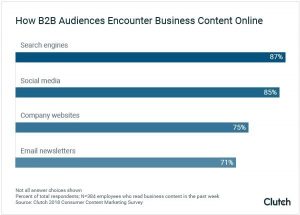
Eighty-seven percent (87%) of B2B audiences find business content online through search engines, according to a new survey from Clutch, a leading B2B research, ratings, and reviews company. B2B audiences also use social media (85%) and companies’ websites (75%) as sources of business-related content online.

Recommended ReadContextual Content and AI: The New Wingmen for Email Marketing Campaigns

These findings illustrate the value of SEO services, especially content marketing, for businesses looking to engage B2B audiences. Without prominent visibility in search engines, people are less likely to find a company’s website or content.

Technology Topics Are Most Popular on the Search Engines

SEO remains an important way for B2B audiences to find content,” said Kim Moustos, Vice President of Editorial for the Content Marketing Institute.

Read AlsoContent Update: Top MarTech Blogs for Every Marketer’s Platter

Clutch’s survey respondents were full- or part-time employees who consumed content online about a business-related topic in the last week. Nearly 90% of these people, referred to in the report as B2B audiences, consume business-related content online at least once a week.

Of the content B2B audiences consume, technology topics are most popular (45%), followed by small business (24%) and workplace/personnel (21%) topics.

Read More: Interview with Jon Lombardo, Global Brand Strategy Lead, LinkedIn

A Broad Content and SEO Portfolio Can Accomplish Multiple Business Goals

Blogs or articles (33%) that provide insight about companies and their products are the preferred content sources for B2B audiences, the survey found. B2B audiences, however, also read reviews (25%) and product descriptions (16%) to learn about companies and their offerings.

To engage B2B audiences through content, businesses should create a diverse content portfolio, said Mike Theodore, Digital Marketing Manager at Digital Third Coast, an Internet marketing and SEO company in Chicago.

“We produce a wide range of content, whether it be social media or content for our own website,” Mike Theodore said.

Recommended Read: Five DIY Activities to Become a B2B Content Rockstar

Mike added, “The goal is to drive organic traffic to our company and our service offerings, to be seen and heard as industry leaders, and to build a level of credibility with prospective employees, clients, and strategic partners.”

Position in the Sales Funnel Determines the Content B2B Audiences Favor

The content B2B audiences consume reflects their position in the conversion funnel.

Clutch B2B audiences
B2B audiences often find business content online through search engines (87%), social media (85%), and companies’ websites (75%), says Clutch

B2B audiences who consume content to stay informed about business or industry trends (45%) or to learn how to approach a business challenge (16%) tend to be in the “awareness” stage of the conversion funnel. This group is most likely to read blogs or articles (42%).

Read More: Transform Your Marketing Team Into A 3D Organization

Those in the “interest” stage of the conversion funnel prefer to consume content to research a company’s products or services: to learn more before investing or making a commitment. They typically read product descriptions (28%) more often than reviews (27%) or blogs/articles (18%).

When it comes to the bottom of the conversion funnel – the “decision” and “action” stages – nearly one-third (32%) of B2B audiences prefer to read reviews to determine whether a company’s products or services are the best fit for their company.

Businesses can use the survey findings to understand how their audience engages with business content and to inform their content strategy. Clutch’s 2018 Consumer Content Marketing Survey included 384 employees who read business-related content online in the past week.

Currently, Clutch’s methodology compares business service providers and software in a specific market based on verified client reviews, services offered, work quality, and market presence.

Read More: Fierce Pace of Tech Disruption Has Forced Companies to Innovate via M&As

Ten Content Marketing Ideas to Grow Your E-Commerce Brand

0
Ten Content Marketing Ideas to Grow Your E-commerce Brand

Mastering the Art of Content Strategy Is Naturally Going to Play an Integral Role for Marketers in 2018. MarTech Series Discusses Ten Content Marketing Ideas to Grow Your E-Commerce Brand

Today, the customer’s voice is believed to be the strongest in an online marketing world. Mastering the art of content strategy is naturally going to play an integral role for marketers in 2018.

As the world of E-commerce is constantly mushrooming, entrepreneurs/retailers are aiming to reach new heights of content creation. The expansion and success of your E-commerce brand lie in the visibility it harnesses on online platforms.

Restricting a brand to a meager Facebook page won’t create much of a dent since there are other E-commerce zones in the portal as well. The sphere of content marketing is constantly changing. In order for your brand to build awareness, creating content that generates traffic and increases sales is crucial.

The new era of content marketing calls for –

  • Transparent content creation and sharing with the audience and building an authentic feed
  • Creating content sources which encourage the audience to be proactive
  • Focusing more on quality and value, in opposition to output and quantity
  • Nurturing relationships with prospective customers by segmentation and personalizing content for a wider reach
  • Focusing less on a product promotion but more on understanding the needs of a customer and creating content for the same
  • Being extremely focused on measuring performance and success by tracking analytics and KPIs

Below are a few stats to understand why content marketing is such a hot topic today;

Despite the facts and figures, face it- content marketing is only going to help your E-commerce brand gain success if you do it right. The following are 10 rules that you should follow to make this work!

Also Read: Integrating AI with Social Media Marketing to Persuade Profitable Markets

Research and Solve

Researching about people who follow your brand and are keen for insights is staying a step ahead of your game. Creating a survey of short questions as to why a customer has abandoned their cart or how you can work towards improving their experience is a great start. At times, customers don’t have the will to cooperate, so being persistent in conducting your own research is particularly effective. Once you’ve done your research, address those problems and work towards resolving them.

If your customers would like better services, different pictures on products or more entertaining content, then work towards creating a blog for the same.

Create a Content Strategy Plan

Your content marketing strategy is a plan, and a plan is always integral to any business. According to the Content Marketing Institute, your content strategy must include;

A business case; reasons you need content marketing

A business plan; content goals

Buyer Personas; the target audience

Brand Story; messages and topics of deliverance

Channel Plan; the platforms required to distribute your content

Also Read: Five Steps to Make Video Production Easier!

Focus on your Audience

Though business owners are important to the company, choosing sides won’t help you here since they’re not the ones who are going to buy your products.

Use your customer data to create content on customer interests and previous buys. Talk in their language and answer their questions by educating and entertaining them. People almost always buy emotions, so crafting your content to suit their desires is a crucial requirement.

Never forget the importance of SEO

Though the content strategy is designed to focus on assisting consumers, it does not focus on search engines. SEO focused content increases the chances of visibility and optimizes content to reach a definite mark.

SEO is a vital part of your content marketing strategy since quality content will help you move up steadily in the search results. Using keywords on site pages, titles and product descriptions helps in making your content efforts effective.

Once search engines identify your e-commerce brand as an online store selling products, half of those tasks are simplified.

Also Read: Why Companies Should Consider Investing in Enterprise Information Management (EIM) Software

Concept of Micro-Content

The bombardment of information online is one of the huge problems faced by marketers.

Limited time and diminishing patience make customers disinterested in consuming large volumes of content. This is when micro-content steps in and bumping a brief 10-second video on any social media platform can significantly boost engagement.

Instagram, Facebook, Twitter and even Snapchat have a number of interactive ways that help in creating bite-sized content. With micro-content, GIFs have become another engaging format to indulge in.

Major brands such as Taco Bell, Doritos and even Lowe’s have incorporated micro-content into their strategies!

Use Social Reviews

Customer product reviews are good ways to build a sign of social proof on your product pages. This helps customers understand what they can expect while purchasing a product from you.

Yotpo is an excellent example of helping you leverage your brand’s customer reviews and photos through the customer buying journey. This increases a customer’s trust in your brand, generates value and increases sales.

Also Read: Integrating AI with Social Media Marketing to Persuade Profitable Markets

Soft selling is the key

Your content needs to be meaningful and interesting, not preachy and vehement. This is when the concept of soft selling gives you more depth on how to plan out your social media strategy.

Focus on ways of placing reviews on product pages, incorporating user-generated content on all social media platforms and also gently pitching points about your product on relatable content pages.

Content Syndication for your Ecommerce brand

Content syndication refers to getting your content published on a third-party site. This can be the entire length of content or snippets of relevant ones. Syndicating content increases exposure and causes a hike in the industry influence’s audience as well.

Content syndication is successful only when you have the right syndicate partner and permissions aligned for the same. The topic of your content needs to be relevant to their audience structure too.

Also Read: 5 Pinterest Hacks That Can Be Used For B2B Marketing

10x Content

Earlier, it was all about keywords and metadata. Today, search engines favor quality content and SEO links. In this booming world of E-commerce portals, experts have created the term ‘10x content’ which translates to curating content which is unique, empathetic and meaningful.

To produce this kind of content, you as a marketer, require immense patience and time. 10x content needs to brew from an angle that has never been done, showcase experience, have good style and is sharable thus inducing connection.

Different content types for 10x content include guides, long-form blogs, and Ebooks.

Content Promotion

Last, but not the least, if you create content which is not shareable—no brand or e-commerce business is going to be making it large.

Constantly updating your page with fresh content and having a social media presence will take your content marketing strategies a long way.

Having written and mixed types of e-commerce content like magazines, e-books, newspapers, research reports, product reviews, GIFs, video, podcasts, memes, and webinars are efficient mediums for creating beneficial content.

 Content marketing for e-commerce is a challenging job since it takes a considerable amount of time and effort to make it happen. Applying the above-mentioned strategies is bound to create a wave of content marketing expertise for your E-commerce brand, thus achieving targets effectively and efficiently.

Recommended Read: How to Grow Your Presence on Twitch in 2018