Home Blog Page 4233

Highspot Scales Its Product & Engineering Team With New Executive Jon White

0
Highspot Scales Its Product & Engineering Team with New Executive Jon White

Jon White Joined Highspot in November 2017 as Senior Director of Product Management

Highspot, powering modern businesses with the industry’s highest-rated sales enablement platform, announced Jon White has been promoted to Vice President of Product Management. White brings more than a dozen years of product leadership in innovative technology companies, including Moz and Xerox. White will lead the Highspot product management team, working under co-founder and Chief Product Officer, David Wortendyke.

“Jon White is an outstanding product innovator who brings rich leadership experience in building products that customers value,” said Robert Wahbe, co-founder and CEO of Highspot. “Jon’s customer focus and deep product experience will help us further accelerate Highspot’s rapid growth.”

White has been building software in product, engineering and leadership roles since 2000. He joined Highspot in November 2017 as Senior Director of Product Management.

Also Read: Highspot Raises $15 Million Backed by 300% Customer Growth in Sales Enablement

“I joined Highspot because I was amazed at how much customers love and use the product—an incredibly hard thing to achieve in enterprise B2B,” said White. “I’m looking forward to building upon this success by looking for more ways to delight our customers and adding value for sales and marketing teams that want to win over modern buyers.”

Prior to Highspot, White managed a product and user experience team building marketing analytics software at Moz, a Seattle-based SaaS startup, as well as at WDS, which was acquired by Xerox. During his time at WDS, White also managed engineering teams in Singapore, Seattle, and the United Kingdom. Before WDS, White held software engineering roles at various organizations, including the British Government’s Defence Evaluation and Research Agency (now QinetiQ).

Highspot has been aggressively expanding its leadership team and staff hiring to accelerate and support its organic customer growth. The company has more than doubled its product, engineering, and technical staff in the last 12 months and has plans to continue its hiring pace through the new year.

Recommended Read: Highspot Debuts New Solution for Social Selling on Twitter, LinkedIn and Facebook

TechBytes with Patrick D. Mahoney, President and CEO, IEEE GlobalSpec

0
Patrick D. Mahoney
TechBytes with Patrick D. Mahoney, President & CEO at IEEE GlobalSpec

Patrick D. Mahoney
President and CEO, IEEE GlobalSpec

Since its first notification, GDPR has proved to be the biggest disruption to business in the European Union. Today, Chief Data Officers and Privacy Officers have become the ubiquitous positions for all companies to ensure they are on the right side of GDPR compliance. To better understand the role of CEOs and CMOs in a GDPR ecosystem, we spoke to Patrick D. Mahoney, President and CEO, IEEE GlobalSpec.


Html code here! Replace this with any non empty text and that's it.

Tell us about your role at IEEE GlobalSpec and the team/technology you handle.

I am the President and Chief Executive Offer of IEEE GlobalSpec. We are an industrial B2B digital publisher that creates community, learning, and business opportunities for engineers and their manufacturing suppliers. Technology touches everything we do.

What are the major challenges to GDPR compliance? How do you prepare for it?

Companies must have a detailed understanding of the General Data Protection Regulation (GDPR) and how it impacts their business activities. If they have existing customer contacts in the European Union, they must re-engage with those contacts to ensure that they can maintain communication going forward and, in parallel, establish a plan for facilitating the ability of new contacts to opt-in. Issues to review range from gaining explicit consent regarding contact preferences, to implementing “opt-in” versus “opt-out” forms, and making necessary revisions to privacy policies.

Here at IEEE GlobalSpec, we’ve been working on GDPR compliance for over a year.

How can B2B technology companies in non-EU states exempt themselves from GDPR?

The only way to claim exemption from GDPR is for a company to limit its business activities to serve only those regions and customers not covered by the regulation.

Would Chief Data Officers and Privacy Officers become ubiquitous positions for all companies?  

As businesses become more focused on securing the data and privacy of their customers, Chief Data Officers and Privacy Officers may become standard positions within some organizations. Smaller organizations, however, may not have the bandwidth to have dedicated officers for data and privacy. There are ways to overcome this challenge.

A data or privacy officer can be someone who already plays a role within your organization, e.g., a company’s general counsel may be a logical choice. It also makes sense to assign data and privacy oversight not just to an individual, but to a team of people.

Here at IEEE GlobalSpec, we have assembled a cross-functional team of colleagues who work together to collectively ensure that we are keeping data and privacy top-of-mind, ensuring compliance.

What would be the role of CEOs and CMOs in a GDPR ecosystem? Would American companies be forced to comply with the regulation as well, and to what extent? 

C-suite executives must set the tone for GDPR compliance within their organizations, making clear to all employees that taking the steps necessary to adhere to the regulation is everyone’s responsibility. Leaders should be the voice of GDPR to both prospects and customers, reassuring them that the business takes the regulation seriously. Such outreach also creates an opportunity for leaders to build deeper relationships with their customers.

American companies doing business with individuals covered by GDPR must comply with the regulation.

What other regulations globally are in place to defend customer identity and their data?

One example is Canada’s CASL legislation, which went into effect in 2014. The legislation’s anti-spam provisions changed the way Canadian businesses communicated with individuals and other Canadian-based companies.

Would Opt-in Opt-out marketing campaigns require a new regulation to comply with GDPR? How would it impact outbound marketing goals?

GDPR impacts any business that markets to contacts in EU countries. Outbound marketing goals must be re-evaluated as a result. One positive outcome is that contacts who do opt-in can be considered to be of high quality because they want to engage.

I encourage businesses seeking to overcome outbound marketing challenges to explore a balanced media mix to attract and engage their EU audience and to ensure that any media partner they are working with has GDPR compliance protocols in place.

Thanks for chatting with us, Patrick.
Stay tuned for more insights on marketing technologies. To participate in our Tech Bytes program, email us at news@martechseries-67ee47.ingress-bonde.easywp.com

AdColony Joins Coalition for Better Ads

0
AdColony Joins Coalition for Better Ads

Mobile Partners to Provide Data-Based Best Practices for In-App Ad Experiences

AdColony, the leading ad quality video marketplace, has joined the Coalition for Better Ads (CBA) as an Associate Member. As a partner, the company will contribute to the development and implementation of new Coalition standards that enhance the consumer experience, including any future standards for mobile in-app advertising.

Since its inception in 2016, the CBA has successfully identified the four types of desktop web ads and eight types of mobile web ads that rank lowest across a range of user experience factors and that are most highly correlated to the adoption of ad blockers, thus falling below the threshold of consumer acceptability.

Formats such as auto-playing video ads with sound, pop-ups, flashing animated ads, large sticky ads and those take up more than 30 percent of the screen are all considered “least preferred” among consumers.

Also Read: AdColony Announces Full Compatibility with IAS, Double Verify and MOAT

As one of the originators of user-initiated video in mobile, in which the consumer chooses to watch a video ad, typically in exchange for some sort of value (i.e., access to gated content, in-app currency), AdColony is supportive of formats that provide the consumer with the most choice and encourage active engagement in a non-intrusive manner.

A user-initiated video is the most accepted ad format across all age groups, with 40 percent of survey respondents finding them to be acceptable advertising, compared to 20 percent acceptability average among all formats (e.g., interstitial, banner, in-feed), according to AdColony research.

Currently, the CBA’s standards around ad environments only pertain to desktop and mobile web, but given that the majority of mobile users are spending much more time in apps than they are on the mobile web, AdColony will be on the forefront of the new standards when the CBA examines and addresses the quality of in-app advertising experiences.

Also Read: AdColony Receives TAG Certification For Fighting Digital Ad Fraud; Commitment To Quality

“User-initiated video is one of the rare mediums where everyone wins; the consumer, publisher, and advertiser all derive tangible value,” said Paul Fields, AdColony’s senior manager of strategic partnerships. “With 98 percent of the views being verified human and overall completion rates hovering around 85 percent, user-initiated video produces remarkable results. We stand strong behind this format and are looking forward to sharing the campaign data that demonstrates its power and efficacy.”

“As one of the very few mobile ad platforms that are part of the Coalition for Better Ads, we are excited to seize the opportunity to craft best practices around in-app advertising experiences, leveraging our own insights and expertise around how to capture consumer attention without interrupting the overall app experience,” said Şekip Can Gökalp, AdColony’s chief operating officer. “We think it’s extremely important that both brands and publishers start leaning more heavily into ad formats that work – and that consumers prefer.”

To date, the Coalition has 51 members, including marquee brands like P&G, Unilever and Microsoft, and agencies such as GroupM, Omnicom Media Group and Publicis Groupe.

Recommended Read: Are You Pinterested Yet? User-Generated-Content Is Going to Transform Online Advertising

Rackspace Appoints Mark Bunting as CMO

0
Rackspace Appoints Mark Bunting as CMO

Under Joe Eazor’s Leadership, Rackspace Is Poised to Continue Its Transformation as One of the Industry’s Broadest Providers of IT Services

Rackspace announced Mark Bunting as their new Chief Marketing Officer (CMO). Bunting joins the executive leadership team, led and built out by CEO Joe Eazor over the past year. Under Joe Eazor’s leadership, Rackspace is poised to continue its transformation as one of the industry’s broadest providers of IT and professional services across applications, data, security, and infrastructure.

Mark Bunting, Chief Marketing Officer, Rackspace

As CMO, Mark Bunting will be directly responsible for global marketing strategy and all aspects of the marketing organization including communications, brand, advertising, creative, digital, field, and channel marketing. He will be based in the company’s San Antonio and Austin, TX offices.

“I’ve known and worked with Mark for years and am excited to have him formally on board,” said Joe Eazor, CEO, Rackspace.

Joe added, “His appointment to CMO, in combination with the recent additions to the Rackspace executive team, serves as a signal to the market that we’re ready to drive Rackspace forward as a digital transformation leader.”

“We are thrilled to have Mark formally join us as CMO as we chart the next phase of our growth,” said Jeff Cotten, president and chief revenue officer, Rackspace.

Jeff added, “He (Mark) has extensive passion, knowledge, and experience as a marketer, influencer, and technology enthusiast. The momentum he has driven as interim CMO for the past two months has been tremendous, and we look forward to further acceleration under his leadership.”

Read More: Interview with John Nash, Chief Marketing and Strategy Officer, RedPoint Global

Mark Bunting is an Industry-Recognized Technology Leader

Mark Bunting brings more than 25 years of experience as a technologist, author, TV personality and influencer to the role. He has served as interim CEO and CMO at various technology companies where his experiences ranged from driving traditional marketing strategy and deployment, to sales and marketing organizational restructure, to agency and personnel selection and team building.

Mark Bunting has also held acting C-suite roles at Apollo Education and McAfee and currently serves as a mentor to numerous technology start-ups at the Texas-based accelerator Capital Factory. In addition to his experience in the C-suite, Bunting is a recognized TV personality on the topic of demystifying technology as host of programs for The Discovery Channel, CNBC, The Learning Channel, Fox and his own series, “Bunting’s Window,” which ran for 23 years on 11 airlines globally. A serial entrepreneur, he has also founded numerous digital and media brands, including SkyTV, which was sold to Ziff-Davis.

Recommended ReadContextual Content and AI: The New Wingmen for Email Marketing Campaigns

At the time of this announcement, Mark Bunting said, “I’ve been a customer of Rackspace for years and have always been amazed by the company’s commitment to what it rightfully calls ‘Fanatical Experience’.”

Mark added, “As one of the world’s leading providers of cloud-ready IT solutions, we see infinite opportunity at Rackspace to continue to help all enterprises, big and small, realize the full potential of their IT investments. I’m honored to be a part of the next incarnation of this innovative and dedicated organization.”

Mark Bunting is a graduate of the University of Texas at Austin, where he is currently a lecturer at the Stan Richards School of Advertising and Public Relations.

Currently, Rackspace is modernizing IT in today’s multi-cloud world. By delivering IT as a service, the company helps customers of all industries, sizes, and locations realize the power of digital transformation without the complexity and expense of managing it on their own.

Recommended ReadB2B Buying Disconnect: Are You Targeting the Right Set of Customers?

SoundCloud Announces Global Programmatic Partnership With AppNexus

0
SoundCloud Announces Global Programmatic Partnership With AppNexus

World’s Largest Open Audio Platform Adopts AppNexus Technology to Monetize Audio and Video Inventory

SoundCloud, the world’s largest open audio platform, announced a partnership with AppNexus, the world’s leading independent advertising technology company. Under the terms of the partnership, SoundCloud’s audio and video inventory are now available programmatically via the AppNexus Marketplace, giving advertisers the ability to reach SoundCloud’s highly engaged millennial and Gen Z audience.

SoundCloud Announces Global Programmatic Partnership With AppNexus
Buyers can access 15 and 30-second pre-roll and in-feed audio and video spots from SoundCloud through open marketplace real-time bidding or through private deals. With demographic, behavioral, and contextual targeting, buyers can target SoundCloud’s inventory based on age, gender, geography, genre and device type. This allows advertisers to reach users with particular habits, sound affinities, and tastes that align with their target and connect with them at the right moment and wherever they may be – which, with over 90% of SoundCloud’s audience on mobile, is likely on the go.

Also Read: Five Disruptive Trends in Social Media Marketing Strategies

“As the first place for listeners who want to discover what’s new and next in music, SoundCloud has a community of highly engaged and influential tastemakers, and we want advertisers to be able to reach this audience through easy, full service solutions. We’re eager to leverage the strength of AppNexus’ global multi-format open marketplace and robust technologies to deliver a new solution to advertisers as we continue to expand our programmatic offering,” said Chris Blackburn, Head of Global Sales and Partnerships, SoundCloud.

“AppNexus is thrilled to partner with SoundCloud as it continues to evolve its programmatic business. Audio and video formats present a compelling opportunity for advertisers, who will now be able to reach SoundCloud’s community of young influencers and engage them with targeted advertisements through the AppNexus Marketplace,” said Michael Rubenstein, President, AppNexus.

As audio and video become increasingly popular channels for consumers, spend on audio and video inventory in AppNexus’ Marketplace has increased 65 percent and 133 percent respectively, year-over-year (April 2018 versus April 2017). AppNexus’ audio capabilities enable advertisers to easily upload VAST audio files within the AppNexus Programmable Platform (APP) interface using any .mp3 audio files.

SoundCloud’s ad-supported offering is available in nine markets. As the world’s largest open audio platform with over 180 million tracks available, what’s next in music is first on SoundCloud. The platform is the first choice for creators and listeners to share and discover the world’s music and audio, with over 60% of the audience comprised of the millennial generation.

Also Read: 4 Pro Tips on How to Succeed with your Email Marketing Campaigns

Atomic X Appoints Mike Gagnon as First Chief Financial Officer

0
Atomic X Appoints Mike Gagnon as First Chief Financial Officer

As the New CFO, Mike Gagnon Is Charged with the Planning, Implementation, Managing, and Running of All of Atomic X’s Financial Activities

Atomic X, an experiential artificial intelligence (AI) firm and consulting business, today announced the latest appointment to its leadership team. Mike Gagnon officially joins Atomic X as the company’s first Chief Financial Officer. Mike Gagnon is charged with the planning, implementation, managing, and running of all of Atomic X’s financial activities. He reports directly to CEO and Founder, Dan Cummins.

After emerging into the global AI marketplace with its flagship product, Rufus, and the addition of elite expertise that comes with Gagnon’s appointment, Atomic X is further accelerating its path towards future financings and laying the requisite foundation for growth.

“Our primary objective as a company is to help prepare both users and chat operators with a first-class, advanced chatbot,” said CEO Dan Cummins.

Dan added, “Mike has established himself as an incredibly successful financial leader, with a proven track record that will be pivotal in advancing the work we are doing with our proprietary chatbot solution, Rufus.

Mike Gagnon joins Atomic X with more than a decade of financial expertise within the technology field. As a seasoned professional, Gagnon has accumulated a tremendous amount of knowledge and insight into the inner-workings of early and late-stage venture capital financing. Prior to joining Atomic X, he served as Comptroller for Shopify, where he helped lead them through two private financing rounds for $15 Million and $100 Million respectively, as well as their successful IPO in 2015.

“Having worked in the fast-growing and dynamic hi-tech scene for a number of years, I’ve been incredibly impressed with the work that Dan and the rest of the team have been able to accomplish in such a short amount of time,” said Mike Gagnon.

Mike added, “I can’t begin to describe how excited I am to hit the ground running, on what’s been an already impressive trajectory for Atomic X.”

Currently, Atomic X provides experiential artificial intelligence (AI) firm and consulting business focused on next-generation chatbots. Comprised of strategists, designers, and builders, Atomic X is applying modern AI approaches to the world of customer communication and shaping the future of conversational user experiences. Their flagship product, Rufus™ is a fast-learning Chatbot that is revolutionizing the way products and services are sold online.

Getty Images and 500px Announce Exclusive Global Distribution Partnership

0
Getty Images and 500px Announce Exclusive Global Distribution Partnership

New Relationship Unlocks Tens of Millions of New Photos for Licensing from the 500px Network

Getty Images, a world leader in visual communications, and 500px, the world’s leading social network for photographers, announced an exclusive distribution partnership that will enable Getty Images customers to access the unique premium royalty-free content from 500px. As a result, the existing Getty Images collection of over 300 million images will expand to include 500px’s growing photographic community content.

Under the terms of the agreement, 500px will continue to represent its photographers, while Getty Images will have exclusive global distribution rights. Visual China Group (“VCG”) will continue to be the exclusive distribution partner inside of China. The partnership follows VCG’s acquisition of 500px, a Toronto-based social network, which represents 13 million professional and hobbyist photographers from over 195 countries and regions.

Also Read: LiveRamp Partners with Lucid for Refined Data Buying and Audience Validation

“As we incorporate the best of 500px into Getty Images, our customers will gain access to a diverse range of images. Getty Images is proud to represent 500px’s renowned global community which produces high-quality content and we look forward to giving customers around the world access to this incredible content,” said Craig Peters, Chief Operating Officer and Executive Vice President, Getty Images.

Aneta Filiciak, VP of Strategic Development, 500px, said “We’re excited to build on 500px’s brand heritage and strengthen our focus on the premium market through Getty Images’ world-leading distribution capabilities. This is an important step in expanding the reach and sales of our contributors’ content to a broader customer base and represents a significant opportunity for the company and our global photographer community.”

This new partnership cements Getty Images’ position as a world leader in visual media, provides boosted access to high-quality and authentic content, in addition to presenting a wealth of opportunities for future collaboration with a world-leading community sourcing platform.

The 500px collection will include several million images over the coming months, and new imagery will be added continually. The collection spans across a multitude of subjects including landscapes, portraiture, lifestyle, travel and conceptual photography. 500px content will be available on the Getty Images website from 1 July, 2018.

Also Read:  The Rise of Search, Mobile, and Dynamic Ads: Where the Money Flows in Digital Advertising

Rakuten Marketing Whitepaper – Avoiding Data Breaches: Understanding What Constitutes a Consumer Data Breach Under GDPR

0
Rakuten Marketing Whitepaper - Avoiding Data Breaches: Understanding What Constitutes a Consumer Data Breach Under GDPR

This Rakuten Marketing Whitepaper Is the Latest in a Series of Industry Expert Thought-Leadership Content

With the General Data Protection Regulation (GDPR) deadline behind us, US brands are now under the gun and those uninformed and/or unprepared face real business risk. At the very root of GDPR is a drive to protect consumer data and drive more meaningful, authentic marketing experiences for online shoppers. Rakuten Marketing, a leading technology company that enables brands to increase sales through data-driven marketing, announced the availability of its latest thought-leadership white paper on GDPR and consumer data breaches.

Titled “Managing Data Breaches: Understanding and Responding to Data Breaches Under GDPR,” this educational whitepaper guides brands and their marketing organizations on how to tackle the growing challenge of consumer data breaches. It offers valuable insight into what a consumer data breach is under the GDPR proper protocol, which brands, advertisers and publishers can use to identify, mitigate and manage data leakage within their organization. According to experts at Rakuten Marketing, brands, publishers and advertisers absolutely have control over data leakage by understanding what the GDPR deems as a consumer data breach, and then, enforcing acceptable use policies and applying appropriate controls through sound security protocol. The white paper defines a breach under GDPR; procedures to follow if a breach occurs, and the key roles marketers play in appropriately managing potential data breaches.

Also Read: Rakuten Marketing Announces Participation at the 2018 IRCE

“Consumer trust is an asset that can be lost in a second, and taking proactive measures to prevent consumer data breaches is a matter of simple and sound business and marketing practice,” commented Danny Kourianos, SVP, Marketing, Rakuten Marketing. “The GDPR has put a spotlight on consumer data protection and the industry has an obligation to be 100 percent informed and prepared. This whitepaper serves as a guide to inform and guide key industry constituents, including brands, advertisers and publishers, on the ABCs of preventing any form of the breach on consumer data.”

This Rakuten Marketing whitepaper is the latest in a series of industry expert thought-leadership content for the digital marketing and advertising industry. Rakuten Marketing also recently released a new consent management platform (CMP), built on the IAB Tech Lab technology framework, in a proactive measure to address GDPR and provide U.S. brands, advertisers and publishers with a trustworthy and reliable solution that simplifies and standardizes all language used to secure consumer ‘consent’ for use of their personal data. The CMP is a free, open-sourced platform that integrates into existing marketing and IT technologies.

Recommended Read: Rakuten Marketing Announces Whitepaper on Global Data Protection Regulation; Offers Specific Recommendations for Brand Marketers

The Most Overlooked Necessities of Branded Content

0
he Most Overlooked Necessities of Branded Content

adyoulikeAlthough native advertising and content marketing are not new concepts, growth in both areas has been impressive in recent years—and that growth shows no signs of waning. In 2018, BI Intelligence estimates that native advertising revenue in the US will hit $21 billion, up from $17.3 billion in 2017. But despite growth, the development and distribution of branded content has never been as confusing and complicated as it is today. Content distribution options, both paid and otherwise, have proliferated, and yet firm definitions and best practices in the space remain elusive.

A few key concepts struck me as being far too frequently overlooked by marketers today.

Key Steps Neglected

As with most marketing disciplines, branded content and native advertising work best when approached in a coordinated fashion. However, many marketers tend to jump right into the middle of the process, with little strategic oversight. Content is created and placed in a one-off manner, and marketers might see some success in these placements. However, the lack of a core framework beneath these efforts means the company’s investment in its content isn’t going nearly as far as it could, and such a scattershot approach is usually unsustainable.

Even if an organization has already waded into branded content and native advertising mid-stream, it’s never too late to back up and ensure these three key bases are covered:

Step 1: Strategy and KPIs

In my experience, this first step is the one most often skipped by marketers, particularly the KPI part. And it’s also the one that most often comes back to bite them later. It is absolutely vital that marketers understand their strategy (for both creative and distribution, and both branded content and native advertising) as well as their goals before diving in. The clearer these elements are in an RFP for partners, the more likely your partners will deliver for your brand.

Also Read: Visualizing Machine Learning: How Do We Humanize The Intelligence?

Step 2: Content Inventory and Creation Plan

In assessing the ever-important content part of branded content, marketers should focus on two questions: What do you already have? What do you need? Often marketers downplay the first question, writing off existing content as “old news.” But often certain pieces of content have never left a company’s own walls and, while it might be old news internally, it can represent valuable external assets. Once the already-have inventory is done, marketers should then assess new needs and decide whether those needs can be fulfilled internally or turned over to a publisher’s content studio, an independent content agency, or possibly even influencers or other UGC methods.

Step 3: Distribution and Activation Plan

If you build it, they won’t necessarily come—not on their own, that is. So distribution is where the rubber meets the road. Of course, your distribution and activation plan will depend heavily on the types of content assets you create, and it’s useful to be eyeing your distribution plan during the initial strategy phase to ensure your creation plan covers all of its bases.

Also Read: Buy versus Build: What Should You Really Do with Tech Stack?

The Measurement Question

Let’s state the obvious: Measuring success on branded content is complicated. That’s always been the case when it comes to tactics designed to influence the upper funnel. But that doesn’t mean marketers should just shrug their shoulders and pass it off as an impossibility. Ultimately, if marketers can’t measure the effectiveness of their content and native ad investments, budget in these areas will dry up over time.

Brands should consider how they want to evaluate their branded content and native advertising success across three key areas: awareness, engagement and consideration. Within each of these three categories, myriad measurable cognitive, emotional and behavioral sub-metrics exist. For example, surveys can be employed to gauge everything from campaign awareness to change in purchase intent. Meanwhile, biometrics and eye-tracking can measure physiological response and metrics like gaze time and rate. But for many marketers, the most reasonable and easily executed measurement strategy employs web analytics and social analytics to track interactions such as clicks, views, searches, and word-of-mouth.

Also Read: 5 Ways Smart Sales Managers Optimize 1:1 Coaching Time

The Importance of Disclosure

I’d wager most publishers and marketers know that the FTC has provided guidelines for identifying native advertising content, and yet adherence to these guidelines is still often reported as low. That’s not terribly surprising given how quickly the branded content landscape is evolving along with consumer perceptions of such content. What is important, however, is that marketers demand adherence to the basic principle that, regardless of context, a reasonable consumer should understand when they are viewing branded content vs. editorial content. While disclosure language is up to the publishers, advertisers need to understand where their content is appearing and how it is being disclosed. Improper disclosure reflects poorly on the brand as well as the publisher.

Also Read: Visitor Segmentation: The Key to Powerful Website Personalization

Veteran Software Executive Bill Demas Joins Conviva as CEO

0
Veteran Software Executive Bill Demas Joins Conviva as CEO

Co-Founder Hui Zhang Takes on Chief Scientist and Chairman of the Board Roles, Will Work Closely with Bill Demas; Former Nielsen Executive John Zelenka Joins as SVP of Global Sales

Conviva, the measurement standard for all-screen streaming TV, announced a major expansion of its executive team in response to accelerating growth in its global business. Veteran software executive Bill Demas has been appointed CEO, and sales and business development specialist John Zelenka has joined the team as SVP of Global Sales. Conviva’s co-founder, Hui Zhang, has been appointed Chief Scientist and Chairman of the Board and will work closely with Demas to accelerate Conviva’s technology leadership in real-time analytics, machine learning, and continuous measurement. He will also drive new product directions in streaming TV content, audience, and monetization measurement & analytics.

“I am thrilled with Conviva’s leadership, business, and technology momentum,” says Dave Habiger, CEO at JD Power and Conviva Board Member. “The commitment to the end user streaming experience is inspiring and lays a solid foundation for the company’s product expansion and continued business growth.”

Also Read: Conviva Measures Explosive Growth in Streaming Video on the Internet

“We’re seeing triple-digit viewer-hour growth in our core quality of experience business, as well as the emergence of exciting new content and monetization analytics opportunities in the sector, as next-generation OTT publishers and distributors continue to draw more traditional pay TV households to direct-to-consumer applications,” Zhang said. “Bill has a strong track record of success in scaling up software companies, launching disruptive technologies, and driving significant revenue growth worldwide.”

Veteran Software Executive Bill Demas Joins Conviva as CEO
Bill Demas

Before joining Conviva, Demas was CEO at Shopkick, where he successfully developed the next generation of omnichannel shopping experiences. Prior to that, Demas served as CEO at Turn, where he drove the development of the only natively integrated, real-time digital advertising hub for audience planning, media execution, and real-time analytics. Under his leadership, Turn’s gross revenue grew 40-fold to exceed $400M while Demas directed the rapid scaling of global operations. Previously, he spent over four years at Overture/Yahoo! driving $1B of product and distribution relationships with Yahoo!, Microsoft, and many of the most important internet publishers.

Also Read: Conviva Announces First-Ever OTT Operational Best Practices Research Study

“Conviva is in a unique position as the only source of truth for digital TV and video. The company is setting the measurement standard as streaming publishers and distributors continue to disrupt the industry,” Demas said. “With a sensor footprint exceeding three billion applications and devices, and processing a trillion events per day, Conviva is helping streaming TV leaders like HBO, Sky, Turner, NBC, and Hulu deliver the best digital experience on any device today.”

John Zelenka manages the worldwide sales, customer success, and business development teams. Zelenka has extensive experience driving transformational revenue growth and value creation at the intersection of digital media, SaaS, and data businesses and will be instrumental in scaling up Conviva’s operations.

Recommended Read: The State Of Play With OTT Sports Streaming

LivePerson Launches LiveEngage; Connects Large Brands and Consumers via Alexa and Google Assistant

1
Liveperson Launches LiveEngage; Connects Large Brands and Consumers via Alexa and Google Assistant

LiveEngage for Voice Assistants Is the First to Work Seamlessly Across In-Home Assistants and Messaging on Smartphones

LivePerson Inc., a leading provider of conversational commerce solutions, announced the launch of LiveEngage for Voice Assistants, the most advanced way for brands to connect conversationally, at scale, with consumers using Amazon Alexa or Google Assistant. As well as performing simple tasks like paying a phone bill or checking an account balance, it is the first conversational platform for the enterprise to deliver two key innovations for consumers:

  • The ability to easily switch device or location, by handing off conversations from voice assistants to messaging on a smartphone, taking that same thread “on the go” without losing the flow or context.
  • Access to both bots and human staff in one thread, so any questions too complicated for a bot can be escalated to a human customer service agent, without the frustrating “dead end” effect often found with bots in the past.

Also Read: Liveperson And Liberty Global Partner To Transform Customer Engagement And Care For The Conversational Era

By allowing handoffs to other devices and combining bots and human staff, LiveEngage for Voice Assistants is far more powerful than earlier solutions, because it puts in-home assistants to work for consumers as part of a wider, continuous connection to the brands they use, from any location, and on the consumer’s preferred schedule. For example, voice assistant owners can start a conversation hands-free in the kitchen, then move it to their smartphone as they leave the kitchen or house, to continue when it’s more convenient.

“As brands adopt conversational commerce, they need to offer consumers a continuous connection across all the most important conversational channels, and LivePerson is the first company to deliver it. With LiveEngage for Voice Assistants, brands can weave Alexa and Google Assistant into this wider continuous connection, and empower consumers with the ability to get any answer they need, at any time, and from any device,” says Robert LoCascio, founder and CEO of LivePerson. “With this release, LivePerson is pointing the way to a conversational future that is far better for consumers than today’s fragmented mix of phone calls, websites and siloed social touchpoints. We’re very excited about it.”

Also Read: Liveperson And Liberty Global Partner To Transform Customer Engagement And Care For The Conversational Era

Alex Spinelli, global CTO of LivePerson, says, “Alexa and other voice assistants are among the most beloved consumer technologies and increasingly a part of people’s everyday lives — in the kitchen, the living room, and beyond. What we have delivered with LiveEngage for Voice Assistants is a way to make them even more valuable and seamlessly integrate them with other ways to message with brands, putting the consumer in control and giving them a great experience.”

Also Read: Adobe Acquires Sayspring to Bring Voice-Based Digital Experience to Life

As well as the new innovations for smartphone handoff and a seamless “tango” between bots and human staff, the system includes the other capabilities which have made LiveEngage the world’s leading conversational commerce platform, including real-time metrics for customer sentiment, satisfaction, and usage; a “write once, run many” bot deployment framework to build one bot and run it across multiple messaging endpoints, such as in-app messaging, SMS, web messaging, Facebook Messenger, LINE, and, now, voice assistants; and a closed-loop optimization process, with a suite of tools to improve bot performance over time.

LiveEngage for Voice Assistants also goes far beyond legacy live chat platforms by allowing multiple bots — including those from multiple vendors — to run alongside each other, with rich metrics on every detail of the conversation. These capabilities, plus the industry’s most advanced suite of management tools, allow brands to deliver the most sophisticated voice assistant services.

Recommended Read: Voice Assistants Set to Revolutionize Commerce in the Next Three Years

Really Simple Systems CRM Releases Final Phase of GDPR Compliance Tools

0
Really Simple Systems CRM Releases Final Phase of GDPR Compliance Tools

Really Simple Systems Announced Its Own Compliance With GDPR in September 2017

Leading CRM vendor, Really Simple Systems, has launched the final phase of its development to enable customer compliance with the new General Data Protection Regulation (GDPR).

This latest release provides a full suite of GDPR compliance tools with the Really Simple Systems’ Marketing Module, enabling customers to collect, record and manage mailing consents.

The product launch comes in the rush for organizations to comply with the European Union’s (EU) new data protection legislation which became law on 25th May 2018. One of the key issues of GDPR for marketers is the need to gain “explicit consent” from an individual before they can engage in digital marketing communication. This includes email, SMS messaging and telephone calls.

Also Read: Really Simple Systems CRM Launches New Quotations Feature

The Really Simple Systems GDPR compliance tools provide customers with the building blocks to assist them in achieving compliance. Whilst the previous two product releases concentrated on collecting consents in the run-up to the May deadline, this final roll-out allows the selection of contacts who have given consent for mailing segmentation. Users can create a profile of customers to mail using the data in the CRM system then cross-refer this with a consent record, and whether the contact is based in a country that is subject to GDPR.

Really Simple Systems CEO, John Paterson, commented “GDPR is biggest marketing and compliance challenge businesses have faced for some time. We’ve embraced the regulation as a positive development for individuals’ data protection and a real opportunity for business.”

Also Read: Really Simple Systems CRM Launches Second Phase of GDPR Compliance Functionality

Really Simple Systems announced its own compliance with GDPR in September 2017, and earlier this year released the first phase development letting its customers collect consent data from online registrations, followed by the second phase to collect consent from an existing contact database.

To support customers as they prepare for GDPR, Really Simple Systems has been running a series of webinars on the subject. The next is on Tuesday, June 26, 2018.

Established in 2006, Really Simple Systems is one of the world’s largest providers of cloud-based CRM systems. Designed for small and mid-sized businesses operating B2B, its customers range from single user start-ups to 100 user systems, including the Red Cross, the Royal Academy of Arts and the British Museum. Featuring an integrated marketing module, Really Simple Systems CRM is credited as being super-easy to use with excellent customer support.

Recommended Read: Defusing GDPR Landmines Before It’s Too Late

The Rise of Search, Mobile, and Dynamic Ads: Where the Money Flows in Digital Advertising

0
The Rise of Search, Mobile, and Dynamic Ads: Where the Money Flows in Digital Advertising

Marin Reveals the Secret to Better Understanding of Global Customers, and the Ways in Which the Digital Advertising Landscape Is Evolving

In a recent report, Marin Software revealed that search spend increased by 11% globally, with Eurozone growth outstripping more mature markets like the UK and the US. The report clearly outlines the surge of mobile advertising as we see its inevitable increase in percentage for spend and clicks. However, CPCs are still lower on mobile than desktop, with the discount averaging 33% worldwide.

The opportunity to find the additional volume on mobile remains open across industries.

To dive deep into how brands can better optimize advertising on Search and Social channels for digital advertising, we spoke to industry veteran and SVP of Marketing at Marin Software, Wesley MacLaggan.

Wesley MacLaggan, SVP-Marketing, Marin Software

Tell us about your role at Marin, and your contribution to the latest report on Digital Advertising Benchmark.

As the SVP of Marketing at Marin Software, I’m tasked with driving awareness around Marin’s core function, which is uniting advertising across search and social channels.

For our Q1 2018 Digital Advertising Benchmark Report, I helped the team gather data from across our customer base to analyze how advertisers are allocating their budgets and getting the best results from their digital ad spend. We often use our benchmark reports to not only get a better understanding of our customers but the industry as a whole and the ways in which the digital marketing landscape is evolving.

Marin Stats on Mobile Share

What is the true state of “Digital Advertising in 2018”? How are native and programmatic advertising ecosystems coping with brand safety and ad fraud?

We can’t talk about digital advertising without talking about Google and Facebook. These two companies represent 63% of US digital ad spend and, as evident with their latest quarterly earnings reports, show no signs of stopping. Aside from the dominance of the big two, our quarterly benchmark report revealed three key, growing trends: the rise of search, mobile, and dynamic ads:

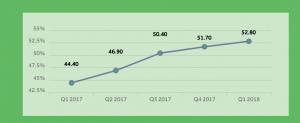
  • Search spend increased by 11% globally, with 30% growth in the Eurozone.
  • Mobile now makes up 40% of search spend, representing an increasing share of spend and clicks.
  • Dynamic ads increased 37% year over year.

Digital advertising spend continues to grow, but it’s no secret that the industry has been under a data privacy microscope this year. Advertisers want to trust the technology they invest in and make sure their ads are being targeted to the right consumers in the most appropriate and relevant way.

Throughout the industry, advertisers and agencies are calling for transparency from their publishers and ad tech partners, and they’re putting more money towards platforms that will help them achieve their marketing objectives in a brand-safe and ethical manner.

Moving forward, brands will need to demand more from their partners in order to combat brand safety and ad fraud—that includes choosing an ally whose platform will share where their ads are running, what they’re paying for those ads, and what the technology is doing to measure, manage, and optimize their advertising placements.

Should marketers focus more on mobile advertising in 2018?

The simple answer is yes. Our quarterly benchmark report shows a steady increase in mobile in terms of both spend and clicks, and this upward trend will continue in the years ahead. While there is currently a 33% discount on mobile CPCs compared to desktop, this number will likely drop as demand for mobile ads rises.

Technology will continue to improve, and as ad tech becomes more sophisticated and does a better job of linking mobile transactions to the full customer journey, interest will peak and higher CPCs will result. We can even see this trend in full force when looking at Facebook’s Q1 2018 earnings, which show that mobile ads now account for 91% of its total revenue. Search isn’t quite at that level yet, but already the majority of searches are coming from mobile devices.

It’s important for publishers to remember that it’s not just the ad, but the end-to-end customer experience that needs to be optimized. If you’re sending mobile users into a dead end, you’re just burning money.

What are the new ad formats that provide better ROI from ad tech budget?

Facebook Dynamic Ads are a new ad format growing quickly in popularity among social advertisers. Looking at our data set, we saw Dynamic Ads increase 37% YoY, and that’s mainly due to the personalization they offer. This type of ad allows advertisers with a product feed to automatically deliver personalized ads based on interest people show on their website or app.

Facebook Dynamic Ads is a powerful ad format that’s gaining momentum, and we can expect it to take off in all industries and verticals as more learn of its ability to deliver hyper-targeted ads on Facebook, Instagram, and the Audience Network to the people most likely to buy their goods/services. It offers brands the best use of creative to gain more clicks and market share. Those who implement Facebook Dynamic Ads can expect to see ROI in the form of increased sales, time savings, automatic alignment with inventory, and more.

In addition, the next evolution of machine-learning powered ad formats can be seen in Dynamic Creatives on Facebook and Responsive Text Ads on Google. For these ads, marketers provide the components of the ads and the publishers compile them into the ideal ad for each user.

How do CPCs differ based on geographies and industries? Which industries are best suited to benefit from mobile marketing?

There are a few reasons one might see higher or lower CPCs in different sectors, but it always comes down to ROI. When looking at different geographies, advertisers are willing to bid more for customers located in an area where ads perform better. For example, if H&M sees better ad performance in NYC versus Chicago, they’ll be willing to pay more per click.

Marin Software takes factors such as this into consideration and shows advertisers which ads are performing best and how they can better allocate their budget to optimize ad performance.

The same is true when considering different industries—CPCs can vary due to the type of consumer each specific industry attracts.

For example, when looking at verticals like healthcare, automotive, and education, a lead can result in someone who spends tens of thousands of dollars on a “big ticket” item such as home insurance, a car, or tuition. Advertisers in those industries are willing to pay higher CPCs since there’s a substantial ROI with their ads, whereas the retail industry often relies on fast-moving consumer goods, with lower price points, sold at scale.

When it comes to mobile marketing, all industries are able to reap its benefits.

In the past, it may have been more natural to call out an industry such as retail, where transactions were relatively small and quick, and therefore consumers felt more comfortable using their phone to do them.

However, as mobile technology has continued to improve and more sites have been optimized for m-commerce, customers across all industries are turning to their phones to do things faster and easier. This includes larger, complex transactions such as purchasing plane tickets, student loan payments, and car rentals. Mobile activity will continue to increase in the years ahead and offer more marketing opportunities for all industries.

Tell us more about Google Shopping and how ad spends vary across customer segments.

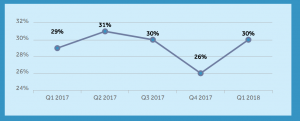
In our Q1 2018 benchmark report, we found that campaigns on Google Shopping represented over 30% of ad share spending across the globe. However, the UK came out on top with Google Shopping ad spend at 41% versus 30% in the US and 33% in EMEA. While the digital retail advertising market seems to be more established in the UK, there are opportunities for other customer segments to grow.

Google Shopping Campaigns

Google Shopping Campaigns offer retail advertisers the opportunity to optimize their current PLA campaigns and at Marin Software, we anticipate that global advertisers a will continue to put more time and budget into this highly effective ad format.

What new goals would you suggest to advertisers for desktop and mobile marketing in 2018-2022?

The first step for most advertisers will be to ensure that have a complete cross-channel measurement solution. If you’re looking at the performance of search and social campaigns independently, you are likely to double counting performance and misallocating your budget.

The rise of Amazon as a third pillar in digital advertising, advances in dynamic ad technology, voice search, and AI-powered campaigns will transform advertising practices in the coming years. Along with emerging digital privacy restrictions, advertisers should be prepared for some fundamental shifts in their digital strategies.

Finding a trusted, independent digital advertising partner to navigate these changes will be essential for success as the advertising landscape continues to evolve.

Thank you, Wesley, for chatting with us!

Industry Influencers To Speak at DMCNY Program in NYC

0
Industry Influencers To Speak at DMCNY Program in NYC

Myths and Realities Culled from Early-, Mid- and Late-Stage Digital Transformation Cases in Marketing to Be Shared

“Digital transformation” – moving from offline to online – has transformed direct and data-driven marketing organizations profoundly over the last two decades, and a Direct Marketing Club of New York (DMCNY) program slated for Thursday, June 7, 2018, will tap industry agency and consultant experts to seek to dispel perpetuating myths and realities about how such transformation can successfully be implemented.

“As entire industries have been disrupted by digital, and new rules of engagement and greater expectations have emerged for interacting with prospects and customers, there are still many brands, and their advertising and marketing partners, who are negotiating a profitable path in digital, social and mobile channels,” said DMCNY President Paulette Oliva, executive vice president and founding member of Merit Direct. “Our program will explore what we’ve learned from industry trailblazers – to manage expectations and achieve milestones as we invest in digital, data and customer experience.”

Also Read: Embracing the Bow-Tie Funnel: Why Marketing is Most Important After the Win

The evening program, from 5 – 8 pm EDT, at WeWork (135 West 41st Street, New York) will feature a lineup of industry influencers and experts, representing media, agency and consulting practices, including:

  • Scott Liewehr, CEO, Digital Clarity Group
  • Michael Lowenstein, Ph.D. CMC CCXP, Thought Leadership Principal and Director, BP Qualitative Insight Services, Beyond Philosophy
  • Alan Schulman, Lead, Brand Creative & Content practice, Deloitte Digital.

“The reality is, only 29 percent of companies have a formal strategy for digitizing their businesses, according to 451 Research,” said Ginger Conlon, chief editor, MKTGinsight, who is moderating the panel. “The panel will discuss how to feel less distracted by all the hype around digital transformation and more in charge of moving forward with the changes that are best for your company and customers.”

The Direct Marketing Club of New York has served the direct marketing field since its founding in 1926 – and today encompasses all facets of integrated data-driven marketing across all media categories. Serving the Greater New York region through its luncheons, networking and website, DMCNY is a leading source of current education and information in the field of measurable marketing.  DMCNY also provides substantial financial support in the form of scholarships to New York City colleges and universities where direct and interactive marketing are taught.

Recommended Read: ‘Marketers May be Overestimating Their Ability to Execute and Deliver ROI’

Where Are We on the Scale of Digital Transformation?

0
Where Are We on the Scale of Digital Transformation?

ThunderheadDigital transformation is a term that has been banded around the industry for many years. In fact, it has been used so regularly within businesses in the UK that some argue that is has become an empty catchphrase. The reason? The digital economy of the last 25 years has been driven by a communications revolution, not a business transformation revolution. And when we take a step back and consider where we are on the scale of digital transformation in 2018, it’s clear that we are only at the beginning.

The digital transformation journey is only just starting. With that in mind, what do businesses need to focus on to be successful?

Also Read: Embracing the Bow-Tie Funnel: Why Marketing is Most Important After the Win

The Digital Make-Up and Structure of the Future

In the next five years, we will see truly transformative business models based on platform and ecosystem thinking. These businesses will be enabled by digital infrastructure and be powered by data and technology loosely referred to as ‘artificial intelligence.” However, in order to get to this place, organizations will need to think beyond their operational agenda and develop their capacity for organizational learning and continuous evolution.

The next phase of the digital economy will make very different demands on organizations and learning and knowledge sharing will be critical to future success. Learning is a key part of continuous innovation. As James Dyson says, “Enjoy failure and learn from it. You can never learn from success.”

As we look to revolutionize our technological journey and move forward in it – the time to reflect, consider and absorb the lessons we have learned is essential to plotting the next productive and effective steps.

A key theme will be moving from a reductionist, analytical and siloed world-view to a holistic and integrated world-view.

Also Read: GDPR is the Best Thing to Happen to Personalization

Innovation: The Essential Ingredient to Value Creation

Companies need to invest in innovation, and ultimately, they need to start now. Innovation is the key to value creation and it should be embedded in every aspect of a business and respected as part of its DNA. It is important to understand that investment means more than one would initially imagine. Innovation is much bigger than technological innovation.

Service innovation and business model innovation are arguably more important if not systemically interlinked, so time and resources need to be paid to all of these areas.

Talent Talent Talent

Investment also needs to fundamentally be attributed to talent. Without it, a company has overlooked the most important item and a tipping point for digital transformation. Talent is what is needed to get the most out of technology innovations, and it is talent that will move us forward in our journey. To not place enough emphasis on individuals, would be a shortcoming that would lead to transformative delay.

Also Read: Buy versus Build: What Should You Really Do with Tech Stack?

Quantum to Present at Creative Storage Conference on Solutions to Accelerate Immersive Content Creation

0
Quantum to Present at Creative Storage Conference on Solutions to Accelerate Immersive Content Creation

Quantum’s Jason Coari Will Host a Session at 2018 Creative Storage Conference

Quantum Corp. announced that Jason Coari, scale-out storage solutions director, will speak at the 2018 Creative Storage Conference in Culver City, California. Coari will discuss how the need to produce higher-resolution, more immersive content in increasingly shorter timelines is becoming the new normal in post-production. As an initial step in supporting such a demanding production environment, many organizations have created a centralized storage system to enhance both collaboration and data accessibility. However, creating a common data lake is only part of the solution. This session will explore how modern storage solutions need to go beyond this premise to deliver varying levels of client-optimized performance while maintaining cost-efficiency across an entire end-to-end workflow. Coari will show how such a solution can be architected, informed by insights gained from customer deployments, newly conducted storage surveys, and rigorous testing of 4K reference architectures.

Title: Accelerate Immersive Content Creation: Add Rivers and Oceans to Your Data Lake
Date: Thursday, June 7, 2018
Time: 3:00 p.m. PDT
Location: DoubleTree Hotel, Culver City, California

“The media and entertainment industry has embraced the idea of data lakes as a repository for data,” said Coari. “However, the current reality is data lakes are not enough. Modern storage solutions also need to provide fast, high-performance streaming – rivers – as well as deep, cost-efficient archiving – oceans – in one global namespace to best enable the most optimized post-production workflows.”

Also Read: Accretive Media Launches New Programmatic Digital Out-of-Home Advertising Platform Bridging the Digital and Physical Worlds

Creative Storage Conference

CS 2018 brings together digital storage providers, equipment and software manufacturers and professional media and entertainment end users to explore the conference theme of “Enabling Immersive Content: Storage Takes Off.” At CS 2018 attendees can learn about the latest developments in digital storage for media and entertainment, and how other media professionals meet their digital storage needs and network with other industry professionals.

Quantum is a leading expert in scale-out tiered storage, archive and data protection. The company’s StorNext platform powers modern high-performance workflows, enabling seamless, real-time collaboration and keeping content readily accessible for future use and re-monetization.

Recommended Read: How The Next Generation of Affiliate Marketing is Driving the Digital Future

conDati Marketing Analytics Unveiled to Transform Digital Campaigns

0
conDati Reinvents Digital Marketing Analytics

Cloud-based Platform Combines Data Science and Machine Learning to Provide Predictive Analytics and Insights to Marketers and Improve Campaign Performance

conDati has announced the first commercial release of conDati Marketing Analytics, a cloud-based platform that applies data science and machine learning to help marketers understand and improve the performance of digital campaigns. conDati Marketing Analytics integrates previously siloed data from multiple martech systems to deliver a single, unified data asset that offers users complete and accurate insights on digital campaign performance.

Recommended ReadContextual Content and AI: The New Wingmen for Email Marketing Campaigns

conDati is the first truly modern marketing analytics platform, providing a real-time understanding of campaign performance to marketing leaders and practitioners and replacing spreadsheet-based tracking metrics for marketing departments of all sizes.

conDati Marketing Analytics can Further Improve the ROI from Digital Marketing

Ken Gardner, CEO, conDati

At the time of this announcement, we spoke to Ken Gardner, CEO of conDati. Ken said, “Every marketing team we meet suffers from a lack of critical campaign financial performance information. And they are very aware of this fact. conDati eliminates manual effort and provides the information to make spend and mix choices that are based on hard data that is constantly updated.”

The company targets the largest areas of digital marketing spend and activity, collecting campaign performance data, including goals, costs and revenue from all of the significant sources of revenue and conversion in a company’s martech stack. This data includes Google Adwords, Facebook Ads, organic search, and SEO, as well as pay-per-click advertising, email and social marketing. Proprietary data science from conDati aggregates and consolidates this information into a single data asset, without the use of IT department or consulting resources.

Read More: Interview with Jon Lombardo, Global Brand Strategy Lead, LinkedIn

conDati Delivers Marketing Leaders with Descriptive Analytics to Illustrate Real-Time Financial and Goal Performance for Digital Campaigns

Currently, conDati provides analytics for digital marketing that helps companies drive value from their cloud-based marketing applications and improve the ROI from digital marketing. The company’s cloud-based data science application delivers the next generation of marketing analytics, creating a single unified data asset from siloed martech systems. This provides marketing leaders with descriptive analytics to illustrate real-time financial and goal performance for digital campaigns, as well as predictive analytics that delivers statistically meaningful forecasts of future campaign performance.

Within days, conDati can be up and running in no time, saving marketers time and money while delivering complete visibility and predictive analytics with just a few clicks. conDati helps marketers pinpoint the highest-performing programs and campaigns and enables the shifting of resources away from non-performing initiatives as needed – achieving greater return on digital marketing in a shorter period of time.

Read More: Five DIY Activities to Become a B2B Content Rockstar

Founded by a team of renowned data scientists and successful Silicon Valley executives, conDati has recently completed a $4.75 million Series A financing round.

Ken added, “Our mission is to transform marketing analytics from 1980s spreadsheet technology to state-of-the-art data science – overnight.”

conDati CEO elucidated, “By delivering a deep level of real-time understanding to marketers, we are empowering them to save time and money and to make better, more-informed decisions that improve business performance.”

Powerful and Intuitive Capabilities, Driven by Data Science

conDati revolutionizes the marketing analytics space by alleviating the need for marketers to log into multiple different dashboards and systems that only show a fraction of available marketing performance data. “A majority of marketing departments still run on spreadsheets, and it’s estimated that no more than three percent of marketing data ever gets used in analyses,” Gardner explained.

With conDati, marketing pros have instant access to a “guided tour” through every campaign, along with the ability to drill into lower levels in the campaign hierarchy, including Campaign, Channel, Source, Group, and Adword.

“With conDati, the ease of use and ease of understanding that consumers expect on their smartphones are being brought to the UI of an enterprise application,” Gardner said.

Easy-to-understand and easy-to-navigate visualizations display key analyses of marketing campaign performance, showing the status of campaigns in current, correct and complete terms, with the same frequency as the data source reports – typically at least once a day versus the hours and days currently required to aggregate, compile and report on marketing campaigns using manual techniques.

With the ability to aggregate and integrate all campaign data in one place, conDati is also the first application to deliver valid and rigorous predictive analytics about future campaign performance. It monitors all active campaigns for performance anomalies, both positive and negative, and triggers configurable alerts to marketing leaders as needed to investigate and take action. conDati also helps marketers calculate and demonstrate the value of marketing to the business overall and enables them to identify problems as they occur and to capitalize on opportunities as they happen.

“Marketing analytics based on incomplete and obsolete data are now a thing of the past,” commented John Zicker, Chief Data Scientist for conDati.

John added, “We’ve engineered a solution that reduces digital marketing costs while saving the elapsed time/data latency from the event to the insight. Marketing teams from here on out are going to be able to take control of their destinies, rather than waiting to see how they did.”

Scalable, Affordable Cloud Infrastructure and Customer Proof

conDati solutions leverage a world-class cloud infrastructure that delivers year-round reliability and scalability in order to provide the disruptive economics of the cloud to even small and mid-size companies. conDati delivers on-demand, affordable and actionable data science to online businesses, including initial conDati Marketing Analytics platform customers Discount Dance Supply and Pepperdine University, as well as other clients in e-commerce, higher education, and business-to-business technology. Each has used conDati-powered insights to change their digital marketing campaigns and business strategies dramatically for optimum results.

According to John Miller, CTO of Discount Dance Supply, conDati enables the company to identify issues, fine-tune strategy, and then adjust online marketing spend for maximum value.

John Miller added, “conDati has helped us identify the ‘super-Pareto’ nature of our digital campaigns – including holiday promotions and flash sales – by showing us where digital marketing spend is most effective. With the insights from conDati, we have consolidated our strategy and spending into our most successful channels, and our results are showing the impact.”

Future releases of the conDati Marketing Analytics platform will incorporate expanded data sources and visibility into more of nearly 7,000 cloud-based martech systems currently on the market. conDati will also release additional predictive analytics capabilities, empowering marketers to run “what-if” scenarios, optimize their programs, and continue to enhance marketing’s return on investment.

Recommended Read: Salesforce Einstein Analytics Unveils Conversational Queries to Simplify Data

Interview with Andy Coghlan, Head of MarTech, Wipro Digital

0
Interview with Andy Coghlan, Head of MarTech, Wipro Digital

[vc_wp_text]“Customer behavior is constantly changing and leveraging new technologies and insights is the only way to keep up.”[/vc_wp_text]
[easy-profiles profile_twitter=”https://twitter.com/AndyCoghlan” profile_linkedin=”https://www.linkedin.com/in/andycoghlan/”]

Tell us about your role at Wipro and how you got here. How do you stay on top of your Martech game?

I lead MarTech and eCommerce at Wipro Digital, where we strive to create experience-led, high-velocity business and marketing transformation. I believe in digital not as a standalone service or offering but as a connector, enabler, and a problem solver. This belief has helped me to be a part of the MarTech evolution from the beginning.

MarTech is a rapidly growing discipline, and I’ve found that it’s important to stay attuned to all current tech trends, including emerging technologies like AR, VR, AI, and IoT. Sooner or later, these types of technologies will be integrated into MarTech strategies, so keeping up with the latest innovations is critical.

Given the changing dynamic of marketing technology landscape, where do you see Wipro fitting into a modern global CMO’s stack?

Wipro Digital is one of the first-of-its-kind digital “incubators” that ties together the enterprise experience of Wipro, with the nimbleness of a startup to deliver rapid, agile solutions for clients. Since Wipro Digital was launched in 2014, we’ve built up formidable digital transformation capabilities and developed a multidisciplinary approach that marries strategy, design, and technology. This approach enables us to deliver end-to-end transformation for companies by using the right tools and solutions in order to complement the skills, data, and business models that a company already has.

This multidisciplinary expertise is absolutely critical for modern CMOs, as technology is fundamentally changing the marketing landscape. Wipro Digital helps CMOs build the teams and capabilities to enable a reinvigorated approach to marketing that finally begins to deliver on the promise of hyper-personalized customer experience.

What is the ‘State of Contextual Marketing’ in 2018? What role does Wipro play in this play of MarTech?

Contextual Marketing is all about being relevant and personal in the moment, and MarTech is allowing it to evolve and help companies to adapt from a system-centric approach to a customer-centric approach. Marketing today is about contextually personalized customer experiences and AI will continue revolutionize the way that we optimize such experiences.

Wipro Digital is helping clients rapidly realize the value derived from MarTech through designing how to deploy MarTech solutions most effectively. We see MarTech as just one facet in the digital transformation playbook, and we help our clients to integrate MarTech to their larger digital transformation strategies rather than simply plug these technologies in marketing efforts.

Through investments in strategic marketing services such as Harte Hanks, and in next-generation customer data solutions such as Opera Solutions’ Signal Hub Platform, an advanced big data analytics and machine learning platform that enables clients to deliver contextually relevant and personalized customer experiences, Wipro continues to proactively position itself as a leader in MarTech.

What does your ‘Ideal Customer’ Profile look like? Which industries are best suited to benefit from Wipro’s marketing technology products?

Wipro Digital works with clients across an array of industries, including everything from auto insurance to retail banking, to construction equipment manufacturing. That said, every industry needs to be thinking about their marketing efforts, and Wipro Digital believes that their MarTech expertise is applicable across the board.

By marrying hands-on marketing leadership expertise with Wipro’s technology and operations capabilities, enables us to be the ‘bridge’ between Marketing and IT. People who understand the complete technology landscape but look at it with a marketers lens – what are the customer and marketer experiences the technology needs to enable, and how.

Our ideal customers are those that have or are struggling to realize a real return on their investments in marketing technology and data. We can help them build marketer-ready platforms that enable them to target personalized content through a more agile, customer journey-aligned operating model.

How should organizations aim to become high-velocity, customer-centric entities? To what extent would automation enable such companies to achieve their objectives?

To me, high-velocity is all about time to market for marketing programs and experiments and is driven by more customer journey centric, multi-disciplinary teams. We need to think in terms of squads and tribes rather than siloed operational departments – to drive omnichannel journeys we need to blend web, mobile, email, social, analytics, etc and not have them still sat in different teams operating with individual channel targets and objectives.

To become high-velocity, customer-centric marketers, organizations must ensure that their C-suite executives are aligned on a more agile strategy. From there, CIOs, CMOs, and CEOs can re-architect the customer experience and digitally execute this transformation. Success lies in the ability to continuously refine a company’s strategy, design, and execution.

CMOs can rebuild their teams to increase MarTech agility while also testing and evolving new technologies like AI and Machine Learning. It’s important to embrace new, non-traditional marketing talent, such as marketing technologists, creative technologists, and data engineers, but marketers need to spend time identifying what specific emerging technology solutions will best help them in their industry sector and help them reach specific audiences. Automation solutions that can capture and analyze personalized data quickly, distribute targeted marketing materials, and help to field customer inquiries will be essential to success.

How do you leverage AI/ML and Data Science at Wipro?

By utilizing customer data, we can proactively target the best customers and optimize resources and revenue. Implementing AI technologies allows marketers to predict what customers want, when they want it, and how they want it. At Wipro, we’re currently prioritizing tracking customer trends, optimizing conversion rates throughout the customer journey, contextualizing online marketing bot experiences, and exploring content automation, by implementing multiple aspects of AI.

What new technologies in marketing and advertising fascinate you the most? What are your thoughts on the future of ‘AR/VR/Video’?

I think the most immediate next wave will definitely be AI, but it isn’t a silver bullet. To me, AI is all about performance optimization. You need to have solid strategy, content, data, and technology foundations in place to deliver ‘good marketing’ before you can apply AI to run automated continuous experiments to drove ever-improving results from those ‘good’ foundations. Don’t even try AI until those foundations are in place.

Customer behavior is constantly changing and leveraging new technologies and insights is the only way to keep up. The future of ‘AR/VR/Video’ is fascinating and one that marketers should embrace.

Experiences that use AR/VR and facial recognition technologies allow consumers to preview products before buying them, all through a simulated reality. Importantly these will also enable us to identify those customers in both physical and digital worlds – connecting the omnichannel journey. These immersive customer experiences are just the beginning of this technology’s potential – and those who embrace best practice catalyzed by GDPR in terms of customer value exchange will win. New tech and GDPR may seem unconnected but those that think ‘connected experience’ will drive success

What startups in the technology industry are you watching keenly right now?

We are building an ecosystem of partners that augment the traditional marketing cloud technologies, and pulling those into lab environments to help clients test and learn how best to ‘exploit’ these technologies and develop PoCs. For example, we are integrating a whole suite of tools with our Digital Experience Platform (bringing together Adobe Marketing Cloud, Hybris, MS Dynamics). This includes, but not limited to, tools such as Albert for paid media optimization. Persado for content AI, Thunderhead for journey analytics and personalization, Workfront for agile marketing management, Aprimo for MRM, Avaamo for marketing bots, and Opera (our signal hub platform) for intelligent data capabilities.

What marketing and sales automation tools and technologies do you currently use?

We have expertise in Adobe, Oracle, Hybris, and Salesforce Marketing clouds but are also building capabilities in the likes of Marketo, Hubspot, and all the AI/Personalization tools mentioned above

What are your predictions on the most influential disruptions in Content Marketing powered by AI/Machine Learning?

In 2018 and beyond, content is what catches the attention of a marketer’s audience. AI is helping to make the content creation process more efficient, especially when it comes to data collection and the research that goes into creating personalized, compelling content. In the near future, we’ll see more and more companies using AI/Machine Learning to augment human marketers to deliver hyper-personalized, enriched experiences for their customers that will help customers determine which products are right for them, answer questions and concerns, and much more. Soon, these technologies will be so entrenched in everyday life that consumers and marketers alike will wonder how they ever functioned without them.

This space is burgeoning, and we are keeping a keen eye on this space, including (in their words):

  • Persado – A revolutionary cloud AI solution that uncovers and generates the language and emotions that make a specific audience, segment or individual take action
  • Uberflip – Utilizes insights about your prospects to provide predictive recommendations so you can ensure you’re giving them what they want without giving up full control
  • Concured – The AI will automatically learn from the content of your competitors, industry peers and relevant publishers to highlight which topics people want to read about… and in context!
  • Codec  – Provides real-time intelligence to inspire and improve creative and planning decisions.
  • Acrolinx‘s  – content optimization software that helps the world’s greatest brands create great content at scale that’s on-brand and on-target
  • Wordsmith – Adjusts the narrative of your content based on data sets and or the compilation of narratives. (news stories, products description, reviews)

Could you tell us about an outstanding digital campaign at Wipro? 

Although we are more focused on enabling clients to drive their own campaigns through marketing technology, we are more and more asked to drive experiments through our labs. We recently collaborated with a major UK client in our labs to test a ‘behaviour-driven’ campaign. This test produced 6x improvement on benchmarked ‘traditional targeting’ campaigns.

On a wider scale, Wipro executes campaigns at scale for numerous global clients, adopting best in class operating model to drive down time to market – for one client we built and executes over 2,000 campaigns in a 6-month ramp up.

How do you prepare for an AI-centric world as a marketing leader?

By using AI, we can predict all aspects of the consumers’ needs and track trends to create a sophisticated trend analysis. Utilizing this data to create hyper-personalized experiences and advertisements actually help customers fill a real need rather than just create noise and distraction.

Marketers can stay up to speed by staying attuned to all tech trends (even those that don’t immediately seem related to marketing), by constantly seeking out learning opportunities and ways to expand skills, and by having conversations with younger employees and next-generation marketers.

How do you inspire your people to work with technology?

A company culture that embraces new ways of working and uses emerging technology to augment talent is key. Wipro Digital believes that companies stay ahead of the curve by supporting a company culture that fosters continuous learning, multidisciplinary teams, and empowers its employees to embrace technology as a catalyst for innovation and productivity. By having transparency and collaboration throughout the organization, employees are aware of the company’s digital agenda and their specific role to fulfill that goal.

One word that best describes how you work.

Collaborative

What apps/software/tools can’t you live without?

Slack, Dropbox, Evernote, Email

What’s your smartest work-related shortcut or productivity hack?

If it looks like a duck, swims like a duck, and quacks like a duck, then it probably is a duck. Don’t waste time on things your gut tells you not to.

What are you currently reading? (What do you read, and how do you consume information?)

Death of a Marketer: Modern Marketing’s Troubled Past and a New Approach to Change the Future: Andrea Fryer

We’re all doomed!

I mainly read on iPad Kindle, but also save web articles and PDFs to Evernote to read on the train on way to work

What’s the best advice you’ve ever received?

Focus on exploiting your strengths over fixing your weaknesses. Be aware of your weaknesses so you can build complementary teams, but don’t waste too much time trying to change them to strengths.

Any leadership team (and to me leadership is needed from the top to the bottom of an organization), needs to be strong across about 12 dimensions, but no one person will be strong in all (maybe only 5 or 6), but overall the team needs to be – think team not individual,

Something you do better than others – the secret of your success?

Synthesize challenges and problems quickly to focus on right things

Tag the one person (or more) in the industry whose answers to these questions you would love to read:

Scott Brinker, Mayur Gupta, David Edelman

Thank you Andy! That was fun and hope to see you back on MarTech Series soon.

[vc_tta_tabs][vc_tta_section title=”About Andy” tab_id=”1501785390157-b58e162d-0ae25a4b-c27aca64-108e51b0-80edaf37-bd3d357a-6c46d712-3b686b5f-1c28″]

Andy is a strategic digital transformation leader focusing on driving experience-led, high-velocity business change. he has lead teams of digital strategists exploiting design-thinking, coupled with systems-thinking rigor to accelerate innovation in product-service, customer experience, digitalization, and new business models. Enable deep collaboration between multi-disciplinary teams to drive dual transformation through rapid prototyping entwined with core capability renovation to drive sustainable commercial growth.

Andy was responsible for digital marketing, driving unique propositions and capability across strategy, technology, and operations to exploit digital marketing technology (MarTech) utilization – specializing in driving successful implementation and adoption of DMP, CRM, CMS, Portal, Analytics, eCommerce, and Email platforms to deliver data-driven strategies

He has a background in Digital, Sales, and Marketing with 25 years experience in agencies, consultancies, business start-ups and FTSE 100.

[/vc_tta_section][vc_tta_section title=”About Wipro Digital” tab_id=”1501785390320-2d44fa50-740c5a4b-c27aca64-108e51b0-80edaf37-bd3d357a-6c46d712-3b686b5f-1c28″]

Wipro Digital
We dream, design, and deliver people-centered and human-shaped experiences for a digital world. Are you a pi-shaped person, combining design with engineering, strategy with design or engineering with strategy? If so, let’s talk. We are an innovation-led, digital transformation partner built for today’s digital challenges. We focus on the things that matter – the insights, the interactions, the integrations, and innovations that make extraordinary things happen for brands, businesses and their customers. We build multi-disciplinary teams combining strategy, design and technology experts oriented around the customer and their journey.

[/vc_tta_section][/vc_tta_tabs]
[mnky_heading title=”MarTech Interview Series” link=”url:https%3A%2F%2Fmartechseries-67ee47.ingress-bonde.easywp.com%2Fcategory%2Fmts-insights%2Finterviews%2F|||”]

The MTS Martech Interview Series is a fun Q&A style chat which we really enjoy doing with martech leaders. With inspiration from Lifehacker’s How I work interviews, the MarTech Series Interviews follows a two part format On Marketing Technology, and This Is How I Work. The format was chosen because when we decided to start an interview series with the biggest and brightest minds in martech – we wanted to get insight into two areas … one – their ideas on marketing tech and two – insights into the philosophy and methods that make these leaders tick.