Home Blog Page 4295

Marketers Cannot Overlook Mobile Casual Gamers Anymore!

0
Aptoide Powers Ahead With Expanded Top Grossing Games Catalog, 75% Revenue Growth and Strategic Investment From Digital Turbine

Perception is the reality when it comes to marketing, and perception is challenging to alter once it is formed. For example, even though 203 million Americans will play mobile games regularly in 2018, most Americans do not identify themselves as gamers. Industry data proves that people of every age, demographic and household income play mobile games. Interestingly, over 20 percent of gamers in a recent study were older than 55. While 60 percent of women in another study said they play mobile games daily, 72 percent of women do not consider themselves gamers, even though 59 percent of them play at least 10 times per week.

Also Read: Advertisers Have Finally Found A Way To Break Into Gaming

The Gamer Image Is A Myth

Let’s face it, the popular concept of a gamer (read: a teenager blowing up zombies in his parents’ basement) is antiquated. Many advertisers have at least partially held back exploring mobile games as an advertising medium because the gamer image turns them off. However, in 2018, the majority of mobile games played are actually casual games: puzzles, word games, quiz games, brain teasers, etc. In other words, brand-safe and family-friendly. Mobile games are so successful that they now eclipse Hollywood’s global box office revenue at $50 billion versus $40 billion.

Additionally, monster hits such as Pokémon Go, Words With Friends, HQ and others have begun to change perceptions. The industry is also remarketing itself to brands, coining the term “MOCA”-a combination of “mobile” and “casual”-to better represent a person who casually plays mobile games. The term originated from Jun Group as a way to rebrand mobile games for the new generation.

Also Read:  Mobile Gaming Apps Provide Higher Brand Engagement Than Social Apps

Mobile Gaming beats Hollywood in Revenue

Mobile games are so successful that they now eclipse Hollywood’s global box office revenue at $50 billion versus $40 billion.Pulling back the curtain on mobile games reveals an environment ideal for brand advertising. For example, the popular coloring book app Recolor surfaced with millions of daily active players who spend 10 minutes a session on average and generate over 68 million app sessions per month. Over 60 percent of Recolor players earn a household income of over $75,000, according to Facebook Analytics.

The success of casual game apps explains why they were predicted to be a more than 50 percent increase (to $655 million) in brand ad spend on mobile games over the past three years. Ninety-three percent of that spend went to video ads, and as brands continue to pull their video spend from unsavory sites and sites with uncontrollable content, they are beginning to see games as a safe and immersive way to reach their customers.

Despite this recent uptick, spend in the category still pales in comparison to the billions of dollars spent on social networks.

Leading industry organizations like the Mobile Marketing Association are working to change that. A recent white paper on mobile games illustrates the opportunities in-game ads present for brands. The reality is that 25 percent of all apps downloaded from iTunes and Google Play are games, making games by far the number one app category. Mobile games typically represent 20-40 percent of the most popular apps in iTunes and the Google Play store. Mobile games are so popular that people spend on average three times more time with them than they do chat apps, as reported by comScore.

Also Read:  Ad Blockers: Take a Page from Video Game Advertisers

Change Advertisers’ Perception

Also of interest to advertisers is the fact that people report feeling more engaged, relaxed, focused, and happy with mobile games as compared to with social media. And people who are in an upbeat and positive mood are 40 percent more receptive to digital ads. Conversely, the mood of a social media goer may be less savory. Studies have revealed feelings of depression and anxiety, especially among millennial audiences-likely not the most receptive of moods for brand messaging.

So, while adopting a new term like MOCA to describe people who casually play mobile games is not a silver bullet for everything that ails digital advertising, it does go a long way to help change advertisers’ perception of the space. It helps to refocus the conversation on an exciting source of brand-safe and high-performing ad inventory. MOCA gaming reflects a growing pastime for hundreds of millions of Americans from all walks of life. Expect to see more people identify themselves as MOCAs in 2018-and look for advertisers to scale their spending accordingly.


Sitetracker’s “Capture the Future” Contest Aims at Bringing Vital Infrastructure to Light

0
Sitetracker
Sitetracker

Sitetracker Launched A Photo Contest That Enables Project Managers To Forecast Accurately Based On Real-Time Data

Sitetracker, the full lifecycle project and asset management platform, launched a photo contest, designed to empower field employees and contractors to be more efficient and productive by ensuring that project managers can forecast accurately based on real-time data.

Sitetracker launched a photo contest to put a spotlight on the often overlooked technology and infrastructure that powers our society. “From small cell installations to smart meter technology, air quality sensors, and solar farms, we wander past these marvels of tech every day without paying them any attention, And yet, we couldn’t live without them — let alone the workers in the field installing this essential gear. We are celebrating them with the launch of this contest,” said Brett Chester, Vice President of Marketing, Sitetracker.

Also Read: Profisee Announces Attendance at Gartner’s Data & Analytics Summit 2018

The first purpose-built full lifecycle project and asset management platform recently launched a game-changing native mobile application that dramatically streamlines workflows, enhances productivity, and strengthens collaboration with stakeholders across organizations. With a special focus on remote and field workers, Sitetracker Mobile includes on-location one-click project and task close out functionality. This industry-first improves both “speed to close” as well as speed to revenue recognition.

“In industries like telecommunications and utilities, where margin compression is the reality, Sitetracker Mobile will directly impact the bottom line. Legacy project and asset management tools continue to fail their users. Sitetracker is committed to innovation and keeping up with the evolving needs of our great customers,” remarked Giuseppe Incitti, Sitetracker CEO, Incitti

Some of the first-to-market features of the Sitetracker Mobile application include:

  • Upload video and photo assets either live or via Wi-Fi at a later stage
  • One click task completion
  • Easy to view project, site, and asset history
  • Live and editable checklists
  • Real-time uploads to ensure data quality

Recommended Read: Tracking First Joins Adobe Exchange Partner Program to Enhance Data Governance and Reporting

Mobile World Congress 2018: What’s Next for Industry Innovation?

0
MWCIndustryInnovation

TealiumMobile World Congress 2018 (MWC 2018) has always been much more than just a launch pad for the latest handsets and gadgets, and 2018 didn’t disappoint. Of course, new cellphone models were released — including Samsung’s long-anticipated Galaxy S9 — but the focus of MWC was on major trends that are transforming the industry, and what innovations we can expect in the next 12 months.

There were three key topics that stole the show: data security, the dawning of 5G, and mitigating the challenges of Artificial Intelligence (AI).

Here’s a quick-fire overview of the highlights from the Mobile World Congress 2018–

Tightening Data Defenses

With the globally- applicable General Data Protection Regulation (GDPR) almost upon us, it’s no surprise that data security was high on the agenda. By now, most companies are nearing compliance — or should be — so conversations about GDPR revolved around how newly-adjusted data processes can be used to enhance campaigns, and the mobile experience.

For example, to meet requirements — such as providing a copy of all data held about individuals on request — many organizations have embraced consolidation: merging fragmented online, offline and cross-device insight in one place. But these central stores don’t just allow marketers to disclose data rapidly.

By collating all insight related to specific consumers, they also provide the basis for building a 360-degree view of individuals and their journey across every screen; mobile included. The result is a comprehensive understanding of each consumer that marketers can use to deliver tailored, engaging, device-appropriate, and impactful messaging.

But, alongside this emphasis on legislative benefits, there was also a focus on strengthening mobile data security. In particular, a session that brought together telecoms giants, as well as Vice-President of the European Commission, Andrus Ansip, put a spotlight on the need for robust transatlantic digital policy.

Centering on the importance of adapting regulation to fit evolving economic, political and citizen needs, it took an in-depth look at current challenges and the effect future laws might have. Was this a small step towards global data policy? Maybe.

Forging an Ethical AI Future

As with any tech event, there was palpable enthusiasm for AI and its efficiency driving potential. At a presentation led by Rob High, IBM Fellow, VP and Chief Tech Officer for smart system Watson, attendees were captivated by examples of practical AI; with tangible results used to demonstrate how effective it can be in the mobile environment.

VineSleuth Founder and CEO Amy Gross spoke confidently of the human benefits of AI, commenting, “We’ve seen an increase in the use of effective Artificial Intelligence, making lives better and creating — not taking away — jobs.”

Yet this enthusiasm was balanced by anxiety around AI ethics. In a discussion featuring experts from IEEE and the UK’s Oxford University, fears were raised about whether tech development is moving more quickly than our ability to manage it responsibly — especially regarding areas such as social profiling and privacy.

Although the advantages of AI were recognized, session leaders called for action on AI governance before possible issues become real and present dangers; advising that flexible standards are urgently required to keep AI useable and safe.

These sentiments were closely echoed in a conversation dedicated to adapting and updating the digital rulebook for a new age of AI, Robotics, and Big Data Analytics. Taking a truly global view — with participants including Argentina’s Minister of Modernization and the Minister of Posts, Telecomms and IT for Bangladesh — the panel covered how policymakers around the world are creating dynamic guidelines to protect the mobile industry and sustain its future growth.

Future proofing proved to be a consistent theme across various MWC discussions; many businesses are keen to raise the data quality bar now so that AI tools will be continually fuelled by premium value insight that guarantees a reliable output.

Also Read: The Future of a Modern Workplace: “HumAIns” are Coming

The Possibilities of 5G

The next revolution in Mobile Connectivity has been an imminent promise for several years, but it looks like 5G may finally be on its way — and it might arrive faster than anticipated, with T-Mobile announcing its ambitions to build a 5G platform able to serve 30 cities across the globe.

As a result, the buzz at MWC was all about the massive impact the fifth generation network would have. During a keynote on the economics of 5G, speakers suggested it would change the way users engage with content, as rising adoption of 5G-enabled mobile devices drives higher consumption and an expectation that operators will be able to manage the traffic increase.  This means there will be more pressure on telecoms firms to upgrade if they want to minimize latency issues.

Also Read:  Why The World Needs 5G And How It Will Impact The Programmatic Advertising & Publisher Industries

The possibilities for 5G to improve the user experience – superfast speeds and immersive, creative ads, powered by detailed data insights – were hot topics. Yet companies should be making the most of existing connections – from Wi-Fi, 2G, 3G, 4G and NB-LTE – instead of waiting for 5G to improve user experience, as explained by Sue Siegel, CEO, Business Innovations, GE.

For some, updating tech is only the first step — at a session investigating the effect of 5G on Chief Information Officers (CIO), speakers argued upskilling would be essential to move with the tide of digital transformation.

For CIOs to successfully implement 5G and influence strategic goals, they’ll need a higher level of tech capability. This is supported by research by Gartner, which forecasts 100% of IT roles will require an intermediate level of business acumen by 2020.

Progress often brings challenges, and at MWC 2018, the focus was squarely on recognizing future issues — and resolving them. While better security, AI-powered data analytics, and 5G will open new opportunities for mobile, we must create standards and processes to ensure they contribute to growth, not hinder it. The next few years will be a time of vast transformation: the industry needs to be ready to meet and harness each change.

Also Read:  Interview with Adam Corey, VP, Marketing at Tealium

Aegis Included in Gartner’s Market Guide for Key Customer Management BPO Service Providers 2018

0
Aegis

Aegis Customer Support Services Private Limited, a global outsourcing and technology services company, announced that it has been included in the Market Guide for Key Customer Management BPO Service Providers 2018 report by Gartner Inc.

Aegis has been included as one of the Customer Management Business Process Outsourcing (CM BPO) service providers with vertical/industry coverage in the report.

“At Aegis we are committed to continue offering innovative services and solutions to our clients that positively enhances their growth, customer experience and bottom line. The Customer Management BPM industry is witnessing a paradigm shift through Automation, AI, SMAC, digitization et al. Thus, there is an opportunity to display both vision and innovation along with a strong ability to execute.” said Sandip Sen, Global CEO, Aegis.

Also Read: Futuri Media’s TopLine Adds Appointment Prep Reports

As per the Gartner report- The CM BPO market continues to bridge legacy services – human agent-based voice service offerings and new automated, digital or multichannel and cloud-delivered services. CM BPO providers, that are able to optimize and leverage technology, adapt to change, improve processes (including redesigning processes), improve competitive advantage and identify sustainable growth opportunities for buyers, will continue to thrive. By 2020, the adoption of mobile apps and chat in the CM BPO sector will grow nearly to 80% by revenue, up from 30% in 2017.

Aegis has emerged as a thought leader in building Omnichannel capabilities. The company has made significant investments in its business models, center of excellence and SMAC (Social, Mobile, Analytics, and Cloud) enabled BPM solutions. Aegis is also engaged in key CM projects across Asia/Pacific (APAC), specifically – in the areas of financial inclusion, citizen services, ecommerce, and Telecom services. Most of these complex engagements leverage digital and analytics services as a key deliverable in the customer CX strategy. Aegis continues to invest in digital and social media business engagement and solutions, through its product – Aegis LISAⁿ

The Gartner report cites that – the level of complexity for traditional voice-based services is expected to increase, hence the increasing cost per call. Therefore, buyers are seeking to increase services across alternative channels such as web chat and virtual assistants, along with video services and video chat, leading to continued growth in non-voice multichannel and digital services. Buyers are investing and increasing their focus on customer experience (CX) – customer journeys and customer engagement life cycles, as a key differentiator.

Recommended Read: Insightly Adds Enterprise-Grade CRM Dashboards and Insight Cards

Aegis’ Business Analytics solutions help customers to gain the right business intelligence quotient and transform values of business insights into decision drivers. The services are positioned as a credible domain centric value driver for BA BPO services. The synergy with existing services positions Aegis uniquely in the market based on turnkey value. The power of this synergy is best captured in Aegis’ multi-pronged engagement with brands across telecom, automotive, aviation etc. among others, where diverse engagement model and integrated offering has become an important attribute for seamless and consistent customer experience delivery.

Ford, Toyota, and Chevrolet Earned The Top Three Spots in the L2 Digital IQ Index; Auto 2018 Report

0
l2inc

Digital Benchmarking Firm L2 Inc Releases Its 6th Annual Digital IQ Index: Auto 2018 Report.

The L2 report benchmarks the digital performance of 43 Auto brands operating in the US, with a specific focus on key digital strategies and best practices for auto manufacturers to follow consumers into a mobile-first world. The Digital IQ Index methodology examines a brand’s strengths and weaknesses across the four digital dimensions of Site, Digital Marketing, Social, and Mobile. Index brands are classified as either Genius, Gifted, Average, Challenged, or Feeble.

“Estimates point to a slowdown in the auto industry by 2019. Combine this with developments in big tech and the race to create the first driverless car and auto brands are faced with even more uncertainty of what the future holds,” noted Grant Torres, Director of Emerging Sectors Research at L2.

Also Read: SOCi Achieves 100% Revenue Growth as Location-Based Social Marketing Business Excels

Key findings from L2’s report include:

A Mobile Minute: In 2017, an average of 61 percent of traffic to Index brand sites came from mobile devices. The average visit to an Index brand mobile site was two and a half minutes shorter and spanned four fewer pages than visits to desktop sites, reinforcing the need for brands to streamline and simplify their mobile touchpoints.

Dare to Compare: Auto brands are ramping up their online vehicle information pages as 95 percent of Index brands now offer product videos on their brand sites, 49 percent provide interior photos and 47 percent give 360-degree views. However, the number of brands who offer brand comparison tools dropped 16 percent between 2017 and 2018 indicating that Index brands may be wary of highlighting vulnerabilities.

Instagram Vs. Facebook: Index brands generated 2.33 times as many Instagram interactions in Q4 2017 as in Q1 2016. While auto brand engagement on Instagram is accelerating, interactions on Facebook have stalled. In 2017, Auto Index brands generated almost four times as many interactions on Instagram as on Facebook.

“Non-Luxury brands have made clear investments in digital to stay top of mind of the evolving consumers. Winning brands optimize their discovery and sales process for mobile by cutting extraneous features that clutter a page, while at the same time layering on mobile-specific features like pinch-to-zoom.” explained Cody Stack, Senior Research Associate at L2.

Recommended Read: Data Science Firm Civis Analytics Extends Partnership with comScore

Interview with Jason Shu, SVP, Data Science, Aki Technologies

0
Jason Shu Aki Technologies

[easy-profiles profile_twitter=”https://twitter.com/akiunlocks” profile_linkedin=”https://www.linkedin.com/in/jasonwshu/”]
[mnky_testimonial_slider slide_speed=”3″][mnky_testimonial name=”” author_dec=”” position=”Designer”]“I believe that we are going to see far more emphasis on developing models that identify the best ads to match the mindset of a consumer, without a care for whether they click on an ad or not.”[/mnky_testimonial][/mnky_testimonial_slider]

Tell us about your role at Aki?

At Aki Technologies, we connect brands to audiences during their most receptive and relevant moments. Naturally, a lot of what we do relies on data and the smart interpretation of data, which is where my team comes in. We’re focused on optimizing the delivery of marketing to mobile users and innovating new methods for reporting on how well those ads affected desired outcomes.

We are proud of the Machine Learning algorithms we’ve built to understand users’ mobile mindsets, but AI is just part of what we do. We’ve built an end-to-end solution that enables us to build marketing strategies for clients and to look beyond the click to objectively measure how well those strategies work.

How would you define a ‘mobile moment’?

A mobile moment is a combination of circumstances that help marketers understand the mindset of a mobile consumer. It is no longer enough to simply look at the time of day and location to infer what a user is doing – the nuances of the always-on mobile experience require a deeper understanding. We’ve built models to help marketers understand how to deliver an ad that is relevant to the way that consumer is feeling during that moment.

How does Aki’s platform help drive the ROI of marketing campaigns? 

By interpreting the mindset and receptivity of a mobile consumer during a given moment, Aki is able to predict when and how a consumer will respond to a marketing message. For example, if a consumer is in a “lean-back,” relaxed mode at home, Aki can optimize performance by delivering a rich media or video ad. Conversely, if the consumer is on the go, Aki can serve more cost-effective “reminder” banner ads. Aki uses a combination of deep audience insights and AI-powered targeting to ensure the best possible experience for the customer and the most efficient path to strong performance.

Which industry verticals does your product find the most resonance in and why?

Today’s marketers recognize that mobile advertising requires a deeper understanding of consumer behavior. Smart marketers are mapping out the moments that are most relevant to their brands and specific campaign objectives to drive greater impact and eliminate waste on poorly-timed impressions. Aki’s moment marketing science provides a framework for this, which is why it is being used with great success across different verticals, from auto to travel to finance to entertainment, restaurants, CPG. The list goes on.

CPG is a great example of a vertical that’s seen a lot of success, partly because moments are such a natural extension of “need states.” Automotive too, because the long consideration cycle requires smarter and timelier engagement. Pair this with Aki’s ability to measure foot traffic in real time, and it’s not surprising we’re seeing a lot of demand in both areas, among others.

In terms of martech, what direction do you see AI/ML moving in?

Machine-learning models love nice clean outcomes (or “labels” in ML parlance) which is why click-through rates have remained the darling of martech. For too long, the industry has blindly focused on how to optimize CTR without any thought about actual marketing strategy or what an ad was intended to do.

Clicks are a relic of the old e-commerce model in which getting someone to visit a website was the only way to make a sale. This doesn’t work in mobile. The point of mobile is to inform, engage, and remind—not immediately get someone to checkout. Brands are starting to understand this difference and are adapting their expectations. Martech has to respond to these new expectations.

I believe that we are going to see far more emphasis on developing models that identify the best ads to match the mindset of a consumer, without a care for whether they click on an ad or not. Obviously, this is much harder than optimizing on clicks, but it is at the heart of what Aki is doing with mobile moments.

What startups are you watching/keen on right now?

Deep Learning is all the rage in the AI/ML space, but its complexity has made it difficult for non-experts to easily prototype new ideas. Libraries such as Keras and TensorFlow have been the go-to tools to help simplify the model-building process, but even these tools have their limits. PyTorch is a new library developed by fast.ai, an organization teaching Deep Learning through the University of San Francisco’s Data Institute. This library expands the breadth of problems that can be solved, while also further simplifying the development and model training processes. I’m excited to see what marketing experts can do, given more time to solve problems and less time to worry about the nuts and bolts of Deep Learning models.

What apps/software/tools can’t you live without?

Search is a Data Scientist’s best friend. It’s the old adage: “If you have a question, there’s a good chance someone else in the room is wondering the same thing.” Why re-invent the wheel if someone else has already solved your problem? This is why I let candidates use Google when they are going through their on-site interviews.

Other than that, iPython is my most indispensable tool for doing analysis or prototyping. When it’s combined with a good Integrated Development Environment (I use both Spyder and PyCharm), I can crank out analyses really really fast.

Which technologies within the AI/ML ambit, do you believe have the most potential?

Advancements in Deep Learning are coming at an incredible pace. The unique things they are capable will result in smarter models capable of predicting outcomes far more impactful than simple clicks.

One word that best describes how you work.

With integrity.

What’s your smartest work related shortcut or productivity hack?

The internal framework that I built has significantly decreased the time it takes us to prototype ideas. It also drastically decreased the learning curve that new team members have to go through before delivering meaningful work. Our framework is simple yet powerful, and our data scientists love contributing to the code base as a way of easily sharing their own learnings and productivity hacks.

What are you currently reading? (What do you read, and how do you consume information?)

I’m currently reading “Thinking Fast and Slow” by Daniel Kahneman and it covers a lot of ideas that can really help data scientists improve the way they approach data and problem-solving. There’s a common assumption that good data scientists just need to know algorithms and be really good at math, but to generate real value you need to do more than simply pass data through models. A great data scientist needs to be perpetually curious, and then be able to deliver on that curiosity with exceptional critical thinking skills—Kahneman’s book provides a lot of insight to that end.

Besides books, my major source of information is actually my Linkedin feed. I’ve connected with so many thought leaders in the Data Science community, and I something new from them almost every day.

What’s the best advice you’ve ever received?

“Hire people with fire in their belly.”

Early in my career, I asked my boss why he chose me over some of the other (clearly more qualified) candidates he had in his pipeline. His response: “You had a raging fire in your belly. I could teach you skills you don’t yet have, but I couldn’t teach the other candidates how to be hungry.”

And while this isn’t advice as much as inspiration, at Aki, we often talk about the importance of grit. We’re working to address the limitations and frustrations in mobile advertising for both brands and consumers. It’s the kind of work that requires a deep commitment and a lot of resolve, and we’ve got plenty of both at Aki.

Tag the one person in the AI/ML sector, whose answers to these questions you would love to read:

I think everybody could learn a thing or two from Henry Humadi – Data Science Lead at Vungle. Henry and I served on the Advisory Board for the Data Institute at the University of San Francisco. He’s a tremendous talent and leader.

Thank you Jason! That was fun and hope to see you back on MarTech Series soon.

[vc_tta_tabs][vc_tta_section title=”About Jason” tab_id=”1501785390157-b58e162d-0ae25a4b-c27aca64-108e51b0-80edaf37-bd3d357a-6c46ef98-a17c”]

Jason Shu is the SVP of Data Science for Aki Technologies, the moment marketing science platform that connects brands to consumers during their most receptive and relevant moments. Jason most recently served as Head of Data Science and Analytics for Womply, a leading FinTech big data solutions provider for small and medium-sized merchants. Prior to Womply, Shu spent twelve years at The Boeing Company in a variety of functions spanning engineering, operations research, corporate strategy, and business development. He holds a B.S. in Mechanical Engineering from the University of Illinois, an M.S. in Systems Engineering from the University of Southern California, and an MBA from Georgetown University. He also holds an M.S. in Analytics from the University of San Francisco, where he served as an Advisory Board Member during the launch of their Data Institute.

[/vc_tta_section][vc_tta_section title=”About Aki” tab_id=”1501785390320-2d44fa50-740c5a4b-c27aca64-108e51b0-80edaf37-bd3d357a-6c46ef98-a17c”]

Aki Logo
Aki Technologies revolutionizes how marketers engage mobile consumers. Through Katana, Aki’s AI-powered moment marketing science platform, Aki predicts when and how a consumer is most likely to respond to a marketing message. Leading brands use Aki Katana’s insights, mobile ad targeting and optimization to dramatically improve awareness, engagement and in-store traffic. The company has offices in San Francisco, New York, Chicago, Detroit, Seattle and Los Angeles. Visit http://www.a.ki or follow @akiunlocks to learn more.​

[/vc_tta_section][/vc_tta_tabs]
[mnky_heading title=”MarTech Interview Series” link=”url:https%3A%2F%2Fmartechseries-67ee47.ingress-bonde.easywp.com%2Fcategory%2Fmts-insights%2Finterviews%2F|||”]

The MTS Martech Interview Series is a fun Q&A style chat which we really enjoy doing with martech leaders. With inspiration from Lifehacker’s How I work interviews, the MarTech Series Interviews follows a two part format On Marketing Technology, and This Is How I Work. The format was chosen because when we decided to start an interview series with the biggest and brightest minds in martech – we wanted to get insight into two areas … one – their ideas on marketing tech and two – insights into the philosophy and methods that make these leaders tick.

Women’s Day Exclusive: Momentum Worldwide Announces New Flex Work Initiatives for Healthy AdTech Ecosystem

0
Momentum Worldwide

New Woman-Friendly Initiatives Support Flexible Schedules and Remote Working and Offer Health and Wellness Programs

In honor of International Women’s Day, Momentum Worldwide, the world’s first global Experiential Advertising Agency, is announcing key flex work initiatives for its employees in the United States. The initiatives aim to help employees have options for flexible work arrangements as well as access to quality programs that improve health and wellness. 

New initiatives by Momentum are being implemented as a direct reaction to the challenges the advertising community faces retaining talent, fostering a diverse workforce and helping women advance and sustain leadership positions.

For example, a recent survey conducted by Momentum found a full 83 percent of respondents saying they would leave the advertising industry if they could not find a work-life fit and a further 40 percent admitting they would leave even without another job lined up. 

Donnalyn Smith, Momentum Worldwide

Donnalyn Smith, North American President at Momentum, said, “As leaders in the advertising industry, we felt a strong need to adopt industry-leading initiatives that create truly supportive working environments for women and working parents. Our industry is losing too many talented people to unreasonable demands that put unnecessary strain on families. At Momentum, we’re tapping the most advanced technologies to help meet client demands, and we’re also using technology to provide our staff with the kind of support they need to thrive at Momentum and help us do the incredible work (that) we are recognized for.”

Donnalyn added, “As a mother of three, I’m proud of the new policies we’re initiating and look forward to working with all our staff on putting them into practice.” 

Momentum, with the support of its executive team, has long been a trailblazer in the advertising industry with their flexible and supportive work policies for employees. The most recent initiatives include the introduction of Flex Working Arrangements, a telepresence robot, and MFit. 

Also Read:  The Next Brand Sponsorship Frontier: Enhancing the eSports Fan Experience 

  • Flex Working Arrangement (FWA)

A solution for managing the work-life fit employees seek. It comes to life as either flex hours or work from home. All solutions are bespoke based on an individual employees’ needs and are structured between the employee and their manager. 

  • Robot

A freestanding robot that allows employees to be “live” even if they are not in the same room. The robot moves, sees and speaks, allowing people to travel less and connect more. This is particularly useful for employees who need to attend important meetings but cannot physically be in the office. 

  • Mfit

A unique health and well-being program, designed to cover four key areas of health and well-being—physical, mental, time and financial. The goal is to increase employee health and fitness levels and promote teamwork, as well as overall engagement and productivity, while also helping to reduce levels of stress. All are achieved through a wide variety of Momentum-sponsored classes, team events, activities, and speakers as well as options to book personal or small group training sessions. 

Momentum’s CEO, Chris Weil, concluded, “In the agency world, we have two key assets – our clients and our talent. It’s easy to become so focused on clients that we forget that without our talent we would have NO clients. We have to be as creative, innovative, respectful, and as service-focused on our talent as we are on our clients and our work. At Momentum, we know that talent is our greatest asset and we must treat them that way. Our new initiatives further our commitment to our staff and allow us to lead by example for the much-needed change in our industry.”

Also Read:  How Strong Culture Translates to Strong Partnerships

Dialpad Launches Call Center to Help Modern Businesses Build a Superior Customer Experience

0
Dialpad Launches Call Center to Help Modern Businesses Build a Superior Customer Experience

Modern Platform Brings Call Centers to the Cloud; Includes Disruptive Pricing Model

Dialpad, the pure-cloud business communications provider, recently announced the launch of Call Center, a new and modern take on call center software. Built on the Google Cloud Platform, Call Center removes the complexity of traditional call centers with its software platform that helps small and medium-sized businesses (SMB) cost-effectively turn an often frustrating experience into an opportunity to create remarkable customer experiences and build brand loyalty.

Dialpad is introducing its single-platform Call Center solution, with native CRM integrations and intuitive user experience, at a time of explosive growth for modern SMB companies looking to solve their inbound or outbound call center needs. According to Walker Research, customer experience will overtake price and product as the key brand differentiator by 2020, further cementing the need for customer-centric call centers driven by modern software.

Also Read: How Marketers Can Optimize $682 Billion in Expected Spend in 2018

Dialpad Launches Call Center to Help Modern Businesses Build a Superior Customer Experience
Craig Walker

“At Dialpad, we believe in disruptive innovation with a purpose and create products that address the way modern businesses strive to communicate today while remaining flexible enough to grow with the businesses of tomorrow. Our technology makes it possible for customers to enjoy one telephony platform for all their business communications needs. Whether it’s inbound and outbound customer communications with Call Center; chats, calling and document sharing with Dialpad; or PIN-free conference lines with UberConference, Dialpad does it all. By adding Call Center, we’ve made it easier for companies to focus on what’s most important – creating happy customers and generating business growth,” said Dialpad CEO, Craig Walker.

Improve Customer Experience with Call Centers Built for Tomorrow

The Dialpad Call Center platform includes a beautiful design aesthetic and intuitive user experience, which provides agents and representatives with easy-to-use features that save time, provide better service, and drive sales. Agents and representatives using Call Center spend less time trying to master unwieldy systems and more time-solving problems, engaging with customers and serving as expert brand ambassadors.

Dialpad Call Center is the only call center software solution built entirely on the Google Cloud Platform with a microservices architecture, which allows customers to future-proof their inbound and outbound customer communication systems with modern tools and integrations. With a flexible and instantly scalable architecture, Dialpad Call Center also allows companies to instantly modernize their IT stack and ensure collaboration and productivity among employees.

Also Read: WalkMe Artificial Intelligence Anticipates User Actions in Enterprise Applications

Call Center features include:

  • In-depth analytics: Complete, real-time view of customer data, agent productivity and more.
  • Real-time alerts: Receive customized email or SMS alerts on key metrics like wait times, queue length and abandonment rates.
  • Seamless coaching and quality management: Supervisors can listen in, monitor active calls, message agents with live coaching tips and advice and handle escalated situations promptly.
  • High-speed performance: High-definition audio and intelligent call routing and queuing connect callers with agents faster.
  • Unified platform for the call centers of tomorrow: Instantaneous onboarding and customized controls eliminate the complexity of traditional call center technology.
Dialpad Launches Call Center to Help Modern Businesses Build a Superior Customer Experience
Vincent Paquet

“We know that 70% of buying experiences are based on how customers feel they are being treated, so we designed Call Center specifically with end users in mind. We are focused on building a user-friendly service that eliminates guesswork and frustration for administrators and agents, improves call quality and routing functionality, minimizes customers’ time spent in call queues, and delivers actionable, customer-centric analytics,” said Vincent Paquet, Chief Product Officer, Dialpad.

Also Read: RedPoint Global Takes The Lead As The Most Comprehensive Customer Data Platform In CDP Institute Vendor Comparison Report

Disruptive Pricing Model

Dialpad Call Center’s unique approach to pricing provides SMB’s with the predictability of a flat-rate with no per-minute fees, that helps combat the volatile rate structures typically offered by other service providers. Call Center allows for short-term and annual contract options at all levels of service, eliminating the need for extreme upfront costs and removing the need for long-term “price-lock” commitments.

Call Center is Dialpad’s third distinct offering and follows the market success of its sister products, UberConference and Dialpad. UberConference is the world’s easiest to use PIN-free conferencing and collaboration service, and winner of TechCrunch Disrupt 2012. Call Center is available as an add-on for existing Dialpad companies and will be made available as a stand-alone subscription for new customers in the coming months.

Recommended Read: The Next Power Couple: How the CMO and CCO Together Can Nail the Customer Experience

Anexinet Enhances Listenlogic With Artificial Intelligence and Ensemble Machine Learning Capabilities

0
Anexinet Enhances Listenlogic With Artificial Intelligence and Ensemble Machine Learning Capabilities

New Improvements Turn Internal and External Unstructured Data from all Omni-Channel sources into Meaningful Sales and Customer Service Insights

Anexinet Corporation, a leading provider of digital business solutions, announced the release of ListenLogic 3.0.

ListenLogic 3.0 has been upgraded with over 20 new enhancements to more efficiently gather data across contact center records, social media posts, email conversations, marketing surveys and automatically return meaningful business insights. Significant improvements include new artificial intelligence (AI) and ensemble machine learning methods, self-service filtering language and classification engine as well as advanced natural language processing (NLP) that quickly analyzes unstructured data with precise accuracy.

Also Read: How Natural Language Processing Is Shaping The Future of Communication

ListenLogic automatically brings meaning to omnichannel customer feedback data by identifying patterns and trends which are often obscured by the immense amount of unstructured information spread across multiple systems.

Anexinet Enhances Listenlogic With Artificial Intelligence and Ensemble Machine Learning Capabilities
Mark Langsfeld

“Modern omnichannel insights frame how organizations transform themselves by listening to every customer interaction. Anexinet brings the experience and solutions that ensure omnichannel insights grow sales, reduce customer churn, ensure compliance and drive contact center efficiency,” said Mark Langsfeld, VP of Analytics Solutions at Anexinet.

Also Read: Protagonist Announces New Artificial Intelligence and Big Data Powered Solutions to Give Marketers Empathy at Scale

The new ListenLogic 3.0 omnichannel analytics omnichannel features:

  • Advanced topic extraction using AI & machine learning, natural language processing, and regex classifiers to identify topics across all data sources – enabling organizations to diagnose not only what is happening in customer interactions, but why it’s happening.
  • Sentiment analysis and entity recognition using proprietary and open source algorithms to understand the overall sentiment and label data by types such as person, organization, location, events, and products.
  • Pre-configured industry dashboards and classifier libraries that address the most common uses cases for sales, churn and compliance to jumpstart time-to-value.
  • Data connectors to a variety of data sources and destinations, send classified data to an internal visualization tool or build powerful apps using the ListenLogic API.
  • On-premise or cloud deployment leveraging proprietary data redaction that removes personally identifiable information for an added level of security.
  • Self-service or fully managed, organizations can work directly on the platform or Anexinet can manage it and turn data into intelligent insights.

Also Read: Why Every Marketer Needs to Focus on Conversations in 2018

Anexinet Enhances Listenlogic With Artificial Intelligence and Ensemble Machine Learning Capabilities
Scott Bakken

ListenLogic additionally integrates third-party voice-to-text, OCR and other transcription services to transform these datasets into actionable customer insights. Scott Bakken, co-founder of MainTrax, an independent leading provider of speech analytics services stated, “ListenLogic is a game changer for not only finding a needle in the haystack across every customer touchpoint but also discovering unexpected gaps throughout the customer journey. Contact centers can truly enhance their customer experience using this new AI filtering capability.”

Recommended Read: How Businesses Can Effectively Implement Chatbots: PointSource

UJET Named a Leader in the SaaS 1000

0
UJET

UJET Recognized for Secure, Cloud-Based and Mobile-Ready Platform Delivers a Holistic Voice and Chat Experience Across All Customer Entry Points

UJET Inc, a real-time customer communications platform that makes it simple for any company to provide intuitive, modern-day support, announced it was named a leader in the SaaS 1000 list for the first quarter of 2018. The SaaS 1000 identifies the fastest-growing software-as-a-service (SaaS) companies, spanning larger enterprises to smaller startups.

UJET’s secure, cloud-based and mobile-ready platform delivers a holistic voice and chat experience across all customer entry points—phone, web, and app. It replaces expensive legacy providers with a simple solution that makes it easy for customers and businesses to instantly connect so they can resolve problems faster.

Also Read: Sephora Selects Salesforce to Power Digital Shopping Experiences in Europe

“We’re thrilled to be recognized as one of the fastest growing SaaS companies. Demand for our product is accelerating and shows that we are filling a significant gap in the market. We also continue to attract top-tier talent as we fill key positions within the company. 2018 is shaping up to be a banner year for UJET,” said Anand Janefalkar, Founder and CEO, UJET

UJET recently announced that it had raised a $25 million Series B round of funding led by GV (formerly Google Ventures) with participation from Citi Ventures, Kleiner Perkins and DCM Ventures, totaling over $45 million to date. The company will not only use this money to invest in scaling the business but also has exciting plans to expand its geographic footprint. Later this month, UJET will officially open its second US office in New York, and plans to open its EU headquarters in the second quarter of 2018.

Also Read: Mapp Digital Unveils Mapp Cloud for Customer Data Orchestration

“The SaaS sector continues its high growth. In fact, based on our tracking and analysis the velocity is increasing. This quarter’s Top 1000 companies grew faster than last quarter’s list. Congrats to these accelerating companies,” said Tom Blue, founder of Lead411 and the SaaS 1000.

Recommended Read: DemandBridge Named Exclusive Technology/Integration Partner of New Sourcing Exchange

Microsoft ScaleUp Chooses Starmind For Its Technological Innovations in AI

0
Microsoft ScaleUp Chooses Starmind For Its Technological Innovations in AI

Starmind Joins 9 Other Selected Technology Startups for the Program

Starmind, the leading technology to expand human ingenuity by applying neuroscientific principles to AI, recently announced that it has been chosen by Microsoft ScaleUp to participate in the prestigious four-month program for technology start-ups.

Starmind joins nine other innovative companies from around the world as they work with experienced coaches at Microsoft and continuing to develop their growth strategy. Microsoft will provide $500 million worldwide for the next two years to help founders expand through co-selling and access to Microsoft’s international sales and partner network and the Azure cloud platform.

Led by a jury of Microsoft Executives and Venture Capitalists (VCs), ScaleUp’s focus is on the technological scaling of start-up solutions, especially with the aid of the Microsoft Azure cloud platform. The program is represented at eight locations worldwide: Bangalore, Beijing, London, Seattle, Shanghai, Sydney, Tel Aviv and Berlin.

Also Read: Microsoft and SAP Join Forces to Give Customers a Trusted Path to Digital Transformation in the Cloud

Microsoft ScaleUp Chooses Starmind For Its Technological Innovations in AI
Pascal Kaufmann

“Microsoft has attracted some of the brightest minds in the world to develop products and technology virtually everyone uses. Their highlighting and recognizing our work in AI is a strong token of acknowledgment and one I am proud to share with the entire Starmind team. We are looking forward to working with and learning from some of the most experienced technology and business development specialists at Microsoft. This will ultimately add more value for our clients, team, and stakeholders,” said Pascal Kaufmann, Founder of Starmind.

Also Read: Microsoft’s Bing Launches Bots for Local Businesses

Microsoft ScaleUp Chooses Starmind For Its Technological Innovations in AI
Iskender Dirik

“The artificial intelligence of the participating start-ups, such as Starmind, simplify administrative tasks, enrich decision-making bases with meaningful insights and ensure better knowledge transfer and exchange within the company. They make work across sectors more efficient and show the potential of the human-machine team,” said Iskender Dirik, Managing Director of Microsoft ScaleUp Berlin.

The other companies included in ScaleUp are: 1PlusX, Coureon Logistics, Jelastic, Nextail, Opinary, PhraseApp, SMACC, speexx, and Webdata Solutions.

Recommended Read: 60% of Enterprise Marketers Set To Use Artificial Intelligence (AI) in Content Marketing Strategy This Year

How Webinerds Came, Conquered and Dazzled at Webinar World 2018

0
How Webinerds Came, Conquered and Dazzled the Show at Webinar World 2018
via ON24
via ON24 – #WebinarWorld

Webinerd — the Coolest Thing We Saw, Heard, and Experienced at ON24’s Webinar Marketing World 2018. Did You Miss It! 

Three coruscating days amidst the beautiful landscape of downtown San Francisco saw brilliant minds come up with a wealth of practical knowledge on the latest trends in B2B marketing – webinars. ON24 Webinar World 2018, held between 5 and 7 March this week, showcased how to build optimized marketing campaigns and deliver events that “put the customer first and foster authentic engagement between the audience and the brand.”

We were a witness to the event, and here’s what we think were the key takeaways from Ground Zero at ON24 Webinar World 2018.

Customer-Obsessed Marketers Follow Three Rules: Human, Helpful and Handy!

The overall theme of the ON24 Webinar World 2018 was to think of prospects as PEOPLE and not just ‘responses/inquiries /MQLs/closed sale’. How do webinerds manage to succeed at their webinar marketing campaigns?

Read on…

When a customer presents a webinar, it outperforms any other in-house webinar that you could have ever designed. We learned that from Hortonworks!

In an interview with MarTech Series, Sudeep Misra, Director, Demand Gen and Global Campaigns, at Hortonworks, said, “Templatize EVERYTHING – webinar request capture, webinars ops, webinar promos, post-webinar touches etc.”

No wonder, Hortonworks won the Game-Changer award to show how to succeed with webinars and expounded on the new tools and techniques around demand gen especially around ABM maturity.

Laura Ramos, Vice President, Principal Analyst at Forrester Research, came up with the staple tip for webi-newbies –

Be it a webinar or any other marketing campaign, be Human, Helpful and Handy!

Webinerds’ Oathkeeper: What to do when Webinars Attack?

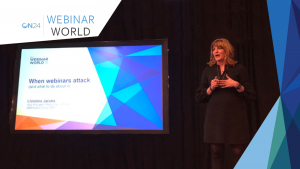
Christine Jacobs Pribilski, Vice President, Marketing, IBM, presented her views onstage to discuss what to do when webinars attack.

via ON24
via ON24

In our TechBytes Series, Christine mentioned, “We have made incredible strides with our webinar program in the past year working with ON24, so I am delighted to share our learnings and success story in ‘casting’ with the attendees at Webinar World with the hope that other marketers can see what’s possible.”

Recommended Read: Webinar World TechBytes with Aaron Dun, Senior Vice President, Marketing, SnapApp

She added, “I am such a champion of webinars, or “casting”, as I like to call it. Casting has come such a long way with the intersection of martech, analytics and content marketing. Casting is not only a viable format to deliver relevant stories and content across the buyers’ journey but also a way to deliver multiple touches in a single event, accelerating prospects forward in their buying journey. In addition, casting platforms can now offer incredible behavioral insights to help marketers become more impactful on next right step.”

In an interview with Annie Lei, Chief Revenue Officer, AmpLive, she said, “Webinar marketing tools are great because they allow you to reach a large number of people all at once, in a particularly human way. You get to put a face on your brand, engage with your audience, and learn from them all while teaching them something useful that (hopefully) leads them back to your product or solution.”

Content, Intent and the Power of AI: The Perfect ABM Synergy Revealed

When you have Karen Steele, CMO of LeanData, Content Zen Master Matt Heinz, and Fred Isbell, Senior Marketing Director at SAP as speakers at an event, we could sense mind-crunching facts bubbling onstage.

Recommended ReadWebinar World TechBytes with Matt Heinz, President, Heinz Marketing

In our TechBytes Series, Matt provided critical insights on the webinar best practices for webinerds. Matt said, Focus on engagement, personality, interactivity, and frequency (of the webinars). Perfect is the enemy of the good. Create more content, shorter content, more “imperfect’ content that’s easier to watch, listen to and share.”

Fred, the uber-calm technocrat from SAP, said, “As a long-time practitioner of webinars, I know that they have a lot of “life and legs left”. I know of no other marketing tactic that’s as useful for fostering awareness, choice, and consideration and is also timely and relevant to demand and lead generation. In my roles for SAP Services Marketing, there’s no better way to communicate the benefits and customer experience from services, which is a fundamentally intangible offering when compared to more traditional products and solutions. The question is not “why webinars” but rather “why not more webinars”!”

Read More: Webinar World TechBytes with Fred Isbell, Senior Marketing Director, SAP

In the age of Modern Marketing, Karen leads the way among women-tech CMOs. She shared the stage with DemandGen’s David Lewis. She was needle-focused at how ABM practitioners should grow beyond the legacy CRM and their limitations in processing data and personal intent in the buyer’s journey.

And we got to know about their weekly web show for B2B marketers and webinerds, called “Revving Up Your Revenue,” too!

Highest-Rated Quadrant #1 Tactic Is the Webinar

Still wondering if you should invest in webinar marketing tools? Then, this block is for you!

B2B webinars and Webcasts for Sales, Marketing and Product Leaders now rank highest in the quadrant for top orchestrated interactions. In her session on creating a marketing mix that resonates and buyer’s journey maps Cheri Keith, Senior Research Analyst at SiriusDecisions, demonstrated how orchestrated interactions based on data, insights and best practices help optimize efficiency and effectiveness of organization initiatives, go-to-market strategy, campaign planning, and program execution.

Every attendee at ON24 Webinar World 2018 would agree that the event offered much more value to the webinerds than what was promised and expected. Cheers to the attendees, speakers, the ON24 team, customers, event partners, sponsors, and B2B influencers on the ground who dazzled the show.

Agency 451 Names Social Influencer Marketing Group Leadership

0
Agency 451 Names Social Influencer Marketing Group Leadership

 Agency 451’s “Wildfire” Team Designs Campaigns Informed by Research and Strategy

Agency 451 announced that Erica Gatlin, director of influencer marketing, and Sarah Lapierre, influencer marketing strategist, will lead its Social Influencer Marketing group: Wildfire. Wildfire campaigns combine the power of influencer marketing with the Agency 451 approach. Programs are connected with insight from world-class creative talent who have experience working with influencers and brands including Julian EdelmanMike Birbiglia, Dunkin Donuts, Smuckers, GMC, and Downy.

Also Read: Patron Raises 10 Million USD, Launches Pre-TGE to Capture the Global Influencer Market

Agency 451 Names Social Influencer Marketing Group Leadership
Erica Gatlin

“Having worked in the influencer marketing space since its infancy, I know all successful campaigns start with insights and data. With Wildfire, we understand the value of developing our programs with a research-focused strategy. It is the most effective approach to reaching a highly targeted audience, generating brand awareness, and ultimately driving revenue,” said Erica Gatlin.

 
Through years of nurturing relationships, the Wildfire team has cultivated a diverse group of influencers across verticals including food, beauty, lifestyle, healthcare and more. Agency 451 also has social influencers on staff who provide invaluable insight into campaign development and execution.
Agency 451 Names Social Influencer Marketing Group Leadership
Sarah Lapierre

“I regularly work with brands to create authentic, sponsored content on my website and YouTube channel, MKUP with Sarah. My unique perspective gives me an exceptional understanding of the goals and needs of both the brand and influencer. This allows us to implement thoughtful strategy and communication resulting in unconventional, forward-thinking campaigns,” said Sarah Lapierre.

Also Read: Impact Radius Unveils ‘Dynamic Payouts’ for Influencer Marketing Campaigns

The agency’s years of experience executing strategic influencer campaigns, and its commitment to creative excellence, was instrumental in the conception of Wildfire. Wildfire programs provide strategic mapping to a client’s custom KPIs, enhanced reporting, and a targeted approach to augmenting a brand’s marketing efforts.

Recommended Read: Influencers Who Work Harder Deserve Deeper Rewards

Ugam Joins the Newly Launched Qualtrics Partner Network

0
Ugam Joins the Newly Launched Qualtrics Partner Network

As a Part of the Qualtrics Partner Network, the Partnership Will Accelerate Digital Transformation

Ugam, a global leader in data and analytics, today announced its partnership with Qualtrics, a leader in research and experience management. Ugam is now part of the Qualtrics Partner Network (QPN), a consortium of worldwide organizations offering programs and solutions that accelerate digital transformation based on the first-of-its-kind Qualtrics Experience Management (XM) Platform.

As a member of the QPN, Ugam expands its innovative suite of data, analytics and market research solutions and services, seamlessly integrating with the cutting-edge Qualtrics Experience Management Platform and providing retailers and manufacturers an end-to-end solution to design, execute, generate and operationalize their customer experience programs. Accordingly, Ugam will empower their customers with data and analytics to optimize their experience management strategies and drive business impact.

Also Read: Qualtrics Announces Speakers and Agenda for X4 Experience Management Summit 2018

Ugam Joins the Newly Launched Qualtrics Partner Network
Sunil Mirani

“Ugam is proud to be one of the first members of the Qualtrics Partner Network as we sharpen our focus on accelerating our clients’ digital transformation initiatives. Combining Ugam’s data and analytics solutions with Qualtrics’ Experience Management Platform will further provide our customers with the competitive advantage needed for improved customer experience and overall business performance,” said Sunil Mirani, Ugam co-founder and CEO.

Also Read: Ugam Releases Key Insights from Amazon Prime Day 2017

Together, Ugam and Qualtrics will provide industry leadership, as well as ongoing platform innovation to help clients reduce their company’s experience gap and give them a competitive edge in the market. Ugam’s customized industry solutions will help the enterprise operationalize data and insights generated by Qualtrics to help make better data-driven business decisions. The robust programs and engagement model that are centered around customer outcomes will help ensure client success.

Also Read: New Qualtrics Partner Network Helps Organizations Close Their Experience Gaps

Kantar TNS and Qualtrics Join Forces to Form Global Customer Experience Powerhouse
John Torrey

“Ugam’s business consulting capabilities and holistic understanding of the Qualtrics platform align with our mission to provide cohesive experience management solutions to our customers and drive impact. Ugam’s survey research heritage, focus on the retail and manufacturing industries, advanced analytics capabilities and technological expertise, coupled with Qualtrics’ industry-leading Experience Management Platform will help organizations across the globe accelerate their digital transformation. We are delighted to have Ugam as our partner in the newly launched Qualtrics Partner Network.”  said John Torrey, chief corporate development officer, Qualtrics.

Recommended Read:  Qualtrics Named One of Fast Company’s Top 10 Most Innovative Companies in Enterprise for 2018

Insightly Adds Enterprise-Grade CRM Dashboards and Insight Cards

0
Insightly Adds Enterprise-Grade CRM Dashboards and Insight Cards

Mid-Sized Businesses Seeking Alternatives to Underutilized, Costly, Legacy CRMs, Can Now Make Better Business Decisions Based on Real Insights

Insightly, the CRM for building lifelong customer relationships, has released new dashboards and Insight Cards that allow companies to visualize their operational and customer data directly within Insightly CRM. For most midsized companies, the CRM is their primary system of record and therefore a natural place in which to capture, visualize and share data.

Read More: S4M Co-founder Stanislas Coignard Takes Over As US CEO to Focus On US Expansion

By building new standards of data visualization right into its CRM, Insightly is the first to provide growing midsize companies with a fully customizable big data solution, right out of the box at no extra cost.

“Insightly has a deep and expanding midsized customer base, and for years the comapny has been on a mission to help these businesses compete on an equal footing with their larger counterparts”

Anthony Smith, CEO and Founder at Insightly
Anthony Smith, CEO and Founder, Insightly

At the time of this announcement, Anthony Smith, CEO and Founder at Insightly, said, “Insightly has a deep and expanding midsized customer base, and for years we’ve been on a mission to help these businesses compete on an equal footing with their larger counterparts.”

Anthony added, “After years of helping everyday businesses realize their ambitious goals and frequently daunting growth targets, we understand their distinct need for business intelligence and customer data visualization. Today, Insightly CRM makes that a reality by bringing enterprise-quality reports and dashboards to businesses of all sizes.”

  • Now, mid-sized businesses seeking alternatives to underutilized, costly, legacy CRM, can now make better business decisions based on real insights from enterprise-grade dashboards and Insight Cards, right out of the box
  • Insightly is a CRM built on a Customer Relationship Platform that allows cross-object, many-to-many relationship linking between multiple accounts, contacts, opportunities, collaborators, projects, documents, and tasks
  • New dashboards feature AI-driven recommendations that help customer-facing employees understand and perform next best actions based on sales event triggers and project management milestones.

Read More: Fierce Pace of Tech Disruption Has Forced Companies to Innovate via M&As

Integrated, Enterprise-Grade Data Visualization Out Of The Box

Insightly’s data visualization dashboards allow companies to uncover new insights about their business, track important projects and share information seamlessly. Using data drawn from Insightly’s Customer Relationship Platform, users can surface rich, customizable dashboards. These visualizations can display more than 80 preconfigured reports, dashboards and Insight Cards™ filtered by role, industry, customer profile and other attributes, and presented in context using a Blade Interface.

Recommended Read: Adobe Advertising Cloud Search Unveiled for Simplified Search Advertising

Uncover Growth Opportunities

Insightly’s new dashboard engine utilizes AI-driven recommendations to display metrics like “Win Rates” and “Average Sale Price” to help users measure performance and make better business decisions.

Insights For Any Role

Insightly data visualizations are customizable to allow sales managers, marketing leaders, executives and collaborators to see everything from leaderboards and pipeline summaries to project updates and productivity goals so they can filter the information that is most relevant to their business function.

Ready In Minutes

Sales and marketing teams need to move fast. Insightly’s intuitive drag-and-drop interface lets users create dashboards in minutes from standard business data or custom fields and personalize the layout to their preference. IT is not required.

Post-Sale Delivery

Insightly uniquely offers product and project delivery capabilities native to the CRM. With the new dashboards and Insight cards, teams can visualize their projects by status, owner or client to ensure successful on-time completion to ensure what is sold actually gets delivered to the customer.

Customer Relationship Platform

The building blocks of Insightly CRM are fundamentally different to those of other legacy CRMs due to its underlying Customer Relationship Platform. This platform has been purposely built using a metadata-driven architecture, which allows for the dynamic rendering of the CRM’s user interface, in accordance with the specific requirements of each individual user. This personalized experience, coupled with dashboards and Insight Cards delivered by the analytics engine, ensure higher levels of adoption and increased productivity across all types of users.

Where a legacy CRM constrains its customers to model its sales strategies within single legal entities, Insightly CRM allows its customers to break down these artificial organizational barriers and freely map the links individuals have to others in their business and personal relationships, and to build what is a relationship graph. Such graphs can open up a wide range of new possibilities for engaging customers and prospects in more meaningful ways than ever before.

Overlay a business’ unique CRM process, combined with deep analytics, and you have tailored customer engagement playbooks that enable businesses to treat every customer like they are their only customer.

Recommended Read: Salesforce Einstein Analytics Unveils Conversational Queries to Simplify Data

Futuri Media’s TopLine Adds Appointment Prep Reports

0
Futuri Media's TopLine Adds Appointment Prep Reports

TopLine Users Can Access Powerful Intelligence About a Prospective Buyer and Decision Makers, Accelerating the Sales Process by Making the Most of Their First Meeting.

Futuri Media, a global leader in SaaS technology designed to drive audience and revenue growth for broadcasters, launched a new feature in its TopLine product: TopLine Appointment Prep Reports. TopLine subscribers will receive the Appointment Prep Report, an invaluable tool for tailoring their approach to new business.

TopLine Appointment Prep Reports include:

  • Decision Maker Personality Profile: Information to help determine the best way to communicate with prospects and key decision makers. Quickly build credibility and trust with information on how to relate to the decision maker. The report includes an overview of their personality-type, tips to communicate effectively, and how to set the agenda for the most compelling meeting.
  • Digital Marketing Overview: A snapshot of a client’s current digital marketing efforts, including digital advertising, high-performing social media content, top searches, and business reputation and discoverability. This overview also identifies potential opportunities for more effective digital campaign-building.

Also Read: IBISWorld Launches Call Prep Insights on Salesforce AppExchange

TopLine Appointment Prep Reports are easy to digest, and they are delivered within one business day of a user’s request. TopLine Appointment Prep Reports are included in all TopLine subscriptions and can be requested through the TopLine web and mobile apps.

TopLine, Futuri Media's Revolutionary Sales Research and Data Visualization System, Adds Appointment Prep Reports
Sophie Fry

“TopLine’s mission is to give sales professionals their time back, so they can focus on what they do best – developing business. TopLine provides resources for sales teams in the field at every step in the sales process, from positioning to presenting and closing. After delivering $100 million in revenue for our partners in 2017, we’re excited for the TopLine Appointment Prep Report to elevate the capabilities of our partners who use TopLine.” said Futuri SVP/Sales and TopLine, Sophie Fry.

Recommended Read: Conga to Acquire Octiv to Accelerate Intelligent Document Automation Capabilities

Epicor Announces Newest Release of Next-Generation DocStar Enterprise Content Management Solution

0
epicor

New Mobile Application and Case Management Capabilities, Enhanced Document Capture and Forms Designer Headline the Latest Release

Epicor Software Corporation, a global provider of industry-specific enterprise software to promote business growth, announced the newest release of the DocStar Enterprise Content Management solution is available now.

The new release includes document capture and DocStar ECM Forms enhancements, expanded mobility, and new DocStar ECM PackageWorks case management functionality. In addition, the next-generation solution supports greater productivity and responsiveness by providing anytime access to capture, process, search, retrieve, share, and collaborate around documents critical to business transactions.

Epicor Announces Newest Release of Next-Generation DocStar Enterprise Content Management Solution
Tom Franceski

“Organizations embrace digital processes to scale and modernize operations and encourage greater collaboration. The new DocStar ECM platform enhancements connect enterprise systems, streamline workflows, and enable anytime access with ease to flow transactions more efficiently. As a result, organizations can achieve their growth and digital transformation goals, improving operational speed and efficiency, visibility and auditability, compliance and governance,” said Tom Franceski, vice president and general manager of DocStar, a division of Epicor Software Corporation.

Also Read: Epicor Announces Epicor Commerce Connect for Eclipse

DocStar ECM Mobile Application

Available for iOS and Android devices, the DocStar ECM mobile app delivers secure and quick access to the DocStar ECM repository, enabling users to gain timely workflow approval from their mobile devices anywhere, anytime. Users can email files in the same manner as the DocStar ECM desktop version, where document access is granted in a seamless, secure fashion via a unique URL or attachment and is password-protected.

DocStar ECM PackageWorks

DocStar ECM PackageWorks supports digital document package compilation with intelligent workflows for comprehensive case management. This provides a secure platform to gather, group, review, approve, and distribute documents quickly and easily in a consistent and accurate process. DocStar ECM PackageWorks streamlines collecting and managing key documents as part of the case management process.

Also Read: Epicor iScala Wins Gold Stevie® in the 2017 International Business Awards

Document Capture Enhancements

Key enhancements include improved optical character recognition (OCR) engine speed and accuracy, barcode and patch code recognition, and document splitting. Users can onboard documents more quickly and efficiently with preset, document-specific settings for optimal quality. Additionally, users can extract more accurate document text for easier document indexing and searches. Improved document splitting and automated workflow assignment allow for more accurate and faster document processing with fewer exceptions.

Forms Enhancements

Improvements to DocStar ECM Forms include designer guidance, drag-n-drop, copy and paste, and forms-element placement sizing. Alignment tools enable faster and easier form creation and existing-forms modification.

Recommended Read: Epicor Prophet 21 Provides Customer Experience To Filter Sales & Service, Inc

Implementing the Omnichannel Approach at the Digiday Retail Summit

0
DigidayRetailSummit

At the Digiday Retail Summit that took place in Texas in February, retail marketers came together to brainstorm around how the industry can address the issues facing– and threatening– their businesses.  And there are quite a few. From changing consumer behavior to how to use First-Party Data while staying compliant and Amazon’s dominance of the e-commerce versus physical word approach.

As an attendee, I listened to the executives explain what’s keeping them up at night and thought about how we can best address these concerns as an advertising industry.

The overall concern and theme was the need for retailers to adopt an omnichannel approach, finding the right mix and balance of both e-commerce and in-store strategies and tactics, to target and engage with consumers.  Although Amazon is clearly owning the lion share of retail e-commerce sales, more than 94% of total retail sales are still generated in-store. While obviously, brands can’t ignore the rise of e-commerce, the physical world shouldn’t be forgotten either.  As Tomorrowland called it, retailers need to implement a “phygital” approach combining e-commerce with in-store.

Also Read:  Building Accurate and Predictable DataDriven Results

Lessons from Digiday Retail Summit

How Can Retailers Best Implement This “Phygital” Omnichannel Approach?

Although there are many channels available, many consumers stick to a select few. Depending on where a retailer’s target audience is spending time, that channel should be a focus. For instance, according to Criteo, shopping apps generate 3x the conversion rates of the mobile web.

Why is that?

According to a report from eMarketer, the US adults spend almost two hours a day using apps on their smartphones but only surf the mobile web on their phones for 19 minutes a day. This means that marketers do need to focus on in-app retail marketing for the best chance of viewability.

But you can’t trust that consumers will stay on one channel. In this digital age, customers expect to start their customer journey to purchase in one place and continue it seamlessly on another device or store location. In fact, the consumer often arrives at the store informed and close to purchasing. This not only means retailers should be serving content before they walk into the store, but that they need to bring consistency and convenience across the customer journey–no matter the channel.

The ultimate goal for retail brands competing with Amazon is to bring that convenience obtained from e-commerce to the physical store. Implementing things like click-and-collect and deliver-to-home will help brick-and-mortar environments succeed. Furthermore, customers are increasingly expecting a more personalized and engaging shopping experience.

Also Read:  Customer Data Is the Next Competitive Battleground Shaping the Future of Digital Marketing

In fact, 75% of consumers are more likely to buy from a retailer that recognizes them by name, recommends options based on past purchases, OR knows their purchase history. This means retailers need to start offering services like having customer shopping carts and search history on the site accessible to salespeople to deliver a connected online-to-offline experience for customers.

In short, the best way to provide that seamless transition, in which consumers can pick up where they left off on the customer journey, is to ensure data is accurate across channels. Brands need to know that a customer identified on one device is the same person as the other and be sure that that individual has viewed and consumed the content previously shared so that the brands pick up the conversation where the customer left off.

Unsurprisingly, much of this responsibility falls on the advertisers. Brands deserve accurate data with verifiable value. There needs to be a standard in the quality of data used. Inconsistencies across agencies and brands cause confusion and frustration as can be seen from the conversations at the event. We as an industry, need to be better about self-policing and standardizing, to ensure we can continue to flourish and provide value to retailers.

With the rise of Amazon and e-commerce, the retail sector is at a turning point, retailers are either going to be the disrupter or get disrupted. According to Criteo, omnichannel customers generate 27% of all sales despite representing just seven percent of customers. Adapting efforts to omnichannel– offline and online– is no longer optional, it’s a do or die situation for retailers.

Also Read:  Need for Data Orchestration for Contextualizing Customer Experience

Data Science Firm Civis Analytics Extends Partnership with comScore

0
Data Science Firm Civis Analytics Extends Partnership with comScore

Civis Analytics Will Continue to Use ComScore Viewership Data to Help Its Clients Improve TV Ad Modeling and Targeting Capabilities

comScore announced data science firm Civis Analytics will extend its licensing of comScore viewership data. Civis uses this data to create custom audiences, which go beyond traditional age and gender demographics, to offer its commercial, political and non-profit clients greater targeting capabilities for their TV advertising campaigns. comScore viewership data also grants Civis’ Media Optimizer clients the ability to analyze TV engagement of these custom audiences on a more granular level and then optimize their total advertising spend.

Also Read: comScore Introduces Plan Metrix Multi-Platform

Data Science Firm Civis Analytics Extends Partnership with comScore
Steven Baumgartner

“comScore data has powered Civis’ ability to deliver advanced TV buy recommendations to our clients across the public and private sectors. By providing us with unique reach and frequency results by audience and ad buys, comScore not only helps us validate the efficacy of our analytics approach but also enables our clients to deliver more personalized and targeted TV ad campaigns for both national and local markets,” said Steven Baumgartner, vice president of sales at Civis Analytics.

Also Read: comScore Launches New Audience Segments to Maximize OTT Reach

Data Science Firm Civis Analytics Extends Partnership with comScore
Pamela Baratta

“Civis has been a long-time user of comScore. We look forward to continuing our work with the firm – providing it with our local television data to inform and enhance its clients’ advertising efforts,” said Pamela Baratta, vice president of political sales at comScore.

Civis Analytics helps businesses use data to gain a competitive advantage in how they identify, attract, and engage loyal customers and employees. With a powerful combination of proprietary data, cutting-edge software solutions, and an interdisciplinary team of data scientists, developers, and survey science experts, Civis works with Fortune 500 companies and the country’s largest nonprofits to make data-driven decision-making essential to how the world’s best companies do business.

Last month comScore announced that it has grown its massive and passive television measurement footprint by more than 40 percent to include more than 69 million televisions in more than 31 million U.S. homes. With the expanded footprint, comScore is now measuring one in every two TV households in 52 of the 210 local U.S. television markets including Los Angeles (#2) and Dallas-Fort Worth (#5), and nearly one in every four TV homes nationally.

Recommended Read: comScore Grows TV Measurement Footprint to More Than 69 Million TVs in Over 31 Million U.S. Homes

Sephora Selects Salesforce to Power Digital Shopping Experiences in Europe

0
Sephora Selects Salesforce to Power Digital Shopping Experiences in Europe

With Salesforce, the Retail Cosmetics Giant Will Be Able to Roll out New Products and Services Faster and Keep up with Fast-Changing Consumer Expectations

Salesforce, the global leader in CRM, announced that Sephora — a global leader in retail cosmetics — is deploying Salesforce Commerce Cloud and Service Cloud in Europe to accelerate growth and deliver more personalized, intelligent shopping journeys—on any channel and any device.

Sephora is one of the world’s most loved beauty communities, offering a unique retail experience for passionate clients and innovative beauty brands, encouraging them to be fearless in their creativity and self-expression. Founded in France by Dominique Mandonnaud in 1970, Sephora’s revolutionary concept offers clients a hands-on relationship with an ever-changing array of carefully curated brand partners.

Also Read: Salesforce Is #1 in Fortune’s List Of ‘100 Best Companies to Work For’

“Everyone has different beauty and skincare needs, and we want to provide our customers with shopping experiences that are as unique as they are, whether they’re shopping in-store or online. By advancing our digital strategy with Salesforce, we’re putting the right platform in place to continue delivering the groundbreaking and personalized beauty tools our customers want,” said Anne-Veronique Baylac, CDO at Sephora Europe & Middle East.

With Commerce Cloud, Sephora Europe shoppers will receive unique content, offers and recommendations based on information such as past purchases, skin type, makeup and cosmetic preferences, and geographic regions. And with Service Cloud, Sephora will be able to provide shoppers with more personalized and connected customer service experiences across every channel and touchpoint.

Also Read: Salesforce Einstein Analytics Unveils Conversational Queries to Simplify Data

Shelley Bransten
Shelley Bransten

“To meet the expectations of today’s shoppers, retailers must deliver customer experiences that are personalized, connected and fast. With Commerce Cloud and Service Cloud, Sephora Europe will be able to grow and innovate at the speed of their consumer and build more personal and predictive shopping journeys for every single shopper,” said Shelley Bransten, SVP, retail industry solutions at Salesforce.

Sephora is now live on Commerce Cloud and Service Cloud in Sweden and Denmark. The company is also planning to roll out the new digital shopping experience all over Europe starting with PortugalGermanyFrance and Poland in the coming months.

Recommended Read: Salesforce.org Partners With United Way To Launch Salesforce.org Philanthropy Cloud