Successful Activation of Customer Data for Use in Artificial Intelligence Correlates with Increased Revenue Performance
Blueshift, the leader in AI-powered cross-channel marketing, announced the results of a study, “Activating Customer Data for AI Powered Marketing,” conducted by independent research company TechValidate. The study shows that AI is top of mind for marketers with over 80 percent of them using some AI techniques today and almost two out of three (64 percent) looking to expand use of AI in the next twelve months. However, the effectiveness of AI depends on the customer data used to drive the AI algorithms and almost all respondents (92 percent) are struggling to either access, unify or analyze their customer data, hindering the effectiveness of their AI-driven marketing campaigns.
Also Read: Blueshift Brings AI-Powered Live Personalization to Websites and Mobile Apps
Study Highlights
– Survey of 200 marketing executives and practitioners from 198 companies reveals that artificial intelligence (AI) is top of mind for most marketers with 64% planning to increase their use of AI in the next 12 months.
– Eighty percent of marketers are using some AI techniques, but fewer than one in six is using advanced AI capabilities such as predictive affinities for segmentation or collaborative filtering for personalization.
– Marketers who control advanced access to data, bypassing IT, are two to three times more likely to deploy leading-edge AI techniques.
– Successful data activation and use of advanced AI techniques for marketing correlates with revenue success.
– However, 92% of marketers still struggle with access, unification or analysis of their customer data, hindering their AI efforts.
The use of AI in marketing remains rudimentary
Though more than 80 percent of marketers are using some form of AI, few have deployed advanced capabilities. Today’s AI use is largely focused on audience expansion and targeting using techniques like “lookalike expansion” — finding new audiences by targeting those with traits similar to existing audiences — on the large advertising networks. Only six percent of all respondents were using collaborative filtering (automated predictions about user interests) and predictive modeling techniques (forecasting outcomes) and only 16 percent used advanced segmentation technologies like predictive affinities on their own data to market more effectively and precisely to customers.
Also Read: Blueshift Launches Predictive Audience Syndication for Facebook
Marketer control and advanced access to data unlocks AI potential
Marketers who control their own data access, without having to go through IT, also activate and use more of their own data. Those who had such access and control were 60 percent more likely to be using a majority of their customer data in their AI-driven campaigns. These marketers were also two to three times more likely to use advanced AI techniques like collaborative filtering and predictive modeling. And companies in which marketers activate and use more than 75 percent of their customer data are 40 percent more likely to exceed revenue targets than those that had not.
Most marketers are still struggling with their customer data
Effectively using a company’s own customer data (first-party data) for AI-driven marketing campaigns is perhaps the biggest hurdle facing marketers. Almost all respondents (92 percent) in the study identified one or more of three factors — access, unification, or analysis — as a major challenge, resulting in a majority of marketers using less than 50 percent of their own customer data.

“This study was illuminating in many respects. While it showed that marketers are extremely interested in expanding their use of AI to increase their marketing performance, it also illustrated the degree to which marketers are missing the potential of using their own customer data to fulfill those aspirations.” He added, “Our advice to all marketers is to focus on the permission-based customer data they already have and put that data to work using AI,” said Vijay Chittoor, co-founder & CEO of Blueshift.
Also Read: Blueshift Receives Patent for AI-Powered Marketing








 According to
 With more than












 24 Hour Fitness is undertaking a journey to digitally transform its operations by combining functional departments to provide a single view of members and guests, messaging, and performance. Integrated cloud solutions from Adobe and Microsoft will help 24 Hour Fitness with scale, security and outreach along with AI and machine learnings to streamline its business and connect more deliberately to its members.











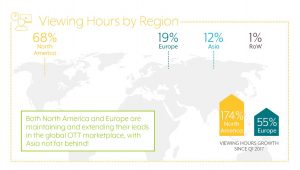
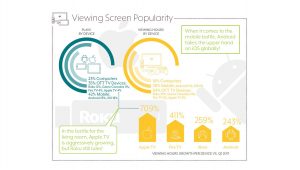 In an annual census of billions of premium video publisher apps, Conviva found viewing hours of internet-delivered video across mobile, connected TVs and desktop screens grew by 114% in the first quarter of 2018 over the same period last year, with the total viewing hours reaching nearly five billion.
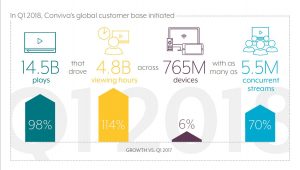 The data captured covers quantities like number of streams played, viewing hours, devices and regions, as well as quality metrics like video start time, buffering time and bit rate. These metrics are the key KPIs for the world’s largest OTT publishers looking to deliver perfect streaming experiences for their viewers.
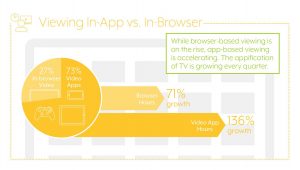
 More and more content is being consumed on mobile devices and internet-connected TVs, as witnessed by the year-over-year growth of in-app viewing versus browser-based viewing. The report supports what Conviva is calling the appification of TV, and found that app-based plays grew four times faster than browser-based viewing on personal computers. The number of viewing hours via apps grew 136% since last year.
 Overall, the state of the OTT market and the quality of streaming video on the internet continues to improve, and Conviva’s continuous measurement all-screen census provides a bird’s eye view to this dynamic and ever-expanding next-generation-of-TV market. Conviva will be publishing both quarterly and annual reports on the state of the global OTT video streaming market across both quantity and quality of viewership.