Home Blog Page 2402

MarTech Interview with Doron Sherman, VP of Evangelism at Cloudinary 

0
Doron-Sherman_MarTech-Series-Cloudrinary-Interview

[vc_tweetmeme]

A big part of enhancing the customer experience in today’s online-first marketplace starts by focusing on what can make the visual content experience better; Doron Sherman, VP of Evangelism at Cloudinary highlights a few best practices:

_______

Welcome to this MarTech Series chat Doron, tell us more about your role at Cloudinary…

Thank you! As the VP of Developer Relations at Cloudinary, I lead a team of developer advocates and developer experience engineers. The developer relations team, as a whole, is first and foremost tasked with representing the voice of the developer inside Cloudinary (advocacy) as well as building educational tools and related community resources for delighting developers (experience). Our specific focus is on developers who seek solutions to problems involving media or want to learn about it, and introduce them to Cloudinary’s media technology through best practices across a variety of use cases and technology stacks.  . 

Marketing Technology News: MarTech Interview with Brian Burt, Founder & Chief Executive Officer, Canopy Management

How have you seen trends evolve in the visual media marketplace? What are some top strategies that are working well for B2B marketers today, in your view? 

As the web turns visual with each new generation, images and video are increasingly dominant forms of communication. Just look at how today’s young people not only consume, but create TikTok videos. And nothing has accelerated the already fast growth of visual media than the current global health crisis, which has required so many people to live more of their lives online. We strongly advocate that B2B marketers raise what we call their “visual literacy”.  Many B2B marketers  – especially those born in the last century – are pretty word-literate in their communications. They know how to write and edit compelling copy. Most are adept at optimising written content for SEO and measuring its effectiveness. Visual media is great at communicating emotions and complex messages in a relatively small package, but it comes with unique challenges. When it comes to UX, the devil really is in the detail. For instance, how do you optimize images and video, to appear consistently across different browsers, devices, and viewing window formats? How do you ensure that when a user flips their phone to landscape, the subject of the video they’re watching isn’t cropped incorrectly? How do you optimise visual content for SEO? These are all the types of visual literacy issues we work with our customers to solve.

As use of interactive channels like videos / webinars becomes more prominent, how do you feel marketers can optimize their end-user streaming / viewing experience? 

As the cliche goes, “I’m glad you asked that question!” We are doing a lot of work in this area and just announced a partnership with a start-up called Visionular to extend our support for the ‘next gen’ video codec called AV1 and its associated image format AVIF. Unlike its predecessors HEVC and H.264, AV1 was conceived in 2017 for the modern web. Not only is it royalty-free, AV1 offers exceptional visual quality, but at a much lower bitrate. So for those brands that stream lots of video content, AV1 has the potential to save them big on bandwidth, costs, and also their carbon footprints while offering high speed and quality. I strongly encourage marketers to talk to their web teams about moving to AV1, AVIF and other new image and video codecs.

Seeing how complex today’s online media mix and marketing model can be, what are some top media optimization strategies that come to mind to help marketers drive digital journeys and experiences?

Optimizing media for different devices, browsers, and social media channels is highly detailed and repetitive work that’s essential, time-consuming, and quite tedious for developers. In other words, a perfect job for AI automation. There are free and subscription-based tools available that use AI to optimise images and video in the four main stages of the media asset lifecycle: creation, editing, delivery, and enhancement. Our customers use AI tools to do things like automatically check the quality of user generated content; automatically crop images correctly, so that the most important content is prominently displayed; automatically generate images tag for SEO; and enhance large volumes of content with filters, effects, overlays and other enhancements.

Marketing Technology News: MarTech Interview with Cailin Pitcher, VP of Marketing at Paubox

Can you share a few thoughts on some of the most creative and leading tech brands have used visual media to enhance their prospects online user experience?

One of the hottest consumer tech products for culinary enthusiasts today is the Thermomix TM6; essentially an IoT kitchen appliance by German manufacturer Vorwerk that performs 20 different tasks, including chopping, blending, weighing, grinding and kneading. Through a visual interface on the device, the TM6 walks users through more than 60,000 recipes, step by step. One thing the TM6 relies on our software for is to automatically optimise video for users in 60 different countries, delivering it the best resolution, bit rate, quality, and with adaptive streaming for uninterrupted buffering regardless of device or bandwidth. This ensures that users, wherever they are located, get a consistent, high-quality experience in line with the TM6’s brand promise.

A few thoughts on the future of martech and marketing and how newer technologies and channels will lead to further changes in core marketing roles and concepts? 

If this last year has taught us anything it’s that marketing and martech need to be flexible, scaleable, and responsive to be able to respond fast changes in consumer demand and behaviour. That’s why we’ve always embraced technologies like cloud, ‘headless’ content management systems, and AI, which all support these properties. During the pandemic, we of course saw a huge shift to e-commerce, but what will come next? There are signs that some consumers will maintain a higher than pre-pandemic level of home consumption, but others want to get out and support their local shops, restaurants, and bars. More consumers are concerned about the environment and are looking to buy items locally, with low mileage and sustainable credentials. 

Some top martech tools you feel marketers today need to integrate into their overall martech stack to enhance the visual experience?

As related to media experience, my advice is to refrain from introducing point solutions and instead take a more holistic approach to delivering great visual UX to consumers. The key functional deliverables of great visual UX include personalization, performance and accessibility. What’s more, to deliver such visual UX, modern interfaces entail mixed media assets, hence calling for a media experience platform that can handle the media asset management in the backend, the advanced processing and the optimized delivery of processed assets. In short, go for a flexible platform capable of handling the end-to-end media processing pipeline rather than point products & tools.

Last thoughts and takeaways for marketing and sales leaders to keep in mind through 2021?

One thing I’m confident about is that visual imagery will play an ever growing role and how brands communicate information about their values, products, and services. Marketing people will need to continue to grow what we call ‘visual literacy’ in order to adapt.

Marketing Technology News: MarTech Interview with Maggie Lower, Chief Marketing Officer at Hootsuite

[vc_tta_tabs][vc_tta_section title=”About Cloudinary” tab_id=”1544515685282-bf64247e-9d9aeec0-8908″]

Cloudinary’s mission is to empower companies to deliver visual experiences that inspire and connect by unleashing the full potential of their media. With more than 50 billion assets under management and nearly 8,000 customers worldwide, Cloudinary is the industry standard for developers, creators and marketers looking to upload, store, transform, manage, and deliver images and videos online. As a result, leading brands like Atlassian, Bleacher Report, Bombas, Grubhub, Hinge, NBC, Mediavine, Peloton, Petco and Under Armour are seeing significant business value in using Cloudinary, including faster time to market, higher user satisfaction and increased engagement and conversions. 

[/vc_tta_section][vc_tta_section tab_id=”1544515685339-cf6c9bcd-6b1aeec0-8908″ title=”About Doron Sherman“]

Doron has been connecting business & technology dots in startups that created multi-billion dollar markets for 3 decades as executive, founder, angel investor & adviser. At Cloudinary, Doron is responsible for developer relations and bridging the gap between developers and marketing.


[/vc_tta_section][/vc_tta_tabs]
[vc_tweetmeme]

Catch the latest B2B Marketing and Sales Conversations with these latest episodes of The SalesStar Podcast Featuring HighSpot, Lift, ON24 and more!

Episode 92: B2B Marketing Learnings And Martech Tips With Jon Perera, CMO At HighSpot

Episode 91: Top Trends And Concerns Of B2B Revenue Teams: With Sylvia Ananicz, Head Of Revenue At Lilt

Episode 90: Boost Your Customer Engagement And Marketing Process: Tips And Thoughts By Steve Daheb, CMO At ON24

New Vulnerabilities In The Digital Ecosystem

0
New Vulnerabilities In The Digital Ecosystem

Last month, IBM announced the results of their annual Cost of a Data Breach Report, which found that data breaches now cost companies $4.24 million per incident on average – the highest cost in the 17-year history of the report. The study suggests that security incidents have become more costly and harder to contain due to drastic operational shifts during the pandemic, with costs rising 10% compared to the prior year. The report also found that while certain IT shifts during the pandemic increased data breach costs, organizations who said they did not implement any digital transformation projects in order to modernize their business operations during the pandemic actually incurred higher data breach costs.

The threat of data breaches is not going away anytime soon, and frankly, over the last few years and especially since the pandemic, we have observed rapidly evolving, diverse tactics of threat actors operating in a dynamic digital ecosystem. This increases risks that can lead to reputational, financial, and legal damages. Cybercriminals and threat actors do not discriminate and are always adapting their tactics. We’ve witnessed Fortune 500 companies and government institutions suffer from data breaches, but also countlessmedium-sized organizations and small, family-owned businesses as well.

The last 365 days have undoubtedly proven profitable for the breach economy. We’ve watched sectors that deliver critical infrastructure come to a screeching halt with the Colonial Pipeline cyberattack and some of America’s most powerful government agencies compromised in the SolarWinds hack. These are just examples, and several more can be cited from sectors ranging from financial services to healthcare and beyond.

As a result of organic modernization, along with COVID-19 forcing a faster adoption of technology, the world increasingly relies on more digital solutions than ever and has made a now definitive shift toward hybrid and remote work models. For both cost and operational efficiencies, individuals, brands, and public institutions have pivoted toward a greater reliance on digital services, providing cybercriminals with a plethora of opportunities to exfiltrate and exploit data. The era of modernization, social media, and the ubiquity of digital solutions has resulted in personally identifiable information (PII) being spread far and wide and into the hands of malicious actors. The weaponization of information and data, from targeted threats to steal data or funds to malign influence and reputational attacks, expands the possibilities at attackers’ disposal. As such, organizations should be astute in understanding the landscape of threats in the digital ecosystem and effectively preparing to defend against them.

Marketing Technology News: Vericast Survey: How Deals Play a Role in Return to Pre-Pandemic Activities

Constella Intelligence’s 2021 Breach Report

Digital risk protection and cybersecurity firm, Constella Intelligence, is home to the most extensive breach data collection on the planet, with more than 45 billion archived identity records. We recently published our 2021 Identity Breach Report, titled PII Fuelling the Threat Economy: How Crisis Creates Targeted Vulnerabilities for Individuals, Executives, and Brands. The report evaluates data collected from Constella’s extensive database of archived identity records from data breaches and leakages found on the surface, deep, and dark web, in addition to trends identified in deep and dark marketplaces over the past year. Our threat intelligence team detected over 8,000 breaches consisting of over 12B records in 2020, and our findings represent far more data breaches and leakages than just those reported in the media.

Findings

Our report found new vulnerabilities exploited by threat actors during the pandemic, including COVID-19 items like vaccines, vaccine certificates, and COVID-19 tests for sale on the dark market.  We identified an exorbitant increase in the prices of sensitive personal records transacted in dark marketplaces, among them credit cards $80.64 (+90.64%), passports +684.29 (+1,185.05%), ID Cards $213.49 (+642.57%), and driver’s licenses $205.71 (+328.56%), possibly due to increased demand for false identification records during the pandemic. These trends are reinforcing what seems to now be the fundamental rule of cyberspace—personally identifiable information is the fuel that keeps the engine of the breach economy going. Astoundingly, nearly 60% of the data breaches our team analyzed exposed some form of PII, and 72% of these breaches included passwords. PII is everywhere, and threat actors want and need it.

The interconnectedness of the threats identified in our 2021 Breach Report is worth paying attention to, as threat actors are targeting individuals to obtain access to corporate networks not only puts employees at risk, but also has serious implications for the reputation of brands and executives, which in turn can have consequences for business continuity. Data breaches are multifaceted in the damage they stand to inflict, as they can undermine the public’s trust in the exploited company while exacting costly financial and legal repercussions as well. Strikingly, our research suggests that the use of corporate credentials by executives and employees in key sectors is not improving. Fortune 500 companies in Energy and Telecommunications have had their corporate domains exposed in approximately 11k breaches/leakages since 2016, and over 40% of these exposures occurred since 2020, indicating worsening security of corporate credentials. Over 40% of executives from a sample of Fortune 500 companies in the Energy and Telecommunications sectors were exposed in a breach over the last 5 years. What is worse, out of a sample of 55 Fortune 500 Energy executives, nearly 1/4 have had their passwords exposed.

As the digital ecosystem becomes more intertwined, it’s become clear that we are all potential vectors of attack—both for our own assets and the networks that we belong to or have access to. The increasing relevance of social media attributes is evidence of this. In several cases, this type of publicly available data has been used to create fake accounts with real information, creating networks of imitation profiles for the deployment of coordinated disinformation campaigns that can have pernicious effects on brand reputation. For hackers, social media attributes can prove useful to obtain personal information about their targets, such as locations, workplaces, hobbies, family members, or friends. By obtaining a victim’s personal information, threat actors can launch more effective and sophisticated impersonation attacks in efforts to get sensitive information. These attacks could be targeted towards several possible entities, including company of employment, bank accounts, other financial information, and much more.

Marketing Technology News: MarTech Interview With George Donovan, Chief Revenue Officer at Allego

What Companies Can Do

As IBM’s aforementioned report noted organizations that did not modernize their business operations during the pandemic incurred higher data breach costs. Similarly, in order to mitigate data breaches, organizations must increase investment in cybersecurity. But this is not merely an investment in technological improvements regarding cybersecurity. Equally important is an organization’s investment in its culture around cybersecurity and cyber hygiene. The human factor is often the key to attacker infiltration (phishing, weak passwords, exposed credentials, social engineering, etc.), so there must be an investment in cyber training to provide employees with a better understanding of how to protect valuable data.

Accompanied by cybersecurity technology and training should be more robust security policies. Multi-factor authentication policies, separating backup storage from critical systems, implementing strong encryption algorithms, and protecting attack surfaces through anticipatory threat intelligence allow organizations to better prevent against breaches. It is the responsibility of executives and leaders to recognize that they themselves, their employees, and their organizations are becoming high-value targets for cyberattacks, and decisive actions must be taken to prevent data loss and reputational or financial harm.

Marketing Technology News: The Biggest Senders Have Their Eyes On A Modern Data Warehouse

Second Annual Thought Industries COGNITION Conference Unites Customer Education Leaders to Learn, Collaborate and Share Best Practices

0
Thought Industries Delivers First 'Headless' LMS for External Enterprise Learning

Thought Industries, the world’s #1 platform for customer learning management (CLM), will bring together leaders from across customer education for its second annual COGNITION conference, which will take place virtually Sept. 21 – Sept. 23, 2021. B2B thought leaders, executives and customers will gather to share their experiences and insights for building customer-centric learning programs that drive business loyalty and revenue growth.

Marketing Technology News:  Avtex Wins 2021 Pandemic Tech Innovation Award

COGNITION 2021 comes at a critical time in the evolution of customer learning. Recent research found that customer education is a vital tool to retaining customers, but many organizations still don’t know how to develop a profitable program. The conference will consist of three information-packed days with sessions featuring executives from leading software organizations including IBM, Hubspot and Oracle, as well as partners such as ServiceRocket and TSIA. In addition to keynotes and panel discussions, COGNITION will have hands-on workshops and networking opportunities, so customer education teams can problem solve and learn from each other.

“Companies are looking for new ways to assess and provide impactful learning experiences across mediums, roles and disciplines—especially given the growing recognition that customer learning efforts are critical to retaining customers and driving additional revenue,” said Barry Kelly, chief executive officer, Thought Industries. “COGNITION will bring together leading voices on customer learning to explore why customer education is critical, especially in increasingly remote working and learning environments, and how to shape effective learning programs for business success.”

Marketing Technology News:  MarTech Interview with Gary Burtka, VP U.S. Operations at RTB House

The conference includes four tracks: the business of learning, design of learning, impact of learning and technology of learning. Sessions feature a diverse array of speakers and topics, including:

  • The Next 10 Years: The Future of Work, Professional Education and Customer Learning presented by Gerd Leonhard with The Futures Agency
  • Learning Agility: Thriving Through Disruptions with Organizational Resilience with Sonia Malik, IBM
  • Ways to Personalize the Learning Experience with Karen Swindells, Ungerboeck
  • Learning in the Flow of Work, with Kristine Kukich, Oracle
  • Everything We Learned About Customer Education, We Learned from Marvel, with Jennifer ClarkMelissa MillowayMatt Mulholland and Dee Kapila from Miro

A Good Branding Strategy is Critical to your Overall B2B Marketing Plans

0

With the advent of the Covid-19 pandemic and the rapid refocus on strengthening multichannel, digital marketing and digital sales efforts, companies and even audiences are now experiencing an online content crisis of sorts. This is why content marketers and B2B Marketing leaders are now required to not only rethink their content strategy to make it more personal, relevant and creative enough to stand out from the crowd; they have to use associated elements of a good content presence to ensure their content, their overall brand positioning and online customer journey are aligned more seamlessly.

Marketing teams today have a wide content base from which to inspire their core content formats and overall content marketing strategies. While some brands are known to capitalize on podcasts or online webinars to drive marketing growth and customer engagement, many others drive their plans keeping other channels like email marketing a core focus area.

But in a multichannel online world, where all of these efforts have to align to speak to a centralized theme that can portray a unified brand strategy and brand identify as well as vision, it is common for marketers to experience a few lags or oversight.

Marketing Technology News: MarTech Interview with Maggie Lower, Chief Marketing Officer at Hootsuite

What are some of the crucial B2B branding strategies and elements that B2B Marketers need to be more attentive to? Let’s explore a few:

What does your ‘’About Your Brand’’ Section say Across Online Channels?

Most marketers, including start ups will follow the usual cues of creating brand pages on various social media platforms to increase thei.

One of the basic must-dos when doing this is ensuring your brand’s ‘’About Us’’ on the website, the various social media pages and other informative online platforms and listings sound or read the same.

This rule also applies to ensuring the company logos are the same across these pages and the website and that the name of the brand is also the same, to reduce customer complexity and confusion.

Experienced marketing and sales leaders who understand the importance of this in the overall brand growth strategy will also ensure other key elements like their pricing pages (across the website, other marketing and sales outreach) sports the most updated details or packages.

Using the Right Brand Templates for Marketing and Sales Campaigns

Marketers are constantly looking for ways to boost brand presence and growth in the market. Revamping your website, re-launching your brand with a new logo and redoing your brand colors are also part of this game. Marketers who undertake a complete brand update and brand facelift also need to align this to their other teams and departments. An email marketing campaign that sports an updated logo while a sales rep’s outreach sports the older logo with an outdated sales presentation that also has an older logo might not seem like a big deal, but it can confuse potential prospects, especially those who haven’t heard of your products or services before. This is where marketing leaders need to step in to host updated content assets and marketing and sales collaterals in centralized CRMs or Content Management Systems to make it easier for their global sales reps to have easy access to the most recent sales and marketing collaterals.

Decision-Makers Play a Key Role in Long-Term Branding Goals

If decision-makers at the level of the CMO, CSO, etc do not see the importance of branding as a long-term growth strategy, marketing and sales teams will always have a disjointed representation of their brand messaging and pitches.

Decision-makers who align on a core brand concept and work towards ensuring this theme is maintained across all online channels and their team campaigns will contribute towards a more unified brand image which also helps new prospects and future customers identify with a united brand identity.

Marketing Technology News: MarTech Interview with Brian Burt, Founder & Chief Executive Officer, Canopy Management

Leading brands who believe in the importance of a strong branding strategy will also ensure their HR department and employees are aligned to this core brand positioning and messaging theme. Ensuring unified brand messaging across hierarchies can boost the overall employee and customer experience significantly while giving employees a more solid work culture. Many leading brands for instance choose to pre-set their official device screensavers to sport their logos and company positioning or tagline before issuing it to employees for use.

Branding is Especially Crucial to Companies with Multiple Product Lines

A strong focus on building a master brand can make it easier for marketers to segment audiences and also capitalize on years of brand positioning and growth to cross promote new products and new product lines. A strong central corporate brand can easily reach a wider circle and boost customer loyalty while reducing confusion in the marketplace too. Building a brand that is known for its multiple products can provide better long-term opportunities and stable growth structure, also contributing to easier marketing processes in future.

Amplifying your Brand Starts with a Well Oiled Multichannel Branding Strategy

In a digital marketplace that is now suffering from a content saturation of sorts, going back to the basics is becoming important to break away from the noise and build brand recognition and brand recall in the eyes of the online customer. A good branding strategy can expand your audience, establish your brand and boost new lead generation and sales opportunities more seamlessly.

Your branding efforts can also be measured effectively if you put key performance indicators in place, evaluate what isn’t falling in place or what is impacting your brand recognition in the market – doing this consistently can improve your overall brand image and brand strategy.

The importance of building a core brand position is just as crucial in B2B marketing today as driving deeper customer relationships with more meaning and personalization.

Marketing Technology News: MarTech Interview with Lorn Davis, VP of Corporate and Product Strategy at Facteus

Alteryx Study: Improving Analytics Maturity Key for Bridging Gaps Between APAC Enterprises’ Business Priorities and Performance

0
Alteryx-Study--Improving-Analytics-Maturity-Key-for-Bridging-Gaps-Between-APAC-Enterprises’-Business-Priorities-and-Performance

Organizations demonstrate analytics maturity in strategy and data dimensions, but they lack workforce- and process-related analytics capabilities

Delivering fresh insights into Asia Pacific (APAC) enterprises’ ability to create business value from data analytics, Alteryx, Inc., the Analytics Automation company, today released findings from its research report titled, “Toward Analytics Automation in Asia Pacific”. The research, conducted by International Data Corporation (IDC) and commissioned by Alteryx, reveals a significant gap between regional enterprises’ business priorities and performance, one that can be bridged by overcoming the lack of workforce- and process-related analytics capabilities.

Marketing Technology News: MarTech Interview with Carrie Palin, SVP & CMO at Cisco

According to the research, APAC enterprises’ top business priorities include customer experience, productivity enhancement, cost reduction, new product development and business model innovation. Currently, while more than 90 percent of business executives believe that data analytics are important for their organizations to remain performant, less than one in five (19 percent) enterprises across the region have achieved high analytics maturity. Enterprises that are ‘Analytics Experts’ tend to outperform their peers across all major business priorities, especially in areas like cost reduction (56 percent), business model innovation (28 percent), new product development (17 percent) and market expansion (12 percent).

To help APAC enterprises to determine their analytics maturity level, IDC designed a framework that assesses their standing across four key dimensions – strategy[1], data[2], workforce[3] and process[4], before providing an aggregated score that identifies Beginners, Practitioners, or Experts. In addition, the framework describes the journey to becoming an Analytics Expert by achieving maturity in strategy, data, workforce, and process.

The research found that enterprises across the region are more mature in strategy and data dimensions, with 48 percent having achieved buy-in and alignment amongst key stakeholders regarding analytics initiatives, but only 38 percent having established policies and practices to ensure data integrity. A large majority, however, lack the necessary workforce (86 percent) and process capabilities (93 percent), which are the most crucial for driving data-driven transformation at scale and deriving long-term business value.

It also suggests that enterprises need to build workforce or process-related capabilities to derive business value from data analytics. In their daily roles, executives across the region currently struggle with hard to use tools (55 percent), scattered and unmanaged tools (49 percent), lack of timely access to data (44 percent), data lineage and integrity (44 percent) and lack of data literacy (43 percent). These challenges are exacerbated by increased complexity and organizational demands for data analytics to be delivered at greater speed and scale, with the average APAC enterprise currently facing internal requests to include 26 new data sources and 30 new data types per month.

Marketing Technology News: Installed Base Management Goes Mobile With Entytle’s Insyghts App For Industrial OEMs

“In today’s volatile, uncertain and challenging business environment, enterprises have expressed the need to invest in mission-critical business areas. In addition, with the evolving needs of customers, enterprises must innovate their business models to meet new needs,” said Julian Quinn, Senior Vice President, APJ, Alteryx. “The findings show a consensus towards the critical role that analytics plays in driving business performance. Yet, organizations are grappling with multiple challenges in using data analytics, uncovering the need to improve workforce and process analytics capabilities. To deliver breakthrough outcomes, organizations need to automate processes and democratize data analytics, elevating workforce’s ability to gain on-demand insights for thriving in their roles.”

“Despite the rapid rate of digital transformation and data generation, many organizations in Asia Pacific are not yet experts in data analytics. They are at the Beginners stage in their workforce and process dimensions which are critical for empowering employees to do their jobs better, faster and with greater impact,” said Dr. Chris Marshall, Associate Vice President, APAC, IDC. “In the face of workforce and process challenges, organizations today can close the gaps with advanced analytics tools. Analytic process automation is a low-code solution that has emerged as a way forward to remove friction, enabling analytics capabilities to scale quickly across the entire organization.”

The research findings also highlight the potential of a self-service, human-centric analytics automation platform to bridge existing workforce and process capability gaps, address analytics challenges faced by executives, and put organizations on a path to become Analytics Experts.

The Alteryx Analytic Process Automation (APA) Platform™ delivers end-to-end automation of analytics, machine learning and data science processes. As a result, organizations can automate analytics and data science, embed intelligent decisioning, empower its employees to deliver faster, better business outcomes and ultimately, enable the agility needed to accelerate digital transformation.

“Data should no longer sit idly in an organization. With the help of analytics automation, an organization can leverage its best assets – people, processes and data – to empower their workforce to increase overall organizational performance and efficiency so that decision-making is faster and more reliable,” said Quinn.

[1] The strategy dimension assesses the presence of a carefully planned data and analytics strategy. Without a strategy in place, the interdependencies amongst stakeholders responsible for different initiatives will become a stumbling block to generating consistent returns from analytics investment.

[2] The data dimension assesses how data, the raw material, is systematically governed across the organization.

[3] The workforce dimension assesses whether productivity tools and automation has enabled and empowered people to do their jobs better, faster and with less effort.

[4] The process dimension assesses whether definition, standardization, and automation of process management are in place.

Marketing Technology News: TechGuilds Becomes a Sitecore Gold Partner

TrustVibes Announces Beta Testing of its Social App Infused With NFTs

0
TrustVibes Announces Beta Testing of its Social App Infused With NFTs

The Blockchain Company promises creators the perfect tools to build their businesses

USTrustVibes Corp. has announced the beta test launch of their Social App, its groundbreaking TrustCircle and monetization tools. The TrustVibes Social app will be the first to utilize an advanced social media framework called TrustCircles to bring together creators and their fan communities. This creator centric model seeks to provide the ideal environment for creators of passion economy to build thriving businesses.

Marketing Technology News: MarTech Interview with Charlie Silver, Founder and CEO, Permission.io

TrustVibes CEO Rashid Jamal says this about their approach to the NFT as a tool, “Although NFTs are one of the hottest areas of crypto, they are only empowering the top 3% creators. We are lacking the tools and strategies to assist the 97% creators with tools required to build community around their creation/art/talent, which will increase their income dramatically. There are many NFT marketplaces, but how does the average creator build an audience on any of them? And on social networks, creators have to fight against the platform to thrive. With the TrustVibes app we have combined the best elements of both platforms to vastly increase what creators can expect from their creative efforts.”

The app addresses the three biggest creator complaints with online platforms; the share of the revenue they take, algorithms that work for advertisers at the expense of creators, and social networks control of their fan bases.

Marketing Technology News: Amplifi Announces Global Partnership With Redpoint Global

In terms of revenue distribution, TrustVibes takes an industry low 1.5% fee from all transactions as their business model. For comparison, Facebook and YouTube charge creators up to 45% of the revenue they generate on their platforms. Costs to advertise and promote your work or events through the app are a fraction of what the lowest cost social media platform charges.

The TrustVibes app does not have advertising so creators never have to worry about ads disrupting their relationship with fans. And the platform promises no algorithms that interfere with creator goals.

In terms of fan control, the TrustVibes app uses an advanced form of social networking called TrustCircles that is 100% controlled by the creator. Fans are invited into creator TrustCircles and both receive enhanced benefits. Creators get a supportive environment that generates positive publicity and more sales. Creators can also host events within the app such as the launch of a new NFT, or use the app to promote off-app events tickets etc. Fans get better access to creators, limited edition NFTs from their favorite creators, a healthy social environment, and sometimes even a share in the revenue.

TrustVibes has designed its app for the $38 billion Passion Economy which seeks to distance itself from social networking and maximize the relationship between creators and fans. To do this effectively, they need tools like the TrustVibes app. Creators seeking to better manage their creator businesses should take note.

Marketing Technology News: ZAPTEST Rated #1 Best Web Testing Tool and Best RPA tool of 2021 by Guru99

Productsup Launches New Platform To Help Businesses Address Growing Commerce Anarchy Crisis

0
Productsup Becomes a GS1 US Solution Partner

Leading commerce data integration company helps businesses radically rethink the entire global value chain

Productsup, the leading commerce data integration company, today announced the launch of a new platform to combat commerce anarchy – a term Productsup coined to describe the struggle companies face managing the increasingly complex paths between products, services, and consumers.

Marketing Technology News: MarTech Interview with Urvish Vashi, Chief Operating Officer, HighRadius

Global retail ecommerce sales hit $4.2 trillion in 2020 alone and are projected to grow to $5.4 trillion by 2022. But commerce anarchy now threatens the online buyer/seller relationship, resulting in confused and fractured interactions between vendors and digitally-empowered customers across marketing and retail channels.

“The relationship between online platforms and businesses has switched from co-existence to competition. The situation worsens by the day as many factors converge,” said Marcel Hollerbach, Chief Innovation Officer of Productsup. “Research* tells us that 94% of vendors state they now compete with the very hyperscale platforms they need to use to digitally reach their buyers and just one in seven trusts the data they receive back from these platforms.”

Solving digital and influencer sprawl
Manufacturers, brands, retailers, and service providers are juggling multiple omnichannel business-to-business (B2B), business-to-consumer (B2C), and direct-to-consumer (D2C) processes in an attempt to manage ever-more-complex paths between products, services, and consumers. Research* amongst Chief Digital Officers and board members highlights that the impact of the chaos caused by digital channel and influencer sprawl is the most pressing issue reported. Solving this problem is a key management challenge.

“Commerce anarchy is, for sure, the major challenge we are dealing with in order to establish a strong and successful ecommerce offer,” said Margit Gosau, CEO of SPORT2000, one of the world’s largest purchasing cooperatives of independent sports retailers, with 3,800 stores in more than 20 countries. “More concretely, it is the complexity of processes, data, sources, and channels which we have to juggle in order to fulfill today’s customer needs in omnichannel retail.”

Managing product information value chains
Productsup knows that successfully navigating a world of commerce anarchy requires a radical rethink of the management of the global product information value chains which connect manufacturers, brands, retailers, and service providers to their online customers. A product information value chain covers all the information flows needed to enable buyer transactions. These include supply chain logistics, product information management, and social media buying signals.

Marketing Technology News: TechGuilds Becomes a Sitecore Gold Partner

To date, many businesses have adopted a piecemeal approach to managing such complex systems. Optimizing a feed here, a product description there, but optimizing alone does not help, it just adds to the chaos. In addition, research* reveals that product information is typically handled by an average of four systems in each organization. A lack of integration of these systems to successfully aggregate, optimize, contextualize and distribute product content means global product information value chains cannot be managed in real time, fast-moving opportunities to sell are lost and brand relationships with buyers are damaged.

Taking advantage of complexity and change with the Productsup Platform
The Productsup team has drawn on its experience at major enterprise software firms such as Siebel, IBM, Oracle, HP, TIBCO, Informatica, and Qlik, to deliver the world’s first platform to manage the product information value chain. The Productsup Platform is trusted by over 900 global brands, such as IKEA, Sephora, and ALDI, across more than 2,500 marketing and retail channels and handling more monthly data requests than Google’s consumer search service.

“Productsup is aimed at creating high-performing and scalable campaigns across markets, redefining product, brand, and service experiences, delivering control over commerce anarchy,” emphasized Hollerbach.“It also comes with a sophisticated set of modules and features that are built to help brands, retailers, and service providers reach more customers and maximize sales.”

The Productsup Platform provides a single solution to effectively manage product information value chains and their constant feedback loops, enabling manufacturers, brands, retailers, and service providers to turn complexity and constant change to their advantage. Using Productsup, Chief Digital Officers and their teams can take ownership, without coding, but with full data transparency and compliance across all value chains.

Marketing Technology News: Amplifi Announces Global Partnership With Redpoint Global

Unleash live Raises $8M in Series A to Scale A.I. Apps for Enterprise Analytics

0
The Future of Automation Requires Visual Media Management Now

Unleash live, one of the world’s leading A.I. video analytics platforms, announces an $8 million Series A funding round led by SafetyCulture.

“It’s great to see such innovative new thinking in response to old challenges”

Marketing Technology News: Making Science Acquires Tech Platform, Ad-Machina to Elevate Its Innovative Technology Offering

Launched in 2016 by co-founders Hanno Blankenstein and Jason Grier, Unleash live’s A.I. powered real time analytics platform, ‘Intelligent Remote Vision’, generates immediate insights that enable enterprises to materially drive down costs, raise productivity, increase accuracy, and improve safety. The company has seen over 500% growth since March 2020.

“We’re excited to welcome the combined expertise of SafetyCulture and renowned investor Roger Allen AM, who will drive the continued success of Unleash live and help take us to the next level,” said co-founder and CEO Hanno Blankenstein.

Unleash live reached an impressive milestone earlier this year, completing 30 million minutes of analysed video, providing analytics across a wide range of enterprise and government use cases, from automating inspections for optimised performance on wind farms, to supporting public transport operators with commuter, social distancing and face mask analytics.

In addition to its investment in Unleash live, SafetyCulture CEO, Luke Anear, will be joining the board. SafetyCulture is a global operations platform empowering teams to drive workplace improvements. One of the fastest-growing technology companies in Australia, it also acquired microlearning business EdApp in 2020.

“It’s great to see such innovative new thinking in response to old challenges,” Anear said. “We recognise the potential of leveraging camera feeds to trigger safer, smarter actions. A.I. video analytics is an enormously powerful data source for an operations platform like ours, and one that many of our customers can benefit from. Unleash live has shown extraordinary growth during the past year. I’m eager to help them support more organisations globally to be better, faster and more reliable.”

Roger Allen AM is an experienced software entrepreneur and venture capital investor focused on investing in Australian fast growth technology companies. Allen said, “Australian technology companies are globally competitive and attracting significant investment both domestically and internationally.

“It is great to see SafetyCulture – an already successful Australian technology company – investing and supporting a new emerging company with a large global opportunity in Unleash live. I look forward to sharing the journey.”

Unleash live’s CEO, Blankenstein explained that the COVID-19 pandemic had played a part in the increased adoption of video streaming and remote collaboration: “A growing number of businesses now use Unleash live to overcome the challenges of maintaining distributed assets and to keep employees out of harm’s way.

“Remote monitoring and machine learning assisted inspections will remain critical when the pandemic ends because so many organisations have realised there is a significant opportunity to improve how they operate. They will continue to apply these learnings and look for new ways to build them into their business.”

Unleash live will use the Series A funding to fuel the growth of its A.I. Apps Store, where developers and organisations with in-house A.I./ML skills can build, train and deploy Apps that meet specific enterprise needs.

A.I. analytics are injected into livestream video to augment the role of inspectors, progress monitors, financiers, auditors, and regulators. The funding will also support the expansion of its US team and help provide the quality experiences that enterprise customers expect.

Marketing Technology News: Numbers Protocol Leverage Blockchain To Create Photo NFTs With Authenticity

Proxymity Appoints Sir Kenneth Olisa as Chairman

0
Proxymity-Appoints-Sir-Kenneth-Olisa-as-Chairman

Proxymity, the digital investor communication platform backed by a consortium of the world’s largest issuer and investor services firms, has announced the appointment of trailblazing business leader Sir Kenneth Olisa as Chairman of the Board.

Sir Ken Olisa’s career has been in the IT industry, and he has served on numerous public and private company boards in the UK, USA and Africa. He is Founder and Chairman of Restoration Partners, a boutique technology merchant bank and Chairman of Interswitch, Nigeria’s largest e-payments company, as well as being a former Director of Thomson Reuters and Eurasian Natural Resources Corporation (ENRC). He was elected as a Fellow of the British Computer Society in 2006, and served as Deputy Chairman of The Institute of Directors.

Marketing Technology News: Numbers Protocol Leverage Blockchain To Create Photo NFTs With Authenticity

In 2016, he was named Number 1 in the “Powerlist” of the UK’s most influential black people. In 2015, Her Majesty the Queen appointed him as HM Lord-Lieutenant for Greater London and he was knighted in the 2018 New Year’s Honours List for services to business and philanthropy.

Commenting on his appointment, Sir Ken said: “My public company experience makes me an enthusiastic advocate of Proxymity’s core mission. Its founders, Dean and Jonathan, have set out to radically transform the antiquated processes by which public companies communicate and engage with their investors.  As someone familiar with the world of technology entrepreneurs, I am impressed by how they have, in a short time, assembled a diverse and dynamic team that has already delivered industry-first solutions in partnership with the world’s largest financial institutions.”

An advocate of social inclusion and public service, Sir Ken is President of homeless charity Thames Reach, and Chair of Shaw Trust, supporting the disabled and chronically unemployed to find work. He founded the social mobility focused Aleto Foundation and has served as a Governor of the Peabody Trust and as a member of IPSA (Independent Parliamentary Standards Authority).

Dean Little, CEO and Co-Founder of Proxymity, said: “We are thrilled to have Sir Ken lend his powerful voice and decades of experience to Proxymity’s executive team. As we continue to advance rapidly in fulfilling our vision of enabling real-time, transparent communication throughout the investment ecosystem, we remain committed to maintaining the highest standards of governance and continue to invest in the diversity, performance and wellbeing of our team.”

During the 2021 season, Proxymity announced its successful integrations with Citi and Deutsche Bank, two of the world’s largest custodian banks, and the platform is on track to represent 70% of assets under management globally by 2022. The company currently provides solutions in 29 markets for digital proxy voting and digitally compliant shareholder disclosure (as mandated by SRD II).

Marketing Technology News: Vivial Named “Best Content Writing Service” For Fourth Straight Year in Annual MarTech Breakthrough…

Juniper Research: Mobile Messaging Leaderboard Reveals New Competitor Line-up

0
LoginAsk's Artificial Intelligence App: Login Method In A New Era

A study from Juniper Research has ranked Infobip as the leading service provider in the mobile messaging space. It employed Juniper Research’s new Competitor Leaderboard tool to assess each vendor’s capacity and capability, and their product positioning, including the size of their operations, financial performance and the sophistication of their messaging solutions.

Marketing Technology News: Helium 10 Announces New Amazon Advertising Platform – Launches ‘Adtomic’ a Breakthrough Solution for Amazon Sellers Looking to Optimize Advertising Campaigns

“As messaging product portfolios become increasingly uniform across messaging vendors, support for new and emerging technologies will be instrumental in providing a differentiation point for leading players in a progressively more crowded space.”

The Competitor Leaderboard identified the five leading mobile messaging platforms as follows:

  1. Infobip
  2. Twilio
  3. CM.com
  4. Route Mobile
  5. Kaleyra

Juniper Research’s new Competitor Leaderboard provides an independent assessment of the market standing of the leading players. It includes a robust and transparent assessment methodology, including heatmap analysis and a thorough explanation of each company’s market position.

Marketing Technology News: MarTech Interview with Lauren Weinberg, Global Head of Marketing and Comms at Square

Support of OTT Messaging Channels Essential for Established Leaders

All the leading players scored highly in Juniper Research’s assessment of the sophistication of their messaging platforms. Support for established technologies, such as SMS and email, is now ubiquitous amongst messaging vendors. The research highlighted vendors’ ability to swiftly integrate emerging messaging channels into their platforms as key to distinguishing their services from competitors. In turn, leading vendors will establish their position in the space by offering their customers the chance to benefit from the more comprehensive messaging formats, such as OTT channels and social media messaging, in addition to SMS.

Research author Scarlett Woodford remarked: “As messaging product portfolios become increasingly uniform across messaging vendors, support for new and emerging technologies will be instrumental in providing a differentiation point for leading players in a progressively more crowded space.”

Further Acquisitions Expected

The report predicts that mergers and acquisitions will continue to characterise the messaging space. Whilst recent acquisitions, such as Infobip’s purchase of Open Market in 2020, have been driven by the need to accelerate the reach of services, the report identified the wider need for services that immediately add value to messaging offerings, such as payments capabilities that support in-app payments over rich media formats.

Juniper Research provides research and analytical services to the global hi-tech communications sector; providing consultancy, analyst reports and industry commentary.

Marketing Technology News: Bad Data is Bad News for Marketers

Accenture Announces Intent to Acquire BENEXT, Independent French Product Management Consulting Company

0
Accenture Announces Intent to Acquire BENEXT, Independent French Product Management Consulting Company

Accenture has announced its intent to acquire BENEXT, an independent product consulting company specializing in product management, agile coaching, cloud-based development and data science. Financial terms of the transaction are not being disclosed.

Founded in 2014 and based in France, BENEXT is a full-stack, product consulting company experienced in helping clients design, organize, deploy, and efficiently manage their digital products, while also enhancing the customer user experience. The company’s approximately 160 highly skilled professionals would join OCTO Technology, already a part of Accenture since 2017, and more broadly expand the European and global capabilities of Accenture Cloud First. OCTO Technology is a technology consultancy specializing in digital transformation and software development. The OCTO team is primarily located in France and also operates across Belgium, the Netherlands and Luxembourg.

Marketing Technology News: OneTrust is “Leading the Market Outright” and Ranked #1 in Market Share for Privacy Software

“With many clients ramping up their multi-cloud environments, the need for new agile operating models and a seamless user experience across a multi-cloud network has never been greater. By tapping into the dynamic capabilities of the cloud, leading companies can reimagine their businesses from design to delivery”

“With many clients ramping up their multi-cloud environments, the need for new agile operating models and a seamless user experience across a multi-cloud network has never been greater. By tapping into the dynamic capabilities of the cloud, leading companies can reimagine their businesses from design to delivery,” said Karthik Narain, global lead, Accenture Cloud First. “Acquiring BENEXT would be a valuable addition to help more clients truly operate in the cloud and become digital enterprises. For clients, this ultimately equates to reaching a tipping point of change and pivoting the entirety of their business toward new opportunities.”

Powered by 77,000 cloud professionals and a $3 billion investment over the next three years, Accenture Cloud First brings together unmatched depth and breadth of cloud expertise, industry cloud solutions, ecosystem partner capabilities, and assets that help clients realize greater value from cloud at speed and scale. Over the past 24 months, Accenture has made a number of strategic investments to expand and enhance its Cloud First capabilities. In France, recent acquisitions include Linkbynet, Gekko, and Cirruseo.

Marketing Technology News: MarTech Interview with Paul Biggs, Director of Product Marketing at Contentful

Olivier Girard, market unit lead for Accenture France & Benelux, said “Together with BENEXT, we would bring more specialized skills to fulfill the growing demand for effective product management and agile methods by leveraging the use of the latest technologies such as cloud, artificial intelligence, data and DevOps. The unique combination of our product management, organizational and technology skills would generate more value to the French market in particular for our clients in the public sector, financial services, and the media industry.”

David Robert, founder and president of BENEXT, said “We are excited about this opportunity based on our history and would accelerate our strategy. The combination of our two organizations’ expertise allied with our deep product management expertise would enable us to take the services offered to our clients to a whole new level. Together, we can help clients reimagine their products, reengineer their product life cycles and optimize their customers’ experiences.”

The acquisition requires prior consultation with the relevant works councils and would be subject to customary closing conditions.

Marketing Technology News: How To Use Marketing Infographics To Attract Customers

Videon Reinvents Live Video Streaming With LiveEdge®

0
VIDEON RAISES ADDITIONAL $9M TO TRANSFORM LIVE VIDEO STREAMING WITH THE POWER OF EDGE COMPUTING

Solution brings cloud control and computing power to the point of video creation to streamline and optimize video service delivery

Videon, a leader in edge computing at the point of video origin, announces the launch of LiveEdge, a premium platform-as-a-service (PaaS) solution that adds feature enhancements, customization options, and intelligent automation to Videon’s video compute platform. With LiveEdge, users can bridge the gap between cloud and on premise devices to create tightly integrated custom orchestrations. This reduces video streaming complexity, latency, and cloud video processing costs, while delivering higher quality and reliability.

Marketing Technology News: Top Five U.S. Bank Accelerates Hardware Order to Fast-Track Deployment of Intellicheck’s In-Branch…

LiveEdge powers EdgeCaster, Videon’s Qualcomm technology-based video compute platform. The LiveEdge suite of functions enables users to rapidly build transformative live video experiences by working with pre-packaged modules, or by taking advantage of an easy-to-use developer kit to create their own custom and unique functions. LiveEdge launches with LiveEdge Streaming, a next-generation edge compute-powered streaming solution, and LiveEdge Compute, which enables developers to create custom functionality using Python or Docker.

For over a decade, video workflows have been based on an encoder providing RTMP (Real Time Messaging Protocol) streams to the cloud where they are re-encoded and re-packaged ahead of distribution to viewers. The on premise encoder has traditionally been isolated from the cloud, creating quality, reliability, and management problems. LiveEdge revolutionizes this legacy approach by connecting the cloud to the on premise environment and moving processing-intensive, time-laden, and costly cloud functions to the point of video creation.

Marketing Technology News: MarTech Interview with Lorn Davis, VP of Corporate and Product Strategy at Facteus

LiveEdge and the EdgeCaster video compute platform enable broadcasters and content creators to create deeper audience engagement. The solution creates the functionality and flexibility needed to increase the number of cameras and feeds to meet growing demand for additional personalized content experiences at scale, unlocking new content monetization opportunities. Working closely with its partner ecosystem, Videon’s standards-based technology is integrated with industry-leading solutions including Akamai MSL4, AWS Mediastore, AWS IVS, and Fastly Origin Shield. With more than 7,000 devices deployed across 19 countries, Videon already powers thousands of hours of live streaming every day for major broadcasters, top sports leagues, and leading OEMs.

“Videon is simplifying the live video supply chain by removing previously disparate steps to make the live streaming experience better,” says Tricia Iboshi, Chief Executive Officer at Videon. “LiveEdge powers new live video workflows by bringing cloud functions to the point of video origin. It removes traditional broadcast industry processes and equipment that add to latency, overall workflow complexity and costs.”

LiveEdge includes features designed to help media services providers remotely deploy and manage large fleets of customer premise equipment (CPE) to support a wide range of video use cases. These include a built-in webserver, zero-touch provisioning, automated remote management, and monitoring over any IP network. As the lifeblood of Videon’s video compute platform, LiveEdge will continue to add cutting-edge functions and applications to meet users changing video delivery needs.

“Our subscription platform-as-a-service model means that Videon customers are future-proofed to easily implement our latest technology, features, and updates that expand the platform’s functionality and capabilities. This means their audiences can always enjoy live video of the highest quality with ultra-low latency,” Todd Erdley, Founder, President, and Chairperson at Videon says.

Marketing Technology News: MarTech Interview with Maggie Lower, Chief Marketing Officer at Hootsuite

PallyCon Adds a Powerful Anti-Piracy Solution to Trace Illegal Content Leak Sources on OTT Platforms

0
PallyCon Unveils CMAF Integration in TNP Workflow, Elevating Security in High-Quality Media Content Delivery

The anti-piracy solution tracks send red alerts and later eliminates illicit content from the pirated site.

PallyCon, a global leader in Multi DRM and content protection service provider, announced the launch of a powerful Anti-piracy solution for the OTT platforms. The solution tracks and mines illegal content leakage and sends a red alert to the source of the illicit content generator.

Marketing Technology News: Granite Announces Vice President of Transformation

Low_PallyCon202109072

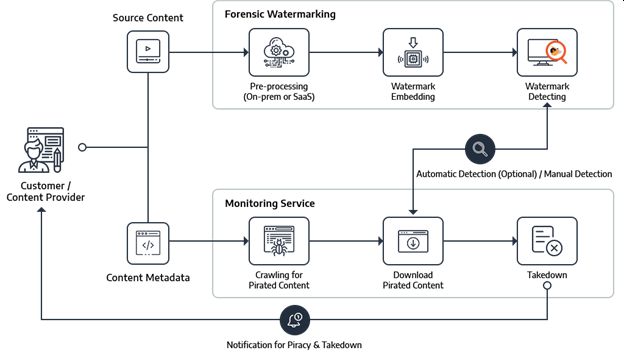
The Anti-piracy solution supported by forensic watermarking integration globally monitors content leakage. It issues a DMCA Takedown Notice to the pirated website before eliminating unlawful content from the site.

PallyCon’s forensic watermarking integrated system intelligently crawls and detects hundreds of illicit pirated links over the internet. It takes down the same while providing customers with the choice to detect the source of piracy.

Marketing Technology News: Moviebook Showcases Full-Stack Technology Solutions for Digital Commerce at CIFTIS 2021 in Beijing

Features of powerful Anti-piracy solution –

– 24×7 Fully Automated service for monitoring
– Global Coverage (for crawling, Detection & Takedown)
– Automated and manual takedown service
– Pre-integrated with PallyCon Forensic Watermarking
– Unique identification of piracy source
– Suitable for VOD content

Expressing his views on the launch, Mr James Ahn, Founder & CEO of INKA ENTWORKS, said that producing premium content requires effort, time, and money. Illegal content copy leads to massive losses to producers and diminishes the charm of new movie releases or any creative content produced.

PallyCon can now safeguard and enable content production houses and content studios to fearlessly produce and distribute content safely by adding an anti-piracy solution to the digital arsenal.

The Anti-piracy solution is a premium addition to the suite of PallyCon content protection, warehousing and forensic watermarking technologies designed to secure and guard apps and developers against various breaches and content piracy.

Marketing Technology News: [24]7.ai Named a Leader in the Everest Group Peak Matrix for Conversational AI Products, 2021

Audius Integrates With Phantom Wallet Bring Solana NFT’s to Its Music Streaming Platform

0
Audius Integrates With Phantom Wallet Bring Solana NFT’s to Its Music Streaming Platform

AUDIUS LAUNCHES NEW COLLECTIBLES GALLERY FOR CREATOR PROFILES WITH SOLANA NFT INTEGRATION

Audius , a blockchain-based music streaming platform, announced the launch of its Solana NFT integration after the high-speed blockchain clocked in $60 million collectible transactions in the last week. The initial integration features exclusively the popular Solana wallet, Phantom (https://phantom.app/). This integration will unlock a new feature for Audius Silver Tier profiles, allowing its more than six million users to begin showcasing Solana SPL NFT collectibles alongside Ethereum’s ERC-20 NFT collectibles such as Crypto Punks, Bored Ape Yacht Club, Cool Cats, Hashmasks and more.

Marketing Technology News: Strata Introduces Identity Orchestration Platform for Multi-Clouds

“There isn’t a robust NFT discovery layer in Solana yet. Building on the success the Audius collectibles tab has had in the Ethereum community, Solana support connects the Solana NFT ecosystem with the over 6mm monthly users of Audius,” said Roneil Rumburg, co-founder and CEO of Audius. “Tooling from Metaplex and the Audius integration with Phantom made it possible to ship Solana support while maintaining the usability bar that Audius has become known for.”

To date, over 100,000 artists spanning Skrillex, Weezer, deadmau5, Diplo, Russ, MadeinTyo, and Odesza to indie artists and DJs are using Audius to deliver a unique listening experience to their fans. Using Audius’ free web, desktop and mobile app, anyone can publish their own original or remixed music content and playlists for the platform’s community to discover, consume and share.

“Audius has become the fastest growing music streaming platform and its remarkable growth signals a seismic shift coming to the digital music and media industries,” said Brandon Millman, CEO and co-founder of Phantom. “We are excited for Phantom to be the main gateway for Solana NFTs to debut with the Audius Collectibles Gallery and look forward to becoming more embedded in the platform’s native user experience.”

Marketing Technology News: MarTech Interview with Navdeep Saini, Co-founder and CEO at DistroScale

Phantom turns browsers like Chrome, Brave, Firefox, and Edge into an easy-to-use Web3 crypto wallet to interact with blockchain-based applications. Using its browser plug-in, users can easily track their digital assets portfolio and view their NFT collectibles in one place. The usability and quality of the Phantom wallet experience is synonymous with the experience that Audius aims to deliver.

“Agility and feedback are key to delivering a high quality user experience in any application,” said Anatoly Yakovenko, CEO of Solana Labs. “Solana allowed Audius to move key information for its growing network of artists, tracks and playlists on-chain. Their growth to six million MAU is a prime example of the web3 world to come.”

The Solana NFT ecosystem has seen tremendous growth with record breaking collectibles including Degen Ape Academy, Solana Monkey Business, and several others.

Marketing Technology News: 4 Best Practices For Managing A Remote Tech Workforce

Capillary Technologies Ramps up Loyalty Game with Acquisition of Persuade

0
Capillary-Technologies-Ramps-up-Loyalty-Game-with-Acquisition-of-Persuade

Capillary’s acquisition of Minneapolis-based company strengthens its ability to deliver hyper-personalized customer loyalty and engagement experiences in an increasingly online world

Singapore-headquartered Capillary Technologies, a leading global customer loyalty and customer engagement solutions provider, today announced the acquisition of Minneapolis-based customer experience (CX) company, Persuade. This marks the company’s first US acquisition and fourth globally.

Marketing Technology News: MarTech Interview with Bonnie Crater, CEO at Full Circle

“Our shared commitment to reimagining loyalty will expand our combined market reach and sharpen our joint technical capabilities, delivering impactful and always-engaging solutions to customers.”

Capillary’s enterprise-ready AI-powered SaaS platform drives consistent business growth and establishes enduring brand relationships with 500M+ customers across multiple industries including apparel & fashion, luxury & lifestyle, food & beverage, supermarkets, hospitality, retail, and consumer goods and durables.

Capillary’s acquisition of Persuade, a brand with over thirty years of expertise, further extends Capillary’s presence in North America and strengthens its position as the global customer loyalty and engagement leader. Persuade’s expertise in digital capabilities and its advanced loyalty platform will complement Capillary’s capabilities to raise the bar of customer loyalty programs and deliver solutions for new verticals like airlines, automotive, and healthcare benefiting customers across the globe.

Persuade is a highly profitable company serving several Fortune 500 brands and having grown 300% in CY2020 and already surpassing its CY2020 revenues during the first six months of CY2021.

Marketing Technology News: ZAPTEST Rated #1 Best Web Testing Tool and Best RPA tool of 2021 by Guru99

“Persuade’s founders, John Tschida and Bill Jansen, bring a deep understanding of customer loyalty with many decades of combined experience in the loyalty management space. They have crystalized their knowledge by building four highly successful loyalty companies including Persuade. Their team of seasoned professionals have built a world class portfolio of prestigious customers. Together, Persuade and Capillary strive for excellence in the global loyalty space,” said Aneesh Reddy, Co-Founder and CEO of Capillary Technologies.

“We are absolutely thrilled to join a global industry leader like Capillary,” said John Tschida, Founder and Managing Partner of Persuade. “Our shared commitment to reimagining loyalty will expand our combined market reach and sharpen our joint technical capabilities, delivering impactful and always-engaging solutions to customers.”

Post-pandemic, companies worldwide are busy reinventing loyalty strategies and this especially involves adapting to the meteoric growth in digital and online customers sparked by rolling lockdowns and less accessible brick-and-mortar business. To meet this need for change and adaptation, the Persuade acquisition enables Capillary to turbocharge curated actionable insights across the customer’s entire journey for both in-store and also online experiences.

Amidst ever-changing consumer expectations, Capillary strives to ensure that customers worldwide remain loyal to their chosen brands by intelligently rewarding them for desired behaviors through hyper-personalized loyalty and engagement experiences.

Marketing Technology News: HyperX Signs Professional Tennis Player Daniil Medvedev as Global Brand Ambassador

transcosmos Wholly-Owned Subsidiary, transcosmos China becomes a Microsoft Power BI Partner

0
transcosmos-wholly-owned-subsidiary_-transcosmos-China-becomes-a-Microsoft-Power-BI-Partner

With the Microsoft BI Solution, transcosmos China helps clients leverage their e-commerce data efficiently

transcosmos inc. is proud to announce that Shanghai transcosmos Marketing Services Co., Ltd. (Headquarters: Shanghai, China; CEO: Eijiro Yamashita; transcosmos China), its wholly-owned subsidiary has become a Microsoft Power BI Partner. As a Microsoft Power BI Partner, transcosmos China will offer customized digital solutions to each individual client, thereby helping clients make data-driven business decisions.

Marketing Technology News: Granite Announces Vice President of Transformation

Given the rapid growth of the e-commerce market, many businesses have shifted to online from offline. Yet, those who have entered the online space are now facing the critical challenge in unifying siloed data onto one platform so that they can leverage the data for making business decisions. transcosmos China has been offering both online sales and website operation services for various brands as their online sales partner. With expanding their business continuously online,transcosmos China’s partner brands need to solve many problems urgently, one of which is how to manage the various data with overwhelming amount that colletcted from the online businesses efficiently.

To Leverage its extensive e-commerce and data analytics experience, transcosmos China has designed a custom solution to suit clients’ needs. The three-phased solution is designed to integrate and visualize brand data. In the first phase, transcosmos China automatically collects client data including CRM, marketing and logistics by using a Robotic Process Automation (RPA) program. In the second phase, the collected data are stored and managed in a scalable cloud database. And in the third phase, transcosmos China builds various dashboards then visualizes the data with Power BI. With the efficient data visualization, clients can not only always monitor their store sales data and track progress against KPIs, but also quickly identify underperforming channels and bottlenecks.

The product report dashboard that shows sales data combined with promotion efficacy
Leveraging the automated program for collecting data and Power BI dashboards, transcosmos China helps clients drastically save time generating online sales reports and utilize data at the right time. Going forward, transcosmos China plans to widen the scope of using Power BI for its partner brands and apply success cases to many more brands.

Marketing Technology News: Moviebook Showcases Full-Stack Solutions for Industrial Digital Transformation at CIDEE 2021 in…

IAS Study Shows Ad Context Increases Memorability Up to 40%

0
IAS-Study-Shows-Ad-Context-Increases-Memorability-Up-to-40%

New biometric research finds consumers respond more to ads in suitable contexts

Integral Ad Science a global leader in digital media quality, released The Context Effect, the company’s latest biometric research on the importance of context in advertising. Conducted with IAS and Neuro-Insight, a neuromarketing and neuroanalytics company, this study goes beyond traditional survey data on consumer preferences and examines brain activity in response to contextually matched ads, showing context can significantly impact ad memorability.

“Using the latest neuroscience and neurometrics, this groundbreaking study demonstrates the specific ways that a webpage’s context can dramatically alter how audiences recall and respond to ads,” said Tony Marlow, CMO, IAS. “As our industry prepares for a cookieless future and increasingly moves away from audience targeting, advertisers have a significant opportunity to be intentional with contextual targeting tools, such as IAS Context Control, to drive greater campaign outcomes.”

Marketing Technology News: Vivial Named “Best Content Writing Service” For Fourth Straight Year in Annual MarTech Breakthrough…

In The Context Effect, consumers evaluated content across three types of contextual matching and IAS uncovered these key findings that can help brands ensure their ads resonate:

  • Endemically matched ads drive higher memorability: Endemically matched ads, or those that align with and match the surrounding content based on vertical (e.g. auto ad near auto content), drove a 23% lift in activation within the part of the brain responsible for memory of practical details, which includes key messages, calls to action, and branding elements. These ads also boosted global memory by 27%, or the memorability of broad themes, overarching narratives, or audio and visual elements.
  • Informational ads perform best when matched with an article’s key message: According to the findings, matching informational ads with an article’s message creates a very strong detail memory response, and drove a 36% lift in detail memory compared to when there was no match. This can be especially relevant for campaigns that focus on a clear call to action that brands want consumers to respond to.
  • Ads focused on an emotional response are best paired with content themes: Ads that aim to leave an emotional memory, a particular feeling or overarching brand perception among consumers performed best when placed alongside articles with a matching theme (for example, an ad with a seasonal Summer thematic adjacent to summer season content). The study found that emotive ads drove 40% higher global memory within thematically-matched articles compared to when there was no match.
  • Consumers recognize ads as part of their online experience: The vast majority of consumers (63%) viewed ads as part of their online reading, not disruptive or a distraction. Only 36% of participants said they scrolled past an ad without reading it.

These findings demonstrate that digital marketers can achieve higher brand memorability and elicit positive emotional responses from consumers by activating contextual strategies. The Context Effect study from IAS monitored 60 U.S. consumers during a 30-minute mobile experience using Neuro-Insight’s Steady State Topography (SST) to track and record brain activity in real-time. Respondents were also asked to match ads to the context they appeared within.

Marketing Technology News: Granite Announces Vice President of Transformation

Consumers across Asia Pacific Show Strong Preference for OTT Platforms; Consider Its Content as Premium Video: InMobi Report

0
Consumers across Asia Pacific Show Strong Preference for OTT Platforms; Consider Its Content as Premium Video: InMobi Report

On average, 46% of respondents across five countries preferred viewing content on over-the-top (OTT) platforms, while 53% felt OTT platforms had the most immersive content  

InMobi, world-leading provider of marketing and monetization technologies reaching billions of consumers around the globe, today released the findings of The OTT Premium Video Wave Consumer Study, Asia Pacific 2021. The report examines consumer preferences for OTT video platforms to other video platforms such as cable TV, long-form videos, and short-form videos, over the last year. It also unravels consumer perceptions of value, ad relevance, and willingness to pay for these platforms across India, Singapore, Indonesia, the Philippines, and Australia.

Marketing Technology News: CoinDesk Positions Itself for Long-Term Growth With Migration To Arc XP

With home media consumption surging globally due to the pandemic, more people are watching OTT content than ever before. Insights from the InMobi report reveal that in 2020, an average of 46% of consumers across Australia, Singapore, India, and the Philippines demonstrated a clear preference for watching videos on OTT platforms; in Indonesia, consumer preference for OTT was second only to long-form videos. Respondents were also more likely to watch and discuss OTT content with friends and family over any of the other compared platforms, indicating the prevalence of OTT in everyday life.

“We are seeing OTT becoming the premium video content platform of choice within the Asia-Pacific region, where several providers have experienced massive jumps in subscriptions during the past year. Users have shown that they are willing to pay for and accept the monetisation of OTT premium content through ads, so we expect that advertisers who make OTT a core part of their programmatic marketing strategies will gain a significant advantage,” said Vasuta Agarwal, Managing Director of Asia Pacific at InMobi.

Marketing Technology News: Martech Interview with Amy D. Love, CMO of SambaNova Systems

The report shares additional insights on consumer preferences for OTT premium video platforms across the region, as well as their perceptions on ads on these platforms compared to cable TV, long-form videos, and short-form videos:

  • Over 40% of respondents in all markets rated OTT platforms as having the ‘most immersive and engaging content’ as well as being the most ‘value for money’
  • Respondents in all markets were least likely to give up OTT platforms, would continue using them even if they were fully ad-based, and were most willing to pay for them
  • At least 50% of respondents in all markets found ads on OTT platforms somewhat relevant, with the Philippines most receptive towards these ads
  • OTT platforms also had the most influence on product selection and purchase among four out of the five surveyed markets, ranking in the top two influential platforms for Australia, Singapore, India and the Philippines
  • Respondents from all countries ranked OTT platforms among their top two for watching and discussing content with their friends and family, indicating that it has captured the family viewing space.

Marketing Technology News: MarTech Interview with Hannah Stewart, VP Marketing at Zeotap


Impact Opens Office In Denmark With Experienced Agency Director Announced

0
impact.com closes 2021 with new Google Pay integration, $150M in funding and 51% increase in clients YoY

Expansion in Nordics for Impact to serve growing roster of clients in the region

The leading partnership management platform, Impact, founded in the US in 2008, has announced the opening of an office in Copenhagen, Denmark, amid the continued expansion of its EMEA team and rapid growth of the global partnerships technology company. As influencers, and other marketing partners become one of the cornerstones of growth for ambitious CMOs, so does the demand for a tool that makes it easy to manage and optimise partnership channels.

Marketing Technology News: Martech Interview with Amy D. Love, CMO of SambaNova Systems

Impact’s expansion into the Nordics solidifies the company as the global leader in and a driving force behind the Partnership Economy. 

To spearhead Impact’s expansion in Denmark, Nicolai Mariegaard has been appointed Country Manager, whilst facilitating collaboration with other Nordic countries. A performance marketing veteran, passionate about creating optimal customer experiences in a digital world, Nicolai has worked with a range of organisations to help them engage and activate customers in a rapidly changing technical landscape – at household names including Toyota, Saxo Bank, Bang & Olufsen, Netflix, Kraft Foods, Universal Music, and many more.

His many areas of expertise include business development, strategy, branded content and digital transformation, with recent spells at companies such as m/Six, where he was CCO.

“With a growing number of Danish customers, we feel it’s an ideal time to have boots on the ground to ensure optimal service for those in the region,” says Frederic Taillier, General Manager Nordics, Impact. “We’re delighted to welcome Nicolai on board to spearhead our efforts here. He is passionate about data-driven business transformation; always seeking to understand the ever-changing needs and behaviours of customers and build services and business models around them, using new technology.”

Nicolai comments: “As Impact continues to grow its team and evolve its market-leading offering, I will be dedicated to supporting Danish and Nordic customers. This is such an exciting time to join, with CMOs waking up to the power of partnerships. That said, while the sector is rapidly gaining traction, there is still a long way to go in terms of transparency and cross channel optimization. Impact is here to help with that.” 

Impact’s varied global client base include Nordic companies such as Soundboks and Organic basics, as well as international clients like Uber, Shopify, and Walmart.

Marketing Technology News: HyperX Signs Professional Tennis Player Daniil Medvedev as Global Brand Ambassador