Home Blog Page 4187

The ADVERTISING Club of New York Enlists Top Industry Talent as New Board Directors

0
The ADVERTISING Club of New York Enlists Top Industry Talent as New Board Directors

Club Honors Standout Talent with 2018 President’s Award and Rising Star Accolade

The ADVERTISING Club of New York, the industry’s leading professional organization representing the advertising, media, marketing and ad-tech industries, announced the addition of seven new board members to new posts at its 122nd Annual Meeting of Members. The event took place at Horizon Media’s Headquarters in New York on July 18.

“All of the great momentum The AD Club has experienced recently is articulated by the recent changes to our board, with a new roster of talented, dedicated individuals at the core of our success,” said Gina Grillo, President and CEO of The ADVERTISING Club of New York and the International ANDY Awards. “The inclusion of some of advertising’s biggest and brightest stars will certainly help our organization continue to grow and make great strides that benefit not only Club members, but the industry at large.”

Also Read: SaaS and Technology Industry Revenue Acceleration Expert Jeff Loeb Joins Chief Outsiders’ Northeast Group

The list of Board Officers and Directors include:

Officers:

  • For Chairman: Mari Kim Novak, President, Stillwell Partners
  • For Senior Vice President: Lee NadlerLead Urban Growth & Transformation, MINI USA
  • For Vice PresidentRick SongChief Revenue Officer, Telaria
  • For Vice PresidentSandra Sims-Williams, Chief Diversity Officer, Publicis Groupe
  • For TreasurerMarie DevlinPartner, Brand Team Partners
  • For Chairman EmeritusCarl Fremont, President, Wavemaker Wunderman Alliance

Directors:

  • Devika Bulchandani, President, McCann New York
  • Sophie Kelly, SVP/NA Whiskeys Portfolio, Diageo
  • Nick Law, Global Chief Creative Officer, Publicis Groupe
  • Sandra Moerch, Site Manager of SAP Leonardo Center & Global Head of Branding, SAP Next-Gen
  • Michael Sallette, Global Marketing & Media, Nestle
  • Andrea Sullivan, Chief Client Officer, VaynerMedia
  • Lisa Valentino, EVP/Revenue Innovation, Univision Communications
  • Joseph Bihlmier, VP/Global Media, American Express
  • Colleen DeCourcy, Partner, Global Co-Executive Creative Director, W+K
  • Katrina Craigwell, Executive Director, Head of Marketing, Finn by Chase
  • Eliza Esquivel, CMO Consultant
  • Scott Falzone, Managing Director, Telecom at Google
  • Olivia Douglas, EVP, Senior Account Director, BBDO
  • Ron Fierman, Partner & President, Digital Pulp
  • Heide Gardner, SVP, Chief Diversity & Inclusion Officer, Interpublic Group
  • Jennifer Gardner, Senior Director, Media, Unilever North America
  • Jeremi Gorman, Head of North America Advertising Sales, Amazon
  • Elyssa Gray, VP/Branding, betterment.com
  • Brad Jakeman, Marketing Consultant
  • Andrew Keller, Global Creative Director, Facebook Creative Shop
  • Danielle Koffer, Chief Client Officer, Mindshare North America
  • Kris Magel, Media Executive, Denstu-Aegis Network
  • Lauren Newman, President/Beauty, Meredith
  • Tricia Nichols, SVP/Global Consumer Marketing, Estée Lauder
  • John Nitti, Chief Media Officer, Verizon
  • Barbara Pelham, Vice President of Global Agency Partnerships, Oath
  • Laurel Rossi, CMO, OMD
  • Bill Westcott, Executive Vice President, Medialink

Also Read: 2018 Content Marketing Awards Winners & Top Finalists Revealed

Young Pro President:

  • Michael Knopf, Director, Medialink

*Indicates new Directors

With Board Chairman Mari Kim Novak’s industry-wide reach, The Club has been able to expand its membership even further, particularly in the digital arena.

“I’m inspired by the talent and passion that sits on The AD Club’s board. This combination of directors will be empowered to make a real and positive difference to our business,” said Novak. “When it comes to training and education of talent in all aspects of the industry, The Club’s resources are unmatched and continue to play an instrumental role in shaping the future of advertising. Not to mention, the Foundation’s endless dedication to championing the power of diversity and promoting a platform that helps educate brands and agencies alike on how to do business better.”

The AD Club also recognized recipients of the 2018 President’s Award, which is granted to individuals and organizations who have demonstrated an outstanding volunteerism and commitment to The Club. They also honored a Rising Star, whose contributions have gone above and beyond. This year’s recipients include:

President’s Award

  • Rick Boyko, Retired, Co-President CCO Ogilvy North American / Director VCU Brandcenter
  • Adam Cohen-AslateiVice President of Marketing, Jun Group
  • Pete Favat, Chief Creative Officer, Deutsch
  • Jeremi Gorman, Head of US Advertising Sales and Global Accounts, Amazon Media Group
  • Harry Kargman, Founder and CEO, Kargo
  • Andrew Keller, Global Creative Director, Facebook Creative Shop
  • John Nitti, Chief Media Officer, Verizon
  • Lukeisha Paul, Senior Partner, Associate Director, Print
  • Barbara Pelham, Vice President of Global Agency Partnerships, Oath
  • Carly Zipp, Senior Director of Communications, Sponsorships, & Events, Outfront Media

Rising Star

  • Jordan Weinstein, Director of Business Development, Candid Worldwide

Recommended Read: Tableau Executive Mark Nelson Joins Talend Board of Directors

comScore Announces Campaign Ratings to Solve Cross-Platform Video Ad Measurement Challenge

1
comScore Announces Campaign Ratings to Solve Cross-Platform Video Ad Measurement Challenge

comscore’s New Product Will Offer Unduplicated Campaign Measurement Across Linear TV, Network OTT and Hulu on Desktop, Mobile, and Living Room Devices

comScore has announced a pilot program for its newest solution aimed to solve the industry’s need for sophisticated cross-platform video advertising measurement. The product, called Campaign Ratings, launches in beta this September with ABC, CBS, CNN, Disney, Fox, Freeform, GroupM, NBCUniversal, The CW Network, Turner, and Viacom, and will provide media buyers and sellers with trusted, unduplicated measurement of ad campaigns across linear TV, over-the-top (OTT), desktop, and mobile platforms, with streaming measurement powered by Hulu.

Currently, comScore is a trusted partner for planning, transacting, and evaluating media across platforms.

Bryan Wiener, CEO of comScore, said, “The measurement gap in advertising has hampered media brands from fully articulating the value of their audiences and advertisers from gaining an accurate understanding of campaign performance.”

Bryan added, “We heard from customers that cross-platform video measurement is a pain point that continues to magnify as audience viewership and engagement proliferates across screens. We’re excited to collaborate with these industry-leading partners on a product that will reduce friction and enable media buyers and sellers to drive business growth.”

The new solution will include an unduplicated view of total audiences across linear TV and digital platforms, person-level reach and co-viewing insights, and reliable audience demographics. comScore will incorporate feedback from beta partners to iterate on and optimize future releases of the product.

comScore’s recent “State of OTT” report highlighted that two-thirds of OTT audiences are also watching linear TV, demonstrating the convergence of digital and linear video consumption and a growing need for unduplicated, cross-platform measurement. In fact, another recent comScore study revealed that OTT alone increased the average number of linear TV viewers for a specific network program by 20 percent. When also combined with mobile and desktop, linear TV viewership for that same program increased by 42 percent, with audience reach increasing by 33 percent.

Given these trends, comScore is partnering with Hulu to power the product’s OTT measurement capability. The comScore “State of OTT” report found that Hulu viewers watched more hours of content per household than any other subscription service. Hulu has amassed more than 20 million U.S. subscribers as of May 2018.

This program is the first step in a broader company initiative to develop comprehensive and unduplicated measurement across all platforms and content types. As part of this initiative, comScore will continue to work with leading media buyers and sellers to create a true cross-platform solution made for the industry, by the industry.

What Customers are Saying

“The market is ripe for true cross-platform measurement that provides critical insight into unduplicated audience reach and co-viewing behavior,” said Radha Subramanyam, Chief Research and Analytics Officer, CBS.

Radha added, “We’re passionate about this initiative and look forward to partnering with comScore’s new leadership on a solution with the potential to move our entire industry forward.”

“CNN has a history of collaborating on new measurement solutions with comScore, notably as an Xmedia launch partner, in order to capture the full multi-platform scope of the CNN brand,” said Robin Garfield, SVP of research and scheduling, CNN.

Robin added, “This beta is another important step towards that goal and will ultimately help the entire industry accelerate investments in content experiences across a growing number of platforms and environments.”

“We continually work with partners and research companies to identify multiplatform measurement solutions that better serve our clients by providing them with a holistic understanding of their audiences and how they engage with brands,” said Elizabeth Sloan, SVP Consumer Insights, Disney|ABC Television Group.

“Supporting the development of a unified, third-party, audience metric covering all video platforms has been a priority for GroupM. A robust, comprehensive video currency is essential to maintaining a healthy video marketplace where agencies can productively trade clients’ budgets with media partners,” said Ed Gaffney, Head of Implementation Research and Marketplace Analysis, GroupM.

Ed added, “We look forward to the shared learning we’ll achieve with our clients by participating in the pilot of this new audience metric.”

“By powering comScore’s cross-platform measurement product for OTT, we’re giving marketers more options for measurement and a third-party validation of the incremental reach only Hulu provides at scale,” said Julie DeTraglia, Vice President and Head of Research at Hulu.

Julie added, “Our partnership with comScore is just another step towards achieving comprehensive measurement for the entire industry.”

“As NBCUniversal continues to seek out the best cross-platform measurement practices, and build on the momentum we’ve created with CFlight, we look forward to working with our measurement partners on new approaches,” said Kavita Vazirani, Executive Vice President, Insights and Measurement, NBCUniversal.

Kavita added, “Industry adoption of new measurement methodologies will be key in keeping up with the changes in consumption of our content.”

“Consumers are watching more video than ever, which underscores the importance of efforts by Turner and the industry as a whole to measure the impact of advertising across every screen, platform and environment,” said Beth Rockwood, vice president of portfolio research, Turner.

Beth added, “Providing measurement that can facilitate accurate planning, and fully value premium video is a priority for both buyers and sellers, and we look forward to expanding on our efforts with comScore through this beta to create measurement solutions that advance the industry.”

“This is a critical effort, not for the future of television, but for its present,” said Bryson Gordon, Executive Vice President of Advanced Advertising at Viacom.

Bryson added, “Closing the cross-platform measurement gap, that once intractable market challenge, with innovation across the industry like the comScore Campaign Ratings pilot and OpenAP’s platform for advanced advertising, will help to propel the industry’s transformation towards new currencies, products and consumer experiences.”

With a data footprint that combines digital, linear TV, over-the-top and theatrical viewership intelligence with advanced audience insights, comScore allows media buyers and sellers to quantify their multiscreen behavior and make business decisions with confidence. A proven leader in measuring digital and set-top box audiences and advertising at scale, comScore is the industry’s emerging, third-party source for reliable and comprehensive cross-platform measurement.

Chorus.ai Brings AI Technology at the Center of Business Conversation Analytics

0
Chorus.ai Brings AI Technology at the Center of Business Conversation Analytics

Chorus.ai Launches ‘Smart Themes’ AI Technology for Analyzing Business Conversations

Most clouds in a company, be it for sales, marketing or BI, have the power to deliver real-time values if they are driven by AI technology. Chorus.ai provides one such platform to leading businesses, where users can identify patterns and themes. Chorus.ai, the creator of the leading Enterprise Call Recording Conversation Cloud solution, announced the launch of its “Smart Themes” technology.

At the time of this announcement, Roy Raanani, CEO & Co-Founder of Chorus.ai, said, “When sales calls are analyzed, it’s hard to know what to look for, especially if executives are using traditional means, such as looking for manually categorized keywords.”

Roy added, “Our technology learns on its own and tells users exactly what they need to know. This process of unsupervised learning means we don’t need to manually input themes; Smart Themes identifies key themes and analyzes them for you.”

Smart Themes Makes Effective Analyses on Business Conversations After Just a Few Hundred Hours of Engagement

Smart Themes utilizes Chorus.ai’s sophisticated AI engine and through a process of unsupervised learning, proactively identifies patterns and themes within conversations and organizes them for easy access to insights. Identifying the use and placement of specific themes serves to bolster best practices, allowing the entire team to benefit from the work of the top performing sellers. Smart Themes begins to produce effective analyses after just a few hundred hours of conversations.

‘Smart Themes’ technology is an AI-powered solution that automatically analyzes business conversations, identifying common themes and topics for sales reps.

AI-powered solutions can significantly alter how day-to-day business conversations are conducted, by transforming them into meaningful data and identifying patterns that can improve the quality and impact of these conversations. While other AI technologies are limited by companies’ tagged data, Smart Themes automatically identifies common patterns, saving time and money by eliminating manual tagging and bypassing cumbersome research.

“Smart Themes automatically learns and highlights important moments in our calls without any configuration from an Admin or Sales Manager,” said Jennifer Yelton, Director of Sales Operations at Recurly.

Jennifer added, “It saves time and setup, but more importantly can tell us things about our sales process that we didn’t know impacted our win and renewal rates.”

Chorus.ai Has Changed How Sales Reps Conduct Sales

Top-revenue teams continue to choose Chorus.ai’s solutions to increase efficiency in business conversations. Marketing companies such as EverString and Engagio, and software companies like Procore, have used Chorus.ai’s technology to shorten ramp times and close more deals. Chorus.ai has changed how sales reps conduct sales and Smart Themes is the latest step in this process.

Currently, Chorus.ai provides its market-leading platform for transforming conversations into data and insights. It is ensuring more effective communication between companies and their customers. Chorus.ai’s technology transcribes and analyzes business conversations in real time. The proprietary algorithms detect High-Value Moments that serve as the foundations of an effective strategy for sales and customer success teams, thus freeing sales representatives to focus on building relationships.

Taoping Alliance Receives $17.6 Million Ad Distribution Order from Ju’an Home

0
TAOP Launches Taoping G Cloud Data Center

Taoping, Inc., a leading provider of internet-based ad distribution and ad display terminal sharing systems in China, announced that Taoping Alliance, a new media operating organization founded by TAOP and Shenzhen Taoping New-Media Limited, have entered into a contract with Ju’an Home, a nation-wide in-home care and service platform. The contract is expected to generate $17.6 million revenues for Taoping Alliance within the next twelve months.

According to the contract, Ju’an Home’s real-time ads, including brand promotions, lock hardware products announcements, and in-home care and service announcements, can be distributed on the selected cloud-based ad terminals respectively owned by local members of Taoping Alliance throughout 22 cities in China. As the developer and technology/ service provider of the Taoping new-media eco-system and the founder of Taoping Alliance, TAOP is expected to receive approximately 15% of the total revenue generated from the contract.

“We are pleased to partner with Ju’an Home,” said Mr. Jianghuai Lin, the Chairman and CEO of TAOP, “By utilizing its nation-wide networks and TAOP’s sophisticated new-media distribution and sharing platform , Taoping Alliance provides local communities the convenience service and adds value to the consumers.”

Taoping Alliance is a nationwide advertising resource sharing platform jointly founded by TAOP and Shenzhen Taoping New-Media Limited. Since its establishment in May 2017, the members of Taoping Alliance have increased to fifty-six members with the coverage of over twenty-five provinces and provincial cities throughout China.

Recommended Read: VenueNext Appoints Anthony Perez as New Chief Executive Officer

Connected Planning: The Key to Customer Engagement

0
Engagement

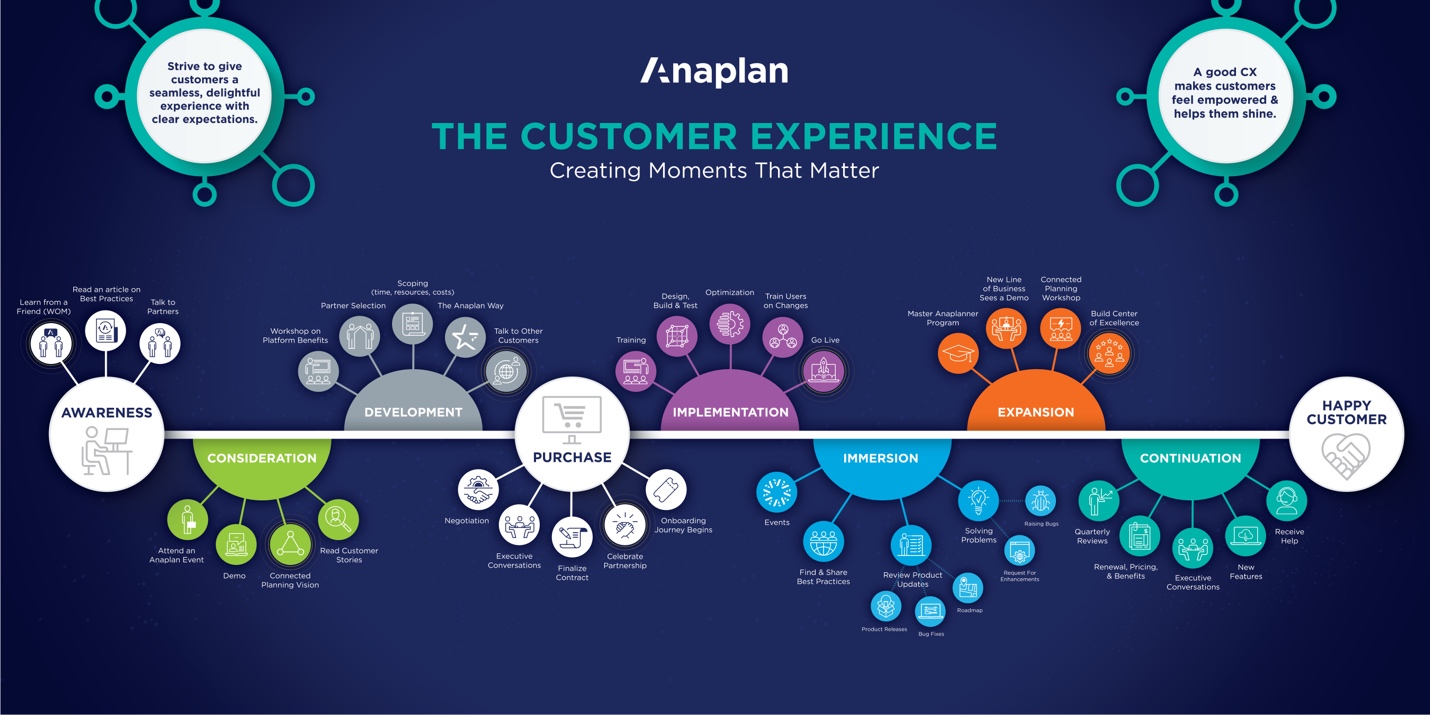
anaplanEngagement is the heart and soul of the customer relationship. Engaged customers are happy customers—they not only share their opinions and experiences, but also trust the vendor to respond in ways that deepen the buyer/seller relationship, increasing loyalty (not to mention repeat purchases) over time.

Customer EngagementAt Anaplan, we believe the essential prerequisite to engagement is a “Customer First” approach. Easy to say—most companies believe in focusing on the customer—but in practice, challenging to implement. Customer First, in order to succeed, must be cultural. It has to permeate the entire organization so that every employee sees her or his job through the lens of the customer experience.

Thanks to Anaplan’s senior management, Customer First has that kind of priority in our company. But for the marketing function in particular, it’s important to view Customer First as a customer lifecycle question. It’s not enough to focus on lead generation; marketers must consider the entire spectrum of touchpoints including relationship management, retention, and customer value creation.

Customer Engagement

At every turn, customer interests must be prioritized in order to achieve the engagement marketers look for. When establishing customer communities online, for example, it makes sense to appropriately open those communities to one’s own employees and business partners. Doing so allows those individuals to see customer concerns, share experiences and tips, and answer questions.

Also Read: Mastering Customer Experience in the Era of the Empowered Consumer

Survey Fatigue

Account-based marketing is another way to gain insight into the complex interests of key accounts (care should be taken, however, to not overlook smaller, yet still loyal customers). Even surveys—a prime source of customer learning—need to be handled carefully. Survey requests from multiple departments should be combined in order to minimize survey fatigue. Incentives also help, to show customers that their time is valued.

At Anaplan we use our own product, the Anaplan Connected Planning platform, to improve our marketing efforts. Connected Planning allows people, data, and plans to seamlessly interact across an enterprise to better manage virtually any and all organizational planning. Working from a single platform, managers can draw from, and inform, all relevant areas of the business.

Connected Planning offers multiple benefits to marketers focused on engagement. Because it allows other departments to see the potential impact of upcoming campaigns, it builds support for marketing efforts and enables those departments to plan better. For marketing executives, Connected Planning provides a more holistic view of the customer, drawing in more data faster and from more sources. As data is rolled up and analyzed collaboratively and across functions, new insights are generated.

Also Read: Lessons B2B Brands Can Learn from Direct-To-Consumer Disruption

Reduces Lag

Finally, Connected Planning reduces lag time for campaign iteration, allowing marketing teams to adjust to customer priorities. Not only do customer feel they are being heard, but teams are better able to shift dollars as needed to places where campaigns are working well—or to places that need help.

The single source of truth that Connected Planning provides is a big advantage for maximizing customer engagement. Used effectively, it promotes a culture that continually puts the customer first—ensuring the success not only of the customer, but the business as well.

Zoho One Achieving Rapid Market Adoption; New Apps, AI, Analytics and Zia Search Further Extend Power of the Integrated Software Suite

0
Zoho

Business-wide AI, Analytics and Search Demonstrate the Power of Building Services on a Pre-Integrated Operating System

Today Zoho announced major updates to Zoho One, its flagship suite of applications designed to put businesses completely in the cloud. Launched in July 2017, this all-in-one solution includes apps that run sales and marketing, finance and HR, operations and business intelligence. One year later, Zoho One is enabling a new set of capabilities that bridge the gap between different departments and roles within an organization: Zia—Zoho’s AI—can now respond to user queries by combining information from multiple apps; Zoho One’s new Analytics delivers a deeper, more contextual picture of business operations by blending data from apps across the suite; and a new unified Search feature can execute across multiple applications, bringing back richer results that significantly reduce the time and effort needed to find the right data.

The company also announced Zoho One adoption numbers for its first year on the market: more than 12,000 business worldwide—with 40 percent from the US—have become Zoho One customers. The average Zoho One customer enables 16 applications for their business, often replacing software from different vendors, preferring instead to run their business from a single cloud platform. The company has added four new apps to Zoho One in the past year—CliqZoho SprintsZoho PageSense and Zoho Flow—and today, they are introducing Zoho Backstage (link), an end-to-end event management software, which is being added to the suite at no additional cost.

“The adoption of Zoho One has exceeded our expectations, and we hope to continue this momentum into its second year. The stats clearly show that customers will use multiple apps from a single suite, if those apps work together more deeply than a patchwork of products from different vendors,” said Raju Vegesna, chief evangelist at Zoho. “We see customers combining data from different Zoho and third-party apps—like email campaigns, CRM, customer support, and invoicing—to generate new insights and make better decisions. Zoho One has already replaced more than 600 different products, and that number will only grow as we release even more new apps.”

New Capabilities Added to Zoho One 

Analytics: The new Zoho One Analytics tab provides analytics across Zoho’s suite of transactional business apps. Business owners, CXOs and managers can now track KPIs and trends all from one place, helping them to make more informed decisions. Users can create their own custom reports and dashboards to blend data from different business apps and do cross-functional analytics. For example, a marketer could combine data from Zoho CRM and Zoho Campaigns to see how many leads were created from a particular campaign and how much they cost. Currently, there are over 500 pre-built reports and dashboards available across applications. Users can also import data stored in third-party applications and analyze it along with the data from Zoho’s internal apps.

Zia for Zoho One: Zia, the AI-powered assistant first introduced by Zoho CRM in 2016, is being extended to Zoho One. Zia for Zoho One functions across various applications, pulling data from different departments to provide the right contextual information. Using simple commands, Zia can handle complex queries. Pulling information from Zoho CRM and Zoho Desk, Zia can tell users how many customers in the sales pipeline have an open support ticket. Similarly, Zia can generate a chart that displays revenue-per-employee trends for the last five years by fetching figures from the accounting app and the human resource management app. Zoho also plans to open up the Zia Voice Platform for Zoho One users, allowing them to extend Zia with custom skill sets built to address their unique needs.

Zia Search: On average, knowledge workers spend 30% of their workday searching for information, according to an IDC research paper. The new Zia Search lets users search across all their Zoho apps instantly, dramatically improving information access within the organization. Zia Search was built from the ground up with an understanding of each application’s domain, design and authorization rules, making it possible to display a more relevant, richer set of results. Zia Search also offers a results preview as well as contextual actions so users can utilize their results without having to leave the search window.

Mobile app: The Zoho One mobile app—for both iOS and Android devices—allows organization administrators and service administrators to onboard new employees, provision applications, manage permissions, set security policies, create groups and more, all from their mobile devices. With this app, admins can even take care of time-sensitive requests, like resetting a password, when they are away from their computers.

Zoho Concierge: Launched last year along with Zoho One, the Zoho Concierge is a free service available exclusively to Zoho One customers. Since its inception, this dedicated 24/7 team has helped more than 6,500 customers by mapping their business processes and advising them on how best to optimize Zoho One for their particular needs.

“Zia for Zoho One, the new Analytics tab, and Zia Search are organization-wide tools designed to give our customers deeper understanding of their businesses,” said Vegesna, “This kind of unified data ecosystem is only possible because all of Zoho’s 40+ applications have been built from scratch, over the last two decades, on the same technology base.”

Statements 

“Zoho One has brought our company closer together. What started out as a North America implementation for 50 users and ended up being a global roll-out for more than 500 employees. Not only do we rely on Zoho One for all intra-company communications, we find ourselves executing more efficiently due to the shared data and analytics we now have across departments and offices. Whether it is through Projects, CRM, Reports, or Connect, all of us have one single source of customer data and work more effectively as one team to serve our distributors and end-users. We’ll continue to explore applications on Zoho One—this is just the beginning of further system expansion we can achieve as a Zoho customer.” – Amanda Dolan, Head of CRM, Purolite

“Businesses are now looking for more integration and automation to simplify workloads for users, make quicker and more informed decisions, and deliver better experiences to customers. And they are gravitating towards vendors who can deliver that combination. To already have more than 12,000 businesses using Zoho One within its first year, ranging from one to 20,000 users, proves the value proposition of Zoho’s integrated platform appeals to companies of all sizes. With so many apps integrated together, Zoho One not only makes it easier for businesses to work more efficiently, but having this integrated data structure allows Zoho to leverage its AI and machine learning technologies to provide users a more diverse and complete data set. This has the potential to combine productivity gains with more impactful customer insights, giving businesses a competitive advantage.” – Brent Leary, Partner, CRM Essentials

“The retail landscape is evolving rapidly and has increasingly become dominated by major online players. As the largest retailer in New Zealand, with more than 200 locations across the globe, it is crucial for us to stay ahead of the landscape changes and be as agile as possible. The breadth of apps within Zoho One has allowed our more than 12,000 employees to work more seamlessly as one team and gives us the ability to communicate real-time across teams and offices. Having data on one platform has also streamlined how we service customers and has unleashed incredible energy within our company. Our response times have been reduced significantly, from days to where we are now able to resolve customer issues in real-time. Zoho One is truly the Operating System for any business!” – Timothy Kasbe, Chief Information and Digital Office, The Warehouse Group

“As a fast-growing solar company in the Northeast, we needed a comprehensive but consolidated solution that not only suited our current needs but our future requirements as well.  Customer satisfaction is our priority, thus it is critical for both sales and operations to access real-time customer status within a single platform. From lead acquisition to installation management, through the final billing, having all our platforms joined in Zoho One helps us track every interaction throughout the customer journey. This has allowed us to work with our customers more efficiently. Having various operational departments all able to work within a single platform has also saved us significant time as Zoho One makes information sharing across apps and channels seamless. We weren’t able to accomplish this prior to Zoho One due to disconnected platforms and the many redundancies that were present with different users, logins, and basic credentials. Our business has grown rapidly, and the ability to scale our operations and adapt to industry changes as efficiently as we have would not have been possible without Zoho One.” – Ben Sopczyk, Director of Marketing, Apex Solar Company

Pricing and Availability

Zoho One is available for $30 per employee per month. Businesses must purchase a license for every employee in their organization to get this pricing. Zoho One is currently available worldwide, in multiple languages. Users can sign up for a 30-day trial version of Zoho One at zoho.com/one.

Zia for Zoho One and the mobile app are not currently available. The Analytics feature will be rolled out in phases, whereas Zia Search is available immediately at search.zoho.com.

Zoho Innovates Event Management Space with New Zoho Backstage

0
Zoho

Comprehensive end-to-end event management platform touts intuitive website builder, seamless marketing campaign integration and event mobile app for attendee engagement

Today, Zoho announced its newest product offering: Backstage, an end-to-end event management tool that allows organizers, corporations, and non-profit agencies to plan, promote, and run enterprise events ranging from large-scale meetings to conferences and trade shows. Zoho Backstage comes equipped with a broad range of features, including a multi-language website builder, agenda planner, attendee mobile app, sponsor management, detailed analytics and more. Backstage adds a completely new marketing channel to Zoho’s integrated suite of apps, Zoho One.

“Planning and running an event is a complex operation that has traditionally required different tools for each stage of the process—a website builder, a mass emailing solution, scanners for checking in attendees, and a stand-alone app for audience engagement,” said Raju Vegesna, Chief Evangelist, Zoho Corp. “Backstage embraces event management from start to finish by offering a unified online platform that allows you to market your event, fill your seats, and engage your audience all from within one product. Rather than getting bogged down in the complexities of the tools being used, this holistic event management system lets organizers focus on what matters: putting on a great event.”

Highlights of Zoho Backstage:

Before the Event

Dynamic event website builder: Zoho Backstage enables organizers to create a dynamic event website from scratch within minutes. The website builder includes multi-language support, an agenda planner, sponsor promotion, direct registration (for free and paid tickets), photo gallery, speaker management, and customizable labels and sections.

Intuitive agenda planner: 

With Backstage’s agenda builder, organizers can create unique schedules for each event, choosing from different session types and organizing presentations into multiple tracks. They can simply drag-and-drop the time blocks to build the perfect event for their attendees.

Sponsor and speaker management:

To get the most out of an event, external partners—such as speakers and sponsors—need to be highlighted prominently on the event website. Important speakers can be featured on the homepage to boost interest, and the dedicated sponsor page gives credit to the outside companies that made the event possible. Backstage also allows organizers to define sponsorship categories to maximize revenue.

Promotion tool: Event planners can use the built-in promotion tools to spread the word and increase event reach. Backstage also offers the option of embedding promotional banners on third-party websites and blogs. It equips event marketers with customizable email templates directed at attendees and sponsors, both for promotional and instructional purposes. In addition to this, Backstage can also be integrated with Zoho Campaigns via Zoho Flow to run email marketing campaigns.

Monitor ticket sales:

Backstage integrates with Eventbrite allowing organizers to watch in real-time as attendance grows in the days and weeks before the event. In the next couple of months, Backstage will also be releasing an in-house ticketing solution that will bring the entire ticketing process onto one platform.

Custom branded mobile app:

Event organizers can provide attendees an engaging experience with a completely custom branded event mobile app. This can be hosted on the app store and is available for both iOS and Android devices.

During the Event

Content Library: Presentations are an integral part of any corporate event. With its native integration with Zoho Docs and Show, Backstage offers a centralized content library to create and manage slide decks, files, images, and more. This ensures that on event day all the presentations are pre-loaded and the sessions run smoothly, without any disruptions.

Agenda personalization:

Personalized agendas allow attendees to keep track of all the sessions they are most interested in. This self-selected schedule makes it easy to check presentation times, speaker bios, and assigned locations on the go.

Audience Engagement:

Backstage also integrates with Zoho’s internal presentation delivery tool, ShowTime. Designed to encourage interaction during presentations, this tool allows attendees to provide speakers with feedback through virtual Q&As, slide likes, and instant ratings, all from within their mobile devices.

Community building:

Event organizers can create an online community even before the event starts. Discussion forums provide a good opportunity for participants to not just interact with the organizers, but also keep conversations going with other participants.

Attendee convenience: Large events can be impersonal and overwhelming if attendee experience is not taken into consideration. In an effort to reduce long lines on the opening day of the event, Zoho Backstage allows staff to check in attendees with the click of a button on the web dashboard or the mobile app, rather than using an external scanning device.

After the Event

Comprehensive analytics: Zoho Backstage gives organizers insight into the key performance indicators for each event, from engagement statistics for individual sessions to attendance metrics for the entire event. Speakers can be evaluated by reviewing the number of likes and comments each session receives, and reading through post-presentation attendee feedback.

Post-event feedback:

Organizers can use Zoho Flow to integrate Backstage with Zoho Survey, making it possible to gather information on how the event resonated with attendees.

Other Integrations: Zoho Backstage is integrated with Eventbrite for ticketing, and will soon have its own ticketing solution. It also work with Zoho Flow, an extensive integration platform that connects Backstage with over 100 third-party applications.

Customer Statements:

“Our Zoho Backstage experience has been very positive.  In less than an hour and a half, Backstage helped me build a two-day event with all the bells and whistles. The ability to have multiple solutions in one place that saved 5 to 6 hours of my time is just wonderful. I highly recommend Zoho Backstage.”

Josh Wagner – Director of Marketing. Fluitec International, New Jersey, United States.

“Zoho Backstage can be best described as convenient, advanced, and smart. We saved a lot of time—and time is money. This solution is definitely worth the investment.” – Quốc Vinh – Group Chairman and CEO. Le Bros, Vietnam

“With Backstage, we were able to save time and money. All it took was a few clicks to get our event website up and running. We were also able to provide our attendees with an engaging and memorable event experience through a custom branded mobile app. Backstage will surely be part of our future events.” – Ramesh C Pathak – PMP, VP Technology. PMI Bangalore, India.

Pricing and availability: 

Zoho Backstage is available immediately, both as a web app and as mobile apps for iOS and Android. Zoho Backstage offers four subscription plans: the Free plan, the Professional plan ($99 per month), the Professional+ plan ($199 per month), and the Single Event plan ($299 per event) with a custom branding add-on at $1000 per year. Custom branding includes a custom domain and mobile app. The Zoho Backstage Professional+ plan is included as a part of Zoho One.

Swrve 3.0 Can Win You More Moments of Multi-Channel Engagement

0
Swrve 3.0 Can Win You More Moments of Multi-Channel Engagement

Swrve 3.0 Is a Powerful Microtargeting Tool Integrating with Multi-Channel Campaign Workflows to Extend Reach Across Mobile, Web, Email and Streaming TV Apps

The rules of engagement have changed. Marketing is shifting from broadcast-based monolithic experiences to contextual, personal experiences served to individuals right in their moments of need.  Leading Mobile Marketing Automation company, Swrve has announced the release of Swrve 3.0. Swrve 3.0 is an entirely new platform that reimagines how marketers know and communicate with their customers across the broad range of mobile, web and TV apps modern consumers use today.

According to Accenture estimates, over $1 trillion is lost to competitors because business messaging is not relevant in the moment. Swrve 3.0 enables marketers to win more customer engagement moments by delivering relevance at scale across the broad range of channels modern consumers use.

This month, the Swrve platform was recognized by Gartner as a Leader in its inaugural “2018 Magic Quadrant for Mobile Marketing Platforms” based on Swrve’s completeness of vision and ability to execute.

At the time of this announcement, Christopher Dean, CEO at Swrve, said, “Eighty-four percent of consumers say the communications sent to them from businesses are irrelevant. Fifty-two percent say they switch brands because of this.”

Christopher added, “Some of the world’s largest organizations are already deploying the new Swrve 3.0 platform, which unites powerful microtargeting capabilities with multi-channel campaign workflows to enable them to win more moments of customer engagement across mobile, web, email and streaming TV apps.”

Swrve 3.0 is a Real-Time Engagement Platform to Reach Customers in Relevant Micro-Moments

Unlike stand-alone analytics tools, Swrve processes real-time behavioral data from multiple sources, builds audiences, and triggers messaging based on user behavior. Presently, the platform process 14 billion events daily. Real-time data eliminates the need to construct elaborate workflows to guess which steps users will take and in which order.

With Swrve 3.0, interactions fire automatically — on any channel — the instant targeting and triggering conditions are met. Uniquely, the platform sees beyond the events a user has taken (e.g. flight purchase), into event “payloads” to unlock individual customer need (e.g. details of the event like LAX/JFK return, no seat purchased, purchased a window seat four times in last five flights).

With an all-new user interface, marketers can build their own segments and audiences on their own and not rely on their business intelligence teams.

Clients Benefit From a Unified, Multi-Channel Campaign Workflow

Swrve 3.0 enables marketers to connect and unify customer data across multiple channels; unify multi-channel campaigns with shared targeting, triggering, personalization and workflow; and finally, reach customers across all the channels modern consumers prefer. These include mobile in-app and push messaging, web messaging, email messaging and messaging through over-the-top (OTT) video streaming platforms like Apple TV, Android TV, and Roku.

Artificial Intelligence Helps Retain and Grow Customer Relationships

Artificial intelligence (AI) technology pervades the Swrve 3.0 platform. It enables marketers to predict individuals whose behavior shows a strong propensity to churn, as well as to optimize mobile experiences with A/B resource testing.

The Autopilot AI feature delivers messaging at each customer’s optimal time of day. Swrve clients entrust Autopilot optimal time delivery to handle 70 percent of all scheduled messages. Using this feature, most clients achieve double or triple response rates compared to “broadcast” approaches.

Currently, Swrve provides SaaS-based, real-time marketing automation software to increase customer engagement through dynamic campaigns across mobile, email, web, TV and emerging digital channels.

Digital marketing and product teams use the Swrve platform’s real-time behavioral analysis and machine learning engines to micro-target messages to millions of segments-of-one at scale while triggering those interactions in micro-moments that matter. Swrve collects customer behavior and attributes from its own SDKs and through flexible integration to virtually any external system or data service.

With the Swrve platform and expert marketing and technical services, brands win more customer engagement moments so they can onboard, retain, convert and monetize for lower customer acquisition cost (CAC) and higher customer lifetime value (CLV).

Branded Cities and NinthDecimal Integrate Out-of-Home and Mobile Advertising for Cross-Channel Brand Engagement

0
Branded Cities and NinthDecimal Integrate Out-of-Home and Mobile Advertising for Cross-Channel Brand Engagement

New Partnership Will Drive Brand Messaging from OOH Locations to Mobile Devices, Delivering Meaningful and Measurable ROI

Branded Cities (BC), a premier Out-of-Home (OOH) and iconic media company in North America and NinthDecimal, the leading omni-channel marketing platform, announced a partnership that will empower brands to amplify their OOH campaigns with mobile advertising. Marketers will have the ability to create one-to-one conversations at Branded Cities’ OOH locations, continue engagement at influential moments and receive actionable audience insights.

ninthdecimal-_-brandedcities

“We are happy to partner with NinthDecimal,” said Steven Ellman, Chairman & Chief Executive Officer of BC. “For us, this is the natural progression of Out-of-Home’s drive towards extending reach, delivering measurable engagement and receiving more reliable analytics. By combining the ubiquity of smartphones and the influential nature of OOH, we will be able to magnify campaigns, connect brands to their target audience, and demonstrate how advertising on our OOH signage can drive in-store visitation.”

Also Read: 5 Pinterest Hacks That Can Be Used For B2B Marketing

The partnership will allow advertisers to elevate the effectiveness of their OOH campaigns through NinthDecimal’s digital media extension to deliver actionable touch points to desired audiences across mobile and desktop. Additionally, NinthDecimal’s campaign measurement attribution solution, Location Conversion Index (LCI), gives advertisers a better understanding of who is being reached by their OOH campaigns and the resulting business impact. By quantifying the incremental lift in visits, brands receive valuable insights into their OOH campaign including its ability to drive customers to stores. This precise attribution can further be used to optimize future marketing spend and maximize effectiveness across metrics that matter most to the brand.

“We are thrilled to be partnering with the leaders in iconic Out-of-Home advertising,” said Michael Fordyce, CEO of NinthDecimal. “Marketers can now leverage NinthDecimal’s real-time engine of consumer behavior to help with their OOH planning, mobile media amplification, and attribution. Together we are unlocking the full potential of OOH campaigns to focus on driving visits and sales for true business growth.”

Recommended Read: Malicious Bots And Bad Apps: Why The Twitter Purge Matters?

Interview with Randy Wootton, CEO, Percolate

0
Randy Wootton
Interview with Randy Wootton, CEO at Percolate

[vc_wp_text]“If your content marketing solution is not designed to anticipate future demand, you may be forced to sacrifice quality and accuracy in the interest of speed and simplicity.”[/vc_wp_text]
[easy-profiles profile_twitter=”https://twitter.com/randy_wootton” profile_linkedin=”https://www.linkedin.com/in/randy-wootton-910″]

Tell us about your role at Percolate and how you got here. What inspired you to join a marketing technology company?

In 1995, Don Peppers and Martha Rogers wrote a book titled, The One to One Future, and in it, they outlined the promise of 1:1 marketing — essentially getting the right message to the right person at the right time. Fast forward 25 years, and we’re still wrestling with the challenge of delivering audience-centric experiences. I’ve been grappling with making the promise of personalization real since 1999 when I started as the Customer Targeting product manager at Avenue A (one of the first all-digital agencies).

Since the beginning of my career, we’ve seen had an explosion of channels, markets and devices — all of which needed more personalized content. However, we have been limited by the cost of creative — specifically the cost to produce the content in terms of people and dollars.

That’s what brought me to Percolate. Percolate is the Content Marketing Platform, and I’m excited at the power our platform can have to solve The Content Bottleneck by helping businesses deliver on The One to One Future’s promise of personalized marketing.

What’s the most fascinating aspect of leading a content analytics team in an AI-driven era?

Over the past two years, we’ve seen advancements in applied AI in the marketing industry, with IBM pushing its Watson AI more aggressively and Salesforce launching Einstein as Marc Benioff touts an “AI-first world.” There are many things driving this, but principal among them is that “Big Data” has now become Immense Data and the challenges of collecting, processing and acting have multiplied exponentially.

In this world, the perceived value of compelling content could become marketing’s biggest and safest opportunity. But if your content marketing solution is not designed to anticipate future demand, you may be forced to sacrifice quality and accuracy in the interest of speed and simplicity.

Predictive marketers who want to take advantage of this data, to create meaningful experiences in the moments that matter, need the computing power to augment both their ability to understand, act and respond in real-time — what we call Applied AI. To tie all the pieces together, marketers need the ability to learn from the data and improve the specificity of a campaign — getting the right creative to the right audience at the right time. With the amount of data being assembled and put to use, an amount that is beyond human scale, artificial intelligence provides the most effective way to process the data and make informed decisions.

Given the changing dynamic of user-generated content and influencers, where do you see Percolate fitting into a CMO’s tech stack?

The growing proliferation of internet-enabled devices is changing the way we work and live. We awaken to a smart device connected to a smart home, our smart cars can back themselves out of the driveway. And while as consumers we delight in these connected experiences, as business people who must meet the heightened expectations these experiences create, there is real pressure for our businesses to transform at the pace of expectation.

Going forward, content marketing will be how brands will communicate their responsiveness to changing expectations.

In this world, the perceived value of compelling content could become marketing’s biggest and safest opportunity. But if your content marketing solution is not designed to anticipate future demand, you may be forced to sacrifice quality and accuracy in the interest of speed and simplicity. This is the crux of the content bottleneck.

Percolate has the only system that is purpose-built to address these problems and is now the only company recognized as a leader in the CMP category by the top three analysts: Gartner, Forrester and SiriusDecisions.

What does your ‘ideal customer’ profile look like? Which new geographies are you currently targeting?

IBM released a CMO study recently that we have been referencing quite a bit lately. They identify key archetypes within an organization and the ‘mindset’ that each exhibit.

In this report, they identify three marketing archetypes: Reinventors, Practitioners and Aspirationals. Reinventors — representing about 30% of the total — are the standouts. IBM reports that these folks outperform their peers in both revenue growth and profitability, and lead as well in innovation.

In every successful implementation of Percolate, we find there is a “reinventor” who is the executive sponsor of radical change — the person who gets the problem has defined a strategy and is confident in their ability to see what others don’t. This is our ideal customer. Beyond that, we look to specific job roles in enterprise companies who understand the need for a platform like ours: ops/IT/leadership (CMO/CIO)/ content/marketing).

What are your thoughts on the future of ‘AR/VR/video’ in full-funnel content marketing campaigns?

Much like 3D printing, AR/VR for marketing feels like a promising technology — but one that is still looking for a problem to solve. From what I can tell, AR/VR is showing up in marketing for retailers and brands who are looking for a way to survive in an Amazon world. Amazon won and will continue to win the efficiency war in terms of supply chain optimization. Today, the existential question facing all “brick and mortar” retailers is how can they win with in-store experience? The transformational opportunity for retailers is if they can convert inefficient (in terms of money spent vs. money made) retail space by creating a cool VR/AR-augmented experience to pull shoppers in

For example, I was just in the AT&T store in Union Square in San Francisco where they had launched a co-promotion with Westworld (the HBO TV show about dystopia in the not-too-distant future). From a brand-building/ROI perspective what is really interesting is that they had converted the entire second floor of some of the most expensive real estate in San Francisco into a branded Westworld museum/experience.

This type of augmented experience is the harbinger of things to come and we will see more retailers using AR/VR to lure folks into experiences rather than try and compete with Amazon’s efficiency dominance. Moreover, I think it is a brilliant “brand” building opportunity when trying to engage millennials in particular who–all the research shows are spending less on goods and more on experiences.

What startups in the technology industry are you watching keenly right now?

I tend to notice those startups that are disrupting a category or solving a specific “pain point” in a unique way through technology. At Percolate, we are relentlessly focused on how marketers unlock the potential of their teams to deliver the highest quality content to their customers. Solving the pain of the “content bottleneck” influences almost every decision we make. The companies below are also solving pain points, and changing the way people work. It will be interesting to see their journeys.

I’ve been hearing buzz around Superhuman and I think what they are trying to do is interesting. I don’t know one person who says their inbox is under control. They are trying to disrupt with their product and make managing your email more feasible. Over 50,000 people are on the waitlist to try it and experience a set of really compelling features. The key will be adoption and if people can break their current email habits.

Another startup that is interesting to watch is BetterUp. Staying with the disruption theme, they are taking 1:1 coaching and making it accessible for companies who don’t have the time or money to coach employees at scale. It’s a way for employees to have mentorship in a fast-paced world where we never have enough time to connect.

The last company is Gusto. I really like their mission and vision for one of the hardest pieces to build in a startup. Being able to spin up a solid HR function is not easy and this product might help companies like ours be more efficient.

What marketing and sales automation tools and technologies do you currently use?

Over the last two years, Percolate has moved from a high volume, point solution GTM motion focused on the mid-market to one that focuses on selling a platform solution to the marketing decision makers at the world’s largest enterprise companies. We have evolved our marketing model to be more of an account-based marketing motion as part of this shift in strategy. As many of your readers will know, embracing an ABM motion is a huge commitment and requires a deliberate strategy supported by specific technology. You won’t be surprised to learn we actually use Percolate to plan and run our omnichannel marketing. We have built integrations with the usual suspects including: Marketo, Salesforce, GoToWebinar, Pendo, LinkedIn to enable us to close the loop on what campaigns-and content — is working for which personas in our target list. We are actually in the throes of evaluating several vendors to deliver more capabilities in line with the strategy outlined above so check back with me in 6 months for where we ended up.

How do you prepare for an AI-centric world as a business leader?

All business leaders are overwhelmed by optionality — i.e., there are infinite problems to consider and options to choose from. The key is understanding what broader trends and/or threats are ones that you need to prepare for today, next year or in the next 5 years. To paraphrase Andy Grove — the long-time CEO of Intel: “Market share is often gained in moments of transition.” And I think we are in the middle of one of those epic moments of transition. It was the reason I left Salesforce to join RocketFuel. I thought the volume and velocity of data had outstripped our ability to process it and the only way forward was in an AI-augmented world. I think the first step in preparing for an AI-centric world is understanding the reality of AI. AI today, for marketers, sits in three areas: natural language processing (for chatbots), deep learning (analytics) for insights, and real-time interaction.

The second step with regards to preparing for an AI world is to think deeply about what processes should be automated and which could be augmented by AI — i.e., which ones could benefit from applying machine learning to massive data sets. There will certainly be some manual tasks — and by extension entire jobs (e.g., pulling data and creating excel reports) — that will be replaced by AI-powered processes.  But some companies, like Salesforce, use AI to turn employees into superheroes, instead of replacing them.

The third step requires creating clean training data. Large companies today have lots and lots of data stored in many — siloed databases, but if it’s not structured in specific ways it may not be useful for certain machine learning approaches. Marketers can make tremendous steps forward by creating a coordinated tech strategy & data taxonomy such that you create access to enough features to enable AI-powered algorithms to learn.

Finally, you have to hire data scientists who have the time and capacity to dedicate to looking for insights and helping to teach the AI v/s just generating reports. Unfortunately, everyone is looking to hire data scientists and they are really expensive. In this case, you may want to look for a consultancy to help you get your AI program up and running. Once you build the model, the idea is that machines will learn over time.

How do you inspire your people to work with technology?

I have been working in the technology industry — specifically the internet tech space — for almost 20 years. And while I continue to be amazed by the potential of tech to change our lives, I — as a business leader — am most interested in how technology can make teams and organizations more effective. I encourage my teams to work with technology by providing them with resources that help them organize and work more efficiently.

What is one word that best describes how you work?

Engaged — fully.

What apps/software/tools can’t you live without?

I’m probably pretty boring in that most of my must-have applications are the standard work/life productivity tools (email, calendar, maps). I do really like having an app for my car that helps me find it in the parking lot and turn on the climate control before I show up on hot days. It will be better when the car does this on its own — i.e., it knows when I have landed and sends me a map to my car and turns on the climate control to get it to my preferred temp.

What’s your smartest work-related shortcut or productivity hack?

I have become a convert to GDocs. I find the ability to develop content and comment on presentations and documents asynchronously extremely valuable. I tend to get up very early in the morning so I am able to consume, process and provide feedback on a lot of information before most people are up and before I lose myself to a day full  of meetings

What are you currently reading?

I just finished re-reading Play Bigger; the idea of creating a category is directly relevant to Percolate as we continue our pivot out of Social Media Monitoring and into Content Marketing. I would say that is often how I determine what I will read for business. Define what is the problem I am wrestling with, find the one or two best books on the topic and then explore the bibliography for other materials. I also read Harvard Business Review every month and consume an inordinate amount of analyst reports from Forrester and Gartner in particular. Our industry is changing so fast, it is almost too fast for book publishers to keep up.

What’s the best advice you’ve ever received?

When I was a young Ensign in the Navy, I had an Admiral tell me to keep a “leadership notebook” and to jot down examples of leaders’ behavior that I admired and wanted to aspire to AND examples of leaders’ behaviors I found off-putting and would want to avoid. Throughout my career, I have continued to watch and learn from both the positive and negative examples as I have continued to develop my own leadership muscle.

What is something you do better than others – the secret of your success?

I am still working that out. But what I do know is I am inherently curious and passionate about all facets of the business and am always operating at the edge of my own ignorance. To me, to be a successful CEO, you have to fall in love with all functions of an organization and grow beyond your individual superpower. And the best part of being a CEO is the opportunity to learn about all facets of a business and a category.

Tag the one person in the industry whose answers to these questions you would love to read:

Elon Musk

Thank you, Randy! That was fun and hope to see you back on MarTech Series soon.

[vc_tta_tabs][vc_tta_section title=”About Randy” tab_id=”1501785390157-b58e162d-0ae25a4b-c27aca64-108e51b0-80edaf37-bd3d357a-6c46d712-3b68db8f-23cbffa7-f690″]

Randy began his career helping Microsoft and Salesforce achieve triple-digit revenue growth rates by focusing on our customers’ thorniest problems. He has brought this same approach to RocketFuel & now Percolate where he continue to focus on strategies that will help make marketing more meaningful for both consumers and brands.

[/vc_tta_section][vc_tta_section title=”About Percolate” tab_id=”1501785390320-2d44fa50-740c5a4b-c27aca64-108e51b0-80edaf37-bd3d357a-6c46d712-3b68db8f-23cbffa7-f690″]

Percolate
Percolate’s complete web and mobile software platform helps the world’s leading brands and agencies deliver unified, inspired customer experiences across all marketing channels. By automating repetitive work, improving team collaboration and delivering unique brand insights, Percolate is The System of Record for Marketing that helps businesses reduce marketing costs and capture widespread efficiency gains.

[/vc_tta_section][/vc_tta_tabs]
[mnky_heading title=”MarTech Interview Series” link=”url:https%3A%2F%2Fmartechseries-67ee47.ingress-bonde.easywp.com%2Fcategory%2Fmts-insights%2Finterviews%2F|||”]

The MTS Martech Interview Series is a fun Q&A style chat which we really enjoy doing with martech leaders. With inspiration from Lifehacker’s How I work interviews, the MarTech Series Interviews follows a two part format On Marketing Technology, and This Is How I Work. The format was chosen because when we decided to start an interview series with the biggest and brightest minds in martech – we wanted to get insight into two areas … one – their ideas on marketing tech and two – insights into the philosophy and methods that make these leaders tick.

TechBytes with Anudit Vikram, SVP of Audience Solutions, Dun and Bradstreet

0
Anudit Vikram

Anudit Vikram
SVP of Audience Solutions, Dun and Bradstreet

GDPR is now perceived as a very positive development for data management, even as it continues to force marketing and advertising teams to count their ducks before attempting to coax customers and online visitors into sharing their private data. That’s encouraging and marketing teams would eventually get a hang of staying within the GDPR boundaries. Anudit Vikram,  SVP of Audience Solutions at Dun and Bradstreet, spoke to us about the direct implications of GDPR and how Dun and Bradstreet empower marketing teams to ensure GDPR compliance.

Html code here! Replace this with any non empty text and that's it.

Tell us about your role at Dun and Bradstreet and the team/technology you handle.

I am the Senior Vice President of Audience Solutions, a group which is responsible for activating Dun & Bradstreet data to solve for digital use cases.  Our products and capabilities allow businesses to target ads more effectively, to understand if their ads are reaching the intended audience, to better understand their website visitors, to use web visitor information to tailor the web experience through custom content, and to get more efficient at lead generation through smart form fills.

What is the state of commercial data management in 2018? What does your product roadmap for data management look like?

The market is not as far along as it believes it is in truly integrating across data types and platforms.  Based on a recent study conducted by Forrester on our behalf, marketing organizations are still struggling to use data effectively to drive marketing campaigns and results.  However, those organizations that are effective at doing so are seeing huge gains, with 73 % reporting more rapid sales cycles, 73 % reporting a higher return on marketing spend and 77 % reporting increased customer retention and loyalty.

From a Dun & Bradstreet perspective, the way we will help the state of commercial data is by helping our customers master their data- meaning we will help them cleanse their data, keep it up to date, and standardize it so it can be shared across systems and platforms. At Dun & Bradstreet, we use the Dun & Bradstreet DUNSÒ Number as a unique, persistent, consistent identifier to tie the data in the systems together. This ensures all departments are looking at the same data sets and interpreting them in the same way.

How can marketers better leverage website data to maximize the value of their auto-fill campaigns?

The biggest hindrance for form fills is the human’s lack of interest in filling forms! Capabilities like D&B Visitor Intelligence, which we have developed, enable marketers to automatically, and in real-time, understand the attributes of a visitor to a web page. This helps shorten the size of the form and results in better fill rates.

How critical is mobile website experience to modern-day marketing and sales?

It’s extremely important- critical I would say. We live in a mobile world and we need to make sure our content is available where and when people want to access it. Mobile web experiences go beyond just ensuring that the website loads correctly on a mobile device. With the proliferation of the number of devices that generate data (computers, laptops, tablets, phones, wearables) and the amount of data available (transactional, social, etc.), managing identity is also becoming a very complex endeavor. This is, again, where a consistent and unique identifier can help tie together the identity of the user across multiple platforms and then serve the consistent experience based on that user’s information. What’s more, this data can then be boiled up to the account level and kept in the account record so all actions taken by people at that account are tracked, regardless of platform.

What impact does GDPR make on website data?

On a whole, I feel GDPR will be good for the industry. The fact that you need clean data and data that is received by consent will help the industry overall. If GDPR is an indication, the industry is going to become more concerned about data and data collection. The process of data collection is going to become more involved with the need for explicit content. Organizations will not be able to simply piggy-back off of tags and collect data for themselves. The few publishers having large user bases gain an inherent advantage, but the large majority of the organizations will have to change the way they have been currently working with data. There aren’t many companies that have enough of their first-party data to run at scale, so the need for third-party data will continue to exist. But we are going to see better controls and better transparency and that will be better for the ecosystem as a whole.

At Dun and Bradstreet, how do your solutions/ products empower marketing teams to ensure GDPR compliance? 

Our customers can be sure that any data collected within our products is legally compliant. This is not anything new for us- we have always followed local, regional, and national laws when it comes to data collection, and we make sure that our data partners do the same. So GDPR for us is really just an evolution rather than a revolution.

We also want to make sure our customers know that the commercial data is completely separate from individual or contact data and different standards apply to commercial data. We think that our customers could still gain a lot of valuable information at the account level without ever obtaining contact data. At some point, of course, they will need to speak with an individual, but there is a lot that can be done at an account level as well.

We anonymize data to comply with all the rules in the digital world. And while we do empower email marketing through the use of our lists, every individual has to be to have opted in. We have processes in place to make sure the data owner we are talking to is compliant.  And then we validate the data we get to make sure it is clean, real, and being used only in the construct in which it is allowed to be used.

How do you work with Data Science and AI/ML to improve your Data Management platform?

The use of Data Science and AI/ML for us is not limited to internal use cases only. Dun & Bradstreet is bringing machine learning, deep learning, and blockchain methodologies into play when it comes to identifying businesses and attributes of businesses. The use of these tools allows us to make sense of the multitude of data sources we work with and derive insights across them. The result is an expanded view of what a business does, for a far more targeted sales and marketing approach.

On the sales and marketing side, there are some very clear data tasks which machine learning can do more quickly. Many of the applications in sales and marketing are geared towards more intelligent decision making in order to move people through the funnel. Marketing automation platforms have been historically rules-based. We’re moving to a system where it can look for what events have the most impact on someone moving through the funnel and can then automatically deliver those things that will drive them through faster. This is starting to get beyond something a single person can write the rules around, so we need machine learning to help look for some patterns. Below are just some of the ways we’re using new technologies to make our processes more efficient and our data more accurate.

  • ISP Classification- While we’re in the business of identifying companies, we want to know if the individuals are online on behalf of a company or not.
  • Match Acceptance- We do matching all day long and, behind the scenes, there is actually machine learning going on to create that match.

Device Cookie estimation- whenever we are building a new segment for a customer and they want to know what kind of reach they are going to get, we have to do some modeling on our side to get a reasonable estimate.  We look at past segments and what we could deliver and make a reasonable propensity guess on volume we can reach for that customer.

Thanks for chatting with us, Anudit.

Stay tuned for more insights on marketing technologies. To participate in our Tech Bytes program, email us at news@martechseries-67ee47.ingress-bonde.easywp.com

LogMeIn Unveils Secure Federated Login to LastPass with Active Directory

0
LogMeIn Unveils Secure Federated Login to LastPass with Active Directory

New Integration Provides Effortless Password Security for Employees by Removing the Need to Create or Remember a Separate Master Password

LastPass by LogMeIn, a leader in password management, announced a new integration with Microsoft’s Active Directory Federation Services (“ADFS”), providing organizations utilizing Microsoft ADFS with the ability to allow employees to access LastPass with their Active Directory (“AD”) credentials. Maintaining the LastPass zero-knowledge security model, this patent-pending security architecture ensures the user’s AD credentials are never exposed to LastPass while providing employees a true single sign-on experience. As a result, with federated login, the user’s AD identity becomes securely linked with their LastPass identity.

Also Read: Knock Knock Raises $2 Million Seed Round, Led by Raine Ventures, to Redefine Chat Gaming

More Updates from LogMeIn and The Benefits of Using LastPass

In addition, organizations can continue to leverage the benefits that LastPass Enterprise already offers, including:

  • Granular control and visibility: LastPass Enterprise offers a centralized admin dashboard for IT managers, with powerful controls like customizable policies and audit reporting.
  • Automation for IT teams: Through scalable, automated integrations with directories, cloud apps, and other services, LastPass simplifies deployment and management for IT teams.
  • Convenient, safe password sharing: From IT departments managing and sharing privileged accounts to marketing teams sharing access to vendors and social media, LastPass provides the convenient password sharing that employees need while maintaining the accountability and proper security controls that IT wants.
  • Reliable autofill across the web: LastPass captures and auto-fills all credentials in use across the organization. LastPass relieves the password burden from employees while giving IT true insight into the password hygiene across the business.
  • Proven security model: From comprehensive security features to endorsements from industry experts, LastPass is based on a security model that’s tested and proven time after time.

“We’re dedicated to providing our LastPass Enterprise customers with a frictionless experience employees love and the strong security and control IT admins need,” said Sandor Palfy, Chief Technology Officer of Identity and Access Management at LogMeIn.

Sandor added, “By tying LastPass to Microsoft Active Directory Federation Services, employees truly only have one password (their AD password) to remember, which translates to a higher adoption rate, helping organizations meet their password security goals faster.”

Recommended Read: Bidalgo Brings Artificial Intelligence to Digital Ad Creative With the Launch of Creative AI

Chatitive Enters New Intelligent Conversational Messaging Ecosystem with Rebranding and Financing

0
Chatitive Enters New Intelligent Conversational Messaging Ecosystem with Rebranding and Financing

Essential Platform Services, Inc. has changed its name to Chatitive, Inc., effective from 31 July 2018. The name change reflects the company’s focus on helping businesses introduce new, dynamic company-customer interactions using conversational messaging across the mobile customer lifecycle using text messaging that consumers use every day.

Chatitive has also announced a new investment from Unlock Venture Partners and existing shareholders to accelerate customer development and to continue to deepen the complexity of conversational engagement supported by the platform. Unlock is a new early-stage venture firm founded by a team of successful serial entrepreneurs and experienced technology angel investors with a focus on emerging opportunities in Seattle and Los Angeles.

Chatitive Platform for Conversational Messaging Dramatically Increase Loyalty, Engagement, Responsiveness, and Value

Recommended ReadContextual Content and AI: The New Wingmen for Email Marketing Campaigns

At the time of renaming the company, Mike McMurray, co-founder and CEO of Chatitive, said, “Chatitive is a new way for companies to engage with their customers over messaging, based on meaningful and purposeful conversations that lead to action – dramatically increasing loyalty, engagement, responsiveness, and value.”

Chatitive would accelerate customer development and continue to deepen the complexity of conversational messaging and engagement supported by the platform.

Mike added, “Businesses using the Chatitive platform for conversational text messaging have a 98% open rate and see response rates 60 times faster than email. Most importantly for businesses, by encouraging customer feedback and interaction, Chatitive campaigns result in 25x the response rate of emails.”

Recommended Read: Mobfox Introduces Audience Analytics for Better In-App Monetization

Businesses are using text messaging powered by Chatitive across the customer lifecycle including social media acquisition, mobile customer onboarding, messaging-based conversational commerce, personalization and customer support. Chatitive’s platform is built to allow businesses new to messaging to start quickly and scale, and for businesses already using outbound messaging to add new, powerful conversational capability to existing experiences.

Chatitive Platform for Conversational Messaging Help Marketing Teams to Easily Engage in a Conversation with the Customers

“We’ve built a best-in-class messaging platform that leverages technologies including artificial intelligence, natural language processing, machine learning and chatbots to create conversations that feel natural to consumers and help them quickly and easily engage in a conversation with the brand,” adds Daniel Pirone, co-founder, and VP of Engineering.

Chatitive was incubated by Madrona Venture Labs and spun off as an independent company in the spring of 2016 with an initial investment from Madrona Venture Group. In the fall of 2017, Chatitive received additional funding from Madrona Venture Group and also angel investment from several prominent Seattle investors including former RootMetrics Co-Founder & Chief Revenue Officer Andy Hollenbeck, former RootMetrics Chairman, and McCaw executive Scott Anderson and former PointMarc CEO Arsenio Valdez.

Read More: Interview with Jon Lombardo, Global Brand Strategy Lead, LinkedIn

Revamped Nielsen Total Audience Report Demonstrates a Refined Approach into Audience Behavior

1
Revamped Nielsen Total Audience Report Demonstrates a Refined Approach into Audience Behavior

Revamped Nielsen Total Audience Report  Utilizes Advancements in Measurement Solutions To Best Reflect What’s Currently Happening With U.S. Consumers Across Both Linear and Digital Landscapes

Leading global measurement and data analytics company, Nielsen released a reimagined Nielsen Total Audience Report. A representative of first-quarter 2018, the industry-leading report offers a comprehensive view into the behaviors and stories developing across the dynamic media landscape. The Nielsen Total Audience Report expands upon its established cross-platform capabilities and provides a complete look at critical media sources and audience behaviors across both traditional and emerging platforms.

Read More: Key Martech-Focused Takeaways from Mary Meeker Internet Trends 2018

Revamped Nielsen Total Audience Report Realigns Focus on virtual Multichannel Video Programming Distributor (vMVPD)

At the time of this announcement, Peter Katsingris, SVP, Audience Insights, Nielsen, said, “The way people consume content is vastly different from what it was five years ago, let alone 10 or 20.”

Peter added, “Consumers have the luxury of more options now than ever before. They can watch videos or listen to music on their smartphone and then just as easily engage with completely different content on their television or radio—the opportunities for how marketers can reach them are endless. Understanding the trends of who’s consuming content, what they’re consuming, and how are the foundations of the industry. Nielsen is uniquely positioned to accurately help the media ecosystem understand these behaviors.”

Key Highlights from the Nielsen Total Audience Report

  • 92% of U.S. adults listen to radio each week, the highest reach across platforms.
  • On average, U.S. adults are spending over 11 hours a day connected to linear and digital media and almost six hours a day with video alone.
  • Young adults 18-34 spend the largest percentage of time with TV-connected devices and digital devices compared to other demographics.
  • Black adults are the heaviest users of media overall. Compared to the overall U.S., Hispanics listen to more radio, and Asian Americans spend more time with computers and tablets.
  • Nearly three percent of TV homes subscribe to a vMVPD which includes “skinny bundles.”
  • Almost 20% of consumers say they use a smart speaker in the household.
  • Two-thirds of U.S. TV households have devices capable of streaming content to the TV set.
  • One out of 10 minutes of television use in streaming capable homes is streaming to the TV set.
  • Over 8 in 10 non-television households still view video content.

The redesigned report includes data on relevant subjects not featured in prior versions, including a detailed look at the usage of streaming content, as well as homes with a virtual multichannel video programming distributor (vMVPD) that provide streaming access to linear television.

 Recommended ReadB2B Buying Disconnect: Are You Targeting the Right Set of Customers?

Additionally, the report features enhanced data from Nielsen’s wide-ranging suite of measurement solutions. This includes Nielsen’s Total Media Fusion, a cross-platform respondent-level dataset that best reflects activity on digital devices like smartphones and tablets, as well as Nielsen’s MediaTech Trender, a quarterly consumer tracking survey launched in first-quarter 2018.

Revamped Nielsen Total Audience Report Empowers Media Companies and Advertisers to Take Full Advantage of the Growing Opportunities to Reach Audiences

With the advertising industry shifting and the evolving way, marketers connect to audiences, understanding the evolution of the media and developing consumer habits is vital to marketers and media owners seeking to reach their best consumer. The revamped Nielsen Total Audience Report seeks to not only make sense of the relationship between consumers and the various sources of media but ultimately build the bridges that will empower media companies and advertisers to take full advantage of the growing opportunities to reach audiences.

Nielsen is committed to providing accurate and reliable third-party measurement and insight. The inclusion of these new datasets and capabilities into this updated report helps align it better with the shifting dynamics of consumer media behavior.

Recommended ReadContextual Content and AI: The New Wingmen for Email Marketing Campaigns

Currently, Nielsen’s approach marries proprietary Nielsen data with other data sources to help clients around the world understand what’s happening now, what’s happening next, and how to best act on this knowledge. For more than 90 years Nielsen has provided data and analytics based on scientific rigor and innovation, continually developing new ways to answer the most important questions facing the media, advertising, retail and fast-moving consumer goods industries. An S&P 500 company, Nielsen has operations in over 100 countries, covering more than 90% of the world’s population.

Recommended ReadOracle Marketing Cloud Adds Infinity and Audience CX to Enable Pinpoint Targeting

Design Systems Will Build the Future of Customer Experience

0
CMO

Business Stakeholders Are Increasingly Understanding the Importance of Providing an Outstanding Customer Experience. But How Do They Collaborate with Marketers to Take Their Products and Services in the Right Direction? Design Systems Might Just Be the Pied-Piper for Futuristic Customer Experience Endeavors

“You‘ve got to start with the customer experience and work back toward the technology – not the other way around.”
-Steve Jobs

An enterprise’s ability to provide optimum customer service will decide the success of tomorrow’s organizations. As businesses become exceedingly competitive, the winner will be the one who can truly make its customers feel special.

So, why are companies prioritizing customer happiness over business strategy?

Huffingpost has this to say.

  • 67% of customers left a brand due to a bad experience
  • 66% of people chose another brand due to appalling service
  • 56% of consumers wanted to get the right answer, however, 64% of consumers failed to trust the information that was given to them
  • Non-engagement resulted in dissatisfaction in 91% of customers and made them leave

The facts are proof that consumers have huge expectations. Especially, now when enterprises are mushrooming. A talented lot of entrepreneurs are managing to develop stunning products for consumers. However, sustenance of their franchise is solely dependent on they handling their customer’s entire lifecycle.

This is even true for larger corporations who are facing a considerable volume of customer attrition.

But, marketers would question the co-relation between design systems and customer experience.

Before finding that out here is a quick revision of the sphere of client service.

Also Read: How Can Event Data Help Enterprises Build Customers?

Revising the Basics of Customer Satisfaction

Essentially, businesses are restricted to thinking that customer satisfaction is limited to a product and its pricing. Traditionally, while this might be true, today’s consumers anticipate a lot more.

Hence, no longer is customer service a simple entity to gratify. Enterprises need to learn about customer service lifecycle. The vast amount of emerging technologies have enabled organizations to experiment with all aspects of their operations. Hence today’s customer sees a stylized website, Mobile application or a product.

Client Engagement

The challenge for stakeholders is how would they know if their attempts are succeeding? This is where client engagement comes into the picture. Customer engagement assessment is at less than 1 percent. Feedback is the key. Marketers need to put in extra efforts to ensure that they are conversing with their customers. Out of the 26 people dissatisfied with service, only one of them ever complains. If customers do not speak, it should not be taken as a sign of satisfaction.

Contact Center

Businesses should invest heavily in their support teams. 84% of customers are reported to be agitated if a support officer did not have information about their query. The same equation applies to email support tickets. Contact centers are the go-to place for clients regarding their questions. A poorly represented center nosedives brand image completely.

Online Presence

Marketing initiatives need to uplift brand value. Such campaigns should be made with a purpose of developing content that its audience loves to engage in. With the rise of capabilities like Influencer Marketing & Video Analytics marketers have the tools to design them with ease.

Bad content or swarming irrelevant advertisements will kill a brand. This is also true for Social Media. Customers are trending towards raising their voice via Social Media channels like Twitter, Facebook, Instagram etc. Instant response to these mediums impresses consumers.

Customer Delight

Customer delight is being pro-active about customers. Essentially customer delight is surprising customers with gestures that benefit them. Customer delight convinces clients that the organization they trade with cares about them. It ensures that it’s not all business and that the company is creating a feel-good atmosphere for its customers. Customer delight guarantees –

  • Customer loyalty
  • Positive word of mouth
  • High retentions

Design

You might be an enterprise who has got most elements of the customer service paradigm right. However, this last bit is a little tricky and involves slightly complex processes to execute. However, in today’s business scenario, the design is a game-changer.

Today, designing for customer service needs to cover all the aforementioned scenarios along with creating newer opportunities for enterprises.

One of the many reasons that Apple is so successful as a brand today is its immersive design. People love It so much that Apple has managed to sell 700 million iPhones globally. Today, Apple doesn’t need to advertise.

For companies to reach great heights, the answer is not copying somebody’s strategy but to build their own. Enterprises need to truly define what their essence is as an organization. They can only then direct themselves to define and implement aesthetically beautiful designs.

As the world shifts towards mobile-first approach companies are gearing up to develop functionally gorgeous applications. They are also working on upgrading their website to optimize browser experience. The challenge here is homogeneity. The entire experience never appears seamless. This is where designers can leverage design systems.

Good designing is also extremely critical to provide omnichannel commerce. Omnichannel commerce is a big opportunity and very few organizations have enabled the omnichannel experience for their customers.

Futuristic technology powered products are also assisting the customer care mission. Internal products like Intelligent assistants and chatbots are showing huge potential to support customers 24/7. This element needs designing too and needs to integrate with business goals.

Hence, design teams need to be enabled with the latest designing tools. Change is always difficult but in order to be at par with the present business scenario, transitions have to happen.

What’s more is that this has to be worked backward. Marketers need to collaborate extensively with designers in order to explain their customer servicing ideas to them. Only then can marketing goals, customer service, and business goals come in sync.

Hence it is very important to know about design systems.

Also Read: Could Amazon Have Done Better on Prime Day?

What Are Design Systems?

A Design System is an array of components that can be reused/recycled to design using a variety of styles. Design Systems enables enterprises to design business critical elements at scale.

System Designs have been around as an applicable concept with design teams. What is changing though is the way in which enterprises are applying it to their business objectives. The Design Systems in the discussion are for products of a digital nature. Hence in this context, Digital Products like websites, mobile applications, Social Media etc. will qualify.

People who need to be enabled with Design Systems are –

  • Digital designers
  • Analysts who work on Customer Experience
  • Designers that craft interactive designs for internal and external customers
  • Front-end developers

Why Should Enterprises Use Design Systems?

Designing world-class digital products is never an easy job. Enterprises who aggressively venture into making excellent digital products will be benefitting by using Design Systems. Businesses need great products that satisfy the entire customer service paradigm, and they need it continuously.

Hence using Design Systems would –

Easily Build Larger Applications

Design Systems help develop applications that comprise of several hundred pages, effortlessly. Further, enterprises can scale up or down depending on the business requirement and can build apps from scratch.

Homogenous Interface

Customers love consistency, be it apps or a website. Design Systems helps developers create a consistent look and feel across a digital product. This earns huge praises from customers about design and adds up to brand value. This is because when customers see a website with two dozen different styles, they lose interest in that brand.

Reusability

Since Design Systems can be reused, developers can build really fast. Interactive and customer experience evangelists can rapidly deploy prototypes and test it for usability.

Next Level Teamwork

The team handling the design section will have a lot more free time due to the above-mentioned scenarios. They can then collaborate and work on upgrading existing products and adding more customer delight. They can also brainstorm about the long list of projects that are pending in the pipeline.

Collaborating with the Marketing Community

Marketers need to collaborate with designers to roll out effective marketing campaigns. They can build a working roadmap about marketing campaigns and proceed to do a hand-off to designers. Designers can then build digital products in tandem with marketing campaigns. Since key teams are in sync, it is very likely that customers would be more than impressed.

Being a Customer-Focused  Enterprise

As customers experience products online, they are comparing it on scales of look, feel & functionality, inventory and customer centricity. As enterprises are understanding this they are continually upgrading their digital presence to be more in favor of consumer expectations.

However, digital products are getting refined every day. The main capability of Design Systems is to fine-tune digital products in real time. Hence, Design Systems will be the future of customer experience.

The only sensible thing that enterprises can do though, is work designs with their own values and themes. Replicating design patterns of an already successful digital product will, in the long run, jeopardize the company and its brand value.

Recommended Read: How Can Event Data Help Enterprises Build Customers?

More Than 50 Pay TV Operators Rolling Out App-Based Television Through MOBITV’s Connect Platform

0
More Than 50 Pay TV Operators Rolling Out App-Based Television Through MOBITV Connect Platform's Managed and In-Network Service Options, Pushing Future-Proof Cable

ATMC, Fidelity Communications, Greenlight Community Broadband, and Others Future-Proofing TV Services, Impacting Approximately One Million Subscribers in US

MOBITV, a global leader in application-based Pay TV video delivery solutions, announces more than 50 customers, including All West Communications, Arvig, ATMC (Atlantic Telephone Membership Corporation), Dalton Utilities/OptiLink, Elevate Fiber, Fidelity Communications, Greenlight Community Broadband, MetroNet, Nex-Tech, Nortex Communications, RiverStreet Networks, and USA Communications, leveraging the Company’s MOBITV Connect platform. These customers represent a total subscriber base of approximately one million across the US.

“Given that we are a software-based solution that provides both in-network and managed service options, we provide a level playing field for operators in terms of cost and, equally important, we allow them to take a leadership role in the user experience.”

Many Pay TV operators would love to compete with a modern app-based approach to their video services but face large investments to upgrade their existing headend infrastructure. Through the MOBITV Connect Platform, operators can transition their network’s video delivery system to an extendable IP-based approach that includes on-demand, live TV, catch-up TV, network DVR, and recommendations. The agile and customizable platform is now the catalyst for these Pay TV providers to be live and in-market in their respective regions. Their subscribers will enjoy TV on the devices they love, while operators no longer have to absorb the high cost of constantly replacing legacy set-top boxes for the home.

Also Read: FlipNpik Announces Partnership with Atayen Inc, Facebook iFrame Apps Developer

“It is becoming apparent that app-based TV is the future for delivering Pay services. In a world where video is growing increasingly competitive from OTT offerings, operators must reduce the expense and overhead associated with Pay TV,” said Charlie Nooney, CEO and Chairman of MOBITV. “Given that we are a software-based solution that provides both in-network and managed service options, we provide a level playing field for operators in terms of cost and, equally important, we allow them to take a leadership role in the user experience.”

The MOBITV Connect managed solution will offer Pay TV subscribers the benefit of a modern user experience enabled across popular streaming devices, while supporting the operator’s unique content lineup, content policies, branding requirements, billing, authentication, and more. With secured streaming delivery rights from major media brands, MOBITV is now authorized to ingest content once and deliver it in an app-based framework to multiple operators. The platform is turn key and can be deployed within 90 days.

“Sustaining our legacy cable TV architecture has become cost prohibitive while the experience it provides our customers struggles to satisfy expectations,” said Jody Heustess, Vice President, Marketing & Customer Care at ATMC. “MOBITV, we feel, gives us a platform by which we can meet our customers’ demands without the need for constant high cost capital investments.”

MOBITV hopes to continue to deploy in-network and managed solutions of the MOBITV Connect platform to more cable operators, and others, by the end of the year.

Recommended Read: video intelligence CEO Kai Henniges Shares Key Takeaways from Cannes Lions 2018

Mavrck Releases New Fraud Detection Tools to Evaluate and Manage Influencer Marketing Risk

0
Mavrck Releases Fraud Detection Tools to Evaluate Influencer Marketing Risk

With influencer fraud becoming more and more prevalent, and as the industry continues to search for ways to address fraudulent activity, influencer marketing platform Mavrck is leading the charge and releasing new, automated tools to help combat influencer fraud. Mavrck’s methodology is designed to assess and indicate follower and engagement fraud to empower marketers to make informed decisions about influencers based on their risk tolerances. With beta testing now complete, Mavrck is rolling the capability out to select customers as a premium feature and will make it available to more customers in the coming months.

“Thanks to the sophistication of influencer marketing platforms, the number of influencers being activated by marketers has grown exponentially over the last two years–there were more than 21 million #sponsored posts created in 2017 alone,” said Lyle Stevens, Co-Founder and CEO of Mavrck. “Unfortunately, the methods by which some bad actors try to game the system with fraudulent followers and engagements have also grown in sophistication to the point where visual inspection is no longer good enough to filter out fraud, especially if you’re activating thousands per month like some of our Fortune 100 customers. To help address this growing problem, Mavrck has developed an automated way to flag an individual as potentially engaging in fraudulent activity so that a marketer can filter out bad actors.”

Also Read: TechBytes with Liz Gottbrecht, VP Marketing, Mavrck

Taking a sample of 3,992 Instagram influencers with at least 5,000 followers, Mavrck found that 394 (9.8%) engaged in fraudulent behavior by buying followers or engagements. To address this issue, Mavrck developed a machine learning algorithm that assesses a statistically significant sample of an influencer’s followers, as well as accounts that like or comment on that influencer’s posts, to determine if an Instagram account is from a real person or if the account is operated by a bot for the purposes of creating artificial followers, likes, and/or comments. Based on Mavrck’s analysis, an account can be flagged as being High, Medium, or Low risk of having purchased followers or engagements. This helps Mavrck customers to ensure that their campaigns are being executed by influencers who best fit their brand needs and objectives.

Mavrck’s new fraud detection efforts represent one of many steps that the company has taken to guide influencer marketing into the future this year. In April 2018, Mavrck launched its new Macro-Influencer Workflow Automation capabilities, which enhanced the platform’s existing workflow automation and provided improved measurement of the full impact of macro-influencer content. Mavrck customers are now able to measure influencer content across networks, and they can track and attribute actions driven as a result of that content to achieve brand objectives.

Recommended Read: Interview with Lyle Stevens, Co-founder and CEO, Mavrck

Splash Worldwide Welcomes Erik Semmelhack as Chief Revenue Officer

0
Splash Worldwide Welcomes Erik Semmelhack as Chief Revenue Officer

Global creative technology company Splash Worldwide has appointed Erik Semmelhack as Chief Revenue Officer, based in New York. With over twenty years of experience in executive level business development roles at both startups and agencies, Semmelhack brings a proven track record and passion for driving innovation in digital. He joins Splash Worldwide after serving as President, North America for WPP’s award-winning creative production studio Ars Thanea, where he launched their North American office in 2015. His prior roles also include Senior Director of Business Development at Omnicom’s Red Sky Interactive, and Co-Founder and EVP of Global Sales & Partnerships at Major League Gaming, which was acquired by Activision for $46M.

Global creative technology company @splashww has appointed Erik Semmelhack as Chief Revenue Officer

“Erik is a highly engaging and strategic business development veteran, and I’m impressed with his entrepreneurial spirit and innovative thinking in the digital space,” commented Splash Worldwide CEO Paul Stonebridge. “In the last few years Splash has transitioned from a pure production vendor to a much more integrated partner that can create, produce, and distribute content across channels at scale anywhere in the world. Erik has a strong understanding of the digital and social landscapes and will be a driving force in strategically marketing our capabilities, particularly to the North American market.”

Also Read: Cherry Creek Now Streaming with WideOrbit

“Splash is incredibly well-positioned and has so much opportunity in the market right now – with the changing agency landscape, the need for robust, nimble production partners is greater than ever, and I think the market can learn a lot from us,” said Semmelhack. “Splash is not only creatively focused, but we give clients the technology they need to effectively control and disseminate versioned assets all over the world in real time. Until now Splash has flown under the radar, so I’m thrilled to step into this new position and really begin to evangelize us to the broader marketplace.”

From startups to established agencies, Semmelhack has shown leadership across departments and globally-dispersed teams to result in over $50M of new revenue to date. He began his career with Omnicom at the beginning of the digital wave, leading strategy and business development for teams doing groundbreaking work in the space. He then led international sales and marketing in telecom with Gotham Broadband, driving new business and ongoing client management with companies such as Time Warner and Comcast. As a co-founder of Major League Gaming, he spent five years building and marketing the company to the video game and emerging eSports markets, ultimately leading to the company’s success and $46M Activision acquisition. He then served as founder and managing partner at broadcast media startup Ted Steel Entertainment, and held SVP and business development roles at various digital agencies, before his most recent role as President, North America for digital and creative studio Ars Thanea.

Recommended Read: Kollective Announces Integration with Microsoft Stream

Survata Secures $14 Million Series B Funding

0
Survata Secures $14 Million Series B FundingSurvata Secures $14 Million Series B Funding

Survata, the top technology-powered advertising measurement and market research company, announced it has secured $14 million in Series B funding led by Conductive Ventures and joined by Industry Ventures. Previous investors Uncork Capital, PivotNorth, Ridge Ventures, Bloomberg Beta and Initialized Capital also contributed, with additional participation again from multiple marketing-technology visionaries. Building on the Survata’s success with its Market Research suite, Survata plans to use the investment to continue building its Ad Measurement suite, which has seen fast growth in the past year.

“We have the privilege of investing in some of the most transformational marketing technology companies every year, so we have a high bar for partnering as an investor. In Survata, we saw a compelling value prop for marketers, driven by powerful industry trends, with clear market adoption. And, of course, we need to be aligned with the leadership team’s vision and trust their capabilities,” said Carey Lai, founding member and managing director at Conductive Ventures. “Major change continues to affect the marketing and advertising landscape where brands are increasingly careful about their spends.This means the time is right for a modern measurement platform like Survata to emerge. Only brands that can accurately measure their marketing impact will continue to thrive.”

Also Read: TechBytes with Krish Subramanian, Co-Founder and CEO, Chargebee

While 2018 global advertising spending on all measured media is expected to rise 7.4 percentto $628.63 billion — with digital representing nearly half of that — the industry recently has experienced significant brand safety problems, technology disruptions and high-profile questions about audience accuracy, especially within programmatic.

In fact, many of the world’s biggest advertisers are reducing spends due to these problems, with some even cutting hundreds of millions out of their budgets. Under pressure to eliminate ineffective spending, brands and agencies are looking to technology to better measure, validate and adjust ad campaigns to not just deliver the desired results, but even simply ensure they are reaching the right people.

While Survata gained wide attention and produced steady growth for its Market Research applications — amassing more than 2,300 customers in six years — large brands began inquiring about the Survata Platform’s potential for ad measurement. Recognizing the industry lacked a tech-driven solution that delivered accurate ad-campaign insights in real-time, Survata developed a full suite of ad measurement applications, with products for brand liftaudience validation and audience creation. In just over a year, Survata Ad Measurement, which drives significantly higher revenue per deal, now has nearly 50 customers, including major brands like Microsoft and Clorox. In addition, Survata Ad Measurement has tracked more than 45 billion ad impressions to date.

Also Read: Kochava Part Of New Google Measurement Partners Program

“We created Survata to solve a simple yet extremely difficult problem: give brands and agencies faster and more accurate consumer and market insights. And, in a few years, we built a very successful, sustainable business,” said Chris Kelly, founder and CEO of Survata. “However, when brands and agencies started using our platform to achieve the Holy Grail of brand advertising — measuring the branding impact of ad dollars in real-time — we knew the time was right to accelerate. This funding from such well-respected VCs and visionary leaders not only validates our vision and direction, it also allows us to fuel further and faster innovation on the Survata platform.”

Survata has attracted attention from many consumer platforms and leading players in data services and marketing technology, garnering more than 20 partnerships or technology integrations. Those include integrations with all of the top DMPs and certifications with many of the world’s largest media companies.

The distinguished group of marketing-technology leaders that also participated in Survata’s Series B round included: SafeGraph CEO Auren Hoffman (former CEO of LiveRamp); Dan Beltramo, co-founder and former CEO of Nielsen acquisition Vizu; former CEO of Datalogix (Oracle acquisition) and current Oracle Data Cloud SVP/GM Eric Roza; Jonah Goodhart, co-founder and CEO of recent Oracle acquisition Moat; Tom Chavez, co-founder and CEO of Salesforce-owned Krux, Inc; and well-known angel investor and strategic communications guru Marcy Simon.

Recommended Read: Amazon Versus Google Search: Who Is Winning the Battle and How?

IZEA Appoints Francesca Cruz as Vice President SaaS Customer Success

0
IZEA Appoints Francesca Cruz as Vice President SaaS Customer Success

IZEA, Inc., operator of IZEAx, the premier online marketplace connecting brands and publishers with influential content creators, announces the appointment of Francesca Cruz to Vice President of SaaS Customer Success, effective immediately.

IZEA Appoints Francesca Cruz as Vice President SaaS Customer Success

Francesca Cruz
Francesca Cruz

The appointment of Ms. Cruz to the role follows the recent close of the acquisition of TapInfluence. Ms. Cruz will lead the team responsible for ensuring the successful adoption and marketplace utilization of all IZEA owned and operated SaaS platforms.

Prior to the acquisition, Cruz served as the Vice President of Customer Success and Partnerships for TapInfluence beginning in 2016. Under Cruz’s direction, marketplace utilization grew 39% from 2016 to 2017. Cruz originally joined TapInfluence in 2015 as Vice President of Sales, and oversaw annual SaaS revenue growth of 204% from 2014 to 2015.

Also Read: Pegasystems Appoints Christine Parker as Vice President and Industry Market Leader for Financial Services

Before joining TapInfluence, Cruz held a variety of sales management positions at Confio Software, which was acquired by SolarWinds during her tenure. She initially led and grew Confio’s Sales Development team and eventually became a Director of Sales for multiple SolarWinds product lines in 2013. Cruz is a graduate of Duke University and a Fulbright Scholar.

“We believe the acquisition of TapInfluence by IZEA represents the first consolidation of significant market leaders in the influencer space. Our joint value proposition will provide brands and agencies with a comprehensive suite of technology and level of support services unparalleled in the industry. I’m extremely excited to be joining the IZEA team and look forward to delivering even more value to our combined customers.”

“We are thrilled to have Francesca join team IZEA. Her extensive background in customer success, sales and management will be of great benefit to both IZEA and our customers,” said Ted Murphy, Founder and CEO of IZEA. “Francesca has a proven track record of growing client relationships through collaborative development and exemplary customer service. Her skillsets and experience complement our increasing investment in SaaS and we are optimistic in her ability to help us grow this part of our business.”

Recommended Read: Meet ReloQuest’s Newest Rainmaker!