Home Blog Page 4188

Chartbeat Announces New Funding to Fuel Growth

0
https://martechseries.com/analytics/behavioral-marketing/digital-marketing-veteran-michael-perlman-joins-jumpshot-as-chief-revenue-officer/https://martechseries.com/analytics/behavioral-marketing/digital-marketing-veteran-michael-perlman-joins-jumpshot-as-chief-revenue-officer/

Chartbeat, the content intelligence platform for the world’s leading publishers, announced that the company has closed a $7 million funding round, led by North Atlantic Capital. The capital will enable Chartbeat to accelerate its leadership position in real-time analytics across desktop, social, and mobile platforms.

2018 has seen unprecedented traffic shifts, and Chartbeat provides media organizations with instant insights about content engagement and reader traffic — whether directly on publisher websites or from platforms such as Facebook and Google. Empowered with data, media organizations can better understand, measure, and build business value from the attention earned by their content.

“Our solid revenue growth and product expansion efforts have put us on a bright path forward,” said John Saroff, Chartbeat’s CEO. “We’re thrilled to have North Atlantic Capital behind us as we continue to scale.” Saroff added, “Chartbeat’s analytics enable publishers to connect with valuable readers and grow a sustainable business. We’ll continue to build out our core business while expanding into new areas within mobile and multivariate testing.”

Also Read: GotChosen Launches First Ever Social Content SSP

Today’s investment follows a period of rapid growth for Chartbeat, whose customer base now includes the top global media, sports and entertainment brands in over 65 countries. Clients include The New York Times, The Washington Post, The Atlantic and ESPN in the US; the Economist, The Telegraph and The Mirror in the UK; Le Figaro and Le Monde in France, Unidad in Spain;Clarin in Argentina; and The South China Morning Post in Hong Kong, to name a few.

“This is a very strong team – impressively talented and dedicated to solving a real need for publishers,” said Mark Morrissette, Managing Director at North Atlantic Capital. “With such passionate customers, we see a lot of opportunity for Chartbeat to expand both within its base and into adjacent markets. This is a great fit for us.”

This late stage funding brings the total amount of money Chartbeat has raised since 2009 to $38 million. North Atlantic will immediately join Chartbeat’s Board of Directors as a board observer, along with investors and board members DFJ, Index Ventures and Betaworks, and board observer Harmony Partners.

Recommended Read: Digital Marketing Veteran Michael Perlman Joins Jumpshot as Chief Revenue Officer

Ruder Finn Acquires RLA Collective to Expand Integrated Marketing and Analytics Expertise

0
New Ruder Finn Survey Shows Consumers Want Brands to Listen But Don't Expect Them to Agree

Ruder Finn announced that it has acquired RLA Collective, a sales-driven integrated marketing agency specializing in health and wellness, including over-the-counter (OTC), nutritional supplement and medical device brands in North America.  With more than two decades in the consumer and pet health sectors, RLA has developed and executed customized marketing campaigns – that blend the latest in digital advertising technologies with traditional tactics – for new and heritage brands sold at major drug, mass market and online retailers, including Amazon and brand-owned e-commerce. The acquisition will further enhance Ruder Finn’s established, decades-long foundation in the health industry.

“Ruder Finn has a deep heritage and renowned reputation in its healthcare expertise – from establishing franchise positions for companies to launching ground-breaking brands, to changing the way healthcare businesses approach and change cultures,” says Kathy Bloomgarden, CEO of Ruder Finn. “The acquisition of RLA Collective will enhance our integrated healthcare marketing offerings, utilizing the latest in digital marketing technologies to reach niche health consumers.”

Also Read: LiveRamp and Sonobi Collaboration Gives Marketers Unique Direct Access to Addressable Consumers

RLA Collective specializes in end-to-end product marketing, from research and strategic competitive positioning, to creative content development and execution of key brand engagement strategies, such as social media marketing, micro-influencers, geo-targeted retailer campaigns and AI digital advertising that can be measured against real-time sales data. RLA Collective has worked with heritage OTC and supplement name brands, such as Balmex, Cold-EEZE, Curad, PediaCare, Sea-Band and Viactiv to Oxy Skincare, Lanacane, ROHTO Eye Drops, Certain Dri, Cystex, Vagisil, and Cepacol, as well as many new brand introductions.

Robin Russo, Founder, CEO and Partner, and Alyson O’Mahoney, President and Partner, at RLA Collective will remain on staff as co-Managing Directors at Ruder Finn. RLA will bring a team of 11 people (including Russo and O’Mahoney) to Ruder Finn, and a wealth of OTC industry contacts, including those in the retail trade industry.

RLA Collective will continue to be based in Pleasantville, NY, but will also have space in Ruder Finn’s New York office. They will use the name RLA Collective, a Ruder Finn Company.

“RLA has incubated some of the latest technologies and platforms for optimized OTC brand marketing that can be tied to sales,” says Robin Russo. “We are thrilled to bring our deep understanding of and success in marketing OTC products, including, FDA/FTC/HIPAA-compliant, sales-driven marketing strategies to Ruder Finn, with its many advanced resources and prestigious global healthcare client roster and expertise. We are looking forward to doing great things together.”

Recommended Read: Vestorly Adds Financial Services Veteran Larry Roth to Advisory Board

PR Tech Leader Cision Acquires Visual Content Technology from ShareIQ

0
PR Tech Leader Cision Acquires Visual Content Technology from ShareIQ

Cision Communications Cloud Becomes First Earned Media Platform to Measure, Analyze and Optimize Performance of Visual Content Across All Channels

After completing the acquisition of PRIME Research in January this year, leading media intelligence and PR tech company, Cision has announced it has acquired the technical assets of Berlin-based ShareIQ. The ShareIQ platform is based on patent-pending technology that discovers, analyzes and indexes original pieces of visual content, as well as shared and republished copies of specific images. With the addition of ShareIQ technology to the Cision Communications Cloud, Cision becomes the first earned media platform in the industry to monitor, analyze and attribute value to both text and visual content.

Read Also: Google Marketing Cloud Gets a New Enriching Destination for Content and Analytics

At the time of this announcement, Kevin Akeroyd, Cision CEO, said, “Cision Comms Cloud is the technology enabler for earned media management, a new discipline in which professional communicators are able to combine the art of storytelling with the power and science of data to establish communications as a critical driver of business value.”

Kevin added, “With more than three billion images uploaded to the web each day and more than 95 million images added to channels like Instagram daily, earned media is becoming increasingly visual. ShareIQ is the latest of our carefully curated technology acquisitions designed to make the Cision Comms Cloud the most robust in the industry – and the first to provide comms professionals with a way to harness the true business impact of the visual content market.”

Conventional monitoring methods rely on text and hashtag capture to track images and logos. But because the bulk of internet-based images are not associated with text or hashtags, conventional systems lack the ability to truly track and measure the impact of visual content. ShareIQ technology is the first to recognize brand images and logos independent of text and hashtags across all social, the web, and digital channels.

The ShareIQ solution maps the history and path of each image to provide reach and engagement, as well as insight into where the image is being shared and by whom – a publisher or an individual influencer.

Additionally, ShareIQ provides the ability to create custom audiences of individuals who have viewed, liked, or shared specific visual content. When used in conjunction with Cision’s established partnerships like LiveRamp and MediaMath, these audiences can be uploaded to any Data Management Platform to facilitate targeted digital advertising.

ShareIQ can track brand-generated, user-generated, and influencer-generated images as well as track and analyze the brand’s competitive visual content.

Recommended ReadInfluencer Solutions Will Become a Core Component of the Marketing Stack

ShareIQ technology will be immediately available to current Cision Comms Cloud customers. It is the company’s aim to integrate ShareIQ technology into our platform workflow by the end of this year for seamless targeting, distribution, and analysis of visual earned media marketing efforts.

Currently, Cision is a leading global provider of earned media software and services to public relations and marketing communications professionals. Cision’s software allows users to identify key influencers, craft and distribute strategic content, and measure meaningful impact.

 Recommended ReadB2B Buying Disconnect: Are You Targeting the Right Set of Customers?

Bidalgo Brings Artificial Intelligence to Digital Ad Creative With the Launch of Creative AI

2
Bidalgo Brings Artificial Intelligence to Digital Ad Creative With Creative AI

Machine Learning, Video and Image Recognition Helps Advertisers Produce the Highest Performing Ad Creative

Bidalgo, a leading provider of ad creative automation software and services for app marketers, announced the launch of Creative AI, the first Artificial Intelligence-based technology to help advertisers design high-performance ad creative. An integrated part of Bidalgo’s self-serve ad automation platform, Creative AI uses image- and video-recognition technology to analyze every component of an advertiser’s creative, down to each individual pixel, and help advertisers develop ad creative that drives campaign goals.

Creative AI uses Bidalgo’s proprietary AI-based algorithms to break down the DNA of successful ad creative by analyzing dozens of variables including images, colors, promotions, contrast, concepts, copy, and more. The solution measures the impact of all variables on app marketing campaign goals such as Return On Ad Spend (ROAS), Cost Per Install (CPI) and more, and it then provides clear insights into what makes certain creative over- or under-perform, while recommending which creative elements to promote and which ones to replace. It also delivers an innovative creative brief that advertisers can use with their own creative teams, Bidalgo’s in house design studio or 3rd party design partners to produce new ad creative that drive results. The technology requires very limited upfront input and uses machine learning to save marketers countless days or even weeks running A/B tests.

Also Read: Walmart Establishes Strategic Partnership with Microsoft to Further Accelerate Digital Innovation in Retail

“Winning ad creatives make all the difference in scaling user acquisition campaigns, but marketers are flying blind when it comes to knowing what makes good ad creative work” said Peli Beeri, CEO of Bidalgo. “Artificial Intelligence has worked its way into every other part of the digital advertising process, and now advertisers can finally get AI-based insights and recommendations on how to improve ad creative as well. Creative AI eliminates the guesswork involved in developing ad creative so that advertisers know exactly which assets perform well, why they perform well, and how to create more successful assets.”

Creative AI uses innovative AI-based algorithms, combined with image- and video-recognition technology, to provide the following insights:

Creative Brief: Study this vital document to get key insights into which elements drive the performance of top creative assets, including which images, colors and general concepts are most effective, with specific recommendations on how to design the next generation of campaign creative for maximum results.

Asset Scorecard: Get a complete blueprint of all ad components and learn how they measure up against the rest of your industry. Quickly understand what’s working, what’s not, and gain valuable insights for immediate fixes.

Industry Trends – stay in the know into what’s working for your relevant industry – ad types, placements, playables as example.

Copy Analysis: Find out which word choices, phrases and calls-to-action resonate best with targeted audiences and are most effective for achieving campaign goals.

Element Analysis: Learn which elements performed well and which ones performed poorly across all campaign creatives, covering image, video, concepts and more.

Also Read: Fractal Analytics Hosts Inaugural ai.now Conference to Help Fortune 500s Realize the Value of Artificial Intelligence

Top Color Combinations: Understand which colors and color combinations work best to help achieve campaign objectives, with specific recommendations on which color palettes drive the best and worst performance.

Top Potential Creatives: Learn which creative assets Bidalgo’s AI algorithms identify as high-quality but are not being delivered to their full potential so that more spend can be allocated to them.

Advertisers can rely on Bidalgo’s in-house design team to produce their next generation creative. Bidalgo is adding more design partners that will connect directly to its platform, such as Glispa Create and CrossInstall for playable ad production. Bidalgo gathers data from media partners such as Facebook, Instagram, Google, Snapchat and others, as well as industry measurement partners such as AppsFlyer, Adjust, and others to turn the right data into the best performing ad creative using the power of AI.

Bidalgo’s Creative AI helped app developer Pixelberry crack the code on ad creative for its hit game, Choices. Pixelberry relied on Bidalgo’s Creative AI to continuously optimize campaign creative in order to leverage winning elements and to produce the next generation of high-performing creative. This strategy led to massive growth for Choices, including 42 times more installs, 185% growth in ROI and a 78% lower Cost Per Action.

“Using Bidalgo AI solutions has allowed us to not only scale to millions of users with incredible return on ad spend, but also understand what type of additional game content to produce and who our target audience is on a deeper level,” said Filippo De Rose, Head of Marketing and Ad Monetization Pixelberry Studios. “Bidalgo was one of our key partners in breaking into the top 10 grossing apps.”

Recommended Read: Tribune Broadcasting TV Ad Sales Open 24-7-365 With WideOrbit’s Programmatic Marketplace

Top Tips For Tackling Software Translation

0
Tackling Software Translation

ingenioustechnologiesIf you’re working for a B2B technology provider, you will probably find translation to be a tricky topic. After all, it isn’t just about translating your system into another language, word for word. Instead, it includes the adaptation of the text into the proper context.

Through our continuous quest of adapting our platform for different markets, we have collected several learnings, both in terms of challenges faced as well as our solutions.

Common Challenges Faced

Establishing a market fit

First of all, you’ll find it difficult to establish a market fit. Words and phrases need to be translated differently in different contexts. Although the industry has professionalized massively over the last years, it is still virtually impossible for a translator to know the language conventions for every industry niche – what more when the niche concerns performance marketing.

Also Read: Native Advertising and the Rebirth of Creativity

Understanding your product

Another challenge is the fact that your translator needs to understand your product well. In B2B contexts, your translator should ideally have some experience in your industry, thereby knowing the keywords that everyone else in the industry understands and uses. Unfortunately, people who do so and also have substantial experience in translating are hard to find…

Maintenance

Most technology providers work in an agile manner these days. Their products constantly change. Any updates or new features mean that the text in the product’s interfaces changes along with it. Therefore, translating a platform or software is a continuous, ongoing maintenance project and that can make things pretty expensive. Most translators accept projects with a small amount of text, but charge high prices for them. Furthermore, it is very difficult to achieve consistency if translations are done bit by bit.

Also Read: Why the Future of the Contact Center Lies with the Home Agent

How we combat these challenges

At Ingenious Technologies, we took some time to figure out how to tackle these challenges. Here is what we did.

Prioritizing the markets

From the markets our clients were active in, we picked out the markets that really need translations. For countries like the Netherlands, Sweden and Denmark, translation is simply a nice-to-have. Their economies are highly globalized and EU research found that over 85% of their population speak English. In more centralized economies such as France or Russia, however, translation is a must. Both languages also open up emerging markets in Africa and Central-Asia to your clients.

Involving clients in the process

If they are willing, we involve our clients in the translation process. Not only do they have more experience in the markets in which they are active – they know also what words to use. What’s more, involving them in the process also gives them a sense of ownership over the product they use, which strengthens the client-vendor relationship.

Also Read: Brand Consistency Issues Hinder Marketers’ Ability to Tackle Customer Experience

Creating a glossary of commonly used terms

We invited one client for every market where we wanted to go local. Together we created a list of key terms used in our platform and turned it into a glossary. The translator used this glossary while translating. After the first draft of the translation was done, the client had the chance to review the translation in a testing environment. Only after the translator used this to finalize the work, we go live with the translation live.

Looking for a good translator

We found that in the long run, it pays to invest some time to pick a good translator. With translators of lower standards, we found that we ended up spending more time and (often) more money, as the entire process goes back and forth more, and you need to manage them. With a good translator, things are simpler.

Moving forward

The translation industry is highly competitive and surprisingly global. For our French translation, we received two offers from the UK, two from Germany, one from South Africa, before we went ahead with an experienced translation expert based in Japan. They all reached out to a simple message we had posted and shared on LinkedIn. Yes, it is difficult to find people who are both good translators and have a background in the industry you are working it, but they are somewhere out there.

And we will continue to keep a look out for performance-marketing-focused translators to collaborate with, so that we can make the platform even better for our clients.

Also Read: Five Inconvenient Truths of Multi-touch Attribution (MTA)

VenueNext Appoints Anthony Perez as New Chief Executive Officer

0
VenueNext Appoints Anthony Perez as New Chief Executive Officer

Perez Comes to VenueNext from NBA’s Orlando Magic Where He Was the Chief Marketing Officer

VenueNext, the leader in connected venue technology, announced that it has named Anthony Perez, former chief marketing officer from the Orlando Magic, as the new chief executive officer, effective July 30, 2018. John Paul, VenueNext’s founder and current CEO, will become vice chairman on VenueNext’s board of directors and remain involved in the company, assisting in various initiatives including expansion into Europe. Anthony will join the VenueNext board.

@venuenext welcomes @orlandomagic’s former CMO, Anthony Perez as its new CEO

“Anthony’s background in finance and sports, as well as his work with VenueNext over the past 3 years, makes him an extraordinary fit to run the company,” said John Paul, founder and vice chairman of VenueNext. “Anthony understands the tremendous value of the VenueNext platform and his role with the NBA’s Orlando Magic was instrumental in enabling one of the best mobile-first personalized fan experiences in the industry. I have full confidence in Anthony to lead the company into its next phase of growth.”

Anthony has spent the last 10 years with the Orlando Magic in various leadership roles. He served as executive vice president of strategy and was promoted to chief marketing officer in 2017 where he was responsible for all marketing and strategy operations. During his tenure, Anthony led several of the Magic’s most significant strategic projects, such as implementing the team’s data and analytics platform, deploying marketing automation, and developing the idea for a virtual currency program, which has been hugely successful in retaining season ticket holders, increasing revenue for the team and paving the way for other professional sports teams to adopt similar fan loyalty programs. Anthony was named to Sports Business Journal/Daily’s Forty Under 40 class of 2017.

Also Read: Plantronics Completes Acquisition of Polycom

Anthony Perez
Anthony Perez

“I’m incredibly excited to join VenueNext,” said Anthony Perez, CEO of VenueNext. “I’ve worked closely with the VenueNext team over the past 3 years and believe in the vision and the platform that they have built and that the Magic adopted. Beyond great momentum in sports, VenueNext has huge potential to gain a foothold in other verticals as well as to expand internationally. I have a great rapport with the team and I’m honored to build upon their accomplishments.”

“Anthony is a natural fit for VenueNext. He has been an integral part of the team at the Orlando Magic leading the reinvention of the fan experience and season pass which has been very successful and increased revenue for the team year over year since its launch,” said Jed York, chief executive officer of the SF 49ers and VenueNext board member. “He has firsthand experience using the VenueNext platform and understands the value proposition for sports and other markets. He will be a great leader for the company and the board is excited to have him join the team.”

Used by the biggest names in professional sports, hospitality and healthcare, VenueNext has a track record of increasing guest app adoption and delivering valuable data insights that enable its customers to improve operations and increase revenue. The Orlando Magic was the first NBA basketball team to leverage the VenueNext technology to redefine the season ticket and amplify the fan experience on a mobile device. VenueNext customers like the Orlando Magic have generated millions of dollars in increased revenues from leveraging the power of VenueNext’s platform at their respective venues.

Recommended Read: Alliance Data Announces Succession Timeline For Longtime Chief Financial Officer Charles Horn

Mudlick Mail Acquires Muscle Up Marketing

0
Mudlick Mail Acquires Muscle Up Marketing

Mudlick Mail is excited to announce that it will combine operations with Muscle Up Marketing, a full-service marketing firm specializing in serving the fitness and health and wellness industries. The combination will expand Mudlick’s expertise into a brand-new vertical market while enhancing the digital services offered to clients. This acquisition marks the first transaction driving towards Mudlick’s vision to become the leading provider of direct response marketing.

“We are very excited to add Muscle Up to the Mudlick family,” said Tim Ross, Mudlick’s CEO.  “We believe our infrastructure and ongoing technology developments combined with Muscle Up’s robust service offerings and industry expertise will allow us to better serve both of our customer bases.”

Based in Alpharetta, GA, Muscle Up serves such well-known clients as Crunch Fitness and Gold’s Gym. The firm offers a full spectrum of digital services to reach customers in a wide variety of channels, including social media management, text message marketing and mobile geo-targeting. Muscle Up’s founder and President, Jon Butts, will remain with the business while maintaining a meaningful ownership stake in the combined company.

Also Read: The Growth Market Striving for Top Spot by 2020

Muscle Up’s digital expertise will complement Mudlick, which continues to develop innovative, data-driven technology. This upgraded platform will enable Mudlick to better help clients make informed buying decisions based on response rates and predictive analytics. It will also illustrate key performance indicators and tie in call tracking information and market penetration reports. Clients can visually track and analyze the success of their direct mail campaigns. In addition, the platform will include a web-to-print portal, allowing clients to print direct mail postcards, business cards or store banners themselves.

“Our goal is to reinvent the way small businesses execute direct mail by giving them the data they need to make smarter decisions about how they allocate their marketing dollars,” added Ross.

Operating out of Acworth, GA, Mudlick is a provider of turnkey, data-driven direct mail, digital and mobile marketing solutions primarily to small and medium-sized businesses and franchisees in a wide variety of consumer services industries.  Mudlick utilizes its extensive experience and expertise to design customized marketing campaigns that generate measurable and attractive returns on investment for its customers. The company has invested heavily to build new capabilities and technologies since it partnered with private equity firm Clearview Capital in February.

Recommended Read: Interview with Bryan Gernert, CEO, Resonate

FlipNpik Announces Partnership with Atayen Inc, Facebook iFrame Apps Developer

0
FlipNpik Announces Partnership with Atayen Inc, Facebook iFrame Apps Developer

FlipNpik, the world’s first-of-its kind blockchain-based collaborative social media platform, which remunerates users for their social media engagements, is pleased to announce a partnership with American-French company, Atayen Inc.

FlipNpik partners with Facebook iFrame Apps Developer Atayen Inc

Specializing in the development of applications such as the iFrame apps, which is an all-in-one Facebook app suite to enhance businesses’ engagement of users, Atayen offers unique expertise in social media networks that will no doubt be beneficial to the FlipNpik platform and ecosystem. As part of the partnership, Atayen will register its over half-million merchants across the globe onto the FlipNpik platform. In addition, FlipNpik will embark on extensive marketing collaborations with Atayen to reach out to over one million users of Atayen.

Also Read: Sprout Social Announces Pinterest Integration

“The strategic alliance with Atayen will not only accelerate FlipNpik’s penetration of the global market and allow our users access to a huge selection of merchants worldwide, it will also significantly increase the intrinsic value of the FlipNpik ecosystem,” says Henri Harland, CEO of FlipNpik.

Currently in the last phase of its democratic and unconventional private sale, FlipNpik is offering special ‘whale’ bonuses (reaching up to 100% token bonus) to the public with a low minimum buy-in of USD100. The private sale will be opened to the public for only 5 more days and ends on August 3.

FlipNpik is the first blockchain-based collaborative social media to allow users to monetize their social media posts by supporting their favourite local shops. Users are rewarded for posting and promoting businesses, and this translates to enhanced marketing and visibility for businesses. The FlipNpik mobile app is available on iOS and Android, and FlipNpik has listed businesses in Switzerland, Great Britain, Ireland, Singapore, Canada and France. 

Atayen Inc is an American-French company with a unique expertise in developing applications dedicated for business pages on Facebook and social networks. The most popular Atayen app is the iFrame app which is a web-based social media marketing platform that helps small and medium-sized businesses engage their customers on Facebook.

Recommended Read: Twitter Acquits Itself of Shadow Ban Antics

Google and GitHub Reaffirm Partnership with Cloud Build Tool Integration

0
Google and GitHub Reaffirm Partnership with Cloud Build Tool Integration

The Two Companies Are Working Together Closely and Have Announced the Expansion of Their Partnership Around Google’s New CI/CD Tool, Cloud Build

When GitHub was acquired by Microsoft for $7.5 Billion, it sent shockwaves through the developer community. However, since then, the two companies have continued to work cohesively.

At Google Next, GitHub and Google announced an expansion of their partnership around Google’s new CI/CD integration tool, Cloud Build. The purpose of this integration is to simplify the tasks of a developer by reducing the need to switch between tools. For example; if GitHub identifies a Docker file without any corresponding CI/CD tool, then the developer will be nudged to choose one from the GitHub marketplace where Google Cloud Build will be offered as one of the most suggested tools.

How Does Google Build Function?

If a developer decides to install Cloud Build, then a tight integration comes into place. Developers can also run Cloud Build directly from GitHub, thus making the results appear from the GitHub interface. The developers wouldn’t need to switch between applications to make it work, thus saving time and effort.

The above functions are a part of GitHub’s new “Smart Recommendations” tab and this function will be available to users in the coming months.

Also Read: Amazon Versus Google Search: Who Is Winning the Battle and How?

Google and GitHub

VP of Engineering for Google Cloud, Melody Meckfessel says, “We have been working together from an engineering standpoint for so many years. We both believe in doing the right thing for the developers. We believe that success, as it relates to cloud adoption, comes from collaborating in the ecosystem.”

Despite the close relationship between the two companies, it may have been a little disappointing on hearing the latest Microsoft acquisition news. Google Cloud Head, Diane Green expressed the same in a CNBC interview earlier this week.

On the other end, GitHub’s SVP of technology Jason Warner believes that Microsoft will be a good steward for GitHub and that the relationship between Google and GitHub will remain strong on solid ground.

Warner further adds, “One of the things that were critical in any discussion about an acquisition was that GitHub shall remain an open platform.”
According to him, the company’s founding principles was not about getting fixated on any particular platform and despite the acquisition- he holds onto his opinion strongly.

Warner indicated that the announcement between GitHub and Google was a starting point and that the two companies will be working strongly towards moving the integration forward. The partnership shall continue to remain affirmed despite the acquisition by Microsoft being finalized later this year.

Recommended Read: Figure Eight Enters Into New Collaboration with Google Cloud

Meet LookinLA, the Digital Marketing Intelligence Agency Behind Hundreds of Business’s Success Stories

0
Meet LookinLA, Digital Marketing Intelligence Agency Behind Hundreds of Business's Success Stories

Boost Your Business Performance with One of the Fastest Growing Digital Marketing Intelligence Agencies in California!

From a small digital agency to a marketing company to 6-figure business – LookinLA is recognized as one of the fastest growing digital marketing intelligence agencies in California. With years of experience and a data-driven approach, their team of experts has helped hundreds of businesses, from all over the world, to grow and increase their revenue.

Unlike other agencies, LookinLA doesn’t provide a quick and generic fix. Ali Payani, Co-Founder and CEO of LookinLA said: “We know how difficult it can be to get your business off the ground, even when you have the expertise to get started, so we provide small businesses with the right marketing support”. The founders of LookinLA proudly say that they provide each client with a case-by-case approach and a unique marketing strategy tailored to their needs.

“We like to think out of the box and we strongly believe that almost any startup or small business has the potential to grow – as long as you are determined, enthusiastic and have a good strategy in place. While we can’t guarantee that we can make you more enthusiastic or determined, we can certainly help you improve your marketing efforts!” said Mahbod Azadian, Co-Founder and COO of LookinLA.

Also Read: Payoneer Lights Up the Digital Marketing Industry with Rapid Growth, Corporate Partnerships and Working Capital Offering

So what’s in it for the clients exactly? First and foremost, LookinLA provides each business with a free consultation and a free marketing analysis report. Then, their team of experts prepares a unique marketing strategy tailored to the particular needs of every client. They offer each one regular support and access to the teaching sessions – their initial goal is to show clients how marketing works and how to best use if for their business. Additionally, they organize regular events for small business owners. “We organize those speaking sessions for entrepreneurs to make them aware of current digital marketing opportunities. We love working with them because they’re so passionate and motivated.”

To put it simply, LookinLA is on a mission to help clients do a better job at keeping their customers on a site. That’s why they focus on teaching business owners how to boost their organic traffic and improve their search engine rankings. For that LookinLA uses popular tools such as search engines optimization, social media, and digital marketing, and pay-per-click advertising. “We enjoy tremendously working with clients on improving their marketing strategies. It’s such a pleasure to see how they progress from having almost no marketing knowledge to eventually standing on their own two feet. We enjoy the process!” said Ali Payani.

If you think that LookinLA is only a marketing agency, think again. They also design responsive and well-performing websites and mobile applications. “Everything has to be in perfect harmony and that’s why we offer both services to our clients.”

Recommended Read: TechBytes with Jean Chen, VP Marketing, SaleScout

Google Marketing Platform Gets a New Enriching Destination for Content and Analytics

3
Google Marketing Cloud Gets a New Enriching Destination for Content and Analytics

Google Marketing Platform Has Formally Announced Their New Home on the Website and Social Media Platforms

Recently, DoubleClick ended its long-time run among Content Marketing teams as Google decided to pull it down. The signs were ominous about Google making a drastic change to its Analytics and Marketing Cloud suite. Yes, they did it. Google introduced their Google Marketing Platform, bringing together Double Click and Google Analytics 360 suite under one umbrella for marketing automation and social media analytics. However, the website lacked the distinct taste and flavor in its content that most marketing teams associate with Google. But, now it is just as enriching as it was ever before.

Google Marketing Platform has formally announced their new home on the website and social media platforms, allowing their audience to bookmark them for news, product information, insights, blogs, and much more. For old content for DoubleClick and Google Analytics websites, the readers would be automatically redirected to the new destination.

Readers can now connect with Google Marketing Platform on social:

Google Marketing Platform is the new amalgamation of DoubleClick Digital Marketing and the Google Analytics 360 Suite. The latest martech platform from Google is directed at marketing and online analytics team to help plan, buy, measure and optimize digital media and customer experiences under one roof.

Google Marketing Platform would also empower marketing teams to deliver more relevant, better personalized and effective marketing with content and analytics, with better data privacy and control at customer’s hands.

Earlier this month, Google also announced their Google Measurement Partners. Google Measurement Partners is a superfluous program for the new and existing partnerships with Google. The program would offer brands a variety of options to measure their advertising media, including for Display & Video 360 and Search Ads 360), Google Ads, YouTube, and more. The existing Google partnership programs, including App Attribution and Marketing Mix Modeling, have also been included in Google Measurement Partners.

The Google Measurement Partners would take Google’s commitment to both quality and choice when it comes to measuring performance, to a new height. These would also enable global online marketers better understand their customers.

Google Cloud Next ’18: Key Announcements Every CMO Should Know from the Event

3
Google Cloud Next '18: Key Announcements Every CMO Should Know from the Event

Google Cloud Next ’18 Led the Way in Turning More Heads that Ever for Business Leaders and CMOs with their 100+ New Announcements

Google Cloud Next’ 18 turned out to be the event of the month for global marketing teams. The tech giants from all over the world thronged to SF last week to celebrate their dependence and collaboration with Google. Add to it, the freefall of Facebook in the share market. The rumor mills kept winding more about more privacy, data protection, the social media apocalypse, and everything AI.

We decided to bring you to top martech-specific developments from the Google Cloud Next’18 that every martech team should be aware of.

Deloitte Announces Collaboration with Google Cloud and SAP

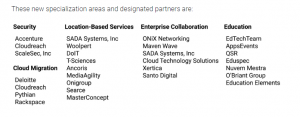
Deloitte collaborated with Google Cloud and SAP to help customers successfully migrate their SAP applications to Google Cloud Platform (GCP). The benefits – SAP, Deloitte, and GCP would deliver 3X more value to their customers in seamlessly managing the digital transformation journeys an hyper-scale all cloud operations management.

The Birth of Accenture Google Cloud Business Group, or AGBG

Businesses can now build next-generation processes with artificial intelligence and machine learning based approaches to create new value across the enterprise. Accenture and Google Cloud joined forces to form the Accenture Google Cloud Business Group, or AGBG. The new group further solidifies the partnership between the two tech giants, since they first came together in 2016.

Expanding Google Cloud’s Solutions for SaaS partners

At the third annual Google Cloud Next event, Google kicked off things by welcoming their existing and ever-expanding galaxy of Google Cloud partners. The annual Partner Summit saw unfurling of many new programs to help technology partners bring next-gen SaaS applications at the doorstep of their customers.

GCP-1
Google Cloud Partners

Everything AI and Machine Learning

Google Cloud Next’18 witnessed an unprecedented development in AI, machine learning and natural language processing technologies. The technology leaders should be particularly keen about three new programs in beta. These are:

  • Google Cloud AutoML Natural Language
  • AutoML Translation
  • AutoML Vision Documentation

For voice-search and call analytics platforms, Google announced new improvements to Cloud Text-to-Speech. This would offer multilingual access to voices generated by DeepMind WaveNet technology and the ability to optimize for the type of speaker you plan to use.

The company also demonstrated the updated version of Kubeflow. Kubeflow v0.2 would now make it easier for customers to use machine learning software stacks on Kubernetes, powered by an improved user interface and several enhancements to monitoring and reporting.

Make a High-Quality Customer Service Accessible to All Customers with AI-Based Contact Center

Self-servicing tools for contact centers have a new player in the league. The DialogFlow Enterprise Edition powered by AI and Machine learning helps customers build virtual assistants and intelligent assists without any waiting queue.

In its new version, Google’s Contact Center AI is set to turn into a trusted tool for building natural, cross-platform conversational experiences “without needing expertise in natural language processing or AI.”

G Suite | Enterprise collaboration and productivity

Apart from the new Gmail that provides offline access to users, Google has announced a battery of new developments for the entire G Suite, particularly focused at enterprises and small-scale collaborations. Particularly important developments that every CMO should know are:

  • Smart Reply in Hangouts Chat
  • Smart Compose
  • Grammar Suggestions in Google Docs
  • Voice commands in Hangouts Meet (select launch for G Suite Customers)

Salesforce Add-On in Google Sheets

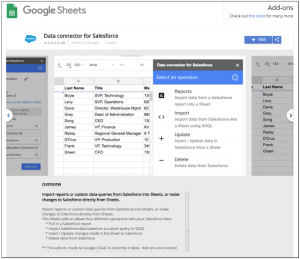
How could we keep Salesforce out of the news at Google Cloud Next’18! Google announced a low-key but significantly beneficial add-on feature for Salesforce users. The new add-on imports data and report from Salesforce into Google Sheets and then magically allows the CRM and BI to push updates back to Salesforce.

GCP-Salesforce-Sheets-Add-on

According to the blog, the new integration would help customers to avoid duplication of efforts and optimize workflows using Data Connectors for Salesforce from the G-Sheet.

Here’s the last best thing that every CMO should watch out for from Google Cloud Next — The Google Cloud Next 2019. The dates are out already- 9-11 April at the newly renovated Moscone in San Francisco.

3 Ways Analytics Tools Drive CX Transformation

0
3 Ways Analytics Tools Drive CX Transformation

Advanced data analytics tools can help businesses uncover business-critical insights and gain a competitive edge. As customer experience analytics matures, it is becoming increasingly predictive and focused on personalization. A sophisticated data analytics tool can make predictions, or generate recommendations based on information gathered, thus giving contact center agents and bots more background and context on each individual customer they are servicing. In addition, analytics plays a significant role in increasing productivity. As one case in point, speech analytics can detect non-value adds, such as long conversational pauses or points in the conversation when the customer has to repeat responses. For these types of opportunities, managers and team leaders can provide agents coaching to educate them on where they have opportunities to be clearer in questions they ask customers.

Investments in analytics tools can reap significant benefits in numerous areas. Here are three major advantages of applying analytics in driving customer transformation:

  • Analytics use Artificial Intelligence (AI) and Natural Language Processing (NLP) to help understand customer behavior and improve quality of customer interaction.Traditional business intelligence helps us convert data into information to understand patterns. New advancements like AI and NLP have stepped up customer experience. Today, talking to a bot is more and more akin to connecting with a human. Bots employ NLP for more colloquial verbiage and appropriate tone, recognition and understanding, to increasingly replicate a human interaction. Culture and customization can be applied to mimic character and persona of human agents. AI and bots also enable real-time customization of customer experience using their complex self-learning capability. They evolve with each customer interaction becoming smarter and more intuitive about customer preferences. With this AI and NLP innovation, interactive analytics are used to analyze customer conversation tone and context. At key focus is the interaction between the customer and agent by channel, whether it’s phone, email, chat, or social media. Analytics create better understanding of the quality of the interaction between customer and agent. As a feedback mechanism, analytics can relay to brands the effectiveness of their CX talent.

Also Read: Interview with Jeff White, Founder, Gravy Analytics

  • Predictive and prescriptive analytics can drive CX transformation through product recommendations. Predictive analytics study customer history and behavior patterns. Based on customer behavior data points, predictive analytics shed light on patterns and possible occurrences in customers’ browsing and shopping behavior. What’s more, these analytics also help take preemptive measures required to take on upcoming challenges. For example, brands have increasingly been using consumer classification, which ensures customers receive product recommendations based on their buying choices, preferences, and habits. Similarly, healthcare entities have started to apply data analytics to classify patients in different personality types, such as “follower” or “health-nut.” This can help healthcare entities to personalize the level of interaction that can be provided to patients and thus improve patient engagement. Purchasing behavior prediction can be as simple as understanding that a customer who has recently bought a car will eventually be looking to buy accessories. In this case, a brand can recommend accessories and services, possibly at a lower cost, for a minimal effort, yet generate a major boost to sales, revenue, and customer satisfaction. Driven by good predictive business insights, an intelligent recommendation engine can spike both sales and customer satisfaction (CSAT) increases. Used proactively, analytics can set in place the steps and remedies required to handle future business or product challenges. Analytics, for instance, are essential to planning for stock inventory, transport logistics, and customer support—all key contributors to better CSAT. For example, advanced analytics can be deployed to map a customer call to the work queue of a customer service representative (CSR), who can handle the request in the best possible manner and within the shortest time. The algorithm that determines this match is based on historical data on the CSR’s interactions on various service lines and the customer’s past interactions on various product lines, creating a matrix of probable scenarios, a few of them being the most optimal.

Also Read: TabMo and zeotap Partnership Delivers ‘Precision Advertising’ for Mobile

  • For optimized CX, analytics ensure better agent coaching and skills reinforcement.Analytics helps reinforce agents with good interactions. Conversely, analytics can be used to correct agents in areas where they need improvement. Interactive analytics provides better customer-agent interactions as a result of positive reinforcement and highly personalized agent development. Another advantage of interaction analytics is that conversations are analyzed by channel, which helps sort agent performances by the specialized set of skills and knowledge required by that channel. Every interaction channel has its own set of requirements, and agents need to be coached on those parameters while enhancing or correcting their behavior on that channel. Additionally, interaction analytics provide information on the overall team’s performance. This helps ensure more comprehensive coaching and skills training, that is focused on the entire team’s performance (positive and negative). Benchmarking is an especially useful training technique, as it will help guide an agent on the areas in which he or she needs to improve. A call driver pattern analysis, especially in high call volume scenarios, can be used to discover call trends by day/week and accordingly do a skill mapping. On the training front, advanced learning platforms apply analytics and data sciences to analyze past training records of associates, data on previous engagements, job roles, span, and behavior—all to arrive at custom training programs for agents. This training helps agents hone their competencies and skills, to equip them to perform their roles better.

It’s still in the early stages for how analytics can affect customer transformation. We have yet to perfect the science of interpreting data, to understand its underlying message and explain it simply. The field has high potential and will be home to many innovations in the years to come. What will be critical is our ability to apply the information in a meaningful and sustainable fashion. Physicist, Albert Einstein aptly summarizes some key thoughts on these changes: “Not everything that can be counted counts, and not everything that counts can be counted.” and “If you can’t explain it simply, you don’t understand it well enough.”

Recommended Read: DISH Adds Apple Messages to Take the Friction Out of Customer Service

Dynamic Yield Named a Leader in Gartner Magic Quadrant for Personalization Engines

1
Dynamic Yield Named a Leader in Gartner Magic Quadrant for Personalization Engines

Positions Dynamic Yield as Highest in Ability to Execute & Furthest in its Completeness of Vision within Leaders Quadrant

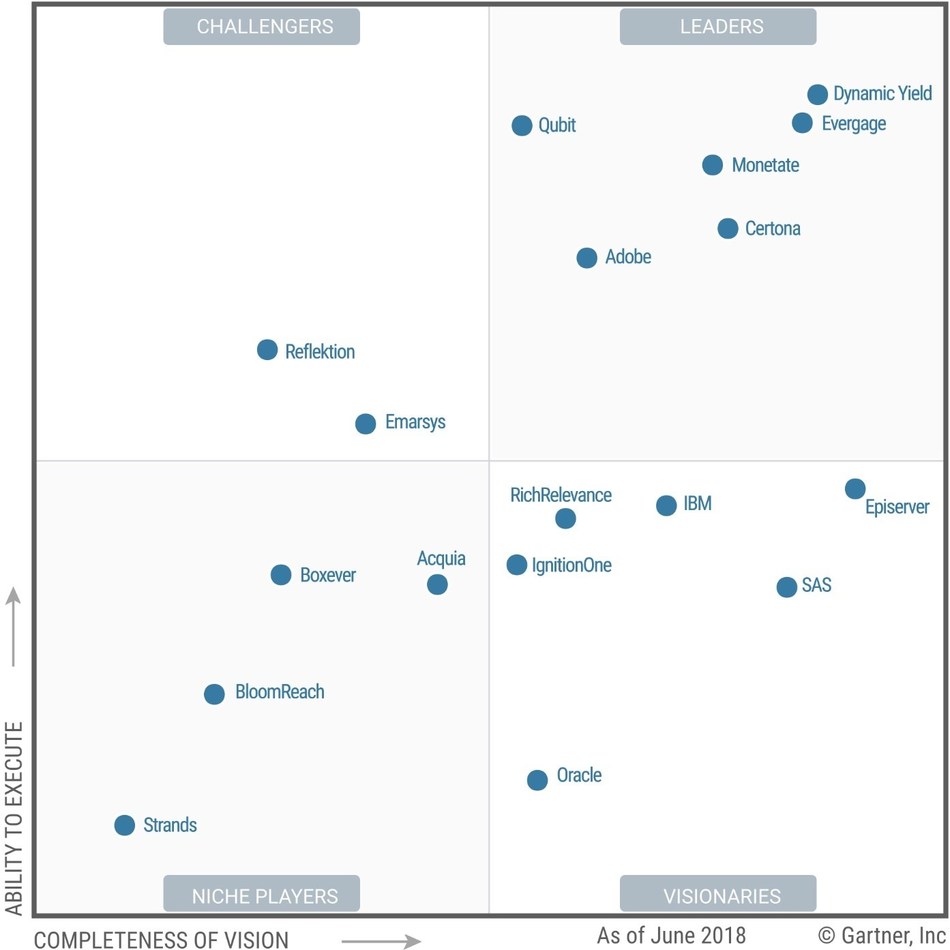
Dynamic Yield, the AI-powered omnichannel personalization engine, announced that it has been named a Leader in Gartner’s 2018 Magic Quadrant for Personalization Engines. Dynamic Yield is positioned highest and furthest in the Leaders quadrant for its ability to execute as well as its completeness of vision. A complimentary copy of the report is available from Dynamic Yield.

“We are thrilled to be named a Leader in the Gartner Magic Quadrant,” said Liad Agmon, Chief Executive Officer and co-founder of Dynamic Yield. “We believe that being positioned highest and furthest in the Leaders quadrant is a validation of Dynamic Yield’s continued leadership in the personalization space, we also see this as a recognition of the power of the technology we have built and the elegance with which our products allow our customers to drive material revenue impact to their businesses while delivering relevant, delightful, customer experiences anywhere.”

2018 Gartner Magic Quadrant for Personalization Engines

Also Read: Localytics Named a Leader in Gartner’s 2018 Magic Quadrant for Mobile Marketing Platforms

For the Magic Quadrant report, Gartner evaluated 18 personalization vendors on their ability to execute and their completeness of vision. As part of the evaluation criteria for ability to

execute, “Vendors are judged on Gartner’s view of their ability and their success in making their vision a market reality that customers believe is differentiated and prepared to buy into.”

The recognition from Gartner comes at a time of record growth for Dynamic Yield, which has doubled in revenue ever since inception. The Dynamic Yield platform personalizes experiences for more than 600M users globally and is trusted by 200+ brands.

Recommended Read: Swrve Named a Leader in Gartner Magic Quadrant for Mobile Marketing Platforms

TechBytes with Jon Aniano, Chief Product Officer, Copper (Formerly ProsperWorks)

1
Jon Aniano
TechBytes with Jon Aniano, Chief Product Officer at Copper (Formerly Prosperworks)

 Jon Aniano
Chief Product Officer, Copper

Recently, ProsperWorks rebranded itself to Copper. While the transformation is aimed to make CRM more productive and to make a long-term relationship, the core technology remains a powerful driving force for the company. Jon Aniano, Chief Product Officer, Copper (formerly ProsperWorks) spoke to us about their CRM for G-suite and the core tenets of their martech offering.

Html code here! Replace this with any non empty text and that's it.

Tell us about your role at Copper and the team/technology you handle.

I’m the Chief Product Officer at Copper. Technically, I own the product roadmap, vision, and execution on R&D initiatives. But, the way I view my role is that I am the Chief Defender of Customer Value. I make sure that the investments we make at Copper translate directly to customer success, better business outcomes for our customers, and a better life for CRM users all over the world.

What are the core tenets driving your CRM technology?

Copper is the CRM for you. Quite simply that means 3 things. 1) Zero Input CRM – we automatically ingest and process your emails, calendar events, productivity docs, calls, etc. so you’re not spending time inputting that into CRM. 2) Copper lives where you work, inside GSuite and your productivity apps. Copper shows up and delivers value right inside of Gmail, Docs, Sheets, Calendar and Google Hangouts. 3) We help you figure out what to do next. We don’t tell you that you had a meeting, we suggest when you should schedule the next meeting to build the best relationships with your customers.

Traditional CRM was built for managers, not users. It was built for reporting, not relationships. We’ve changed all that.

Tell us more about your CRM for G-suite?

At Copper, we love Google and we’re really impressed with the way that Google built GSuite. They started with some really key principles around simplicity in design and user experience, and an intense focus on the problems to be solved and the jobs to be done. GSuite pioneered tools that support the way work is done in the new world of productivity. Employees today are much more likely to communicate and collaborate with their peers and their customers while they create documents, send emails, etc. and Google saw that future and built it right into the tools. This gave them a tremendous advantage vs existing productivity tools and that has translated to great success in the market.

At Copper, we believe that productivity tools are the anchor of all business apps in the future. If you’re writing an email, creating a doc, or scheduling a meeting – you’re not doing that in isolation, there’s a business relationship or a customer on the other end. Why switch into another app to see that context? With Copper, we live in Gmail, we live in Google Calendar, Docs, Hangouts, etc. We work for you and bring the context directly into GSuite. We also believe in simplicity. When you sign up for Gsuite you’re up and running in minutes, well, the same is true for Copper. You can sign up for Copper and within 5 minutes your CRM is being populated with your activities, communications, customers and relationships.

Traditional CRMs were built as standalone apps that live in their own silo and are used by a portion of the employees of the company.

What is the state of CRM and marketing automation tools in 2018-2022?

I think its clear that what we traditionally think of as CRM is blending directly into the world of Productivity. The standalone CRM app that doesn’t auto-ingest data or live inside of your productivity tools is fading away. We’re seeing a lot of smaller “apps/features” that tie into CRM like outbound sales tools, call recording, AI and voice tools, etc. that are adding a lot of value to the CRM experience. I think we’ll see these things get better integrated into the world of core CRM.

As for Marketing Automation, that space moves really really fast and we’ve seen some great companies with some great ideas, like LeanPlum who is just killing it with their mobile marketing and engagement platform. I think the intersection of consumer data, mobile, messaging apps, in-location experiences, etc. is creating problems for a lot of the traditional marketing automation players which is why you see a lot of smaller tech players jumping in to solve these problems, we’ll see those get closer to the core Marketing Automation suites over the next few years.

Which regulations are in place to defend CRM makers in a post-GDPR era?

Look, I don’t really look for regulations to protect CRM makers. I think of regulations like GDPR  as those that protect consumer privacy and give consumers more control and more power over their data. I believe companies should disclose how they collect consumer information and how they use that information. I think that’s fair and those regulations are there to protect consumers, not CRM makers. CRM makers are doing just fine, and we should be held accountable to operate responsibly.

Thanks for chatting with us, Jon.

Stay tuned for more insights on marketing technologies. To participate in our Tech Bytes program, email us at news@martechseries-67ee47.ingress-bonde.easywp.com

OFX Group Turns to Box for Cloud Content Management

0
OFX Group Turns to Box for Cloud Content Management

Box Enables a Truly Digital Workplace for One of Australia’s Largest International Money Transfer Specialists

Box Inc., a leader in cloud content management, announced that OzForex Limited, trading as OFX, part of the OFX Group, the Australian international money transfer specialist, has moved its workforce to Box. Since 2016, OFX has been using Box in its seven global offices as part of its strategy to become a truly digital workplace.

“@BoxHQ has completely transformed how we work on content.” Phillip Scott, Head of IT Operations @OFX

“Box has completely transformed how we work on content,” said Phillip Scott, Head of IT Operations at OFX. “From our internal procedures through to how we process content from clients, Box has helped us to modernise our systems, making us significantly more efficient and productive and ultimately helped us to serve our customers better.”

“Additionally, by leveraging Box Platform our consumer and corporate clients can easily provide us with documents like passports, driver’s licenses, and bank statements, in a secure and compliant way. Such documents are essential for the new client registration process. Further, by adding metadata within Box, we’re able to tag attributes like Geography, Client, Type, etc. This makes processing, accessing, and tracking vital information immeasurably better than our old way of working.”

Also Read: Box Announces Expansion of Box Skills Private Beta to Bring Advanced Machine Learning to Enterprise Content

“OFX is a great example of a Fintech which is benefitting by modernising its business processes,” said Scott Leader, Box VP of ANZ. “The IT team has taken a new approach to managing content and is reaping the rewards. We’re delighted that Box has given OFX greater control and security over content, and that we can help keep OFX compliant with Australia’s strict data regulations.”

OFX selected Box to:

  • Replace its on-premise file servers and migrate all its content to the cloud for greater control and flexibility
  • Leverage Box Platform APIs to enable customers to easily upload documents directly from the OFX customer portal. This has helped the Compliance team to dramatically improve success rates for document receipt and processing times
  • Automate content workflow processes
  • Migrate sensitive information off email and into a secure cloud environment
  • Integrate with its telephony system to automatically store and log all calls
  • Integrate Box with Okta and Office 365 providing a pure cloud IT stack

OFX has a strong presence in Australia, the United Kingdom, Canada, the United States and countries in Europe and Asia Pacific. It has joined a growing list of multinational enterprises that have moved to Box including: General Electric, AstraZeneca, Fujitsu, Komatsu, the Metropolitan Police Service of London, and Dubai Airports.

Recommended Read: Knock Knock Raises $2 Million Seed Round, Led by Raine Ventures, to Redefine Chat Gaming

SRAX Agrees to Sell SRAXmd for Up to $52.5 Million

0
SRAX Agrees to Sell SRAXmd for Up to $52.5 Million

Social Reality, Inc., a digital marketing and consumer data management and distribution technology platform company, announced that it signed an asset purchase agreement on July 29, 2018 to sell a controlling interest in its healthcare and pharmaceutical digital advertising product line, SRAXmd, for total consideration of up to $52.5 million. The transaction is expected to close on or about August 7, 2018.

SRAX’s CEO and Chairman Christopher Miglino, stated, “SRAX’s long standing goal has been to leverage our proprietary technology to build and monetize distinct verticals in digital advertising. SRAXmd has consistently demonstrated great opportunity in healthcare and its abilities to operate in a stringent regulatory environment. This transaction gives us the benefit of the long-term growth we have been experiencing in MD, which we believe will be worth significantly more in the future while providing us the capital we need to grow our other verticals and to bring Big Token to market.”

Also Read: SRAX’s New Video Ad Unit Takes Shopper Marketing to Real-Time Targeting Heights

Terms of the Transaction

On July 29, 2018 management signed an asset purchase agreement to sell all of the assets of the SRAXmd product line to an affiliate of private equity firm Halyard Capital for total consideration of up to $52.5 million. SRAX will receive $33.5 million in cash, $10 million in Class A membership units of Halyard MD, LLC, the parent of the entity acquiring the assets, and an earn-out of up to $9 million upon the buyer achieving certain gross profit thresholds by December 31, 2018. The transaction is expected to close on or about August 7, 2018, subject to customary closing conditions.

More information regarding the transaction can be found in the Form 8-K to be filed by the company with the Securities and Exchange Commission.

Advisors

The company was assisted by Chardan Capital Markets and Noble Capital Markets, both of which acted as financial agents for the company. The company was represented by Silvestre Law Group, P.C. in the transaction.

Recommended Read: Google Stops Allowing Direct Uploads of Public URLs

Interview with Tom Pallack, CEO, SITO Mobile

1
Tom Pallack
Interview with Tom Pallack, CEO at SITO Mobile

[vc_wp_text]“Location is a critical part of the customer journey and mobile platforms are the catalyst for bringing those insights to life.”[/vc_wp_text]
[easy-profiles profile_twitter=”https://twitter.com/SITO_Mobile” profile_linkedin=”https://www.linkedin.com/in/tompallack/”]

Tell us about your role and how you got here. What inspired you to be a part of SITO Mobile?

As CEO of SITO, I am working day-in and day-out to solidify the company’s position as the premier partner for location-based data. I work with the amazing team here to develop our emerging technology, craft breakthrough initiatives and drive continual growth. My road to SITO involved more than thirty years of experience leading sales and business development divisions for technology software companies like Oracle, SAP Ariba, Consilium and NCA Corporation. I held a CEO position prior to SITO after co-founding Strategic Business Velocity (SBV) Solutions, a software sales company.

Coming to SITO felt like a natural fit. My prior roles in the technology sector instilled a hunger to work with a business who offered a cutting-edge product, one that solved a notable problem plaguing businesses everywhere. For SITO, it was offering a platform that could better engage with, and win over, today’s tech-savvy consumer. While other location-based companies existed, SITO stood out because of what it did with location-based data. Our platform puts location data in context with other digital data, giving advertisers the ability to tailor messages based on a holistic view of the customer. I was excited to be a part of a company that was at the forefront of marketing innovation.

How do you see the mobile advertising platforms driving better customer experiences and delivering sales results?

Brands are utilizing a variety of adtech solutions to better reach customers, and yet they’re often missing the “how” and “where” customers are consuming media. Location is a critical part of the customer journey and mobile platforms are the catalyst for bringing those insights to life.

For example, location data from a mobile device can help an advertiser understand where home vs. work is, and where a consumer most often shops with a brand before heading in-store. By marrying this location data with pre-existing digital data, advertisers have a better understanding of a customer’s interests, actions and experiences. And this is really the biggest benefit of mobile advertising platform—getting a 360-degree view of the customer so you can provide the relevant, timely and personalized experiences customers want.

What are the major challenges in the adoption of mobile technologies for marketing and sales?

The major challenge in adopting mobile technologies is integrating them with already existing technology stacks. Location data offers wonderful insights on the consumer, but it must be tied to other digital data to provide the all-encompassing view marketers need.

What are the core pillars of a solid tech-based marketing strategy?

A solid tech-based marketing strategy should be able to answer the following questions about a customer: who, what, when, where, why and how. If a marketer has a technology stack that cannot address all these questions, they will miss critical opportunities to engage with a consumer. They also run the risk of sending sub-par messages to new and existing customers because they don’t have all the information they need for an optimized and personalized customer experience.

How can ABM companies leverage native Mobile Advertising solutions to achieve hyper growth?

As I mentioned earlier, location data is the missing piece of the customer journey. Once a brand gets their hands on this data, they open a whole new world of possibilities as they pair it with other insights from a customer’s existing profile. ABM companies can use location data to understand what motivates an individual to buy and spend more.Using this information to create personalized, real-time messages will ultimately lead to more in-store visits and higher sales for products consumers may have otherwise forgotten about during their shopping journey. ABM companies that provide relevant and customized messages will prove to customers that they understand their individual preferences and experiences, leading to increased sales and more loyal customers.

What startups, in the Martech/ Ad Tech industries, are you keen on right now?

While it’s not a startup, it’s the one company everybody is watching right now and SITO is no different. Amazon is a technology powerhouse and it has a vision that is quietly taking a platform stance across the entire digital media ecosystem.

What marketing and sales automation tools do you use? What technologies are you keenly following in 2018?

The tools we use at SITO include some of the more standard and obvious ones such as Salesforce and Slack for centralized internal communication. We also rely heavily on the SITO Platform for audience observation, modeling, recommendation, activation and measurement. In terms of tools we are following, we are constantly trying to keep track of the hundreds of new companies entering the space. Our eyes and ears are open, but until we have identified a core issue within our current workflow, we’re limiting the exploration into process change.

Can you tell us about SITO Mobile’s vision and how it has changed since its start in 2000? 

In the past, SITO was strictly a mobile company, but that has changed. We are now a company that leverages mobile location data to strategically influence larger brand decisions. Mobile media activation might be the beneficiary of those higher-level findings, but our focus has shifted to observation, validation, enrichment and insights for some of the world’s biggest brands. Although these insights could influence an omnichannel distribution strategy, it is no longer limited to just media. Our measure for success directly ties to our ability to open the aperture of a brand’s lens and transform its conventional ways of seeing the world and how it makes decisions.

How do you prepare for an AI-centric world as a business leader? How do you leverage AI capabilities at SITO Mobile?

We, like many companies, are already there. Wherever there is an opportunity to introduce machine learning and system-based decision making to increase overall efficiency/productivity – we are all in.  Our entire system is built on this premise and will continue to innovate as the industry and ourselves evolve.

How do you bring together people and technology 

In order to move at the speed of your clients’ needs and the marketplace you are serving, you have to be efficient. Whether it’s product innovation, response times to support, or effective communication about the value of our platform, technology is at the core of the needed automation to empower our employees to successfully deliver. Any tool, internal or external, that promotes efficiencies and that can be recognized as adding value to our clients is evaluated and embraced by the team.

What apps/software/tools can’t you live without?

Slack and the SITO Platform. Slack for SITO is like Slack for all – it’s a wonderful communication tool that effectively manages multiple conversation threads and easily integrates with other 3rd party systems for tractability and search. The SITO platform is our bread and butter. It’s where all location signals are aggregated, observed, verified, enriched, activated and measured. All the magic happens here as it relates to brand intelligence, omnichannel media activation, and verified walk-in (TM) attribution.

What’s your smartest work-related shortcut or productivity hack?

Surround yourself with smart people. But don’t just hire them, trust them. Empower that trust to usher in solutions by looking at new problems through a different lens.

What are you currently reading? 

Frank Coyle’s “Draft Insiders Digest”, which is a publication listing everyone going out for this season’s NFL draft, along with their stats.

To me, measuring success in life often correlates to one’s ability to handle, manage, and overcome adversity. In the world of professional sports, specifically the NFL, you could argue that some of the best examples of individual stories of perseverance and focus to achieve the ultimate success come in the form of being drafted from College to the NFL.

I find it fascinating to study the candidates’ backgrounds and stories, the high school and/or colleges they attended, their stats, and how those experiences correlate to their individual success. I ask, “What is it about those experiences that set the stage for such accomplishments, and is it possible to package up that passion and discipline to be replicated in other walks of life?”

What’s the best advice you’ve ever received?

Actually, there are 2 and both have to do with teamwork:

  1. Don’t be the king, be the kingmaker. Don’t make it about you, make it about everyone else.
  2. Pride is no issue, winning is everything. If you make decisions based on ego, it’s harder to win.

Tag the one person in the industry whose answers to these questions you would love to read:

Satya Nadela. He transformed Microsoft in a few short years and changed the culture from “know it all” to “learn it all”, instilled a sense of purpose and humility to an organization that in some ways had lost its way.

Thank you, Tom! That was fun and hope to see you back on MarTech Series soon.

[vc_tta_tabs][vc_tta_section title=”About Tom” tab_id=”1501785390157-b58e162d-0ae25a4b-c27aca64-108e51b0-80edaf37-bd3d357a-6c46d712-3b68db8f-23cb6837-2be7″]

Tom has earned #1 worldwide salesman and leadership status at every company including Oracle and Ariba. He has multi-industry experience with product lines including healthcare analytics, supply chain, finance, big data analytics, social media, cloud strategy. Tom specializes in complex negotiations, strategic planning, strategic partnerships, team leadership delivery of worldwide demand generation and lead nurturing programs, building high performing teams and has led numerous early stage ventures to successful exits.

[/vc_tta_section][vc_tta_section title=”About SITO Mobile” tab_id=”1501785390320-2d44fa50-740c5a4b-c27aca64-108e51b0-80edaf37-bd3d357a-6c46d712-3b68db8f-23cb6837-2be7″]

SITO Mobile
Through Consumer Behavior and Location Sciences™️, SITO develops customized, data-driven solutions for brands spanning strategic insights and media. The platform reveals a deeper and more meaningful understanding of customer interests, actions and experiences providing increased clarity for clients when it comes to navigating business decisions. The company is home to the most complete, internally developed location-data technology stack in the market, offering a powerful resource for not only granular data, but also real-time insights and delivery of successful media campaigns. Using in-store targeting, proximity targeting, geo-conquesting and attribution data, the platform creates audience profiles to develop measurable hyper-targeted campaigns for brands. SITO’s real-time, location-based technology gives clients the unique advantage of understanding and shaping the future of retail and consumer behavior. SITO is one of the fastest growing publicly traded companies in the ever-evolving advertising and marketing technology space. As a team member of SITO, you’d be a key contributor to an innovative business with a culture that prioritizes agility and collaboration. SITO offers competitive salaries, medical, vision & dental benefits, birthday parties, free beverages/snacks, Friday lunches, quarterly team building activities, sales contests and fun happy hours. SITO is an entrepreneurial, close-knit, friendly & inclusive team.

[/vc_tta_section][/vc_tta_tabs]
[mnky_heading title=”MarTech Interview Series” link=”url:https%3A%2F%2Fmartechseries-67ee47.ingress-bonde.easywp.com%2Fcategory%2Fmts-insights%2Finterviews%2F|||”]

The MTS Martech Interview Series is a fun Q&A style chat which we really enjoy doing with martech leaders. With inspiration from Lifehacker’s How I work interviews, the MarTech Series Interviews follows a two part format On Marketing Technology, and This Is How I Work. The format was chosen because when we decided to start an interview series with the biggest and brightest minds in martech – we wanted to get insight into two areas … one – their ideas on marketing tech and two – insights into the philosophy and methods that make these leaders tick.

Myntra Partners with WebEngage to Power Their User Engagement Strategy

0
Myntra Partners with WebEngage to Power Their User Engagement Strategy

Online fashion retail major Myntra has chosen to employ the services of Marketing Automation platform WebEngage to power their User Engagement strategy. This partnership will provide Myntra with the technological firepower required to enhance their on-site user engagement, create highly-personalized brand experiences at scale and bolster their user retention strategy.

Myntra is a household name in online fashion retail, with millions of users logging in daily to browse through over 5 lakh products from 2500+ brands across multiple categories. Myntra wanted to constantly deliver a valuable user experience to their users, and simplify the entire shopping experience by making it more intuitive.

Having looked at multiple options in the market, they zeroed in on WebEngage’s full-stack Marketing Cloud platform to help them automate their user engagement intelligently, and create a positive uptick in conversions.

Also Read: Marketing Automation Platform WebEngage Has Been Roped in By OTA Major Goibibo

According to Mr. Anuj Sharma (Director – Growth Team), “Retention is a critical frontier for a brand like Myntra that is operating at massive scale. We wanted to deliver a superior experience to each individual user augmented by personalization and contextual relevance. The WebEngage platform has allowed us the flexibility to do exactly that by improving our understanding of consumer behavior and user intent. Features like the Journey Designer allows us to visualise and create complex and powerful lifecycle marketing campaigns for different user segments really easily.”

According to WebEngage Co-Founder & CEO, Mr. Avlesh Singh, “We identified the need for a powerful, but easy to use Marketing Automation solution that caters to the needs of large B2C businesses.

Our platform empowers marketers with tools that allows them to leverage their own business data into creating intelligent, highly effective campaigns served via multiple channels like Email, SMS, Web & Mobile Push, In-App & Browser Messages etc. We are helping brands create multiple growth avenues by introducing the element of smarter, more contextual user engagement.”

Recommended Read: Edina Realty Launches “Emma Marketing” Automation for Agents

Alliance Data Announces CFO Succession Timeline

0
Alliance Data Announces Succession Timeline For CFO Charles Horn

Alliance Data Systems Corporation , a leading global provider of data-driven marketing and loyalty solutions, announced that Charles Horn, its longtime CFO, has informed the Company of his intent to retire in 2019. The Company’s succession process is structured to ensure that Management and the Board of Directors have the appropriate time to evaluate candidates, while maintaining the services and institutional knowledge base of the incumbent. The search for a successor will include both internal and external candidates.

In announcing his plans, Charles Horn said, “I joined in 2009 with the goal of helping Alliance Data grow and mature into the world class organization it is today. I also set a personal goal of being the CFO of a large public company for 10 years. Next year marks that milestone and with it comes the opportunity to retire along with the right time to transition to the next generation of leadership.”

Also Read: NetScore Named NetSuite Vertical Alliance Partner of the Year

“I want to thank Charles for his commitment to our company’s success,” said Ed Heffernan, president and chief executive officer of Alliance Data. “Perhaps Charles’ greatest contribution is the tremendous finance organization he built with a deep bench of expertise across the financial spectrum.”

Heffernan continued, “Our succession plan gives us the time and flexibility to find the right candidate while crystallizing the critical initiatives his successor will lead. In addition to his normal duties as CFO, I have asked Charles to focus on three priorities during his remaining tenure. First, ensuring that the internal recovery investment made at our Card Services business is completed and, thus, that our credit loss rate remains stable going into 2019. Next, assisting in the rapid reconfiguration of our credit card client portfolio toward nontraditional, fast-growing categories. And finally, leading strategic efforts to accelerate the growth rate of our non-card businesses.”

Recommended Read: SITO Launches the SITO Channel Alliance